New CD published – Piano Music of Walter Niemann vol. 27

A new CD recording has been issued by Romantic Discoveries Recordings.

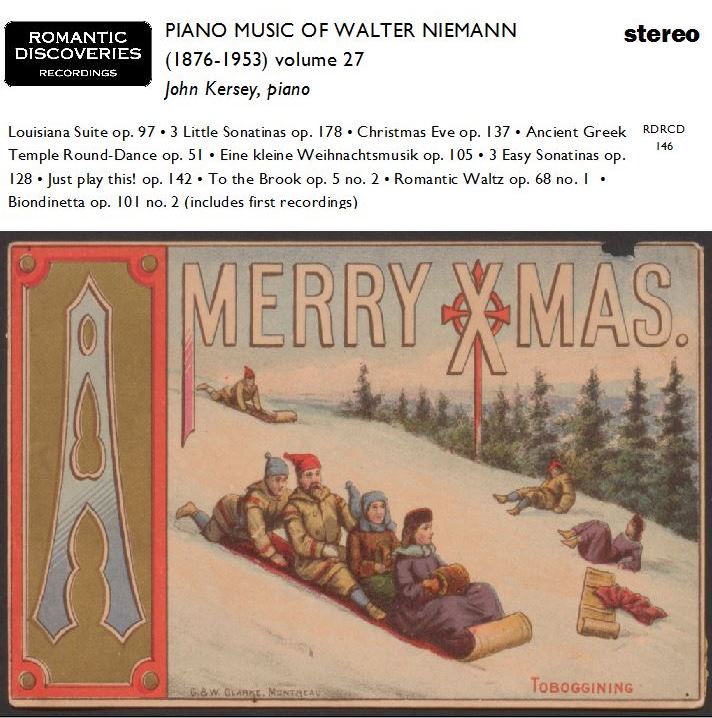
Piano Music of Walter Niemann volume 27
 (includes first recordings)
John Kersey, piano
RDR CD146

Total time: 67 minutes 39 seconds

1. Louisiana Suite, op. 97
i. The Mississippi Steam-Boat’s in Sight
(“The Glendy Burke” – Stephen C. Foster)
ii. My Old Kentucky Home (Stephen C. Foster)
iii. The Interrupted Serenade
(“Old Black Joe” – Stephen C. Foster; “Massa’s in the Cold Ground” – Stephen C. Foster; “Oh! boys carry me ‘long” – Stephen C. Foster; “Gentle Nettie Moore” – Pike)
iv. Longing for Home
(“Old Folks at Home” (Way down upon the Swanee River) – Stephen C. Foster)
v. Mardi Gras in New Orleans
(“Dixie’s Land” – Dan Emmet)

Foreword by Walter Niemann (1924)
The following Suite contains eight of the finest and best-known popular Negro-Songs, such as were chiefly sung on the vast Cotton- and Sugar-plantations in the Southern States of North America, and arranged by the composer.

By far the finest songs, born of and permeated with the national spirit, both as regards the words and the music, are those written by America’s most popular and earliest song-composer, Stephen C. Foster (1826 to 1864). His chief aim throughout was to counter-balance the predominating number of sad or religious songs with merry, cheerful tunes. Both kinds breathe the very soul of these great big grown-up black children, whose spirit feels, pulsates and responds just as vividly and deeply, as cheerfully and tenderly to the joys and sorrows of life, as our own.

The grief and sorrow for the old abandoned country is mostly done full justice to and pulsates in most of these songs; thus, for instance, in the heart-touching tune “My old Kentucky Home” or in the early “Song of Home”; The “Old Folks at Home”, the rendering of which is so beautifully described by the German poet Paul Keller, when he says “She sang this most pathetic of all Songs of Home with deep heart-born emotion, and Mr. Brown hummed the accompaniment with a nasal tone, as the negroes do, when, far from home, one of them, leaning against the wall, allows his inmost, heart-felt sorrow and the grief of his enslaved soul to flow forth in song. Then all, with motionless body, like rigid statues, join in the humming-part, their large eyes fed with burning tears gazing, staring at the yellow light of the dim lamps.”

The tunes or melodies upon which “The Interrupted Serenade” is based, belong to the series or class of songs expressive of: the heart, forlorn and longing for death (“Old black Joe”), -lamenting the dead (“Massa’s in the cold ground”), –farewell to life (“Oh boys, carry me ‘long!”) They all impressed the minstrel accompanying himself on the banjo, the national instrument of the negroes, as being too sad, hence his ever-increasing desire, his demand for something merry and cheerful, resulting in his winding up with a little serenade to his sweetheart: “Nettie Moore”. This leads to the class of cheerful songs, as delightful in their simple, childlike purity and mirth, as they are fascinating in their charm of melody and rhythm.

Such a one is “Dixie Land” – that beautiful, tropical Florida in the South, where the minstrel’s cradle stood, and finally that delicious melody in praise of the famous old Mississippi Express-boat “Glendy Burke”

2. Drei kleine Sonatinen, op. 178
no. 1 in F major:
i. Morgentlich frisch und munter
ii. Rondino (Pastorale)
no. 2 in D major
i. Munter und frisch
ii. Im alten Menuett-Tempo
iii. Lebhaft und heiter
no. 3 in C major
i. Mässig bewegt
ii. Kinderliedchen (aus Alt-Hamburg)

3. Der Weihnachtsabend, op. 137
i. Christmas is ringing in
ii. Shepherds’ music
iii. The boys play soldiers
iv. Dolls’ waltz for the girls
v. To bed

4. Altgriechischer Tempelreigen, op. 51

5. A little Christmas music on old Christmas melodies, op. 105
i. O Holy Night
ii. Under the Christmas tree – little variations on the German Christmas carol “O Tannenbaum”
iii. At the Christmas market
iv. The Christmas Mass
v. Farmhand Rupert
vi. The Christmas Bells

6 Drei leichte Sonatinen, op. 128
no. 1 in C major
i. Moderato ma energico
ii. Minuetto
iii. Giga alla caccia (A little Hunting Air). Presto.
no. 2 in G major
i. Amabile con moto
ii. Siciliano per la notte de natale. Un poco lento.
iii. Giocoso ed animato alla burla
no. 3 in F major
i. Allegro non troppo, ma giocoso
ii. Pastorale “Die Schalmei”. Moderato ed amabile con moto.
iii. Finale. Molto animato e giocoso

7. To the brook from Pastellbilder, op. 5 no. 2
8. Romantic Waltz from Three Modern Pieces, op. 68 no. 1
9. Biondinetta – Graceful Waltz from Zwei kleine Waltzer, op 101 no. 2

John Kersey, piano

Our thanks go to Nicolo Figowy and Steffen Herrmann for their generous loan of scores.

Walter Niemann was regarded in 1927 as “the most important living piano composer who knows how to make music from the piano in a subtle and colorful way, although he often enters the field of salon music” (H. Abert, Illustrated Music Lexicon). This most sensitive and introverted master of the piano devoted his life to composition and musical scholarship, also performing his music in concerts and radio broadcasts. Niemann’s vast output for the piano is only now starting to become more widely known. Although his style is generally unashamedly conservative, he was one of the very few German composers to explore Impressionism in music, and this also reflected a fascination with the Far East. Elsewhere, Niemann’s imagination takes us from much Baroque recreation to large-scale epic sonatas, Schumannesque miniatures and even the exploration of early jazz styles. His understanding of the capabilities of the piano was complete, and his works include both collections for young pianists and mature works that exploit the full range of pianistic effect and make significant demands on the performer.

New CD published – Piano Music of Walter Niemann vol. 26

A new CD recording has been issued by Romantic Discoveries Recordings.

Piano Music of Walter Niemann volume 26
 (includes first recordings)
John Kersey, piano
RDR CD145

Total time: 77 minutes 25 seconds

1. Tafelmusik, op. 125
i. Intrada
ii. Pavane
iii. Inventione fugata
iv. Allemanda
v. Courante
vi. Sarabande
vii. Rigaudon
viii. Menuett
ix. Gigue

2. Variationen über eine altholländische Sarabande, op. 118 no. 2 (Theme and Variations 1-7 by Gisbert Steenwick (c. 1670))
Tema (Tempo di Sarabande)
Var. 1: Un poco allegro
Var. 2: L’istesso tempo
Var. 3: Più allegro
Var 4: Più tranquillo
Var. 5: Un poco Andantino
Var. 6: Molto allegro e scherzando
Var. 7: Tempo del tema
Var. 8: Allegro leggiero
Var. 9: Moderato, ma energico marcato
Var. 10: Vivo (molto allegro)
Var. 11: Moderato, ma energico marcato
Var. 12: Andante mosso
Var. 13: Giga (molto allegro e chiaro)
Var. 14: Canarie (l’istesso tempo, giocoso)
Var. 15: Almand (molto moderato)
Var. 16: Pavana (Sostenuto con grazia)
Var. 17: Gagliardo (Con moto e giocoso)
Var. 18: Courante (Allegro molto e con grazia)
Var. 19: Minuetto (Moderato)
Var. 20: Siciliana (Tempo di Siciliano)
Var. 21: Rigaudon (animato e marcato)
Var. 22: Molto allegro marcato e appassionato
Var. 23: Moderato pesante
Var. 24: L’istesso tempo
Var. 25: Tempo del tema, ma più largamente e pesante

3. Menuett und Bourrée, op. 111

4. Die Gespensterbark, Traumballade, op. 160

5. Impromptu-Caprice, op. 94 no. 2

6. Erinnerungen, Stimmungen und Bilder, op. 9
i. On the Fjord (Norwegian Idyll)
ii. Hermitage (A little Gavotte)
iii. When our grandfather met our grandmother
iv. A sad hour (In memory of my dear cousin Carl Warnke (obit. Kiel, May 1908))
v. A little dance on the green

7. Sturm und Drang Etude

8. Zwei Romantische Impressionen, op. 56
i. The blue grotto
ii. Der Goldsoot*
Er stand und sah ins Wasser, das mit stillem, traurigem Auge ihn ansah, als hielte es wehmütig sein Geheimnis fest. – Gustav Freussen
He stood and looked into the water, which looked at him with quiet, sad eyes, as if it were wistfully holding on to its secret.
*According to a Schleswig-Holstein folk legend, the Goldsoot (Soot = spring), located in the deepest heathland solitude, keeps immeasurable treasures at its bottom.

John Kersey, piano

Our thanks go to Nicolo Figowy and Steffen Herrmann for their generous loan of scores.

Walter Niemann was regarded in 1927 as “the most important living piano composer who knows how to make music from the piano in a subtle and colorful way, although he often enters the field of salon music” (H. Abert, Illustrated Music Lexicon). This most sensitive and introverted master of the piano devoted his life to composition and musical scholarship, also performing his music in concerts and radio broadcasts. Niemann’s vast output for the piano is only now starting to become more widely known. Although his style is generally unashamedly conservative, he was one of the very few German composers to explore Impressionism in music, and this also reflected a fascination with the Far East. Elsewhere, Niemann’s imagination takes us from much Baroque recreation to large-scale epic sonatas, Schumannesque miniatures and even the exploration of early jazz styles. His understanding of the capabilities of the piano was complete, and his works include both collections for young pianists and mature works that exploit the full range of pianistic effect and make significant demands on the performer.

New CD published – Piano Music of Walter Niemann vol. 25

A new CD recording has been issued by Romantic Discoveries Recordings.

Piano Music of Walter Niemann volume 25
Heitere Sonate (Piano Sonata no. 5), op. 96 • Wood-Pictures from the Fichtelgebirge, op. 141 • The Ruby, op. 161 • Modern Miniatures, op. 95 • Venetian Gardens, op. 132 (includes first recordings)
John Kersey, piano
RDR CD144

Total time: 71 minutes 11 seconds

1. Sonatina giocosa (Heitere Sonate) (Piano Sonata no. 5), op. 96
i. Moderato e lusinghando
ii. Canzona – Larghetto con intimissimo sentimento
iii. Allegro non tanto, ma giocoso

2. Waldbilder aus dem Fichtelgebirge (Wood-Pictures from the Fichtelgebirge), op. 141
i. Juni-Morgen (June Morning)
ii. Einsamer Weiher im Hochmoos (Lonely pond in Hochmoos)
iii. Siebenstern
iv. Felsenmeer
v. Waldbächlein (Little Wood Brook)
vi. Rosarote Abendwolken (Pink evening clouds)
vii. Farren im Wind (Bullocks in the wind)
viii. Heroische Landschaft (Vogelruf in der Luisenburg) (Heroic Landscape – Birdsong in the Luisenburg)
ix. Abschied (Farewell)

3. Der Rubin (The Ruby) (after Friedrich Hebbel), op. 161
i. Assad
ii. Fatime
iii. Soliman der Juwelier
iv. Der Kadi
v. Der Sultan

4. Modern Miniatures, op. 95
i. An Old Spanish Mission
ii. The Mirror Lake
iii. A Chinese Quarrel
iv. A Dickens Story
v. Catalonian Serenade
vi. A Lonely Pine Tree (Via Appia)
vii. The Lady in Old Brocade
viii. Dance of the Odalisque
ix. Mid-Autumn
x. Delft (Boerendans)

5. Venezianische Gärten (Venetian Gardens), Imaginary Drama in Two Scenes after Schiller’s “Visionary”, op. 132

“A maiden, fair as a houri, wandering beneath my windows, at break of day, with her lover – and a lover, who did not know to make better use of such an hour; surely these supplied materials for the composition of a picture which might well occupy the fancy of a dreamer.” – Schiller

i. Very stirring scene before the playing fountain
They were standing before the basin of a fountain, some distance apart, both wrapped in deep silence.

ii. The Flight
With a speed that her companion cannot use, she hastens to the shore. Too late! Quick as the arrow in its flight, the gondola bounds forward; and soon, nothing is visible but a white handkerchief fluttering in the air from afar.

John Kersey, piano

Our thanks go to Nicolo Figowy and Steffen Herrmann for their generous loan of scores.

Walter Niemann was regarded in 1927 as “the most important living piano composer who knows how to make music from the piano in a subtle and colorful way, although he often enters the field of salon music” (H. Abert, Illustrated Music Lexicon). This most sensitive and introverted master of the piano devoted his life to composition and musical scholarship, also performing his music in concerts and radio broadcasts. Niemann’s vast output for the piano is only now starting to become more widely known. Although his style is generally unashamedly conservative, he was one of the very few German composers to explore Impressionism in music, and this also reflected a fascination with the Far East. Elsewhere, Niemann’s imagination takes us from much Baroque recreation to large-scale epic sonatas, Schumannesque miniatures and even the exploration of early jazz styles. His understanding of the capabilities of the piano was complete, and his works include both collections for young pianists and mature works that exploit the full range of pianistic effect and make significant demands on the performer.

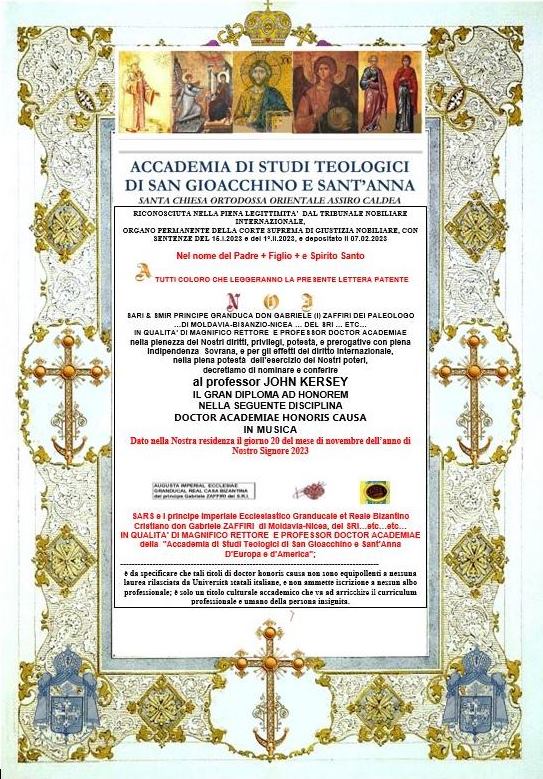
Honours and awards: Doctor of Music honoris causa from the Accademia di Studi Teologici di San Gioacchino e Sant’Anna

I have been honoured to receive the degree of Doctor of Music honoris causa from the Accademia di Studi Teologici di San Gioacchino e Sant’Anna (Academy of Theological Studies of St Joachim and St Anne). The Accademia is an institution of the Santa Chiesa Ortodossa Orientale Assiro Caldea (Holy Eastern Orthodox Assyrian Chaldean Church) and offers courses from its headquarters in Turin, Italy. The President of the Accademia is the Patriarch for Western Europe of the Assyrian Chaldean Church, Archbishop Adeodato (Leopoldo Mancini).

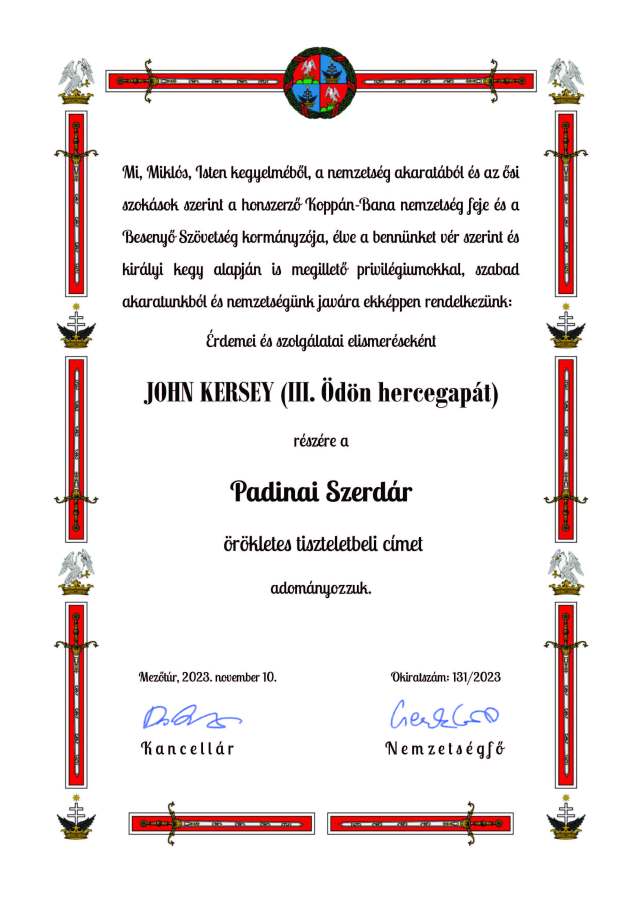
Honours and awards: Dynastic honours from the House of Cseszneky

The Hungarian noble House of Cseszneky (de Csesznek(Vár) et Milvány) has previously established relations with my own house. Its head, His Illustrious Highness Count Miklós M. M. Cseszneky, is my cousin, and we share descent from the House of Rurik of Russia and the medieval Kings of Poland. I have been very pleased to receive further dynastic honours from the House.

1. Kenéz (≈prince) of Balta:

2. Szerdár (≈count/earl) of Padina:

Sam Swerling (1939-2023)

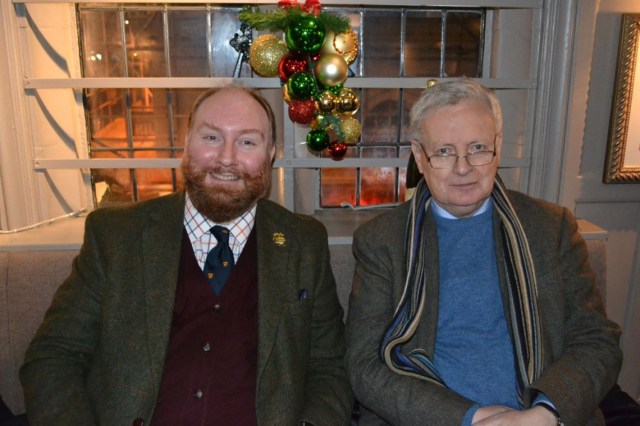
With Sam Swerling at the Traditional Britain Group Christmas Social, 2014

Sam Swerling, one of my fellow Vice-Presidents of the Traditional Britain Group, died earlier today from cancer at the age of 83. An outline of his life can be read here.

Aside from his career as a senior law lecturer at City University, Sam devoted his life to traditional conservatism, giving many years of service to the Conservative Party and the Conservative Monday Club, of which he was at one point Chairman. He was a founder member of the former Conservative Democratic Alliance and a member of the Western Goals Institute. He was a well-received speaker at the events of the Traditional Britain Group, where one of his last speeches was an extremely cogent and compelling analysis of the National Interest with relation to the politics of Britain today.

In 2017, Sam published a most absorbing memoir detailing his political life spanning half a century.

To this I contributed a short introduction,

Sam was a man of integrity and a patriot who loved his country and its people. His work will be continued and his memory kept alive. May he rest in peace and rise in glory.

Honours and awards: Doctor of Music honoris causa from the Accademia Templare Internazionale Templum Domini, Italy

I have been awarded the degree of Doctor of Music honoris causa by the Accademia Templare Internazionale Templum Domini (Templum Domini Studiorum Universitas). The Accademia is a private Italian institution of university level that shares a number of historical and present connexions with my involvement with the Templar heritage and that of Byzantium.

Speech to the Heritage and Destiny meeting, September 2023

The Heritage and Destiny Annual Meeting – “Honour the Past – Conquer the Future” – took place at Preston, Lancashire, on 9 September. This year, the meeting honoured Derek Beackon and Andrew Brons, and remembered Sir Oswald Mosley and Ian Stuart Donaldson.

The text of my speech to the meeting is below. A video can be seen here.

Mr Chairman, ladies and gentlemen, the theme of our meeting today is “Honour the Past – Conquer the Future”, and I am going to address that theme. Let me begin with a few views on where we are politically at the moment.

Our political system has changed radically in the past forty years. The most significant change has been that we are no longer ruled in the national interest. Our Prime Minister often seems weak and ineffective precisely because he is. The policy and the agenda are not being set in Westminster any more. Instead, they are set internationally, by a web of treaties, international agreements and international organizations – the World Economic Forum, the World Health Organization and the United Nations among others – to which our nation is tied and by which it is controlled. It is through this web that the global corporate interests who pull the strings operate, allied to a plethora of think tanks, academia, the media and non-government institutions through which their funding is channelled and their influence bought. It looks a lot like an unelected world government. And in this context, nations are forced into lockstep. If Rishi Sunak wanted to change any of this, he can’t, because he simply doesn’t have the power to do it.

I don’t deny that there are still people today who go into politics because they have a genuine concern for people and want to make their lives better. I am well aware we have a number of them here today. However, most successful politicians at national level are there because if they please their masters, they can move effortlessly from political office to positions of money and influence with the corporate sector and its wider web of influence. They don’t get to change the agenda, but they do get to benefit from it.

At the moment, the British system of democracy is broken. Even when the Conservative Party was delivered a true mandate from the people of Britain at the last election, resulting in an eighty-seat majority, they have achieved nothing significant since Brexit, and the Brexit they have delivered was not the one the British people voted for. The agenda that the government have enacted is that of the globalists, and it has nothing to do with the interests of the ordinary people of this country, who are increasingly regarded by politicians with contempt and disregard. The proof of this can be found in the Liz Truss government, which tried to introduce some actual conservative policies only to find itself blocked by the same international financial markets that are controlled by the global corporations.

On the face of it, the Conservative government claims to be of the right. Yet their actions prove entirely otherwise. The truth is that the Conservatives gave up being of the Right around 2005 and instead adopted a Faustian pact. The deal was that they would not challenge the globalist and authoritarian left agenda. In return, they would be allowed to enrich themselves and benefit both personally and financially. We now have the biggest gap between rich and poor since before 1939. The poor are taught to know their place and that if they step out of line, they will be crushed. The rich are taught that if they speak out, they will be cancelled.

When we see our politicians shrug their shoulders faced with our grotesque cost of living crisis, we are witnessing the truth of their powerlessness. They, of course, are insulated from the misery inflicted on ordinary folk. But they are also controlled from above. In the 1970s, we had a socialist government that promised, and largely delivered, a cradle to grave welfare state. We had a working NHS, a working education system and cheap public transport. The present government spends far more money now than it did then, but it is no longer concerned with improving the lives of its citizens. It will spend our money on war with Russia, green policies and overseas aid, and leave our elderly to freeze. It will shut our schools because it did not fund the investment necessary to keep their buildings in good order. It will allow our public transport system to be run for profit by private, and often foreign, companies who are out to fleece us of every penny they can. And the line between private and public interest in the NHS has become so blurred that it often seems that doctors are simply salespeople for Big Pharma.

And if politicians question the tactics that are being used by their corporate masters, they are cast out. Consider Andrew Bridgen, MP, who lost the Conservative whip for voicing the concerns of a cardiologist about the harm being done by Covid vaccines. If you want to be part of the globalist club, you can’t criticise Big Pharma, however many people happen to be dying suddenly. And you also can’t escape the agenda for more control over people’s lives. Whether it be state surveillance, central bank digital currencies, net zero or the increasing merger of the state with the corporate world, nobody prominent in politics is standing up for freedom or privacy. It’s more than their job’s worth.

That censorship also extends to the way in which we are losing the freedom of speech that many of us consider to be an integral part of the character of our nation. The mass public use of the internet is now around twenty-five years old. We had two good decades during which there was a great deal of opportunity, entrepreneurialism and plenty of chances for independent voices to be heard.

Now we are entering into a new age of censorship and control where the online environment is being drastically remodelled according to the corporate agenda. Giant online corporations – Google, YouTube, Facebook, Twitter – have shut out the competition in a massive centralization of market power, and everything is being made subject to a commercial purpose, usually the serving of advertising. It is also being actively controlled. What you see on these platforms is not random, but instead a carefully manipulated algorithmic nexus of advertising and content designed to lead you to spend more time and money on the platform.

The globalist interest is overtly censoring whatever it finds unacceptable, often under the pretext of “disinformation”. And much of what is presented as spontaneous reaction online has in fact been carefully arranged and manipulated behind the scenes. This is why when the media reports on particular stories, we as seasoned observers can predict which facts will be omitted from the story and what reactions are going to be allowed. And every time we feed these systems data, it is gathering that data and using it to profile us.

This situation gives free rein to militant interest groups, who can use the minority group that they claim to represent as a means to push woke ideas online and to cancel those individuals who question them. These people seek to make others afraid to oppose them, because the power that they can muster online is capable of destroying businesses and individual livelihoods.

This kind of bullying goes unquestioned and unchecked because it suits the globalist agenda. Globalists don’t necessarily believe in the agenda of the militant interest groups, but they find that agenda to be an extremely useful tool in their aim to bring an end to national identity, culture, a cohesive society and to overcome any other barrier to people becoming compliant, faceless servants of global power. So it is happy to push Marxist ideas that destroy our institutions and our society, and that reduce it to atomised individuals whose will to resist has been broken and who are caught up in the distraction of Marxist identity politics where nothing is genuine or permanent and everything can be manipulated. Likewise, the relentless push of mass immigration is another attempt to break down those aspects of society that will resist the globalist agenda.

A successful society depends on a relatively high level of trust between its members. This is how our society used to be, and the trust level has gone down rapidly in the past thirty years. Where there is low trust, society falls apart and in a worst case scenario we are left with a Mad Max world. And this, ultimately, is why the globalist agenda will fail.

In the future, we will need to adopt a more selective and critical approach to technology. Technology in itself is neutral, but in practice it becomes controlled by forces that are often hostile to us. Everything is presented to us in terms of convenience. But that convenience comes at a price. And convenience is not good for us – it turns us into passive consumers.

We are also facing an imminent revolution of artificial intelligence. It is predicted that in the future most online content, including writing, music and film, will be generated by AI rather than written by humans. So again we have a choice. We will need to stand up for humanity and its values. The individual and the imperfect are always preferable to sterile perfection. Rather than become more like machines, we need to reemphasise our true nature and our connection to the divine.

There is precedent for this in one of the most successful examples of a group maintaining its culture separately from the mainstream. I am talking about the Amish in the United States. Contrary to popular belief, not all Amish groups completely reject modern technology, but all of them consider it critically before they accept it. They ask the important questions; is this for the good of our people? Will this help or hinder our way of life and our values? And will it interfere with our relationship with God? Mankind has only been industrialised relatively recently. If we look at the way in which we have existed through much of our history, we find organic communities living close to nature. The stresses of the city and the impositions of modern life are not our natural state. We need to find alternatives that replace machine-scale living with human-scale living.

Here is an uncomfortable truth; efforts to wake up the masses are a waste of time. For years we might have thought that the day would come when the British people as a whole would speak truth to power and bring about positive and meaningful change. But the pandemic showed this to be a fantasy. It hasn’t all been bad news, though. We have succeeded in raising awareness. The issues that we care about are at least now firmly on the national agenda even if they are being discussed by others and not on our terms. And never believe the lie that there are not many, many people out there who will agree with everything we are talking about as long as they do so in private and in situations where they risk nothing by giving their opinion. Unfortunately, the reality is that most people will compromise when it comes to truth. As long as they have a minimal level of comfort and safety, and sometimes not even then, they will not rock the boat. They have been conditioned by the political classes to know their place. They are where the globalists want them; weak, afraid and controlled.

So I’m here to talk to those of us who are awake, because it’s in your hands that our future lies. If we are going to keep our people, our culture and our way of life alive, we need to be concentrating on doing what is necessary to survive. Nobody is coming to save us. Certainly we should continue to engage with electoral politics when that is possible, but we need to take other measures too, because the change that is going on around us is too rapid for us to endure. The rate of immigration to our country is deliberately being kept high not least because it is preventing the building of a serious united resistance movement. The globalists know the truth is that in order to rule, you first divide.

The first thing I want to emphasise is that we will be judged by our descendants as to how we conduct ourselves in the present and coming adversity. We must provide them with an example to follow. Each of us is the result of the love of thousands. Let us listen to the voices of our ancestors as they tell us to fulfil our destiny and do our duty as we preserve their values and meet the challenges of our age with resolve, strength, integrity  and wisdom.

And we should be aiming not only to survive, but to really live. All of us see plenty of content on social media that is devoted either to complaint, to passive endurance or to escapism. To despair or to embrace nihilism is all too understandable, but this is a defeatist, soul-killing mentality that does no honour to our ancestors. We need to keep a proper perspective and accept that whatever our fate may hold for us, we need to genuinely love life and get the most out of it that we possibly can. We were born for this life and we have no other. Our lives have purpose and meaning, and there is still plenty of pleasure and fulfilment to be had. Rather than gravitating to those schools of thought that teach us to hate our lives, that destroy pleasure and that suppress our vigour, the best thing to do is to embrace the simple truth that there is no point worrying about things that we can’t change.

We need to truly engage with life to get the best out of it. Our movement talks a lot about the fulfilment of family life and I can certainly recommend that from my own experience. But for those who don’t have a family, there is still a lot to enjoy. Men of my father’s and grandfather’s generation cultivated interests that absorbed them and kept them going, as well as providing a means to get involved with like-minded others should they want to. We could also talk at length about the benefits of getting out in nature, and the fulfilment that comes from developing your spiritual life.

But above all one of the best things to do is actively to engage with our rich culture and heritage, whether as an enthusiastic observer or fan, or as someone who makes or does things. And so I’m going to talk about creativity, and specifically about music.

An important truth about doing anything creative is that the point at which you’re going to achieve anything worthwhile is when you stop worrying about whether what you’re doing is any good. You need to turn off your inner critic and stop listening to outside critics. In art or music you need to be able to make mistakes and to revise what you’ve done as you develop further on your artistic journey. The more you put in to your work of yourself, the more meaning it will have both for you and for others. And the more you develop yourself through absorbing as much of our culture as you can, the more you will have to say through any creative output.

At the present time, creativity is subjected to commercial exploitation and control by an establishment that says that the only definition of having “made it” is to achieve commercial and critical success on their terms. They say of us that we have no culture, and only the Left has. And it’s easy to say that when being left-wing is a requirement for their promotion. But musical freedom comes the moment you say it isn’t about the money or the fame, or about what anyone, powerful or not, thinks of it. It’s about the need to engage with our culture and community, to create, to communicate and to inspire. The reward isn’t money or fame. The reward is doing it and making your audience feel that you have connected with them in a way that nothing else can.

At the moment, the mainstream of music is stagnant. There’s nothing there that is going to inspire anybody, however heavily it is promoted. We need to get back to music that is made live in our own communities by our own people. We need music that bursts with raw truth, energy and attitude. We need people to rediscover our traditions of folk music, art music and British rock ‘n’ roll. And when this happens, we will find out again that one song can influence and inspire more people than dozens of political podcasts.

A lot of attention lately has focused on Oliver Anthony’s song “Rich Men North of Richmond”. Whatever happens to him in the future, we won’t forget that this was a song that spoke for a generation and that reflected some hard, universal truths. And it came from one man and his guitar, standing in a wood, originally recorded on his mobile phone.

You don’t need anyone’s permission to get out there and make music. You don’t even need formal training – many musicians learn simply by copying the records they like. And you don’t need anyone’s approval. Whatever you do, some people will like it and others won’t, and everyone will have an opinion. But if it is truly yours, if it speaks your truth in your language, as the latest link in a chain stretching back to the bards who inspired our ancestors, then it has an integrity that nobody can take away. You will have created a legacy that has the potential to reach beyond your own life and that can share your ideas, your outlook and your emotions in a way that could be an inspiration for others.

My own field is Western art music. It’s the richest legacy we could possibly have. It speaks to us of the best that we can be. It is a living, breathing artform with divine power and essence. And there is no barrier to discovering it. Every great musical work is available to listen to online for free. Never let anyone make you think that the very best in our culture and heritage is not your birthright. Try it, and you might well find you like it – because your ancestors certainly did.

This year, sales of cassette tapes reached their highest level since 2003. Vinyl is already firmly re-established. That shows that people are coming back to the depth and richness of analogue sound. Where digital sound is clinical and inhuman, we need to get back to recordings that sound real again. Again, it’s about prioritising the things that define us.

So I say to you today, do creativity, whether in music, or art, or poetry, or anything else that you can do. Do it for our culture, for our heritage and for our people. Do it so that once again our culture is a grass roots movement, by and of the people, and not a top-down movement where everything is dictated by commercial masters. And do it because we need creativity to inspire us. Let me end with the words of Irish poet John Anster,

What you can do, or dream you can, begin it,
Boldness has genius, power, and magic in it,
Only engage, and then the mind grows heated—
Begin it, and the work will be completed!


This has also been published at the website of the Libertarian Alliance (https://libertarianism.uk/2023/09/10/speech-to-the-heritage-and-destiny-meeting-september-2023/)

Foreign nobiliary and chivalric honours held, and foreign sovereignty exercised, by British nationals

There is not, and never has been, any law that prevents a British citizen from accepting or using socially a foreign title of nobility or rank in a foreign Order of Chivalry. There is also no law that prevents the granting of titles of nobility and Chivalric Orders by foreign fontes honorum who are resident in the United Kingdom. Several former foreign sovereigns have chosen exile in Britain, and as will be discussed below, several British citizens have acquired the attributes of foreign sovereignty through inheritance or election to sovereign office.

The question then arises as to whether foreign titles and Orders can receive any form of official recognition in the UK. Until 1932, it was theoretically possible to apply for a Royal License to use a foreign title in the UK, however, the decisions surrounding this process seem to have been attended by little consistency or logic[i].

The current policy of HM Government regarding British passports is stated as follows, “By Royal Warrant of 27 April 1932, the use in England and Wales of foreign titles of nobility was discontinued, and existing warrants licensing the use of such titles were revoked – with certain named exceptions. In Scotland, a foreign title may continue to be recognised and registered by the Lord Lyon. However, [the Identity and Passport Service] maintains the right to provide a policy that is consistent throughout the UK. In consequence, at present a foreign title will not be shown on a British passport unless they hold a valid Royal warrant.

This will affect all those who may quite legitimately hold a foreign title, but which is not recognised in the UK. The personal details page of the passport will only show their forenames, family names and place and date of birth.

However, an observation indicating that ‘THE HOLDER IS ALSO KNOWN AS (foreign title)’ will be included in the passport.”[ii]

In permitting the observation, the British government does in fact accord a form of official recognition to what is, after all, the personal property of the holder, albeit that it does so in a deliberately understated manner. The author has seen several examples of foreign titles included in British passports in this way, one of which was a princely title.

In considering the Royal Warrant of 1932 it is important to have regard to its context, which was the scheme of Royal Licences referred to above. The Royal Warrant addresses itself to the matter of the existing Royal Licences and their holders, hence it speaks of the use of foreign titles (as enabled by the Royal Licences, which gave them a form of official approval) being discontinued, which meant that there would be no further Royal Licences issued and the existing licences would for the most part expire after the third generation from the holder as of 1932. The Royal Warrant does not speak of any wider context with respect to the use of foreign titles in the UK, and although it is clear from other correspondence of Kings Edward VII and George V that their personal opinions were generally disapproving of foreign titles being held and used by British subjects, what matters is what the relevant instruments actually say. The Royal Warrant does not prohibit or forbid the use of foreign titles, nor does it address their widespread use socially and in other contexts by those who had not obtained a Royal Licence. Indeed, until 1932, both Burke’s Peerage and Debrett’s Peerage had extensive appendices listing foreign title-holders in the UK with their armorial bearings, such listings not being confined to holders of Royal Licences. Debrett’s Peerage (1921 edition, p. 114) states, “Foreign titles borne by British subjects afford their holders no precedence whatever in this country and, strictly speaking, a royal licence should be obtained for their use.” The phrase “strictly speaking” indicates that limited regard was given to the scheme of Royal Licences even during its lifetime, while the lack of any legislative measure addressing the topic speaks for itself.

A further example of the official view of the UK concerning foreign titles is provided by a letter from Judith Usher of the Royal, Ceremonial and Honours Unit Protocol Directorate of the Foreign and Commonwealth Office dated 21 March 2013[iii]. The letter is addressed to a Knight of the Sacred Military Constantinian Order of St George, which is today awarded independently by two rival claimants to be the head of the House of Bourbon-Two Sicilies, which last reigned in 1861, and by the Duke of Parma[iv]. The Order derives its authority from a Papal Bull of 1718, and the Pope appointed a Cardinal Protector for the Order until 1927. Notwithstanding this, and the fact that membership is restricted to Roman Catholics, the Order is not under patronage of the Holy See, is not awarded by the Pope, and is among the Orders included in the statement of dissociation by the Vatican Secretary of State of 16 October 2012[v]. It is therefore not a Papal Order, but rather an Order which derives its authority from the Holy See and is now under an independent Grand Master. In this respect it is of the same ilk as other Orders which are conferred by the heads of ex-regnant dynasties and which owe their impetus to ecclesiastical authority.

While there is no law that governs the use and wearing of foreign Orders, there is a protocol governing these matters which does not have the force of law, but which is binding on members of the British Armed Forces, the Civil Service and others in the direct service of the Crown as one of the conditions of their service. It may be argued that this protocol is also proper to be followed by private citizens, and where, for example, they already hold a British honour, it is clearly a matter of courtesy that they should follow not only the law but the expressed wishes and preferences of the Crown in such matters. The protocol requires that in advance of receipt of any foreign honour, the putative recipient should apply for permission to accept, and in some cases permission to accept and wear, the decoration in question. Such permission may, if granted, be with specific conditions, and may be partial, that is to say permission may be granted to accept a decoration but not to wear it. If unrestricted permission to accept and wear is granted, the foreign decoration may be worn on official occasions and, where applicable, on uniform and in the presence of the Queen. The protocol applies only to “wearable” decorations, such as Orders and medals, and does not apply in regard to foreign titles of nobility.

The letter contains the following statements, “We can only seek Her Majesty the Queen’s permission for the acceptance and wearing of foreign awards conferred by a Head of State or the Government of a foreign country, so called “State honours or awards”. State honours can only be worn when The Sovereign’s permission has been given and approval for the award to be bestowed given in advance.

However, the Sacred Military Constantinian Order of St George is a Roman Catholic order of chivalry. Therefore your award is not defined as a “State Award” under the rules on the acceptance of foreign awards. This means that we cannot seek Her Majesty’s permission for your award to be accepted or worn under those rules. It does though mean that you are free to wear your award as and where you feel it appropriate to do so.”

It is important to note that the FCO in this response explicitly denies that if it is not possible to apply for permission to accept a foreign award, it cannot or should not be accepted or worn. Rather, the position is that the recipient is free to accept it and may wear it when they consider that it would be appropriate to do so. The position will by extension be the same concerning the acceptance and use of foreign titles of nobility, which carry no recognition by the Crown but equally are neither the subject of legal prohibition nor of a specific protocol.

In 2016, following controversy which had ensued upon the use of an Antiguan knighthood of high rank awarded to Anthony Bailey, OBE, the FCO, the Central Chancery of the Orders of Knighthood, and the College of Arms issued a statement published in the London Gazette[vi]. Bailey had used the style “Sir Anthony Bailey” in keeping with the practice of Antigua, which allows holders of the knighthood bestowed on Bailey to use the style “Sir”. The statement reads as follows:

TITLES CONNECTED WITH ORDERS, DECORATIONS AND MEDALS CONFERRED BY ANOTHER COUNTRY, INCLUDING COUNTRIES OF WHICH THE SOVEREIGN IS HEAD OF STATE, OTHER MEMBERS OF THE COMMONWEALTH AND BY ALL OTHER FOREIGN COUNTRIES Notice is hereby given that, in line with the long-established convention concerning foreign titles, British nationals who have been awarded an honour by another country may not use any associated title, that the award might bestow, in the United Kingdom.

Only those British nationals, including dual nationals, awarded a British Knighthood or appointed to a British Order of Chivalry as a Dame, may use the title ‘Sir’ or ‘Dame’ in the United Kingdom.”

The notice refers to “long-established convention”. In fact, it is not particularly long-established and has no antecedence prior to the nineteenth-century. Whatever the circumstances in which his Antiguan award was made (and it was rescinded without any published reason being given in 2017[vii]), it is difficult to conclude that Bailey did anything wrong in using the title “Sir”. Legally, a man may call himself what he wishes provided he does not commit fraud in so doing. Convention is not law. In our view, Bailey was amply justified in following the explicitly-stated practice of Antigua, and could have defended any allegation of imposture robustly on that basis.

The notice also explicitly refers to honours awarded by a country. It therefore excludes honours awarded by Heads of ex-regnant Royal Houses or by the Holy See (unless the awarding body was seen as the Vatican City, which seems not to be the case as far as the UK is concerned), or by other churches, although it is rare that their recipients would seek to style themselves Sir or Dame. It remains to be seen whether defiance of the notice would have any consequence other than the displeasure of the British establishment, since no law is being broken. It could further be argued that while a person may legally change their name under English law, no legal mechanism exists whereby they may officially change their title[viii]. Any title that is not legally sanctioned in the UK, including in theory that of “Sir” or “Dame” in the case of foreign knighthoods, has therefore simply been adopted informally and has no standing other than of courtesy.

The concept of courtesy has a rather direct example in the styles used by the heirs to British peerages. To generalize, the eldest son of a peer of a rank of earl or higher is usually known by a courtesy title chosen from among the subsidiary titles held by the peer, and his eldest son and heir apparent in turn is likewise known by a more junior courtesy title. Thus the eldest son and heir of the Duke of Abercorn has the courtesy title of Marquess of Hamilton, and his eldest son and heir in turn has the courtesy title of Viscount Strabane. Both of these latter titles as substantive titles, however, are actually held by the Duke himself. A courtesy title lacks the prefix “the”, since “the” Marquess of Hamilton is actually the Duke of Abercorn, rather than his son and heir. Other courtesy titles include Lord or Lady for the younger children of dukes and marquesses, and The Honourable for the children of Scottish lords, barons, viscounts and the younger sons of earls[ix].

Moreover, courtesy titles are decided according to the custom of the family. They may be different from the actual title concerned – for example, the Duke of Wellington is also Marquess Douro, but his son and heir uses the courtesy title Marquess of Douro, and the son and heir of the Earl of Devon is known by the courtesy title Lord Courtenay although no barony of that designation exists.

These courtesy titles, however, though long-established in custom, are not actually provided for in law, and are simply a styled title or name adopted by the holder and permitted by society rather than held by legal right. In legal documents, they are designated by the phrase “commonly called”. Moreover, since a Royal Warrant of 2004, adopted children, although they may not succeed to peerages, are entitled to use courtesy titles.

It may be considered that the legal position regarding the use of foreign titles of nobility in England is akin to that of the holders of British courtesy titles, in that there is no law that governs these titles or usage, but nevertheless they are used legitimately by their holders as styled names or titles by which the holder may be commonly called. There are other British non-noble titles that are similarly unregulated and likewise function as customary styled names or titles, such as Lord or Lady of the Manor, or (in Scotland) Laird or Lady, and their associated prefixes, suffixes, and forms of address.

On 8 March 2017, further illustration of the principles at work in Britain was provided when H.M. the Queen accepted the Grand Collar of the Order of the Eagle of Georgia. This Order is awarded by Crown Prince Davit Bagration of Mukhrani of Georgia, who is one of two pretenders to the Georgian throne. As a pretender who has never reigned himself, he grants the Order in exercise of the fons honorum as the head of an ex-regnant royal dynasty (which last reigned in 1800). According to the official report of the presentation, the honour was received on behalf of the Queen at Kensington Palace by the Duke and Duchess of Gloucester, having initially been proposed and accepted in 2016[x].

In accepting this non-state award, the Queen broke new ground, in that she had never previously accepted an honour from an ex-regnant Royal House. Moreover, the acceptance sent clear messages to the rival pretender to Crown Prince Davit, Prince Nugzar of Georgia, and indeed to Georgia’s republican government. It should be added that in 2018, Crown Prince Davit and his brother attended the inauguration of Georgia’s first female President at one of the former royal palaces. Notwithstanding this, there is no prospect in Georgia at present for the restoration of the monarchy or the official recognition of the titles of nobility and chivalric Orders bestowed by Prince Davit.[xi]

Pace Guy Stair Sainty’s comments on this matter on Facebook, there is nothing accidental in the decision of the Queen. Rather it reflects a position where the Georgian Republic has indirectly indicated its acceptance of Crown Prince Davit as pretender rather than Prince Nugzar, and where the Republic has also indirectly approved the role of Crown Prince Davit in international affairs where he represents the Georgian nation. Lastly, this situation shows the acceptability of non-state awards in the United Kingdom at the highest level. Indeed, Prince Davit has gone on to confer at least two dukedoms upon British citizens.

Therefore we can see that foreign titles of nobility and Orders awarded by formerly ruling Royal Houses or by ecclesiastical authority, are not governed by law or protocol in the United Kingdom and there is no law that restricts their acceptance or social use, or their granting in the United Kingdom by foreign resident or non-resident authorities. Any foreign title, be it membership of an Order of Chivalry or a title of nobility, may be recorded as an observation in a British passport.

The exercise of foreign sovereignty by British citizens

Let us now address the position of the sovereignty that is exercised within the United Kingdom by dynastic heads and others. We shall deal with three examples of such. The first two are of past Prince Grand Masters of the Order of Malta, Fra’ Andrew Bertie (1929-2008) and Fra’ Matthew Festing (1949-2021). The third is the current pretender to the Rwandan throne, H.M. Yuhi VI (1960-). The first two were born British citizens while Yuhi VI is a naturalized British citizen. All were or are permanently resident in England.

The United Kingdom does not regard the Order of Malta as a state; it does not have diplomatic relations with it and it regards the Order’s ranks of membership as religious, non-State awards. Nevertheless, the acceptance of the Order socially and the regard for its humanitarian and religious standing is high. Sir Conrad Swan, late Garter King of Arms, was also Knight of Honour and Devotion in the Order as well as being Genealogist to the British Association.

The two English Prince Grand Masters of the Order of Malta are examples of British citizens receiving an elected office that carried with it non-territorial sovereignty. The Prince Grand Master admits candidates to the chivalric honours and ranks of the Order of Malta by his own authority (see brevets).

Upon election, the Prince Grand Master becomes entitled to armigerous privileges befitting his office. He may quarter his own arms with those of the Order. Other members of the Order acquire armigerous privileges consequent upon their membership. Francois Velde summarizes these as follows, “Only the professed members (and perhaps the Knights and Chaplains of Obedience as well) are entitled to place a cross of Malta behind their arms. Knights Commanders also surround their shield with the chaplet from which hangs their insignia. Baillis quarter their arms with those of the order. Professed Chaplains surround their shield with a chaplet from which hangs their insignia. Professed knights have the full cross hanging from a black ribbon. The non-professed categories of knights have their insignia hanging from a black ribbon (with no cross behind the shield), but Knights Grand-Cross or Bailiffs within each class edge the ribbon with gold and add a chief with the arms of the Order (chef de la religion) to their coat. Ecclesiastics who are members of the Order are exempted from the prohibition on display of exterior ornaments.” [xii]

There is no evidence to hand that suggests that either Prince Grand Master was required or saw it as necessary to seek the permission of H.M. the Queen before accepting their sovereign office. Nor is there evidence that they sought to matriculate their new arms at the College of Arms before using them. Had this been done, it would have called into question the sovereignty that was claimed for their office, by showing that it was, in fact, dependent upon an unrelated monarchy (that of the United Kingdom) and, in matters of arms, upon a national heraldic authority (the College of Arms).

The case of H.M. Yuhi VI[xiii] is different in that his claim in pretence is to a sovereignty that is not religious in nature. As the pretender to the throne of Rwanda, Yuhi VI has and exercises the right to grant and regulate titles of nobility originating from the Rwandan Crown, and to bestow the Rwandan Orders of Chivalry instituted by his predecessor (and any new Order that he may choose to institute). Moreover, he has inherited as foreign arms the arms of the Rwandan Crown and possesses an inherent right to grant and regulate arms with respect to the holders of Rwandan dignities[xiv]. These are sovereign rights and as such would be compromised if not extinguished if subjected to the British authorities. There is no evidence that the British authorities object to Yuhi VI exercising his rights; there is no law that forbids him from doing so, and there is no protocol in England and Wales that governs the acceptance or wearing of the Orders that he may bestow since they are not State Awards.

When an Englishman is required by election or inheritance to undertake the responsibilities that attach to non-territorial sovereignty, be that as a result of sovereignty over a non-territorial entity or sovereignty in pretence with respect to a throne occupied by hostile powers, he does so on the basis that sovereignty cannot be extinguished by any power outside the country or sovereign entity in question. The practical exercise of sovereignty can certainly be restricted by the laws of his country of residence, but if the law is silent, the sovereign may act.

NOTES:

[i] See https://www.heraldica.org/topics/britain/TNA/HO_45_13725.htm retrieved September 21 2020. It should be noted in view of the previous observations that in some cases the Royal Licence for the use of a foreign title imposed a different limitation to that which would have applied in the host country; for example, the restriction of some Continental titles that would normally have been shared equally among male dynasts to descend according to male primogeniture. Some of the holders of Royal Licences were listed in Burke’s Peerage and Debrett’s Peerage until 1932, though these listings were never complete and it appears that some who did not hold licences were also included.

[ii]https://assets.publishing.service.gov.uk/government/uploads/system/uploads/attachment_data/file/118548/titles-included-in-passports.pdf retrieved September 21 2020.

[iii] The recipient of the letter has been anonymised.

[iv] See R.A.U. Juchter van Bergen Quast, Legal opinion: the legitimacy of the Constantinian Orders (2018) published at https://freiherrvonquast.wordpress.com/2018/10/24/the-legitimacy-of-the-constantinian-orders/ retrieved September 25 2020.

[v] https://www.orderofmalta.int/2012/10/17/clarification-of-the-secretary-of-state-of-the-holy-see-on-the-equestrian-orders/ retrieved September 23 2020, “In response to frequent requests for information concerning the recognition by the Holy See of Equestrian Orders dedicated to the saints or to holy places, the Secretariat of State considers it opportune to reiterate what has already been published, namely that, other than its own Equestrian Orders (i.e.: the Supreme Order of Christ, the Order of the Golden Spur, the Pian Order, the Order of Saint Gregory the Great, and the Order of Pope Saint Sylvester), the Holy See recognizes and supports only the Sovereign Military Order of Malta – also known as the Sovereign Military Hospitaller Order of Saint John of Jerusalem of Rhodes and of Malta – and the Equestrian Order of the Holy See Sepulchre of Jerusalem. The Holy See foresees no additions or innovations in this regard. All other orders, whether of recent origin or medieval institution, are not recognized by the Holy See. Furthermore, the Holy See does not guarantee their historical or juridical legitimacy, their ends or organizational structures. To avoid any possible doubts, even owing to illicit issuing of documents or the inappropriate use of sacred places, and to prevent the continuation of abuses which may result in harm to people of good faith, the Holy See confirms that it attributes absolutely no value whatsoever to certificates of membership or insignia issued by these groups, and it considers inappropriate the use of churches or chapels for their so-called “ceremonies of investiture”.’

[vi] https://www.thegazette.co.uk/notice/2547848 retrieved October 18 2020.

[vii] See https://www.thegazette.co.uk/London/issue/62016/page/15017 retrieved October 18 2020.

[viii] Several vendors on the Internet offer products which purport to give the buyer the styled title of Lord or Lady, but officially the recipient, if not a peer, will remain Mr John Smith, Lord of X (or potentially and rather confusingly, Mr Lord John Smith, where Lord is in fact a Christian name and not a title).

[ix] Scots law has slightly different practices regarding courtesy titles.

[x] http://www.royalhouseofgeorgia.ge/p/eng/434/news/114/HER-MAJESTY-QUEEN-ELIZABETH-II-PRESENTED-WITH-THE-GRAND-COLLAR-OF-THE-ORDER-OF-THE-EAGLE-OF-GEORGIA retrieved October 21 2020.

[xi] See R.A.U. Juchter van Bergen Quast The value of nobiliary titles issued by HRH Prince Davit Bagration of Mukhrani, 2020, retrieved from https://freiherrvonquast.wordpress.com/2020/07/10/the-value-of-nobiliary-titles-issued-by-hrh-prince-david-bagration-of-mukhrani/ October 21 2020.

[xii] See Velde, Francois, The Sovereign Military Order of Saint-John (a.k.a. Malta), retrieved from https://www.heraldica.org/topics/orders/ordmalta.htm January 3 2021.

[xiii] http://royalhouseofrwanda.org/ retrieved January 3 2021.

[xiv] For details of the current protocols regarding titles and arms, see http://www.royalhouseofrwanda.org/images/guidance-for-honours-2016.pdf retrieved January 3 2021.

National, State and Civic honours and awards

United States of America

Texas

Kentucky

Nebraska

Georgia

The Gambia

Hungary (Hungarian National Guard)

United Kingdom (City of London)

United Kingdom (Manorial)

Intergovernmental associations

Chivalry

Where an award carries entitlement to postnominal letters these are indicated in brackets after it.

Grand Mastership or equivalent positions within Orders of Chivalry and other Orders of a chivalric character

Appointments to other Orders of Chivalry and Orders of a chivalric character

1. From reigning monarchies

2. From Heads of Imperial and Royal Dynasties, Heads of Churches, International Orders etc.

3. Crosses and Medals of Merit etc.

4. Fraternal associations

See also Foreign nobiliary and chivalric honours held, and foreign sovereignty exercised, by British nationals

Military honours

Honorary military commissions

United States of America

Hungary

Medals and awards from associations of military veterans and associations with a military antecedence

Italy

Poland

Germany

Academic and religious awards, and awards from learned and professional societies

Where an award or fellowship carries entitlement to postnominal letters these are indicated in brackets after it.

Academic and professional degrees, diplomas and certificates

  • Doctorado en Humanidades con énfasis en Historia (Ph.D. in History), Universidad Empresarial de Costa Rica, Costa Rica (2011)
    Thesis: Arnold Harris Mathew and the Old Catholic Movement in England 1908-52.
  • Doctorado en Humanidades (Ph.D), Universidad San Juan de la Cruz, Costa Rica (2009)
    Awarded by incorporation of previous doctoral studies and award in France.
  • Doctor en Educación con Especialización en Docencia Superior (Doctor of Education with specialization in Higher Education), International University, Panama, (Ed.D.) (2009)
    73 semester hours of graduate credit with a grade point average of 2.88 out of the maximum 3.0 used in the University’s grading scale, equivalent to an overall A grade.
  • Doctor of Letters, Trinity International University, France/Delaware, USA (D.Litt.) (2004)
  • Docteur ès Lettres en Humanités (mention très honorable), Université Francophone Robert de Sorbon, Anjouan (Union of the Comoros)/Maine, USA (D.ès L.) and ad eundem Ph.D en Humanités, Ecole Supérieure Robert de Sorbon, France (Ph.D.) (2004)
    Awarded following assessment according to the French validation des acquis de l’expérience law.
  • Doctor of Philosophy in Music, Knightsbridge University, Denmark (Ph.D.) (2003)
    By published work.
  • Maestria (M.B.A.) en Administración de Empresas (Master of Business Administration), Universidad Empresarial de Costa Rica, Costa Rica (2010)
    14 courses and 42 credits, including an emphasis in entrepreneurship.
  • Master of Arts in History, Adam Smith University of Liberia, Liberia (M.A.) (2005)
    31 semester credit hours with A grades in all graded assessments, principally concentrated on the history of education, comprising two research reports, a research thesis, two assessed practicums, and assessed field experience based on my history teaching at the school level.
  • Master of Music in Performance Studies: Applied Research, Royal College of Music, United Kingdom (M.Mus.R.C.M.) (1997)
    with distinction in the Final Recital and viva voce sections.
  • Bachelor of Music with Honours: First Class, Royal College of Music, United Kingdom (B.Mus.(Hons.)R.C.M.) (1995)
    Graduated as the top pianist of my year.
  • Diploma of the Royal College of Music for Teachers: Pianoforte, Royal College of Music, United Kingdom (Dip.R.C.M.(Teacher)) (1994)
  • Certificate in Managing People/Managing Others, INSEAD, France (Cert.INSEAD) (2006)
  • Répétiteurs’ Course, English National Opera (1992-93)

Religious degrees and diplomas

Degrees awarded honoris causa, jure dignitatis and ad eundem gradum

Degree status

Church awards

Awards from learned and professional societies and academies

Academic honours

Awards and fellowships from music colleges and societies of musicians

Former fellowships and memberships

Membership of academic societies

Religious offices and appointments

Primatial and equivalent religious appointments

All religious appointments are held under the overall aegis of the Abbey-Principality of San Luigi, within which the Catholicate of the West is the federative ecumenical body under which the various churches and religious orders of the Abbey-Principality are organized.

Within the federation of the Catholicate of the West are merged the following offices within churches and religious orders:

The Catholicate of the West also includes the following historic churches and orders which, while retaining their validity and religious status, do not pursue an active ministry at the present time:

Honorary offices

Former religious offices

  • Co-founder and member of the Independent Liberal Catholic Fellowship (2008-09)
  • Metropolitan Primate, The Liberal Catholic Apostolic Church (2008-09)
  • Co-Presiding Bishop, The Old Catholic Church of the Utrecht Succession, subsequently The Liberal Rite (2006-08)
  • Member of the Society for Humanistic Potential (2007-10)
  • Licensed Minister, The Society of the Divine Spirit, subsequently The English Liberal Free Church (Chancellor, 2005-06)
  • Member of the Religious Society of St Katharine (2002-05)

Holy Orders

  • Consecrated bishop:
    • 23 November 2008 sub conditione for the Apostolic Episcopal Church by Archbishop Nils Bertil Persson, Primate Emeritus of the Apostolic Episcopal Church, assisted by Metropolitan-Archbishop-Primate Phillip Lewis, the Ethiopian Orthodox Coptic Church of North & South America & Europe, and Archbishop Paget E.J. Mack, AEC (acting as Commissary for AEC Primate, Archbishop Francis C. Spataro (Mar Timotheos III)) at Golder’s Green Unitarian Church, London.
    • 11 November 2006 sub conditione by Archbishop Phillip Robert Kemp of the Old Catholic Church of Great Britain at the Oratory of the Holy Spirit, Enfield, Middlesex.
    • 29 July 2006 by Archbishop Illtyd Thomas of the Celtic Catholic Church (The Old Catholic Church of the Utrecht Succession) at the Chapel of St David, Muswell Hill, London.
  • Ordained priest:
    • 11 November 2006 sub conditione by Archbishop Phillip Robert Kemp of the Old Catholic Church of Great Britain at the Oratory of the Holy Spirit, Enfield, Middlesex.
    • 8 July 2006 by Archbishop Illtyd Thomas of the Celtic Catholic Church (The Old Catholic Church of the Utrecht Succession) at the Chapel of St David, Muswell Hill, London.
  • Ordained deacon:
    • 11 November 2006 sub conditione by Archbishop Phillip Robert Kemp of the Old Catholic Church of Great Britain at the Oratory of the Holy Spirit, Enfield, Middlesex.
    • 10 June 2006 by Archbishop Illtyd Thomas of the Celtic Catholic Church (The Old Catholic Church of the Utrecht Succession) at the Chapel of St David, Muswell Hill, London.

As a supplementary authority to my principal religious offices above, I have also been since 2002 an ordained minister of the Universal Life Church, California, USA.

Nobility

Sovereign nobiliary offices

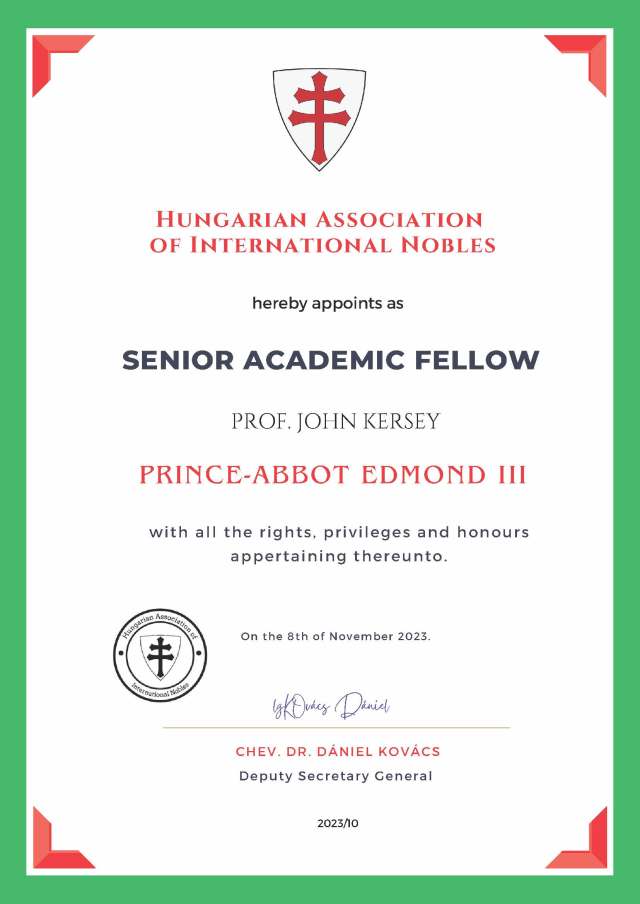
  • 8th Prince-Abbot of San Luigi in succession to the former sovereign and religious Abbey-Principality of San Luigi in the Fezzan, established in 1883 (further recognized by King Peter II of Yugoslavia as Prince de San Luigi in 1962, etc.) (2011-)

The arms of San Luigi
(Registered Polish Heraldic College and American College of Heraldry, 1930s; Collegium Heraldicum Concordiae, Poland, 2016)

  • Head of the Royal House Polanie-Patrikios, descending from the first rulers of Poland and Emperor Leo V Patrikios (the Armenian) of the Byzantine (Eastern Roman) Empire (formally recognized by by H.B. Peter II Andrew, Patriarch of Miensk and All Byelorussia in Dispersion with approval of the Holy Synod, in favour of H.S.H. Prince Kermit William I, first Head of the Royal House Polanie-Patrikios 1970, and further by the Bunyoro-Kitara Kingdom, 2019, etc.) (2015-)

The arms of the Royal House Polanie-Patrikios
(Matriculated by the International College of Arms of the Noblesse no. 2015/14)

  • 2nd Prince of Miensk and All Byelorussia, and pretender to the throne of Byelorussia (Belarus) (title created 1970 by H.B. Peter II Andrew, Patriarch of Miensk and All Byelorussia in Dispersion with approval of the Holy Synod, in favour of H.S.H. Prince Kermit William I, first Head of the Royal House Polanie-Patrikios) (2015-)

The arms of the Prince of Miensk and All Byelorussia (Gules fimbriated or a bend vert fimbriated or. Coronet: A princely coronet. Crest: An eagle displayed or.)
(Matriculated by the International College of Arms of the Noblesse no. 2015/15)

Nobility by virtue of descent from reigning monarchs

  • A Prince of Gniezno (by virtue of descent from the first rulers of Poland; the title of Prince or Princess of Gniezno is borne by all male and female members of the Royal House Polanie-Patrikios) (2015-)

The arms of the Princes of Gniezno (Per pale azure and gules a fleur de lis or in chief bendy of four azure and gules. Crown: A Saxon crown. Supporters: Two lions rampant or. Crest: A demi-lion rampant argent.) (Matriculated by the International College of Arms of the Noblesse no. 2015/16)

  • A Prince of the Holy Roman Empire and Hereditary Patrician of the Eastern Roman Empire (by virtue of primary descent from Emperor Leo V the Armenian of the Byzantine (Eastern Roman) Empire, and additional descent from Eastern Roman Emperors Basil I, Leo VI, Alexios I Comnenos, Isaac II Angelos, Romanos II, and the Western Holy Roman Emperors Charlemagne and Louis III inter alia) (the title of Prince or Princess of the Holy Roman Empire is borne by all male and female members of the Royal House Polanie-Patrikios) (2015-)
  • Noble of Memphis (by the Illustrious Society of Lords and Ladies of Memphis, Descendants of the Egyptian Pharaoh Ha’a’ib.Re’ (Wahibre Ibiau)) (the title of Noble of Memphis is borne by all male and female members of the Royal House Polanie-Patrikios) (2013-)
  • Prince Charlemagne (by virtue of descent from Charlemagne, Holy Roman Emperor and King of the Franks and Lombards; the title of Prince or Princess Charlemagne is borne by all male and female members of the Royal House Polanie-Patrikios) (2015-)
  • Further nobiliary distinctions are held as a consequence of descent from the earliest rulers of various European monarchies (2015-)

Membership of other Royal and Imperial Houses

Nobiliary concessions by reigning monarchs

The arms of the Chief Oshodi of Irrua (Vert a cross gules surmounted by two swords in saltire or hilts and pommels in chief.) (Matriculated by the International College of Arms of the Noblesse no. 2015/17)

The arms of the Marquis of Valjevo (Barry of eight vert and argent a lion salient argent surmounted by a crocodile of the same. Coronet: The coronet of a Marquis. Motto: Fortiter.) (Matriculated by the International College of Arms of the Noblesse no. 2011/3)

Nobiliary creations by dynastic heads of Imperial and Royal Houses and by ecclesiastical authority

  • 3rd Prince of Vilna and All Byelorussia (title created 1971 by by H.B. Peter II Andrew, Patriarch of Miensk and All Byelorussia in Dispersion with approval of the Holy Synod in favour of Prince Frederick of Vilna and All Byelorussia, attached to San Luigi since 1985) (2011-)
  • 2nd Prince of Chou Wu (title created 1972 by H.R.H. Prince Au Chin-Han, pretender to the Celestial Empire of Great China) (2015-)
  • 2nd Prince of Hohenheim (title created 1987 by the head of the Swabian Imperial House of Hohenstaufen-Lanza) (2015-)

The arms of the Prince of Hohenheim (Gules a chevron vert fimbriated or between three fleurs de lis argent. Coronet: A princely coronet.) (Matriculated by the International College of Arms of the Noblesse no. 2015/18)

The arms of the Royal House Shikal 

  • 1st Kenéz (≅prince) of Balta (title created by the House of Cseszneky (de Csesznek(Vár) et Milvány), Hungary)  (2023-)
  • 1st Prince of Buloberde (title created by the Royal House of Hussen-Shikal-Mudaffar of Somalia) (2025-)
  • Royal Prince in the Royal House of Epirus (2025-)
  • Honorary Datu (title created by the Sultan of Baloi, The Philippines) (2015-)
  • Datu Paduka (title created by the Royal House of Maharaja Adinda Aranan, Sulu, The Philippines) (2016-)
  • 2nd Duke of Smolensk (subsidiary title of the Prince of Miensk and All Byelorussia created by H.B. Peter II Andrew, Patriarch of Miensk and All Byelorussia in Dispersion with approval of the Holy Synod, 1970) (2015-)
  • 3rd Duke of Serbia, Bosnia and the Holy Roman Empire (title created 1971 by the Byzantine and Serbian Imperial House under H.I.H. Marziano II Lavarello in favour of Prince Frederick of Vilna and All Byelorussia; attached to San Luigi since 1985) (2011-)
  • 2nd Duke of St. Cyrille (title created by H.R.S.H. Prince William of Alabona-Ostrogojsk and Garama in favour of H.S.H. Prince Kermit William I as Head of the Royal House Polanie-Patrikios) (2011-)
  • 2nd Duc de Resigne (title created by the Byzantine and Serbian Imperial House under H.I.H. Marziano II Lavarello in favour of H.S.H. Prince Kermit William I, head of the Royal House Polanie-Patrikios, 1971) (2015-)

The arms of the Duc de Resigne (Tierced per pall reversed gules or and argent three lions rampant or gules and argent.) (Matriculated by the International College of Arms of the Noblesse no. 2015/19)

  • 1st Duke of Feuat (subsidiary title of the Prince-Abbot of San Luigi, 2012) (2012-)
  • 2nd Duke of Kelibia (title created by H.S.H. Edmond III, 8th Prince-Abbot of San Luigi in favour of H.S.H. Prince Kermit William I, head of the Royal House Polanie-Patrikios, 2013, merged in 2015) (2015-)
  • 1st Duke of Samos (title created by H.S.H. Prince Kermit William I as head of the Royal House Polanie-Patrikios 2013 in favour of H.S.H. Edmond III, 8th Prince-Abbot of San Luigi, merged in 2015) (2013-)
  • 1st Duke of Synnada (title created by the Imperial Byzantine Amorian Dynasty) (2016-)
  • 1st Duke of Mardin (title created by the Imperial House of Tommassini-Leopardi of Constantinople (Justinian and Heraclian Dynasties) (2018-)
  • 1st Duke of Fushë-Kuqe (title created by the Princely House of Scuro, Albania) (2018-)
  • 1st Elteber of the Krivichs (title created by the House of Cseszneky (de Csesznek(Vár) et Milvány), Hungary)  (2023-)
  • 3rd Marquis de St. Laurent (title created by the Princely House of Deols, 1968, in favour of Prince Frederick of Vilna and All Byelorussia; attached to San Luigi since 1985) (2011-)
  • 2nd Marquis of Inheressu (title created by H.S.H. Edmond III, 8th Prince-Abbot of San Luigi in favour of H.S.H. Prince Kermit William I, head of the Royal House Polanie-Patrikios, 2013, merged in 2015) (2015-)
  • 1st Marquis of Tiberiopolis and San Giovanni d’Acri (title created by the Imperial Byzantine Amorian Dynasty) (2016-)
  • 1st Marquis of Mamurras (title created by the Princely House of Scuro, Albania) (2018-)
  • 1st Marquis of Maslinica (title created by the Sovereign Royal Granducal House of Dalmatia (Val d’Ors)) (2020-)
  • Count Palatine (of the Imperial Phrygian Amorian Dynasty) (2016-)
  • Count Palatine (of the Justinian-Heraclian Dynasty of Tomasi (subsequently Tomassini)-Paternò Leopardi of Constantinople) (2018-)
  • Count Palatine (of the Princely House of Scuro) (2018-)
  • 3rd Comte de Berville (title created 1936 as subsidiary title of the Prince-Abbot of San Luigi) (2011-)
  • 2nd Count in Swabia (title created by Fürst Johann Caspis von Schwaben, Pfalzgraf von Rhein-Kurfürst, in favour of H.S.H. Prince Kermit William I, head of the Royal House Polanie-Patrikios, 1980) (2015-)
  • 2nd Count of Celaya (title created by H.S.H. Simone Velluti Zati, head of the Ducal House of Isla de San Clemente in favour of H.S.H. Prince Kermit William I, head of the Royal House Polanie-Patrikios) (2015-)
  • 1st Count of Flaviopolis and San Giovanni d’Acri (title created by the Imperial Byzantine Amorian Dynasty) (2016-)
  • 1st Count of Pontus (title created by the Imperial House of Tommassini-Leopardi of Constantinople (Justinian and Heraclian Dynasties) (2018-)
  • 1st Count of Milot (title created by the Princely House of Scuro, Albania) (2018-)
  • 1st Szerdár (≅count/earl) of Padina (title created by the House of Cseszneky (de Csesznek(Vár) et Milvány), Hungary)  (2023-)
  • 1st Vicomte de St Jean (title created by Archbishop Frederick Burcklé von Aarburg, head of the House of Burcklé von Aarburg) (2017-)
  • 1st Vicomte de St. Serge (title created by Archbishop Frederick Burcklé von Aarburg, head of the House of Burcklé von Aarburg) (2023-)
  • 2nd Baron of Aarburg in Swabia (title created by Fürst Johann Caspis von Schwaben, Pfalzgraf von Rhein-Kurfürst, in favour of H.S.H. Prince Kermit William I, head of the Royal House Polanie-Patrikios, 1980) (2015-)

The arms of the Baron of Aarburg in Swabia (Within a bordure compony azure and argent, per pale argent and azure, a lion rampant counterchanged, in dexter chief point and sinister chief point bendwise two leopards’ heads counterchanged, on a chief gules three fleurs de lis argent. Coronet: A baronial coronet of the Holy Roman Empire.) (Matriculated by the International College of Arms of the Noblesse no. 2015/20)

It is the policy of the Abbey-Principality of San Luigi and the Royal House Polanie-Patrikios that titles of nobility conferred upon or inherited by their heads (in united administration since 2015) are not only maintained as part of the nobility within the Royal Houses that have originally conferred them, but are also considered through the exercise of the sovereign prerogative to become substantive titles of the Abbey-Principality of San Luigi and the Royal House Polanie-Patrikios as of the date of their conferral or inheritance. This policy ensures that should any of the conferring Royal Houses become extinct in the future (as has happened in the case of at least one such Royal House), the titles that have been conferred will continue in existence, as well as ensuring that the titles in question are subject to the various recognition agreements that apply to the titles and honours of the Abbey-Principality of San Luigi and the Royal House Polanie-Patrikios. In addition, all arms awarded or inherited by the heads of the Abbey-Principality of San Luigi and the Royal House Polanie-Patrikios are additionally matriculated in the register of the International College of Arms of the Noblesse with assignment in perpetuity to the heads of the Abbey-Principality of San Luigi and the Royal House Polanie-Patrikios as applicable.

Royal Protections and Patronages

Memberships of nobiliary associations

See also Foreign nobiliary and chivalric honours held, and foreign sovereignty exercised, by British nationals

Index to Libertarian Alliance articles

Statements of principle:

The following articles were written during my tenure as Director of Cultural Affairs of the former Libertarian Alliance and initially published by the Libertarian Alliance both in its series of online and print articles and on its blog.

Index to Talks on education