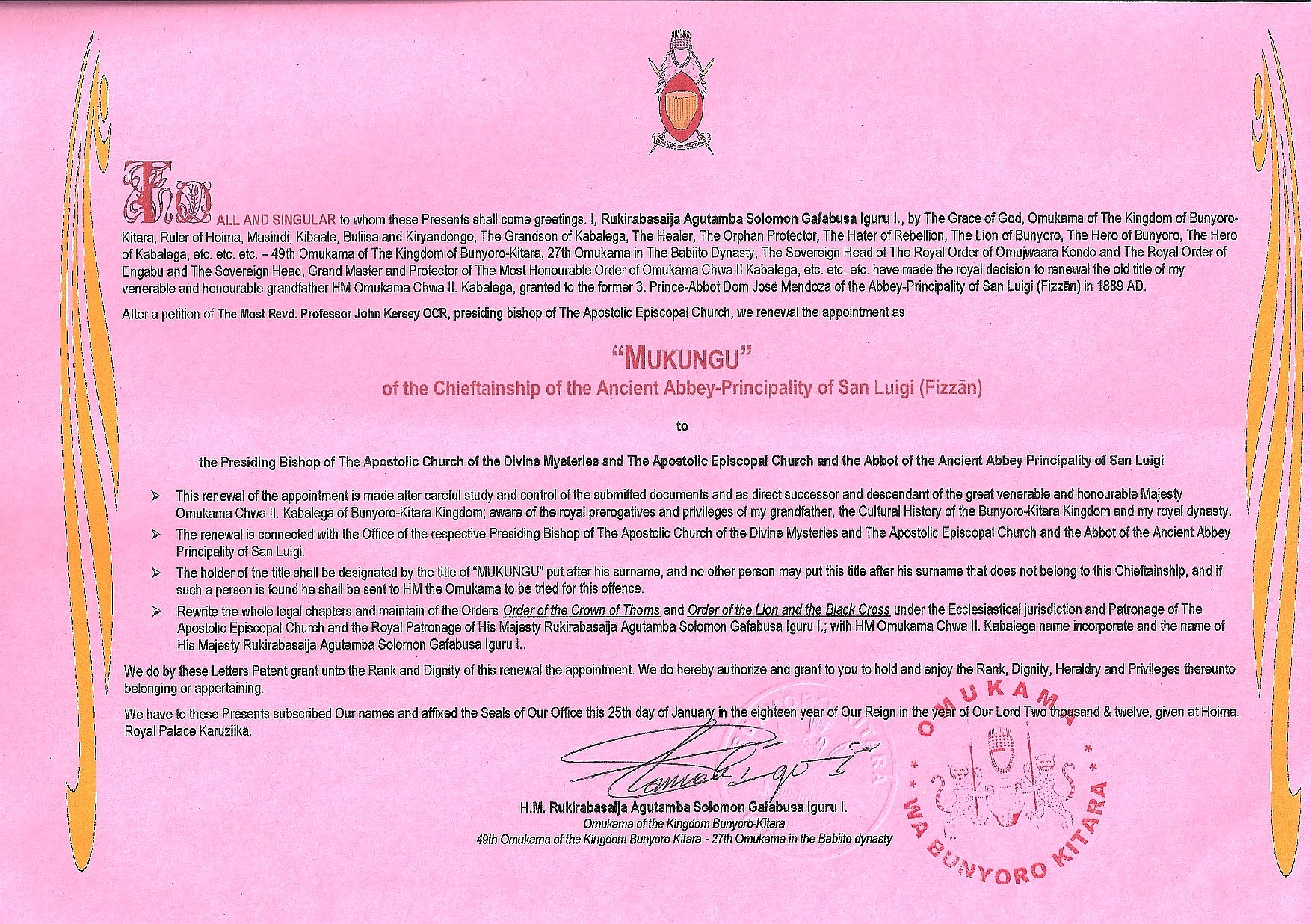
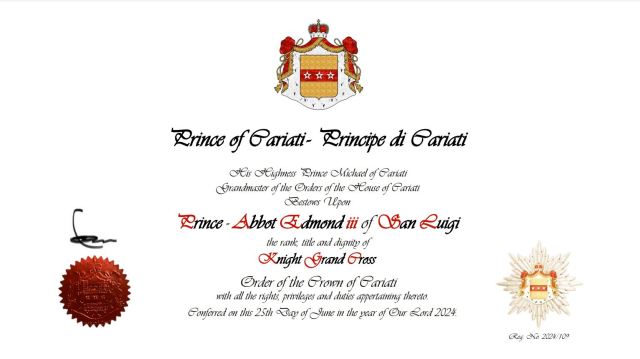
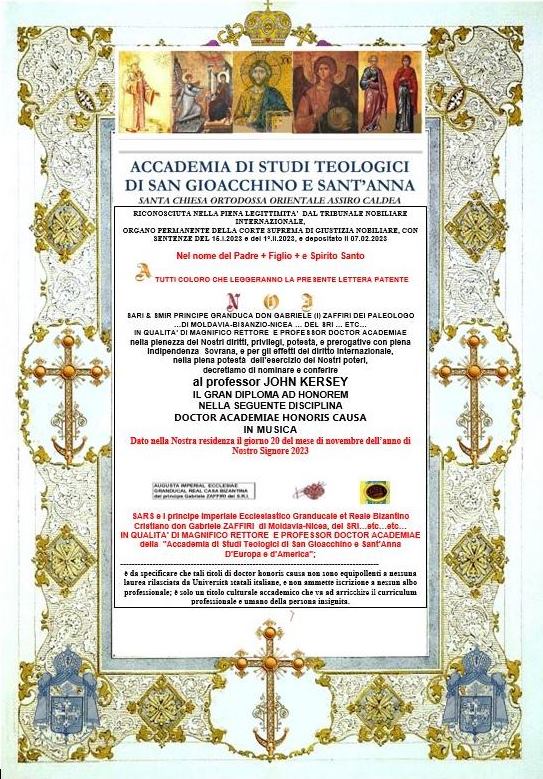
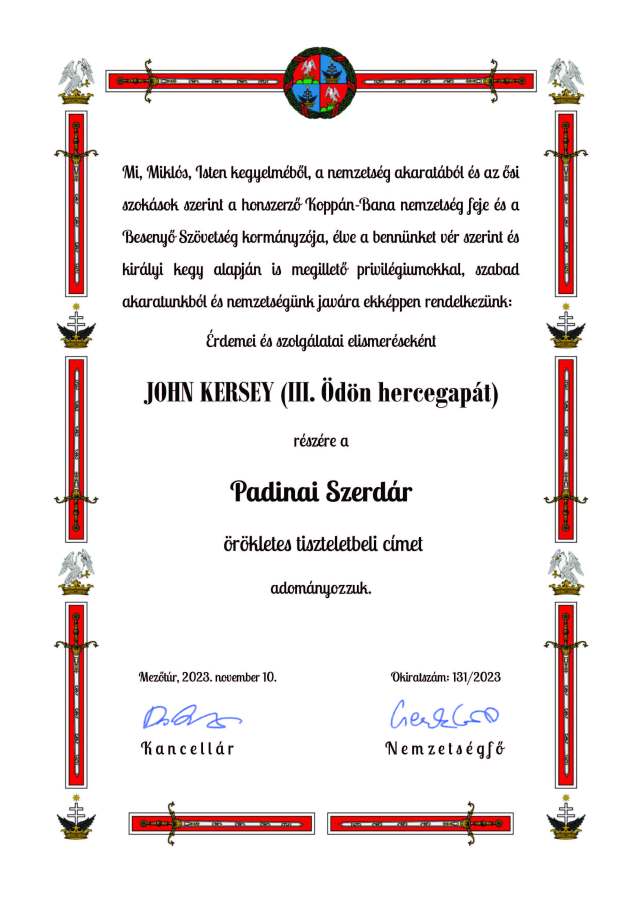
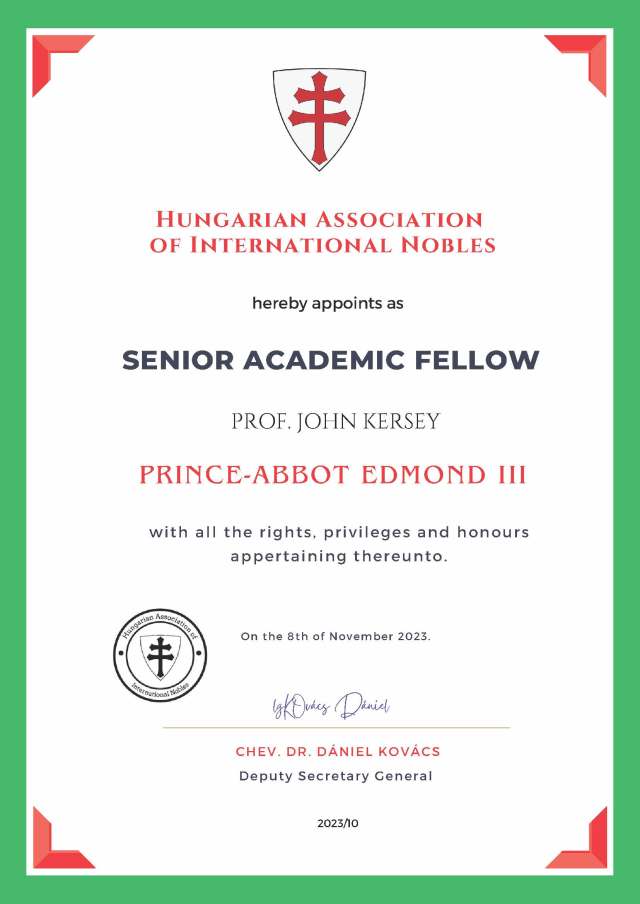
There is not, and never has been, any law that prevents a British citizen from accepting or using socially a foreign title of nobility or rank in a foreign Order of Chivalry. There is also no law that prevents the granting of titles of nobility and Chivalric Orders by foreign fontes honorum who are resident in the United Kingdom. Several former foreign sovereigns have chosen exile in Britain, and as will be discussed below, several British citizens have acquired the attributes of foreign sovereignty through inheritance or election to sovereign office.
The question then arises as to whether foreign titles and Orders can receive any form of official recognition in the UK. Until 1932, it was theoretically possible to apply for a Royal License to use a foreign title in the UK, however, the decisions surrounding this process seem to have been attended by little consistency or logic[i].
The current policy of HM Government regarding British passports is stated as follows, “By Royal Warrant of 27 April 1932, the use in England and Wales of foreign titles of nobility was discontinued, and existing warrants licensing the use of such titles were revoked – with certain named exceptions. In Scotland, a foreign title may continue to be recognised and registered by the Lord Lyon. However, [the Identity and Passport Service] maintains the right to provide a policy that is consistent throughout the UK. In consequence, at present a foreign title will not be shown on a British passport unless they hold a valid Royal warrant.
This will affect all those who may quite legitimately hold a foreign title, but which is not recognised in the UK. The personal details page of the passport will only show their forenames, family names and place and date of birth.
However, an observation indicating that ‘THE HOLDER IS ALSO KNOWN AS (foreign title)’ will be included in the passport.”[ii]
In permitting the observation, the British government does in fact accord a form of official recognition to what is, after all, the personal property of the holder, albeit that it does so in a deliberately understated manner. The author has seen several examples of foreign titles included in British passports in this way, one of which was a princely title.
In considering the Royal Warrant of 1932 it is important to have regard to its context, which was the scheme of Royal Licences referred to above. The Royal Warrant addresses itself to the matter of the existing Royal Licences and their holders, hence it speaks of the use of foreign titles (as enabled by the Royal Licences, which gave them a form of official approval) being discontinued, which meant that there would be no further Royal Licences issued and the existing licences would for the most part expire after the third generation from the holder as of 1932. The Royal Warrant does not speak of any wider context with respect to the use of foreign titles in the UK, and although it is clear from other correspondence of Kings Edward VII and George V that their personal opinions were generally disapproving of foreign titles being held and used by British subjects, what matters is what the relevant instruments actually say. The Royal Warrant does not prohibit or forbid the use of foreign titles, nor does it address their widespread use socially and in other contexts by those who had not obtained a Royal Licence. Indeed, until 1932, both Burke’s Peerage and Debrett’s Peerage had extensive appendices listing foreign title-holders in the UK with their armorial bearings, such listings not being confined to holders of Royal Licences. Debrett’s Peerage (1921 edition, p. 114) states, “Foreign titles borne by British subjects afford their holders no precedence whatever in this country and, strictly speaking, a royal licence should be obtained for their use.” The phrase “strictly speaking” indicates that limited regard was given to the scheme of Royal Licences even during its lifetime, while the lack of any legislative measure addressing the topic speaks for itself.
A further example of the official view of the UK concerning foreign titles is provided by a letter from Judith Usher of the Royal, Ceremonial and Honours Unit Protocol Directorate of the Foreign and Commonwealth Office dated 21 March 2013[iii]. The letter is addressed to a Knight of the Sacred Military Constantinian Order of St George, which is today awarded independently by two rival claimants to be the head of the House of Bourbon-Two Sicilies, which last reigned in 1861, and by the Duke of Parma[iv]. The Order derives its authority from a Papal Bull of 1718, and the Pope appointed a Cardinal Protector for the Order until 1927. Notwithstanding this, and the fact that membership is restricted to Roman Catholics, the Order is not under patronage of the Holy See, is not awarded by the Pope, and is among the Orders included in the statement of dissociation by the Vatican Secretary of State of 16 October 2012[v]. It is therefore not a Papal Order, but rather an Order which derives its authority from the Holy See and is now under an independent Grand Master. In this respect it is of the same ilk as other Orders which are conferred by the heads of ex-regnant dynasties and which owe their impetus to ecclesiastical authority.
While there is no law that governs the use and wearing of foreign Orders, there is a protocol governing these matters which does not have the force of law, but which is binding on members of the British Armed Forces, the Civil Service and others in the direct service of the Crown as one of the conditions of their service. It may be argued that this protocol is also proper to be followed by private citizens, and where, for example, they already hold a British honour, it is clearly a matter of courtesy that they should follow not only the law but the expressed wishes and preferences of the Crown in such matters. The protocol requires that in advance of receipt of any foreign honour, the putative recipient should apply for permission to accept, and in some cases permission to accept and wear, the decoration in question. Such permission may, if granted, be with specific conditions, and may be partial, that is to say permission may be granted to accept a decoration but not to wear it. If unrestricted permission to accept and wear is granted, the foreign decoration may be worn on official occasions and, where applicable, on uniform and in the presence of the Queen. The protocol applies only to “wearable” decorations, such as Orders and medals, and does not apply in regard to foreign titles of nobility.
The letter contains the following statements, “We can only seek Her Majesty the Queen’s permission for the acceptance and wearing of foreign awards conferred by a Head of State or the Government of a foreign country, so called “State honours or awards”. State honours can only be worn when The Sovereign’s permission has been given and approval for the award to be bestowed given in advance.
However, the Sacred Military Constantinian Order of St George is a Roman Catholic order of chivalry. Therefore your award is not defined as a “State Award” under the rules on the acceptance of foreign awards. This means that we cannot seek Her Majesty’s permission for your award to be accepted or worn under those rules. It does though mean that you are free to wear your award as and where you feel it appropriate to do so.”
It is important to note that the FCO in this response explicitly denies that if it is not possible to apply for permission to accept a foreign award, it cannot or should not be accepted or worn. Rather, the position is that the recipient is free to accept it and may wear it when they consider that it would be appropriate to do so. The position will by extension be the same concerning the acceptance and use of foreign titles of nobility, which carry no recognition by the Crown but equally are neither the subject of legal prohibition nor of a specific protocol.
In 2016, following controversy which had ensued upon the use of an Antiguan knighthood of high rank awarded to Anthony Bailey, OBE, the FCO, the Central Chancery of the Orders of Knighthood, and the College of Arms issued a statement published in the London Gazette[vi]. Bailey had used the style “Sir Anthony Bailey” in keeping with the practice of Antigua, which allows holders of the knighthood bestowed on Bailey to use the style “Sir”. The statement reads as follows:
“TITLES CONNECTED WITH ORDERS, DECORATIONS AND MEDALS CONFERRED BY ANOTHER COUNTRY, INCLUDING COUNTRIES OF WHICH THE SOVEREIGN IS HEAD OF STATE, OTHER MEMBERS OF THE COMMONWEALTH AND BY ALL OTHER FOREIGN COUNTRIES Notice is hereby given that, in line with the long-established convention concerning foreign titles, British nationals who have been awarded an honour by another country may not use any associated title, that the award might bestow, in the United Kingdom.
Only those British nationals, including dual nationals, awarded a British Knighthood or appointed to a British Order of Chivalry as a Dame, may use the title ‘Sir’ or ‘Dame’ in the United Kingdom.”
The notice refers to “long-established convention”. In fact, it is not particularly long-established and has no antecedence prior to the nineteenth-century. Whatever the circumstances in which his Antiguan award was made (and it was rescinded without any published reason being given in 2017[vii]), it is difficult to conclude that Bailey did anything wrong in using the title “Sir”. Legally, a man may call himself what he wishes provided he does not commit fraud in so doing. Convention is not law. In our view, Bailey was amply justified in following the explicitly-stated practice of Antigua, and could have defended any allegation of imposture robustly on that basis.
The notice also explicitly refers to honours awarded by a country. It therefore excludes honours awarded by Heads of ex-regnant Royal Houses or by the Holy See (unless the awarding body was seen as the Vatican City, which seems not to be the case as far as the UK is concerned), or by other churches, although it is rare that their recipients would seek to style themselves Sir or Dame. It remains to be seen whether defiance of the notice would have any consequence other than the displeasure of the British establishment, since no law is being broken. It could further be argued that while a person may legally change their name under English law, no legal mechanism exists whereby they may officially change their title[viii]. Any title that is not legally sanctioned in the UK, including in theory that of “Sir” or “Dame” in the case of foreign knighthoods, has therefore simply been adopted informally and has no standing other than of courtesy.
The concept of courtesy has a rather direct example in the styles used by the heirs to British peerages. To generalize, the eldest son of a peer of a rank of earl or higher is usually known by a courtesy title chosen from among the subsidiary titles held by the peer, and his eldest son and heir apparent in turn is likewise known by a more junior courtesy title. Thus the eldest son and heir of the Duke of Abercorn has the courtesy title of Marquess of Hamilton, and his eldest son and heir in turn has the courtesy title of Viscount Strabane. Both of these latter titles as substantive titles, however, are actually held by the Duke himself. A courtesy title lacks the prefix “the”, since “the” Marquess of Hamilton is actually the Duke of Abercorn, rather than his son and heir. Other courtesy titles include Lord or Lady for the younger children of dukes and marquesses, and The Honourable for the children of Scottish lords, barons, viscounts and the younger sons of earls[ix].
Moreover, courtesy titles are decided according to the custom of the family. They may be different from the actual title concerned – for example, the Duke of Wellington is also Marquess Douro, but his son and heir uses the courtesy title Marquess of Douro, and the son and heir of the Earl of Devon is known by the courtesy title Lord Courtenay although no barony of that designation exists.
These courtesy titles, however, though long-established in custom, are not actually provided for in law, and are simply a styled title or name adopted by the holder and permitted by society rather than held by legal right. In legal documents, they are designated by the phrase “commonly called”. Moreover, since a Royal Warrant of 2004, adopted children, although they may not succeed to peerages, are entitled to use courtesy titles.
It may be considered that the legal position regarding the use of foreign titles of nobility in England is akin to that of the holders of British courtesy titles, in that there is no law that governs these titles or usage, but nevertheless they are used legitimately by their holders as styled names or titles by which the holder may be commonly called. There are other British non-noble titles that are similarly unregulated and likewise function as customary styled names or titles, such as Lord or Lady of the Manor, or (in Scotland) Laird or Lady, and their associated prefixes, suffixes, and forms of address.
On 8 March 2017, further illustration of the principles at work in Britain was provided when H.M. the Queen accepted the Grand Collar of the Order of the Eagle of Georgia. This Order is awarded by Crown Prince Davit Bagration of Mukhrani of Georgia, who is one of two pretenders to the Georgian throne. As a pretender who has never reigned himself, he grants the Order in exercise of the fons honorum as the head of an ex-regnant royal dynasty (which last reigned in 1800). According to the official report of the presentation, the honour was received on behalf of the Queen at Kensington Palace by the Duke and Duchess of Gloucester, having initially been proposed and accepted in 2016[x].
In accepting this non-state award, the Queen broke new ground, in that she had never previously accepted an honour from an ex-regnant Royal House. Moreover, the acceptance sent clear messages to the rival pretender to Crown Prince Davit, Prince Nugzar of Georgia, and indeed to Georgia’s republican government. It should be added that in 2018, Crown Prince Davit and his brother attended the inauguration of Georgia’s first female President at one of the former royal palaces. Notwithstanding this, there is no prospect in Georgia at present for the restoration of the monarchy or the official recognition of the titles of nobility and chivalric Orders bestowed by Prince Davit.[xi]
Pace Guy Stair Sainty’s comments on this matter on Facebook, there is nothing accidental in the decision of the Queen. Rather it reflects a position where the Georgian Republic has indirectly indicated its acceptance of Crown Prince Davit as pretender rather than Prince Nugzar, and where the Republic has also indirectly approved the role of Crown Prince Davit in international affairs where he represents the Georgian nation. Lastly, this situation shows the acceptability of non-state awards in the United Kingdom at the highest level. Indeed, Prince Davit has gone on to confer at least two dukedoms upon British citizens.
Therefore we can see that foreign titles of nobility and Orders awarded by formerly ruling Royal Houses or by ecclesiastical authority, are not governed by law or protocol in the United Kingdom and there is no law that restricts their acceptance or social use, or their granting in the United Kingdom by foreign resident or non-resident authorities. Any foreign title, be it membership of an Order of Chivalry or a title of nobility, may be recorded as an observation in a British passport.
The exercise of foreign sovereignty by British citizens
Let us now address the position of the sovereignty that is exercised within the United Kingdom by dynastic heads and others. We shall deal with three examples of such. The first two are of past Prince Grand Masters of the Order of Malta, Fra’ Andrew Bertie (1929-2008) and Fra’ Matthew Festing (1949-2021). The third is the current pretender to the Rwandan throne, H.M. Yuhi VI (1960-). The first two were born British citizens while Yuhi VI is a naturalized British citizen. All were or are permanently resident in England.
The United Kingdom does not regard the Order of Malta as a state; it does not have diplomatic relations with it and it regards the Order’s ranks of membership as religious, non-State awards. Nevertheless, the acceptance of the Order socially and the regard for its humanitarian and religious standing is high. Sir Conrad Swan, late Garter King of Arms, was also Knight of Honour and Devotion in the Order as well as being Genealogist to the British Association.
The two English Prince Grand Masters of the Order of Malta are examples of British citizens receiving an elected office that carried with it non-territorial sovereignty. The Prince Grand Master admits candidates to the chivalric honours and ranks of the Order of Malta by his own authority (see brevets).
Upon election, the Prince Grand Master becomes entitled to armigerous privileges befitting his office. He may quarter his own arms with those of the Order. Other members of the Order acquire armigerous privileges consequent upon their membership. Francois Velde summarizes these as follows, “Only the professed members (and perhaps the Knights and Chaplains of Obedience as well) are entitled to place a cross of Malta behind their arms. Knights Commanders also surround their shield with the chaplet from which hangs their insignia. Baillis quarter their arms with those of the order. Professed Chaplains surround their shield with a chaplet from which hangs their insignia. Professed knights have the full cross hanging from a black ribbon. The non-professed categories of knights have their insignia hanging from a black ribbon (with no cross behind the shield), but Knights Grand-Cross or Bailiffs within each class edge the ribbon with gold and add a chief with the arms of the Order (chef de la religion) to their coat. Ecclesiastics who are members of the Order are exempted from the prohibition on display of exterior ornaments.” [xii]
There is no evidence to hand that suggests that either Prince Grand Master was required or saw it as necessary to seek the permission of H.M. the Queen before accepting their sovereign office. Nor is there evidence that they sought to matriculate their new arms at the College of Arms before using them. Had this been done, it would have called into question the sovereignty that was claimed for their office, by showing that it was, in fact, dependent upon an unrelated monarchy (that of the United Kingdom) and, in matters of arms, upon a national heraldic authority (the College of Arms).
The case of H.M. Yuhi VI[xiii] is different in that his claim in pretence is to a sovereignty that is not religious in nature. As the pretender to the throne of Rwanda, Yuhi VI has and exercises the right to grant and regulate titles of nobility originating from the Rwandan Crown, and to bestow the Rwandan Orders of Chivalry instituted by his predecessor (and any new Order that he may choose to institute). Moreover, he has inherited as foreign arms the arms of the Rwandan Crown and possesses an inherent right to grant and regulate arms with respect to the holders of Rwandan dignities[xiv]. These are sovereign rights and as such would be compromised if not extinguished if subjected to the British authorities. There is no evidence that the British authorities object to Yuhi VI exercising his rights; there is no law that forbids him from doing so, and there is no protocol in England and Wales that governs the acceptance or wearing of the Orders that he may bestow since they are not State Awards.
When an Englishman is required by election or inheritance to undertake the responsibilities that attach to non-territorial sovereignty, be that as a result of sovereignty over a non-territorial entity or sovereignty in pretence with respect to a throne occupied by hostile powers, he does so on the basis that sovereignty cannot be extinguished by any power outside the country or sovereign entity in question. The practical exercise of sovereignty can certainly be restricted by the laws of his country of residence, but if the law is silent, the sovereign may act.
NOTES:
[i] See https://www.heraldica.org/topics/britain/TNA/HO_45_13725.htm retrieved September 21 2020. It should be noted in view of the previous observations that in some cases the Royal Licence for the use of a foreign title imposed a different limitation to that which would have applied in the host country; for example, the restriction of some Continental titles that would normally have been shared equally among male dynasts to descend according to male primogeniture. Some of the holders of Royal Licences were listed in Burke’s Peerage and Debrett’s Peerage until 1932, though these listings were never complete and it appears that some who did not hold licences were also included.
[ii]https://assets.publishing.service.gov.uk/government/uploads/system/uploads/attachment_data/file/118548/titles-included-in-passports.pdf retrieved September 21 2020.
[iii] The recipient of the letter has been anonymised.
[iv] See R.A.U. Juchter van Bergen Quast, Legal opinion: the legitimacy of the Constantinian Orders (2018) published at https://freiherrvonquast.wordpress.com/2018/10/24/the-legitimacy-of-the-constantinian-orders/ retrieved September 25 2020.
[v] https://www.orderofmalta.int/2012/10/17/clarification-of-the-secretary-of-state-of-the-holy-see-on-the-equestrian-orders/ retrieved September 23 2020, “In response to frequent requests for information concerning the recognition by the Holy See of Equestrian Orders dedicated to the saints or to holy places, the Secretariat of State considers it opportune to reiterate what has already been published, namely that, other than its own Equestrian Orders (i.e.: the Supreme Order of Christ, the Order of the Golden Spur, the Pian Order, the Order of Saint Gregory the Great, and the Order of Pope Saint Sylvester), the Holy See recognizes and supports only the Sovereign Military Order of Malta – also known as the Sovereign Military Hospitaller Order of Saint John of Jerusalem of Rhodes and of Malta – and the Equestrian Order of the Holy See Sepulchre of Jerusalem. The Holy See foresees no additions or innovations in this regard. All other orders, whether of recent origin or medieval institution, are not recognized by the Holy See. Furthermore, the Holy See does not guarantee their historical or juridical legitimacy, their ends or organizational structures. To avoid any possible doubts, even owing to illicit issuing of documents or the inappropriate use of sacred places, and to prevent the continuation of abuses which may result in harm to people of good faith, the Holy See confirms that it attributes absolutely no value whatsoever to certificates of membership or insignia issued by these groups, and it considers inappropriate the use of churches or chapels for their so-called “ceremonies of investiture”.’
[vi] https://www.thegazette.co.uk/notice/2547848 retrieved October 18 2020.
[vii] See https://www.thegazette.co.uk/London/issue/62016/page/15017 retrieved October 18 2020.
[viii] Several vendors on the Internet offer products which purport to give the buyer the styled title of Lord or Lady, but officially the recipient, if not a peer, will remain Mr John Smith, Lord of X (or potentially and rather confusingly, Mr Lord John Smith, where Lord is in fact a Christian name and not a title).
[ix] Scots law has slightly different practices regarding courtesy titles.
[x] http://www.royalhouseofgeorgia.ge/p/eng/434/news/114/HER-MAJESTY-QUEEN-ELIZABETH-II-PRESENTED-WITH-THE-GRAND-COLLAR-OF-THE-ORDER-OF-THE-EAGLE-OF-GEORGIA retrieved October 21 2020.
[xi] See R.A.U. Juchter van Bergen Quast The value of nobiliary titles issued by HRH Prince Davit Bagration of Mukhrani, 2020, retrieved from https://freiherrvonquast.wordpress.com/2020/07/10/the-value-of-nobiliary-titles-issued-by-hrh-prince-david-bagration-of-mukhrani/ October 21 2020.
[xii] See Velde, Francois, The Sovereign Military Order of Saint-John (a.k.a. Malta), retrieved from https://www.heraldica.org/topics/orders/ordmalta.htm January 3 2021.
[xiii] http://royalhouseofrwanda.org/ retrieved January 3 2021.
[xiv] For details of the current protocols regarding titles and arms, see http://www.royalhouseofrwanda.org/images/guidance-for-honours-2016.pdf retrieved January 3 2021.



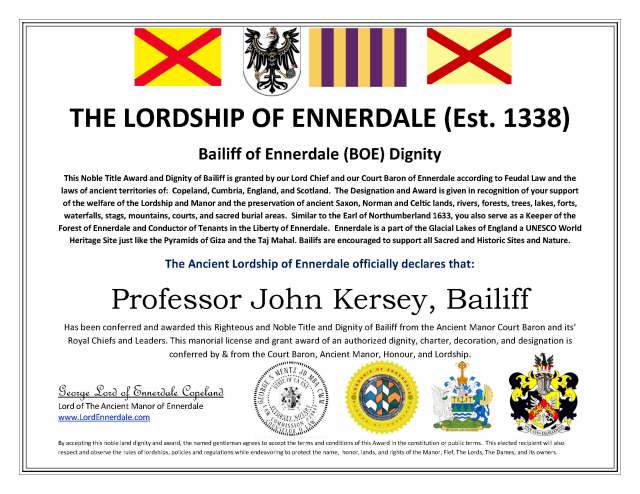


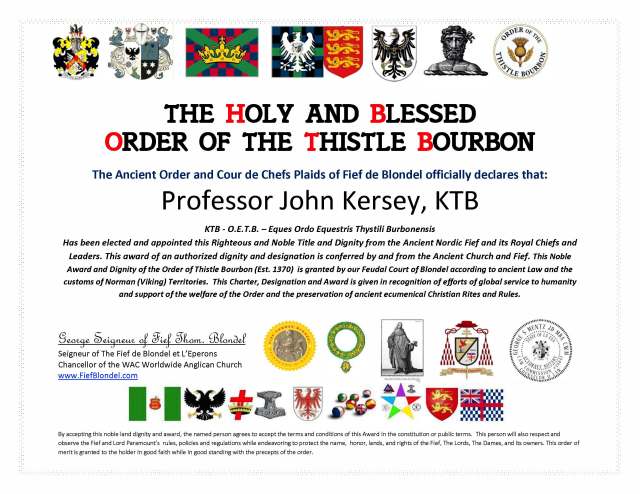
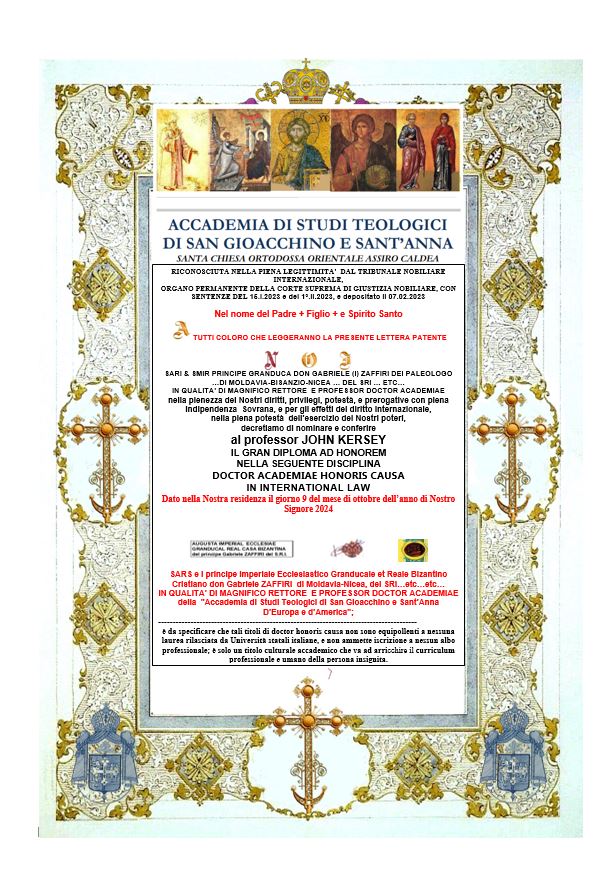












 Professor John Kersey