Honours and awards: Medaglia Europea of the Federazione Italiana dei Combattenti Alleati

I have been honoured to receive the Medaglia Europea of the Federazione Italiana dei Combattenti Alleati. FIDCA was founded in 1972 as an association of European ex-combatants and others who were supportive both of the European ideal and of the sacrifices of those who had sacrificed themselves for freedom. FIDCA was recognized as a distinct legal personality in Italy by Presidential Decree n.305 of 9/4/1986, and by means of DPR 27-2-1990, it was placed under the direct patronage of the Italian Ministry of Defense.

The Medaglia Europea, or European Cross, is awarded after nomination from a participating organization both to ex-combatants and to supporters, remembering the service and sacrifice of those who fought not only for Italy but in the Allied cause all over Europe. This has a particular resonance for me since my maternal grandfather was killed in action in Belgium in 1945 while fighting for the Allies in World War II.

Honours and awards: Knight Grand Cross of the Ordo Supremus Militaris Templi Hierosolymitani

I have been delighted to receive the distinction of Knight Grand Cross of the Ordo Supremus Militaris Templi Hierosolymitani (O.S.M.T.H.) The honour was bestowed by the Italian Magistral Delegation.

The Ordo Supremus Militaris Templi Hierosolymitani (Sovereign Military Order of the Temple of Jerusalem) continues the Templar tradition that was revived in France in 1705, reconstituted under Bernard Raymond Fabré-Palaprat in 1804, and recognized by the Emperor Napoléon I in 1805. It was under the leadership of Grand Master Fernando Campello Pinto Pereira de Sousa Fontes between 1960 and 2018. The present Grand Master is Fra Albino Neves.

The Italian Magistral Delegation maintains a website at http://www.cavalieritemplariosmth.it

On marriage

In 2013 and 2014, at the time when the Government was redefining civil marriage, I wrote two essays on the matter that were published on the Libertarian Alliance blog and subsequently included in my collection of talks and essays The Radical Traditionalist Today. Here are those essays, very slightly revised. My conclusion was then and remains that there are now serious obstacles for traditionally-minded Christians (and indeed others who are traditionally-minded) who would want to enter into civil marriage, and my view is that civil marriage as currently constituted in England and Wales does not conform to marriage as that sacrament is understood by traditional Christians.

The trouble with gay marriage

I should begin with a simple statement of libertarian principle. The state has no business being involved in any way with marriage. It has adopted that role as a consequence of the compromise Henry VIII engendered when he merged Church and State. Since marriage within the Church of England is governed by the law of the land, and not simply by canon law, it follows that when marriage takes place between persons who are not members of that church, the state must act as registrar in order that those marriages have equivalent legal standing. One simple answer to the matter would be to disestablish the Church of England and thereby reduce marriage to a matter of private contract with an optional religious component, but this is not under consideration at present.

My purpose here is not primarily a discussion of marriage and same-sex relationships in their religious context, nor the case for the disestablishment of the Church of England. Rather, I want to point out that what is being proposed with regard to same-sex marriage has some important implications for those who are already married (ie. for those of the opposite sex) and further that its hamfisted legal construction is setting up a series of wholly avoidable and undesirable problems.

Let us not forget, however, that the institution of civil partnership has already established a position of legal equality between marriage and same-sex partnerships. Before civil partnerships, there were eminently legitimate complaints that the inequalities that existed in respect of inheritance and status as next-of-kin were iniquitous in a free society, and that there should be a means by which this could be redressed. In civil partnership, an institution was created that was distinct from marriage; indeed that was exclusively and completely a same-sex institution. For those same-sex couples who had said that they did not want marriage with its accompanying associations, but instead something that, while equal to marriage in law, was theirs alone to define, civil partnership could not have fitted the bill better, and its popularity since introduction would appear to have borne this out. Moreover, it was open to those churches that wished to do so to bless civil partnerships, and several have done so. Even the Church of England, which officially forbids such blessings, has a number of parishes where the letter of the law is observed but ways around the prohibition have been found through “services of prayer and dedication”[i]. At their most elaborate, such occasions are so close to the service for the blessing of civil marriage that were it not for the sex of the participants it would be difficult to tell the difference[ii].

Now, though, we find our legislators – without any apparent cause other than the Left’s shibboleth of “equality” – contemplating far-reaching changes to the nature of marriage between both same-sex and opposite-sex couples. Marriage as constituted at present has to do with the Christian viewpoint that the primary purpose of marriage is for the bringing of children into the world and their upbringing. Consequently, marriage is construed as a specifically sexual bond between husband and wife. This finds expression in the law in respect of the definition of marriage as a binding contract that is not entered into unless and until the marriage has been consummated. Non-consummation renders the marriage voidable under the Matrimonial Causes Act 1973, section 12a. Consummation has been defined, both in religion and in secular law, as the “ordinary and complete” act of sexual intercourse, a phrase which needs no amplification.

The problems with regard to same-sex marriage will by now be obvious to the reader. The partners cannot consummate the marriage according to the legal definition of that term. Nor is there any other equivalent sexual act that is universal to same-sex couples. Therefore, the government proposes to create a virtually unprecedented new definition of marriage that has no sexual component to it. Here is the relevant section of the government’s consultation document on the matter:

“2.16 Specifically, non-consummation and adultery are currently concepts that are defined in case law and apply only to marriage law, not civil partnership law. However, with the removal of the ban on same-sex couples having a civil marriage, these concepts will apply equally to same-sex and opposite-sex couples and case law may need to develop, over time, a definition as to what constitutes same-sex consummation and same-sex adultery.”[iii]

In other words, the government can see the problem but has absolutely no idea how to solve it. It therefore proposes to foist the entire matter on to the courts to be resolved sine die.

The implications are interesting. As the law would stand under the proposal, for example, a same-sex married partner cannot commit adultery with another partner of the same sex, since any definition of adultery applies only to heterosexual sexual intercourse. But they can commit adultery against their same-sex married partner with a person of the opposite sex. What will constitute adultery or consummation if a definition needs now to be found that applies both to heterosexual and homosexual marriages? The implication is that acts of a sexual nature that fall short of sexual intercourse and which are not regarded as of paramount significance in such discussions at present may come to be seen in a whole new light. Even without my religious hat on, I cannot see this as in any way being a good thing for our society.

I note, incidentally, that Ben Summerskill, chief executive of the gay rights organization Stonewall, thinks that “This focus on consummation, in particular on the sexual element of it, seems to exercise heterosexuals more than most lesbian and gay people.”[iv] He does not seem to realize that the reason why this exercises heterosexuals is because we, too, are to be significantly affected by the proposed legislation, and in ways that are as yet impossible for anyone to quantify or anticipate with any accuracy. As such, this is a leap into the unknown. There is still time to pull back from the brink.

[i] http://inclusive-church.org.uk/about/church-services-after-civil-partnerships

[ii] http://www.dailymail.co.uk/news/article-1026599/Rector-faces-sack-holding-Britains-gay-wedding-Anglican-church.html

[iii] http://www.homeoffice.gov.uk/publications/about-us/consultations/equal-civil-marriage/consultation-document?view=Binary

[iv] http://www.guardian.co.uk/society/2012/dec/10/legal-definition-consummation-gay-marriage

The new marriage and conscience

The Marriage (Same Sex Couples) Act 2013 is one of the most divisive pieces of legislation to have been passed for many years. While the most obvious aspect of this law – that it permits homosexual couples to contract civil marriage – has been widely publicised, there are further aspects whose significance is likely to prove extremely far-reaching.

In preparing this legislation, the Government appears to have considered that, in respect of those religious groups that object to homosexual marriage, it has been sufficient to allow those groups an opt-out, which it assures us is unlikely to be capable of legal challenge. The veracity of the latter claim is currently under test by Barrie and Tony Drewitt-Barlow, who intend to sue in order to compel the Church of England, to which they belong, to solemnize their marriage.

While the legislation takes account of religious groups that have an objection to same-sex marriage, it makes no provision for those people who are not religious but likewise object to same-sex marriage. They are expected and indeed encouraged to enter into civil marriage regardless of the fact that said civil marriage has been profoundly redefined by this law. Both they and members of religious groups that are officially opposed to same-sex marriage (including the Church of England and the Church in Wales, many Jews, almost all Muslims, some Buddhists, Zoroastrians and Bahá’is) are now placed in an extremely difficult position. This was, furthermore, something of which Parliament was clearly warned during the legislative process and that it chose to disregard in its rush to embrace the “equality agenda”.

The historical position of English law has been to define civil marriage according to Christian understanding, and in so doing to promote a position which is common to the Abrahamic faiths. That position is based on definitions of consummation (and thereby the validity of marriage), and of adultery (which constitutes grounds for divorce). A couple of the opposite sex who contracted civil marriage before 2013 could have that marriage blessed in a religious ceremony in the knowledge that they had not, in entering into civil marriage, engaged in a contract that contradicted the teachings of their religious faith. With the abandonment of consummation as a test of the validity of marriage, and the non-universality of adultery (since its definition applies only to members of the opposite sex), it can no longer be said that civil marriage for heterosexual couples does not involve the implicit acceptance of concepts that run directly counter to much religious teaching on the nature of marriage.

I will speak particularly of the Catholic faith here, since it is that with which I am most familiar, and I am aware that my remarks will have applicability to other faiths as well. In Catholicism, marriage is defined as a sacrament instituted by Christ. As such, definitions of marriage before the time of Christ, ie. in Jewish law, or in pre-Christian societies where the state undertook a role in marriage, are disregarded as irrelevant. The only definition of marriage that matters today is that which Christ gave us, and it is His standard by which other commentaries on marriage are to be measured.

Catholic doctrine holds that the state of marriage is opposed to all forms of unnatural, homosexual behaviour[i]. It is unambiguous on this point. While the Catholic Church does not permit divorce, it holds nevertheless that extramarital acts – of which adultery would be among the most serious – are to be seen as a violation of justice. It can therefore be concluded that adultery is highly germane to an understanding of the boundaries of Catholic marriage.

Our question now is whether a member of the Roman Catholic Church can in good conscience contract civil marriage in the light of the 2013 law. In so doing, the civil marriage that they would now contract is far from being opposed to all forms of unnatural and homosexual behaviour. Rather, it considers that behaviour to be on an equal footing with marriage. The Pastoral Letter “The Narrow Gate” of the Archbishop of Westminster on the passage of the 2013 law says,

“The Marriage (Same Sex Couples) Act has changed the legal definition of marriage in this land. No longer does this definition assume or support the complementarity of male and female, or expect sexual fidelity between the married couple, or see marriage as oriented towards conceiving and nurturing of children. The titles ‘husband’ and ‘wife’ are now officially gender neutral. This is the deconstruction of marriage as it has been understood for millennia. In effect, this Act completes the privatisation of marriage, so that its central content is whatever the couple wish to construct. Marriage is no longer a truly public institution, at the basis of society.”[ii]

This issue is more complex that it might seem. It should not be thought that the Roman Catholic Church advocates that its members should contract civil marriage in isolation from religious marriage. Rather, the Roman Catholic Church in practice requires that marriages take place in church and are solemnized by a priest, but also that the priest should hold a certificate or license to solemnize marriages from their local Superintendent Registrar. Failing this, it is required that a registrar should be present at the service and should simultaneously complete the necessary paperwork for civil marriage. Under either situation, a Roman Catholic priest effectively performs the marriage service on behalf of the state, under an arrangement that was first agreed in 1895. Whether he should continue to do so given the changed legal position has already been the subject of some discussion.

The present situation requires the acceptance of a moral contradiction that could not be more stark. The acceptance in conscience of civil marriage which directly opposes Catholic teaching on the nature of marriage is a matter of great seriousness. The registrar is taking from the words the priest says during the service those elements that fulfil the requirements of civil marriage as currently constituted. The priest and the couple marrying are therefore actively colluding in the act of civil marriage and not merely treating it as incidental (as would be the case, for example, in France, where church and state are separate, and the registration of a marriage is merely a bureaucratic act). In so colluding, they are forced into a position of the gravest moral compromise.

It may be responded that without civil registration, our Catholic couple would have no standing as married persons in law. Their marriage would be valid in Catholic canon law, but for civil purposes their standing would be as cohabitees. My personal view is that this is now becoming the only route for Catholics that would not involve moral compromise as to the principles of their faith. It would involve a degree of sacrifice – for the legal recognition of marriage brings with it a number of important rights that are not extended to cohabitees – but that is nothing new for Catholics in this country. It would also require the agreement of the Catholic hierarchy, which for all its vocal opposition to the 2013 legislation has tended to take the view that once a law is passed, it must be complied with. While no-one would advocate that Catholics should break the law, there is an important issue as to whether a law that has a distinctive moral element that is opposed to Catholic teaching may be the subject of conscientious objection whereby that law is shunned on those grounds.

It should be mentioned that the existing status of a number of Muslim marriages in England and Wales is of relevance. The Muslim marriage contract or nikah is not automatically recognized as a marriage in English law (in contrast to most Muslim countries, where it is so recognized), and the couple need to contract a civil marriage in order to be recognized as other than cohabitees. The situation is further complicated by the fact that the nikah may be polygamous.

Those Muslims who contract the nikah, and those Christians or others who contract a religious marriage that is not recognized by law, may feel that their religious contract is sufficiently binding in conscience as to constitute all the marriage that they would need. They will need to make additional safeguards in their legal arrangements to ensure that their spouse is treated in the way that they believe is fitting to them, rather than assuming the legal benefits that civil marriage confers, but this may well be an acceptable price for them to pay in order to avoid the moral compromise now involved in contracting civil marriage.

Couples who cohabit have already had to evolve private contracts that serve as alternatives to civil marriage, on whatever terms they may agree. It seems that those who hold religious beliefs that do not equate homosexual partnerships with heterosexual marriage may now be compelled to do likewise. Effectively, we have indeed seen the end of marriage as a public institution in our country, and its aftermath will be one of increasing fragmentation.

[i] See Fr. John Hardon SJ, “Marriage” in  Modern Catholic Dictionary, consulted at http://www.catholicculture.org/culture/library/dictionary/index.cfm?id=34750

[ii] http://www.catholic-ew.org.uk/content/download/38192/291236/file/the-narrow-gate-reflection-abp-nichols.pdf

“Ordinary morality is only for ordinary people” – Another perspective on Aleister Crowley

This essay was originally published by the former Libertarian Alliance in April 2014 and subsequently collected in my book “The Radical Traditionalist Today”.

Dr Gabb has recently posed to us the questions “Was Crowley a sort of national socialist, or a sort of libertarian? Was he a sex-obsessed libertine, or did he preach absolute self-control?”[i] He suspects that all these questions have the same answer, and that such an answer does not reflect well upon the self-styled Great Beast. I hope I can propose to him a rather more nuanced appreciation of this complex and enduringly fascinating – though hardly entirely admirable – character.

An understanding of Crowley – and by that, I mean an understanding of what Crowley himself intended by his work and actions rather than the various re-interpretations and smoke-and-mirrors exercises that even he indulged in, should start from the context of the revival of interest in Western esotericism in which Crowley became a pivotal figure. The key to this revival is that it was by nature anti-modern; its proponents were counter-Enlightenment conservatives who sought to recapture the wisdom and ways of the ancients. Their models of spiritual belief were hierarchical and retrogressive at a time when the demos was in its ascendancy; they proposed not only an aristocratic replacement for modern ecclesiastical structures, but furthermore that progress towards the upper echelons of this enlightened aristocracy would involve exposure to and understanding of progressively more advanced ritual practices and the results thereof, bringing about the growth of the soul and rewards that were to be expressed beyond the present world.

The most direct influence upon the way that Crowley approached this, and indeed most other aspects of his life, was the Decadents and particularly Swinburne; from his Cambridge years onwards, Crowley wrote poetry in the Swinburnian mould, including significant erotic verse. Whereas Swinburne’s moral turpitude was largely the product of his imagination, for Crowley those degenerate aspects which attracted him became a practical way of life. It is not entirely true to suggest that Crowley was obsessed by sex; rather that he attached a high spiritual importance to sex, necessitating it as an aspect of his religious ritual and practice of ceremonial magick, and was frank about discussing it in a way that was unusual for his time and was held by many to be immoral. As he opined, “part of the public horror of sexual irregularity so-called is due to the fact that everyone knows himself essentially guilty.”[ii]

From Blavatsky to Leadbeater to Crowley and myriad other teachers and methods that fall within the Western esoteric tradition, there are constant themes: the material world is illusory; the spiritual world is omnipresent; connexion between mankind and the spiritual world is essential but only possible for the initiate; and that the given method of spiritual training offers such initiation with the promise of resultant enlightenment if its disciplines and rituals are correctly observed by a pupil of sufficient aptitude.

The appeal of the esoteric tradition to the West lies precisely in the failure of Western spirituality – in the wake of the disasters of Protestantism and the First Vatican Council – to offer a true spiritual connexion with eternal principles, and in particular its development in the direction of dogmatic centralization so as to enshrine a false rather than a genuine tradition. The search for the perennial philosophy – that which is held to be present in a degenerate form in the fundamental principles of the major religions – led to an inevitable quest towards the ultimate source of this wisdom in the oldest of human spiritual traditions. The parallel between Western esotericism and Eastern modes of belief is obvious and was explicit in a number of syncretic schools, notably Theosophy, as a form of renewal of the West from without. Crowley’s own peregrinations led him from Egypt and Algeria through India and to China, climbing mountains, indulging in opium and performing magical rituals all the while.

The esotericists are radical decentralizers, and yet they are not quite the individualists or anarchists that some would have us believe. Each has a school, a method, and seeks to teach from the perspective of experience and (so they would assert) achievement. And at the top of each of those schools we find one or more individuals who will assert that they have some form of intercourse with the divine and the supernatural, most commonly in the form of spirit guides and the practice of various forms of magic and clairvoyance. Each such entity is a pyramid in shape, and depends for its continuation not only upon the magus at the top but upon the desire of others to gain access to his wisdom – a prize for which many will pay dearly.

It is, I think, unfair to Crowley to suggest that he had no fixed ideas. His work was, after all, experimental in nature – as a ritual magician it could hardly be otherwise – but it was also dedicated to synthesis: to the exploration of diverse spiritual paths and to the distillation of the results into what he believed to be the end product of that process. The ensuing religion, Thelema, may have a single central fixed principle in the Will, but that is not to imply that it does not also have its own recognizable codex, practices and lore. Thelemites are, for all their tendency to fall out spectacularly with each other, nevertheless recognizable as a group with common beliefs and a common culture, and these rest securely upon Crowley’s writings, most notably the Holy Books of Thelema, and the rituals of the Ordo Templi Orientis.

Above all, Thelema is an anti-modernist school of thought; it is oriented towards the primal and in this aspect forms an interesting analogue to the rediscovery of paganism that was going on at the same time – Gardnerian Wicca owes its impulse and some of its content to Crowley’s decision to entrust Gardner with the revival of the O.T.O. in Britain. It directs itself to those who find in the modern and the material only an emptiness that is far divorced from human potential and human instinct. But in its reversion it also abandons what Crowley construed as bourgeois constraint. His libertinism was a mixture of hedonism for its own sake, particularly in drug-taking, and hedonism with an ulterior ritual purpose – all of his various relationships included the practice of sex magick, and in the case of his homosexual partnerships ritual rather than pleasure appears to have been the main objective, since his primary sexual attraction was to women. His magical work was disciplined and assiduously documented, whatever the chaos that persisted externally. He was a prolific writer, and in a number of works wrote spontaneously, attempting to access unconscious or supernatural impulses. It would be misleading, I think, to dismiss Crowley simply as a bad writer. He certainly has his own style, and there is something crude and elemental about it that can disturb the reader with its ferocity.

There is, of course, the strong suggestion that a certain amount of Crowley’s behaviour was simply designed to shock, an aim in which it succeeded in generous measure, but he was also committed to the exploration of physical and spiritual extremes as part of what he saw as his mission; he himself was the testing-ground for much of his practical work, and as such inevitably the focus became his own ideas, reactions and experiences rather than those of others – a focus that could easily spill over into egotism and arrogance. His biographer Laurence Sutin refers to Crowley’s “courage, skill, dauntless energy, and remarkable focus of will”[iii], but on the other hand, Crowley also had a great capacity for physical and mental cruelty and little time for those who disagreed with him.

Nevertheless, and for all that he participated willingly in his own demonization in the press, it is inaccurate to label Crowley as either a nihilist or a Satanist. Crowley did not worship Satan precisely because he rejected the Christian worldview in which Satan exists. Thelema has a specific code of ethics, entitled Duty, that sets out the role of the Thelemite in relation to self, others, mankind and all other beings and things. This code, amongst other observations, designates crime as a violation of the True Will, calls for the laws of the land to promote the maximum liberty for the individual, and exhorts the Thelemite to promote the enlightenment of others and to avoid the wanton destruction of humans, animals or the environment. This is not to suggest that Thelema is necessarily a socially acceptable religion, but it should be enough to quash suggestions that it is one that is purely destructive, or, as has been suggested in certain rather excitable quarters, that it prescribes human or animal sacrifice. In 2009, Thelema was recognized as a religion by the Courts Service for the purpose of administering an oath for a juror who was a Thelemite.

A revealing side to Crowley remains his counter-establishmentarianism. Having entered an organization, Crowley sought to mould it to his own ends; where this proved impossible, he then used what he had learned to create what he regarded as a superior body of his own. The dissent that surrounded his promotion in the Golden Dawn – in which Crowley remained loyal to the order’s autocrat, Mathers, while feuding with other members, notably Yeats – was the springboard for Crowley to develop the A.:.A.:. from the Golden Dawn rituals with the addition of Thelemic elements.

His Freemasonry further illustrates the point; having been initiated into a clandestine Lodge in Mexico, he was then accepted as a member of a Lodge which had been chartered by the Grande Loge de France, and eventually received numerous esoteric Masonic authorities from the Masonic scholar John Yarker. This was not enough; he desired acceptance by “regular” English Freemasonry, and specifically to join the Royal Arch, and so presented his credentials to Great Queen Street, but was informed by the Secretary that he would not recognize him. In a gesture of unabashed defiance, Crowley immediately walked into another room in the building and took his seat as a Past Master in “one of the oldest and most eminent Lodges in London”. Moreover, the authorities that Crowley received from Yarker provided the foundation for the O.T.O., which Crowley perceived as a consolidation of “bodies of initiates” into a single system. He was no longer interested in being a part of Freemasonry as an organization, but rather in taking its forms, rituals and arguably its secrets for his own ends, and forming a body that he and other members regarded as more highly evolved than the original and thereby superior to it.

Another theme in Crowley’s life was his fascination with the status of the aristocrat. He was uninterested in the mundane aspects of the aristocracy, but merged the concept of aristocratic status with his work as an occultist, purchasing Boleskine House on the banks of Loch Ness and proclaiming himself as the Laird of Boleskine – or sometimes, rather less accurately, as Lord Boleskine. What was certainly the case at that time was that Crowley had a sufficiently generous inheritance to live an independent lifestyle and indulge his passions; indeed he may have embraced hedonism with such vigour not least because he viewed it as part and parcel of the aristocratic outlook. Had these passions been rather more moderate, he would doubtless not have run through his funds as he did; but Crowley was never a man of moderation. His descent into addiction to heroin and cocaine, along with the general breakdown of his health, made his financial problems terminal, and by this point his notoriety was such that – even had he wanted to – it seems unlikely that he could have secured a conventional means of income.

If we see Crowley as part of a traditionalist worldview, then it is plain that he sought the overthrow of the present way of things. He hoped that Germany under the Third Reich and the Soviet Union would adopt Thelema as their religion, and despised democracy. Equally, he was an active agent for British intelligence operations during the First World War and worked to destabilise the pro-German lobby. However, Crowley’s practical progress was not through political or revolutionary action, but rather through the spread of ideas and the setting of an example in his own person and through his teachings. Like others of his time, he saw in Enlightenment thought – and indeed in Western, that is to say, Christian, civilization – only decay and the denial of the human spirit. That spirit was to be liberated only if it could be allied to the true expression of the Will. It could not be found in conventionality, in employment, or in industrial life in general. It was expressed, for Crowley, in a hierarchical, ritualistic social organization in which he was the prime instigator and magus, and where his time was spent not merely communing with human beings but with occult forces whose powers were far in excess of his own and whose willing instrument he had become. At his happiest, at the Abbey of Thelema on the island of Cefalu, he lived a life of simple observance among like minds interspersed with painting, writing, drug-taking, teaching and sex – the last two being inextricably intertwined. Here was his ideal, his “aristocratic communism” lived out before, inevitably, practical considerations intervened and the Italian government expelled him.

Aspects of Crowley’s libertinism were, as many have pointed out, a kind of precursor to the hippy movement of the 1960s, but the context was altogether different. Crowley was not concerned with the Age of Aquarius but with the Aeon of Horus; a time in the affairs of mankind in which man would take increasing control of his destiny, and that had followed upon previous aeons that had been respectively maternalistic and paternalistic. In the new aeon, paternalistic religions such as Christianity, Islam and Buddhism would come to be supplanted. Thelema had been codified in order to replace them, while at the same time being rooted in the teachings of the ancients. It offered its adherents the transcendence that they sought but had failed to find in the mundane. It is perhaps unsurprising that several prominent children of the New Age, including guitarist Jimmy Page (who bought Boleskine House) and the late Peaches Geldof should have become interested in Thelema after having explored a number of mainstream religious beliefs, though one suspects that for some adherents the hedonistic aspects are of greater appeal than spiritual disciplines. We might note, moreover, that the O.T.O. remains the only religious organization to send its members a letter of congratulations when they leave – for in deciding to do so they have exercised their Will.

Why should we concern ourselves with Crowley? To be occupied only with his excesses of behaviour and weaknesses of character seems to me to short-change him. The answer surely comes in his dominant influence upon the development of Western esoteric thought and in turn the influence of that thought upon twentieth-century and contemporary culture. He has left a tangible legacy in terms of those who define themselves as Thelemites and are members of the O.T.O. There is also a much wider legacy defined both in terms of those who have absorbed some of Crowley’s ideas and those who have reacted in sometimes extreme ways against them, either to reassert those belief systems that Crowley so comprehensively rejected, or to promote further directions in occultism that differ from his own. Whichever viewpoint one takes, it is hard to ignore Crowley. Even were one not to be at all concerned with the outcomes of his spiritual work, his life is nevertheless a source of interest in itself, and has been subjected to everything from hagiography to excoriation – and that simply among those who knew him!


[i] “Sean Gabb on Aleister Crowley” http://thelibertarianalliance.com/2015/01/22/sean-gabb-on-aleister-crowley/

[ii] Crowley, The Confessions of Aleister Crowley, chapter 50, 1929: http://www.thelema.ca/156/Confessions/chapter50.html

[iii] Laurence Sutin, Do What Thou Wilt: A Life of Aleister Crowley, New York, St Martin’s Press, 2000, p. 148.

Response to falsehoods published online

“We in Britain are entering a dangerous social condition in which the direct expression of opinions that conflict – or merely seem to conflict – with a narrow set of orthodoxies is instantly punished by a band of self-appointed vigilantes.” – Sir Roger Scruton

I wish to state the following in rebuttal of a defamatory article published online in 2017 by one Johnny Vedmore. The allegations put forth in the article are wholly untrue and I will address them in turn below.

My alleged “fake online diploma”

I have never procured any such thing: the Doctor of Education degree that I was awarded by St Regis University, Liberia (for which I paid the fees stated on their website, just as most university students pay fees) was fully earned, not bought. I have written extensively about my experience and views concerning St Regis University, Liberia, and its closure by the government of the United States following Operation Gold Seal. I have made it clear in my article that my dealings with SRU as a student were pursued with integrity and I do not regret my support for SRU. I have known schools with problems similar to SRU overcome those problems and turn around with the right management. I have also known schools that today are very much an established part of the educational mainstream that did not look so very different from SRU during the 1980s and 1990s. It is a tragedy that SRU’s potential was never truly realized.

I have never been contacted on any matter by the FBI or other American law enforcement authorities and therefore I was not contacted at any stage of the investigatory or pre-trial process by anyone connected with Operation Gold Seal. Had I been contacted, I would of course have co-operated fully with any investigation and offered any assistance that I could have provided. None of the vast number of court papers that I have seen (in the course of my own research) identify me or any of my business concerns, which were always fully separate from those of SRU, so I can only doubt the veracity of whatever documents Mr Vedmore claims to have seen.

What is true is that I have consistently advocated for non-traditional distance education for more than twenty years. In my professional practice, I have provided expert opinion on both traditional and non-traditional credentials from all over the world. I have founded and administered several non-traditional institutions myself, and served on the faculties and boards of others. In my exploration of distance education, I have sought quality and distinctive provision among schools that are not part of the mainstream sector, and on quite a few occasions I have found it.

All of my other doctorates are genuine, legally issued credentials, and the status of each one is explained in detail in this website. Three of my doctorates were issued by governmentally accredited universities listed in the International Association of Universities/UNESCO World Handbook of Universities.

The Traditional Britain Group and my supposedly “far-right” views

I remain a Vice-President of the Traditional Britain Group. I look forward to continuing to serve the TBG and am proud of what it has achieved. My speeches to the TBG, available on this website in both video and transcript, with the videos also on YouTube, show my style as hardly being that of the populist rabble-rouser: I am not, as Mr Vedmore has maliciously asserted, a “hate-filled demagogue”. I do believe there is a need to focus on the problems in our society and their negative effects, and I am happy to widen the debate about them.

It is certainly not the case that I “care only for the English”. I have spent the entirety of my student years and subsequent career in international environments, have studied and worked at foreign universities and with people from all over the world, and have devoted considerable effort to educational projects in Africa. Some indication of my international involvement might be gained from the fact that I have been recognized for my work by four governors of states of the USA and President Barack Obama, who awarded me the President’s Lifetime Achievement Award for Volunteer Service. I hold several honours of a chiefly nature from Africa, and have also received several of similar rank from South-East Asia, including from an Islamic sultanate.

I have never spoken publicly on the issue of climate change. I believe strongly that all have an imperative to care for the natural environment, and find a number of themes in “green” politics with which I agree.

The charge that I am “obviously homophobic” is absurd and baseless. My friends and family members include people who are homosexual. I have worked as a musician, a teacher and a clergyman alongside colleagues who are gay and lesbian without difficulty. As a former officer of the Libertarian Alliance, I argued in a number of papers and blog posts against state interference in matters of sexual choice and expression that are properly the business of the individual. What I have certainly steadfastly opposed is the political use of minority gender and sexual identities as part of the ideology of leftist identity politics and postmodernism. But I also believe that those who disapprove of homosexuality or of aspects of its practice, whether for religious or other reasons, should be free to say so openly. In religious matters, there is a distinction between the doctrinal and the pastoral. I do not interpret the Christian doctrinal position on homosexuality as being other than disapproving, but equally I believe that our pastoral approach to those who are homosexual should be inclusive and supportive.

The alleged “fake” company

I established Marquess Educational Consultants, Ltd., in 2005 to undertake educational work, including both consultancy and the provision of distance education. I was the sole director of the company. The existence of this company can easily be confirmed with Companies House using their WebCheck service which includes records for dissolved companies. Mr Vedmore’s statement that Marquess Educational Consultants, Ltd. “was never a registered company in the UK” is completely false. I should add that since I was a director of Marquess Educational Consultants, Ltd., from its foundation in 2005, my personal information was on record at Companies House from that date onward. I would hardly have been seeking to keep my name off records in which it had already appeared for several years.

Certificate of incorporation for Marquess Educational Consultants, Ltd., issued by Companies House

Companies House WebCheck public listing for Marquess Educational Consultants, Ltd.

Initial register of Marquess Educational Consultants, Ltd., showing me as the sole director

My alleged “crimes”

I wish to refute in the strongest terms the comments made by Mr Vedmore that I have ever been a party to an allegation of fraud. Mr Vedmore’s accusation that I have made “a false representation with the intention of making a personal gain, causing a loss to someone else or exposing someone else to the risk of a loss” is an outrageous falsehood manufactured by him seemingly for the sole reason of sensationalism and to attack my integrity. I have never been arrested or questioned in respect of allegations of fraud by any authority either in the United Kingdom or overseas. Regarding my educational work, I have on several occasions had contact with the Department for Education and Skills and its predecessors, and have always been scrupulous to ensure that my institutions are maintained in compliance with relevant laws in the United Kingdom. Regarding the Traditional Britain Group, Mr Vedmore’s comments were clearly aimed at my colleagues in the hope that his lie that I have “risked exposing” the TBG to loss would be followed by my dismissal as they took fright, which of course has not happened.

My office as a bishop and my title of professor are both recognized by H.M. Passport Office and appear as official observations in my passport. I am not “pretending” to be anything that I am not. As to whether I am a “paragon of virtue” that is for others to judge: as a Christian I am certainly not seeking to portray myself in such a way. If my life contains moments of both achievement and recognition, I see no reason to cut myself down to size – even if others seem to want to do so.

I have never been convicted of any criminal offence whatsoever, and in my former career as a teacher was required to hold a full clearance from the predecessor agency of the Disclosure and Barring Service. There are therefore no “safeguarding issues at stake” as is vexatiously alleged.

Conclusions

The major failure of Mr Vedmore’s article seems to me to lie in its lack of humanity. Mr Vedmore has never met me, does not know me, and knows nothing about me other than what little he has managed to glean from the internet. He has not even managed to get the facts straight as shown above. Rather than subject my ideas to robust criticism and debate, which I would welcome, his choice instead is the crude path of libel and personal attack. Even in the heat of political debate, the act of dehumanizing one’s opponent is the mark of the extremist. Unlike Mr Vedmore, I do not demonize others, and indeed I know from personal experience that friendships can form even across the widest of ideological divisions.

I note that Mr Vedmore, in a particularly nasty and mean-spirited previous article, has taken it upon himself to accuse Theresa May’s dead father, on the most absurdly tendentious of grounds, of being a paedophile. He has also previously come to the attention of the blogger Richard Bartholomew, who has written “There’s no point arguing with this sort of author (and those promoting the garbage on Twitter): they don’t give a damn about what’s true or not…All they care about is…weaponizing a concocted claim for some reason or another, usually to do with politics.” Lastly, and perhaps most directly, I recall the words of Dr Andrew Joyce, writing at The Occidental Observer, who has said of the proper approach to such activists, “Our priority is winning cultural influence and political power, not confronting small numbers of social effluent.”

I am grateful to the person who has brought this article to my attention. If anyone has any further information regarding the dissemination of libellous accusations against me, I would appreciate it if they would send them to me (I will preserve their anonymity if they request it.) This will enable me to take the necessary action against those doing so by the appropriate legal means. To date, my solicitors have issued three sets of libel proceedings against individuals who have republished the article online, all of which have been settled out of court in my favour.

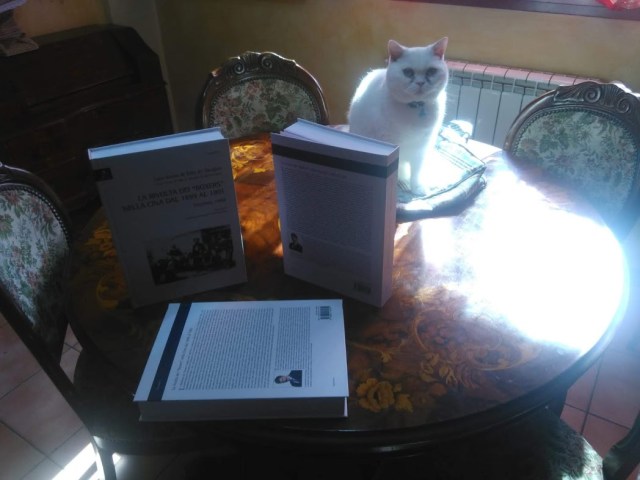
Publication of “La rivolta dei “Boxers” nella Cina dal 1899 al 1901”

I have contributed a preface to the book “La rivolta dei “Boxers” nella Cina dal 1899 al 1901” by Prof. Dr. Luca Scotto Tella de’ Douglas di Castel di Ripa, published by Aracne Editrice in Rome. I am also one of the dedicatees of the book.

The Rebellion of the “Boxers” (boxers, specifically Chinese Boxing practitioners of the Kung Fu Wu Shu), or more correctly the Yihetuan Movement, was the culmination of the nineteenth century Chinese resistance to Western Colonialism and to foreign and Christian influences in China. Foreign colonialism was not the only trigger for the violence that broke out in Shandong and the plains of Northern China, but it was certainly one of the main causes of resentment. After being defeated in several wars, China was forced to allow the incursion of Western culture and influence through unequal treaties. Christian Missionaries, an extension of their Western governments, often disrespected the Chinese people and constantly provoked them. In 1897–98, Shandong Province was hit first by drought and subsequently by floods. Threatened by hunger, the farmers were forced to flee to the cities, however the Missionaries fed only those who converted (the so-called “Rice Christians”). In November 1897, a group of gunmen killed two German Missionaries in what became known as the “Juye incident”.

The book is of 760 pages. It is available from Amazon and other booksellers.

Publication of “L’Ordine Equestre del Santo Sepolcro di Gerusalemme”

I have contributed a preface to the book “L’Ordine Equestre del Santo Sepolcro di Gerusalemme” by Prof. Dr. Luca Scotto Tella de’ Douglas di Castel di Ripa in collaboration with Maurizio Cancelli, published by Aracne Editrice in Rome.

The Equestrian Order of the Holy Sepulchre of Jerusalem (in Latin: Ordo Equestris Sancti Sepulcri Hierosolymitani, OESSH), also called the Order of the Holy Sepulchre or of the Knights of the Holy Sepulchre, is a Roman Catholic Knightly Order placed under the protection of the Holy See. Its main mission is to “support the Christian presence in the Holy Land”. According to ancient tradition, the Knights had the power to create other Knights, thus obtaining even the privilege of making even those Knights who were not nobles from birth become nobles. In addition, the acquisition of nobility also came from belonging to the Order. Among the privileges of the Order, registered by its Guardian in 1553 and approved by subsequent Popes, were included some of the greatest granted to any Order. Among these we should remember the ancient papal tradition, never repealed, which gives the Knights of the Equestrian Order of the Holy Sepulcher of Jerusalem the title, granted by the Holy Father as Head of the Vatican State, of Count Palatine “Comes Palatii” (ad personam) of the Sacred Lateran Palace. The Order takes precedence in ceremonies and Apostolic Palaces over any other Religious-Chivalric Order and, according to experts and historians, in the hierarchy of the Pontifical Orders it would come immediately after the Order of the Golden Spur (currently quiescent), according to the ancient custom, although this rule is currently under discussion.

This study of the Order is undertaken from a perspective independent of the Vatican, and considers the Order in its historic, religious and nobiliary context.

The book is of 860 pages. It is available from Amazon and other booksellers.

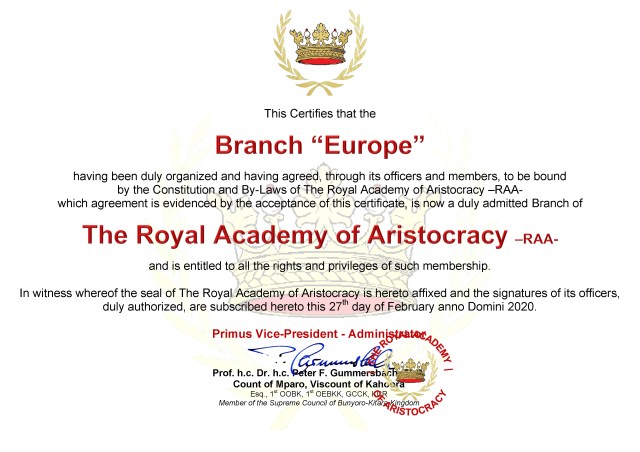
Honours and awards: Royal Fellow and Branch-Governor for Europe of the Royal Academy of Aristocracy

I have been appointed a Royal Fellow of the Royal Academy of Aristocracy and Branch-Governor for Europe of the Academy.

The Royal Academy of Aristocracy is an institution of the Kingdom of Bunyoro-Kitara (Uganda) designed to bring together the aristocrats of the world. Each appointment is made subject to the approval of the Royal Commission of Royalty and Nobility of the Bunyoro-Kitara Kingdom.

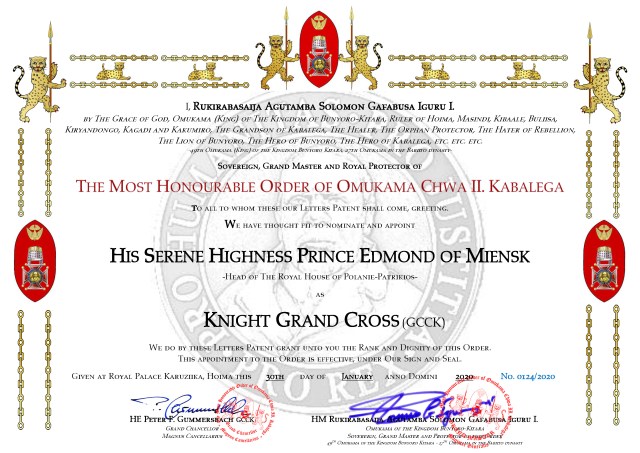
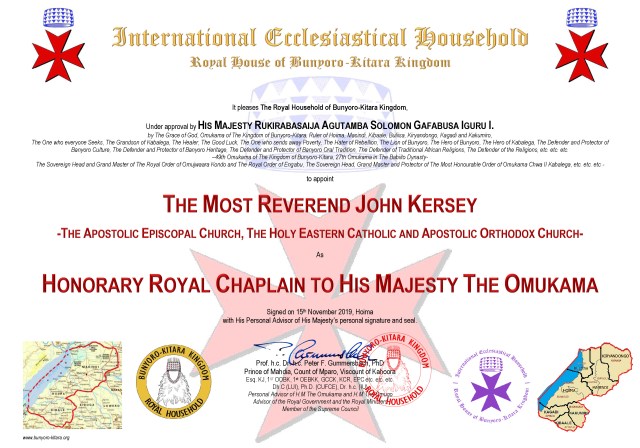
Honours and awards: The Most Honourable Order of Omukama Chwa II Kabalega

I have been honoured to receive appointment as a Knight Grand Cross in the Most Honourable Order of Omukama Chwa II Kabalega in the Kingdom of Bunyoro-Kitara. Bunyoro-Kitara is one of the constituent kingdoms of Uganda and the Sovereign, Grand Master and Protector of the Order is the reigning Omukama of Bunyoro-Kitara, H.M. Rukirabasaija Agutamba Solomon Gafabusa Iguru I.

HM The Omukama (King) of Bunyoro-Kitara Kingdom and the Bunyoro-Kitara Kingdom were restored by the Amendment [No. 8] Act – Statute No. 8, Article 118 (1)- of 1993 enacted by the Parliament of Uganda and officially recognized and protected by the Constitution of the Republic of Uganda by Chapter IV. –Article 37.-, Chapter XVI. -Article 246. (1) – (6)- of 1995 and by the Amendment [No. 2] Act -schedule V. -Article 178.8- of 2005 and by the Acts Supplement [No. 4] -Act 6. of 2011.

The Order was founded in 2010 and commemorates the present Omukama’s grandfather, the last absolute ruler of Bunyoro-Kitara.

Honours and awards: Recognition of Royal House Polanie-Patrikios by the Bunyoro-Kitara Kingdom

The Royal Office of Orders, Honours and Awards Affairs of the Kingdom of Bunyoro-Kitara (Uganda) has officially recognized the Royal House Polanie-Patrikios, of which I am head. Consequently, the titles and honours of the Royal House Polanie-Patrikios are fully recognized and may be used officially in the Kingdom of Bunyoro-Kitara.

Publication of “Attacco alla Massoneria”

I have contributed a preface to the book “Attacco alla Massoneria” by Prof. Dr. Luca Scotto Tella de’ Douglas di Castel di Ripa, published by Aracne Editrice in Rome.

This powerful monographic text on Freemasonry and its enemy, Anti-Freemasonry, is not only the umpteenth valuable cultural and didactic work of the author, well known and appreciated for his detailed, painstaking, exquisitely interdisciplinary and multidisciplinary research (for example, his latest book, on the Kamikaze, Vento Divino, was published by Aracne in January 2019) but also represents an encyclopedic and university-level publication of a unique scientific and academic importance, of international and world caliber, since such a monumental study on Freemasonry, richly illustrated and enriched both by many footnotes, and by a large and highly accurate Masonic, religious, philosophical, spiritual and numerological glossary-dictionary, was never created, much less conceived before now. The topic is treated as usual across the board and so as to allow even those who are not already experts in the field – Freemason, esotericist, Gnostic or professor of History of Religions – to understand this ancient initiatory path, with a core of Solomonic and Hiramitic wisdom and with sapiential, mystical and initiatory contributions from the greatest and most ancient civilizations of our planet. This theme is still unfortunately unknown and misunderstood to most, so much so that the Free Masonry, or Freemasonry, or Royal Art, in the collective imagination, in Europe and especially in Italy, has always been wrongly connected to Satanism, thanks to the totally fictional books invented by Léo Taxil (1854–1907), to the underworld, and even to organized crime, while in reality the greatest philosophers, religious, statesmen, scientists, artists, musicians, captains of industry and philanthropists of history have been Masons. Freemasonry has been and is, in the history of humanity, similar to the sun in that everyone has enjoyed its salutary and life-giving effects (even unwittingly) and whose rays have shone and still shine refracting on every side. Nobody knows how to penetrate its sacred origin, because it is divine, to discover its luminous process and its intimate essence.

With interviews with Lidia Reghini di Pontremoli, Davide Scaranari, Ilenia Mastroscusa, Agostino Mario Cannataro; a Glossary, a Masonic Dictionary and multiple culturally useful curiosities.

The book is of 1,656 pages published in two volumes. It is available from Amazon and other booksellers.

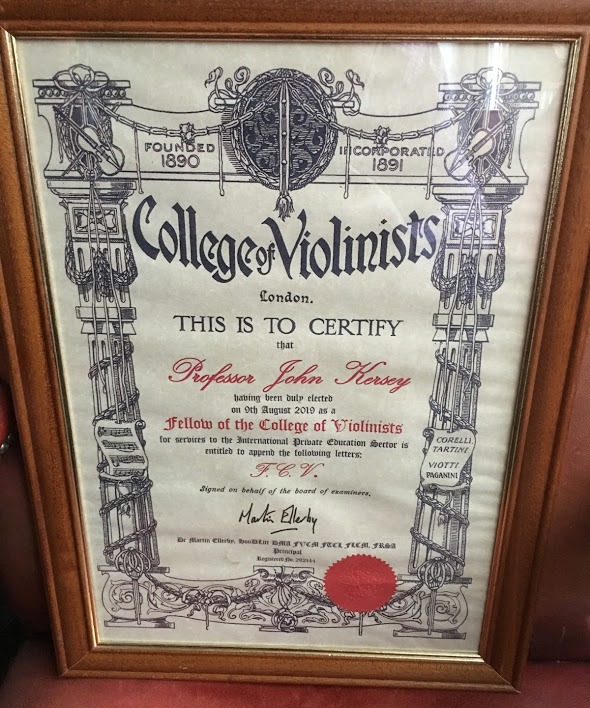
Honours and awards: Fellowship of the College of Violinists

I was greatly honoured recently to be elected a Fellow of the College of Violinists “for services to the International Private Education Sector”. The College of Violinists was founded in 1890 and has been administered by the Victoria College of Music since 1962. I was elected a Fellow honoris causa of the Victoria College of Music for services to the Performing Arts in 2010.

Today, the Fellowship of the College of Violinists is the highest honorary award of the Victoria College of Music, and is awarded to both violinists and non-violinists for services to the arts. It is awarded rarely and requires the unanimous agreement of Executive Council.


Elitism and libertarianism

For several years I was a council member and Director of Cultural Affairs of the former Libertarian Alliance, until its dissolution in June 2017. I continue to identify with many aspects of paleolibertarianism and with the Libertarian Alliance as that body was latterly constituted. However, the following quotation summarizes where I stand today regarding libertarianism in more general terms, particularly given the considerable changes in the British libertarian movement during the past decade:

“I was very much an ardent libertarian, free-market doctrinaire. But gradually I came to realize that those around me with similar views were very much unlike me personally. They were plebean populists. No appreciation for elitism, social hierarchy, and culture and tradition. They wanted to elevate the lowest among us through the medium of unregulated markets. I began to abhor this philosophy and no longer associate myself with it. I have come to appreciate that I am an elitist, through and through.”

The link in the paragraph above is to Sir Roger Scruton’s address “In Defense of Elitism”, the most significant passage of which is the following,

“A culture that is based in knowledge and in the distinction between real knowledge and mere opinion…[is] there because it’s been bequeathed to us by people who made sacrifices in order that it should occur. And we I think should learn to honour those sacrifices and to do our part in passing on these institutions and traditions in our turn. That doesn’t mean that we have to accept everything about them. We have to, on the contrary, make our own living contributions to them. And they have to be amended in lots of ways. But I think, above all, we have to keep alive the collective memory of what we are as a people. That doesn’t reduce to merely what the majority of people presently happen to want.”

Personal observations on the episcopate in the smaller churches

These general observations serve as a postscript to my autobiographical series entitled Life in the Church.

I am sometimes asked how my office as a bishop in the smaller churches differs from that of bishops in the larger, mainstream denominations. Clearly there is a difference in the numbers concerned, both in respect of clergy and laity. That makes the bishop a more immediate and accessible figure in the smaller church, and also means that the bishop can undertake more in the way of a presbyteral ministry. Bureaucracy is generally more streamlined internally, but no less so in respect of conformity to external laws and requirements, which can involve multiple jurisdictions and require some degree of legislative expertise and linguistic dexterity.

A smaller church will inevitably bear the imprint of the bishop who leads it. In the modern age of centralized, committee-run churches, this is unusual, as is the directly hierarchical structure in which the presiding bishop has the final say on all matters. The model that works best in this situation is that of the benevolent dictator, but it is crucial that in exercising authority, the bishop is aware of the implications of his decisions on the church as a whole. He may have the ultimate responsibility before God, but he would be foolish not to listen to his clergy and laity. I have been surprised over the years how many outside my churches have wrongly assumed that the policy of my churches is merely a direct reflection of my own views. In fact, policy is carefully crafted bearing in mind the significance of tradition, external requirements (such as legislation), the need for accountability and the nature of the body of active clergy and laity as it may be constituted from time to time. My role is to integrate these factors and to consider, after prayer and reflection, how they may be best expressed in practice.

Probably the biggest point of similarity with the larger churches is in dealing with the clergy and the challenges they face. These raise familiar and universal themes, but within a structure such as the Catholicate of the West where the clergy are all non-stipendiary, there is the additional factor that the connexion between the clergy and their church is more readily frangible; there are many competing denominations, and where church buildings are not owned centrally, they can move jurisdiction with the clergyman in question. This tends to produce a pressure for smaller churches to advance their clergy irrespective of pastoral necessity, in order not to lose them to other churches where they might find such advancement more readily. I have always taken the view that this pressure is to be resisted. Holy Orders are conferred for the Church, not for the individual benefit of the person concerned, and it means considerably more to be a priest in a well-run church than it does to be a bishop in those jurisdictions where the episcopate is indiscriminately conferred. With most smaller churches being “top heavy”, what is actually needed is more deacons and priests, more lay ministers, and of course, more laity.

The experience of working with others within small religious bodies tends to heighten differences that would be more readily absorbed within a larger organization. When the group of clergy is small, there is a risk of dominance of the more extrovert personalities at the expense of others, and where there is a clash of ideologies or personalities it will become more readily apparent at an early stage. Over the years, I have been privileged to work with some outstandingly gifted clergy, who have been every bit the equal of those to be found in the larger churches. Notwithstanding this, there have been occasions when it has been necessary to admit that the paths of clergy have diverged to an incompatible extent from the nature of our church, and occasions where working relationships have sadly broken down. Wherever possible, my duty is to assure stability and to manage change in a way that is organic and that offers reassurance as to the way ahead.

There are inevitable difficulties in relations with members of other churches who have a prejudiced view of our traditions and practices. The smaller churches have not proved immune from the scandals of abuse that have affected the mainstream communions, and so there is a particular need for vigilance in respect of the selection of ordinands and others who may be placed in positions of trust. On a more subjective level, there are issues where I take a particular position in view of some of the more justified criticisms that have been levelled at the smaller churches over the years. I have always insisted that candidates for admission to the clergy be of graduate standing and undergo background checks (including in some cases psychological testing by a qualified professional). Those convicted of criminal offences are not eligible for admission to the clergy. I require of the clergy that they conduct a purposeful and visible ministry in the community, or follow a contemplative vocation guided by a Rule of Life.

More generally, I try to avoid “hard edges” in theological interpretation, mindful that it is the pastoral application of theology that is at the heart of Christian ministry. I have also always taken a studied disinterest in the minutiae of liturgy, ceremonial, and ecclesiastical robes, having too often seen these things lead clergy down the wrong paths and away from our proper priorities. I hold, in the words of Mar Georgius of Glastonbury, that “the most spiritual people are usually the most natural”.

Regarding the question of titles, I believe that these should serve a practical purpose within the body concerned, and be integral to the preservation of its distinctive ethos. Often, those who object to titles are objecting primarily to the hierarchy that they signify, and yet hierarchy is fundamental to the nature and governance of all the churches that I lead today, having been inherited by me as a living tradition and continued accordingly. I do not interpret Christianity as supporting egalitarianism, and neither did the overwhelming majority of Christians prior to the second half of the twentieth-century.

I am a firm believer that integrity in the episcopal office is best served by a thorough knowledge both of the Church and her mission and of oneself. The diversity of character among those called to the episcopacy is considerable; some are obvious saints, some are of a monastic mien, some are parish priests writ large, while others are sadly clearly more at home with administrative responsibilities than with people. My own approach is to be and give of myself as much as I can, and through this, to try to lead people to Jesus by my own, inevitably flawed, example. Key to my approach is to try to meet people at the point they have reached on their spiritual journey.

The Anglican tradition of “muscular Christianity” has a certain appeal for me, and points towards a degree of unstuffiness in which the Christian way becomes the natural context for our values and behaviour, integrated indelibly into the archetypal English character and the history of our nation. I also identify with the concept of the guardian of multiple traditions, maintaining and preserving these in good order so that in due course they will survive me. Although these are sober and sometimes weighty responsibilities, I try to remain as grounded as possible and not take myself too seriously, which is an easy task with three young children.