In my capacity as Primate of the Apostolic Episcopal Church, I authorized the issue of two charity medals in memory of the late Bishop Juliusz Nowina-Sokolnicki. The Most Revd. Juliusz Nowina-Sokolnicki (1920-2009) served as Assistant Bishop of the Apostolic Episcopal Church in Great Britain both as deputy to the late Archbishop-Count George Boyer and as bishop with special responsibilities for the Polish-speaking peoples. He was consecrated for the Apostolic Episcopal Church on 27 May 1983.
Juliusz Nowina-Sokolnicki is best-known in his capacity as the head of one of the two entities that maintained rival claims to be the Polish government-in-exile between 1971 and the fall of communism in 1990. He was Prince Grand Master of the Order of St Stanislas.
The Charity Medals were issued in gold (for outstanding merit) and silver. For each medal, a donation was made to support activity centres for children from poor families in Wrocław, Poland.
The Committee of the Charity Medals in Poland made the decision that I should be one of the recipients of the gold medal.
The St Cecilia School of Music was founded in 1974 in Launceston, Tasmania. The initial aim was to develop a professional, full-time teaching School which catered for the growing number of music students in Northern Tasmania. This aim was rapidly fulfilled.
Within a short period of time over 1,000 music students were enrolled in the School with 18 fully-qualified professional music teachers. The tradition of offering high-quality music education continues to this day.
The expansion of the School’s Examination system (St. Cecilia Examinations) resulted from a need for a more relevant, innovative and exciting approach to assessing the capabilities of music students at all levels. The examination system also offers professional teaching and performing qualifications.
St Cecilia Examinations is now a powerful force in the music world with centres operating in major towns and cities throughout Australia, New Zealand, Asia and Europe.
In 2016, I was awarded a Fellowship honoris causa by the School.
I have been honoured to receive the decoration of the Związku Polskich Spadochroniarzy w Warszawie – the Polish Union of Parachutists, Warsaw branch. The Union was established in 1989 by a group of former paratroopers. It brings together military veterans, current military paratroopers and reservists, as well as some civilians involved in parachuting professionally or for recreation. It is officially registered as a public benefit association in law and is a member of the European Federation of Paratroopers and the Federation of Associations of Reservists and Veterans of the Polish Armed Forces. The Warsaw branch is one of forty branches in Poland and Germany.
The Sovereign Orthodox Order of the Knights Hospitaller of St John of Jerusalem is a direct descendant of the world’s oldest order of chivalry. Founded around 1023 by Blessed Gerard Thom to provide care for poor, sick and injured pilgrims to the Holy Land, it was associated with an Amalfitan hospital in Jerusalem. When Jerusalem was conquered by Christians during the First Crusade in 1099, a Papal charter was issued to the Hospitallers as a religious and military order responsible for the care and defence of the Holy Land. After the Holy Land fell to the Muslims in 1291, the Order moved first to Cyprus, and then in 1309 captured Rhodes, where it became sovereign. The dissolution of the Knights Templar in 1312 was to the benefit of the Order, and at this time eight “tongues” of the Order were established in the countries where it was active. In 1522, the knights were defeated after six months of siege by the Muslim forces, and retreated to Sicily. In 1530, King Charles of Sicily gave them Malta, Gozo and Tripoli, which they ruled as a perpetual fiefdom in exchange for an annual falcon as tribute. In 1565, following the Great Siege of Malta, the knights won a significant victory over the Muslims, though hugely outnumbered.
During the Reformation, some of the Order’s commanderies in northern Germany and the Netherlands became Protestant and have remained so ever since, and the Order was disestablished in England, Denmark and other northern European countries. Having lost the initial reason for its existence, and with no battles to fight, it turned its attention to combatting piracy and saw a period of economic decline as its currency, the scudo, lost value. As a result, the knights began to attack Muslim ships in search of plunder, and again became wealthy. Many enrolled in foreign navies in search of adventure. This meant that grants to the Order diminished and that its economic survival became more and more dependent on conquest. Notwithstanding this, Malta flourished under the Knights and became regarded as one of the great powers of Europe.
The French Revolution saw the attempted abolition of the Order, and in 1798, Napoleon I captured Malta, forcing the knights to surrender. This signalled the end of the Order on Malta after 268 years. The largest group of knights made their way to Russia, where Czar Paul I (pictured at left wearing the Crown of the Order) gave them shelter and was elected their Grand Master, with the Apostolic Delegate to St Petersburg, Mgr. Lorenzo de Litta, officiating at the ceremony. Historians differ as to whether the original Order survived at this point, or whether, the original Order having been dissolved by Napoleon, new Orders of St John were now created respectively by Czar Paul I in 1798 (the Russian Order), and by the Pope from 1803-14, revived in 1879 (the Sovereign Military Order or Order of Malta), both of which have claimed the tradition of the original Hospitallers, together with various other bodies, some of which gained the protection of their respective states*.
The Order under Czar Paul I was recognized among the Russian Imperial Orders and the Czar created a Russian Grand Priory consisting of 118 commanderies. The Czar was Orthodox and his Grand Priory was open to all Christians, also having provision for Roman Catholic members of the Order. Under decrees of Czar Alexander I of 1810-11, the Russian Grand Priory was made a fiscally separate community from the Order overseas, and in 1817 a further decree forbade the wearing of decorations of the Order that had been granted outside the Russian Grand Priory by the Roman Catholic Order. In 1811, total membership of the Russian Grand Priory stood at 853 knights. A number of the commanderies were hereditary and portraits of Russian nobles wearing the Order can be found throughout the nineteenth-century, including that of Count Vassiliev pictured above. In 1916, Czar Nicholas II appointed two Hereditary Commanders in the Order.
In the wake of the Russian Revolution of 1917 the Order went into exile. In 1928, thirteen surviving Hereditary Commanders of the Order met in Paris as the Union des Commandeurs et Chevaliers Hereditaires, supported by three others, and set about re-establishing the Russian Grand Priory. Their Declaration read, in part:
“Later events have limited the activity of the Grand Priory of Russia; a revolution had provoked a deficiency in the legitimate power throughout the Empire; yet nothing could weaken our hereditary right as a regular affiliation and as a sovereign order of chivalry. We were born with this privilege and we retain it without further question in law. Circumstances dictate that we should now sustain without futile and vain ostentation, the prerogatives acquired by our ancestors. The tragic test which overwhelmed our Fatherland calls us to an activity full of abnegation and sacrifice worthy of the best traditions of the illustrious Order of St John of Jerusalem. It is, therefore, our duty that all of us shall initiate the following:
1) Re-establish the activity of the Russian Grand Priory of the Order of Malta created and regularised by a treaty signed on the 4th-15th January, 1799, between the Throne of Russia and the Sovereign Order of Malta.
2) Appeal to direct descendants of other Russian Hereditary Knights of Malta in order to urge them to rally with us within the fold of the Grand Priory of Russia which we are reconstituting abroad.”
The Grand Priory was under Grand Priors Grand Duke Alexander Mikhailovich until 1933, and Grand Duke Andrei Vladimirovich from 1933 to 1956. On 31 July 1950, Grand Duke Andrei issued a declaration that the Order of St John and its Hereditary Commanders were never abrogated in Russia and continued to exist. In addition, Grand Duke Kyrill Vladimirovitch, as Head of the Imperial House (also Grand Cross of the Order of the Crown of Thorns), made several appointments of Hereditary Commanders in the Grand Priory during the period 1934-36. On 9 December 1953, a constitution was established at a meeting in Paris, and in February 1955 the Grand Priory was registered as a foreign association under French law as “The Russian Grand Priory of the Order of Saint John of Jerusalem”. In 1956, Grand Duke Vladimir Kirillovich became Protector to the Grand Priory, but refused the title of Grand Prior. He was succeeded as Dean by Hereditary Commander Nicholas Tchirikoff, who died in 1974, and by the Secretary of the Paris group, General Georges Sergeievitch Rtitcheff, who died in 1975.
Two of the Hereditary Commanders had become members of the branch of the Order of St John (Order of St John of Jerusalem, Knights Hospitallers), that was under High Protection of the late King Peter II of Yugoslavia, who is pictured at right. Following the death of King Peter in 1970, these two, Prince Sergei Troubetskoy and Prince Serge Sergeievitch Belosselsky-Belozersky, formed a Priory in New York in 1972 together with another Hereditary Commander, Count Nicholas Alexeievitch Bobrinskoy, great-great-great grandson of Empress Catherine the Great. This Priory became the centre for attempts to unify the remaining Hereditary Commanders and their descendants, and to bring together other elements of the King Peter Order which had split into factions after the King’s death. An alliance was also pursued for a time with the Most Sacred Order of the Orthodox Hospitallers, which was under the patronage of the President of Cyprus. On 20 April 1977, a meeting took place at which three Hereditary Commander families were present along with other Russian nobles, and this elected Count Bobrinskoy as Grand Prior of the revived Russian Grand Priory.
The Russian Grand Priory was registered and incorporated as a non-profit charitable institution in the United States and began an energetic programme of fundraising. It received canonical recognition from the Russian Orthodox Church outside Russia (1974), the Russian Orthodox Church in America (1974) and the Orthodox Church of America (1983), and in 1992, HH Alexey II, Patriarch of Moscow and all Russia, became Spiritual Protector of the Russian Grand Priory and permitted its return to its ancient homeland, which occurred in 1996. Although under Orthodox protection, the Russian Grand Priory has preserved its ecumenical character; however, a condition of the blessing (strictly maintained since) is that the Russian Grand Priory should not admit Roman Catholics or Freemasons. In addition, the Russian Grand Priory gained the Imperial Protection of the House of Romanoff from 1977 until 2008, with successive Protectors Prince Andrei Alexandrovitch of Russia (1977-81), Prince Vassily Alexandrovitch of Russia (1981-89) and from 1990-2008 Prince Michael Andreevitch of Russia, who was Vice-President of the Romanoff Family Association. In 2006, following the death of Count Bobrinskoy, Prince Michael was elected Grand Prior of the Russian Grand Priory. He was succeeded in 2009 by Hereditary Family Commander Count Alexander Woronzoff-Dashkoff. In 2011, the Order changed its registered name to the Knights of the Orthodox Order of St John Russian Grand Priory, known for short as the Orthodox Order of St John.
In 1998, the Russian Grand Priory commemorated the 200th anniversary of its foundation in St Petersburg. In 2004, the Russian Grand Priory announced the re-establishment of the 1928 Union des Commandeurs et Chevaliers Hereditaires in France, with the involvement of descendants of the original Hereditary Commanders and their families. The Russian Grand Priory has never appointed a Grand Master, and continues to regard the Grand Master of the (Roman Catholic) Sovereign Military Order of Malta, currently Fra’ Matthew Festing, as overall Head of the Order. It is, however, organizationally completely separate from the Order of Malta and is not subject to its governance. A charter from the late King Baudouin of Belgium led to the admission of the Russian Grand Priory to the United Nations as an NGO.
My involvement with the Order of St John began not with the Russian Grand Priories but with the Sovereign Order of St John of Jerusalem – The Hereditary Order. This branch of the Order had developed from the King Peter Order and was led from Malta by the late Marquis Kelinu Vella Haber as Grand Master. It was internationally represented and active, publishing a quarterly journal of its affairs. In 2002, following nomination by Dr W.H. Munro, who I had come to know through the World University Roundtable, I was admitted as a Knight of Grace of the Order at a ceremony at the Guildhall in Coventry. The Order in Great Britain was headed by the late Baron Kenneth Benfield de Palmanova, who was a former Mayor of Coventry and was Lieutenant Grand Master of the Order internationally. At the time, I was one of the youngest members of the Order. Kenneth Benfield was 87, while the Grand Prior, Captain Bruce Peace, TD, had just celebrated his 88th birthday. I was presented with a set of Italian-made insignia that had previously been owned by the musician and educationalist Dr Leonard Henderson, who had been a Knight of the Order and a member of many of the musical associations with which I was involved.
The investiture at Coventry Guildhall – I am first on the left with two Dames, the Grand Prior, and the Chaplain, the Revd. Douglas Pharaoh
Unfortunately, the Order in England became inactive after the death of Kenneth Benfield in 2007, and my letters to the English office and the Malta headquarters received no reply.
In the intervening years I had been ordained and consecrated bishop, and in 2011 had been elected Prince-Abbot of San Luigi. In 2012, I accepted an invitation from the Prelate, my friend the Most Revd. Howard Weston-Smart, to become a Chaplain to the British Association of the Russian Grand Priory. This had developed from the former Grand Priory of the British Isles of the King Peter Order, and was subsequently constituted as a registered charity under the Presidency of Alexandre Tissot Demidoff, who was a descendant of a Hereditary Commander of the Order. I was installed at the investiture at the Church of Our Most Holy Redeemer, Clerkenwell, London, on 30 June 2012. After nine years as Chaplain, I resigned from all appoitments in the British Association in September 2021.
After my installation
Meanwhile, in September 2005, Prince Michael of Russia and Count Bobrinskoy had erected the Commandery of Carpathia of the Russian Grand Priory. Among the very limited appointments subsequently made to this Commandery were the late Dom Klaus Schlapps, OPR, OA, Duke of Saih Nasra in the Abbey-Principality of San Luigi, and myself. Both of us were appointed as Prelate – Knight Grand Cross of Justice, and the privilege of extraterritoriality was extended to my appointment. The category of Justice is exclusively reserved, as was the case historically, for those who can provide proof of noble status. Dom Klaus and I discussed the formation of a presence of the Russian Grand Priory in the United Kingdom on several occasions. We both deplored the divisions that had come to exist between the representatives of the Russian and Yugoslav traditions of St John and sought, in the spirit of the efforts of the 1970s, to bring about unity where possible.
Following the sudden and unexpected death of Dom Klaus in January 2013, a number of changes took place. It became clear that, although it was wished that amicable relations should continue with the Carpathian Commandery and the present-day Russian Grand Priory, some degree of independent re-organization would be necessary in order to continue the work that Dom Klaus and I had planned together.
In August 2013, the committee of the Supreme Council of the Abbey-Principality of San Luigi that had been created to examine the matter petitioned me in my office as Prince-Abbot to exercise my right as a fons honorum to erect an autonomous and extraterritorial Protectorate of San Luigi of the Orthodox Order of the Knights Hospitaller of St John of Jerusalem. The Protectorate used the former name of the Order to distinguish itself from the name that was currently in use by the Russian Grand Priory. This name was used in full on all official documents.
The Proclamation, no. 2013/72, issued by me in my office as Prince-Abbot of San Luigi on 20 August 2013, reads as follows:
“We, Edmond III, by the grace of God Prince-Abbot of San Luigi etc. etc., being desirous of giving a proof of our particular esteem and affection towards the Orthodox Order of the Knights Hospitaller of St John of Jerusalem, declare, that we take the said Order under our protection and that of the Abbey-Principality of San Luigi; and that we will employ every possible care and attention to maintain it in all its rights, honours, privileges and possessions.”
When I additionally succeeded as Prince of Miensk and Ecclesiast of All Byelorussia and as head of the Royal House Polanie-Patrikios in March 2015, the decision was taken to elevate the Protectorate to the status of a Royal Byelorussian organization, thus bringing it closer to its immediate history and heritage.
As a result, the present character of the Royal Byelorussian Protectorate of the Orthodox Order of the Knights Hospitaller of St John of Jerusalem is that of an ecumenical and extraterritorial Christian ecclesiastical community under my aegis as Prince of Miensk and Ecclesiast of all Byelorussia. As such, it represents a return to the Order’s origins as a body under religious governance.
While it shares a common history with other institutions representing the Order of St John and the Russian Grand Priory and is open to the possibilities of collaboration with them, the Protectorate is self-governing and has no official relationship with any other Order of St John at the present time. Membership in the Protectorate is strictly by personal invitation of the Prince of Miensk and is extended ecumenically to all Christians, with non-Christians admitted to all ranks as honorary Knights or Dames. Associate membership is extended to members of other legitimate Orders of St John who wish to support the work of the Protectorate; if admitted as associates, they retain their existing rank in their “mother Order” and cannot be promoted within the Protectorate. The Protectorate preserves the historical and nobiliary traditions of the Order that it has inherited by virtue of its antecedence, and as is traditional, voting rights are reserved to members in the category of Justice. Since it also has a distinctive ecclesiastical character, it is especially devoted to the support of the work of all Johannites worldwide through prayer.
*Those interested in the history of the Order of St John and the modern representatives of its legacy are recommended to read the thesis of Dr. Hendrik J. Hoegen Dijkhof “The legitimacy of Orders of St. John” (doctoral thesis of the University of Leiden, 2006, available online at https://openaccess.leidenuniv.nl/handle/1887/4576).
The present-day Military and Hospitaller Order of St. Lazarus of Jerusalem looks back to an ancient origin. At some time after 1098, the crusaders at the Latin Kingdom of Jerusalem founded this order of chivalry at a leper hospital. The founding knights were themselves lepers, and they devoted their order to the treatment of those with the disease. King Baldwin IV of Jerusalem, who was a leper, may have been a knight of the Order or received assistance from it. It was probably by the end of the twelfth-century that the Order had become a military order, and the four classes of members – brothers, knights, clerics and donors – were acknowledged in a Bull of Pope Gregory IX of 1227. Definite evidence of the Order’s active participation in military campaigns is only documented in 1234 when Pope Gregory IX made a general appeal for aid to the Order to clear debts contracted in the defence of the Holy Land. The Ordinis Fratrum & Militum Hospitalis Leprosorum S. Lazari Hierosolymitani under the Augustinian Rule was confirmed by the Papal Bull Cum a nobis petitur of Pope Alexander IV in April 1255. The order established “Lazar houses” across Europe to care for lepers, and was well supported by other military orders which compelled brethren in their rule to join the order on contracting leprosy.
The symbol of the Order of St Lazarus is the eight-pointed green Maltese cross. This is believed to have given rise to the use of a green cross as a symbol by pharmacies worldwide.
The order remained primarily a hospitaller order but it did take part in a number of battles, including the Battle of La Forbie on 17 October 1244 (where all of the Lazar brethren who fought died) and the Battle of Al Mansurah on 8–11 February 1250. The leper knights were protected by a number of able-bodied knights but in times of crisis the leper knights themselves would take up arms. The order quickly abandoned their military activities after the fall of Acre in 1291 and the dissolution of the Knights Templar due to their relative poverty. After this, the knights moved to Cyprus, then Sicily and finally to Boigny near Orléans in France, where King Louis VII of France (ancestor of the Princes of Miensk) had given the Order a property in 1154, which had been the Order’s headquarters outside the Holy Land.
In 1308, the Order was placed under the temporal protection of King Philippe IV of France. This protection was confirmed in 1604 by King Henri IV, and in 1608, the order was merged with the Order of Our Lady of Mount Carmel, becoming the Royal, Military and Hospitaller Order of Our Lady of Mount Carmel and St. Lazarus of Jerusalem. This amalgamation eventually received canonical acceptance on 5 June 1668 by a bull issued by the Cardinal Legate de Vendôme under the authority of Pope Clement IX. While being a French Royal Order, the Order remained under apostolic authority. Meanwhile, in 1572, Pope Gregory XIII had merged the Italian branch of the Order with the Order of St Maurice (founded 1434), creating the Order of Ss. Maurice and Lazarus, of which the Head of the Royal House of Savoy is Grand Master today.
In 1791, the French Revolution suppressed the Order in that country and confiscated its property. However, the future King Louis XVIII (pictured left wearing the Grand Cross) continued to confer it in exile, and on the restoration of the monarchy the Bourbon monarchs continued as protectors until 1830. On 12 March 1825, King Charles X issued a declaration that the United Order of Our Lady of Mount Carmel and St. Lazarus of Jerusalem would be allowed to become extinct. Under canon law, this would occur one hundred years after the death of the last member unless the Order was canonically re-organized. The last such member died in 1856, which would have allowed for canonical re-organization until 1956.
In the event, canonical re-organization had occurred in 1841, when the Melkite Greek Patriarch Maximos III (Mazloum) granted his spiritual protection to the Order, and this state of affairs continued under his successors until the Patriarch transferred the government of the Order to a Council of Officers in Paris in 1910. This was confirmed by blessing of Patriarch Cyril VIII (Geha) (pictured right) on 3 June 1911. The factual position regarding the protection of the Order in the nineteenth-century has since been confirmed by successive Melkite Patriarchs to this day, notably by Patriarch Maximos IV (Sayegh) in 1965 and Patriarch Gregorios III in the Kevelaer Declaration of 2012. It should also be remembered that the Patriarch was a fons honorum by right of his office.
Although much of the nineteenth-century had been a period of decline for the Order, by the 1930s it was active once more, being led by Comte Charles Otzenberger-Detaille (pictured left) and the Duke of Seville. Otzenberger-Detaille was a member of the Order of the Crown of Thorns, and Prince-Abbot Edmond I of San Luigi was a member of the Order of St Lazarus under him, as well as having a close relationship to the Melkite church through Patriarch Antoine Aneed, who re-established the ecclesiastical jurisdiction of San Luigi in 1946. As a result, all the Prince-Abbots of San Luigi from Edmond I onwards, including the present Prince of Miensk, are in the episcopal succession of the Melkite Patriarchs. From 1961, at the initiative of the late Colonel Robert Gayre of Gayre and Nigg, the Order agreed to admit Protestants for the first time and became ecumenical rather than purely Catholic. Gayre became an enthusiastic promoter of the Order and ensured its expansion, though unfortunately a good deal of his energy was spent in attacking other Orders so as to vaunt the legitimacy of St Lazarus.
In 1973, the Order divided into two factions, the Paris Obedience and the Malta Obedience, which continued under separate Grand Masters, the Duke of Seville and the Duc de Brissac. A third faction emerged in 2004 under Prince Charles Philippe, Duke of Anjou. In 2008, a partial reunion was promoted between the larger Lazarite bodies, resulting in the emergence of the United Grand Priories.
The Constitutional Jurisdictions of Carpathia (Grand Priory of Carpathia) of the Order were formerly organized under the Paris Obedience. In 2008, they rejected unification under the United Grand Priories, citing many points of difference, among which was the proposed dilution of the hierarchical and nobiliary character of the Order and the rejection of its traditional history, and continued autonomously. The late Dom Klaus Schlapps, OPR, OA, Duke of Saih Nasra in the Abbey-Principality of San Luigi, became a member of the Order in 2005, becoming Senior Chaplain for the Commandery of Slovakia in 2006 and was subsequently promoted to Almoner (Grosskapitel) and Ecclesiastical Grand Cross Chaplain, the most senior chaplain in the Grand Priory. Dom Klaus held the offices of Preceptor of Bavaria and Commander of Klausenberg in Siebenbürgen. He was Patron of the International Green Cross Organization in Bavaria and a member of its Board of Directors. In November 2012, Dom Klaus was responsible for introducing me in my office as Prince-Abbot of San Luigi (also from 2015 Prince of Miensk) to the Order, in which I was appointed a Senior Chaplain in the rank of Knight Commander, in the category of Justice. The privilege of extraterritoriality was extended to this appointment so as not to bring about any conflict with existing Lazarite bodies in the United Kingdom; nor was any oath of obedience imposed. The category of Justice is exclusively reserved, as was the case historically, for those who can provide proof of noble status.
Following the sudden and unexpected death of Dom Klaus in January 2013, a number of changes took place. It became clear that, although it was wished that amicable relations should continue with the Carpathian Grand Priory, some degree of independent re-organization would be necessary in order to continue the work that Dom Klaus and I had planned together.
In August 2013, the committee of the Supreme Council of the Abbey-Principality of San Luigi that had been created to examine the matter petitioned me in my office as Prince-Abbot to exercise my right as a fons honorum to erect an autonomous and extraterritorial Protectorate of San Luigi of the Military and Hospitaller Order of St. Lazarus of Jerusalem in which, in consequence of my role as Protector, I would serve as Prelate Grand Cross of Justice.
The Proclamation, no. 2013/73, issued by me in my office as Prince-Abbot of San Luigi on 20 August 2013, reads as follows:
“We, Edmond III, by the grace of God Prince-Abbot of San Luigi etc. etc., being desirous of giving a proof of our particular esteem and affection towards the Military and Hospitaller Order of St. Lazarus of Jerusalem, declare, that we take the said Order under our protection and that of the Abbey-Principality of San Luigi; and that we will employ every possible care and attention to maintain it in all its rights, honours, privileges and possessions.”
When I additionally succeeded as Prince of Miensk and Ecclesiast of All Byelorussia and as head of the Royal House Polanie-Patrikios in March 2015, the decision was taken to elevate the Protectorate to the status of a Royal Byelorussian organization, thus bringing it closer to its immediate history and heritage.
As a result, the present character of the Royal Byelorussian Protectorate of the Orthodox Order of the Military and Hospitaller Order of St. Lazarus of Jerusalem is that of an ecumenical and extraterritorial Christian ecclesiastical community under my aegis in my offices as Prince of Miensk and Ecclesiast of all Byelorussia. As such, it represents a return to the Order’s origins as a body under religious governance.
While it shares a common history with other institutions representing the Order of St. Lazarus and is open to the possibilities of collaboration with them, the Protectorate has no official relationship with any other Order of St Lazarus at present.
Membership in the Protectorate is strictly by personal invitation of the Prince and is open to baptised Christians of any denomination. Non-Christians may be admitted to the ranks of the Order as honorary Knights or Dames. Associate membership is extended to members of other legitimate Orders of St Lazarus who wish to support the work of the Protectorate; if admitted as associates, they retain their existing rank in their “mother Order” and cannot be promoted within the Protectorate. The Protectorate preserves the historical and nobiliary traditions of the Order of St Lazarus that it has inherited by virtue of its antecedence, and as is traditional, voting rights are reserved to members in the category of Justice. Since it also has a distinctive ecclesiastical character, it is especially devoted to the support of the work of all Lazarites worldwide through prayer.
One of the curious things about education is that, having experienced it at first hand, everyone believes themselves to be an expert on it. This is particularly damaging in the case of politicians, whose record of interference in education during the post-war era has offered a prime example of the dead hand of the state going where it has no business to be. Meanwhile, those who supposedly are the experts – those who teach – have effectively presided over the decline of their profession through decades of mistaken ideology and a belief that their profession continues to offer the last resting place for the Marxist spirit of 1968.
It is difficult for us to imagine now, but there was a time not so long ago when our education system was largely independent of government. The universities, in particular, were held to be self-governing communities of scholars, which is the model of the university we inherited from medieval times. At Oxford, there was not even any formal government instrument that permitted the University to grant degrees; simply the acknowledgement that it had done so since time immemorial and should continue in a similar manner. The history of our schools begins with the grammar schools, established by the Church, and from these our great independent schools developed from collegiate foundations – Eton, Winchester, Radley – which were both closely allied to the universities of Oxford and Cambridge and, because they were boarding schools, could accept their pupils without geographical restriction.
Grammar schools have been much in the news recently and it is worth analysing some of the motives behind the debate on them and its wider context within our education system. I must declare a personal interest here: I was myself educated at what was at that time the top co-educational grammar school in the country. It was an academically highly selective school that was tremendously successful and which gave its pupils an outstanding education.
The history of state intervention in the grammar schools begins in 1869 under Gladstone, with the Endowed Schools Act. This Act followed upon the Public Schools Act of the previous year and proposed to restructure the endowments of the grammar schools so that they were more evenly distributed around the country and so that there was better provision for girls’ education. The Act changed many of the grammar schools which had been endowed to offer free classical education to boys into independent co-educational schools teaching a broader curriculum. The 1907 Education (Administrative Provisions) Act then introduced a requirement that all schools aided by government grant must reserve 25% of their places as free scholarships for students from the public elementary schools. This reform effectively brought about the grammar school in its twentieth-century guise.
It is with the 1944 Education Act that we see a designated role for the grammar schools as part of the tripartite system proposed, under which they would educate the top 25% of pupils. At this point there were around 1,200 state funded grammar schools, including not only those of ancient foundation but many which had been founded in the Victorian era, with its strong emphasis on self-improvement. In addition, there were 179 direct grant grammar schools, at which between 25 and 50% of pupils were educated free of charge and the remainder paid fees. All these became the maintained sector’s response to the independent schools; academic powerhouses dedicated to the needs of the most able.
We should now consider this system in its wider context. The tripartite system – divided between grammar schools, secondary moderns and technical schools – was designed to ensure that educational resources were distributed according to the ability of pupils to benefit from them and the state to provide for them. It was predicated upon the assumption that academically selective education produced the best results in terms of educating future leaders of the country in all areas, and above all upon the assumption that a university education should place academic excellence at the forefront of its priorities and should be reserved for those who stood to benefit most from it. It was academically competitive and there were consequences for failure at any level of the process. If, for example, you failed the eleven plus examination, you were unlikely to go to university.
Until 1965, this resulted in a situation where the universities were almost entirely filled by the products of independent and grammar schools. Their reputation was extremely high and their independence in academic terms was unquestioned. In a 1969 contribution to the educational “Black Papers”, Professor Richard Lynn wrote, “British education has been designed primarily to produce an intellectual elite. This is nothing to be ashamed of. Indeed, such an elite is necessary to keep going the intellectual and cultural tradition of European civilisation.” There was no suggestion in those days that the universities existed merely to train students for a career. Rather, they provided an academic education and existed for the purpose of propagating academic virtues, of which scholarship for its own sake and teaching were chief. Their graduates were, of course, in high demand by employers, but outside the specific professions, this was as much because of their intellectual calibre and qualities of character as it was because of any specific knowledge they possessed. In those days, the attitude persisted within independent and grammar school teaching that if someone was of the intellectual calibre to have graduated from Oxford or Cambridge they were capable of mastering and teaching any subject required at school level within reason. There were many examples of classicists who taught English Literature, or physicists who taught mathematics, and of course many academic staff also coached sport and music to a high level. Indeed, such breadth was viewed as a positive attribute.
We cannot pin the blame for the decline in our education entirely upon the Labour Party. It is quite true that many in the Labour Party have seen opposition to selective and fee-paying education as a cornerstone of their egalitarianism. But the Conservative Party has throughout the past fifty years signally failed to show support for academically selective education and as a result has been as willing a participant in our decline as its political rivals. The expansion of the universities during the 1960s took place under a Conservative government, which accepted the recommendations of the Robbins Report. The major expansion which followed during the 1990s and which is still ongoing has likewise been initiated by Conservatives. While the Conservatives introduced the Assisted Places scheme at independent schools in 1980, they have so far done nothing to bring it back since Tony Blair, himself an alumnus of Fettes, abolished it in 1997.
And yet, while our politicians can all trumpet that they have got more people into university education, what they cannot address is the fact that when you convert a selective education system into a mass education system you inevitably devalue the end product. In the 1960s it was extremely rare to see graduates working in non-graduate jobs because there was no graduate employment available to them. Nowadays it is commonplace. This transition has involved the creation of a deliberate untruth and its maintenance by an elaborate and costly bureaucracy. The untruth is that a British degree, wherever it is from, is a product of universal value. There is no end of quangos and interest groups – the Quality Assurance Agency for Higher Education, the Higher Education Academy, Universities UK, GuildHE – all of which are dedicated to maintaining that premise of “quality assurance”, to continually expanding higher education seemingly without limitation, and ultimately to what amounts to a universal higher education system whereby all who go to school can be admitted to a university.
It is interesting to note that the funding of education has told the truth far more than have the pronouncements from the powers that be. Until the 1990s, it was generally true that if you were successful in winning a university place, you would not have to pay for your education and you could access a grant that would cover your living expenses. With the rapid expansion in higher education and the conversion of the former polytechnics into universities came student loans to replace grants. Now, as the university sector expands even further, students in England and Wales must pay tuition fees in addition to the debts they incur for their maintenance.
Higher education has changed from an experience that was due to our brightest as of right to a commodity which is now available to all if they wish to pay for it, and particularly to foreign students who will pay even more than domestic ones. It is hardly surprising that if higher education is presented as a product within a marketplace – albeit a marketplace that consists entirely of a state monopoly – that the public will assess its value shrewdly and in many cases will decide that it is not worth the price being charged for it. That, however, cannot conceal the fact that for those who can benefit from academically selective higher education, that kind of education is increasingly subordinate to the mass higher education system, in which the scholarly ideal has been replaced by that of the Research Assessment Exercise and the demand for research to result in tangible product. Moreover any higher education is now increasingly out of reach for those without significant financial means or who are unwilling to incur significant debt against an uncertain return.
Education is the visible casualty of these changes, but it is not the only part of the picture. One very practical reason why governments have embraced mass higher education is because our society no longer has a large number of unskilled or semi-skilled jobs available. Where they are available, there is an increasing expectation that they will be filled by cheap immigrant labour. This leaves the unskilled native population to exist on benefits and occasional appearances on Channel Five. The government takes the view that the answer to this is to subject all to more education, hence its raising of the school leaving age. But this ignores the plain fact that of our population, a large number are not capable nor temperamentally suited to continuing their education. What they need is jobs, not an artificial means of keeping them off the unemployment statistics.
One curious characteristic of the decline of British education has been the willingness of those who have benefitted from its excellence to implement measures that have effectively denied the next generation the opportunity to benefit from the same opportunities as them. The losers in this are the academically able but financially impecunious. Social mobility is not something that should be the preserve of socialist politicians. During the 1980s there was much talk of Britain as a meritocracy, and yet the opportunities for those born in poverty to rise through the education system nowadays are fewer than they ever have been. Our politics, law, media and even the Olympics are now dominated by former pupils of independent schools. Since the effective abolition of the grammar schools the number of state school entrants to Oxford and Cambridge has fallen. This is not merely because pupils are not reaching the required academic standard but also because their teachers in too many cases believe that the top universities are elitist and that pupils should instead go to their local university much as they do their local school. In believing this, they condemn their pupils to fail.
An expectation has developed that those who are successful in our society will either pay for their children to be educated at independent schools, or will, usually for ideological reasons where they oppose selective education, send them to take their chances at the local comprehensive. The former option is becoming more difficult, because independent school fees are now pitched at a level that attracts the children of foreign oligarchs, and increasingly international students are taking more and more of the independent school places in this country at the expense of those from our own population who could benefit from such an education if only it were more reasonably priced.
The way in which properties are now sold according to the catchment areas of good schools tells us another fundamental truth; the education system may have abolished selection officially, but another kind of selection – one far less fair and far less transparent – is going on behind the scenes. We should not forget that the grammar schools had no catchment areas; they took everyone who passed the entrance exam regardless of where they lived. If you decide school admissions on the basis of property prices, you will create schools that are segregated by class and you will ensure that the poorest areas have the worst-performing schools.
League tables and OFSTED inspections are the government’s chosen means of reassuring us about the standards of our schools, but they are selective in the story they tell. Some examinations count for more than others, and schools have effectively played the system by entering pupils for them accordingly. On the other hand, weaker candidates have been withdrawn from subjects lest their results should reflect badly on the school’s standing.
And this brings us back to the grammar schools. When the Labour government abolished the tripartite system in 1965, it largely forced the maintained grammar schools to become comprehensives. Only in a few local authorities – just imagine today, local authorities defying central government! – did the grammar schools remain. In 1975, Labour ended the direct grant system and forced direct grant grammar schools to become comprehensives or independent schools if they wanted to continue. This left what remains today: 169 grammar schools in England and Wales and 69 in Northern Ireland.
We should ask why seventeen years of Conservative government between 1979 and 1997 did not see a renaissance for selective education, and indeed why further grammar schools closed or ceased to be selective during that period. The answer is that by this point, our education system had become one of the firmest bastions of the Left in the country. Its official endorsement of comprehensive education has been unwavering despite the eminently visible problems that have resulted from it. Any measure of reform or any challenge to the comprehensive system has been shouted down by the teaching unions, the university departments of education and the quangos – a group which Michael Gove used to refer to as “the blob”. He has said that these people believe that schools “shouldn’t be doing anything so old-fashioned as passing on knowledge, requiring children to work hard, or immersing them in anything like dates in history or times tables in mathematics…the result of their approach has been countless children condemned to a prison house of ignorance.” When I was at school, my teachers were drawn from all parts of the political spectrum. When I became a teacher myself, that was far less the case. My belief is that the comprehensive system exists to benefit one sector of society solely, and that is the teachers who find it ideologically to their liking.
By the end of my time in teaching it was axiomatic that whatever your politics, if you wished to teach, you would accept the Leftist orthodoxy that the profession had imposed and that you would not challenge it. That orthodoxy says, in essence, that all must have prizes and that the excellent are the enemy of the good. It sees education not as an academic pursuit but instead as a means of social engineering and vocational training, and as a means of reducing crime and social disorder. Over the years it has provided a happy home for all manner of Marxist nonsense and has enshrined teaching methods, particularly in basic English, that fail to achieve the same results as the traditional methods they replaced. It is not difficult to see the decline in the standard of written English in public life today compared to that of fifty years ago, and we have those teachers who promoted free expression ahead of spelling and grammar to thank for that.
Any education system will produce winners and losers. If we say that all must have prizes, then we must reconcile ourselves to the fact that those prizes will be of limited value. We cannot create their value merely by attaching government branding to them, for no-one believes that something is good simply because the government endorses it. Indeed, we had a situation in this country for many years where the products of the state monopoly, notably those of British Leyland, were regarded as markedly inferior to those of the private sector. The state can only win in education by deliberately retarding any perceived or actual competition. It does so through legislation – the Education Reform Act of 1988 effectively banned private sector universities – and for those entities that are private or independent in theory, it has devised a web of regulation and bureaucracy that in practice curtails their independence. OFSTED is one manifestation of this. Another is the devaluation that has characterized our exam system.
For many years, O and A level examinations were regarded as a gold standard. They were difficult to obtain and represented a high standard of achievement. They were unashamedly academic and required a high degree of factual recall. They could be taught in a way that stretched the most able and allowed for considerable extension activity. They were tested predominantly through timed examinations and not through coursework or continuous assessment. This was also the model of educational assessment maintained by the universities who were in turn responsible for the examination boards. While the CSE examination taken in secondary modern schools was not regarded as prestigious there is no question that it was a rigorous and well respected credential, as indeed were the awards of the former polytechnics. The fact that those awards were not degrees or were not O and A levels did not diminish their fitness for purpose, but it fostered a belief among egalitarians that they were second-tier qualifications and that they deserved the same titles as would be awarded to the more academically inclined. Unfortunately, this academic inflation has proved very costly. Because we no longer teach woodwork and metalwork in our schools, we end up importing our joiners and plumbers from Poland, and those who want to learn a skilled trade are unlikely to do so during their school years. The truth is that not everyone needs, wants or will benefit from an academic education, and when subjected to one against their will, it is unsurprising that many teenagers become disruptive and unco-operative.
It is interesting to note that while we have moved away from the academically selective model and from traditional modes of teaching and assessment, other former British possessions, notably India, have kept it and benefitted strongly as a result. The government determined to take the examination boards out of university control, to privatize them and to introduce competition. The result has been a race to the lowest denominator. The examinations are not invariably easier, but they have become increasingly turgid and reductive, with an emphasis on turning everything into something that can be easily and transparently assessed in simple terms. The GCSE examination, brainchild of Sir Keith Joseph and strongly opposed at the time by Baroness Thatcher, has been a misguided attempt to merge academic and vocational education, and the fact that a number of selective schools have turned to international examinations to replace it in recent years testifies to its limitations. It is also notable that many academically demanding schools now prefer the International Baccalaureate to A levels.
I believe that Michael Gove will come to be seen as the only Education Secretary of the past fifty years to have genuinely understood some of these problems and tried, in the face of overwhelming opposition from “the blob”, to address them. I hasten to add that this is not a general endorsement of Gove’s views or policy solutions, many of which I disagree with. He has, however, endeavoured to return rigour to our exam system and it may well be that he has, at least in some respects, succeeded. How lasting that success will be remains to be seen. Gove, after all, was replaced as Education Secretary because, so it is said, his approach was seen to be too confrontational; the opposition he had aroused included two votes of no confidence from three teaching unions, voodoo pincushions, anti-Gove T-shirts and an entire Twitter feed devoted to hating him. But the fact remains that we must confront the education establishment and we must win that confrontation if we are to achieve anything at all. The path of least resistance is to go along with the blob and do their bidding. The difficulty with that is that it fails those who lack a voice in this debate but whose interests need to be right at its heart: our next generation of pupils. Perhaps Gove, who was born far from privilege and won a scholarship to an independent school, understood this more than many of his colleagues.
I want to close by noting some aspects of the ethos of the grammar school. For all that academies and free schools may have some elements of it, they are still a long way away. The good grammar school is a highly structured and disciplined institution where academic values are at the heart of the life of the school and these are allied to an institutional endorsement of Christian principle irrespective of pupils’ own religious beliefs. It is formal in its rituals, encouraging teachers to wear academic dress, having a house system that is both pastoral and competitive, and maintaining high standards of uniform and behaviour. Often the school has an extensive history and distinctive, occasionally eccentric, traditions. What it teaches should be what the top selective universities demand. I well remember that my school did not teach certain subjects because those universities did not take them seriously at entrance, and that it disdained vocational studies altogether. Unlike the comprehensives, it is not a school where all are forced to study the same curriculum regardless of ability. Above all, it is a place where to excel academically is the norm and where to aim high is natural, with the expectation that the vast majority of pupils would go on to places at university and the best would go on to those which were rated most highly. If the grammar school is an elite, then it is not in my experience a complacent elite, but rather one where elite status must be earned anew by each generation of pupils and teachers. When such schools work, they offer a beacon of opportunity for those who, on merit, win a place at them. We need more of them. In 1997, John Major promised us a grammar school in every town, a phrase which has since been echoed by UKIP. It is time to restore our culture and values to our education system, and a strong grammar school system is the best way to do this.
With the writer on music Stuart Millson before the dinner
I was the invited speaker at the Traditional Britain Group Annual Dinner at the Royal Over-Seas League on 12 September 2015. Below is the speech given on that occasion. This transcript was also published at LewRockwell.com and at the Libertarian Alliance under the headlines “A propertarian speaks on the immigration crisis” and “Should the English people be abolished?”
My Lords, ladies and gentlemen, thank you for inviting me to address you tonight. I am going to address a few words on the current immigration crisis.
Let me begin with some considerations of principle. Freedom and civilisation are based upon a simple premise: that land should be privately owned. If we build a society based on the private ownership of land then there is no limit to our endeavour. For centuries, this was the foundation of the West; land was owned and managed by landowners who had a direct interest in its prosperity and an equally direct interest in the welfare of those who worked that land. If we seek the roots of the England we know and love, we find it most clearly in the private ownership of land.
In our time, this freedom has been challenged. Under socialism, and regrettably under governments that call themselves conservative, we have seen measures that have been designed to break the link between landowner and land, and instead to introduce a very different concept. This is the idea that sovereignty consists not in land but in the person. If the person is sovereign, then we will build a very different kind of society; indeed, we are unlikely to build a society at all, because individualism will cause that society to atomize into multiple and ever-changing identity groups.
Here, then, is the root of the immigration crisis. If we say that land is sovereign, then it follows that someone must exercise control over it. There are still substantial private landowners in Britain today, especially so in Scotland. But for our purposes, we should see land as it really is. There is no terra nullis in Britain today. Even that which is owned privately is subordinate to the Crown, and the Crown is effectively a surrogate for the people in its ownership and management of that land which is deemed to be held in common by the nation. I am not talking here of those private estates, such as the Duchy of Cornwall, which belong to the Crown, but instead of the vast mass of common land that we encounter every day of our lives and that is subject to the management of those who are, ultimately, servants of the Crown, whether as politicians, civil servants or local council workers. This is our land, and we are right to care about what happens to it.
This, then, is why as a propertarian, I find the immigration crisis so vexed by unclear thought. Land belongs to someone. If land belongs to the Crown, the Crown has a duty to manage that land in the best interests of the people of Britain, because it is on behalf of the people of Britain that the Crown holds that land in the first place. And that duty cannot be construed otherwise than to the people of Britain as they stand now. It cannot be a duty to foreigners or their governments, for how could that be in our national interest? Therefore we are faced with the prospect that the Crown and its servants believe that in permitting mass immigration to this country, they are actually acting in the best interests of the people of Britain. I believe they are quite wrong in this.
Let us now look more closely at what is going on at the moment. I believe that Janice Atkinson MEP has summed the situation up very well. Here is what she had to say,
“Let’s be clear about another thing: despite what the human rights industry and the massed ranks of taxpayer-funded charities and lobby-groups repeat, this is not a refugee crisis but a massive crisis of illegal immigration which must be resisted for what it is. A man who leaves Syria may be a refugee at the start of the journey. When he is illegally living in Calais and illegally attempting to enter Britain, he is an economic migrant and an illegal immigrant. The humanitarian consequences of the Syrian crisis are for the countries of the Middle East to manage. Not for Britain, not for France, not for Austria, not for Italy, not for the Netherlands, not for Poland, not for Romania. That cannot be said too often. Oil-rich, cash-rich petro-monarchies of the region must act. They claim to be our allies. Instead, some fund Islamic terrorism and allow hundreds of thousands to come to our countries against the wishes of our people.”
It seems to me that we have, since at least 1997, suffered a concerted political attack on our immigration system. The driving force behind that attack seems to be the belief that the person is sovereign; that anyone who wishes should be able to come to Britain regardless of the skills or abilities they would bring to our country or their cultural compatibility with it, and that the settled population of these islands should simply put up with it. We do not need to look far to find the cause of this. The Labour Party saw that immigrants and their descendants were among their core supporters. They believed that the more they opened our doors to immigrants the more they would create a Labour client state and effectively pack Britain with Labour voters. Others, influenced by the ideology of multiculturalism, saw mass immigration in the same way as theorists such as the Frankfurt School as a means of destabilising opposition to socialism and making the lot of conservatives a miserable one. In an interview in 2013, Lord Mandelson said “In 2004 when as a Labour government, we were not only welcoming people to come into this country to work, we were sending out search parties for people and encouraging them, in some cases, to take up work in this country.”
Now we are seeing the distinction between legal and illegal immigration further weakened. Having encouraged mass immigration, we cannot then profess ourselves surprised when people from countries where life chances are extremely poor decide that any chance to get across our borders is worth taking. We are told that if we send millions of pounds in international aid, and indeed if we intervene militarily in foreign wars, that we will help these people stay where they are and stabilise their countries. Don’t believe it. Those who are coming to Europe believe that the standard of living that their countries provide is inadequate by comparison with that of the West. They do not want mere safety, which is why they do not want to stay in Hungary. Rather, they see the prosperity that Britain and Germany represent, and they want to experience it for themselves.
What is happening to our immigration system is an erosion of its natural boundaries. Time after time, the Prime Minister assures us that we will get an immigration system that is tougher. When he says tougher, what he actually means is fairer; that is to say, fairer both to the immigrants and to those who are already here. And yet the changes made do not have the effect that is claimed for them, nor do they succeed in substantially lowering the numbers who enter Britain each year. I hear constant statistic-based arguments from both sides about whether immigration is economically beneficial. I do not believe that it is, because it artificially distorts our labour market. I certainly do not believe it is in anyone’s interest that we should have a class of super-rich international jet-setters employing an underclass of disenfranchised immigrants to do menial work that the existing population of this country is supposedly unwilling to do. But this is what happens when an aristocracy of land is replaced by an aristocracy of money. We should not think that Tony Blair and his colleagues are motivated by noblesse oblige or care for our society and our environment. Their motivation seems, by contrast, to speak all too plainly of short-term, materialistic, self-interested greed and tribalism in favour of their family and friends. Their interest is not so much in New Labour as in cheap labour. These are not the values we should have at the heart of our society and they are not values that have had any significant place in the Britain of the past.
But it is not the economic arguments that have the greatest impact on me, it is the cultural arguments. These are arguments that go largely unheard in the House of Commons. It is left to Hungary’s Prime Minister, Viktor Orban, to voice them. He says “Those arriving have been raised in another religion, and represent a radically different culture. Most of them are not Christians, but Muslims. This is an important question, because Europe and European identity is rooted in Christianity. Is it not worrying in itself that European Christianity is now barely able to keep Europe Christian? There is no alternative, and we have no option but to defend our borders.” His is not the only country to say that it cannot accept more Muslim migrants.
Is it not sobering that our own Prime Minister cannot mount a robust defence of the Christian heritage of our country in this way? It must be admitted that were he to do so, he would not get a lot of support from the Church of England. But this is the crux of the matter. We cannot allow mass immigration by people, whatever their personal merits and humanitarian need, whose cultural commitment is to values which are profoundly different from our own, without a heavy price being paid. And the countries where those values are naturally at home – Saudi Arabia chief among them – are noticeable by their reluctance to assist in the present crisis, even though it is they who should be bearing the heaviest burden. As those rich Arab countries look at Europe, they must be reminding themselves of the old saying, “never interrupt your enemy when he is making a mistake”.
A further argument which is extremely important is that we must learn the lessons of the past when it comes to immigration. The character of Britain depends in large part on the fact that our country is relatively underpopulated. Even our cities, which have always been cosmopolitan in nature, are having to bear a burden that is far greater than they were designed for. The NHS, the transport system and local services cannot be stretched beyond their limit without breaking. We are seeing property prices being inflated by an artificial scarcity, and new housing being built not only on brownfield sites but often as infill development on greenfield sites as well.
As our towns and cities become more packed, our quality of life suffers. It also suffers from the failure to assimilate migrants by enforcing our cultural values. It should be the norm that the English language is spoken on our streets, for example, and it should also be used in commerce, so that we do not have shop frontages entirely in a foreign language. Immigrants should learn English, and we should monitor their progress until they can communicate clearly in the language. We should have the courage to ban the burka and thereby defend the rights and freedoms of women which were hard-fought in this country. We must ensure that immigrants do not jump the queue for council housing or other public services at the expense of our settled population, but that they wait their turn like everyone else. We should also ensure that British values are taught in our schools and that Muslim propaganda has no place there. One aspect of this that I came across recently is that music – singing or playing an instrument – is regarded as haram, or forbidden, by most Muslims. We should be clear that every child should be allowed the experience of singing and the opportunity to learn a musical instrument during their time at school, regardless of their religious beliefs. And we should not hesitate to deport from this country those who use our hospitality to argue against Western values and to encourage terrorism and armed jihad. That has no place whatsoever in this country. If people want to go to Syria to fight with ISIS, they should not be allowed back and should be treated as undesirable aliens. As recent experience has shown, it is very easy for the Home Office to keep people out of this country.
In short, where our cultural values and those of foreign migrants clash, ours should prevail and our national systems should enforce them. We cannot be equivocal about this. If we give in to cultural relativism, we are effectively signing our death warrant as a people and as a culture. We need to understand that the support of our culture requires its positive reinforcement at every level. It cannot simply be absorbed by osmosis, and certainly not if we allow ghettoes to form.
I do not want to deny or diminish the human cost of immigration from the migrants’ point of view. We would not be human if we were not moved by the plight of dead children or desperate people. Those scenes rightly evoke an emotional response in us. But political policy cannot be subject to emotion; it must be made with a cool head and in a climate of calm and reasoned judgement. The decisions we make about immigration, whatever they may be, will always have a cost to pay. My belief, though, is that the balance of those decisions must always be firmly towards the settled population of this country, who look to their government to defend their interests. We cannot accept everyone who wants to come here, and if we do, we will have acted to destroy this country, not enrich it. We must have the maturity and the courage to say, as Hungary has said, that there are good reasons to say no.
I have been honoured to receive the title of Honorary Datu from the Sultan of Baloi, Mindanao, Philippines, HRH Tuanku Dr Datu Camad M. Ali, and to be adopted as a Noble of the Royal Dynasty of Baloi.
Baloi is one of the Sultanates of Lanao in Mindanao, Philippines. These were founded in the 16th century through the influence of Shariff Kabungsuan, who was enthroned as first Sultan of Maguindanao in 1520. The Maranaos of Lanao were acquainted with the sultanate system when Islam was introduced to the area by Muslim missionaries and traders from the Middle East, Indian and Malay regions who propagated Islam to Sulu and Maguindanao.
Unlike in Sulu and Maguindanao, the Sultanate system in Lanao was uniquely decentralized. The area was divided into Four Sovereign States of Lanao or the Pat a Phangampong a Ranao which are composed of a number of royal houses (Sapolo ago nem a Panoroganan or The Sixteen Royal Houses) with specific territorial jurisdictions within mainland Mindanao. This decentralized structure of royal power in Lanao was adopted by the founders, and maintained up to the present day, in recognition of the shared power and prestige of the ruling clans in the area, emphasizing the values of unity of the nation (Kaiisaisa o Bangsa), patronage (kaseselai) and fraternity (kaphapagaria).
The Sultanates of Lanao had maintained and had successfully defended their Sultanate from all Spanish attempts. After the last attempt, the Spanish never again ventured in all their duration in the Archipelago for 333 years. In the modern-day Philippines, there is no official recognition accorded to the former Royal Houses, but they continue to be regarded as an important source of regional and local leadership and to be accorded the rights of traditional leaders under the Indigenous Peoples’ Rights Act, 1997.
On 2 September 2015, I was the invited speaker at a lunch at the National Liberal Club. Here is the talk given on this occasion:
NLC 2 September 2015 – Music in education
Ladies and gentlemen, thank you for the opportunity to speak to you this lunchtime. I am going to venture a few remarks concerning music in education. Over the years, I have had the good fortune to teach music at all levels from junior school to postgraduate, and have examined it for graded examinations, A level and degree level, so I hope I have picked up the odd point of value along the way.
I should begin by emphasising that music is arguably the most important subject that can be taught in a school. Why do I say that? Because music engages the whole person and not merely the intellect. It also calls upon the emotions and, where singing or playing an instrument are concerned, the body. Moreover, it requires us to balance and control all of these elements of the whole person at once. Some of those who encounter music in school will go on to make careers in music. But many more will continue to enjoy music as members of amateur choirs and orchestras, or playing for their own pleasure at home or with friends, or simply listening to live or recorded music as a means of enriching their lives. It is not difficult to be an evangelist for music, because its effects are so comprehensively beneficial. I believe that music is also an important way for us to process emotional and spiritual events in our lives, leading to greater well-being and fulfilment.
It is unfortunate that these benefits are not as widely acknowledged as they should be. That this is the case is due to a philosophical difficulty on the part of government. If we look back to a Liberal Party report of 1974, we find the following,
Once the basic needs of food and shelter are met, the individual’s greatest satisfactions are to be found in love, trust and friendship, in beauty, art and music, and in learning, none of which are served by the mythology of growth for its own sake.
We are no longer living in a society where politicians make statements of this kind. Indeed, they are afraid to do so. Education in the contemporary sense has become interchangeable with training, and as such it has one purpose only, and that is to produce workers who will aid Britain’s economic growth. The concern is no longer with individual development but instead with the subordination of the individual to the aims of the prevailing system through mass social engineering. Our government supports participation in higher education not because it believes that it is an aim of a civilised society that those who can benefit from a university education should have that opportunity, but because it holds that young people in higher education are less likely to commit crime and become involved in anti-social behaviour.
Furthermore, education and society in general have increasingly accepted the agenda of mass commercialism. Western art music fares very poorly when judged by commercial standards. It is expensive to perform large-scale works and difficult to turn a profit from those performances; most instruments are relatively expensive to buy and maintain; instrumental tuition costs money, and there is also the time cost involved in the many hours of practice required to gain proficiency. Against this, pop music in particular succeeds because it makes few if any demands on its audience and is designed and marketed for nakedly commercial ends. Its exponents, who rarely need to have an advanced technique, enjoy obvious success and fame, while a career in classical music, for all its greater demands, rarely garners such rewards.
Economic arguments for music education are, to my mind, doomed to failure. But for the first time in the post-1997 period, we have also lost the cultural arguments. It was bad enough in the 1980s where politicians asked why opera should receive a greater place in the nation’s cultural life than football, given that football was both self-supporting economically and demonstrably more popular among the electorate. Now we are in a position where the question is not even asked. Austerity politics means not only that Western art music has lost much of its central funding but – and I would argue more importantly – its lack of support from the establishment has led to its disappearance from our cultural agenda. When politicians and other establishment figures appear on “Desert Island Discs”, their choice of records nowadays generally centres on pop music, which is no longer regarded as the preserve of the young. And yet to experience music merely through the series of shallow three-minute formulaic commercial vignettes that constitute mainstream pop music is merely to scratch the surface of an art form that encompasses the entirety of the human experience.
This position has been accompanied by the adoption of an ideology whereby education is measured and assessed according to reductive criteria. Success or failure are subject to what is essentially a tick-box system; we see this through our public exams, and also through the league tables by which our schools are judged. This is driven partly by an emphasis on accountability and a desire to make clear that public money is being spent wisely. But it is also driven by a mindset that is fundamentally soulless. It rejects music, which is pushed to the margins in the national curriculum, because music is too hard to quantify, because music’s benefits are too difficult to assess in reductive terms, and because music, and particularly Western art music, is now culturally alien to those making policy. For years, a special case in education was made for Western art music because of its perceived benefits and cultural status. Now, a false parity is maintained in our education system between Western art music and other forms of music, where in reality there is no valid comparison.
Western art music is differentiated from other types of music, such as non-Western art music and Western and non-Western popular music by one particular aspect: it is written down, or codified. Our culture has, for centuries, regarded codification as important. It is an act of preservation, but it is more than that: it is the means by which a work of art enters the public domain. Through codification, a piece of music is replicable by others who may never have met the composer and may indeed be several centuries removed from him or her. It can thus be discussed with reference to a central written text that permits detailed analysis and comparison with other similar works. Codification matters because it constitutes a definitive statement, even if that statement may be subsequently revised.
Codification is fundamentally alien to Western popular music and those non-Western art and popular musics, such as, for example, Indian classical music, that rely upon improvisation for their source. It is also, incidentally, alien to those recent developments of Western art music that incorporate aleatoricism, or chance events. It is symptomatic of the malaise of our current culture that we too often confuse chance events with creativity, where in fact they are simply the random or idiomatic exploration of a sound medium. Why should we be confused in this way? Firstly, because we lack the critical apparatus to assess creativity, a default which is due to inadequacy in musical education. Secondly, because of our reliance on sound recording. We confuse sound recording with the process of musical codification via a score. In fact, sound recording is like a photograph of a bird in flight. It depicts a given moment in that flight, but cannot capture the mechanism by which the bird flies. By contrast, a musical score does just this. The mechanism of the given work is captured within its notation, enabling it to take flight again and again when presented to a performer of sufficient ability.
We are ultimately doing uncodified music a disservice through the way in which it is studied. Where works in a jazz or pop idiom are set for study in GCSE or A level, they are first notated into score by transcribers employed by the exam boards, and then subjected to the same kind of analysis as any other notated score. This is absolutely not the way in which jazz or pop musicians think about their music. It ignores the most fundamental element of that music, which is that jazz in particular is by essence of the moment and is dependent upon a living interaction between performers (often also composers) and audience. For all that jazz and pop are frequently recorded, they are essentially subordinate to the live experience; because they rely on improvisation, every recording is essentially a “live recording”. The decision not to codify substantial aspects of those musics is therefore entirely deliberate. As a result, all too often we are trying to understand an improvised art form not through a genuine encounter with that form itself but merely through an artificial and constructed description of it; we are re-living the dictum that talking about such music is like dancing about architecture.
I am not seeking to imply that uncodified music is not worth studying as a cultural phenomenon. Nor do I say that it cannot appeal to the emotions or provide a source of enrichment as composer, listener or performer. But I will illustrate my point with an example. What if we were to say that we would study English literature based not on books, on novels, poems and short stories that have been codified, but instead on improvised poetry, folk tales or hip-hop lyrics? Would doing so, and thus depriving the next generation of the time that would otherwise be spent studying Shakespeare and the Brontes, not be seen as the utmost folly? If that is the case, then it is the more unfortunate that we are depriving that same generation of the means to understand and to enjoy Bach, Mozart and Beethoven because we are giving them insufficient emphasis within the musical curriculum.
The reason why this dumbing-down is taking place is fundamentally because our politicians do not see the difference. They, and unfortunately some musicians who should know better, have jumped on the bandwagon that music knows no division other than good or bad, in other words whether you like it or not. This is a philistine’s approach to artistic endeavour. What you like and what is easiest to understand are generally synonymous. We do not teach mathematics or science on the basis of what pupils like about them, but on the basis that each constitutes a body of knowledge from which our curriculum selects vital information and techniques that are necessary to grasp the subject to the level concerned.
One thing that distinguishes the great works of the Western musical tradition is that they do not give everything up at first hearing. They seek to express something that requires concentration, analysis and contextual understanding. They require hard work to pick apart, and similar work if we want to write something that emulates them. It is easier to take a music lesson where the pupils are given percussion instruments and encouraged to make some noise than to teach them musical notation, structure and harmony. But if we do not emphasise those aspects that need to be taught in order to be understood, we are not teaching them anything of value, merely providing them with an extension of the playground. To return to my comparison, if we want pupils to write English and to genuinely express themselves, we must first introduce them to grammar and structure so that their writing is comprehensible and cogent. If we want to provide facilities for pop music on top of a sound foundation, all well and good. But it is worth remembering that most of our established pop musicians succeeded on the basis of a secondary education in Western art music, not in pop. Indeed, I think many of them would recall that grounding as having given them the best opportunity to succeed in their field.
Much of these developments are due to the flight from formality that characterized the past decade. Entirely wrongly, both politicians and educators have seen the formality of musical grammar and structure as a negative attribute. They associate it, and indeed they associate much Western art music, with elitism. But it is not elitist to want for our children the best of our culture and its values. In the 1920s, coal miners and their families in Yorkshire used to form amateur string quartets, choirs and brass bands so that they could hear and play the music that they valued. No-one forced them to do it, and indeed their actions were the ultimate in anti-elitism; they brought Beethoven to the working person. They said that the best things in life were rightly theirs to aspire to, and we today should be saying the same. We live in a world where commercialized music has become a mass market product. But when we teach music, we should not simply see our role in terms of producing fodder for a system that judges quality by the yardsticks of the media and the flashy materialism it promotes. We need to aspire to raise standards, not just within schools but within our society in general. As part of that process, we should not accept unquestioningly the commercial pressures placed upon our young people, often by global brands, to become consumers of a mass market product.
The irony of the current system is that because it is depriving pupils of the means to understand and appreciate Western art music, it is making that music and indeed the musical profession ever more the preserve of those educated at independent schools, where an emphasis upon classical music is seen as a very strong selling-point. Nor are those schools embarrassed to present classical music because of the cultural relativism that seems prevalent within the maintained sector. Independent schools, indeed, have an extremely diverse student body these days because of their overseas recruitment. Those students rightly view the experience and understanding of Western art music as an indication of what it is to receive an English education. We should take note of their view.
If we are to bring about a change in musical education, several things need to be done. Firstly, we need to ensure that the foundations are sound. That means teachers who are fully and properly trained in the history and techniques of Western art music. Sadly, at the moment, many are not, because some of our university music courses lack rigour and do not, for example, prepare their students to conduct a choir or an orchestra, which should be a basic requirement of a school music teacher. Secondly, we must ensure that it is part of every primary school pupil’s experience to sing in a choir and to learn to play an instrument that can be bought cheaply and played in a group. In my day it was the recorder. It could equally well be the ukulele. Thirdly, we must ensure that music regains priority at secondary level. Each school should have a good representative selection of recordings of Western classical music and offer pupils the chance to listen to them. There should be the opportunity for choirs and orchestras in which all can participate. And there should be the opportunity to learn an instrument for all who want to do so, regardless of their financial circumstances.
The Apostolic Pastoral Congress is a Pentecostal Holiness church and a member of the Evangelical Alliance of Great Britain as well as a number of ecumenical groups.
Bishop Kliver has awarded the Medal “Pro Deo et Ecclesia” and the “Abbot Klaus D. Schlapps OPR” Memorial Medal to me. The latter medal commemorates the late Dom Klaus Schlapps OPR OA, Grand Prior and Duke of Saih Nasra in the Abbey-Principality and a member of the Order of Antioch, who was a mutual friend of Bishop Kliver and myself.
I was at John Kersey’s piano recital on Saturday May 16th 2015 in Chingford parish church, London E4. The size of the audience was disappointing; perhaps 50 or maybe 60. But I wasn’t disappointed by the experience.
Let me tell you where I come from (musically, not politically). I’m no pianistic expert, but I am a musician. I’ve played in a brass band for more than 40 years. For most of that time my main instrument has been the euphonium; but about 7 years ago, my band suffered a sudden shortage of bass players. So, these days I play the E flat bass tuba.
Oh yes, and I’m also, in my own small way, a composer and arranger for brass band. That tends to give me a wider perspective on the music I hear than most listeners.
Now to John Kersey’s recital. The echoing acoustic of the church, I thought, didn’t help the percussive effects in the opening Bach prelude and fugue. But maybe there was a bit of my own bias in play as well. For church music isn’t really my thing. And Bach, while I recognize his genius, is a little early for my taste.
I was on more comfortable ground with the late Beethoven which followed. There were moments, in the last movement of the Sonata in E major, when I felt briefly transported into another world. Few composers, and few performers, can do that to me.
With the Bagatelles, John Kersey showed us how good a technician he is. I particularly enjoyed the second and fifth of the six pieces.
After the very brief interval, two Fauré barcarolles were not my personal cup of tea. But they paved the way for what I expected to be the highlight: Alkan’s “Symphonie pour piano.” I’d heard this piece on recordings before, but never live.
In the first movement, John Kersey set himself a challenging tempo, and didn’t overdo the rubato. The result was spectacular. Even on its own, to hear that movement was worth going all the way to Chingford for. The third movement was even better. As to the last movement, just before the end I found myself writing in the little A6 book I carry with me what became the following words:
“John Kersey conveyed superbly to the audience the manic energy and sheer horror of the ride through hell on which Alkan takes us.”
I cannot praise John Kersey’s performance highly enough. And I recommend that all of you who enjoy 19th century music should look out for his next recital, and go to it.
The Medal of the Regent of the UPUM was established by resolution of the Council of Regency UPUM No. 15/010 November 11, 2010. The medal is awarded to long-serving members of UPUM for their great loyalty to the Union and to other persons who are active in fostering awareness of monarchist ideas in society.
The Jerusalem Cross of the UPUM was established by resolution of the Council of Regency UPUM No. 4/08 of 5 June 2008 to honour charitable work. This is one of the highest honours of the Union of the Polish Monarchists Association. It is a distinction for UPUM members, for members of the Collegium Heraldicum Concordiæ, and for other people from friendly organizations who have promoted the common good in an extraordinary way. The Jerusalem Cross of the UPUM is in one class with a neck decoration and a certificate accompanies the award.
“The Radical Traditionalist Today” is a collection of essays and talks by John Kersey. Deriving from his contributions to the Traditional Britain Group and the Libertarian Alliance (UK), they explore areas of culture, politics and law, as well as addressing the increasing ideological censorship of the modern British state.
Published by European-American University Press and available in paperback. 242pp. £17.95.
I have been honoured to receive the Badge of Honour – Cross of Merit for organization of soldiers of the Home Army Uprising Special Forces “Jerzyki” (“Swifts”) (Odznaka Honorowa Krzyż Za Zasługi dla Środowiska Żołnierzy AK Powstańcze Oddziały Specjalne “Jerzyki”). The Special Forces “Swifts” was the most prominent Polish underground resistance movement during the Second World War committed to achieving Polish independence from Nazi occupation and to taking an active part in the rescue of Jews from the ghettos in Warsaw, Podole and Lviv. It was said that by 1942-43 the group numbered some twelve thousand, and it had by then become an effective military force with a number of victories against the regime to its credit. The name “Swifts” derived from the nickname of the Polish commander Jerzy Strzałkowski.
In peacetime, the Swifts have maintained an association for veterans and to commemorate their members’ service during the war. An annual ceremony is held in memory of fallen colleagues (see photograph above). In 1987, the Republic of Poland conferred upon the Special Forces “Swifts” the Gold Cross of the Order Virtuti Militari.
I have been honoured by Prince Kermit Poling de Polanie-Patrikios, Prince of Gniezno, with the Order of Merit of Leszek II. This award was initiated by the Dynastic House Polanie-Patrikios as a reward for merit. Leszek II (Leszko II) was Duke of the Polanes between 804 and 810 and is an ancestor of Prince Kermit, who is 37th in descent from him. Leszek II is mentioned in the Chronica Polonorum by Wincenty Kadłubek (1190-1208).
Several recent press articles have been concerned with my maternal grandfather, Ernest William Cooper, who was declared missing in action during the last days of the Second World War.
My grandfather, who was known to everyone as Ernie, was born in Barnsbury, Islington, then very much a working-class district of London, on 14 February 1915, the third son of Charles Edward Cooper (1886-1918) and his wife Ellen (not Helen as given in some press articles) (1889-1980). His father was a carman on the Great Northern Railway who served as a driver in the Royal Horse and Royal Field Artillery during the First World War. He was gassed in action, and although he was returned to England, died in hospital there, leaving his widow to bring up four young children.
Family memories of my grandfather indicate that he was a man of considerable charm with a talent for working with his hands. He left school as was usual in those days at the age of fourteen and four years later was working as a picture-frame maker. At the age of eighteen he married May Eveline (Lou) Withers (1915-66) and they lived at 23, Tiber Street in Islington. Most of the Withers family were then employed by the Islington brewers Whitbread. By the time of the outbreak of the Second World War my grandparents had moved to Enfield in North London and lived in a flat at 15, Bicknoller Road. Their only child, my mother Evelyn, was born in 1942, at which time my grandfather was working as a moulder of bakelite goods. This was a reserved occupation, bakelite being used for a number of items needed in the war effort, and so he was not called up for war service until the following year, when he joined the ranks of the Royal Marines. He would be the last of our large extended family to be called up, and the only one not to return home at the end of the war.
My grandfather’s letters home show him to have been strongly pacifist and his loathing of the war is evident, primarily because of the separation it caused him from his wife and young daughter. He spent some of his spare time at the front engaged in making art and writing poetry that reflected his views. The photograph shows two crosses that he fashioned out of bullets, along with a badge from his service.
In 1945, 30th Battalion of the Royal Marines of the 116th Infantry Brigade, with which my grandfather was serving, was deployed on Operation Orange in The Netherlands. The objective was to liberate the Bommelerwaard region and link up with the Dutch Army’s Princess Irene Brigade. The battle was hard-fought but was abandoned on 25 April for humanitarian reasons.
My grandfather, who was then aged 30, was engaged in the attack across the River Maas on 23 April. What happened next is recounted in a letter from his fellow Marine Bill Moore to my grandmother of 22 May. Bill Moore says,
We had to make a withdraw back across a river and we came under very heavy fire when we got on the bank. Ernie and myself got on an old house-boat and returned Jerry’s fire while the others got across, when they reached the other side it became impossible to get a boat out for us and we had to swim for it, we took all our clothes off and dived in, I can’t tell you to this day how I managed it as I am a poor swimmer & the current was very strong, anyhow we managed to get out to an old barge that was laying in the middle of the river. I was about 10 yards in front of Ern and I can tell you I was nearly finished, when I saw some old shrapnel holes in the side of the barge which I clung to and got my breath back. I shouted to Ern to hold on as I was doing, while I climbed aboard to see if I could find anything that we could use to help us to keep afloat on. I climbed aboard and saw an old log which I immediately threw in and dived in after, when I came to the surface I looked around, but couldn’t see Ern anywhere. I swam over to where I saw him last and swam around looking for him for about 10 minutes, but it was of no use, we were under fire from the bank all the time and Ernie may have been hit, I couldn’t understand at all because Ern was a much better swimmer than I, I thought perhaps he may have got cramp and was carried away by the current, but then, I would have heard him shout or have seen something of him, I wasn’t out of the water more than 30 seconds. If I had heard him shout I would have gone to his assistance Lou but as it was he just disappeared. I climbed back on the barge after that Lou, and then Jerry started searching for us so I had to hide, I hid on the barge all night and managed to get back as dawn broke next morning.
Then we were taken out of the line and sent up to Germany, after we had reformed, so we didn’t get a chance to search for him.
As you say Lou, Ern was one of the best. I would have much rather gone myself if it would have spared him, but that’s how it is and we can’t alter these things.
The recent press coverage has been centred on the erroneous belief that the grave of an unnamed Marine in the military cemetery at Geldermalsen is that of my grandfather. In fact, my grandfather’s body has never been recovered, and it can only be presumed that it still lies at the bottom of the River Maas. He is commemorated at the Chatham war memorial and also, thanks to the efforts of Dutch World War II researcher Ronny van Hoften, now at the new memorial at Kerkdriel.



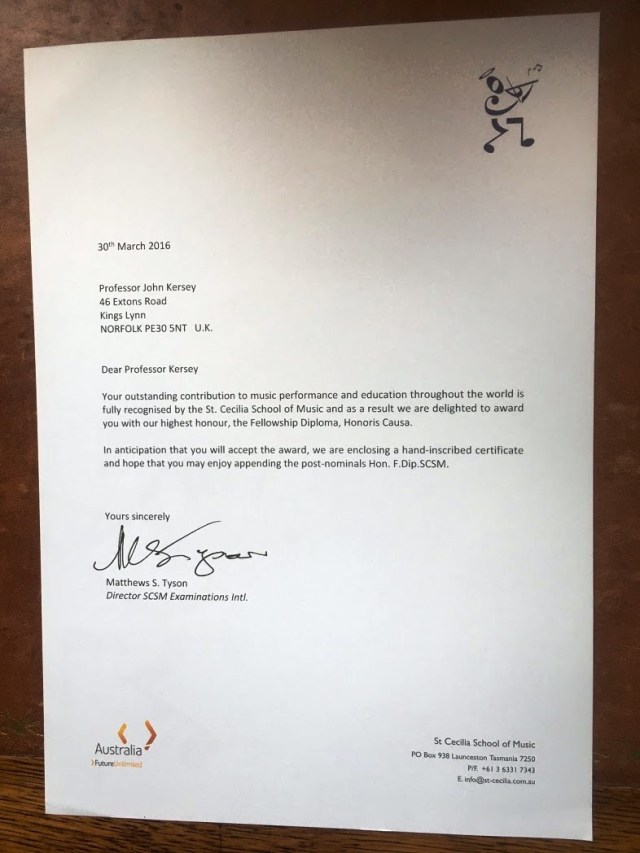

 During the Reformation, some of the Order’s commanderies in northern Germany and the Netherlands became Protestant and have remained so ever since, and the Order was disestablished in England, Denmark and other northern European countries. Having lost the initial reason for its existence, and with no battles to fight, it turned its attention to combatting piracy and saw a period of economic decline as its currency, the scudo, lost value. As a result, the knights began to attack Muslim ships in search of plunder, and again became wealthy. Many enrolled in foreign navies in search of adventure. This meant that grants to the Order diminished and that its economic survival became more and more dependent on conquest. Notwithstanding this, Malta flourished under the Knights and became regarded as one of the great powers of Europe.
 The French Revolution saw the attempted abolition of the Order, and in 1798, Napoleon I captured Malta, forcing the knights to surrender. This signalled the end of the Order on Malta after 268 years. The largest group of knights made their way to Russia, where Czar Paul I (pictured at left wearing the Crown of the Order) gave them shelter and was elected their Grand Master, with the Apostolic Delegate to St Petersburg, Mgr. Lorenzo de Litta, officiating at the ceremony. Historians differ as to whether the original Order survived at this point, or whether, the original Order having been dissolved by Napoleon, new Orders of St John were now created respectively by Czar Paul I in 1798 (the Russian Order), and by the Pope from 1803-14, revived in 1879 (the Sovereign Military Order or Order of Malta), both of which have claimed the tradition of the original Hospitallers, together with various other bodies, some of which gained the protection of their respective states*.
 The Order under Czar Paul I was recognized among the Russian Imperial Orders and the Czar created a Russian Grand Priory consisting of 118 commanderies. The Czar was Orthodox and his Grand Priory was open to all Christians, also having provision for Roman Catholic members of the Order. Under decrees of Czar Alexander I of 1810-11, the Russian Grand Priory was made a fiscally separate community from the Order overseas, and in 1817 a further decree forbade the wearing of decorations of the Order that had been granted outside the Russian Grand Priory by the Roman Catholic Order. In 1811, total membership of the Russian Grand Priory stood at 853 knights. A number of the commanderies were hereditary and portraits of Russian nobles wearing the Order can be found throughout the nineteenth-century, including that of Count Vassiliev pictured above. In 1916, Czar Nicholas II appointed two Hereditary Commanders in the Order.
 The Grand Priory was under Grand Priors Grand Duke Alexander Mikhailovich until 1933, and Grand Duke Andrei Vladimirovich from 1933 to 1956. On 31 July 1950, Grand Duke Andrei issued a declaration that the Order of St John and its Hereditary Commanders were never abrogated in Russia and continued to exist. In addition, Grand Duke Kyrill Vladimirovitch, as Head of the Imperial House (also Grand Cross of the Order of the Crown of Thorns), made several appointments of Hereditary Commanders in the Grand Priory during the period 1934-36. On 9 December 1953, a constitution was established at a meeting in Paris, and in February 1955 the Grand Priory was registered as a foreign association under French law as “The Russian Grand Priory of the Order of Saint John of Jerusalem”. In 1956, Grand Duke Vladimir Kirillovich became Protector to the Grand Priory, but refused the title of Grand Prior. He was succeeded as Dean by Hereditary Commander Nicholas Tchirikoff, who died in 1974, and by the Secretary of the Paris group, General Georges Sergeievitch Rtitcheff, who died in 1975.

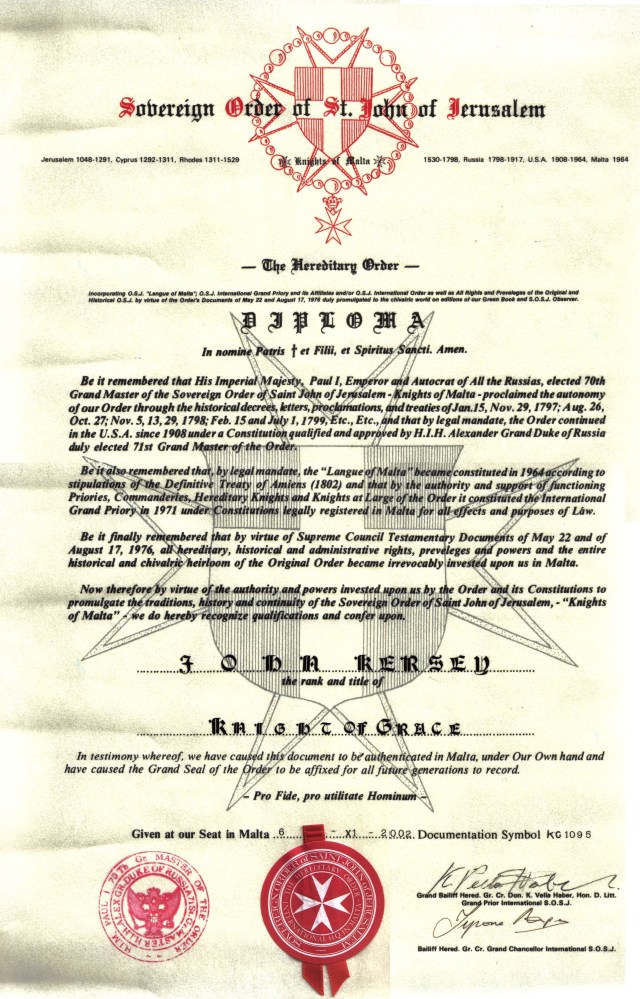
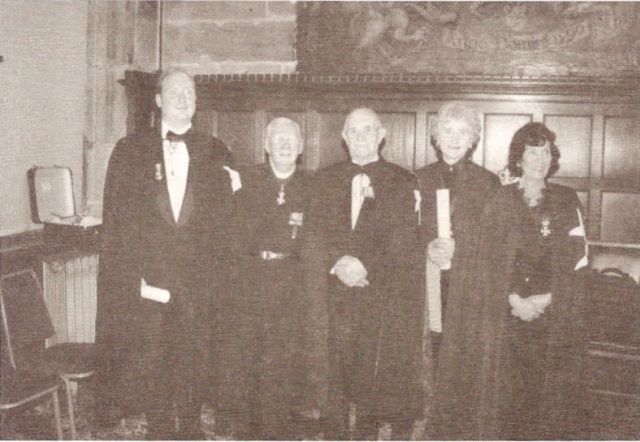
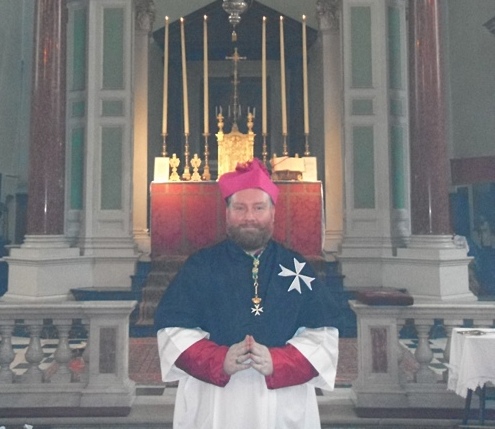
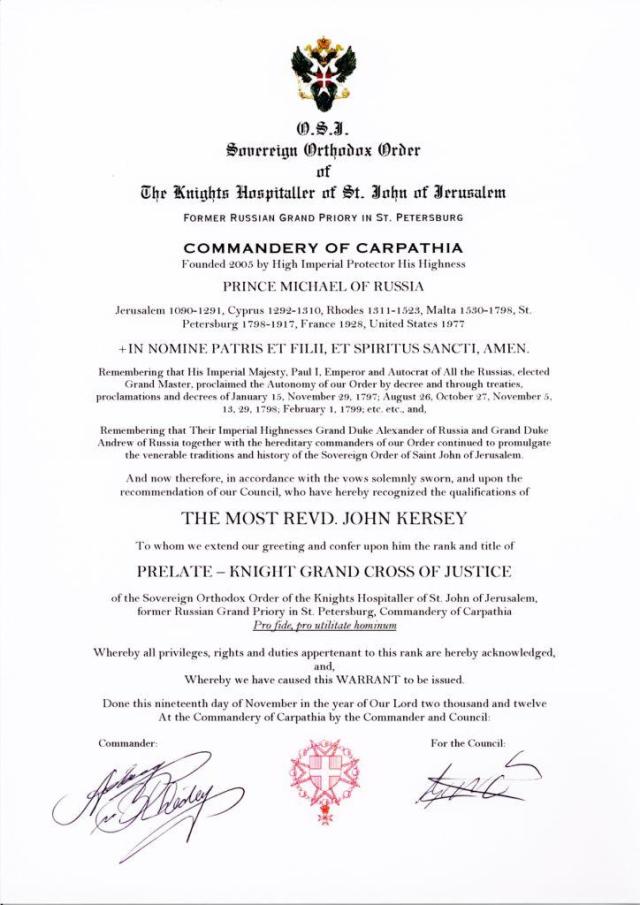
 Following the sudden and unexpected death of Dom Klaus in January 2013, a number of changes took place. It became clear that, although it was wished that amicable relations should continue with the Carpathian Commandery and the present-day Russian Grand Priory, some degree of independent re-organization would be necessary in order to continue the work that Dom Klaus and I had planned together.
 While it shares a common history with other institutions representing the Order of St John and the Russian Grand Priory and is open to the possibilities of collaboration with them, the Protectorate is self-governing and has no official relationship with any other Order of St John at the present time. Membership in the Protectorate is strictly by personal invitation of the Prince of Miensk and is extended ecumenically to all Christians, with non-Christians admitted to all ranks as honorary Knights or Dames. Associate membership is extended to members of other legitimate Orders of St John who wish to support the work of the Protectorate; if admitted as associates, they retain their existing rank in their “mother Order” and cannot be promoted within the Protectorate. The Protectorate preserves the historical and nobiliary traditions of the Order that it has inherited by virtue of its antecedence, and as is traditional, voting rights are reserved to members in the category of Justice. Since it also has a distinctive ecclesiastical character, it is especially devoted to the support of the work of all Johannites worldwide through prayer.
 The order remained primarily a hospitaller order but it did take part in a number of battles, including the Battle of La Forbie on 17 October 1244 (where all of the Lazar brethren who fought died) and the Battle of Al Mansurah on 8–11 February 1250. The leper knights were protected by a number of able-bodied knights but in times of crisis the leper knights themselves would take up arms. The order quickly abandoned their military activities after the fall of Acre in 1291 and the dissolution of the Knights Templar due to their relative poverty. After this, the knights moved to Cyprus, then Sicily and finally to Boigny near Orléans in France, where
  In 1791, the French Revolution suppressed the Order in that country and confiscated its property. However, the future King Louis XVIII (pictured left wearing the Grand Cross) continued to confer it in exile, and on the restoration of the monarchy the Bourbon monarchs continued as protectors until 1830. On 12 March 1825, King Charles X issued a declaration that the United Order of Our Lady of Mount Carmel and St. Lazarus of Jerusalem would be allowed to become extinct. Under canon law, this would occur one hundred years after the death of the last member unless the Order was canonically re-organized. The last such member died in 1856, which would have allowed for canonical re-organization until 1956.
 In the event, canonical re-organization had occurred in 1841, when the Melkite Greek Patriarch Maximos III (Mazloum) granted his spiritual protection to the Order, and this state of affairs continued under his successors until the Patriarch transferred the government of the Order to a Council of Officers in Paris in 1910. This was confirmed by blessing of Patriarch Cyril VIII (Geha) (pictured right) on 3 June 1911. The factual position regarding the protection of the Order in the nineteenth-century has since been confirmed by successive Melkite Patriarchs to this day, notably by Patriarch Maximos IV (Sayegh) in 1965 and Patriarch Gregorios III in the Kevelaer Declaration of 2012. It should also be remembered that the Patriarch was a fons honorum by right of his office.
 Although much of the nineteenth-century had been a period of decline for the Order, by the 1930s it was active once more, being led by
 Membership in the Protectorate is strictly by personal invitation of the Prince and is open to baptised Christians of any denomination. Non-Christians may be admitted to the ranks of the Order as honorary Knights or Dames. Associate membership is extended to members of other legitimate Orders of St Lazarus who wish to support the work of the Protectorate; if admitted as associates, they retain their existing rank in their “mother Order” and cannot be promoted within the Protectorate. The Protectorate preserves the historical and nobiliary traditions of the Order of St Lazarus that it has inherited by virtue of its antecedence, and as is traditional, voting rights are reserved to members in the category of Justice. Since it also has a distinctive ecclesiastical character, it is especially devoted to the support of the work of all Lazarites worldwide through prayer.






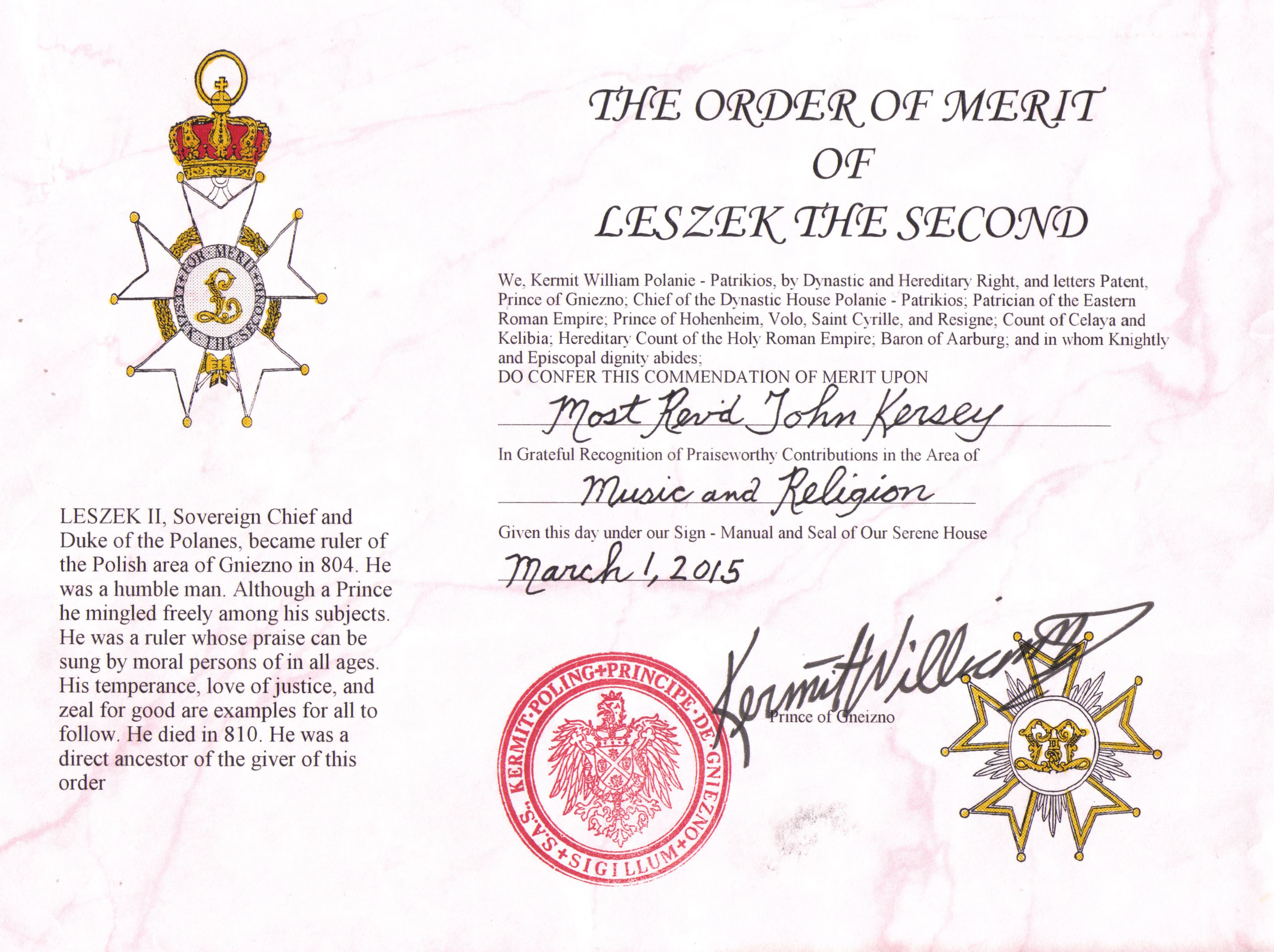
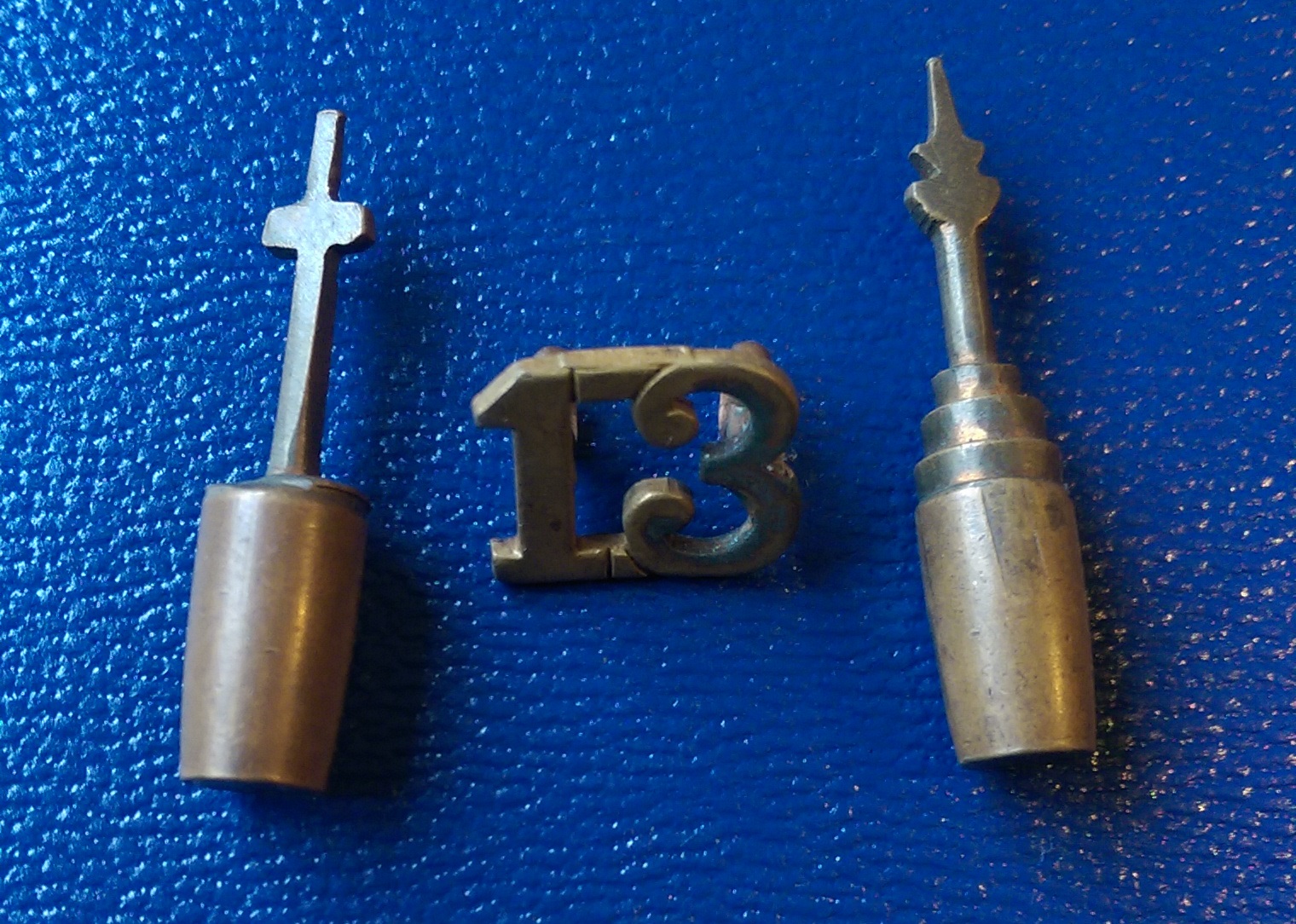
 Professor John Kersey
