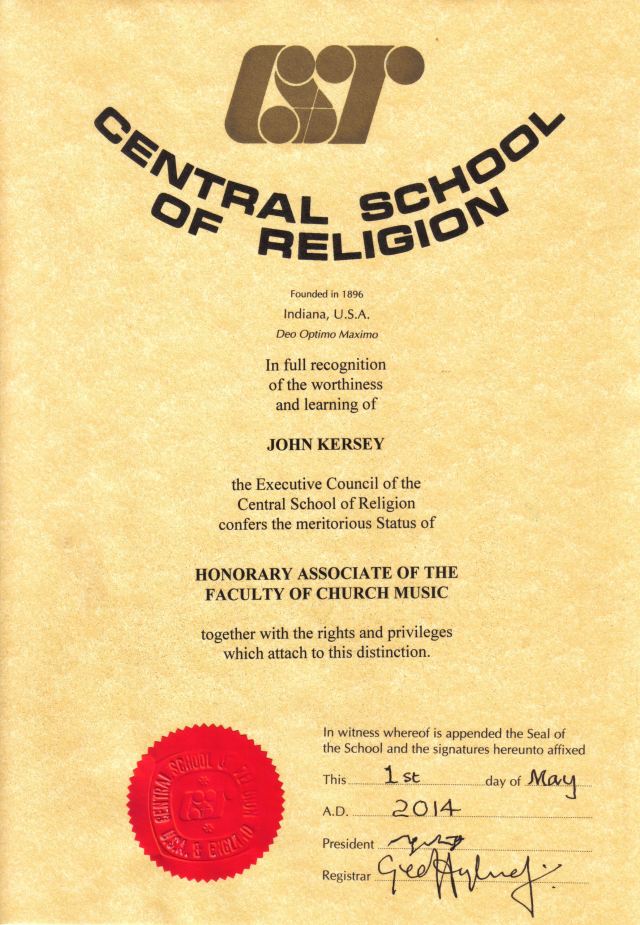
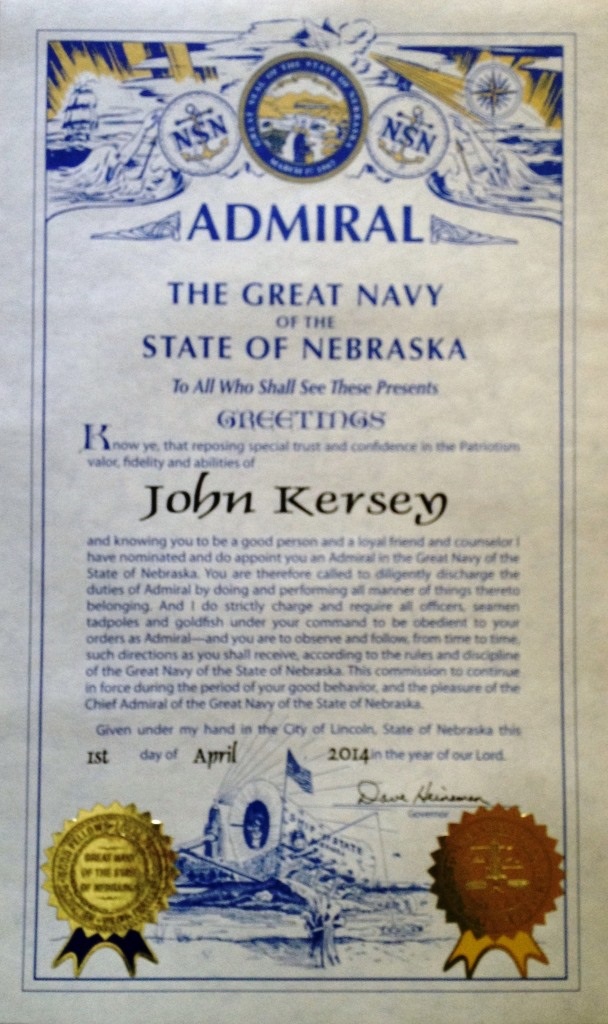
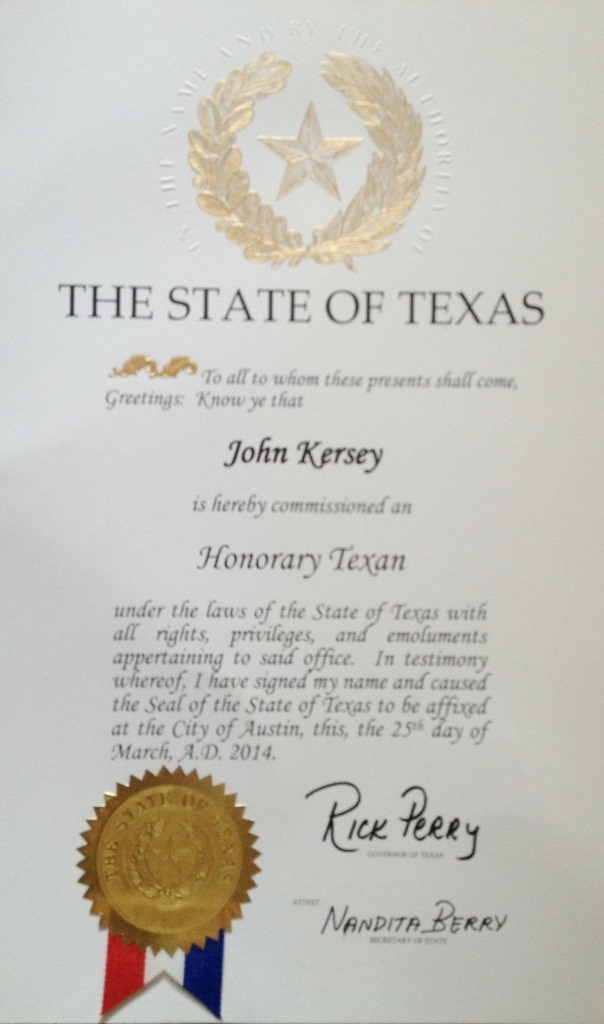
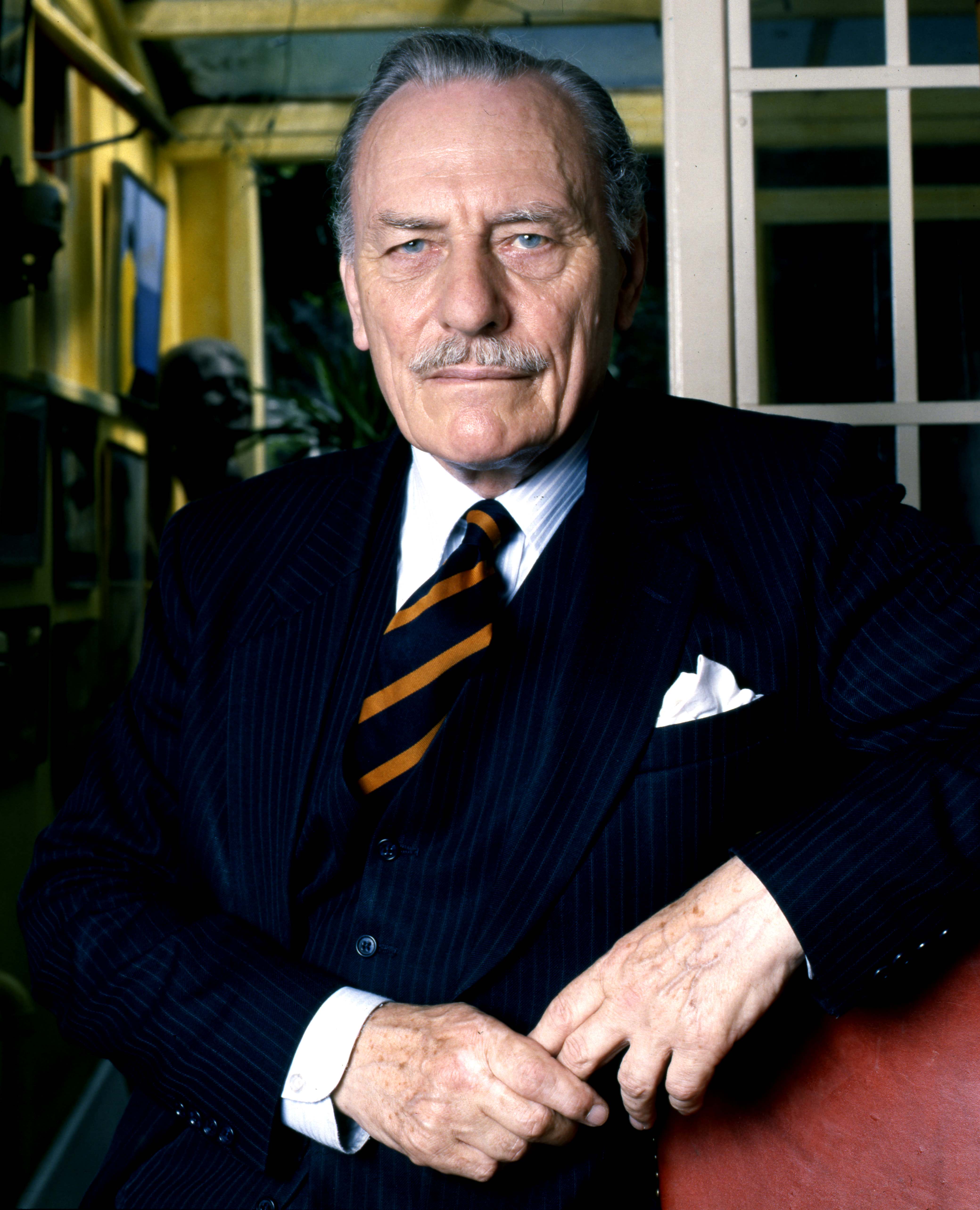
Honours and awards: Związek Kombatantów RP i Byłych Więźniów Politycznych

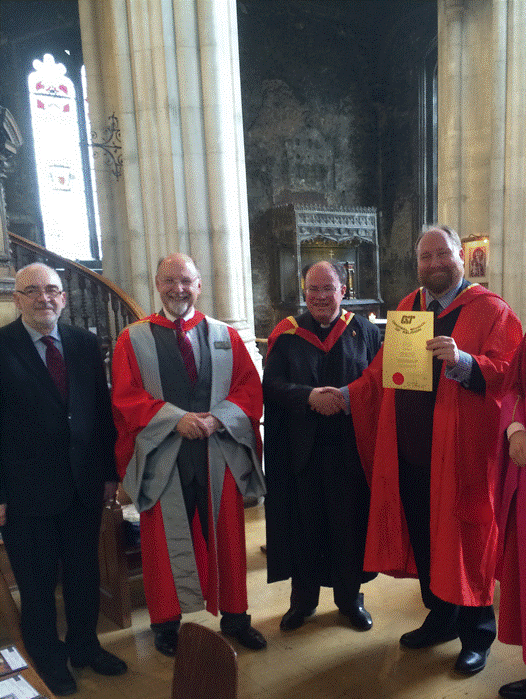
I have been honoured to have been awarded the Cross of Merit of the Polish Society of War Veterans and Former Political Prisoners (Związek Kombatantów RP i Byłych Więźniów Politycznych). The ZKRPiBWP is an official Polish Veterans association and the largest such, with 43 regional chapters across Poland as well as 2364 clubs. Membership may be granted to any Polish citizen who was an active duty member of the Polish military (including partisan, self-defence units, and Polish Underground State) in or during the war, campaign, or conflict, as well as to all survivors of German concentration camps and pro-Soviet political imprisonment in the communist era. The constitution also requires members to have not been discharged under any conditions other than honourable.

Society of Polish War Veterans Cross of Merit

John Kersey on Legacy

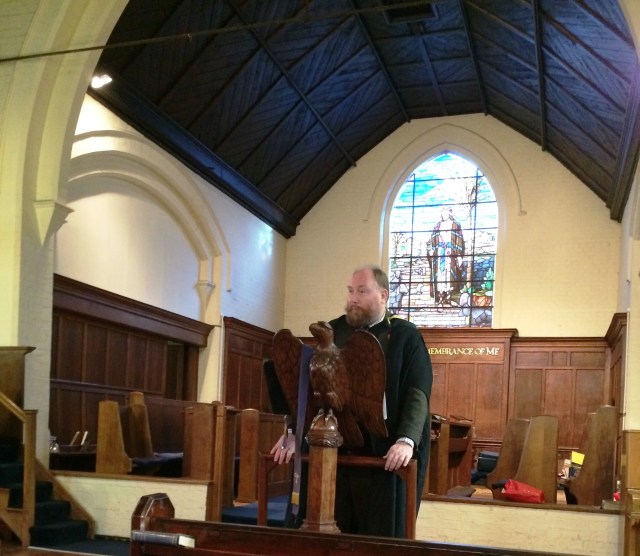
Christmas talk to the Traditional Britain Group, December 2014.

It is said that Dom Paul Neville, Headmaster of Ampleforth College from 1924 to 1954, was at a meeting of the Headmasters’ Conference. The theme of discussion was preparation for life, and the various headmasters were vying to show how their schools were at the cutting edge in preparing their pupils for Life, in various ways. Dom Paul rose and said, “Gentlemen, I have been very impressed to hear how your schools are preparing pupils for Life. I have little to add to this discussion, because my school prepares the boys not for Life, but for Death.”

I am going to talk to you today about the significance of death from the perspective of one of the key concepts of traditionalist conservatism, that of legacy. The concept of legacy is as integrated into our society as the family itself; the idea that we may have an influence on generations to come. In a number of important ways, our legacy is not simply genetic in terms of descendance, but can also have significant effects on future generations unrelated to us. If we seek to stand for positive values in our lives, we can also hope that when we are dead, those values will not merely continue (for all true values are eternal) but that our engagement with them can assist others in turn to discover and be enriched by them in various ways.

When Edward Latymer, a London city merchant, died childless in 1624, he made several important provisions in his will. The will left a sum in trust that would provide “eight poore boies” from Edmonton and another eight from Fulham yearly on November 1st with a doublet, a pair of breeches, a shirt, a pair of woollen stockings and shoes. In return for being educated to the age of thirteen at a “petty school” the boys had to wear the red cross from Latymer’s coat of arms on their sleeves. The trustees are under a duty to carry out the provisions of Edward Latymer’s will “unto the end of the world.”

The effect of Latymer’s will has been far-reaching. From the original eight poor boys, the Latymer Foundation now has responsibility for three large and thriving schools; two in Hammersmith and one in Edmonton, and it was at the latter, which is the senior school of the Foundation, that I myself received my schooling. Had that not been so, I should never have heard of Edward Latymer. Instead, as in many other schools of a similar vintage, the Founder was commemorated each year on Foundation Day, which had the notable benefit of being a half-day holiday.

The lesson of what Latymer did can be summarized in this way: he was determined that the wealth he had created would not simply die with him, but would be used to nurture something that he believed in strongly. By establishing what would in modern times be termed a charitable bequest, he ensured that his estate would neither pass to distant relatives (although they did contest his will) nor into the clutches of government. His actions are a fine example of noblesse oblige: the doctrine that holds that to those to whom wealth is given, there falls a concomitant responsibility to administer that wealth in a way that benefits the common good.

It will come as no surprise to those who have heard me talk before that G.K. Chesterton is one of the writers to whom I make frequent reference. In his book Orthodoxy, Chesterton has this to say, “Tradition means giving a vote to most obscure of all classes, our ancestors. It is the democracy of the dead.” He continues, “Tradition refuses to submit to the small and arrogant oligarchy of those who merely happen to be walking about. All democrats object to men being disqualified by the accident of birth; tradition objects to their being disqualified by the accident of death. Democracy tells us not to neglect a good man’s opinion, even if he is our groom; tradition asks us not to neglect a good man’s opinion, even if he is our father.”

What Chesterton refers to is the interconnectedness of human existence through the generations. All of us are the sum total of our ancestors in terms of our genetics, but we may well forget how like them we can be not only in our looks but in our character. If we look to the famous families of England these intergenerational traits can often be observed, and are aided by the ability to refer to portraiture from previous centuries that can reveal much about those who have gone before. We also share a more general commonality; not for naught did writers of past generations attribute particular characteristics to the people of the various regions of our island, or refer to the English race, or speak of us as the island stock, or indeed “this happy breed”. For those of us whose ancestry here reaches back some centuries, before the time of widespread immigration, we are each others’ kith and kin far more than is commonly acknowledged, even though it must be said that it is part of our national character to keep others at a certain distance. This shared heritage should not surprise us, since our island is not a large one, and for many centuries the English flourished unconquered.

In truth, we are living links in the chain that binds us from the dead to the unborn; we hold our lives in trust, and should be determined to pass to the next generation that which we ourselves have enjoyed, in as good if not better condition. Indeed, that concept of trust is enshrined in English law and is one of the crowning glories of that legal system. The Trustee has ownership, but his ownership is conceived exclusively as a duty. This remains the embodiment of intelligent conservatism, because it safeguards those things that are of value and prevents them from being dissipated or squandered.

How different our society is now from that which Edward Latymer knew! We should remember that in his day, there was no income tax – that would not arrive fully until 1842 – and few restrictions on what a man could do with his assets; his rights under common law were inalienable. It is still possible for someone to leave their entire estate to charity today, but otherwise there are many pitfalls that work to oppose any idea of legacy. Why should this be?

If we seek to understand how English society has been comprehensively destabilised during the past century, we need look no further than the obscenity of death duties. This Socialist measure is designed to forcibly redistribute wealth; to rob the wealthy of their inheritance, and to smash the hierarchy that is inbuilt into England’s history and character. Countless landed families have gone under; forced to sell the home that was theirs for generations and see their heritage squandered by here-today gone-tomorrow politicians who hate the established way of life of these islands and their people with a fervour I have never understood.

Many today comment on the shallowness of our society; its short-termism and the atomization of its people. Our society penalises those who save money and instead encourages everyone to live on so-called “easy” credit. It privileges two classes of people; those at the bottom who have no money and can therefore obtain the maximum in benefits that is available to them, and those at the top who have so much money that they can either engage in creative ways to hide it or simply not worry about it. Those in the middle are not merely squeezed, they are prisoners of a brutal and uncaring state machine that is designed to exploit their labour and remove their wealth for whatever vain pursuit may be in fashion at the time. Foreign expeditionary wars, High Speed Two, housebuilding on swathes of our Green Belt in order to house the ever-increasing numbers entering our country – these are the things that no-one seems to want and yet everyone is obliged to pay for.

While there is legitimacy to the Crown as a hereditary landowner and centre of wealth in the Britannic realm, there is none whatsoever in the aggregation of wealth by Parliament. The modern State is entitled to nothing; everything it owns it has gained by legalized theft from its subjects. Its sole aim is to keep its subjects in their place, so that the rich stay rich, the poor stay poor and everyone else stays worried, harassed and permanently short of money.

It is no wonder that our society should be shallow and short-termist if the result of aggregating even a modest level of wealth is that death duties of a swingeing forty per cent should forcibly redistribute it against your wishes. It is an absolute scandal that the government that maintains this robbery, backed of course by the ultimate threat of violence, should call itself “Conservative”. It is nothing of the kind: it has embraced a Socialism that Marx himself would have applauded, and it is the embodiment of the politics of envy that are so very popular with the Labour Party these days. Can we be surprised, then, that the most logical response to such measures is to resort to an empty hedonism; if you can neither take your wealth with you nor give it to whom you wish without contortions and expensive planning, it is all too natural simply to spend the lot.

I do not want to talk about legacy simply in terms of money, however. There remain personal elements of legacy that are part of living life as a traditionalist and that apply whatever the state of our personal exchequer. Indeed, these elements are considerably more important than any financial consideration, for they are not only actions taken with a view to the future but also actions that reveal and may indeed form our characters. Not for nothing is it said that success built purely on money and material goods is an empty vessel. Since we cannot immediately hope to displace the state or to abolish taxation, we should instead concentrate on what we can do to create value for ourselves.

The creation of value, of significance and of substance is something that will outlast us even if the things we have created no longer exist. Consider Socrates, a man who wrote nothing that survived him. Everything we know of his thought has been filtered through those who knew and were influenced by him, chiefly Plato and Xenophon, and also Aristophanes and Aristotle. For that matter, consider Jesus Christ, whose words were conveyed to us through his disciples. Theirs may be a barely tangible legacy, but they have created an immense sphere of influence throughout the entirety of Western civilisation. What we see here is a chain not dissimilar to the genetic chain I described earlier, but here it is a chain of ideas whereby one person influences another, and in turn builds those ideas into his worldview. The philosophy expounded by Socrates and by Jesus is not merely a set of dead ideas, confined to the distant past: it is a living legacy, debated and discovered afresh by every generation. To leave a legacy even remotely approaching this brings a satisfaction far beyond that of materialism; it is to know that something of us will remain alive when even our tomb has disappeared.

Even if our accomplishments are, of necessity, considerably more modest than those of Socrates, we can still derive great satisfaction from engagement in work of significance. Creative endeavour of any kind is an obvious means of adding value to life. But there are other ways towards the same fulfilment. Engagement in work that seeks to promote the betterment of our society and the improvement of the lives of others enables us to participate with the same spirit that inspired Edward Latymer. The raising of children who are educated to understand the importance of our core values is another crucial task, and one that must increasingly be undertaken in opposition to government.

If we are to dedicate ourselves to seeking this fulfilment, we must first realize that our lives are finite and that there is no time to waste. This is what my opening quotation means: if we prepare for death, we live our lives with a perspective that looks for the good that we can accomplish in the time left to us, and we actively consider the way we want to be remembered. We may be impelled towards that consideration by a religious belief, or we may simply want to honour life itself, for it is a gift, and one that is all-too fragile.

Whatever the case, we are unlikely to emerge from such contemplation with the view that the way forward is that of pointless nihilism. More likely, we will conclude that the values that are at the heart of us impel us towards a life of integrity. They will be values that, as we explore them more deeply, will reveal a moral code, and will moreover speak to those aspects of our character that we will want to develop. We all begin as deeply imperfect and flawed clay; we can mould ourselves into something that can transcend our past and achieve both self-respect and the respect of others.

We may find our value in a job, but there is no reason why value should be confined there. What people do when they are not at work is an area that continually surprises and intrigues me. Some people balance their lives so that their work is merely a means of paying the bills without interest in career or promotion; their passion is explored outside any environment of financial reward. And as for finance, all of us except the most impoverished can benefit from learning to live on less than we do; the consequence is greater financial freedom and in consequence greater personal freedom.

Whatever we do, its effect is to turn us outward. Spending time with others, particularly others who need us, is often one of the most valuable things we can do. What we are asked to do in such situations is not to give money, but to give of ourselves. We each have qualities and talents that can give pleasure and provide lasting enjoyment. Our lives are better for sharing them. The impact we have on the lives of others is something that will outlast us; it is the most important legacy that most of us will have the chance to leave.

It is not a coincidence that I am delivering this talk in Advent; indeed I did promise to others that it would be morally improving, and I hope it has been so without becoming a sermon. It is easy in today’s world to neglect our common humanity and I hope I have been able to counteract that impulse. Traditionalists may argue over exactly what it is that they are preserving, but I would maintain that it is a way of living in which people have context; where they feel a part of landscape, heritage, society and country in a way that binds them to their roots and enables them in turn to engage in propagation. It is, in short, the opposite of the Marxist society that promotes merely alienation and consequent misery.

And with that, I wish all of you a very merry Christmas.


“Music and Culture” – Traditional Britain Group Conference 2014

Why does today’s Western art music strive so conspicuously for cultural relevance? Why are many of our university music faculties more concerned with cultural theory than with applied music? Why have we lost confidence in historical and applied models of musicology, and moreover in the tonal tradition that forms the basis of the greatest musical heritage known to mankind? In this talk, I will trace the roots of this malaise over the past century. I will explore the ways in which an explicitly Marxist agenda has caused Western art music to abnegate its past, and in doing so, to render itself marginalized in comparison to popular music of chiefly African-American origin. I will also show how political influence has played a large part in the contemporary perception of the Western musical heritage as elitist and thereby culturally taboo.

What makes for good music? Until the First World War there was a general consensus that Western societies valued music that was written with cogency, formal command and structure, and that communicates the higher values of those societies – in which respect we might refer to such words as nobility, beauty and complexity, by which latter term I mean the capacity to reveal hidden levels of meaning upon greater exploration. A major work of Western art music does not merely reflect the human condition, but inspires us beyond our own limitations towards the best of which we are capable.

The experience of good music lifts the spirits, challenges the mind and opens us to the riches of Western civilization. Even works of Western art music which may be considered of lesser stature have the capacity to accord enjoyment from their craft, proportion and charm of execution, in the same way that we may derive pleasure from an Agatha Christie novel despite being aware of its formulaic nature. In the best composers we discover a capacity to surprise and constantly renew their chosen forms with a distinctive individual voice. This renewal leads to organic development and also to experimentation, sometimes with dramatic and effective results.

Although an appreciation of music is probably innate to mankind, it would be a mistake to believe that Western art music will yield up its secrets without an appreciation of its context and techniques. Certainly we can appreciate music that is strongly rhythmic, or that relies on simple repetition for its effects, without much in the way of specialist knowledge. But when encountering a Bach fugue for the first time, many of the uninitiated will be put off by what appears arcane, impenetrable and difficult to follow. To traverse the unknown region, a roadmap is necessary.

The roadmap comes in the form of understanding both the circumstances in which that piece came to be written – the details of the composer’s biography and the way in which the work in question fits into his output and the overall genre in question – and the means by which the piece makes its effect. The first consideration belongs to the realms of history and musical appreciation. The second belongs to the realm of musical techniques.

If our aim is merely to appreciate music at the level of the amateur, so that we can enrich our lives as a result, we need to go down both of these routes on the roadmap. If our aim is either to write music that is worthy of comparison with that of the masters, or to perform it in some way that does it justice, we need to travel further and explore more widely.

In doing so, we will discover that much of what we consider characteristic of Western thought as regards the melodic and harmonic components of music is in fact the product of observed phenomena of long standing. Writing in “Dimensions of Paradise”, John Michell says “Long before Pythagoras made his famous experiments with lengths of string and pipe, the relationship between number and sound had been noted, and ancient rulers specified certain lawful scales that had to be followed in all musical compositions. The reason for this was that they recognized music as the most influential of all arts, appealing directly to the human temper, and thus a potential source of disturbance in their carefully-ordered canonical societies.”

The Pythagorean method of tuning is, just like modern equal temperament, a form of syntonic temperament, in which each tuning is the product of powers of the ratio 3:2, giving us the cycle of fifths that is familiar within tonal harmony. Another fundamental of tonal harmony, the chromatic scale, originates in an equalized version of the harmonic series, and this equalization in turn owes its impetus to the just intonation established by Ptolemy of Alexandria. As was established by nineteenth-century theorists Riemann and Hauptmann there is nothing accidental or random about the basis of Western music, or indeed of what we have come to regard as hierarchical tonality. It originates in the observation of mathematical and acoustic phenomena and it is likewise a mathematical sense that illuminates our concepts of musical form, proportion and structure. Sir Thomas Browne had it correct when he said, “For there is a music wherever there is a harmony, order or proportion; and thus far we may maintain the music of the spheres.”

As may therefore be expected, the Western musical tradition places a high emphasis upon codification through a notated score and pre-composition. Indeed, the principal difference between Western and non-Western music lies in the West’s relative disdain for improvisation. Whereas Indian art music, for example, places improvisation at its heart, Western art music relegates improvisation to specific and relatively minor roles – chiefly instrumental cadenzas and melodic embellishments. Because of its codification, Western art music is concerned with music not merely as an act of the moment, to be experienced simply by those present, but as an act of legacy, whereby once a composition has been born, it can enjoy a future that is open to posterity, since its score can be interpreted and reinterpreted by successive generations. This codification is akin to the progression from the collective oral tradition of storytelling at the dawn of mankind to the individual authorship of literary work after writing was discovered. It follows that the interpretation of Western art music is therefore also a complex matter embracing distinct schools of thought and specific techniques with much scope for individual input.

We can see, then, that Western music places a clear divide between its art tradition of codified music and its vernacular tradition of uncodified or improvised folk music. We should not deny the appeal and importance of that vernacular tradition. Indeed, the interchange that occurred between national folk traditions and Western art music in the nineteenth-century brought about a renewal that was far-reaching in its influence. Composers such as Vaughan Williams, for example, not only employ actual English folk music as a basis for art music composition, but also write melodies that are inspired by the contours of folk melody, so that they sound as English as the models that inspired them. This, however, is a conscious transmutation. The use of a folk melody in Western art music is the act of the cultural observer and recorder from the world of codified music, not the act of an authentic folk music exponent for whom notation is incidental to the living improvisatory tradition of that music. Nevertheless, there is a justified claim to superiority for Western art music over that of the improvisatory tradition, in that its premeditation leads to greater melodic, harmonic and structural complexity and thereby to more profound possibilities of expression through an extended form such as the symphony.

The secure foundation established by Western art music has contributed to a flourishing of musical performance as well as high standards of music teaching and of musical literacy in the general public. Even as the growth of radio and television during the twentieth-century made concert-going less popular, the following for Western art music among all sectors of society remained strong, as witnessed by the continuation of the private music clubs (which were a leading employer of young musicians and those with a local, rather than a national, reputation), brass bands, music appreciation societies and amateur choirs and orchestras. Significantly, this was a participatory tradition. Western society viewed engagement with music, even at a modest level, as culturally enriching and as a hallmark of the educated man or woman. Further, music’s strong association with the Church was such as to mark music out as morally improving, for after all were the angels not depicted with harps?

One of the main aspects that characterizes the pre-1914 tradition of Western art music is its confidence. The majority of musicians and music educators were not generally beset by existential angst as to the justification for their art. Tonality was expanded, experimented with and challenged by such composers as Wagner and Debussy, but it would only be a small number of composers who, led by Schoenberg, would deliberately break with tonality. What has been described as the late nineteenth-century crisis of tonality is in fact an organic process that would find its logical conclusion not in Second Viennese School serialism, but instead in what might be described as tonal freedom, whereby composers such as Scriabin or Hindemith would retain a background context of tonally-derived melody and harmony while seeking to enrich that context through the extension of tonality into less familiar territory. In other words, musical renewal rested ultimately not with those extremists who sought to cast away tonality’s naturally-derived basis and replace this with an artificial construct, but with those who saw the horizons of tonality widening rather than narrowing. The music of Sibelius offers us many examples of this new approach to tonality, particularly in his Seventh Symphony. Other examples of such organic development would be the progressive tonality of Nielsen and the highly distinctive harmonic world of Robert Simpson which is firmly rooted in classicism and often based on the opposition of particular intervals or keys.

The theme of the replacement of an organic order with one that is artificial and man-made is not a new one in modern ideas. The idea of cultural struggle, in which an established order is subverted by direct opposition, is likewise familiar. These are Marxist concepts and should be seen as such. Let us be clear; the nineteenth-century crisis of tonality was manipulated for propagandistic purposes as part of a much wider cultural crisis in which Western civilization and culture and their established order came under direct attack from Marxism. The revolution that brought about atonality and serialism was the same ideological revolution that deposed Europe’s crowns and that, at its point of greatest early fulfilment, led to the Communist ascendancy in Russia. As one of its architects, Georg Lukacs, would write, “Who will save us from Western civilization?”

What Lukacs and his fellows abhorred above all was the unique and sacred nature of the individual within the Christian worldview. Lukacs was determined to reduce the individual to a common destiny in a world which, in his words, “had been abandoned by God”. Another leading thinker of this ilk, Walter Benjamin, tells us that “religious illumination,” must be shown to “reside in a profane illumination, a materialistic, anthropological inspiration, to which hashish, opium, or whatever else can give an introductory lesson.” He goes on, “Do not build on the good old days, but on the bad new ones.” If man were to lose his connection to the divine, his only remaining creative option would be political revolt, which, according to Benjamin and his colleagues, would bring about a Marxist revolution.

Of course these developments were not without reaction and resistance. However, what was to be remarkable was the way in which Marxist intellectuals of the Frankfurt School succeeded in the post-1945 period in discrediting conservative reaction by identifying it explicitly with the Third Reich. For the Frankfurt School, creativity was impossible, anyone who adhered to universal truth was an authoritarian and even reason was subject to the shifting sands of critical theory. Culture was to be abolished; a “new barbarism” was to be created through new cultural structures that would increase the alienation of the people. Before long, from the ashes of a war-torn Europe, a surprisingly broad intellectual coalition had formed that supported and funded the Frankfurt School and its front organization, the Institute for Social Research. This gave the Frankfurt School the means to set in place its intellectual undermining of Western civilization.

The major works in which this is done include Theodor Adorno and Max Horkheimer’s Dialectic of Enlightenment of 1944, which gives us the concept of a manipulative culture industry, and The Authoritarian Personality of 1950 by Adorno and others. This latter work was sponsored by the American Jewish Committee and sought to connect the Freud-derived concept of the authoritarian personality to conservative and fascist ideology, and to anti-semitism. It should not be thought that Adorno and Horkheimer were writing with the intention of protecting Jews from prejudice. Rather, they, along with Marx, were opposed to all religions, including Judaism. They wanted to destroy the principles of both Jewish and Christian civilization and force the “scientifically planned reeducation” of Americans and Europeans. While the overtly politicized conclusions of The Authoritarian Personality have since been comprehensively disproven, they were not disproven quickly enough to prevent their cultural influence becoming widespread in the post-war years and even today. Indeed, they remain foundations for many of the ideas that are dominant in today’s academy.

We should look particularly carefully at the legacy of Adorno. Adorno as a pupil of Schoenberg and Berg believed that composers should relate to the past as a canon of taboos rather than a canon of models for emulation. His concept of art was also structured on that of Marxist Kulturkampf, in that he saw the duty of art to be “corrosively unacceptable” to the sensibilities of the middle class, and therefore to be a succession of shocking, difficult and obscure events.

The Adornoist concept has the advantage of wrapping music up in an impenetrable web of self-meanings. It means that music structured on these lines is likely to be theoretically extremely complex, divorced from significant cultural reference, emotionally arid and exceptionally difficult both to play and to listen to. Of the thousands of works written during the post-war years in this style, not a single one has attained genuine public popularity. They speak only to an elite, and that elite is specifically ideologically driven. As far as many executant musicians are concerned, they are indeed tolerated but not loved. Indeed, many would say that one might just as well love industrial noise as the work of  Stockhausen and the post-war Darmstadt School, for all its undoubted intellectual accomplishment. What is created is effectively non-music, non-art, because of its rejection of the musical values that I outlined at the beginning of this lecture. It preserves something of the colour, the instrumentation, the dynamic variety of Western art music, but it ignores what David Hellewell has called “music’s unique language; the dialectic of notes.” Even Adorno admitted that atonalism was sick, but as he said, “the sickness, dialectically, is at the same time the cure…The extraordinarily violent reaction protest which such music confronts in the present society…appears nonetheless to suggest that the dialectical function of this music can already be felt…negatively, as ‘destruction.’”

Moreover, Adornoism gives itself a license to view the past through its own distorting Freudian prism; for example, Adorno believed that the chord structure of late Beethoven was striving to be atonal, but Beethoven could not bring himself consciously to break with the structured world of Congress of Vienna Europe. For Adorno, an individual such as Beethoven was not autonomous and acting with free will, but was instead the prisoner of unconscious historical forces. Such arguments are merely Trojan horses for Marxism, since they can rewrite history according to an unlimited degree of political interpretation.

The effect of this movement on Western art music has been disastrous. Because Adornoist music cannot exist without significant public subsidy and is explicitly Marxist in its aesthetic, the general tendency of governments to become more controlling with regard to the arts in the post-war period has had a field-day. Without the government supporting the Adornoists, they would have failed in a blink of an eye when subjected to the popular market. When William Glock became director of the BBC Third Programme in 1959 he presided over a decade in which the Adornoist avant-garde was given public support while dissenters were consciously suppressed. Yet this support achieved nothing in terms of producing a wider popularity outside the limited circle of initiates. Rather, it furthered the fragmentation of our musical culture and an alienation of the West from its cultural heritage.

A combination of centralising tendencies and Marxist ideology with a decline in support for composers who do not fit the Adornoist and government image of what they should be, has left multiple generations without access to new music in the classical tradition which has the prospect of speaking directly to them. I can assure you that this tradition has been there – in the music of such post-war figures as Howells, Ferguson, Arnold, Lloyd and Arthur Butterworth – all of which have written vital and much underrated music – but even though all but the last are dead, their music remains largely sidelined by the mainstream today. They have become a narrowly specialist taste, and one that is nowadays increasingly dismissed as socially elitist and thus contrary to the egalitarian zeitgeist.

The concept of an official line on what composition should be – so very Soviet in its way – has led also to a situation where it is axiomatic that musicians be if not actively Marxist, then at least tolerant of working within that ideological framework. This gives us “luvvies for Labour”; it also means that those who doubt the left-wing consensus are afraid to speak out for fear of losing their livelihoods. The constraining ideological framework is not always obvious; it is often a superstructure far above the head of the individual musician, but it is there nonetheless. Orchestras, for example, are highly unionized organizations; the Musicians’ Union negotiates standard fees and terms of employment for orchestral musicians, and it in turn affiliates to the TUC and the Labour Party.

As soon as the Frankfurt School saw the burgeoning of mass entertainment and popular music they seized upon it as a means of Marxist dialectic. One of the most interesting aspects of pop music is that it is concerned largely with a group aesthetic and with the reproduction of the same experiences – musical stereotypes – that are already established as commercially successful. For Adorno, this stereotyping meant that exposure to pop music disengaged the mind, making the experience of music less sacred and increasing alienation, a process which he called “demythologizing”. In addition, pop music was largely non-Western in its origins, consisting of commercialized versions of African, Afro-American and Afro-Caribbean folk music. Adorno says, “contemporary listening…has regressed, arrested at the infantile stage. Not only do the listening subjects lose, along with the freedom of choice and responsibility, the capacity for the conscious perception of music…[t]hey fluctuate between comprehensive forgetting and sudden dives into recognition. They listen atomistically and dissociate what they hear, but precisely in this dissociation they develop certain capacities which accord less with the traditional concepts of aesthetics than with those of football or motoring. They are not childlike…but they are childish; their primitivism is not that of the undeveloped, but that of the forcibly retarded.

It is significant that every time mainstream pop music has tried to move beyond stereotype – as is the natural tendency of human creativity – there have been powerful forces dragging it back. Time and again during the 1960s and 1970s, jazz and pop music moved forward because of engagement with aspects of the Western art music tradition. The work of George Martin, Gil Evans, Charles Stepney, Claus Ogerman and those working in progressive rock drew directly on Western art music to create art music from the roots of pop music. In addition, an entire genre of music grew up – labelled “easy listening” – that presented jazz and pop music in arrangements that were considered more acceptable to those whose ears were attuned to art music. All of this resulted in a brutal record industry reaction in the late 1970s in which the nihilism and Leftism of punk and electronic music was vaunted and primitivism embraced once more. In the past two decades a further development has taken place, in which we are for the first time confronted by the phenomenon of all but the elderly having grown up in the post-1945 era and thus having been targeted since youth as consumers of pop music. This has allowed pop music finally to displace Western art music within the media and within our education system, as pop is now held by the decision-makers concerned to be culturally equal if not superior to its art music counterpart.

Those who perform Western art music have inevitably seen the landscape of their profession altered totally by this cultural shift. The former confidence in the cultural value of what they do has been replaced by an insecurity of purpose; a questioning of their very reason for existence. The contemporary focus on the physical appearance of classical artists and on short, memorable pieces as the vehicle for their success belongs to the world of pop. What it is not is the popularisation of classical music. Rather, it is the dumbing down of the Western art music tradition by presenting it with the same commercial values as pop music, with attendant assumptions of limited shelf-life and quick profits rather than long-term viability. What more can we expect when the Chairman of Universal Music Group considers that classical music is “rather unwelcoming” and “a bit like an elitist club”.

Artistic quality is now judged more on the basis of record company and media hyperbole than by an educated public, because that public has been systematically disempowered from the ability to exercise meaningful artistic judgement. The loss of the live concert experience as part of our culture has been more visible in Britain than on the Continent, but it is perhaps most obvious in the loss of community and amateur music-making dedicated to the Western art music tradition and even home listening in the form of the radio and recordings. Increasingly, that tradition is losing its hold as its exponents and enthusiasts become older and die off, being supplanted or even replaced altogether by pop music. One has only to listen to Desert Island Discs to become painfully aware that for many men and women who occupy leading roles in our society, who are otherwise educated and sensitive human beings, Western art music is something as remote to them as the planet Jupiter. Indeed, the Culture Secretary tells us that he never listens to Radio 3, and prefers Classic fM, which he finds “accessible and informal” – and this despite the fact that today’s Radio 3 falls over itself to dumb down, fetishize youth and employ announcers whose gauche chumminess must be making Cormac Rigby and Patricia Hughes turn in their graves.

Shortly after the election of the New Labour government in 1997, those responsible for British music education were essentially told that they would be compelled to embrace the Government’s educational priorities. Those priorities were towards Leftist multiculturalism and political correctness, and to the replacement of education with vocational training in pursuit of a social engineering agenda. Institutions would no longer be permitted to be determinedly exclusive in their admissions policies; the focus on excellence was seen as “disenfranchising people”.

Interestingly, this development presaged the cult of the amateur and the disparaging of expert status that has since become such a prevalent feature of the Internet. It owes its roots, of course, to the prevalence of postmodernism, itself an ideology owing much to Marx. Once the idea that there are central concepts of value or meaning that run through all good music can be thrown aside, or that critical rationalism is a basis for assessing the worth of a statement that lies outside of the realm of pure opinion, the ground is clear for all sorts of phony replacements.

Above all, what is promoted is a closed, totalitarian arts system. It is a system where government funding creates an expensive elite based on ideology, not ability. It remains dedicated to the Adornoist means whereby Western art music is to be subverted: firstly by the promotion of art music whose ideology is that of alienation, which is by definition anti-populist, and where complexity and obscurity of method are valued highly. Secondly, pop music is endorsed by the arts establishment and with it the concept that anyone, regardless of ability, can become a pop star instantly simply through winning a television talent contest and receiving media promotion. Music education now gives less emphasis to the history and techniques of Western art music and more to free expression and improvisation. Indeed, there are in our schools, according to Sir Peter Maxwell Davies, “music teachers who thought that even to teach standard western musical notation was to indulge in extreme elitism, claiming that it would inhibit the children’s creativity, and was alien to the “working class values of ordinary people”.

Increasingly, cultural relativism is a third means of attacking the West; non-Western music is given equality if not priority with Western art music both in our education system and increasingly in arts funding. Concepts such as “diversity” and multiculturalism in general are part of this trend. In his excellent book, “Cultural Revolution, Culture War”, Sean Gabb reminds us that, “In October 2003, the Association of British Orchestras organised a symposium on Cultural Diversity and the Classical Music Industry, and effectively required attendance from every classical music organisation in England larger than a string quartet. Among those addressing the symposium was Professor Lola Young, Head of Culture at the Greater London Authority. She said: “We must change the look of the classical music industry”. She was supported by Roger Wright, head of BBC Radio 3, who confessed that everyone at the BBC now underwent “diversity training”.” Practitioners of Western art music have a new-found obsession with “relevance” – they must make the case for their existence in a society that once considered them a vital element of their culture.

In a climate of austerity and cultural hostility, the vital structures that support and nurture Western art music have been placed under unprecedented stress. Local councils have discontinued elements of their music services and, driven by opposition to elitism, ended their support of assisted places at the junior departments of the conservatoires. Western art music classes and activities in publically-funded adult further education have been cut drastically. Meanwhile, the Church, once responsible for the development of young musicians through its choral tradition, has also increasingly replaced Western art music with pop. Our present Archbishop of Canterbury, who had African drummers and Punjabi music at his installation ceremony, has declined the customary office of vice-patron of the Royal College of Organists that his predecessors have held since the foundation of the College in 1864.

Let us move on to consider what is taught in our university music departments that concern themselves with Western art music – that is to say, those which have not closed under the recent funding pressures. Presaging New Labour by a couple of years came the movement entitled the “new musicology”, also called cultural or critical musicology, a jackdaw hybrid of gender and queer studies, cultural theory, post-structuralism, postcolonial studies and the theorising of Adorno and Benjamin.

What is notable in the “new musicology” is how little of originality it contains. It is as if someone were to gather up the most leftist elements of university teaching and then unite them in a single Marxist behemoth. There is psychology, of course, and pointless theorising as to whether one can tell whether Schubert was gay or not from his use of the German sixth. There is cultural theory a-plenty, the return of extended prose written in numbered paragraphs, and the meaningless, self-referential cant of structuralism and post-structuralism. Indeed, Professor Lawrence Kramer has said that in order to survive, musicology must embrace a network of “postmodernist strategies of understanding”. To appease the multiculturalists, ethnomusicology has now taken much of the space and funding formerly allocated to dead white males, meaning that the folk songs of obscure Third World tribes are now accorded the importance that the powers that be feel they deserve. Feminism of a particularly assertive kind has been allowed free rein, determining among other things that sonata form is sexist and misogynist. Here, we are no longer talking about music as music, but instead music, in the words of Professor Susan McClary, “as a medium that participates in social formation”.

What the new musicologists have done is effectively set up a straw man in order to justify their ideological lurch. That straw man is the idea that music has no meaning and no political or social significance. As Charles Rosen points out, with the exception of nineteenth-century critic Hanslick, it is doubtful whether anyone has ever actually believed this. Rather, there has always been what we might refer to as a divine fusion in the performance of music between what is deemed to be the composer’s meaning and significance and that overlaid or recreated by the performer, and then a third overlay of meaning and significance by the listener. Not only are those perceptions likely to differ between individuals, they may well differ among the same individuals on different occasions, depending on emotional state. Even the eminent may legitimately see different and contradictory things in a musical work.

The authoritarianism inherent in Adorno’s vision is equally prevalent in the new musicology. New musicologists usually seem to be telling us what to think and what to feel when we listen to music. By imposing meaning they present their opinion as dogma. By refusing to acknowledge the essential subjectivity that is at the heart of musical meaning they deny the individual the right to experience music in his or her own way and – heaven forbid – to use cultural references that are not chosen from the fashionable Left. The result is an edifice built on sand; once one does not accept the authority of the critic to dictate significance and meaning, much of what remains is merely ideological cant. Does the recapitulation of the first movement of Beethoven’s Ninth represent “the throttling murderous rage of a rapist incapable of attaining release”? Susan McClary published just that analysis, which to my mind is an excellent illustration of the way that this mode of discourse has a tendency to lapse into self-indulgent fantasy.

The aim of all this is, of course, to offer a further justification for the Adornoist position. By connecting music with other disciplines, links are created that are harder to break and that make music harder to isolate within the academy. By borrowing highly obscure modes of language and reference from those disciplines, and talking about music in terms of cultural or critical theory, new musicologists make it more difficult to discuss their work in anything other than its own terms, unless the critic stands wholly outside their viewpoint. They also fulfil Marxism’s inherent self-hatred by focussing on the effort expended in method and execution rather than the value or intelligibility of the results. And by ensuring that those disciplines chosen support the broadly Adornoist view – in other words that they support the concept of paternalistic, nanny-knows-best culture ruled by experts who tell the underclass what to like and what to think, they create a perfect ideological fit with academia’s Leftist zeitgeist and with the culture industry as defined by New Labour and left unchallenged by our present government.

What we are witnessing is effectively the continuation of the process that drove Western tonal music underground under the weight of post-war ideology. Traditional musicologists and music historians are no longer welcome in British academia unless they are willing to accept the new musicology. Indeed, Lawrence Kramer has said, “The theories that ground [postmodernist] strategies are radically anti-foundationalist, anti-essentialist, and anti-totalizing. They emphasize the constructedness, both linguistic and ideological, of all human identities and institutions. They insist on the relativity of all knowledge to the disciplines–not just the conceptual presuppositions but the material, discursive, and social practices–that produce and circulate knowledge. While often disagreeing with each other, poststructuralists, neopragmatists, feminists, psychoanalytic theorists, critical social theorists, multiculturalists and others have been changing the very framework within which disagreement can meaningfully occur.” Once you can control disagreement, there’s not much else that isn’t within your power.

I conclude, then, with an exhortation. To listen to and to play or sing Western art music is now a counter-cultural act. It is an act of profound rebellion against our politically correct Cultural Marxist zeitgeist as well as being a source of pleasure, moral and spiritual improvement and enhanced appreciation of the connection between the human and the divine. Let us not be afraid to relegate pop music to its proper place, to embrace our Western art music heritage and to resolve to make it a central part of our lives as educated men and women. Whether in our local community or nationally, let us support those who perform and teach this heritage, and let us give particular attention to the riches that are to be found in the music of our own island and culture; supporting organizations such as the English Music Festival which celebrate it, and independent record companies such as Chandos and Hyperion who have devoted much time and expense to producing first-rate recordings of it. And let us never forget these words of Bulwer-Lytton: “Music, once admitted to the soul, becomes a sort of spirit, and never dies.” If we care for our souls as we should, let us nourish them with good music, and let us then become better people for doing so.

Talk to the Central School of Religion Reunion

I was the invited speaker at the Central School of Religion Reunion at St Jude’s Free Church of England, Balham, in November 2014. Here is the talk given on that occasion:

Ambrose Philipps de Lisle, 1809-78

I am going to talk to you today about a nineteenth-century English pioneer of the ecumenical movement, Ambrose Philipps de Lisle, and give a brief account of his life and achievement.

Ambrose Lisle March Phillipps de Lisle was born on 17 March 1809. He was the son of Charles March-Phillipps of Garendon Hall, Leicestershire, and Harriet Ducarel, a lady of Huguenot descent. The de Lisle family of Leicestershire were originally simply the Phillipps from London. The Garendon estate near Loughborough, was inherited by Thomas March, who adopted the name Phillipps, and married Susan de Lisles. Their son, Charles, adopted the de Lisle crest and arms. Steady accumulation of landed property made him one of the ‘wealthiest commoners’ in England and a member of that class known as the landed gentry. When Charles March-Phillipps died in 1862, Ambrose took the additional name of Lisle, becoming Ambrose Charles Lisle March Phillipps de Lisle. For the purposes of this talk, I shall take the liberty of referring to him as Ambrose, not least because in doing so I will also recall the saint and Doctor of the Church after whom he was named, one who provided a model for him in his famous saying “When in Rome, do as the Romans do”.

Ambrose spent his earliest years at his birthplace and was brought up as a member of the Church of England, receiving his first religious instruction from his uncle, William March Phillipps, a High Church clergyman of the Church of England. The Bishop of Gloucester, having married Sophia March Phillipps, was his uncle by marriage, and so the boy spent Sundays and holidays at the bishop’s palace. In 1818 Ambrose was sent to a private school in South Croxton, whence he was removed in 1820 to Maizemore Court School, near Gloucester, kept by the Rev. George Hodson.

At school he met for the first time a Catholic, the Abbé Giraud, a French émigré priest. A visit to Paris in 1823 gave him his first acquaintance with the Catholic liturgy. The effect on his mind was shown on his return home when he persuaded the Anglican rector to place a cross on the communion table, but this first effort to restore the cross to English churches was stopped by the Bishop of Peterborough. He converted to Catholicism, and immediately removed from Mr. Hodson’s school, and returned home with his father, who arranged for him to continue his preparation for the university under the private tuition of the Rev. William Wilkinson. He was obliged every Sunday to attend the Anglican church, but did not join in the service.

Ambrose was admitted to Trinity College, Cambridge in November 1825, though he did not go into residence there until 16 October 1826. At the university he found a congenial friend in Kenelm Digby, author of Mores Catholici and The Broadstone of Honour, who was, like himself, a member of a long-established family of the landed gentry and a recent convert. In those days there was no Catholic chapel at Cambridge, and every Sunday for two years these two young Catholics used to ride, fasting, over to St. Edmund’s College, Ware, a distance of twenty-five miles, for Catholic Mass and Communion. It was on one of these visits to St. Edmund’s, in April 1828, that Phillipps was seized with a serious illness, having burst a blood-vessel in his lung. The doctors recommended his father to take him to Italy for the winter, and this necessarily cut short his Cambridge career, so that he had to leave the university. It should be remembered that at this point, because he was not an Anglican, he was debarred from taking a degree at the University.

On his return to England in 1829, he became acquainted with the Hon. George Spencer, then an Anglican clergyman, and his conversation was largely instrumental in leading to Spencer’s conversion to Catholicism, as the latter admits in his Account of my Conversion – he says “I passed many hours daily in conversation with Phillipps and was satisfied beyond all expectations with the answers he gave me to the different questions I proposed about the principal tenets and practices of Catholics.” The following winter (1830–1831) Ambrose again spent in Italy, on which occasion he met the Blessed Antonio Rosmini-Serbati, the philosopher and founder of the Rosminian Order, who made a great impression on him.

On 25 July 1833, Ambrose married Laura Mary, eldest daughter of the Hon. Thomas Clifford, son of Hugh, fourth Baron Clifford of Chudleigh, in the Church of St James, Spanish Place, London. Charles March Phillipps gave his son possession of the second family estate, the manor of Grace-Dieu in Leicestershire, which before the Protestant Reformation had been the Augustinian Grace Dieu Priory. Here Ambrose Phillipps built a new manor-house Grace Dieu Manor, 1833–34, and in the meantime he and his wife resided at Leamington, or at Garendon Hall. Writing a few years before his death he summed up the chief aims of his own life in these words: “There were three great objects to which I felt after my own conversion as a boy of fifteen specially drawn by internal feeling for the whole space of forty-five years which have since elapsed. The first was to restore to England the primitive monastic contemplative observance, which God enabled me to do in the foundation of the Trappist monastery of Mount St. Bernard. The second was the restoration of the primitive ecclesiastical chant, my edition of which is now recommended by the Archbishop of Westminster for the use of churches and chapels. The third was the restoration of the Anglican Church to Catholic Unity.”

According to Edmund Purcell’s 1900 biography of Ambrose, “In that early day no one did more for the Catholic revival in England, almost single-handed, than Phillipps de Lisle”. In the foundation of the Cistercian Mount St. Bernard Abbey in Leicestershire he received generous support from his friend John, Earl of Shrewsbury, but it was Ambrose himself who conceived the idea, believing it necessary that the ascetic aspect of Catholic life should be presented to the English people. Mount St. Bernard Abbey was the first monastery built in England since the Reformation. Ambrose gave both land and money, severely depleting his own resources in providing the necessary buildings. This work was begun in 1835 and completed in 1844, while, during the same period, he founded missions at Grace Dieu and Whitwick. His disappointment was great when he found that the Trappists were prevented by their rule from undertaking active missionary work, because he attached the greatest importance to a supply of zealous missionary priests who would labour in English villages; he said, “I would have them go about and preach everywhere on the foreign plan, in the fields or in the high roads even”.

In 1838 Ambrose joined his friend Rev. George Spencer in establishing and propagating the Association of Universal Prayer for the Conversion of England. In a continental tour he and Spencer made together, accompanied by Mrs. Phillipps and two of her children, in 1844, they passed through Belgium, Germany, and North Italy, meeting many distinguished Catholics and enlisting the sympathy of prelates and clergy in the cause. Nicholas, soon to be Cardinal, Wiseman was co-operating in Rome, and soon the movement spread widely through the Catholic world. Ambrose was for some time the only Catholic who was in confidential correspondence with the leaders of the Oxford Movement, including Blessed John Henry Newman, receiving them at Grace-Dieu. He saw the Oxford Movement as a step towards his desire of reconciling the Anglican Church with Rome. As his son stated: “National Conversion by means of Corporate Reunion he likened unto the Apostolic practice of fishing with a net ‘gathering in multitudes of all kinds of fishes.’ And this he considered to be his own special call from on High, to prepare the way and hasten the time when the Divine Word should again be spoken to Peter, ‘Cast your nets into the deep’.”

In a letter of 1841 to John Rouse Bloxam of Magdalen College, Oxford, who was, in the words of Lord Blachford, “the grandfather of all Ritualists”, Ambrose explained that for him, the Church of England was the true Catholic church of the British nation, despite its lack of communion with Rome. He regarded Anglican Holy Orders as valid, and the eucharistic service of the Book of Common Prayer as a true Catholic sacrificial Mass. It was the State, for Ambrose, that had impaired the Catholic witness of the Church of England; if reunion could be achieved, he saw the possibility of all churches and cathedrals being united in the celebration of the Sarum Rite in Latin, while some portions could be given simultaneously in English translation. He also foresaw circumstances in which the Anglican clergy would be permitted to retain their wives. These insights came about because Ambrose was closely in touch with European thought on these matters, in contrast to the British Establishment which was much less cosmopolitan in its inclinations. Equally, the capacity of Ambrose and his wife to offer lavish hospitality at Grace-Dieu Manor helped secure him a greater measure of support, even among the clergy of the Church of England.

As well as his Catholic works of translation and compilation, Ambrose in 1855 authored a work entitled Mahometanism in its relation to Prophecy; or an Inquiry into the prophecies concerning Anti-Christ, with some reference to their bearing on the events of the present day. This is an interesting work, and I will quote a few words from its conclusion, “If Mahomet be not Antichrist, may humanity be spared the revelation of something worse, of something still more horrible ! But if the imagination of my reader would be satisfied with something less horrible than Mahomet, let me, at least, congratulate humanity that it has already seen the worst phase of evil, while I leave it to the contradictor to adjust the balance between the statements of prophecy, and the phantoms of his own brain.” In fact, this was a longstanding preoccupation of Ambrose, who as a boy had seen a bright light in the sky and heard a voice say “Mahomet is anti-Christ, for he denieth the Father and the Son”.

Ambrose welcomed the restoration of a Catholic hierarchy in the United Kingdom in 1850, and tried to reconcile to it some of the Catholic laymen who thought it inexpedient. He saw great significance in the fact that Pope Pius IX had not named any of the new dioceses after any of the medieval Sees, since he surmised that the Pope must therefore share his view that the Church of England was the true church of the English nation. During the debates that ensued throughout the country he wrote two pamphlets: A Letter to Lord Shrewsbury on the Re-establishment of the Hierarchy and the Present Position of Catholic Affairs, and A few words on Lord John Russell’s Letter to the Bishop of Durham. The progress of events raised his hopes so high that he regarded the reconciliation of the Anglican Church to the Holy See as imminent, and to hasten its fulfilment entered on a new crusade of prayer, in which the co-operation of non-Catholics was desired. Following Ambrose’s eirenic pamphlet “On the future unity of Christendom”, “The Association for Promoting the Unity of Christendom”, (A.P.U.C.) was founded on 8 September 1857, by fourteen people including Father Lockhart and Fr. Collins; the rest were Anglicans, with one exception, a Russo-Greek priest. Cardinal Wiseman gave it his blessing.

The only obligation incumbent on members, who might be Catholics, Anglicans, or Greeks, was to pray to God for the unity of the baptised body. At first the association progressed rapidly. Ambrose wrote to Lord John Manners and said, “We soon counted among our ranks many Catholic Bishops and Archbishops and Dignitaries of all descriptions from Cardinals downwards; the Patriarch of Constantinople and other great Eastern prelates, the Primate of the Russian Church … I do not think any Anglican Bishops joined us, but a large number of clergy of the second order” – that is to say, presbyters. He gave the number of members as nine thousand. The formation of this association was, however, regarded with distrust by Cardinal Manning and a good number of other influential Catholics, who also took exception to Ambrose’s treatise On the Future Unity of Christendom. The matter was referred to Rome by Cardinal Manning and was finally settled by a papal rescript addressed Ad omnes episcopos Angliæ, dated 16 September 1864, which condemned the association and directed the bishops to take steps to prevent Catholics from joining it.

As might be expected, this was a great blow to Ambrose, who considered that “the authorities had been deceived by a false relation of facts”. He however withdrew his name from the A.P.U.C. “under protest, as an act of submission to the Holy See”. The ground on which the association was condemned was that it subverted the Divine constitution of the Church, inasmuch as its aim rested on the supposition that the true Church consists partly of the Catholic Church in communion with Rome, “partly also of the Photian Schism and the Anglican heresy, to which equally with the Roman Church belong the one Lord, the one faith and one baptism”. His own pamphlet was not censured, but the condemnation of the A.P.U.C. was regarded by him as the death-blow of his hopes for the reunion of Christendom during his own lifetime. But his own belief in it persevered and influenced his views in other Catholic affairs. Thus he warmly supported the attendance of Catholics at the English universities, and he even approved of the abortive project of a Uniate English Church. He pointed out that his prophesy of 1841 had come true, and that at least a few parish churches were now using the Sarum Rite in the vernacular. Writing in 1867, he noted that within the Church of England we could now find churches that were “restored in all their grandeur. The sweet perfume of holy incense is again inhaled in our ancient temples, the names of Mary and the Saints are again honoured and invoked, and men are once more called to the practice of sanctity, and the imitation of the Saints”, while “Catholic morality is again inculcated in pulpits that used to utter only the errors of Calvin or Luther”.

During the remainder of his life, Ambrose continued ever to take an interest in public affairs as affecting the fortunes of the Church, and in the same connexion he carried on intimate and cordial correspondence with men as different as Cardinal Newman, William Ewart Gladstone, and Charles Forbes René de Montalembert. He counted among his friends John, Earl of Shrewsbury, Cardinal Wiseman, Augustus Pugin, who provided designs for Grace-Dieu, and many other well-known Catholics, and though he differed on many points from Cardinal Manning and Dr. W.G. Ward, the professor of moral philosophy at St Edmund’s College, he remained on friendly terms with both. In 1868, he was appointed High Sheriff of Leicester, and chose Dr Frederick Lee of Lambeth, one of the founding prelates of the Order of Corporate Reunion, as his chaplain. Lee’s second son was named Ambrose de Lisle Lee after him. Ambrose’s plans for a Uniate Church continued to occupy him and his colleagues, and he was among the first to propose that the clergy of the Church of England should be conditionally reordained in order to secure their validity. This proposal, too, would eventually be adopted by the Church of England following the 1931 Bonn Agreement with the Old Catholic Churches.

On 5 March 1878 Ambrose died at Garendon, survived by his wife and eleven of his sixteen children. His achievement was to be the prophet of much that was to follow him, and that would eventually find expression in the current Personal Ordinariate of Our Lady of Walsingham.

Another look at Emma West

Another look at Emma West

Libertarian Alliance, September 2014

There are, perhaps, more than two sides to the Emma West story. That this should be so is at least in part due to the torturous duration of her public exposure along with the complexity of the judicial process to which she has been subjected. Through it all, we have had to learn the story of Ms West at second or third hand. Rather like the Queen, by keeping her public statements limited she has made herself a tabula rasa for others to read into her character and intentions whatever they will. To certain people, she is a working-class heroine who dares to say the unsayable about issues of race and immigration. To others, she is a demon of our time, to be shunned and sentenced to deportation by Piers Morgan. Yet others hold her up as an example of a victim of mental illness and/or aberrant behaviour caused by prescription drugs but, in whatever case, subject to impulses beyond her own control.

Perhaps I am alone in finding all this media speculation rather tantalising. Who is the authentic Emma West? What is she really like? There is little that the media dislikes more than someone who, given their allotted fifteen minutes, fails to play the game. Perhaps her legal advisers have told her that silence is her best course of action. Perhaps she is, as has been said, too disturbed to focus on anything other than her own misery (her barrister, David Martin-Sperry, has said that she has attempted suicide on three occasions since the beginning of all this) or that of her domestic circumstances (in May 2013, she stabbed her husband twice in the back with an ornamental knife[1]). I do not go along with the establishment’s medicalization of mental distress through the prism of mental illness, but that does not mean that her experience of mental distress has not been extreme and harrowing.

It is clear that reporting restrictions had been imposed upon this case which have now been lifted. From what has now been reported of the court proceedings, and here I rely mainly on the accounts provided by the Croydon Advertiser, West has asserted that she took an overdose of antidepressant medication combined with a glass of wine before the incident on the tram. She remembered that something had happened on the tram, but not what it was. A month later, video footage of her was on the national news, and she was hailed with some enthusiasm by the British National Party and the National Front, amongst others. We are now told by Mr Martin-Sperry that this political support “coupled with the pressure of the trial” “deeply distressed” West and led her to attempt suicide by twice trying to throw herself in front of traffic from roundabouts in Croydon[2]. These actions led to her being detained in a psychiatric unit. Applications were made by her defence for the case against her to be terminated on the grounds of the state of her health. These grounds were refused by the Crown Prosecution Service and West’s legal team were preparing an abuse of process application when a compromise solution was proposed by the judge and accepted by both parties.

The nature of that compromise may give us pause for thought. The concept of plea bargaining is familiar to students of the American judicial process, but less so over here. As reported by the Croydon Advertiser,

West had denied racially aggravated intentional harassment on a tram travelling between Croydon and Wimbledon between September 30 and November 28, 2011.

However, she has now pleaded guilty to a lesser offence of racially aggravated harassment, alarm or distress, which crucially does not include mention of ‘intent’.

West, we are told, would not admit to anything that would have the effect of labelling her “racist”. Her defence has been to characterize her behaviour on the YouTube video as an episode of what amounts to temporary insanity, caused entirely by the mixture of her overdose of antidepressants with alcohol, and in no way representative of what she actually thinks on the issues of race and immigration. She would have us believe, it seems, that she in fact subscribes to the prevailing opinions on those issues; that is to say, those which are politically correct. Of course I have no reason to doubt West’s version of events, but having viewed the video in question in some detail, I still see in it someone who is, through evident and visceral anger, articulating deeply-held views and emotions in a blunt and direct manner, not a person who appears to be drunk, under the influence of drugs or otherwise insensibly dissembling.

That essential sincerity made an impression upon elements of our political spectrum that have for many years drawn their membership from the working class; from those, like West, who see their society changing before their eyes in ways that they cannot control and never consented to; who find that it is not merely the old economic certainties that have disappeared, but also those of their very social fabric – their family structures, the cohesion of their communities, their refuge in shared opinions and shared prejudices. Someone or something has betrayed them, of that they can be sure, but pinning down exactly what that force might be is a much more complex task. And in betraying them, it has driven them to the margins and taken away their voice. Can it be any surprise that when West and her ilk look around them, they say what they see?

If the BNP and the English Defence Force, among other similar groups, have been wooing West by sending her flowers and cheques, they have not been the only ones to pay her attention. The Croydon Advertiser reports that Mr Martin-Sperry has said that, in consequence of this public support,

“The net result is that threats have been made to burn down her house, not by the political right but by people from the other end of the political spectrum.

“There have been threats to burn her house, she has been physically assaulted and beaten to the ground outside her home.

“If she is to plead guilty to an offence which contained the words racial aggravation, she fears being labelled a racist.”

This week Mr Martin-Sperry said the arson threats had been made on an internet forum and the assault had not been reported to the police.”[3]

(emphasis mine).

So, let us understand a little more of what is going on here. West could, conceivably, have defended her comments. She could have said that her videoed remarks were indeed representative of her general views, albeit crudely and unfortunately expressed in a moment of anger. She could also have made a case that the labelling of her views as “racist” would have been the imposition of a Marxist construct whose shifting sands serve whichever emphasis the Left wishes to put on them this week. She might have developed her views into a political position that could have opened up opportunities to take on a wider role within society either within a political party or as an activist on the specific issues that she was particularly engaged with. But the consequences of doing so would, it appears, have been severe.

While the Left constantly demonizes such groups as the BNP and the National Front as violent extremists, it needs to look rather more carefully at its own ranks. It was not the Right who threatened to burn Emma West’s house down. It was not the Right who beat her up outside her home. If West had retained sufficient trust in the police to report the assault to them (and it should be remembered that she had assaulted a police officer when arrested for stabbing her husband), could she have been assured that she would have been believed, or that any serious action against the perpetrators would have followed? Is it any surprise that faced with this kind of pressure, a young mother in her position would say anything at all that might pacify a lynch mob? Is it any surprise that if someone is forced to deny their beliefs when on the receiving end of such behaviour, that they should be driven to suicide and mental torment? Was the only possible response for Emma West to plead insanity and beg for absolution on the grounds that she was not in control of her actions?

So I do not believe that Emma West’s case is quite as straightforward as Robert Henderson’s recent article indicates, although I do not deny that Robert makes some pertinent points therein[4]. What I do believe is that Emma West began this series of events as a vulnerable person, and that she has become significantly more so in spite of the duty of care our society had towards her.

The challenges of West’s life should not be underestimated. She has a husband, and is a mother. She held down a job as a dental receptionist and nurse for ten years, despite suffering from depression since the age of eighteen. Her mental distress had resulted in her being sectioned just one month before the tram incident, after she attacked a close friend. Immediately before the tram incident, she had attended a session with her therapist which was sufficiently gruelling for her to overdose on her medication and resort to a glass of wine with lunch.

And to these direct pressures, we can add some more that are indirect but nonetheless insidious. Doubtless West has seen London grow significantly more crowded during the past decade, and has witnessed its public transport system become significantly more prone to incidents of low-level aggression and inconsiderate behaviour as it creaks at the seams to accommodate the extra load. Doubtless she has seen her job and her home life grow more difficult as government has imposed ever-greater levels of bureaucracy and micro-management upon employers and the welfare system. Doubtless she worries as wages stagnate while the cost of living soars, particularly with a growing child to feed. Doubtless she has wondered at the alienation of our society as it atomises ever further, the old links of family and class solidarity, the old values of protection for women, children and the elderly swept aside. Is it any wonder that all that weight would eventually cause something to snap?

A moment of anger – and she says that it was provoked when another passenger collided with her as she was standing on the crowded tram, knocking her infant son out of her arms and onto the floor of the carriage – has cost West any peace of mind she might once have had. What is the answer that society can offer? A supervision order and further mental health treatment, according to the court. The end of her career, according to the General Dental Council, which has struck her off and publicly branded her a risk to the “safety of her patients”[5]. The major media outlets seem to have reported these events no differently than if she had not accepted the plea bargain; she is still eternally damned by the video footage that continues to reduce her life to two minutes and twenty-five seconds of ugly rage and hurt.

Perhaps someone in a stronger condition might have found some way to transcend such an episode and rebuild something. For West, she seems crushed by it all, destroyed by a system whose crusading zeal on behalf of its sacred cows carries all before it. It is not easy to hold West up as a martyr. What little we know of her life presents a picture of messy ambiguities, moral compromises and uneasy truths, not the certainties, consistency and steadfastness in the face of opposition that we might expect. Yet, perhaps she would not be the first in whom weakness and vulnerability in the face of overwhelming opposition came to be perceived as virtues.

[1] http://www.croydonadvertiser.co.uk/Emma-West-isn-t-racist-s-unwell-says-friend/story-19215366-detail/story.html

[2] Ibid.

[3] Ibid.

[4] https://thelibertarianalliance.com/2014/09/22/the-persecution-of-emma-west-continues/

[5] http://www.mirror.co.uk/news/uk-news/dental-nurse-who-went-racist-4272210

Two views of Hell

Two views of Hell

Libertarian Alliance, July 2014

Let us begin with the Bible – for that is where, as Christians, we must always begin. And I must crave the indulgence for a moment of those who do not share my faith, but who will perhaps acknowledge that it has been directly formative upon the character and culture of our isles, and therefore has a place, however restricted, in our public discourse.

Psalm 14: 1 puts the matter very succinctly: “The fool hath said in his heart, There is no God. They are corrupt, they have done abominable works, there is none that doeth good.” This seems by any standard to be a condemnation of atheistic belief, not merely in itself, but in terms of the character which such belief – and it is belief, not “the absence of belief” as Dawkins’ followers sometimes tautologically argue – engenders in its adherents.

Atheists have not been responsible for the creation of civilisation or its constituent parts. Those political movements that are predominantly atheistic – chief among which is communism – have not contributed to the world’s bounty one iota and have resulted in the display of callous inhumanity on a massive scale. That is not to say that an atheist cannot have a moral code, or act in a moral way. The difficulty, above all, is that the said atheist does not share that moral code with other atheists, nor indeed with his or her fellows who are adherents of a faith. When morality atomizes or is replaced by ideology, society breaks down. Even within an anarchist construct such as a Hoppean covenant community, there will be a common moral outlook that unites the community. It may be aligned with a particular faith, or it may be an agreed code that, while constructed outside the framework of faith or syncretically from a variety of faith and/or non-faith beliefs, nevertheless provides a direct analogue to that which would arise within such a framework. If we discard faith, we invent that which substitutes for faith, rather as if we discarded the wheel and then tried to recreate it ab initio.

I grow weary of the arrogance, intolerance and general self-destructive stupidity of those atheists, particularly of the younger generation, who hold that the rectitude, nay, certainty, of their beliefs gives them a right to dismantle the spiritual foundations of our country. To their credit, the representatives of the National Secular Society have generally been supportive of freedom of speech for those who disagree with them. But I reserve a greater degree of ire altogether for those individuals who claim to exercise Christian ministry while ignoring its basic foundations. Of their company the late Anthony Bridge, erstwhile Dean of Guildford in the Church of England, had this description in mind:

    “A bureaucratic annexe to the Welfare State with a few pious and neo-Gothic overtones. Hag-ridden by committees and worm-eaten by synodical government, it has dedicated itself to activism, having banished prayer, mystery, silence, beauty and its own rich musical and liturgical heritage to a few remote oases in order to make way for hymns written by third-rate disciples of Noël Coward and sung to the strident noise of guitars played by charismatic curates in jeans.”[1]

One cannot help but reflect that when the devil cannot find a way in from the outside, he will mount his attack from within. And he has been most successful. We are fast approaching a time where to make a public statement about what the Bible teaches is some form of criminal offence. The representatives of the larger churches seem to have done little to protect their members from this; indeed, too often the impression that is given is that where a challenge to the state – or to the liberal agenda which many of them support – is involved, they have simply washed their hands, or indeed sided with the state against their own brethren.

One difficulty is that Christianity is not a “fluffy” religion. Its precepts are tough and uncompromising. Jesus Christ is not merely “gentle Jesus, meek and mild”. As He says in Matthew 10:34, “Think not that I am come to send peace on earth: I came not to send peace, but a sword.” The purpose of the Church – and if it neglects this purpose, it is nothing – is to encourage individuals to find and follow Christ in all His complexity. And while it would to my mind be impossible to read the Bible and come away with the view that its chief message is that mankind is eternally damned, it remains the case that central aspects of the Christian faith will always pose problems for its adherents. They challenge and provoke; we wrestle with faith because it is often at odds with what we might believe (wrongly) to be “natural” or “fair”. Out of that process can come transcendance. As C.S. Lewis says in “Mere Christianity”,

    “…a Christian is not a man who never goes wrong, but a man is enabled to repent and pick himself up and begin over again after each stumble–because the Christ-life is inside him, repairing him all the time, enabling him to repeat (in some degree) the kind of voluntary death which Christ Himself carried out.”[2]

There is a term for those who wish to pick and choose which doctrines of Christianity they wish to follow and those which they do not – “cafeteria Christianity”. All too often, it is reducible to the idea of “be nice to each other”, as if we were all children in a playgroup. All too often, it is distorted to conform with various brands of socialism, be they dressed up as “liberation theology” or in other guises. It is a form of faith in which Christ is made less than God and man greater than man. It is that which Dietrich Bonhoeffer identified as the deadly enemy of the Church – cheap grace.

Robert Gladwin, a young man from Attleborough in Norfolk, articulates his own version of this bowdlerization when he says “It is my basic understanding that Christianity is inclusive and loving in nature.” Mr Gladwin has objected to his local Baptist church putting up a poster outside the church that suggests that atheists will go to Hell. He has complained to the police, who have recorded the matter as a “hate incident” and required the pastor of the church to take the poster down. We are told that it has been replaced by one featuring meerkats.[3]

Let us examine, for a moment, what the Bible has to say on the matter of atheists and Hell. There is this, for example, from Revelation 21:8-9:

    But the fearful, and unbelieving, and the abominable, and murderers, and whoremongers, and sorcerers, and idolaters, and all liars, they shall have their portion in the pool burning with fire and brimstone, which is the second death,

That seems pretty clear, then. Now consider Matthew 12:31:

    Wherefore I say unto you, All manner of sin and blasphemy shall be forgiven unto men: but the blasphemy against the Holy Ghost shall not be forgiven unto men.

and Matthew 13:49-50:

    The angels will come and separate the wicked from the righteous and throw them into the fiery furnace, where there will be weeping and gnashing of teeth.

and, indeed, Matthew 3:12:

    His winnowing fork is in his hand, and he will clear his threshing floor, gathering his wheat into the barn and burning up the chaff with unquenchable fire.

There is a legitimate theological debate to be had on the nature, permanency and inhabitants of Hell, and indeed upon the effect of all this for the believer in this world. The Pope has recently engaged in this debate. But to suggest that Christian churches in this country should refrain from proclaiming what their faith teaches and muzzle it according to a secular code of imagined “offence” and “hatred” is worse than an obscenity. We are not told if Mr Gladwin has studied theology. He may well be the next John Shelby Spong, though I have my doubts. The fact remains that his actions do harm to our culture. They bring nearer the time when Christians will face a sort of inner death in which their faith will be effectively banished from public life and to confess its tenets will be to invite formal or informal sanction from those in power. We should be clear: this is persecution.

Mr Gladwin and the Baptists are not the only ones who have been talking about Hell recently. Anjem Choudhary has also been advancing the tenets of his particular brand of Islam. He tells us, speaking of the murder of Drummer Lee Rigby,

    “So as an adult non-Muslim, whether he is part of the Army or not part of the Army, if he dies in a state of disbelief then he is going to go to the hellfire. That’s what I believe so I’m not going to feel sorry for non-Muslims.”

The news report tells us “Choudary insisted he had not ‘said anything incendiary’ and claims he does not fear being arrested.”[4] There is no reason to doubt his words. There is a double standard at work here, and any student of Cultural Marxism will be aware of how it operates.

[1] See obituary in the Daily Telegraph: http://www.telegraph.co.uk/news/obituaries/1550260/The-Very-Reverend-Antony-Bridge.html

[2] C.S. Lewis, Mere Christianity, Harper Collins, 2001, pp 62-63.

[3] See http://www.dailymail.co.uk/news/article-2637193/If-think-no-God-better-right-Police-probe-churchs-sign-suggested-non-Christians-burn-hell.html

[4] http://www.dailymail.co.uk/news/article-2335575/Anjem-Choudary-fresh-vile-rant-Lee-Rigby-burn-hellfire-Muslim.html

Honours and awards: Knight of the Order of the Precious Blood

I have been honoured with Knighthood in the Order of the Precious Blood of the Old Roman Catholic Church in America (since 2017, the Society of Mercy). The Order is administered by Bishop William Myers, and describes itself as “an award of merit for those who have promoted the common good in an extraordinary way. Awarding meritorious service is a long-held tradition, and the Order of the Precious Blood is the second highest order awarded. It is awarded by the Superior General at his choice to those who have served him or the common good, and recipients may be of any faith background. It is in two classes with a neck decoration or a breast star and certificate accompanies the award.”

Bishop Myers, who is a member of the Order of the Crown of Thorns, met with me on his visit to England in 2014 and presented me with the Order of the Precious Blood on that occasion.

My education: Universidad Empresarial de Costa Rica

The Universidad Empresarial de Costa Rica (Business University of Costa Rica) is a fully accredited private university in Costa Rica.

For some general remarks on Costa Rican private universities, their legal context and international comparability, please see this article.

The University was founded in 1992 as the International Postgraduate School and has been continuously accredited by the Consejo Nacional de Enseñanza Superior Universitaria Privada (CONESUP) of the Ministry of Education, Costa Rica, since 5 November 1997. An officially certified and Apostilled copy of the complete listing of private universities accredited by CONESUP as of 2017, including the Universidad Empresarial de Costa Rica, can be downloaded here:

>>Officially certified list of CONESUP-accredited private universities (April 2017).pdf

As of 2020, the University was listed in the International Association of Universities/UNESCO International Handbook of Universities and World Higher Education Database. The University was a member of the International Association of Universities with IAU ID number IAU-017738.

>>Listing and profile of UNEM in the International Association of Universities International Handbook of Universities, 18th Edition. The profile includes a description of the University’s facilities and the programs offered.

 The University has for many years combined offering programs to Costa Rican citizens with a thriving International Program which makes its degree programs available to Spanish-speaking citizens worldwide. The University has delivered programs by distance learning for many years but has also maintained campus facilities in San José, including in recent years at C

In 2009, the university which I co-founded and head today, European-American University, established a relationship of academic collaboration and subsequently validation with the Universidad Empresarial de Costa Rica, which continues at the time of writing. As such, I was offered the opportunity to become a candidate for a degree on the same terms as other members of the faculty. Accordingly, I was a candidate for the degree of Maestria en Administracion de Empresas (Master of Business Administration) by distance learning, which was awarded on 15 January 2010. My program comprised 14 courses and 42 credits, including an emphasis in entrepreneurship.

In addition, I was a candidate for a further Doctorado en Humanidades (PhD in Humanities) with emphasis in History. For this degree, I submitted a thesis on the British Old Catholic bishop Arnold Harris Mathew (1852-1919) that was subsequently published as a book. My thesis was prepared with the benefit of the guidance of Professor Bertil Persson and access to several important private archives, including material from the Liberal Catholic Church. It has since been cited in the doctoral theses of others writing on Old Catholicism.

In 2014, I was appointed to a Full Professorship in Education in the International Program of UNEM, as confirmed by the following letter, and continue to hold this position at the time of writing.

Can aristocracy and its feudal roots offer a prospect and model for secessionist solutions to the present crisis in Britain?

A functioning aristocracy is fundamental to a traditionalist society, and its structures and concepts have greatly influenced the development of British society over the centuries. In this essay, I intend, while showing some of the difficulties that have come to occupy the British aristocracy today, to consider whether the aristocracy as a class may be useful to our nation in firstly seeking to challenge the prevailing structures of the state and secondly offering us a model and structure for a projected traditionalist replacement of it.

Why secessionism?

This essay is written from a secessionist perspective. It addresses both partial secessionist or regionalist solutions, and also explores a limited number of total secessionist solutions. In doing so, it is concerned with secessionism on the basis of geographical regions that form a part of Great Britain, and is not concerned with secession that is not based upon the ownership of land and that therefore applies solely to a non-geographically constituted individual (sovereign individualism) or group.

This paper adopts a secessionist perspective because it recognizes the following conditions to apply:

1. that the government and institutions of Britain have effectively been captured by an enemy political class that, regardless of party affiliation, is dominated by Left-wing ideology and permanently subject to the European Union, as well as supporting a form of global oligarchy that runs counter both to British national interests and to a genuinely free approach to trade;

2. that there is active support from the political class for the destruction of the historic culture, precepts and way of life of the British people, together with the absorption of the British nation into an European super-state, and that it is a fundamental right that the British identity should be able to be preserved against such threats;

3. that there is and has been ineffective control over the borders of the British Isles, such that mass immigration both from within and outside the European Union has been politically sanctioned, as has been admitted, as a means of attack upon the traditional values of Britain;

4. that there is, for the present, little prospect of sufficient mass support against the political class being mobilized through democratic structures, and even were such support to be forthcoming, any political solution would depend to a large extent upon the co-operation of political class itself and its substantial client state;

5. that despite the absence of mass support, there remains a substantial minority of traditionalist conservatives, paleolibertarians and others who are effectively disenfranchised by the political class and who seek alternatives to the prevailing status quo and direction of political so-called “progress”;

6. that this substantial minority is already concentrated geographically in particular areas and regions, such that those regions or subdivisions thereof could potentially produce majority support and therefore consent for a partial or fully secessionist solution;

7. that even if these minority areas were to be small and their secession only partial, nevertheless the gains in returning to a small or human-scale organization of society as distinct from centralized governance from London or Brussels would outweigh the disadvantages of such independence;

8. that such a secessionist solution would offer a peaceful answer to the ideological and cultural division that has come to affect our nation, and would therefore be preferable to any solution that would involve violent conflict or indeed civil war. It would end the current position whereby traditional conservatives are subjugated and disenfranchised by means of the exercise of force by the state, and at the same time seek separation from, rather than the subjugation of, opponents of a broadly traditional way of life, who would be free to continue to administer those areas and regions where their followers were most concentrated;

9. that the proposed solution would be complimentary to existing long-term cultural strategies that aim towards the support of British national heritage and institutions through the creation of an active counter-establishment, ensuring that any secessionist entity could in time grow beyond its initial boundaries;

10. that the proposed solution would look to essentially British and traditionalist entities, in particular the aristocracy and feudal structures, and would thus promote an indigenous settlement of the problems facing us rather than seeking the adoption of any form of modern ideology or historical model that was either so far removed from our era as to be incompatible with it or that was based on a foreign or artificial construct.

Aristocracy – its landed origins and Parliamentary downfall

The origin of the aristocracy is inescapably feudal. The titles of our most venerable nobles are rooted in the land. The Dukes of Norfolk, the Dukes of Somerset, the Dukes of Devonshire, the Earls of Derby, the Barons Hastings; all speak of the feudal past of our country, and of a time when to be an aristocrat was inextricably linked with the ownership and management of territory. The greatest of these landowners sat at the top of a pyramid of feudalism that extended down to the lesser feudal overlords – in England and Wales, the lords of the manor, and in Scotland, the barons and lairds.

The major change that has come to influence this situation has been the gradual alienation of land-ownership from the concept of aristocracy, and the absorption of the aristocracy into a political class. Lords of the land became Lords of Parliament; as the barons were summoned to parliament, so that summons became in time the distinction between peer and commoner. This change was wide-reaching, and ultimately, as I shall show, would prove destructive. The old system was based upon a direct link between the sovereign and the landed aristocracy. The new system interposed a layer of parliamentarians between the two. Initially, the parliamentarians were, of course, themselves landed aristocrats, but that was not to remain the case, and the twin developments of constitutional monarchy and universal enfranchisement served further to weaken the traditional role of the aristocracy. In time, the Parliament Acts of 1911 and 1949 would serve to subjugate the House of Lords entirely to the House of Commons, a reversal of the natural order that has assisted in the decline of our nation.

This is not to say that there have not remained to this day aristocrats who are great landowners. Particularly, but not entirely, in Scotland, this link has remained extremely robust. However, the move towards the parliamentary concept of an aristocrat caused an anomalous situation to arise, whereby a man could be a great landowner, indeed a feudal lord, yet not be a peer on account of the lack of a summons to Parliament. This gave rise to the class which from the sixteenth-century onwards was termed the landed gentry; a class of landowners that includes several notable families who had either never been peers, or whose peerages had become abeyant or had been attainted due to political factors – the family of Scrope of Danby being perhaps the most notable example of these latter conditions.

The loss of the feudal basis for the aristocracy was the beginning of their slow decline. It signified a loss of power, and moreover a loss of that measure of individual sovereignty that the landed aristocrat exercised as an immediate vassal of the king. Administration,  which under the feudal system had included the administration of justice, became monopolized through a centralized structure, and the traces of feudalism were in time relegated to the exercise of mineral and fishing rights over particular land and the occasional quaint custom, such as the right of the Lord of the Manor of Worksop to place a glove on the monarch’s right hand at his or her coronation. Appointments to peerages became a matter of political favour and were before long entirely independent of the ownership of land. With the coming of constitutional monarchy, this process accelerated to produce the ancestor of the modern “honours system”; one in which the sovereign was eventually relegated to a mere rubber stamp for appointments made entirely by, and for the benefit of, the political class and its attendant establishment.

Nation and state, and the values of the aristocracy

It is perhaps useful at this point to draw a distinction between the terms nation and state as they are to be used in this essay. The state is that body of administration formed by the political class and its extensions. Those extensions constitute the following entities: large corporations, which cannot flourish without the active support of the state; the supportive administrative apparatus, both local and national, that implements the decisions of the political class; the legislature; the military and the police; the state’s church, and the major institutions that are dependent upon the state for direct or indirect patronage, such as our education system and the majority of the arts establishment. These, then, are the clients of the state; their relationship with the political class is symbiotic and effectively unbreakable. And moreover, the state, for the past few decades and for the foreseeable future, is the creature of the philosophies and ideologies of the Left, both indigenously and as expressed through the European Union.

The nation is not the same as the state. It is a much looser term, defined by a common culture, the origins of its people, their customs, character and manners, and to a large extent influenced by the very land itself and its variety. The feudal system, and the feudal aristocracy, are part of the nation far more than they are part of the state. The nation is less easily defined in purely tangible terms; rather, it is almost a matter of instinct. We might say that we know it when we see it. The nation represents a true and authentic expression of traditionalism and conservatism. It is free from ideology, immune from fashion, a greater entity than those men and women who serve it. Even though we can trace specific events in its history and even pinpoint some of its origins precisely, it feels as if it is independent of the constraints of time; it is our ancestral memory expressed through a living experience.

It is from these broad values as a nation that those specific values develop which we most readily associate with the patrician archetypes of the aristocracy and with noblesse oblige; an ability to take the long view, an independence of mind, a deep sense of rootedness to place and people, and following from this latter a duty to those for whom the aristocrat has responsibility, be they family, tenants, his peers or indeed the nation itself. That is not to imply that all aristocrats are paragons of virtue; far from it. Within aristocracy as a class, nevertheless, there is an expectation of virtue, a code, if you will, that if disappointed causes us to regard the exception to the rule as  aberrant; both aristocrat and non-aristocrat understand the high standard that is expected of those who enjoy privilege as of right of birth. In turn, the sensible aristocrat will also realise that his own interests and those of his family depend upon his choices and behaviour, and that excess and greed will result in detriment, whether immediate or delayed until the next generation. The aristocracy did not survive for centuries simply because wealth and position propped it up; its survival was dependent upon the consent of the nation as a whole, which would hardly have supported it had it been seen as merely a narrow self-interest group for the rich. It is because the aristocracy lived out its code that it established such a basis of consent. That code can still be of service to us today.

The sovereign, to a certain extent, is also carefully positioned to epitomize the nation and not the state. Yet here this is a false distinction, for while the sovereign has in theory an independence from the state, in practice the sovereign is bound to agree with the state lest a constitutional crisis be provoked and the supposed will of the people be countermanded. Can it truly be said that a sovereign who has consented – without an apparent murmur – to such heinous wrongs as the absorption of Britain within the European Union, and thus to the effective extinction of our national independence, is not effectively indivisible from the state?

The hereditary principle

Fundamental to our understanding of the true principles of aristocracy, and indeed of the nation of which it is a part, is the hereditary principle. Aristocracy represents, at its origins, the logical means by which land is preserved intact from generation to generation. It is the enshrining of what Roger Scruton has cogently described as the rights of the dead. The fundamental concept in effect here is that what one owns should be conveyed intact not so much to an individual member of one’s family, but to the family itself as represented by its most senior individual. The family name – perhaps seen most clearly in the Scottish clan system – is seen as the primary quality to be preserved in inheritance. The aim is to avoid a situation where, as a result of marriage, the estate passes out of the family and one’s kinsmen by name are thus dispossessed, perhaps losing their lands to another rival clan that will treat them as aliens and give their positions and tenures to their own kinsfolk. It is more desirable, therefore, that the estate be held by a male member of the family than a female, because this is the only way by which the family name may be continually allied with the estate in question. Inheritance by successive males in order of seniority is thus the main system by which both land and peerages have come to be organized. It is through this system that permanence is assured as best it can be; when implemented it means that stability should be the defining characteristic of our land rather than the uncertainties of political whim and opportunism.

In recent years there have been attacks on descent by primogeniture in the case of peerages of the United Kingdom, notably in the case of the Earl Kitchener, whose title became extinct even though there were female descendants of the second Earl living[i]. Legislation has also been introduced to establish “gender equality” in the case of succession to the Crown[ii]. Of course, where land is not in question and the peerage is simply “an award of the state”, one may ask to what extent it matters; the Crown is no longer seen as truly dynastic per se – else, by strict Legitimism, our monarch would be a Jacobite heir – and indeed there was no established surname for the Royal Family at all during the Hanoverian years. Nonetheless, there is in peerage primogeniture more than a vestige of the importance of ancestral name, of descent, of blood – all of which are fundamental components of identity not merely for individual peers, but for the peerage as a class. There are ways around these problems – the Dukes of Northumberland, after all, would but for an eighteenth-century Act of Parliament be Smithsons and not Percys, for their Percy descent is through the female line – and many of the oldest English baronies may descend either to male or to female heirs. But nevertheless, it is primogeniture that is a part of our national warp and weft. It is not a perfect system, yet it still serves to maintain land, family and title as a single unit more than would any other.

The state and aristocracy in opposition

It is the intervention of the state that has caused the acceleration of the slow decline of the aristocracy. That is not to say that the feudal system would not, of itself, have changed and evolved over the centuries. It would be imaginable, though, for Britain to have developed more along the lines of pre-unification Germany had our peers not instead have been absorbed into the political class as Lords of Parliament, with regional autonomy much more a feature of our land. And moreover, as my colleague Sean Gabb has written recently[iii] it is possible to imagine a Britain where the Industrial Revolution happened differently. Without the massive intervention of the state, global corporatism would not have taken hold in the way that it did. Certainly, there would be some centralized production, some international specialization, but this would be taking place within a framework that was still essentially and historically indigenous to the British nation and not simply as an alien extension of the political class.

The relationship between aristocrats and their serfs and franklins would certainly have developed differently in these circumstances. It would more than likely take the form that today’s landed estates have adopted, where the bonds of co-operative endeavour establish common interests between individuals, whatever their class differences, and the permanence and stability offered, not to mention the charity often shown to aged and infirm workers, stands in stark contrast to the mercantile alternatives, with their care for workers defined strictly by the boundaries of contract and legal obligation, and those of pensionable age offloaded to the responsibility of the state. A landed aristocracy would have had more to concern itself than simply profit and competition for their own sake, not least because the majority of the supply for its products would be local and domestic rather than national, thus reducing the number of its likely competitors, but also because the long-term and inter-generational nature of aristocratic interests contrasts starkly with the short-termism of elected politicians concerned with five-year leases upon office.

Of course, we can look to the French Revolution as a major watershed in the spillover of anti-aristocratic sentiments, and the consequent adoption by the Left (notably under the influence of Marx) of class war as a major means of discourse, still very present in the Labour Party of today. The futility of the First World War deprived the officer class of many of its brightest and best. The introduction of punishing death duties robbed many estates of their natural heirs. Legislative change separated both English lordships of the manor and Scottish baronies from the ownership of the lands that went with them historically; they can now be bought and sold simply as titles.

The last days of the aristocracy

What is crucial, however, is this: an aristocracy is an exclusive club, certainly, but it can never be a closed club. There must always be a route in, if an aristocracy is to live. Yet if it was the Left that sought the disestablishment of what was left of the aristocracy, it was as much the Conservative Party that cut them off at the knees. By closing the door to the creation of hereditary peerages, the state has killed our aristocracy through an infinitely slow and tortuous asphyxiation. Every time Debrett’s and Burke’s Peerages are published they list those peerages that have become extinct since the previous issue for want of heirs, or, in the case of life peerages, simply through the death of the holder. The list grows ever longer. Just as some peerages are well supplied with heirs, others hang by a thread. The Dukedom of Westminster has only one heir at present; if he should die without male issue, the dukedom will die with him. We have already lost the Dukes of Leeds, Portland and Newcastle within the past century. And it is doubtful as to whether life peers, for all their profusion, are aristocrats in any true sense of that word.

Just as long ago, the peerage had exchanged a position in the nation as territorial administrators for one as parliamentary governors; now in turn the logical conclusion of that process is working itself out: the hereditary peers are gradually being lost from even that role and it seems that the majority of life peers view their role as akin to members of an appointed senate rather than being in any sense part of the nation’s permanent settlement. This, then, is the beginning of the end; those peers who are great landowners will doubtless be able to withstand even this change, but those who are not will increasingly need to look for a redefinition of their role within a country that has decided that they are surplus to requirements.

Peers stand up to Parliament

This is not to imply that there are not within our peerage today those who have a very sound view indeed of their obligations to our nation and a willingness to act upon that duty. In 2001, four hereditary peers, acting under the settlement of Magna Carta, clause 61, and with the pledge of support of many more, presented a petition to the Queen to urge her to block provisions of the Treaty of Nice which they rightly pointed out would destroy fundamental provisions of British liberties[iv]. The clause in question provided that if the Sovereign did not observe Magna Carta, the people would be justified in waging war upon her, seizing lands, castles and possessions until they obtained redress. A period of forty days was given for the Sovereign’s response, but response came there none.

As will be obvious, there has been no outbreak of civil war and certainly no recorded response from the peers in question, but this position serves amply to reinforce my earlier comments about the sovereign as part of the state, and only symbolically part of the nation. A number of individuals have entered into a common law state of Lawful Rebellion as a result of these events, in which they have served petitions upon the Queen declaring that their allegiance is now to the Barons’ Committee rather than to Parliament, and that they are therefore exempt from various forms of taxation and state charges[v]. In doing so, they have not gained the endorsement of that committee or any individual member of it, but have instead relied upon the same provisions of Magna Carta as formed the basis of the 2001 petition.

We may at least derive some degree of comfort from the fact that the intricacy of the legal arguments that surround Lawful Rebellion can be used by its adherents to impose delay and confusion upon what is already a strained and inefficient system, but the eventual results of these endeavours, should they embrace any form of widespread popular movement, will surely ultimately be the same as any others that seek to oppose the state; since the state has a monopoly on force, it will use that force against any threat to its position regardless of any moral, historical or legal legitimacy that might otherwise prove an impediment. We should not forget that the power of the state is based entirely upon force; those who resist, and keep on resisting, will be imprisoned, and those who resist imprisonment will be killed.

The prospects for the aristocracy

We must be clear, then, that our aristocracy is today in an extremely difficult position. It is largely excluded, and will before long be entirely excluded, from its legislative role. It has lost much of the territorial role that it once had. The feudal system that once gave it vitality has been dismantled. Year by year, hereditary peerages become extinct and no more are created. The state promotes an egalitarian ideology in which aristocracy is less important than mere celebrity, and pays court to an elite of wealthy globalists who show little regard for the historic British ways of life. The outlook does not appear promising.

Before we discuss solutions, let us point out one additional factor. This is that the opposition to any aristocratic counter-establishment is likely to come from at least some of our existing aristocrats. State patronage and position is a heady brew, and it is not easy to wean people off it. There are still many conservatives who have not grasped that a loyalty to the institutions of the political class is a loyalty to style and not to substance. They remain within, and supportive of, the current establishment even though that establishment has – across all parties – actively supported their disenfranchisement and eventual extinction. Perhaps some hope that things will, in the end, turn around and that if only the right people are in the right positions some progress may be made. I do not share that optimism, and indeed at this stage it would appear to be the last gasp of a drowning man.

How can the aristocracy be saved to useful purpose?

Now, let us examine how the drowning man may yet be saved. In the first place, we should be clear that we are advocating the preservation of aristocracy as a defined class, with its accompanying context and structures, and not simply endorsing individual peers, however worthy they may be. We can then establish the following steps:

–  The preservation of aristocracy and the re-establishment of aristocratic structures as a partial or complete alternative to the state as I have defined it, and as a means of solving the current difficulties that have arisen through power passing into the hands of a centralized political class;

–  The need for aristocracy to continue to represent an exclusive and defined class, but also an open class, ie. that there are circumstances where someone who is not at present an aristocrat can become one. If we do not do this, the aristocracy will face etiolation and eventual extinction, and it will also risk becoming a monopolist body;

–  We are not proposing a return to a medieval feudalism or to serfdom, but rather that feudal principles can be re-interpreted with regard to our own age, on similar lines to the management and organization of many of the major landed estates today;

–  We are concerned with this preservation firstly because it will re-establish a future for our country that is based upon long-term interests and sound, sustainable principles, and secondly because it returns our country to its natural, historic and time-honoured order and rejects the egalitarian ideology that has done it such harm;

–  In our process of preservation and re-establishment, we must accept that the aristocracy of our projected future will not be the same as that of its parliamentary past. We must be prepared to be radical traditionalists.

A future society that seeks to establish traditionalist principles must be based initially on a strict interpretation of propertarianism, as set out by Murray Rothbard (“Ethics of Liberty”) and Hans-Hermann Hoppe (“Economics and Ethics of Private Property”). A private property society establishes a means of social organization that does not depend upon a political state. Indeed, it is above politics altogether. Individuals, families and in some cases covenanting communities own land and determine the use of that land, including who will live and work on it, who will exercise rights over it, and under what conditions those grants will be made. The state ceases to be a surrogate for its people in exercising land ownership or establishing a monopoly on its use. It ceases to exercise a role in centralized taxation.

The role of feudal structures in a revived propertarian aristocracy

If we seek an indigenous solution to the issues of property, the basic land unit of this future society would most naturally be the manor. Manors, being a feudal structure, are among the oldest dignities in England and Wales that are still extant, and all date to before the statute Quia emptores of 1290. Ownership of a manor within a propertarian neo-feudal structure is likely to engage the owner in a range of responsibilities, relating to commerce and trade, the local administration of justice through courts leet (in accordance with a specific bill of rights or code of private law), the maintenance of or contribution to a militia, the payment and housing of employees, and provision (typically organised through the voluntary sector) of healthcare, education and welfare facilities for the sick and elderly. There would also be significant responsibilities for the spiritual welfare of the manor, through the responsibility of the lord of the manor to appoint the parish priest or other clergy, as well as to establish provision for religious worship of those kinds that are held to be desirable. There would further be responsibilities for border control and relationships with neighbouring communities, enabling co-operative alliances and ensuring that areas where centralization was considered essential could be conducted through shared facilities and access agreements.

It should not be thought that this is anything terribly unusual. Several of the Crown Dependencies have implemented something that – at least until quite recently, and perhaps even still – is not dissimilar to just such a plan. Life in the Isle of Man, Jersey and Guernsey is not by any definition medieval, and yet these places are far closer to the model of propertarian feudal governance that I have proposed than they are to the state control of mainland Britain. Indeed, until external pressure was applied in 2008, Sark was governed via a wholly feudal system, with the Seigneur ruling it as a fiefdom of the Crown. All of these places have a provision for representation of the people, and in most cases this consists of a formal parliament. That parliament has distinct differences from the mainland state structures, however. On Sark prior to 2008, for example, representation was confined to those who were landed tenants. Likewise, the powers of representation in such small bodies can be limited in ways that seek to concentrate upon areas of common interest rather than any infringement upon the rights of individual landowners.

There will be some who may say that this is all too agrarian, that it makes no allowance for industry or for large-scale business. We should be realistic in that almost all of Britain’s heavy industry has now been lost and that it is not likely to return. Certainly, there are foreign businesses that choose to bring their industrial requirements to Britain. But the system I propose can accommodate this. When we speak of a manor, that entity can as easily be formed of industrial plant or a major shopping centre as farmland. None of this alters the fact that a propertarian system can encompass any type of commercial activity. It simply alters the means by which the land upon which that activity takes place is governed, and results in the landowner having the effective power and responsibility concerning the use of that land without being disenfranchised by the state.

Is secession as a Crown Dependency possible?

If an area of mainland England were to find the proposed form of organization attractive and to decide that it wished to take advantage of it, it could perhaps seek to remove itself from the United Kingdom and to redesignate itself as a Crown Dependency. There is no apparent minimum size limit on a Crown Dependency – some of the Channel Islands are very small in population as well as in geographical area. A single manor or group of manors could in theory constitute a Crown Dependency. A Crown Dependency also has a different relationship with the European Union from that which applies to the United Kingdom. The existing Dependencies have chosen to permit the free movement of goods but not the free movement of people, services or capital. They are exempt from the Common Agricultural Policy and in the case of the Channel Islands, from VAT.

But we should not imagine that this would be an easy process. The first challenge would be to secure effective ownership of the land in question. Purchasing the relevant Lordship of the Manor is not enough to do this. The Feudal Tenures Act 1660 abolished feudal tenure. Today, manorial lordships can be separated from their lands, and the last of the effective structures of the manor in the form of copyhold tenancies were abolished in 1925. The right to manorial incidents – that is to say, rights held by a lord of the manor over other people’s land – lapsed in October 2013 unless those rights had by then been registered with the Land Registry. As a result, we must look to freehold ownership to establish the necessary basis for action. Supposing that this were done – after all, it is not unknown for substantial landed estates and interests to be held in private hands in Britain – and a petition for Crown Dependency status submitted to the Queen? What next?

We have already established that the Queen made no response to the petition by the Barons in 2001. In 2008, Stuart Hill, who had purchased the Scottish island of Forewick Holm, maintained that the island and indeed the entirety of Shetland were illegally incorporated into Great Britain in the Act of Union of 1707, and presented a Declaration of Direct Dependence to the Queen seeking to establish what he has designated as Forvik as a Crown Dependency under his Stewardship[vi]. The Queen has not made any response to this document, but the Department of Justice – in other words the state – issued a statement the day before Hill’s declaration was published saying that Forvik is an integral part of the UK. Hill has since declared full independence for Forvik in view of the lack of any response from the Queen to his declaration. Because Hill is seeking to contest this point in law, and believes that he is in the right with regard to the relevant historical and legal arguments, he welcomes any resulting conflict with the UK government. However, in the only court case so far to hear any of Hill’s arguments, they were simply rejected out of hand without any investigation of their merits; the court assumed jurisdiction and proceeded to jail Hill for traffic offences relating to driving what he has designated as a Forvik consular vehicle on the Scottish mainland. This again establishes the principle that the state will not engage with arguments about its authority, since its authority is primarily established and exercised by means of force.

It seems highly probable that were another attempt made to convert part of the United Kingdom to Crown Dependency status, particularly if that part were relatively small and sparsely populated, it would meet with non-response from the Queen and hostile action towards those involved from the authorities. There would appear to be a case for regarding the Queen not as superior to the constitutional settlement but in fact something closely approaching a prisoner of it, in that she can take no action of governance that is not specifically countenanced under that settlement – and is thus effectively subject to the state, even when the interests of the state run directly counter to her own views as to what may be in the best interests of the nation. The state will not give up any of its territory without a fight, and it is uninterested in the Queensberry Rules. Only if the territory were substantial and fairly heavily populated would it become an option that would stand a chance of success; even in the case of Scotland itself, which is large, populous and has elected a nationalist government, the road to independence appears to be far from smooth.

Can the Barons’ Committee offer an alternative?

If the concept of a Crown Dependency is not available, we might instead look to place our territory under the authority of the Barons’ Committee acting as a surrogate for the Crown, and effectively holding that we had entered Lawful Rebellion. But to do so would by now to have entered into open conflict with the powers that be, and it would rely on the robustness of the Barons’ Committee to step up to the role that was now expected of it. The Barons’ Committee would need to engage in an active opposition to the British government, providing an alternative (and more legitimate) source of governance and guardianship of the nation’s conscience. It would need to be able to govern those who wished to place themselves under its authority efficiently, with widespread consent, and without the ensuing crisis of power provoking open conflict with those loyal to Parliament. A central question would inevitably be whether the Barons’ Committee was up to the job. Are our present generation of aristocrats the heirs to the spirit of their ancestors, or simply the parasitic beneficiaries of generations of political patronage? It may well be that such a challenge would produce interesting results.

Some indication of likely outcome might be gained from the approach of the Barons’ Committee to their petition to the Crown. A brief survey of press coverage of the matter shows that this is sparse. None of the members of the Committee appear to have given an interview to the press on the outcome of the matter, or considered its implications given their earlier stance. No website or published journal represents their interests. Significantly, none of the members of the Committee have, apparently, exercised their claimed rights under Magna Carta, entered Lawful Rebellion, or advised others to act in furtherance of these rights. We must ask: was their rebellion merely a publicity stunt or empty gesture? It seems too serious a matter – and they too serious a body of people – to be subject to such a response. If the Barons’ Committee meant what it said then, it would have to either follow through on those principles or openly recant them. Perhaps we shall yet hear from them as to their plan of action and proposals for our country’s future. Until we do, any allegiance that is pledged to them would appear to rest on insecure foundations.

In a strange way, any bisection of Britain caused by the Barons’ Committee forming an alternative government would re-open precisely the same sorts of historic questions that were at issue in the English Civil War, in which Crown was set against Parliament, except that in this case, the very position of the monarch would be one of the issues to be decided – could the Queen be liberated from her position as a “prisoner of the constitution” and reinstated as the head of an aristocratic feudal structure? Or, indeed, as might well be agreed to be preferable, could she in fact combine both roles? Just as Sean Gabb imagined a position in which the Industrial Revolution had happened differently, can we perhaps imagine a position in which the culmination of the strife of the 1640s was not regicide and the Puritan dictatorship, to be followed by the compromised Restoration of 1660, but instead a voluntary separation between Royalists and Puritans, with each determining to live within their own communities and to allow their opponents their differences?

Concluding thoughts

Such a suggestion raises again the issues that we set out at the beginning of this essay, and specifically whether secession can be achieved peacefully and without rancour by those who wish for a non-violent means of living in the manner that they choose. Logic and libertarian theory says that this must be possible. History is less favourable, pointing to the tendency for the assertion of human difference to result, sooner or later, in armed conflict and bloodshed between different groups. Yet this is where, perhaps, we can learn history’s lessons and determine that such an end is not inevitable. It is, indeed, the forcing of human difference into an artificial and often oppressive state hegemony that is the most likely means of bringing about unpredictable and destructive revolt. Alternatives to that hegemony, be they cultural, territorial or, indeed, secessionist, are a means of releasing pressures that would otherwise be overwhelming; they are ultimately the expression of the self-determination that lies at the heart of any humane vision of mankind.

It seems clear that Crown and Parliament will not be separated, at least in their present state. The Queen has shown herself unwilling or unable to act independently of Parliament; all attempts to appeal to her directly have been met by a wall of silence and by the action of the state. It is not impossible that a future settlement may change this. Equally, it would be wrong if we did not, given the facts, judge that the Queen, having so comprehensively supported her government throughout, did not bear the joint responsibility with that government for its actions in abdicating our national sovereignty and other rights. We can conclude that the apparent distinction between Crown and Parliament is more illusory than its public image would have it seem.

The revival of aristocratic structures in a neo-feudal propertarian society is not entirely a retrograde step, nor should it be seen as a panacea for all of our present malaises. It would, nevertheless, offer a way forward that is so deeply rooted in the British culture and people that it would probably preserve much that would otherwise be lost and restore a good deal that had already been consigned to history. It seems that such an appeal to aristocracy cannot rely entirely upon the present aristocratic class, for this is composed of those who are the beneficiaries of the patronage of the current system, but should instead look to a renewal of the aristocratic feudal impulse within the modern age and in the light of propertarian theory, knowing that such principles would likely bring about a society that was traditionally structured, stable and sustainable.


[i] “Julian Fellowes: inheritance laws denying my wife a title are outrageous”, Anita Singh, The Telegraph, 13 September 2011: http://www.telegraph.co.uk/news/picturegalleries/celebritynews/8757793/Julian-Fellowes-inheritance-laws-denying-my-wife-a-title-are-outrageous.html

[ii] Succession to the Crown Act 2013.

[iii] Sean Gabb, Traditionalism and Free Trade: An exercise in libertarian outreach, Libertarian Alliance Blog, 3 November 2013: http://libertarianalliance.wordpress.com/2013/11/03/traditionalism-and-free-trade-an-exercise-in-libertarian-outreach/

[iv] “Peers petition Queen on Europe”, Caroline Davies, The Telegraph, 24 March 2001: http://www.telegraph.co.uk/news/uknews/1327734/Peers-petition-Queen-on-Europe.html

[v] See, for example, http://www.lawfulrebellion.org/

[vi] See http://www.forvik.com/ which is Hill’s website setting out his claims.

Recital at the Guild of Musicians and Singers, 17 May 2014

GMS newsletter coverGMS programmeA CD recording of this recital is now available from Romantic Discoveries Recordings.

Recital at the 41st General Meeting of the Guild of Musicians and Singers, 17 May 2014
John Kersey, piano
RDR CD103

Audio samples:
Faure: Barcarolle no. 2
Faure: Barcarolle no. 3
Faure: Nocturne no. 6
Alkan Symphony: movt. 1; movt. 2; movt. 3; movt 4

Total time: 71 minutes 15 seconds

Gabriel Fauré (1845-1924):
1. Barcarolle no. 2 in G major, op. 41 (1885) (6’16”)
2. Barcarolle no. 3 in G flat major, op. 42 (1885) (8’59”)
3. Barcarolle no. 4 in A flat major, op. 44 (1886) (4’06”)
4. Barcarolle no. 5 in F sharp major, op. 66 (1894) (6’28”)
5. Nocturne no. 6 in D flat major, op. 63 (1894) (+ applause) (10’32”)

Charles-Valentin Alkan (1813-88):
Symphonie for solo piano, from 12 Etudes in the minor keys, op. 39 nos. 4-7
6. Allegro moderato (10’14”)
7. Marcia funebre: Andantino (6’27”)
8. Menuet (5’56”)
9. Finale: Presto (+ applause) (5’28”)

10. (encore) Faure: Nocturne no. 3 and concluding remarks by Master of the Guild Dr. David Bell (6’59”)

Recorded at the concert on 17 May 2014 and the rehearsal concert preceding it.

gms 1

Membership and other details of the Guild and Musicians and Singers can be found on the Guild’s website: www.musiciansandsingers.com.

Honours and awards: Honorary Associate of the Faculty of Church Music of the Central School of Religion

I have been delighted to have received Honorary Associateship of the Faculty of Church Music of the Central School of Religion.

The Faculty of Church Music was originally formed as a diploma-awarding body in order to provide the Free Churches with an alternative to the Guild of Church Musicians. The first President (from 1957) was the Rt. Revd. G.F.B. Morris, who was a Bishop of the Church of England in South Africa and a leading evangelical. The founding Honorary Secretary and Executive Officer was Dr Douglas Geary, who in 1967 became President of the Central School of Religion.  A few years after this the FCM was absorbed into the CSR, where its diploma programmes continue alongside the degrees in Church Music that were introduced in 1980. The current Director of the FCM, Dr Andrew Padmore, was formerly Organist of Belfast Cathedral.

The awards of the original grades of Associate and Fellow were made after examination; this was changed in 1958 to a system of accreditation of prior learning and experience and this method of award has continued ever since, supplemented by teaching and coursework. The award systems were revised in about 1997. A scheme of examinations for lay readers and their counterparts in the Free Churches has also been operated, leading to the former Bronze and current Silver and Gold Medals of the FCM in the Spoken Word and to the AFCM and LFCM in the same discipline.

The Society of Church Musicians was formed along similar lines to the FCM circa 1970 and merged with the FCM in 1980. This merger saw the FCM introduce a greater level of support and teaching in theoretical aspects of church music.

I was presented with the diploma of my award by Dr Mark Gretason, President of the Faculty, in a short ceremony at the Church of All Hallows by the Tower in London.


Honours and awards: Nebraska Admiral

An honorary military commission is considered by some to be the American equivalent of being knighted. The honorary title of Colonel is conferred by some states in the United States of America. The origins of the titular colonelcy can be traced back to colonial and antebellum times when men of the landed gentry were given the title for financing the local militia without actual expectations of command. This practice can actually be traced back to the English Renaissance when a colonelcy was purchased by a lord or prominent gentleman but the actual command would fall to a lieutenant colonel, who would deputize for the proprietor. It has come to be associated in popular culture with the image of the aristocratic Southern gentleman, not least because of one of the most famous Kentucky Colonels, Harland D. Sanders.

Some states bestow other military commissions. The highest honour of the State of Nebraska is that of Nebraska Admiral (or in full, Admiral of the Great Navy of the State of Nebraska), bestowed personally by the Governor of Nebraska. The title is deliberately tongue-in-cheek; Nebraska is landlocked, and the diploma makes humorous reference to the command of tadpoles and goldfish. The Great Navy of the State of Nebraska was created in 1931 when the Acting Governor appointed twenty or so prominent Nebraskans as Nebraska Admirals. Today, recipients are considered to qualify on the basis that they have “contributed in some way to the state, promote the Good Life in Nebraska, and warrant recognition as determined by the Governor”.

Honours and awards: Honorary Texan

Since the 1930s, the Governor of Texas has bestowed the honour of Honorary Texan upon any person who, in his or her opinion, is worthy of the qualities of the Lone Star State but has not had the good fortune to be counted among its citizens.

The award of Honorary Texan has frequently been bestowed by the Governor on foreign visitors to Texas and for foreigners who have provided assistance to Texas businesses doing business in a foreign country. Another category of recipients is children of native Texans when those children have been born outside the boundaries of Texas. While the honour is understood no longer to be bestowed on foreign nationals today, two notable British recipients in the past few decades have been Lord Hague of Richmond (in 1999, when leader of the Conservative Party; he was quoted as saying “I might be persuaded to wear the boots, but I’m certainly not going to wear the hat”) and musician Phil Collins (in 2015).

I was delighted to be commissioned an Honorary Texan in 2014.

Honours and awards: Gold Cross of Merit of the Royal Order of St Stanislas

I have been honoured by the Royal Order of St Stanislaus in Poland. The Order continues the chivalric work established by the Most Revd. Prince Juliusz Nowina-Sokolnicki, formerly its Grand Master. Prince Juliusz was a bishop of the Apostolic Episcopal Church in which I also serve.

The Order has conferred one of its highest awards, the Gold Cross of Merit, upon me.

GCMStSIn addition, I have received the Medal of the Commandery of Wrocław of the Order.

Medal of the Wroclaw CommanderyOStS patents

Traditional Britain Seminars 2014

Enoch_Powell_6_Allan_Warrenhttp://traditionalbritain.org/content/traditional-britain-seminars-2014-john-kersey-was-enoch-right

On the 8th March the Traditional Britain Group will be hosting a half day event, titled ‘Traditional Britain Seminars 2014’ at a prestigious club in central London from 1pm until 6pm, followed by an evening social until late.

For more details, see here.

Was Enoch Powell Right? – Seminar led by John Kersey

In today’s society it has become politically unacceptable to state that Enoch Powell was right – with the inevitable assumption that what he was right about was mass immigration, and that his Birmingham speech of 20 April 1968 was not merely a critique of the government policy of the day but a prediction of the conditions that such a policy was creating for his constituents and for the next generation. Significantly, Powell, a long-time critic of the United States, feared quite specifically that Britain was emulating the American problems of racial tension and lack of social cohesion that had culminated in the assassination of Martin Luther King earlier the same month as his speech.

Forty years on from that historic speech, how much of what Powell feared has come to pass? Mass immigration, particularly during the post-1997 period, has vastly exceeded the levels of 1968, and it is beyond dispute that areas of Britain have been profoundly changed as a result. One of Powell’s chief criticisms of immigrant populations was that although many thousands wanted to integrate into British society, the majority did not. Are such phenomena as home-grown Islamic terrorism part of the legacy he described?

As Powell was clear, mass immigration has been brought about with no overt consent from the populace, and indeed has been considered by many to be contrary to the interests of the settled population. Under New Labour, according to Lord Mandelson in 2013, “We sent out search parties to get them to come… and made it hard for Britons to get work.” Yet when Labour supporter Gillian Duffy told then-Prime Minister Gordon Brown that she was concerned about immigration from Eastern Europe, his response was to dismiss her as a “bigoted woman”.

There has been a concerted refusal by the mainstream political parties to address the views of their constituents on immigration, resulting in the electoral rise of the BNP and of UKIP, both campaigning on anti-immigration platforms, and even prompting some reforms to the immigration system under the Coalition government. But is any of this enough? What should our response be today both to continuing immigration to Britain and to those who are now here? Powell advocated voluntary repatriation on generous terms, but would such a remedy be even remotely practical, even if it were politically acceptable today? Can any alternative strategy be formulated that is both effective and politically acceptable? Can the Britons of today find a way to live together, or is cultural or even political separation of some sort inevitable?

In what will doubtless be a wide-ranging seminar, we will consider these and other issues from a traditional conservative viewpoint and endeavour to get to the roots of why this issue has proved so intractable that the most common response it receives from the establishment is censorship.

Honours and awards: Honorary Brotherhood in the Ordine Militare e Religioso dei Cavaliere di Cristo and Academic Membership “ad honorem” in the Accademia Templare di San Bernardo da Chiaravalle

I have been honoured by the Ordine Militare e Religioso dei Cavalieri di Cristo (Religious and Military Order of the Knights of Christ, abbreviated as OMRCC) in Italy. The OMRCC is a modern Order inspired by the historic Templar tradition, and is organized as a Public Association of the Faithful of the Roman Catholic Church. It is an active charitable body with numerous humanitarian projects worldwide and welcomes donations from those wishing to support its work.

The Grand Vicar International of the OMRCC, H.E. Frà Federico Righi, has been admitted as a Knight Officer of the Order of the Crown of Thorns under my Grand Mastership.

I have been awarded Honorary Brotherhood in the OMRCC and Academic Membership “ad honorem” in the associated Accademia Templare di San Bernardo da Chiaravalle, which has been established for the purpose of historical research into the Templar tradition and St. Bernard of Clairvaux.

The connexion with modern Templars today reflects the legendary foundation of the Order of the Crown of Thorns as a continuation of the Templar legacy, as well as the ecclesiastical succession of the Prince-Abbot from Bernard Fabré-Palaprat, founder of the Ordre du Temple in 1804, which is commemorated in the Ecclesia Apostolica Divinorum Mysteriorum within the Abbey-Principality of San Luigi.

10013681_658742797504589_555017928_n

10152940_658742790837923_1813976160_n

Honours and awards: Grosses Verdienstkreuz in Silber from the Freundeskreis Hoch- und Deutschmeister, Mannheim/Baden, Germany

I have been honoured with the Grosses Verdienstkreuz in Silber from the Freundeskreis Hoch- und Deutschmeister, Mannheim/Baden, Germany. The Freundeskreis Hoch- und Deutschmeister commemorates the military tradition of the Deutschmeistern, who were established as a regiment by treaty of the Emperor Leopold I and the Grand Master of the Teutonic Order in 1696. Thereafter the military tradition of the Hoch- und Deutschmeistern is distinguished by numerous battle honours.

From the end of the nineteenth-century, former members of the regiment and related organizations formed a German confederation of associations under the protection of the Grand Master of the Teutonic Order. From 1986, this umbrella organization has been headquartered in Vienna. It includes German members, belonging to the federal government, who meet on St George’s Day each year at Bad Mergentheim. Since 1993, the Freundeskreis Hoch- und Deutschmeister Mannheim/Baden has been among their number, becoming a member of the central Vienna organization from 2010 onwards.

FkHuDM

Honours and awards: Tennessee Squire

The Tennessee Squire Association was established in February 1956 by the famous Jack Daniel Distillery in Lynchburg, Tennessee.

Following World War II, the demand for Jack Daniel’s whiskey was higher than production could keep up with and their first National Sales Manager, Winton Smith, was looking for a way to keep customers around the country happy while supplies were low. He decided that loyal fans who had written the Distillery saying they could not get any Jack Daniel’s whiskey would instead receive a plot of land, a square inch of unrecorded property on the Distillery’s grounds. This would make them part owners, or Squires, and the first members inducted into the Tennessee Squire Association.

Today, the Tennessee Squire Association is an exclusive club, with many prominent members from the worlds of government, business and entertainment. To become a member, you must be nominated by an existing Squire. By tradition, however, each Squire can only nominate one member in his or her lifetime (thank you, Zackary). There is a secret room reserved for Squires at the Lynchburg Distillery, and not even the tour guides are allowed to mention it.

Ownership of a square inch of the Distillery land is generally unproblematic. From time to time, others request to graze their cattle on it, and occasionally there is trouble with skunks or possums. By and large, however, peace reigns.

The honour of Tennessee Squire is probably one of the more unusual distinctions around today. It goes without saying that it is the more valued because the quality of the product it commemorates remains second to none.