The Sovereign Orthodox Order of the Knights Hospitaller of St John of Jerusalem is a direct descendant of the world’s oldest order of chivalry. Founded around 1023 by Blessed Gerard Thom to provide care for poor, sick and injured pilgrims to the Holy Land, it was associated with an Amalfitan hospital in Jerusalem. When Jerusalem was conquered by Christians during the First Crusade in 1099, a Papal charter was issued to the Hospitallers as a religious and military order responsible for the care and defence of the Holy Land. After the Holy Land fell to the Muslims in 1291, the Order moved first to Cyprus, and then in 1309 captured Rhodes, where it became sovereign. The dissolution of the Knights Templar in 1312 was to the benefit of the Order, and at this time eight “tongues” of the Order were established in the countries where it was active. In 1522, the knights were defeated after six months of siege by the Muslim forces, and retreated to Sicily. In 1530, King Charles of Sicily gave them Malta, Gozo and Tripoli, which they ruled as a perpetual fiefdom in exchange for an annual falcon as tribute. In 1565, following the Great Siege of Malta, the knights won a significant victory over the Muslims, though hugely outnumbered.
 During the Reformation, some of the Order’s commanderies in northern Germany and the Netherlands became Protestant and have remained so ever since, and the Order was disestablished in England, Denmark and other northern European countries. Having lost the initial reason for its existence, and with no battles to fight, it turned its attention to combatting piracy and saw a period of economic decline as its currency, the scudo, lost value. As a result, the knights began to attack Muslim ships in search of plunder, and again became wealthy. Many enrolled in foreign navies in search of adventure. This meant that grants to the Order diminished and that its economic survival became more and more dependent on conquest. Notwithstanding this, Malta flourished under the Knights and became regarded as one of the great powers of Europe.
 The French Revolution saw the attempted abolition of the Order, and in 1798, Napoleon I captured Malta, forcing the knights to surrender. This signalled the end of the Order on Malta after 268 years. The largest group of knights made their way to Russia, where Czar Paul I (pictured at left wearing the Crown of the Order) gave them shelter and was elected their Grand Master, with the Apostolic Delegate to St Petersburg, Mgr. Lorenzo de Litta, officiating at the ceremony. Historians differ as to whether the original Order survived at this point, or whether, the original Order having been dissolved by Napoleon, new Orders of St John were now created respectively by Czar Paul I in 1798 (the Russian Order), and by the Pope from 1803-14, revived in 1879 (the Sovereign Military Order or Order of Malta), both of which have claimed the tradition of the original Hospitallers, together with various other bodies, some of which gained the protection of their respective states*.
 The Order under Czar Paul I was recognized among the Russian Imperial Orders and the Czar created a Russian Grand Priory consisting of 118 commanderies. The Czar was Orthodox and his Grand Priory was open to all Christians, also having provision for Roman Catholic members of the Order. Under decrees of Czar Alexander I of 1810-11, the Russian Grand Priory was made a fiscally separate community from the Order overseas, and in 1817 a further decree forbade the wearing of decorations of the Order that had been granted outside the Russian Grand Priory by the Roman Catholic Order. In 1811, total membership of the Russian Grand Priory stood at 853 knights. A number of the commanderies were hereditary and portraits of Russian nobles wearing the Order can be found throughout the nineteenth-century, including that of Count Vassiliev pictured above. In 1916, Czar Nicholas II appointed two Hereditary Commanders in the Order.
In the wake of the Russian Revolution of 1917 the Order went into exile. In 1928, thirteen surviving Hereditary Commanders of the Order met in Paris as the Union des Commandeurs et Chevaliers Hereditaires, supported by three others, and set about re-establishing the Russian Grand Priory. Their Declaration read, in part:
“Later events have limited the activity of the Grand Priory of Russia; a revolution had provoked a deficiency in the legitimate power throughout the Empire; yet nothing could weaken our hereditary right as a regular affiliation and as a sovereign order of chivalry. We were born with this privilege and we retain it without further question in law. Circumstances dictate that we should now sustain without futile and vain ostentation, the prerogatives acquired by our ancestors. The tragic test which overwhelmed our Fatherland calls us to an activity full of abnegation and sacrifice worthy of the best traditions of the illustrious Order of St John of Jerusalem. It is, therefore, our duty that all of us shall initiate the following:
1) Re-establish the activity of the Russian Grand Priory of the Order of Malta created and regularised by a treaty signed on the 4th-15th January, 1799, between the Throne of Russia and the Sovereign Order of Malta.
2) Appeal to direct descendants of other Russian Hereditary Knights of Malta in order to urge them to rally with us within the fold of the Grand Priory of Russia which we are reconstituting abroad.”
 The Grand Priory was under Grand Priors Grand Duke Alexander Mikhailovich until 1933, and Grand Duke Andrei Vladimirovich from 1933 to 1956. On 31 July 1950, Grand Duke Andrei issued a declaration that the Order of St John and its Hereditary Commanders were never abrogated in Russia and continued to exist. In addition, Grand Duke Kyrill Vladimirovitch, as Head of the Imperial House (also Grand Cross of the Order of the Crown of Thorns), made several appointments of Hereditary Commanders in the Grand Priory during the period 1934-36. On 9 December 1953, a constitution was established at a meeting in Paris, and in February 1955 the Grand Priory was registered as a foreign association under French law as “The Russian Grand Priory of the Order of Saint John of Jerusalem”. In 1956, Grand Duke Vladimir Kirillovich became Protector to the Grand Priory, but refused the title of Grand Prior. He was succeeded as Dean by Hereditary Commander Nicholas Tchirikoff, who died in 1974, and by the Secretary of the Paris group, General Georges Sergeievitch Rtitcheff, who died in 1975.
 Two of the Hereditary Commanders had become members of the branch of the Order of St John (Order of St John of Jerusalem, Knights Hospitallers), that was under High Protection of the late King Peter II of Yugoslavia, who is pictured at right. Following the death of King Peter in 1970, these two, Prince Sergei Troubetskoy and Prince Serge Sergeievitch Belosselsky-Belozersky, formed a Priory in New York in 1972 together with another Hereditary Commander, Count Nicholas Alexeievitch Bobrinskoy, great-great-great grandson of Empress Catherine the Great. This Priory became the centre for attempts to unify the remaining Hereditary Commanders and their descendants, and to bring together other elements of the King Peter Order which had split into factions after the King’s death. An alliance was also pursued for a time with the Most Sacred Order of the Orthodox Hospitallers, which was under the patronage of the President of Cyprus. On 20 April 1977, a meeting took place at which three Hereditary Commander families were present along with other Russian nobles, and this elected Count Bobrinskoy as Grand Prior of the revived Russian Grand Priory.
 The Russian Grand Priory was registered and incorporated as a non-profit charitable institution in the United States and began an energetic programme of fundraising. It received canonical recognition from the Russian Orthodox Church outside Russia (1974), the Russian Orthodox Church in America (1974) and the Orthodox Church of America (1983), and in 1992, HH Alexey II, Patriarch of Moscow and all Russia, became Spiritual Protector of the Russian Grand Priory and permitted its return to its ancient homeland, which occurred in 1996. Although under Orthodox protection, the Russian Grand Priory has preserved its ecumenical character; however, a condition of the blessing (strictly maintained since) is that the Russian Grand Priory should not admit Roman Catholics or Freemasons. In addition, the Russian Grand Priory gained the Imperial Protection of the House of Romanoff from 1977 until 2008, with successive Protectors Prince Andrei Alexandrovitch of Russia (1977-81), Prince Vassily Alexandrovitch of Russia (1981-89) and from 1990-2008 Prince Michael Andreevitch of Russia, who was Vice-President of the Romanoff Family Association. In 2006, following the death of Count Bobrinskoy, Prince Michael was elected Grand Prior of the Russian Grand Priory. He was succeeded in 2009 by Hereditary Family Commander Count Alexander Woronzoff-Dashkoff. In 2011, the Order changed its registered name to the Knights of the Orthodox Order of St John Russian Grand Priory, known for short as the Orthodox Order of St John.
In 1998, the Russian Grand Priory commemorated the 200th anniversary of its foundation in St Petersburg. In 2004, the Russian Grand Priory announced the re-establishment of the 1928 Union des Commandeurs et Chevaliers Hereditaires in France, with the involvement of descendants of the original Hereditary Commanders and their families. The Russian Grand Priory has never appointed a Grand Master, and continues to regard the Grand Master of the (Roman Catholic) Sovereign Military Order of Malta, currently Fra’ Matthew Festing, as overall Head of the Order. It is, however, organizationally completely separate from the Order of Malta and is not subject to its governance. A charter from the late King Baudouin of Belgium led to the admission of the Russian Grand Priory to the United Nations as an NGO.
My involvement with the Order of St John began not with the Russian Grand Priories but with the Sovereign Order of St John of Jerusalem – The Hereditary Order. This branch of the Order had developed from the King Peter Order and was led from Malta by the late Marquis Kelinu Vella Haber as Grand Master. It was internationally represented and active, publishing a quarterly journal of its affairs. In 2002, following nomination by Dr W.H. Munro, who I had come to know through the World University Roundtable, I was admitted as a Knight of Grace of the Order at a ceremony at the Guildhall in Coventry. The Order in Great Britain was headed by the late Baron Kenneth Benfield de Palmanova, who was a former Mayor of Coventry and was Lieutenant Grand Master of the Order internationally. At the time, I was one of the youngest members of the Order. Kenneth Benfield was 87, while the Grand Prior, Captain Bruce Peace, TD, had just celebrated his 88th birthday. I was presented with a set of Italian-made insignia that had previously been owned by the musician and educationalist Dr Leonard Henderson, who had been a Knight of the Order and a member of many of the musical associations with which I was involved.
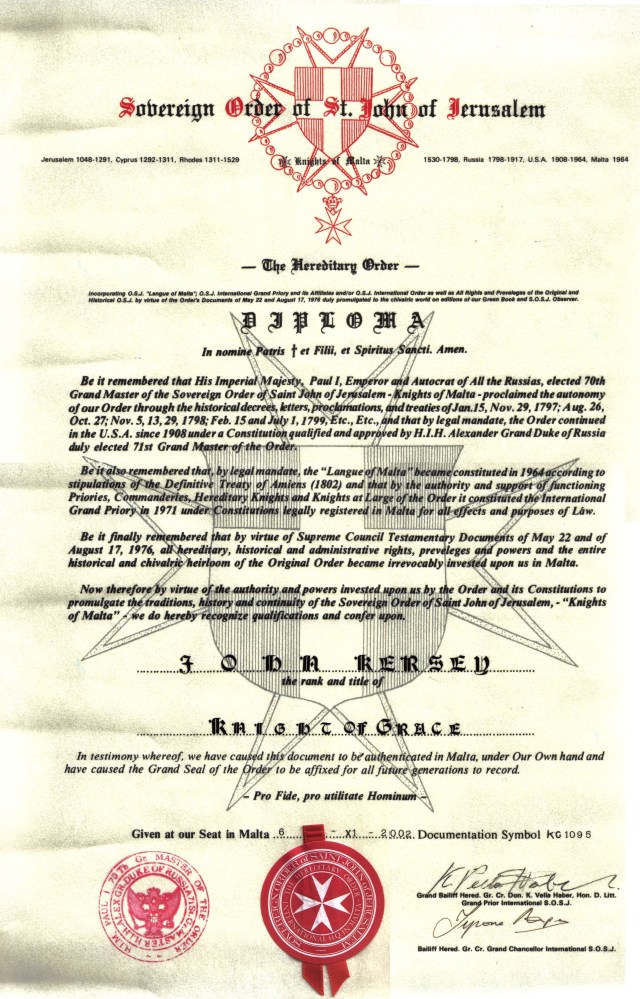
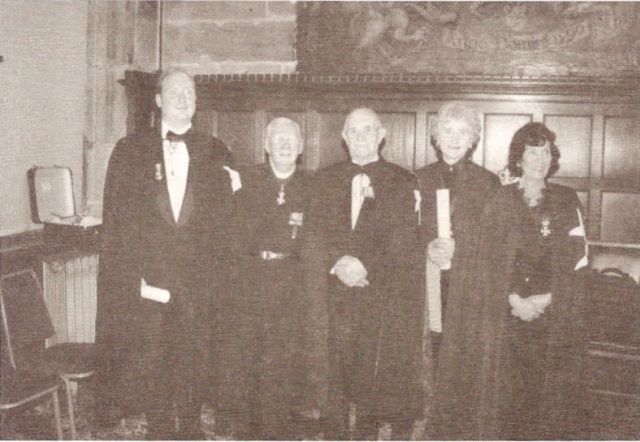
The investiture at Coventry Guildhall – I am first on the left with two Dames, the Grand Prior, and the Chaplain, the Revd. Douglas Pharaoh
Unfortunately, the Order in England became inactive after the death of Kenneth Benfield in 2007, and my letters to the English office and the Malta headquarters received no reply.
In the intervening years I had been ordained and consecrated bishop, and in 2011 had been elected Prince-Abbot of San Luigi. In 2012, I accepted an invitation from the Prelate, my friend the Most Revd. Howard Weston-Smart, to become a Chaplain to the British Association of the Russian Grand Priory. This had developed from the former Grand Priory of the British Isles of the King Peter Order, and was subsequently constituted as a registered charity under the Presidency of Alexandre Tissot Demidoff, who was a descendant of a Hereditary Commander of the Order. I was installed at the investiture at the Church of Our Most Holy Redeemer, Clerkenwell, London, on 30 June 2012. After nine years as Chaplain, I resigned from all appoitments in the British Association in September 2021.
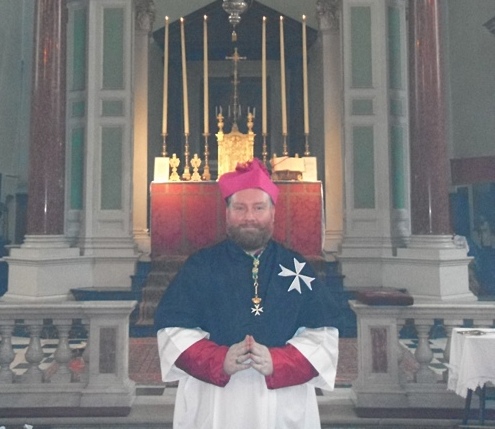
After my installation
Meanwhile, in September 2005, Prince Michael of Russia and Count Bobrinskoy had erected the Commandery of Carpathia of the Russian Grand Priory. Among the very limited appointments subsequently made to this Commandery were the late Dom Klaus Schlapps, OPR, OA, Duke of Saih Nasra in the Abbey-Principality of San Luigi, and myself. Both of us were appointed as Prelate – Knight Grand Cross of Justice, and the privilege of extraterritoriality was extended to my appointment. The category of Justice is exclusively reserved, as was the case historically, for those who can provide proof of noble status. Dom Klaus and I discussed the formation of a presence of the Russian Grand Priory in the United Kingdom on several occasions. We both deplored the divisions that had come to exist between the representatives of the Russian and Yugoslav traditions of St John and sought, in the spirit of the efforts of the 1970s, to bring about unity where possible.
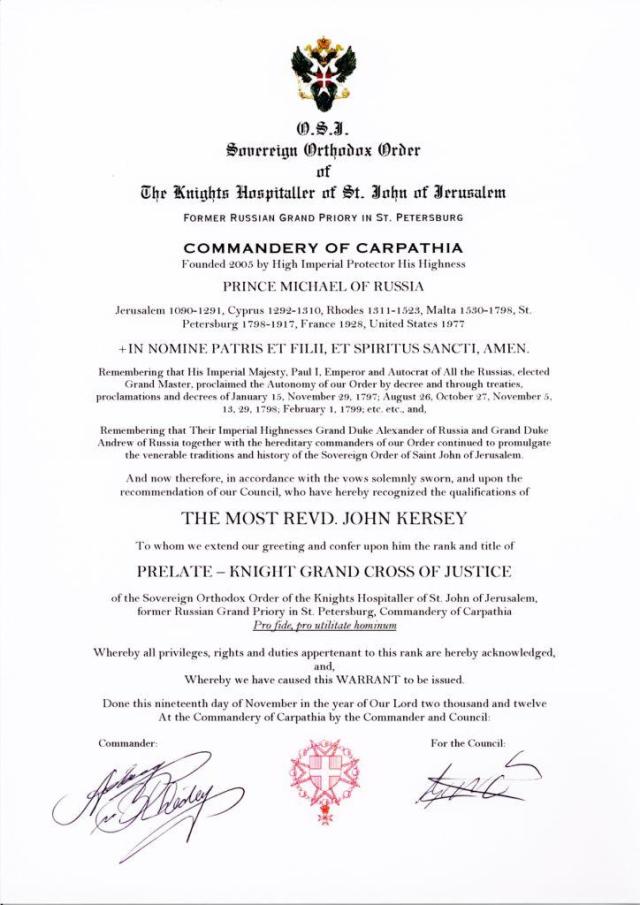
 Following the sudden and unexpected death of Dom Klaus in January 2013, a number of changes took place. It became clear that, although it was wished that amicable relations should continue with the Carpathian Commandery and the present-day Russian Grand Priory, some degree of independent re-organization would be necessary in order to continue the work that Dom Klaus and I had planned together.
In August 2013, the committee of the Supreme Council of the Abbey-Principality of San Luigi that had been created to examine the matter petitioned me in my office as Prince-Abbot to exercise my right as a fons honorum to erect an autonomous and extraterritorial Protectorate of San Luigi of the Orthodox Order of the Knights Hospitaller of St John of Jerusalem. The Protectorate used the former name of the Order to distinguish itself from the name that was currently in use by the Russian Grand Priory. This name was used in full on all official documents.
The Proclamation, no. 2013/72, issued by me in my office as Prince-Abbot of San Luigi on 20 August 2013, reads as follows:
“We, Edmond III, by the grace of God Prince-Abbot of San Luigi etc. etc., being desirous of giving a proof of our particular esteem and affection towards the Orthodox Order of the Knights Hospitaller of St John of Jerusalem, declare, that we take the said Order under our protection and that of the Abbey-Principality of San Luigi; and that we will employ every possible care and attention to maintain it in all its rights, honours, privileges and possessions.”
When I additionally succeeded as Prince of Miensk and Ecclesiast of All Byelorussia and as head of the Royal House Polanie-Patrikios in March 2015, the decision was taken to elevate the Protectorate to the status of a Royal Byelorussian organization, thus bringing it closer to its immediate history and heritage.
As a result, the present character of the Royal Byelorussian Protectorate of the Orthodox Order of the Knights Hospitaller of St John of Jerusalem is that of an ecumenical and extraterritorial Christian ecclesiastical community under my aegis as Prince of Miensk and Ecclesiast of all Byelorussia. As such, it represents a return to the Order’s origins as a body under religious governance.
 While it shares a common history with other institutions representing the Order of St John and the Russian Grand Priory and is open to the possibilities of collaboration with them, the Protectorate is self-governing and has no official relationship with any other Order of St John at the present time. Membership in the Protectorate is strictly by personal invitation of the Prince of Miensk and is extended ecumenically to all Christians, with non-Christians admitted to all ranks as honorary Knights or Dames. Associate membership is extended to members of other legitimate Orders of St John who wish to support the work of the Protectorate; if admitted as associates, they retain their existing rank in their “mother Order” and cannot be promoted within the Protectorate. The Protectorate preserves the historical and nobiliary traditions of the Order that it has inherited by virtue of its antecedence, and as is traditional, voting rights are reserved to members in the category of Justice. Since it also has a distinctive ecclesiastical character, it is especially devoted to the support of the work of all Johannites worldwide through prayer.
*Those interested in the history of the Order of St John and the modern representatives of its legacy are recommended to read the thesis of Dr. Hendrik J. Hoegen Dijkhof “The legitimacy of Orders of St. John” (doctoral thesis of the University of Leiden, 2006, available online at https://openaccess.leidenuniv.nl/handle/1887/4576).








 The order remained primarily a hospitaller order but it did take part in a number of battles, including the Battle of La Forbie on 17 October 1244 (where all of the Lazar brethren who fought died) and the Battle of Al Mansurah on 8–11 February 1250. The leper knights were protected by a number of able-bodied knights but in times of crisis the leper knights themselves would take up arms. The order quickly abandoned their military activities after the fall of Acre in 1291 and the dissolution of the Knights Templar due to their relative poverty. After this, the knights moved to Cyprus, then Sicily and finally to Boigny near Orléans in France, where
  In 1791, the French Revolution suppressed the Order in that country and confiscated its property. However, the future King Louis XVIII (pictured left wearing the Grand Cross) continued to confer it in exile, and on the restoration of the monarchy the Bourbon monarchs continued as protectors until 1830. On 12 March 1825, King Charles X issued a declaration that the United Order of Our Lady of Mount Carmel and St. Lazarus of Jerusalem would be allowed to become extinct. Under canon law, this would occur one hundred years after the death of the last member unless the Order was canonically re-organized. The last such member died in 1856, which would have allowed for canonical re-organization until 1956.
 In the event, canonical re-organization had occurred in 1841, when the Melkite Greek Patriarch Maximos III (Mazloum) granted his spiritual protection to the Order, and this state of affairs continued under his successors until the Patriarch transferred the government of the Order to a Council of Officers in Paris in 1910. This was confirmed by blessing of Patriarch Cyril VIII (Geha) (pictured right) on 3 June 1911. The factual position regarding the protection of the Order in the nineteenth-century has since been confirmed by successive Melkite Patriarchs to this day, notably by Patriarch Maximos IV (Sayegh) in 1965 and Patriarch Gregorios III in the Kevelaer Declaration of 2012. It should also be remembered that the Patriarch was a fons honorum by right of his office.
 Although much of the nineteenth-century had been a period of decline for the Order, by the 1930s it was active once more, being led by
 Membership in the Protectorate is strictly by personal invitation of the Prince and is open to baptised Christians of any denomination. Non-Christians may be admitted to the ranks of the Order as honorary Knights or Dames. Associate membership is extended to members of other legitimate Orders of St Lazarus who wish to support the work of the Protectorate; if admitted as associates, they retain their existing rank in their “mother Order” and cannot be promoted within the Protectorate. The Protectorate preserves the historical and nobiliary traditions of the Order of St Lazarus that it has inherited by virtue of its antecedence, and as is traditional, voting rights are reserved to members in the category of Justice. Since it also has a distinctive ecclesiastical character, it is especially devoted to the support of the work of all Lazarites worldwide through prayer.




 Professor John Kersey