What do The Beatles, Sir Ian McKellen, Sir Richard Branson, Professor Richard Dawkins, Adele, and Benedict Cumberbatch (not to mention many other famous people all around the world) have in common with me? We are all ministers of a remarkable institution called the Universal Life Church (ULC), which was founded in Modesto, California, in 1959 by the late Rev. Kirby J. Hensley.
The ULC was the outcome of many years of study of world religions by Hensley, a self-educated Baptist minister. Hensley said, “The Universal Life Church believes that when a man requests to be ordained, that he is already ordained of God, according to the Bible. In St. John 15-16, it says that God called you and has ordained you. We, the Universal Life Church believe that scripture to be true. We believe you are an ordained minister. What we do, is stand between you and the Federal Governments and between you and the state, not between you and your God.” The sole precept of the ULC is “do that which is right”, with the interpretation of this being left to the individual.
There are various Protestant denominations who, following the teachings of Luther and Calvin in particular, accept the priesthood of all believers in an exclusionary sense, but the ULC was the first to interpret this concept by offering actual ministerial ordination for free to anyone who felt called to accept it. Moreover, it extended the concept beyond professed Christians, embracing all religious beliefs of any kind as well as atheists and agnostics. Hensley said of this “I started studying all kinds of religions and ideals. For the past 40 years, if I heard of any kind of religion, I would look into it and find out what it had to offer.”
The revolutionary vision of Kirby Hensley was motivated both by a dissatisfaction with the mainstream churches and also by a desire to make a stand concerning the conflicts between church and state in the USA during his time. Hensley would say of this, “Let me give you a couple of quotes from the Bible that stresses how important this is. We find Paul saying to the Ephesians: “For we wrestle not against flesh and blood, but against principalities, against powers, against the rulers of the darkness of the world, against spiritual wickedness in high places.” (6:12) We must know who our enemies are – they are the church and the state…God told John the Revelator that in the last days a messenger would come with this message, and the message is that he would gather all things that are in the church and all things that are in the state and make them one. The message is that all men are born free and that they are also born Kings. This earth belongs to all people. It will be taken away from the church and the state and be given back to the people.” We can therefore see that Hensley proposed a concept of the church that was radically libertarian, democratic and decentralized, and that stood firmly against any kind of religious or political establishment.
The USA has a constitutional separation of Church and State such that religious bodies enjoy a very high degree of freedom from regulatory control. Hensley saw the state as an oppressive force, “We created the Church to take care of spiritual matters, and we created the State to solve material problems for us. We elected representatives to handle the work and paid them through taxes. And very much like the Church, the State grew into a system that soon took over the right to direct for us and made us its servants. The State keeps people down in the same way as the Church; with reward and punishment. The law abiding, tax paying citizen is rewarded with a house in a suburb, and his children are sent to schools in which they are taught to be good citizens like their fathers and mothers. This is the reward. But there is punishment too. Those of us who refuse to conform, and feed a system that we do not want any part of, are dragged to court and put in jail. The State, the laws, and the police were created by us to serve us, but today they have made us their servants. The freedom within the system is only imaginary, as the bureaucrats in charge constantly find new ways to impose restrictions within the boundaries of the law.”
In 1962, Hensley and others incorporated the Universal Life Church in California. It was not long before there were dozens of legal challenges to the ULC, questioning its nature as a church as well as its right to tax exemption. The ULC took on these battles and won the most important of them, with a Federal Court ruling in 1974 that it was indeed a valid church and was entitled to tax exemption (Universal Life Church, Inc. v. United States, 372 F. Supp. 770 – Dist. Court, ED California 1974). Regarding the diffuse nature of the ULC, the Federal Court found that the “First Amendment forbade any branch of the government to tell any church whether it must have beliefs or not.”
Hensley commented, “We have fought the state through-out the country. We will not yield to their dictations. So, we fought the system. We feel that the people have the first rights, the church organization has the second, and the state has the third rights. The church and the state were created by men and women for men and women. Therefore, we have allowed the church and the state to dictate our freedom. We are no longer willing to let the state dictate our lives.”

Revd. Kirby J. Hensley at the ULC Headquarters, Modesto, California (Photo credit: The Modesto Bee)
The ULC continues to be based in Modesto, California, although there are many other independent branches and ministries related to the ULC throughout the USA and in many other countries. My involvement has been solely with the parent body of the ULC in Modesto which continues under the leadership of Kirby Hensley’s son André today, and my remarks in this essay (except where specifically referenced) do not relate to any other branches of the ULC which are independent in their governance and may take a different view of various matters.
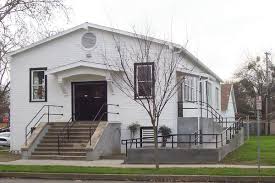
In Modesto, the ULC maintains a large church building and services open to the public take place there every Sunday morning. This building also serves as the International Headquarters where staff work to conduct the ULC’s activities and maintain its records.
The most important activity of the ULC continues to be the ordination of ministers.
The Universal Life Church will ordain anyone who asks; for life, without cost, without question of faith, and regardless of anyone’s belief system, age, race, gender or orientation. We maintain that every person has the natural right (and the responsibility) to peacefully determine for themselves what is right.
ULC ministers are people from all walks of life, including teachers, nurses, office clerks, engineers, food servers and celebrities. There are also ordained ministers whose backgrounds are from more traditional churches and choose to participate as ULC ministers as a show of support for our mission of religious freedom.
(ULC.net)
This process was originally conducted by mail, but has also been made available by online application in the present century. Each application is checked by a member of staff before being accepted. The result is probably the most diverse body of clergy in the world. ULC ministers are also permitted to belong to any other church or religious body without prejudice to their status within the ULC. They include members (and clergy) of all the major religions of the world as well as atheists, agnostics and those whose beliefs are not conventionally classified. Many famous and quite a few infamous people have become ULC ministers over the years.
Most states in the USA have made it a legal requirement that marriage be celebrated by a minister of religion, and this is the main reason why around 70% of applicants seek ULC ordination, as part of a recent trend of marriage being celebrated by friends or loved ones. Currently, ULC ordination is accepted as valid for the purposes of celebrating marriage in the vast majority of US states.
The case law in the USA that involves the ULC is voluminous and encompasses some of the most significant American battles for religious freedom of the past sixty years. There is now a website (associated with the ULC Monastery, one of the larger branches of the ULC) devoted to this case law at https://ulccaselaw.com.
An obvious question is what value and meaning ULC ordination has if it is open to all comers? While the ULC provides a legal ordination credential, since this does not involve any examination of the fitness of the candidate for the ordained ministry, it is the individual who will determine whether that credential has any meaning beyond a merely functional and legalistic level. Certainly some people become ordained in the ULC without taking it seriously, and for some it is simply a legal rubber stamp enabling them to officiate a marriage ceremony. As with other religious bodies there is also always the possibility that some may seek ordination with malign intent. The ULC is very clear that it takes no responsibility for the actions of its ministers.
Despite this, I have been consistently impressed by the calibre of a number of ministers ordained by the ULC, particularly those such as interfaith ministers, pagans, and New Age practitioners who wish to follow a genuine ministerial calling that is not served by other more established paths. They demonstrate that ULC ministry is truly what you make of it. I have also become aware of several clergy of mainstream Christian churches who additionally hold ULC ordination.
My own position has been that I was attracted to the ULC because I shared its libertarian belief in religious freedom. The ULC has consistently stood for this principle and has not hesitated to defend it in court. My status as a minister of the ULC has always been supplementary to my position as a clergyman in more traditional Christian denominations.

The work of the ULC is sometimes interpreted by mainstream religious bodies as threatening their status or control. In my view, the ULC’s willingness to fight for religious freedom has assisted all religious bodies. However, this fight has also emphasised the separation of church and state under the US Constitution.
As we can see in other countries, where this separation is not maintained, it leads to what many would see as too close a bond between the larger religious bodies and the state, such that the power of the state can then be used to enforce their hegemony, particularly against smaller or more unusual religious bodies. While human rights legislation generally protects the freedom of belief of the individual, it does not generally promote equal status between religious bodies. In England, the Church of England is established by law and its canon law is the law of the land; it is also endowed with very significant property, wealth and influence in public life. The history of the Church of England’s relationship with some smaller churches, notably with Old Catholicism, has unfortunately been characterised by hatred and discrimination, and yet this is allowed to go unchecked because of its establishment status.
Because these are important matters to me, I hold that support for the mission of the ULC is a way to stand for a better relationship between Church and State.
In England, there have been various efforts over the years to establish associations of ULC clergy. There is no provision in our law that gives recognition to churches as religious bodies per se, nor are they required to register with the state so long as they remain unincorporated. The ULC would in theory be able to establish places of worship and to register charities if it were to grow to a size where this was desired. Its ministers may use the title Reverend or another title that signifies their ministry in the same way as other clergy of various religious bodies.
In respect of the celebration of marriage, ULC ministers are in a similar position to humanist and related celebrants, in that marriage would require legal registration before a registrar in order to be valid, either before the ULC ceremony or with the registrar in attendance at that ceremony to perform the legal requirements.
In furtherance of its mission, the ULC also grants degrees. The practice of churches granting religious degrees has a long history in the United States, and many churches there maintain their own seminaries to train their clergy. Because of the separation of church and state, it has been upheld by various court judgements over the years that the granting of religious degrees by a religious organization is an activity which states cannot regulate or interfere with. Given the increasing politicization of the educational establishment, the religious alternative may well prove to be the last haven of genuine academic freedom for those who are not aligned with the current mainstream.
Degrees in religious subjects awarded by churches in the United States have exactly the same legal status as United States degrees in religious subjects awarded by mainstream universities. The separation of church and state means that they may be used freely in any context; the doctorates entitle the holder to use the title Doctor, and all degrees entitle the holder to use postnominal letters. While certain states have attempted to regulate the use of degrees, religious degrees that have been awarded legally under state law are valid in all states and any attempt to restrict them would be unconstitutional. Moreover, and uniquely, the degrees of the ULC have the protection of a Federal Court judgement as to their legality.
In a Federal Court judgement of 1974, the judgement records that “Rev. Hensley further testified that the Honorary Doctor of Divinity program was developed since the church policy allowed ministerial credentials to be conferred gratis upon anyone on request and upon new ministers who were seeking information on ministerial procedures. (Kirby J. Hensley deposition, page 21, lines 18-25.) The lesson plans (defendant’s Exhibits G through L) cover basic church functions, how to conduct services, marriage, baptismal ceremonies, burial services, etc. The lesson plans were mailed out or otherwise distributed on request with the Honorary Doctor of Divinity as a course of instruction in the principles of the church.” The court then found that, “Expert opinion evidence established that an Honorary Doctor of Divinity is a strictly religious title with no academic standing. Such titles may be issued by bona fide churches and religious denominations, such as plaintiff, so long as their issuance is limited to a course of instruction in the principles of the church or religious denomination. The Court’s conclusion that the issuance of Honorary Doctor of Divinity certificates is not violative of the California Education Code and therefore public policy is supported by a reading of Section 20920, California Education Code: The provisions of Sections 29003 to 29010, inclusive, do not apply to any diploma or course of instruction given by a bona fide church or religious denomination if such course is limited to instruction in the principles of that church or denomination.”
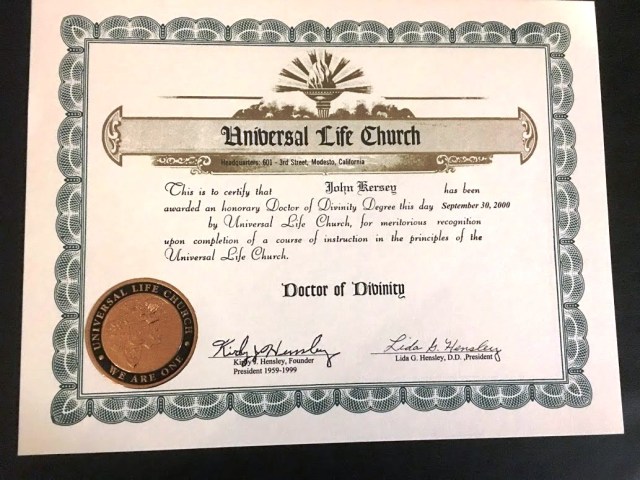
California law permits churches or religious denominations to issue degrees, with the current (2023) provision being contained in the California Code, Education Code – EDC § 94874. This reads as follows,
Except as provided in Sections 94874.2, 94874.7, and 94927.5, the following are exempt from this chapter: […]
(e)(1) An institution owned, controlled, and operated and maintained by a religious organization lawfully operating as a nonprofit religious corporation pursuant to Part 4 (commencing with Section 9110) of Division 2 of Title 1 of the Corporations Code, that meets all of the following requirements:
(B) The diploma or degree is limited to evidence of completion of that education.
(2) An institution operating under this subdivision shall offer degrees and diplomas only in the beliefs and practices of the church, religious denomination, or religious organization.
(3) An institution operating under this subdivision shall not award degrees in any area of physical science.
(4) Any degree or diploma granted under this subdivision shall contain on its face, in the written description of the title of the degree being conferred, a reference to the theological or religious aspect of the degree’s subject area.
(5) A degree awarded under this subdivision shall reflect the nature of the degree title, such as “associate of religious studies,” “bachelor of religious studies,” “master of divinity,” or “doctor of divinity.”
Those wishing to argue against the ULC often point out that the earned degrees that it offers require little academic work. There are no general education courses; the study materials are uncomplex in nature, and the student is either not tested at all (being awarded the degree on a good faith basis assuming that they have studied the materials provided) or is subject to a straightforward pass/fail test. But to understand the ULC’s degrees it is essential to grasp the central point that they are religious, not academic, in nature.
A close reading of the statute above will find that it is not the ULC that limits the content of its degrees, but in fact the law of the State of California itself. A degree conferred under this statute is deliberately circumscribed, so that “the instruction is limited to the principles of that religious organization” and “the diploma or degree is limited to evidence of completion of that education,” and moreover “An institution operating under this subdivision shall offer degrees and diplomas only in the beliefs and practices of the church, religious denomination, or religious organization.” Therefore, the only subject matter that can form part of a degree curriculum is the principles, beliefs and practices of the ULC, which as discussed above has but one religious principle. The ULC could not add substantially to the content of its degree curriculums without contravening the law.
In practice, the content of ULC degrees is therefore principally the writings and beliefs of its founder, Kirby J. Hensley, including his personal views on aspects of religious study including the Bible. Much is made of Hensley’s illiteracy, but if this was indeed the case he must have left one of the most comprehensive written legacies of any illiterate. His writings are interesting, clearly expressed and at times thought-provoking, and certainly worthy of study. I have enjoyed reading them, and hope to read more of them in the future.
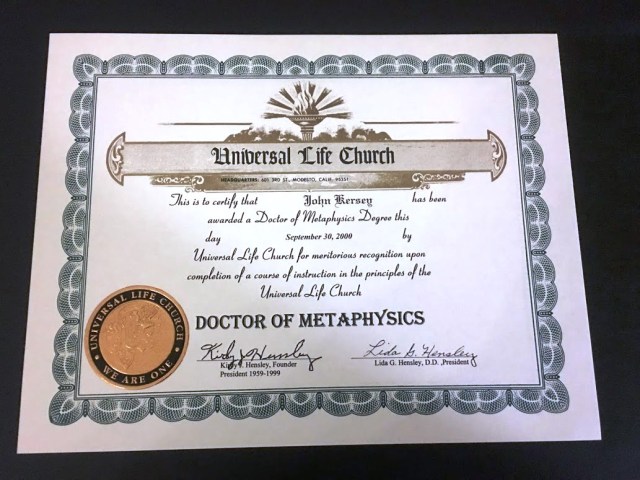
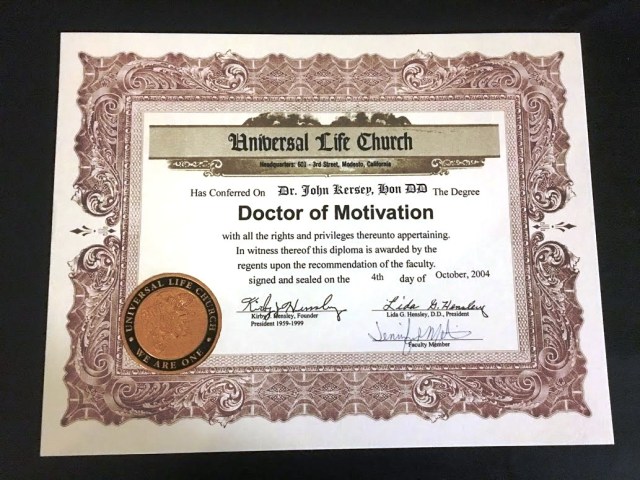
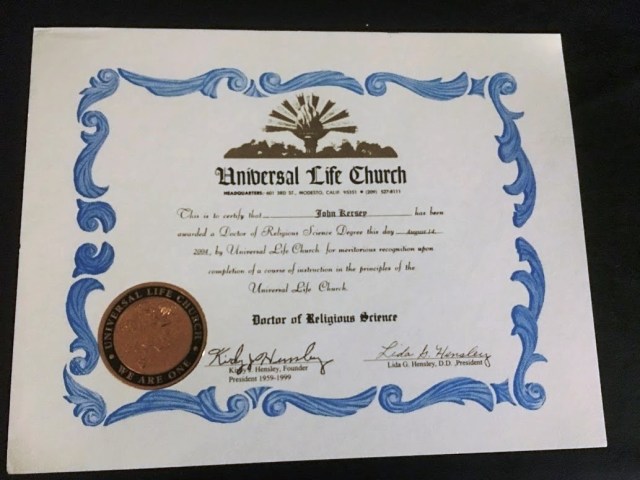
I have taken a number of the ULC’s degrees from interest over the years (where else could one become a Doctor of Motivation?), and when time permits hope to do more. They are not, and do not claim to be, academic credentials. They are exactly what they claim to be, which is legal and valid California religious degrees.
There is a scheme of academic dress for the degrees of the ULC. The hoods are in Cambridge full shape, made in Mary blue worsted wool and lined with the discipline colour (which is scarlet for the Hon.D.D. and each of the other degrees which are all in subjects related to divinity or theology, except the Ph.D. in Religion which would be dark blue).
The hood is the same for each degree level in the same discipline, so the Master’s Degree in Religion receives the same hood as the Hon.D.D.
The gowns, however, differ between the levels. There is provision for bachelors, although the ULC is not known to have awarded any bachelor’s degrees. They wear the American Intercollegiate Code bachelor’s gown in black. Masters wear the basic master’s gown in black, and doctors wear the American Intercollegiate Code gown in blue worsted wool.
This article has also been published on the website of the Libertarian Alliance (https://libertarianism.uk/2024/08/10/the-universal-life-church/)













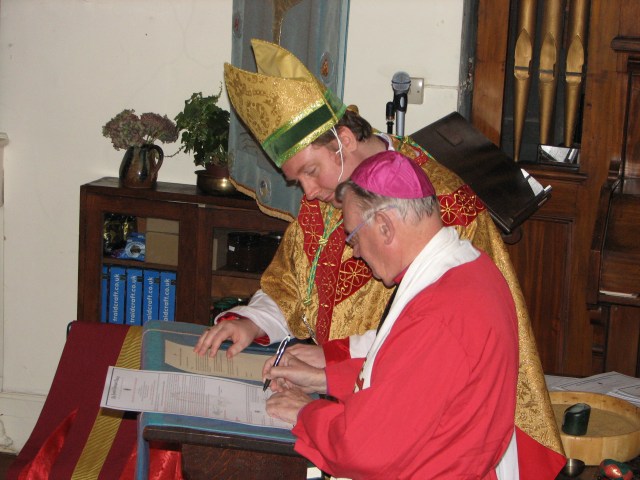


 Dom Phillip Kemp OSB(csr) was Primate of the Old Catholic Church of Great Britain, which had been founded in 1968. He was for twelve years employed at the Department of Work and Pensions, where he rose to become a manager. He then became a learning and development officer, and latterly Regional Manager, for the public service trades union Unison. An able chef, he served for eight years in the Territorial Army Catering Support Regiment, Royal Logistics Corps, and was promoted from the ranks to Second Lieutenant in 1992. Further promotion to Captain followed before he left the T.A. in 1998. Although he had not pursued university education after leaving school, he studied later in life with the Open University.
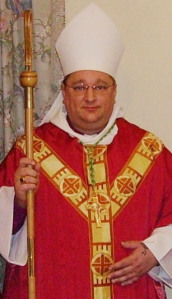


 The Society was a small autocephalous group of Christians that had first formed in South London in 1999. First called the British Liberal Free Church, and later renamed the Society of the Divine Spirit (SDS), the inspiration for this foundation was the work of Revd. J.M. Lloyd Thomas and the Society of Free Catholics earlier in the twentieth-century, with the aim of combining the intellectual freedom of the Free Church tradition with gently Catholic worship. The Society of Free Christians was also formed in 1999 as a ministerial organisation working in parallel with SDS.


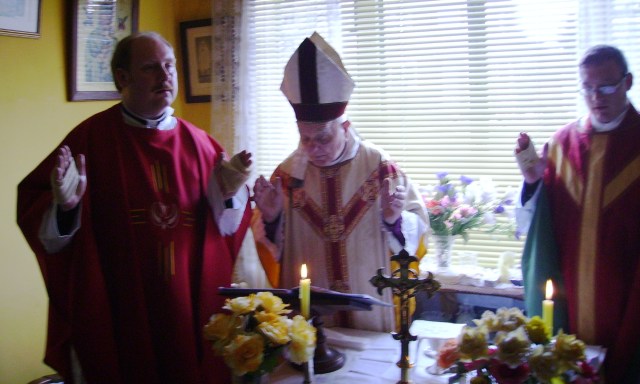


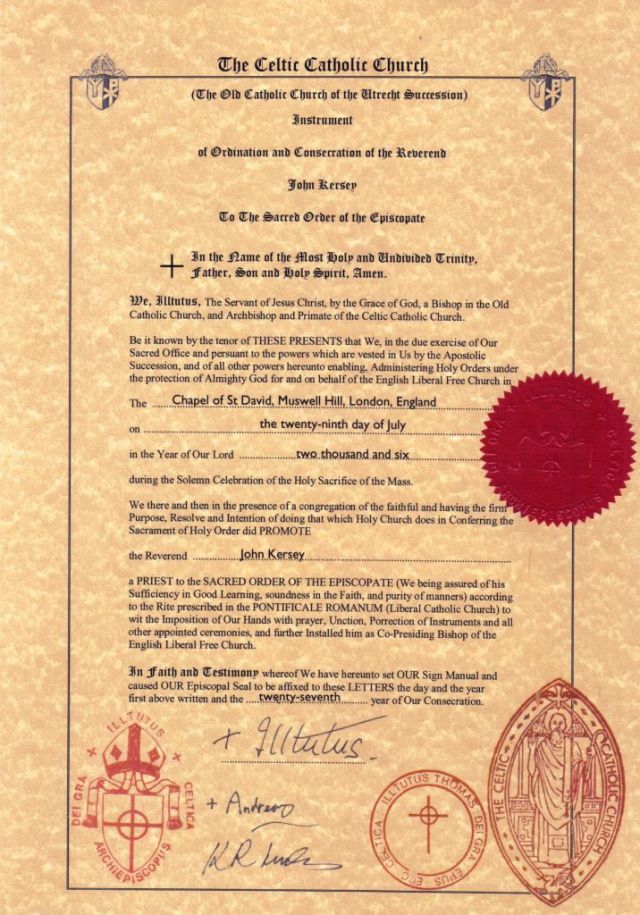


 Professor John Kersey