New CD published – Piano Sonatas of Eduard Franck (1817-93) vol. 2

A new CD is available from Romantic Discoveries Recordings.

Piano Sonatas of Eduard Franck (1817-93) vol. 2
John Kersey, piano
RDR CD88

Piano Sonata in F major, op. 40 no. 1
1. Allegro 2. Allegretto 3. Allegro vivace

Piano Sonata in C major, op. 40 no. 2
4. Allegro risoluto 2. Andante sostenuto 3. Allegro vivace

Piano Sonata in G minor, op. 40 no. 3
7. Allegro 8. Allegretto 9. Allegretto

Our thanks to Andreas and Paul Feuchte for supplying scores of these rare works.

Eduard Franck was born in Silesia into a wealthy and cultured family that numbered Mendelssohn and Wagner among its acquaintances. He studied with Mendelssohn as a private student and then began a long career as a concert pianist and teacher. He was regarded as one of the leading pianists of his day and also as an outstanding teacher.

Franck was not forthcoming about his compositions, and failed to publish many of them until late in life. He was a perfectionist and would not release a work until he was absolutely satisfied that it met his standards. Yet what survives is extremely high in quality. Writing of his chamber music, Wilhelm Altmann said, “This excellent composer does not deserve the neglect with which he has been treated. He had a mastery of form and a lively imagination which is clearly reflected in the fine and attractive ideas one finds in his works.”

The six piano sonatas forming op. 40 were published in Berlin in 1882 and dedicated to Franck’s son Richard. They show his mastery of the sonata at its zenith, and in all likelihood were written over a number of years preceding their publication, along with the ten other sonatas that form Franck’s known output in this form.

All three of these sonatas demonstrate Franck’s key qualities of proportion and command of structure, within which a wide emotional canvas is developed. The shades of Beethoven and Schubert hover near, with the latter’s influence felt particularly in the Allegretto finale of the G minor sonata, whose second subject is notably Schubertian in design. Other passages in that work’s first movement recall figures from Beethoven’s G major sonata, op. 31 no. 1, though in a darker and more serious context than that work’s playfulness.

Franck generally puts the burden of argument in these sonatas upon the first movement, with the central movement acting as a contrast to this intensity and thorough working-out of the sonata form. In two of the sonatas, there is no true slow movement, with scherzo-like foils taking that place, although in the G minor sonata there are lyrical episodes that give something of a sense of an extended cantabile. The finale is then left to promote resolution, generally taking on a more humorous, Haydn-like character and treating motifs that open up multiple developmental possibilities. The choice of sonata-rondo form is another indication of Franck’s concern with development as an integral part of design; not for him the freer approach of Chopin, for example. With Franck, a Viennese formality is a part of that sense of proportion that holds head and heart in balance.

His sonatas are the stronger and more impressive for this element of restraint within boundaries. The listener will be struck by Franck’s economy of gesture over what is often quite a large-scale movement; not a note is wasted or out of place, and throughout a terse inner logic first explores the potential of the material and then ties it together in a typical extended coda.

Contrast is also a major strength of Franck’s approach. His choice of varied motivic material is deft and at times, such as in the second subject of the G minor finale mentioned above, gives rise to genuinely memorable and beautiful writing. These lyrical passages are often deceptively technically demanding; Franck was clearly an exceptionally able pianist and he takes few prisoners in his demands for stamina and agility, not to mention complex accompaniment-figures in double-notes.

The ‘Neue Zeitschrift für Musik” of 11 May 1883 reviewed the sonatas of op. 40 and op. 44 with the following words, “In all these works, a rich treasure of good German music is laid down. It is said of our time, that it brings forth no thorough Sonata, here we find a refutation of such a claim. Since Beethoven, only a few talented writers such as Ed. Franck have probably been called into existence. Almost all motives are created vividly before us and are well crafted. It is evident how versatile and diverse they are, especially from the fact that there is an underpinning of good counterpoint as if it were naturally present in the hands. Several of these [sonatas] deserve to be performed symphonically, because a dramatic element predominates in them. This Franck has always kept in mind, just as our classical piano masters treated their instruments, in so far as the piano is an orchestra.”

Honours and awards: Fellow in Performance of the Australian Society of Musicology and Composition

The Australian Society of Musicology and Composition promotes and rewards the study and growth of all musically-related subjects throughout the world. Whilst the principal emphasis is on Musicology and Composition, all disciplines including performance are included and encouraged. It is governed by a Council of leading Australian composers, musicologists and music educationalists.

The Society is an examining body and offers the diplomas of Licenciate, Associate and Fellow. There is considerable flexibility regarding choice of repertoire. Candidates may enter from anywhere within Australia, or from overseas.

In 2011, the Society awarded its Fellowship in Performance to me following my nomination by a member of Council. The Society does not confer honorary awards but states that “Fellowship may be conferred without examination in exceptional cases to persons whose standing or record of achievement is considered by an examiner to make examination unnecessary or inappropriate.” The citation for the award reads in part “your contribution to the music world, both in performance and teaching, is exemplary.”

New CD published – Piano Music of Robert Fuchs (1847-1927)

A new CD has been published by Romantic Discoveries Recordings.

Piano Music of Robert Fuchs (1847-1927)
John Kersey, piano
RDR CD87

Improvisationen, op. 11: 1. Grazioso 2. Andante con espressione 3. Un poco con moto 4. Allegretto 5. Presto 6. Allegretto tranquillamente 7. Allegro 8. Allegro moderato (scherzando) 9. Tranquillo. Sommermärchen und Herbstblätter, op. 39 (excerpts) 10. Anmuthig 11. Etwas langsam, gemüthvoll. 12. Capriccietti, 11 Stücke, op. 12: Mässig bewegt – Im selben Tempo – Etwas ruhiger – Ziemlich geschwind – Mässig bewegt – Im selben Tempo – Langsam breit – Unruhig – Sehr ruhig – Bewegt – Finale. Ländliche Scenen, leichte Stücke, op. 8: 13. Sommer-Morgen 14. Auf dem Teich 15. Verlassen! 16. Plaudernde Mädchen 17. Trauliches Plätzchen 18. In der Dorfschmiede 19. Die Schule ist aus! 20. Auf der Waldweise 21. Im stillen Grunde 22. Waldvögelein 23. Heimkehr vom Felde 24. Zur Kirmess. Romantic Discoveries Recordings CD 87.

Our thanks to Dr Klaus Tischendorf for supplying scores of these rare works.

Robert Fuchs was born in 1847 in Styria, the youngest of thirteen children. He attended the Vienna Conservatoire where he studied with Felix Dessoff and Joseph Hellmesberger, and subsequently taught there, being appointed professor of music theory in 1875. He retired in 1912. The list of his pupils includes Sibelius, Mahler, Enescu, Wolf, von Zemlinsky, Korngold, Schmidt and Schreker, and it has been suggested by one critic that Mahler’s Second Symphony bears the marks of several “Fuchsisms”.

Fuchs disliked the promotional aspects of life as a composer and did little or nothing to promote his works during his lifetime. He preferred a quiet and comfortable existence in Vienna, where his teaching position ensured both financial security and the opportunity to continue his work as he saw fit. Nevertheless, his five serenades did achieve popularity in his time, earning him the nickname “Serenaden-Fuchs”. Conductors such as Nikisch also did much to champion his orchestral works, though with little ultimate result.

Fuchs was reasonably prolific in most areas of composition, including four symphonies, but it is his chamber and instrumental music that is regarded as his most personal and significant. Brahms, who was not overly given to praise of other composers, said of Fuchs, “Fuchs is a splendid musician, everything is so fine and so skillful, so charmingly invented, that one is always pleased.” One might add that Fuchs is a supremely balanced composer: sensitive yet formal in approach, and tending towards intimacy of expression while not being without the capacity to express a more extrovert drama.

Fuchs’ works for piano include three piano sonatas, which have been recorded in recent years, and a number of other cycles. The Improvisationen, op 11, show him to have absorbed the influences of Schumann, Brahms and Mendelssohn, and reveal a composer of considerable emotional range and an instinctive command of the capabilities of the piano. The Capriccietti, op 12, are a set of pieces designed to play continuously as a cycle, not unlike Schumann’s Humoreske, and with a finale that is reminiscent of that from his Symphonic Etudes. Away from these ambitious works, the Ländliche Scenen are simple pieces that present an idealized world of rural childhood. Unpretentious and melodic, they show Fuchs at his most genial and lyrically inspired.

Two new CDs published – Piano Music of J.P.E. and Emil Hartmann and August Winding

Two new CDs are now available from Romantic Discoveries Recordings.

Piano Music of J.P.E. and Emil Hartmann and August Winding
John Kersey, piano
RDR CD86

Johan Peter Emilius Hartmann (1805-1900): 1. Fantasistykke: Allegretto grazioso e moderato. August Winding (1835-99): Sommerminder, op 26: 2. Feriestemning 3. Nyt Liv 4. J Sukkenes Allee I 5. J Sukkenes Allee II 6. Valse Impromptu 7. Serenade 8. Notturno. J.P.E. Hartmann: 9. Introduction et Andantino religioso, op. 26. August Winding and Emil Hartmann (1836-98): Fjeldstuen, ballet by A. Bournonville: 10. Sæterpigernes Dands om det nydødbte Barn (Winding)  11. Astas Dands til Faderens Spil (Hartmann)  12. Bornene Fortælle om Astas Dands (Hartmann) 13. Menuet (Hartmann) 14. Huldredands (Winding) 15. Springdands (Winding) 16. Scherzo (Hartmann). J.P.E. Hartmann: Novelletten: Sechs kleine Stücke, op 55: 17. Allegretto 18. Allegro giocoso 19. Menuet-Tempo 20. Allegro vivace, assai 21. Andantino sostenuto 22. Allegro assai. Emil Hartmann: Sonata in F major, op 17: 23. Allegro 24. Cantilene: Andantino 25. Rondo: Allegro grazioso.

Johan Peter Emilius Hartmann succeeded his father at the Garnisons Kirke in 1824, and thereafter was successively professor at Copenhagen University and the founding director of the Conservatoire there from 1867. His studies in Europe in 1836 brought him into contact with Chopin, Rossini, Cherubini and Spohr. In musical style he successfully fused elements of Nordic nationalism with a post-Mendelssohnian style that at its most progressive (such as in op 74) clearly looks forward to Brahms. The quality of Hartmann’s inspiration and mastery of compositional and pianistic technique was considerable, and marks him out as the leading Danish composer for the piano of his generation.

Emil Hartmann, son of J.P.E., received his early training from his father and developed a successful career in his homeland and Germany, despite being somewhat eclipsed by his father’s fame. His unpublished Sonata shows a forward-looking grasp of the mid-Romantic idiom, with a powerful opening movement followed by two that were both left unfinished, interestingly when each had reached similar melodic ideas. His shorter works are gratefully written for the instrument, showing an apt grasp of the salon style of the turn of the century. The ballet Fjeldstuen (The Mountain Hut, or Twenty Years) to choreography by the royal ballet master August Bournonville was completed in 1859 and was the first significant work of Emil Hartmann, here collaborating with his brother-in-law August Winding, to come to public notice.

August Winding was the son of a pastor, and received his first piano lessons from his parents. In 1847 he studied with Carl Reinecke and from 1848-51 with Anton Rée, also studying composition with Niels Gade. In 1856 he completed his studies in Leipzig and Prague, where he studied with Dreyschock. Returning to Denmark, he became well-known for appearances as a soloist, particularly in Beethoven’s Fourth Piano Concerto. In 1864, he married Clara, daughter of J.P.E. Hartmann. From 1867 he taught at the Royal Conservatory, as well as privately. In 1872 he developed a nervous injury to his arm as a result of overwork which forced him to stop concertizing and devote his attention to composition. He resumed teaching at the Conservatory in 1881 and became a member of its board after the death of Gade in 1890. In 1888 he reappeared in public as a soloist and gave a limited number of concerts between then and his death, receiving the accolade of a state professorship and annuity in 1892.

Piano Music of August Winding (1835-99)
John Kersey, piano
RDR CD85

Preludes in all the Keys: A Cycle, op 26: 1. in C major: Poco Adagio, maestoso e con nobilità 2. in A minor: Allegro agitato ed affetuoso 3. in F major: Comodo 4. in D minor: Allegro risoluto e energico 5. in B flat major: Allegro non troppo. Giocoso, con allegrezza 6. in G minor: Moderato con fierezza 7. in E flat major: Andante innocente e tenero 8. in C minor: Presto impetuoso 9. in A flat major: Allegro non troppo con dolcezza 10. in F minor: Allegro moderato, poco agitato 11. in D flat major: Con moto. Soave e con grazia 12. in B flat minor: Andantino quasi Allegretto, Grave e mesto 13. in G flat major: Allegro vivace con calore e molt’ animato 14. in E flat minor: Presto furioso e con strepito 15. in B major: Allegretto tranquillo e dolce 16. in G sharp minor: Allegretto dolente e malinconico 17. in E major: Moderato grazioso e con tenerezza  18. in C sharp minor: Allegro energico e molt’ appassionato  19. in A major: Allegretto dolce e piacevole 20. in F sharp minor: Andantino con duolo 21. in D major: Allegro con vivacità ed anima 22. in B minor: Adagio grave e lugubre 23. in G major: Allegro molto con gran vivacità 24. in E minor: Andante sostenuto, quasi una fantasia 25. Postludium in C major: Poco Adagio, maestoso e con nobilità. Landlige Scener: Skizzer for Piano, op 9: 26. Med Tilegnelsen 27. Ved Daggry 28. Ved Kornmarken 29. I det Frie 30. Løvfald 31. Aftenstemning 32. Afsked.

August Winding was the son of a pastor, and received his first piano lessons from his parents. In 1847 he studied with Carl Reinecke and from 1848-51 with Anton Rée, also studying composition with Niels Gade. In 1856 he completed his studies in Leipzig and Prague, where he studied with Dreyschock. Returning to Denmark, he became well-known for appearances as a soloist, particularly in Beethoven’s Fourth Piano Concerto. In 1864, he married Clara, daughter of J.P.E. Hartmann. From 1867 he taught at the Royal Conservatory, as well as privately. In 1872 he developed a nervous injury to his arm as a result of overwork which forced him to stop concertizing and devote his attention to composition. He resumed teaching at the Conservatory in 1881 and became a member of its board after the death of Gade in 1890. In 1888 he reappeared in public as a soloist and gave a limited number of concerts between then and his death, receiving the accolade of a state professorship and annuity in 1892.

Winding’s works include principally a large amount of solo piano music, particularly etudes, as well as a symphony, piano concerto, concert allegro for piano and orchestra, piano quartet, string quintet and two violin sonatas. This disc is the first to be devoted to his solo piano music.

The major cycle of Preludes in all the keys is dedicated to Isidor Seiss, the noted piano teacher and pupil of Friedrick Wieck. Unlike Chopin, Winding adopts a cycle of ascending fourths followed by their relative minors. This is a superbly varied and inspired series, with a lyrical emphasis throughout. Of particular note are the finely-drawn B flat minor (no. 12), perhaps the most reminiscent of Chopin, and the final E minor dark fantasia. The set ends with the first prelude returning as a postlude, having already been alluded to in the B minor prelude (no. 22).

The Landlige Scener (Rural Scenes) are an early work of Winding’s and show his distinctive voice already well-developed with clear progression from the world of Schumann and Mendelssohn. The movements are attractively descriptive, including Ved Daggry (at dawn), Løvfald (leaf fall), Ved Kornmarken (through the cornfield), Aftenstemning (evening mood) and Afsked (farewell). Winding’s father had a passion for collecting and arranging folk music and its contours are evident in a number of these effective, unpretentious pieces.

New CD – Piano Music of August Halm (1869-1929)

A new CD has been issued by Romantic Discoveries Recordings.

Piano Music of August Halm (1869-1929)
John Kersey, piano
RDR CD84

August Halm
1. Prelude and Fugue in E minor 2. Pastorale and Andantino 3. Prelude and Fugue in C minor 4. Prelude and Fugue in F sharp minor 5. Praeludium and Invention. Adolf Schulz-Evler (1852-1905) 6. Echo de la Partita de J.S. Bach. Rudolph Niemann (1838-98) Concert Suite, op. 34: 7. Praeludium 8. Sarabande 9. Alla Gavotte 10. Bourrée

August Halm was the third son of Hermann Friedrich Halm and Charlotte Augusta (nee Kulmbach). His father was at that time pastor in Grossaltdorf. Halm reluctantly studied theology at the University of Tuebingen, combined with the study of composition. His teacher and promoter was Tuebingen’s director of academic music Emil Kauffmann. After an unenthusiastic beginning in ministry he sought two years of leave to study with Rheinberger, but found this uninspiring. He took work as a conductor and after the turn of the century he met Hermann Lietz , Gustav Wyneken and Paul Geheeb. From 1906 to 1910 and in the period from 1920 to 1929 he was active with Wyneken at his Free School in Wickersdorf near Saalfeld.

Halm was considered the most important music educator and spokesman of the musical youth movement, and worked to establish connexions between art and religion. His Free School developed ideas that would also be associated with Rudolf Steiner, such as child-centred, non-traditional learning in contrast to the regimented public school system. In its forest location and emphasis on nature (hiking movements that came to agitate for social reform were growing forces in the Germany of that time), it was also typical of the alternative living communities that Steiner’s Anthroposophy and indeed the wider Theosophical movement would generate in the early decades of the twentieth-century.

As a composer, Halm remained firmly in the model of Anton Bruckner, concentrating on the compositional techniques of the fugue and the sonata.  He did, however, establish a distinguished reputation as a music aesthetician as well as a writer on music. His writings, intended for the general public rather than other musicians, are characterized by a direct, obvious and clear language.

Those of Halm’s piano works collected on this disc show a clear development of Bachian language in a direction parallel to but distinct from Busoni’s new classicism. As a tonalist, Halm directed his attention away from modernism and towards breathing new life into Baroque forms and devices, in an attempt to recapture the vigour and purity of an idealized past. The result is music that is unusually individual while clearly showing its Teutonic influences in Bach, Beethoven and Bruckner. As in Reger’s world there is little concession to sensualism but instead an energy, clarity and logical purpose that propels the music with dynamic force and a structural cogency that is sometimes terse and rarely risks over-extension. The harmonic shifts, so much a part of Bruckner’s sound-world, have the capacity to pull the music sideways in an abrupt and striking fashion, but are deployed as part of a rigorous overall plan of the work in question. The E minor Prelude and Fugue, the longest in that genre, is a remarkable work making use of alternating themes and sections, and relying greatly on continuity of thought and line.

All that is known of Adolf (or sometimes Andrey) Schulz-Evler’s fifty or so compositions today is his popular showpiece Concert Arabesques on Strauss’s The Blue Danube, a fiendish Octave Etude (as yet unrecorded) and this little transcription of Bach, replete with huge chords and octaves in the manner of such transcribers as Stradal.

Rudolph Niemann is even less familiar, and this is the first recording of any of his music. He was the father of composers Walter and Gustav Adolph Niemann. The son of a local organist, he studied piano with Moscheles, travelling to Paris where he studied with Marmontel and Halevy, and then back to Berlin with Hans von Buelow. He undertook concert tours of Europe both as soloist and with the violinist Wilhelmj. From 1883 he taught at the Robert Fuchs Conservatoire in Wiesbaden. His Concert Suite continues the retrospective theme of this disc with its clear Baroque models and vigorous approach to reviving the old dance-forms.

Honours and awards: Georgia Lieutenant Colonel, Aide de Camp Governor’s Staff

An honorary military commission is considered by some to be the American equivalent of being knighted. The honorary title of Colonel is conferred by some states in the United States of America. The origins of the titular colonelcy can be traced back to colonial and antebellum times when men of the landed gentry were given the title for financing the local militia without actual expectations of command. This practice can actually be traced back to the English Renaissance when a colonelcy was purchased by a lord or prominent gentleman but the actual command would fall to a lieutenant colonel, who would deputize for the proprietor. It has come to be associated in popular culture with the image of the aristocratic Southern gentleman, not least because of one of the most famous Kentucky Colonels, Harland D. Sanders.

The State of Georgia, under the provisions of the Official Code of Georgia Annotated 38-2-111, commissions individuals into the Governor’s personal staff with the rank of Lieutenant Colonel. The commission is active from the commencement of the Governor’s term of office until that term expires – in my case, under Governor Nathan Deal, between 2011 and 2019.

New CD – The Circle of Brahms, vol. 2

A new CD has been issued by Romantic Discoveries Recordings.

The Circle of Brahms, vol. 2
John Kersey, piano
RDR CD82

Ignaz Brüll (1846-1907)
1. Theme with Variations, op. 35 no 1 2. Mazurka, op. 35 no 2

Ernst Rudorff (1840-1916)
3. Fantasie, op. 14 – first movement

Brüll
4. Ballade, op. 84 5. Theme with Variations, op. 39  Drei Klavierstücke, op. 101:
6. Menuett 7. Gavotte 8. Novelette

Karl Georg Peter Grädener (1812-83)
Fliegende Blätter, op. 5: 9. no. 1: Presto assai10. no. 4: Allegretto poco vivace

Brüll
11. Impromptu, op. 37 no. 1 12. Idylle, op. 37 no. 2. Zwei Klavierstücke, op. 94:
13. Gondoliera14. Marche a la japonaise

This disc is our third exploring those composers who were part of Brahms’s circle, and concentrates on Ignaz Brüll, the traditionalist friend of Brahms.

Ignaz Brüll, son of a prosperous Moravian Jewish family, moved to Vienna in infancy and was to study there under Anton Rufinatscha and Julius Dessoff (composition) and Julius Epstein (piano). A rapid developer, he had completed his first piano concerto by the age of fourteen and, having received the support of Anton Rubinstein, began a successful career as a concert pianist, with many tours throughout Europe. He continued composing, and his second opera “Das goldene Kreuz” was well-received.

Brüll’s villa by Lake Attersee became known as the Berghof, and became a meeting-place for the leading musicians of the day, including Mahler, Goldmark, Fuchs, Hanslick and Billroth. His friend Brahms was a frequent visitor and clearly enjoyed his time there. Stories of Brüll tell not only that he was held in high regard as a musician but also that he was a companionable and popular family man. Following his marriage in 1882, he devoted himself increasingly to composition.

Brüll is a traditionalist in composition, and there is nothing in his music that suggests that he was at all impressed by musical developments during his lifetime. Rather, he concentrates on a language midway between that of Mendelssohn, Schumann and Brahms, but with a number of individual touches. His Ballade, op. 84, looks forward to Grieg, while some of the shorter works suggest the style of Raff.

Ernst Rudorff studied piano under Woldemar Bargiel (see previous RDR releases) and then entered the Leipzig Conservatoire under Moscheles, Plaidy and Rietz. He undertook further study with Hauptmann and Reinecke. Appointment as professor of piano at the Cologne Conservatoire in 1865 was followed by the senior piano position at the Berlin Hochschule between 1869 and his retirement in 1910. A prolific composer, arranger and editor, Rudorff was a friend of both Brahms and Joachim.

Carl Grädener was born in Rostock and spent ten years as a cellist in Helsinki. He was then director of music at the Kiel Conservatoire for ten years, later teaching at the Vienna and Hamburg Conservatoires. His compositions include operas, symphonies and other large-scale works, as well as miniatures for piano and songs. His son Hermann also became a composer.

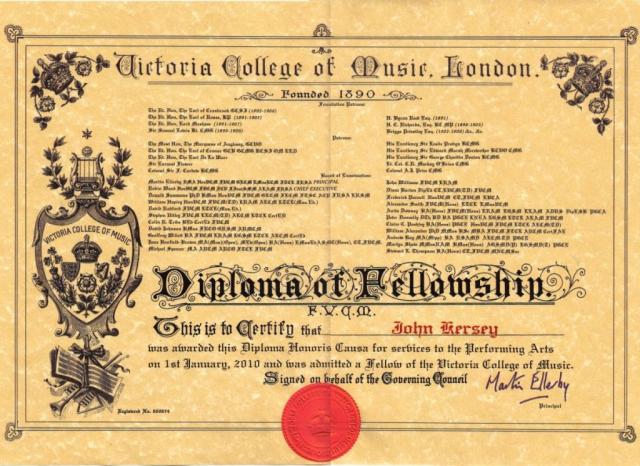
Honours and awards: Fellowship honoris causa of the Victoria College of Music

The Victoria College of Music has awarded a Fellowship honoris causa to me in recognition of services to the Performing Arts.

The Victoria College of Music was established in 1890 and specialises in external examinations in music and speech subjects in Centres throughout the United Kingdom and in some countries overseas. Its qualifications and syllabuses are approved for use in schools under the Education Reform Act 1988.

The Victoria College of Music is nowadays active only as an examining body; however, earlier in its foundation it had performed many of the other functions of a conservatoire. Its founding Principal was Dr J.H. Lewis, who remained in charge of the VCM for thirty-four years. From its outset the mission of the VCM has been extremely broadly-based, so that, as well as examining in all musical disciplines, it also examines in Bible reading and in a range of speech and drama subjects, currently including Shakespeare, mime, Group Discussion and Business English, and interview technique.

Although the local grades 1 to 8 of the VCM are intended to be comparable in standard with the equivalently-named examinations of other examination boards, special attention is given to the early grades. Grades 1 and 2 are supplemented by Grades 1A and 2A, thus offering particular encouragement to young children. The College is also active in enabling candidates with a disability to take its examinations. There is a Grade 9 examination, which provides a bridge to the diploma of AVCM, as well as a series of medal awards. The College of Violinists, incorporated into the VCM, is no longer active as an independent body, although its diplomas are still used by the VCM as senior honorary awards.

The College maintains the London Music Press, which is the in-house publisher of music for its examinations, and keeps in touch with teachers via its newsletter “College Noticeboard”. A widespread network of local secretaries is used to administer its examinations, which are usually held twice a year. The certificate design used for diplomas is identical to that first established in 1890.

New CD – The Circle of Brahms, vol. 2

A new CD has been issued by Romantic Discoveries Recordings.

The Circle of Brahms, vol. 2
John Kersey, piano
RDR CD82

Albert Dietrich (1829-1908): 6 Klavierstücke, op 6

Heinrich von Herzogenberg (1843-1900): 5 Klavierstücke, op. 25

Friedrich Gernsheim (1839-1916): 4 Klavierstücke, op. 61

This disc continues our earlier exploration of those composers who were part of Brahms’s circle (RDR46) with three sets of connected and contrasted piano pieces that show that the spiritual depth and intimate expression of Brahms’s piano music found immediate admirers, some of whom took the form in individual directions.

Albert Dietrich was not merely influenced by Brahms, but was one of the composer’s closest friends. He studied with Schumann from 1851 and then, in 1853, met Brahms and collaborated with him and Schumann on the “F-A-E Sonata” for Joachim. Thereafter, Dietrich was music director at the court of Oldenburg (1861-90) and did much to promote Brahms’ music. The quality of Dietrich’s own output is high and includes works in large-scale forms such as concerti for violin, cello and horn and a symphony dedicated to Brahms. In chamber music his output includes two piano trios as well as a small amount of music for solo piano. The set of piano pieces forming his op. 6 is distinctive and shows Dietrich at his most poetically inspired.

Heinrich von Herzogenberg studied composition under Dessoff and, influenced by his studies of Bach, became an ardent admirer of Brahms. He married one of Brahms’s piano pupils, and it is suggested by some that Brahms’s resentment of this union played a part in his generally curmudgeonly attitude towards Herzogenberg. In 1872, Herzogenberg moved to Leipzig where, along with Philip Spitta, he founded the Leipzig Bach-Verein, which did much to revive Bach’s cantatas. From 1885 he was professor of composition at the Berlin Hochschule für Musik, and in his last years, although a Roman Catholic, composed extensively for the Lutheran church. Herzogenberg’s works include several important pieces for solo piano and piano four hands. The five pieces that form his op. 25 are confident statements of his style; while this has an undeniable influence of Brahms, that influence does not overwhelm Herzogenberg’s own ideas and rather more cosmopolitan approach. The second, a martial Capriccio, is particularly striking.

Friedrich Gernsheim met Brahms later in his career, in 1868, and from that point onwards showed a notable Brahmsian influence in his works, which include four symphonies, concertos and much chamber music. Earlier on he had studied piano with Moscheles and spent five years in Paris, meeting Lalo, Rossini and Saint-Saëns among others. He taught at the conservatoires in Cologne and Berlin, and held conducting posts in Saarbrücken and Rotterdam. Gernsheim’s piano music is imaginative, stylistically effective and technically demanding. His Four Pieces, op. 61, are a notably contrasting set, with plenty of variety of mood and colour, and in the Legende that forms the third piece, a distinctive improvisatory feel.

New CD – Eduard Schütt (1856-1933): Piano Works

A new CD has been issued by Romantic Discoveries Recordings.

Eduard Schütt (1856-1933): Piano Works
John Kersey, piano
RDR CD81

1. Thème varié, op. 62. Poésies – 3 Romances, op. 21: 2. Lento ma non troppo 3. Poco moderato, non troppo lento 4. Andante tranquillo. 5 Piano Pieces, op. 8: 5. Humoreske 6. Ariette 7. Menuett 8. Intermezzo 9. Walzer. 10. Thème varié et Fugato, op. 29. Scènes de bal, op. 17: 11. Gavotte-Humoresque 12. Valse lente 13. Polka rococo 14. Mazurka 15. Theme with Variations, op. 95

Russian pianist and composer Eduard Schütt was born at St Petersburg and studied there under Petersen and Theodor Stein. Between 1876-78 he studied in Leipzig, where his teachers included Salomon Jadassohn and Carl Reinecke (see earlier RDR releases), as well as Ernst Friedrich Richter. In 1879 he moved to Vienna where he became a pupil of the celebrated pedagogue Theodor Leschetizky. Between 1881-97 he was director of the Vienna Academy Wagner-Edition. In 1892, his reputation as pianist and composer firmly established, he moved to a villa he named Mon Repos in Obermais in the South Tyrol and turned to teaching in earnest. Schütt’s circle of friends included Liszt, Brahms, Heuberger and Grünfeld.

Schütt’s music includes two piano concertos, a comic opera “Signor Formica” and piano and chamber music. His preference tended to be for shorter forms or their combination in the suite rather than for extended structures. Of those compositions, only Schütt’s waltz “A la bien aimée” acquired tremendous popularity, and that work was performed and recorded by pianists of the fame of Godowsky and Harold Bauer. Occasionally other pieces found their way onto disc in the early years of the gramophone, although sadly not those which are recorded here for the first time. As well as original works, there is a number of transcriptions of waltzes by Strauss that demonstrate a glittering virtuosity.

Schütt’s three sets of variations presented here show a serious side to him, with some advanced harmonies and a confident command of the resources of the keyboard. Equally, as in his shorter works, he does not allow ideas to outstay their welcome, and varies the repetition of themes in an effective manner. Among the most attractive works here are his three Poésies, which are inward in character, and the Five Pieces, op. 8, which provide a pleasing calling-card for a young composer who quickly found his feet, and whose music still has the capacity to give great pleasure today.

3 new CDs – Johann Carl Eschmann (1826-82): Piano Works vol. 2; Nicolai von Wilm (1834-1911): Völker und Zeiten im Spiegel ihrer Tänze, op 31, etc.; Nicolai von Wilm (1834-1911): Fantasie, op 68; Rondo, op 69 no 2, etc.

Three new CDs have been issued by Romantic Discoveries Recordings.

Johann Carl Eschmann (1826-82): Piano Works vol. 2
John Kersey, piano
RDR CD80

Sonata in A flat major op 72 no 2: Spring
1. Moderato espressivo 2. Am Waldbach: Romanze: Allegretto 3. Allegro vivace

Three Salon Pieces, op 21
4. Humoreske 5. Polonaise 6. Waltz

Twelve French Folk Songs, op 54
7. La bonne aventure 8. En revenant de Bâle en Suisse 9. Air de la pipe de tabac 10. Fournissez un canal au ruisseau 11. Eh! lon lon la, Landerinette! 12. Air de la ronde-de-camp de Grandpré 13. Une fille est un oiseau 14. La Vivandière 15. Ce jour-là, sous son ombrage 16. Le bruit des roulettes gâte tout 17. La marmotte a mal au pied  18. Epilogue: J’ai vu partout dans mes voyages.

Notes on the music
The Swiss composer Johann Carl Eschmann was born to a family of musicians in Zurich. He studied at the Leipzig Conservatoire between 1847 and 1849 with Mendelssohn, Moscheles and Gade, and thereafter pursued a career as composer and teacher initially in Kassel. From 1850-59 he taught in Winterthur but found competition with his friend Theodor Kirchner difficult, and between 1859-66 based himself in Schaffhausen. The latter year saw him return to Zurich where he spent the remainder of his days.

In 1871, Eschmann published his “Wegweiser durch die Klavierliteratur”, a graded survey of the piano repertoire suitable for teachers. This was republished in several editions, but by the tenth edition in 1925, Eschmann’s name as compiler and reference to all except his most basic didactic works had been entirely removed.

Eschmann was a reasonably prolific composer of piano and chamber music. His style is firmly in the mould of Mendelssohn and Schumann, and is concerned primarily with the expression of character and mood within well-defined structures. At the same time, some of his earlier works are more experimental and more technically varied that this would suggest, with some exploration of cyclical forms.

Eschmann knew Richard Wagner, and indeed Wagner referred to him on one occasion as a friend. There is a suggestion that Eschmann may have been involved in the first performance of the “Wesendonk-Lieder” and a copy of one of these songs exists with a dedication from Wagner to him. In his work “Richard Wagner’s Zurich: the muse of place”, Chris Walton suggests that Eschmann’s song “Mittags” may have provided Wagner with one of the themes from “Das Rheingold” (pp 141-148). Walton also provides much further information on Eschmann’s work. In July 1853, Liszt invited Eschmann and Kirchner to meet him at Wagner’s apartment and presumably to bring their latest compositions; unfortunately no details of the meeting have been recorded.

Later on, however, Eschmann developed an affinity with Brahms and became sharply critical of Wagner in his “100 Aphorisms” (1878). His output tended to become more conservative after his earlier works, and by and large he was content to compose within established boundaries rather than seeking to innovate, with many of his later piano pieces intended for pupils.

The cycle of four sonatas inspired by the seasons seems to have been written with able women pianists in mind, for although they contain some demanding passages, they carefully avoid the use of passages in octaves. Such music was a requirement of the period, since many women attained a high standard of piano playing while being unable to pursue a public concert career. Rather like Czerny before him, Eschmann writes in such a way as to make technical points while maintaining musical interest; the sonatas are attractive and confident in their compositional approach, with plenty of melodic inspiration and a lively spirit throughout.

The three salon pieces that form op 21 were dedicated to Eschmann’s teacher Alexander Muller in Zurich, and are more adventurous in their piano style, with something of the typically showy technique of the salon genre but at the same time a distinctive and rather subtle individuality, particularly in the opening Humoreske, whose slow introduction leads to a tarantella central section.

Transcriptions of folk songs are common in the Romantic era, but Eschmann’s set of twelve French songs treats the material in a characteristic and effective way that marks it out from the run of the mill. The set is designed to be played as a cycle, with plenty of contrast within and an effective Epilogue to round it off.

Nicolai von Wilm (1834-1911): Völker und Zeiten im Spiegel ihrer Tänze, op 31, etc.
John Kersey, piano
RDR CD79

Völker und Zeiten im Spiegel ihrer Tänze (Nations and Epochs illustrated by their Dances), op. 31
1. Roundelay (German) 2. Sarabande (Spanish) 3. Gavotte and Tambourin (Old French) 4. Ländler (Bavarian) 5. Rigaudon (Provençal) 6. Mazurka (Polish) 7. Minuet (Old French) 8. Bolero (Spanish) 9. Bourrée (Old French) 10. Rustic Dance (Norwegian) 11. Gigue (Old French) 12. Dance of the Rhinelanders (German) 13. Csardas (Hungarian) 14. Loure (Old French) 15. Pavane (Old Spanish) and Gaillarde (Old French).

16. Melodie, op 113. 17. Bilder vom Lande, op 146: no 1 Ankunft. 18. Klage, op 194 vol 1 no 2.  19. Ergebung, op 194 vol 2 no 6. 20. Entblätterte Rose. 21. Loure (Old French Dance). 22. Frohe Botschaft, op 196 no 6.

Nicolai von Wilm was born in Riga in 1834 and studied at the Leipzig Conservatoire between 1851 and 1856. The following year he returned to Riga to take up the position of second Kapellmeister at the State Theatre. In 1860 he moved to the Nikolai Institute in St Petersburg, where he taught until 1875, after which he made his home in Wiesbaden.

von Wilm’s output includes around 250 works, including many for piano. This disc represents the first recording of any of his piano compositions. His neglect is surprising in view of the esteem in which he was held in his lifetime, particularly during his time at St Petersburg, and the high quality of his music, which embraces both large-scale works such as the Fantaisie in F minor (recorded on CD78) and much in shorter forms.

The set of dances forming op 31 is typical of the nationalistic element that became particularly predominant in music of the later Romantic era, as music became increasingly the expression of ethnic – and often political – identity. The pleasure in such sets lies in their ready characterisation of the forms they encompass; those who consider the nineteenth-century uninterested in the baroque might well look to the number of Old French dances revived here, as they also are in the very similar suite of ancient dances op 75 by Ernst Pauer (previously recorded for RDR). von Wilm is concerned throughout with stamping his own musical personality on each miniature; although sometimes given to reflection, he comes across as a rather vigorous and energetic character with a thorough command of the piano’s capabilities.

This is then complimented with a journey through some of von Wilm’s miniatures from other groups. The first movement from his op 146 set of countryside evocations is the most extensive, being a truncated sonata form that has much of Schumann about it and whose appeal is considerable. Other works include those published in the Neuen Musik-Zeitung of 1909; calling-cards, as it were, of von Wilm’s art.

Nicolai von Wilm (1834-1911): Fantasie, op 68; Rondo, op 69 no 2, etc.
John Kersey, piano
RDR CD78

Nicolai von Wilm: Fantasie in F minor, op 68
1. Praeludium und Recitativ 2. Intermezzo: Assai vivo 3. Adagio cantabile e sostenuto 4. Finale: Allegro con brio

Hugo Reinhold (1854-1935): Traunseebilder: 5 Tonstücke, op 55
5. Morgengruss 6. Abendämmerung 7. Echo 8. Barkarole 9. Irrlicht

Nicolai von Wilm: Rondo in E flat major, op 69 no 2

Josef Rheinberger (1839-1901): Passacaglia: Free concert transcription of the final movement of the Organ Sonata op 132

Nicolai von Wilm was born in Riga in 1834 and studied at the Leipzig Conservatoire between 1851 and 1856. The following year he returned to Riga to take up the position of second Kapellmeister at the State Theatre. In 1860 he moved to the Nikolai Institute in St Petersburg, where he taught until 1875, after which he made his home in Wiesbaden.

von Wilm’s output includes around 250 works, including many for piano. This disc represents the first recording of any of his piano compositions. His neglect is surprising in view of the esteem in which he was held in his lifetime, particularly during his time at St Petersburg, and the high quality of his music, which embraces both large-scale works such as the Fantaisie in F minor and much in shorter forms. The Fantaisie shows a clear Bachian influence and also perhaps something of Cesar Franck in its opening pairing of a prelude and recitative. This is music that seeks to make a significant statement, and if that statement is perhaps more notable for its echoing of more prominent composers (notably Schumann) that does not exclude some degree of von Wilm’s own compositional and pianistic individuality. The piano writing, replete with octaves and massive chords, certainly takes few prisoners, but this is counterbalanced by a nonchalant Intermezzo and a fine, deeply-felt slow movement of considerable merit. The Rondo – the second of two forming von Wilm’s op 69 – is rather more Chopinesque in places, and again represents a considerably accomplished style with plenty of melodic invention and contrast.

Hugo Reinhold was a Vienna-based composer who, under the patronage of the Duke of Saxe-Coburg-Gotha, studied at the Conservatorium der Musikfreunde under Bruckner, Felix Dessoff and Julius Epstein. He became a teacher of piano at the Akademie der Tonkunst and acquired a sound reputation as a composer, with his works being performed, inter alia, by the Vienna Philharmonic. His set of five Pictures from the Traunsee was published in 1897 and forms an effective and straightforward collection, somewhat reminiscent of Grieg in places.

The name of Joseph Gabriel Rheinberger is more familiar to organists than to pianists, although he also wrote a good deal of piano music. Rheinberger was a child prodigy, being appointed organist to the parish church of Vaduz at the age of seven. After three years at the Munich Conservatoire (1851-54) he studied privately with Franz Lachner. His appointment as professor of piano (1859) and composition (1860) at the Conservatoire was thwarted by the institution’s closure in 1860, but on its re-opening in 1867 he was reappointed as Royal Professor. Rheinberger was noted for his supreme musicianship and ability as an executant, and counted Humperdinck, Wolf-Ferrari and Furtwangler among his composition pupils. The Passacaglia is a concert transcription for piano of the last movement of the organ sonata, op 132, and follows the form of that movement closely with many demanding passages where the counterpoint of the original is rigorously preserved despite the pianistic difficulties that result. The effect is of a profoundly serious and effective work which deserves concert revival in our own time.

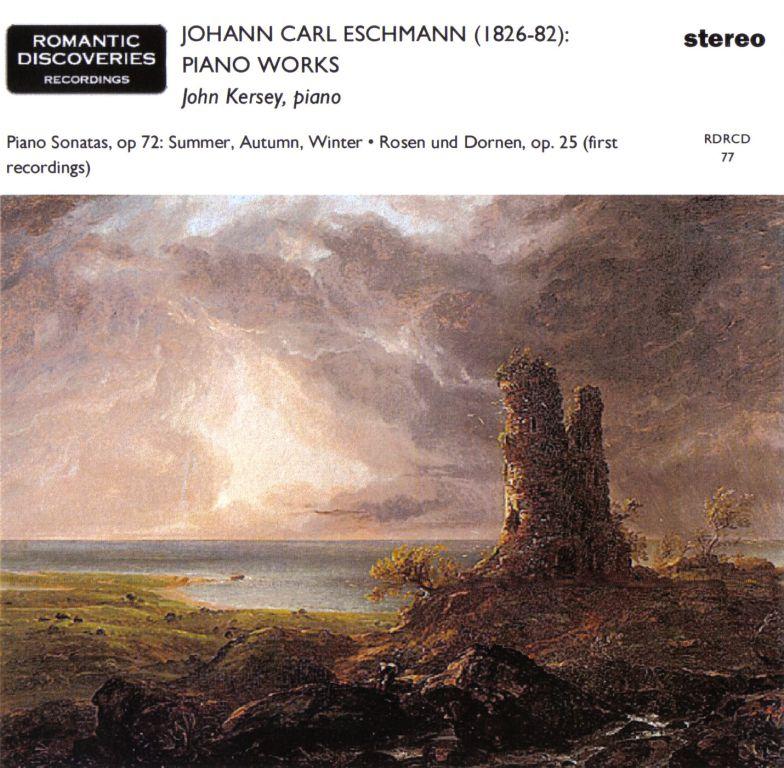
New CD – Johann Carl Eschmann (1826-82): Piano Works

A new CD has been issued by Romantic Discoveries Recordings.

Johann Carl Eschmann (1826-82): Piano Works
John Kersey, piano
RDR CD77

Piano Sonata op 72 no 3 “Summer”
Rosen und Dornen (Roses and thorns), op 25
Piano Sonata op 72 no 4 “Autumn (The Hunt)”
Piano Sonata op 72 no 1 “Winter”

The Swiss composer Johann Carl Eschmann was born to a family of musicians in Zurich. He studied at the Leipzig Conservatoire between 1847 and 1849 with Mendelssohn, Moscheles and Gade, and thereafter pursued a career as composer and teacher initially in Kassel. From 1850-59 he taught in Winterthur but found competition with his friend Theodor Kirchner difficult, and between 1859-66 based himself in Schaffhausen. The latter year saw him return to Zurich where he spent the remainder of his days.

In 1871, Eschmann published his “Wegweiser durch die Klavierliteratur”, a graded survey of the piano repertoire suitable for teachers. This was republished in several editions, but by the tenth edition in 1925, Eschmann’s name as compiler and reference to all except his most basic didactic works had been entirely removed.

Eschmann was a reasonably prolific composer of piano and chamber music. His style is firmly in the mould of Mendelssohn and Schumann, and is concerned primarily with the expression of character and mood within well-defined structures. At the same time, some of his earlier works are more experimental and more technically varied that this would suggest, with some exploration of cyclical forms. The conjoined Andante and Scherzo in the Summer Sonata on this disc is one example of this tendency.

Eschmann knew Richard Wagner, and indeed Wagner referred to him on one occasion as a friend. There is a suggestion that Eschmann may have been involved in the first performance of the “Wesendonk-Lieder” and a copy of one of these songs exists with a dedication from Wagner to him. In his work “Richard Wagner’s Zurich: the muse of place”, Chris Walton suggests that Eschmann’s song “Mittags” may have provided Wagner with one of the themes from “Das Rheingold” (pp 141-148). Walton also provides much further information on Eschmann’s work. In July 1853, Liszt invited Eschmann and Kirchner to meet him at Wagner’s apartment and presumably to bring their latest compositions; unfortunately no details of the meeting have been recorded.

Later on, however, Eschmann developed an affinity with Brahms and became sharply critical of Wagner in his “100 Aphorisms” (1878). His output tended to become more conservative after his earlier works, and by and large he was content to compose within established boundaries rather than seeking to innovate, with many of his later piano pieces intended for pupils.

The cycle of four sonatas inspired by the seasons seems to have been written with able women pianists in mind, for although they contain some demanding passages, they carefully avoid the use of passages in octaves. Such music was a requirement of the period, since many women attained a high standard of piano playing while being unable to pursue a public concert career. Rather like Czerny before him, Eschmann writes in such a way as to make technical points while maintaining musical interest; the sonatas are attractive and confident in their compositional approach, with plenty of melodic inspiration and a lively spirit throughout.

The set of “Rosen und Dornen” is a cycle of miniature studies of the kind that Kirchner would make his own. Here, in works that are at times aphoristic, one might at times be listening to Schumann. The cycle is attractively varied and the beautiful cantabile melody of the seventh piece is particularly notable.

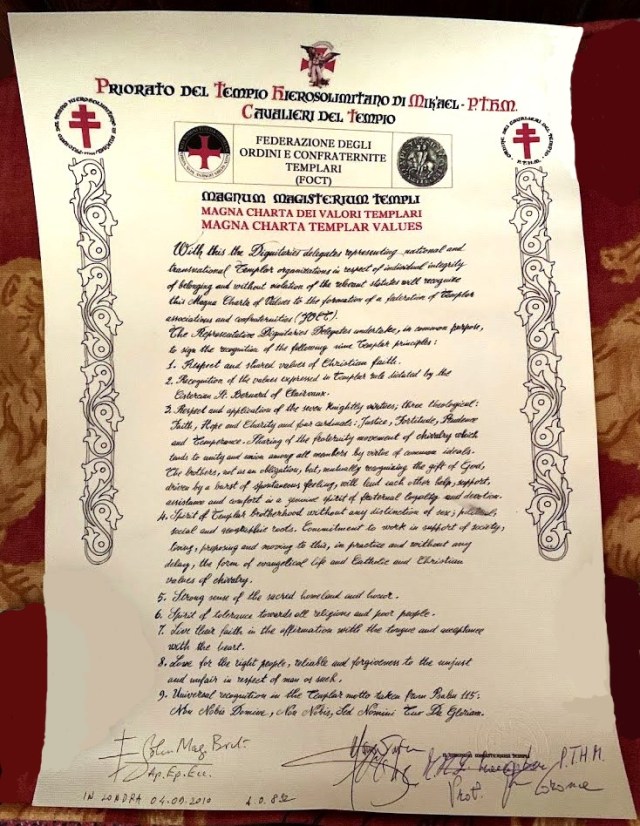
Magna Charta to the Priorato del Tempio Hierosolimitano di Mik’Ael (PTHM)

In 2010, I was approached by a modern Templar group based in Italy, the Priorato del Tempio Hierosolimitano di Mik’Ael (PTHM) with a request that I should provide them with a charter of authority in my capacity as Presiding Bishop of the Ecclesia Apostolica Divinorum Mysteriorum (which body has significant Templar links).

I met with the representatives of the PTHM in London on 3 September 2010. Although this was a cordial occasion, it was made difficult by the language barrier; my spoken Italian was unfortunately inadequate to the task. I issued my Magna Charta to the PTHM, and the PTHM conferred upon me the insignia of their organization.

New CD – Johan Peter Emilius Hartmann (1805-1900): Piano Works

A new recording has been released by Romantic Discoveries Recordings.

Johan Peter Emilius Hartmann (1805-1900): Piano Works
John Kersey, piano
RDR CD 76

Fantasy Pieces, op 54; 6 Tone Pieces in Song Form, op 37; Bellmanske Billeder: Menuetter; 8 Sketches, op 31

Johann Peter Emilius Hartmann succeeded his father at the Garnisons Kirke in 1824, and thereafter was successively professor at Copenhagen University and the founding director of the Conservatoire there from 1867. His studies in Europe in 1836 brought him into contact with Chopin, Rossini, Cherubini and Spohr. In musical style he successfully fused elements of Nordic nationalism with a post-Mendelssohnian style that at its most progressive clearly looks forward to Brahms. The quality of Hartmann’s inspiration and mastery of compositional and pianistic technique was considerable, and marks him out as the leading Danish composer for the piano of his generation.

This disc reflects Hartmann’s devotion to that most nineteenth-century of piano forms, the set of contrasting miniatures. For Hartmann, as for his predecessors (notably Beethoven), the miniature offers the opportunity to capture a brief mood or atmosphere without the concerns of formal development or the complex extension of structure; indeed where structure is extended, it is by simple episodic means. This distillation of musical inspiration to its essentials enables a rare intensity of experience; at their best, such pieces have the impact of the shorter forms of poetry, reflecting a more improvisatory and free-spirited art than can necessarily be present in the sonata or variations.

There is often much of Mendelssohn to be detected in Hartmann’s music, but with an individual and at times authentically Danish voice (see for example the Vekselsang that concludes op 37). This national feeling perhaps imparts a certain seriousness to his output by comparison with his contemporaries, and if not using actual folksong in his works here, he certainly often takes his inspiration from its contours and characteristic modulations.

The Fantasy Pieces op 54 are dedicated to Clara Schumann, who one feels would have readily appreciated their adventurous and intimate world. Particularly notable is the rhythmic displacement that appears in the second piece, which is both clever and effective. The fifth of the set is a dark Menuetto in A minor which at times bridges the gap with the waltz. Hartmann’s interest in the minuet, often considered antiquated by his contemporaries, can also be seen in the Bellmanske Billeder, an unusual set of two linked minuets with a virtuoso introduction, published without an opus number.

The title “Tone Pieces in Song Form” given to the set op 37 is surely a conscious reminiscence of Mendelssohn’s “Songs Without Words” of which the first piece could very easily be a continuation given its typical Mendelssohnian texture and melodic appeal. The set features a dramatic “hunting scene” as its third piece, and in its successor turns to a very Schumannesque narrative idea, answered in the last bars by a bluff “Chorus”. The ensuing Allegretto quasi Andantino flows amid complex double-note figuration, reminding us of Hartmann’s abilities in counterpoint.

The Eight Sketches op 31 date from 1842, by which time Hartmann was firmly established at the forefront of the Danish musical scene. They are notable for their pair of contrasting Scherzos that juxtapose enthusiasm and calmer polyphony. Older forms are suggested with the gigue-like movement that forms the sixth piece before the set concludes with a waltz and a fast-moving caprice in the minor.

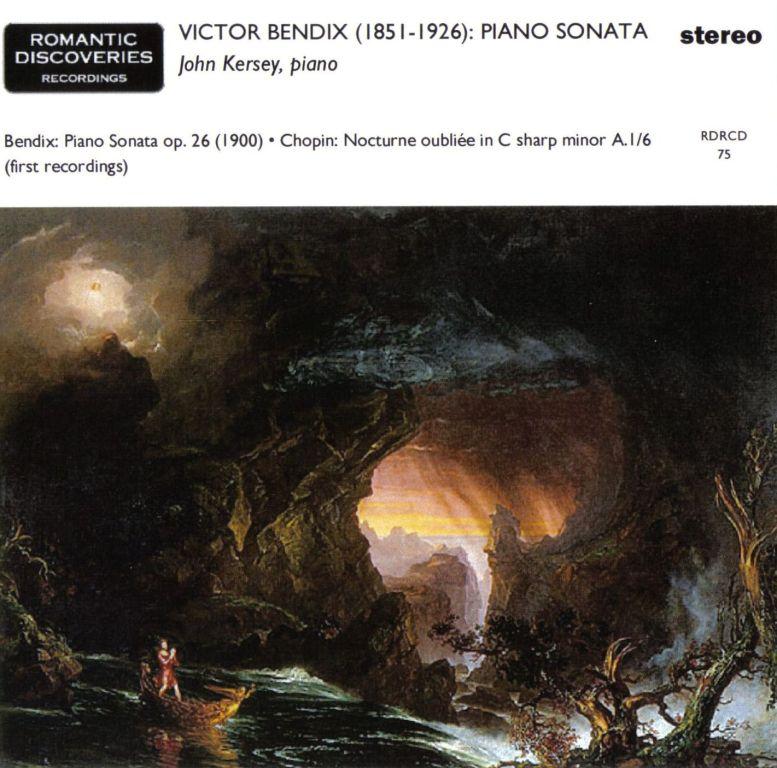
New CD – Victor Bendix (1851-1926): Piano Sonata. Frederic Chopin (1810-49): Nocturne oubliée

A new recording has been released by Romantic Discoveries Recordings.

Victor Bendix (1851-1926): Piano Sonata. Frederic Chopin (1810-49): Nocturne oubliée
John Kersey, piano
RDR CD75

Victor Bendix (1851-1926): Piano Sonata in G minor op. 26 (1900)

Frederic Chopin (1810-49): Nocturne oubliée in C sharp minor, A.1/6 (7’08”)

Victor Emmanuel Bendix was born to a Jewish family of music-lovers in Copenhagen in 1851. He was one of the first to study at the Royal Danish Conservatoire in Copenhagen and developed his style under the tutelage of Niels Gade, August Winding and J.P.E. Hartmann. A virtuoso pianist with a long and active career, he studied piano with Liszt in Weimar in 1881. In the last years of the nineteenth-century he toured Europe playing his piano concerto (1884), which his wife Dagmar performed in London.

Bendix belongs to the late Romantic school that stands between Brahms and Nielsen, and even to some extent Sibelius. He is concerned with the evocation of mood and atmosphere but within a formal structure that takes precedence. At times his music is rhetorical and rhapsodic; at others he presents epic drama and music of deep emotion (such as in the slow movement of his Sonata). Although well-regarded in his day (a street in Copenhagen is named after him today), Bendix’ demanding and complex works fell out of fashion in his later years and his major output, such as the four symphonies, is only just beginning to be revived.

The single piano sonata in Bendix’s output is a giant of the repertoire. The performance on this recording occupies nearly fifty-eight minutes, and it would be quite possible to imagine another interpretation that would take a broader view of some passages. However, Bendix manages this extended structure well, creating ample contrast, interest and thematic continuity. It is difficult, indeed, to imagine a work more typical of the piano sonata in the last years of Romanticism, with an enduring sense of fantasy reflected in mature musical language of great power.

The epic sweep of the first movement is indicative of Bendix’s ambitions for the work. The surging first theme is bardic and suggests a grand orchestral texture; its chordal counterpart balances not only its character but also acts as a foil to its chromaticism. The presentation is in some respects reminiscent of Chopin’s op 58 sonata, in which the structure unfolds seamlessly and gradually rather than with obvious divisions and landmarks. This long exposition is performed here with the optional repeat, before giving way to the unsettled and extensive development, which resembles an exotic and enchanted forest in its ability to create strange beauties from material that is by now familiar. Throughout, the use of chordal and octave writing maximises the expressive potential of the piano.

The second movement is seemingly lighter in tone; a gruff, rustic Intermezzo rather like a proto-Mahlerian Ländler. The humour is always somewhat on edge here, and even the comic bass section in the trio leads to chromatic filigrees that recall the uncertain atmosphere of earlier moments.

The slow movement is perhaps the emotive heart of the work, consisting of an extensive transformation of a folk-like theme in the dominant. Variations of an active, martial and scherzando character give way to an eerie, suspended Adagio. This begins a long transition to the glowing presentation of the theme in the major, though the coda reverts any sense of triumph or resolution to end disconsolately.

The finale again inhabits the sphere of action, and represents a pageant of contrasting ideas that are often reached by complex dramatic transitions. The music develops great virtuosic power and tests the performer in many strenuous passages of double-notes. Towards the end the second theme of the first movement returns accompanied by triumphant figurations; this is indicative of the increasingly confident and positive mood that dominates the coda as the sonata ends with a fanfare of massive chords.

The Nocturne oubliée is a good example of the many manuscripts discovered after Chopin’s death and (here) brought to light in the former Soviet Union; most such pieces are brief and insubstantial, but here we have a complete Nocturne that – for all that some have suggested that it is not authentic – certainly to this interpreter’s ear has many of the unmistakeable characteristics of Chopin’s early style, suggesting that it is either Chopin’s own work or that of a remarkably slavish imitator. Certain figurations are of a type that Chopin would later work out more pianistically, and we can also imagine that a certain amount of ornamentation would distinguish the otherwise-literal recapitulation. For all that it has its shortcomings, this is nevertheless an intriguing glimpse into Chopin’s compositional processes.

Honours and awards: Honorary Fellowship of the National College of Music

The National College of Music has awarded an Honorary Fellowship to me in recognition of services to music.

The National College of Music and Arts, London, was established in 1894 by the Moss family and friends and incorporated in 1898. A number of eminent musicians, aristocrats and other distinguished people of the day were persuaded to become Founder Patrons.

As a result of the wish of Mr William J. Moss, the senior member of the family, for the College to remain in the hands of the founders for as long as possible, a company was established entitled The Musical Reform Association in order to secure this objective. The design of the unusually large certificates of the NCM continues to follow the pattern established by Mr William J. Moss.

Until the Second World War the College operated from premises in London and established many centres throughout the country for the conduct of external examinations. During the war, the College lost its London building and since then has concentrated upon the work of examining, carrying out this activity not only within the UK but also increasingly overseas.

The position of General Secretary was held successively by Messrs Harold and Noel Moss and then by Mr Noel Moss’s widow Violet until she was well into her eighties. The current management of the College is in the hands of its College Council, which meets a number of times each year in order to formulate policy.

In 1994 the NCM celebrated its centenary with a concert and service of thanksgiving in the Archway Central Hall in London. That year also saw the recognition of the College’s diplomas by what is now the Qualifications and Curriculum Authority.

The ethos of the NCM is firmly towards the creation of the well-rounded musician, and the College encourages the enjoyment of the candidates’ studies in both music and speech subjects. A very wide range of syllabuses is offered, covering all major disciplines at Grades 1-8, Medal and Diploma examinations. Diplomas are available by examination, composition and thesis.

Christianity and Esotericism

Christianity & Esotericism
Markus van Alphen
Introduction by John Kersey

Articles on the subject of esoteric Christianity by Markus van Alphen, Founding Bishop of The Young Rite, with an introduction by me.

“Bishop Markus van Alphen offers an accessible and informed introduction to the means by which esoteric Christians approach their faith and the questions it raises. This is above all a book that shows something of the patterns in the Christian life that become the warp and weft of esoteric interpretation. Those for whom this is new and strange will find their perceptions challenged, while those already embarked upon their voyage into occult ways will find plentiful illumination on offer from an experienced and gifted guide.”
(from the Introduction)

Purchase a copy from Inspiration Press.

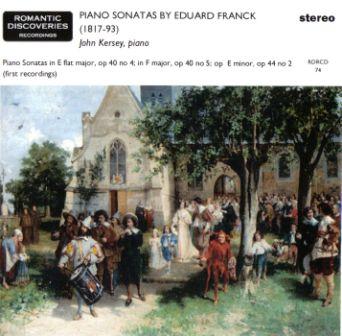
New CD – Piano Sonatas of Eduard Franck (1817-93)

A new CD has been released by Romantic Discoveries Recordings.

Piano Sonatas of Eduard Franck (1817-93)
John Kersey, piano
RDR CD74

Piano Sonata in E flat major, op 40 no 4. Piano Sonata in F major, op 40 no 5. Piano Sonata in E minor, op 44 no 2

Eduard Franck was born in Silesia into a wealthy and cultured family that numbered Mendelssohn and Wagner among its acquaintances. He studied with Mendelssohn as a private student and then began a long career as a concert pianist and teacher. He was regarded as one of the leading pianists of his day and also as an outstanding teacher.

Franck was not forthcoming about his compositions, and failed to publish many of them until late in life. He was a perfectionist and would not release a work until he was absolutely satisfied that it met his standards. Yet what survives is extremely high in quality. Writing of his chamber music, Wilhelm Altmann said, “This excellent composer does not deserve the neglect with which he has been treated. He had a mastery of form and a lively imagination which is clearly reflected in the fine and attractive ideas one finds in his works.”

The three Piano Sonatas on this disc demonstrate Franck’s varied approach to the genre. The E flat major sonata is outgoing and virtuosic, recalling both Beethoven and Haydn and the triumphant associations of the E flat major tonality. The opening movements have elements of Mendelssohn’s virtuoso piano style but are generally more emotionally charged, with an effective contrast between the first and second subjects in both movements. Indeed, this attention to formal contrast and finely-worked transition passages is entirely characteristic of Franck’s writing.

The elaborate slow movement is an extremely fine example of Franck’s mastery of extended structure. Indeed, the heart of the argument of Franck’s sonatas is frequently to be found in their slow movements, which show a level of inspiration, extension and variety within an essentially episodic format that stands with the finest of Early Romantic models. Mendelssohn is an obvious melodic reference, but Franck goes further in his exploitation of subtle and daring harmonic shifts – a device that was to become something of a trademark.

Where the E flat major sonata is predominantly music of extroversion, the canvas of the F major sonata is more intimate, recalling Beethoven’s experimental use of that key in his sonatas op 10 no 2 and op 54. Like op 54, the sonata begins with a movement with some characteristics of a minuet, though for Franck this is never more than a stylistic allusion as the work quickly develops momentum and transcends the formality of its opening motif.

The slow movement here is of the sort that Mendelssohn would have titled Venetian Gondola Song; its calm progress arrested by shifts in harmony and mood that disorient the richness of the opening material. Where the first movement had been relatively straightforward in utterance, the slow movement again for Franck is the means of introducing greater musical and emotional complexity within the sonata structure.

The Presto finale is based on a motif that could have come directly from the pen of late Haydn, and rests upon the contrast between two main groups in the major and relative minor. These develop somewhat through harmonic transformation although the mood is rarely concerned with deep matters, and a virtuosic coda ends the sonata on an exultant note.

The E minor sonata is the most ambitious of those included here. The intense opening movement is a high Romantic essay in tension and adventure, with a hymn-like second subject offering a prayerful calm in contrast. This movement shows Francks exploitation of piano technique at its most dramatic, though his “orchestral” writing is generally subtle and controlled even when expressing menace.

Such a tone-picture could only be succeeded by a lighter foil, and the scherzo that follows is playful and graceful in style, though still with an underlying anxiety and uncertainty, dispelled in part by the sustained Schubertian trio in the tonic major.

Perhaps recalling the outline of Beethoven’s op 109, Franck decides to end the sonata with a set of extended variations on a slow theme somewhat akin to that chosen by Schubert for his variations in the Sonata in A minor, D845. These begin in the unexpected key of C major and pass through a variety of textures before arriving at an elaborate and triumphant conclusion, which then dies away into nothing.

A History of the Old Catholic Movement in England

A History of the Old Catholic Movement in England (2 volumes)
John Kersey

This pioneering history traces the development of the Old Catholic movement in England from its origins to the present-day. It discusses each of the churches that have been involved in this movement, and profiles the clergy who have been responsible for them. It is a direct response to the appeal by Fr. Kenneth Leech that “… the issues raised [by the Old Catholics]…will not go away; and we need a more thoughtful, less hostile, and more discriminating approach to a subculture that, however odd and marginal, deserves to be treated with respect, compassion, and intelligence.”

English Old Catholicism is a tremendously diffuse movement in which the outsider can find it difficult to discern structure or commonality. Between 1908 and 1910, that structure was provided through the formal alliance of the Old Catholic Church of Great Britain with the Union of Utrecht of the Old Catholic Churches on the Continent. The Union appointed Arnold Harris Mathew, a former Roman Catholic priest who had also served as a curate in the Church of England, as Old Catholic Regionary Bishop of Great Britain. However, the Union was moving ever closer towards Canterbury as Mathew was moving closer towards a Romanist position in keeping with the original mission of Old Catholicism. These and other factors caused a breach whereby Mathew declared his autonomy from Utrecht in 1910.

Organisationally, the Old Catholic movement is both a structural and a theological entity. Structurally, it is a decentralised church that manifests as a series of small groups, most of which take on an autocephalous and autonomous identity based on their ultimate origins within the Roman Catholic Church. This leads variously to groups which are proto-Uniate in character, seeing their mission as closely aligned to Rome, as well as groups that express a wider ecumenical identity.

Published in a limited, numbered, softcover edition by European-American University Press: Volume 1, 522 pages. Volume 2 (Supplement), 126 pages.

Sold out.

New CD – Piano Music of Alexander Ilynsky (1859-1920)

A new CD has been issued by Romantic Discoveries Recordings.

Piano Music of Alexander Ilynsky (1859-1920)
John Kersey, piano
RDR CD73

Three Pieces, op 30: no. 2, Nocturne; La journée d’une petite fille, op 19: book 4 (nos. 19-24); from Six Pieces, op 17: nos. 1-4; Three Pieces, op 18

Biographical notes (from Wikipedia)
Alexander Ilyinsky was born in Tsarskoye Selo in 1859. His father was a physician in the Alexander Cadet Corps. His general education was in the First Cadet Corps at St Petersburg, and he served in the Artillery from 1877 to 1879. His music studies were in Berlin, under Theodor Kullak and Natanael Betcher at the Berlin Conservatory, and under Woldemar Bargiel at the Neue Akademie der Tonkunst. He returned to Russia in 1885, graduated from the St Petersburg Conservatory and taught at the music school of the Philharmonic Society in Moscow. He resigned in 1899 and started giving private lessons. In 1905 he joined the staff of the Moscow Conservatory. His students included Vasily Kalinnikov, Anatoly Nikolayevich Alexandrov and Nikolai Roslavets.

His major work, the 4-act opera The Fountain of Bakhchisaray, to a libretto based on Alexander Pushkin’s poem, was produced in Moscow in 1911. He also wrote a symphony, a Concert Overture, a string quartet, three orchestral suites, a set of orchestral Croatian Dances, a symphonic movement called Psyche, two cantatas for female chorus and orchestra (Strekoza (The Dragonfly) and Rusalka), incidental music to Sophocles’ Oedipus Rex and Philoctetes, and to Aleksey Konstantinovich Tolstoy’s Tsar Fiodor Ioannovich, piano pieces, church music, songs, etc. His name is perhaps most familiar to music students for his Lullaby from the third orchestral suite (sometimes described as a ballet), “Noure and Anitra”, Op. 13, which excerpt has appeared in many different arrangements.

Alexander Ilyinsky also wrote “A Short Guide to the Practical Teaching of Orchestration” (1917), which remained in use long after his death. In 1904 there appeared under his editorship “Biographies of all Composers from the Fourth to the Twentieth Century”. He edited the complete piano works of Beethoven for a commercial publication. He died in 1920 in Moscow.