Honours and awards: Dukedom of Samos in the Royal House Polanie-Patrikios

I have been honoured with the title of Duke of Samos awarded by the Royal House Polanie-Patrikios. The Head of the House, the Most Revd. Prince Kermit William Poling de Polanie-Patrikios, is the direct descendant of at least eleven of the Byzantine emperors. He is a member of clergy of the Order of Antioch and was honoured with membership in the San Luigi Orders by the late Prince-Abbot Edmond II. Today he holds the office of Vice-Chancellor Emeritus of the San Luigi Orders.

Duke of Samos

Quarterly Review – Apocalypse Discs

Reblogged from http://www.quarterly-review.org/?p=1507

Apocalypse Discs – John Kersey

JOHN KERSEY

Historian, musician and educationalist

www.johnkersey.org

As a musician, I face the prospect of having to save a limited number of works from certain apocalypse with a certain degree of trepidation. The difficulty is always that any selection is by nature impermanent, since music is perhaps the most responsive of the arts to one’s emotional state, and thus any change in personal equilibrium is likely to prompt a need for fresh aural inspiration. Nevertheless, the choice I make at present is of key works that have lived with me to the extent that I feel they have become a part of my way of seeing the world, and thus they can at least form something of a personal credo as far as those values – both musical and in a wider context – I would wish to see promulgated are concerned.

The chief object of art is, to my mind, a search for the expression of truth and beauty, and this theme runs through the selection I have made. There is some emphasis upon those composers who espoused a Traditionalist vision and set themselves against prevailing fashions in music, often at great personal cost. Their work is united by this artistic honesty and integrity, and perhaps their example also presents us with a microcosm of the resistance their art made to the apocalypse that came to dominate the avant-garde of their time, which sought to divorce itself from the dialectic of tonality. Although some works will doubtless be unfamiliar, there is no search for deliberate obscurity here, but rather a conscious immersion in a particular compositional thread that is effectively that of Romanticism and its extensions, and the quest for its most distinctive exponents, some of whose music deserves wider currency than it has hitherto enjoyed. JK, 25th March 2013

Lyra Angelica, William Alwyn (1905-85)

Alwyn was a polyglot, poet, artist, composer and sometime flautist with the London Symphony Orchestra. His compositions include many film scores, five symphonies (of which the last is entitled Hydriotaphia or Urn Burial) and this extraordinary harp concerto, which in my view is undoubtedly the greatest music written for the instrument. The first half of his working life was spent in London, teaching and serving on committees and boards. The second was spent in Suffolk, overlooking the Blyth estuary and writing music, poems and painting. One of his poems, Daphne, expresses his artistic credo,

Beauty is my reason for existence,

My day, my night, my all-in-all.

Faithless, I should cease to write.

http://www.youtube.com/watch?v=TooYPQtVUik&list=PLYAT_hEhVbG8b3cPPChfB8-nSU7wtKd-E

Concerto for solo piano, Charles-Valentin Alkan (1813-88)

Alkan was one of the greatest pianists of his stellar generation and a highly original and accomplished composer. In his early career, he was a friend of Liszt and Chopin, but in 1848 he was passed over for the position of head of piano at the Paris Conservatoire in favour of one of his pupils, and he seems never to have recovered from this blow, retreating into isolation. His concerto for solo piano, though a highly substantial work, is in fact part of one that is still larger, his twelve studies in all the minor keys, op. 39. Here it is given an outstanding performance by supervirtuoso Marc-Andre Hamelin.

http://www.youtube.com/watch?v=OQz5tWzVQiA

Spring Fire, Sir Arnold Bax (1883-1953)

Bax was the most Celtic of composers, encapsulating in his style the Ireland of myth and legend and evoking a distant past that also drew extensively upon Norse influences. As part of the Rathgar Circle that developed around the poet, artist and mystic AE (G.W. Russell) he adopted the pseudonym Dermot O’Byrne and published a number of poems and short stories that reflected an increasing involvement with Irish nationalism. Spring Fire is a relatively early work, inspired by Swinburne. Its extreme technical difficulty prevented any performance in Bax’s lifetime. For several years the only surviving score was believed to have been lost in a fire in 1964, but later another was discovered. The world it evokes is pagan and fantastic, and he wrote of it, “It is as though the whole of nature participated in the careless and restless riot of youth and sunlight.”

http://www.youtube.com/watch?v=AV5oHECmSg4

Sun God Symphony, Geirr Tveitt (1908-81)

An Odinist and Traditionalist, Tveitt was part of the circle of Hans S. Jacobsen in Oslo in the 1930s, but he remained aloof from political action and did not join the Nasjional Samling. The ballet Baldur’s Dreams is the apex of his Neo-Heathen worldview, being first performed in 1938 to great acclaim. After the war, his beliefs led to his complete ostracism from the Norwegian arts establishment, and the problems were compounded when, in 1970, his house burned to the ground, taking with it about 80% of his compositions, and leaving his last years bereft and embittered. The Sun God Symphony is therefore a posthumous reconstruction of three pictures from Baldur’s Dreams, and shows the extraordinary power and energy of Tveitt’s compositional imagination.

http://www.youtube.com/watch?v=Kws0g4Dfvco

Piano Concerto, op. 39, Ferruccio Benvenuto Busoni (1866-1924)

In its intellectual and humane distinction, subtle innovation and adherence to the Apollonian ideal, Busoni’s music is unparalleled. A master pianist, his Piano Concerto – in five movements, and with a male chorus singing a setting of Oehlenschlaeger’s Aladdin in the last – is an extraordinary achievement. This live performance by Peter Donohoe at the Proms remains one of the finest accounts of the work.

http://www.youtube.com/watch?v=FH60TO4egW0

Cello Concerto, Gerald Finzi (1901-56)

This work, the composer’s last, sums up his compositional achievement. It has become commonplace to say that Finzi’s music “sounds English” in that it evokes a particular combination of landscape and character. Certainly it is that, but its distinction is much greater, in that this is music of nobility, imagination, integrity and drama, suffused with a melancholic yet lyrical temperament.

http://www.youtube.com/watch?v=Bj_U1BntjPo

Symphony no. 1 “Gothic”, Havergal Brian (1876-1972)

A monumental work from an extraordinary man from whom music poured in torrents even when there was no-one interested in performing or listening to it. Brian did not “fit in” with the musical establishment; working-class, self-taught, and entirely dedicated to his own artistic standards. The more I come to know him and his output, the more I admire him. This work is huge, uncompromising and intellectually of the highest order. Richard Strauss described it as “magnificent”.

https://www.youtube.com/watch?v=CgUmpSWB-fc&list=PL9DF86B95A0102369

Trio in Three Movements, York Bowen (1884-1961)

Although widely respected as a pianist during his lifetime, and once described by Saint-Saens as “the finest of English composers”, Bowen’s works lay largely unpublished and unperformed until after his death. His individual style is felt at its best in this ambitious and effective piano trio.

https://www.youtube.com/watch?v=Tc3eniV0kQc

Hymnus paradisi, Herbert Howells (1892-1983)

This work was written in response to the death of the composer’s son from polio, aged nine, and requires no commentary. It is quite simply among the finest works of the English choral tradition.

http://www.youtube.com/watch?v=at-yv-BQAeA

Som Lynet er Kristi Genkomst (As Lightning Cometh Christ Again)

Rued Langgaard (1893-1952)

It is perhaps appropriate that one should close a selection of Apocalypse Discs with one of the very few depictions of the Second Coming in music. Rued Langgaard, a reactionary genius, composed in a style that ensured his treatment with utter disdain by the prevailing Danish musical establishment; his resulting isolation gave rise to a series of extraordinary compositions that is only now coming to be heard and appreciated. His music ranges from the visionary and prophetic to the bizarre and aphoristic. This short organ work develops in the manner of a ritual, fixating eventually upon its opening phrase, before rising in ecstasy amid the repeated gestures. A short pause leads to an increasing sense of expectation and the cataclysmic final chord that marks the moment of apparition.

http://www.youtube.com/watch?v=1ECKf__IJf4

Honours and awards: Noble of Memphis

The Illustrious Society of Lords and Ladies of Memphis, Descendants of the Pharaoh Ha’a’ib.Re’ (H’o’phra, Apries or Wahibre) is a lineage society established by my late adoptive father, Prince Kermit Poling de Polanie-Patrikios, in his capacity as Chief Lord of the Society and Prince of Mennof-Ra. The Pharaoh Wahibre ruled Egypt for ten years around 1670 BC.

The subject of descent from antiquity was a great interest of Prince Kermit, and was given added impetus by the work and publications of the Unit for Prosopographical Research at Linacre College, Oxford, and in particular the work of Christian Settipani on the descent from antiquity of Charlemagne.

With regard to this particular lineage society, see in particular A 4000–Year Old Descent from Antiquity: From the 12th Egyptian Dynasty to the Capetians and Beyond compiled by F.A. Doria with analysis by Chris Bennett and comments by Christian Settipani and N. Taylor (2001). Further studies of antiquity that traced this lineage back to the 13th Egyptian Dynasty established the descent from the Pharaoh Wahibre, which was set out in a publication by Prince Kermit.

New CD published – Piano Music of Sydney Smith (1839-89) volume 2

A new CD has been published by Romantic Discoveries Recordings.

Piano Music of Sydney Smith (1839-89) volume 2
John Kersey, piano
RDR CD99

Total time:

Total time: 76 minutes 47 seconds

1. Nadeshda, fantasia on the opera by Arthur Goring Thomas (1850-92), op. 211b 2. Aspiration (mélodie), op. 208 no. 1 3. Inquiétude (impromptu), op. 208 no. 2 4. Gavotte and Musette, op. 188 5. Vie orageuse (Deuxième ballade), op. 203 6. Chant de berceau, op. 156 7. Harmonies du soir (morceau élégant), op. 54 8. Menuet romantique, op. 174 9. Rayons d’or (Bagatelle), op. 176 10. Happy memories (morceau de salon), op. 77 11. Kermesse (Scène hollandaise), op. 181 12. Voix du coeur (Mélodie), op. 178 13. Zeffiretta (Morceau de salon), op. 159 14. Bacchanale, op. 170

Our thanks to the Sydney Smith Archive for supplying scores of these rare works.

Sydney Smith represents a lost generation of English composer-pianists who enjoyed both critical and commercial success in his heyday, only to be eclipsed by a rapid change in musical fashion that was compounded by his own ill-health. Born in Dorchester, in close proximity to Thomas Hardy, Smith won a place at the Leipzig Conservatoire aged seventeen and studied there for three years under Moscheles and Plaidy (piano) and Grutzmacher (cello). The Crown Prince of Prussia was apparently greatly impressed with his talent, and Smith’s move to London in 1859 marked the beginning of a career as a recitalist (notably at the Crystal Palace) and teacher. Added to this was the beginning of a prolific career as a melodic and effective composer of works for the salon and concert hall, many of which became included in popular anthologies of piano music of the day. This oeuvre made Smith one of the most famous musicians of his day, not only in England, but in Australia, America and continental Europe, and his name became a household word. Smith was particularly known for his virtuoso opera transcriptions, but as this album will show, was also gifted in a variety of short original forms, including characteristic dances and evocative mood-pieces. These works are written in a masterly way for the piano, showing a mature understanding of pianistic effect (with a good deal of influence from Chopin and Liszt) and providing a considerable technical challenge for the performer. The present recital offers probably the only opportunity at the moment to hear any of Arthur Goring Thomas’s last opera “Nadeshda” and is otherwise devoted to a varied selection of Smith’s original works, concentrating particularly on those from his later years.

Honours and awards: Commemorative medals of the Royal House of Thailand

I have been honoured to have been presented with several commemorative medals of the Royal House of Thailand. They were presented for “outstanding work for the progress of mankind through peace education” by the former Advisor of the President of the Committee for Private Education of the National Assembly.  In Thailand, it is customary for these medals to be worn by members of the civil service and the armed forces.

The medals presented were the Commemorative Medal for the 7th Cycle Birthday Anniversary of King Bhumibol Adulyadej (Rama IX), 2007; Commemorative Medal on the Occasion of the 6th Cycle Birthday Anniversary of H.M. Queen Sirikit, 2004; Commemorative Medal for the Investiture of H.R.H. Prince Vajiralongkorn as Crown Prince, 1972. Each of the medals was first issued on an earlier date, but this presentation was made in December 2012.

Thai medals

Honours and awards: Knight Majus in the Byzantine Order of Leo the Armenian

I have been appointed as a Knight Majus in the Byzantine Order of Leo the Armenian. The Order is a house order of the Dynastic House Polanie-Patrikios, whose head is the Most Revd. Prince Kermit Poling de Polanie-Patrikios. Prince Kermit is the senior living member of the San Luigi Orders, having been admitted to all three Orders by Prince-Abbot Edmond II, and traces his ancestry to several of the Byzantine Emperors.

Honours and awards: Honorary Doctor of Byzantine Studies from the Constantinople Orthodox Institute

The Constantinople Orthodox Institute was established by my late adoptive father, Prince Kermit Poling de Polanie-Patrikios, in his capacity as Head of the Royal House Polanie-Patrikios, on 1 January 2006. It is a study society established to foster interest in Byzantine faith, history and culture, which was particularly encouraged through directed self-study. Various issues of The Excubitor, the journal of the Byzantine Order of Leo V, contained resources for students of the Institute.

The Institute conferred honorary degrees only, and in 2012 I was honoured to receive an honorary Doctor of Byzantine Studies.

Honours and awards: Knight of the Order of the Sacred Cup

The Order of the Sacred Cup is a fraternal fellowship of Christian men. While chivalric in its character, it is not an Order of Chivalry in the classical definition of that term. It acknowledges Jesus Christ, Son of God, as its Grand and only Master. These knights exalt the Sacred Cup and defend the symbolic meaning of the elements of the Last Supper as representing the broken body and shed blood of Jesus. The Order gives forth no code of conduct except that which is handed down through the teachings of Holy Scripture.

The Order of the Sacred Cup was founded in Grafton, West Virginia, USA, on 1 August 1970, with the main purpose to be that of helping and aiding needy children. It still pursues this goal on a selected basis. The order also functions as an honorary award given in recognition of outstanding service to the Church of Jesus Christ.

The Order is truly Ecumenical in nature. The founders and original officers were mostly drawn from Protestant churches. Its original religious charter was bestowed by Patriarch Peter II Zhurawetsky of Miensk, and the Patriarch of Jerusalem, Benedict I, conferred Apostolic Blessings on the Order. His successor Patriarch Diodoros likewise extended his Patriarchal Blessing to the Knights of the Sacred Cup. In 1988 Prince Kermit William of Miensk became Grand Knight Chancellor and held that position with distinction, building up the work and membership of the Order. He appointed me as a Knight of the Order in September 2012. On his death in 2015 he was succeeded by me as his adopted son and heir.

New CD published – Piano Music of Herrmann Scholtz (1845-1918)

A new CD has been published by Romantic Discoveries Recordings.

Piano Music of Herrmann Scholtz (1845-1918)
John Kersey, piano
RDR CD98

Total time: 74 minutes 50 seconds

1. Nocturne op 41 no 1. 2. Nocturne op 41 no 2. 3. Variationen über ein norwegisches Volklied, op 27. Traumbilder, op 22: 4. Langsam 5. Im mässigen Tempo 6. Langsam 7. Sehr rasch. 8. 14 Variationen über ein Original-Thema, op 31. Albumblätter, op 20: 9. Ziemlich langsam 10. Mässig bewegt 11. Innig bewegt 12. Ziemlich bewegt 13. Innig bewegt 14. Ziemlich langsam und äusserst zart zu spielen 15. Nicht zu langsam und etwas graziös 16. Ziemlich belebt und sehr gesangvoll zu spielen 17. Still und träumerisch 18. Ziemlich bewegt 19. Ziemlich langsam und mit innigem Ausdruck 20. Freudig bewegt.

Our thanks to Peter Cook for supplying scores of these rare works.

Herrmann Scholtz was born in Breslau and studied there with Brosig and subsequently at the Leipzig Conservatoire with Plaidy (1865-67). On the advice of Liszt, he completed his studies at Munich with von Bülow and Rheinberger. He taught at Munich for six years after graduation, before moving to Dresden where he was appointed Sächsischen Kammer-virtuose in 1880 and professor in 1910. Scholtz’s posthumous reputation rests upon his edition of the works of Chopin, but he was also a versatile composer. For piano, he composed a sonata and a piano concerto (unpublished) and a number of shorter works from which this disc presents a selection. There is also a piano trio and several orchestral Suites.

Scholtz’s American pupil Mary Y. Mann wrote in a reminiscence of him, “I wish it lay in my power to teach all here to appreciate and honor him in the same degree that all who know him do…so ever courteous, gentle and friendly, possessed of so great musical intelligence and feeling, yet so modest with all that it humbled one to think of one’s own diminutiveness…in every way Professor Scholtz is a most delightful teacher, and his music room where he always gives his lessons is enough to delight a musician’s heart so full of mementos of the old masters and music of all kinds; and to crown all two grand pianos, at one of which he always sits with a copy of the pupil’s lesson, thus sparing you the nervous feeling of having some-one “look over your shoulders,” and at times playing with you, imbuing you with his spirit and tempo.” Regarding Scholtz as a player, she tells us, “He plays rather seldom as his time is fully occupied and of late has had an affection of the hand aside from an injury to one of his fingers that has debarred him from overuse of them, but he is always a warmly-welcomed and a very sympathetic performer, and so generous to his brother-artists that one appreciates his greatness the more.”

New CD published – The Little Russians

A new CD has been published by Romantic Discoveries Recordings.

The Little Russians
John Kersey, piano
RDR CD97

Alexander Alexandrovich Kopylov (1854-1911): 1. Feuille d’album in G Gennari Ossipovich Karganov (1858-90): 2. Serenade, from “Album lyrique”, op 20 no 4 3. Menuet all’antico, op 20 no 5 4. Dans le gondole, op 20 no 6 5. Kopylov: Polka de salon on the theme B-la-F, op 16 6. Karganov: Reverie du soir, op 20 no 7 7. Scherzino, op 20 no 8 8. Berceuse, op 20 no 11 9. Kopylov: Album leaf in C minor, from “3 Album Leaves”, op 26 no 3 10. Karganov: Romance, op 20 no 9 11. Nocturne, op 18 no 1 12. Kopylov: Chanson sans paroles 13. Karganov: Valse-caprice, op 16 14. Kopylov: A drop of rain, op 13 no 4 15. Mazurka 16. Karganov: Capriccietto, op 20 no 10 17. Mazurka, op 20 no 12 18. Nocturne, op 18 no 2 19. Kopylov: Feuille d’album in C 20. Karganov: Berceuse, from “Aquarelles”, op 22 no 3 21. Polka, from “For the Youth”, op 21 no 7

Our thanks to Peter Cook for supplying scores of these rare works.

Gennari Ossipovich Karganov was born in Kvarely in Georgia in 1858 (or possibly 1852). He was of Armenian nationality but subsequently became a naturalized Russian. He was professor of piano at the conservatoire in Georgia and composed mainly for the piano, including many miniatures and some instructional works. He died at Rostov-on-Don in 1890, aged just 31.

Alexander Alexandrovich Kopylov studied privately with Rimsky-Korsakov and Liadov. Principally a singer and violinist, he taught at the Imperial Court Choir where he had formerly been a chorister. Composer of symphonies and string quartets, he also composed a number of miniatures for piano.

Honours and awards: Royal Protector and Member of Sovereign Council of the Regency of Lomar

206878_216437535034563_5632262_nSince March 2012 I have served as Royal Protector of the Regency of Lomar and as a member of its Sovereign Council. The position of Regent of Lomar, which carries with it the title of Duke of Saih Nasra in the Abbey-Principality, has been vacant following the death of the last Regent, Dom Klaus Schlapps OPR OA, in January 2013.

The Regency of Lomar is fundamentally a small sovereign, non-territorial, non-profit, transnational diplomatic and humanitarian institution, or non-government organization (NGO). ROL primarily provides humanitarian and direct aid for refugees and other abused people, and works closely with international aid, government and non-government organizations in compliance with the UNHCR Convention of the Status of Refugees and the UN Universal Declaration of Human Rights. Although some have described the ROL as a micronation, it has always rejected this term.

logolomarFounded in 1997 in Silicon Valley, California, by Lawrence A. Cleenewerk and a small group of Catholic and Orthodox Christians, Lomar was inspired by the novella The Dream-Quest of Unknown Kadath by H.P. Lovecraft, from which Cleenewerk developed the idea of a state which would provide an “utopian safe haven for refugees and displaced persons”. Initially titling the project the Republic of Lomar after the legendary polar kingdom of the same name, Cleenewerk later adopted an acronym to describe its aims, “Libre Organisation Mondiale d’Aide aux Réfugiés”. In March 1998, the Republic of Lomar Foundation (Fédération Humanitaire Republique de Lomar) was incorporated as a non-profit corporation in Delaware, USA. An office was initially established in Washington, D.C., moving to Nevada in 2004. A paper entitled “The Republic of Lomar, Sovereignty and International Law” discusses the status of Lomar at this time.

passpic1Lomar grew quickly and developed a network of volunteer diplomats, with a particular base in France and consulates in seven countries in all. By 2001, there were over 4,500 registered citizens located all over the world. Lomar issued its own passports, similar to the UN Passport or the Nansen Passport, to the collective community of underprivileged people, including exiles, stateless refugees, victims of oppressive regimes, unrepresented people (Lomar has been a supporter of the UNPO (Unrepresented Nations & Peoples Organization) from the outset) and other deserving individuals who were in need of relocation. Legal help was offered with immigration matters. Although no state formally recognized Lomar, its passports were used to enter countries including Russia and Cuba.

The Lomar flag symbolically represents the green color of Life on Earth and the blue symbol of the sky and life-giving Water. The purple star is the symbol of Hope and Royalty, representing the Polaris Star. The flag was manufactured both in full size and in miniature versions suitable for desktop use.

media_php

In 2001 a group of criminals in Nigeria – a country where Lomar has never had any representation – used the Lomar name without authorization to sell bogus passports and “citizenships”, with tens of thousands of people suffering financial loss as a result. Lomar worked with international police authorities to combat this menace and expose it in the media, but the ensuing scandal was at a heavy cost to its resources and reputation.

In December 2003, Dom Klaus Schlapps was appointed First Counsellor and President of Lomar. He changed the name from Republic to Regency of Lomar and was elected the first Regent in 2004. Finding Lomar’s fortunes at a low ebb, he worked with others, particularly Secretary General HE Renaud Le Mailloux, to revive its humanitarian activities, now no longer concentrating on stateless persons as had previously been the case, and free from all religious or political affiliation.

cameroon_kumboit

Before long, Lomar had started to develop new and productive endeavours. Through Dom Klaus’s project Art Aid a hospital was built in Peru and a daycare centre was also scheduled for construction. A programme of wind turbines in Burkina Faso generated electricity for villages there, and a consignment of ten computers, bicycles and other goods was sent in late 2005. Work in collaboration with the Navti Foundation in Cameroon led to the donation of five tons of humanitarian aid in May 2005, including old computers for the use of children there, sewing machines (with volunteer teachers from ROL to teach their use), bedding and free medicines supplied as a result of Dom Klaus’s association with German-based charity PARMED, where he served as president. Donations were made to the victims of Hurricanes Katrina and Rita. In the People’s Republic of China and Hong Kong SAR, ROL supported the care of the elderly and young children. A Mercedes jeep was donated by PARMED to help ROL work in Cameroon. Literary and music competitions were organized, and a fundraising CD “Sounds of the East” was issued.

image010

The patrons of the ROL included French politician Jack Lang; the Fon of Nso, HRH Fon Sehm Mbinglo I, the Fon of Mbiame, HRH Schindzev Tata II, and the Fon of Nseh, Kwinkor Fonban, from Cameroon; Princess Angela Fugger von Glott; and HIH Prince Nguyen Phuc Buu Phuc of Viet Nam. Dom Klaus received the title of Shufaiy Ngaibunri (equivalent to Duke) from the Fon of Nso in recognition of his humanitarian work.

471564_406934882651493_1750875350_o

The associations entered into by the ROL included Akamai University, Hawai’i, USA, PARMED e v., Leinau, Germany (now defunct, archive site), the Navti Foundation, CRIG International, the Association for Protection of the Rights of the Refugees from Abkhazia (APPRA), Georgia, ANAMED, and the International Green Cross Organization. In February 2012, mutual recognition was extended between the ROL and the Abbey-Principality of San Luigi.

Before 2004 a number of Lomar stamps were issued. Two of these issues are shown below. Proceeds from the sale of the stamps in remembrance of the occupation of Tibet went to the Tibetan government-in-exile.

557136_406043052740676_1958299661_n

In 2006 the only coin of Lomar was issued, a 1 Kurant piece in bronze that depicted the arms of Lomar, the Arctic Wolf and the Polaris Star.

544486_406221336056181_1268913368_n

All of this meant that Lomar stood – and stands still – as one of the most successful virtual government projects in the history of the internet. In 2009, however, a major software and database failure placed its future in jeopardy. With no backups available, activities were suspended and serious consideration was given as to whether Lomar should continue. In 2012, Lomar returned with a limited internet presence and support was sought from outside agencies and individuals for it to resume its work. The sudden and unexpected death of its Regent in the following year again called a halt to its activities, and so Lomar now waits to discover the next chapter in its existence.

Lomar

Two new CDs published – Piano Music of Jakob Rosenhain (1813-94) vols. 1 and 2

Two new CDs have been published by Romantic Discoveries Recordings.

Piano Music of Jakob Rosenhain (1813-94), vol. 1
John Kersey, piano
RDR CD95

Total time: 60 minutes 47 seconds

Sonata in F minor, op 40: 1. Allegro con fuoco 2. Andantino 3. Scherzo – Allegro molto 4. Rondo – Presto 5. Slavonic Dance, op. 67 no. 1 6. Poeme, op. 24 Deux Morceaux de Salon, op. 28: 7. Nocturne 8. Rondo-valse 9. Grande valse de concert, op. 33

Piano Music of Jakob Rosenhain (1813-94), vol. 2
John Kersey, piano
RDR CD96

Total time: 61 minutes 46 seconds

1. Grand Caprice brillant, op. 23 Deux Reveries, op. 26: 2. Andantino doloroso 3. Andantino con moto Quatre Romances, op. 14: 4. Allegro non troppo 5. Andantino 6. Scene suisse au bord du lac de Genève 7. Andante espressivo 8. Etude op 17 no 6 – The Fisher’s Serenade 9. Etude op 17 no 8 – Lied 10. Etude op 17 no 11 – Con passione, tempo rubato.

Our thanks to Dr Klaus Tischendorf for supplying scores of these rare works.

The German-Jewish composer and pianist Jakob Rosenhain was born at Mannheim in 1813 and made his debut aged eleven. Piano studies with Jacob Schmitt in Mannheim and Schnyder von Wartensee in Frankfurt followed culminating in final studies with Kalliwoda. By 1832 he was settled in Frankfurt. He subsequently developed a concert career, appearing with the London Philharmonic Orchestra in the 1837 season and also enjoying success with his one-act opera “Der Besuch im Irrenhauses” which was first given in Frankfurt in 1834 and afterwards taken up at Weimar under Hummel. However, he was unable to repeat the success of this work with his second opera, “Liswenna” (1835) even though he reworked this as “Le Demon de la Nuit” in 1851. From at least 1839 he was a friend of Mendelssohn, and also knew Hiller and Moscheles, with whom he stayed. From the autumn of 1837 he settled in Paris, where he worked on writing a school of piano playing with the well-known pedagogue John Baptist Cramer and gave chamber music evenings that were attended by such luminaries as Berlioz, Rossini and Cherubini. Continuing to hope for another operatic success, his third opera, “Volage et Jaloux” was given at Baden in 1863, but again failed to make the desired impression, and after this time Rosenhain concentrated on instrumental music. In 1870 the Franco-Prussian War forced him to relocate to Baden, where he had a villa. He received honours from Holland, France, Spain, Portugal and Baden and was elected an honorary member of the St Cecilia Society of Rome.

Rosenhain’s output includes three symphonies, one of which the London Philharmonic Orchestra performed in 1854. The second symphony, his op. 43, was performed by Mendelssohn in Leipzig in 1846; the first had been given by the same forces in 1840. There is a piano concerto in D minor, four piano trios, Lieder,  and a quantity of solo piano music including three known sonatas, of which that recorded on RDR CD 95 is the first. Several works were reviewed by Schumann in his capacity as a critic.

The two disc set of piano works by Rosenhain comprising RDR CD 95 and 96 represents a cross-section of his output for which scores can be sourced at present. The F minor sonata is the largest-scale work here, and in the dramatic gestures and taut structure of its first movement suggests a composer of considerable accomplishment. After this, the other movements represent a significantly calmer and more optimistic outlook, with a scherzo that features bell-effects in its trio section and a rapid finale with something of a rustic character. Evidently, Rosenhain intended through this contrast to demonstrate his full range of expressive writing; at times he certainly recalls his contemporary Mendelssohn, particularly in the latter movements, but in the first movement there is a tougher quality to his gestures that suggests a more Beethovenian spirit.

The other works in extended forms are the Poeme, op. 24, the Two Reveries comprising op. 26 and the Grande Caprice brillant, op. 23. These are ambitious concert works that develop a subtle but individual voice, characterized by an able and varied approach to structure and a convincing handling of chromatic harmony. While there are demanding passages in some of Rosenhain’s music, particularly in the extrovert Grande Caprice brillant, he is not generally concerned with virtuoso display and adopts a more Chopinesque style in which the achievement of expressive effect is paramount.

Rosenhain’s Parisian world was one where the salon was central to the life of the pianist, and his shorter works, even where not explicitly designated as morceaux de salon, were likely intended for performance in these intimate, atmospheric surroundings before poets, artists and fellow musicians. The Quatre Romances are striking examples of this genre, with one of their number depicting a rustic scene at Lake Geneva, complete with alpine effects.

Rosenhain’s Etudes, op. 17, achieved recognition in his lifetime as worthy examples of the concert etude, and his Fisher’s Serenade was probably the best known of this set. Equally notable, however, is the etude op. 17 no 11, which is a passionate and effective study in octaves and chords.

New CD published – The Circle of Brahms, vol. 6

A new CD has been published by Romantic Discoveries Recordings.

The Circle of Brahms, vol. 6
John Kersey, piano
RDR CD94

Total time: 73 minutes 41 seconds

1. August Bungert (1845-1915): Aus meinem Wanderbuch: Unter Palmen (Bordighera), op. 53 no 1
2. Bungert: Variations and Fugue on an original theme, op. 13
3. Woldemar Bargiel (1828-97): Nachtstück, op. 2
Bungert: Albumblätter: Characterstücke, op. 9 book II
4. Allegro moderato, op. 9 no. 4 5. Andante, op. 9 no. 5 6. Moderato, op. 9 no. 6
7. Heinrich von Herzogenberg (1843-1900): Eight Variations, op. 3
8. Ernst Rudorff (1840-1916): Impromptu, op. 51

The quintessential German Romantic, August Bungert, a pupil of Friedrich Kiel, came to the attention of Brahms when his Piano Quartet, op. 18, was awarded the Florentine Quartet Prize in 1877, the judges being Brahms and Robert Volkmann. This success proved extremely important for Bungert, since it provided him with the means to move to Italy, where he formed significant connexions with Verdi and Friedrich Nietzsche (who was his neighbour). Here also he met the Queen of Romania, known in artistic circles by the name Carmen Sylva, who became his patron, providing him with a Bechstein grand piano, a house, and organising a group of supporters known as the Bungert-Bund. In return, Bungert set many of her poems to music (composing some 362 songs in all), and also began to work on a series of epic operas. Although seen initially as an opposing pole to Wagner, Bungert became increasingly influenced by him, and his operas treat the world of Homer in the same way as Wagner’s own operas on mythic subjects.

Earlier on, it had been Brahms who had been Bungert’s stylistic model. His major set of Variations, op. 13, can be considered a response to Brahms’ own works in that form but attempts a more contemporary symphonic style, with many striking moments and a crowning fugue that is complex both technically and musically. The neglect of this work is difficult to understand; in post-war Germany Bungert was considered the inferior of Wagner, but nowadays we can see his work for its individual qualities rather than merely in comparison with others.

Woldemar Bargiel was not a prolific composer, but his works deserve greater attention than the almost complete neglect they fell into in the years immediately following his death. Similarly, if he is known at all these days, it is as the half-brother of Clara Schumann (as a result of her mother’s second marriage to music teacher Adolf Bargiel), with the implication that not only was the success of his career due to this connexion (which was undoubtedly the case) but also that such reputation that he enjoyed was merely the result of this nepotism (which was certainly not so).

Bargiel studied under Moscheles, Hauptmann, Rietz and Gade at the Leipzig Conservatoire (being noted among the younger generation in Schumann’s Neue Bahnen in 1853) and from 1859 took up a teaching position as a theorist at the conservatoire in Köln. 1866 saw him move to Rotterdam where he concentrated on conducting and musical direction, and 1874 (at the invitation of Joachim) back to Berlin (where he had taught privately throughout the 1850s) as professor of composition at the Royal Hochschule. He attained the peak of professional recognition as a senator of the Akademie der Künste, teaching up until his death at the age of sixty-nine.

Bargiel’s well-crafted and distinctive music enjoyed wide popularity during his lifetime. As well as piano music, he wrote a number of chamber works, songs, and orchestral pieces. His Notturnos date from 1853 and show a command of the Gothic style he had inherited from Schumann, but in the first, particularly, adding a rhetorical element that creates an individual impression.

Ernst Rudorff studied piano under Woldemar Bargiel and then entered the Leipzig Conservatoire under Moscheles, Plaidy and Rietz. He undertook further study with Hauptmann and Reinecke. Appointment as professor of piano at the Cologne Conservatoire in 1865 was followed by the senior piano position at the Berlin Hochschule between 1869 and his retirement in 1910. A prolific composer, arranger and editor, Rudorff was a friend of both Brahms and Joachim.

Heinrich von Herzogenberg studied composition under Dessoff and, influenced by his studies of Bach, became an ardent admirer of Brahms. He married one of Brahms’s piano pupils, and it is suggested by some that Brahms’s resentment of this union played a part in his generally curmudgeonly attitude towards Herzogenberg. In 1872, Herzogenberg moved to Leipzig where, along with Philip Spitta, he founded the Leipzig Bach-Verein, which did much to revive Bach’s cantatas. From 1885 he was professor of composition at the Berlin Hochschule für Musik, and in his last years, although a Roman Catholic, composed extensively for the Lutheran church. Herzogenberg’s works include several important pieces for solo piano and piano four hands. His early Variations, op. 3, show an ambitious young composer with plenty to say, and suggest that he had absorbed much of the Brahmsian style.

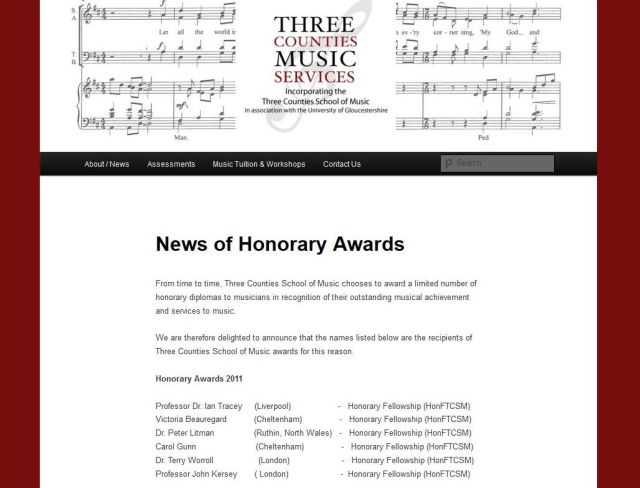
Honours and awards: Honorary Fellowship of the Three Counties School of Music

The Three Counties School of Music has awarded me an Honorary Fellowship in recognition of my “services to music and outstanding musical achievements both at national and international level.”

The School, which is in association with the University of Gloucestershire, was founded in 2010 to provide quality, accessible and affordable music education for people of all age groups, who wish to focus on a variety of styles of music performance or composition, with less formal but equally rigorous assessments than traditional examination boards. I previously advised on the School’s initial stages and assessment structures.

New CD published – The Circle of Brahms, vol. 5

A new CD has been published by Romantic Discoveries Recordings.

The Circle of Brahms, vol. 5
John Kersey, piano
RDR CD93

Total time: 72 minutes 19 seconds

1. Friedrich Gernsheim (1839-1916): Variations in E flat major, op. 18
2. Gernsheim: Variations in C minor, op. 22
3. Gernsheim: Weihe der Nacht, op. 69
4&5. Gernsheim: Fantasie und Fuge, op. 76b
Ernst Rudorff (1840-1916): 3 Romanzen, op 48: 6. Andante con moto tranquillo  7. Allegro capriccioso 8. Larghetto – Allegro vivace
9. Rudorff: Variazioni capricciose, op 55
10. Rudorff: Capriccio appassionato, op. 49

Friedrich Gernsheim was born of a Jewish family in Worms and studied there with Louis Liebe, who had been a pupil of Spohr. Following the 1848 revolutions, his father moved the family to Frankfurt, where he studied with Edward Rosenhain. His debut in 1850 was followed by two years of touring, before he undertook advanced studies with Moscheles. Between 1855-60 he was in Paris, where he met Lalo, Rossini and Saint-Saëns. In 1861 he succeeded Hermann Levi as music director in Saarbrücken, and in 1865 Hiller appointed him to the staff of the Cologne Conservatoire, where he taught Engelbert Humperdinck among others. In 1868 he met Brahms for the first time, and his compositions, which include four symphonies (the third based on the Jewish theme of the Song of Miriam), concertos and much chamber music, show a notable Brahmsian influence. He spent the years 1874-90 as director of the Rotterdam Philharmonic Society, before joining the faculty of the Stern Conservatoire in Berlin, finally leaving to teach at the Academy of Arts in 1897, the year he was elected to the senate.

Gernsheim was a talented pianist and composer, and although it is not difficult to see elements of Brahms and Schumann in his work, there is also a personal voice that tends distinctly towards the melancholic. His sets of piano variations on original themes are inventive and ambitious, featuring intricate textural writing and some effective harmonic touches. His Fantasie und Fuge is a transcription of an organ work that begins in the traditional improvisatory style with abrupt contrasts of mood and tempo before building into a noble work that pays homage to the example of Bach. His poetic “Weihe der Nacht” is a transcription of a work originally for piano four hands.

Ernst Rudorff studied piano under Woldemar Bargiel (see previous RDR releases) and in 1859 entered the Leipzig Conservatoire where he studied under Moscheles, Plaidy and Rietz. He undertook further study with Hauptmann and Reinecke. Appointment as professor of piano at the Cologne Conservatoire in 1865 was followed by the senior piano position at the Berlin Hochschule between 1869 and his retirement in 1910. In 1867 he founded the Bach-Verein Köln and from 1880-90 was conductor of the Stern Gesangverein, succeeding Bruch.

A prolific composer, arranger and editor, Rudorff was a friend of both Brahms and Joachim. His original works include three symphonies, overtures, variations and serenades for orchestra, chamber music and vocal music both with orchestra and with piano. He was responsible for orchestrating Schubert’s four-hand Fantasy in F minor.

His compositional style owes something to Brahms but is also relatively forward-looking, at times approaching in its chromatic harmonic style such younger contemporaries as Dohnanyi. His music is characterized by a certain degree of vigour; the extended coda of his Variazioni capricciose being notable for its extroversion. Again, the Three Romances op. 48 might arouse expectations of tranquil works, but the second and third (after a slow introduction) are in fact highly active.

New CD published – The Circle of Brahms, vol. 4

A new CD has been issued by Romantic Discoveries Recordings.

The Circle of Brahms, vol. 4
John Kersey, piano
RDR CD92

Carl Georg Peter Grädener (1812-83): Piano Sonata in C minor, op. 28
1. Allegro molto e con brio 2. Grave assai lento 3. Scherzo finale molto vivace

Heinrich XXIV Prinz Reuss zu Köstritz (1855-1910)
4. Andante

Grädener: Fantastische Studien und Träumereien, op. 52, vol. 1
5. „Immer zu immer zu/Ohne Rast noch Ruh!” 6. Beschaulichkeit 7. Jüngling und Mädchen 8. Kampf, Entsagung, Kampf 9. Resignation

Gustav Nottebohm (1817-82): Six Romanesques, op. 2
10. Andantino 11. Allegro poco agitato 12. Andante cantabile 13. Allegro grazioso  14. Allegro 15. Allegro brioso

Our thanks to Dr Klaus Tischendorf and Peter Cook for supplying scores of these rare works.

Carl Grädener was born in Rostock and spent ten years as a cellist in Helsinki. He was then director of music at the Kiel Conservatoire for ten years, later teaching at the Vienna and Hamburg Conservatoires. His compositions include operas, symphonies and other large-scale works, as well as miniatures for piano and songs. His son Hermann also became a composer. His piano sonata op. 28 is a large-scale and ambitious work that has stylistic parallels with Brahms’ own early essays in the genre. Like Brahms, Grädener’s writing is tightly worked-out and highly pianistic, with a good deal of writing in double octaves and other virtuoso figurations. By contrast, the central slow movement is introverted and, while continuing the overall seriousness of the work, introduces a lyrical element that is otherwise absent. Grädener’s combination of scherzo and finale is an interesting innovation whose stormy character is fully in keeping with the Romanticism of his age without neglect of the essential backbone of Classical form.

Grädener’s first book of Fantastische Studien und Träumereien shows him to have been an effective scene-painter tending particularly towards the intense and dramatic, as in the first and fourth pieces. However, there is contrast here and the second piece, Beschaulichkeit (or Tranquillity) is full of bluff good humour of a slightly boisterous kind. The last of these studies, headed Resignation, is the most extended, with an agitated middle section leading to a long passage of repeated figuration for the left hand.

Martin Gustav Nottebohm is probably best known for his studies of Beethoven’s sketchbooks, but was also well regarded as a composer. After studies in Leipzig, where he met Mendelssohn and Schumann, he settled in Vienna in 1846. His first meeting with Brahms was in 1862 and the two men became close friends, with Brahms caring for Nottebohm in his last illness and making the arrangements for his funeral.

Nottebohm composed on a domestic scale, with most of his works for piano or chamber ensembles. His Variations on a Sarabande of J.S. Bach for piano duet was performed with Brahms as his duo partner. Brahms wrote in a letter to Heinrich von Herzogenberg (see earlier volumes of this series) that Nottebohm was among the modern practitioners of variation form.

Prince Heinrich XXIV Reuss zu Köstritz was born into the younger line of the Princely House of Reuss; his father was an amateur composer. He studied music at Dresden and then entered the Universities of Bonn and Leipzig where he studied with Wilhelm Rust. From 1881 he studied with Herzogenberg and through his good relations with Herzogenberg came to meet Brahms, who offered him some helpful advice on compositional matters. As well as six symphonies, he wrote a quantity of chamber music, influenced in style by Herzogenberg and Mendelssohn. His works were admired by Reger and other contemporaries, but he fell from favour in the post-war years.

New CD published – Piano Sonatas of Eduard Franck (1817-93) vol. 3

A new CD has been issued by Romantic Discoveries Recordings.

Piano Sonatas of Eduard Franck (1817-93) vol. 3
John Kersey, piano
RDR CD91

8 Klavierstücke, op. 62:

1. Allegretto 2. Allegro molto 3. Andante 4. Presto 5. Allegro appassionato 6. Andante 7. Allegretto 8. Vivace

Piano Sonata in F major, op. 44 no 3:

9. Allegro 10. Allegro 11. Andante – Più tranquillo 12. Allegro vivace

Eduard Franck was born in Silesia into a wealthy and cultured family that numbered Mendelssohn and Wagner among its acquaintances. He studied with Mendelssohn as a private student and then began a long career as a concert pianist and teacher. He was regarded as one of the leading pianists of his day and also as an outstanding teacher.

Franck was not forthcoming about his compositions, and failed to publish many of them until late in life. He was a perfectionist and would not release a work until he was absolutely satisfied that it met his standards. Yet what survives is extremely high in quality. Writing of his chamber music, Wilhelm Altmann said, “This excellent composer does not deserve the neglect with which he has been treated. He had a mastery of form and a lively imagination which is clearly reflected in the fine and attractive ideas one finds in his works.”

The Eight Piano Pieces op. 62 are among Franck’s last piano works and were first published posthumously in 1910 as a result of the efforts of Franck’s son Richard. They constitute a large-scale cycle varying greatly in mood and tempo, and with a notably more experimental approach than Franck’s earlier works.

The Piano Sonata in F major op 44 no 3 is the longest of Franck’s published piano sonatas, and although published in 1882 was very probably composed earlier than that date. The ‘Neue Zeitschrift für Musik” of 11 May 1883 reviewed the sonatas of op. 40 and op. 44 with the following words, “In all these works, a rich treasure of good German music is laid down. It is said of our time, that it brings forth no thorough Sonata, here we find a refutation of such a claim. Since Beethoven, only a few talented writers such as Ed. Franck have probably been called into existence. Almost all motives are created vividly before us and are well crafted. It is evident how versatile and diverse they are, especially from the fact that there is an underpinning of good counterpoint as if it were naturally present in the hands. Several of these [sonatas] deserve to be performed symphonically, because a dramatic element predominates in them. This Franck has always kept in mind, just as our classical piano masters treated their instruments, in so far as the piano is an orchestra.”

New CD published – Piano Music of Algernon Ashton (1859-1937)

A new CD has been issued by Romantic Discoveries Recordings.

Piano Music of Algernon Ashton (1859-1937)
John Kersey, piano
RDR CD90

Total time: 75 minutes 5 seconds

6 Pieces, op. 140
1. Rêverie 2. Capriccio 3. Scherzo 4. Ballade 5. Impromptu 6. Romance

3 Traumbilder, op. 83
7. Elegie 8. Intermezzo 9. Ballade

5 Piano Pieces, op. 127
10. Elegie 11. Humoreske 12. Romanze 13. Toccata 14. Berceuse

7 Pieces, op. 125
15. Capriccio 16. Idylle 17. Cavatine 18. Intermezzo 19. Silhouette 20. Nocturne 21. Impromptu

Our thanks to Peter Cook for supplying scores of these rare works.

While some aspects of Algernon Ashton’s life have been unearthed in recent years, and important releases on other labels have begun to reevaluate his piano works, much remains enigmatic. Born in Durham, where his father was a lay clerk at the cathedral, his family moved to Leipzig when Algernon was aged four. It was there that he completed his musical education, studying (on the recommendation of Moscheles) during 1875-79 at the Leipzig Conservatoire with Salomon Jadassohn, Carl Reinecke (see previous RDR releases) and Ernst Richter; this was followed by a year in Frankfurt with Raff and Iwan Knorr.

In 1882, his studies complete, Ashton returned to England, settling in London. Three years later, he was appointed professor of piano at the then newly-chartered Royal College of Music, where his pupils included William Yeates Hurlstone and William Alwyn. Here he remained for thirty-five years, retiring aged 60 but continuing to teach pupils privately.

Here the enigma of Ashton begins. Outwardly, his life would appear to have been one of steadfast teaching activity, doubtless enough for many of his contemporaries. But there were two other aspects to his output. One, the musical, consisted of an enormous output of published and unpublished works, many now lost, that came to include twenty-four piano sonatas and string quartets in all the keys, five symphonies, concerti for piano and violin and many piano works in shorter forms and songs. It is these latter that have mostly survived. The other aspect of his work (which gives a clue to his personality and which brought him some measure of fame before the general public) was as a voluminous writer of letters to the newspapers, on a wide range of subjects from the profound to the trivial. He became known for correcting aspects of biographical information, and particularly matters concerning graves and cemeteries, on which his knowledge was encyclopaedic, and his letters were published in several anthologies.

Ashton seems to have been – rather like his predecessor Alkan, with whom he shares several traits – compulsively creative, even given the relative indifference of English public reception, such that he could only find a publisher in Germany. Music and written material poured from him at white heat, with most of his works dating from his first forty years. One might expect from this a degree of prolixity or trivial statement, but not a bit of it. Ashton is a highly original composer and as for the relatively small number of his works currently available to examine, there is not a dud among them.

Mentioning Alkan brings two notable qualities of Ashton’s music to the fore. One is its extreme technical difficulty. While Ashton is rarely entirely outlandish or exotic in his demands on the pianist, he is uniformly severe, with the writing often cruelly exposed and leaving nowhere to hide any deficiency. If he wrote for his own performance, as seems likely, he must have been a truly astonishing pianist on the level of his more famous contemporaries. The other quality is Ashton’s intense intellectual command of his material. Like Alkan, he is motivically obsessive at times (see the Silhouette from op 125 for a good example of how the same material can be viewed from slightly different angles), but Ashton is far more influenced by the musical language of Brahms and is thus more retrospective than forward-looking for his era. Yet his music is still as English-sounding as it could be, and the blandness of the titles that the shorter pieces bear is deceptive.

This retrospective trait combines with a set of characteristics that we would perhaps cite as a stereotype of Ashton’s northern stock. His music is tough, wiry, emotionally sincere and at times extremely pessimistic, and in its plainness of utterance lacks any hint of the cheapness or sentimentality sometimes associated with his era. This, perhaps, is the key to Ashton’s personality; that he was in essence an idealist and was unconcerned with any form of acclaim save on his own terms. Others such as Rutland Boughton and Harold Truscott have pleaded his case earnestly, noting that while wholly unacknowledged publically, his compositional style was in fact extremely influential. The works on this disc add to his known legacy and further support his claim to distinction.

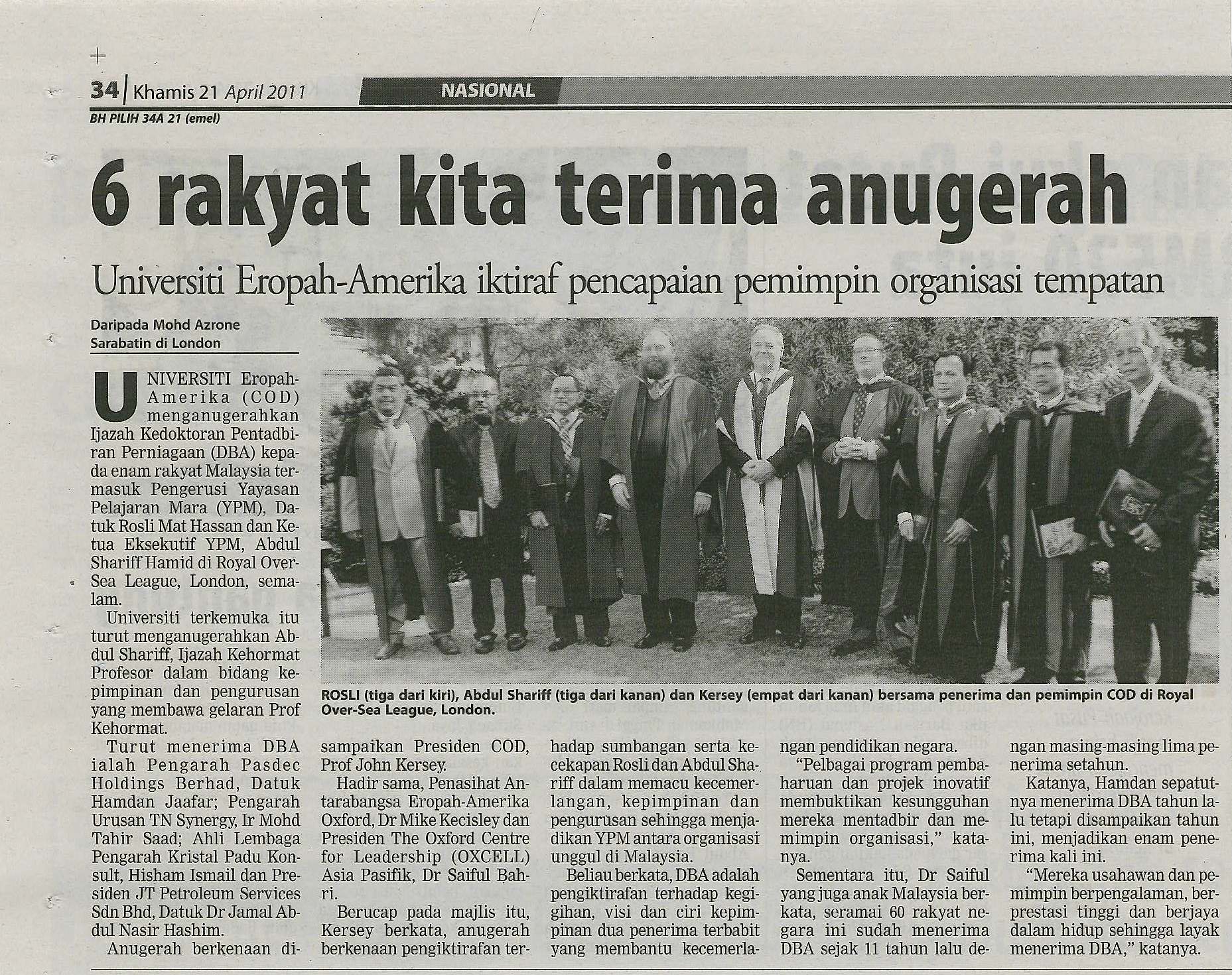
Ceremonies in London and Oxford

During April 2011, ceremonies took place for visiting doctoral graduates of the joint EAU – Oxford Centre for Leadership (OXCELL) program in Oxford and London. The graduates from Malaysia and Indonesia enjoyed a full program of events culminating in evening events in Oxford and afternoon tea (amid unusually fine weather) at the Royal Over-Seas League in London.

The ceremonies have been reported in the national press in Malaysia, including the following article (click to enlarge):

New CD published – Piano Music of Hugo Wolf (1860-1903)

A new CD is available from Romantic Discoveries Recordings.

Piano Music of Hugo Wolf (1860-1903)
John Kersey, piano
RDR CD89

Twelve Mörike Lieder, transcribed for solo piano by Max Reger (1873-1916): 1. Jägerlied  2. Er ist’s 3. Begegnung 4. Fussreise 5. Verborgenheit 6. Elfenlied 7. Der Gärtner 8. Schlafendes Jesuskind 9. Gebet 10. Rat einer Alten 11. Gesang Weyla’s 12. Selbstgeständnis

13. Albumblatt
14. Kanon

Piano Sonata in G major, op. 8
15. Allegro gracioso 16. Largo et sostenuto 17. Scherzo 18. Rondo Allegro (incomplete)

Our thanks to Dr Klaus Tischendorf for supplying scores of these rare works.

Wolf’s Lieder are so completely conceived within their medium that, short of orchestrating their piano parts, it is difficult to imagine them being presented convincingly in another guise. The option of a more-or-less free paraphrase was adopted by Bruno Hinze-Reinhold in his Piano Pieces based on ten of the Lieder, but he, as with Max Reger on this disc, was doubtless well-aware that any attempt at Lisztian filigree or abandonment of such carefully worked-out textures would depart unacceptably from the spirit of the original.

Max Reger is known to us above all as a master of the Germanic school of polyphony, and it seems to have been that aspect of Wolf’s work that most appealed to him. Reger’s choice is most frequently to submerge the vocal line in the midst of others, and not infrequently in a chordal texture, which creates a challenge for the performer that would not be altogether obvious to the casual listener. Indeed, by taking this approach, Reger causes us to question whether the vocal line is indeed primus inter pares, or whether at times it is in fact subordinate to the piano part. His transcriptions bring out the intricacy of Wolf’s writing and also enable the intensity of his world to be conveyed within broader tempi than could be comfortably sustained by the human voice. The result is something of a new departure that recasts these familiar works into a new sound-world.

The Piano Sonata op. 8 dates from 1876, when Wolf was aged 16 and in the midst of his two years of studies at the Vienna Conservatoire. In the previous year, he had met Wagner, who had encouraged him and would become a major model for the younger composer. However, Wolf’s impassioned temperament and tendency for outspokenness was not suited to the discipline of conservatory study and he was to part company with the institution on less than amicable terms. This sonata has some aspects reminiscent of Wagner’s own solo piano output, though more that suggest the influence of the Viennese classics, and also points to Wolf’s desire to explore the piano’s interpretative possibilities (as he would do later and with greater success in his Lieder).

The manuscript of the sonata is mostly devoid of dynamics and articulation, and in some aspects carelessly written, with many missing accidentals. Nevertheless, it is not difficult to discern Wolf’s intentions, and what emerges is an energetic and optimistic work which suggests a young man keen to make an impression and show ability in dealing with a large-scale compositional canvas. Already in the thematic material there is plenty of strength, with the slow movement particularly striking in its recall of Beethovenian and Schubertian models. Structural issues are mainly well-handled (though the development in the first movement is cursory at best). The last movement is incomplete, breaking off in the middle of an episode; the remaining pages were likely completed by Wolf but have since been lost.

The Albumblatt (1880) and Kanon (1882) are Wolf’s last works for solo piano; by now he had found his feet as a composer, though was suffering much emotional disturbance due to his unhappy affair with Vally Franck and a not altogether successful period as a music teacher in Vienna. The former work in particular, with its striking harmonies, shows that Wolf had marshalled the elements that would form his mature style.