The International Academy of Saint George is incorporated in the State of Wyoming, USA. The Academy offers advanced studies in History, Heraldry, Chivalry and Ecumenical Religion. I have been honoured by the Academy with the award of Academic Doctor honoris causa in Religion.
I have had the honour to be created a Prince of the Royal Principality of the Upper Region of Hiran, Royal House Shikal, Somalia. The Head of the Royal House Shikal is H.E. and H.R.H. the Ambassador, Federal, Special Police and Military Colonel (G.di F.), Royal Prince Professor Dr Ali M. (Moallim) Hussen, son of the late traditional King of the Hiran Region of Somalia, H.R.H. the Prince Moallim Hussen, descendant of the Sultanate of Mudaffar.
Prince Ali M. Hussen was Minister of Justice for the Horn of Africa from 1965 to 1967. He served as Somalian Ambassador to the the Holy See/Vatican City during the incumbency of President Major-General Mohamed Siad Barre (1990) and subsequently became Ambassador of the Transitional National Government of Somalia for Italy. Prince Ali was Shaykh/Sheik of Tariqah Qadiriyyah of Sufism, and President from 1981 to August 2003 (when he retired due to health problems) of the Associazione Musulmani Italiani (A.M.I./Association of Italian Muslims (established in Naples in 1982 and heir of the Associazione Musulmana del Littorio, Muslim Association of Littorio (Fasces), co-founded by H.R.H. Prince Moallim Hussen in 1937). Prince Ali was also an Islamic Judge (Qadi) and Professor of Islam, from 1970, by a Decree of the Grand Mufti of Saudi Arabia, Shaykh Abd al-Aziz ibn Baz.
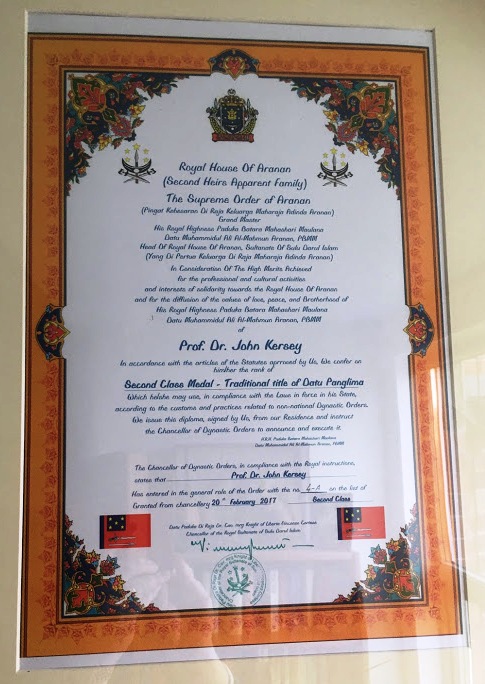
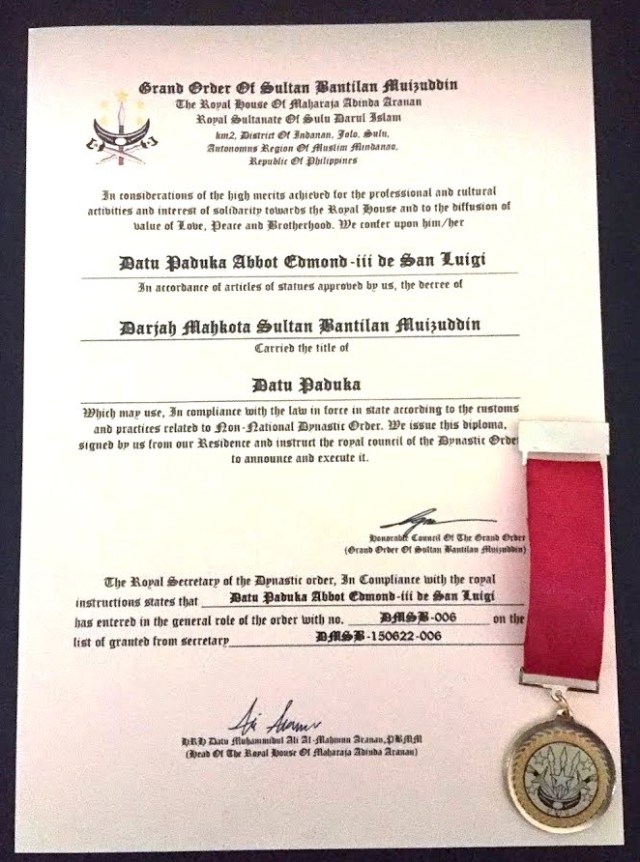
The Head of the Royal House of Maharaja Adinda Aranan, H.R.H. Datu Muhammidul’ Ali Al-Mahmun Arunan, PBMM etc. has bestowed the Second Class Medal and title of Datu Panglima in the Supreme Order of Aranan upon me. This follows my earlier appointment as Datu Paduka in the Grand Order of Sultan Bantilan Muizuddin in 2016.
The Royal House is descended from Sultan Bantilan Muizuddin, who ruled as Sultan of Sulu between 1748 and 1763. The Sultanate of Sulu includes parts of the present-day Philippines and Brunei, and reigned between 1405 and 1915.
On 18 February 2017, I spoke at the inaugural meeting of the Ludwig von Mises Institute UK in London. This is the text of my speech.
When Donald Trump was mounting his presidential campaign, nothing he said struck me as more significant than his pledge that he would drain the swamp. By this phrase, President Trump has signified several things. Immediately, he has announced ethics reform for Washington lobbyists. But more generally, he has embarked on a course of action that those interested in liberty, and specifically those who believe that the modern bureaucratic state is an obstacle to liberty, should take a close interest in.
Much has been made of President Trump’s status as an outsider. No-one has exploited that status more successfully than he has himself. He is not a politician, but an anti-politician. As such, he has established himself with great vigour and courage as a crusader on behalf of the ordinary voter and as an opponent of the Washington machine. Indeed, that machine has since expanded to pit him against forces that arguably include the whole of the Federal government of the United States.
President Trump is not interested in doing things the way the political and civil service establishment are used to doing them. He has established that this is not, for him, an effective way to achieve his aims. As a businessman, he wants to run the United States of America like a business. For him, that means that he as the CEO sets out the overall principle and vision, others develop strategy based on this, and then further down the hierarchy others yet are charged with the practical enaction of that strategy.
Those of us who are interested in liberty are likely to agree that the elimination of the modern state is a development that would undoubtedly lead to greater freedom for society, for business and for individuals. It is the state that seeks to regulate activity that could and should be the subject of private contract solely so that it can extract profit from it and preserve its own favoured interests. It is the state that takes from the citizen the money that he has earned by force in the form of taxation. It is the state that represents the coalition of powerful vested interests and lobbies who with justification believe that it is they, not the ordinary voter, who own government. In electing President Trump, the people of America have served notice on the state that they will not any longer see those vested interests prosper at their expense, and that they will no longer put up with their public relations justifications for their failure and underperformance. They, like President Trump, have told those bodies “you’re fired”.
I do not suppose that President Trump is a libertarian in that he espouses any given libertarian theorist or that he is advised by particular libertarian groups, although it is heartening to see that some libertarians are certainly playing advisory roles in his administration. I certainly do not think he would have any time for the Libertarian Party as represented so abjectly by Gary Johnson. But I do see in his plans and policies a good deal that was prefigured by Dr Ron Paul in his memorable candidacy in the last Presidential election. President Trump’s political philosophy is not driven by theory but by functionality, and in that respect it is a philosophy of business. He has the capacity to envision an end result and articulate this as an accessible vision. The question of how we get to that end result is not so much inchoate as subject to as many changes of plan as are necessary in the process. One thing that liberals find so hard to grasp about President Trump is that he is not about process but about product. The state, by contrast, must take the opposite view if it is continually to perpetuate and expand itself.
When President Trump announced a hiring freeze for the federal government; when he took on the bureaucrats and their unions; when he effectively took a scalpel to the heart of the state, I was greatly heartened. Here is the first Western leader in living memory, and the first American president since Ronald Reagan, who has actively tried to shrink the state and who has dared take on those who believed the President was their man, that their roles meant that he was the leader of their club and shared their outlook and interests. President Trump has wasted no time in telling them that his and their interests no longer coincide and that their days in power are coming to an end. They call him a loose cannon; they call him unpredictable and inconsistent. They can call him what they like; if they lose their battle with him – and I believe they will – then they are finished.
For years in the United States, powerful vested interests have dominated a number of sectors of government. My own particular interest is education, and I have consulted on educational issues for law firms in the United States for the past eleven years. During that time I have seen every state in the United States pass laws restricting the provision of higher education in favour of the accreditation lobby, despite independent studies showing that the accreditation process does little or nothing to assure quality in education or do anything save promote protectionism and add to the eye-watering costs of education for the consumer. The accreditation lobby represents the state universities above all, and it represents a standardized educational product. For those of us who believe that to standardize education is to reduce it to mere training, the process by which the accreditation lobby has exerted a stranglehold upon legislators to eliminate any competition to their product is an example of precisely what President Trump has been elected to office to deal with. We need him to look at protectionist legislation like this and to put choice and responsibility back into the hands of employers and the public.
A number of President Trump’s appointments give some degree of confidence. The determination to appoint outsiders is likely to be accompanied with a mission statement that those outsiders are not going to turn native. They are there to hire, fire and bring about radical reform. If they succeed, they will transform the United States into a country that is, for its citizens, uniquely equipped to tackle globalized complex markets through business structures of unparalleled flexibility. If the United States is not yet the land of the free, it is without question that it has become, at least in part, the home of the brave.
I have been honoured by the Norman Academy with an appointment as Academician of Honor.
The Norman Academy is incorporated in the State of Florida, USA, and is a non-profit association concerned with Arts, Letters, Humanities and Human Rights. It is active in the United States, Italy and The Gambia, where the President, H.E. Dr Yahya A.J.J. Jammeh, is Honorary Chairman of the Norman Academy. On April 29, 2003, the Norman Academy was recognized by the Government of the Republic of The Gambia as a Moral Entity of Public Utility and of High Culture, with decree no.246/2003 issued by the Ministry of Justice.
The Head of the Royal House of Maharaja Adinda Aranan, H.R.H. Datu Muhammidul’ Ali Al-Mahmun Arunan, PBMM etc. has bestowed the title of Datu Paduka in the Grand Order of Sultan Bantilan Muizuddin upon me. The Royal House is descended from Sultan Bantilan Muizuddin, who ruled as Sultan of Sulu between 1748 and 1763. The Sultanate of Sulu includes parts of the present-day Philippines and Brunei, and reigned between 1405 and 1915.
I have been honoured to have been admitted as a Pontifical Academician, becoming an Honorary Academician of the Pontificia Accademia Tiberina in Rome, Italy. The distinction of Honorary Academician is the highest award of the Accademia.
The Accademia Tiberina was founded in 1813 and received official recognition from the Sacred Congregation of Studies under Pope Leo XII in 1825. Already in 1816, the Papal States had granted the Accademia the right in perpetuity to display on its door the coat of arms of the Senate and the Roman people. In 1878 the Accademia was given permanent hospitality in the palazzo of the Cancelleria Apostolica by Pope Leo XIII.
The Accademia counts five popes among its distinguished past membership: Pius VIII, Gregory XVI, Pius IX, Leo XIII, and Pius XII, and numerous Cardinals of the Catholic Church. Among its many other distinguished members are the composers Liszt, Bellini, Rossini and Respighi, the inventor Marconi and the chemist Marie Curie.
The Accademia has also honoured Eastern Catholic prelates, including the Patriarchs of the Melkite Greek Catholic Church and the Syrian Catholic Church. During the 1930s, as a means of improving relations between the Holy See and the Abbey-Principality of San Luigi, the Duc d’Allery de Bourbon, who was a member of the Camerier Secret of the Pope, arranged for Prince Edmond I de San Luigi to be admitted an Academician of the Accademia Tiberina. My present appointment as his successor some eighty years on stands as testament to continued friendly relations with Rome.
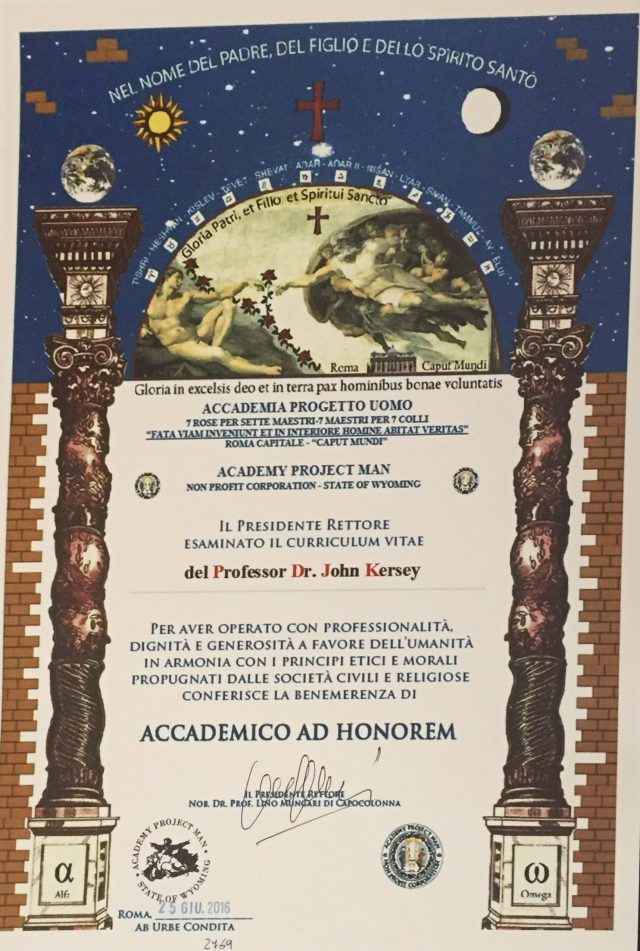
The “Academy Project Man” (Accademia Progetto Uomo), is incorporated in the State of Wyoming, USA, and also based in Rome, Italy. Its activities include the organization of conferences and the conferral of prizes for humanitarian work. I have been honoured by the Academy with the distinction of Honorary Academician.
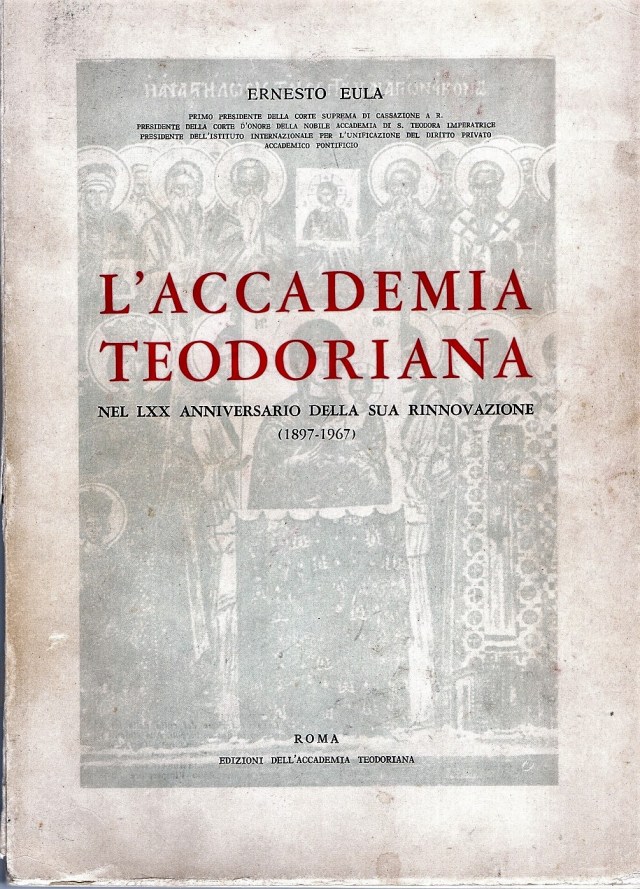
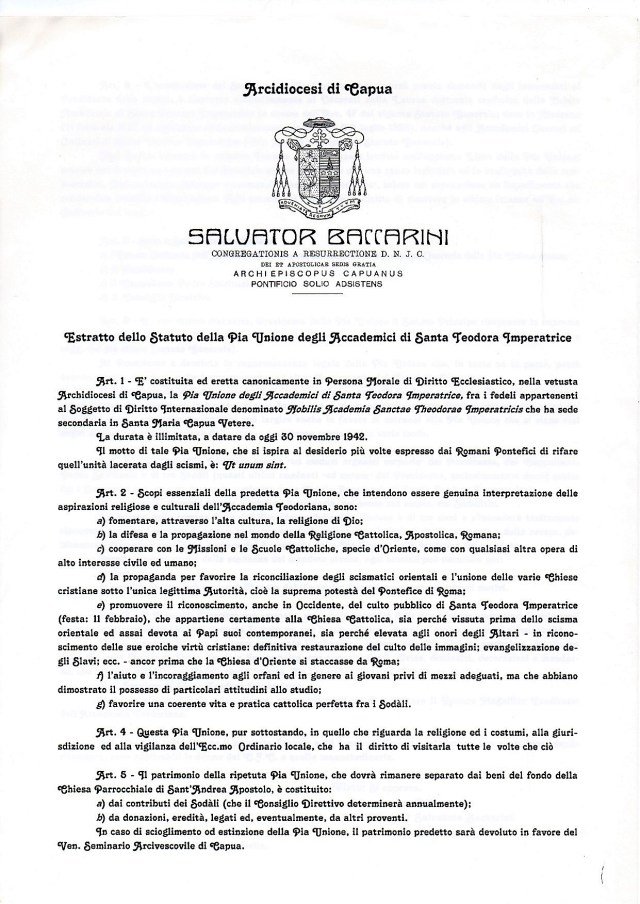
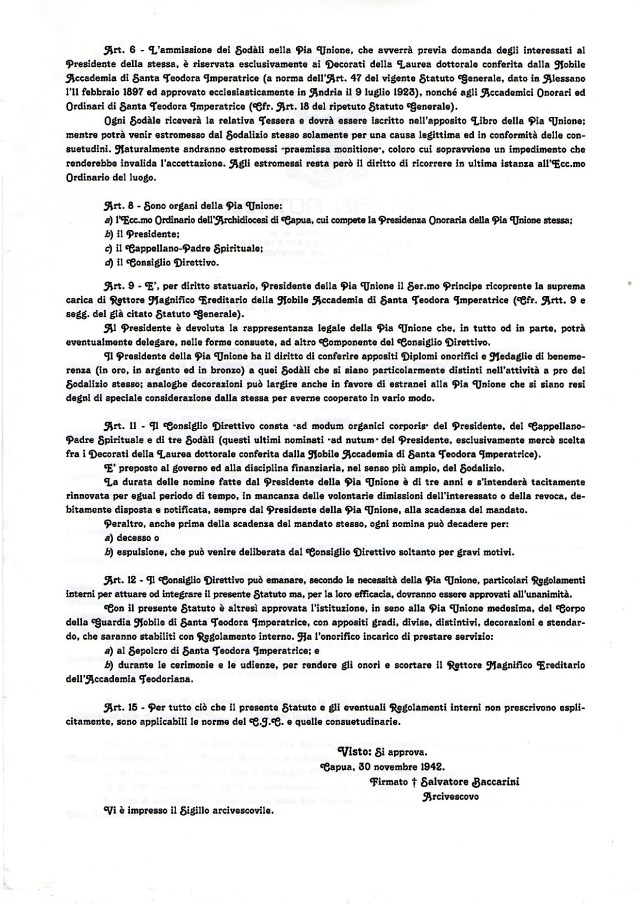
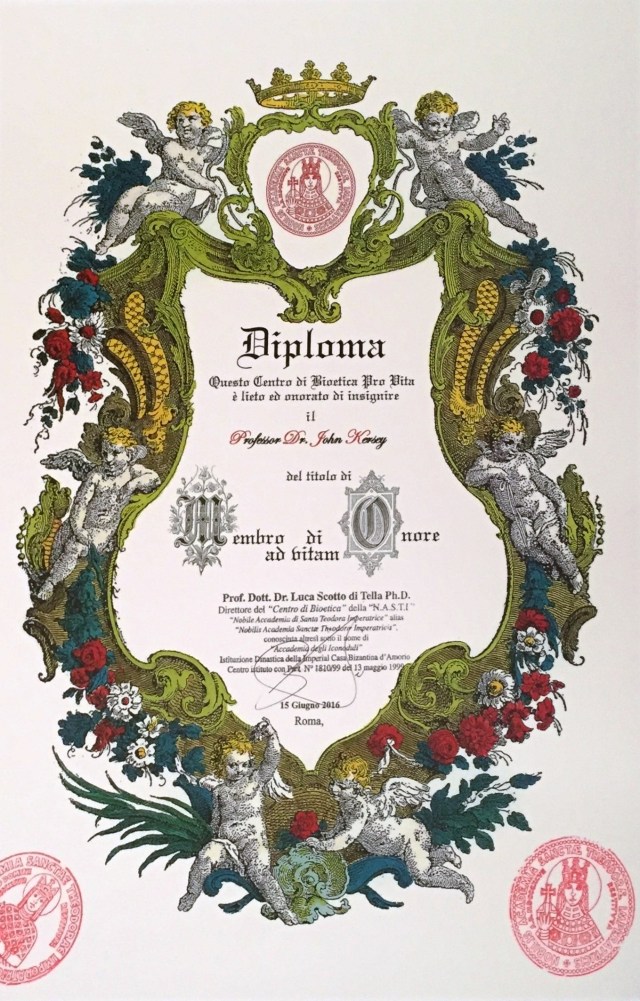
I have been honoured by the Nobile Accademia di Santa Teodora Imperatrice (NASTI), Rome, Italy. The Accademia is recognized as a subject of international law by the Italian government and since 1942 has been recognized as a sodality of the faithful by the Archdiocese of Capua of the Roman Catholic Church.
The International University SAADAUD was founded in Mogadishu, Somalia, in 1980, by H.E. and H.R.H. the Ambassador, Federal, Special Police and Military Colonel (G.di F.), Royal Prince Professor Dr Ali M. (Moallim) Hussen, son of the late traditional King of the Hiran Region of Somalia, H.R.H. the Prince Moallim Hussen, descendant of the Sultanate of Mudaffar. Prince Ali became its first Rector. The University was officially registered and recognized by the Government of Somalia. The Centre of Bioethics and Human Rights was established by Rectoral Decree in 2006. Prince Ali M. Hussen was Minister of Justice for the Horn of Africa from 1965 to 1967. He served as Somalian Ambassador to the the Holy See/Vatican City during the incumbency of President Major-General Mohamed Siad Barre (1990) and subsequently became Ambassador of the Transitional National Government of Somalia for Italy. Prince Ali was Shaykh/Sheik of Tariqah Qadiriyyah of Sufism, and President from 1981 to August 2003 (when he retired due to health problems) of the Associazione Musulmani Italiani (A.M.I./Association of Italian Muslims (established in Naples in 1982 and heir of the Associazione Musulmana del Littorio, Muslim Association of Littorio (Fasces), co-founded by H.R.H. Prince Moallim HUSSEN in 1937). Prince Ali was also an Islamic Judge (Qadi) and Professor of Islam, from 1970, by a Decree of the Grand Mufti of Saudi Arabia, Shaykh Abd al-Aziz ibn Baz.
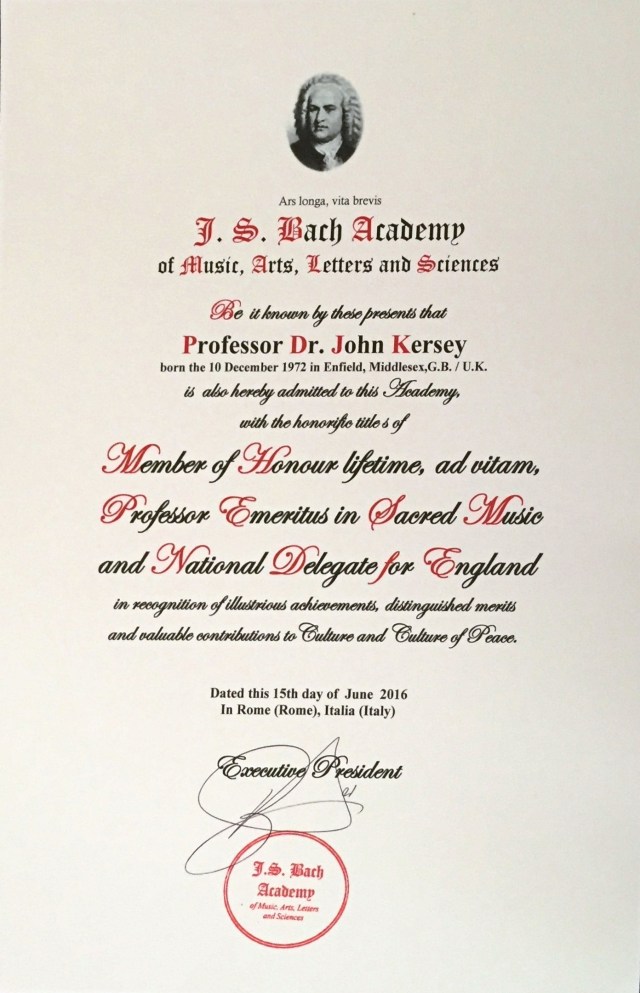
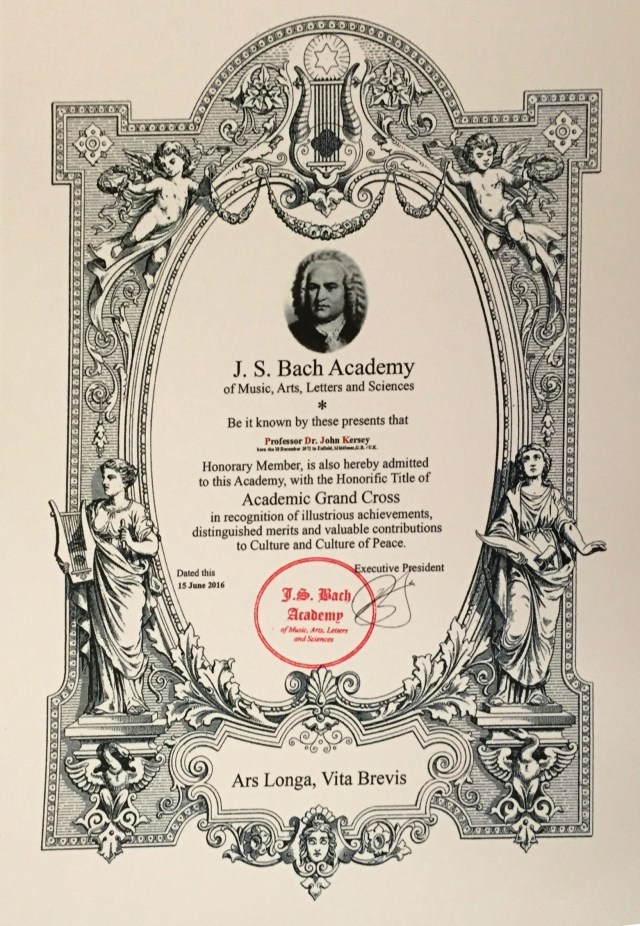
The J.S. Bach Academy was initially established in Australia. The Academy is a cultural and educational institution that honours the example of J.S. Bach (1685-1750) as a composer and executant musician of genius; a distinguished pedagogue, an intellect of the highest order and a polymathic artist. From the outset its activities have centred not only upon music but on endeavour in other areas such as literature and the sciences. As such, the Academy stands against the fragmentation of human knowledge and promotes unity and interdisciplinary endeavour.
I have served as International Executive Vice-President and International Musical Director of the Academy and also received other awards from the Academy in 2016.
I have been honoured with appointments as National Delegate for England and Member of Honour, and with a Certificate of Appreciation, by the International Centre of Bioethics of the Moscow University “Sancti Nicolai”. The University is a free university of higher studies and was authorized by decree of King Victor Emmanuel III of Italy of 4 November 1943, no. 158. It is further recognized by Sentenza Internazionale of the Corte Suprema di Giustizia Arbitrale di Bari of 5 February 2016, published in the Bollettino Ufficiale della Regione Puglia, n. 36 of 23 March 2017. The Supreme Rector is HRH Prof. Antonio Tiberio di Dobrynia.
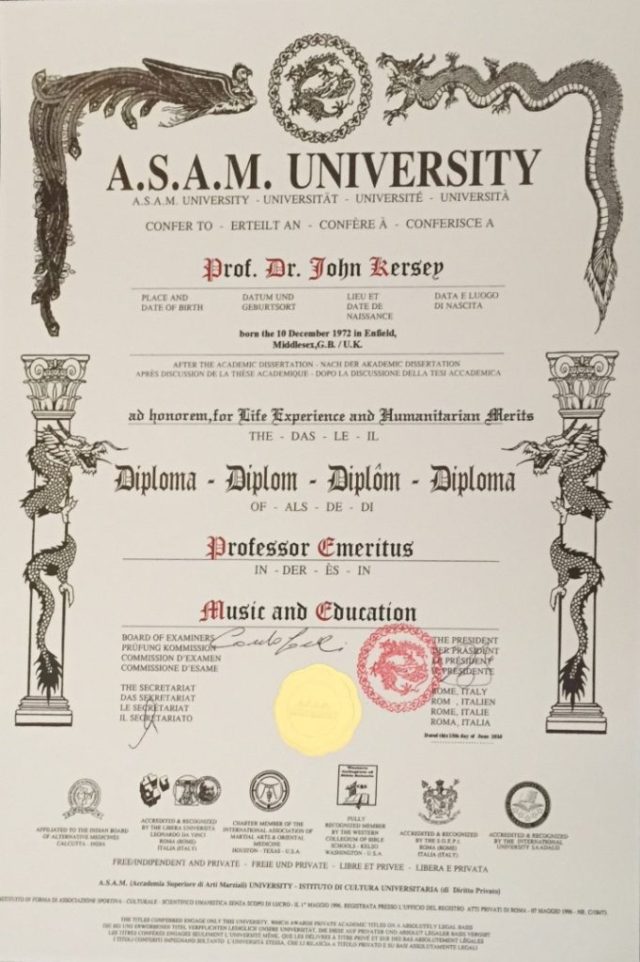
I have received the honorary degree of Master of Science in Bioethics from the A.S.A.M. University in Rome, Italy. The basis of the award is “for Life Experience and Humanitarian Merits”. I have also been appointed as a Professor Emeritus in Music and Education, Sacred Theology and Moral Philosophy of the University, and as National Delegate for Great Britain and Northern Ireland.
The A.S.A.M. University (having the Motto: “Non scholae, sed vitae discimus” (We are not learning for the School but for Life”, Lucius Annaeus SENECA, “Epistulae Morales”, 106) is a non-profit and pro-life private institute of High Culture (originating for the Study and Practice of Martial Arts, for example Shaolin Kung Fu Wu Shu and for Oriental Studies; in fact A.S.A.M. is an acronym of “Accademia Superiore di Arti Marziali”, Superior Academy of Martial Arts), promoting Human and Animals Rights and Bioethics, on the model of the Popular Universities, registered in Rome, Italy, since 1996.
The University is a free and private institute of culture with university character, operating under private law. The diplomas and titles of the University are awarded on a strictly private basis in accordance with Italian and international law.
It is accredited and recognized by (amongst others) the Libera Università Leonardo da Vinci (Free University Leonardo da Vinci), Rome, the International University Saadaud, Somalia, and the Anglican Association of Colleges and Schools, and is affiliated to the I.B.A.M./Indian Board of Alternative Medicines, Calcutta (India). It has the status of meritorious twin partner to the Imperiale Accademia di Russia/Moscow University “Sancti Nicolai”. It is a Charter Member of the International Association of Martial Arts and Oriental Medicine, Texas, U.S.A.
I have received a number of honours from my cousin the Head of the Imperial Byzantine Amorian Dynasty (Amoroso d’Aragona). The dynasty was fully recognized by judgments of the Italian courts (under King Victor Emmanuel III) in 1945.
I have been appointed a Privy Counsellor, Honorary Family Member, Noble and Peer of the Imperial Byzantine Amorian Dynasty. As such, by right of family membership and the family laws of 1522, I am a Knight Grand Cross of Honour (thereby of Justice) in the Sacro Imperiale Ordine Costantiniano Nemagnico di Santo Stefano of the Imperial e Real Casa Capone Nemagna Paleologo, and Count Palatine (cf. judgement of 18 July 1945 (Luogotenenza del Regno), Tribunale Civile di Napoli, Quarta Sezione, filed on July 28, 1945 and registered in Naples, Office of Judicial Acts, on July 30, 1945: section 4).
I have received the titles of Prince of the Holy Roman Empire (in the Imperial Byzantine Amorian Dynasty), Duke of Synnada, Marquis of Tiberiopolis and San Giovanni d’Acri, Count of Flaviopolis and San Giovanni d’Acri, Count Palatine of the Phrygian Dynasty of Amorio, and Baron of San Giovanni d’Acri; the Hereditary Grand Cross of the Ordine Internazionale delle Legion d’Onore dell’Immacolata, Hereditary Knight of Justice of the Serenissimo Militare (e Nobiliare) Ordine di San Marco, Hereditary Grand Cross of Justice with Collar of the Order of the Knights of St Catherine of Sinai, Hereditary Grand Cross of Justice of the Sacro Sovrano Imperiale Militare Ordine Costantiniano di San Giorgio della Milizia Aurata d’Oriente della Imperiale e Real Casa Lascaris Ventimiglia Valperga Sanmartino, Hereditary Grand Collar of Justice of the Sovrano Costantiniano Ordine di San Giorgio, già detto Ordine Costantiniano-Amoriano dei Cavalieri Aurati d’Oriente (Dinastico d’ Amorio); Hereditary Grand Collar of Justice of the Ordine Militare et Ospitaliere di San Giovanni d’Acri e San Tommaso; Hereditary Grand Collar of Justice of the Ordine Militare e Ospedaliero di Santa Maria di Betlemme; Hereditary Grand Collar of Justice of the (Ordine del) Cingolo – alias Cingolo Militare (Dinastico d’Amorio), and (through the succession from the late Prince Pierre Pasleau de Charnay et Surmont) Hereditary Grand Collar of Justice of the Ordre Équestre de Saint George de Bourgogne, together with numerous armigerous rights.
The Head of the Imperial House has graciously accepted a number of honours conferred by me in my capacity as Head of the Royal House Polanie-Patrikios.
In my capacity as Primate of the Apostolic Episcopal Church, I authorized the issue of two charity medals in memory of the late Bishop Juliusz Nowina-Sokolnicki. The Most Revd. Juliusz Nowina-Sokolnicki (1920-2009) served as Assistant Bishop of the Apostolic Episcopal Church in Great Britain both as deputy to the late Archbishop-Count George Boyer and as bishop with special responsibilities for the Polish-speaking peoples. He was consecrated for the Apostolic Episcopal Church on 27 May 1983.
Juliusz Nowina-Sokolnicki is best-known in his capacity as the head of one of the two entities that maintained rival claims to be the Polish government-in-exile between 1971 and the fall of communism in 1990. He was Prince Grand Master of the Order of St Stanislas.
The Charity Medals were issued in gold (for outstanding merit) and silver. For each medal, a donation was made to support activity centres for children from poor families in Wrocław, Poland.
The Committee of the Charity Medals in Poland made the decision that I should be one of the recipients of the gold medal.
The St Cecilia School of Music was founded in 1974 in Launceston, Tasmania. The initial aim was to develop a professional, full-time teaching School which catered for the growing number of music students in Northern Tasmania. This aim was rapidly fulfilled.
Within a short period of time over 1,000 music students were enrolled in the School with 18 fully-qualified professional music teachers. The tradition of offering high-quality music education continues to this day.
The expansion of the School’s Examination system (St. Cecilia Examinations) resulted from a need for a more relevant, innovative and exciting approach to assessing the capabilities of music students at all levels. The examination system also offers professional teaching and performing qualifications.
St Cecilia Examinations is now a powerful force in the music world with centres operating in major towns and cities throughout Australia, New Zealand, Asia and Europe.
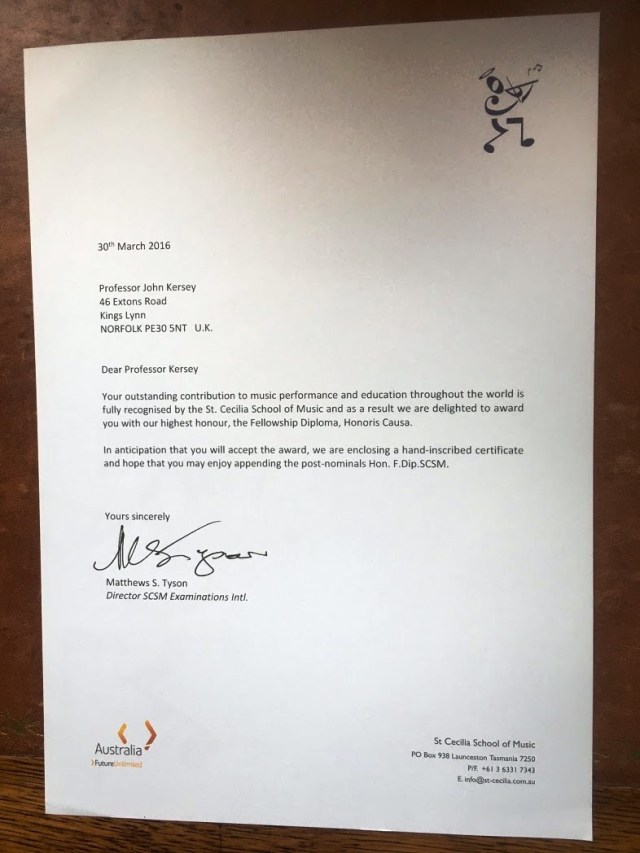
In 2016, I was awarded a Fellowship honoris causa by the School.
I have been honoured to receive the decoration of the Związku Polskich Spadochroniarzy w Warszawie – the Polish Union of Parachutists, Warsaw branch. The Union was established in 1989 by a group of former paratroopers. It brings together military veterans, current military paratroopers and reservists, as well as some civilians involved in parachuting professionally or for recreation. It is officially registered as a public benefit association in law and is a member of the European Federation of Paratroopers and the Federation of Associations of Reservists and Veterans of the Polish Armed Forces. The Warsaw branch is one of forty branches in Poland and Germany.
The Sovereign Orthodox Order of the Knights Hospitaller of St John of Jerusalem is a direct descendant of the world’s oldest order of chivalry. Founded around 1023 by Blessed Gerard Thom to provide care for poor, sick and injured pilgrims to the Holy Land, it was associated with an Amalfitan hospital in Jerusalem. When Jerusalem was conquered by Christians during the First Crusade in 1099, a Papal charter was issued to the Hospitallers as a religious and military order responsible for the care and defence of the Holy Land. After the Holy Land fell to the Muslims in 1291, the Order moved first to Cyprus, and then in 1309 captured Rhodes, where it became sovereign. The dissolution of the Knights Templar in 1312 was to the benefit of the Order, and at this time eight “tongues” of the Order were established in the countries where it was active. In 1522, the knights were defeated after six months of siege by the Muslim forces, and retreated to Sicily. In 1530, King Charles of Sicily gave them Malta, Gozo and Tripoli, which they ruled as a perpetual fiefdom in exchange for an annual falcon as tribute. In 1565, following the Great Siege of Malta, the knights won a significant victory over the Muslims, though hugely outnumbered.
During the Reformation, some of the Order’s commanderies in northern Germany and the Netherlands became Protestant and have remained so ever since, and the Order was disestablished in England, Denmark and other northern European countries. Having lost the initial reason for its existence, and with no battles to fight, it turned its attention to combatting piracy and saw a period of economic decline as its currency, the scudo, lost value. As a result, the knights began to attack Muslim ships in search of plunder, and again became wealthy. Many enrolled in foreign navies in search of adventure. This meant that grants to the Order diminished and that its economic survival became more and more dependent on conquest. Notwithstanding this, Malta flourished under the Knights and became regarded as one of the great powers of Europe.
The French Revolution saw the attempted abolition of the Order, and in 1798, Napoleon I captured Malta, forcing the knights to surrender. This signalled the end of the Order on Malta after 268 years. The largest group of knights made their way to Russia, where Czar Paul I (pictured at left wearing the Crown of the Order) gave them shelter and was elected their Grand Master, with the Apostolic Delegate to St Petersburg, Mgr. Lorenzo de Litta, officiating at the ceremony. Historians differ as to whether the original Order survived at this point, or whether, the original Order having been dissolved by Napoleon, new Orders of St John were now created respectively by Czar Paul I in 1798 (the Russian Order), and by the Pope from 1803-14, revived in 1879 (the Sovereign Military Order or Order of Malta), both of which have claimed the tradition of the original Hospitallers, together with various other bodies, some of which gained the protection of their respective states*.
The Order under Czar Paul I was recognized among the Russian Imperial Orders and the Czar created a Russian Grand Priory consisting of 118 commanderies. The Czar was Orthodox and his Grand Priory was open to all Christians, also having provision for Roman Catholic members of the Order. Under decrees of Czar Alexander I of 1810-11, the Russian Grand Priory was made a fiscally separate community from the Order overseas, and in 1817 a further decree forbade the wearing of decorations of the Order that had been granted outside the Russian Grand Priory by the Roman Catholic Order. In 1811, total membership of the Russian Grand Priory stood at 853 knights. A number of the commanderies were hereditary and portraits of Russian nobles wearing the Order can be found throughout the nineteenth-century, including that of Count Vassiliev pictured above. In 1916, Czar Nicholas II appointed two Hereditary Commanders in the Order.
In the wake of the Russian Revolution of 1917 the Order went into exile. In 1928, thirteen surviving Hereditary Commanders of the Order met in Paris as the Union des Commandeurs et Chevaliers Hereditaires, supported by three others, and set about re-establishing the Russian Grand Priory. Their Declaration read, in part:
“Later events have limited the activity of the Grand Priory of Russia; a revolution had provoked a deficiency in the legitimate power throughout the Empire; yet nothing could weaken our hereditary right as a regular affiliation and as a sovereign order of chivalry. We were born with this privilege and we retain it without further question in law. Circumstances dictate that we should now sustain without futile and vain ostentation, the prerogatives acquired by our ancestors. The tragic test which overwhelmed our Fatherland calls us to an activity full of abnegation and sacrifice worthy of the best traditions of the illustrious Order of St John of Jerusalem. It is, therefore, our duty that all of us shall initiate the following:
1) Re-establish the activity of the Russian Grand Priory of the Order of Malta created and regularised by a treaty signed on the 4th-15th January, 1799, between the Throne of Russia and the Sovereign Order of Malta.
2) Appeal to direct descendants of other Russian Hereditary Knights of Malta in order to urge them to rally with us within the fold of the Grand Priory of Russia which we are reconstituting abroad.”
The Grand Priory was under Grand Priors Grand Duke Alexander Mikhailovich until 1933, and Grand Duke Andrei Vladimirovich from 1933 to 1956. On 31 July 1950, Grand Duke Andrei issued a declaration that the Order of St John and its Hereditary Commanders were never abrogated in Russia and continued to exist. In addition, Grand Duke Kyrill Vladimirovitch, as Head of the Imperial House (also Grand Cross of the Order of the Crown of Thorns), made several appointments of Hereditary Commanders in the Grand Priory during the period 1934-36. On 9 December 1953, a constitution was established at a meeting in Paris, and in February 1955 the Grand Priory was registered as a foreign association under French law as “The Russian Grand Priory of the Order of Saint John of Jerusalem”. In 1956, Grand Duke Vladimir Kirillovich became Protector to the Grand Priory, but refused the title of Grand Prior. He was succeeded as Dean by Hereditary Commander Nicholas Tchirikoff, who died in 1974, and by the Secretary of the Paris group, General Georges Sergeievitch Rtitcheff, who died in 1975.
Two of the Hereditary Commanders had become members of the branch of the Order of St John (Order of St John of Jerusalem, Knights Hospitallers), that was under High Protection of the late King Peter II of Yugoslavia, who is pictured at right. Following the death of King Peter in 1970, these two, Prince Sergei Troubetskoy and Prince Serge Sergeievitch Belosselsky-Belozersky, formed a Priory in New York in 1972 together with another Hereditary Commander, Count Nicholas Alexeievitch Bobrinskoy, great-great-great grandson of Empress Catherine the Great. This Priory became the centre for attempts to unify the remaining Hereditary Commanders and their descendants, and to bring together other elements of the King Peter Order which had split into factions after the King’s death. An alliance was also pursued for a time with the Most Sacred Order of the Orthodox Hospitallers, which was under the patronage of the President of Cyprus. On 20 April 1977, a meeting took place at which three Hereditary Commander families were present along with other Russian nobles, and this elected Count Bobrinskoy as Grand Prior of the revived Russian Grand Priory.
The Russian Grand Priory was registered and incorporated as a non-profit charitable institution in the United States and began an energetic programme of fundraising. It received canonical recognition from the Russian Orthodox Church outside Russia (1974), the Russian Orthodox Church in America (1974) and the Orthodox Church of America (1983), and in 1992, HH Alexey II, Patriarch of Moscow and all Russia, became Spiritual Protector of the Russian Grand Priory and permitted its return to its ancient homeland, which occurred in 1996. Although under Orthodox protection, the Russian Grand Priory has preserved its ecumenical character; however, a condition of the blessing (strictly maintained since) is that the Russian Grand Priory should not admit Roman Catholics or Freemasons. In addition, the Russian Grand Priory gained the Imperial Protection of the House of Romanoff from 1977 until 2008, with successive Protectors Prince Andrei Alexandrovitch of Russia (1977-81), Prince Vassily Alexandrovitch of Russia (1981-89) and from 1990-2008 Prince Michael Andreevitch of Russia, who was Vice-President of the Romanoff Family Association. In 2006, following the death of Count Bobrinskoy, Prince Michael was elected Grand Prior of the Russian Grand Priory. He was succeeded in 2009 by Hereditary Family Commander Count Alexander Woronzoff-Dashkoff. In 2011, the Order changed its registered name to the Knights of the Orthodox Order of St John Russian Grand Priory, known for short as the Orthodox Order of St John.
In 1998, the Russian Grand Priory commemorated the 200th anniversary of its foundation in St Petersburg. In 2004, the Russian Grand Priory announced the re-establishment of the 1928 Union des Commandeurs et Chevaliers Hereditaires in France, with the involvement of descendants of the original Hereditary Commanders and their families. The Russian Grand Priory has never appointed a Grand Master, and continues to regard the Grand Master of the (Roman Catholic) Sovereign Military Order of Malta, currently Fra’ Matthew Festing, as overall Head of the Order. It is, however, organizationally completely separate from the Order of Malta and is not subject to its governance. A charter from the late King Baudouin of Belgium led to the admission of the Russian Grand Priory to the United Nations as an NGO.
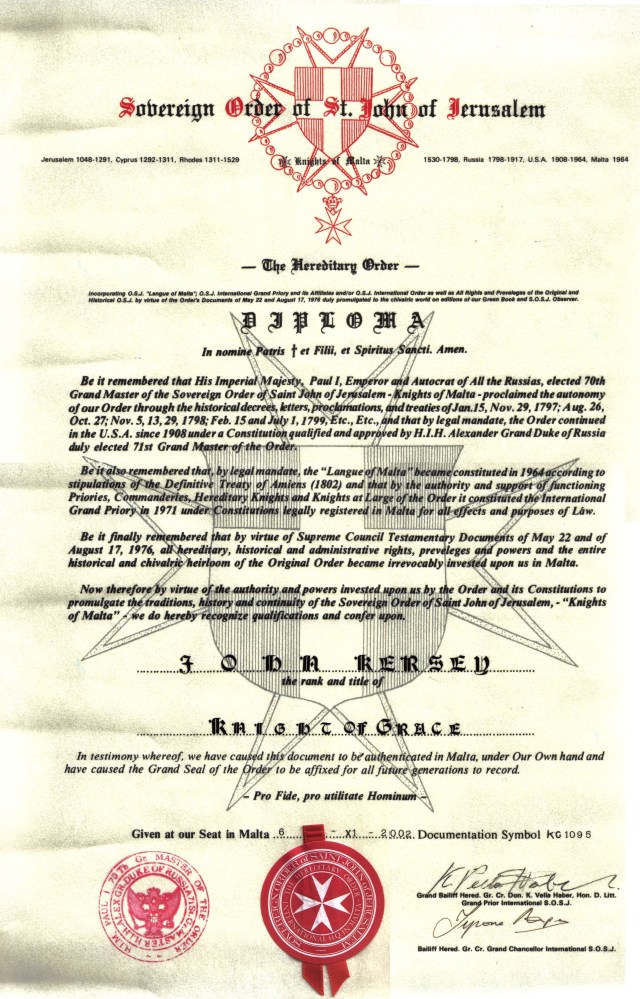
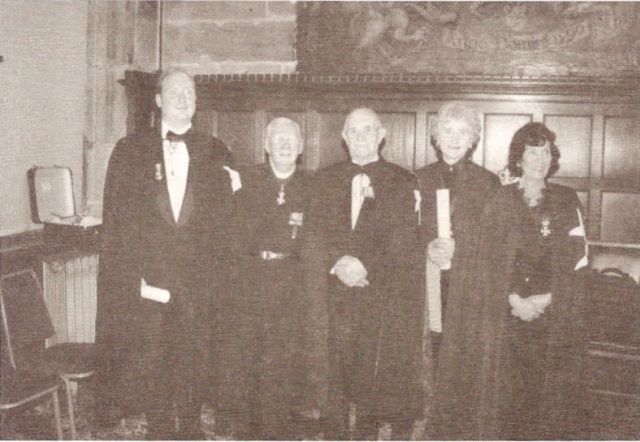
My involvement with the Order of St John began not with the Russian Grand Priories but with the Sovereign Order of St John of Jerusalem – The Hereditary Order. This branch of the Order had developed from the King Peter Order and was led from Malta by the late Marquis Kelinu Vella Haber as Grand Master. It was internationally represented and active, publishing a quarterly journal of its affairs. In 2002, following nomination by Dr W.H. Munro, who I had come to know through the World University Roundtable, I was admitted as a Knight of Grace of the Order at a ceremony at the Guildhall in Coventry. The Order in Great Britain was headed by the late Baron Kenneth Benfield de Palmanova, who was a former Mayor of Coventry and was Lieutenant Grand Master of the Order internationally. At the time, I was one of the youngest members of the Order. Kenneth Benfield was 87, while the Grand Prior, Captain Bruce Peace, TD, had just celebrated his 88th birthday. I was presented with a set of Italian-made insignia that had previously been owned by the musician and educationalist Dr Leonard Henderson, who had been a Knight of the Order and a member of many of the musical associations with which I was involved.
The investiture at Coventry Guildhall – I am first on the left with two Dames, the Grand Prior, and the Chaplain, the Revd. Douglas Pharaoh
Unfortunately, the Order in England became inactive after the death of Kenneth Benfield in 2007, and my letters to the English office and the Malta headquarters received no reply.
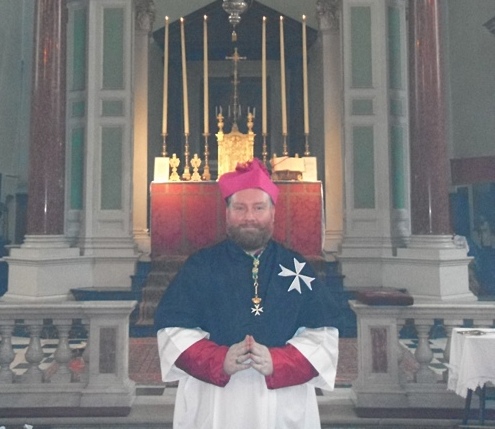
In the intervening years I had been ordained and consecrated bishop, and in 2011 had been elected Prince-Abbot of San Luigi. In 2012, I accepted an invitation from the Prelate, my friend the Most Revd. Howard Weston-Smart, to become a Chaplain to the British Association of the Russian Grand Priory. This had developed from the former Grand Priory of the British Isles of the King Peter Order, and was subsequently constituted as a registered charity under the Presidency of Alexandre Tissot Demidoff, who was a descendant of a Hereditary Commander of the Order. I was installed at the investiture at the Church of Our Most Holy Redeemer, Clerkenwell, London, on 30 June 2012. After nine years as Chaplain, I resigned from all appoitments in the British Association in September 2021.
After my installation
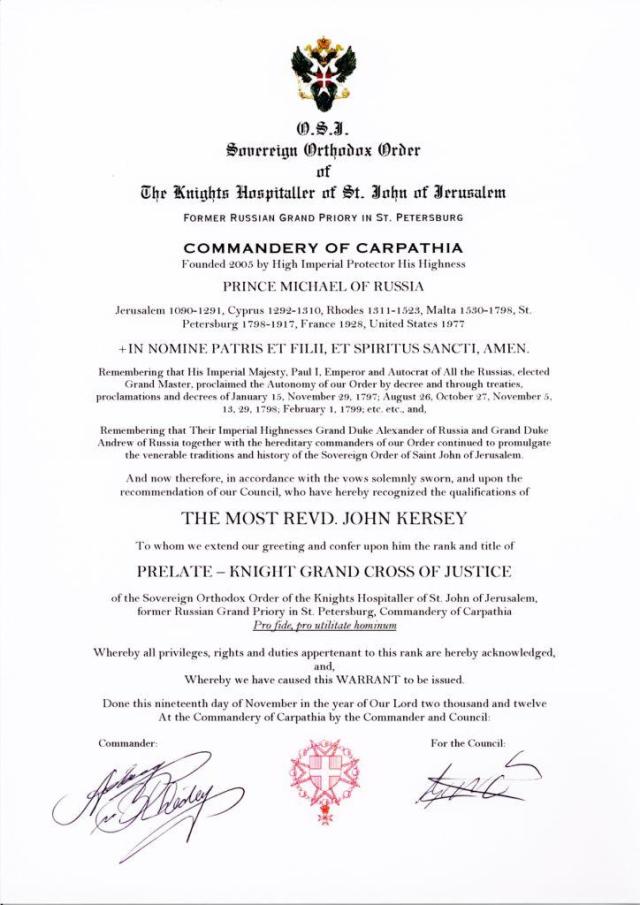
Meanwhile, in September 2005, Prince Michael of Russia and Count Bobrinskoy had erected the Commandery of Carpathia of the Russian Grand Priory. Among the very limited appointments subsequently made to this Commandery were the late Dom Klaus Schlapps, OPR, OA, Duke of Saih Nasra in the Abbey-Principality of San Luigi, and myself. Both of us were appointed as Prelate – Knight Grand Cross of Justice, and the privilege of extraterritoriality was extended to my appointment. The category of Justice is exclusively reserved, as was the case historically, for those who can provide proof of noble status. Dom Klaus and I discussed the formation of a presence of the Russian Grand Priory in the United Kingdom on several occasions. We both deplored the divisions that had come to exist between the representatives of the Russian and Yugoslav traditions of St John and sought, in the spirit of the efforts of the 1970s, to bring about unity where possible.
Following the sudden and unexpected death of Dom Klaus in January 2013, a number of changes took place. It became clear that, although it was wished that amicable relations should continue with the Carpathian Commandery and the present-day Russian Grand Priory, some degree of independent re-organization would be necessary in order to continue the work that Dom Klaus and I had planned together.
In August 2013, the committee of the Supreme Council of the Abbey-Principality of San Luigi that had been created to examine the matter petitioned me in my office as Prince-Abbot to exercise my right as a fons honorum to erect an autonomous and extraterritorial Protectorate of San Luigi of the Orthodox Order of the Knights Hospitaller of St John of Jerusalem. The Protectorate used the former name of the Order to distinguish itself from the name that was currently in use by the Russian Grand Priory. This name was used in full on all official documents.
The Proclamation, no. 2013/72, issued by me in my office as Prince-Abbot of San Luigi on 20 August 2013, reads as follows:
“We, Edmond III, by the grace of God Prince-Abbot of San Luigi etc. etc., being desirous of giving a proof of our particular esteem and affection towards the Orthodox Order of the Knights Hospitaller of St John of Jerusalem, declare, that we take the said Order under our protection and that of the Abbey-Principality of San Luigi; and that we will employ every possible care and attention to maintain it in all its rights, honours, privileges and possessions.”
When I additionally succeeded as Prince of Miensk and Ecclesiast of All Byelorussia and as head of the Royal House Polanie-Patrikios in March 2015, the decision was taken to elevate the Protectorate to the status of a Royal Byelorussian organization, thus bringing it closer to its immediate history and heritage.
As a result, the present character of the Royal Byelorussian Protectorate of the Orthodox Order of the Knights Hospitaller of St John of Jerusalem is that of an ecumenical and extraterritorial Christian ecclesiastical community under my aegis as Prince of Miensk and Ecclesiast of all Byelorussia. As such, it represents a return to the Order’s origins as a body under religious governance.
While it shares a common history with other institutions representing the Order of St John and the Russian Grand Priory and is open to the possibilities of collaboration with them, the Protectorate is self-governing and has no official relationship with any other Order of St John at the present time. Membership in the Protectorate is strictly by personal invitation of the Prince of Miensk and is extended ecumenically to all Christians, with non-Christians admitted to all ranks as honorary Knights or Dames. Associate membership is extended to members of other legitimate Orders of St John who wish to support the work of the Protectorate; if admitted as associates, they retain their existing rank in their “mother Order” and cannot be promoted within the Protectorate. The Protectorate preserves the historical and nobiliary traditions of the Order that it has inherited by virtue of its antecedence, and as is traditional, voting rights are reserved to members in the category of Justice. Since it also has a distinctive ecclesiastical character, it is especially devoted to the support of the work of all Johannites worldwide through prayer.
*Those interested in the history of the Order of St John and the modern representatives of its legacy are recommended to read the thesis of Dr. Hendrik J. Hoegen Dijkhof “The legitimacy of Orders of St. John” (doctoral thesis of the University of Leiden, 2006, available online at https://openaccess.leidenuniv.nl/handle/1887/4576).
The present-day Military and Hospitaller Order of St. Lazarus of Jerusalem looks back to an ancient origin. At some time after 1098, the crusaders at the Latin Kingdom of Jerusalem founded this order of chivalry at a leper hospital. The founding knights were themselves lepers, and they devoted their order to the treatment of those with the disease. King Baldwin IV of Jerusalem, who was a leper, may have been a knight of the Order or received assistance from it. It was probably by the end of the twelfth-century that the Order had become a military order, and the four classes of members – brothers, knights, clerics and donors – were acknowledged in a Bull of Pope Gregory IX of 1227. Definite evidence of the Order’s active participation in military campaigns is only documented in 1234 when Pope Gregory IX made a general appeal for aid to the Order to clear debts contracted in the defence of the Holy Land. The Ordinis Fratrum & Militum Hospitalis Leprosorum S. Lazari Hierosolymitani under the Augustinian Rule was confirmed by the Papal Bull Cum a nobis petitur of Pope Alexander IV in April 1255. The order established “Lazar houses” across Europe to care for lepers, and was well supported by other military orders which compelled brethren in their rule to join the order on contracting leprosy.
The symbol of the Order of St Lazarus is the eight-pointed green Maltese cross. This is believed to have given rise to the use of a green cross as a symbol by pharmacies worldwide.
The order remained primarily a hospitaller order but it did take part in a number of battles, including the Battle of La Forbie on 17 October 1244 (where all of the Lazar brethren who fought died) and the Battle of Al Mansurah on 8–11 February 1250. The leper knights were protected by a number of able-bodied knights but in times of crisis the leper knights themselves would take up arms. The order quickly abandoned their military activities after the fall of Acre in 1291 and the dissolution of the Knights Templar due to their relative poverty. After this, the knights moved to Cyprus, then Sicily and finally to Boigny near Orléans in France, where King Louis VII of France (ancestor of the Princes of Miensk) had given the Order a property in 1154, which had been the Order’s headquarters outside the Holy Land.
In 1308, the Order was placed under the temporal protection of King Philippe IV of France. This protection was confirmed in 1604 by King Henri IV, and in 1608, the order was merged with the Order of Our Lady of Mount Carmel, becoming the Royal, Military and Hospitaller Order of Our Lady of Mount Carmel and St. Lazarus of Jerusalem. This amalgamation eventually received canonical acceptance on 5 June 1668 by a bull issued by the Cardinal Legate de Vendôme under the authority of Pope Clement IX. While being a French Royal Order, the Order remained under apostolic authority. Meanwhile, in 1572, Pope Gregory XIII had merged the Italian branch of the Order with the Order of St Maurice (founded 1434), creating the Order of Ss. Maurice and Lazarus, of which the Head of the Royal House of Savoy is Grand Master today.
In 1791, the French Revolution suppressed the Order in that country and confiscated its property. However, the future King Louis XVIII (pictured left wearing the Grand Cross) continued to confer it in exile, and on the restoration of the monarchy the Bourbon monarchs continued as protectors until 1830. On 12 March 1825, King Charles X issued a declaration that the United Order of Our Lady of Mount Carmel and St. Lazarus of Jerusalem would be allowed to become extinct. Under canon law, this would occur one hundred years after the death of the last member unless the Order was canonically re-organized. The last such member died in 1856, which would have allowed for canonical re-organization until 1956.
In the event, canonical re-organization had occurred in 1841, when the Melkite Greek Patriarch Maximos III (Mazloum) granted his spiritual protection to the Order, and this state of affairs continued under his successors until the Patriarch transferred the government of the Order to a Council of Officers in Paris in 1910. This was confirmed by blessing of Patriarch Cyril VIII (Geha) (pictured right) on 3 June 1911. The factual position regarding the protection of the Order in the nineteenth-century has since been confirmed by successive Melkite Patriarchs to this day, notably by Patriarch Maximos IV (Sayegh) in 1965 and Patriarch Gregorios III in the Kevelaer Declaration of 2012. It should also be remembered that the Patriarch was a fons honorum by right of his office.
Although much of the nineteenth-century had been a period of decline for the Order, by the 1930s it was active once more, being led by Comte Charles Otzenberger-Detaille (pictured left) and the Duke of Seville. Otzenberger-Detaille was a member of the Order of the Crown of Thorns, and Prince-Abbot Edmond I of San Luigi was a member of the Order of St Lazarus under him, as well as having a close relationship to the Melkite church through Patriarch Antoine Aneed, who re-established the ecclesiastical jurisdiction of San Luigi in 1946. As a result, all the Prince-Abbots of San Luigi from Edmond I onwards, including the present Prince of Miensk, are in the episcopal succession of the Melkite Patriarchs. From 1961, at the initiative of the late Colonel Robert Gayre of Gayre and Nigg, the Order agreed to admit Protestants for the first time and became ecumenical rather than purely Catholic. Gayre became an enthusiastic promoter of the Order and ensured its expansion, though unfortunately a good deal of his energy was spent in attacking other Orders so as to vaunt the legitimacy of St Lazarus.
In 1973, the Order divided into two factions, the Paris Obedience and the Malta Obedience, which continued under separate Grand Masters, the Duke of Seville and the Duc de Brissac. A third faction emerged in 2004 under Prince Charles Philippe, Duke of Anjou. In 2008, a partial reunion was promoted between the larger Lazarite bodies, resulting in the emergence of the United Grand Priories.
The Constitutional Jurisdictions of Carpathia (Grand Priory of Carpathia) of the Order were formerly organized under the Paris Obedience. In 2008, they rejected unification under the United Grand Priories, citing many points of difference, among which was the proposed dilution of the hierarchical and nobiliary character of the Order and the rejection of its traditional history, and continued autonomously. The late Dom Klaus Schlapps, OPR, OA, Duke of Saih Nasra in the Abbey-Principality of San Luigi, became a member of the Order in 2005, becoming Senior Chaplain for the Commandery of Slovakia in 2006 and was subsequently promoted to Almoner (Grosskapitel) and Ecclesiastical Grand Cross Chaplain, the most senior chaplain in the Grand Priory. Dom Klaus held the offices of Preceptor of Bavaria and Commander of Klausenberg in Siebenbürgen. He was Patron of the International Green Cross Organization in Bavaria and a member of its Board of Directors. In November 2012, Dom Klaus was responsible for introducing me in my office as Prince-Abbot of San Luigi (also from 2015 Prince of Miensk) to the Order, in which I was appointed a Senior Chaplain in the rank of Knight Commander, in the category of Justice. The privilege of extraterritoriality was extended to this appointment so as not to bring about any conflict with existing Lazarite bodies in the United Kingdom; nor was any oath of obedience imposed. The category of Justice is exclusively reserved, as was the case historically, for those who can provide proof of noble status.
Following the sudden and unexpected death of Dom Klaus in January 2013, a number of changes took place. It became clear that, although it was wished that amicable relations should continue with the Carpathian Grand Priory, some degree of independent re-organization would be necessary in order to continue the work that Dom Klaus and I had planned together.
In August 2013, the committee of the Supreme Council of the Abbey-Principality of San Luigi that had been created to examine the matter petitioned me in my office as Prince-Abbot to exercise my right as a fons honorum to erect an autonomous and extraterritorial Protectorate of San Luigi of the Military and Hospitaller Order of St. Lazarus of Jerusalem in which, in consequence of my role as Protector, I would serve as Prelate Grand Cross of Justice.
The Proclamation, no. 2013/73, issued by me in my office as Prince-Abbot of San Luigi on 20 August 2013, reads as follows:
“We, Edmond III, by the grace of God Prince-Abbot of San Luigi etc. etc., being desirous of giving a proof of our particular esteem and affection towards the Military and Hospitaller Order of St. Lazarus of Jerusalem, declare, that we take the said Order under our protection and that of the Abbey-Principality of San Luigi; and that we will employ every possible care and attention to maintain it in all its rights, honours, privileges and possessions.”
When I additionally succeeded as Prince of Miensk and Ecclesiast of All Byelorussia and as head of the Royal House Polanie-Patrikios in March 2015, the decision was taken to elevate the Protectorate to the status of a Royal Byelorussian organization, thus bringing it closer to its immediate history and heritage.
As a result, the present character of the Royal Byelorussian Protectorate of the Orthodox Order of the Military and Hospitaller Order of St. Lazarus of Jerusalem is that of an ecumenical and extraterritorial Christian ecclesiastical community under my aegis in my offices as Prince of Miensk and Ecclesiast of all Byelorussia. As such, it represents a return to the Order’s origins as a body under religious governance.
While it shares a common history with other institutions representing the Order of St. Lazarus and is open to the possibilities of collaboration with them, the Protectorate has no official relationship with any other Order of St Lazarus at present.
Membership in the Protectorate is strictly by personal invitation of the Prince and is open to baptised Christians of any denomination. Non-Christians may be admitted to the ranks of the Order as honorary Knights or Dames. Associate membership is extended to members of other legitimate Orders of St Lazarus who wish to support the work of the Protectorate; if admitted as associates, they retain their existing rank in their “mother Order” and cannot be promoted within the Protectorate. The Protectorate preserves the historical and nobiliary traditions of the Order of St Lazarus that it has inherited by virtue of its antecedence, and as is traditional, voting rights are reserved to members in the category of Justice. Since it also has a distinctive ecclesiastical character, it is especially devoted to the support of the work of all Lazarites worldwide through prayer.
One of the curious things about education is that, having experienced it at first hand, everyone believes themselves to be an expert on it. This is particularly damaging in the case of politicians, whose record of interference in education during the post-war era has offered a prime example of the dead hand of the state going where it has no business to be. Meanwhile, those who supposedly are the experts – those who teach – have effectively presided over the decline of their profession through decades of mistaken ideology and a belief that their profession continues to offer the last resting place for the Marxist spirit of 1968.
It is difficult for us to imagine now, but there was a time not so long ago when our education system was largely independent of government. The universities, in particular, were held to be self-governing communities of scholars, which is the model of the university we inherited from medieval times. At Oxford, there was not even any formal government instrument that permitted the University to grant degrees; simply the acknowledgement that it had done so since time immemorial and should continue in a similar manner. The history of our schools begins with the grammar schools, established by the Church, and from these our great independent schools developed from collegiate foundations – Eton, Winchester, Radley – which were both closely allied to the universities of Oxford and Cambridge and, because they were boarding schools, could accept their pupils without geographical restriction.
Grammar schools have been much in the news recently and it is worth analysing some of the motives behind the debate on them and its wider context within our education system. I must declare a personal interest here: I was myself educated at what was at that time the top co-educational grammar school in the country. It was an academically highly selective school that was tremendously successful and which gave its pupils an outstanding education.
The history of state intervention in the grammar schools begins in 1869 under Gladstone, with the Endowed Schools Act. This Act followed upon the Public Schools Act of the previous year and proposed to restructure the endowments of the grammar schools so that they were more evenly distributed around the country and so that there was better provision for girls’ education. The Act changed many of the grammar schools which had been endowed to offer free classical education to boys into independent co-educational schools teaching a broader curriculum. The 1907 Education (Administrative Provisions) Act then introduced a requirement that all schools aided by government grant must reserve 25% of their places as free scholarships for students from the public elementary schools. This reform effectively brought about the grammar school in its twentieth-century guise.
It is with the 1944 Education Act that we see a designated role for the grammar schools as part of the tripartite system proposed, under which they would educate the top 25% of pupils. At this point there were around 1,200 state funded grammar schools, including not only those of ancient foundation but many which had been founded in the Victorian era, with its strong emphasis on self-improvement. In addition, there were 179 direct grant grammar schools, at which between 25 and 50% of pupils were educated free of charge and the remainder paid fees. All these became the maintained sector’s response to the independent schools; academic powerhouses dedicated to the needs of the most able.
We should now consider this system in its wider context. The tripartite system – divided between grammar schools, secondary moderns and technical schools – was designed to ensure that educational resources were distributed according to the ability of pupils to benefit from them and the state to provide for them. It was predicated upon the assumption that academically selective education produced the best results in terms of educating future leaders of the country in all areas, and above all upon the assumption that a university education should place academic excellence at the forefront of its priorities and should be reserved for those who stood to benefit most from it. It was academically competitive and there were consequences for failure at any level of the process. If, for example, you failed the eleven plus examination, you were unlikely to go to university.
Until 1965, this resulted in a situation where the universities were almost entirely filled by the products of independent and grammar schools. Their reputation was extremely high and their independence in academic terms was unquestioned. In a 1969 contribution to the educational “Black Papers”, Professor Richard Lynn wrote, “British education has been designed primarily to produce an intellectual elite. This is nothing to be ashamed of. Indeed, such an elite is necessary to keep going the intellectual and cultural tradition of European civilisation.” There was no suggestion in those days that the universities existed merely to train students for a career. Rather, they provided an academic education and existed for the purpose of propagating academic virtues, of which scholarship for its own sake and teaching were chief. Their graduates were, of course, in high demand by employers, but outside the specific professions, this was as much because of their intellectual calibre and qualities of character as it was because of any specific knowledge they possessed. In those days, the attitude persisted within independent and grammar school teaching that if someone was of the intellectual calibre to have graduated from Oxford or Cambridge they were capable of mastering and teaching any subject required at school level within reason. There were many examples of classicists who taught English Literature, or physicists who taught mathematics, and of course many academic staff also coached sport and music to a high level. Indeed, such breadth was viewed as a positive attribute.
We cannot pin the blame for the decline in our education entirely upon the Labour Party. It is quite true that many in the Labour Party have seen opposition to selective and fee-paying education as a cornerstone of their egalitarianism. But the Conservative Party has throughout the past fifty years signally failed to show support for academically selective education and as a result has been as willing a participant in our decline as its political rivals. The expansion of the universities during the 1960s took place under a Conservative government, which accepted the recommendations of the Robbins Report. The major expansion which followed during the 1990s and which is still ongoing has likewise been initiated by Conservatives. While the Conservatives introduced the Assisted Places scheme at independent schools in 1980, they have so far done nothing to bring it back since Tony Blair, himself an alumnus of Fettes, abolished it in 1997.
And yet, while our politicians can all trumpet that they have got more people into university education, what they cannot address is the fact that when you convert a selective education system into a mass education system you inevitably devalue the end product. In the 1960s it was extremely rare to see graduates working in non-graduate jobs because there was no graduate employment available to them. Nowadays it is commonplace. This transition has involved the creation of a deliberate untruth and its maintenance by an elaborate and costly bureaucracy. The untruth is that a British degree, wherever it is from, is a product of universal value. There is no end of quangos and interest groups – the Quality Assurance Agency for Higher Education, the Higher Education Academy, Universities UK, GuildHE – all of which are dedicated to maintaining that premise of “quality assurance”, to continually expanding higher education seemingly without limitation, and ultimately to what amounts to a universal higher education system whereby all who go to school can be admitted to a university.
It is interesting to note that the funding of education has told the truth far more than have the pronouncements from the powers that be. Until the 1990s, it was generally true that if you were successful in winning a university place, you would not have to pay for your education and you could access a grant that would cover your living expenses. With the rapid expansion in higher education and the conversion of the former polytechnics into universities came student loans to replace grants. Now, as the university sector expands even further, students in England and Wales must pay tuition fees in addition to the debts they incur for their maintenance.
Higher education has changed from an experience that was due to our brightest as of right to a commodity which is now available to all if they wish to pay for it, and particularly to foreign students who will pay even more than domestic ones. It is hardly surprising that if higher education is presented as a product within a marketplace – albeit a marketplace that consists entirely of a state monopoly – that the public will assess its value shrewdly and in many cases will decide that it is not worth the price being charged for it. That, however, cannot conceal the fact that for those who can benefit from academically selective higher education, that kind of education is increasingly subordinate to the mass higher education system, in which the scholarly ideal has been replaced by that of the Research Assessment Exercise and the demand for research to result in tangible product. Moreover any higher education is now increasingly out of reach for those without significant financial means or who are unwilling to incur significant debt against an uncertain return.
Education is the visible casualty of these changes, but it is not the only part of the picture. One very practical reason why governments have embraced mass higher education is because our society no longer has a large number of unskilled or semi-skilled jobs available. Where they are available, there is an increasing expectation that they will be filled by cheap immigrant labour. This leaves the unskilled native population to exist on benefits and occasional appearances on Channel Five. The government takes the view that the answer to this is to subject all to more education, hence its raising of the school leaving age. But this ignores the plain fact that of our population, a large number are not capable nor temperamentally suited to continuing their education. What they need is jobs, not an artificial means of keeping them off the unemployment statistics.
One curious characteristic of the decline of British education has been the willingness of those who have benefitted from its excellence to implement measures that have effectively denied the next generation the opportunity to benefit from the same opportunities as them. The losers in this are the academically able but financially impecunious. Social mobility is not something that should be the preserve of socialist politicians. During the 1980s there was much talk of Britain as a meritocracy, and yet the opportunities for those born in poverty to rise through the education system nowadays are fewer than they ever have been. Our politics, law, media and even the Olympics are now dominated by former pupils of independent schools. Since the effective abolition of the grammar schools the number of state school entrants to Oxford and Cambridge has fallen. This is not merely because pupils are not reaching the required academic standard but also because their teachers in too many cases believe that the top universities are elitist and that pupils should instead go to their local university much as they do their local school. In believing this, they condemn their pupils to fail.
An expectation has developed that those who are successful in our society will either pay for their children to be educated at independent schools, or will, usually for ideological reasons where they oppose selective education, send them to take their chances at the local comprehensive. The former option is becoming more difficult, because independent school fees are now pitched at a level that attracts the children of foreign oligarchs, and increasingly international students are taking more and more of the independent school places in this country at the expense of those from our own population who could benefit from such an education if only it were more reasonably priced.
The way in which properties are now sold according to the catchment areas of good schools tells us another fundamental truth; the education system may have abolished selection officially, but another kind of selection – one far less fair and far less transparent – is going on behind the scenes. We should not forget that the grammar schools had no catchment areas; they took everyone who passed the entrance exam regardless of where they lived. If you decide school admissions on the basis of property prices, you will create schools that are segregated by class and you will ensure that the poorest areas have the worst-performing schools.
League tables and OFSTED inspections are the government’s chosen means of reassuring us about the standards of our schools, but they are selective in the story they tell. Some examinations count for more than others, and schools have effectively played the system by entering pupils for them accordingly. On the other hand, weaker candidates have been withdrawn from subjects lest their results should reflect badly on the school’s standing.
And this brings us back to the grammar schools. When the Labour government abolished the tripartite system in 1965, it largely forced the maintained grammar schools to become comprehensives. Only in a few local authorities – just imagine today, local authorities defying central government! – did the grammar schools remain. In 1975, Labour ended the direct grant system and forced direct grant grammar schools to become comprehensives or independent schools if they wanted to continue. This left what remains today: 169 grammar schools in England and Wales and 69 in Northern Ireland.
We should ask why seventeen years of Conservative government between 1979 and 1997 did not see a renaissance for selective education, and indeed why further grammar schools closed or ceased to be selective during that period. The answer is that by this point, our education system had become one of the firmest bastions of the Left in the country. Its official endorsement of comprehensive education has been unwavering despite the eminently visible problems that have resulted from it. Any measure of reform or any challenge to the comprehensive system has been shouted down by the teaching unions, the university departments of education and the quangos – a group which Michael Gove used to refer to as “the blob”. He has said that these people believe that schools “shouldn’t be doing anything so old-fashioned as passing on knowledge, requiring children to work hard, or immersing them in anything like dates in history or times tables in mathematics…the result of their approach has been countless children condemned to a prison house of ignorance.” When I was at school, my teachers were drawn from all parts of the political spectrum. When I became a teacher myself, that was far less the case. My belief is that the comprehensive system exists to benefit one sector of society solely, and that is the teachers who find it ideologically to their liking.
By the end of my time in teaching it was axiomatic that whatever your politics, if you wished to teach, you would accept the Leftist orthodoxy that the profession had imposed and that you would not challenge it. That orthodoxy says, in essence, that all must have prizes and that the excellent are the enemy of the good. It sees education not as an academic pursuit but instead as a means of social engineering and vocational training, and as a means of reducing crime and social disorder. Over the years it has provided a happy home for all manner of Marxist nonsense and has enshrined teaching methods, particularly in basic English, that fail to achieve the same results as the traditional methods they replaced. It is not difficult to see the decline in the standard of written English in public life today compared to that of fifty years ago, and we have those teachers who promoted free expression ahead of spelling and grammar to thank for that.
Any education system will produce winners and losers. If we say that all must have prizes, then we must reconcile ourselves to the fact that those prizes will be of limited value. We cannot create their value merely by attaching government branding to them, for no-one believes that something is good simply because the government endorses it. Indeed, we had a situation in this country for many years where the products of the state monopoly, notably those of British Leyland, were regarded as markedly inferior to those of the private sector. The state can only win in education by deliberately retarding any perceived or actual competition. It does so through legislation – the Education Reform Act of 1988 effectively banned private sector universities – and for those entities that are private or independent in theory, it has devised a web of regulation and bureaucracy that in practice curtails their independence. OFSTED is one manifestation of this. Another is the devaluation that has characterized our exam system.
For many years, O and A level examinations were regarded as a gold standard. They were difficult to obtain and represented a high standard of achievement. They were unashamedly academic and required a high degree of factual recall. They could be taught in a way that stretched the most able and allowed for considerable extension activity. They were tested predominantly through timed examinations and not through coursework or continuous assessment. This was also the model of educational assessment maintained by the universities who were in turn responsible for the examination boards. While the CSE examination taken in secondary modern schools was not regarded as prestigious there is no question that it was a rigorous and well respected credential, as indeed were the awards of the former polytechnics. The fact that those awards were not degrees or were not O and A levels did not diminish their fitness for purpose, but it fostered a belief among egalitarians that they were second-tier qualifications and that they deserved the same titles as would be awarded to the more academically inclined. Unfortunately, this academic inflation has proved very costly. Because we no longer teach woodwork and metalwork in our schools, we end up importing our joiners and plumbers from Poland, and those who want to learn a skilled trade are unlikely to do so during their school years. The truth is that not everyone needs, wants or will benefit from an academic education, and when subjected to one against their will, it is unsurprising that many teenagers become disruptive and unco-operative.
It is interesting to note that while we have moved away from the academically selective model and from traditional modes of teaching and assessment, other former British possessions, notably India, have kept it and benefitted strongly as a result. The government determined to take the examination boards out of university control, to privatize them and to introduce competition. The result has been a race to the lowest denominator. The examinations are not invariably easier, but they have become increasingly turgid and reductive, with an emphasis on turning everything into something that can be easily and transparently assessed in simple terms. The GCSE examination, brainchild of Sir Keith Joseph and strongly opposed at the time by Baroness Thatcher, has been a misguided attempt to merge academic and vocational education, and the fact that a number of selective schools have turned to international examinations to replace it in recent years testifies to its limitations. It is also notable that many academically demanding schools now prefer the International Baccalaureate to A levels.
I believe that Michael Gove will come to be seen as the only Education Secretary of the past fifty years to have genuinely understood some of these problems and tried, in the face of overwhelming opposition from “the blob”, to address them. I hasten to add that this is not a general endorsement of Gove’s views or policy solutions, many of which I disagree with. He has, however, endeavoured to return rigour to our exam system and it may well be that he has, at least in some respects, succeeded. How lasting that success will be remains to be seen. Gove, after all, was replaced as Education Secretary because, so it is said, his approach was seen to be too confrontational; the opposition he had aroused included two votes of no confidence from three teaching unions, voodoo pincushions, anti-Gove T-shirts and an entire Twitter feed devoted to hating him. But the fact remains that we must confront the education establishment and we must win that confrontation if we are to achieve anything at all. The path of least resistance is to go along with the blob and do their bidding. The difficulty with that is that it fails those who lack a voice in this debate but whose interests need to be right at its heart: our next generation of pupils. Perhaps Gove, who was born far from privilege and won a scholarship to an independent school, understood this more than many of his colleagues.
I want to close by noting some aspects of the ethos of the grammar school. For all that academies and free schools may have some elements of it, they are still a long way away. The good grammar school is a highly structured and disciplined institution where academic values are at the heart of the life of the school and these are allied to an institutional endorsement of Christian principle irrespective of pupils’ own religious beliefs. It is formal in its rituals, encouraging teachers to wear academic dress, having a house system that is both pastoral and competitive, and maintaining high standards of uniform and behaviour. Often the school has an extensive history and distinctive, occasionally eccentric, traditions. What it teaches should be what the top selective universities demand. I well remember that my school did not teach certain subjects because those universities did not take them seriously at entrance, and that it disdained vocational studies altogether. Unlike the comprehensives, it is not a school where all are forced to study the same curriculum regardless of ability. Above all, it is a place where to excel academically is the norm and where to aim high is natural, with the expectation that the vast majority of pupils would go on to places at university and the best would go on to those which were rated most highly. If the grammar school is an elite, then it is not in my experience a complacent elite, but rather one where elite status must be earned anew by each generation of pupils and teachers. When such schools work, they offer a beacon of opportunity for those who, on merit, win a place at them. We need more of them. In 1997, John Major promised us a grammar school in every town, a phrase which has since been echoed by UKIP. It is time to restore our culture and values to our education system, and a strong grammar school system is the best way to do this.


 Prince Ali M. Hussen was Minister of Justice for the Horn of Africa from 1965 to 1967. He served as Somalian Ambassador to the the Holy See/Vatican City during the incumbency of President Major-General Mohamed Siad Barre (1990) and subsequently became Ambassador of the Transitional National Government of Somalia for Italy. Prince Ali was Shaykh/Sheik of Tariqah Qadiriyyah of Sufism, and President from 1981 to August 2003 (when he retired due to health problems) of the Associazione Musulmani Italiani (A.M.I./Association of Italian Muslims (established in Naples in 1982 and heir of the Associazione Musulmana del Littorio, Muslim Association of Littorio (Fasces), co-founded by H.R.H. Prince Moallim Hussen in 1937). Prince Ali was also an Islamic Judge (Qadi) and Professor of Islam, from 1970, by a Decree of the Grand Mufti of Saudi Arabia, Shaykh Abd al-Aziz ibn Baz.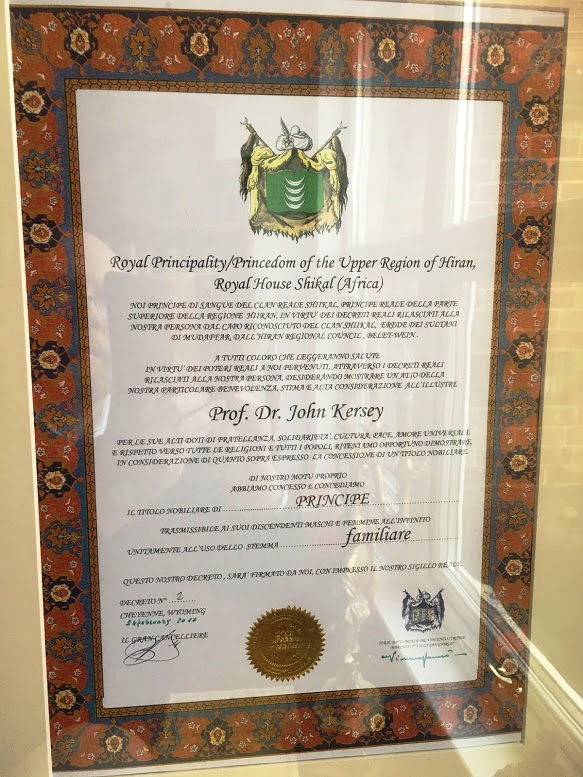


 The Accademia counts five popes among its distinguished past membership: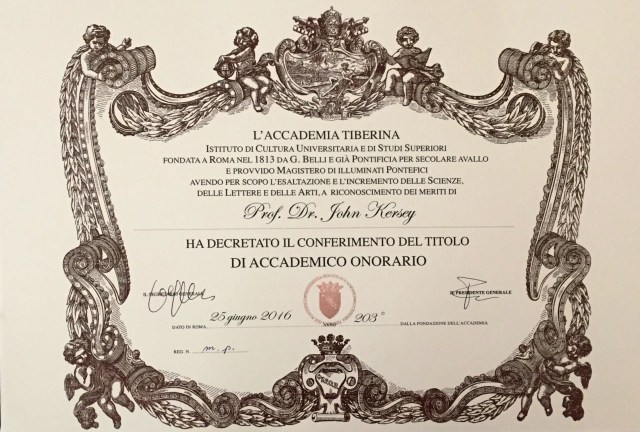








 During the Reformation, some of the Order’s commanderies in northern Germany and the Netherlands became Protestant and have remained so ever since, and the Order was disestablished in England, Denmark and other northern European countries. Having lost the initial reason for its existence, and with no battles to fight, it turned its attention to combatting piracy and saw a period of economic decline as its currency, the scudo, lost value. As a result, the knights began to attack Muslim ships in search of plunder, and again became wealthy. Many enrolled in foreign navies in search of adventure. This meant that grants to the Order diminished and that its economic survival became more and more dependent on conquest. Notwithstanding this, Malta flourished under the Knights and became regarded as one of the great powers of Europe.
 The French Revolution saw the attempted abolition of the Order, and in 1798, Napoleon I captured Malta, forcing the knights to surrender. This signalled the end of the Order on Malta after 268 years. The largest group of knights made their way to Russia, where Czar Paul I (pictured at left wearing the Crown of the Order) gave them shelter and was elected their Grand Master, with the Apostolic Delegate to St Petersburg, Mgr. Lorenzo de Litta, officiating at the ceremony. Historians differ as to whether the original Order survived at this point, or whether, the original Order having been dissolved by Napoleon, new Orders of St John were now created respectively by Czar Paul I in 1798 (the Russian Order), and by the Pope from 1803-14, revived in 1879 (the Sovereign Military Order or Order of Malta), both of which have claimed the tradition of the original Hospitallers, together with various other bodies, some of which gained the protection of their respective states*.
 The Order under Czar Paul I was recognized among the Russian Imperial Orders and the Czar created a Russian Grand Priory consisting of 118 commanderies. The Czar was Orthodox and his Grand Priory was open to all Christians, also having provision for Roman Catholic members of the Order. Under decrees of Czar Alexander I of 1810-11, the Russian Grand Priory was made a fiscally separate community from the Order overseas, and in 1817 a further decree forbade the wearing of decorations of the Order that had been granted outside the Russian Grand Priory by the Roman Catholic Order. In 1811, total membership of the Russian Grand Priory stood at 853 knights. A number of the commanderies were hereditary and portraits of Russian nobles wearing the Order can be found throughout the nineteenth-century, including that of Count Vassiliev pictured above. In 1916, Czar Nicholas II appointed two Hereditary Commanders in the Order.
 The Grand Priory was under Grand Priors Grand Duke Alexander Mikhailovich until 1933, and Grand Duke Andrei Vladimirovich from 1933 to 1956. On 31 July 1950, Grand Duke Andrei issued a declaration that the Order of St John and its Hereditary Commanders were never abrogated in Russia and continued to exist. In addition, Grand Duke Kyrill Vladimirovitch, as Head of the Imperial House (also Grand Cross of the Order of the Crown of Thorns), made several appointments of Hereditary Commanders in the Grand Priory during the period 1934-36. On 9 December 1953, a constitution was established at a meeting in Paris, and in February 1955 the Grand Priory was registered as a foreign association under French law as “The Russian Grand Priory of the Order of Saint John of Jerusalem”. In 1956, Grand Duke Vladimir Kirillovich became Protector to the Grand Priory, but refused the title of Grand Prior. He was succeeded as Dean by Hereditary Commander Nicholas Tchirikoff, who died in 1974, and by the Secretary of the Paris group, General Georges Sergeievitch Rtitcheff, who died in 1975.

 Following the sudden and unexpected death of Dom Klaus in January 2013, a number of changes took place. It became clear that, although it was wished that amicable relations should continue with the Carpathian Commandery and the present-day Russian Grand Priory, some degree of independent re-organization would be necessary in order to continue the work that Dom Klaus and I had planned together.
 While it shares a common history with other institutions representing the Order of St John and the Russian Grand Priory and is open to the possibilities of collaboration with them, the Protectorate is self-governing and has no official relationship with any other Order of St John at the present time. Membership in the Protectorate is strictly by personal invitation of the Prince of Miensk and is extended ecumenically to all Christians, with non-Christians admitted to all ranks as honorary Knights or Dames. Associate membership is extended to members of other legitimate Orders of St John who wish to support the work of the Protectorate; if admitted as associates, they retain their existing rank in their “mother Order” and cannot be promoted within the Protectorate. The Protectorate preserves the historical and nobiliary traditions of the Order that it has inherited by virtue of its antecedence, and as is traditional, voting rights are reserved to members in the category of Justice. Since it also has a distinctive ecclesiastical character, it is especially devoted to the support of the work of all Johannites worldwide through prayer.
 The order remained primarily a hospitaller order but it did take part in a number of battles, including the Battle of La Forbie on 17 October 1244 (where all of the Lazar brethren who fought died) and the Battle of Al Mansurah on 8–11 February 1250. The leper knights were protected by a number of able-bodied knights but in times of crisis the leper knights themselves would take up arms. The order quickly abandoned their military activities after the fall of Acre in 1291 and the dissolution of the Knights Templar due to their relative poverty. After this, the knights moved to Cyprus, then Sicily and finally to Boigny near Orléans in France, where
  In 1791, the French Revolution suppressed the Order in that country and confiscated its property. However, the future King Louis XVIII (pictured left wearing the Grand Cross) continued to confer it in exile, and on the restoration of the monarchy the Bourbon monarchs continued as protectors until 1830. On 12 March 1825, King Charles X issued a declaration that the United Order of Our Lady of Mount Carmel and St. Lazarus of Jerusalem would be allowed to become extinct. Under canon law, this would occur one hundred years after the death of the last member unless the Order was canonically re-organized. The last such member died in 1856, which would have allowed for canonical re-organization until 1956.
 In the event, canonical re-organization had occurred in 1841, when the Melkite Greek Patriarch Maximos III (Mazloum) granted his spiritual protection to the Order, and this state of affairs continued under his successors until the Patriarch transferred the government of the Order to a Council of Officers in Paris in 1910. This was confirmed by blessing of Patriarch Cyril VIII (Geha) (pictured right) on 3 June 1911. The factual position regarding the protection of the Order in the nineteenth-century has since been confirmed by successive Melkite Patriarchs to this day, notably by Patriarch Maximos IV (Sayegh) in 1965 and Patriarch Gregorios III in the Kevelaer Declaration of 2012. It should also be remembered that the Patriarch was a fons honorum by right of his office.
 Although much of the nineteenth-century had been a period of decline for the Order, by the 1930s it was active once more, being led by
 Membership in the Protectorate is strictly by personal invitation of the Prince and is open to baptised Christians of any denomination. Non-Christians may be admitted to the ranks of the Order as honorary Knights or Dames. Associate membership is extended to members of other legitimate Orders of St Lazarus who wish to support the work of the Protectorate; if admitted as associates, they retain their existing rank in their “mother Order” and cannot be promoted within the Protectorate. The Protectorate preserves the historical and nobiliary traditions of the Order of St Lazarus that it has inherited by virtue of its antecedence, and as is traditional, voting rights are reserved to members in the category of Justice. Since it also has a distinctive ecclesiastical character, it is especially devoted to the support of the work of all Lazarites worldwide through prayer.
 Professor John Kersey