

This extempore speech was given by me when one of our invited speakers was delayed at the airport (you will see Gregory informing me that he had just arrived shortly before the end).
Notes from a pianist: Please don’t do this
Mark Thomas of the Joachim Raff Society has previously had some positive things to say about my recordings on CD, although it seems from his more recent comments that my interpretations are not always to his taste. Of course, we all have our own preferences in the interpretation of piano music and I welcome the fact that several works of which I made the first recording have since been recorded by other pianists (for example, the Piano Sonata by Victor Bendix, of which I made the first recording in 2010, has since had a further two commercial recordings, both of which are interesting interpretations that add to our understanding and appreciation of the work).
Although I am happy to explain the basis and rationale of my interpretations should this benefit from further clarification (as has been done in this series of posts), I would hope that anyone who hears them would recognize firstly that they reflect conscious and considered interpretative choices, and secondly that as such they are part of an approach to the performance of the music that prizes coherence, integrity and fidelity to the spirit of the composer.
The rest is subjective taste. In some respects, I am an anti-virtuoso pianist, deliberately avoiding exhibitionism and overt display in favour of what I believe are more profound and vital musical qualities. This places me against the prevailing currents in pianism, and is not something everyone will identify with or like. It is, however, the way I believe the music in question should be played if it is to reveal the interpretative aspects that I regard as integral to my personal identification with the work in question.
As I hope will be obvious to any informed surveyor of my work as a pianist, I have the command to do whatever I want at the piano. If I often choose a slower tempo than might possibly be taken by others, I do so not because I cannot play faster, but because I believe the work in question gains from a broader approach and that I can express its emotional content more fully by playing it in this way. If a model is sought for this approach among the great pianists, then I would point to the strong influence on my musical outlook of such artists as Grigory Sokolov and Valery Afanassiev.
Mark Thomas writes, “I’ve found that, if one has the audio software to do it, the flatter performances can be injected with a lot more life by speeding things up by 5-10% (being careful to maintain the original pitch).” In some respects, it would be fair to say that once you purchase a recording you may do whatever you like with it. But I appeal to any who may read this not to do as he suggests.
My interpretative decisions as to speed may be controversially slow on occasion, and some may prefer faster or flashier approaches. If that is what is desired, then it is proper to look to other pianists who are more to one’s taste. The deliberate distortion by speeding up of my recordings, however, disrespects their integrity as interpretations. Please don’t do it.
The Quarterly Review, August 2021
http://www.quarterly-review.org/endnotes-august-2021
by Stuart Millson
“Our musical world has been reshaped by the Covid crisis – but we also face challenges from those who wish to destroy high-art, those “cultural commentators” who seek to dismantle the intrinsic European cultural reference points of the classical genre. A musician and academician who holds firm against today’s post-modernist onslaught is Professor John Kersey, a pianist who has studied and recorded Beethoven’s unfinished Sonata of 1794, and has also reinstated obscure but worthy late-romantic composers, such as Adolf Jensen. Professor Kersey’s search for the essence of the music means that we have unfussy, clearly-framed interpretations – and (like Gilbert Rowland) a performer who is more than happy to write about, discuss and present music – and the cause of culture.”
Honours and awards: Fellow of the Central School of Religion and Fellow of the Faculty of Church Music
Central School of Religion was founded and chartered as Central University in Indiana, USA, in 1896 to provide external facilities for those whose circumstances did not permit work at a residential college. In 1968, the University was revised, and only its religious programmes were continued as the Central School of Religion.
Central School of Religion has always borne witness to the unique and divine inspiration of Holy Scripture and is non-denominational in character. Members of many different churches are tutors, graduates or members of the School. The School continues to derive its degree-granting authority from its 1896 charter in Indiana, but since 1968 has also had a presence in the United Kingdom.
Central School of Religion in the United Kingdom functions as a theological society and offers diplomas in Theology (and related subjects) and Church Music. It is the aim of the School to follow as closely as possible the standards and practices of British universities. Degrees are conferred by the School in America upon the recommendation of examiners. Central School of Religion has never sought accreditation, but is a member of the Association of Centres of Adult Theological Education, a premier fraternity of theological colleges and institutions.
The School enjoys links with a number of colleges and academics. Tutors and examiners are recruited from all major Christian churches and hold recognised qualifications. Although there is no provision for the recognition of American degrees by the State in the United Kingdom for general purposes, and thus the degrees awarded by the School itself are unaccredited, the co-operation in scholarship achieved by the School is the accreditation most valued by its members who may be found in many areas of Christian service.
The School holds an annual Reunion in London which typically includes the presentation of academic awards, several academic talks, and the performance of music, usually with a sacred focus. This is followed by Choral Evensong.
I was responsible for writing a History of the CSR, involving research on both sides of the Atlantic, which was published in 2002 (European-American University Press). At that time, I had no formal affiliation with the School, and was interested in its history principally because it was one of the oldest purely distance learning institutions still in existence today. A paper later published with the History was devoted to the academic dress of the School.
I have been delighted to receive the distinction of Fellow of the School.
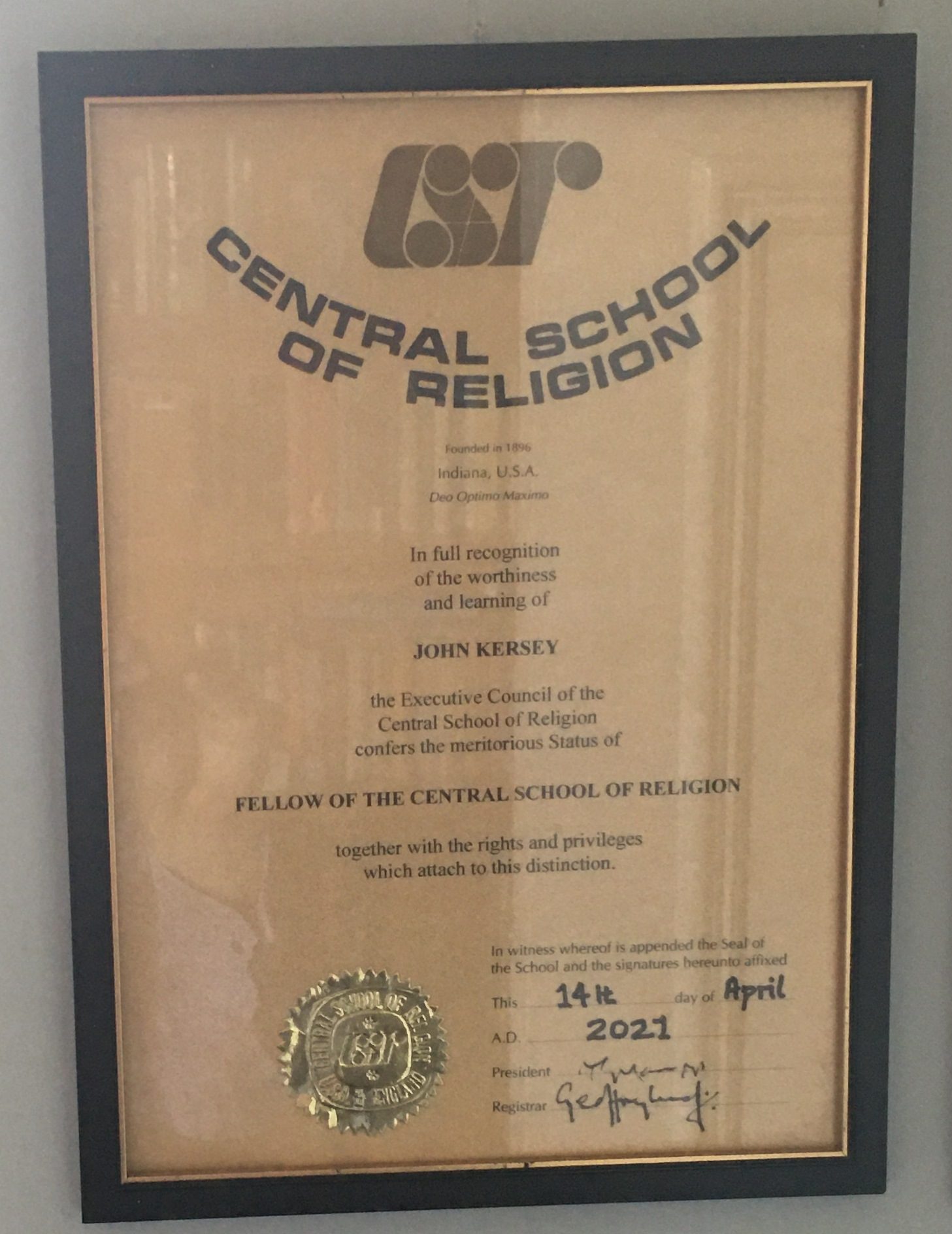
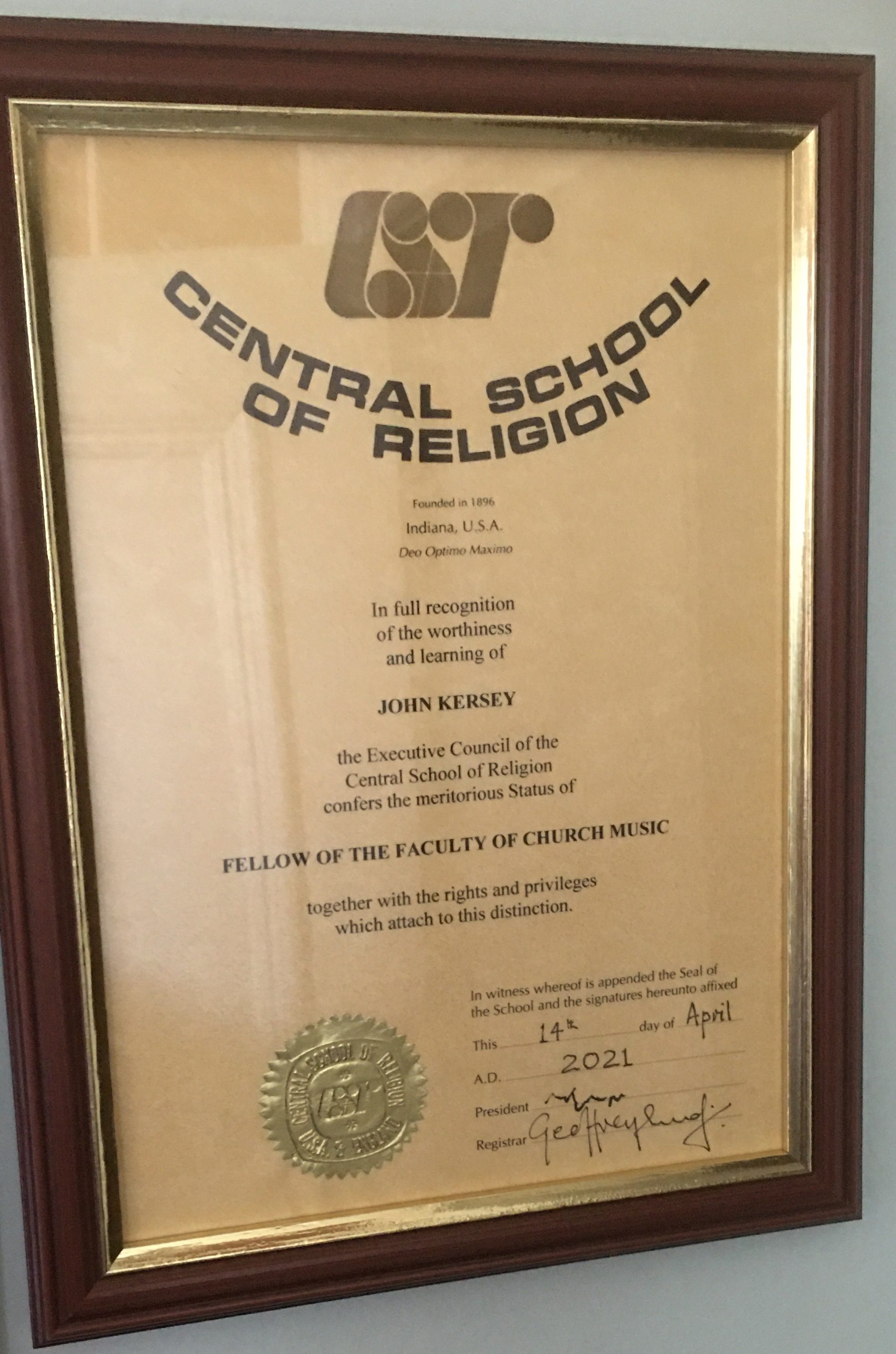
In 2014, I was appointed an Honorary Associate of CSR’s Faculty of Church Music. In 2021, I received the Fellowship of the Faculty of Church Music.
Honours and awards: Officer’s Cross of the Prussian Order of the Eagle
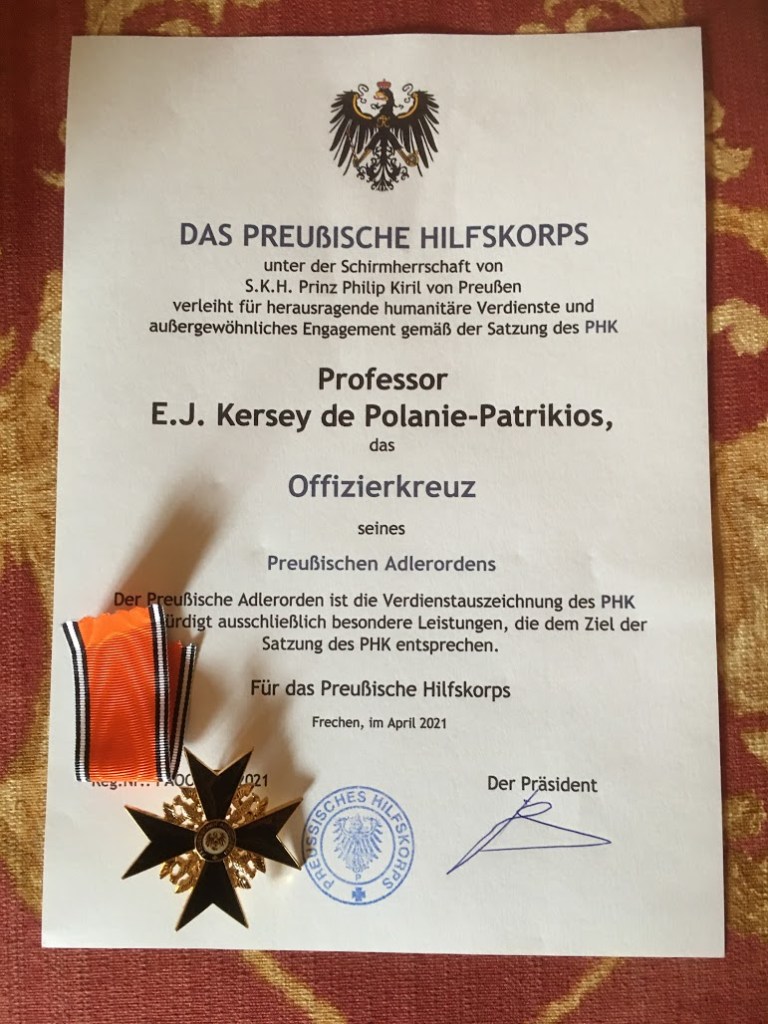
I have been honoured to receive the Officers’ Cross of the Prussian Order of the Eagle, which is organized as the order of merit of the Preussische Hilfskorps, a non-profit charitable body under the patronage of H.R.H. Prince Philip Kiril of Prussia. I am grateful to the President of the Preussische Hilfskorps for his kind nomination.
Lockdown recordings
A number of pianists have responded to the national lockdowns of 2020-21 by producing recordings from their homes. I decided to use the opportunity to do the same, and in doing so to choose music that particularly reflected my response to these events.
This has been the first time in living memory, if not for many centuries, that it has actually been illegal to give or attend a concert in England. As a former council member of the Libertarian Alliance until its dissolution in 2017, I spent a lot of time arguing for the preservation and indeed the extension of our civil liberties, and against governments that – on whatever pretext – would curtail them. The present events have served to emphasise the necessity of that work. I will leave a detailed discussion of lockdowns and their purported effectiveness for another occasion, but will mention that I am one of over 750,000 concerned citizens who are signatories to the Great Barrington Declaration. I also agree with many of the interventions made by Lord Sumption, who has said,
“I feel sad that we have the kind of laws which public-spirited people may need to break. I have always taken a line on this, which is probably different from that of most of my former colleagues. I do not believe that there is a moral obligation to obey the law… You have to have a high degree of respect, both for the object that the law is trying to achieve, and for the way that it’s been achieved. Some laws invite breach. I think this is one of them.”
Wherever one may stand on all this, there is without question a general sense of uncertainty, of transition, of alienation and of loss of control. These are all themes explored in the late sonatas of Beethoven and Schubert, which are written with an unparalleled awareness of human mortality and which reach forward into the world beyond our own. I decided that central to this series of recordings would be the last three sonatas of Beethoven and Schubert, together with other key late works of Beethoven.
In many ways, these works are the ultimate challenge for the pianist. They are, in Schnabel’s phrase, “better than they can be played”. No matter how well one may play them, they will always be bigger than any interpreter, and like Shakespeare, their emotional and humane range is of the widest imaginable. This compels at once a degree of humility on the part of the pianist and also a profound emotional and intellectual identification between interpreter and work as the full gamut of expressive effect is called upon.
Why should the spirits of Beethoven and Schubert still speak to us today? In some respects, they are different sides of the same coin. Schubert is sometimes held up as primarily lyrical and introspective in contrast to Beethoven’s heroic and indomitable style. But as his last piano works clearly show, Schubert also looks into the abyss and responds with optimism and the triumph of the human spirit. His last three sonatas all at various points confront nightmarish visions, with the first movement of the last sonata (D.960) perhaps providing us with the most compelling portrait of human isolation and tragedy. But there is no sense in which the music succumbs to despair. The ending of the last sonata is exuberant, even joyous. It breaks bonds and transcends limitations. It looks grim authority in the face and laughs at it.
Beethoven, too, is concerned with the juxtaposition of extreme contrasts, and the triptych of his last sonatas presents us with music that is concerned above all with transcendence. This is music that can at times return startlingly to convention, but at the same time remains unsettled and questing in spirit. Thomas Mann (borrowing from Adorno) discusses the sonata in chapter 8 of his novel Doctor Faustus, and speaking of the Arietta second movement of the last sonata (op. 111) says,
“But what now becomes of this gentle statement, this pensively tranquil figure, in terms of rhythm, harmony, counterpoint, what blessings its master bestows upon it, what curses he heaps upon it, into what darknesses and superilluminations, where cold and heat, serenity and ecstasy are one and the same, he hurls and elevates it one may well call it elaborate, miraculous, strange, and excessively grand without thereby giving it a name, because in actuality it is nameless…“
It is possible to read an overly religious subtext into Beethoven’s last sonatas, as did Wilfrid Mellers in suggesting that the last movement of the penultimate sonata (op. 110) is a wordless Passion (with its thematic links to the Bach St John Passion). There is surely something of Calvary in it; of suffering and deliverance. There is a sense of suppression in the quiet, slow passages (Arioso dolente), with their evocation of the human voice, that suggest both the impact of pain and the struggle of impaired communication. The sonata bears the date of Christmas Day, 1821.
By the time we reach the final sonata we have moved into more elemental territory. As the variations of the last movement reach an unprecedented level of rhythmic complexity, some hear a prototype of jazz in Beethoven’s anxious exuberance. In fact, this variation is more like a development of the baroque gigue and any resemblance to African-American music of a century later is purely coincidental.
Particularly in Schubert, I feel that this music benefits from a broad conception. In recent decades, pianism has been dominated by what might be referred to as a “modernist school” of interpretation, characterized by fast tempi, clear (and often dry) textures and a degree of emotional detachment. I do not find this approach appealing and my preference is for an altogether more Romantic and subjective aesthetic in which emotional response is the key objective. I do not always aim for an “orchestral” piano sonority, but I do often think in terms of different instrumental and vocal colours and textures.
In particular, the finale of Schubert’s C minor sonata (D.958) tends to be played not at its marked Allegro but more like Prestissimo. This excessive speed robs the movement of its anxious, at times hesitant, character, and the slightly surreal effect of its abrupt contrasts and episodes in distant keys. Another decision that short-circuits Schubert’s intentions is the omission of the exposition repeat in the B flat major sonata, D.960. Many fine pianists do this and it makes no sense to me whatsoever, given not only that Schubert provides a unique transition to the repeat but also that this transition contains material of vital importance to the movement that appears nowhere else.
In the first movement of Beethoven’s Hammerklavier sonata, there is a more immediate controversy in that Beethoven’s metronome marking imposes a breakneck tempo on the music that seems to me – even in the finest “fast” performances – to rob the music of its majesty, its contrasts and its symphonic character. There is certainly a need to give the music a powerful sense of forward momentum in its more dynamic moments, but in a convincing interpretation, Beethoven is not always pushing forward in a relentless manner. There is room to breathe, and indeed much music here that is ruminative and that benefits from a considered rather than hectic treatment.
A personal note is in order with respect to Beethoven’s “Tempest” sonata (op. 31 no. 2). This is the work that inspired me to become a pianist. I first heard it on BBC Radio 3, and thanks to BBC’s Genome project, I can now identify that the date of the broadcast was 10 May 1982, and the pianist was Pascal Rogé. I was nine years old. I was transfixed by the work and became, frankly, obsessed by it. In those days, my local public library had a large collection of music scores available to borrow. I duly took out the second volume of Augener’s complete edition of the Beethoven sonatas, and prevailed on our neighbour (who owned a piano) to allow me to try it out. At that point, my musical education consisted of singing in the school choir and playing the recorder indifferently. I could read the treble clef, and through a combination of luck and judgement managed to pick out the first few bars of Beethoven on the piano, and then improvise a little on the main ideas of the movement, to the astonishment of my neighbour. This was where it all began for me. Within weeks, my parents had bought me a piano and provided me with lessons; four years later I had won a Junior Exhibition Award to the Royal College of Music.
I did not play this, or anything else by Beethoven, in public until I was in my forties. I could play, after a fashion, all of the sonatas by my late teens and was thoroughly au fait with their structure and musical features. I also studied a lot of Beethoven during my time at the Royal College of Music; probably more than any other composer, and with a professor who was notably expert in Beethoven interpretation. Unfortunately, my awareness of the sheer magnitude of the music and of the shortcomings of my youthful approach to it had a deeply inhibiting effect. It was not until many years later that I had sufficient faith in the validity of my interpretation of Beethoven that I could put it before the public without feeling that I had let the composer down. Other pianists have spoken of similar experiences. Beethoven, perhaps more than any other composer, pushes the interpreter to go beyond their limits, in what I see as an essentially creative agon between performer and work. The Beethoven that we play now will not be the same as that which we play in five or ten years’ time. It is changing with us, constantly growing and developing, and is not just part of Beethoven’s creative universe but an organic part of ourselves.
These works carry with them not only their significance as music but also an immense cultural legacy. This is music which generations have held to represent the apex of Western civilization. If we are, as I believe, in a time when that civilization is under grave threat both internally and externally, then one of the most potent responses is for us to re-engage with the richness of this legacy and re-assert its greatness. At the time that I am writing this, it has been reported that some at the University of Oxford consider musical notation “colonialist” and want to “focus less on White European culture”. I have been actively opposed to the delegitimization of Western art music for many years, and find that the arguments and Cultural Marxist academic atmosphere that are encountered now have changed little from those which I first opposed at Cambridge twenty years ago. In such a situation, to play the music of the Austro-German Classical and Romantic schools might be held to constitute an openly reactionary act and stands as an eloquent response to its opponents. We might indeed venture the opinion that here is White European culture at its best.

Of course there are disadvantages in recording performances in such conditions as we face at the moment. Perhaps the most obvious is that it has been impossible to have pianos tuned during lockdown. Equally, audiences of Beethoven’s and Schubert’s time were probably far more used to compensating for this deficiency than we have become today. My lockdown recordings were made at home, in my music room. The basis for each recording was a live performance immediately followed by a patching session, edited with basic audio editing software. The result is unashamedly a personal view of the works concerned, and moreover a view that is influenced by the present time and circumstances.
I hope that you will find the results interesting and enjoyable. The recordings will be issued on my recording label, Romantic Discoveries Recordings.
Notes from a pianist: Using the score in performance
When I was training as a pianist at the Royal College of Music, it was unthinkable that a solo pianist would perform anything from the standard repertoire using the score in performance. Indeed, I think it was written into most rubrics in those days that memorization was compulsory, and when a postgraduate contemporary of mine played some Brahms from the score in an internal RCM concert it brought about reactions of strong disapproval bordering on anger in some.
It could validly be argued that in this practice the RCM was merely following the standard of the profession. Most if not all piano competitions require memorization. And while there is more flexibility at the highest levels of the music profession, there is still an assumption on the part of most concert venues and audiences in favour of memorization.
Throughout my student years, I performed from memory. I did so not because I believed in it as a beneficial practice, but because it was both an effective requirement and a professional standard. Fortunately, I have never had problems with my memory in a performance, although I have witnessed at close hand the crippling effect such problems can have on other performers. Nevertheless, since leaving the RCM, I have given the vast majority of my solo performances from the score, and from my thirties onwards have made this a firm point of principle.
The seeds of that principle were sown early. In March 1989, in what would be one of the most formative concert experiences of my life, I had the unique opportunity to see Sviatoslav Richter play two concerts at the Royal Festival Hall and the Barbican Centre. The first recital consisted of Schubert’s Sonata in G major, D894 as well as Prokofiev’s Fourth Sonata, Bartok (the Burlesques) and Schumann (the Nachtstücke). The second consisted of Mozart sonatas and Chopin etudes. Richter played in a hall that was completely dark with the exception of the exit signs and a single spot lamp trained upon the score. He himself was barely visible and his page-turner even more so. The second recital was filmed and its first half can be seen below.
The effect of this experience on me was not merely that of having heard great music interpreted by a genius. It struck me that what Richter was doing was making several important points. The only thing that he wanted the audience to concentrate on was the music, the profound alchemy that he wrought in sound, rather than on the appearance of the performer. Richter, like several other great pianists of his generation, eschewed keyboard histrionics and was personally self-effacing. The second aspect was that Richter’s interpretations, particularly in Schubert and Mozart, created that most paradoxical quality in a packed concert-hall, intimacy. The music was the more moving because we as the audience were compelled to listen actively; sound had become the centre of our experience without any extraneous distractions.
Was Richter’s performance the more remarkable because it was undertaken from the score? I believe so. There are various stories about why Richter, in middle age, began using the score in performance rather than continuing to play from memory. For me, the most important reason was part of the overall aesthetic of performance that he developed in that era of his playing. It was in keeping with the desire to present the music to the audience in as direct, honest and emotionally truthful way possible, often in small venues and with a highly personal choice of repertoire. It was also – despite Richter’s titanic technique – a powerful statement against virtuosity. Even when playing music that is ostensibly about solving technical problems, such as the Chopin Etudes, Richter concentrated on each etude as a musical tone-picture and never as a vehicle for display. Even in his choice of instrument – a Yamaha rather than a Steinway – Richter was avoiding a piano that would impose extravagant tone-colour where he clearly did not want it, offering him something far more neutral as a starting-point.
Some pianists who use scores in performance actually rarely look at them while playing. A study of the film of Richter above will show that this was not his approach. He read the score while playing. However good one’s memory, the score is where our interpretation starts and ends. If we are of the school of interpretation where every decision is predestined before we walk on stage, the score has little to offer us but a crutch. If, alternatively, we are open to the insight of a moment, to the inspiration that can come upon us when amid the energy of an audience, to the capacity for fresh ideas and the ability to convey them, then the score becomes a springboard. We can read it in the same way as we would read a sacred text, and could even construe it as the composer’s physical presence among us, the counterpart to his spiritual presence in the world of sound as interpreted through the performer as his medium.
I do not say that performing from the score is right for every pianist. I could well imagine those whose repertoire features works of great Romantic extroversion regarding memorization as integral to their concept of interpretation and performance. I am also aware that others simply feel that they play better from memory; that perhaps it adds an element that for them is one of liberation. They may not, in fact, want to be tied too closely to the score at all, but to express ideas that go beyond and even contradict the printed note.
These are legitimate approaches, but they do not negate those who do not do likewise. At the back of my mind remains one of the significant changes that has affected music of all kinds in the last few decades; as music has become increasingly commodified, so its marketing has concentrated upon image at the expense of substance, because image is easier to sell. The prevailing image of the youthful, physically attractive piano virtuoso sells, whereas the older, more thoughtful, even spiritual pianist is less of a marketable proposition. Such concentration on image also further entrenches the stereotypes of the profession, producing pressure for pianists to look and sound a particular way in order to appeal to the audience. Against such a background, it takes a level of determination, indeed of integrity, to choose instead to plough one’s own furrow.
The topic of memorization also reminds me of the journey I have been on as a pianist and that continues today. As a young pianist, technique and virtuosity were matters of great interest to me, leading me to the study of countless etudes, transcriptions and concert showpieces. As I grew older, my initial interests in music of communicative substance reasserted themselves. I was less interested in display at the keyboard and more interested in the expression and reception of emotional truths. I looked for music that moved me, and that I believed that I could play in such a way that others would share what I felt. That journey would eventually take me to a concentration – by no means exclusively – on certain works, of which Artur Schnabel said, “I am attracted only to music which I consider to be better than it can be performed. Therefore I feel (rightly or wrongly) that unless a piece of music presents a problem to me, a never-ending problem, it doesn’t interest me too much.” This means the Viennese classics above all, and particularly Mozart, Beethoven and Schubert, but it is not at all difficult to find later works of which the same can be said.
The two giants who did most to standardize memorization in the nineteenth-century – Liszt and Clara Schumann – have a certain amount in common, in that for them (and in respect of Clara Schumann, I am thinking of her husband’s music here) the score was merely a starting-point. If one were to play many piano works of Robert Schumann only adhering to the markings in the score, the result would be dull. Schumann’s many repeats are invitations to the performer to introduce variety, to change tone-colour, to use rubato to expressive effect. These inspirations of the moment could hardly be tied down without becoming unduly prescriptive. Liszt, meanwhile, would re-compose certain passages for greater effect or pianistic ease while performing. His performing editions of Schubert’s “Wanderer” Fantasy and Sonata D894 are illustrative of these practices. Nevertheless, Liszt reserved a far greater respect for the integrity of Beethoven’s scores, as shown both by his edition of Beethoven’s piano sonatas and of course by the piano transcriptions of the symphonies.
The practice of memorization in performing Beethoven is inauthentic. Beethoven himself disapproved of it, believing that the performer could not then address himself to the many expressive markings in the score. Beethoven’s scores are full of detail, and it is surprising how much of that detail does not always come across in performance (the precisely-notated but often ignored accents in Variation IV of the last movement of the Sonata op. 109 are a case in point). Similarly, it is not an authentic practice in Chopin or Mendelssohn.
In an interview, Richter was once asked why he used scores in performance, and answered “out of respect for the composer”. Nor was Richter the only pianist to have come to this conclusion. Myra Hess, Raoul Pugno, Bela Bartok, Clifford Curzon and John McCabe among others have similarly regarded memorisation as a barrier between the composer and the interpreter. The views of the cellist Janos Starker, as told to Janos Gereben are instructive;
“Contrary to the mores of concert life today, I use music to play Bach. It’s not because I don’t know the notes or I am worried about a memory lapse. I will never forget what Fritz Reiner told me when I was first cellist of the Chicago Symphony, and he was conducting the “Eroica.” He had a phenomenal memory, conducted rehearsals of just about everything from his head, but came the evening, and the performance, he put the score up and he was turning pages. It didn’t make sense to me at the time, in the era when the memory wizards came around, careers being made from conducting the “Rite of Spring” from memory – and I asked Reiner why he is using the score. He said: “When I look at the music, it gives me new ideas.” This is precisely what I am doing today. When I look at the music, I keep changing the performance. Instead of making an echo-effect in one bar, I play it in two bars. I differentiate when I repeat something from the second time. Let’s now do the more Germanesque version of the Gigue instead of the light one like at the beginning of the suite. This depends on acoustics, for example, if there is a reverberation in the hall – it’s the split personality of the performer: one who says what to do and the other who listens. One reason I am against playing without music in a group [switching from the topic of the Bach suite] is that sometimes you begin to play in a linear fashion [Starker might have meant “mechanically”], your part, not the totality of the work. My attitude has always been that I am one member of the community, I am the protagonist when I am playing a concerto, but I have only one part of the whole. Composers seldom write for the cello – they write a concerto (unless it’s Boccherini who was a cellist), they hear either vocal sounds or [generic] instrumental sounds. Now, as to the Gigue last night, I sometimes joke about the last movement getting faster because you’re hoping to get to the Scotch bottle. You say it sounded more “free” than the rest, and that’s where the music [the score] helps in that you can “improvise” more, you can take greater chances, you have greater freedom of varying your performance. You’re right, it was totally different from any of my recordings… and that’s what one hopes, that after playing it hundreds and hundreds of times, you can still find new ideas – that’s why Bach is a treasure hunt in a whole lifetime. You look for hidden treasures, and sometimes in the middle of the concert, you say: “How come I never thought of that?!” Mind you: you have to reach a certain age, a certain experience, a stage that you can afford the luxury of looking for new things. But then that’s what keeps one alive musically, artistically.”
Consider also the late John McCabe’s comments in his interview with Christopher Morley:
“JM… in the arts – it’s not only in music, it’s in the arts generally, I think that people are very suspicious of all-rounders. They think that if you play the piano you can’t possibly be a full-time composer, and if you’re a full-time composer, you can’t possibly be a proper pianist. Now one thing I do which people seem to think proves that is that I play from the music, always, never play from memory, but I do that because a) I couldn’t carry the repertoire that I do, which is vast, and b) I know that I’ve got a very quick, superficial memory which I do not trust, and really, if I’m going to play something from memory and forget, I’m not playing the music – I’m playing something else – not playing what the composer wrote. I’ve suffered from this myself as a composer, and I know that if somebody leaves out half a piece, which happened with one of mine, the audience is not actually going to hear what I wrote, and I don’t think it’s fair, and since I’m liable to do that if I play from memory, then that’s why I play from music – it’s not laziness, it’s …
CM: Like Richter, your hero.
JM: Well Richter, Clifford Curzon, Myra Hess … Klemperer actually admired Myra Hess for playing the Beethoven Fourth Concerto from the music – he said so.”
So for these musicians and others, the use of the score was a liberating process that contributed to a greater spontaneity and inspiration in performance, and a means by which a greater repertoire could be maintained. Since these are matters of cardinal importance for me as well, I began to use scores in performance to the point where I, too, experienced an artistic rebirth. I believe that the composer and the audience are certainly the beneficiaries.

Honours and awards: Honorary Rector for United Kingdom of the Centro Studi Accademici

Sadly, this institution was dissolved in 2022.
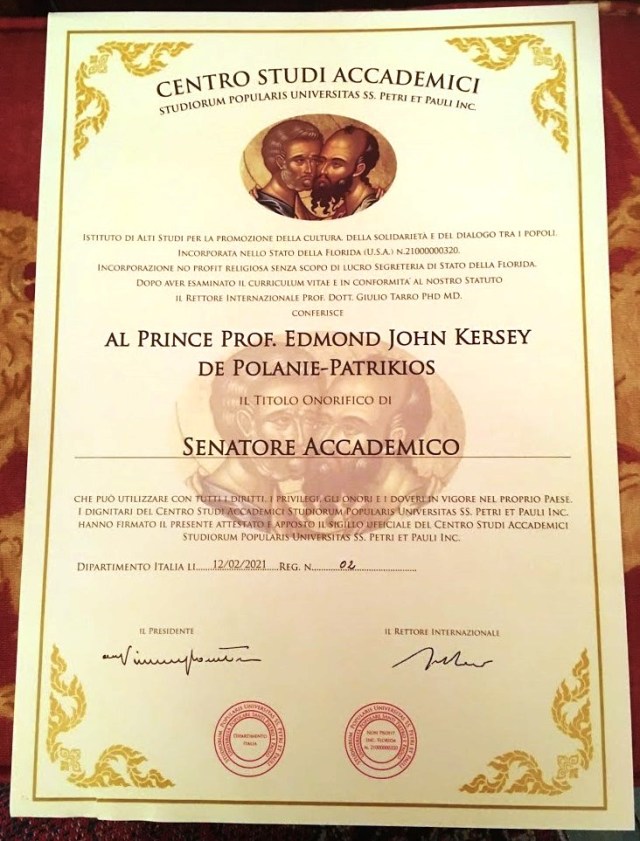
Honours and awards: Academic Senator of the Centro Studi Accademici “Studiorum Popularis Universitas Ss. Petri et Pauli”
I was honoured by the Centro Studi Accademici “Studiorum Popularis Universitas Ss. Petri et Pauli”, which conferred an honorary appointment as Academic Senator upon me. The Centro was incorporated in Florida, USA, as a religious institution in 2021, and was under the Presidency of Prof. Dr. Vincenzo Cortese of Italy. Sadly it was dissolved in 2022.
The common pursuit
It seems to me that the great characters of the classroom are a dying breed. By that, I do not mean that teaching does not now, as it always has done, attract men and women of conspicuous ability and inspire in them remarkable service. But the culture of teaching has changed. That change was in process before my time, but took a significant step forward while I myself was at school, spurred by the Thatcherite ethos, and had gathered pace under Tony Blair when I came to teach in my twenties and thirties. Now the process appears largely complete.
The detailed examination of the roots of that change can be left for another time, but its manifestations are easily noted; the micro-management of the classroom, the increase in bureaucracy, the demand for uniformity (dare one say, blandness), and the reductive nature of the examination system. As backdrop, we might cite both the loss of our civil religion – Christianity not so much as a system of religious observance, but as the warp and weft of our national life – and the vaunting of low culture at the expense of high. We might also cite the way in which our universities have turned away from scholarship for its own sake, and from an emphasis on their life as a community of scholars, to one of narrower specialisms, more circumscribed intellectual enquiry, an emphasis on quantitative output, and the imposition of scientific method and peer review upon the arts and humanities. It is a form of commodification; a set of values that a generation ago would have been dismissed as inappropriate for an academic setting because their commercialism cheapens and ultimately debases scholarship.
The foundation of most learning is curiosity, and the effective teacher builds on this curiosity to foster enthusiasm and knowledge. Boundaries are inimical to such an approach. It can be summed up as “scholarship for its own sake”, or the traditional phrase “a liberal education”.
This attitude was once the dominant paradigm in our education system, both at secondary and postsecondary levels. The quality of donnishness – not so much “teaching” as instruction, but more akin to the shared exploration of a subject – was born in the universities but also could be applied to many schoolteachers who saw in their work a particular scholarly vocation both to their pupils and to their subjects, and who continued to make a significant wider contribution to those subjects through creative work, books and research papers.
Intellectually-rounded people were seen as the product of a rounded education; the idea that a detailed knowledge of other subjects informed one’s own specialisms. This perhaps found its greatest expression in the view expressed to me in former years that if one had obtained a good degree from a good university, one could then master and teach any subject within reason. This was reflected in a number of eminent university scholars whose degree was not in the subject they taught (or, in rare cases, who had not earned a degree at all), and many more schoolteachers who were in the same position. Education did not merely teach a given set of facts and precepts, it taught its subjects how to learn, how to conduct research, how to apply critical (and self-critical) faculties, and moreover imparted the development of an aesthetic sense – a sense of discrimination between qualities that led to an appreciation of why some things were superior to others. A more nebulous expression of the same concept came in the form of the role of sport in the liberal education; I must say that this was largely lost on me at school, but in subsequent years I have come to appreciate that there are aspects of character and strategy that are perhaps better expressed in Test cricket than anywhere else.
These values are, I would argue, essentially anti-capitalist and anti-materialist, and do not sit well with reductive models of output and assessment. They are values that precede and supersede those of the computer age, and in which, certainly in the arts and humanities, the love of books is foremost. They give vigour to the learner rather than encouraging passivity. And lastly, they mark out, through merit, those who are capable of insight, even of originality, from those who are merely capable of following instructions. They are values that lend themselves to competition, and that produce an inequality of outcome. Lastly, they are values that have been under threat during much of the past century, and that will survive only with cultivation and determined effort.
The deaths of two of my own teachers at The Latymer School, Edmonton, prompts some reflection on these matters. Brian Binding, who taught me English and was my form tutor in my fourth year, died recently as a result of complications from COVID-19 at the age of 85. Andrew Granath, who taught me History, died last year of COVID-19 at the early age of 68.

The Latymer School, Edmonton (©Google)
Brian Binding read English at Downing College, Cambridge, under F.R. Leavis (whose wife, Queenie (Q.R.) Leavis, a distinguished critic in her own right, was an Old Latymerian). He taught at another of the three schools founded by Edward Latymer, Latymer Upper in Hammersmith (then a direct-grant boys’ grammar school), where his pupils included the late Alan Rickman, before arriving as Head of English at Latymer in Edmonton (also a grammar school, though this one mixed) in the year of my birth, 1972. One of his pupils at Latymer Upper captured something of his essence,
“He had the power of turning an English class into a kind of shared meditation. He could sit perched on a radiator in silence while we watched him think. The most important thing I learned from him was disrespect for the canon, since if he did not like the set text (in our case Much Ado About Nothing) that he was supposed to be teaching he spent the minimum time on it and used the lessons to read Lawrence stories or analyse passages of James.”
Neil Roberts, “Leavisite Cambridge in the 1960s” in F.R. Leavis; Essays and Documents, ed. McKillop and Storer, Sheffield Academic Press, 2011, pp. 14-15.
That freedom of approach was born of intellectual confidence. Leavis is not so much in fashion these days, being very much contrary to the mores of our age. He stood for a certain sort of uncompromising rigour that was unashamedly that of an intellectual elite. In his essays in “Education and the University” (1943), Leavis proposes the university as a “focus for the finer life of cultural tradition” and draws attention to the disappearance of the traditional liberal education in favour of increasing specialisation. He writes “if something is not done…this country will not long retain, and will not deserve to retain, any of the influence belonging to the culturally senior partner.” Essential to Leavis’s argument, too, is a confidence in the qualitative pre-eminence of English literature over its foreign counterparts, not from crude jingoism, nor from innate superiority, but rather that “greater maturity means – or should mean – greater vitality.”
Although there were certainly those who studied with Leavis and reacted against his approach, those who were sympathetic to his ideas formed a kind of scholarly disciplehood, gathered among the university faculties and the better schools, which was designed to perpetuate the values that Leavis and his followers held dear. It was to their numbers, presumably, that Leavis (echoing Matthew Arnold) addressed his words “in any period it is upon a very small minority that the discerning appreciation of art and literature depends: it is (apart from cases of the simple and the familiar) only a few who are capable of unprompted, first-hand judgment. They are still a small minority, though a larger one, who are capable of endorsing such first-hand judgment by genuine personal response.”
In his essay quoted above, Neil Roberts speaks of the network of which Brian Binding was a part, and the way in which informal contacts directed able school-leavers to sympathetic dons as they became the next generation to carry the torch. He says of the influence of Leavis that this persuaded him that “the study of literature is a compellingly serious matter”. This was also something that I understood both from Brian Binding’s teaching and from his example, and not merely literature but culture more generally. I thought it significant that in the mid-1980s, he did not own a television, nor attached any importance to that medium. What I also remember were his many enthusiasms in literature, and his dry, unstuffy sense of humour allied to a quick wit. He was also a notable pipe-smoker, a pursuit impossible without a modicum of patience and a ruminative desire to sit, think and talk while enveloped in an aromatic, even ethereal, cloud.
But above all, the Leavisite legacy was that of literary criticism. Literary criticism has now been largely replaced by literary theory and its associated cant of postmodernism, post-colonialism, gender and identity politics. Both Leavises would have had none of that, and Q.D. Leavis was a particularly mordant critic of feminism. Some certainly found the Leavis approach forbidding, holding up a standard so high that it would inhibit any but the most confident from thinking they had something worthwhile to say. But that was not my impression. When I came to read the work of both Leavises – some years after Brian Binding had retired from teaching – what struck me was its abundance of sense, its communicative and persuasive qualities, and the confidence of judgment which, even if one sometimes disagreed profoundly with it, was reasoned and not infrequently hit the mark. Enthusiasm and condemnation alike were the consequence of a developed taste; it was inevitable that if one’s attachment was to values and qualities, then one would then discriminate based on them. As I.A. Richards rightly put it in a passage quoted by Leavis, “to set up as a critic is to set up as a judge of values.”
Critical theory never produces the same reactions. Firstly, it is impenetrable, being addressed entirely inward to the academic establishment, and not aiming at a wider audience. Secondly, it is inherently political, framing itself in the language and ideas of post-war Marxism and being inseparable from that creed. Of course that is not to suggest that Leavis was apolitical, or that his disciples did not include those who embraced socialism, but their version of socialism was (and I shall return to this shortly) quite different from that which would take over academia during the first decades of the present century. In particular, it was a socialism whose dialectic of class was not accompanied by a similar dialectic of intellect, and indeed that appealed to a certain kind of social conservatism. It was common in the grammar schools to encounter the view that intellectual merit was to be celebrated and encouraged, and that high culture was an end to which all might aspire irrespective of class – if not as creators or critics, then at least as an appreciative and informed audience. The best things in life were for everyone, and the good teacher would lead his pupils up the foothills of Parnassus, even if not all would make it to the top.
At a selective grammar school, there was an expectation that we pupils would form an intellectual elite – it was certainly the norm there that the majority of school-leavers would go on to the more selective universities. Certainly it was an atmosphere in which scholarship was given primacy and a remarkably free rein, and the values which this produced contributed to the overall humane and civilised ethos of the school. I do not think this had changed too much since the post-war era in which the universities were suddenly opened up to the new influx of working-class students from the grammar schools. That generation certainly proved itself worthy. Unfortunately it would later also show a remarkable propensity for pulling up the ladder behind it, as the selective principle in education came under sustained attack from the establishment and many grammar schools found themselves forced to choose between charging fees or becoming comprehensives.
Another idea of Leavis’s that remains significant to me is that of the “organic community”. In this, he calls upon England’s pre-industrial heritage to recall lives whose rhythms are those of traditional rural life; folk tradition and folk song. This is in essence an anti-modern concept, but one that found much resonance and active revival in the England of Leavis’s time. One might reflect on the utopian socialism of Eric Gill’s community at Ditchling, or the revival of folk traditions in John Hargrave’s Kibbo Kift, or in the economics of Social Credit and Distributism, or in the Guild Socialism that developed out of William Morris’s ideas. Indeed, this was also an era when English music emerged from Continental influence to rediscover its national roots through the folk song revival of Vaughan Williams and his contemporaries. The Romanticism of these currents was always tempered by a strong measure of practical idealism, and by another English characteristic, the distrust of sentimentality. The appeal, as with Leavis, was to vigour rather than to comfort.
Andrew Granath arrived at Latymer in my fourth year there, and made an immediate impression on our class of GCSE historians. Visually, he was extremely tall and striking in appearance, with features that suggested that he had been hewn out of stone. But it was also obvious from the start that he was the “real thing” academically, with an authority and intensity that made you feel that what was being taught really mattered, and we soon became accustomed to working hard and at a high level. The syllabus in those very early days of GCSE was far fuller than it became when I taught GCSE History a little over a decade later. Andrew brought it all alive. But more than that, he was a remarkably interesting person with an unusually wide range of interests. He was passionate about boxing, and saw in that noble art far more than mere sport. He rode classic motorcycles (as had Brian Binding before him). And he was from Basildon.
Basildon is an unremarkable suburban town in Essex, not a vast distance from Latymer in Edmonton. It is the ostensible subject of Andrew Granath’s only book, Searching for the Promised Land, which he wrote at the age of fifty. This, however, is to underplay its hand. Searching for the Promised Land is a meditation – even in places a Brian Binding-esque meditation – on the essence of Basildon as a metaphor for the changes in the post-war working-class. It is a consciously unruly book; not conventional history, but rather a personal and subjective narrative. At times it is extremely funny, and at others sad, touching and thought-provoking. There is a tone of lamentation for the deliberate destruction of the working-class community that once formed Basildon. One passage emphasises the optimism of the post-war vision, and the way in which it, as with so many visions, came to be corrupted,
“Fifty years ago, in the stasis of the post-war years, it was assumed that the working class was not meant to be aspirational. Give them a watertight house, and elementary education, free health care and a modestly-paid job and the world could carry on indefinitely as if 1955 represented the end of history. Today, in the new, thrusting post-Thatcher Britain where we are all bewildered by the pace of change, it has become a way of life. It is difficult to overstate the optimism that was left at the time for those who had escaped the grim cramped life of inner London. Within the authoritarianism imposed by a lack of choice, a whole new vista opened up to us. It was a grand view of gardens, parks, countryside, neat brick-built houses, open airy schools, bright modern shops and willing citizens revelling in the munificence of government – ‘Bliss was it in that dawn to be alive.’ In 2003 it all looks rather different. Talking to the elderly of the town – those who arrived as young adults in the 1950s – there is now a pervasive sense of disillusionment that the dream failed to live up to their expectations. The promises of the good life have not been kept. As Nigel Birch put it to Harold Macmillan at the time of Profumo crisis: “Never glad confident morning again.” It is now impossible to imagine that the state would ever again have the confidence and self-belief to create such a community in the hope that it could transform the quality of peoples’ lives. We truly believed, fifty years ago, that it would be possible to build that shining city on the hill if we all pulled in the same direction.”
That optimism is also seen in a number of his other topics. Inevitably, he discusses socialism, but with a scepticism born of experience of the failures of central planning. As a former member of the Woodcraft Folk (which had grown out of a rift in the Kibbo Kift), he knew utopian socialism at first hand,
“By the 1930s, Letchworth, in particular, had acquired a reputation for what George Orwell rather contemptuously called ‘sandal and nuts’ socialism. It was the Letchworth ILP Summer Schools, with their espousal of progressive utopian ideas, that goaded Orwell into his famous denunciation (in The Road to Wigan Pier) of ‘every fruit juice drinker, nudist, sandal wearer, sex maniac, Quaker, Nature Cure quack, pacifist and feminist in England’. For Orwell, the Letchworth middle class socialist was summed up by the two men who got on his bus while riding through the town. ‘They were dressed in pistachio-coloured shirts and khaki shorts into which their huge bottoms were crammed so tightly that you could study every dimple. Their appearance created a mild stir of horror on top the bus. The man next to me murmured, “Socialists” as who should say “Red Indians”. Every generation has its discontented minority looking for a different way of life. In the 1930s, they flocked to Letchworth, particularly those who had tired of the tyranny of the ‘meat and two veg’ diet of the inter war years. By 1935 the town boasted seven vegetarian restaurants at a time when the whole of London could barely muster the same number. For the ‘simple lifers’ who flocked there, the principle was even more simple – ‘more air, less alcohol’. For Orwell, a meat-eating, chain-smoking, beer-swilling despiser of the middle-class socialists, the lure of Catalonia must have seemed irresistible.”
He might have gone on to add that the rather wonderful bastion of vegetarianism, teetotalism, Theosophy and free-thinking, the Liberal Catholic Church, had been established in Letchworth in 1923 and remains active there today.
This was socialism as a middle-class lifestyle choice, not the struggle of the working-class to overcome very real disadvantages. Among the faddishness, however, there was a genuine energy and some idealism that had more to it than the humbug that Orwell rejected. What Andrew Granath saw was the arc of that idealism; rising in the working-class London-exiled community that formed in the “plotlands” of Basildon where many families built their own homes during the 1930s, only to see them flattened by central planning bulldozers twenty years later. He visited as the last of these awaited demolition, “As I wandered past the neat little houses, I realised for the first time that, although the men and women that comprise government may be perfectly decent people individually, they are, collectively, given some sort of rationale, capable of acting in a grossly unjust manner. And here was the result of this misguided ‘we know best’ attitude.”
The central planning that Andrew Granath decried in Basildon is exactly the same malaise that has affected the teaching profession. All of the changes that have affected teaching in the last twenty years have been imposed from the top down, by governments and others who “know best”. They have, in my view, had the effect (and often deliberately) of vastly reducing the autonomy of the teacher in the classroom. In the early 1970s, Dr Robert Leoline James, who was regarded as one of the great headmasters of Harrow, gave his headmaster protégés the advice, “Appoint the best and leave them alone.” Few schools are always in the position of being able to appoint the best, but it seems to me that one rarely attracts the best with the prospect of endless circumscription and micromanagement.
At the point when I left school teaching in 2005, we had even reached the point where certain established styles of teaching, most notably “chalk and talk” had become officially deprecated. A lesson with Andrew Granath not infrequently consisted entirely of his exposition of a topic followed by dictated notes and the occasional question. Nothing was deemed to be learned until it had been codified. Of course he knew what I later discovered myself as a teacher; making the pupil do something active with the knowledge at hand, such as writing it down for themselves, is usually the best way to get them to remember it. There was nothing stale or passive about those lessons, but they reflected a scholarly approach that, despite its considerable effectiveness, has now become manifestly unfashionable.
Teaching has been diminished by the imposition of a quantifiable matrix that prizes assessment, value for money and accountability ahead of more subjective qualities. Inevitably, in the name of uniformity, much of humanity has found itself squeezed out just as the central planners imposed their stultifying vision on the sprawling individuality of Basildon’s plotlands. And it must also be questioned whether the reductive world of league tables is really cognisant of the true meaning of “accountability” and “value for money”, which have a much wider context than might at first glance be imagined. The aim of liberal education – to produce rounded individuals capable of fulfilling their potential and contributing in full measure to society – has been forgotten because it is by nature not easily quantifiable; it asks too many difficult and subjective questions and those answers that are available do not lend themselves to statistical analysis or computer processing.
I am not a revenant, and have, if memory serves, only returned to my old school on two occasions after leaving, those being both over twenty years ago now. There were, however, two encounters later in life with the teachers I have written about. Brian Binding surprised me one day in my early twenties when I was reading a book outside a café on Hampstead High Street. He told me that he had taken up a second career as a translator in retirement, and was greatly enjoying it, and we shared some memories of Latymer as it had been.
Andrew Granath wrote to me out of the blue in 2012, having found my website. Returning to his words after his death, I am struck both by his kindness and his intellectual curiosity.
“I hope you don’t mind me writing to you like this. It simply occurred to me just a few days ago I wonder what happened to John Kersey, I googled you and was both surprised and delighted to be see how brilliantly prolific and committed you are.
I hardly dare try to understand the sort of issues and beliefs that you are part of but it does seem to be an extraordinary and fascinating world that you have made. You would have liked my Aunt who died a few years ago. She was a quiet disciple of Joseph de Maistre and Rene Guenon and had an extraordinary collection of early mystical books (hermetic, Rosicrucian and alchemical including first editions of John Dee and Michael Maier) that, to my irritation, were donated to the Warburg Institute. She was a friend of Frances Yates who you may be familiar with.
For Murray Rothbard and Joachim Raff to be admired and appreciated by the same person is a great feat and for that I congratulate you.
Latymer is a very different place from the one that you left I suspect more than twenty years ago. Neither better nor worse but different. For myself I think that I will do one more year after this and will then retire or rather do something else. I hope that you do not mind me sending you this message. Looking at the picture on the your website I can still see very clearly the 16 year old you.”
Of course I replied to him. But how do you say thank you to your teachers and give some idea of what their example has meant to you without lapsing into embarrassing sentimentality? It seems an impossible task. Perhaps there is something less direct that can be done, though. Alan Bennett, himself a grammar school pupil, gave us the definitive study of grammar school life in the early 1980s in The History Boys, which captures the intensity and the intellectual excitement of that experience together with the inevitable emotional complexities of teenage years. The final scene is visited by the spirit of the inspirational Hector, the general studies teacher, who directs his charges to “pass it on, boys”. And that. surely, is what it is all about.
Further reading:
Granath, Magnus C., Searching for the Promised Land: Basildon and the Pursuit of Happiness, London, GoldStar Books, 2004.
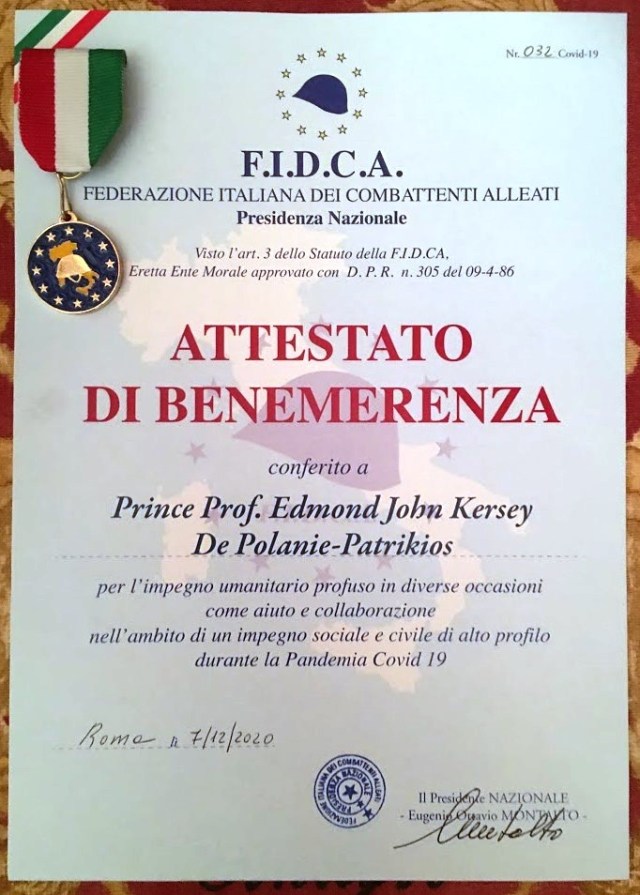
Honours and awards: Attestato di Benemerenza from F.I.D.C.A.
I have been honoured with the Attestato di Benemerenza with medal of the Federazione Italiana dei Combattenti Alleati. The attestation reads: “for the humanitarian commitment given on several occasions as aid and collaboration in the context of a high profile social and civil commitment during the Covid-19 Pandemic .”
Honours and awards: International Honorary President of the International Association for Financial Managers and Administrators and Association of Chartered Professional Managers of Nigeria
I have been delighted to receive the International Honorary Presidency of the International Association for Financial Managers and Administrators and the Association of Chartered Professional Managers of Nigeria. Both of these institutions are recognized as professional associations by the Federal Government of Nigeria. I have also been appointed to the Fellowship of both institutions.


Honours and awards: Sovereign Royal Granducal House of Dalmatia
I have been honoured by the head of the Sovereign Royal Granducal House of Dalmatia (Val d’Ors), H.S.H. Prince Orazio Mezzetti, with the grant of the titles of Marquis of Maslinica and Honorary Cousin of the Royal House. Prince Orazio is in concordat relations with several of the institutions under my leadership, and is a Byzantine Imperial descendant. Previously, he had appointed me to the rank of Byzantine Patrician.

Professor of History in the Catholic University “Joseph Pulitzer”, Budapest, Hungary
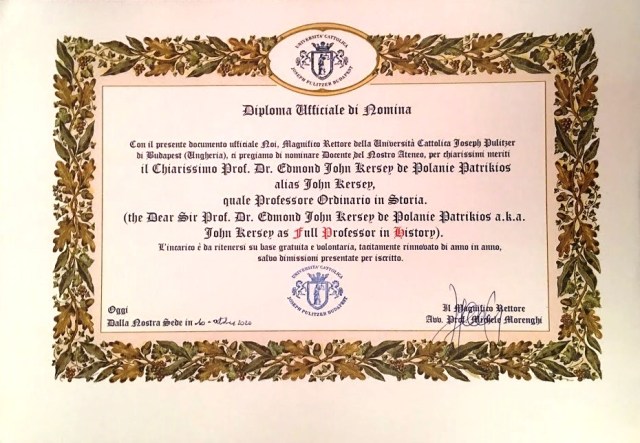
In 2020, I was honoured to receive an appointment as Professor of History in the Catholic University “Joseph Pulitzer”, Budapest, Hungary. The University was established by the well-known Italian lawyer Prof. Michele Morenghi and offered online courses in the history of the Catholic religion, international tax law, international contract law, cybercrime and other areas.
The University also entered into a wide-ranging reciprocal recognition agreement with all the institutions under my control.
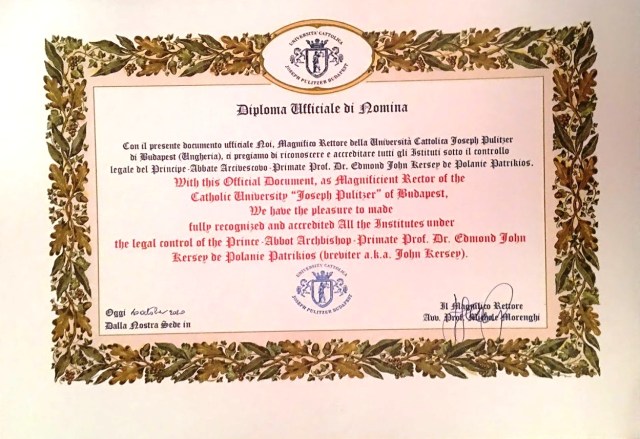
The University ceased activity at the end of 2023 at which point its website was removed.
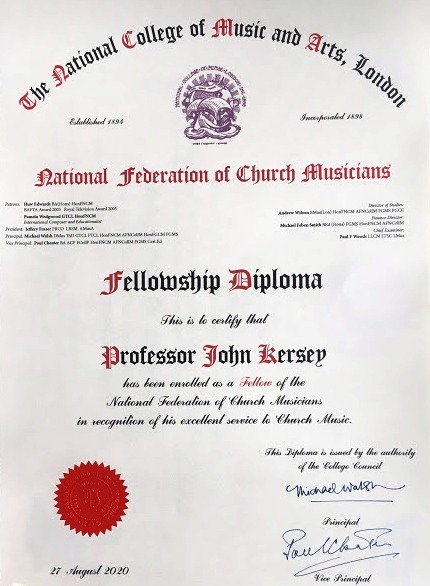
Fellowship of the National Federation of Church Musicians
I have been delighted to receive Fellowship of the National Federation of Church Musicians. The Federation is administered by the National College of Music, It says of the award, “In order to qualify, candidates are expected to demonstrate at least twenty years of fully-documented service in the field of church music in any denomination of the Christian church as an organist, choir director or singer, making the award of the FNFCM a formal recognition of long and distinguished service.”
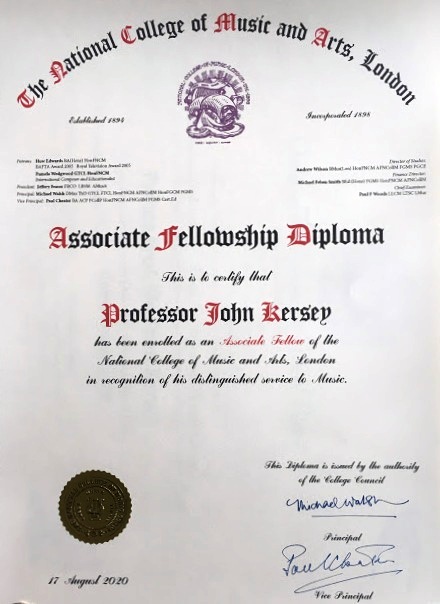
Associate Fellowship of the National College of Music
 I have been delighted to receive the Associate Fellowship of the National College of Music. The Associate Fellowship was introduced in 2020 and “is designed to recognise professional musicians who have made an outstanding contribution to the musical arena.” The award is reserved “to those who can provide evidence of the highest level of musical expertise during a course of a minimum of ten years. It will therefore be appropriate for conductors, choral directors, recitalists, composers, musicologists and those who have made an exceptional contribution to musical education.”
I was awarded Honorary Fellowship of the National College of Music in 2010, and am very pleased to continue my association with this institution.
Honours and awards: Commander (Laksamana) in the Supreme Order of Aranan

This was a promotion from my previous appointment in the Order.

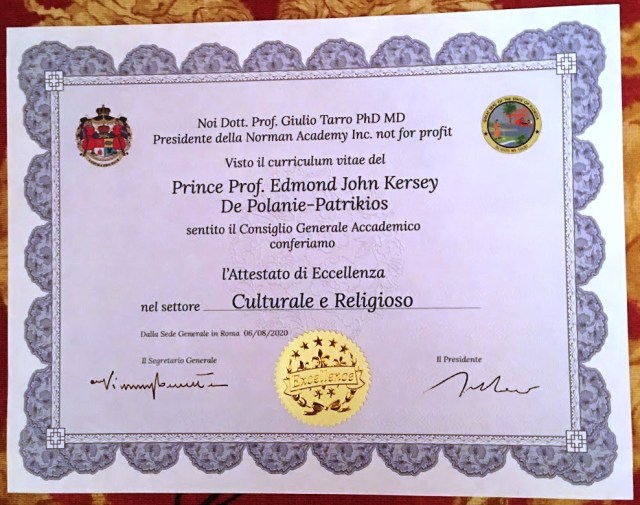
Honours and awards: Attestato di Eccellenza from the Norman Academy
The Norman Academy in Rome, Italy, of which I am an Academician of Honor, has further honoured me with an Attestato di Eccellenza in the sectors of Culture and Religion.
 Professor John Kersey