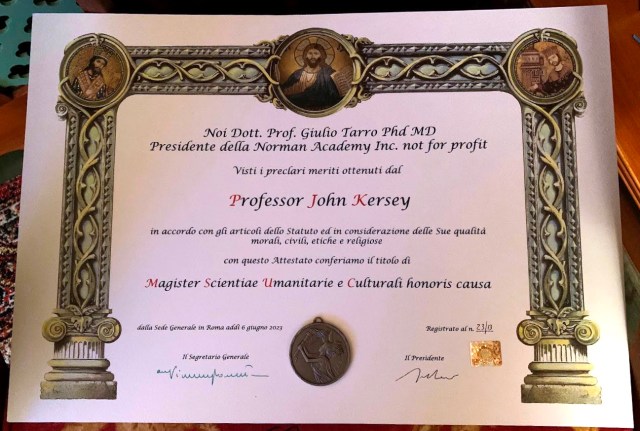
I have recently been awarded the honorary degree of Magister Scientiæ Umanitarie e Culturali (Master of Science (Humanitarian and Cultural)) by the Norman Academy (Italy; The Gambia; USA).

I have recently been awarded the honorary degree of Magister Scientiæ Umanitarie e Culturali (Master of Science (Humanitarian and Cultural)) by the Norman Academy (Italy; The Gambia; USA).

In 2018, I was awarded Honorary Knighthood in the Ordo Templum Domini, a Templar Order based in Brazil whose Prior is Archbishop David Caparelli, representative for Brazil of the Apostolic Episcopal Church. I have recently been pleased to receive promotion to substantive Knighthood in the Order.

In addition, the Order has conferred the honorary distinction of “Knight of Acre” on me.

By Resolution of the Chapter of Decorations of the Union of Polish Monarchist Groups no. 41 of 17 April 2023 for Outstanding Merits in Promoting the Concept and Distinction of Nobility, His Serene Highness Archbishop Professor Edmond John Kersey de Polanie-Patrikios of His Own Armigerous House was Awarded a Commemorative Medal Celebrating 25 Years of the U.P.U.M.


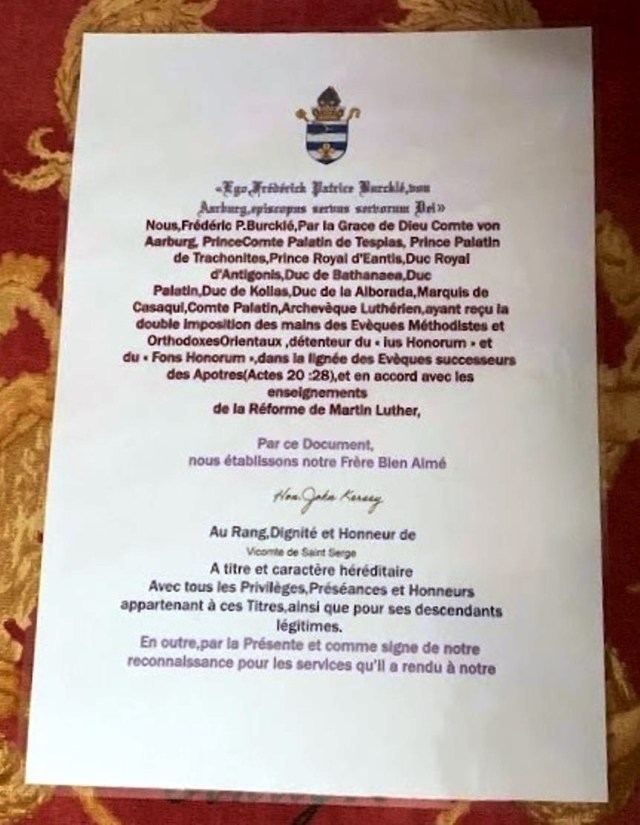
In 2018, I was honoured by the House of Burcklé von Aarburg with the title of Vicomte de Saint Jean. I am delighted to have been honoured again with the title of Vicomte de Saint Serge. As previously, the title is hereditary with remainder to legitimate descendants.


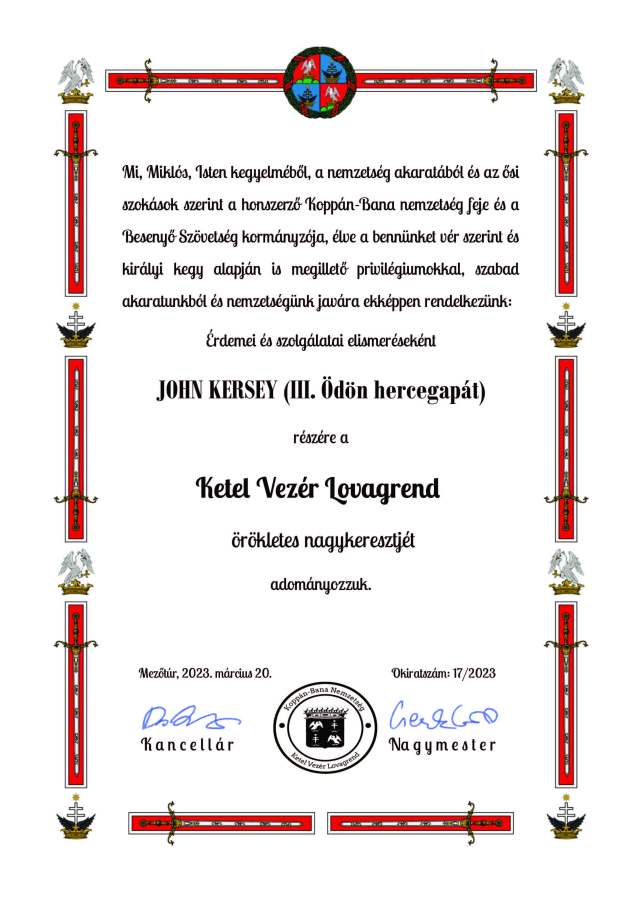
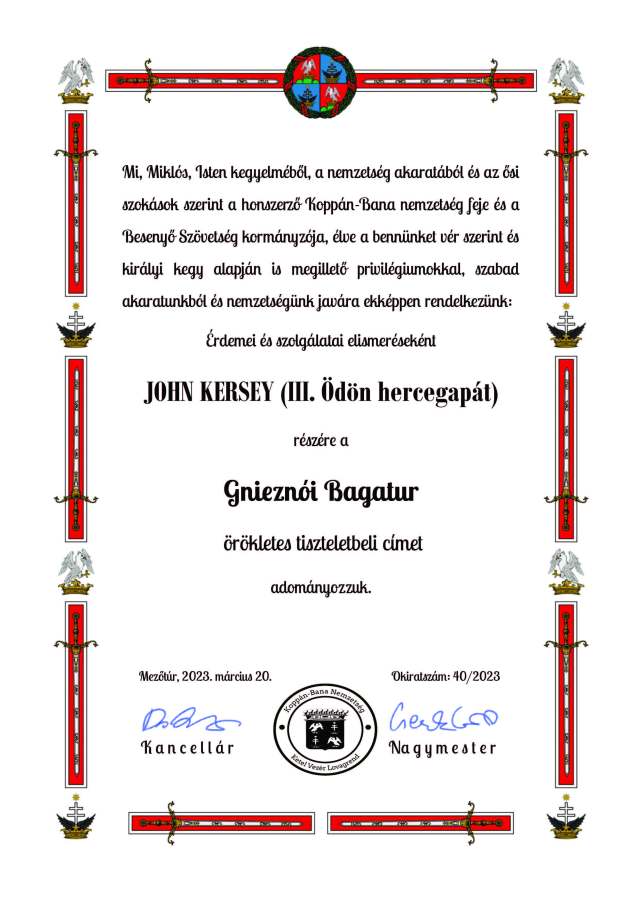
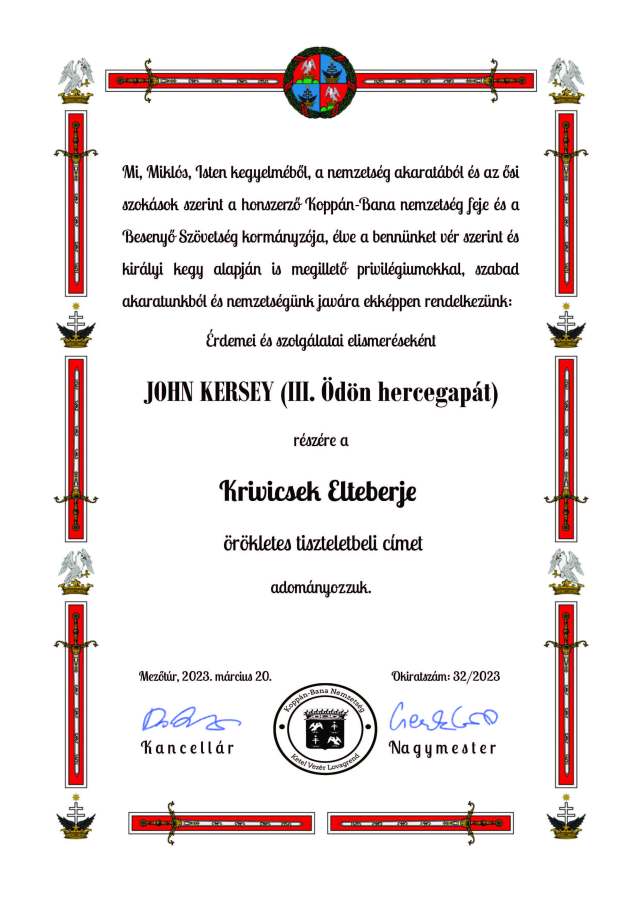
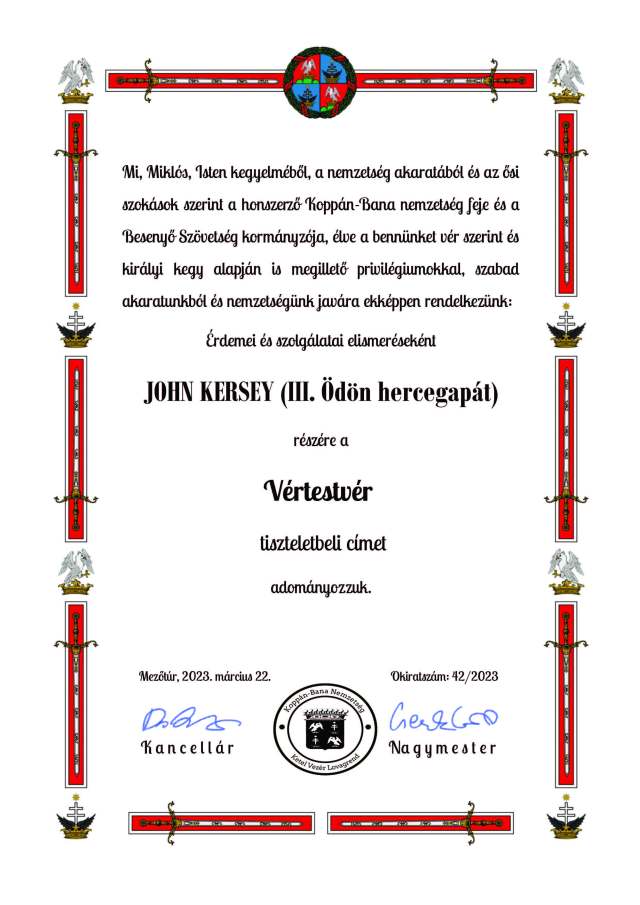
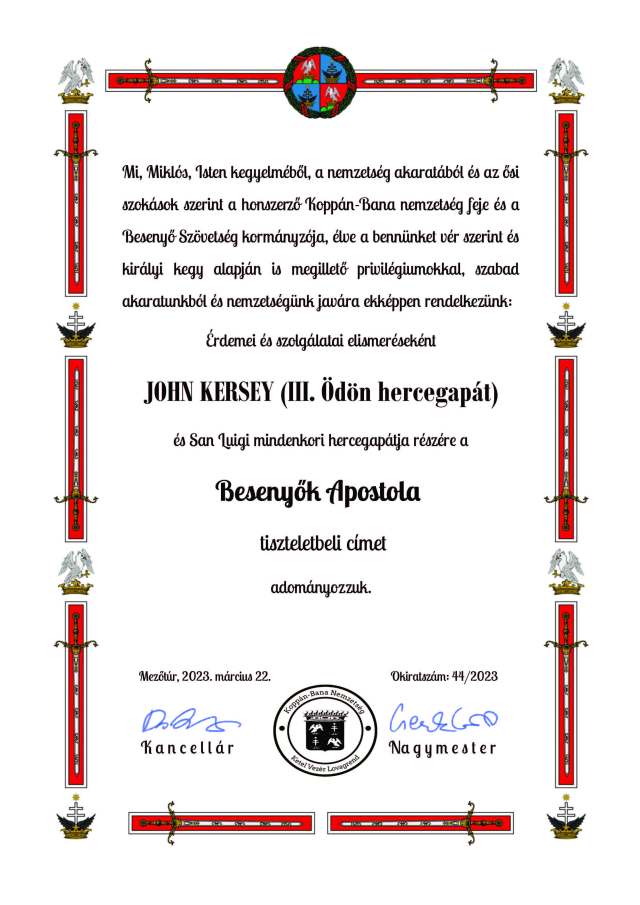
I have been honoured to receive a number of awards from the Hungarian noble House of Cseszneky (de Csesznek(Vár) et Milvány) and its head, His Illustrious Highness Count Miklós M. M. Cseszneky. H.Ill.H. the Count is my cousin, and we share descent from the House of Rurik of Russia and the medieval Kings of Poland. The awards below have been made in the context of an exchange of honours from my own Royal House and my recent appointment as an Honorary Fellow and Member of the Academic Advisory Council of the Hungarian Association of African, American, Asian and Oceanian Nobles which is under the Count’s direction.
1. Hereditary Grand Cross of the Order of Duke Ketel

2. Bagatur of Gniezno
The title of Bagatur was originally a Turkic and Mongol honorific that has been compared to a knighthood. Although the title may be (as here) awarded with a territorial designation, this does not refer to a fiefdom, but rather to the holder as hero of that place. Historically, if the title comes with a territorial reference it is because the person carried out a heroic deed in that place, typically in the battlefield. In this regard it is very similar to a British victory title: e.g. Viscount Montgomery of Alamein or Earl Mountbatten of Burma. Nowadays, it can refer to any important event, personal or ancestral achievement that took place there. Therefore, the territorial designation can be any place in the world. The choice of Gniezno therefore reflects and honours my remote ancestors, the first Princes of Gniezno and rulers of the Polanes. Today, each member of the Royal House Polanie-Patrikios is a Prince or Princess of Gniezno, and my heirs will also inherit the title of Bagatur.

3. Elteber of the Krivichs
The hereditary honour of Elteber is the Pecheneg equivalent of Duke or Margrave. It originally referred to the position of a client king within the Turkic khaganates. The Krivichs were a tribal union of Early East Slavs between the 6th and 12th centuries AD, and have a historic connection with Belarus and the Princes of Polotsk, thus directly referencing the position of the Royal House Polanie-Patrikios as pretender to the Byelorussian throne.

4. Blood Brother of His Illustrious Highness the Count Cseszneky
The status of blood brother is the utmost honour one can receive in the Equestrian Civilizations.

5. Companion of Saint Bruno
This title is hereditary, being attached to the Abbey-Principality of San Luigi. It commemorates St Bruno of Querfurt, the first Christian to begin evangelizing the Pechenegs.

6. Apostle of the Pechenegs
This title is hereditary, attached to the Abbey-Principality of San Luigi.

7. Örkönd-oba
The Pecheneg honorific of Örkönd-oba approximately means “Free Lord” or “Father of Liberty”.

I have been honoured to receive an appointment as Hereditary Grand Collar of the Royal Order of Kwakyen Ababio. The Order is awarded by HRH Nana Kojo Kurentsir X, the Papagyahen (King) of the Kingdom of Abura Papagya, Abura Traditional Area, Republic of Ghana. The Kingdom is a recognized traditional (divisional) kingdom in Ghana.
The website of Papagya linked above gives further information concerning the Kingdom, its history and its current projects.
A Treaty of Friendship, Amity and Goodwill has been entered into between the Kingdom of Papagya and the Abbey-Principality of San Luigi under my leadership, and in this context, HRH Nana Kojo Kurentsir X has been appointed by me to an equivalent rank in the Order of the Crown of Thorns.

I have received the Honorary Fellowship and been appointed a Member of the Academic Advisory Council of the Hungarian Association of African, American, Asian and Oceanian Nobles.
The Association was founded in 2022 as the Afronobilitas Association with the aim of uniting the members and descendants of African and African-American noble families living in Hungary, as well as to acquaint the Hungarian public with the rich and varied African and African-American monarchical and noble traditions, and to promote the preservation of African and African-American traditions. From 2023, the name was changed to Hungarian Association of African, American, Asian and Oceanian Nobles, as there was an increasing need to introduce the noble and monarchical traditions of other distant continents to the Hungarian public.
It is not well known that several persons of Hungarian origin have received noble titles from African rulers and became real or honorary members of the indigenous leadership class. Count Móric Benyovszky became the king of Madagascar, Africa-explorer László Magyar married the daughter of an Angolan ruler, Count Lajos Königsegg-Rottenfels and Count Gyula Cseszneky received Ethiopian noble titles, whereas Béla Póczik and Count Zsigmond Széchenyi received titles of honour from several sub-Saharan tribal leaders.
In addition to cultural goals, the association carries out charitable activities as well, and it financially supports several social projects in Africa and Latin America.

The award citation reads “in recognition of your extraordinarily prolific activities, particularly those related to monarchical and indigenuous traditions.”

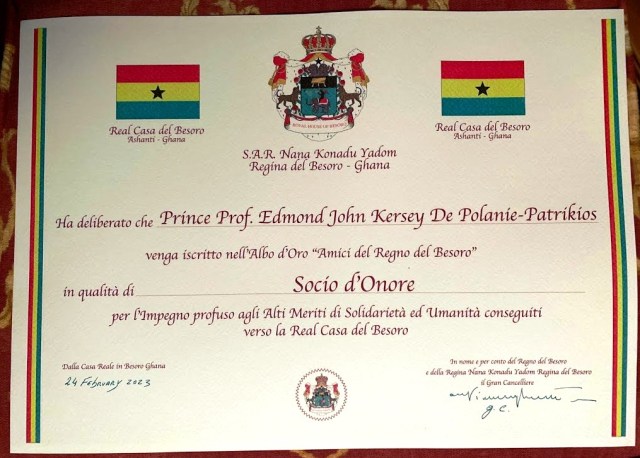
I have been honoured to receive an appointment as Knight Grand Cross of the Royal Order of the Elephant of Besoro. This Order is bestowed by H.R.H. Queen Nana Konadu Yadom of the Kingdom of Besoro, Ashanti, Ghana.

I have also been honoured by being included in the Golden Book of Friends of the Kingdom of Besoro as an Honorary Member.

In 2017, I was honoured with the dignity of Prince in the Royal Principality of the Upper Region of Hiran, Royal House Shikal, Somalia. The Principality has now further honoured me with the title of Honorary Vice-President.

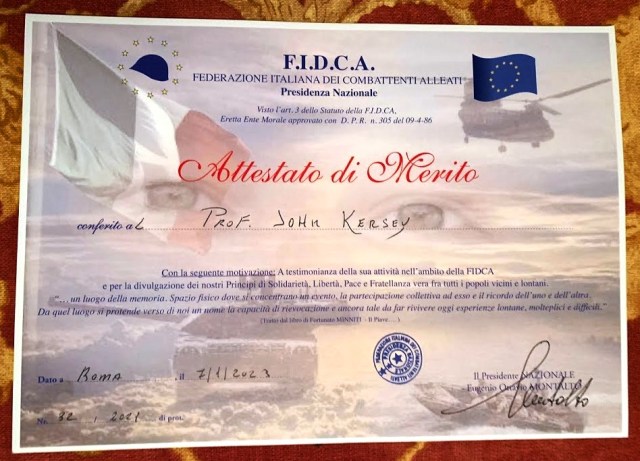
I have been honoured to receive an Attestation of Merit from the Federazione Italiana dei Combattenti Alleati. FIDCA was founded in 1972 as an association of European ex-combatants and others who were supportive both of the European ideal and of the sacrifices of those who had sacrificed themselves for freedom. FIDCA was recognized as a distinct legal personality in Italy by Presidential Decree n.305 of 9/4/1986, and by means of DPR 27-2-1990, it was placed under the direct patronage of the Italian Ministry of Defense.
The citation reads, “As evidence of his activity within FIDCA and for the dissemination of our Principles of Solidarity, Freedom, Peace and True Brotherhood among all peoples near and far.”

I have been honoured to receive the distinction of Member of Honour of “Friends of The Gambia”. This is bestowed by the Minister Counsellor, Head of the Consulate General of the Republic of The Gambia in the Republic of San Marino and the Republic of Italy, Prof. Avv. Francesco Cristina of Santannera. The citation reads, “for the high value of his outstanding accomplishments to date permeated with humanitarian and solidarity examples for the entire Community.”

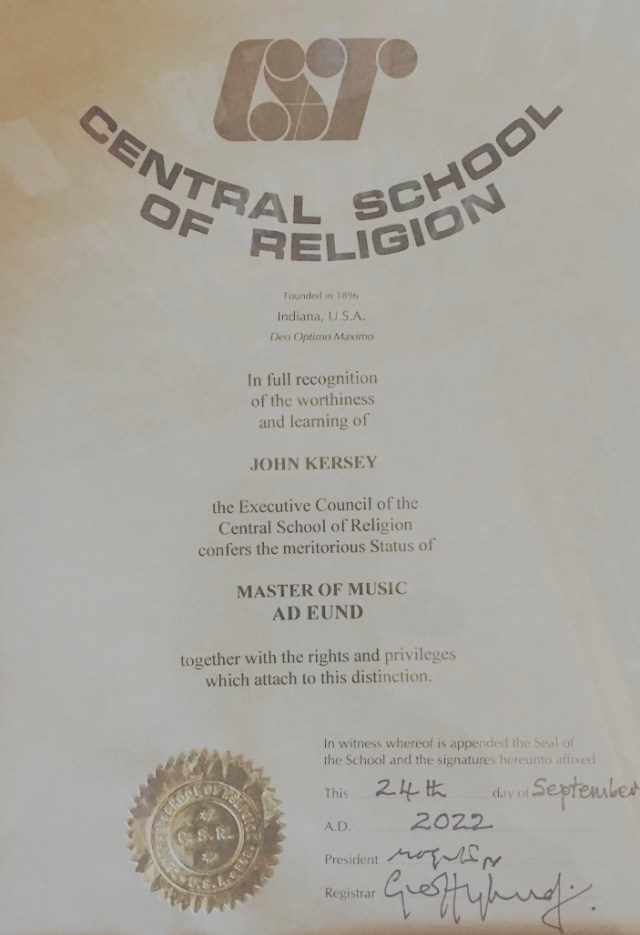
Having previously been made a Fellow of the Central School of Religion and successively Honorary Associate and then Fellow of its Faculty of Church Music, I was delighted to receive the degree of Master of Music from the School awarded ad eundem. The basis of this award is the degree of Master of Music that I received from the Royal College of Music in 1997.

Today, I was among the speakers at this meeting in Preston, organized by Heritage and Destiny.


The review of my speech by Heritage and Destiny said that I “gave a cogent analysis of the burgeoning threats to traditional British values and freedoms – and to the Christian values that are the bedrock of British and European civilization. The dictatorial grip of the political establishment is at last being resisted: the forces of resistance are no longer marginalised – our agenda of maintaining and restoring British traditions is now at the centre of political debate.”
The text of my speech follows below. A video recording can be found here.
“The New World Order”
Mr Chairman, thank you. I want to begin today by drawing your attention to the two greatest shocks that the globalist establishment has received since it began its work in the years after the end of the Second World War.
The first of these events was when, on the 23rd of June 2016, against the combined power of everything the establishment did and stood for, the British people, and largely the indigenous British working class, told the European Union to get lost. The Eurofederalists, every media outlet and every global corporation stood against us. They never wanted us to have a vote. But the British people had had enough. The European Union began as a Common Market but was fast developing into a socialist superstate in which our nationhood would be lost and we would be relegated to a mere region controlled from outside our borders. And the EU’s open border policy meant unlimited mass immigration to Britain.
The second was later that same year, on the 8th of November 2016, when Donald Trump was, again contrary to every media outlet, every global corporation and the vast amount of money and resources deployed against him, elected President of the United States of America, principally again by White working class voters. Everything was done to prevent Trump’s election and to frustrate his Presidency, including two failed impeachment attempts. But he served his term, delivered on most of his campaign promises, and became the first President to defy the political establishment openly.
We should not think that these things have been allowed simply to go unremarked by the globalist establishment. That establishment has spent a lot of time, money and energy trying to ensure that nothing similar can ever happen again. And in doing so, they have identified as their principal enemy the White working class.
The globalists have gained at least a temporary victory in the United States, and they are also well on the way in Britain. The answer is what the World Economic Forum announced in 2020 as The Great Reset, with a launch video by our now King Charles III. This means among other things that control will move from government to large multinational companies, thus rendering the voting public impotent, that we will “own nothing and be happy” by 2030, that policy will be driven by environmental priorities made by those who believe in man-made climate change, and that taxes, trade and regulations will be harmonized to achieve so-called “fairer outcomes”. It also promotes the idea of implanting our children with microchips and running increasing parts of our lives via artificial intelligence. We are already seeing systems like Facebook and Google turn over large parts of their decision-making not to human beings but to artificial intelligence algorithms. Banks have been doing this as well, and now it is not just “computer says no”, but a situation where humans cannot override the policies the computers implement.
We should not think that all this is driven by any regard for our benefit. It is driven by the billionaire class and by global corporations that long ceased to be about just making money and are now convinced their mission is to tell us how to live our lives. There is a new class system developing, and it is to consist of the super-rich at the top, everyone else at the bottom, and a middle class that people can aspire to if they do what the super-rich want. How will it work? In China, they are rolling out what they call a social credit system that will turn every interaction with authority into a system of rewards and punishments, with dissenters shut out from the privileges reserved for the compliant.
In Britain, there are two Brexits; the one that we voted for and the one the politicians have given us. Our politicians have talked tough, but what they have delivered is far closer to what Brussels wanted than what British voters wanted. We have been landed with a mess in Ireland that threatens our sovereignty and the Union, and this comes after years of our own government selling Ulster out to the Republicans. And in place of mass immigration from the European Union we now see mass immigration, both legal and illegal, from Africa and the Middle East. The globalists are still pulling the strings. But now they have the White working class in their sights. They are determined to destroy our culture so that our people are atomised and isolated, to force multiculturalism on us, and to replace us with immigrants who have no loyalty to our way of life or our nation, but who can be used by their masters to create a society of compliant wage-slaves.
If you are a Marxist-leaning billionaire who wants to influence government and global corporation policy, the methodology is simple. You ensure that the media carries your message both online and in print. You fund supposedly independent think-tanks which produce policy reports which are then used as levers for decision-makers to act. You endow universities with funding to produce graduates and research that conform to an agreed common leftist ideology. You fund scientific research that produces the answers you want to see to questions that you hand-picked. You fund charities that are in fact campaigning fronts for particular ideological views. And that’s without the direct and indirect influence you can have on politicians themselves. There is a web of influence here, and all of it is intimately connected. It is being used to push Cultural Marxism on our society in such a way that it is permanently baked-in to our institutions and anyone who dissents is pushed out.
In our institutions, the priority is now diversity before all else. The agenda is openly anti-White and opposed to the nuclear family. If you are from an ethnic minority, you are promoted as a victim of racial oppression, regardless of whether that is actually the case, and automatically given a superior status because of your race. If you are White, the only way you can attain a similar status is to identify as a member of a sexual minority, the more esoteric the better, and claim victim status as a result. The media seems to feel now that it cannot create television programmes, advertising or films without representing Black people in a way that used to be criticized as tokenism; where they are given automatic privilege for their race regardless of their actual merits. And even the government seems to follow suit. Could you imagine the governments of Nigeria or Ghana promoting Whites to the senior positions in their cabinets in order to parade their diversity credentials? I have worked closely with both Nigerians and Ghanaians and I can tell you that they have preserved something which should be cherished by all of us – pride in their race and pride in the nations it has created.
Of course, diversity doesn’t extend to opinions. For many years the middle class in Britain has been a class that is not so much defined by money and possessions as by shared opinions and values. To be middle class today means to agree with diversity and wokeism, not least because all of the professions now impose those values on their members, so that they are now socially promoted and accepted as the only way to be. From time to time, one of their members finds that they are turned upon for a real or imagined transgression against these rules, often by a Twitter mob, and thrown out of the middle class club. They are made an example of so that the others will toe the line.
That is not the only way that the New World Order is being imposed. One of the oldest lessons from history is that one of the best ways to ensure compliance is to create fear. Frightened people do as they are told. Now, you could frighten people by creating a totalitarian state, but that’s far too obvious to win mass support. Far better to use an authority figure that almost everyone obeys without question – the doctor.
To further the purposes of the New World Order, it would not really matter what the chosen disease was. It could be Covid-19, it could be flu, it could be monkeypox or almost anything else. The key is the way that this is then used to create mass fear and to destroy civil liberties on a scale never before seen in peacetime. Lockdowns did immense and possibly irreparable damage to our nation. They were vastly disproportionate to the risk that Covid actually posed, and they were imposed in a way that silenced any dissenters.
The response to any objection was fear, fear and more fear. This is how you control people. Everyone deferred to the experts, particularly scientists and the medical establishment, because they had been encouraged by the system to do this rather than thinking for themselves or seeing the wider picture. If they had seen the wider picture, they would have seen that the multinationals were being protected by lockdown rules while small businesses were left to go to the wall. Our way of life and our society, even our family bonds, were being attacked and the damage is still evident. It is time we saw lockdown tactics for what they are, because there are plenty of people who would love to see them reimposed on us. What we need to remember is that a life lived in fear is no life at all. Could you imagine the Britain of even thirty years ago giving up its freedoms so easily? Freedom is hard won but easily lost. Let us resolve that whatever health crises our country may face in the future, as far as lockdown is concerned our answer must be never again.
In 2015, the World Economic Forum was talking about making injectable rNA vaccines to create genetic changes in mice. Every time this technology was tried in humans, it was abandoned because the side effects were too severe. But come Covid, and rNA vaccines suddenly became the answer, despite their very limited effectiveness and side effects that include death and debilitating illness. We are told that only a very small proportion of those taking the vaccines will suffer any side effects, though we will not know for sure until there is any proper long-term testing on them – which there has never been. So effectively, that’s like saying you should play Russian Roulette with better odds against getting the bullet. There is also now significant evidence that the vaccines are indeed bringing about a reduction in the population. Mortality rates per hundred thousand in Britain are lowest among the unvaccinated in all age groups. In UK government data quietly released during the weekend of the Queen’s funeral, we also find that there have been over twenty-four thousand “unexplained” excess deaths since April, while the triple vaccinated accounted for 91% of Covid deaths throughout 2022.
The most important thing I’m going to say to you is this. Yes, the globalists have the money. They have the control over the institutions, the media and the government. But we have something far more important. And a time is coming when our people will tell the New World Order where to go.
It will not be easy. In fact, it will be the hardest fight of our lifetimes. To win, we must focus on what victory means for us. What are we fighting for? We must secure the existence of our people and a future for White children.
Now how are we going to do it? The globalists fear us because we have already shown that when we get together and exercise our power, there is nothing that can stop us. When they try to divide us, we will come together. When they try to silence us, our voices will grow ever louder. When they try to make us live in fear, we will show them that the British spirit will never be ground down by faceless authority. To be part of this great nation is to have won first prize in the lottery of life. It is our birthright, and the weight of thousands of years of noble history is on our shoulders. Let us tell our children and grandchildren in the years to come that we faced down our enemies; we looked them straight in the eye and we took our country back.
The majority of commercial recordings of classical pianists today are the product of the modern studio and its processes. This involves not only the pianist, but recording editors and producers who will often be deeply involved in the artistic decisions that are integral to recording. The pianist may or may not have the final say as to which takes are used, and will have limited input into issues such as microphone placement and the technical acceptability of particular takes. These are much more likely to be decisions taken on the basis of standard studio practice and the expectations of the recording industry than on the basis of artistic judgement alone.
Let us take a step back, however. Should the point of recording a solo pianist not be to capture the experience of their playing in as natural and unforced a manner as possible, as if he or she were in the room with us? How often does the commercial recording process succeed in capturing intimacy, or a sense of spontaneity? Why do old recordings seem to achieve these things far more successfully than modern ones?
The unfortunate fact is that far too many commercial piano recordings sound exactly the same; they share a standard approach to recording the piano and an interpretative approach that rarely creates any sense of surprise or of an unfolding musical experience born of head and heart rather than of industry expectations.
The first pianist that I am aware of who made extensive private recordings was the late Gunnar Johansen (1906-91), a Danish pianist who settled in the USA. Johansen taught himself how to edit tape, and as a result produced a remarkable and extensive series of LP and cassette recordings (including the collected works of Liszt, Busoni and Ignaz Friedman) for his own recording label, Artist Direct Recordings. Initially, he made recordings in his living room at home, and later built a home studio. Andres Segovia said of this, “Oh, I so wish I had a place like this! I sit there in the professional recording studios, play a work perfectly … and then they tell me, ‘We heard your chair creak at one point,” or” your shoe hit the floor” … and we have to do it over again!’”
Segovia’s point is well-made. Johansen’s recordings do not sound like the clinical products of the studio, but create a very powerful sense of direct presence, as if he is playing directly for you. There are occasional noises off, and not every edit is imperceptible, but the result is honest, real, and a genuine musical experience of the playing of a master pianist. When artists such as Celibidache disdained the recording process as being unable to capture the essence of music-making, they might have paused at Johansen’s achievement.
Glenn Gould, too, foresaw a point where the pianist would also take charge of the studio side of recording. The key to doing so is that there is a unified vision behind the recording in question. No more is there the risk of clash between recording producer, sound engineer and pianist; no more the risk that the finished product might in fact be so far from the pianist’s own interpretation that it was unrecognizable to them. And there would, in all likelihood, be much less of the assembly of a collage-like performance from multiple unrelated takes. On a visit to a major studio, an acquaintance was told that they were also working on a recording of Beethoven’s last piano sonata by an extremely prominent pianist who is rightly esteemed to be among the greatest living today. The studio was littered with what appeared to be hundreds of labelled tape fragments taken from days of sessions. From this would eventually be constructed twenty-five minutes of recorded music that was subsequently released to enduring critical acclaim. Great recording it may have been, but it was the product of the studio and not of anything resembling live performance.
Having now edited many of my own recordings, I would maintain that the editing process involves important artistic choices that are integral to the interpretative process. They are choices that I would now be reluctant to concede to others, however expert they might be (and I certainly make no claims for my own technical expertise as a sound engineer). There are many electronic tricks that could be used to make a recorded performance appear to be something it is not, from the addition of acoustic effects that could make it sound as if it were in a large concert hall, to more subtle but insidious sonic alterations that would probably be imperceptible to most, but would produce a final product that would sound more like the output of a modern studio. My preference is to disdain them all.
There are times when my recordings are affected by factors such as the physical noise of the instrument (keys or pedals); the occasional sound of my children and cats playing (or arguing) in the background; the odd bumpy edit; or my piano not being perfectly in tune (though its colour and character more than compensate for any such deficiency in my view). But these are real performances, by a real pianist passionate about the music, and they aim at an artistic integrity that brings them into line with the experience of hearing the work played in a natural, intimate setting similar to that envisioned by the composers in question.
Likewise, each work is wherever possible recorded in a single session and a single microphone is used (because we as listeners only hear music from a single location in live performance). The recordings use the widest dynamic range possible, meaning that they will often benefit from playback at a slightly louder volume than is usual. And I hope that they succeed in capturing that indefinable quality that drew me to the music in the first place and that makes me want to share it with others; an emotional richness and warmth that creates intimacy and the human touch.

Lord Sudeley with me at the Traditional Britain Group Conference, 2015
The death has been announced of Merlin Charles Sainthill Hanbury-Tracy, 7th Baron Sudeley, at the age of eighty-three. Lord Sudeley was President of the Traditional Britain Group of which I am a Vice-President.
Lord Sudeley succeeded to his peerage at the age of two. Educated at Eton and Oxford, he saw National Service in the Scots Guards. Taking his seat aged twenty-one, he completed thirty-nine years of service in the House of Lords, where he was regular in his attendance and introduced several measures, before being ejected with the majority of hereditary peers under Tony Blair’s so-called “reforms”, which he opposed strongly. His book “Peers through the mists of time” was a conservative history of the House of Lords and a contribution to the upholding of the hereditary nobiliary principle, which he rightly saw as integral to our nation and her monarchy.
Lord Sudeley was for many years a member of the Conservative Monday Club and became its President between 1991 and 2008. His traditional Conservative views put him at odds with the modernising and leftist tendencies of the party leadership in the post-Thatcher years. Under Ian Duncan-Smith the leadership required Conservative MPs to resign their membership of the Club, sought to censor the Club’s discussion of policies relating to race, and also forbade Conservative MPs from contributing to the magazine Right Now! of which Lord Sudeley was a Patron, after an article in that magazine drew attention to Nelson Mandela’s terrorist past.
As a man of integrity, Lord Sudeley did not hesitate to express his opinions, however unpopular these might prove, and was ready to support them with insight and considerable intellectual depth. He supported slavery, arguing that one should care far more for a person in the context of possessory ownership than in mere employment. He wrote on his ancestors and the family seat, Toddington Manor, and also published short stories and satire.
To those he did not know, Lord Sudeley could appear reticent, but once one touched upon a subject which interested him he came alive and revealed an ingenious, unconventional intellect that could easily have suited him for academic life. Indeed, he did undertake some lecturing at the University of Bristol earlier in his career.
He was married three times, but had no children, and the barony has been inherited by his fourth cousin once removed.
The use of the piano’s sustaining pedal is a vast subject, and in this brief article I wish to mention only a few salient aspects.
It has become fashionable for pianists today to play with very little use of the sustaining pedal and for the prevailing critical taste to praise performances that are predominantly dry and clear in texture as well as fast in tempo. This is in keeping with a modernist sensibility. However, there is an alternative approach to the use of the pedal that is Romantic in origin and spirit.
The editions of Bach and Mozart prepared by leading pianists and musicologists of the Romantic era, typically in the nineteenth-century, are generally shunned by modern pianists who assume that the understanding of such editors as Czerny and Liszt is defective in comparison to their own modernist conceptions of authenticity in the performance of music of the pre-1825 period. Such editions usually include recommendations for pedalling, despite the fact that the modern sustaining pedal (and indeed the modern piano) was not available to the composers in question. Because this is at first sight “inauthentic” a stylistic orthodoxy has therefore developed in which historically-informed performance practice essentially treats the prevailing performing traditions of the nineteenth-century, notably pedalling, as taboo and replaces them with their own concept of what early music should sound like. This aesthetic has since come to encompass much Romantic music as well.
Yet there is another way to see these matters.
In Beethoven, we have the benefit of a number of fortepianos surviving today that represent the traditions of piano-making that Beethoven himself was on record as praising, and also excellent modern copies of the same. Playing and listening to these is often a surprising experience, not least because their sound-world is the opposite of the dryness that now characterizes much Beethoven on the modern piano. Although outside the scope of this article, similar observations might be made of clavichords of Bach’s era, which often resonate very expressively in the right acoustic.
There is a tremendous and extremely attractive resonance built into the Beethoven-era fortepiano. We hear all manner of sympathetic vibrations and related sounds when a chord is played, creating a wider harmonic context. Moreover, Beethoven invites us directly to use and experience that resonance as part of the sound-world of his piano music. The first movement of the famous “Moonlight” Sonata (op. 27 no. 2) contains the direction “Si deve suonare tutto questo pezzo delicatissimamente e senza sordino” (“This whole piece ought to be played with the utmost delicacy and without damper[s]”). This means that the sustaining pedal is to be depressed at the inception of the movement and lifted at its end. This is not a new effect; we find C.P.E. Bach in 1762 advocating a similar use of the undamped effect when playing in an improvisatory and fantasia-like style. Beethoven’s sonata is of course headed “quasi una fantasia”.
It is perhaps testament to the modernism to which I referred earlier that in a search of the many performances of this movement on YouTube it was frequently the case that even those who used fortepianos disregarded Beethoven’s instructions and changed the pedal with the changing harmonies. In the performance of Dmitry Ablogin, however, we can hear rather more of Beethoven’s actual conception:
Schindler, Beethoven’s biographer, tells us that by the 1850s this effect was no longer possible due to the greater volume of the pianos being produced at this time. Most pianists since have agreed with him. And yet, this is surely a challenge to the imagination and technical control of the performer. More modern pianos can be played just as quietly as a fortepiano, and indeed more tonal control is possible in instruments of particularly fine quality. Sustaining pedals on fine instruments are also capable of subtle half-pedalling rather than binary on-off operation. In achieving these effects, it will be obvious that excessive speed is to be avoided if the result is not to be an ugly clash of harmonies.
The control of tonal gradation, speed and expression by the performer can therefore bring about an expressive interpretation of this work on a modern piano, albeit one that may be shocking in its effect. The result may well be a challenge to modern ears, but it will be one that seeks to capture the essence of Beethoven’s imaginative world rather than bowdlerise it for contemporary taste. And it can be applied to much else in Beethoven’s piano works, from the recitatives in the first movement of op. 31 no. 2 to the arioso of op. 110.
In Schubert, too, we can see this resonance at work in the marvellous reading of his last piano sonata by Tobias Koch, who plays an exceptionally sonorous fortepiano by Conrad Graf. Koch takes the first movement at a true molto moderato, unlike many modern pianists, and this expansive tempo allows every expressive nuance to make itself felt, including a much deeper and richer sonority than we usually hear. Is something similar possible on the modern piano? Certainly so.
Such was Romantic taste for resonance that the piano maker Blüthner developed an aliquot system whereby an extra set of strings was provided in the treble that were not struck but instead vibrated sympathetically with the others, producing an expressive silvery haze. I have loved these instruments since I first discovered them many years ago and they provide in many respects an ideal sonority for Romantic repertoire.
For the modern audience, Romantic pedalling is unexpected and often perplexing. Time and again, reviews criticise certain artists for “overpedalling” when in fact the use of the pedal is entirely deliberate as part of their interpretative concept and is authentic within the context of their pianistic tradition. The late John Ogdon, for example, made copious use of the sustaining pedal in Romantic repertoire, drawing on the legacy of such pianistic giants as Busoni and Anton Rubinstein to produce a full-blooded, passionate pianism that could often be colossal in its effect.
Another such artist is Stephen Kovacevich, who often seems to have an orchestral imagination in such composers as Beethoven and Brahms, and uses the sustaining pedal to great expressive effect. His playing is never dry. Indeed, in an interview, he has offered a view that sums up the parsimonious taste of contemporary modernism,
“What do you mean by P[olitically]C[orrect] in a musical context?
Fast, mean, spare…
According to authentic perspective?
Yes. Maybe also PC in a deeper, cultural sense as well, who knows? Political correctness is something that enrages me.”
(https://theartsdesk.com/classical-music/theartsdesk-qa-pianist-stephen-kovacevich)
There is nothing politically correct about Romanticism. It calls forth an individual response that, if it is to be spiritually authentic, must be an entirely sincere and committed reflection of the interpreter’s identification with the work in question. It may be too much for a shallow, sound-bite world. The Romantic pianist sees the pedal as an extension of the fingers; a vital expressive dimension to building an edifice in sound.
“In my early days I made the mistake of listening to what everyone said and therefore not following my own feelings about what I was playing. Now I know it’s my business to convince audiences that my view is the right one.” – Peter Katin, quoted in 1969
The pianist has a clear task; to interpret the work at hand in the way that best illuminates and communicates its meaning. Since a work of substance grows with you the more you know and play it, this means that interpretation deepens as our familiarity with the music increases and we perceive new aspects and insights, as well as new ways of communicating these.
The approach that I was raised in as a pianist emphasised considerably that interpretation is a process requiring the utmost integrity, honesty and to some extent humility, as the interpreter places him or herself at the service of the composer. Even in works that require a high degree of virtuosity, the musical message remains paramount – consider the virtuoso works of Liszt as interpreted with ideal balance by Claudio Arrau, for example. To display virtuosity for its own sake, to show off with speed or volume purely in order to excite an audience, or to play in a brash or shallow manner has been regarded rightly as being in poor taste. Towards the end of my student days I sat through a recital by a recent graduate consisting mainly of extrovert works of Liszt and Chopin played with all the subtlety of a sledgehammer. The technical accomplishment was on one level impressive. There was no want of speed, tonal command or power. On the other hand, it did the composers concerned a considerable disservice to be reduced to such a one-dimensional view.
Of course, most pianists are aware of the boundaries of accepted good taste. But in this lies a problem. Firstly, the audience for the classical pianist has grown less attuned to the subtle art of interpretation and, in the shallow spirit of the age, expects the easier option of simply being entertained. Most pianists today seem to play in order to please the audience, rather than developing interpretations that may prove more controversial but are equally more personal and possessing greater integrity. Moreover, because of the prevalence of piano competitions and auditions as gateways to a pianistic career, an orthodoxy is imposed. The pianist is told: this is what the competition jury and the agents want to hear. His or her choice is then between giving the jury and the agents what they want or not having a career. The integrity that should be at the heart of the process is gone, replaced by a consensus judgement born of commercial, not artistic, imperatives.
This is a symptom of the increasing blurred lines between the business worlds of classical and popular music. Both are now concerned with demotic commercialism. If the audience is not pleased, or has been made to work hard for their pleasure, the commercial reward is lessened. This is one reason why so many pianists now sound alike, and play similar repertoire. To play in a different or more personal style, or to choose repertoire that does not have instant audience appeal, is to separate oneself from the mainstream.
The popular musician is often just as intent on personal integrity and artistic expression as the classical musician. For the popular musician, the battle against the restrictions of record labels can take on an epic quality, as the artist struggles to place their creativity ahead of its commercial exploitation. Historically, the classical musician has not had to fight this battle to the same extent, because society has rightly held that high art is an end worthy in itself, and has supported the idealism that is required to achieve it. Now, with high art no longer valued, the non-mainstream classical musician finds him or herself in a similar position to the popular musician who does not find chart success or who fades from fashion; the choice is either between trying to find some form of lasting niche, capitulating to stylistic pressure in the hope of being re-absorbed into the mainstream, or giving up altogether.
Another aspect of this is that the focus is now far more on selling the performer than the music. This again borrows from popular music. It is far easier to sell a personality than it is to focus on the complexities of profound, often elusive music. Again, there is a great deal of conformity in the way pianists are presented today. The agents know what will sell to their audience and what in turn will keep them in business. It is rare that a pianist’s biography these days offers any kind of surprise, for they all follow a very similar formula. Above all, anything controversial or extra-musical is studiously avoided. The result is a blandness and a deliberate concealment of the pianist as a whole person, lest any aspect prove unpalatable to the audience. Gone are the days when Shura Cherkassky, that most individual of pianists, could say “Some people like my playing and some don’t, but nobody can say that I’m boring.” And that recalls the late John Barstow, doyen of piano professors at the Royal College of Music, who opined “the only sin is to be boring.”
There may be no commercial reward for the pianist who prizes integrity above mainstream values that he or she disagrees with, but there is the knowledge that integrity is the more important artistic goal. My view is that the mature artist should concentrate not on what the audience wants but on repertoire that he or she believes in passionately and is capable of advocating to the full in a way that is not merely dutiful but promotes that mystical identification of composer and interpreter such that interpretation truly becomes a recreative activity. The result may challenge the listener, and provoke strong reactions for and against, but if it has integrity, it will ultimately also command respect.
The technical work of becoming a pianist of professional level is unremittingly hard. Most begin with some level of natural facility, but refining this into a flexible and reliable technique is work that demands great concentration and dedication. As a student, having been gifted with a considerable natural facility, I nevertheless usually put in four hours practice a day, which generally achieved what I needed to do without becoming stale or unduly fatigued.
It never occurred to me that there were any short cuts to the goal of a comprehensive technical command. There was no substitute for putting in the physical work, and above all you had to learn how to work not just hard but smart. Progress resulted, and eventually you reached the goal of being able to perform a work not only to a professional standard but in the way that you believed it should be played.
And yet there were always limitations. The most obvious is a natural limitation on the size of the hand and to some extent its flexibility. There are techniques that can be learned to overcome many problems in piano playing. Nevertheless, there are some works that will never lie entirely comfortably under the hands. It is a rare pianist who can, for example, play all of the Chopin Etudes to the same high standard, since they expose different facets of technique mercilessly. Differences in technical emphasis among composers is also a major factor that leads to pianists specializing in the repertoire that best suits them. I remember as a student some pianists whose physique and temperament best suited them for Mozart rather than for Rachmaninoff, and others for whom that position was reversed. What I was taught was that you accepted what nature had given you and did your best with the result, and that in the vast majority of the standard repertoire there were solutions at hand that were interpretatively satisfactory.
But some pianists cheat. It seems, at least according to the internet, that Beethoven and Chopin, as well as some famous pianists of the modern age, all underwent a physical operation in which the webbing between some or all of their fingers was cut. If successful, this meant that the stretch of the hand would increase dramatically as well as aiding its flexibility in certain figurations. If unsuccessful, I suspect it would damage the hands beyond repair.
According to Alan Walker’s biography of Liszt, this practice had become fashionable in the late 1860s. Writing to his student Johanna Wenzel in 1872, Liszt counselled strongly against it,
“My dear young lady,
In reply to your friendly lines I earnestly beg of you to think no more of having this barbarous finger operation. Better to play every octave and chord wrong throughout your life than to commit such a mad attack on your hands.”
Liszt was correct to think of such practices as entirely alien to the pianist’s art. Those who knew Liszt uniformly refer to the nobility and artistic integrity of his interpretations and his teaching. Subordinating such values to a diabolical (and medically risky) compromise would be an unforgivable interference with nature.
Walker also tells us that by 1885 the tendons themselves were being cut, and that a description of the procedure involved had appeared in the British Medical Journal. In the United States, surgeon William E. Forbes specialized in the procedure, which was completed in fifteen minutes, and by 1898 estimated that he had performed it 2,500 times.
What of today? I am not aware of any pianist who will admit publicly to having undergone this or a similar procedure. Yet the internet suggests it is rife, both in Europe and in Asia, and the contemporary classical piano world’s emphasis on shallow virtuosity would tend to provide an impetus for such things. Who are the surgeons who (presumably privately) are doing this? Is it ethical for them to do so? In the already mired and corrupt world of piano competitions, should we not be separating those who have given themselves an unfair technical advantage from their uncut peers in the same way as the sports world bans doping? Is it not time to reassert the position that piano playing depends for its very essence on the integrity of the interpreter, both musically and personally?
Between 2021 and 2022, the Iglesia Anglicana Tradicional de Santa Maria Virgen, which is headquartered in Ecuador with communities throughout the Spanish-speaking world, joined the Apostolic Episcopal Church of which I am Primate and Presiding Bishop, becoming constituted as the Province of St Mary the Virgin of the AEC. The William Laud Seminario de Ciencias Humanas Integrales was established in Santo Domingo, Ecuador, as the seminary of the church, which was recognized by the Ministry of Human Rights and Worship of the Ecuadorian government by ministerial agreement no. 1130 of December 17, 2015. I was honoured to receive the degrees of Doctor of Theology and Doctor of Divinity, jure dignitatis, from the Seminary.


The churches of which I am a member have a distinctive policy on the question of clerical dress. By this is not meant the traditional dress of clerics when participating in a religious service, but what a clergyman wears on those occasions when he is not in church, such as walking down the street or visiting those in need.
The tradition which I have inherited draws from that of the Liberal Catholic Church and others which maintain a non-stipendiary clergy who support themselves and the Church through secular (or in rare cases religious) paid work. Non-stipendiary emphatically does not mean “part-time”, since a vocation of necessity involves the person as a whole, but it reflects both the fact that these churches are generally small communities with relatively limited resources as well as that their character is to some extent formed by the voluntary nature of the endeavour that they attract, uncompromised so far as is possible by Mammon. They also have regard to the fact that their clergy may not be of the financial means necessary to afford expensive specialist clerical dress, which is generally priced much higher than equivalent non-clerical garments.
At the point when the Liberal Catholic Church formed in the years of the First World War, the time was well within living memory, at least in England, when there was no “everyday” clerical dress. The detachable clerical collar (“dog collar”) was invented in 1865 by the Rev. Donald McLeod, a Church of Scotland (Presbyterian) minister in Glasgow. Prior to this, from the 1840s, Anglican clergy sought a means of visually (and perhaps otherwise) separating themselves from the common run of men, initially with black coat and white necktie, and from the 1880s onwards, through adoption of the clerical collar. It may therefore be seen that distinctive clergy dress is a relatively modern invention.
It should also be pointed out that anyone of any religion (or indeed none) may wear a clerical collar; it is not a legally protected mode of dress nor is it associated with one or more Christian denominations exclusively. There are those who believe that wearing a clerical collar “on the street” is a form of ministry, and those who find in doing so a greater strength and purpose. There are also those who believe it serves no useful purpose and may indeed alienate some whose past experience with the clergy has not been positive. The churches to which I belong have always made this an optional matter, recognizing that there will be differing views as well as differing circumstances at issue.
As for me, I nowadays never wear a clerical collar except when performing a specific clerical function. I do not find it helpful to be visually set apart from those whom I serve, and nor is the erroneous assumption that I must be a clergyman of the Church of England one that I would wish to go uncorrected. In addition, I take the view that there is no need to broadcast that I am ordained through wearing clerical dress; that fact should be evident to others from my behaviour and discourse.
The question of what should be worn when I am a congregant in a church of which I am not a member (and when I have not been invited in my clerical capacity) also arises from time to time. In this I remember the answer of the late Bishop Leila Boyer of the Church of the Ascension, who maintained that clerical dress was wholly unnecessary in order to participate spiritually to the full on such occasions; such participation would take place entirely beyond the mundane world. I would also not want the clergy of the church in question to be unsettled by seeing someone in clerical dress in the congregation, perhaps thinking that they had been sent there in order to report in some way on them.
My preference instead is to wear a tie, and in doing so I am looking back to a tradition of decency and proper sartorial standards that should never have been let go in our society. I think above all of my grandfather, a painter and decorator by trade, who was never seen not to wear a tie even when he was in his own home. The tie is deprecated today, but not generally by people who share my outlook on life, and it remains nevertheless a discreet but effective means of the expression of taste and character.