Howard John Zitko (1911-2003) was responsible, largely single-handedly, for the creation of the World University Roundtable, an international learned society that was, some twenty years later, to create the World University in Arizona and, via its Regional Colleges, in Africa, Asia and South Africa as well. His vision of education was ambitious and all-encompassing, rooted in an esoteric spiritual consciousness which pervaded everything that he did. In his pursuit of the World University ideal of a global educational establishment transcending national and cultural boundaries, Zitko was far ahead of his time; many of his ideas concerning experiential education have since passed into the mainstream contexts of the non-traditional, open and distance education movements in the USA and elsewhere. If his pioneering achievement was at times acknowledged more by a circle of initiates rather than by the public at large, this was a reflection of the way his ideas had come to capture the mind of a generation to such an extent that they had ceased to be merely the property of a single individual and passed into common consciousness.
Born on 26 October 1911 and educated at the Universities of Wisconsin and California, Zitko entered the Christian ministry in the 1930s in Milwaukee, Wisconsin, later becoming pastor of churches in Hollywood and Huntington Park, California. His interest in spiritual matters transcended orthodox Christianity, however, and he began to become increasingly involved with the Arcane school of belief, whose chief protagonist was Alice A. Bailey. Other esoteric spiritual influences acknowledged by Zitko at this time included C.W. Leadbeater (Theosophy), Max Heindel (Rosicrucianism), Manly P. Hall, Edgar Cayce, Krishnamurti, Aurobindo and Sivananda. Influenced by these teachings, Zitko became much involved in Lemurian and Atlantean philosophy, which was at that time to the forefront of spiritual investigation, and was a leading member of the Lemurian Fellowship, heading its Midwestern Division. Spurred on by this research, he produced in 1936 his philosophical masterwork; the Lemurian Theo-Christic Conception, a complex and extremely wide-ranging work of some 325,000 words outlining in a lucid and cogent manner his credo, and addressing much that was then at the forefront of spiritual science and esoteric philosophy. This was presented by the Lemurian Fellowship as a study course during the 1940s, when it attracted many students, and was subsequently revised in 1956 and 1979 before publication by the World University Press. In 1940, Zitko had followed the Conception with the publication of An Earth-Dweller’s Return, the edited unpublished manuscripts of the spiritual master Phylos, part of which had been published in 1884 by the medium Frederick Spencer Oliver as A Dweller on Two Planets. These Zitko also made available to the public, initially through the Lemurian Press and later through the World University Press. He was later to author Democracy in Economics – Streamers of Light from the New World, World University Insights and New Age Tantra Yoga.
Zitko’s productive activity was crowned in 1946, when, inspired by the recent foundation of the United Nations, he addressed an audience of educators and lay members on the winter solstice at the Echo Park Women’s Club, Los Angeles, outlining the establishment of a world university on a world scale with a world programme that would further the cause of world peace and understanding. From that meeting a board of thirteen trustees was formed in Los Angeles, resulting in the incorporation of the World University Roundtable in California on February 24, 1947, as a non-profit religious, educational and charitable corporation that would work towards the furtherance of the World University vision. Of these thirteen, comprising spiritual leaders, educators, naturopaths and others, Zitko was the last to survive, although his colleague Dr Norman Walker was to live to the age of 108. It was this board that inaugurated the Los Angeles Section of the World University in 1948 with forty instructors and a diverse curriculum; however, the section was to founder for lack of funding and suitable space a few years afterwards. The World University movement thus created was to be described as the “Grandaddy” of all such experiments by Dr Robert Muller, former secretary-general of the United Nations.
In 1950, the erstwhile First Lady, Eleanor Roosevelt, endorsed the World University, praising its world peace initiatives. With a mind towards expansion, Zitko oversaw the creation of the World University Association of Schools, which was to embrace numerous worldwide institutions in the succeeding years. The concept, partly born of financial necessity, was that in each country the university would grow from the grass roots rather than according to a centralised plan; in this way existing schools would affiliate to the World University and in time work towards Regional College status. In 1952, adherents in Buenos Aires published a four-page informative bulletin about the World University and distributed 10,000 copies; this complimented the University’s own bimonthly journal, eventually entitled Liftoff, which continued in publication for 56 years from 1947 until its last issue in May-June 2003, bringing news of the World University to its many adherents around the globe. From 1947 onwards, an Annual Conference was organised in accordance with the Roundtable constitution, initially at the Roundtable headquarters, then in Washington, DC from 1967-75, but subsequently expanding to take in locations in Europe, Asia, Africa and Latin America. The 1970 Conference was held simultaneously in Nigeria, the Netherlands and the USA; after this Conferences took place in, amongst other places, Brussels (1992), Rome (1993), England (1996), Bali (1997), Korea (1979, 1990), India (1987), Canada (1984), Puerto Rico (1994), Germany (1995), USA (Los Angeles, 1976, Oregon, 1977, Texas, 2000) and St Lucia (2002). The 2003 Conference had been scheduled for Arizona, but was pre-empted by Zitko’s death. It was perhaps these Annual Conferences, which brought together educators from around the world, that were the supreme demonstration of the strength of support for the World University movement.
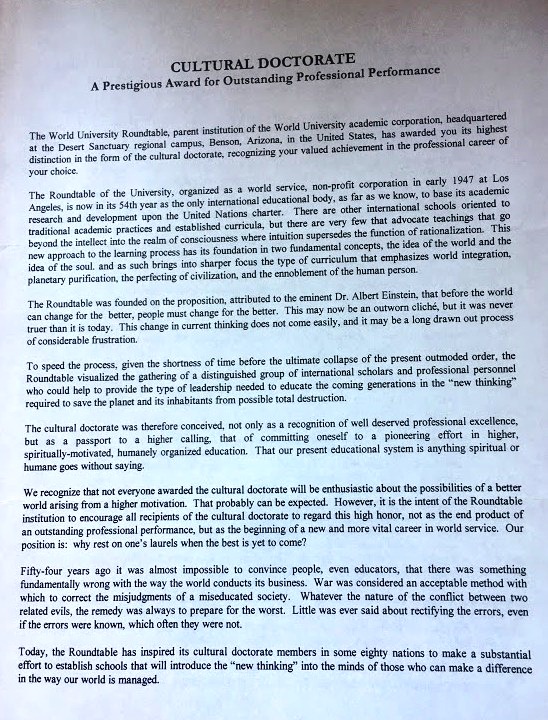
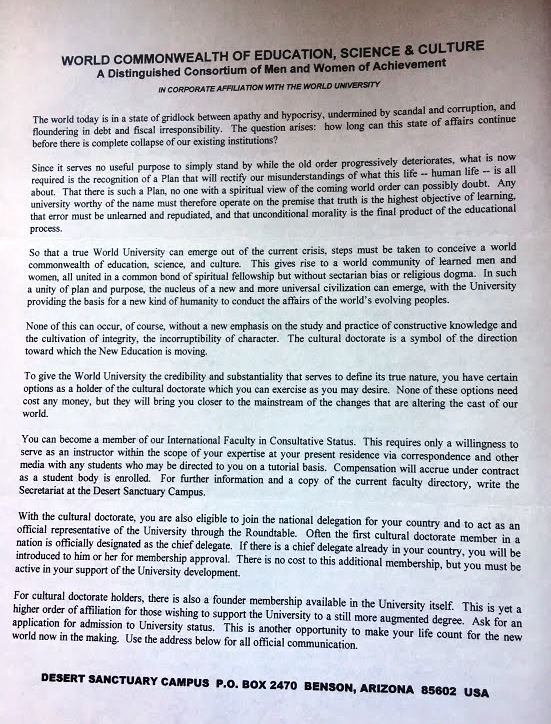
The organisation of the Roundtable proceeded with the appointment of Chief Delegates in each country in which there was representation (that total rising to more than 80 countries by the close of the twentieth-century) and the formation of national offices in those countries beginning with India in 1987 and succeeded by Nigeria and Ghana in 1991, Italy in 1992, Argentina, Greece, Bulgaria, Luxembourg, Bangladesh and others. Membership was by invitation, with each Chief Delegate invited to nominate individuals of considerable distinction in their fields for the award of the Cultural Doctorate in their discipline, which honorary award then brought these individuals into the work of the World University. In addition ordinary membership of the Roundtable was open to those from all walks of life who wished to support the endeavour. In time the roll of the Cultural Doctorate membership was to grow to several hundred, embracing educators, spiritual and political leaders, business people, writers, artists, musicians and others. One of the last recipients was the Governor-General of St Lucia, Dame Pearlette Louisy. In India, the members of the Roundtable were so numerous as to merit the creation of the “Indian Alumni of the World University” under the chairmanship of Dr J.J. Bennett in 1988; the roll of this organisation stood at 88 in 2001. Its activities have included the reprinting of Liftoff in Indian languages, the sponsorship of essay competitions, and the involvement in political, social and humanitarian projects throughout the sub-continent.
In 1958, the World University Roundtable offices moved to Huntington Park from their former location in Hollywood and Burbank, in consequence of Zitko’s appointment to a new ministry there. He was to hold this appointment until 1964, when he devoted himself full-time to the work of the World University. 1962 had seen former US President Dwight D. Eisenhower advocate a World University in an address to the Confederation of Organizations of the Teaching Profession in Stockholm, Sweden, and as a result the World University received banner headlines in the Los Angeles Times. In 1964, Zitko and the World University organised a move to Arizona, where two years later they reached an agreement with the Horizon Land Corporation to relinquish six hundred acres leased from the State Land Department. Once it had become clear that a substantial campus was now a real possibility, the Roundtable trustees organised the new incorporation of the World University itself in Arizona as an institution of higher education on December 21, 1967, having registered the Roundtable in Arizona in 1964. This represented a fulfilment of the original aims of the Roundtable conceived some twenty years earlier, thus creating a twofold organisation comprised of a spiritual arm (the Roundtable) and an academic arm (the University). 1967 also saw the publication of Michael Zweig’s “The Idea of a World University” (Southern Illinois University Press) in which the World University was given honourable mention.
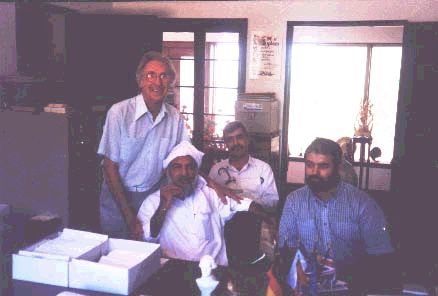
Dr Zitko (standing) with international visitors at the Desert Sanctuary Campus
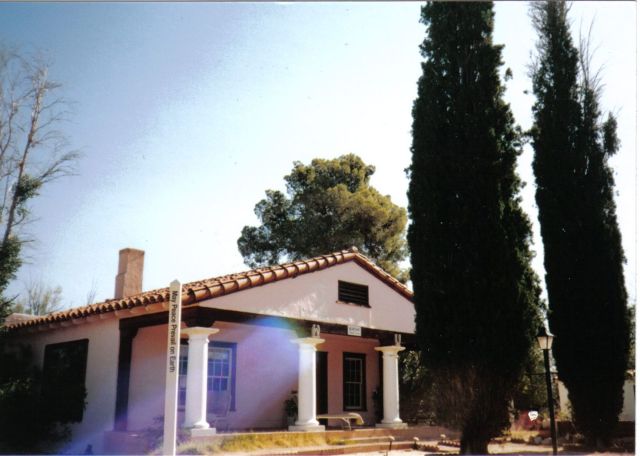
In 1969, after surrendering the lease on their previous land, the World University purchased a complex of buildings in Tucson, to which was added a library, which was to be the University’s home until 1985. That year saw the purchase of the University’s final home, the 80-acre Desert Sanctuary Campus at the foot of the Rincon Mountain Range near Benson, Arizona, and two years later, once the move was complete, the Tucson campus was sold. The Desert Sanctuary Campus had originally been used as a yoga ashram and a school for disadvantaged young people; now it was adapted for the World University with the conversion of its nine buildings to provide offices, visitor accommodation and a substantial library. The library building came to house what is arguably the finest library on esoteric and spiritual science and related subjects in the world, consisting of some 25,000 books, manuscripts and other resources, together with theses that had been submitted for the cultural doctorate. 2003 had seen a successful restoration project completed on the library building. The campus, which is of outstanding natural beauty, also featured an Olympic-size swimming pool. Zitko was to make the campus his home; he received visitors from throughout the world there, and together with a small staff of volunteers administered the business of the World University without salary, funded by donations and by the trust that he had established to support the University in perpetuity. Chief among this staff must be mentioned Zitko’s devoted Secretary, Dr Jill Overway, an expert in yoga also resident on the campus, who typed and prepared each edition of Liftoff and handled much in the way of communications, latterly including messages from around the world via email.
The activities of the University expanded to encompass a substantial publications arm during the 1970s; as well as Zitko’s writings, it published works of literary criticism, child development, poetry by the acclaimed Canadian poet Stephen Gill and the autobiography of impresario Irwin Parnes.
By the 1990s the World University was ready to initiate a series of Regional Colleges, beginning with the North American Regional College (housed at the Desert Sanctuary Campus) in 1998. This college published a prospectus of non-traditional experiential and spiritual studies leading to certificate and diploma awards, with forty-four faculty members drawn from around the world. Although all courses were offered by distance learning, some on-campus instruction also took place, and in 2002 programmes leading to the award of a research doctorate in association with Zoroastrian College were made generally available (from which programme Dr S.S. Walia was the first to graduate in Energy Science, following a thesis on the therapeutic qualities of solar energy). In the following year, the Design, Technology and Management Society initiated the South African Regional College in Ladismith, although this was to cease affiliation in 2002 following a change in management of the DTMS. This was to be followed by the South East Asian Regional College (the World Association of Integrated Medicine in India), the West African Regional College and World University Computer Center (Nigeria) and the Zoroastrian Regional College (the Zoroastrian College, India). At the time of Zitko’s death, Queen’s University, Bangladesh (the largest private university in that country) and the Daya Pertiwi Foundation, Indonesia, were in the process of seeking Regional College status.
Some twenty or so schools and other organisations, whilst not achieving Regional College status, were affiliated or associated with the World University; these included to name but a few, the University for Human Goodness in North Carolina, USA, the Vidya Yoga Free University, Brazil, Ansted University, British Virgin Islands and Malaysia, the International States Parliament for Safety and Peace, the International Association of Educators for World Peace, the Academy of Ethical Science, India, and the Mandingo Academy, New York, USA. Other institutions had formed affiliations with the World University in earlier years, including notably the Parthasarathy International Cultural Academy, India, the Accademia Superiore di Studi di Scienze Naturali e Psicobiofisiche Prof. Ambrosini – Diandra International University and Academy, Italy, Brazil, Spain and USA, and the World University of Intercultural Studies, Bulgaria.
A website was set up by the World University and Roundtable in 1998, and in 2001 this registered 45,784 hits. After the September 11 attacks, the number of hits snowballed from an average of 1,800 per month to an astonishing 12,959 in the month of those events, suggesting that a wider audience was turning to the World University in times of crisis.
Each winter solstice from 1956, commemorating the tenth anniversary of the foundation of the Roundtable, was designated World University Day and formed the focus for an outpouring of worldwide messages to the Desert Sanctuary Campus, sharing in telepathic rapport with the ceremony conducted there. 2002 saw an unprecedented demonstration of support, with many messages from around the globe producing what Zitko described as a “stream of love divine”. In his own words, “there never was a greater conviction among all…that the World University was linked with a Higher Authority, cognizant of the dedication expressed by all those who have made the commitment to support the vision which underlies the New World Civilisation of “Light, Love and Power.” The ceremony had included the Affirmation of Djwhal Khul the Tibetan, a Message of the Master Phylos and Zitko’s own keynote address delivered earlier that year at the Annual Conference in St Lucia.
Zitko was a man of imposing presence and energy, and his spiritual qualities became quickly apparent in any discourse. He was generous with his time and encouragement and was an entertaining and thought-provoking correspondent, sending his review of the year’s events as a Christmas gift annually. His humanity and warmth were witnessed by the many friends he counted throughout the entire world, making the Desert Sanctuary Campus a focus for those who sought an educational and philosophical ideal that transcended temporal boundaries. One rarely exchanged ideas with him without leaving with a renewed faith in human nature. I corresponded with him over a number of years, and in his last message to me he wrote “you are one of the most valued members in our world institution.” The World University survived Dr Zitko’s death, but its activities were gradually discontinued and the campus in Benson was eventually sold.
In answer to the question of how he maintained his faith in the World University in the face of what was at times significant opposition, including at one point a death threat against his person, Zitko replied simply, “Serve as selflessly as possible with your eyes on the stars and your feet on the ground, and let the result take care of itself.”
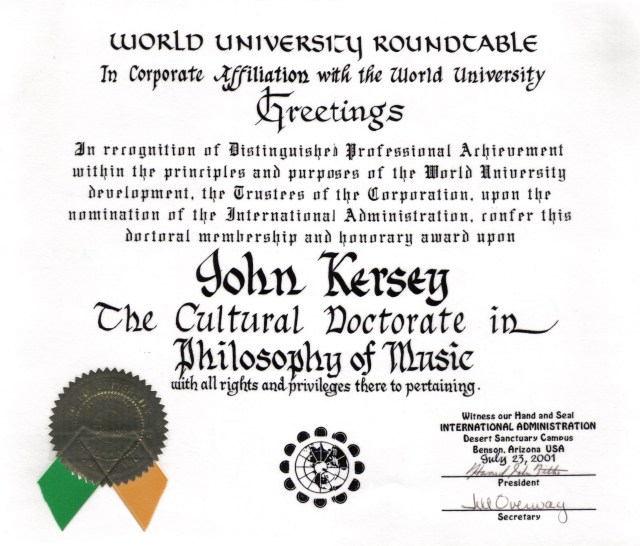
In 2001, I was awarded the Cultural Doctorate in the Philosophy of Music by the World University Roundtable. Subsequently I served the institution as a Founder Member of the World University and as Vice-Delegate and President of its English National Office.
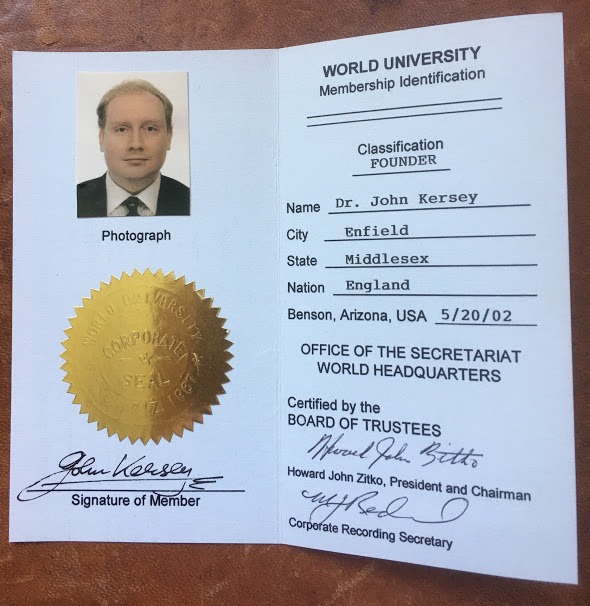



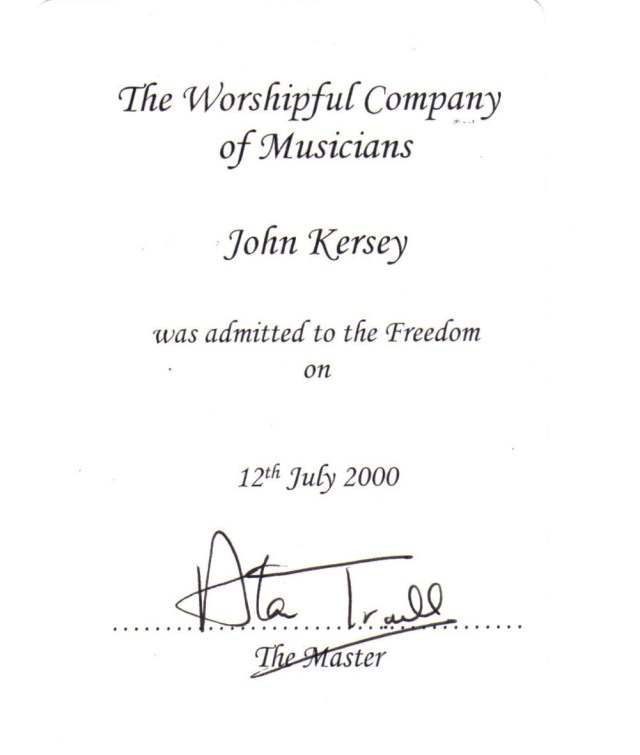


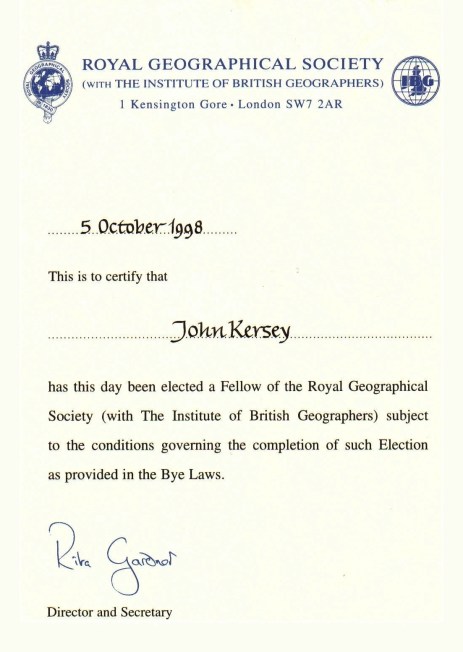
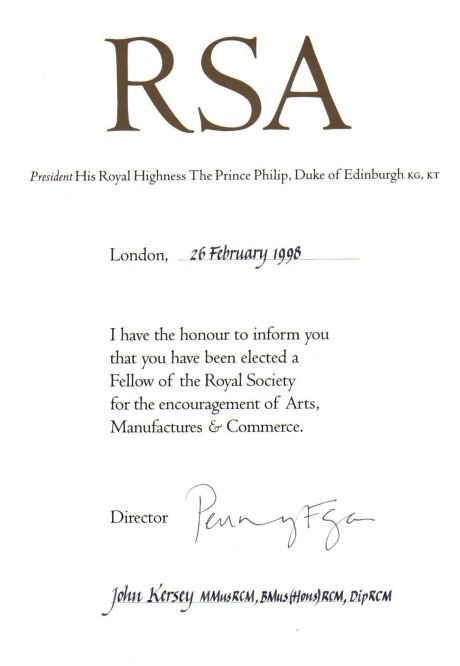
 Professor John Kersey