
I was honoured to receive the Medal of Solidarity awarded by H.R.H. Princess Dayang-Dayang nur Mahal T. Kiram. The Princess is the sister of Ampun Sultan Muedzul Lail Tan Kiram, the current Head of the Royal House of Sulu.
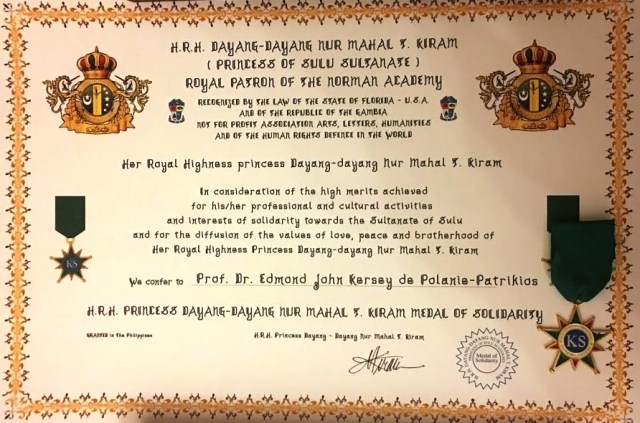

I was honoured to receive the Medal of Solidarity awarded by H.R.H. Princess Dayang-Dayang nur Mahal T. Kiram. The Princess is the sister of Ampun Sultan Muedzul Lail Tan Kiram, the current Head of the Royal House of Sulu.
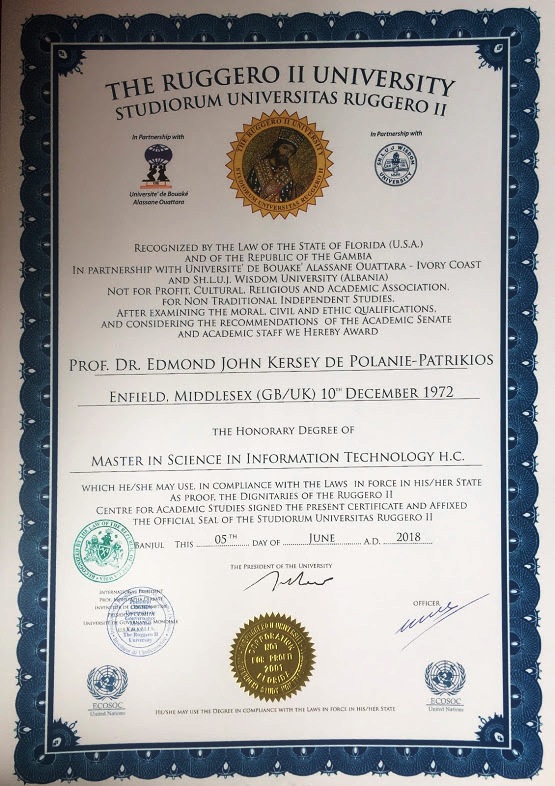
The Ruggero II University (Studiorum Universitas Ruggero II) is a free and independent university incorporated in the State of Florida, USA, since 2001. On 29 April 2003, it was recognized by the Government of the Republic of the Gambia as a Moral Entity of Public Utility, with a degree of incorporation no. 246/2003 issued by the Ministry of Justice. The University has an agreement of partnership with the government-accredited Université Alassane Ouattara (formerly Université de Bouaké), Ivory Coast.
I have been honoured by the University with an appointment as Associate Professor in Music and the honorary degree of Master of Science in Information Technology.

In 2017, I was honoured to be appointed a Grand Commander of the Order of the Calamian Star of Peace. The Order is awarded by Tagbanwa Tribal Chieftain H.M. Rodolfo Aguilar I, ruler of the Coron Island Ancestral Domain in The Philippines.
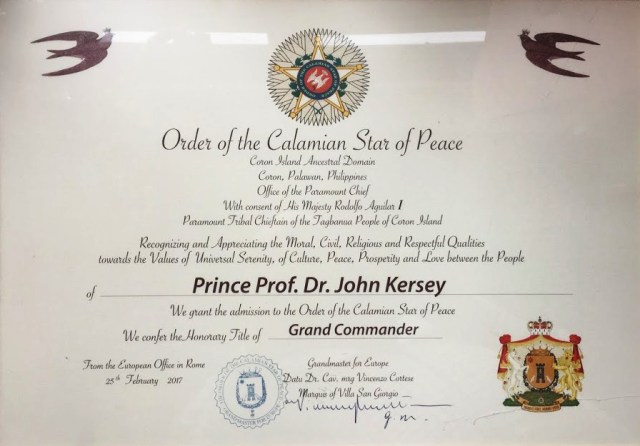
In 2018, I was further appointed as Grand Prior of the UK for the Order.

I have been honoured to receive honorary membership in the Ordo Templum Domini, a Templar Order based in Brazil whose Prior is Archbishop David Caparelli, representative for Brazil of the Apostolic Episcopal Church.


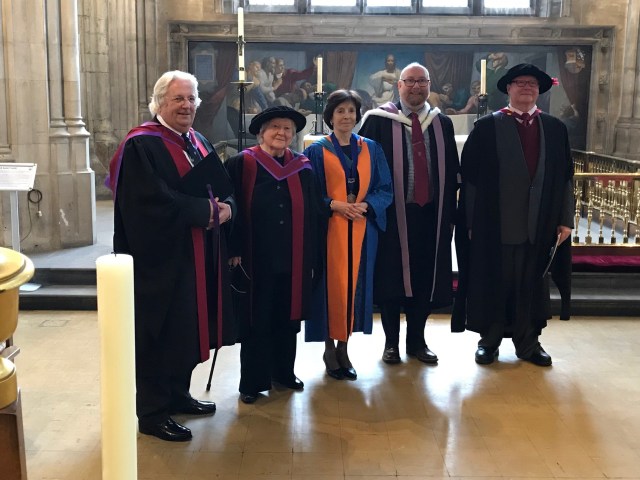
With other Honorary Fellows at the ceremony at All Hallows-by-the-Tower, London.

The presentation ceremony

The Guild of Musicians and Singers was established in 1993 by the late Dennis Puxty. He established as a guiding principle of the Guild that it should draw its membership equally from professional and amateur musicians, allowing through its meetings the productive discourse that characterizes a learned society. Other leading members have included Masters of the Guild Dr David Bell, late organist to Herbert von Karajan, and Dr Maurice Merrell, chairman of the organ builders Bishop and Son.
The Guild has held twice-yearly meetings in central London, latterly at All Hallows by the Tower, which have been committed to celebrating a high standard of musical performance throughout. Programmes have included recitals on both the church and theatre organs and concerts by chamber and brass ensembles. I have given two piano recitals for the Guild, in 2004 and 2014. Illustrated lectures and talks have also been an important feature of the Guild’s activities.
The Guild is not an examining body but has admitted candidates to membership as Associates (now discontinued), Licentiates or Fellows based on their musical achievements. I was elected a Fellow in 2001.

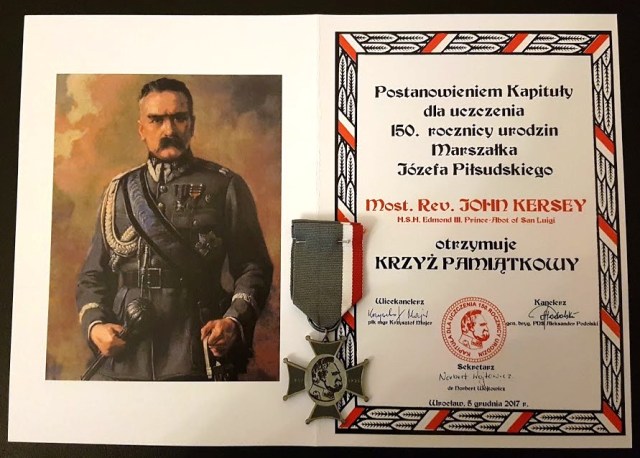
I have been honoured to receive the Commemorative Cross of the 150th anniversary of the birth of Marshal Józef Piłsudski. This is a joint decoration on the initiative of several Polish veteran organizations, patriotic associations, monarchists and former military men. It was made in a circulation of only 300 medals.
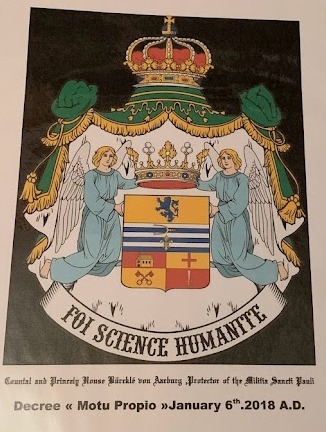
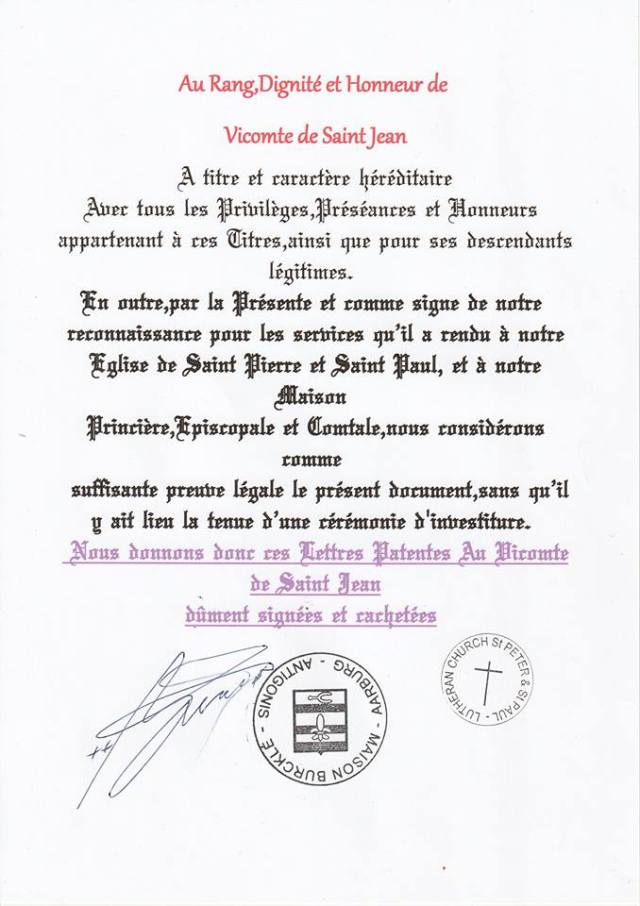
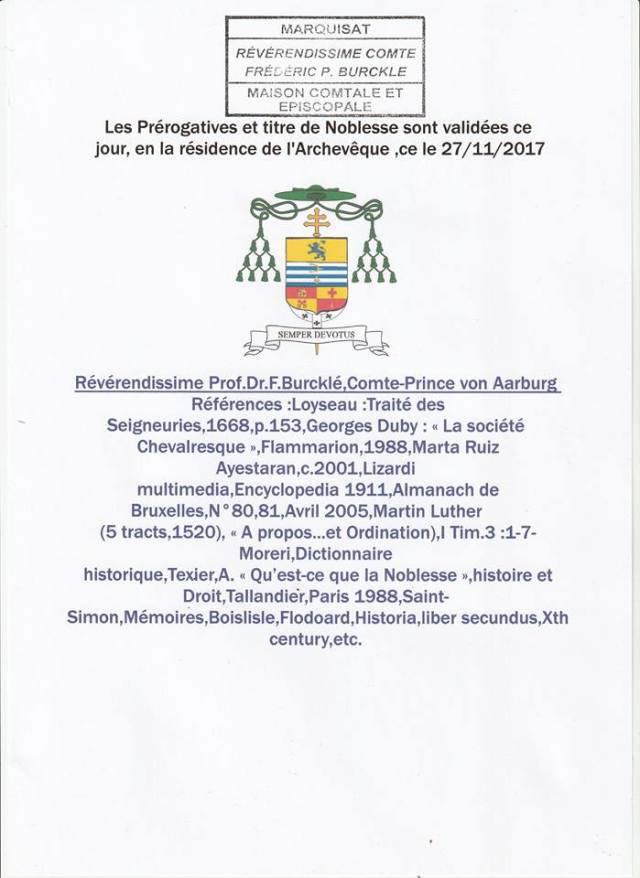
Archbishop Frederick Burcklé von Aarburg has conferred the title of Vicomte de St Jean upon me, as well as the Grand Cross of the Militia Sancti Pauli under his aegis. Archbishop Burcklé resides in France where he is head of the Church of St Peter and St Paul, which is a Lutheran denomination. He also holds a number of titles of nobility of high rank, and has established a number of agreements of co-operation between his institutions and those under my aegis.


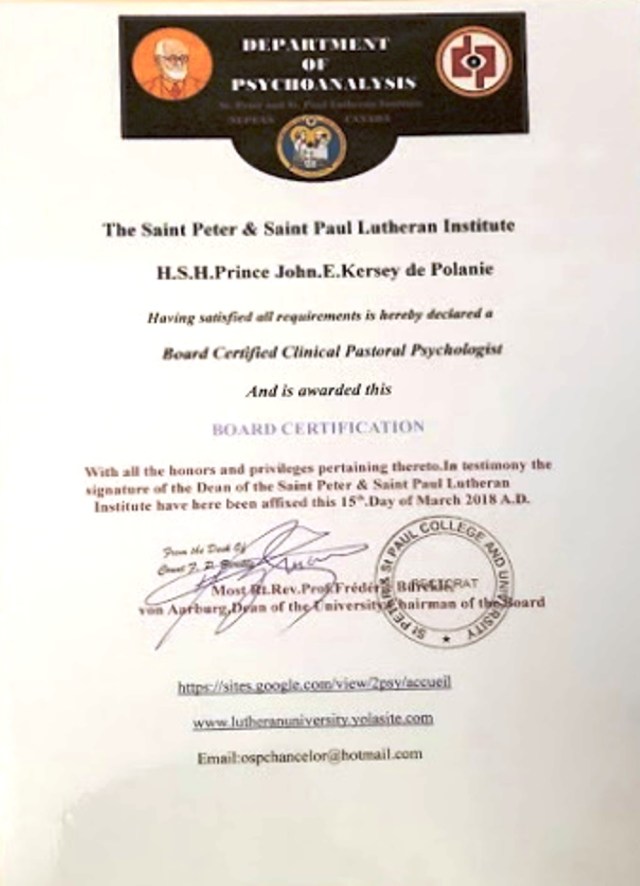
The Department of Psychoanalysis of the Saint Peter and Saint Paul Lutheran Institute, which is registered in France under Archbishop Frederick Burcklé, has declared me to be a Board Certified Clinical Pastoral Psychologist, based on my experience in pastoral psychology, which particularly focuses on the methods and teachings of Jung and R.D. Laing.
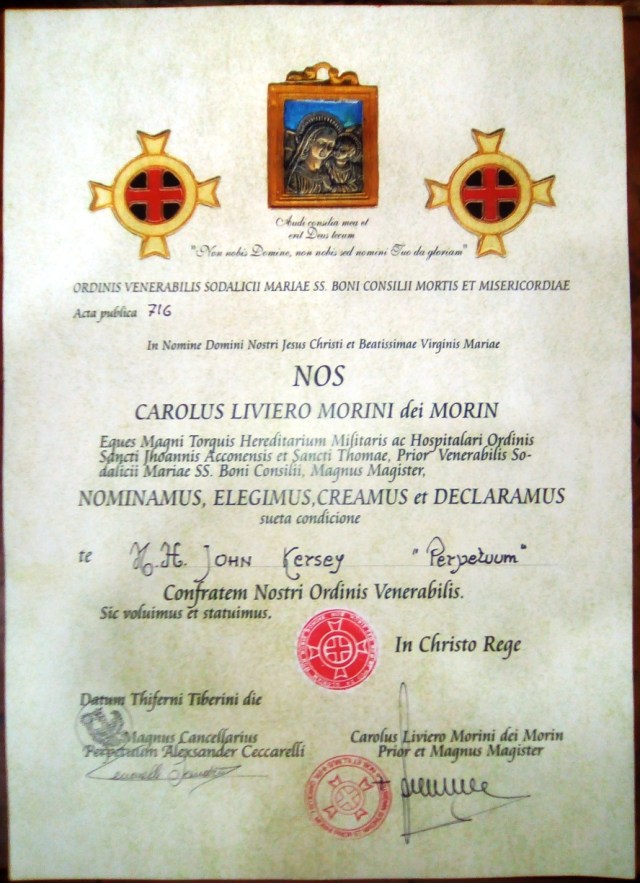
 The Venerabile Confraternita (o Compagnia) detta del Buonconsiglio di Città di Castello and the OR.VEN. – Ordine Venerabile della Venerabile Confraternita di Maria Ss.ma del Buonconsiglio della Buona Morte e
  Misericordia, Città di Castello, Italy (Order of the Venerable Confraternity (or Company), known as of (Our Lady of) Good Counsel of Good Death and Mercy of Città di Castello) is a chivalric and Christian brotherhood that can trace its origins to the last years of the first millennium (990-999 A.D.) and in its present form dates to 1230, making it probably the oldest religious brotherhood in continuous existence today. The Order is based at Città di Castello (Province of Perugia) where it has its own Magistral Church, and is governed by a Grand Prior (Grand Master). I have had the honour to be appointed a Perpetuum (Grand Cross) of the Order, its highest rank.
>>Further information (in Italian)
>>More information
>>History
>>Photographs of the Order
>>The Magistral Church of the Order
>>The Magistral Church (further information)
>>Statutes of the Order
>>Press article on the Order (in Italian)
The Order of St George traces its history to its foundation as a knightly fraternity in 1326 by King Károly Róbert of Hungary. In post-communist Hungary, chivalric traditions were revived, and in 1991, Sándor Hadházy, mayor of Visegrád, with other leading citizens, established a cultural association in continuation of the objects of the Order that carried out its first investiture of knights the following year. The Order swiftly became established in Hungary with many prominent members. In 1994, Frigyes Kahler (English: Frederick Kahler), the senior judge in Hungary, succeeded as Grand Master. The Ceremony in St Stephen’s Basilica, Budapest to install him was attended by the President’s representative, the Cardinal Primate and the senior Protestant bishop, as well as numerous politicians. Dr Kahler served until 1997 when he was succeeded by Colonel László Erdős.
In 2000, a division in the Order occurred as a result of a financial dispute between the Grand Magistry and the British Grand Priory under General János Daniel vitez Karaszy-Kulin as Grand Prior. General Karaszy-Kulin recalled that he had been faced with demands from the Grand Magistry to raise the membership fee by 500% and transfer 50% of the assets of the British Grand Priory to the Grand Magistry. He objected that this was unjust and in violation of the spirit of the Order. Holding that his continuation of the Order was as its legitimate successor, General Karaszy-Kulin duly took office as Grand Master and renamed it as the International Knightly Order of St George. Frigyes Kahler served as one of his Deputy Grand Masters.
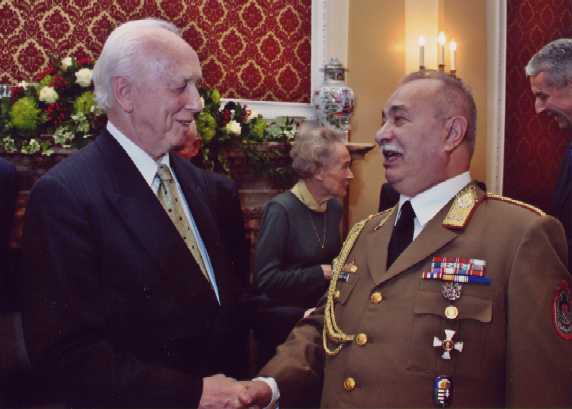
General vitez János Karaszy-Kulin (right) with President of Hungary Ferenc Mádl
General vitez János Karaszy-Kulin was one of the most highly-decorated officers in the Hungarian armed forces, and was revered as one of the heroes of the Second World War and of the 1956 uprising, in which his valour earned him the highest military distinctions. It also earned him a death sentence under the Communist régime and forty years in exile under an assumed name in England.
Upon the fall of communism he was able to resume his rightful place and was promoted to the rank of Major General of the Hungarian Air Force. He was received by the Hungarian President and named a Hero of the Hungarian People. He held many chivalric distinctions and was a Knight Grand Cross and Grand Officer of Merit of the Military and Hospitaller Order of St Lazarus (Paris Obedience) and a Knight of the Order of the Vitez.
The Order defined its aims as to assist the needy, both mentally and materially, and to uphold the Chivalric Code of Prowess, Justice, Loyalty, Defense, Courage, Faith and Humility. Members were charged with the continuation of the traditions instituted by the medieval Order. They must provide a charitable service to humanity, support the underprivileged, hospitals, hospices, orphanages, homes for the elderly and other worthy institutions. They must reward the services rendered to humanity in all fields of human achievement.
This was reflected in an energetic programme of charitable work. In the war-torn areas of Croatia, Romania, Bosnia, Kosovo, Czechoslovakia and Hungary the Order shipped on a regular basis 220 tons of second-hand clothing, bedding, food, hospital equipment including X-ray machines, and other medical equipment to a value of US$15 million to the aid of the needy in Eastern Europe.
The principal project of the first decade of the twenty-first century was the reconstruction and furnishing of a derelict building as a home for the elderly in Nyírgelse in the north-east of Hungary. The Hungarian Government pledged to match donations made by the Order in the ratio of 2:1. A special appeal was organized under the patronage of Rt Hon Lord Taylor of Blackburn, who was a Grand Cross of the Order of St George, and the £20,000 needed to complete the project was raised within two years. As a result, the St George’s Home was completed on schedule and opened by the Grand Master and his wife, Colonel Dame Iris, on 20 August 2002. It provided accommodation to a modern standard for sixteen elderly people in need, as well as housing a day centre, which served the wider community of older people in this deprived area.
The Order under General János Karaszy-Kulin had as its Spiritual Protector the Bishop of Rochester, Dr Michael Nazir-Ali, and held its annual investiture in Rochester Cathedral. A representative of the Hungarian Embassy usually attended in an official capacity. As well as Hungary and the United Kingdom, the Order established priories in Poland, the Netherlands, Serbia, and Canada. György Keller, the Grand Prior of Hungary and Deputy Grand Master, was also Major-General and Vice-President of the Hungarian National Guard, bringing about a close connection between the Hungarian National Guard and the Order.
The Hungarian National Guard (Magyar Köztársaság Nemzetör Gárda), under the command of the late General Professor Béla Király, was the historic Hungarian reserve force, originally founded in 1848, that mobilised against the Soviet invaders in 1956. General János Karaszy-Kulin was Commander-in-Chief of the Hungarian National Guard (Overseas), and a number of senior members of the Order of St George received honorary military rank in the Hungarian National Guard as a result.
I met General János Karaszy-Kulin through our common involvement with the Central School of Religion, of which he was an honorand and Fellow. We quickly developed a friendship and I visited him and his wife Dame Iris on a number of occasions at his home in Rochester. He appointed me to an honorary commission of Major in the Hungarian National Guard in 2002.

At the General’s invitation, I was admitted as a Knight of the Order of St George at the investiture in Rochester Cathedral in 2003.

At the investiture in 2004, I was promoted to Knight Commander.

I was awarded the Medal of the Anniversary of the 1956 Revolution of the Hungarian National Guard by the General in the same year.


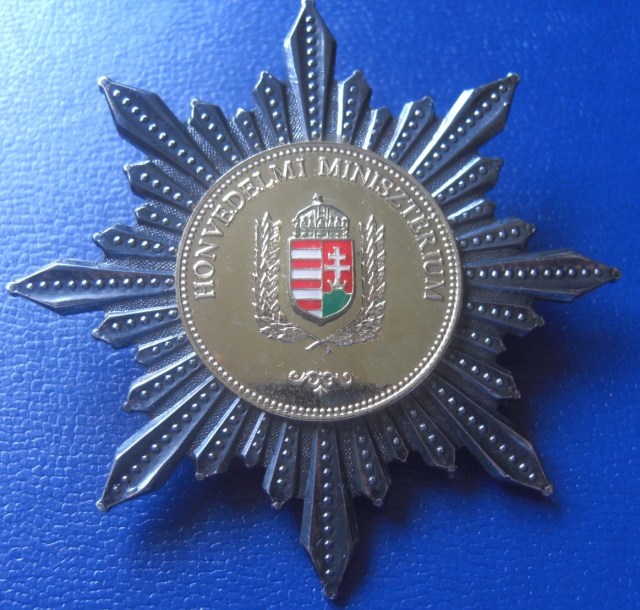
In addition, I received the Grand Star of the Hungarian National Guard, its highest honour, which was awarded with the approval of the Hungarian Ministry of Defence. This was presented by the General at the dinner following the Order’s investiture at the King’s School Rochester. It carries the postnominal letters MKNL (the postnominal MKN signifies a member of the Hungarian National Guard, and the addition of the L represents the Grand Star).
In 2005, I was promoted by the General to the honorary rank of Colonel in the Hungarian National Guard.

The General repeatedly asked me to become involved in the government of the Order of St George, but I declined his offers. The Order had been registered as a charity in England and Wales, but the committee nature of charitable governance did not sit well with the General, whose leadership style was that of military command. Several unsuccessful appointments to senior positions had resulted in the breakdown not only of working relationships but also of personal friendships. I considered it vital that I should preserve my friendship with the General, and avoid being led into any situation of potential conflict.
Moreover, the Order was, in those days, comprised of an extremely interesting and varied group of people, meaning that the investitures and other events were not merely ceremonial occasions but also social gatherings of great warmth and fellowship. Ken Martin, who was a Deputy Grand Master, became a good friend and I regularly visited him at his home in Cambridge. He was Dean of a leading sixth-form college there, and at their annual Advent service of Nine Lessons and Carols (which was held in the chapel of St John’s College), the General and several senior members of the Order were regularly among the guests. I greatly enjoyed this occasion, which was always well-organized and musically of a high standard.
When I was involved in the foundation of Claremont International University (Seychelles) the General and Dame Iris graciously agreed to serve as joint Chancellors and were strongly supportive of the University’s aims and ethos. The General was also appointed a Fellow of the Institute of Arts and Letters (London) and made a number of successful nominations to the Fellowship.
The General was happy to hear of my ordination and episcopal consecration, and at the investiture at Rochester Cathedral in 2007, I was invited to join the other clergy in the sanctuary.
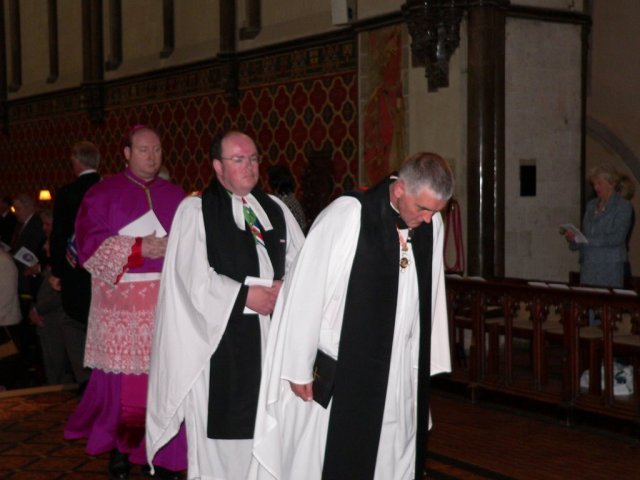
In October 2008, the General, who had been in poor health for some years, died. At his memorial service in Rochester Cathedral, my obituary for him was read by his son. In one of our last meetings, he had discussed his plans and wishes for the future of the Order, and also said that he wished to promote me to Grand Cross.
It was not long before the Order was plunged into a period of conflict and strife. At the conclusion of this, two bodies emerged tracing their common origin to the Order as it had been constituted under the General. Both are registered charities and endeavour to continue the Order’s aims and charitable mission.
The duly elected Grand Master, Tadeusz Kaczor, who had been the Order’s Grand Prior of Poland, presided over what became known as the Knightly Order of St George the Martyr, whose English representation was based in Cambridge and which had priories in Hungary and other countries in Europe. At its investiture held at Great St Mary’s in 2017, I was promoted to Grand Cross of the Order.

I have been honoured with the award of Academical Knight of Verbano “for high cultural merits” by the Ordine Accademico Internazionale “Greci-Marino” – Ordine Accademico del Verbano, Italy.
>>Profile of the Accademia
>>Further information: page 1; page 2
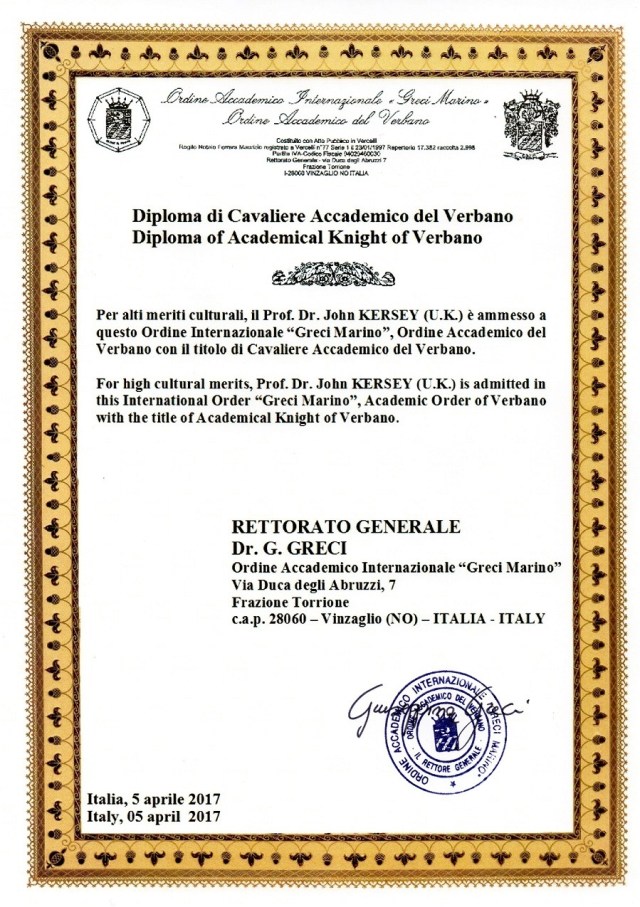
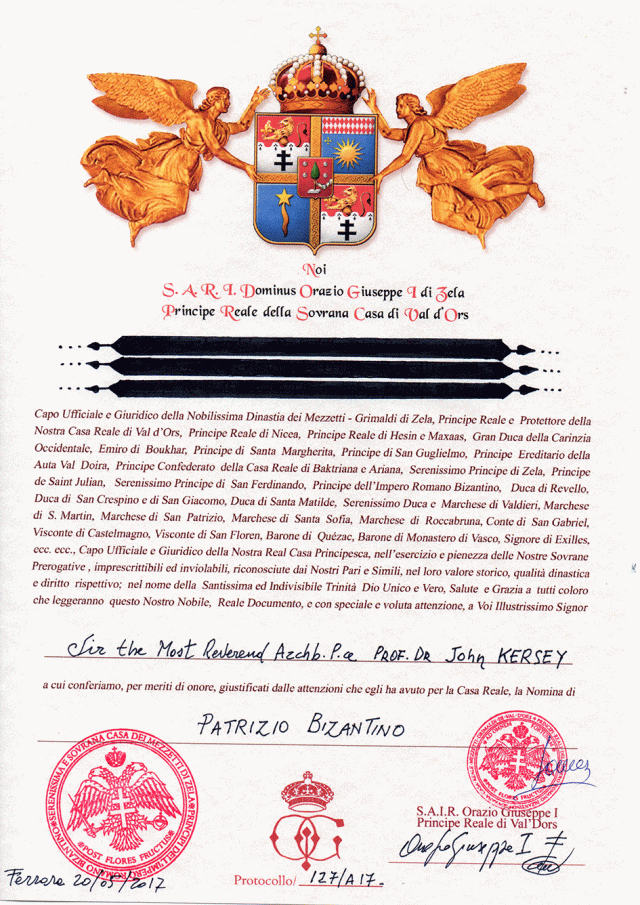
I have been honoured with the title of Byzantine Patrician from Don Orazio Giuseppe Mezzetti, Prince of Zela and Head of the Sovereign House of Dalmatia (Val d’Ors).

The International Academy of Saint George is incorporated in the State of Wyoming, USA. The Academy offers advanced studies in History, Heraldry, Chivalry and Ecumenical Religion. I have been honoured by the Academy with the award of Academic Doctor honoris causa in Religion.

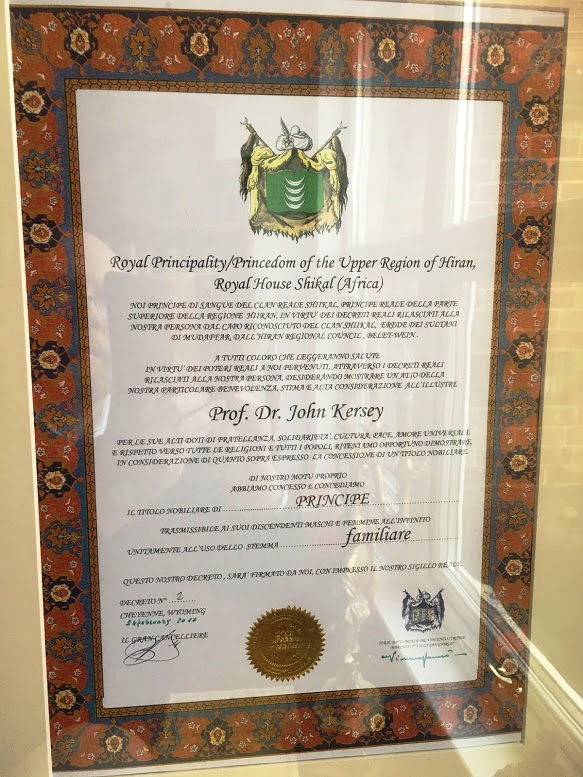
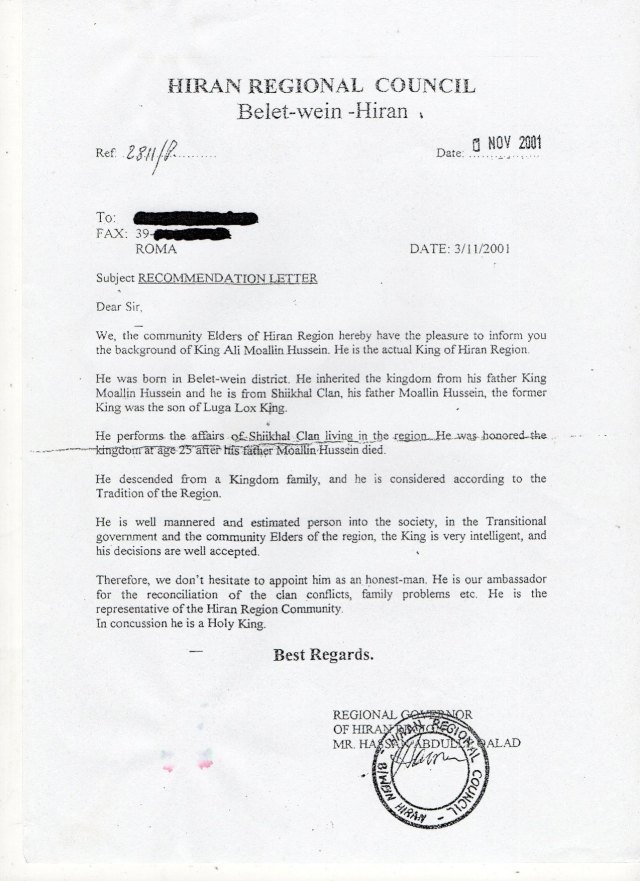
I have had the honour to be created a Prince of the Royal Principality of the Upper Region of Hiran, Royal House Shikal, Somalia. The Head of the Royal House Shikal is H.E. and H.R.H. the Ambassador, Federal, Special Police and Military Colonel (G.di F.), Royal Prince Professor Dr Ali M. (Moallim) Hussen, son of the late traditional King of the Hiran Region of Somalia, H.R.H. the Prince Moallim Hussen, descendant of the Sultanate of Mudaffar.
 Prince Ali M. Hussen was Minister of Justice for the Horn of Africa from 1965 to 1967. He served as Somalian Ambassador to the the Holy See/Vatican City during the incumbency of President Major-General Mohamed Siad Barre (1990) and subsequently became Ambassador of the Transitional National Government of Somalia for Italy. Prince Ali was Shaykh/Sheik of Tariqah Qadiriyyah of Sufism, and President from 1981 to August 2003 (when he retired due to health problems) of the Associazione Musulmani Italiani (A.M.I./Association of Italian Muslims (established in Naples in 1982 and heir of the Associazione Musulmana del Littorio, Muslim Association of Littorio (Fasces), co-founded by H.R.H. Prince Moallim Hussen in 1937). Prince Ali was also an Islamic Judge (Qadi) and Professor of Islam, from 1970, by a Decree of the Grand Mufti of Saudi Arabia, Shaykh Abd al-Aziz ibn Baz.
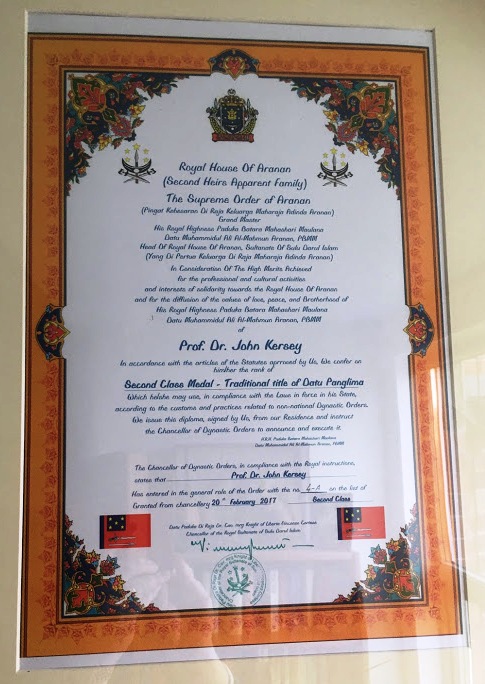
The Head of the Royal House of Maharaja Adinda Aranan, H.R.H. Datu Muhammidul’ Ali Al-Mahmun Arunan, PBMM etc. has bestowed the Second Class Medal and title of Datu Panglima in the Supreme Order of Aranan upon me. This follows my earlier appointment as Datu Paduka in the Grand Order of Sultan Bantilan Muizuddin in 2016.
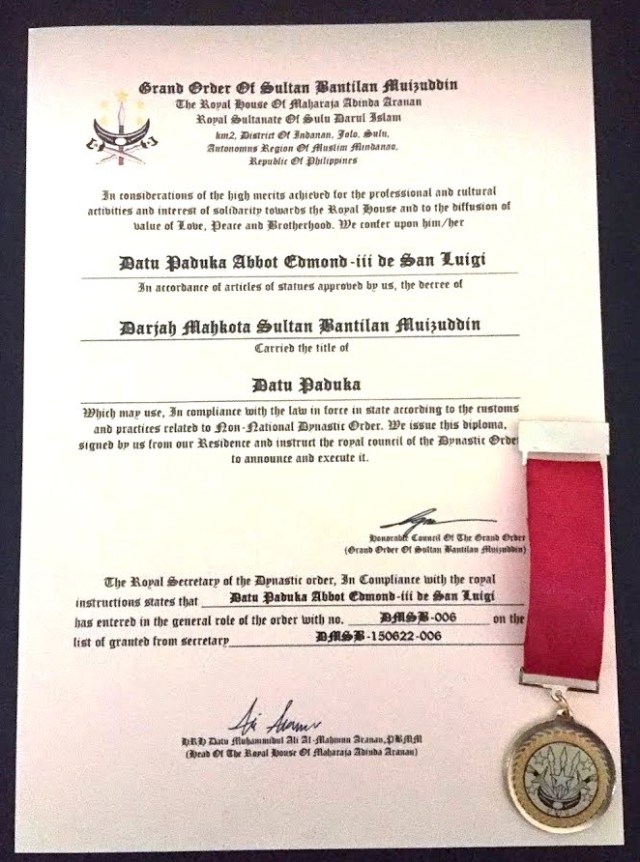
The Royal House is descended from Sultan Bantilan Muizuddin, who ruled as Sultan of Sulu between 1748 and 1763. The Sultanate of Sulu includes parts of the present-day Philippines and Brunei, and reigned between 1405 and 1915.
I have been honoured by the Norman Academy with an appointment as Academician of Honor.
The Norman Academy is incorporated in the State of Florida, USA, and is a non-profit association concerned with Arts, Letters, Humanities and Human Rights. It is active in the United States, Italy and The Gambia, where the President, H.E. Dr Yahya A.J.J. Jammeh, is Honorary Chairman of the Norman Academy. On April 29, 2003, the Norman Academy was recognized by the Government of the Republic of The Gambia as a Moral Entity of Public Utility and of High Culture, with decree no. 246/2003 issued by the Ministry of Justice.

The Head of the Royal House of Maharaja Adinda Aranan, H.R.H. Datu Muhammidul’ Ali Al-Mahmun Arunan, PBMM etc. has bestowed the title of Datu Paduka in the Grand Order of Sultan Bantilan Muizuddin upon me. The Royal House is descended from Sultan Bantilan Muizuddin, who ruled as Sultan of Sulu between 1748 and 1763. The Sultanate of Sulu includes parts of the present-day Philippines and Brunei, and reigned between 1405 and 1915.
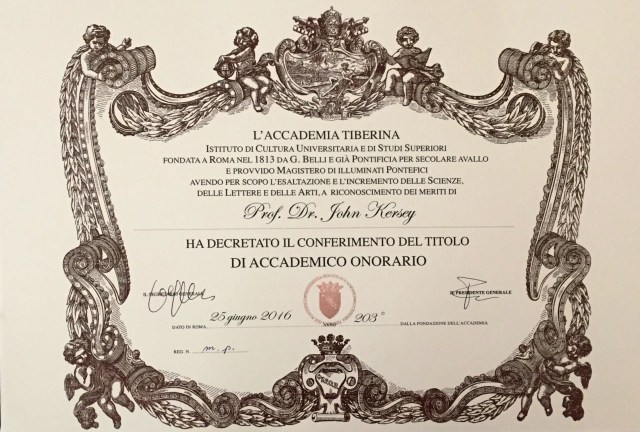
I have been honoured to have been admitted as a Pontifical Academician, becoming an Honorary Academician of the Pontificia Accademia Tiberina in Rome, Italy. The distinction of Honorary Academician is the highest award of the Accademia.
The Accademia Tiberina was founded in 1813 and received official recognition from the Sacred Congregation of Studies under Pope Leo XII in 1825. Already in 1816, the Papal States had granted the Accademia the right in perpetuity to display on its door the coat of arms of the Senate and the Roman people. In 1878 the Accademia was given permanent hospitality in the palazzo of the Cancelleria Apostolica by Pope Leo XIII.
 The Accademia counts five popes among its distinguished past membership: Pius VIII, Gregory XVI, Pius IX, Leo XIII, and Pius XII, and numerous Cardinals of the Catholic Church. Among its many other distinguished members are the composers Liszt, Bellini, Rossini and Respighi, the inventor Marconi and the chemist Marie Curie.
The Accademia has also honoured Eastern Catholic prelates, including the Patriarchs of the Melkite Greek Catholic Church and the Syrian Catholic Church. During the 1930s, as a means of improving relations between the Holy See and the Abbey-Principality of San Luigi, the Duc d’Allery de Bourbon, who was a member of the Camerier Secret of the Pope, arranged for Prince Edmond I de San Luigi to be admitted an Academician of the Accademia Tiberina. My present appointment as his successor some eighty years on stands as testament to continued friendly relations with Rome.
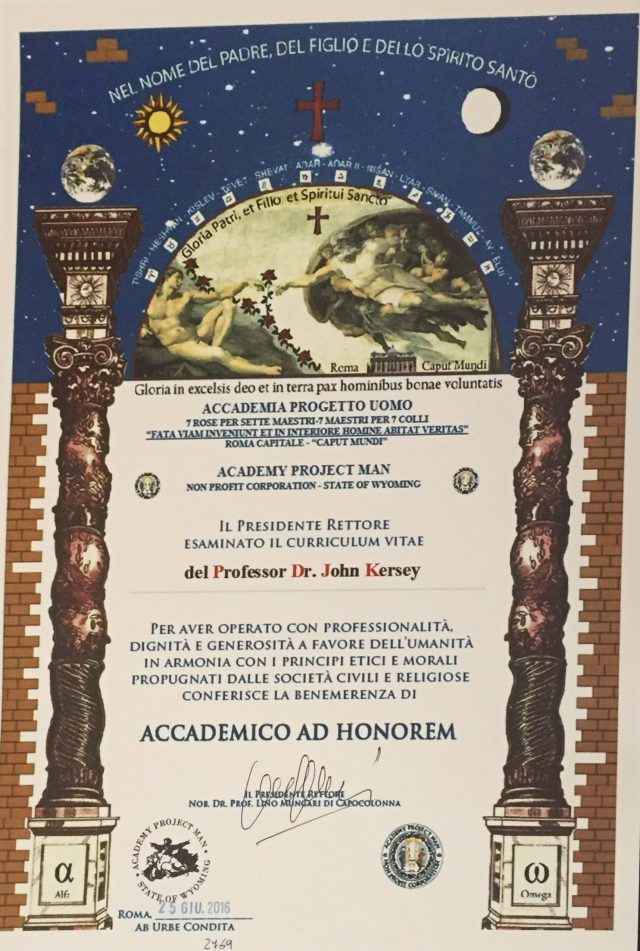
The “Academy Project Man” (Accademia Progetto Uomo), is incorporated in the State of Wyoming, USA, and also based in Rome, Italy. Its activities include the organization of conferences and the conferral of prizes for humanitarian work. I have been honoured by the Academy with the distinction of Honorary Academician.
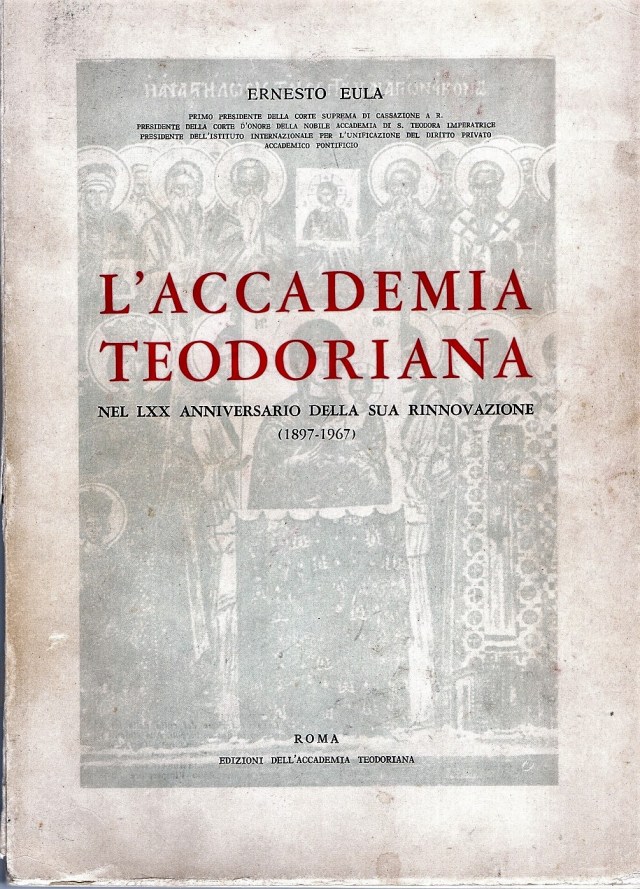
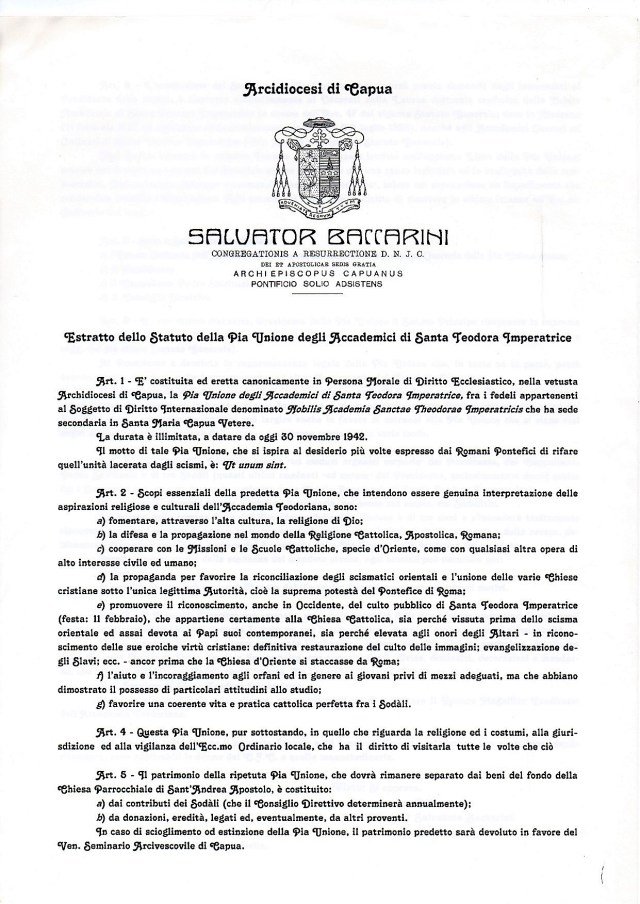
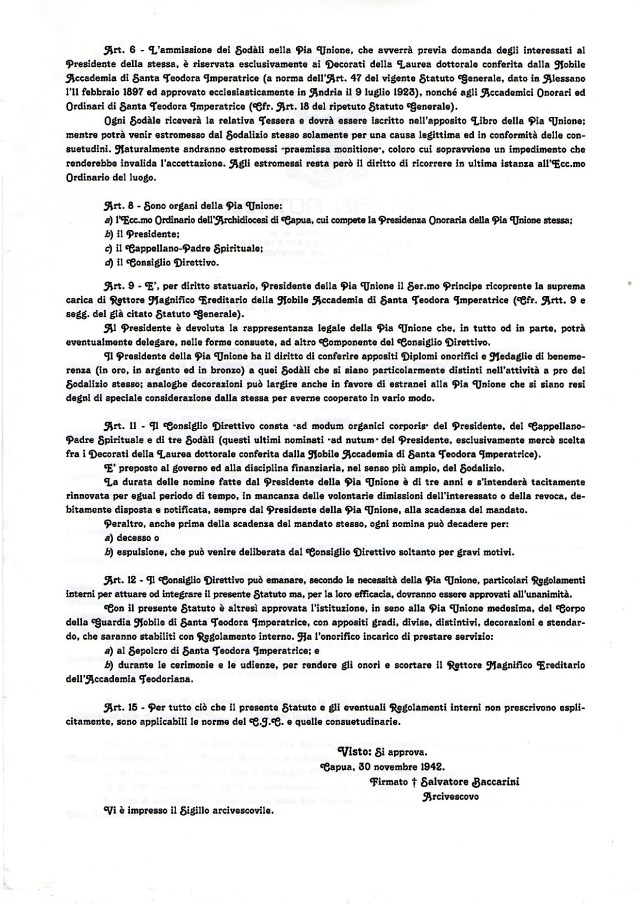
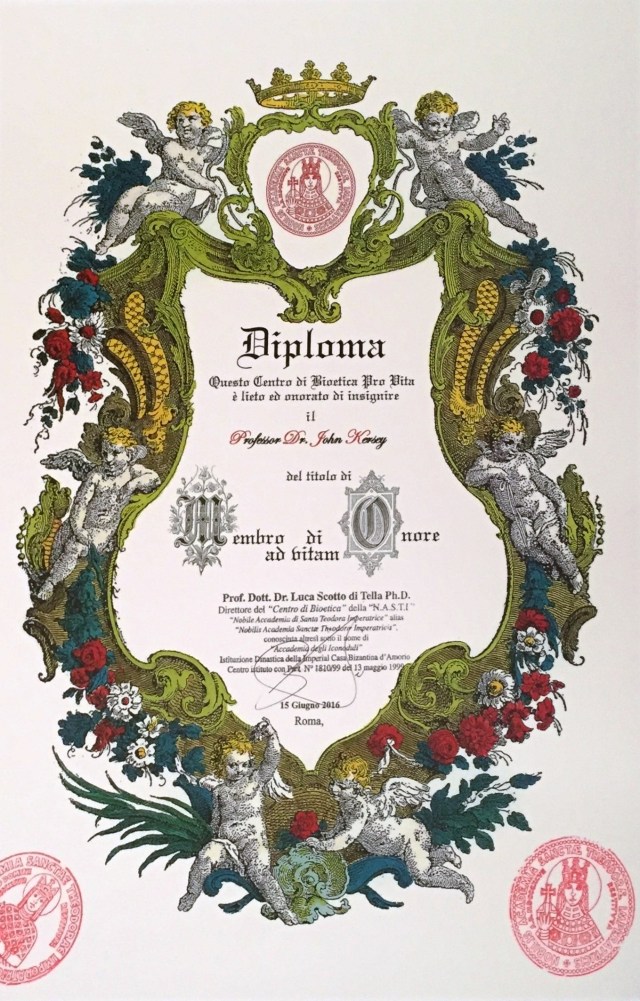
I have been honoured by the Nobile Accademia di Santa Teodora Imperatrice (NASTI), Rome, Italy. The Accademia is recognized as a subject of international law by the Italian government and since 1942 has been recognized as a sodality of the faithful by the Archdiocese of Capua of the Roman Catholic Church.


The International University SAADAUD was founded in Mogadishu, Somalia, in 1980, by H.E. and H.R.H. the Ambassador, Federal, Special Police and Military Colonel (G.di F.), Royal Prince Professor Dr Ali M. (Moallim) Hussen, son of the late traditional King of the Hiran Region of Somalia, H.R.H. the Prince Moallim Hussen, descendant of the Sultanate of Mudaffar. Prince Ali became its first Rector. The University was officially registered and recognized by the Government of Somalia. The Centre of Bioethics and Human Rights was established by Rectoral Decree in 2006. Prince Ali M. Hussen was Minister of Justice for the Horn of Africa from 1965 to 1967. He served as Somalian Ambassador to the the Holy See/Vatican City during the incumbency of President Major-General Mohamed Siad Barre (1990) and subsequently became Ambassador of the Transitional National Government of Somalia for Italy. Prince Ali was Shaykh/Sheik of Tariqah Qadiriyyah of Sufism, and President from 1981 to August 2003 (when he retired due to health problems) of the Associazione Musulmani Italiani (A.M.I./Association of Italian Muslims (established in Naples in 1982 and heir of the Associazione Musulmana del Littorio, Muslim Association of Littorio (Fasces), co-founded by H.R.H. Prince Moallim HUSSEN in 1937). Prince Ali was also an Islamic Judge (Qadi) and Professor of Islam, from 1970, by a Decree of the Grand Mufti of Saudi Arabia, Shaykh Abd al-Aziz ibn Baz.


 Professor John Kersey


