My education: Fellowship of the Norwich School of Church Music

The Norwich School of Church Music (archived website from 2004) was founded in 1981 by some local church musicians in Norwich. Its diplomas were awarded either after examination or by recommendation. The diploma of Associate of the School was awarded after successful completion of two essays of between 5,000 and 7,000 words each. The titles were published by the School; one must be on History of Church Music, and the other on Liturgy and Practice. The entry requirement was five years’ experience as a church musician in whatever capacity. The diploma of Fellow of the School was awarded after successful submission of an extended essay of about 10,000 words, or of a portfolio of compositions. Entry requirements for Fellowship were the ANSCM with two extra years’ experience, or five years’ experience with certain approved qualifications.

Diplomas could also be awarded on the basis of work done, with recipients being recommended to the Council for election, usually by existing Fellows of the School. In this way they resembled somewhat the manner in which “Lambeth” degrees are awarded. The Fellowship was awarded to church musicians of long standing or of prominence; the Associateship was awarded to those who, while not necessarily musicians in the first case, had the interests of church music at heart. There was no difference in standing of recipients of diplomas by this method as opposed to those who gained them by examination.

The School closed in 2010.

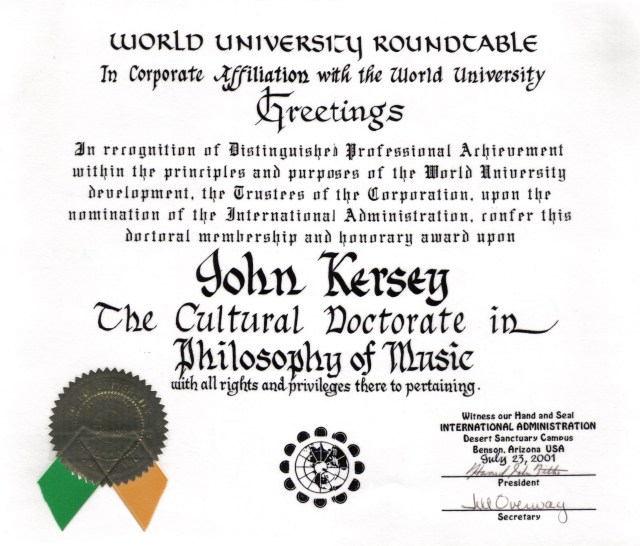
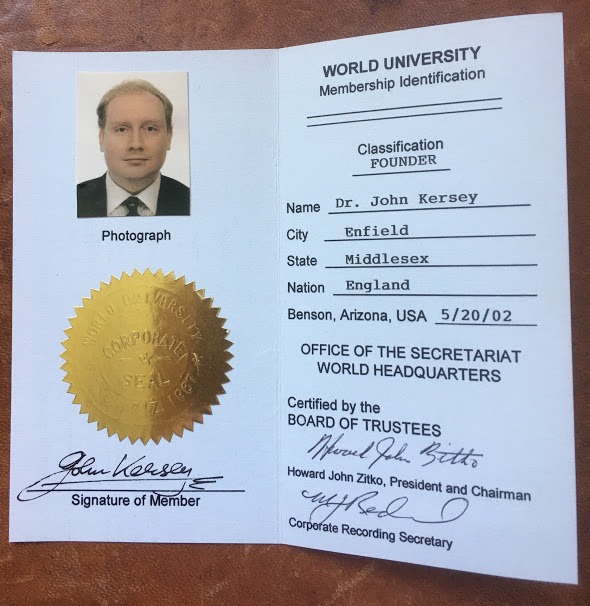
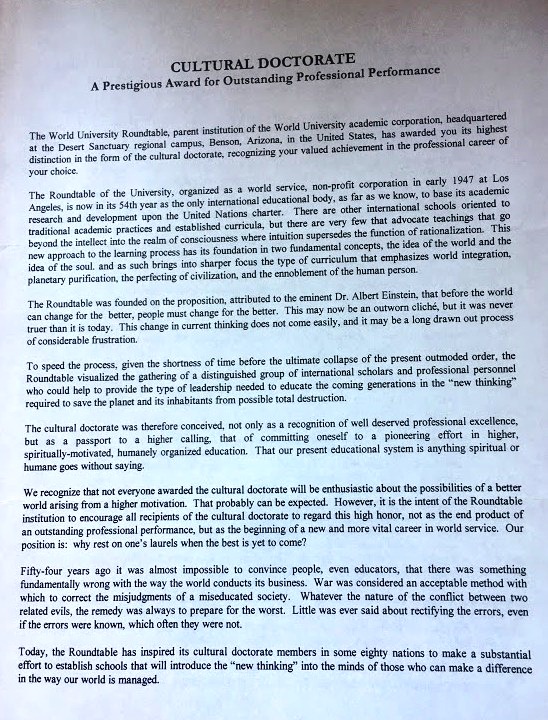
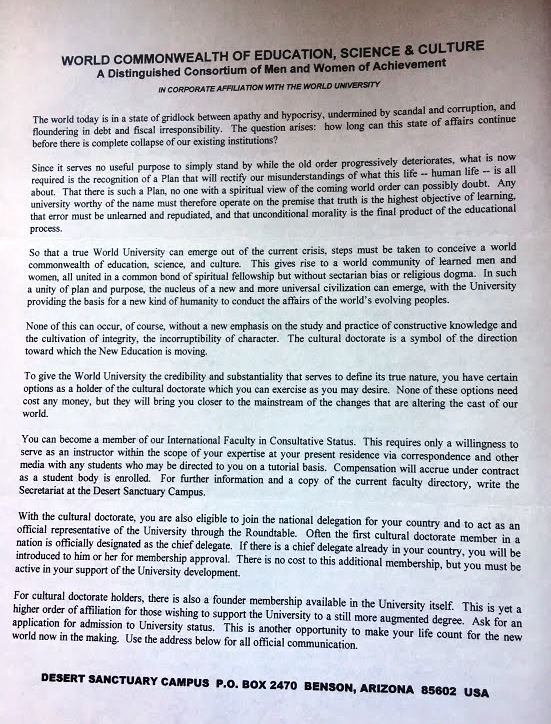
Honours and awards: Cultural Doctorate in Philosophy of Music from the World University Roundtable, Arizona

Howard John Zitko (1911-2003) was responsible, largely single-handedly, for the creation of the World University Roundtable, an international learned society that was, some twenty years later, to create the World University in Arizona and, via its Regional Colleges, in Africa, Asia and South Africa as well. His vision of education was ambitious and all-encompassing, rooted in an esoteric spiritual consciousness which pervaded everything that he did. In his pursuit of the World University ideal of a global educational establishment transcending national and cultural boundaries, Zitko was far ahead of his time; many of his ideas concerning experiential education have since passed into the mainstream contexts of the non-traditional, open and distance education movements in the USA and elsewhere. If his pioneering achievement was at times acknowledged more by a circle of initiates rather than by the public at large, this was a reflection of the way his ideas had come to capture the mind of a generation to such an extent that they had ceased to be merely the property of a single individual and passed into common consciousness.

Born on 26 October 1911 and educated at the Universities of Wisconsin and California, Zitko entered the Christian ministry in the 1930s in Milwaukee, Wisconsin, later becoming pastor of churches in Hollywood and Huntington Park, California. His interest in spiritual matters transcended orthodox Christianity, however, and he began to become increasingly involved with the Arcane school of belief, whose chief protagonist was Alice A. Bailey. Other esoteric spiritual influences acknowledged by Zitko at this time included C.W. Leadbeater (Theosophy), Max Heindel (Rosicrucianism), Manly P. Hall, Edgar Cayce, Krishnamurti, Aurobindo and Sivananda. Influenced by these teachings, Zitko became much involved in Lemurian and Atlantean philosophy, which was at that time to the forefront of spiritual investigation, and was a leading member of the Lemurian Fellowship, heading its Midwestern Division. Spurred on by this research, he produced in 1936 his philosophical masterwork; the Lemurian Theo-Christic Conception, a complex and extremely wide-ranging work of some 325,000 words outlining in a lucid and cogent manner his credo, and addressing much that was then at the forefront of spiritual science and esoteric philosophy. This was presented by the Lemurian Fellowship as a study course during the 1940s, when it attracted many students, and was subsequently revised in 1956 and 1979 before publication by the World University Press. In 1940, Zitko had followed the Conception with the publication of An Earth-Dweller’s Return, the edited unpublished manuscripts of the spiritual master Phylos, part of which had been published in 1884 by the medium Frederick Spencer Oliver as A Dweller on Two Planets. These Zitko also made available to the public, initially through the Lemurian Press and later through the World University Press. He was later to author Democracy in Economics – Streamers of Light from the New World, World University Insights and New Age Tantra Yoga.

Zitko’s productive activity was crowned in 1946, when, inspired by the recent foundation of the United Nations, he addressed an audience of educators and lay members on the winter solstice at the Echo Park Women’s Club, Los Angeles, outlining the establishment of a world university on a world scale with a world programme that would further the cause of world peace and understanding. From that meeting a board of thirteen trustees was formed in Los Angeles, resulting in the incorporation of the World University Roundtable in California on February 24, 1947, as a non-profit religious, educational and charitable corporation that would work towards the furtherance of the World University vision. Of these thirteen, comprising spiritual leaders, educators, naturopaths and others, Zitko was the last to survive, although his colleague Dr Norman Walker was to live to the age of 108. It was this board that inaugurated the Los Angeles Section of the World University in 1948 with forty instructors and a diverse curriculum; however, the section was to founder for lack of funding and suitable space a few years afterwards. The World University movement thus created was to be described as the “Grandaddy” of all such experiments by Dr Robert Muller, former secretary-general of the United Nations.

In 1950, the erstwhile First Lady, Eleanor Roosevelt, endorsed the World University, praising its world peace initiatives. With a mind towards expansion, Zitko oversaw the creation of the World University Association of Schools, which was to embrace numerous worldwide institutions in the succeeding years. The concept, partly born of financial necessity, was that in each country the university would grow from the grass roots rather than according to a centralised plan; in this way existing schools would affiliate to the World University and in time work towards Regional College status. In 1952, adherents in Buenos Aires published a four-page informative bulletin about the World University and distributed 10,000 copies; this complimented the University’s own bimonthly journal, eventually entitled Liftoff, which continued in publication for 56 years from 1947 until its last issue in May-June 2003, bringing news of the World University to its many adherents around the globe. From 1947 onwards, an Annual Conference was organised in accordance with the Roundtable constitution, initially at  the Roundtable headquarters, then in Washington, DC from 1967-75, but subsequently expanding to take in locations in Europe, Asia, Africa and Latin America. The 1970 Conference was held simultaneously in Nigeria, the Netherlands and the USA; after this Conferences took place in, amongst other places, Brussels (1992), Rome (1993), England (1996), Bali (1997), Korea (1979, 1990), India (1987), Canada (1984), Puerto Rico (1994), Germany (1995), USA (Los Angeles, 1976, Oregon, 1977, Texas, 2000) and St Lucia (2002). The 2003 Conference had been scheduled for Arizona, but was pre-empted by Zitko’s death. It was perhaps these Annual Conferences, which brought together educators from around the world, that were the supreme demonstration of the strength of support for the World University movement.

The organisation of the Roundtable proceeded with the appointment of Chief Delegates in each country in which there was representation (that total rising to more than 80 countries by the close of the twentieth-century) and the formation of national offices in those countries beginning with India in 1987 and succeeded by Nigeria and Ghana in 1991, Italy in 1992, Argentina, Greece, Bulgaria, Luxembourg, Bangladesh and others. Membership was by invitation, with each Chief Delegate invited to nominate individuals of considerable distinction in their fields for the award of the Cultural Doctorate in their discipline, which honorary award then brought these individuals into the work of the World University. In addition ordinary membership of the Roundtable was open to those from all walks of life who wished to support the endeavour. In time the roll of the Cultural Doctorate membership was to grow to several hundred, embracing educators, spiritual and political leaders, business people, writers, artists, musicians and others. One of the last recipients was the Governor-General of St Lucia, Dame Pearlette Louisy. In India, the members of the Roundtable were so numerous as to merit the creation of the “Indian Alumni of the World University” under the chairmanship of Dr J.J. Bennett in 1988; the roll of this organisation stood at 88 in 2001. Its activities have included the reprinting of Liftoff in Indian languages, the sponsorship of essay competitions, and the involvement in political, social and humanitarian projects throughout the sub-continent.

In 1958, the World University Roundtable offices moved to Huntington Park from their former location in Hollywood and Burbank, in consequence of Zitko’s appointment to a new ministry there. He was to hold this appointment until 1964, when he devoted himself full-time to the work of the World University. 1962 had seen former US President Dwight D. Eisenhower advocate a World University in an address to the Confederation of Organizations of the Teaching Profession in Stockholm, Sweden, and as a result the World University received banner headlines in the Los Angeles Times. In 1964, Zitko and the World University organised a move to Arizona, where two years later they reached an agreement with the Horizon Land Corporation to relinquish six hundred acres leased from the State Land Department. Once it had become clear that a substantial campus was now a real possibility, the Roundtable trustees organised the new incorporation of the World University itself in Arizona as an institution of higher education on December 21, 1967, having registered the Roundtable in Arizona in 1964. This represented a fulfilment of the original aims of the Roundtable conceived some twenty years earlier, thus creating a twofold organisation comprised of a spiritual arm (the Roundtable) and an academic arm (the University). 1967 also saw the publication of Michael Zweig’s “The Idea of a World University” (Southern Illinois University Press) in which the World University was given honourable mention.

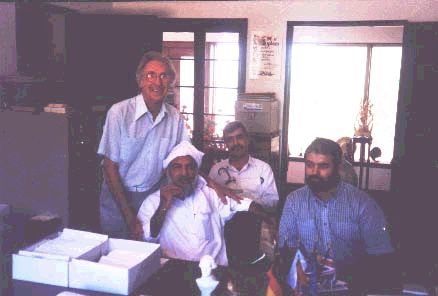
Dr Zitko (standing) with international visitors at the Desert Sanctuary Campus

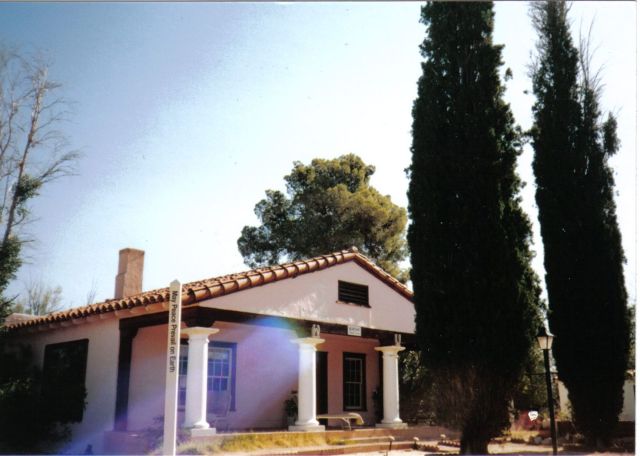
In 1969, after surrendering the lease on their previous land, the World University purchased a complex of buildings in Tucson, to which was added a library, which was to be the University’s home until 1985. That year saw the purchase of the University’s final home, the 80-acre Desert Sanctuary Campus at the foot of the Rincon Mountain Range near Benson, Arizona, and two years later, once the move was complete, the Tucson campus was sold. The Desert Sanctuary Campus had originally been used as a yoga ashram and a school for disadvantaged young people; now it was adapted for the World University with the conversion of its nine buildings to provide offices, visitor accommodation and a substantial library. The library building came to house what is arguably the finest library on esoteric and spiritual science and related subjects in the world, consisting of some 25,000 books, manuscripts and other resources, together with theses that had been submitted for the cultural doctorate. 2003 had seen a successful restoration project completed on the library  building. The campus, which is of outstanding natural beauty, also featured an Olympic-size swimming pool. Zitko was to make the campus his home; he received visitors from throughout the world there, and together with a small staff of volunteers administered the business of the World University without salary, funded by donations and by the trust that he had established to support the University in perpetuity. Chief among this staff must be mentioned Zitko’s devoted Secretary, Dr Jill Overway, an expert in yoga also resident on the campus, who typed and prepared each edition of Liftoff and handled much in the way of communications, latterly including messages from around the world via email.

The activities of the University expanded to encompass a substantial publications arm during the 1970s; as well as Zitko’s writings, it published works of literary criticism, child development, poetry by the acclaimed Canadian poet Stephen Gill and the autobiography of impresario Irwin Parnes.

By the 1990s the World University was ready to initiate a series of Regional Colleges, beginning with the North American Regional College (housed at the Desert Sanctuary Campus) in 1998. This college published a prospectus of non-traditional experiential and spiritual studies leading to certificate and diploma awards, with forty-four faculty members drawn from around the world. Although all courses were offered by distance learning, some on-campus instruction also took place, and in 2002 programmes leading to the award of a research doctorate in association with Zoroastrian College were made generally available (from which programme Dr S.S. Walia was the first to graduate in Energy Science, following a thesis on the therapeutic qualities of solar energy). In the following year, the Design, Technology and Management Society initiated the South African Regional College in Ladismith, although this was to cease affiliation in 2002 following a change in management of the DTMS. This was to be followed by the South East Asian Regional College (the World Association of Integrated Medicine in India), the West African Regional College and World University Computer Center (Nigeria) and the Zoroastrian Regional College (the Zoroastrian College, India). At the time of Zitko’s death, Queen’s University, Bangladesh (the largest private university in that country) and the Daya Pertiwi Foundation, Indonesia, were in the process of seeking Regional College status.

Some twenty or so schools and other organisations, whilst not achieving Regional College status, were affiliated or associated with the World University; these included to name but a few, the University for Human Goodness in North Carolina, USA, the Vidya Yoga Free University, Brazil, Ansted University, British Virgin Islands and Malaysia, the International States Parliament for Safety and Peace, the International Association of Educators for World Peace, the Academy of Ethical Science, India, and the Mandingo Academy, New York, USA. Other institutions had formed affiliations with the World University in earlier years, including notably the Parthasarathy International Cultural Academy, India, the Accademia Superiore di Studi di Scienze Naturali e Psicobiofisiche Prof. Ambrosini – Diandra International University and Academy, Italy, Brazil, Spain and USA, and the World University of Intercultural Studies, Bulgaria.

A website was set up by the World University and Roundtable in 1998, and in 2001 this registered 45,784 hits. After the September 11 attacks, the number of hits snowballed from an average of 1,800 per month to an astonishing 12,959 in the month of those events, suggesting that a wider audience was turning to the World University in times of crisis.

Each winter solstice from 1956, commemorating the tenth anniversary of the foundation of the Roundtable, was designated World University Day and formed the focus for an outpouring of worldwide messages to the Desert Sanctuary Campus, sharing in telepathic rapport with the ceremony conducted there. 2002 saw an unprecedented demonstration of support, with many messages from around the globe producing what Zitko described as a “stream of love divine”. In his own words, “there never was a greater conviction among all…that the World University was linked with a Higher Authority, cognizant of the dedication expressed by all those who have made the commitment to support the vision which underlies the New World Civilisation of “Light, Love and Power.” The ceremony had included the Affirmation of Djwhal Khul the Tibetan, a Message of the Master Phylos and Zitko’s own keynote address delivered earlier that year at the Annual Conference in St Lucia.

Zitko was a man of imposing presence and energy, and his spiritual qualities became quickly apparent in any discourse. He was generous with his time and encouragement and was an entertaining and thought-provoking correspondent, sending his review of the year’s events as a Christmas gift annually. His humanity and warmth were witnessed by the many friends he counted throughout the entire world, making the Desert Sanctuary Campus a focus for those who sought an educational and philosophical ideal that transcended temporal boundaries. One rarely exchanged ideas with him without leaving with a renewed faith in human nature. I corresponded with him over a number of years, and in his last message to me he wrote “you are one of the most valued members in our world institution.” The World University survived Dr Zitko’s death, but its activities were gradually discontinued and the campus in Benson was eventually sold.

In answer to the question of how he maintained his faith in the World University in the face of what was at times significant opposition, including at one point a death threat against his person, Zitko replied simply, “Serve as selflessly as possible with your eyes on the stars and your feet on the ground, and let the result take care of itself.”

In 2001, I was awarded the Cultural Doctorate in the Philosophy of Music by the World University Roundtable. Subsequently I served the institution as a Founder Member of the World University and as Vice-Delegate and President of its English National Office.

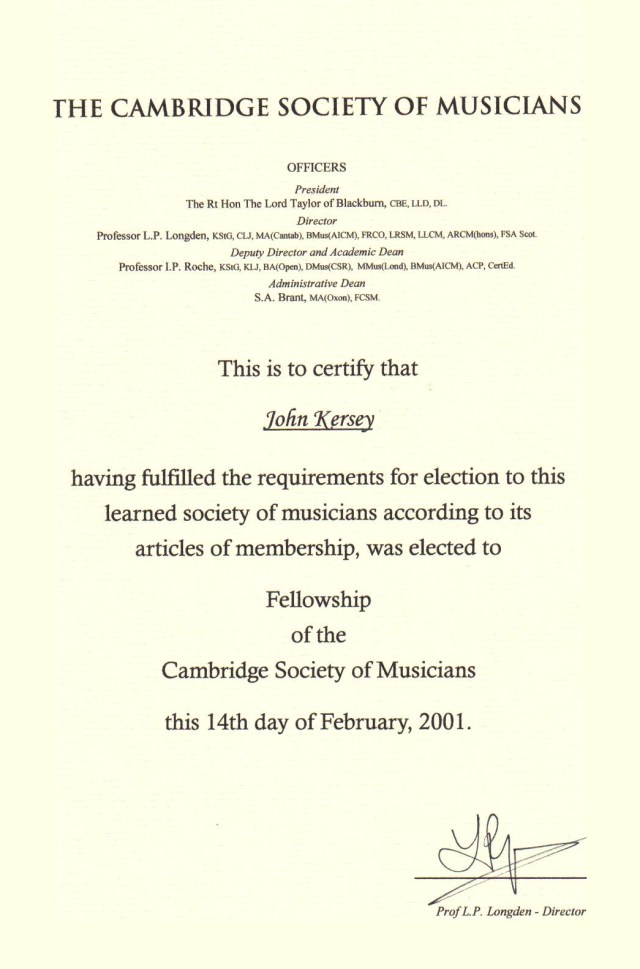
Honours and awards: Fellowship of the Cambridge Society of Musicians

The Cambridge Society of Musicians was a learned society of musicians and music educators founded in Cambridge in 1991 by musicians who were graduates of the University. It restricted its membership to those who could prove an active involvement in the practice of music. Election to the various grades of membership was on the basis of the applicant’s prior qualifications and experience. Fellowship was restricted to graduates in music or music education or those who could prove equivalent experience, and who were determined to be “active amateur or professional musicians who are able to clearly demonstrate a high level of musical competence.”

The Society appears to have become inactive around 2004.

Freedom of the City of London

The Freedom of the City of London can be gained through being proposed by one of the City’s Livery Companies or by direct application supported by a suitably qualified proposer and seconder. A limited number of Freemen are admitted each year by the Clerk to the Chamberlain of the City of London during a ceremony at Guildhall. A certificate is presented to the recipient together with a book entitled “Rules for the Conduct of Life”.

Although the Freedom is neither an honour nor an award (except on those rare occasions when it is conferred as the Honorary Freedom), the majority of recipients are men and women who are well established in their chosen field, some of whom have achieved success, celebrity or public recognition.

There is a number of historic privileges attached to the Freedom, most of which are apocryphal, including the right to be hanged by a silken cord if convicted of a capital offence and to carry a naked sword in public. The only privilege that is regularly exercised today is the right to drive sheep over London Bridge, which has been done on a number of occasions to raise funds for charity.

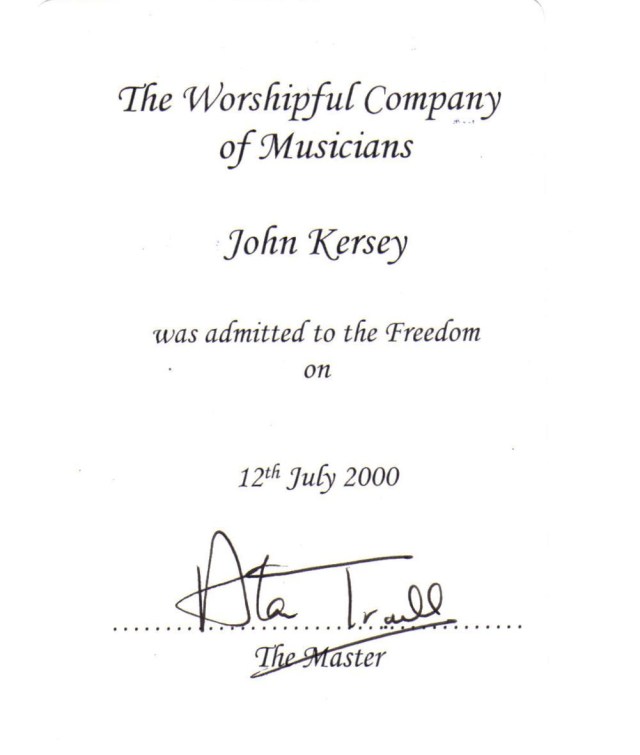
The designation “citizen and musician” on the certificate signifies that I was proposed for the Freedom by the Worshipful Company of Musicians. I was admitted to the Freedom of the Company on 12 July 2000 and promoted to Liveryman on 9 October 2002.


Honours and awards: Liveryman of the Worshipful Company of Musicians

Following my proposal by two Past Masters of the Worshipful Company of Musicians, the late John Iles senior and junior, I was admitted to the Freedom of the Company in July 2000.

Shortly afterwards, I was admitted to the Freedom of the City of London.

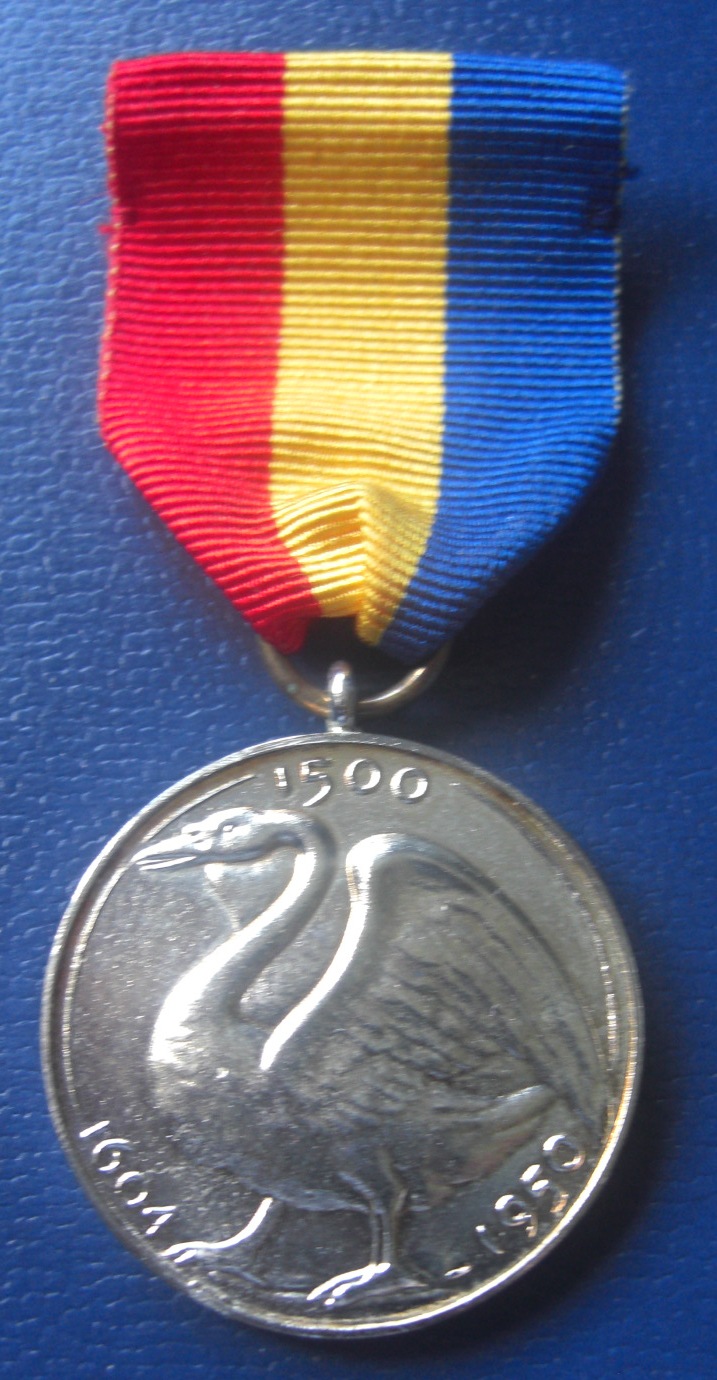
In 2002, I was clothed with the Company’s Livery and presented with the Company’s Livery Badge. The Badge is of silver, bearing the Company’s emblem of the silver swan and its dates of foundation on the obverse, and on the reverse the name of the Liveryman and the date of his admission to the Livery.

WCM1WCM2

At the time of my admission in 2000, the system was that the incoming candidate was admitted as a Freeman of the Company and then could progress to clothing with the Livery after two years, in both cases on payment of a Fine which was a life subscription. As of the early years of the century, this was a reasonably substantial sum that was not greatly different from the sums requested from other learned societies for life membership. I was explicitly told that once the Livery Fine was paid no further financial input was required, unless one wished to attend formal events which were paid for on an individual basis.

The Company decided to introduce quarterage (an annual subscription) in 2003, and this became compulsory for new members and was also payable by members of the Court. The subscription was not inconsiderable and has since increased. Initially, it was not made retrospective, but around 2013 it was decided that those Liverymen who did not elect to pay it (having been admitted under the previous life subscription arrangements) would be designated as “dormant” and deprived of most of the privileges of membership, although they would not (and indeed could not legally) be removed from the Livery.

My position was and is that I had entered the Company on terms that would provide life membership and with which I had complied fully, and that in effect the Company had breached this agreement by attempting to change those terms retrospectively. At the time of my admission, the Company concentrated on specific areas within music which were also interests of mine – notably jazz and brass bands. It seemed to me a friendly organization with a welcome amateur spirit, and since I greatly like and wished to encourage amateur music-making I felt a synergy with its enthusiasms and was happy to volunteer my services should they have been required. I attended several of its informal lunches and at one of these met the late Dr Leonard Henderson, who would become a significant influence on my work.

The lunches ceased fairly early on, and the Company was overtaken by an ethos of competition with the other Livery Companies and a quest for status within the musical establishment. This meant that the focus became less upon the membership as a body of professional and amateur musicians and more upon the membership becoming a source of financial input and donation. I did not welcome this change and had never seen my membership in these terms. In my view, it was a development that would remodel the Company as a club for the affluent and would as such exclude the majority of musicians. What it certainly did was destroy the amateur ethos that had formerly prevailed, and I felt this was greatly regrettable.

Accordingly, I remain a Liveryman today, but take no part in (nor endorse) the activities of the Company. I continue to hope that at some point in the future there may be a change of heart regarding the prevailing direction of the Company and its approach to the membership.

The status of Master of Arts at Cambridge

The degree of Master of Arts at the University of Cambridge is unusual in that, although it is a full degree, it is conferred without examination, reflecting its mediæval origin whereby its holders became full members of the University. Indeed, until 1851, students of King’s College were also permitted to proceed to the Bachelor of Arts degree without examination. The majority of those who proceed to the conferral of the degree today are holders of the degree of Bachelor of Arts who are eligible to proceed MA in the sixth term after they came into residence and two years after proceeding BA. There is also provision for conferral of the MA upon senior academic members of the University and certain other officers, and for its conferral by incorporation on holders of the same degree at the Universities of Oxford and Dublin.

Statute B II 2(d) permits the University to make an Ordinance “prescribing conditions under which the status of Bachelor of Arts and or Master of Arts may be held or may be granted by the Council.” The Ordinance in question is contained in Chapter II, pp. 169-170.

The status of a degree is not the same either as the conferral of the degree proper, or the conferral of the title of a degree (which was formerly done in the case of female students and is today retained under Statute A II 14 for conferring degrees honoris causa, whereby the degree is conferred without its full privileges). Status might best be defined as admission to the privileges of a degree without that degree having been formally conferred. However, at Cambridge, the privileges of those who hold BA and MA status are more restricted than those who have had the degree conferred upon them. For example, those who hold MA status are not members of the Senate, whereas those who have been admitted to the full MA degree are.

The status of Bachelor of Arts is either had, by virtue of a person’s status as a Graduate Student, or granted for a set period of time upon recommendation by the Head or a Tutor of a College. Where it is had, the person in question is a Graduate Student who is not a graduate of the University. For such persons, the status of Bachelor of Arts ends when they cease to be registered as a Graduate Student or when they are eligible to have the status of Master of Arts. The status of Bachelor of Arts allows the privileges of wearing the BA gown without its strings, but not the BA hood, and to have the same privileges as a BA so far as access to the University’s libraries, museums and Botanic Garden is concerned. It restricts the holder, however, from being a candidate for the degrees of Bachelor of Arts or Bachelor of Music.

The status of Master of Arts may again either be had or granted. Where it is had, the person in question must either be a Graduate Student or an “other person who has previously had the status Bachelor of Arts” who has attained the age of twenty-four years. Where it is granted, which is for a set period of time in each case, the recipient is a Fellow of a College, a University officer, another University officer or employee of a specified category, or a graduate or visiting scholar from another university recommended for the grant by the Chair of a Faculty Board or the Head of a Department. The status of Master of Arts allows the holder to wear the MA gown without its strings, but not its hood, and to have the same privileges as an MA with respect to the University’s libraries (except the University Library), museums and Botanic Garden. They may also certify their own residence, and are not subject to the regulations for motor vehicles, bicycles or boats. As with BA status there is a restriction on holders becoming candidates for the degrees of Bachelor of Arts or Bachelor of Music.

It is not in question that the status of Bachelor of Arts is either had or granted on a temporary basis. It will end in each case when the holder either receives a degree of the University, ceases to be a Graduate Student, qualifies to have MA status or when their grant of BA status expires.

However, it is not widely realized that there are certain circumstances whereby the status of Master of Arts may be held indefinitely. Consider, for example, my own position as a Graduate Student at Cambridge for a term during 1996. At the time of my matriculation in October, I was aged twenty-three years, and by virtue of my being a Graduate Student, duly had the status of Bachelor of Arts. But in December during that term, I celebrated my twenty-fourth birthday and consequently qualified to have Master of Arts status. I ceased to be a registered Graduate Student at the end of the term, and during my time at the University did not take any exams or become a candidate for a degree.

The question then arises as to when the status of Master of Arts will end in those cases where it is had rather than granted (since all grants are for a fixed term). The position is not the same as that for had BA status, whereby that status definitively ends when the holder ceases to be registered as a Graduate Student. Indeed, someone in my position would continue to qualify to hold MA status after ceasing to be a registered Graduate Student, given that I then fulfilled the alternative qualification of being an “other person who has previously had the status of Bachelor of Arts”. The phrase “other person” is not further defined, nor, since membership of the University is for life, could it logically be interpreted as being limited to those in statu pupillari. Moreover, it refers to those who have had BA status rather than those who have been granted it. It must, therefore, include former Graduate Students. This indefinite MA status would also appear to apply to any other former Graduate Student who has had BA status and subsequently attained the age of twenty-four, at which point they would have become, if not still a Graduate Student, an “other person who has previously had the status of Bachelor of Arts”.

The conditions under which MA status continues to be held are set out as being “for so long as he or she is not of standing to proceed to the degree of Master of Arts”. It will be clear that there are those who would never be of such standing, since they are prima facie ineligible to proceed to the degree of Master of Arts, and are forbidden by the regulations for MA status from being a candidate for the degree of Bachelor of Arts. In those cases, including my own, the status of Master of Arts would therefore appear to be held indefinitely.

To summarize, the holding of indefinite Master of Arts status occurs when a person fulfils  the following conditions:

1. They have had BA status.
2. They have subsequently attained the age of twenty-four years (at which point they will either be a Graduate Student for as long as they remain as such, or an “other person who has previously had the status of Bachelor of Arts”)
3. They are ineligible to proceed to the degree of MA.

Whether this situation has arisen intentionally or not is a matter for speculation, and naturally it is open to the University to change its regulations on this point should it see fit to do so. However, the number of people affected is certainly small, and it is doubtful whether, in practice, any privilege extended to them by virtue of holding MA status would be of significance when compared to the general privileges extended to all alumni by the University and the Colleges. Doubtless some of those affected will, like me, have since proceeded to the substantive degree of Master of Arts at another University.

This article is based on the 2019 edition of the Statutes and Ordinances of the University of Cambridge, available online at https://www.admin.cam.ac.uk/univ/so/index.shtml

My education: Cambridge

When I had completed the requirements for my Master’s degree at the Royal College of Music, I intended primarily to continue, and hopefully expand, the freelance performing work as a pianist and organist that I had been doing throughout my time at the RCM. However, I also felt that I did not want to rule out opportunities for further musicological research, which would require a continuing institutional affiliation. It was with this in mind that I decided to undertake a period of postgraduate research at the University of Cambridge, which I would pursue during the Michaelmas Term of 1996.

At that time, the Music Faculty at Cambridge gave limited emphasis to the performance of music as part of its curriculums. However, it had been the home of some significant work in eighteenth-century historical musicology, organology and performance practice concerned with Mozart’s keyboard music, much of which I had encountered and referenced in the dissertation I had previously prepared at the RCM on the cadenzas and Eingänge in Mozart’s C minor piano concerto K491. My supervisor at the RCM, Gerald Gifford, had also been a member of the Faculty of Music at Cambridge, although he had retired by the time of my arrival, and he encouraged my application to undertake further research on keyboard performance practice in Mozart.

In general terms, I took the view that membership of the University and of one of the colleges (which is conferred for life at Cambridge) would be a considerable future asset to me in its own right, as would access to the libraries and research collections, which would remain open to me as an alumnus after I had ceased to be a student. If my research developed sufficiently, I considered that it might lead on to book or article publications. Having already earned a research-based master’s degree at the RCM, I had been advised that a doctorate was not necessary and might even be seen as undesirable for teaching positions in the conservatoire sector. I was also aware that so far as Cambridge and the general university sector were concerned, conservatoire people like myself were generally seen as outsiders. With this in mind, I did not take a degree at Cambridge, but pursued a shorter and less prescriptive course of study with an open mind as to where it might lead.

While nowadays most students intend to obtain a degree at the conclusion of their university studies (and may well be obliged to do so as a condition of their funding), there is a long and honourable history of students pursuing research and related studies for the purposes of personal or professional development, or with a particular scholarly aim in mind, without becoming candidates for a degree. Indeed, several professors at the RCM had previously undertaken such periods of study at Cambridge as part of their education.

My agenda at Cambridge was therefore my own. I chose to follow the curriculum for research master’s students (the M.Phil. in musicology) during my term at Cambridge, consisting of research, analysis and seminars, but did not take any exams or formal assessments. I also attended a wide range of lectures and events, and experienced Cambridge’s legendary choral tradition at first hand as well as the variety of worship offered by the various college chapels and churches. I became a life member of both the Union Society and the University Conservative Association, enjoyed a variety of formal dining and was introduced to blind wine tasting.

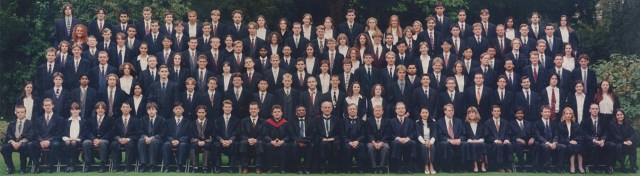
Matriculation at Christ’s College. I am seated in the front row, tenth from the right.

Although I did not take a degree at Cambridge, on matriculation, I acquired the status of Bachelor of Arts in the University under the relevant statute, and on my twenty-fourth birthday that December, I proceeded to the status of Master of Arts, which I still have today.

To my surprise, I found on arrival that I had not been assigned to either of the supervisors whom I had requested, and indeed I was never to meet them during my time at Cambridge. Instead, I was assigned to a supervisor who was wholly unsympathetic to my conservative intellectual approach, uninterested in my proposed research, and with whom I was unable to establish an effective working relationship. This did not entirely prevent me from undertaking useful work during my period of study (and indeed some of this work formed part of my subsequent doctoral studies), but it meant that I did so on my own.

My term at Cambridge was in many respects the most valuable of my education, because being exposed to an academic climate of adversity compelled me to define exactly where I stood intellectually and why. The graduate seminars in the Faculty of Music that I attended were dominated by the so-called “new musicology”. It seemed to me, and I was not the only one of this opinion, that the Faculty had suddenly found itself in the grip of an ideological craze that had clearly attracted its fair share of zealots. Those who did not share this zeal, including the historical musicologists and performance practice experts who had attracted me to Cambridge in the first place, appeared to be keeping their heads down.

Unlike historical musicology, which was seen as largely an apolitical discipline, the “new musicology” was explicitly political, and the politics behind it were Marxist in origin, having been imported from other disciplines of cultural studies, and being composed in large part of Critical Theory as formulated by the Frankfurt School. As an outsider following my own path, I had less to lose than others, and I challenged this robustly as a traditionalist of the Right. The response I received from my supervisor was in essence that the Faculty was now committed to this particular ideological cause, and that if I did not like it, I should leave. My academic style was said to be too reminiscent of that of the eminent musicologist Donald Jay Grout, who was regarded negatively since as a traditionalist historical musicologist he was the antithesis of the vaunted “new musicology”. This was taken by me as a high compliment, for I have always admired and respected Grout’s work. But when this approach was compared by my supervisor (entirely wrongly) to fascism, I concluded that it was time to go. I returned to the RCM where I was elected to a Junior Fellowship for the following academic year.

I had hoped that Cambridge would have offered some element of respect for different intellectual approaches including my traditionalism, since it had offered a home for historical musicologists of a similar viewpoint to my own in the recent past. Instead, I was confronted by a doctrinaire imposition of the new Marxist orthodoxy in which the past was rejected and any dissenting voices were condemned and silenced.

At the conclusion of my studies, I was left with the view that my experience with the Faculty of Music had not been what I had hoped for academically, but that nevertheless I had taken much away with me overall that was worthwhile in terms of my broader education. I continue to regard the University and my College with affection.

Today, I am a member of the Christ’s College Association (for alumni) and the Christ’s College Fisher Society (for testators making bequests to the College).

A few years on from my studies, I was elected a fellow of the Cambridge Society of Musicians, which had been established by several Cambridge graduates. Twenty years later, when living nearby, I often returned to Cambridge to enjoy the ambience of the city and its many attractions.

My education: Royal College of Music

The Royal College of Music (RCM) is a public conservatoire in London, England, constituted by Royal Charter of Queen Victoria on 23 May 1883. The Royal Charter marked the RCM out as unique among conservatoires at that time, in that it was given the power in its own right to confer the degrees of Bachelor, Master and Doctor in Music either after examination or honoris causa. The RCM first used these powers in 1933 when it conferred the degree of Doctor of Music in the Royal College of Music, honoris causa, upon HM Queen Mary. From then until 1982 this degree was conferred only on members of the Royal Family. The degree of Master of Music in the Royal College of Music was first awarded in the 1940s and that of Bachelor of Music in the Royal College of Music in 1995.

I was associated with the RCM successively as a Junior Exhibitioner, undergraduate student, postgraduate student and Junior Fellow for eleven years, between 1987 and 1998. During my time there, the RCM maintained a pre-eminent place amongst the world’s conservatoires and its diverse student body, with many coming from overseas to study, reflected its international reputation for musical training. It was highly selective in its admissions processes, and entry was by competitive audition. The RCM was generally regarded as having the strongest piano faculty of the London conservatoires at that time, and it was exceptionally difficult for a British pianist to win a place there. Once there, the atmosphere was intense and at times highly competitive. The College had a close relationship with the Royal Family, reflecting the foundation of the RCM under the personal initiative of King Edward VII (when Prince of Wales), and during my time I was present during multiple official visits by HM the Queen, HM the Queen Mother and HRH the Prince of Wales.

The Local Authority Junior Exhibition Awards were scholarships awarded by the London boroughs that allowed musically gifted school pupils to begin their training at the London conservatoires alongside their regular schooling, by attending the conservatoires’ Junior Departments free of charge on a Saturday. These awards, too, were subject to competitive audition, and I was fortunate to win a London Borough of Enfield Junior Exhibition Award to the Royal College of Music in 1987. I was then aged fourteen, and, as a late starter, was only in my fourth year of piano lessons.

Prior to entering the RCM, I had spent a very enjoyable year studying privately with the concert pianist Paul Coker, who apart from his work as a soloist was Yehudi Menuhin’s accompanist. Paul was an alumnus of the RCM and it was at his suggestion that I applied to study with his professor, Yu Chun-Yee. This was still more of a challenge since Yu Chun-Yee did not teach regularly at the RCM Junior Department and only accepted two junior students in addition to his undergraduates and postgraduates. Having successfully auditioned for him, I found myself at the RCM twice a week; on Friday evenings for my piano lesson with Mr Yu, and then all day on Saturday for the other activities of the RCM Junior Department.

In all, I would study with Yu Chun-Yee for nine years. He had one of the finest analytical minds I have ever come across. He could be fiercely demanding, and was often quite right to be so in setting the highest of standards, but was also extremely supportive and expressed great confidence in my abilities. Under his guidance, I developed both as a musician and as a person, and his detailed and exacting approach to study and interpretation has remained a cardinal influence on me ever since. What I valued in particular was that he taught me how to work out the answers to musical and technical problems for myself, providing me with an interpreters’ toolkit that has served me well ever since. The transferability of this training to other aspects of life has also proved to be considerable.
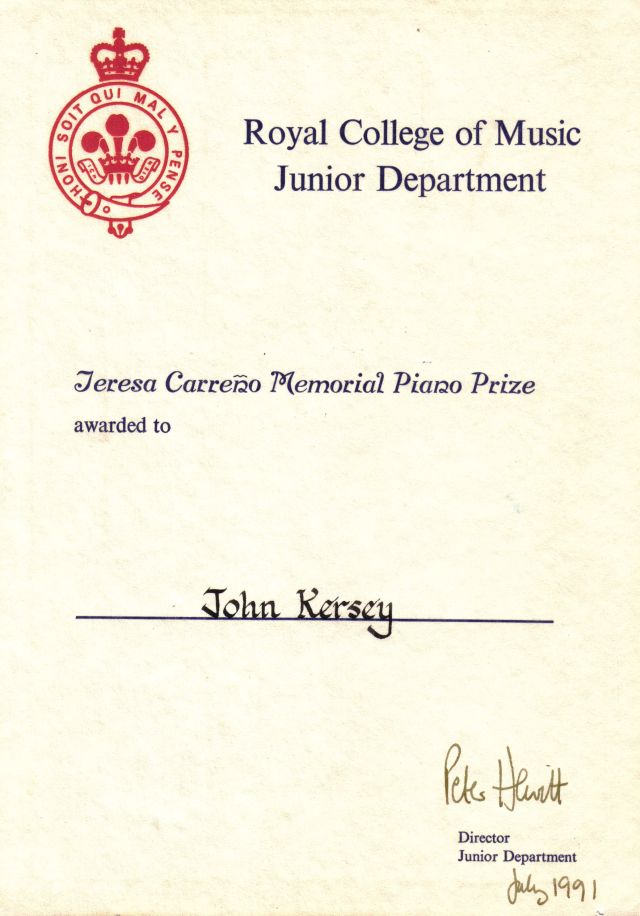
In my final year at the Junior Department I won the Teresa Carreño Memorial Piano Prize, the major competition award for pianists, and was also awarded the Constance Poupard Prize. After another set of competitive auditions, I was offered a place at the RCM to read for the Bachelor of Music degree, which was for the first time to be awarded by the RCM itself, rather than as previously by the University of London. This was a four year degree, in contrast to the usual three year duration of British first degrees.

The great strength of studying at the RCM in those days was the fundamental emphasis on one-to-one tuition with leading professors. Most of those in the piano faculty were of many years’ standing and considerable eminence. Providing one made satisfactory progress, there was a great deal of freedom; obviously much time had to be devoted to individual practice and preparation for examinations and competitions, but outside this, there was the chance to read and listen widely, and to explore new repertoire with the aid of one of the best-stocked libraries of its kind. The overall ethos was dedicated to the applied musician. It was well suited to a pianist like myself who wanted in essence to be left alone to develop and grow under expert guidance, rather than to seek a more conventional “student experience”, and although I had a lively social life in those years, it was almost all outside the RCM. There was also a confidence in the RCM’s position as guardian of the traditions of Western art music, and in particular as the artistic home of several generations of distinguished English composers and pianists.

The RCM’s outlook of determined independence had been reinforced because at that time its closest rival, the Royal Academy of Music (RAM), had mounted what was in effect a takeover bid for the RCM. This seemed for a time to have government support. The RCM resisted the resulting pressure to create a London “superconservatoire” fiercely, and other than a joint vocal faculty with the RAM which lasted for a few years before being abandoned, was successful in maintaining its separate identity.

The RAM had deliberately jettisoned the conservatoire tradition that it had inherited in favour of a bid to create a “centre of excellence” on the model of Philadelphia’s Curtis Institute. This involved inter alia a reduction in student numbers, an academic partnership with King’s College, London, and an emphasis on masterclasses by international classical superstars, despite complaints that these were disruptive to first study teaching. In contrast to the RCM’s emphasis on the codified Western tradition, the RAM had also begun to teach jazz. Whilst I greatly enjoyed listening to jazz (and was a member of Ronnie Scott’s club for several years), I did not take the view that it should be taught in conservatoires or given equal standing with the interpretation of codified music. Largely out of a sense of obligation, I had auditioned for the RAM, but disliked the atmosphere and approach strongly, and never seriously considered studying there.

It was in this context that the RCM had decided to exercise its own degree-granting powers in respect of the new Bachelor of Music programme, which was introduced in 1991. When I was able to add input to the RCM’s direction – chiefly as a member of student review panels for my degree courses, as well as more informally in conversation with members of the administration – I sought to argue for the vision of the conservatoire in its historic context as a wholly independent entity dedicated to applied music, separate both from the university sector and the wider higher education establishment. This was a view that also enjoyed support among a significant number of the RCM’s staff, but that was increasingly coming to be seen as reactionary and anachronistic given the prevailing political winds.

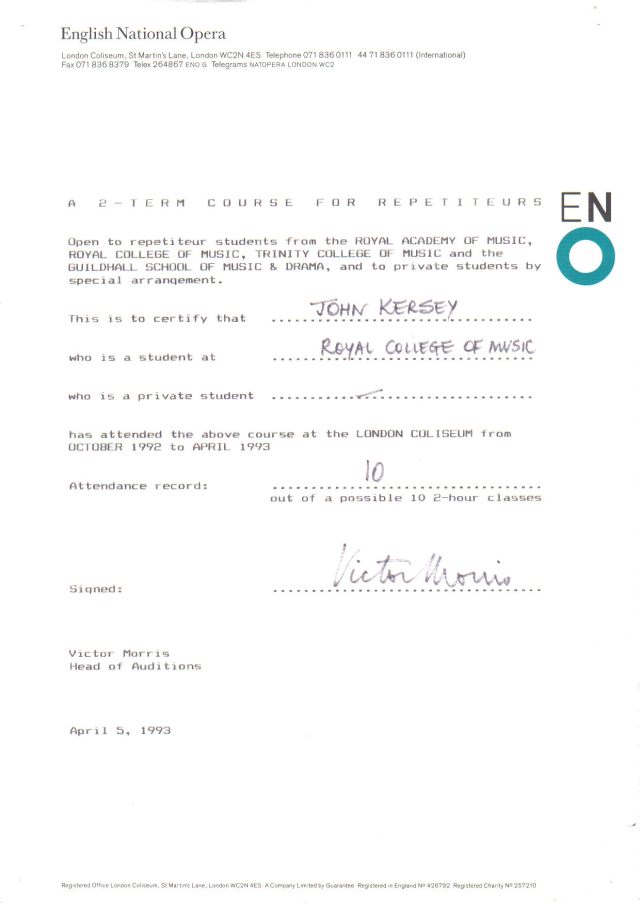
During my second year at the RCM, I was given the opportunity concurrently to undertake the Répétiteurs’ Course at English National Opera, which was usually open only to postgraduates. Not only was this fascinating and useful, it also carried with it a free rehearsal pass to all of ENO’s productions. I spent a good deal of time there during the year immersing myself in some glorious music-making, of which a marvellous and innovative production of Humperdinck’s Hansel and Gretel made a particular impression.
My studies at the RCM were pursued alongside a good deal of professional freelance work as a pianist and organist. Both as soloist and as a member of various duo partnerships, I played concerts at music clubs and societies around the country and also worked as a choral accompanist and pianist for musical theatre. One of my duos led to my playing on several occasions for the cellist William Pleeth at his home in north London. I found Pleeth’s energetic approach fascinating and loved his passionate, committed engagement with the music. Of course he was well-known as the teacher of Jacqueline du Pré, and a further close connexion with the circle of du Pré and Finzi was my supervisor at the RCM, the composer Jeremy Dale Roberts, who encouraged my developing interest in British music of the twentieth-century. Some years later, I would meet another member of the Finzi circle, the poet Ursula Vaughan Williams, when my duo partner and I gave the first performance of the song cycle All the Future Days in which the composer Jonathan Dove  set her poems.

I was continuing to develop as a pianist, and several key performances in RCM concerts included Rachmaninov’s Second Sonata in the original 1913 version, and his Symphonic Dances in the version for two pianos. As well as concerts, the RCM placed much emphasis on competitions, which are often seen as a means to gain exposure for young pianists. However, the competitive spirit did not sit well with me. Competitions were deeply opposed to my own philosophical approach to music and I thought they did a profound disservice to music itself. During my time at the RCM, I entered internal competitions largely out of a sense of obligation and without ever feeling that they brought out the best in my playing. I certainly had no inclination to enter external competitions or to play the international piano competition circuit. Notwithstanding this, I managed to win some of the RCM’s prizes and awards. At the end of my second year, I was awarded the Margot Hamilton Prize for piano and the prizes for second year techniques and practical skills. A year on, I won the third year examination prize for piano, the Pauer Prize.

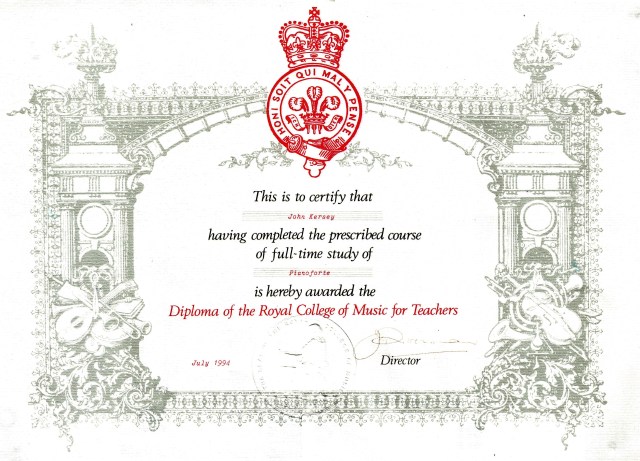
In addition to my degree studies, it was then a requirement for piano undergraduates that they should take the RCM’s teaching diploma. This was designated as the DipRCM(Teacher) for internal full-time RCM candidates, but followed the same syllabus and was examined to the same standard as the Associateship of the RCM in teaching that was available to external candidates. I attended some excellent Art of Teaching lectures with Peter Element, whose confident and authoritative approach appealed greatly to me, and the splendid Patricia Carroll, who I had known from the Junior Department. I was a successful candidate for the diploma at the end of my third year.
My interest in historical musicology was developed during my final year with a stimulating elective study in Advanced Performance Practice and Editorial Method under the organist and harpsichordist Gerald Gifford. As well as being a professor at the RCM, Gerald was also Fellow and Director of Music at Wolfson College, Cambridge, where I was invited to give a chamber music concert with fellow students that included Brahms’ wonderful late Clarinet Trio. Under Gerald’s guidance, I prepared a dissertation on cadenzas and related performance practice issues in Mozart’s piano concertos, focusing particularly on the C minor concerto K491. The RCM has Mozart’s autograph score of that work in its library, and the experience of seeing this familiar music in Mozart’s own handwriting left a deep impression on me.

Gerald Gifford was in charge of the RCM’s Master of Music programme in Performance Studies, which he had been responsible for designing. This combined advanced performance studies with research into cognate subjects. The programme had an excellent reputation and I had no reservation in applying for a place. Having been accepted, it remained only to undertake the remaining requirements for my BMus.

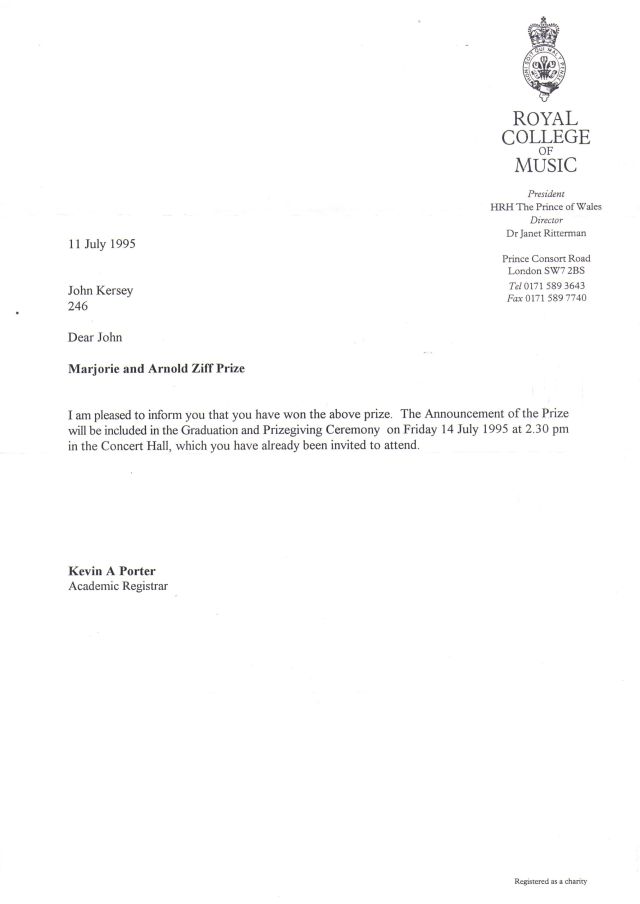
My degree studies culminated with a public final recital of some fifty minutes. I presented a varied programme including music by Bach, Berio, Schubert and Rachmaninov. I was awarded the Marjorie and Arnold Ziff Prize for the best piano final recital, and was the only first study pianist to be awarded a First. I was also the only first study pianist of the 1991 undergraduate intake to take First Class Honours overall in my degree.
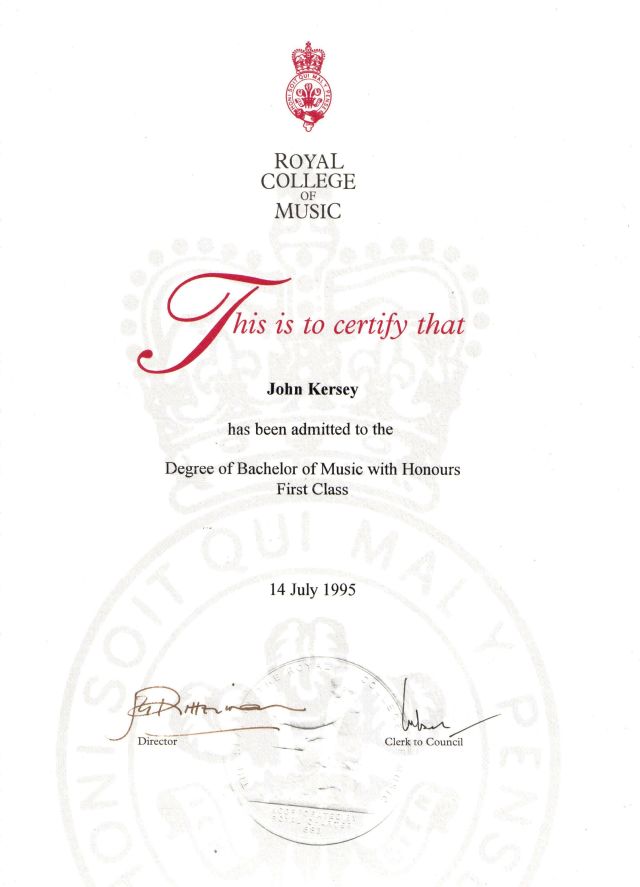
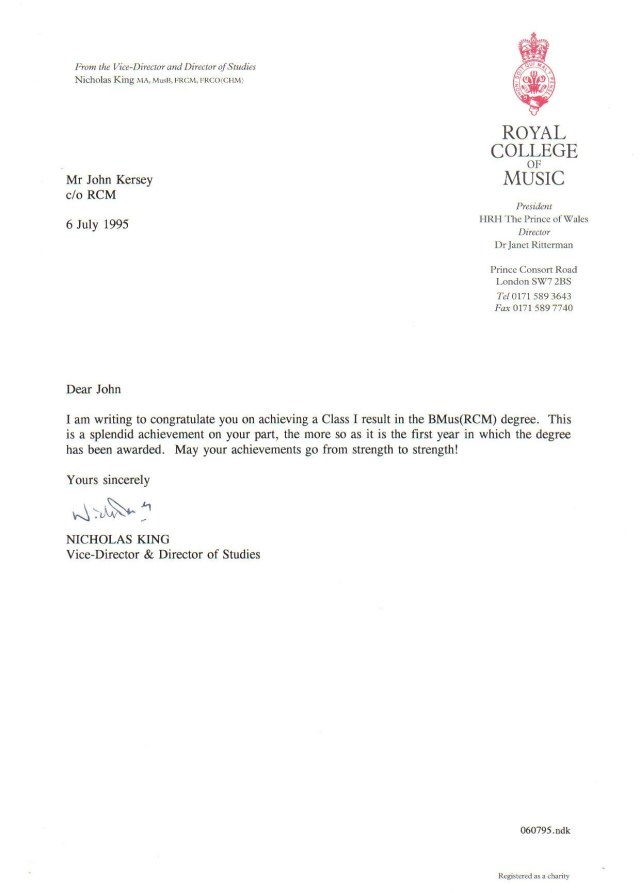
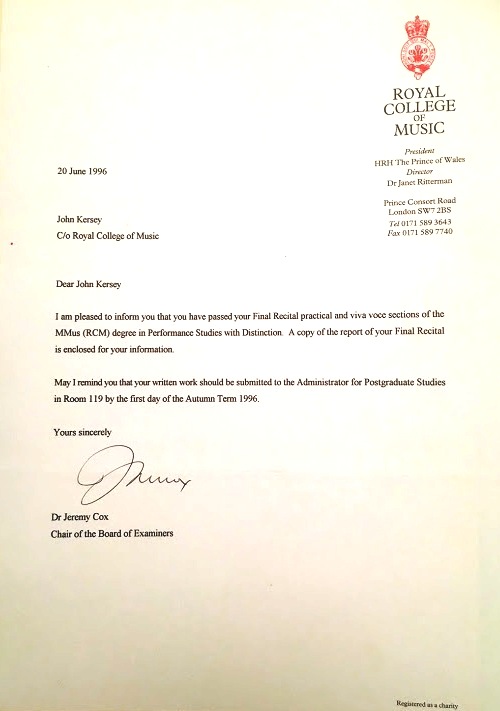
I received an official congratulatory letter from the RCM on achieving my First.
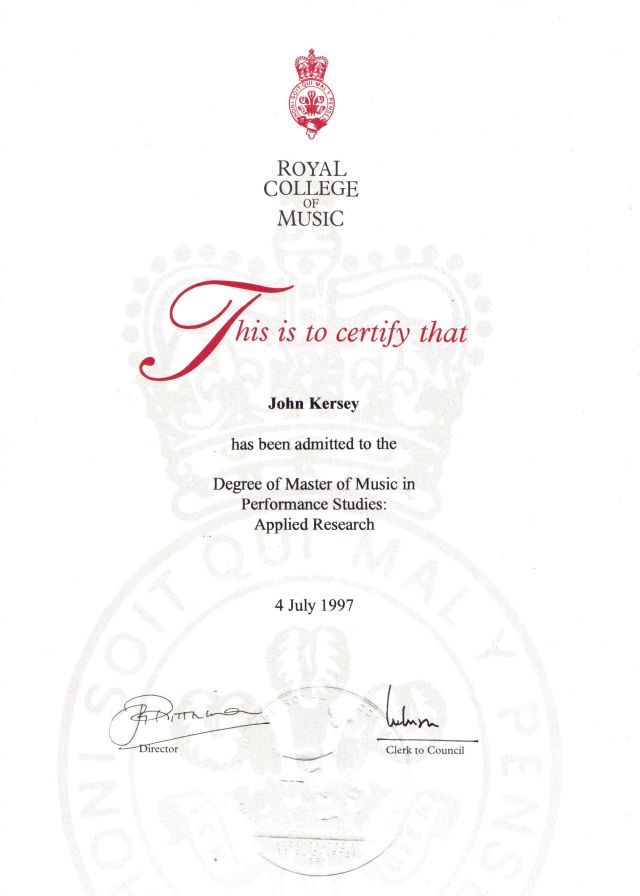
That autumn, I began my studies on the Master of Music programme. This required a final recital, a lecture recital and a research dissertation, with viva voce examinations on each component. The programme was unusually structured. The degree was not awarded until the end of the second year after enrolment, but formal studies extended only over thirteen months, leaving most of the second year vacant. This time, my research focused on performance practice in recordings of Liszt’s piano music by his pupils, and my lecture-recital was on aspects of rhythm in Alkan’s piano music. For my final recital, I presented two works, the Piano Sonata by the remarkable composer (and former professor at the RCM) Bernard Stevens (1916-83), and Schumann’s Humoreske. Both this and the viva that followed were awarded distinctions.
I was fortunate to be one of the winners of the RCM Concerto Trials, which offered the opportunity to play a concerto with one of the RCM orchestras. I had chosen Liszt’s Totentanz, a demanding and demonstrative virtuoso work, and performed this with the RCM Symphony Orchestra conducted by Andrea Quinn on 23 January 1996. I chose to use the expanded performing edition by Liszt’s pupil Alexander Siloti, which adds a number of interesting passages to the original.

During the year, I won the Sir Arthur Bliss Solo Piano Prize and was also awarded the Bernard Stevens Performance Prize for performances of those composers’ piano sonatas. The Bliss Prize led to a recital at the West Road Concert Hall in Cambridge and a meeting with the composer’s widow, who wrote “your interpretation of the Bliss piano sonata is one which would, I know, have delighted the composer.” I was also awarded the Sir Percy Buck Prize for a postgraduate who had previously studied in the RCM Junior Department.

As I reached the end of my studies, Yu Chun-Yee told me that I had now arrived at the point where I could play anything in the pianist’s repertoire. He meant by this not that I would not have to work hard at whatever I had chosen to attempt, but that I now knew how to do that work and was in possession of the necessary interpretative skills, musicianship and technique. This was the fulfilment of what I had set out to do when I first began studying the piano seriously, and although I would subsequently seek advice from other professors when preparing for concerts, notably John Blakely and Yonty Solomon, I regarded my formal piano studies as now being complete.

I was notified that I had been successful in the Master of Music degree that autumn, and would await formal graduation the following summer.
The question inevitably arose as to what I should do next, both immediately in the eleven months that remained until my MMus would formally be awarded, and beyond this. There was the option of simply continuing (and hopefully expanding) the freelance performing work that I had been doing throughout my time at the RCM, but I also felt that I did not want to rule out opportunities for further research, which would require a continuing institutional affiliation.

In considering my options, I had to face the fact that the RCM was no longer the same institution that I had joined almost a decade earlier. The higher education funding and regulation authorities, driven by the universities and by ministers who neither understood nor were sympathetic to the conservatoire way of doing things, were no longer happy to see the RCM plough its own furrow, and the postgraduate provision had been particularly (and in my view unfairly) criticized. These criticisms seemed to me to be designed to curb the RCM’s independent viewpoint and fully integrate it into the higher education establishment. Although the RAM’s “centre of excellence” plans had not directly provided the model for what was to come, it was not difficult to see that the reformed RAM was more obviously suited to the new regime, and that the RCM was to be compelled in a similar direction. The first signs of this were an increase in administrative and bureaucratic requirements culminating in a fairly brutal round of staff departures. Two further changes that I considered key were the effective abolition of its alumni association*, and of the RCM Magazine. It seemed to me that these moves were attempts to keep a lid on staff and alumni dissent, which had previously proved a significant issue during the RAM’s period of radical change.

These changes were not happening in isolation. The British musical tradition was under attack from a press that considered it mediocre in comparison to the glitzier product on offer abroad. My chief research interests in rare music of the Romantic era, in piano performance history and in twentieth-century British tonal music were deeply unfashionable. It was also clear that the concert infrastructure that had supported British pianists for generations, in particular the music clubs and societies, was diminishing significantly as its members grew older, and there was an increasing demotic shallowness to the way in which classical music was now being sold to the public that did not sit well with me. As society itself became more consumerist and fixated upon youth, the virtues of maturity and reflection, which are cardinal to musical interpretation, all but disappeared from view. More practically, even pianos themselves were changing. The pianist is hypersensitive by nature; so is ivory, which is the ideal material for piano keys since it not only absorbs perspiration but is highly responsive. In the wake of the international ban on ivory, the top manufacturers had turned to making piano keys from resins and various forms of plastic instead, which lacked the responsiveness of ivory and also left drips of perspiration on their surfaces. For me, it was like replacing gold with brass.

That autumn, I had the opportunity to undertake a term of postgraduate research at Cambridge, which I have written about elsewhere. After Christmas, I returned to a life of freelance musical engagements in London, and before long also began to do some voluntary work at the RCM Library, where I covered staff vacancies and undertook several cataloguing projects of historic materials concerning British musicians of the nineteenth and twentieth-centuries. The Library had not yet been computerized, and was still using handwritten card indices and catalogues. This suited me well, since I had an innate dislike of computers, and my time there was both happy and productive.

A new development at the RCM was the introduction of Junior Fellowships. These were intended to support young musicians after the conclusion of formal studies and their holders were attached to the staff rather than to the student body. I was offered the Geoffrey Parsons Junior Fellowship for the academic year 1997-98, and as a result was presented to HRH the Prince of Wales, President of the RCM.
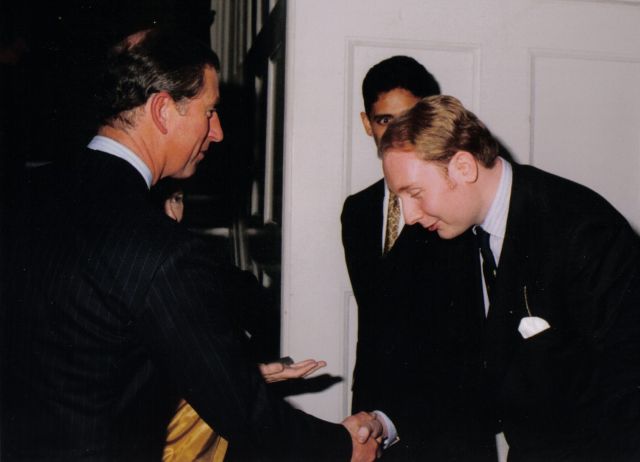
There was a sense in which my Junior Fellowship year felt valedictory as soon as it had begun, and I was certainly aware that I needed to make the most of all the opportunities that it offered. I undertook a great variety of ensemble and accompaniment work, and also toured with the RCM in Portugal, playing before the President and Prime Minister there at the British Embassy. All this was combined with my existing external commitments as a performing musician, to which I had now added regular work as a record critic and a teaching position at a nearby sixth-form college. I enjoyed the atmosphere of the RCM’s Senior Common Room, and formed good relationships with a number of the professors.

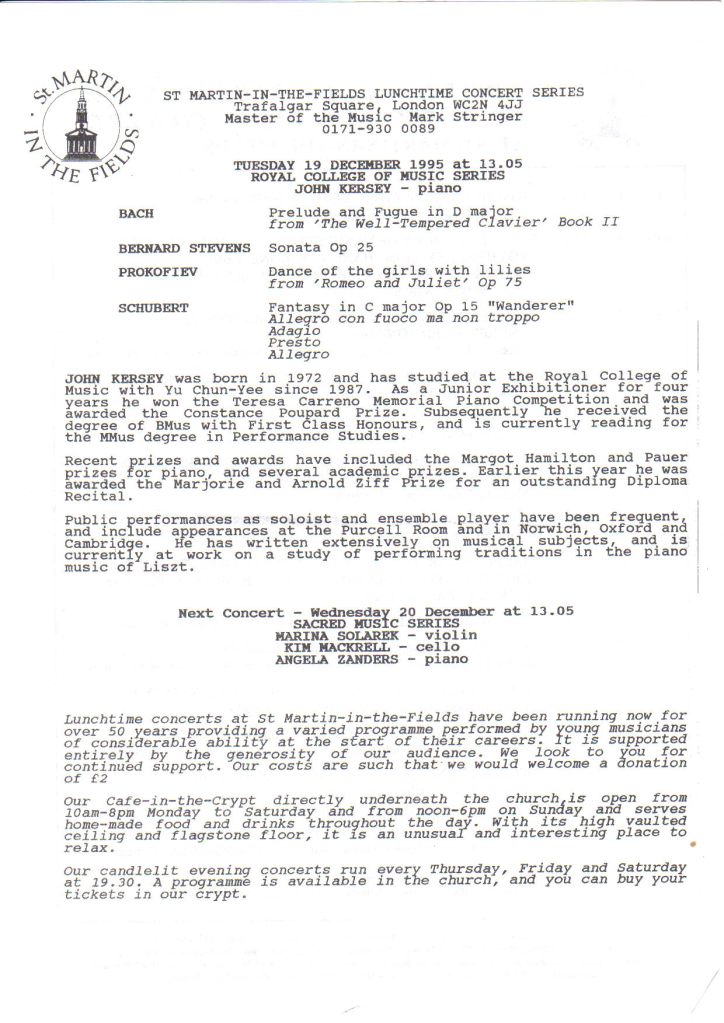
Although Junior Fellows were not permitted to perform as soloists in RCM concerts, I considered it vital that I should continue my work as a solo pianist alongside my other commitments. The RCM had recently built a professional recording studio, and I was given the opportunity to record a CD of some works of my choice there. I devised a programme of twentieth-century British piano sonatas by Arthur Bliss, Bernard Stevens and Stanley Bate. Bate’s unpublished second piano sonata was part of his manuscript collection now in the RCM Library. I prepared the work from the composer’s autograph, and played it in concert at St Martin-in-the-Fields. Although Bate was an accomplished pianist who was often to be heard in his own works, there was no record of him having performed this sonata in public, and accordingly both my performance and recording were premières.

I returned to the RCM on a few occasions in the year after my Junior Fellowship. I was delighted to be asked back to join a group of postgraduates in playing the demanding piano part in Webern’s arrangement of Schoenberg’s First Chamber Symphony for the Pierrot Lunaire combination of instruments, and much enjoyed the resulting performance. I also undertook some occasional deputy teaching to cover the absence of one of the keyboard professors. This, however, was to be my final involvement with the RCM.

In my view, the RCM as it is now has changed immensely from the institution as it was during my time. The change has not merely been of a kind that one would normally expect of an institution over time but has been radical and at times iconoclastic in response to external pressures on higher education, meaning that the concept of what the RCM is and how it fulfils its mission now is quite different from the conservatoire tradition that I experienced and inherited there. My loyalties continue to remain with the principles that the RCM upheld during my era, and as an old Royal Collegian, I have tried to bring those principles to bear on my other work in music and education since then.

* The initial alumni and former staff association of the RCM was the RCM Union, founded in 1906, which also included as members all current students and staff of the RCM. The RCM Union was the body responsible for the RCM Magazine. In 1992, the RCM Union was closed. The alumni association element was continued by a new RCM Society, which like the RCM Union was a subscription-based association, but in 2001 this was repurposed as a non-subscription body of wider scope including all former students and staff. In 2009 it was abolished altogether. The RCM Magazine was initially taken over by the RCM Society but was discontinued in 1994, to be replaced by an Annual Review that was issued as an official publication of the RCM’s governing administration rather than being under the editorship of a member of the professorial staff as had been the case with the RCM Magazine.

Honours and awards: Fellow of the Royal Geographical Society

I was a Fellow of the Royal Geographical Society between October 1998 and December 2018.

FRGS

Fellowship was by election and was maintained by paying an annual subscription. At the time of my election, the Fellowship was not only intended for those professionally engaged in geography but also embraced those who had an avocational interest in the subject. My interest in cartography stems from childhood (resulting in a large and somewhat unruly collection of antique maps) and has since been augmented by interests in the history and other aspects of public transport systems in England as well as a general regard for our environment and its preservation from commercial encroachment.

Starting in 2007, the Beagle Campaign was launched with the stated objectives “to reactivate the society’s own research and re-establish the Royal Geographical Society (with IBG) as the world leader of exploration endeavour: to advance geographical science on all fronts and to bring together the relevant scientific/exploration departments – under the society’s umbrella; it can also help solve climate change conundrums and other pressing issues related to human interaction with Earth. The RGS (with IBG) is in the unique position to achieve these goals, for we live in a new age of exploration as if everything the Society has achieved since its foundation has been training for this time.” This reflected the pivotal role of the RGS in having sponsored leading expeditions such as those of Darwin, Shackleton, Livingstone, Stanley, Scott and others. The campaign sought to place exploration once more as a primary rather than peripheral part of the Society’s activities. This appealed to me not merely from my Romanticist admiration for the explorers of the past but because I could see the considerable value of exploration in today’s world.

Unfortunately, despite gathering considerable support among the Fellowship and in the national press, the Society voted against the resolution put by the Beagle Campaign that it should once again mount large-scale multidisciplinary expeditions (in addition to continuing to support smaller-scale or independent external expeditions). Almost 40% of those Fellows and Postgraduate Fellows voting had supported the resolution, revealing a deeply divided Society.

The writer Justin Marozzi, one of the supporters of the campaign, had summarized the issue in an article for Standpoint Magazine entitled, “What is the Royal Geographical Society for — exploration or ‘post-socialist urban identities’?” Marozzi expressed the divide thus, “In the 19th century, when the Royal Geographical Society was a byword for international exploration and scientific discovery, the German naturalist and explorer Alexander von Humboldt helped lay the foundations for modern geography with his magnum opus Kosmos, a prodigious, five-volume attempt to unify the various strands of geographical science. Charles Darwin considered Humboldt “the greatest scientific traveller who ever lived”. For many geographers today, this sort of physical geography is deeply unfashionable and downright irrelevant. Human geographers, by definition, are more interested in people than in places. They are interested, among other things, in gender, culture, health, development, urban environments, behaviour, politics, transportation and tourism. Many physical geographers feel increasingly alienated by their colleagues’ distrust of empirical science, a scepticism informed largely by the post-modernist assault on geography in recent years…

Among six projects that the RGS says demonstrate its commitment to support (other people’s) research, are two fairly eyebrow-raising studies. One, conducted by Dr Craig Young and colleagues from Manchester Metropolitan University, is entitled “Global change and post-socialist urban identities”. Another, led by Dr Heaven Crawley and colleagues from Swansea University, is “Children and global change: Experiencing migration, negotiating identities”. Professor Ian Swingland, founder of the Durrell Institute for Conservation and Ecology, is unimpressed. “My scientific and international experience strongly suggests to me that neither of these projects is academically robust, likely to change anything on the ground, improve the status of the environment or the social woes of the world, and they are frankly to a large degree incomprehensible,” he wrote in an open letter to Sir Gordon Conway, the RGS president. “They will make no difference to anything other than those prosecuting the work. What are ‘post-socialist urban identities’ exactly? What are ‘children’s reflexive negotiations of their identities’ precisely? And does it matter? And will this work educate the future ways we can help the world?” What such research appears to demonstrate is the tragic introversion and irrelevance of swathes of contemporary academe, academics writing for academics, leaving the rest of the world none the wiser — or better off. In an era when environmental woes and challenges press in on us, the RGS’s failure to provide high-profile leadership on vital issues such as climate change, global warming, biodiversity, the forced migration of species, deforestation, desertification and a host of other scientific unknowns is deeply regrettable. What can one say of post-structuralist cultural studies other than they provide careers for a certain breed of academic geographer?”

Although the vote was lost, the Beagle Campaign vowed to continue, but it made no further headway and it was clear that the Society’s leadership were minded to impose their view of the way ahead rather than making any meaningful compromise. The criteria for election to the Fellowship were redefined so as to now be principally aimed at the academic and professional geographer.

After twenty years as a Fellow, I resigned from the Society in December 2018.

Honours and awards: Fellow of the Royal Society of Arts

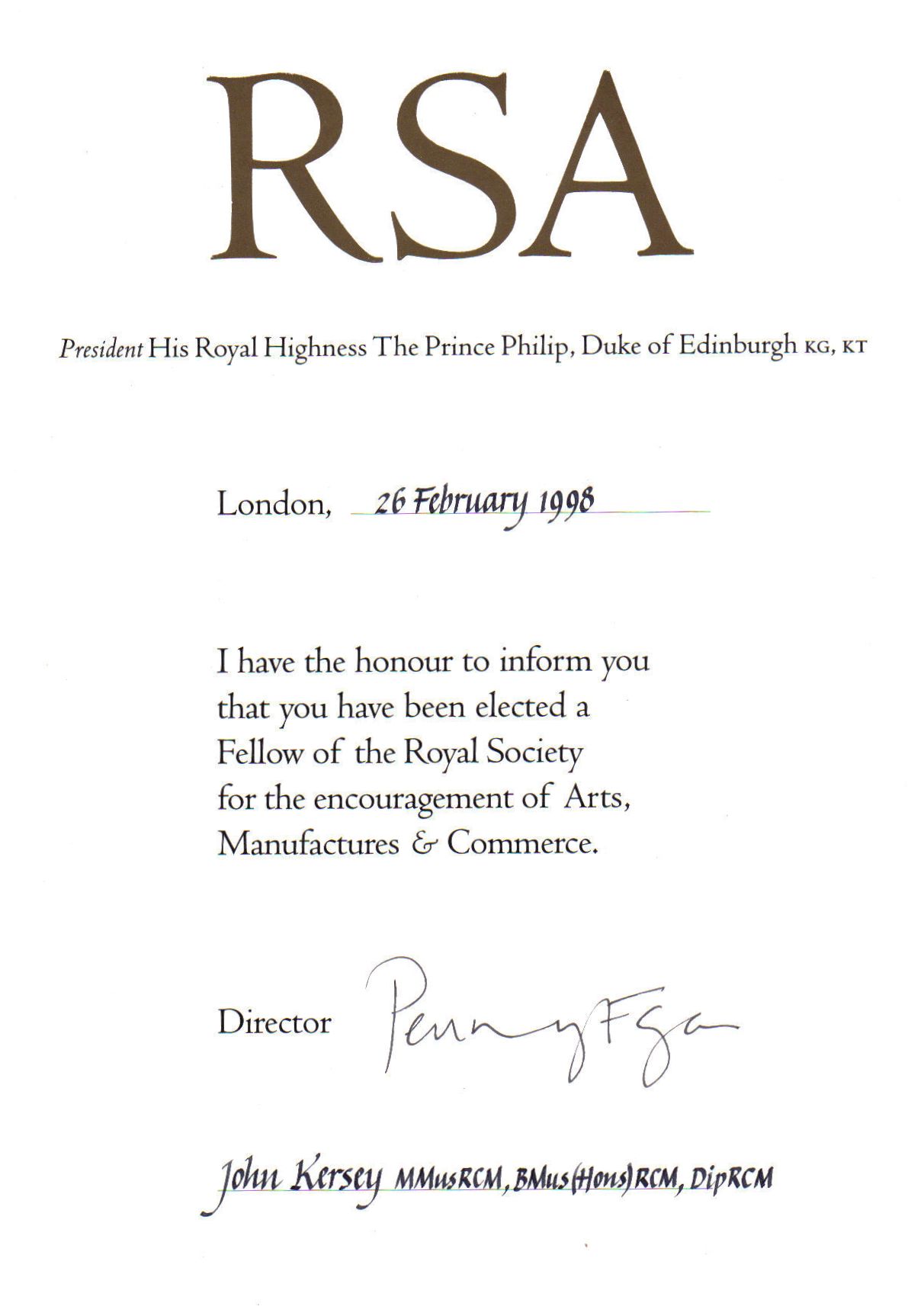
I was a Fellow of the Royal Society of Arts between February 1998 and June 2018.

FRSA

At the time of my election in 1998, aged twenty-five, I was one of the youngest Fellows of the Society. The Society elected to Fellowship on the basis of merit with the support of two existing Fellows required. Fellowship was then maintained based on the payment of an annual subscription.

After twenty years as a Fellow, I resigned from the Fellowship in June 2018.

During my time, the Fellowship was a body with a wide membership from all sectors and a commitment to innovative and creative ideas beyond political or ideological boundaries. Election to the Fellowship when I joined required proposal and seconding by existing Fellows and was restricted to those who were judged to have made a contribution to the arts, manufactures or commerce according to the standards then applied.

In the past few years, the RSA has changed its view of the Fellowship considerably. As of 2022, new applicants, who can fill in an online form, are now told “It is very likely that you will be accepted to the Fellowship” and there is no longer a requirement that they be proposed or seconded by existing Fellows. Indeed, there is no longer any requirement that they should demonstrate merit or accomplishment, as appointment to the Fellowship is regardless of background, qualifications or level of perceived success in their field.

The RSA also now requires of Fellows that they must “share our commitment to social change” and, according to the new Fellowship Charter, “promote a culture where equality, diversity and inclusivity are at the heart of everything we do.” In other words, the Society has now endorsed explicitly the values of the woke Left, which are not values that I share.

Whilst the Fellowship was never an honorary award, it was once rightly regarded as a prestigious learned society membership given the history and status of the Society and the distinguished make-up of the Fellowship. In my view the recent changes profoundly devalue the Fellowship to the point that it is no longer comparable with its former iteration of which I was a part.

Subsequent events have further reinforced these conclusions.