Obituary – Yu Chun-Yee

Yu Chun-Yee, formerly professor of piano at the Royal College of Music, and with whom I studied piano for ten years, died on 23 December 2023 from cancer, aged eighty-six. It is rather surprising that no obituary of this remarkable pianist and teacher has yet appeared in the mainstream press.

Yu Chun-Yee was born in Shanghai on 12 July 1936. He grew up in Singapore, where he attended the Chinese High School and then the Raffles Institution. Aged eighteen, he won the Singapore Musical Society competition where the judge was Julius Katchen, and also represented Singapore at the first Asian Music Festival in Hong Kong. He further obtained the diploma of Licenciate of the Royal Schools of Music.

In 1956, he was awarded a grant of financial support that enabled him to come to England and become the first Singaporean pianist to study at the Royal College of Music. His professor was the noted Beethoven exponent Kendall Taylor, and Yu would follow him as an exceptional interpreter of that composer. At the RCM, where he studied for four years, he won the McEwen Prize for piano and the Ricordi Prize for conducting. His performances in RCM concerts included works by Bach, Brahms, and Chopin.

At the end of his time in England, he was awarded the opportunity to study in Siena with Busoni pupil Guido Agosti, and then went on to complete his studies in Paris with Magda Tagliaferro. His Wigmore Hall debut followed in 1961 and in 1963 he was the soloist in Beethoven’s Fourth Piano Concerto with the London Philharmonic Orchestra at the Royal Festival Hall. This performance was still described in superlative terms many years later. 1963 also saw his only solo broadcast for the BBC Home Service with an all-Bach programme.

At this time, Yu also became the pianist in the Tagore Piano Trio with violinist Frances Mason and cellist Jennifer Ward-Clarke, and the trio broadcast on a number of occasions on the BBC. His last broadcast with them was in 1969.

Yu’s performing career was seriously curtailed by a hand injury that I was told had occurred as a result of practising the demanding double octave passages in the Tchaikovsky First Piano Concerto. Had this not happened, there can be little doubt that he would have further established himself among the front rank of pianists of his generation. It certainly did not altogether stop him; a demanding solo recital programme in Singapore in 1978 featured a programme including Beethoven’s “Appassionata” sonata and Chopin’s second piano sonata. But by the time I came to study with him he only very rarely demonstrated at the keyboard, and that more often with his left hand than his injured right.

Perhaps initially out of necessity, Yu’s focus shifted to teaching, but it was soon apparent that he had just as much ability in that field as in performance. In 1972 he was appointed to the professorial staff of the RCM, and in the mid-1970s was also teaching piano at the University of Reading, which in those days had a music department. He combined these appointments with examining for the Associated Board of the Royal Schools of Music, and would regularly examine overseas, combining this with concert tours. He often visited the Far East and returned to Singapore on numerous occasions, also touring Japan and Taiwan.

To convey something of Yu’s impact as a teacher, it would be sufficient to say that there was no problem that a pianist might encounter in technique or interpretation to which he could not offer a well thought-out and effective answer. He excelled in the analysis of thorny difficulties and subtle gradations of style, always demanding the highest of standards and absolute dedication to the music. He did not impose a particular interpretative style, nor belonged to any particular school of pianism, but expertly aided the student to bring out their own qualities in response to the music. His authority extended over the entire piano repertoire, from the established canon to contemporary music, and even when a work was new to him he could quickly grasp its essence and offer insightful comment on it.

There was great competition to study with him, particularly among those students at the RCM who had come from the Far East, and many of his students went on to successful musical careers. As well as the three days a week that he taught at the RCM, he also taught privately at his home in Golders Green, where his mahogany-cased Steinway had a particularly beautiful tone but also one of the heaviest actions I had encountered – which makes some things more difficult for the pianist but others easier.

Yu projected an air of urbane civility and wisdom that made him an engaging personality. He had mastered the often difficult politics of working within institutions and with the assistance of a number of exceptional colleagues ensured that the RCM’s piano faculty achieved a pre-eminent place among the London conservatoires. There were many accounts of his kindness and generosity towards his students and I was certainly among those who had reason to be grateful for his support.

In 1988, the RCM appointed Yu to its Fellowship in recognition of his contribution to the institution and to music. But in 1998, faced with the iconoclastic changes now being implemented at the RCM as well as his long-held promise to return permanently to Singapore one day, he decided to leave for home, initially taking up the Vice-Principalship of the Nanyang Academy of Fine Arts and later founding the School of Young Talents. He remained an advisor to the RCM for some years.

Away from the piano, he was a player of bridge to a high level, and competed on many occasions for high stakes. When travelling, he would often seek out opportunities to play bridge both for its social benefits and as an intellectual discipline. He was also a connoisseur of the cuisine of the Far East, and a memorable lunch of dim sum with him included a number of dishes that I have never encountered in England since.

He was married twice, firstly in December 1963 to Isabella Miao, by whom he had two sons, and secondly in June 1982 to Jung Chang.

The questions of legality and legitimacy in respect of degrees

In the discussion of academic and religious degrees, a great deal of hot air is expended on the questions of legality and legitimacy. This matter is in fact quite straightforward.

To take legality first; a degree is issued within a legal context. A degree-granting institution is usually required by law to disclose this context to the public. Any institution that will not state plainly the source of its legal right to grant degrees should be regarded with great suspicion.

In the majority of cases, the institution issuing the degree (which may be called a university, college, military academy, conservatoire, business school or some other name) will have been given express degree-granting powers, for example by a Royal Charter or an Act of the legislature in its favour. This is usual in respect of state universities and those which are part of a state system.

Private institutions that grant degrees will usually operate under a different legal system. In France, for example, government registered private institutions operate under a set of statutes that govern the activities of private providers of higher education and that are separate from those of state universities. Some states of the USA, notably California and Hawaii, have systems of licensing for private schools. In the USA, as established by several Federal Court cases, religious institutions are exempted from private school licensing in respect of the issuing of degrees in religious subjects. In certain countries, such as Ireland and Denmark, private institutions may issue degrees without any legal restriction. In some Latin American countries and also in Spain there exists a statutory exemption from regulation that applies to some degrees issued by private institutions. While the degrees of private institutions do not always form part of the state system of higher education, in general (where they are compliant with the law) they are legally-issued degrees and have exactly the same legal validity as other degrees issued in the same country.

Having dealt with legality of issue, there is then the matter of legality of use. Certain states of the USA have legislated to restrict the usage of degrees issued by particular institutions, although when these laws have been challenged in the courts they have generally been found to be unconstitutional. No state in the USA can prohibit the use of religious degrees issued lawfully in other states of the USA. In other countries there are various systems of regulation and approval of foreign degrees, particularly for the practice of the regulated professions and associated licensing.

The question of legitimacy is entirely one of subjective opinion, and this therefore produces the most heated level of debate. Since the growth of higher education, there has been constant competition between the graduates of the various universities. Sometimes the ensuing discussions point to genuine differences between degree programmes, but more often they are based on simple academic snobbery and prejudice. In situations of institutional insecurity, some will unfortunately seek to bolster their chosen institution by means of attacking others that are perceived to be inferior to it.

A diverse higher education sector reflects the diversity of humankind. It is both right and good that there should be higher education providers of vastly different character to choose between, and that their degrees should reflect status within their respective institutions rather than being a cookie-cutter product imposed by the mainstream academic establishment. This distinction depends upon degrees remaining marks of educational and professional standing, and not becoming mere credentials.

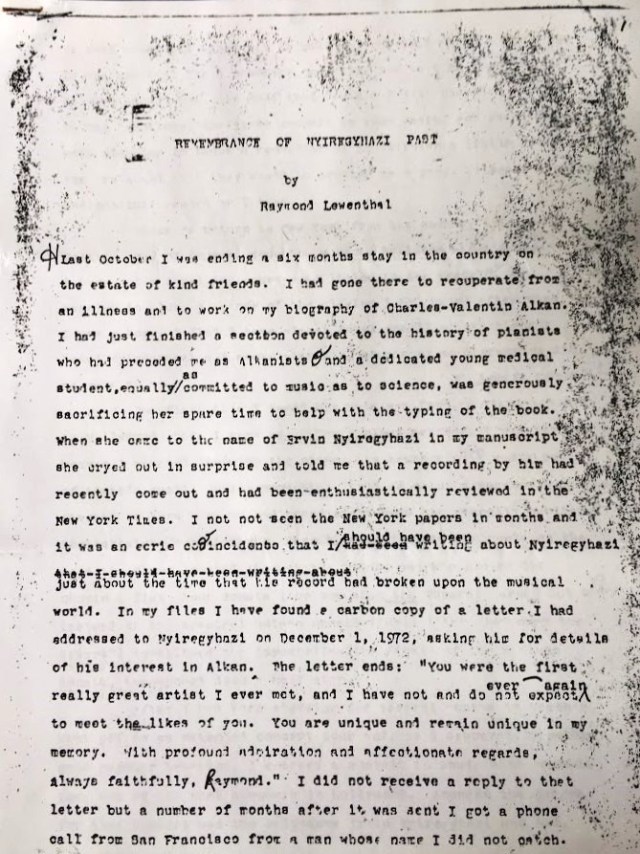
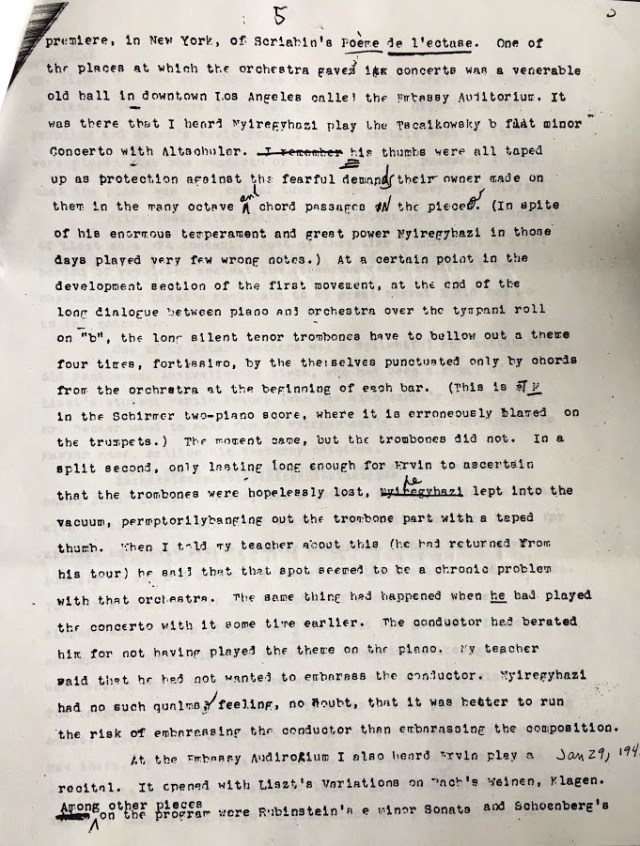
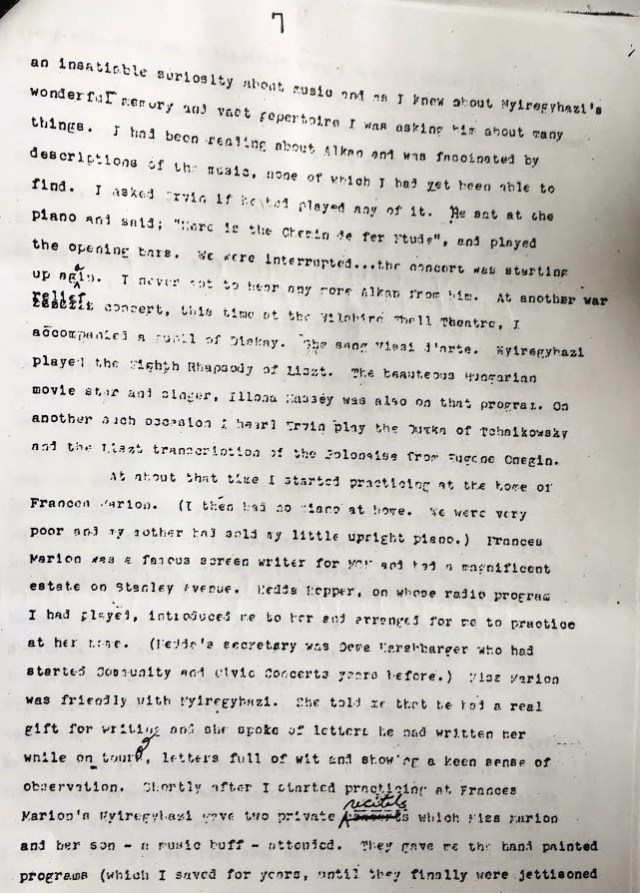
Raymond Lewenthal on Ervin Nyiregyhazi

Many years ago, this interesting manuscript came into my possession. It is an essay by the great American pianist Raymond Lewenthal (1923-88) entitled “Remembrance of Nyiregyhazi Past” in which he gives his personal recollections of the remarkable pianistic genius Ervin Nyiregyhazi (1903-87).

My manuscript is a rather poor quality photocopy of Lewenthal’s twelve-page typescript with his handwritten annotations. The last page is incomplete, but is clearly headed towards its conclusion. It is reproduced here for educational purposes in the hope that the insights it contains will be of benefit to all who are fascinated by the phenomenon that was Nyiregyhazi.

The Universal Life Church

What do The Beatles, Sir Ian McKellen, Sir Richard Branson, Professor Richard Dawkins, Adele, and Benedict Cumberbatch (not to mention many other famous people all around the world) have in common with me? We are all ministers of a remarkable institution called the Universal Life Church (ULC), which was founded in Modesto, California, in 1959 by the late Rev. Kirby J. Hensley.

The ULC was the outcome of many years of study of world religions by Hensley, a self-educated Baptist minister. Hensley said, “The Universal Life Church believes that when a man requests to be ordained, that he is already ordained of God, according to the Bible. In St. John 15-16, it says that God called you and has ordained you. We, the Universal Life Church believe that scripture to be true. We believe you are an ordained minister. What we do, is stand between you and the Federal Governments and between you and the state, not between you and your God.” The sole precept of the ULC is “do that which is right”, with the interpretation of this being left to the individual.

There are various Protestant denominations who, following the teachings of Luther and Calvin in particular, accept the priesthood of all believers in an exclusionary sense, but the ULC was the first to interpret this concept by offering actual ministerial ordination for free to anyone who felt called to accept it. Moreover, it extended the concept beyond professed Christians, embracing all religious beliefs of any kind as well as atheists and agnostics. Hensley said of this “I started studying all kinds of religions and ideals. For the past 40 years, if I heard of any kind of religion, I would look into it and find out what it had to offer.”

The revolutionary vision of Kirby Hensley was motivated both by a dissatisfaction with the mainstream churches and also by a desire to make a stand concerning the conflicts between church and state in the USA during his time. Hensley would say of this, “Let me give you a couple of quotes from the Bible that stresses how important this is. We find Paul saying to the Ephesians: “For we wrestle not against flesh and blood, but against principalities, against powers, against the rulers of the darkness of the world, against spiritual wickedness in high places.” (6:12) We must know who our enemies are – they are the church and the state…God told John the Revelator that in the last days a messenger would come with this message, and the message is that he would gather all things that are in the church and all things that are in the state and make them one. The message is that all men are born free and that they are also born Kings. This earth belongs to all people. It will be taken away from the church and the state and be given back to the people.” We can therefore see that Hensley proposed a concept of the church that was radically libertarian, democratic and decentralized, and that stood firmly against any kind of religious or political establishment.

The USA has a constitutional separation of Church and State such that religious bodies enjoy a very high degree of freedom from regulatory control. Hensley saw the state as an oppressive force, “We created the Church to take care of spiritual matters, and we created the State to solve material problems for us. We elected representatives to handle the work and paid them through taxes. And very much like the Church, the State grew into a system that soon took over the right to direct for us and made us its servants. The State keeps people down in the same way as the Church; with reward and punishment. The law abiding, tax paying citizen is rewarded with a house in a suburb, and his children are sent to schools in which they are taught to be good citizens like their fathers and mothers. This is the reward. But there is punishment too. Those of us who refuse to conform, and feed a system that we do not want any part of, are dragged to court and put in jail. The State, the laws, and the police were created by us to serve us, but today they have made us their servants. The freedom within the system is only imaginary, as the bureaucrats in charge constantly find new ways to impose restrictions within the boundaries of the law.”

In 1962, Hensley and others incorporated the Universal Life Church in California. It was not long before there were dozens of legal challenges to the ULC, questioning its nature as a church as well as its right to tax exemption. The ULC took on these battles and won the most important of them, with a Federal Court ruling in 1974 that it was indeed a valid church and was entitled to tax exemption (Universal Life Church, Inc. v. United States, 372 F. Supp. 770 – Dist. Court, ED California 1974). Regarding the diffuse nature of the ULC, the Federal Court found that the “First Amendment forbade any branch of the government to tell any church whether it must have beliefs or not.”

Hensley commented, “We have fought the state through-out the country. We will not yield to their dictations. So, we fought the system. We feel that the people have the first rights, the church organization has the second, and the state has the third rights. The church and the state were created by men and women for men and women. Therefore, we have allowed the church and the state to dictate our freedom. We are no longer willing to let the state dictate our lives.”

Revd. Kirby J. Hensley at the ULC Headquarters, Modesto, California (Photo credit: The Modesto Bee)

The ULC continues to be based in Modesto, California, although there are many other independent branches and ministries related to the ULC throughout the USA and in many other countries. My involvement has been solely with the parent body of the ULC in Modesto which continues under the leadership of Kirby Hensley’s son André today, and my remarks in this essay (except where specifically referenced) do not relate to any other branches of the ULC which are independent in their governance and may take a different view of various matters.
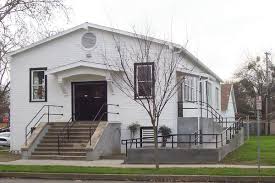
 

In Modesto, the ULC maintains a large church building and services open to the public take place there every Sunday morning. This building also serves as the International Headquarters where staff work to conduct the ULC’s activities and maintain its records.

The most important activity of the ULC continues to be the ordination of ministers.

The Universal Life Church will ordain anyone who asks; for life, without cost, without question of faith, and regardless of anyone’s belief system, age, race, gender or orientation. We maintain that every person has the natural right (and the responsibility) to peacefully determine for themselves what is right.

ULC ministers are people from all walks of life, including teachers, nurses, office clerks, engineers, food servers and celebrities.  There are also ordained ministers whose backgrounds are from more traditional churches and choose to participate as ULC ministers as a show of support for our mission of religious freedom.

(ULC.net)

This process was originally conducted by mail, but has also been made available by online application in the present century. Each application is checked by a member of staff before being accepted. The result is probably the most diverse body of clergy in the world. ULC ministers are also permitted to belong to any other church or religious body without prejudice to their status within the ULC. They include members (and clergy) of all the major religions of the world as well as atheists, agnostics and those whose beliefs are not conventionally classified. Many famous and quite a few infamous people have become ULC ministers over the years.

Most states in the USA have made it a legal requirement that marriage be celebrated by a minister of religion, and this is the main reason why around 70% of applicants seek ULC ordination, as part of a recent trend of marriage being celebrated by friends or loved ones. Currently, ULC ordination is accepted as valid for the purposes of celebrating marriage in the vast majority of US states.

The case law in the USA that involves the ULC is voluminous and encompasses some of the most significant American battles for religious freedom of the past sixty years. There is now a website (associated with the ULC Monastery, one of the larger branches of the ULC) devoted to this case law at https://ulccaselaw.com.

An obvious question is what value and meaning ULC ordination has if it is open to all comers? While the ULC provides a legal ordination credential, since this does not involve any examination of the fitness of the candidate for the ordained ministry, it is the individual who will determine whether that credential has any meaning beyond a merely functional and legalistic level. Certainly some people become ordained in the ULC without taking it seriously, and for some it is simply a legal rubber stamp enabling them to officiate a marriage ceremony. As with other religious bodies there is also always the possibility that some may seek ordination with malign intent. The ULC is very clear that it takes no responsibility for the actions of its ministers.

Despite this, I have been consistently impressed by the calibre of a number of ministers ordained by the ULC, particularly those such as interfaith ministers, pagans, and New Age practitioners who wish to follow a genuine ministerial calling that is not served by other more established paths. They demonstrate that ULC ministry is truly what you make of it. I have also become aware of several clergy of mainstream Christian churches who additionally hold ULC ordination.

My own position has been that I was attracted to the ULC because I shared its libertarian belief in religious freedom. The ULC has consistently stood for this principle and has not hesitated to defend it in court. My status as a minister of the ULC has always been supplementary to my position as a clergyman in more traditional Christian denominations.

The work of the ULC is sometimes interpreted by mainstream religious bodies as threatening their status or control. In my view, the ULC’s willingness to fight for religious freedom has assisted all religious bodies. However, this fight has also emphasised the separation of church and state under the US Constitution.

As we can see in other countries, where this separation is not maintained, it leads to what many would see as too close a bond between the larger religious bodies and the state, such that the power of the state can then be used to enforce their hegemony, particularly against smaller or more unusual religious bodies. While human rights legislation generally protects the freedom of belief of the individual, it does not generally promote equal status between religious bodies. In England, the Church of England is established by law and its canon law is the law of the land; it is also endowed with very significant property, wealth and influence in public life. The history of the Church of England’s relationship with some smaller churches, notably with Old Catholicism, has unfortunately been characterised by hatred and discrimination, and yet this is allowed to go unchecked because of its establishment status.

Because these are important matters to me, I hold that support for the mission of the ULC is a way to stand for a better relationship between Church and State.

In England, there have been various efforts over the years to establish associations of ULC clergy. There is no provision in our law that gives recognition to churches as religious bodies per se, nor are they required to register with the state so long as they remain unincorporated. The ULC would in theory be able to establish places of worship and to register charities if it were to grow to a size where this was desired. Its ministers may use the title Reverend or another title that signifies their ministry in the same way as other clergy of various religious bodies.

In respect of the celebration of marriage, ULC ministers are in a similar position to humanist and related celebrants, in that marriage would require legal registration before a registrar in order to be valid, either before the ULC ceremony or with the registrar in attendance at that ceremony to perform the legal requirements.

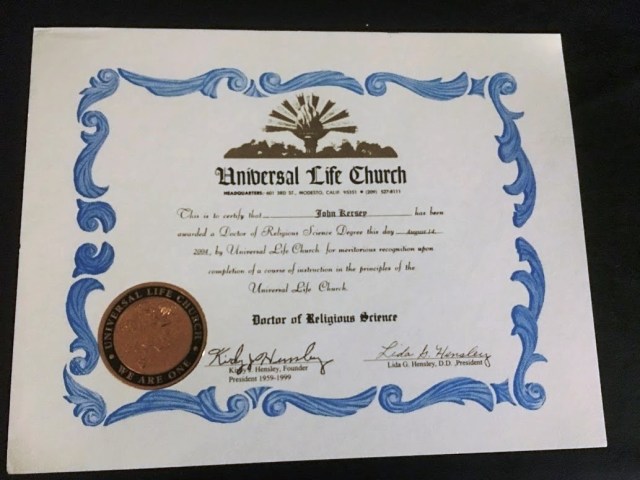
In furtherance of its mission, the ULC also grants degrees. The practice of churches granting religious degrees has a long history in the United States, and many churches there maintain their own seminaries to train their clergy. Because of the separation of church and state, it has been upheld by various court judgements over the years that the granting of religious degrees by a religious organization is an activity which states cannot regulate or interfere with. Given the increasing politicization of the educational establishment, the religious alternative may well prove to be the last haven of genuine academic freedom for those who are not aligned with the current mainstream.

Degrees in religious subjects awarded by churches in the United States have exactly the same legal status as United States degrees in religious subjects awarded by mainstream universities. The separation of church and state means that they may be used freely in any context; the doctorates entitle the holder to use the title Doctor, and all degrees entitle the holder to use postnominal letters. While certain states have attempted to regulate the use of degrees, religious degrees that have been awarded legally under state law are valid in all states and any attempt to restrict them would be unconstitutional. Moreover, and uniquely, the degrees of the ULC have the protection of a Federal Court judgement as to their legality.

In a Federal Court judgement of 1974, the judgement records that “Rev. Hensley further testified that the Honorary Doctor of Divinity program was developed since the church policy allowed ministerial credentials to be conferred gratis upon anyone on request and upon new ministers who were seeking information on ministerial procedures. (Kirby J. Hensley deposition, page 21, lines 18-25.) The lesson plans (defendant’s Exhibits G through L) cover basic church functions, how to conduct services, marriage, baptismal ceremonies, burial services, etc. The lesson plans were mailed out or otherwise distributed on request with the Honorary Doctor of Divinity as a course of instruction in the principles of the church.” The court then found that, “Expert opinion evidence established that an Honorary Doctor of Divinity is a strictly religious title with no academic standing. Such titles may be issued by bona fide churches and religious denominations, such as plaintiff, so long as their issuance is limited to a course of instruction in the principles of the church or religious denomination. The Court’s conclusion that the issuance of Honorary Doctor of Divinity certificates is not violative of the California Education Code and therefore public policy is supported by a reading of Section 20920, California Education Code: The provisions of Sections 29003 to 29010, inclusive, do not apply to any diploma or course of instruction given by a bona fide church or religious denomination if such course is limited to instruction in the principles of that church or denomination.”
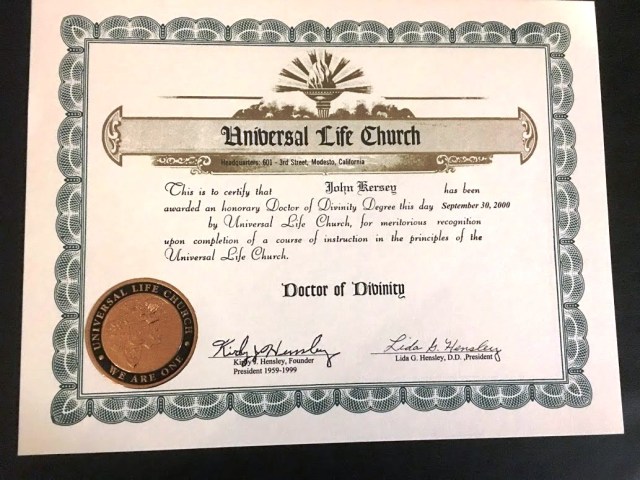
California law permits churches or religious denominations to issue degrees, with the current (2023) provision being contained in the California Code, Education Code – EDC § 94874. This reads as follows,

Except as provided in Sections 94874.294874.7, and 94927.5, the following are exempt from this chapter: […]
(e)(1) An institution owned, controlled, and operated and maintained by a religious organization lawfully operating as a nonprofit religious corporation pursuant to Part 4 (commencing with Section 9110) of Division 2 of Title 1 of the Corporations Code, that meets all of the following requirements:

(A) The instruction is limited to the principles of that religious organization, or to courses offered pursuant to Section 2789 of the Business and Professions Code.

(B) The diploma or degree is limited to evidence of completion of that education.

(2) An institution operating under this subdivision shall offer degrees and diplomas only in the beliefs and practices of the church, religious denomination, or religious organization.

(3) An institution operating under this subdivision shall not award degrees in any area of physical science.

(4) Any degree or diploma granted under this subdivision shall contain on its face, in the written description of the title of the degree being conferred, a reference to the theological or religious aspect of the degree’s subject area.

(5) A degree awarded under this subdivision shall reflect the nature of the degree title, such as “associate of religious studies,” “bachelor of religious studies,” “master of divinity,” or “doctor of divinity.”

Those wishing to argue against the ULC often point out that the earned degrees that it offers require little academic work. There are no general education courses; the study materials are uncomplex in nature, and the student is either not tested at all (being awarded the degree on a good faith basis assuming that they have studied the materials provided) or is subject to a straightforward pass/fail test. But to understand the ULC’s degrees it is essential to grasp the central point that they are religious, not academic, in nature.

A close reading of the statute above will find that it is not the ULC that limits the content of its degrees, but in fact the law of the State of California itself. A degree conferred under this statute is deliberately circumscribed, so that “the instruction is limited to the principles of that religious organization” and “the diploma or degree is limited to evidence of completion of that education,” and moreover “An institution operating under this subdivision shall offer degrees and diplomas only in the beliefs and practices of the church, religious denomination, or religious organization.” Therefore, the only subject matter that can form part of a degree curriculum is the principles, beliefs and practices of the ULC, which as discussed above has but one religious principle. The ULC could not add substantially to the content of its degree curriculums without contravening the law.

In practice, the content of ULC degrees is therefore principally the writings and beliefs of its founder, Kirby J. Hensley, including his personal views on aspects of religious study including the Bible. Much is made of Hensley’s illiteracy, but if this was indeed the case he must have left one of the most comprehensive written legacies of any illiterate. His writings are interesting, clearly expressed and at times thought-provoking, and certainly worthy of study. I have enjoyed reading them, and hope to read more of them in the future.

I have taken a number of the ULC’s degrees from interest over the years (where else could one become a Doctor of Motivation?), and when time permits hope to do more. They are not, and do not claim to be, academic credentials. They are exactly what they claim to be, which is legal and valid California religious degrees.
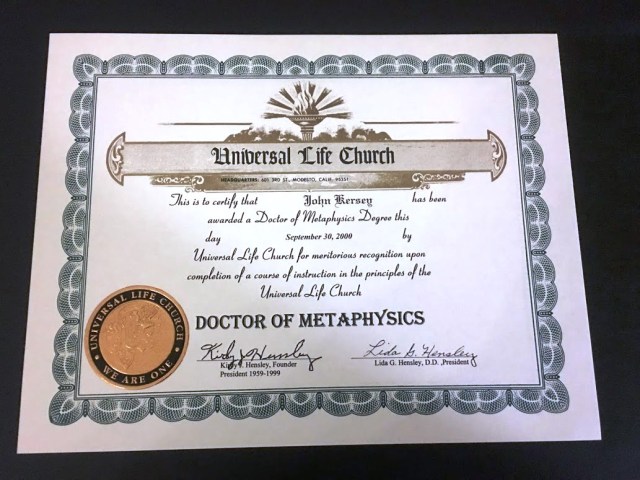
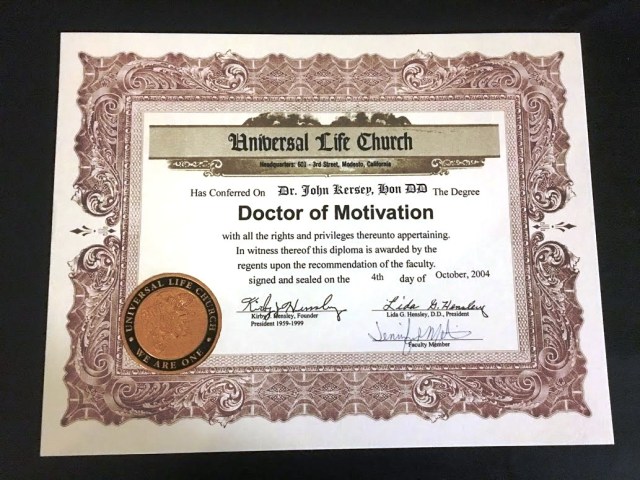
There is a scheme of academic dress for the degrees of the ULC. The hoods are in Cambridge full shape, made in Mary blue worsted wool and lined with the discipline colour (which is scarlet for the Hon.D.D. and each of the other degrees which are all in subjects related to divinity or theology, except the Ph.D. in Religion which would be dark blue).

The hood is the same for each degree level in the same discipline, so the Master’s Degree in Religion receives the same hood as the Hon.D.D.

The gowns, however, differ between the levels. There is provision for bachelors, although the ULC is not known to have awarded any bachelor’s degrees. They wear the American Intercollegiate Code bachelor’s gown in black. Masters wear the basic master’s gown in black, and doctors wear the American Intercollegiate Code gown in blue worsted wool.


This article has also been published on the website of the Libertarian Alliance (https://libertarianism.uk/2024/08/10/the-universal-life-church/)

Honours and awards – Medal of Honour in Silver with Swords (Knight 2nd Class) of the Association for the Memory of the House of Hohenzollern and the Kingdom of Prussia

I have been honoured by the Verein zur Erinnerung an das Haus Hohenzollern und das Königreich Preuβen, Germany, which has awarded me its Medal of Honour in Silver with Swords (Knight 2nd Class). The award was made in recognition of my support for monarchism and for the objects of the Association.

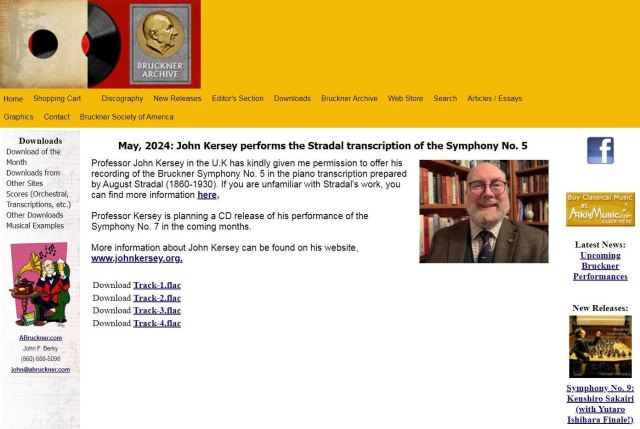
New CD published – Bruckner Symphony no. 5 transcribed for solo piano by August Stradal

A new CD recording has been issued by Romantic Discoveries Recordings.

Bruckner: Symphony no. 5 transcribed for solo piano by August Stradal
(first recording)
John Kersey, piano
RDR CD149

Total time: 77 minutes 8 seconds.

Anton Bruckner (1824-96) Symphony no. 5 in B flat major, WAB 105 transcribed for solo piano by August Stradal (1860-1930)

1. Adagio-Allegro (00:00)
2. Adagio (23:09)
3. (Scherzo) Molto vivace (41:04)
4. (Finale) Adagio-Allegro (52:47)

Artwork: Landscape in the moonlight by Carl Johan Fahlcrantz (1774-1861)

August Stradal was a Czech pupil of Bruckner and also studied piano with Liszt and Leschetizky. He was known for his ability to perform the most technically demanding piano works of Liszt, and made piano transcriptions of Liszt’s symphonic poems. He transcribed five of Bruckner’s symphonies for solo piano, following the performing versions prepared by fellow Bruckner pupil Franz Schalk.

New CD published – Bruckner Symphony no. 7 transcribed for solo piano by Cyrill Hynais

A new CD recording has been issued by Romantic Discoveries Recordings.

Bruckner: Symphony no. 7 transcribed for solo piano by Cyrill Hynais
(first complete recording)
John Kersey, piano
RDR CD148

Total time: 65 minutes 41 seconds.

Anton Bruckner (1824-96) Symphony no. 7 in E major, WAB 107 transcribed for solo piano by Cyrill Hynais (1862-1913)

1. Allegro moderato (00:00)
2. Adagio: Sehr feierlich, aber nicht schleppend (In memoriam +Richard Wagner, 13 February 1883.) (18:28)
3. Scherzo: Sehr schnell (42:42)
4. Finale: Bewegt, doch nicht zu schnell (52:59)

John Kersey, piano

Artwork: Max Brückner and Otto Henning – Final scene of Wagner’s Götterdämmerung

Cyrill Hynais was a pupil and friend of Bruckner. He transcribed three of Bruckner’s symphonies for solo piano. This is the first complete recording of his transcription of the Seventh.

The ties of the Royal College of Music

The use of distinctive ties to establish an institutional association is a notable element of British culture, having begun at Cambridge in the nineteenth-century. In respect of our schools, colleges and universities, ties form a part of academic dress.

Today, many educational institutions continue to prescribe one or more ties that may be worn by those who have attended them, or in some cases also by former staff and other associated persons. The Royal College of Music, which I attended as a student and was later associated with as a Junior Fellow, was formerly among these.

During my time at the RCM I carried out some research into the ties that had been prescribed in the past. In the RCM Magazine of 1929 (Vol.3 no. 23) reference is made to badges, ties and blazers in the colours of the RCM Union. The RCM Union comprised the current students and staff, alumni and former staff of the RCM, being  formed in 1906 and maintained by annual subscription.

No surviving examples of the tie were known to exist, and therefore I embarked upon a project to reconstruct it, enlisting the help and advice of a doyen of institutional ties, the late Tom Clegg of Benson and Clegg in the Piccadilly Arcade. The royal blue referred to is likely to have been the same shade as is used in the hood of the Associateship of the RCM. Traditionally, royal blue is a deep, dark blue rather than the lighter colour that is more usual these days (and that is also used by the RCM, for example in the former D.Mus.R.C.M. robe and the pre-1998 M.Mus.R.C.M. hood).

The ARCM hood, showing the dark traditional shade of royal blue used by the RCM. This shade is also used in the FRCM hood and in the Director’s robe.


RCM tie after the 1929 specification as made by Benson and Clegg in non-crease silk. This is a most pleasing and distinctive  tie and it is difficult to understand why it was discontinued.

In the same RCM magazine of 1929 there is reference to the Union Badge, which had been produced by Mr George Kruger Gray, FSA, some time previously, and which was accompanied by the motto “The Letter killeth, but the Spirit giveth life”.


By the 1970s, a new tie had appeared, bearing the same crest that had been designed for the RCM Union. This was often to be seen worn by Sir David Willcocks as Director of the RCM as well as by staff and students.

To mark the RCM’s Centenary in 1982 a further tie had been introduced. It was described as “plain navy blue with a gold musical motif surrounding the Prince of Wales’ feathers (the motif used on RCM cheques in 1882)”. It was available in silk for £8.50 or polyester for £4.50.

It can be seen that the design that appeared on the cover of the RCM Magazine at that time used several of the same elements:


During my time at the RCM between 1987 and 1998, both of these ties were worn proudly by a number of students and staff (many of the staff at that time were RCM alumni). The crested tie was also worn by the Prince of Wales on his visits to the RCM as President during the 1990s.


The Prince of Wales (now King Charles III) wearing the RCM crested tie and the robes of the D.Mus.R.C.M. These robes use the lighter, more modern shade of royal blue discussed above.


The former RCM scarf also used the crested device and again combines the RCM colours of (lighter) royal blue and gold.

As of 1991, the RCM Union was described as comprising “past students, the teaching and administrative staffs of the College, all members of the Students’ Association and others whom the Committee decide to elect.” Several persons were elected to honorary membership during its history. The RCM Union was abolished in 1992 and replaced by the RCM Society which initially had the same membership composition and aims as the RCM Union, but was converted to a non-subscription model in 2001 and abolished altogether in 2009.

Ties were still available from the RCM until the mid-1990s, but when their stock ran out it was not replenished, and provision appears to have ceased altogether in the late 1990s. While the Prince of Wales continued to wear his RCM crested tie on his visits in his capacity as the RCM’s President for some years, more recent photographs on the RCM website suggest that he ceased to do so in the present century.

Given the extensive and indeed iconoclastic changes that attended the RCM in the last years of the last century, it is perhaps unsurprising that there should have been no place in the new-look institution for an institutional tie. As one who was a part of the RCM before its present incarnation, however (and as a former member of both the RCM Union and RCM Society), I continue to wear the ties above with an awareness that they recall the values of the College as they were then, which values in my view are well worth perpetuating.

Royal Collegian Jonathan Mann informs me that there was in fact a move to reintroduce a RCM tie as a result of alumni suggestions as part of the RCM’s More Music Appeal around 2018. It appears that a few prototypes of this splendid new design were issued, but in the event, it was abandoned without being put into production.

As a postscript, it seems that the subject of RCM ties is not quite exhausted. In the present century the American designer Ralph Lauren produced a tie for his Purple Label that is based on the crest of the RCM and achieves an effect that is both dignified and attractive. Albeit unofficially, this tie nevertheless provides a worthy example of what might, and perhaps should, have been.


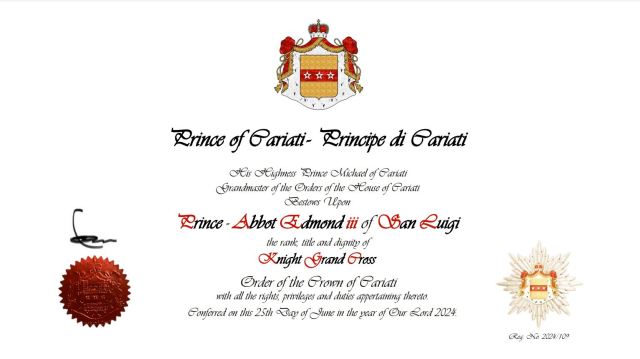
Honours and awards – Knight Grand Cross of the Order of the Crown of Cariati

The Principality of Cariati was established by His late Royal Highness Prince Vittorio Emanuele, Head of the Royal House of Savoy and son of the last King of Italy, H.M. Umberto II, in 2021, under the patronage of Princess Marie Elisabeth de Balkany, the sister of Prince Vittorio Emanuele, in favour of H.H. Michael Corey Chan.

The Order of the Crown of Cariati is one of two dynastic orders of the Prince of Cariati. In June 2024 friendly relations were established between the Prince of Cariati and the Abbey-Principality of San Luigi, and the Prince of Cariati was appointed a Knight Grand Cross of the Order of the Lion and the Black Cross by me.

Honours and awards – Honorary Protective Shield in the African Royalty Humanitarian Order

I have been honoured by the African Royalty Humanitarian Order with the title of Honorary Protective Shield. The Grand Delegation of Africa – Alkebu-Lan (GDAAL) describes the nature and purposes of the Order, which was founded in 2021, thus,

“The main purpose of the GDAAL is to support, to protect, to strengthen, to improve and to preserve the position of the aristocracy (53 countries and more than 7,800 royal clans/ dynasties) and the Cultural Leader at the African Continent.

The GDAAL is independent from any Dynasty in Africa; this organization is a “protective umbrella organization” for all 7,800 royal clans of Africa, every Royal Clan is on the same eye level and all noble members have equal rights.”

The brevet cites my “praiseworthy service for the entirety of the Royal Dynasties of Africa.” I am proud to continue to serve the causes of African monarchy and its nobiliary and chivalric traditions.

Honours and awards – Silver Cross of the Union of Veterans and Reservists of the Polish Army of the Republic of Poland

I have been honoured with the award of the Silver Cross of the Zwiqzek Weteranów i Rezervistów Wojska Polskiego Rzeczypospolitej Polskiej. The Cross of the Union exists in three classes; gold, silver and bronze, but the gold cross has not yet been awarded. Therefore the silver cross is at present its highest honour.

New CD published – Piano Music of Walter Niemann vol. 28

A new CD recording has been issued by Romantic Discoveries Recordings.

Piano Music of Walter Niemann volume 28
 (includes first recordings)
John Kersey, piano
RDR CD147

Total time: 60 minutes 24 seconds

1. Venezia – Barcarole from Zwei Klavierstücke, op. 94 no. 1
2. Stürmische Vorfrühling in der Heide (Stormy early spring morning on the heath) from Heidebilder, op. 12 no. 1

3. Mein Klavierbuch, twenty little pieces from the life of children, op. 114
i. Good Morning! (Praeludium)
ii. Little Clementi in Great Difficulties
iii. March of the Boy Scouts
iv. Chimes
v. What the Giant’s Grave Relates
vi. A Little Tango
vii. The Old Musical-Box
viii. The Cuckoo-Boston
ix. Song on the Water
x. Old Viennese Waltz
xi. Russian Troika Journey
xii. Jackie Coogan Dances the Blues
xiii. Blackbirds in the Garden
xiv. A Little Shimmy
xv. A Ghost
xvi. Circus
xvii. Butterfly
xviii. Teddy is to Sleep
xix. A Gallant Play of Colours
xx. Good Night! (Finale)

4. From Classical Christmas Music
i. Johann Sebastian Bach (1685-1750) transc. Walter Niemann: Pastoral Symphony from the Christmas Oratorio, BWV 248
ii. Francesco Manfredini (1684-1762) transc. Walter Niemann: Christmas Symphony
iii. Arcangelo Corelli (1653-1715) transc. Walter Niemann: Pastorale from the Christmas Concerto, op. 6 no. 8

5. Spielt es mal, 12 little pieces for youth, op. 142
i. Teddy Bear is sick
ii. A half penny’s worth on the Merry-go-round
iii. Christmastree nicknacks
iv. We wish you many happy returns of the day
v. The Humming-Top
vi. Granny’s Musical Clock
vii. Oh dear! I am so tired
viii. Have an Orange?
ix. Claudina on her Circuspony
x. Black-cap at his little food-bowl
xi. Micky-Mouse
xii. The Man with the Balloons

John Kersey, piano

Our thanks go to Nicolo Figowy and Steffen Herrmann for their generous loan of scores.

Walter Niemann was regarded in 1927 as “the most important living piano composer who knows how to make music from the piano in a subtle and colorful way, although he often enters the field of salon music” (H. Abert, Illustrated Music Lexicon). This most sensitive and introverted master of the piano devoted his life to composition and musical scholarship, also performing his music in concerts and radio broadcasts. Niemann’s vast output for the piano is only now starting to become more widely known. Although his style is generally unashamedly conservative, he was one of the very few German composers to explore Impressionism in music, and this also reflected a fascination with the Far East. Elsewhere, Niemann’s imagination takes us from much Baroque recreation to large-scale epic sonatas, Schumannesque miniatures and even the exploration of early jazz styles. His understanding of the capabilities of the piano was complete, and his works include both collections for young pianists and mature works that exploit the full range of pianistic effect and make significant demands on the performer.

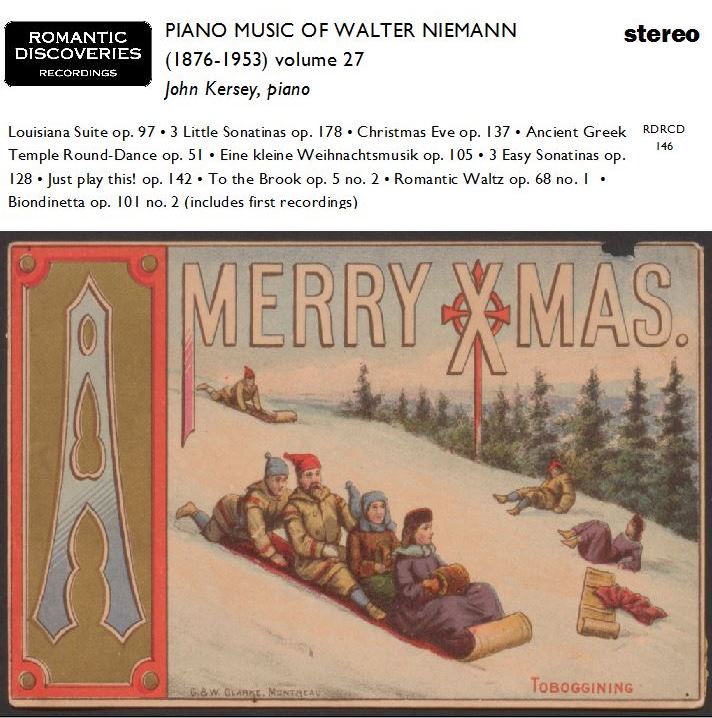
New CD published – Piano Music of Walter Niemann vol. 27

A new CD recording has been issued by Romantic Discoveries Recordings.

Piano Music of Walter Niemann volume 27
 (includes first recordings)
John Kersey, piano
RDR CD146

Total time: 67 minutes 39 seconds

1. Louisiana Suite, op. 97
i. The Mississippi Steam-Boat’s in Sight
(“The Glendy Burke” – Stephen C. Foster)
ii. My Old Kentucky Home (Stephen C. Foster)
iii. The Interrupted Serenade
(“Old Black Joe” – Stephen C. Foster; “Massa’s in the Cold Ground” – Stephen C. Foster; “Oh! boys carry me ‘long” – Stephen C. Foster; “Gentle Nettie Moore” – Pike)
iv. Longing for Home
(“Old Folks at Home” (Way down upon the Swanee River) – Stephen C. Foster)
v. Mardi Gras in New Orleans
(“Dixie’s Land” – Dan Emmet)

Foreword by Walter Niemann (1924)
The following Suite contains eight of the finest and best-known popular Negro-Songs, such as were chiefly sung on the vast Cotton- and Sugar-plantations in the Southern States of North America, and arranged by the composer.

By far the finest songs, born of and permeated with the national spirit, both as regards the words and the music, are those written by America’s most popular and earliest song-composer, Stephen C. Foster (1826 to 1864). His chief aim throughout was to counter-balance the predominating number of sad or religious songs with merry, cheerful tunes. Both kinds breathe the very soul of these great big grown-up black children, whose spirit feels, pulsates and responds just as vividly and deeply, as cheerfully and tenderly to the joys and sorrows of life, as our own.

The grief and sorrow for the old abandoned country is mostly done full justice to and pulsates in most of these songs; thus, for instance, in the heart-touching tune “My old Kentucky Home” or in the early “Song of Home”; The “Old Folks at Home”, the rendering of which is so beautifully described by the German poet Paul Keller, when he says “She sang this most pathetic of all Songs of Home with deep heart-born emotion, and Mr. Brown hummed the accompaniment with a nasal tone, as the negroes do, when, far from home, one of them, leaning against the wall, allows his inmost, heart-felt sorrow and the grief of his enslaved soul to flow forth in song. Then all, with motionless body, like rigid statues, join in the humming-part, their large eyes fed with burning tears gazing, staring at the yellow light of the dim lamps.”

The tunes or melodies upon which “The Interrupted Serenade” is based, belong to the series or class of songs expressive of: the heart, forlorn and longing for death (“Old black Joe”), -lamenting the dead (“Massa’s in the cold ground”), –farewell to life (“Oh boys, carry me ‘long!”) They all impressed the minstrel accompanying himself on the banjo, the national instrument of the negroes, as being too sad, hence his ever-increasing desire, his demand for something merry and cheerful, resulting in his winding up with a little serenade to his sweetheart: “Nettie Moore”. This leads to the class of cheerful songs, as delightful in their simple, childlike purity and mirth, as they are fascinating in their charm of melody and rhythm.

Such a one is “Dixie Land” – that beautiful, tropical Florida in the South, where the minstrel’s cradle stood, and finally that delicious melody in praise of the famous old Mississippi Express-boat “Glendy Burke”

2. Drei kleine Sonatinen, op. 178
no. 1 in F major:
i. Morgentlich frisch und munter
ii. Rondino (Pastorale)
no. 2 in D major
i. Munter und frisch
ii. Im alten Menuett-Tempo
iii. Lebhaft und heiter
no. 3 in C major
i. Mässig bewegt
ii. Kinderliedchen (aus Alt-Hamburg)

3. Der Weihnachtsabend, op. 137
i. Christmas is ringing in
ii. Shepherds’ music
iii. The boys play soldiers
iv. Dolls’ waltz for the girls
v. To bed

4. Altgriechischer Tempelreigen, op. 51

5. A little Christmas music on old Christmas melodies, op. 105
i. O Holy Night
ii. Under the Christmas tree – little variations on the German Christmas carol “O Tannenbaum”
iii. At the Christmas market
iv. The Christmas Mass
v. Farmhand Rupert
vi. The Christmas Bells

6 Drei leichte Sonatinen, op. 128
no. 1 in C major
i. Moderato ma energico
ii. Minuetto
iii. Giga alla caccia (A little Hunting Air). Presto.
no. 2 in G major
i. Amabile con moto
ii. Siciliano per la notte de natale. Un poco lento.
iii. Giocoso ed animato alla burla
no. 3 in F major
i. Allegro non troppo, ma giocoso
ii. Pastorale “Die Schalmei”. Moderato ed amabile con moto.
iii. Finale. Molto animato e giocoso

7. To the brook from Pastellbilder, op. 5 no. 2
8. Romantic Waltz from Three Modern Pieces, op. 68 no. 1
9. Biondinetta – Graceful Waltz from Zwei kleine Waltzer, op 101 no. 2

John Kersey, piano

Our thanks go to Nicolo Figowy and Steffen Herrmann for their generous loan of scores.

Walter Niemann was regarded in 1927 as “the most important living piano composer who knows how to make music from the piano in a subtle and colorful way, although he often enters the field of salon music” (H. Abert, Illustrated Music Lexicon). This most sensitive and introverted master of the piano devoted his life to composition and musical scholarship, also performing his music in concerts and radio broadcasts. Niemann’s vast output for the piano is only now starting to become more widely known. Although his style is generally unashamedly conservative, he was one of the very few German composers to explore Impressionism in music, and this also reflected a fascination with the Far East. Elsewhere, Niemann’s imagination takes us from much Baroque recreation to large-scale epic sonatas, Schumannesque miniatures and even the exploration of early jazz styles. His understanding of the capabilities of the piano was complete, and his works include both collections for young pianists and mature works that exploit the full range of pianistic effect and make significant demands on the performer.

New CD published – Piano Music of Walter Niemann vol. 26

A new CD recording has been issued by Romantic Discoveries Recordings.

Piano Music of Walter Niemann volume 26
 (includes first recordings)
John Kersey, piano
RDR CD145

Total time: 77 minutes 25 seconds

1. Tafelmusik, op. 125
i. Intrada
ii. Pavane
iii. Inventione fugata
iv. Allemanda
v. Courante
vi. Sarabande
vii. Rigaudon
viii. Menuett
ix. Gigue

2. Variationen über eine altholländische Sarabande, op. 118 no. 2 (Theme and Variations 1-7 by Gisbert Steenwick (c. 1670))
Tema (Tempo di Sarabande)
Var. 1: Un poco allegro
Var. 2: L’istesso tempo
Var. 3: Più allegro
Var 4: Più tranquillo
Var. 5: Un poco Andantino
Var. 6: Molto allegro e scherzando
Var. 7: Tempo del tema
Var. 8: Allegro leggiero
Var. 9: Moderato, ma energico marcato
Var. 10: Vivo (molto allegro)
Var. 11: Moderato, ma energico marcato
Var. 12: Andante mosso
Var. 13: Giga (molto allegro e chiaro)
Var. 14: Canarie (l’istesso tempo, giocoso)
Var. 15: Almand (molto moderato)
Var. 16: Pavana (Sostenuto con grazia)
Var. 17: Gagliardo (Con moto e giocoso)
Var. 18: Courante (Allegro molto e con grazia)
Var. 19: Minuetto (Moderato)
Var. 20: Siciliana (Tempo di Siciliano)
Var. 21: Rigaudon (animato e marcato)
Var. 22: Molto allegro marcato e appassionato
Var. 23: Moderato pesante
Var. 24: L’istesso tempo
Var. 25: Tempo del tema, ma più largamente e pesante

3. Menuett und Bourrée, op. 111

4. Die Gespensterbark, Traumballade, op. 160

5. Impromptu-Caprice, op. 94 no. 2

6. Erinnerungen, Stimmungen und Bilder, op. 9
i. On the Fjord (Norwegian Idyll)
ii. Hermitage (A little Gavotte)
iii. When our grandfather met our grandmother
iv. A sad hour (In memory of my dear cousin Carl Warnke (obit. Kiel, May 1908))
v. A little dance on the green

7. Sturm und Drang Etude

8. Zwei Romantische Impressionen, op. 56
i. The blue grotto
ii. Der Goldsoot*
Er stand und sah ins Wasser, das mit stillem, traurigem Auge ihn ansah, als hielte es wehmütig sein Geheimnis fest. – Gustav Freussen
He stood and looked into the water, which looked at him with quiet, sad eyes, as if it were wistfully holding on to its secret.
*According to a Schleswig-Holstein folk legend, the Goldsoot (Soot = spring), located in the deepest heathland solitude, keeps immeasurable treasures at its bottom.

John Kersey, piano

Our thanks go to Nicolo Figowy and Steffen Herrmann for their generous loan of scores.

Walter Niemann was regarded in 1927 as “the most important living piano composer who knows how to make music from the piano in a subtle and colorful way, although he often enters the field of salon music” (H. Abert, Illustrated Music Lexicon). This most sensitive and introverted master of the piano devoted his life to composition and musical scholarship, also performing his music in concerts and radio broadcasts. Niemann’s vast output for the piano is only now starting to become more widely known. Although his style is generally unashamedly conservative, he was one of the very few German composers to explore Impressionism in music, and this also reflected a fascination with the Far East. Elsewhere, Niemann’s imagination takes us from much Baroque recreation to large-scale epic sonatas, Schumannesque miniatures and even the exploration of early jazz styles. His understanding of the capabilities of the piano was complete, and his works include both collections for young pianists and mature works that exploit the full range of pianistic effect and make significant demands on the performer.

New CD published – Piano Music of Walter Niemann vol. 25

A new CD recording has been issued by Romantic Discoveries Recordings.

Piano Music of Walter Niemann volume 25
Heitere Sonate (Piano Sonata no. 5), op. 96 • Wood-Pictures from the Fichtelgebirge, op. 141 • The Ruby, op. 161 • Modern Miniatures, op. 95 • Venetian Gardens, op. 132 (includes first recordings)
John Kersey, piano
RDR CD144

Total time: 71 minutes 11 seconds

1. Sonatina giocosa (Heitere Sonate) (Piano Sonata no. 5), op. 96
i. Moderato e lusinghando
ii. Canzona – Larghetto con intimissimo sentimento
iii. Allegro non tanto, ma giocoso

2. Waldbilder aus dem Fichtelgebirge (Wood-Pictures from the Fichtelgebirge), op. 141
i. Juni-Morgen (June Morning)
ii. Einsamer Weiher im Hochmoos (Lonely pond in Hochmoos)
iii. Siebenstern
iv. Felsenmeer
v. Waldbächlein (Little Wood Brook)
vi. Rosarote Abendwolken (Pink evening clouds)
vii. Farren im Wind (Bullocks in the wind)
viii. Heroische Landschaft (Vogelruf in der Luisenburg) (Heroic Landscape – Birdsong in the Luisenburg)
ix. Abschied (Farewell)

3. Der Rubin (The Ruby) (after Friedrich Hebbel), op. 161
i. Assad
ii. Fatime
iii. Soliman der Juwelier
iv. Der Kadi
v. Der Sultan

4. Modern Miniatures, op. 95
i. An Old Spanish Mission
ii. The Mirror Lake
iii. A Chinese Quarrel
iv. A Dickens Story
v. Catalonian Serenade
vi. A Lonely Pine Tree (Via Appia)
vii. The Lady in Old Brocade
viii. Dance of the Odalisque
ix. Mid-Autumn
x. Delft (Boerendans)

5. Venezianische Gärten (Venetian Gardens), Imaginary Drama in Two Scenes after Schiller’s “Visionary”, op. 132

“A maiden, fair as a houri, wandering beneath my windows, at break of day, with her lover – and a lover, who did not know to make better use of such an hour; surely these supplied materials for the composition of a picture which might well occupy the fancy of a dreamer.” – Schiller

i. Very stirring scene before the playing fountain
They were standing before the basin of a fountain, some distance apart, both wrapped in deep silence.

ii. The Flight
With a speed that her companion cannot use, she hastens to the shore. Too late! Quick as the arrow in its flight, the gondola bounds forward; and soon, nothing is visible but a white handkerchief fluttering in the air from afar.

John Kersey, piano

Our thanks go to Nicolo Figowy and Steffen Herrmann for their generous loan of scores.

Walter Niemann was regarded in 1927 as “the most important living piano composer who knows how to make music from the piano in a subtle and colorful way, although he often enters the field of salon music” (H. Abert, Illustrated Music Lexicon). This most sensitive and introverted master of the piano devoted his life to composition and musical scholarship, also performing his music in concerts and radio broadcasts. Niemann’s vast output for the piano is only now starting to become more widely known. Although his style is generally unashamedly conservative, he was one of the very few German composers to explore Impressionism in music, and this also reflected a fascination with the Far East. Elsewhere, Niemann’s imagination takes us from much Baroque recreation to large-scale epic sonatas, Schumannesque miniatures and even the exploration of early jazz styles. His understanding of the capabilities of the piano was complete, and his works include both collections for young pianists and mature works that exploit the full range of pianistic effect and make significant demands on the performer.

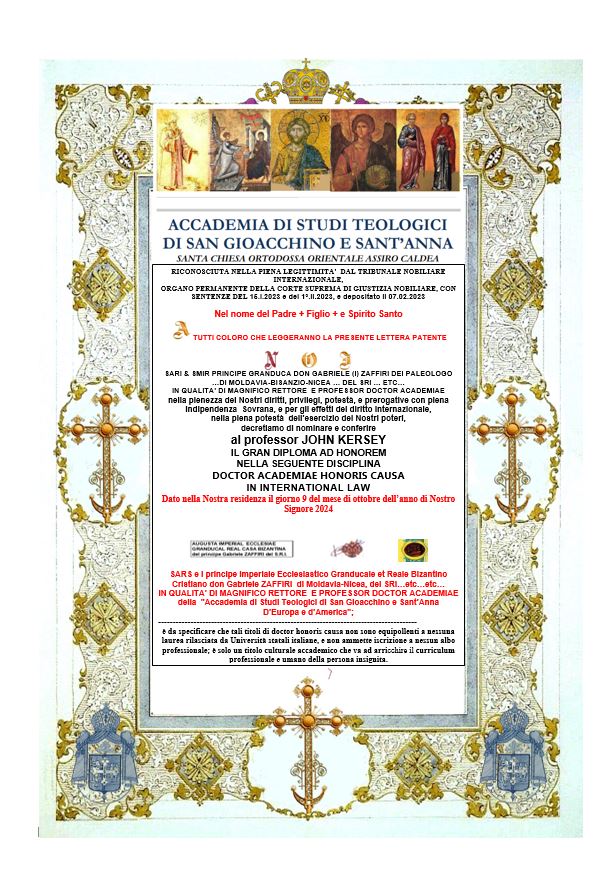
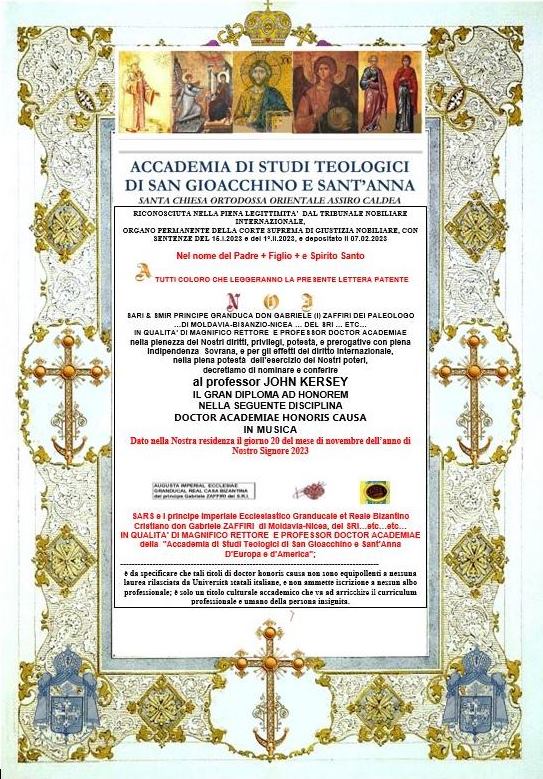
Honours and awards: Doctor of Music honoris causa from the Accademia di Studi Teologici di San Gioacchino e Sant’Anna

I have been honoured to receive the degree of Doctor of Music honoris causa from the Accademia di Studi Teologici di San Gioacchino e Sant’Anna (Academy of Theological Studies of St Joachim and St Anne). The Accademia is an institution of the Santa Chiesa Ortodossa Orientale Assiro Caldea (Holy Eastern Orthodox Assyrian Chaldean Church) and offers courses from its headquarters in Turin, Italy. The President of the Accademia is the Patriarch for Western Europe of the Assyrian Chaldean Church, Archbishop Adeodato (Leopoldo Mancini).

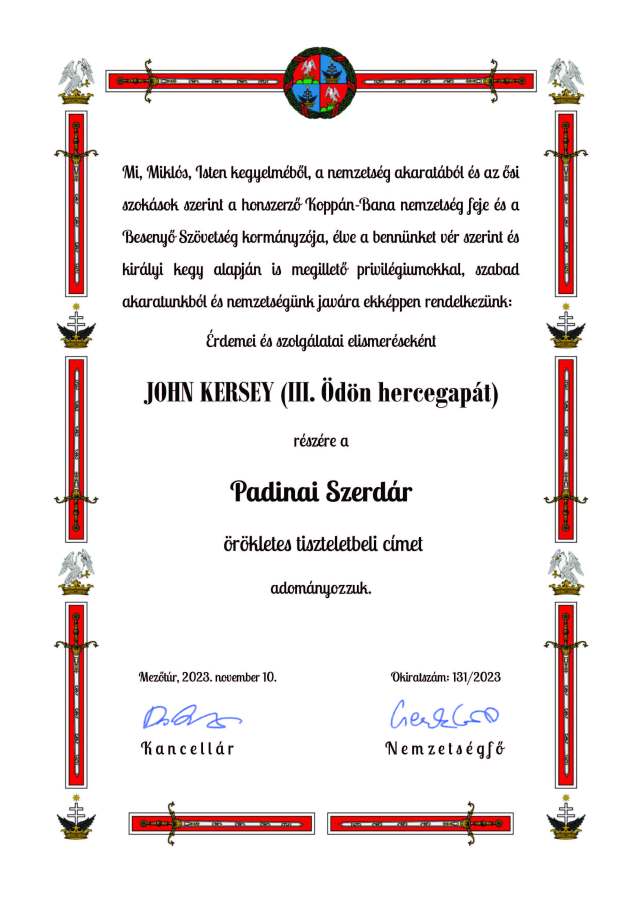
Honours and awards: Dynastic honours from the House of Cseszneky

The Hungarian noble House of Cseszneky (de Csesznek(Vár) et Milvány) has previously established relations with my own house. Its head, His Illustrious Highness Count Miklós M. M. Cseszneky, is my cousin, and we share descent from the House of Rurik of Russia and the medieval Kings of Poland. I have been very pleased to receive further dynastic honours from the House.

1. Kenéz (≈prince) of Balta:

2. Szerdár (≈count/earl) of Padina:

Sam Swerling (1939-2023)

With Sam Swerling at the Traditional Britain Group Christmas Social, 2014

Sam Swerling, one of my fellow Vice-Presidents of the Traditional Britain Group, died earlier today from cancer at the age of 83. An outline of his life can be read here.

Aside from his career as a senior law lecturer at City University, Sam devoted his life to traditional conservatism, giving many years of service to the Conservative Party and the Conservative Monday Club, of which he was at one point Chairman. He was a founder member of the former Conservative Democratic Alliance and a member of the Western Goals Institute. He was a well-received speaker at the events of the Traditional Britain Group, where one of his last speeches was an extremely cogent and compelling analysis of the National Interest with relation to the politics of Britain today.

In 2017, Sam published a most absorbing memoir detailing his political life spanning half a century.

To this I contributed a short introduction,

Sam was a man of integrity and a patriot who loved his country and its people. His work will be continued and his memory kept alive. May he rest in peace and rise in glory.