Author: johnkersey
Honours and awards: Honorary Rector for United Kingdom of the Centro Studi Accademici

Sadly, this institution was dissolved in 2022.
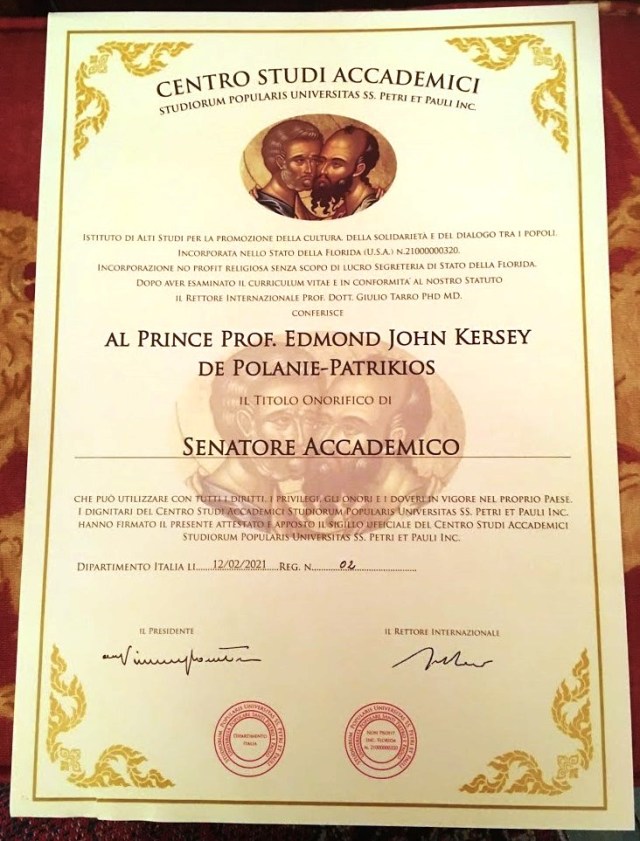
Honours and awards: Academic Senator of the Centro Studi Accademici “Studiorum Popularis Universitas Ss. Petri et Pauli”
I was honoured by the Centro Studi Accademici “Studiorum Popularis Universitas Ss. Petri et Pauli”, which conferred an honorary appointment as Academic Senator upon me. The Centro was incorporated in Florida, USA, as a religious institution in 2021, and was under the Presidency of Prof. Dr. Vincenzo Cortese of Italy. Sadly it was dissolved in 2022.

The common pursuit
It seems to me that the great characters of the classroom are a dying breed. By that, I do not mean that teaching does not now, as it always has done, attract men and women of conspicuous ability and inspire in them remarkable service. But the culture of teaching has changed. That change was in process before my time, but took a significant step forward while I myself was at school, spurred by the Thatcherite ethos, and had gathered pace under Tony Blair when I came to teach in my twenties and thirties. Now the process appears largely complete.
The detailed examination of the roots of that change can be left for another time, but its manifestations are easily noted; the micro-management of the classroom, the increase in bureaucracy, the demand for uniformity (dare one say, blandness), and the reductive nature of the examination system. As backdrop, we might cite both the loss of our civil religion – Christianity not so much as a system of religious observance, but as the warp and weft of our national life – and the vaunting of low culture at the expense of high. We might also cite the way in which our universities have turned away from scholarship for its own sake, and from an emphasis on their life as a community of scholars, to one of narrower specialisms, more circumscribed intellectual enquiry, an emphasis on quantitative output, and the imposition of scientific method and peer review upon the arts and humanities. It is a form of commodification; a set of values that a generation ago would have been dismissed as inappropriate for an academic setting because their commercialism cheapens and ultimately debases scholarship.
The foundation of most learning is curiosity, and the effective teacher builds on this curiosity to foster enthusiasm and knowledge. Boundaries are inimical to such an approach. It can be summed up as “scholarship for its own sake”, or the traditional phrase “a liberal education”.
This attitude was once the dominant paradigm in our education system, both at secondary and postsecondary levels. The quality of donnishness – not so much “teaching” as instruction, but more akin to the shared exploration of a subject – was born in the universities but also could be applied to many schoolteachers who saw in their work a particular scholarly vocation both to their pupils and to their subjects, and who continued to make a significant wider contribution to those subjects through creative work, books and research papers.
Intellectually-rounded people were seen as the product of a rounded education; the idea that a detailed knowledge of other subjects informed one’s own specialisms. This perhaps found its greatest expression in the view expressed to me in former years that if one had obtained a good degree from a good university, one could then master and teach any subject within reason. This was reflected in a number of eminent university scholars whose degree was not in the subject they taught (or, in rare cases, who had not earned a degree at all), and many more schoolteachers who were in the same position. Education did not merely teach a given set of facts and precepts, it taught its subjects how to learn, how to conduct research, how to apply critical (and self-critical) faculties, and moreover imparted the development of an aesthetic sense – a sense of discrimination between qualities that led to an appreciation of why some things were superior to others. A more nebulous expression of the same concept came in the form of the role of sport in the liberal education; I must say that this was largely lost on me at school, but in subsequent years I have come to appreciate that there are aspects of character and strategy that are perhaps better expressed in Test cricket than anywhere else.
These values are, I would argue, essentially anti-capitalist and anti-materialist, and do not sit well with reductive models of output and assessment. They are values that precede and supersede those of the computer age, and in which, certainly in the arts and humanities, the love of books is foremost. They give vigour to the learner rather than encouraging passivity. And lastly, they mark out, through merit, those who are capable of insight, even of originality, from those who are merely capable of following instructions. They are values that lend themselves to competition, and that produce an inequality of outcome. Lastly, they are values that have been under threat during much of the past century, and that will survive only with cultivation and determined effort.
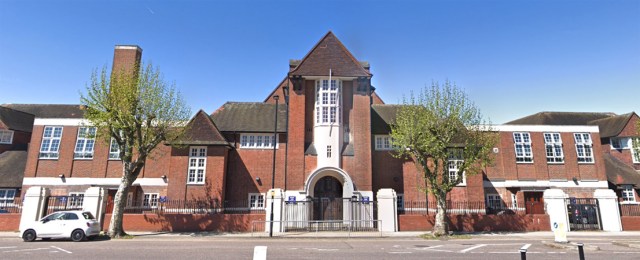
The deaths of two of my own teachers at The Latymer School, Edmonton, prompts some reflection on these matters. Brian Binding, who taught me English and was my form tutor in my fourth year, died recently as a result of complications from COVID-19 at the age of 85. Andrew Granath, who taught me History, died last year of COVID-19 at the early age of 68.

The Latymer School, Edmonton (©Google)
Brian Binding read English at Downing College, Cambridge, under F.R. Leavis (whose wife, Queenie (Q.R.) Leavis, a distinguished critic in her own right, was an Old Latymerian). He taught at another of the three schools founded by Edward Latymer, Latymer Upper in Hammersmith (then a direct-grant boys’ grammar school), where his pupils included the late Alan Rickman, before arriving as Head of English at Latymer in Edmonton (also a grammar school, though this one mixed) in the year of my birth, 1972. One of his pupils at Latymer Upper captured something of his essence,
“He had the power of turning an English class into a kind of shared meditation. He could sit perched on a radiator in silence while we watched him think. The most important thing I learned from him was disrespect for the canon, since if he did not like the set text (in our case Much Ado About Nothing) that he was supposed to be teaching he spent the minimum time on it and used the lessons to read Lawrence stories or analyse passages of James.”
Neil Roberts, “Leavisite Cambridge in the 1960s” in F.R. Leavis; Essays and Documents, ed. McKillop and Storer, Sheffield Academic Press, 2011, pp. 14-15.
That freedom of approach was born of intellectual confidence. Leavis is not so much in fashion these days, being very much contrary to the mores of our age. He stood for a certain sort of uncompromising rigour that was unashamedly that of an intellectual elite. In his essays in “Education and the University” (1943), Leavis proposes the university as a “focus for the finer life of cultural tradition” and draws attention to the disappearance of the traditional liberal education in favour of increasing specialisation. He writes “if something is not done…this country will not long retain, and will not deserve to retain, any of the influence belonging to the culturally senior partner.” Essential to Leavis’s argument, too, is a confidence in the qualitative pre-eminence of English literature over its foreign counterparts, not from crude jingoism, nor from innate superiority, but rather that “greater maturity means – or should mean – greater vitality.”
Although there were certainly those who studied with Leavis and reacted against his approach, those who were sympathetic to his ideas formed a kind of scholarly disciplehood, gathered among the university faculties and the better schools, which was designed to perpetuate the values that Leavis and his followers held dear. It was to their numbers, presumably, that Leavis (echoing Matthew Arnold) addressed his words “in any period it is upon a very small minority that the discerning appreciation of art and literature depends: it is (apart from cases of the simple and the familiar) only a few who are capable of unprompted, first-hand judgment. They are still a small minority, though a larger one, who are capable of endorsing such first-hand judgment by genuine personal response.”
In his essay quoted above, Neil Roberts speaks of the network of which Brian Binding was a part, and the way in which informal contacts directed able school-leavers to sympathetic dons as they became the next generation to carry the torch. He says of the influence of Leavis that this persuaded him that “the study of literature is a compellingly serious matter”. This was also something that I understood both from Brian Binding’s teaching and from his example, and not merely literature but culture more generally. I thought it significant that in the mid-1980s, he did not own a television, nor attached any importance to that medium. What I also remember were his many enthusiasms in literature, and his dry, unstuffy sense of humour allied to a quick wit. He was also a notable pipe-smoker, a pursuit impossible without a modicum of patience and a ruminative desire to sit, think and talk while enveloped in an aromatic, even ethereal, cloud.
But above all, the Leavisite legacy was that of literary criticism. Literary criticism has now been largely replaced by literary theory and its associated cant of postmodernism, post-colonialism, gender and identity politics. Both Leavises would have had none of that, and Q.D. Leavis was a particularly mordant critic of feminism. Some certainly found the Leavis approach forbidding, holding up a standard so high that it would inhibit any but the most confident from thinking they had something worthwhile to say. But that was not my impression. When I came to read the work of both Leavises – some years after Brian Binding had retired from teaching – what struck me was its abundance of sense, its communicative and persuasive qualities, and the confidence of judgment which, even if one sometimes disagreed profoundly with it, was reasoned and not infrequently hit the mark. Enthusiasm and condemnation alike were the consequence of a developed taste; it was inevitable that if one’s attachment was to values and qualities, then one would then discriminate based on them. As I.A. Richards rightly put it in a passage quoted by Leavis, “to set up as a critic is to set up as a judge of values.”
Critical theory never produces the same reactions. Firstly, it is impenetrable, being addressed entirely inward to the academic establishment, and not aiming at a wider audience. Secondly, it is inherently political, framing itself in the language and ideas of post-war Marxism and being inseparable from that creed. Of course that is not to suggest that Leavis was apolitical, or that his disciples did not include those who embraced socialism, but their version of socialism was (and I shall return to this shortly) quite different from that which would take over academia during the first decades of the present century. In particular, it was a socialism whose dialectic of class was not accompanied by a similar dialectic of intellect, and indeed that appealed to a certain kind of social conservatism. It was common in the grammar schools to encounter the view that intellectual merit was to be celebrated and encouraged, and that high culture was an end to which all might aspire irrespective of class – if not as creators or critics, then at least as an appreciative and informed audience. The best things in life were for everyone, and the good teacher would lead his pupils up the foothills of Parnassus, even if not all would make it to the top.
At a selective grammar school, there was an expectation that we pupils would form an intellectual elite – it was certainly the norm there that the majority of school-leavers would go on to the more selective universities. Certainly it was an atmosphere in which scholarship was given primacy and a remarkably free rein, and the values which this produced contributed to the overall humane and civilised ethos of the school. I do not think this had changed too much since the post-war era in which the universities were suddenly opened up to the new influx of working-class students from the grammar schools. That generation certainly proved itself worthy. Unfortunately it would later also show a remarkable propensity for pulling up the ladder behind it, as the selective principle in education came under sustained attack from the establishment and many grammar schools found themselves forced to choose between charging fees or becoming comprehensives.
Another idea of Leavis’s that remains significant to me is that of the “organic community”. In this, he calls upon England’s pre-industrial heritage to recall lives whose rhythms are those of traditional rural life; folk tradition and folk song. This is in essence an anti-modern concept, but one that found much resonance and active revival in the England of Leavis’s time. One might reflect on the utopian socialism of Eric Gill’s community at Ditchling, or the revival of folk traditions in John Hargrave’s Kibbo Kift, or in the economics of Social Credit and Distributism, or in the Guild Socialism that developed out of William Morris’s ideas. Indeed, this was also an era when English music emerged from Continental influence to rediscover its national roots through the folk song revival of Vaughan Williams and his contemporaries. The Romanticism of these currents was always tempered by a strong measure of practical idealism, and by another English characteristic, the distrust of sentimentality. The appeal, as with Leavis, was to vigour rather than to comfort.
Andrew Granath arrived at Latymer in my fourth year there, and made an immediate impression on our class of GCSE historians. Visually, he was extremely tall and striking in appearance, with features that suggested that he had been hewn out of stone. But it was also obvious from the start that he was the “real thing” academically, with an authority and intensity that made you feel that what was being taught really mattered, and we soon became accustomed to working hard and at a high level. The syllabus in those very early days of GCSE was far fuller than it became when I taught GCSE History a little over a decade later. Andrew brought it all alive. But more than that, he was a remarkably interesting person with an unusually wide range of interests. He was passionate about boxing, and saw in that noble art far more than mere sport. He rode classic motorcycles (as had Brian Binding before him). And he was from Basildon.
Basildon is an unremarkable suburban town in Essex, not a vast distance from Latymer in Edmonton. It is the ostensible subject of Andrew Granath’s only book, Searching for the Promised Land, which he wrote at the age of fifty. This, however, is to underplay its hand. Searching for the Promised Land is a meditation – even in places a Brian Binding-esque meditation – on the essence of Basildon as a metaphor for the changes in the post-war working-class. It is a consciously unruly book; not conventional history, but rather a personal and subjective narrative. At times it is extremely funny, and at others sad, touching and thought-provoking. There is a tone of lamentation for the deliberate destruction of the working-class community that once formed Basildon. One passage emphasises the optimism of the post-war vision, and the way in which it, as with so many visions, came to be corrupted,
“Fifty years ago, in the stasis of the post-war years, it was assumed that the working class was not meant to be aspirational. Give them a watertight house, and elementary education, free health care and a modestly-paid job and the world could carry on indefinitely as if 1955 represented the end of history. Today, in the new, thrusting post-Thatcher Britain where we are all bewildered by the pace of change, it has become a way of life. It is difficult to overstate the optimism that was left at the time for those who had escaped the grim cramped life of inner London. Within the authoritarianism imposed by a lack of choice, a whole new vista opened up to us. It was a grand view of gardens, parks, countryside, neat brick-built houses, open airy schools, bright modern shops and willing citizens revelling in the munificence of government – ‘Bliss was it in that dawn to be alive.’ In 2003 it all looks rather different. Talking to the elderly of the town – those who arrived as young adults in the 1950s – there is now a pervasive sense of disillusionment that the dream failed to live up to their expectations. The promises of the good life have not been kept. As Nigel Birch put it to Harold Macmillan at the time of Profumo crisis: “Never glad confident morning again.” It is now impossible to imagine that the state would ever again have the confidence and self-belief to create such a community in the hope that it could transform the quality of peoples’ lives. We truly believed, fifty years ago, that it would be possible to build that shining city on the hill if we all pulled in the same direction.”
That optimism is also seen in a number of his other topics. Inevitably, he discusses socialism, but with a scepticism born of experience of the failures of central planning. As a former member of the Woodcraft Folk (which had grown out of a rift in the Kibbo Kift), he knew utopian socialism at first hand,
“By the 1930s, Letchworth, in particular, had acquired a reputation for what George Orwell rather contemptuously called ‘sandal and nuts’ socialism. It was the Letchworth ILP Summer Schools, with their espousal of progressive utopian ideas, that goaded Orwell into his famous denunciation (in The Road to Wigan Pier) of ‘every fruit juice drinker, nudist, sandal wearer, sex maniac, Quaker, Nature Cure quack, pacifist and feminist in England’. For Orwell, the Letchworth middle class socialist was summed up by the two men who got on his bus while riding through the town. ‘They were dressed in pistachio-coloured shirts and khaki shorts into which their huge bottoms were crammed so tightly that you could study every dimple. Their appearance created a mild stir of horror on top the bus. The man next to me murmured, “Socialists” as who should say “Red Indians”. Every generation has its discontented minority looking for a different way of life. In the 1930s, they flocked to Letchworth, particularly those who had tired of the tyranny of the ‘meat and two veg’ diet of the inter war years. By 1935 the town boasted seven vegetarian restaurants at a time when the whole of London could barely muster the same number. For the ‘simple lifers’ who flocked there, the principle was even more simple – ‘more air, less alcohol’. For Orwell, a meat-eating, chain-smoking, beer-swilling despiser of the middle-class socialists, the lure of Catalonia must have seemed irresistible.”
He might have gone on to add that the rather wonderful bastion of vegetarianism, teetotalism, Theosophy and free-thinking, the Liberal Catholic Church, had been established in Letchworth in 1923 and remains active there today.
This was socialism as a middle-class lifestyle choice, not the struggle of the working-class to overcome very real disadvantages. Among the faddishness, however, there was a genuine energy and some idealism that had more to it than the humbug that Orwell rejected. What Andrew Granath saw was the arc of that idealism; rising in the working-class London-exiled community that formed in the “plotlands” of Basildon where many families built their own homes during the 1930s, only to see them flattened by central planning bulldozers twenty years later. He visited as the last of these awaited demolition, “As I wandered past the neat little houses, I realised for the first time that, although the men and women that comprise government may be perfectly decent people individually, they are, collectively, given some sort of rationale, capable of acting in a grossly unjust manner. And here was the result of this misguided ‘we know best’ attitude.”
The central planning that Andrew Granath decried in Basildon is exactly the same malaise that has affected the teaching profession. All of the changes that have affected teaching in the last twenty years have been imposed from the top down, by governments and others who “know best”. They have, in my view, had the effect (and often deliberately) of vastly reducing the autonomy of the teacher in the classroom. In the early 1970s, Dr Robert Leoline James, who was regarded as one of the great headmasters of Harrow, gave his headmaster protégés the advice, “Appoint the best and leave them alone.” Few schools are always in the position of being able to appoint the best, but it seems to me that one rarely attracts the best with the prospect of endless circumscription and micromanagement.
At the point when I left school teaching in 2005, we had even reached the point where certain established styles of teaching, most notably “chalk and talk” had become officially deprecated. A lesson with Andrew Granath not infrequently consisted entirely of his exposition of a topic followed by dictated notes and the occasional question. Nothing was deemed to be learned until it had been codified. Of course he knew what I later discovered myself as a teacher; making the pupil do something active with the knowledge at hand, such as writing it down for themselves, is usually the best way to get them to remember it. There was nothing stale or passive about those lessons, but they reflected a scholarly approach that, despite its considerable effectiveness, has now become manifestly unfashionable.
Teaching has been diminished by the imposition of a quantifiable matrix that prizes assessment, value for money and accountability ahead of more subjective qualities. Inevitably, in the name of uniformity, much of humanity has found itself squeezed out just as the central planners imposed their stultifying vision on the sprawling individuality of Basildon’s plotlands. And it must also be questioned whether the reductive world of league tables is really cognisant of the true meaning of “accountability” and “value for money”, which have a much wider context than might at first glance be imagined. The aim of liberal education – to produce rounded individuals capable of fulfilling their potential and contributing in full measure to society – has been forgotten because it is by nature not easily quantifiable; it asks too many difficult and subjective questions and those answers that are available do not lend themselves to statistical analysis or computer processing.
I am not a revenant, and have, if memory serves, only returned to my old school on two occasions after leaving, those being both over twenty years ago now. There were, however, two encounters later in life with the teachers I have written about. Brian Binding surprised me one day in my early twenties when I was reading a book outside a café on Hampstead High Street. He told me that he had taken up a second career as a translator in retirement, and was greatly enjoying it, and we shared some memories of Latymer as it had been.
Andrew Granath wrote to me out of the blue in 2012, having found my website. Returning to his words after his death, I am struck both by his kindness and his intellectual curiosity.
“I hope you don’t mind me writing to you like this. It simply occurred to me just a few days ago I wonder what happened to John Kersey, I googled you and was both surprised and delighted to be see how brilliantly prolific and committed you are.
I hardly dare try to understand the sort of issues and beliefs that you are part of but it does seem to be an extraordinary and fascinating world that you have made. You would have liked my Aunt who died a few years ago. She was a quiet disciple of Joseph de Maistre and Rene Guenon and had an extraordinary collection of early mystical books (hermetic, Rosicrucian and alchemical including first editions of John Dee and Michael Maier) that, to my irritation, were donated to the Warburg Institute. She was a friend of Frances Yates who you may be familiar with.
For Murray Rothbard and Joachim Raff to be admired and appreciated by the same person is a great feat and for that I congratulate you.
Latymer is a very different place from the one that you left I suspect more than twenty years ago. Neither better nor worse but different. For myself I think that I will do one more year after this and will then retire or rather do something else. I hope that you do not mind me sending you this message. Looking at the picture on the your website I can still see very clearly the 16 year old you.”
Of course I replied to him. But how do you say thank you to your teachers and give some idea of what their example has meant to you without lapsing into embarrassing sentimentality? It seems an impossible task. Perhaps there is something less direct that can be done, though. Alan Bennett, himself a grammar school pupil, gave us the definitive study of grammar school life in the early 1980s in The History Boys, which captures the intensity and the intellectual excitement of that experience together with the inevitable emotional complexities of teenage years. The final scene is visited by the spirit of the inspirational Hector, the general studies teacher, who directs his charges to “pass it on, boys”. And that. surely, is what it is all about.
Further reading:
Granath, Magnus C., Searching for the Promised Land: Basildon and the Pursuit of Happiness, London, GoldStar Books, 2004.
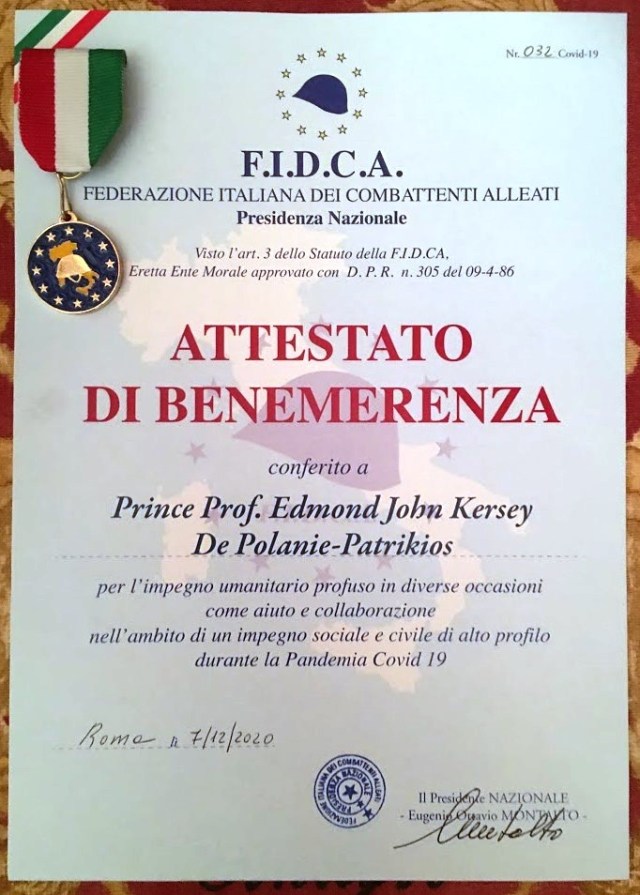
Honours and awards: Attestato di Benemerenza from F.I.D.C.A.
I have been honoured with the Attestato di Benemerenza with medal of the Federazione Italiana dei Combattenti Alleati. The attestation reads: “for the humanitarian commitment given on several occasions as aid and collaboration in the context of a high profile social and civil commitment during the Covid-19 Pandemic .”

Honours and awards: International Honorary President of the International Association for Financial Managers and Administrators and Association of Chartered Professional Managers of Nigeria
I have been delighted to receive the International Honorary Presidency of the International Association for Financial Managers and Administrators and the Association of Chartered Professional Managers of Nigeria. Both of these institutions are recognized as professional associations by the Federal Government of Nigeria. I have also been appointed to the Fellowship of both institutions.


Honours and awards: Sovereign Royal Granducal House of Dalmatia
I have been honoured by the head of the Sovereign Royal Granducal House of Dalmatia (Val d’Ors), H.S.H. Prince Orazio Mezzetti, with the grant of the titles of Marquis of Maslinica and Honorary Cousin of the Royal House. Prince Orazio is in concordat relations with several of the institutions under my leadership, and is a Byzantine Imperial descendant. Previously, he had appointed me to the rank of Byzantine Patrician.

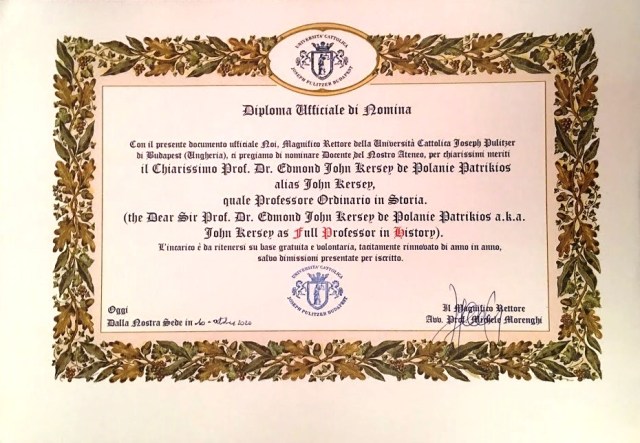
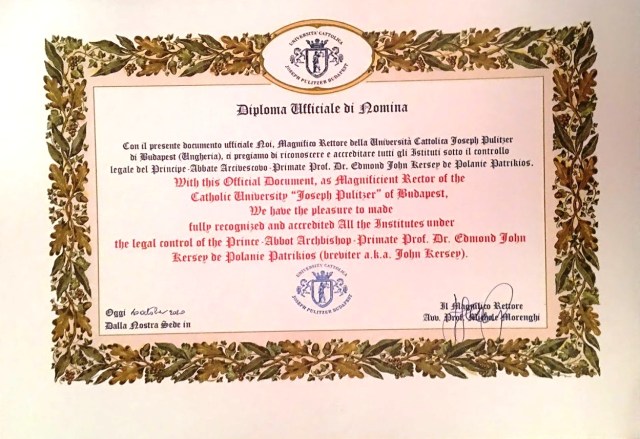
Professor of History in the Catholic University “Joseph Pulitzer”, Budapest, Hungary

In 2020, I was honoured to receive an appointment as Professor of History in the Catholic University “Joseph Pulitzer”, Budapest, Hungary. The University was established by the well-known Italian lawyer Prof. Michele Morenghi and offered online courses in the history of the Catholic religion, international tax law, international contract law, cybercrime and other areas.
The University also entered into a wide-ranging reciprocal recognition agreement with all the institutions under my control.

The University ceased activity at the end of 2023 at which point its website was removed.
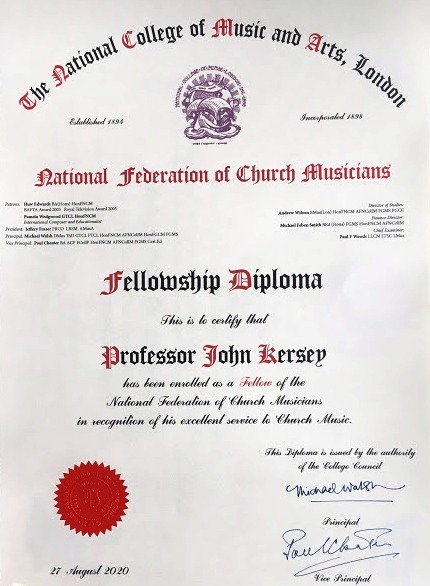
Fellowship of the National Federation of Church Musicians
I have been delighted to receive Fellowship of the National Federation of Church Musicians. The Federation is administered by the National College of Music, It says of the award, “In order to qualify, candidates are expected to demonstrate at least twenty years of fully-documented service in the field of church music in any denomination of the Christian church as an organist, choir director or singer, making the award of the FNFCM a formal recognition of long and distinguished service.”

Associate Fellowship of the National College of Music
I have been delighted to receive the Associate Fellowship of the National College of Music. The Associate Fellowship was introduced in 2020 and “is designed to recognise professional musicians who have made an outstanding contribution to the musical arena.” The award is reserved “to those who can provide evidence of the highest level of musical expertise during a course of a minimum of ten years. It will therefore be appropriate for conductors, choral directors, recitalists, composers, musicologists and those who have made an exceptional contribution to musical education.”
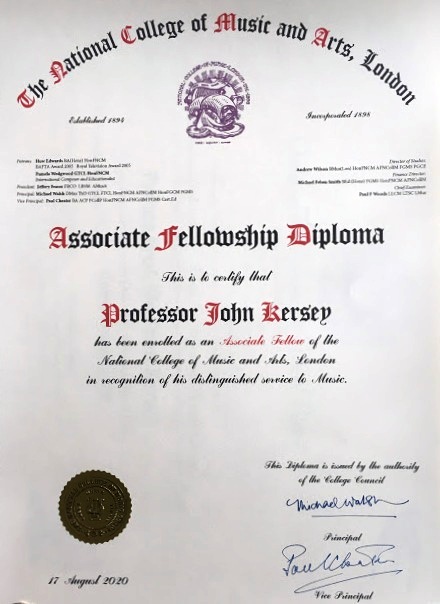
I was awarded Honorary Fellowship of the National College of Music in 2010, and am very pleased to continue my association with this institution.

Honours and awards: Commander (Laksamana) in the Supreme Order of Aranan

This was a promotion from my previous appointment in the Order.
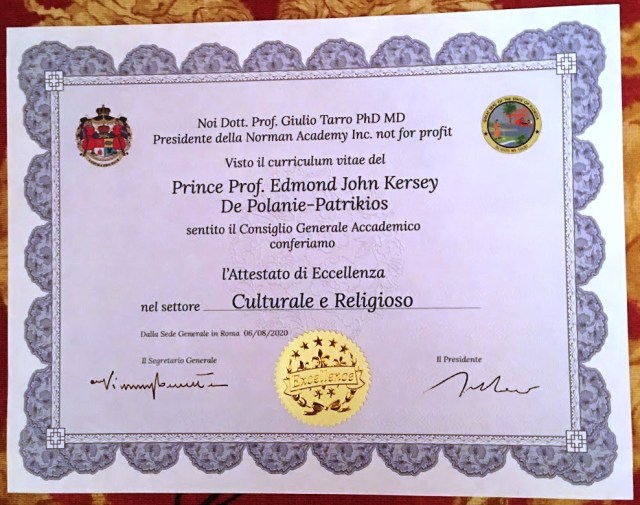
Honours and awards: Attestato di Eccellenza from the Norman Academy
The Norman Academy in Rome, Italy, of which I am an Academician of Honor, has further honoured me with an Attestato di Eccellenza in the sectors of Culture and Religion.

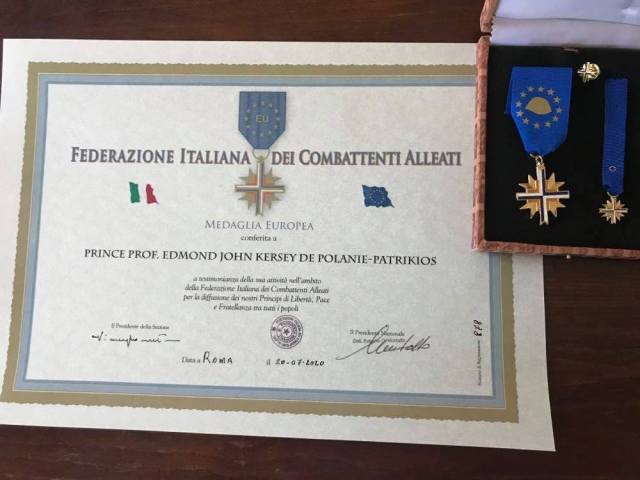
Honours and awards: Medaglia Europea of the Federazione Italiana dei Combattenti Alleati
I have been honoured to receive the Medaglia Europea of the Federazione Italiana dei Combattenti Alleati. FIDCA was founded in 1972 as an association of European ex-combatants and others who were supportive both of the European ideal and of the sacrifices of those who had sacrificed themselves for freedom. FIDCA was recognized as a distinct legal personality in Italy by Presidential Decree n.305 of 9/4/1986, and by means of DPR 27-2-1990, it was placed under the direct patronage of the Italian Ministry of Defense.
The Medaglia Europea, or European Cross, is awarded after nomination from a participating organization both to ex-combatants and to supporters, remembering the service and sacrifice of those who fought not only for Italy but in the Allied cause all over Europe. This has a particular resonance for me since my maternal grandfather was killed in action in Belgium in 1945 while fighting for the Allies in World War II.

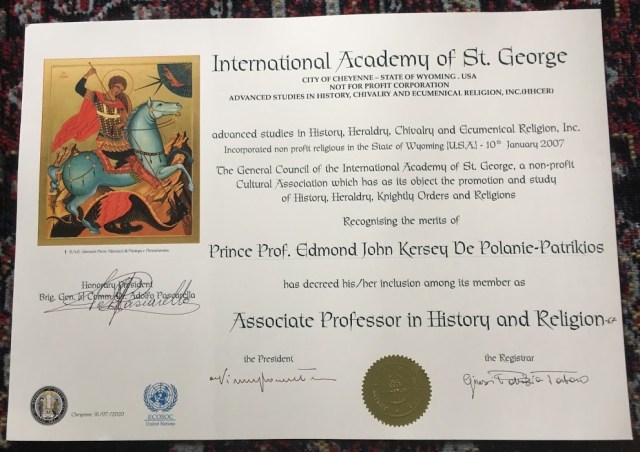
Associate Professorship in History and Religion of the International Academy of St George, Wyoming, USA
I have been honoured to receive an appointment of Associate Professor in History and Religion from the International Academy of St George, Wyoming, USA. The Academy is a nonprofit organization specializing in History, Heraldry, Chivalry and Ecumenical Religion.

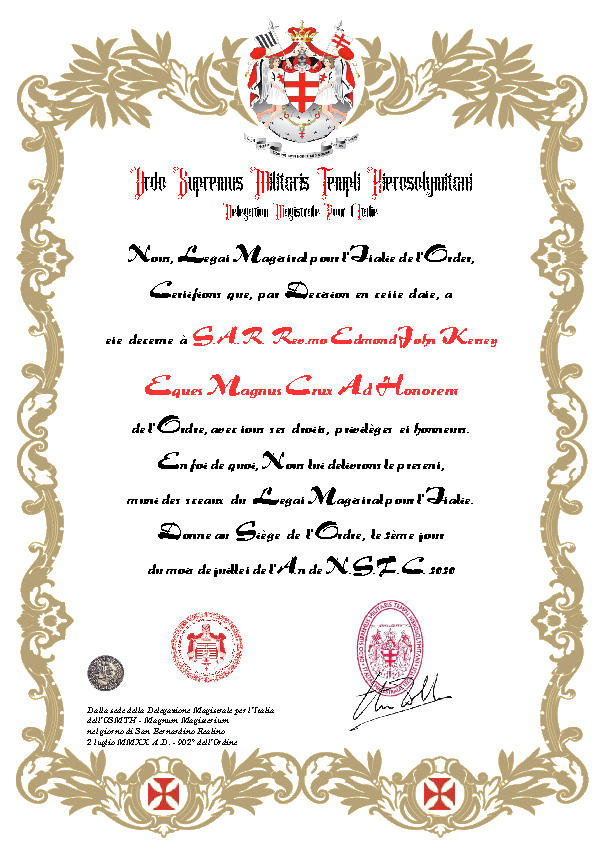
Honours and awards: Knight Grand Cross of the Ordo Supremus Militaris Templi Hierosolymitani
I have been delighted to receive the distinction of Knight Grand Cross of the Ordo Supremus Militaris Templi Hierosolymitani (O.S.M.T.H.) The honour was bestowed by the Italian Magistral Delegation.
The Ordo Supremus Militaris Templi Hierosolymitani (Sovereign Military Order of the Temple of Jerusalem) continues the Templar tradition that was revived in France in 1705, reconstituted under Bernard Raymond Fabré-Palaprat in 1804, and recognized by the Emperor Napoléon I in 1805. It was under the leadership of Grand Master Fernando Campello Pinto Pereira de Sousa Fontes between 1960 and 2018. The present Grand Master is Fra Albino Neves.
The Italian Magistral Delegation maintains a website at http://www.cavalieritemplariosmth.it

On marriage
In 2013 and 2014, at the time when the Government was redefining civil marriage, I wrote two essays on the matter that were published on the Libertarian Alliance blog and subsequently included in my collection of talks and essays The Radical Traditionalist Today. Here are those essays, very slightly revised. My conclusion was then and remains that there are now serious obstacles for traditionally-minded Christians (and indeed others who are traditionally-minded) who would want to enter into civil marriage, and my view is that civil marriage as currently constituted in England and Wales does not conform to marriage as that sacrament is understood by traditional Christians.
The trouble with gay marriage
I should begin with a simple statement of libertarian principle. The state has no business being involved in any way with marriage. It has adopted that role as a consequence of the compromise Henry VIII engendered when he merged Church and State. Since marriage within the Church of England is governed by the law of the land, and not simply by canon law, it follows that when marriage takes place between persons who are not members of that church, the state must act as registrar in order that those marriages have equivalent legal standing. One simple answer to the matter would be to disestablish the Church of England and thereby reduce marriage to a matter of private contract with an optional religious component, but this is not under consideration at present.
My purpose here is not primarily a discussion of marriage and same-sex relationships in their religious context, nor the case for the disestablishment of the Church of England. Rather, I want to point out that what is being proposed with regard to same-sex marriage has some important implications for those who are already married (ie. for those of the opposite sex) and further that its hamfisted legal construction is setting up a series of wholly avoidable and undesirable problems.
Let us not forget, however, that the institution of civil partnership has already established a position of legal equality between marriage and same-sex partnerships. Before civil partnerships, there were eminently legitimate complaints that the inequalities that existed in respect of inheritance and status as next-of-kin were iniquitous in a free society, and that there should be a means by which this could be redressed. In civil partnership, an institution was created that was distinct from marriage; indeed that was exclusively and completely a same-sex institution. For those same-sex couples who had said that they did not want marriage with its accompanying associations, but instead something that, while equal to marriage in law, was theirs alone to define, civil partnership could not have fitted the bill better, and its popularity since introduction would appear to have borne this out. Moreover, it was open to those churches that wished to do so to bless civil partnerships, and several have done so. Even the Church of England, which officially forbids such blessings, has a number of parishes where the letter of the law is observed but ways around the prohibition have been found through “services of prayer and dedication”[i]. At their most elaborate, such occasions are so close to the service for the blessing of civil marriage that were it not for the sex of the participants it would be difficult to tell the difference[ii].
Now, though, we find our legislators – without any apparent cause other than the Left’s shibboleth of “equality” – contemplating far-reaching changes to the nature of marriage between both same-sex and opposite-sex couples. Marriage as constituted at present has to do with the Christian viewpoint that the primary purpose of marriage is for the bringing of children into the world and their upbringing. Consequently, marriage is construed as a specifically sexual bond between husband and wife. This finds expression in the law in respect of the definition of marriage as a binding contract that is not entered into unless and until the marriage has been consummated. Non-consummation renders the marriage voidable under the Matrimonial Causes Act 1973, section 12a. Consummation has been defined, both in religion and in secular law, as the “ordinary and complete” act of sexual intercourse, a phrase which needs no amplification.
The problems with regard to same-sex marriage will by now be obvious to the reader. The partners cannot consummate the marriage according to the legal definition of that term. Nor is there any other equivalent sexual act that is universal to same-sex couples. Therefore, the government proposes to create a virtually unprecedented new definition of marriage that has no sexual component to it. Here is the relevant section of the government’s consultation document on the matter:
“2.16 Specifically, non-consummation and adultery are currently concepts that are defined in case law and apply only to marriage law, not civil partnership law. However, with the removal of the ban on same-sex couples having a civil marriage, these concepts will apply equally to same-sex and opposite-sex couples and case law may need to develop, over time, a definition as to what constitutes same-sex consummation and same-sex adultery.”[iii]
In other words, the government can see the problem but has absolutely no idea how to solve it. It therefore proposes to foist the entire matter on to the courts to be resolved sine die.
The implications are interesting. As the law would stand under the proposal, for example, a same-sex married partner cannot commit adultery with another partner of the same sex, since any definition of adultery applies only to heterosexual sexual intercourse. But they can commit adultery against their same-sex married partner with a person of the opposite sex. What will constitute adultery or consummation if a definition needs now to be found that applies both to heterosexual and homosexual marriages? The implication is that acts of a sexual nature that fall short of sexual intercourse and which are not regarded as of paramount significance in such discussions at present may come to be seen in a whole new light. Even without my religious hat on, I cannot see this as in any way being a good thing for our society.
I note, incidentally, that Ben Summerskill, chief executive of the gay rights organization Stonewall, thinks that “This focus on consummation, in particular on the sexual element of it, seems to exercise heterosexuals more than most lesbian and gay people.”[iv] He does not seem to realize that the reason why this exercises heterosexuals is because we, too, are to be significantly affected by the proposed legislation, and in ways that are as yet impossible for anyone to quantify or anticipate with any accuracy. As such, this is a leap into the unknown. There is still time to pull back from the brink.
[i] http://inclusive-church.org.uk/about/church-services-after-civil-partnerships
[iv] http://www.guardian.co.uk/society/2012/dec/10/legal-definition-consummation-gay-marriage
The new marriage and conscience
The Marriage (Same Sex Couples) Act 2013 is one of the most divisive pieces of legislation to have been passed for many years. While the most obvious aspect of this law – that it permits homosexual couples to contract civil marriage – has been widely publicised, there are further aspects whose significance is likely to prove extremely far-reaching.
In preparing this legislation, the Government appears to have considered that, in respect of those religious groups that object to homosexual marriage, it has been sufficient to allow those groups an opt-out, which it assures us is unlikely to be capable of legal challenge. The veracity of the latter claim is currently under test by Barrie and Tony Drewitt-Barlow, who intend to sue in order to compel the Church of England, to which they belong, to solemnize their marriage.
While the legislation takes account of religious groups that have an objection to same-sex marriage, it makes no provision for those people who are not religious but likewise object to same-sex marriage. They are expected and indeed encouraged to enter into civil marriage regardless of the fact that said civil marriage has been profoundly redefined by this law. Both they and members of religious groups that are officially opposed to same-sex marriage (including the Church of England and the Church in Wales, many Jews, almost all Muslims, some Buddhists, Zoroastrians and Bahá’is) are now placed in an extremely difficult position. This was, furthermore, something of which Parliament was clearly warned during the legislative process and that it chose to disregard in its rush to embrace the “equality agenda”.
The historical position of English law has been to define civil marriage according to Christian understanding, and in so doing to promote a position which is common to the Abrahamic faiths. That position is based on definitions of consummation (and thereby the validity of marriage), and of adultery (which constitutes grounds for divorce). A couple of the opposite sex who contracted civil marriage before 2013 could have that marriage blessed in a religious ceremony in the knowledge that they had not, in entering into civil marriage, engaged in a contract that contradicted the teachings of their religious faith. With the abandonment of consummation as a test of the validity of marriage, and the non-universality of adultery (since its definition applies only to members of the opposite sex), it can no longer be said that civil marriage for heterosexual couples does not involve the implicit acceptance of concepts that run directly counter to much religious teaching on the nature of marriage.
I will speak particularly of the Catholic faith here, since it is that with which I am most familiar, and I am aware that my remarks will have applicability to other faiths as well. In Catholicism, marriage is defined as a sacrament instituted by Christ. As such, definitions of marriage before the time of Christ, ie. in Jewish law, or in pre-Christian societies where the state undertook a role in marriage, are disregarded as irrelevant. The only definition of marriage that matters today is that which Christ gave us, and it is His standard by which other commentaries on marriage are to be measured.
Catholic doctrine holds that the state of marriage is opposed to all forms of unnatural, homosexual behaviour[i]. It is unambiguous on this point. While the Catholic Church does not permit divorce, it holds nevertheless that extramarital acts – of which adultery would be among the most serious – are to be seen as a violation of justice. It can therefore be concluded that adultery is highly germane to an understanding of the boundaries of Catholic marriage.
Our question now is whether a member of the Roman Catholic Church can in good conscience contract civil marriage in the light of the 2013 law. In so doing, the civil marriage that they would now contract is far from being opposed to all forms of unnatural and homosexual behaviour. Rather, it considers that behaviour to be on an equal footing with marriage. The Pastoral Letter “The Narrow Gate” of the Archbishop of Westminster on the passage of the 2013 law says,
“The Marriage (Same Sex Couples) Act has changed the legal definition of marriage in this land. No longer does this definition assume or support the complementarity of male and female, or expect sexual fidelity between the married couple, or see marriage as oriented towards conceiving and nurturing of children. The titles ‘husband’ and ‘wife’ are now officially gender neutral. This is the deconstruction of marriage as it has been understood for millennia. In effect, this Act completes the privatisation of marriage, so that its central content is whatever the couple wish to construct. Marriage is no longer a truly public institution, at the basis of society.”[ii]
This issue is more complex that it might seem. It should not be thought that the Roman Catholic Church advocates that its members should contract civil marriage in isolation from religious marriage. Rather, the Roman Catholic Church in practice requires that marriages take place in church and are solemnized by a priest, but also that the priest should hold a certificate or license to solemnize marriages from their local Superintendent Registrar. Failing this, it is required that a registrar should be present at the service and should simultaneously complete the necessary paperwork for civil marriage. Under either situation, a Roman Catholic priest effectively performs the marriage service on behalf of the state, under an arrangement that was first agreed in 1895. Whether he should continue to do so given the changed legal position has already been the subject of some discussion.
The present situation requires the acceptance of a moral contradiction that could not be more stark. The acceptance in conscience of civil marriage which directly opposes Catholic teaching on the nature of marriage is a matter of great seriousness. The registrar is taking from the words the priest says during the service those elements that fulfil the requirements of civil marriage as currently constituted. The priest and the couple marrying are therefore actively colluding in the act of civil marriage and not merely treating it as incidental (as would be the case, for example, in France, where church and state are separate, and the registration of a marriage is merely a bureaucratic act). In so colluding, they are forced into a position of the gravest moral compromise.
It may be responded that without civil registration, our Catholic couple would have no standing as married persons in law. Their marriage would be valid in Catholic canon law, but for civil purposes their standing would be as cohabitees. My personal view is that this is now becoming the only route for Catholics that would not involve moral compromise as to the principles of their faith. It would involve a degree of sacrifice – for the legal recognition of marriage brings with it a number of important rights that are not extended to cohabitees – but that is nothing new for Catholics in this country. It would also require the agreement of the Catholic hierarchy, which for all its vocal opposition to the 2013 legislation has tended to take the view that once a law is passed, it must be complied with. While no-one would advocate that Catholics should break the law, there is an important issue as to whether a law that has a distinctive moral element that is opposed to Catholic teaching may be the subject of conscientious objection whereby that law is shunned on those grounds.
It should be mentioned that the existing status of a number of Muslim marriages in England and Wales is of relevance. The Muslim marriage contract or nikah is not automatically recognized as a marriage in English law (in contrast to most Muslim countries, where it is so recognized), and the couple need to contract a civil marriage in order to be recognized as other than cohabitees. The situation is further complicated by the fact that the nikah may be polygamous.
Those Muslims who contract the nikah, and those Christians or others who contract a religious marriage that is not recognized by law, may feel that their religious contract is sufficiently binding in conscience as to constitute all the marriage that they would need. They will need to make additional safeguards in their legal arrangements to ensure that their spouse is treated in the way that they believe is fitting to them, rather than assuming the legal benefits that civil marriage confers, but this may well be an acceptable price for them to pay in order to avoid the moral compromise now involved in contracting civil marriage.
Couples who cohabit have already had to evolve private contracts that serve as alternatives to civil marriage, on whatever terms they may agree. It seems that those who hold religious beliefs that do not equate homosexual partnerships with heterosexual marriage may now be compelled to do likewise. Effectively, we have indeed seen the end of marriage as a public institution in our country, and its aftermath will be one of increasing fragmentation.
[i] See Fr. John Hardon SJ, “Marriage” in Modern Catholic Dictionary, consulted at http://www.catholicculture.org/culture/library/dictionary/index.cfm?id=34750
“Ordinary morality is only for ordinary people” – Another perspective on Aleister Crowley
This essay was originally published by the former Libertarian Alliance in April 2014 and subsequently collected in my book “The Radical Traditionalist Today”.
Dr Gabb has recently posed to us the questions “Was Crowley a sort of national socialist, or a sort of libertarian? Was he a sex-obsessed libertine, or did he preach absolute self-control?”[i] He suspects that all these questions have the same answer, and that such an answer does not reflect well upon the self-styled Great Beast. I hope I can propose to him a rather more nuanced appreciation of this complex and enduringly fascinating – though hardly entirely admirable – character.
An understanding of Crowley – and by that, I mean an understanding of what Crowley himself intended by his work and actions rather than the various re-interpretations and smoke-and-mirrors exercises that even he indulged in, should start from the context of the revival of interest in Western esotericism in which Crowley became a pivotal figure. The key to this revival is that it was by nature anti-modern; its proponents were counter-Enlightenment conservatives who sought to recapture the wisdom and ways of the ancients. Their models of spiritual belief were hierarchical and retrogressive at a time when the demos was in its ascendancy; they proposed not only an aristocratic replacement for modern ecclesiastical structures, but furthermore that progress towards the upper echelons of this enlightened aristocracy would involve exposure to and understanding of progressively more advanced ritual practices and the results thereof, bringing about the growth of the soul and rewards that were to be expressed beyond the present world.
The most direct influence upon the way that Crowley approached this, and indeed most other aspects of his life, was the Decadents and particularly Swinburne; from his Cambridge years onwards, Crowley wrote poetry in the Swinburnian mould, including significant erotic verse. Whereas Swinburne’s moral turpitude was largely the product of his imagination, for Crowley those degenerate aspects which attracted him became a practical way of life. It is not entirely true to suggest that Crowley was obsessed by sex; rather that he attached a high spiritual importance to sex, necessitating it as an aspect of his religious ritual and practice of ceremonial magick, and was frank about discussing it in a way that was unusual for his time and was held by many to be immoral. As he opined, “part of the public horror of sexual irregularity so-called is due to the fact that everyone knows himself essentially guilty.”[ii]
From Blavatsky to Leadbeater to Crowley and myriad other teachers and methods that fall within the Western esoteric tradition, there are constant themes: the material world is illusory; the spiritual world is omnipresent; connexion between mankind and the spiritual world is essential but only possible for the initiate; and that the given method of spiritual training offers such initiation with the promise of resultant enlightenment if its disciplines and rituals are correctly observed by a pupil of sufficient aptitude.
The appeal of the esoteric tradition to the West lies precisely in the failure of Western spirituality – in the wake of the disasters of Protestantism and the First Vatican Council – to offer a true spiritual connexion with eternal principles, and in particular its development in the direction of dogmatic centralization so as to enshrine a false rather than a genuine tradition. The search for the perennial philosophy – that which is held to be present in a degenerate form in the fundamental principles of the major religions – led to an inevitable quest towards the ultimate source of this wisdom in the oldest of human spiritual traditions. The parallel between Western esotericism and Eastern modes of belief is obvious and was explicit in a number of syncretic schools, notably Theosophy, as a form of renewal of the West from without. Crowley’s own peregrinations led him from Egypt and Algeria through India and to China, climbing mountains, indulging in opium and performing magical rituals all the while.
The esotericists are radical decentralizers, and yet they are not quite the individualists or anarchists that some would have us believe. Each has a school, a method, and seeks to teach from the perspective of experience and (so they would assert) achievement. And at the top of each of those schools we find one or more individuals who will assert that they have some form of intercourse with the divine and the supernatural, most commonly in the form of spirit guides and the practice of various forms of magic and clairvoyance. Each such entity is a pyramid in shape, and depends for its continuation not only upon the magus at the top but upon the desire of others to gain access to his wisdom – a prize for which many will pay dearly.
It is, I think, unfair to Crowley to suggest that he had no fixed ideas. His work was, after all, experimental in nature – as a ritual magician it could hardly be otherwise – but it was also dedicated to synthesis: to the exploration of diverse spiritual paths and to the distillation of the results into what he believed to be the end product of that process. The ensuing religion, Thelema, may have a single central fixed principle in the Will, but that is not to imply that it does not also have its own recognizable codex, practices and lore. Thelemites are, for all their tendency to fall out spectacularly with each other, nevertheless recognizable as a group with common beliefs and a common culture, and these rest securely upon Crowley’s writings, most notably the Holy Books of Thelema, and the rituals of the Ordo Templi Orientis.
Above all, Thelema is an anti-modernist school of thought; it is oriented towards the primal and in this aspect forms an interesting analogue to the rediscovery of paganism that was going on at the same time – Gardnerian Wicca owes its impulse and some of its content to Crowley’s decision to entrust Gardner with the revival of the O.T.O. in Britain. It directs itself to those who find in the modern and the material only an emptiness that is far divorced from human potential and human instinct. But in its reversion it also abandons what Crowley construed as bourgeois constraint. His libertinism was a mixture of hedonism for its own sake, particularly in drug-taking, and hedonism with an ulterior ritual purpose – all of his various relationships included the practice of sex magick, and in the case of his homosexual partnerships ritual rather than pleasure appears to have been the main objective, since his primary sexual attraction was to women. His magical work was disciplined and assiduously documented, whatever the chaos that persisted externally. He was a prolific writer, and in a number of works wrote spontaneously, attempting to access unconscious or supernatural impulses. It would be misleading, I think, to dismiss Crowley simply as a bad writer. He certainly has his own style, and there is something crude and elemental about it that can disturb the reader with its ferocity.
There is, of course, the strong suggestion that a certain amount of Crowley’s behaviour was simply designed to shock, an aim in which it succeeded in generous measure, but he was also committed to the exploration of physical and spiritual extremes as part of what he saw as his mission; he himself was the testing-ground for much of his practical work, and as such inevitably the focus became his own ideas, reactions and experiences rather than those of others – a focus that could easily spill over into egotism and arrogance. His biographer Laurence Sutin refers to Crowley’s “courage, skill, dauntless energy, and remarkable focus of will”[iii], but on the other hand, Crowley also had a great capacity for physical and mental cruelty and little time for those who disagreed with him.
Nevertheless, and for all that he participated willingly in his own demonization in the press, it is inaccurate to label Crowley as either a nihilist or a Satanist. Crowley did not worship Satan precisely because he rejected the Christian worldview in which Satan exists. Thelema has a specific code of ethics, entitled Duty, that sets out the role of the Thelemite in relation to self, others, mankind and all other beings and things. This code, amongst other observations, designates crime as a violation of the True Will, calls for the laws of the land to promote the maximum liberty for the individual, and exhorts the Thelemite to promote the enlightenment of others and to avoid the wanton destruction of humans, animals or the environment. This is not to suggest that Thelema is necessarily a socially acceptable religion, but it should be enough to quash suggestions that it is one that is purely destructive, or, as has been suggested in certain rather excitable quarters, that it prescribes human or animal sacrifice. In 2009, Thelema was recognized as a religion by the Courts Service for the purpose of administering an oath for a juror who was a Thelemite.
A revealing side to Crowley remains his counter-establishmentarianism. Having entered an organization, Crowley sought to mould it to his own ends; where this proved impossible, he then used what he had learned to create what he regarded as a superior body of his own. The dissent that surrounded his promotion in the Golden Dawn – in which Crowley remained loyal to the order’s autocrat, Mathers, while feuding with other members, notably Yeats – was the springboard for Crowley to develop the A.:.A.:. from the Golden Dawn rituals with the addition of Thelemic elements.
His Freemasonry further illustrates the point; having been initiated into a clandestine Lodge in Mexico, he was then accepted as a member of a Lodge which had been chartered by the Grande Loge de France, and eventually received numerous esoteric Masonic authorities from the Masonic scholar John Yarker. This was not enough; he desired acceptance by “regular” English Freemasonry, and specifically to join the Royal Arch, and so presented his credentials to Great Queen Street, but was informed by the Secretary that he would not recognize him. In a gesture of unabashed defiance, Crowley immediately walked into another room in the building and took his seat as a Past Master in “one of the oldest and most eminent Lodges in London”. Moreover, the authorities that Crowley received from Yarker provided the foundation for the O.T.O., which Crowley perceived as a consolidation of “bodies of initiates” into a single system. He was no longer interested in being a part of Freemasonry as an organization, but rather in taking its forms, rituals and arguably its secrets for his own ends, and forming a body that he and other members regarded as more highly evolved than the original and thereby superior to it.
Another theme in Crowley’s life was his fascination with the status of the aristocrat. He was uninterested in the mundane aspects of the aristocracy, but merged the concept of aristocratic status with his work as an occultist, purchasing Boleskine House on the banks of Loch Ness and proclaiming himself as the Laird of Boleskine – or sometimes, rather less accurately, as Lord Boleskine. What was certainly the case at that time was that Crowley had a sufficiently generous inheritance to live an independent lifestyle and indulge his passions; indeed he may have embraced hedonism with such vigour not least because he viewed it as part and parcel of the aristocratic outlook. Had these passions been rather more moderate, he would doubtless not have run through his funds as he did; but Crowley was never a man of moderation. His descent into addiction to heroin and cocaine, along with the general breakdown of his health, made his financial problems terminal, and by this point his notoriety was such that – even had he wanted to – it seems unlikely that he could have secured a conventional means of income.
If we see Crowley as part of a traditionalist worldview, then it is plain that he sought the overthrow of the present way of things. He hoped that Germany under the Third Reich and the Soviet Union would adopt Thelema as their religion, and despised democracy. Equally, he was an active agent for British intelligence operations during the First World War and worked to destabilise the pro-German lobby. However, Crowley’s practical progress was not through political or revolutionary action, but rather through the spread of ideas and the setting of an example in his own person and through his teachings. Like others of his time, he saw in Enlightenment thought – and indeed in Western, that is to say, Christian, civilization – only decay and the denial of the human spirit. That spirit was to be liberated only if it could be allied to the true expression of the Will. It could not be found in conventionality, in employment, or in industrial life in general. It was expressed, for Crowley, in a hierarchical, ritualistic social organization in which he was the prime instigator and magus, and where his time was spent not merely communing with human beings but with occult forces whose powers were far in excess of his own and whose willing instrument he had become. At his happiest, at the Abbey of Thelema on the island of Cefalu, he lived a life of simple observance among like minds interspersed with painting, writing, drug-taking, teaching and sex – the last two being inextricably intertwined. Here was his ideal, his “aristocratic communism” lived out before, inevitably, practical considerations intervened and the Italian government expelled him.
Aspects of Crowley’s libertinism were, as many have pointed out, a kind of precursor to the hippy movement of the 1960s, but the context was altogether different. Crowley was not concerned with the Age of Aquarius but with the Aeon of Horus; a time in the affairs of mankind in which man would take increasing control of his destiny, and that had followed upon previous aeons that had been respectively maternalistic and paternalistic. In the new aeon, paternalistic religions such as Christianity, Islam and Buddhism would come to be supplanted. Thelema had been codified in order to replace them, while at the same time being rooted in the teachings of the ancients. It offered its adherents the transcendence that they sought but had failed to find in the mundane. It is perhaps unsurprising that several prominent children of the New Age, including guitarist Jimmy Page (who bought Boleskine House) and the late Peaches Geldof should have become interested in Thelema after having explored a number of mainstream religious beliefs, though one suspects that for some adherents the hedonistic aspects are of greater appeal than spiritual disciplines. We might note, moreover, that the O.T.O. remains the only religious organization to send its members a letter of congratulations when they leave – for in deciding to do so they have exercised their Will.
Why should we concern ourselves with Crowley? To be occupied only with his excesses of behaviour and weaknesses of character seems to me to short-change him. The answer surely comes in his dominant influence upon the development of Western esoteric thought and in turn the influence of that thought upon twentieth-century and contemporary culture. He has left a tangible legacy in terms of those who define themselves as Thelemites and are members of the O.T.O. There is also a much wider legacy defined both in terms of those who have absorbed some of Crowley’s ideas and those who have reacted in sometimes extreme ways against them, either to reassert those belief systems that Crowley so comprehensively rejected, or to promote further directions in occultism that differ from his own. Whichever viewpoint one takes, it is hard to ignore Crowley. Even were one not to be at all concerned with the outcomes of his spiritual work, his life is nevertheless a source of interest in itself, and has been subjected to everything from hagiography to excoriation – and that simply among those who knew him!
[i] “Sean Gabb on Aleister Crowley” http://thelibertarianalliance.com/2015/01/22/sean-gabb-on-aleister-crowley/
[ii] Crowley, The Confessions of Aleister Crowley, chapter 50, 1929: http://www.thelema.ca/156/Confessions/chapter50.html
[iii] Laurence Sutin, Do What Thou Wilt: A Life of Aleister Crowley, New York, St Martin’s Press, 2000, p. 148.