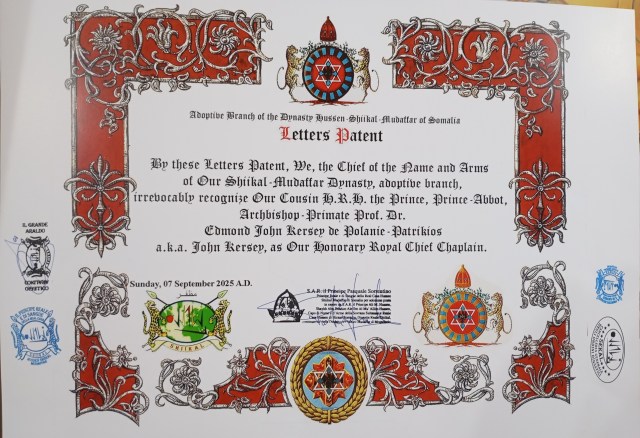
The Royal House of Hussen-Shikal-Mudaffar of Somalia was led by the late Prince Ali M. Hussen (Shaykh Abu Ibrahim Ale Ibn Al Mu’Allim Hussen) who was Chief of the Name and Arms of this Sultanate and Royal House. The Royal House represents the descent from the Sultans Mudaffar of Mogadishu. Prince Ali adopted as his heir to all his titles Prince Pasquale Sorrentino of Rome, Italy. Prince Pasquale is a senior member of the San Luigi Orders and my adoptive cousin in the Royal House Polanie-Patrikios, and has entered into wide-ranging mutual treaties of recognition with the institutions for which we have respective responsibilities. I have been honoured with the appointment of Honorary Royal Chief Chaplain to the Royal House, which represents both an Islamic and Christian heritage and thus serves as an example of interfaith co-operation.
The Università Popolare e della Terza Eta “Evy Delia Tommassini” is an institution of the Imperial and Royal House of Tommassini-Leopardi of Constantinople, of which I am a member. It is a private Italian institution of higher education in the tradition of the “universities of the people” there, based in Milan.
The University has appointed me as Honorary Life Fellow and Professor Emeritus of Music (Pianoforte):
The Royal House of Epirus is the descendant of the independent state of Epirus that existed between February and October 1914 before being occupied successively by Greece and Albania. The Royal House has continued a representation in exile and the current head is Prince Davide Pozzi Sacchi di Santa Sofia who is Grand Prince of Epirus. The website of the Royal House gives much historical and current information and in addition the book “Le Royaume d’Epire, son Histoire et sa Monarchie au XXIe siècle” by Prof. Claude Chaussier (Brussels, 2005) explores these subjects in further detail.
A recent wide-ranging agreement between our respective jurisdictions has been marked by an exchange of honours and distinctions.
Prince Davide has appointed me as his honorary cousin, and as a Royal Prince in the Royal House of Epirus:
He has further appointed me to the rank of Hereditary Grand Cross of Justice with Grand Collar of the Constantinian Order of Epirus:
I have also been appointed as Honorary Life Member of the International Cultural Association of Royal Epirus and Honorary Life Academician of the Royal Academy of Epirus.
In the Royal Academy of Epirus, I have been appointed as a Professor Emeritus in Music/Musicology.
Prince Davide has also issued Letters Patent of recognition of my religious offices as Prince-Abbot of San Luigi and Catholicos of the West:
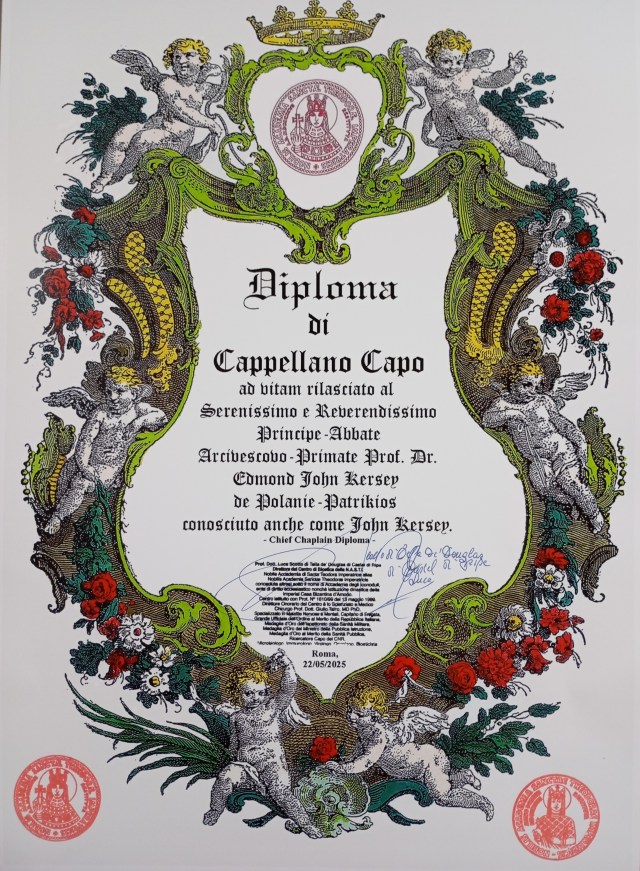
The Imperial and Royal House has appointed me as Honorary Chief Chaplain:
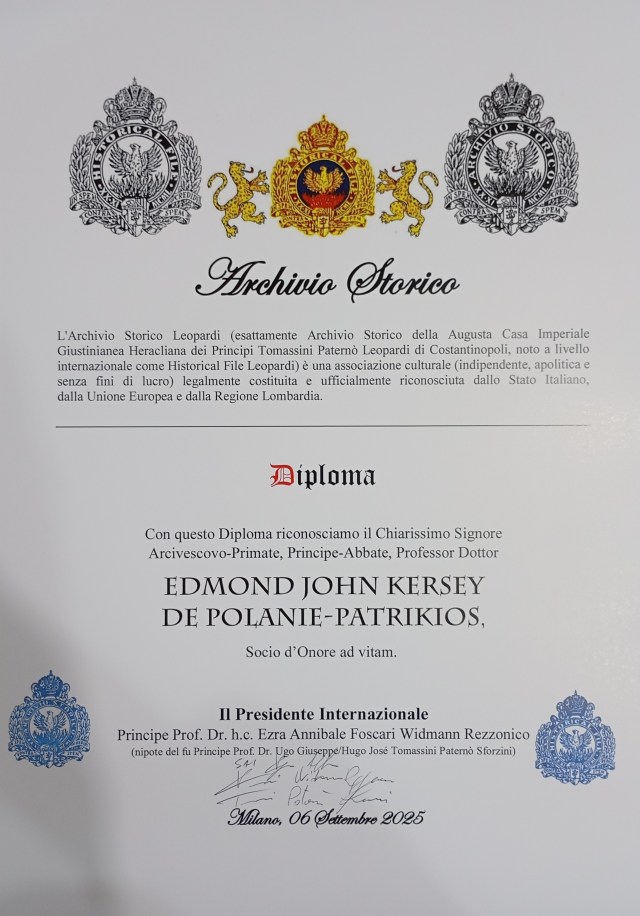
The Historic Archive of the Imperial and Royal House (Archivo Storico) has appointed me as an Honorary Life Fellow:
The Accademia Costantiniana Leopardiana of the Royal and Imperial House has appointed me as an Honorary Life Fellow/Academician:
The Nobile Accademia Heracliana of the Imperial and Royal House has appointed me as an Honorary Life Fellow/Academician:
The Nobile Accademia Giustinianea of the Imperial and Royal House has appointed me as an Honorary Life Fellow/Academician:
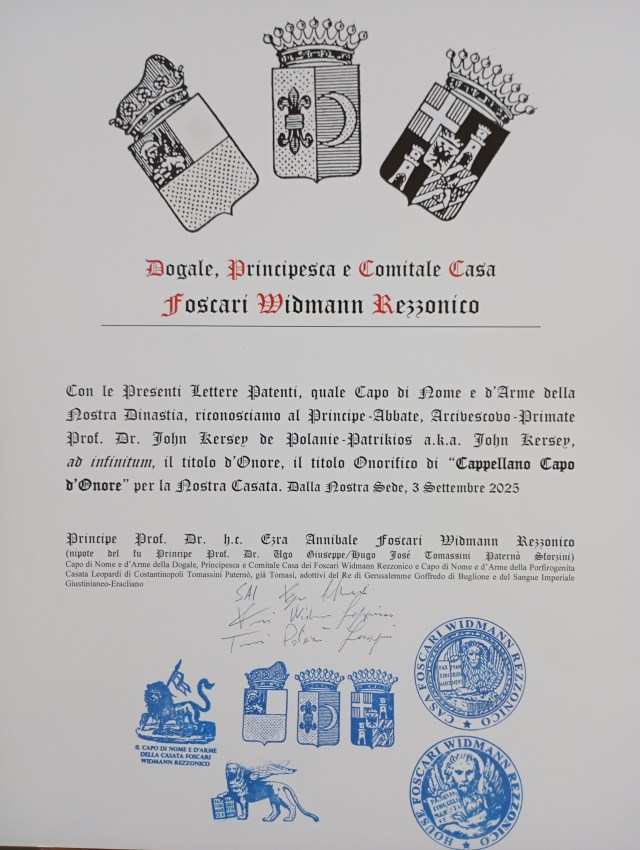
The House is united in the person of its head, H.I.R.H. Prince don Ezra Annibale Foscari Widmann Rezzonico, with the Princely, Ducal and Comital House of Foscari Widmann Rezzonico, in which Royal House I have also been appointed Honorary Chief Chaplain.
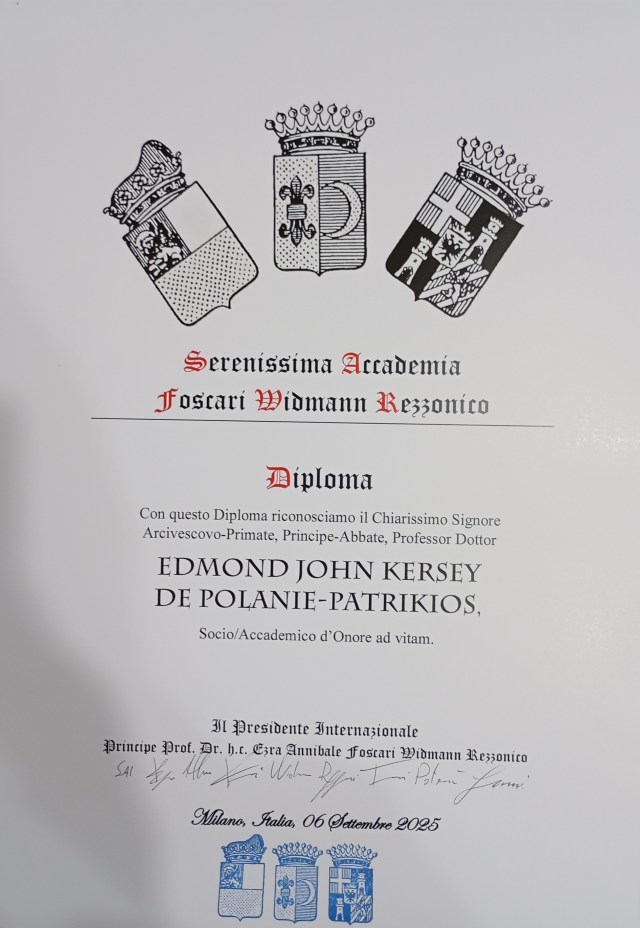
The Serenissima Accademia Foscari Widmann Rezzonico of the Royal House has appointed me as an Honorary Life Fellow/Academician:
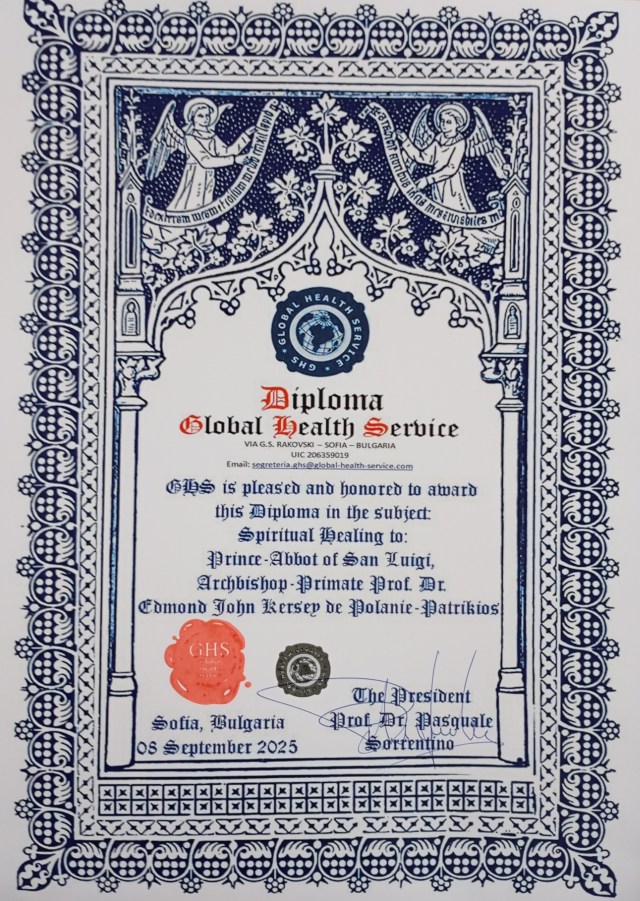
The Global Health Service is incorporated in Sofia, Bulgaria, and undertakes a programme of humanitarian support under the presidency of Prince Professor Pasquale Sorrentino. The Service has awarded me a Diploma in Spiritual Healing.
My recording of the Willner transcription of Bruckner’s Third Symphony for piano solo is Download of the Month for August 2025 at the excellent and informative website abruckner.com
There are many curious and not a few inaccurate entries in the online encyclopedia Wikipedia. One of the latter has concerned the entry on my old school The Latymer School, Edmonton, where we have been able to read the following wholly unsourced and largely inaccurate material which I will correct and respond to in this post.
In 1967 the school switched to a comprehensive intake as a result of Circular 10/65, a request from the Labour government to local education authorities to plan for conversion to a fully comprehensive education system. However, a certain amount of informal selection still took place in liaison with local primary schools.
In 1988, Latymer took advantage of the Education Reform Act 1988 to become a Grant-Maintained school with selective entrance exams once more.
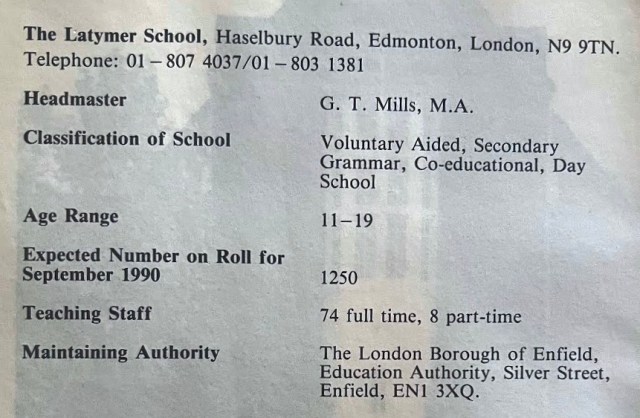
The first point of error is that Latymer did not become a grant maintained school in 1988. The School Prospectus for 1990-91 gives the school status as “Voluntary Aided, Secondary Grammar, Co-educational, Day School.”
It was not until some years later that the prospect of obtaining Grant Maintained Status was mooted. The End of Term Newsletter for Summer 1992 says,
Grant Maintained Status: At a recent meeting of the Governing Body the Governors discussed the future of the school and in particular whether it would be to Latymer’s advantage to seek Grant Maintained Status. The Governors decided to hold special meetings at which resolutions to proceed with a ballot of parents on the issue will be discussed and voted on.
Latymer did indeed obtain Grant Maintained Status in 1993 (see Hansard listing of 8 February designating it as having voted Yes and published proposals) and held this status until it was abolished in 1998. In the latter year, the Education (Grammar School Designation) Order 1998 came into force and officially confirmed Latymer as one of the remaining grammar schools in England.
The implication of the anonymous Wikipedia author is that after 1967 Latymer became a comprehensive school and thus that it accepted pupils of all abilities. This was not the case. While a comprehensive school is not permitted to select its intake by ability, Latymer, by contrast, remained a voluntary aided grammar school and accepted only those of high academic ability.
The authoritative reference on these matters is “A History of the Latymer School at Edmonton” by J. A. Morris (Latymer Foundation at Edmonton, 1975) which discusses matters as they actually were. Turning to page 300, we read,
…one feels certain that the School will always owe a great debt to [Dr Trefor Jones, Headmaster 1957-70] for asserting vigorously and uncompromisingly its special claims to uniqueness in a comprehensive world. His predecessor and an earlier generation of governors had first faced the problem…The full force of the attack was felt in 1964. In this year, a new Labour Government was elected pledged to end selection at age 11 and to eliminate separation in secondary education. The Government’s White Paper issued in 1965 referred to the anomalous position of voluntary schools. Paragraph 38 stated, “It is not essential that the same pattern should be adopted for denominational and other schools in any given area as is adopted for that area’s county schools. The disposition and nature of the existing voluntary school buildings might dictate a different solution”.
The Governors and the headmaster felt that such was the case at the Latymer School of Edmonton. The immense size of the building may have satisfied the spatial requirements of a large neighbourhood school, but Latymer’s interior arrangements and furnishings – such as the twelve laboratories for advanced science – were designed for a school having 240 sixth formers in mind. Their main objection to the plans of the local authority (since 1965, the Greater London Borough of Enfield) was that the Latymer endowment was the birthright of every child in the parish…’to the end of the world’. It should not be restricted to the children of any limited area. A compromise plan was finally agreed extending the benefits of the Foundation to the whole of the Greater London Borough of Enfield, i.e. to the children of the old parish of Enfield as well as those in Edmonton and Southgate.
In every year after the end of the 11+ examination the Governors received far more applications than there were places available, and from parents who approved of the headmaster’s drive towards academic achievement and examination success, with firm discipline and the minimum concession to the current trendiness. Though the intake was not being selected in the old 11+ way, the School was attracting the most highly motivated parents and pupils, and attracting them from over a much extended catchment area.
It can therefore be seen that voluntary aided schools, including Latymer, could and did still maintain a selective intake post-1967, despite the changes in government policy. There was nothing “informal” about this selection; it was the published policy of the school.
Reference to the School Prospectus above finds the following described under Admissions Policy and Procedure,
The admission of pupils is the responsibility of the Governing Body, acting in accordance with the arrangements agreed with the Local Education Authority. Pupils admitted are required to be capable of following an education directed towards the highest grades of the G.C.S.E. Most are expected to proceed to Advanced level and subsequently to University or Polytechnic degree courses.
Primary Secondary Transfer
Reference is made to aptitude and ability with emphasis on academic attainment and potential. Those admitted are normally among the most able in their year group. The School has an outstanding musical tradition and the Governors give consideration to the admission of pupils of exceptional musical talent provided that they are also capable of following the academic courses offered. Other aptitudes and interests are also relevant. Family connections with the School are considered but are not a dominant factor in the decisions of the Governors.
Parents are invited to complete a questionnaire giving information of their child’s special interests and aptitudes. All applicants take a non-verbal reasoning test at Latymer School in late October. Reports from primary Headteachers are then requested on approximately 500 candidates who have the highest standardised scores on the non-verbal test.
On the basis of the information received the Governors choose those pupils (up to the Standard Number) who, in their judgement can best be served by the School and on the evidence are likely to respond best to what the School has to offer.
It may therefore be seen that admission to Latymer in those years was a highly selective and competitive process in which academic merit was the chief criterion. I entered the school in 1984, when only four pupils from my year at primary school were accepted. My parents were opposed to comprehensive education for me, and had considered several local independent schools as alternatives to Latymer before concluding that Latymer was in many aspects the superior option.
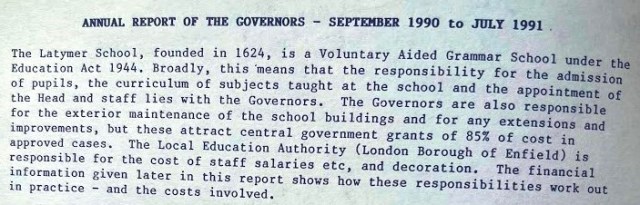
As well as the School Prospectus referenced above, we can also refer to the Annual Report of the Governors for 1990-91 which states plainly that Latymer was a Voluntary Aided Grammar School under the Education Act 1944.
The promulgation of inaccurate information via Wikipedia does a considerable disservice to the very real achievement of several generations of Latymerians whose ability and hard work earned them the opportunity to become part of an exceptional grammar school. In my view, grammar schools are something to celebrate as an antidote to the often stultifying egalitarianism that dominates modern education. Their role in promoting academic achievement and social mobility is often underestimated and should be more widely recognized.
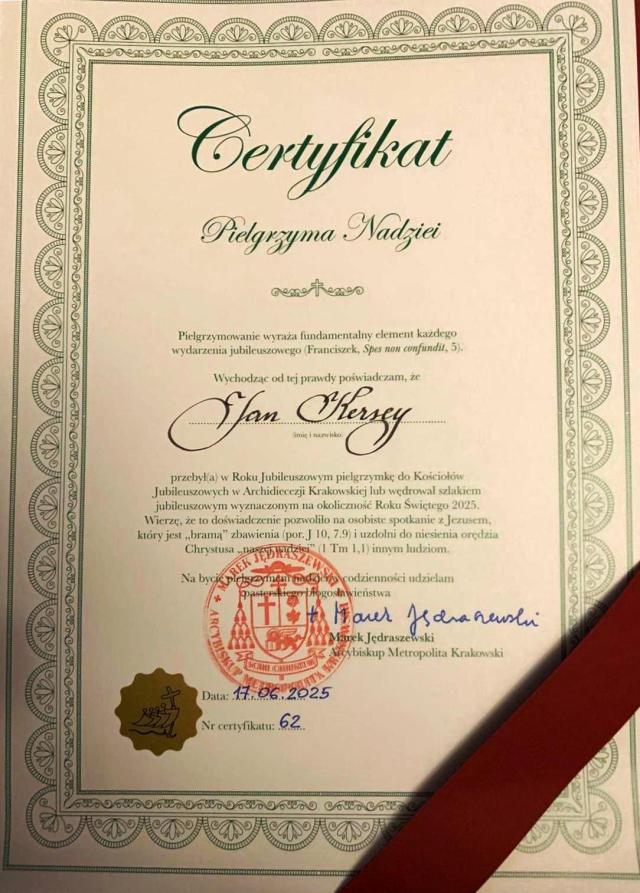
I have been honoured to receive the Pilgrim of Hope certificate from the Archbishop of Cracow, Poland. The certificate recognizes my participation in the Jubilee Route (following St Philomena’s Way in the West Midlands of England) designated by the Pope for the Holy Year 2025. The Pilgrimage is recognized as an opportunity for a personal encounter with Jesus and to bring the message of Jesus to others. The certificate ends with a pastoral blessing. The award of this certificate further emphasises unity with other Catholics and our common hope in our Lord and Saviour through the ancient and honoured path of pilgrimage.
The Royal House of Hussen-Shikal-Mudaffar of Somalia was led by the late Prince Ali M. Hussen (Shaykh Abu Ibrahim Ale Ibn Al Mu’Allim Hussen) who was Chief of the Name and Arms of this Sultanate and Royal House. The Royal House represents the descent from the Sultans Mudaffar of Mogadishu. Prince Ali adopted as his heir to all his titles Prince Pasquale Sorrentino of Rome, Italy. Prince Pasquale is a senior member of the San Luigi Orders and my adoptive cousin in the Royal House Polanie-Patrikios, and has entered into wide-ranging mutual treaties of recognition with the institutions for which we have respective responsibilities.
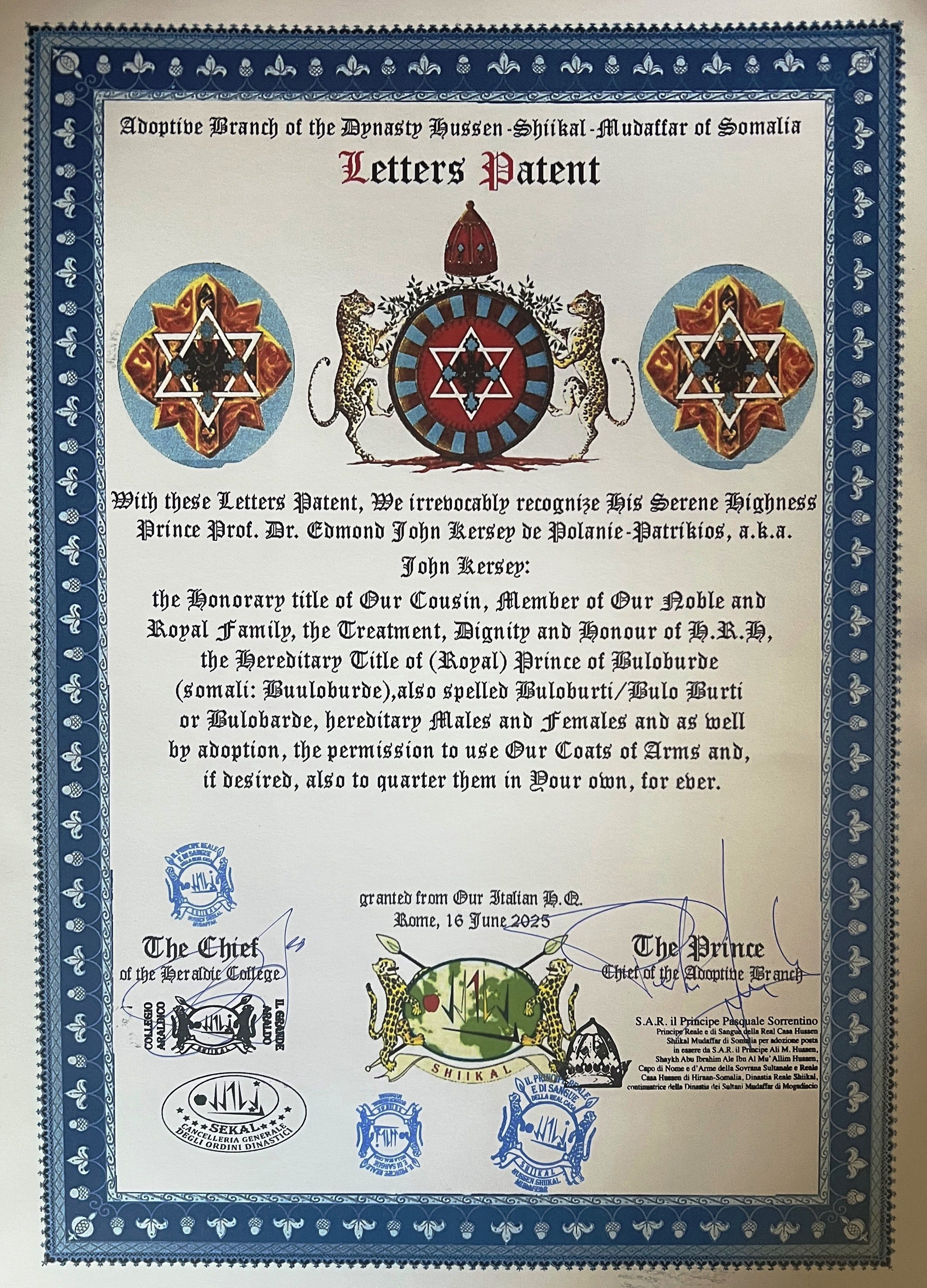
The Royal House has previously honoured me with the title of Prince. This year I was delighted to receive the further title of Prince of Buloberde (Somalian: Buuloburde, also rendered Buloburti, Bulo Berti or Bulobarde) from the Royal House, with remainder to my male and female descendants. I have also been adopted as a Cousin of Prince Pasquale and member of the Royal House of Hussen-Shikal-Mudaffar of Somalia with the right to use and quarter the arms of the Royal House.
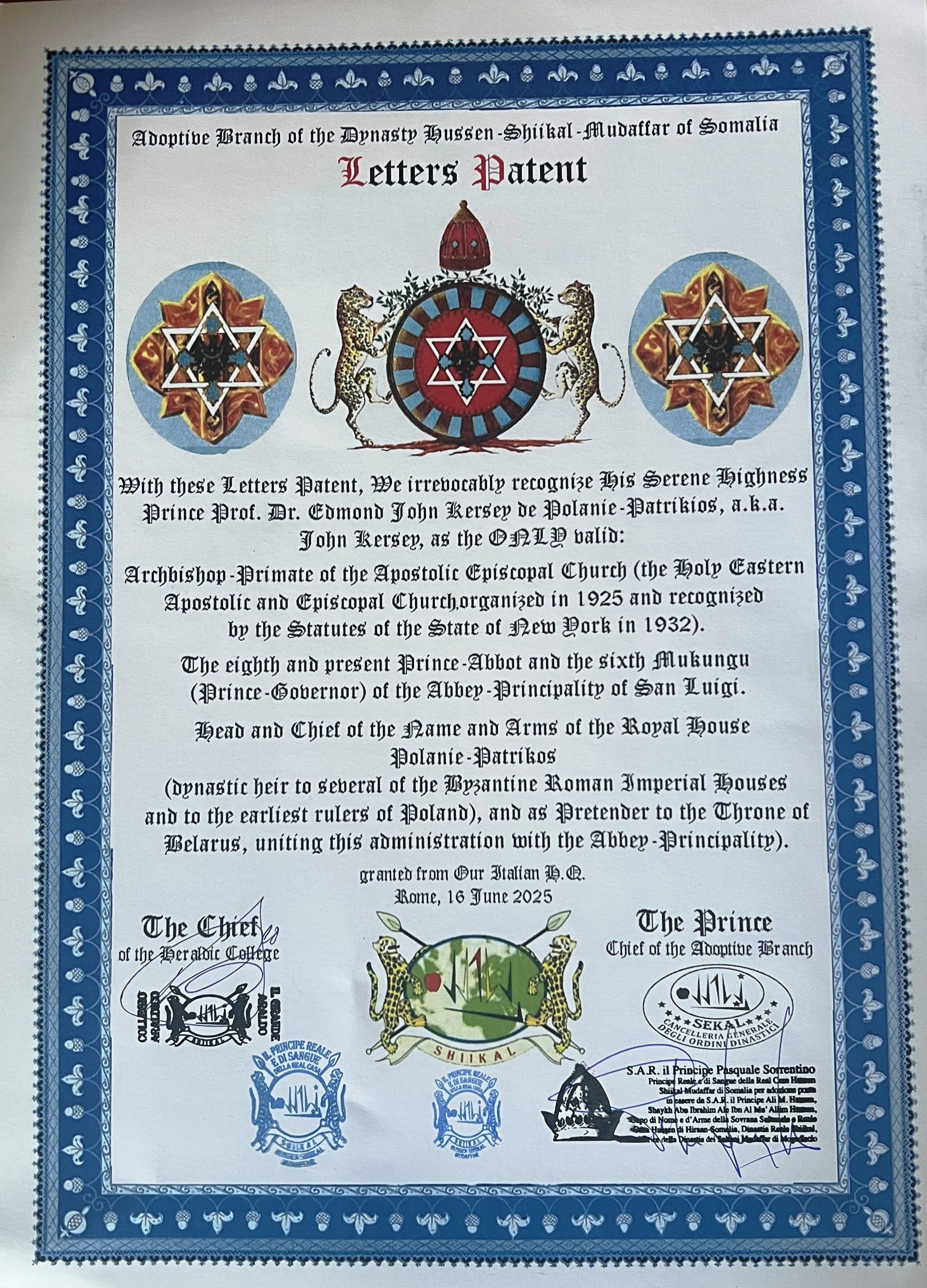
In addition, the Royal House has issued further Letters Patent of recognition in respect of the royal and ecclesiastical offices that I hold:
This is an index to the online recordings made by me as pianist that are available to listen via YouTube. My YouTube channel is at https://www.youtube.com/@JohnKerseypiano.
The recordings marked * are believed to be the first recording of the work in question. In some cases they are the first complete recording of a work of which one or more movements have been previously recorded by others. Although many of these recordings have been issued on CD by Romantic Discoveries Recordings there are also some world première recordings that have been released to the public online via YouTube.
Designation as a world première recording means that the recording has been released to the public in a permanent format, whether digitally online or on CD. The designation is independent from any commercial consideration. It also means that it is the first such release to be made by a human pianist using an acoustic piano; artificial intelligence and MIDI recordings as well as those made on electric keyboards are discounted.
Transcriptions are listed under the name of the transcriber.
My thanks to everyone who has kindly contributed copies of scores for use in these recordings, in particular the late Klaus Zehnder-Tischendorf, Peter Cook, Robert Commagère, Denis Waelbroeck, Nicolo Figowy and Steffen Herrmann.
The highest goal of music is to connect one’s soul to their Divine Nature, not entertainment.
– Pythagoras
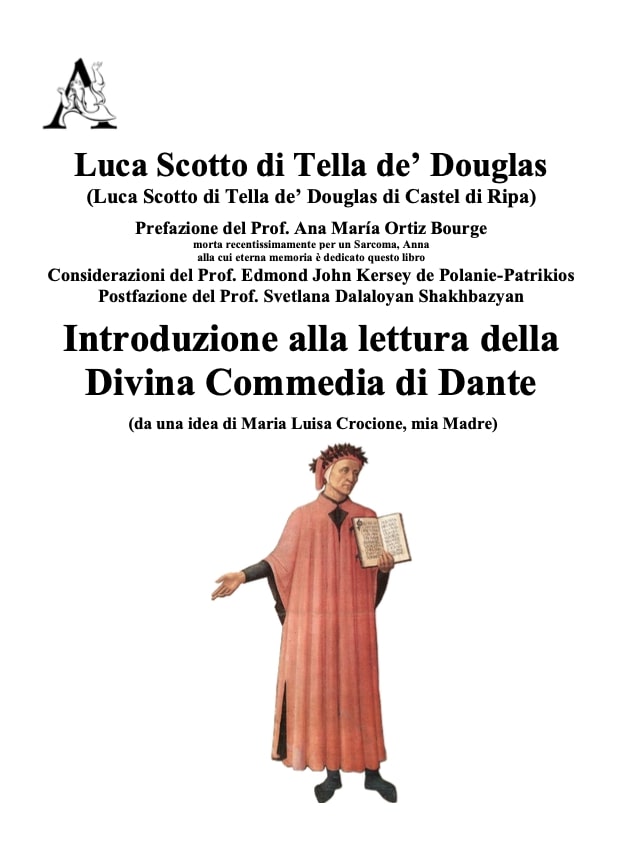
The book “Introduzione alla Lettura della Divina Commedia di Dante” by Professor Luca Scotto Luca Scotto di Tella de’ Douglas di Castel di Ripa has recently been published by Aracne Editrice. I have contributed to this work.
The second edition of “Vento Divino – Il corpo dei Kamikaze e il suo ruolo nella Seconda Guerra Mondiale” by Professor Luca Scotto di Tella de’ Douglas di Castel di Ripa has recently been published by Aracne Editrice. I have contributed a preface to this work.
The Accademia Universitaria Internazionale was established in Italy in 1939 by the late Prince Hugo-José Tomassini Paternò, Head of the Tomasi-Leopardi (Justinian-Heraclian) Imperial House. It was registered with the Ministry of Public Instruction and established partnerships with other educational institutions internationally. Today under Prince Ezra, the current Head of the Imperial House, the Accademia has established reciprocal relationships of partnership, accreditation and recognition with a number of my educational institutions. It was with particular pleasure that I received a Diploma of Merit (Diploma de Benemerenza) from the Accademia, which is based in Milan, Italy.
Professor Maurice Merrell, DLitt, DMus, FGMS, FCCM, FISOB, FSCO, FIGOC, FGCO, FNSCM, HonFASC, HonFNCM, MNCMSoc, FMCM, FRSA, FWOU, FEAU, CompCIL, Emeritus Fellow and Leonard Henderson Memorial Professor of Organology at European-American University, died on 28 May 2025 aged 89.
Maurice Edward Merrell was born in February 1936. He was both an organist and an organ builder. In 1951, aged sixteen, he was apprenticed to the organ builders Bishop and Sons under the late Miss Hilda Mary Suggate, and after some time dealing with their business in the Midlands and Wales took over as London Manager at their premises in Beethoven Street in Queen’s Park. After Miss Suggate died, he became Principal of Bishop and Sons and completed seven decades with the company, retiring in 2022. He was a Fellow of the Incorporated Society of Organ Builders, also serving on the Society’s Council. It could truly be said that there was nothing concerning the construction of pipe organs with which he was not familiar, and he subsequently trained several generations of apprentices. Even in advanced years he would still be found clambering around in organ lofts and ensuring that the instruments were maintained in good order.
He served as organist of St George’s Church, Bloomsbury, for over thirty years, also being a Churchwarden and Treasurer there. He had previously been appointed as organist of St James, Bermondsey, at the age of fourteen, and then moved to St Peter, Islington. He was an able improviser and could effectively evoke the style of Howells. He was president of the London Organists’ Guild.
He was also active in the Church Lads’ Brigade, where he was an instructor and held the rank of captain.
Maurice was always ready to give his support to societies of musicians. He was a founder member and served on the Council of the Guild of Musicians and Singers for three decades, eventually becoming Master of the Guild. He was also a founding Fellow of the British Academy of Music and the Faculty of Church Organists. As a Fellow, he gave his support to the Institute of Arts and Letters, London, and was also a Fellow of the Curwen College of Music, where he was Hon. Treasurer. He was President of the Society of Crematorium Organists.
He received honorary Fellowships from the National College of Music and the Academy of St Cecilia, was elected to the Fellowship of the Metropolitan College of Music for distinguished service to music, and in 2003 received the degree of Doctor of Music from St Katharine’s Institute, Wyoming, USA, on the basis of his service to music. He was appointed a Companion of the Central Institute, London, and received the knighthood of the International Knightly Order Valiant of St George in a ceremony at Rochester Cathedral.
Maurice in 2008 wearing his DMus robes
On 21 November 2015 there was a Presentation Lunch in his honour at the Civil Service Club in which he received the degree of Doctor of Letters of the Western Orthodox University and was appointed Emeritus Fellow and Leonard Henderson Memorial Professor of Organology at European-American University, reflecting his long and distinguished service to the musical profession.
Maurice and I at the 2015 presentation lunch at the Civil Service Club
At the meetings of the societies with which he was involved, Maurice was notable for his depth of knowledge, friendliness and considerable social skills. He was a great conversationalist, and would make time to speak with everyone. With his optimistic attitude and sound foundations in the Church, he was a reassuring and respected presence who maintained the highest of standards in dress and deportment. In the nearly thirty years that I knew him he did not seem to change at all. He was also a pipe smoker, and at the various society meetings would join others outside the church in question for a smoking break and conversation. His contributions to the Guild meetings in the form of addresses on musical matters were always interesting and often included moments of humour.
Maurice was unmarried and lived in a flat near Regent’s Park. He suffered a stroke in 2020 which marked a significant deterioriation in his health, but continued to be involved with the work of Bishop and Sons and his musical institutions. He will be much missed, since he was a pillar of this particular corner of the musical world and a gentleman of the old school.
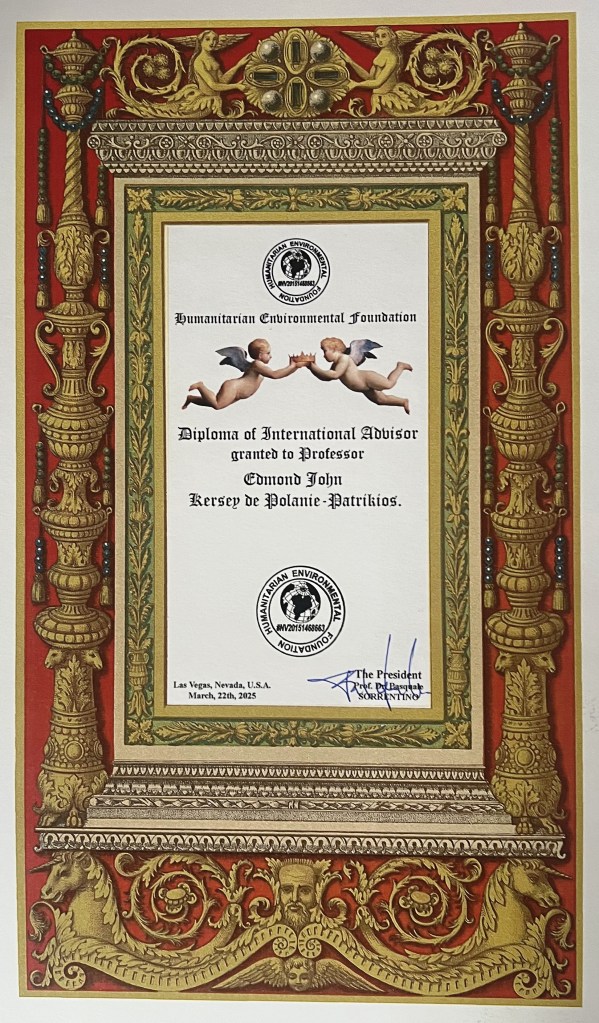
The Humanitarian Environmental Foundation is established as a nonprofit foundation in Las Vegas, Nevada, USA, under the presidency of Professor Pasquale Sorrentino. I have been particularly pleased to become involved with its work given my commitment to the environment.
The Foundation has appointed me as an Honorary Life Fellow and an International Advisor and Ambassador of Goodwill for Great Britain.
The Foundation has made several awards to me, in Christian Theology and British Culture.
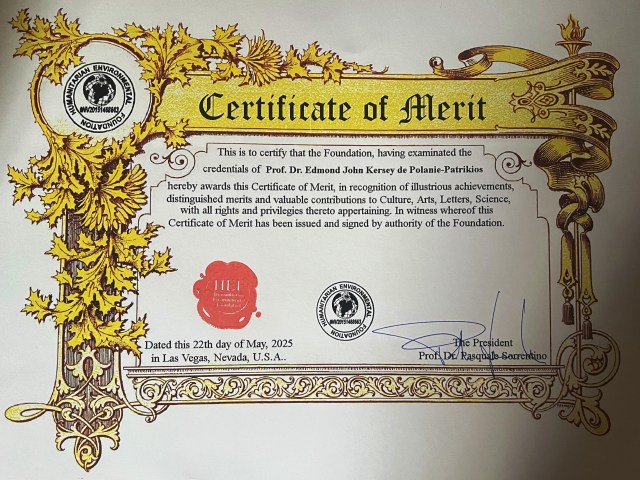
The Foundation has also awarded me a Certificate of Merit in recognition of contributions to Culture, Arts, Letters and Science.
The Foundation has awarded me the Advanced Diploma for Teaching – Master Teacher Certification.
On May 10, 2025, I addressed the Traditional Britain Group Annual Luncheon in London.
The text of my speech is below.
As I speak to you today, we have recently seen Reform’s extremely impressive performance in the local elections, and if such a performance were to be repeated at a General Election, Nigel Farage would be our next Prime Minister. This is highly significant because it is the first time in living memory that there has been any disruption to the two-party system of government in this country by a new party of the Right. It tells us that voters are not only looking for change but are prepared to put their trust in Reform, doubtless in no small part because of Nigel Farage’s high profile.
It is interesting to note that one extremely skilful aspect of Nigel Farage’s public image is his appearance. Yes, like most politicians, he tends to wear dark suits when he appears on political programmes on television. But when he is canvassing and speaking in public, he alone among our party leaders and prominent politicians wears classic English country clothes. We see him wearing tweed jackets, Barbours, tattersall check shirts, ties with pheasants on them, yellow corduroys and red chinos. These things are the nearest thing we have to an English national costume for men. They at once mark out the wearer as an Englishman, but moreover they speak of his affinity with the rural rather than the urban, and with traditionalism rather than the modern. They are also quintessentially masculine. This is therefore not just clothes, it is a set of values. Of course, we will need to see whether Nigel Farage can follow this up with policies that match his appearance, but we can see from this that he is at least visually distancing himself from the current establishment.
What this image suggests is something fundamental to our identity as a nation. It is that of society on a human scale. We find this most clearly expressed in rural life because it is there that we see the traditional concept of Englishness in the rural professions, above all agriculture, as well as communities that are built around villages and market towns, most of which have managed to preserve at least some of their historic buildings. There has been much technological change in farming over the last few decades, but it has generally been absorbed within the same outlook as has always been characteristic of those who are in touch with the land and with livestock. There is above all a continuity and long-term view in rural life that is very different from the alienation that predominates in the urban setting. The rural existence is an indigenous way of life, and reminds us of our heritage, our identity, and that we are rooted in the very soil of our nation. It is also a life that includes not only purposeful activity but stillness and silence. As so eloquently summed up by the ruralist farmer and author Henry Williamson, “What is this life, if, full of care, we have no time to stand and stare?”
But our political class is generally opposed to rural life. It has become a regrettable aspect of our political system that it is now dominated by urban concerns and urban people, and that the voice of the countryside is increasingly excluded. This began with the Labour government of 1997, and many will remember the Countryside Marches in London in those years in protest at the government’s policy on rural affairs, including the Liberty and Livelihood march in 2002. We would have to go back before 1997 to remember politicians who had a genuinely rural perspective, such as the late Sir Richard Body, who was a great supporter of environmental issues and the natural and organic communities that are the bedrock of the countryside. Rather than this, we have seen in more recent years the banning of hunting and now potentially of trail hunting, the substantial increase in bureaucracy and regulation in farming, and now the potentially enormously damaging imposition of death duties on farms, many of which are worth a lot in terms of their land value but actually do not make much in terms of profit. The position seems to be that our present politicians want there to be fewer farms, presumably so they can cover empty farmland either with housing or with solar panels. They also want to feed our cows additives that reduce their methane output, a matter on which former Reform MP Rupert Lowe has expressed concern.
I do not believe our farmers will stand for this, as witness the tractor protests in London earlier this year, and nor do I think they will simply be bought off. To farm is to understand the profound connexion between ourselves and the natural environment, and to be the antithesis of those who we might rightly say know the price of everything and the value of nothing. If we understand Nature and its laws, then we know the fundamentals on which everything worthwhile is based, and also comprehend that to be against Nature is to be against life itself.
From a rural perspective, our view of the destiny of our nation is very different from that of our politicians. Since the 1980s, the dominant consensus in our politics has been that of internationalism. One reason why so much faith has been lost in our democracy – and as witness I cite the pitiful turnout at the last General Election – is because politicians are increasingly blatant in their rule for the benefit of an elite class, and in too many cases place their personal interests before any ethos of public service. They take their lead not from the working people of this country but from unaccountable international bodies, not least the World Economic Forum. I say that this is entirely wrong. Our government is elected by our people to rule for their benefit, to put the national interest first, and not to sacrifice it for the benefit of the so-called international community. And politics is about solving people’s problems. While I certainly have political disagreements with the Liberal Democrats, one thing I will say of them is that they have well understood the importance of engaging directly with local people on local issues and being visible and active in their local communities. We all need to learn from that example, because it achieves far more positive results than grandstanding on the international stage.
Our people see the increasing damage that this approach is doing in their daily lives. They are the ones who are faced with the harsh realities of the past decades. If we look to our towns that grew up around now-dead British industries, we now see a catalogue of neglect of these communities and more importantly a loss of hope. No government can look at generations of our people surviving on benefits because there are no jobs for them and say that is any kind of success. And we should remember that we lost our industries because they were sacrificed to cheap foreign imports. The argument is always that our industries are uneconomic and cannot survive amid market pressure. But market pressure in this context is not a neutral force. It represents nations competing not merely on the price and quality of goods, but nations competing for power and influence in foreign countries. If we do not want to sacrifice that power and influence as a nation, we must accept that the purely economic interest cannot always be the deciding factor.
There seems to be no solution to this situation coming from our politicians, and we now have a rampant cost of living crisis that shows no signs of being tackled effectively and that is yet again hitting the poorest in society the hardest. Our political class often seems to ignore the realities of life outside the Westminster bubble. Those realities in our towns and cities are of an increasingly fractured nation and also one that is increasingly plagued by violence and anti-social behaviour.
If we look at the causes of this, we can see a major reason being uncontrolled mass immigration. One problem that this creates is that we move from a high trust to a low trust society. If we look at historical British communities, even up to the last years of the last century, we see a predominance of a shared culture among our indigenous people. I remain to be convinced that there was anyone who lived through the Second World War who did not know all the popular songs of that era by heart. There was a cultural basis of Christian principle that even if it did not express itself in churchgoing, was still a part of our politics, our judicial system, our schools and our arts. And there was a justifiable pride in our nation as a civilised influence that had rightly been highly regarded around the world. And that is before we get to our many local traditions. All of this created bonds between people in a way that mere proximity never could. Even our customs were held in common. It was rightly said that when two Englishmen met as strangers, their first talk would be of the weather, and there were standards of appearance and behaviour that were part of our culture and observed by most people.
What Nigel Farage wears now was at one time not unusual to see in most men of the country and still can be found there. Away from this, it is not so long ago that we can remember when both young and not so young people would dress according to particular tribes and enthusiasms in music. Now, we have a predominance of “athleisure” which makes everyone look the same. That, of course, seems now to be the whole point, because most people no longer want to stand out or look distinctive.
High trust is what makes a society work. Low trust, on the other hand, occurs when people are forced to live and work with others who may hold very different and opposing values to their own. The Ancient Greeks understood this, and Aristotle expressed the view that democracy was only possible within homogeneous societies, whereas those which were fragmented would be ruled by despots. The key was philia, which he defined in his work Rhetoric as “wanting for someone what one thinks good, for his sake and not for one’s own, and being inclined, so far as one can, to do such things for him.” It can be seen that such a principle was historically present in our Britain, indeed it represents one of the finest aspects of the archetypal British character. Where it exists, it produces a unity and commonality in society which is then based on mutuality, trust and respect.
But our government in recent decades has not wanted a unified society. It has done everything to ensure that divisions, whether ethnic, cultural or class-based, have come to predominate in Britain today. Rather than strengthening democracy, this promotes an unaccountable rule which does not govern for the benefit of the people but rather for an elite sector that sees itself as having a responsibility to control the people by telling them what to do and what to think. The growth in the nanny state is due to this, and we can see the Covid lockdowns as a dry run for a controlled population that would willingly follow instructions from on high that deprived them of even the basic comforts of human contact with loved ones and the liberty of free movement.
As people are increasingly controlled by the state, so their liberties are ever more circumscribed. Opinion is now only permitted within narrow boundaries set by the political elite. We have seen people thrown in prison for statements that were not only conceded to have been legal, but in many cases were also true. We have seen something that I had only thought would happen in societies like Communist China; foreign websites unable to permit British visitors access, because they are unable to comply with the Online Safety Act. It is essential that we should regain our faith in freedom of speech and our commitment to it as one of the most fundamental freedoms that a civilised nation should uphold. On matters of politics and religion in particular, there must be a freedom to voice and debate all opinions openly, and we must end the belief that anyone’s right not to be offended should take priority over the principle of freedom of speech.
One major reason why we have ended up in this situation is that our society has been deliberately dumbed down. There has been a movement in government to prioritize safety and security rather than favouring risk and its rewards. This has led to a system of centralized control, a significant increase in regulation, and a tick-box culture that cannot cope with anything that is not objectively quantified, with technology increasingly used to monitor and enforce. Individual and local variation, and more significantly, any suggestion of difference or subjectivity, have been forced out in favour of uniformity and consistency. There is no greater enemy of excellence than this agenda. It favours the mediocre and the time-serving. And this is fundamentally against human nature, which represents a genuine diversity of all kinds and which flourishes in conditions of freedom.
My school and university education was centred upon academic excellence, and in those days it was rightly said that a person with a good degree from a top university then had the capacity to attain a reasonable mastery of any subject they might choose, because they had acquired the analytical and research techniques that they could apply to anything. The acquisition of a critical faculty was seen as essential. We would know what we considered good and bad and we would be able to justify those positions with some form of reference to the aesthetic foundations laid by others or to wider religious, moral or cultural principle. The traditional liberal education of the English worked on the tolerant and civilised principle that all ideas regardless of their merit should be heard, and that those which were bad or wrong could then be shown to be so through rational debate. An important principle of this was that people had the freedom to advance ideas that might later be shown to be wrong, or to change their mind about what they believed, without those things then being held against them. Someone’s politics, unless they were running for office, were generally held to be a private matter, and the topics of politics and religion were placed off-limits in certain social situations because of their capacity to cause division. Even when there was strong disagreement, it was right that we would echo Evelyn Beatrice Hall in her biography of Voltaire in saying “I disapprove of what you say, but I will defend to the death your right to say it.”
Now, people are encouraged not to ask questions, and to accept blindly anything outside their specialism that is delivered by those who are proclaimed as experts, even when this is subjective opinion. This is an agenda all about control and the suppression of dissent, whereby those who defy the views of the mainstream are cancelled and many are afraid to speak their minds openly. One major reason why this has happened is because the ideas that are held by the mainstream in some cases will not stand up to rational debate, and therefore need to be protected by censorship.
We are also seeing the growth in political decisions which are made not based on accountability to the people of this country but rather are abdicated to nebulous international forces over which voters are given no say and which politicians will simply treat as beyond their control. We learned recently that our government intends to put pollutants into the air to dim the light of the Sun. The Guardian called this “barking mad” and they are right to do so – it is not only barking mad but potentially catastrophic. Eight states of the USA have recently introduced laws that prohibit solar geoengineering, but Britain still persists. And nobody here voted for anything like this. We were never asked. Yet the government has every intention of pressing ahead with this and anything else that will prove its loyalty to the United Nations’ Agenda 2030. It is to be hoped that Reform, which has expressed its opposition to net zero, will soon start to exert enough pressure to stop this dangerous lunacy in its tracks.
Unlike the United States, where the Constitution acts as a unifying force, we have nothing in Britain that could bind us together except for our own indigenous identity as an island nation, giving rise to our culture and its values which were once revered the world over. We have moved from a situation where immigrants to Britain at least in some cases admired and wanted to be a part of our culture, to one where immigration has now given rise to deeply divided communities in which there is no assimilation and the reasons for coming here are largely economic rather than cultural.
It is no coincidence that this has happened along with the promotion of globalist mass culture, largely online, in which we have lost much of the distinctiveness of our own cultural output and are now being fed the same bland globalist slop as the rest of the world. For this reason, I believe it is imperative that we should rediscover and reclaim our national culture in all its vigour and variety.
Some say that this is a downward spiral from which there is no escape. This is not so. All the problems that I have outlined could be solved in this country by a British government committed to restore our liberties and to once again put our national interest and our people first. It would take a tremendous effort, it would involve radical and major change, and it would be done in the face of enormous opposition by the current establishment, but it is nevertheless achievable and it would probably be easier than it might at first sight seem.
The vision which needs to be put forward is very different from the current viewpoint. It foresees a Britain that in many ways is less a part of the international community, that withdraws from its membership of international bodies where that membership is not in the national interest, just as we did with the European Union, and that focuses instead on meeting the needs of our citizens first and foremost.
The money that goes to meeting what are known as our international obligations would instead go to providing first class public services in which the public service ethos would be restored and self-interest deprecated. We should also ensure that Britain is self-sufficient and does not become reliant on foreign imports, foreign labour, or foreign ownership of our industries or our utilities, because with this comes the risk of ceding national control to interests which may at times not be favourably disposed towards us. We should once again take measures to encourage small business and revive our high streets, and not simply give in to the pressures of global big business. We should ensure that our police focus on violent crime and anti-social behaviour so that people again feel that they can walk the streets safely. This requires above all a visible police presence on the streets – officers walking the beat – and a return to local policing, where police officers serve their local communities, are themselves known there, and in turn know the people who form that community.
And we should ensure that our borders are protected and that any person who arrives in this country illegally, or is found to have done so subsequently, is not housed at the taxpayer’s expense, nor supported by our benefits system, but is instead sent back to their home country as quickly as possible. A full overhaul of the immigration system would be based on the fact that we should in all cases be training and employing our own people to fill job vacancies and not relying on cheap unskilled imported labour.
We can also see some excellent measures begun by Reform at the local level that could be scaled up nationally. The first is the end to net zero policies, which would bankrupt our country and are grossly disproportionate considering Britain’s minimal global contribution to carbon emissions. The second is an end to wokeism and the culture of diversity, equity and inclusion, which has far too often simply become a means to push Marxist ideas and to attack White people. We need D.E.I. to D.I.E.
These are some of the things that could be done with the right government. But what if this does not happen? What if things do not go well for us and we, the indigenous British, become a minority in our own country, as some predictions indicate will happen and as is already the case in several of our cities? It is imperative that we ensure our survival and preservation if this should come to pass. And there are still things we can do to ensure that what survives of us is something that reflects the debt we owe to our ancestors –the “democracy of the dead” as the late Sir Roger Scruton put it – and the responsibility we have to our descendants. And we can begin doing all of these things now. We should only put our energy into politics if there is a realistic prospect of winning power at least at some level. If not, we should bypass politics entirely and concentrate on other ways to improve our lives and prospects.
The first thing to do is to take every opportunity to promote solidarity among our people. We need to learn from other nations and peoples in the world who are unashamed about their identity and culture, and stand up for our own. That which is good for our people is to be prized. We need to keep our traditions and culture alive, and to ensure that whatever happens we never compromise the values that make us who we are. Where we stand, we stand in peace, and with dignity and integrity, and we never forget that our duty is to set an example, however difficult the circumstances we may face.
As consumers, we make choices every time we make a purchase. What if we were to decide wherever possible to trade and buy with our own people rather than with globalist corporations? What if we were to focus our purchases upon things that reflect our culture and values, rather than a culture and values which are imposed on us by others? What if, when we could, we started businesses or non-profits that would provide something useful and valuable to our communities? We can make these choices, but we are too often pressured into avoiding them. Let us resist that pressure. Often, small and local is the best way to be.
And lastly, we need never to forget ourselves and the noble mission in which each of us can play our part. I will end with the words of that great patriotic poet Sir Henry Newbolt:
To set the cause above renown,
To love the game beyond the prize,
To honour, while you strike him down,
The foe that comes with fearless eyes;
To count the life of battle good,
And dear the land that gave you birth,
And dearer yet the brotherhood
That binds the brave of all the earth.
The Manor of Stoborough (Ancient Liberty) was established in 1086 and is currently held by Lord of the Manor the Most Revd. Dr. George Mentz, who is an American attorney and bishop in a Continuing Anglican church. Stoborough is the southern part of the town of Wareham in Dorset. A webpage on the history of Stoborough is maintained at https://stoborough.com
I have known the Stoborough area for many years and so was particularly happy when the Lord of the Manor appointed me as Mayor of Stoborough.
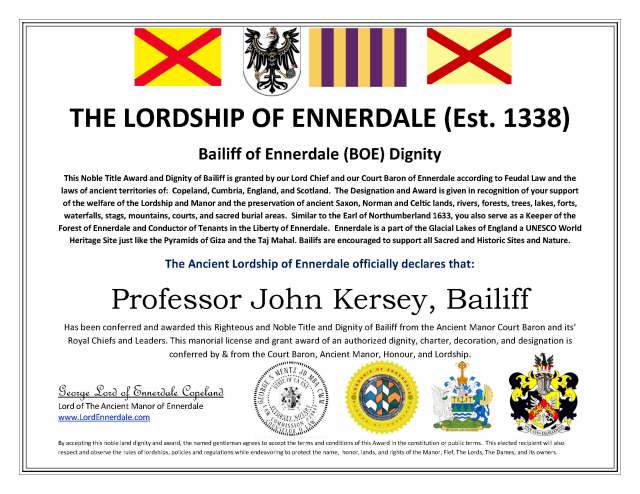
The Lordship of the Manor of Ennerdale was established in 1338 and is currently held by the Most Revd. Dr. George Mentz, who is an American attorney and bishop in a Continuing Anglican church. A webpage giving information on the history of the manor can be found at https://lordennerdale.com Ennerdale is located in Cumbria, in the heart of the Lake District.
I have been appointed by the Lord of the Manor as Bailiff of Ennerdale, also serving as a Keeper of the Forest of Ennerdale and Conductor of Tenants in the Liberty of Ennerdale. Given my love of England’s natural environment, I was particularly grateful for these honours.
The Norman Fief of Thomas Blondel and the Fief de l’Eperons are among the feudal dignities of the Channel Island of Guernsey, dating from 1020AD. They are subject to the British Crown by virtue of the Crown’s inheritance of the French Duchy of Normandy, of which the Channel Islands are the last surviving remnant under the terms of the Treaty of Paris of 1259. In 2018, the Fiefs were conveyed to the present Seigneur, the Most Revd. Dr. George Mentz, who is an American attorney and a bishop in a Continuing Anglican church, by a Deed of Conveyance registered at the Royal Courts of the Bailiwick of Guernsey. Dr Mentz has authored an extremely informative and well-researched website about the Fief Blondel and its history which can be viewed at https://fiefblondel.com.
The Order of the Genet is the oldest known chivalric Order in France, being founded by Charles Martel in 726AD. With the abolition of nobility and chivalry in France, the only remnant of ancient France in which feudal law still applies is the Channel Islands. Dr Mentz, who is a descendant of the ancient French Royal House, has revived the Order and authorized it to operate within the bounds of the Fief Blondel under the feudal laws of the Bailiwick of Guernsey. For further information see https://fiefblondel.com/Order-of-the-Genet-Knighthood.html
I have been honoured with knighthood in the Order of the Genet within the Fief Blondel.
I have been honoured with knighthood in the Order of the Star within the Fief Blondel.
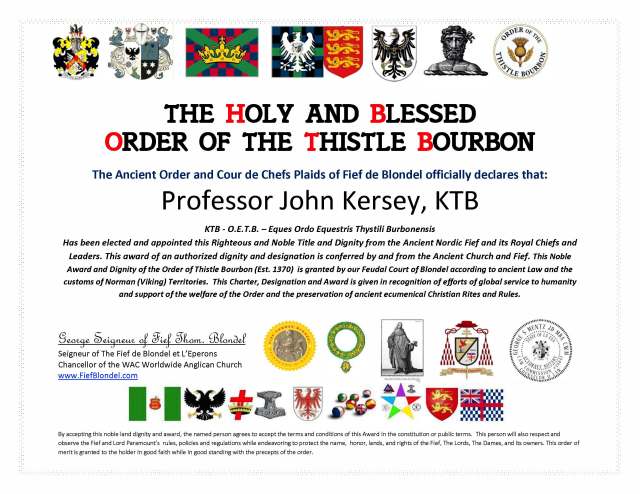
The Order of the Thistle of Bourbon was established in 1370 by Louis II (“the Good”), Duke of Bourbon. Within the Fief Blondel it consists today of 120 knights.
I have been honoured with knighthood in the Order of the Thistle of Bourbon within the Fief Blondel.


 The Royal House of Epirus






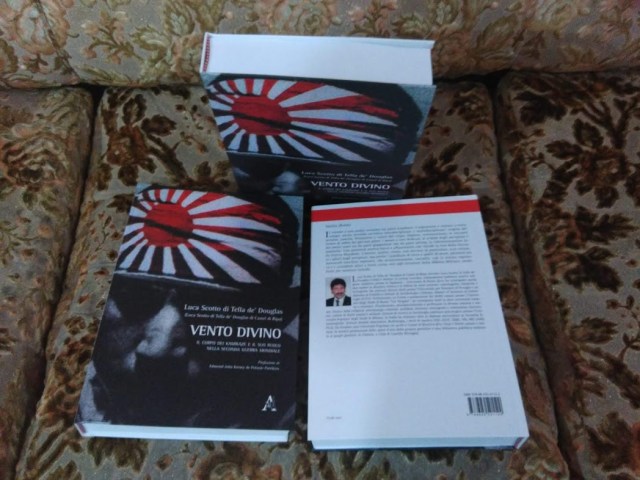 The second edition of “Vento Divino – Il corpo dei Kamikaze e il suo ruolo nella Seconda Guerra Mondiale” by Professor Luca Scotto di Tella de’ Douglas di Castel di Ripa has recently been published by Aracne Editrice. I have contributed a preface to this work.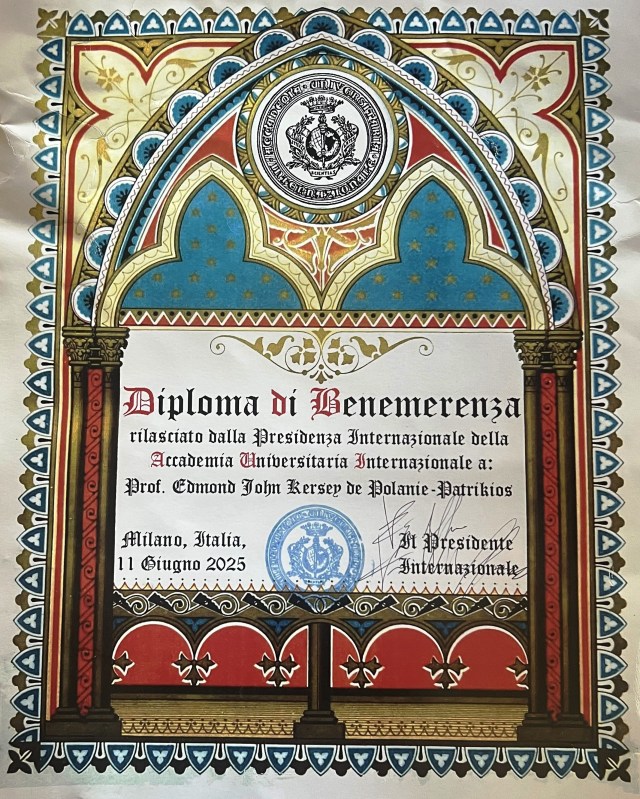
 Professor Maurice Merrell, DLitt, DMus, FGMS, FCCM, FISOB, FSCO, FIGOC, FGCO, FNSCM, HonFASC, HonFNCM, MNCMSoc, FMCM, FRSA, FWOU, FEAU, CompCIL, Emeritus Fellow and Leonard Henderson Memorial Professor of Organology at European-American University, died on 28 May 2025 aged 89.