

Author: johnkersey
Educationalist, musician and clergyman.

Another look at Emma West
Another look at Emma West
Libertarian Alliance, September 2014
There are, perhaps, more than two sides to the Emma West story. That this should be so is at least in part due to the torturous duration of her public exposure along with the complexity of the judicial process to which she has been subjected. Through it all, we have had to learn the story of Ms West at second or third hand. Rather like the Queen, by keeping her public statements limited she has made herself a tabula rasa for others to read into her character and intentions whatever they will. To certain people, she is a working-class heroine who dares to say the unsayable about issues of race and immigration. To others, she is a demon of our time, to be shunned and sentenced to deportation by Piers Morgan. Yet others hold her up as an example of a victim of mental illness and/or aberrant behaviour caused by prescription drugs but, in whatever case, subject to impulses beyond her own control.
Perhaps I am alone in finding all this media speculation rather tantalising. Who is the authentic Emma West? What is she really like? There is little that the media dislikes more than someone who, given their allotted fifteen minutes, fails to play the game. Perhaps her legal advisers have told her that silence is her best course of action. Perhaps she is, as has been said, too disturbed to focus on anything other than her own misery (her barrister, David Martin-Sperry, has said that she has attempted suicide on three occasions since the beginning of all this) or that of her domestic circumstances (in May 2013, she stabbed her husband twice in the back with an ornamental knife[1]). I do not go along with the establishment’s medicalization of mental distress through the prism of mental illness, but that does not mean that her experience of mental distress has not been extreme and harrowing.
It is clear that reporting restrictions had been imposed upon this case which have now been lifted. From what has now been reported of the court proceedings, and here I rely mainly on the accounts provided by the Croydon Advertiser, West has asserted that she took an overdose of antidepressant medication combined with a glass of wine before the incident on the tram. She remembered that something had happened on the tram, but not what it was. A month later, video footage of her was on the national news, and she was hailed with some enthusiasm by the British National Party and the National Front, amongst others. We are now told by Mr Martin-Sperry that this political support “coupled with the pressure of the trial” “deeply distressed” West and led her to attempt suicide by twice trying to throw herself in front of traffic from roundabouts in Croydon[2]. These actions led to her being detained in a psychiatric unit. Applications were made by her defence for the case against her to be terminated on the grounds of the state of her health. These grounds were refused by the Crown Prosecution Service and West’s legal team were preparing an abuse of process application when a compromise solution was proposed by the judge and accepted by both parties.
The nature of that compromise may give us pause for thought. The concept of plea bargaining is familiar to students of the American judicial process, but less so over here. As reported by the Croydon Advertiser,
West had denied racially aggravated intentional harassment on a tram travelling between Croydon and Wimbledon between September 30 and November 28, 2011.
However, she has now pleaded guilty to a lesser offence of racially aggravated harassment, alarm or distress, which crucially does not include mention of ‘intent’.
West, we are told, would not admit to anything that would have the effect of labelling her “racist”. Her defence has been to characterize her behaviour on the YouTube video as an episode of what amounts to temporary insanity, caused entirely by the mixture of her overdose of antidepressants with alcohol, and in no way representative of what she actually thinks on the issues of race and immigration. She would have us believe, it seems, that she in fact subscribes to the prevailing opinions on those issues; that is to say, those which are politically correct. Of course I have no reason to doubt West’s version of events, but having viewed the video in question in some detail, I still see in it someone who is, through evident and visceral anger, articulating deeply-held views and emotions in a blunt and direct manner, not a person who appears to be drunk, under the influence of drugs or otherwise insensibly dissembling.
That essential sincerity made an impression upon elements of our political spectrum that have for many years drawn their membership from the working class; from those, like West, who see their society changing before their eyes in ways that they cannot control and never consented to; who find that it is not merely the old economic certainties that have disappeared, but also those of their very social fabric – their family structures, the cohesion of their communities, their refuge in shared opinions and shared prejudices. Someone or something has betrayed them, of that they can be sure, but pinning down exactly what that force might be is a much more complex task. And in betraying them, it has driven them to the margins and taken away their voice. Can it be any surprise that when West and her ilk look around them, they say what they see?
If the BNP and the English Defence Force, among other similar groups, have been wooing West by sending her flowers and cheques, they have not been the only ones to pay her attention. The Croydon Advertiser reports that Mr Martin-Sperry has said that, in consequence of this public support,
“The net result is that threats have been made to burn down her house, not by the political right but by people from the other end of the political spectrum.
“There have been threats to burn her house, she has been physically assaulted and beaten to the ground outside her home.
“If she is to plead guilty to an offence which contained the words racial aggravation, she fears being labelled a racist.”
This week Mr Martin-Sperry said the arson threats had been made on an internet forum and the assault had not been reported to the police.”[3]
(emphasis mine).
So, let us understand a little more of what is going on here. West could, conceivably, have defended her comments. She could have said that her videoed remarks were indeed representative of her general views, albeit crudely and unfortunately expressed in a moment of anger. She could also have made a case that the labelling of her views as “racist” would have been the imposition of a Marxist construct whose shifting sands serve whichever emphasis the Left wishes to put on them this week. She might have developed her views into a political position that could have opened up opportunities to take on a wider role within society either within a political party or as an activist on the specific issues that she was particularly engaged with. But the consequences of doing so would, it appears, have been severe.
While the Left constantly demonizes such groups as the BNP and the National Front as violent extremists, it needs to look rather more carefully at its own ranks. It was not the Right who threatened to burn Emma West’s house down. It was not the Right who beat her up outside her home. If West had retained sufficient trust in the police to report the assault to them (and it should be remembered that she had assaulted a police officer when arrested for stabbing her husband), could she have been assured that she would have been believed, or that any serious action against the perpetrators would have followed? Is it any surprise that faced with this kind of pressure, a young mother in her position would say anything at all that might pacify a lynch mob? Is it any surprise that if someone is forced to deny their beliefs when on the receiving end of such behaviour, that they should be driven to suicide and mental torment? Was the only possible response for Emma West to plead insanity and beg for absolution on the grounds that she was not in control of her actions?
So I do not believe that Emma West’s case is quite as straightforward as Robert Henderson’s recent article indicates, although I do not deny that Robert makes some pertinent points therein[4]. What I do believe is that Emma West began this series of events as a vulnerable person, and that she has become significantly more so in spite of the duty of care our society had towards her.
The challenges of West’s life should not be underestimated. She has a husband, and is a mother. She held down a job as a dental receptionist and nurse for ten years, despite suffering from depression since the age of eighteen. Her mental distress had resulted in her being sectioned just one month before the tram incident, after she attacked a close friend. Immediately before the tram incident, she had attended a session with her therapist which was sufficiently gruelling for her to overdose on her medication and resort to a glass of wine with lunch.
And to these direct pressures, we can add some more that are indirect but nonetheless insidious. Doubtless West has seen London grow significantly more crowded during the past decade, and has witnessed its public transport system become significantly more prone to incidents of low-level aggression and inconsiderate behaviour as it creaks at the seams to accommodate the extra load. Doubtless she has seen her job and her home life grow more difficult as government has imposed ever-greater levels of bureaucracy and micro-management upon employers and the welfare system. Doubtless she worries as wages stagnate while the cost of living soars, particularly with a growing child to feed. Doubtless she has wondered at the alienation of our society as it atomises ever further, the old links of family and class solidarity, the old values of protection for women, children and the elderly swept aside. Is it any wonder that all that weight would eventually cause something to snap?
A moment of anger – and she says that it was provoked when another passenger collided with her as she was standing on the crowded tram, knocking her infant son out of her arms and onto the floor of the carriage – has cost West any peace of mind she might once have had. What is the answer that society can offer? A supervision order and further mental health treatment, according to the court. The end of her career, according to the General Dental Council, which has struck her off and publicly branded her a risk to the “safety of her patients”[5]. The major media outlets seem to have reported these events no differently than if she had not accepted the plea bargain; she is still eternally damned by the video footage that continues to reduce her life to two minutes and twenty-five seconds of ugly rage and hurt.
Perhaps someone in a stronger condition might have found some way to transcend such an episode and rebuild something. For West, she seems crushed by it all, destroyed by a system whose crusading zeal on behalf of its sacred cows carries all before it. It is not easy to hold West up as a martyr. What little we know of her life presents a picture of messy ambiguities, moral compromises and uneasy truths, not the certainties, consistency and steadfastness in the face of opposition that we might expect. Yet, perhaps she would not be the first in whom weakness and vulnerability in the face of overwhelming opposition came to be perceived as virtues.
[1] http://www.croydonadvertiser.co.uk/Emma-West-isn-t-racist-s-unwell-says-friend/story-19215366-detail/story.html
[2] Ibid.
[3] Ibid.
[4] https://thelibertarianalliance.com/2014/09/22/the-persecution-of-emma-west-continues/
[5] http://www.mirror.co.uk/news/uk-news/dental-nurse-who-went-racist-4272210
Two views of Hell
Two views of Hell
Libertarian Alliance, July 2014
Let us begin with the Bible – for that is where, as Christians, we must always begin. And I must crave the indulgence for a moment of those who do not share my faith, but who will perhaps acknowledge that it has been directly formative upon the character and culture of our isles, and therefore has a place, however restricted, in our public discourse.
Psalm 14: 1 puts the matter very succinctly: “The fool hath said in his heart, There is no God. They are corrupt, they have done abominable works, there is none that doeth good.” This seems by any standard to be a condemnation of atheistic belief, not merely in itself, but in terms of the character which such belief – and it is belief, not “the absence of belief” as Dawkins’ followers sometimes tautologically argue – engenders in its adherents.
Atheists have not been responsible for the creation of civilisation or its constituent parts. Those political movements that are predominantly atheistic – chief among which is communism – have not contributed to the world’s bounty one iota and have resulted in the display of callous inhumanity on a massive scale. That is not to say that an atheist cannot have a moral code, or act in a moral way. The difficulty, above all, is that the said atheist does not share that moral code with other atheists, nor indeed with his or her fellows who are adherents of a faith. When morality atomizes or is replaced by ideology, society breaks down. Even within an anarchist construct such as a Hoppean covenant community, there will be a common moral outlook that unites the community. It may be aligned with a particular faith, or it may be an agreed code that, while constructed outside the framework of faith or syncretically from a variety of faith and/or non-faith beliefs, nevertheless provides a direct analogue to that which would arise within such a framework. If we discard faith, we invent that which substitutes for faith, rather as if we discarded the wheel and then tried to recreate it ab initio.
I grow weary of the arrogance, intolerance and general self-destructive stupidity of those atheists, particularly of the younger generation, who hold that the rectitude, nay, certainty, of their beliefs gives them a right to dismantle the spiritual foundations of our country. To their credit, the representatives of the National Secular Society have generally been supportive of freedom of speech for those who disagree with them. But I reserve a greater degree of ire altogether for those individuals who claim to exercise Christian ministry while ignoring its basic foundations. Of their company the late Anthony Bridge, erstwhile Dean of Guildford in the Church of England, had this description in mind:
“A bureaucratic annexe to the Welfare State with a few pious and neo-Gothic overtones. Hag-ridden by committees and worm-eaten by synodical government, it has dedicated itself to activism, having banished prayer, mystery, silence, beauty and its own rich musical and liturgical heritage to a few remote oases in order to make way for hymns written by third-rate disciples of Noël Coward and sung to the strident noise of guitars played by charismatic curates in jeans.”[1]
One cannot help but reflect that when the devil cannot find a way in from the outside, he will mount his attack from within. And he has been most successful. We are fast approaching a time where to make a public statement about what the Bible teaches is some form of criminal offence. The representatives of the larger churches seem to have done little to protect their members from this; indeed, too often the impression that is given is that where a challenge to the state – or to the liberal agenda which many of them support – is involved, they have simply washed their hands, or indeed sided with the state against their own brethren.
One difficulty is that Christianity is not a “fluffy” religion. Its precepts are tough and uncompromising. Jesus Christ is not merely “gentle Jesus, meek and mild”. As He says in Matthew 10:34, “Think not that I am come to send peace on earth: I came not to send peace, but a sword.” The purpose of the Church – and if it neglects this purpose, it is nothing – is to encourage individuals to find and follow Christ in all His complexity. And while it would to my mind be impossible to read the Bible and come away with the view that its chief message is that mankind is eternally damned, it remains the case that central aspects of the Christian faith will always pose problems for its adherents. They challenge and provoke; we wrestle with faith because it is often at odds with what we might believe (wrongly) to be “natural” or “fair”. Out of that process can come transcendance. As C.S. Lewis says in “Mere Christianity”,
“…a Christian is not a man who never goes wrong, but a man is enabled to repent and pick himself up and begin over again after each stumble–because the Christ-life is inside him, repairing him all the time, enabling him to repeat (in some degree) the kind of voluntary death which Christ Himself carried out.”[2]
There is a term for those who wish to pick and choose which doctrines of Christianity they wish to follow and those which they do not – “cafeteria Christianity”. All too often, it is reducible to the idea of “be nice to each other”, as if we were all children in a playgroup. All too often, it is distorted to conform with various brands of socialism, be they dressed up as “liberation theology” or in other guises. It is a form of faith in which Christ is made less than God and man greater than man. It is that which Dietrich Bonhoeffer identified as the deadly enemy of the Church – cheap grace.
Robert Gladwin, a young man from Attleborough in Norfolk, articulates his own version of this bowdlerization when he says “It is my basic understanding that Christianity is inclusive and loving in nature.” Mr Gladwin has objected to his local Baptist church putting up a poster outside the church that suggests that atheists will go to Hell. He has complained to the police, who have recorded the matter as a “hate incident” and required the pastor of the church to take the poster down. We are told that it has been replaced by one featuring meerkats.[3]
Let us examine, for a moment, what the Bible has to say on the matter of atheists and Hell. There is this, for example, from Revelation 21:8-9:
But the fearful, and unbelieving, and the abominable, and murderers, and whoremongers, and sorcerers, and idolaters, and all liars, they shall have their portion in the pool burning with fire and brimstone, which is the second death,
That seems pretty clear, then. Now consider Matthew 12:31:
Wherefore I say unto you, All manner of sin and blasphemy shall be forgiven unto men: but the blasphemy against the Holy Ghost shall not be forgiven unto men.
and Matthew 13:49-50:
The angels will come and separate the wicked from the righteous and throw them into the fiery furnace, where there will be weeping and gnashing of teeth.
and, indeed, Matthew 3:12:
His winnowing fork is in his hand, and he will clear his threshing floor, gathering his wheat into the barn and burning up the chaff with unquenchable fire.
There is a legitimate theological debate to be had on the nature, permanency and inhabitants of Hell, and indeed upon the effect of all this for the believer in this world. The Pope has recently engaged in this debate. But to suggest that Christian churches in this country should refrain from proclaiming what their faith teaches and muzzle it according to a secular code of imagined “offence” and “hatred” is worse than an obscenity. We are not told if Mr Gladwin has studied theology. He may well be the next John Shelby Spong, though I have my doubts. The fact remains that his actions do harm to our culture. They bring nearer the time when Christians will face a sort of inner death in which their faith will be effectively banished from public life and to confess its tenets will be to invite formal or informal sanction from those in power. We should be clear: this is persecution.
Mr Gladwin and the Baptists are not the only ones who have been talking about Hell recently. Anjem Choudhary has also been advancing the tenets of his particular brand of Islam. He tells us, speaking of the murder of Drummer Lee Rigby,
“So as an adult non-Muslim, whether he is part of the Army or not part of the Army, if he dies in a state of disbelief then he is going to go to the hellfire. That’s what I believe so I’m not going to feel sorry for non-Muslims.”
The news report tells us “Choudary insisted he had not ‘said anything incendiary’ and claims he does not fear being arrested.”[4] There is no reason to doubt his words. There is a double standard at work here, and any student of Cultural Marxism will be aware of how it operates.
[1] See obituary in the Daily Telegraph: http://www.telegraph.co.uk/news/obituaries/1550260/The-Very-Reverend-Antony-Bridge.html
[2] C.S. Lewis, Mere Christianity, Harper Collins, 2001, pp 62-63.
[3] See http://www.dailymail.co.uk/news/article-2637193/If-think-no-God-better-right-Police-probe-churchs-sign-suggested-non-Christians-burn-hell.html
[4] http://www.dailymail.co.uk/news/article-2335575/Anjem-Choudary-fresh-vile-rant-Lee-Rigby-burn-hellfire-Muslim.html
Honours and awards: Knight of the Order of the Precious Blood
I have been honoured with Knighthood in the Order of the Precious Blood of the Old Roman Catholic Church in America (since 2017, the Society of Mercy). The Order is administered by Bishop William Myers, and describes itself as “an award of merit for those who have promoted the common good in an extraordinary way. Awarding meritorious service is a long-held tradition, and the Order of the Precious Blood is the second highest order awarded. It is awarded by the Superior General at his choice to those who have served him or the common good, and recipients may be of any faith background. It is in two classes with a neck decoration or a breast star and certificate accompanies the award.”
Bishop Myers, who is a member of the Order of the Crown of Thorns, met with me on his visit to England in 2014 and presented me with the Order of the Precious Blood on that occasion.

My education: Universidad Empresarial de Costa Rica
 The Universidad Empresarial de Costa Rica (Business University of Costa Rica) is a fully accredited private university in Costa Rica.
For some general remarks on Costa Rican private universities, their legal context and international comparability, please see this article.
The University was founded in 1992 as the International Postgraduate School and has been continuously accredited by the Consejo Nacional de Enseñanza Superior Universitaria Privada (CONESUP) of the Ministry of Education, Costa Rica, since 5 November 1997. An officially certified and Apostilled copy of the complete listing of private universities accredited by CONESUP as of 2017, including the Universidad Empresarial de Costa Rica, can be downloaded here:
>>Officially certified list of CONESUP-accredited private universities (April 2017).pdf
As of 2020, the University was listed in the International Association of Universities/UNESCO International Handbook of Universities and World Higher Education Database. The University was a member of the International Association of Universities with IAU ID number IAU-017738.
>>Listing and profile of UNEM in the International Association of Universities International Handbook of Universities, 18th Edition. The profile includes a description of the University’s facilities and the programs offered.
The University has for many years combined offering programs to Costa Rican citizens with a thriving International Program which makes its degree programs available to Spanish-speaking citizens worldwide. The University has delivered programs by distance learning for many years but has also maintained campus facilities in San José, including in recent years at C
In 2009, the university which I co-founded and head today, European-American University, established a relationship of academic collaboration and subsequently validation with the Universidad Empresarial de Costa Rica, which continues at the time of writing. As such, I was offered the opportunity to become a candidate for a degree on the same terms as other members of the faculty. Accordingly, I was a candidate for the degree of Maestria en Administracion de Empresas (Master of Business Administration) by distance learning, which was awarded on 15 January 2010. My program comprised 14 courses and 42 credits, including an emphasis in entrepreneurship.

In addition, I was a candidate for a further Doctorado en Humanidades (PhD in Humanities) with emphasis in History. For this degree, I submitted a thesis on the British Old Catholic bishop Arnold Harris Mathew (1852-1919) that was subsequently published as a book. My thesis was prepared with the benefit of the guidance of Professor Bertil Persson and access to several important private archives, including material from the Liberal Catholic Church. It has since been cited in the doctoral theses of others writing on Old Catholicism.
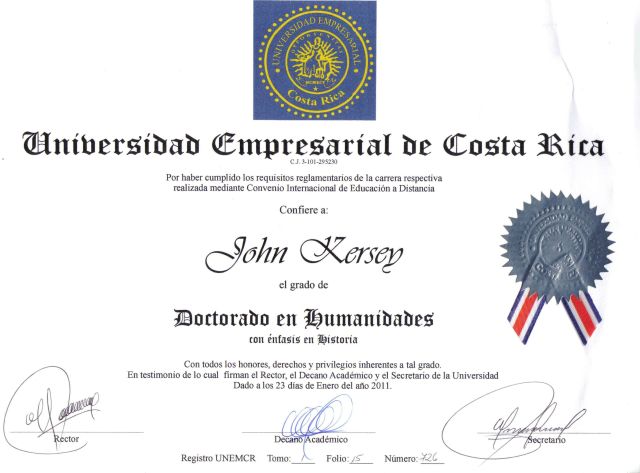
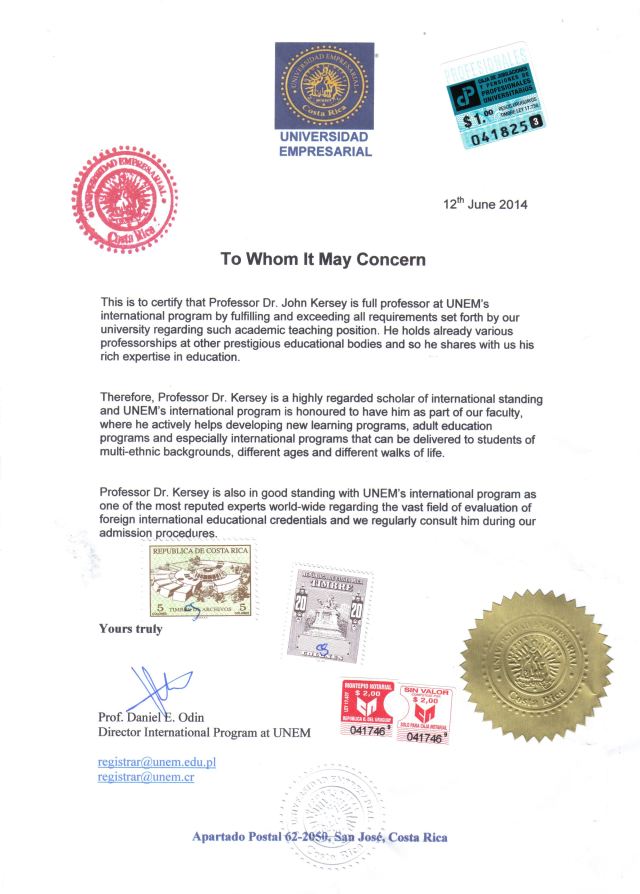
In 2014, I was appointed to a Full Professorship in Education in the International Program of UNEM, as confirmed by the following letter, and continue to hold this position at the time of writing.
Can aristocracy and its feudal roots offer a prospect and model for secessionist solutions to the present crisis in Britain?
A functioning aristocracy is fundamental to a traditionalist society, and its structures and concepts have greatly influenced the development of British society over the centuries. In this essay, I intend, while showing some of the difficulties that have come to occupy the British aristocracy today, to consider whether the aristocracy as a class may be useful to our nation in firstly seeking to challenge the prevailing structures of the state and secondly offering us a model and structure for a projected traditionalist replacement of it.
Why secessionism?
This essay is written from a secessionist perspective. It addresses both partial secessionist or regionalist solutions, and also explores a limited number of total secessionist solutions. In doing so, it is concerned with secessionism on the basis of geographical regions that form a part of Great Britain, and is not concerned with secession that is not based upon the ownership of land and that therefore applies solely to a non-geographically constituted individual (sovereign individualism) or group.
This paper adopts a secessionist perspective because it recognizes the following conditions to apply:
1. that the government and institutions of Britain have effectively been captured by an enemy political class that, regardless of party affiliation, is dominated by Left-wing ideology and permanently subject to the European Union, as well as supporting a form of global oligarchy that runs counter both to British national interests and to a genuinely free approach to trade;
2. that there is active support from the political class for the destruction of the historic culture, precepts and way of life of the British people, together with the absorption of the British nation into an European super-state, and that it is a fundamental right that the British identity should be able to be preserved against such threats;
3. that there is and has been ineffective control over the borders of the British Isles, such that mass immigration both from within and outside the European Union has been politically sanctioned, as has been admitted, as a means of attack upon the traditional values of Britain;
4. that there is, for the present, little prospect of sufficient mass support against the political class being mobilized through democratic structures, and even were such support to be forthcoming, any political solution would depend to a large extent upon the co-operation of political class itself and its substantial client state;
5. that despite the absence of mass support, there remains a substantial minority of traditionalist conservatives, paleolibertarians and others who are effectively disenfranchised by the political class and who seek alternatives to the prevailing status quo and direction of political so-called “progress”;
6. that this substantial minority is already concentrated geographically in particular areas and regions, such that those regions or subdivisions thereof could potentially produce majority support and therefore consent for a partial or fully secessionist solution;
7. that even if these minority areas were to be small and their secession only partial, nevertheless the gains in returning to a small or human-scale organization of society as distinct from centralized governance from London or Brussels would outweigh the disadvantages of such independence;
8. that such a secessionist solution would offer a peaceful answer to the ideological and cultural division that has come to affect our nation, and would therefore be preferable to any solution that would involve violent conflict or indeed civil war. It would end the current position whereby traditional conservatives are subjugated and disenfranchised by means of the exercise of force by the state, and at the same time seek separation from, rather than the subjugation of, opponents of a broadly traditional way of life, who would be free to continue to administer those areas and regions where their followers were most concentrated;
9. that the proposed solution would be complimentary to existing long-term cultural strategies that aim towards the support of British national heritage and institutions through the creation of an active counter-establishment, ensuring that any secessionist entity could in time grow beyond its initial boundaries;
10. that the proposed solution would look to essentially British and traditionalist entities, in particular the aristocracy and feudal structures, and would thus promote an indigenous settlement of the problems facing us rather than seeking the adoption of any form of modern ideology or historical model that was either so far removed from our era as to be incompatible with it or that was based on a foreign or artificial construct.
Aristocracy – its landed origins and Parliamentary downfall
The origin of the aristocracy is inescapably feudal. The titles of our most venerable nobles are rooted in the land. The Dukes of Norfolk, the Dukes of Somerset, the Dukes of Devonshire, the Earls of Derby, the Barons Hastings; all speak of the feudal past of our country, and of a time when to be an aristocrat was inextricably linked with the ownership and management of territory. The greatest of these landowners sat at the top of a pyramid of feudalism that extended down to the lesser feudal overlords – in England and Wales, the lords of the manor, and in Scotland, the barons and lairds.
The major change that has come to influence this situation has been the gradual alienation of land-ownership from the concept of aristocracy, and the absorption of the aristocracy into a political class. Lords of the land became Lords of Parliament; as the barons were summoned to parliament, so that summons became in time the distinction between peer and commoner. This change was wide-reaching, and ultimately, as I shall show, would prove destructive. The old system was based upon a direct link between the sovereign and the landed aristocracy. The new system interposed a layer of parliamentarians between the two. Initially, the parliamentarians were, of course, themselves landed aristocrats, but that was not to remain the case, and the twin developments of constitutional monarchy and universal enfranchisement served further to weaken the traditional role of the aristocracy. In time, the Parliament Acts of 1911 and 1949 would serve to subjugate the House of Lords entirely to the House of Commons, a reversal of the natural order that has assisted in the decline of our nation.
This is not to say that there have not remained to this day aristocrats who are great landowners. Particularly, but not entirely, in Scotland, this link has remained extremely robust. However, the move towards the parliamentary concept of an aristocrat caused an anomalous situation to arise, whereby a man could be a great landowner, indeed a feudal lord, yet not be a peer on account of the lack of a summons to Parliament. This gave rise to the class which from the sixteenth-century onwards was termed the landed gentry; a class of landowners that includes several notable families who had either never been peers, or whose peerages had become abeyant or had been attainted due to political factors – the family of Scrope of Danby being perhaps the most notable example of these latter conditions.
The loss of the feudal basis for the aristocracy was the beginning of their slow decline. It signified a loss of power, and moreover a loss of that measure of individual sovereignty that the landed aristocrat exercised as an immediate vassal of the king. Administration, which under the feudal system had included the administration of justice, became monopolized through a centralized structure, and the traces of feudalism were in time relegated to the exercise of mineral and fishing rights over particular land and the occasional quaint custom, such as the right of the Lord of the Manor of Worksop to place a glove on the monarch’s right hand at his or her coronation. Appointments to peerages became a matter of political favour and were before long entirely independent of the ownership of land. With the coming of constitutional monarchy, this process accelerated to produce the ancestor of the modern “honours system”; one in which the sovereign was eventually relegated to a mere rubber stamp for appointments made entirely by, and for the benefit of, the political class and its attendant establishment.
Nation and state, and the values of the aristocracy
It is perhaps useful at this point to draw a distinction between the terms nation and state as they are to be used in this essay. The state is that body of administration formed by the political class and its extensions. Those extensions constitute the following entities: large corporations, which cannot flourish without the active support of the state; the supportive administrative apparatus, both local and national, that implements the decisions of the political class; the legislature; the military and the police; the state’s church, and the major institutions that are dependent upon the state for direct or indirect patronage, such as our education system and the majority of the arts establishment. These, then, are the clients of the state; their relationship with the political class is symbiotic and effectively unbreakable. And moreover, the state, for the past few decades and for the foreseeable future, is the creature of the philosophies and ideologies of the Left, both indigenously and as expressed through the European Union.
The nation is not the same as the state. It is a much looser term, defined by a common culture, the origins of its people, their customs, character and manners, and to a large extent influenced by the very land itself and its variety. The feudal system, and the feudal aristocracy, are part of the nation far more than they are part of the state. The nation is less easily defined in purely tangible terms; rather, it is almost a matter of instinct. We might say that we know it when we see it. The nation represents a true and authentic expression of traditionalism and conservatism. It is free from ideology, immune from fashion, a greater entity than those men and women who serve it. Even though we can trace specific events in its history and even pinpoint some of its origins precisely, it feels as if it is independent of the constraints of time; it is our ancestral memory expressed through a living experience.
It is from these broad values as a nation that those specific values develop which we most readily associate with the patrician archetypes of the aristocracy and with noblesse oblige; an ability to take the long view, an independence of mind, a deep sense of rootedness to place and people, and following from this latter a duty to those for whom the aristocrat has responsibility, be they family, tenants, his peers or indeed the nation itself. That is not to imply that all aristocrats are paragons of virtue; far from it. Within aristocracy as a class, nevertheless, there is an expectation of virtue, a code, if you will, that if disappointed causes us to regard the exception to the rule as aberrant; both aristocrat and non-aristocrat understand the high standard that is expected of those who enjoy privilege as of right of birth. In turn, the sensible aristocrat will also realise that his own interests and those of his family depend upon his choices and behaviour, and that excess and greed will result in detriment, whether immediate or delayed until the next generation. The aristocracy did not survive for centuries simply because wealth and position propped it up; its survival was dependent upon the consent of the nation as a whole, which would hardly have supported it had it been seen as merely a narrow self-interest group for the rich. It is because the aristocracy lived out its code that it established such a basis of consent. That code can still be of service to us today.
The sovereign, to a certain extent, is also carefully positioned to epitomize the nation and not the state. Yet here this is a false distinction, for while the sovereign has in theory an independence from the state, in practice the sovereign is bound to agree with the state lest a constitutional crisis be provoked and the supposed will of the people be countermanded. Can it truly be said that a sovereign who has consented – without an apparent murmur – to such heinous wrongs as the absorption of Britain within the European Union, and thus to the effective extinction of our national independence, is not effectively indivisible from the state?
The hereditary principle
Fundamental to our understanding of the true principles of aristocracy, and indeed of the nation of which it is a part, is the hereditary principle. Aristocracy represents, at its origins, the logical means by which land is preserved intact from generation to generation. It is the enshrining of what Roger Scruton has cogently described as the rights of the dead. The fundamental concept in effect here is that what one owns should be conveyed intact not so much to an individual member of one’s family, but to the family itself as represented by its most senior individual. The family name – perhaps seen most clearly in the Scottish clan system – is seen as the primary quality to be preserved in inheritance. The aim is to avoid a situation where, as a result of marriage, the estate passes out of the family and one’s kinsmen by name are thus dispossessed, perhaps losing their lands to another rival clan that will treat them as aliens and give their positions and tenures to their own kinsfolk. It is more desirable, therefore, that the estate be held by a male member of the family than a female, because this is the only way by which the family name may be continually allied with the estate in question. Inheritance by successive males in order of seniority is thus the main system by which both land and peerages have come to be organized. It is through this system that permanence is assured as best it can be; when implemented it means that stability should be the defining characteristic of our land rather than the uncertainties of political whim and opportunism.
In recent years there have been attacks on descent by primogeniture in the case of peerages of the United Kingdom, notably in the case of the Earl Kitchener, whose title became extinct even though there were female descendants of the second Earl living[i]. Legislation has also been introduced to establish “gender equality” in the case of succession to the Crown[ii]. Of course, where land is not in question and the peerage is simply “an award of the state”, one may ask to what extent it matters; the Crown is no longer seen as truly dynastic per se – else, by strict Legitimism, our monarch would be a Jacobite heir – and indeed there was no established surname for the Royal Family at all during the Hanoverian years. Nonetheless, there is in peerage primogeniture more than a vestige of the importance of ancestral name, of descent, of blood – all of which are fundamental components of identity not merely for individual peers, but for the peerage as a class. There are ways around these problems – the Dukes of Northumberland, after all, would but for an eighteenth-century Act of Parliament be Smithsons and not Percys, for their Percy descent is through the female line – and many of the oldest English baronies may descend either to male or to female heirs. But nevertheless, it is primogeniture that is a part of our national warp and weft. It is not a perfect system, yet it still serves to maintain land, family and title as a single unit more than would any other.
The state and aristocracy in opposition
It is the intervention of the state that has caused the acceleration of the slow decline of the aristocracy. That is not to say that the feudal system would not, of itself, have changed and evolved over the centuries. It would be imaginable, though, for Britain to have developed more along the lines of pre-unification Germany had our peers not instead have been absorbed into the political class as Lords of Parliament, with regional autonomy much more a feature of our land. And moreover, as my colleague Sean Gabb has written recently[iii] it is possible to imagine a Britain where the Industrial Revolution happened differently. Without the massive intervention of the state, global corporatism would not have taken hold in the way that it did. Certainly, there would be some centralized production, some international specialization, but this would be taking place within a framework that was still essentially and historically indigenous to the British nation and not simply as an alien extension of the political class.
The relationship between aristocrats and their serfs and franklins would certainly have developed differently in these circumstances. It would more than likely take the form that today’s landed estates have adopted, where the bonds of co-operative endeavour establish common interests between individuals, whatever their class differences, and the permanence and stability offered, not to mention the charity often shown to aged and infirm workers, stands in stark contrast to the mercantile alternatives, with their care for workers defined strictly by the boundaries of contract and legal obligation, and those of pensionable age offloaded to the responsibility of the state. A landed aristocracy would have had more to concern itself than simply profit and competition for their own sake, not least because the majority of the supply for its products would be local and domestic rather than national, thus reducing the number of its likely competitors, but also because the long-term and inter-generational nature of aristocratic interests contrasts starkly with the short-termism of elected politicians concerned with five-year leases upon office.
Of course, we can look to the French Revolution as a major watershed in the spillover of anti-aristocratic sentiments, and the consequent adoption by the Left (notably under the influence of Marx) of class war as a major means of discourse, still very present in the Labour Party of today. The futility of the First World War deprived the officer class of many of its brightest and best. The introduction of punishing death duties robbed many estates of their natural heirs. Legislative change separated both English lordships of the manor and Scottish baronies from the ownership of the lands that went with them historically; they can now be bought and sold simply as titles.
The last days of the aristocracy
What is crucial, however, is this: an aristocracy is an exclusive club, certainly, but it can never be a closed club. There must always be a route in, if an aristocracy is to live. Yet if it was the Left that sought the disestablishment of what was left of the aristocracy, it was as much the Conservative Party that cut them off at the knees. By closing the door to the creation of hereditary peerages, the state has killed our aristocracy through an infinitely slow and tortuous asphyxiation. Every time Debrett’s and Burke’s Peerages are published they list those peerages that have become extinct since the previous issue for want of heirs, or, in the case of life peerages, simply through the death of the holder. The list grows ever longer. Just as some peerages are well supplied with heirs, others hang by a thread. The Dukedom of Westminster has only one heir at present; if he should die without male issue, the dukedom will die with him. We have already lost the Dukes of Leeds, Portland and Newcastle within the past century. And it is doubtful as to whether life peers, for all their profusion, are aristocrats in any true sense of that word.
Just as long ago, the peerage had exchanged a position in the nation as territorial administrators for one as parliamentary governors; now in turn the logical conclusion of that process is working itself out: the hereditary peers are gradually being lost from even that role and it seems that the majority of life peers view their role as akin to members of an appointed senate rather than being in any sense part of the nation’s permanent settlement. This, then, is the beginning of the end; those peers who are great landowners will doubtless be able to withstand even this change, but those who are not will increasingly need to look for a redefinition of their role within a country that has decided that they are surplus to requirements.
Peers stand up to Parliament
This is not to imply that there are not within our peerage today those who have a very sound view indeed of their obligations to our nation and a willingness to act upon that duty. In 2001, four hereditary peers, acting under the settlement of Magna Carta, clause 61, and with the pledge of support of many more, presented a petition to the Queen to urge her to block provisions of the Treaty of Nice which they rightly pointed out would destroy fundamental provisions of British liberties[iv]. The clause in question provided that if the Sovereign did not observe Magna Carta, the people would be justified in waging war upon her, seizing lands, castles and possessions until they obtained redress. A period of forty days was given for the Sovereign’s response, but response came there none.
As will be obvious, there has been no outbreak of civil war and certainly no recorded response from the peers in question, but this position serves amply to reinforce my earlier comments about the sovereign as part of the state, and only symbolically part of the nation. A number of individuals have entered into a common law state of Lawful Rebellion as a result of these events, in which they have served petitions upon the Queen declaring that their allegiance is now to the Barons’ Committee rather than to Parliament, and that they are therefore exempt from various forms of taxation and state charges[v]. In doing so, they have not gained the endorsement of that committee or any individual member of it, but have instead relied upon the same provisions of Magna Carta as formed the basis of the 2001 petition.
We may at least derive some degree of comfort from the fact that the intricacy of the legal arguments that surround Lawful Rebellion can be used by its adherents to impose delay and confusion upon what is already a strained and inefficient system, but the eventual results of these endeavours, should they embrace any form of widespread popular movement, will surely ultimately be the same as any others that seek to oppose the state; since the state has a monopoly on force, it will use that force against any threat to its position regardless of any moral, historical or legal legitimacy that might otherwise prove an impediment. We should not forget that the power of the state is based entirely upon force; those who resist, and keep on resisting, will be imprisoned, and those who resist imprisonment will be killed.
The prospects for the aristocracy
We must be clear, then, that our aristocracy is today in an extremely difficult position. It is largely excluded, and will before long be entirely excluded, from its legislative role. It has lost much of the territorial role that it once had. The feudal system that once gave it vitality has been dismantled. Year by year, hereditary peerages become extinct and no more are created. The state promotes an egalitarian ideology in which aristocracy is less important than mere celebrity, and pays court to an elite of wealthy globalists who show little regard for the historic British ways of life. The outlook does not appear promising.
Before we discuss solutions, let us point out one additional factor. This is that the opposition to any aristocratic counter-establishment is likely to come from at least some of our existing aristocrats. State patronage and position is a heady brew, and it is not easy to wean people off it. There are still many conservatives who have not grasped that a loyalty to the institutions of the political class is a loyalty to style and not to substance. They remain within, and supportive of, the current establishment even though that establishment has – across all parties – actively supported their disenfranchisement and eventual extinction. Perhaps some hope that things will, in the end, turn around and that if only the right people are in the right positions some progress may be made. I do not share that optimism, and indeed at this stage it would appear to be the last gasp of a drowning man.
How can the aristocracy be saved to useful purpose?
Now, let us examine how the drowning man may yet be saved. In the first place, we should be clear that we are advocating the preservation of aristocracy as a defined class, with its accompanying context and structures, and not simply endorsing individual peers, however worthy they may be. We can then establish the following steps:
– The preservation of aristocracy and the re-establishment of aristocratic structures as a partial or complete alternative to the state as I have defined it, and as a means of solving the current difficulties that have arisen through power passing into the hands of a centralized political class;
– The need for aristocracy to continue to represent an exclusive and defined class, but also an open class, ie. that there are circumstances where someone who is not at present an aristocrat can become one. If we do not do this, the aristocracy will face etiolation and eventual extinction, and it will also risk becoming a monopolist body;
– We are not proposing a return to a medieval feudalism or to serfdom, but rather that feudal principles can be re-interpreted with regard to our own age, on similar lines to the management and organization of many of the major landed estates today;
– We are concerned with this preservation firstly because it will re-establish a future for our country that is based upon long-term interests and sound, sustainable principles, and secondly because it returns our country to its natural, historic and time-honoured order and rejects the egalitarian ideology that has done it such harm;
– In our process of preservation and re-establishment, we must accept that the aristocracy of our projected future will not be the same as that of its parliamentary past. We must be prepared to be radical traditionalists.
A future society that seeks to establish traditionalist principles must be based initially on a strict interpretation of propertarianism, as set out by Murray Rothbard (“Ethics of Liberty”) and Hans-Hermann Hoppe (“Economics and Ethics of Private Property”). A private property society establishes a means of social organization that does not depend upon a political state. Indeed, it is above politics altogether. Individuals, families and in some cases covenanting communities own land and determine the use of that land, including who will live and work on it, who will exercise rights over it, and under what conditions those grants will be made. The state ceases to be a surrogate for its people in exercising land ownership or establishing a monopoly on its use. It ceases to exercise a role in centralized taxation.
The role of feudal structures in a revived propertarian aristocracy
If we seek an indigenous solution to the issues of property, the basic land unit of this future society would most naturally be the manor. Manors, being a feudal structure, are among the oldest dignities in England and Wales that are still extant, and all date to before the statute Quia emptores of 1290. Ownership of a manor within a propertarian neo-feudal structure is likely to engage the owner in a range of responsibilities, relating to commerce and trade, the local administration of justice through courts leet (in accordance with a specific bill of rights or code of private law), the maintenance of or contribution to a militia, the payment and housing of employees, and provision (typically organised through the voluntary sector) of healthcare, education and welfare facilities for the sick and elderly. There would also be significant responsibilities for the spiritual welfare of the manor, through the responsibility of the lord of the manor to appoint the parish priest or other clergy, as well as to establish provision for religious worship of those kinds that are held to be desirable. There would further be responsibilities for border control and relationships with neighbouring communities, enabling co-operative alliances and ensuring that areas where centralization was considered essential could be conducted through shared facilities and access agreements.
It should not be thought that this is anything terribly unusual. Several of the Crown Dependencies have implemented something that – at least until quite recently, and perhaps even still – is not dissimilar to just such a plan. Life in the Isle of Man, Jersey and Guernsey is not by any definition medieval, and yet these places are far closer to the model of propertarian feudal governance that I have proposed than they are to the state control of mainland Britain. Indeed, until external pressure was applied in 2008, Sark was governed via a wholly feudal system, with the Seigneur ruling it as a fiefdom of the Crown. All of these places have a provision for representation of the people, and in most cases this consists of a formal parliament. That parliament has distinct differences from the mainland state structures, however. On Sark prior to 2008, for example, representation was confined to those who were landed tenants. Likewise, the powers of representation in such small bodies can be limited in ways that seek to concentrate upon areas of common interest rather than any infringement upon the rights of individual landowners.
There will be some who may say that this is all too agrarian, that it makes no allowance for industry or for large-scale business. We should be realistic in that almost all of Britain’s heavy industry has now been lost and that it is not likely to return. Certainly, there are foreign businesses that choose to bring their industrial requirements to Britain. But the system I propose can accommodate this. When we speak of a manor, that entity can as easily be formed of industrial plant or a major shopping centre as farmland. None of this alters the fact that a propertarian system can encompass any type of commercial activity. It simply alters the means by which the land upon which that activity takes place is governed, and results in the landowner having the effective power and responsibility concerning the use of that land without being disenfranchised by the state.
Is secession as a Crown Dependency possible?
If an area of mainland England were to find the proposed form of organization attractive and to decide that it wished to take advantage of it, it could perhaps seek to remove itself from the United Kingdom and to redesignate itself as a Crown Dependency. There is no apparent minimum size limit on a Crown Dependency – some of the Channel Islands are very small in population as well as in geographical area. A single manor or group of manors could in theory constitute a Crown Dependency. A Crown Dependency also has a different relationship with the European Union from that which applies to the United Kingdom. The existing Dependencies have chosen to permit the free movement of goods but not the free movement of people, services or capital. They are exempt from the Common Agricultural Policy and in the case of the Channel Islands, from VAT.
But we should not imagine that this would be an easy process. The first challenge would be to secure effective ownership of the land in question. Purchasing the relevant Lordship of the Manor is not enough to do this. The Feudal Tenures Act 1660 abolished feudal tenure. Today, manorial lordships can be separated from their lands, and the last of the effective structures of the manor in the form of copyhold tenancies were abolished in 1925. The right to manorial incidents – that is to say, rights held by a lord of the manor over other people’s land – lapsed in October 2013 unless those rights had by then been registered with the Land Registry. As a result, we must look to freehold ownership to establish the necessary basis for action. Supposing that this were done – after all, it is not unknown for substantial landed estates and interests to be held in private hands in Britain – and a petition for Crown Dependency status submitted to the Queen? What next?
We have already established that the Queen made no response to the petition by the Barons in 2001. In 2008, Stuart Hill, who had purchased the Scottish island of Forewick Holm, maintained that the island and indeed the entirety of Shetland were illegally incorporated into Great Britain in the Act of Union of 1707, and presented a Declaration of Direct Dependence to the Queen seeking to establish what he has designated as Forvik as a Crown Dependency under his Stewardship[vi]. The Queen has not made any response to this document, but the Department of Justice – in other words the state – issued a statement the day before Hill’s declaration was published saying that Forvik is an integral part of the UK. Hill has since declared full independence for Forvik in view of the lack of any response from the Queen to his declaration. Because Hill is seeking to contest this point in law, and believes that he is in the right with regard to the relevant historical and legal arguments, he welcomes any resulting conflict with the UK government. However, in the only court case so far to hear any of Hill’s arguments, they were simply rejected out of hand without any investigation of their merits; the court assumed jurisdiction and proceeded to jail Hill for traffic offences relating to driving what he has designated as a Forvik consular vehicle on the Scottish mainland. This again establishes the principle that the state will not engage with arguments about its authority, since its authority is primarily established and exercised by means of force.
It seems highly probable that were another attempt made to convert part of the United Kingdom to Crown Dependency status, particularly if that part were relatively small and sparsely populated, it would meet with non-response from the Queen and hostile action towards those involved from the authorities. There would appear to be a case for regarding the Queen not as superior to the constitutional settlement but in fact something closely approaching a prisoner of it, in that she can take no action of governance that is not specifically countenanced under that settlement – and is thus effectively subject to the state, even when the interests of the state run directly counter to her own views as to what may be in the best interests of the nation. The state will not give up any of its territory without a fight, and it is uninterested in the Queensberry Rules. Only if the territory were substantial and fairly heavily populated would it become an option that would stand a chance of success; even in the case of Scotland itself, which is large, populous and has elected a nationalist government, the road to independence appears to be far from smooth.
Can the Barons’ Committee offer an alternative?
If the concept of a Crown Dependency is not available, we might instead look to place our territory under the authority of the Barons’ Committee acting as a surrogate for the Crown, and effectively holding that we had entered Lawful Rebellion. But to do so would by now to have entered into open conflict with the powers that be, and it would rely on the robustness of the Barons’ Committee to step up to the role that was now expected of it. The Barons’ Committee would need to engage in an active opposition to the British government, providing an alternative (and more legitimate) source of governance and guardianship of the nation’s conscience. It would need to be able to govern those who wished to place themselves under its authority efficiently, with widespread consent, and without the ensuing crisis of power provoking open conflict with those loyal to Parliament. A central question would inevitably be whether the Barons’ Committee was up to the job. Are our present generation of aristocrats the heirs to the spirit of their ancestors, or simply the parasitic beneficiaries of generations of political patronage? It may well be that such a challenge would produce interesting results.
Some indication of likely outcome might be gained from the approach of the Barons’ Committee to their petition to the Crown. A brief survey of press coverage of the matter shows that this is sparse. None of the members of the Committee appear to have given an interview to the press on the outcome of the matter, or considered its implications given their earlier stance. No website or published journal represents their interests. Significantly, none of the members of the Committee have, apparently, exercised their claimed rights under Magna Carta, entered Lawful Rebellion, or advised others to act in furtherance of these rights. We must ask: was their rebellion merely a publicity stunt or empty gesture? It seems too serious a matter – and they too serious a body of people – to be subject to such a response. If the Barons’ Committee meant what it said then, it would have to either follow through on those principles or openly recant them. Perhaps we shall yet hear from them as to their plan of action and proposals for our country’s future. Until we do, any allegiance that is pledged to them would appear to rest on insecure foundations.
In a strange way, any bisection of Britain caused by the Barons’ Committee forming an alternative government would re-open precisely the same sorts of historic questions that were at issue in the English Civil War, in which Crown was set against Parliament, except that in this case, the very position of the monarch would be one of the issues to be decided – could the Queen be liberated from her position as a “prisoner of the constitution” and reinstated as the head of an aristocratic feudal structure? Or, indeed, as might well be agreed to be preferable, could she in fact combine both roles? Just as Sean Gabb imagined a position in which the Industrial Revolution had happened differently, can we perhaps imagine a position in which the culmination of the strife of the 1640s was not regicide and the Puritan dictatorship, to be followed by the compromised Restoration of 1660, but instead a voluntary separation between Royalists and Puritans, with each determining to live within their own communities and to allow their opponents their differences?
Concluding thoughts
Such a suggestion raises again the issues that we set out at the beginning of this essay, and specifically whether secession can be achieved peacefully and without rancour by those who wish for a non-violent means of living in the manner that they choose. Logic and libertarian theory says that this must be possible. History is less favourable, pointing to the tendency for the assertion of human difference to result, sooner or later, in armed conflict and bloodshed between different groups. Yet this is where, perhaps, we can learn history’s lessons and determine that such an end is not inevitable. It is, indeed, the forcing of human difference into an artificial and often oppressive state hegemony that is the most likely means of bringing about unpredictable and destructive revolt. Alternatives to that hegemony, be they cultural, territorial or, indeed, secessionist, are a means of releasing pressures that would otherwise be overwhelming; they are ultimately the expression of the self-determination that lies at the heart of any humane vision of mankind.
It seems clear that Crown and Parliament will not be separated, at least in their present state. The Queen has shown herself unwilling or unable to act independently of Parliament; all attempts to appeal to her directly have been met by a wall of silence and by the action of the state. It is not impossible that a future settlement may change this. Equally, it would be wrong if we did not, given the facts, judge that the Queen, having so comprehensively supported her government throughout, did not bear the joint responsibility with that government for its actions in abdicating our national sovereignty and other rights. We can conclude that the apparent distinction between Crown and Parliament is more illusory than its public image would have it seem.
The revival of aristocratic structures in a neo-feudal propertarian society is not entirely a retrograde step, nor should it be seen as a panacea for all of our present malaises. It would, nevertheless, offer a way forward that is so deeply rooted in the British culture and people that it would probably preserve much that would otherwise be lost and restore a good deal that had already been consigned to history. It seems that such an appeal to aristocracy cannot rely entirely upon the present aristocratic class, for this is composed of those who are the beneficiaries of the patronage of the current system, but should instead look to a renewal of the aristocratic feudal impulse within the modern age and in the light of propertarian theory, knowing that such principles would likely bring about a society that was traditionally structured, stable and sustainable.
[i] “Julian Fellowes: inheritance laws denying my wife a title are outrageous”, Anita Singh, The Telegraph, 13 September 2011: http://www.telegraph.co.uk/news/picturegalleries/celebritynews/8757793/Julian-Fellowes-inheritance-laws-denying-my-wife-a-title-are-outrageous.html
[ii] Succession to the Crown Act 2013.
[iii] Sean Gabb, Traditionalism and Free Trade: An exercise in libertarian outreach, Libertarian Alliance Blog, 3 November 2013: http://libertarianalliance.wordpress.com/2013/11/03/traditionalism-and-free-trade-an-exercise-in-libertarian-outreach/
[iv] “Peers petition Queen on Europe”, Caroline Davies, The Telegraph, 24 March 2001: http://www.telegraph.co.uk/news/uknews/1327734/Peers-petition-Queen-on-Europe.html
[v] See, for example, http://www.lawfulrebellion.org/
[vi] See http://www.forvik.com/ which is Hill’s website setting out his claims.
Recital at the Guild of Musicians and Singers, 17 May 2014

 A CD recording of this recital is now available from Romantic Discoveries Recordings.
 Recital at the 41st General Meeting of the Guild of Musicians and Singers, 17 May 2014
John Kersey, piano
RDR CD103
Audio samples:
Faure: Barcarolle no. 2
Faure: Barcarolle no. 3
Faure: Nocturne no. 6
Alkan Symphony: movt. 1; movt. 2; movt. 3; movt 4
Total time: 71 minutes 15 seconds
Gabriel Fauré (1845-1924):
1. Barcarolle no. 2 in G major, op. 41 (1885) (6’16”)
2. Barcarolle no. 3 in G flat major, op. 42 (1885) (8’59”)
3. Barcarolle no. 4 in A flat major, op. 44 (1886) (4’06”)
4. Barcarolle no. 5 in F sharp major, op. 66 (1894) (6’28”)
5. Nocturne no. 6 in D flat major, op. 63 (1894) (+ applause) (10’32”)
Charles-Valentin Alkan (1813-88):
Symphonie for solo piano, from 12 Etudes in the minor keys, op. 39 nos. 4-7
6. Allegro moderato (10’14”)
7. Marcia funebre: Andantino (6’27”)
8. Menuet (5’56”)
9. Finale: Presto (+ applause) (5’28”)
10. (encore) Faure: Nocturne no. 3 and concluding remarks by Master of the Guild Dr. David Bell (6’59”)
Recorded at the concert on 17 May 2014 and the rehearsal concert preceding it.

Membership and other details of the Guild and Musicians and Singers can be found on the Guild’s website: www.musiciansandsingers.com.
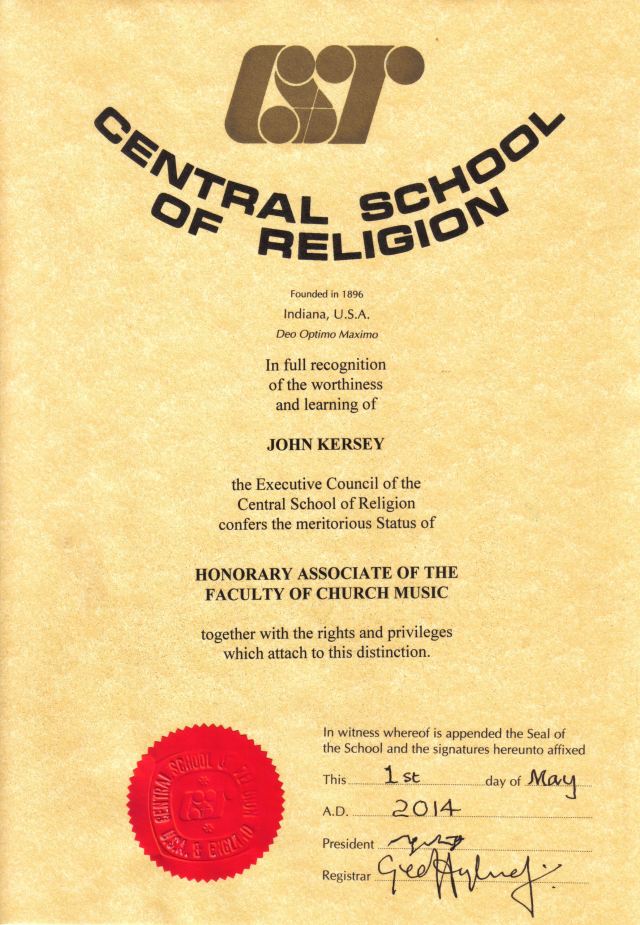
Honours and awards: Honorary Associate of the Faculty of Church Music of the Central School of Religion
I have been delighted to have received Honorary Associateship of the Faculty of Church Music of the Central School of Religion.
The Faculty of Church Music was originally formed as a diploma-awarding body in order to provide the Free Churches with an alternative to the Guild of Church Musicians. The first President (from 1957) was the Rt. Revd. G.F.B. Morris, who was a Bishop of the Church of England in South Africa and a leading evangelical. The founding Honorary Secretary and Executive Officer was Dr Douglas Geary, who in 1967 became President of the Central School of Religion. A few years after this the FCM was absorbed into the CSR, where its diploma programmes continue alongside the degrees in Church Music that were introduced in 1980. The current Director of the FCM, Dr Andrew Padmore, was formerly Organist of Belfast Cathedral.
The awards of the original grades of Associate and Fellow were made after examination; this was changed in 1958 to a system of accreditation of prior learning and experience and this method of award has continued ever since, supplemented by teaching and coursework. The award systems were revised in about 1997. A scheme of examinations for lay readers and their counterparts in the Free Churches has also been operated, leading to the former Bronze and current Silver and Gold Medals of the FCM in the Spoken Word and to the AFCM and LFCM in the same discipline.
The Society of Church Musicians was formed along similar lines to the FCM circa 1970 and merged with the FCM in 1980. This merger saw the FCM introduce a greater level of support and teaching in theoretical aspects of church music.
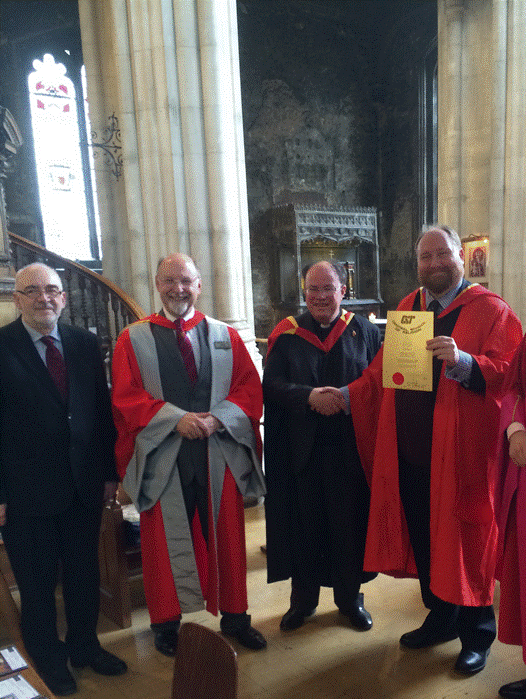
I was presented with the diploma of my award by Dr Mark Gretason, President of the Faculty, in a short ceremony at the Church of All Hallows by the Tower in London.
Honours and awards: Nebraska Admiral
An honorary military commission is considered by some to be the American equivalent of being knighted. The honorary title of Colonel is conferred by some states in the United States of America. The origins of the titular colonelcy can be traced back to colonial and antebellum times when men of the landed gentry were given the title for financing the local militia without actual expectations of command. This practice can actually be traced back to the English Renaissance when a colonelcy was purchased by a lord or prominent gentleman but the actual command would fall to a lieutenant colonel, who would deputize for the proprietor. It has come to be associated in popular culture with the image of the aristocratic Southern gentleman, not least because of one of the most famous Kentucky Colonels, Harland D. Sanders.
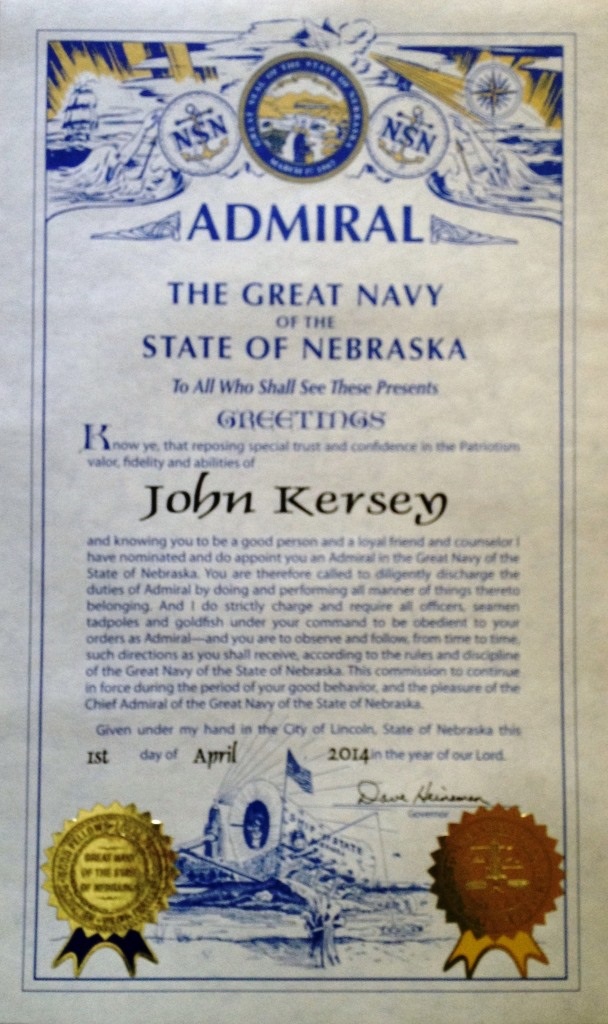
Some states bestow other military commissions. The highest honour of the State of Nebraska is that of Nebraska Admiral (or in full, Admiral of the Great Navy of the State of Nebraska), bestowed personally by the Governor of Nebraska. The title is deliberately tongue-in-cheek; Nebraska is landlocked, and the diploma makes humorous reference to the command of tadpoles and goldfish. The Great Navy of the State of Nebraska was created in 1931 when the Acting Governor appointed twenty or so prominent Nebraskans as Nebraska Admirals. Today, recipients are considered to qualify on the basis that they have “contributed in some way to the state, promote the Good Life in Nebraska, and warrant recognition as determined by the Governor”.
Honours and awards: Honorary Texan
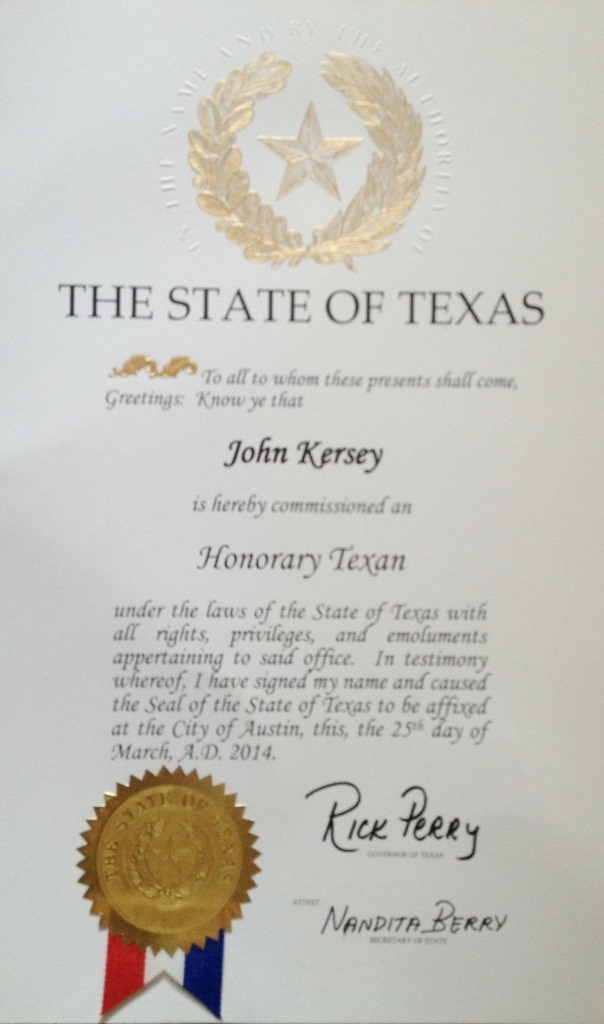
Since the 1930s, the Governor of Texas has bestowed the honour of Honorary Texan upon any person who, in his or her opinion, is worthy of the qualities of the Lone Star State but has not had the good fortune to be counted among its citizens.
The award of Honorary Texan has frequently been bestowed by the Governor on foreign visitors to Texas and for foreigners who have provided assistance to Texas businesses doing business in a foreign country. Another category of recipients is children of native Texans when those children have been born outside the boundaries of Texas. While the honour is understood no longer to be bestowed on foreign nationals today, two notable British recipients in the past few decades have been Lord Hague of Richmond (in 1999, when leader of the Conservative Party; he was quoted as saying “I might be persuaded to wear the boots, but I’m certainly not going to wear the hat”) and musician Phil Collins (in 2015).
I was delighted to be commissioned an Honorary Texan in 2014.
Honours and awards: Gold Cross of Merit of the Royal Order of St Stanislas
I have been honoured by the Royal Order of St Stanislaus in Poland. The Order continues the chivalric work established by the Most Revd. Prince Juliusz Nowina-Sokolnicki, formerly its Grand Master. Prince Juliusz was a bishop of the Apostolic Episcopal Church in which I also serve.
The Order has conferred one of its highest awards, the Gold Cross of Merit, upon me.
 In addition, I have received the Medal of the Commandery of Wrocław of the Order.


Traditional Britain Seminars 2014
 http://traditionalbritain.org/content/traditional-britain-seminars-2014-john-kersey-was-enoch-right
On the 8th March the Traditional Britain Group will be hosting a half day event, titled ‘Traditional Britain Seminars 2014’ at a prestigious club in central London from 1pm until 6pm, followed by an evening social until late.
For more details, see here.
Was Enoch Powell Right? – Seminar led by John Kersey
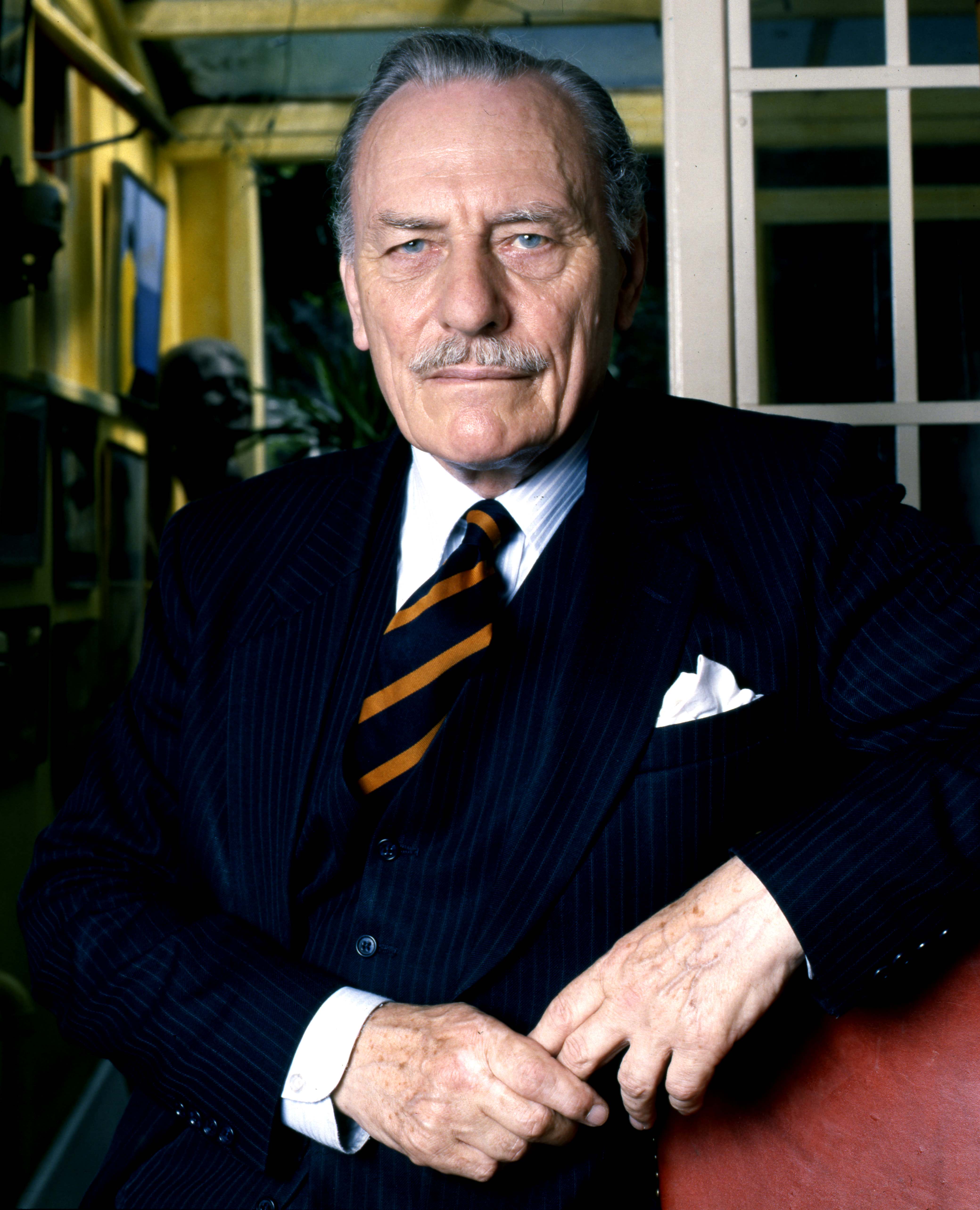
In today’s society it has become politically unacceptable to state that Enoch Powell was right – with the inevitable assumption that what he was right about was mass immigration, and that his Birmingham speech of 20 April 1968 was not merely a critique of the government policy of the day but a prediction of the conditions that such a policy was creating for his constituents and for the next generation. Significantly, Powell, a long-time critic of the United States, feared quite specifically that Britain was emulating the American problems of racial tension and lack of social cohesion that had culminated in the assassination of Martin Luther King earlier the same month as his speech.
Forty years on from that historic speech, how much of what Powell feared has come to pass? Mass immigration, particularly during the post-1997 period, has vastly exceeded the levels of 1968, and it is beyond dispute that areas of Britain have been profoundly changed as a result. One of Powell’s chief criticisms of immigrant populations was that although many thousands wanted to integrate into British society, the majority did not. Are such phenomena as home-grown Islamic terrorism part of the legacy he described?
As Powell was clear, mass immigration has been brought about with no overt consent from the populace, and indeed has been considered by many to be contrary to the interests of the settled population. Under New Labour, according to Lord Mandelson in 2013, “We sent out search parties to get them to come… and made it hard for Britons to get work.” Yet when Labour supporter Gillian Duffy told then-Prime Minister Gordon Brown that she was concerned about immigration from Eastern Europe, his response was to dismiss her as a “bigoted woman”.
There has been a concerted refusal by the mainstream political parties to address the views of their constituents on immigration, resulting in the electoral rise of the BNP and of UKIP, both campaigning on anti-immigration platforms, and even prompting some reforms to the immigration system under the Coalition government. But is any of this enough? What should our response be today both to continuing immigration to Britain and to those who are now here? Powell advocated voluntary repatriation on generous terms, but would such a remedy be even remotely practical, even if it were politically acceptable today? Can any alternative strategy be formulated that is both effective and politically acceptable? Can the Britons of today find a way to live together, or is cultural or even political separation of some sort inevitable?
In what will doubtless be a wide-ranging seminar, we will consider these and other issues from a traditional conservative viewpoint and endeavour to get to the roots of why this issue has proved so intractable that the most common response it receives from the establishment is censorship.
Honours and awards: Honorary Brotherhood in the Ordine Militare e Religioso dei Cavaliere di Cristo and Academic Membership “ad honorem” in the Accademia Templare di San Bernardo da Chiaravalle
I have been honoured by the Ordine Militare e Religioso dei Cavalieri di Cristo (Religious and Military Order of the Knights of Christ, abbreviated as OMRCC) in Italy. The OMRCC is a modern Order inspired by the historic Templar tradition, and is organized as a Public Association of the Faithful of the Roman Catholic Church. It is an active charitable body with numerous humanitarian projects worldwide and welcomes donations from those wishing to support its work.
The Grand Vicar International of the OMRCC, H.E. Frà Federico Righi, has been admitted as a Knight Officer of the Order of the Crown of Thorns under my Grand Mastership.
I have been awarded Honorary Brotherhood in the OMRCC and Academic Membership “ad honorem” in the associated Accademia Templare di San Bernardo da Chiaravalle, which has been established for the purpose of historical research into the Templar tradition and St. Bernard of Clairvaux.
The connexion with modern Templars today reflects the legendary foundation of the Order of the Crown of Thorns as a continuation of the Templar legacy, as well as the ecclesiastical succession of the Prince-Abbot from Bernard Fabré-Palaprat, founder of the Ordre du Temple in 1804, which is commemorated in the Ecclesia Apostolica Divinorum Mysteriorum within the Abbey-Principality of San Luigi.


Honours and awards: Grosses Verdienstkreuz in Silber from the Freundeskreis Hoch- und Deutschmeister, Mannheim/Baden, Germany
I have been honoured with the Grosses Verdienstkreuz in Silber from the Freundeskreis Hoch- und Deutschmeister, Mannheim/Baden, Germany. The Freundeskreis Hoch- und Deutschmeister commemorates the military tradition of the Deutschmeistern, who were established as a regiment by treaty of the Emperor Leopold I and the Grand Master of the Teutonic Order in 1696. Thereafter the military tradition of the Hoch- und Deutschmeistern is distinguished by numerous battle honours.
From the end of the nineteenth-century, former members of the regiment and related organizations formed a German confederation of associations under the protection of the Grand Master of the Teutonic Order. From 1986, this umbrella organization has been headquartered in Vienna. It includes German members, belonging to the federal government, who meet on St George’s Day each year at Bad Mergentheim. Since 1993, the Freundeskreis Hoch- und Deutschmeister Mannheim/Baden has been among their number, becoming a member of the central Vienna organization from 2010 onwards.

Honours and awards: Tennessee Squire
The Tennessee Squire Association was established in February 1956 by the famous Jack Daniel Distillery in Lynchburg, Tennessee.
Following World War II, the demand for Jack Daniel’s whiskey was higher than production could keep up with and their first National Sales Manager, Winton Smith, was looking for a way to keep customers around the country happy while supplies were low. He decided that loyal fans who had written the Distillery saying they could not get any Jack Daniel’s whiskey would instead receive a plot of land, a square inch of unrecorded property on the Distillery’s grounds. This would make them part owners, or Squires, and the first members inducted into the Tennessee Squire Association.
Today, the Tennessee Squire Association is an exclusive club, with many prominent members from the worlds of government, business and entertainment. To become a member, you must be nominated by an existing Squire. By tradition, however, each Squire can only nominate one member in his or her lifetime (thank you, Zackary). There is a secret room reserved for Squires at the Lynchburg Distillery, and not even the tour guides are allowed to mention it.
Ownership of a square inch of the Distillery land is generally unproblematic. From time to time, others request to graze their cattle on it, and occasionally there is trouble with skunks or possums. By and large, however, peace reigns.
The honour of Tennessee Squire is probably one of the more unusual distinctions around today. It goes without saying that it is the more valued because the quality of the product it commemorates remains second to none.
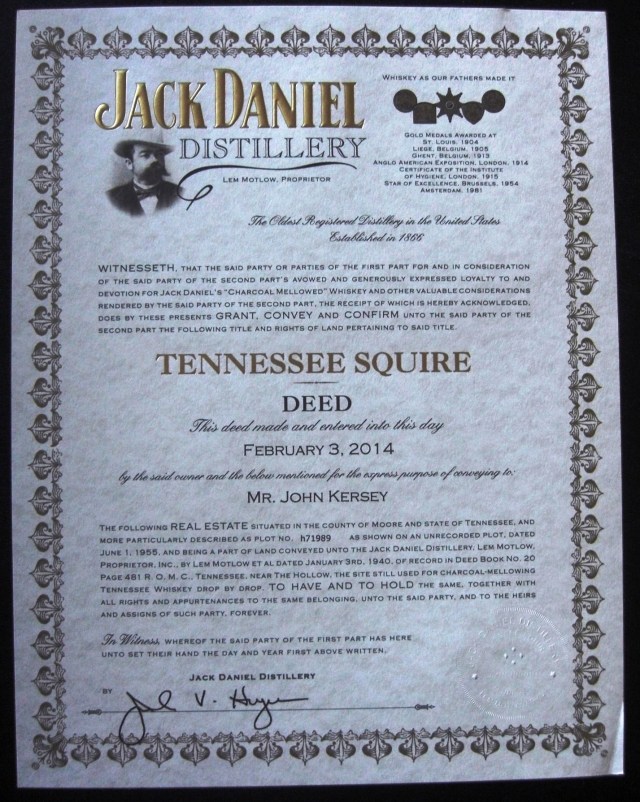
Honours and awards: Member of the Royal Society of Musicians
I was a Member of the Royal Society of Musicians between February 2014 and November 2018. Membership was by election and payment of an annual subscription.

In 2018, the Society announced its intention to impose a Code of Conduct upon its members. I felt that this was contrary to the spirit of the Society and would hardly have been something of which a free spirit like Handel would have approved. Specifically, the proposed Code intended not to tolerate discrimination on the grounds of “level of intellectual or professional achievement”, which I found absurd given that in my view achievement should be the foundation of any society devoted to the practice of a profession and that elected its members from that profession.
Elsewhere, the Code proposed to give the Board of Governors the sole power to discipline or expel a member who had “acted in a way which is in conflict with the interests of the Society”. I had previously seen similar measures to this used elsewhere as an unsubtle means of quelling dissent in the ranks. Like other changes in the Society such as the unexpected sale of its historic headquarters, much seemed to be being implemented in a “top-down” manner that was not in my view the way that such an institution should be run. In my view, members of a professional society should be responsible for its major executive decisions by democratic vote, rather than most of the power resting with a less accountable elite.
I resigned from membership of the Society in November 2018.
Honours and awards: Kentucky Colonel
An honorary military commission is considered by some to be the American equivalent of being knighted. The honorary title of Colonel is conferred by some states in the United States of America. The origins of the titular colonelcy can be traced back to colonial and antebellum times when men of the landed gentry were given the title for financing the local militia without actual expectations of command. This practice can actually be traced back to the English Renaissance when a colonelcy was purchased by a lord or prominent gentleman but the actual command would fall to a lieutenant colonel, who would deputize for the proprietor. It has come to be associated in popular culture with the image of the aristocratic Southern gentleman, not least because of one of the most famous Kentucky Colonels, Harland D. Sanders.
Today, Kentucky Colonel is the highest title of honour bestowed by the Commonwealth of Kentucky, USA. Commissions for Kentucky colonels are given by the governor and the secretary of state to individuals in recognition of noteworthy accomplishments, contributions, and outstanding service to community, state, or the nation. The Governor of Kentucky bestows the honor of a colonel’s commission, through the issuance of letters patent. The commission is a legal act of the Office of the Governor and lifetime appointment. At the time I received my commission in 2014, it was only possible for a person to be nominated for the honour by an existing Kentucky Colonel.

New CD published – Franz von Holstein (1826-78): Piano Sonata in C minor, op. 28
A new CD has been issued by Romantic Discoveries Recordings:
 Franz von Holstein (1826-78): Piano Sonata in C minor, op. 28
John Kersey, piano
RDR CD102
Total time: 76 minutes 54 seconds
Franz von Holstein (1826-78): Piano Sonata in C minor, op. 28
1. Allegro con brio, un poco maestoso (9’58”) 2. Andante (7’35”) 3. Allegro appassionato (8’43”)
Otto Klauwell (1851-1917): Drei Stücke in Kanonform, op. 38:
4. Praeludium (2’43”) 5. Scherzo (1’13”) 6. Romanze (2’30”)
7. Variations in D minor, op. 22 (10’36”)
Hans Seeling (1828-62):
8. Impromptu, op. 8 no. 1 (1’42”) 9. Romance, op. 8 no. 2 (6’18”)
Wilhelm Speidel (1826-99): Suite (quasi Sonata), op.111:
10. Praeludium (2’24”) 11. Andante espressivo (3’03”) 12. Scherzo (3’27”) 13. Marcia funebre (9’41”) 14. Finale (6’30”)
Our thanks to Klaus Zehnder-Tischendorf for supplying scores of these rare works.
Franz von Holstein was destined for an army career at the insistence of his father, but during his officer training he composed the opera ‘Zwei Nächte in Venedig’ as well as songs and ballads, and for a time, encouraged by his friendship with Griepenkerl, continued to compose in the free time allowed by his military duties. By 1853 he was free to pursue a musical career, and came to Leipzig where he studied with Moritz Hauptmann and, as a pianist, with Plaidy and Ignaz Moscheles. He then lived for a time in Rome, Berlin and Paris before becoming manager of the Leipzig Bach-Gesellschaft. Although chiefly known as a composer of songs, he was also responsible for several operas, orchestral works and chamber music, and wrote a significant amount of poetry. During his last six years he suffered with stomach cancer, and it was his wish that a bequest should establish a fund for impecunious musicians at the Leipzig Conservatoire. His Piano Sonata is a major composition of some ambition and achievement, with a clear influence of Schumann and Brahms evident.
Wilhelm Speidel is best remembered today as founder of the Stuttgart Music School. His father was a singer and composer and it was by him that his early musical talent was first nurtured. At Munich, he became a composition pupil of Ignaz Lachner and studied piano with Christian Wanner. After spending 1846-7 as a private teacher in Alsace, he returned to Munich, where he taught, also undertaking a tour throughout Germany as a pianist. He was known as an interpreter of Beethoven, who is also a major influence on his compositions. At Ulm, he founded and conducted the Liedertafel, and became active as a choral conductor. In 1857 he moved to Stuttgart where, together with Lebert, Stark, Faisst and others the Stuttgart Music School, today the Hochschule für Musik und Darstellende Kunst in Stuttgart. Here he taught and conducted the Stuttgart Liederkranz; his pupils included the American composer Edgar Stillman Kelley. However, after a quarrel with Lebert in 1874 he resigned his post and started his own conservatoire. He accepted reinstatement at the Music School upon Lebert’s death in 1885. Speidel composed in almost every form and was chiefly known in his lifetime as a composer of songs and choral music, adopting the popular idioms of German folk song.
Hans Seeling was born and studied in Prague, and suffered from delicate health from an early age. In 1852 he made his first public appearance as a pianist, in Italy, and then toured the Orient in 1856, followed by concerts in Germany. In 1859 he came to Paris. The lung condition from which he was suffering worsened and he returned to his native town, where he died. Seeling’s youth means that his compositions, all of which are for piano, are relatively few in number, but merited comparison with Chopin and Henselt in his time.
A tale of two Christians
A tale of two Christians
Libertarian Alliance, January 2014
Let us compare and contrast the following quotations. Firstly, from 2007:
“The Rt Rev Graham Dow, Bishop of Carlisle, argued that the floods are not just a result of a lack of respect for the planet, but also a judgment on society’s moral decadence.
“This is a strong and definite judgment because the world has been arrogant in going its own way,” he said. “We are reaping the consequences of our moral degradation, as well as the environmental damage that we have caused.”
The bishop, who is a leading evangelical, said that people should heed the stories of the Bible, which described the downfall of the Roman empire as a result of its immorality.
“We are in serious moral trouble because every type of lifestyle is now regarded as legitimate,” he said.
“In the Bible, institutional power is referred to as ‘the beast’, which sets itself up to control people and their morals. Our government has been playing the role of God in saying that people are free to act as they want,” he said, adding that the introduction of recent pro-gay laws highlighted its determination to undermine marriage.
“The sexual orientation regulations [which give greater rights to gays] are part of a general scene of permissiveness. We are in a situation where we are liable for God’s judgment, which is intended to call us to repentance.”
He expressed his sympathy for those who have been hit by the weather, but said that the problem with “environmental judgment is that it is indiscriminate”.[1]
This is the publicly expressed view of a (now retired) bishop of the Church of England, indeed of a “leading evangelical” and thus of a representative of a movement that now accounts for a very major part of our national church.
Our second quotation is much more recent, and comes from David Silvester, who left the Conservatives for UKIP in protest at same-sex unions becoming law. In a letter to his local paper, Mr Silvester is reported as saying,
“The scriptures make it abundantly clear that a Christian nation that abandons its faith and acts contrary to the Gospel (and in naked breach of a coronation oath) will be beset by natural disasters such as storms, disease, pestilence and war.”
He added: “I wrote to David Cameron in April 2012 to warn him that disasters would accompany the passage of his same-sex marriage bill.
“But he went ahead despite a 600,000-signature petition by concerned Christians and more than half of his own parliamentary party saying that he should not do so.
“It is his fault that large swathes of the nation have been afflicted by storms and floods.”
He went on to say that no man, however powerful “can mess with Almighty God with impunity and get away with it”.[2]
It would be difficult, I think, to get a cigarette paper between these two views. Yet their expression has had serious consequences for Mr Silvester, who has just been suspended as a UKIP councillor for giving a media interview about his religious views contrary to the instructions of the party hierarchy, who would clearly have preferred that he had kept quiet about them.
Interestingly, the Rev. Colin Coward, who we are told represents Anglican group Changing Attitude, said: “I don’t know where David worships, but clearly it’s in a sect, a church which is not mainstream in its Christian practice and teaching.” One wonders whether Mr Coward has encountered Anglican evangelicals previously, or indeed the Baptist Church, to which Mr Silvester belongs and which has a long history of representation in our country. If he has not, then he is in for something of a surprise.
For these views that have been quoted are supported by the overwhelming majority of those who have called themselves Christians throughout history. It is not the view that homosexuality is wrong, or that environmental disaster may be God’s judgement upon man, that is not “mainstream”. It is the contrary view; a view that is all too recently formulated and that has relied for its proselytisation not upon the pulpit but upon aggressive lobbying and the dead hand of legislation.
Clearly the Left depends for its dominance upon rewriting history; their view must be seen as mainstream, other views must be discredited, and so on and so forth in the best traditions of Gramsci and the other architects of political correctness. But the real story here is how far UKIP has fallen in terms of loyalty to those that it once needed and which it can now jettison as it gains a broader base of support.
At one point, UKIP was being heralded as a home for traditional conservatives (not a few of whom hold to an evangelical interpretation of the Christian faith) and as a party of libertarian values, central of which, surely, must be a commitment to free speech and the free expression of religious (or indeed non-religious) views. In its bid to become “mainstream”, as previously discussed here, it has increasingly come to see its core supporters as an embarrassment; libertarianism is played down and traditional conservatism is muted at best. As UKIP woos Labour voters and as its leading lights scent the whiff of real power, the compromises have started to tell.
Now we are told that if you have “extremist, barmy or nasty” views, according to the article, UKIP’s new vetting system for candidates will weed you out and consign you to the rubbish-heap. It remains to be seen where that will leave the evangelical Christians among its ranks.
[1] http://www.telegraph.co.uk/news/uknews/1556131/Floods-are-judgment-on-society-say-bishops.html
 Professor John Kersey