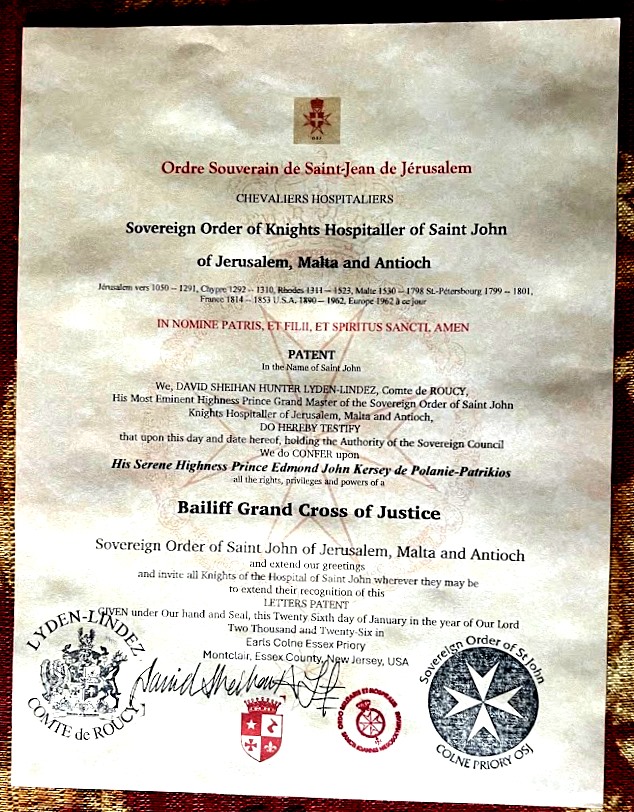
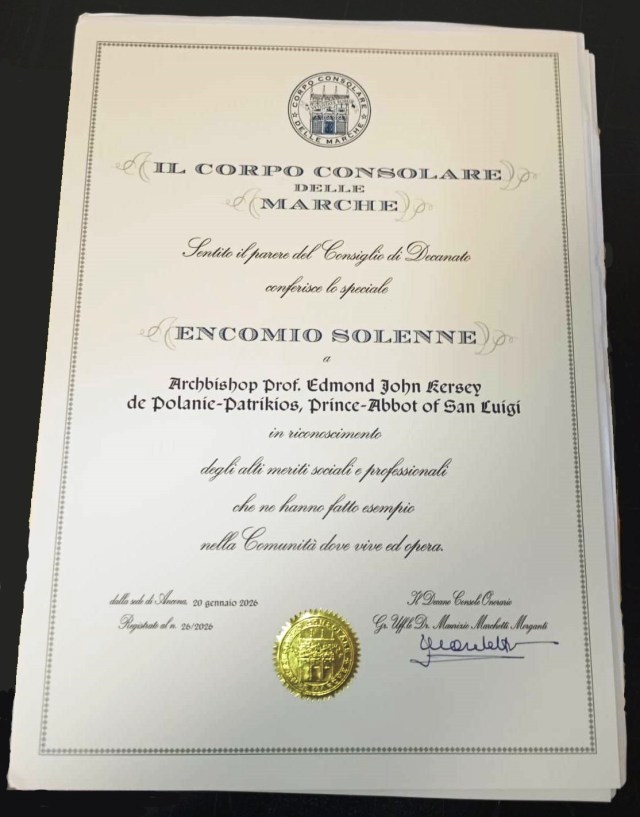
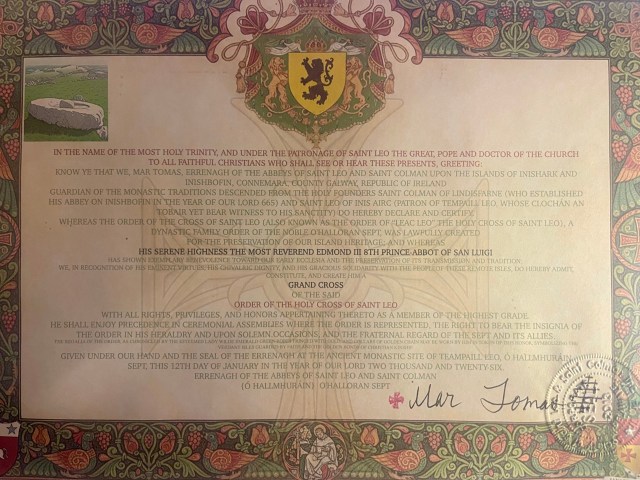
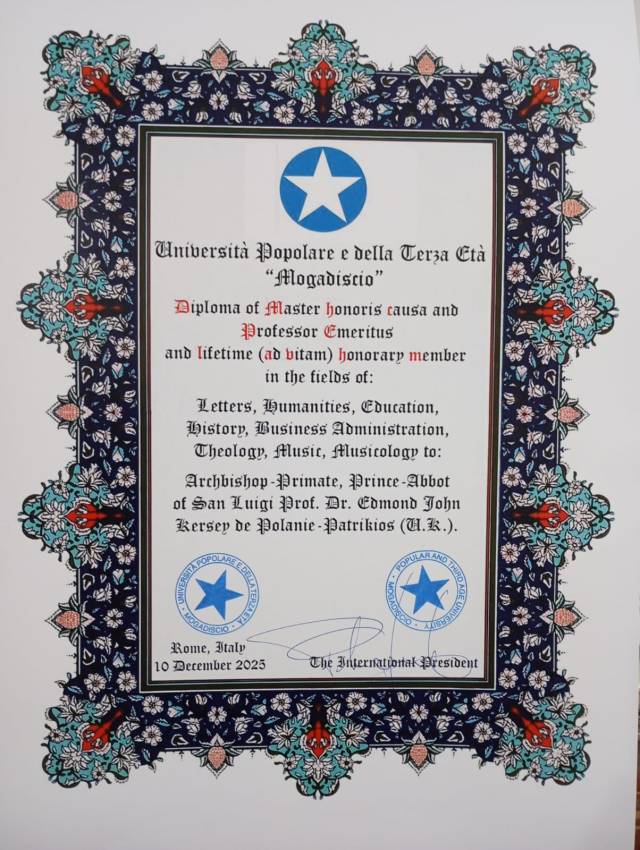
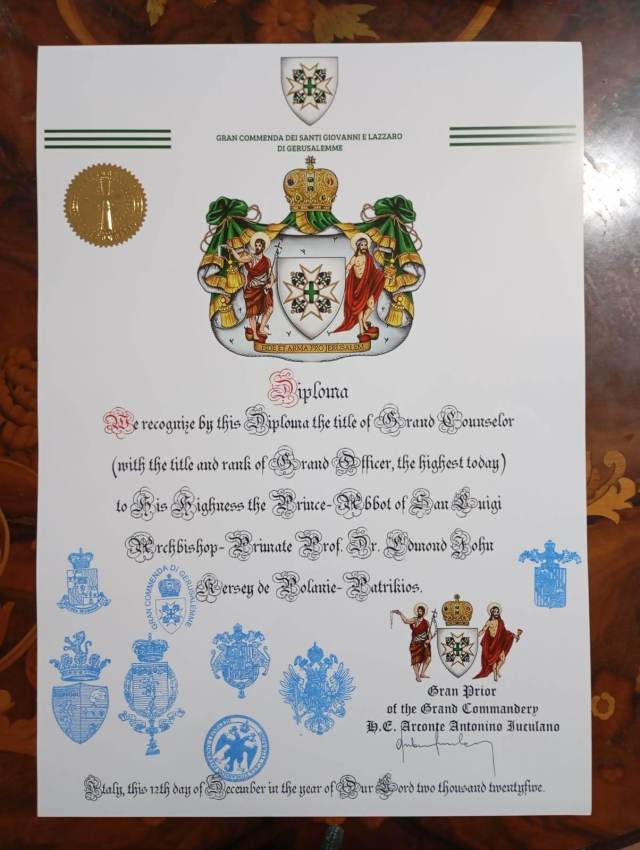
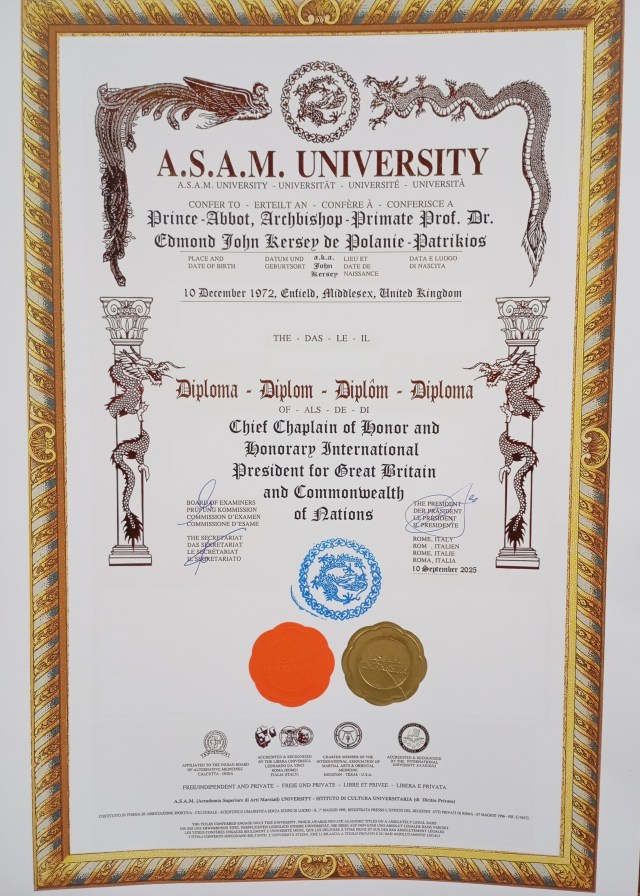
Honours and awards: Hereditary Commander of Justice of the Grand Commandery of Saints John and Lazarus of Jerusalem

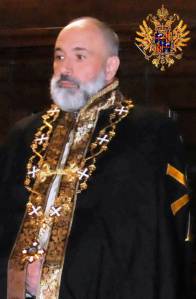
The Grand Commandery of Saints John and Lazarus of Jerusalem (Gran Commenda dei Santi Giovanni e Lazzaro di Gerusalemme) has honoured me with the appointment of Hereditary Commander of Justice. The Grand Commandery was formed in 2019 by the union of several international commanderies in the chivalric traditions of St John and St Lazarus. These included some who were already under the protection of Prince Don Hugo José Tomassini Paternò Leopardi of Constantinople. They have continued under Prince Hugo José’s successor Prince Ezra.

The Grand Commandery is under the temporal protection of the Imperial House of Tomassini Paternò Leopardi of Constantinople and has received the spiritual blessing of the Patriarchate of Antioch of the Syriac Orthodox Church, in addition to having the official recognition of Syrian institutions.

Membership of the Grand Commandery is restricted to the titled nobility solely. All members are appointed to the rank of Commander.

The Grand Commandery is committed to the noble mission of supporting persecuted Christians in Syria, Iraq, Egypt, and Palestine.


Speech to the British Democrats Annual Conference 2025

I was a guest speaker at the annual conference of the British Democrats on 25 October 2025. This is the speech I gave:

Last year I encountered a sticker on a town wall placed there by a Marxist group. The content was as you might usually expect, but there was also something new about it. Not only did it proclaim its opposition to fascism and the so-called far right, but it also attacked patriotism. I will leave it to your imagination as to what I did to the sticker.

We should consider why it is that at the present time the Left is so opposed to patriotism. It is not so long ago that the Left was generally supportive of Britain and our national character. Working-class Labour supporters would have defended the British way of life and our values. While there might have been much that separated us politically, there was still a common national culture that acted as a unifying force.

What has happened now is that the Labour Party and indeed most mainstream political parties have unceremoniously ditched the working class. It is not hard to see why. The working class have been blamed for voting for Brexit and it is clear that they constitute the principal opposition to the globalist system. They are held by those in power to have nationalist and patriotic views and to oppose mass immigration. It is of course the working class that feels the impact of mass immigration most acutely in the changes to its communities and in the destruction of its culture, and that is at the heart of the present ongoing protests at the housing of asylum seekers in hotels. If any political party succeeds in mobilising the working class, it will be in a position to change this country’s destiny.

And yet the current Labour government has members of its Cabinet who are beyond any doubt from the working class. What has happened to them? The answer is that in order to progress and profit from their positions, they have shown that they will adopt the values of globalism in place of those of the working class. They have done the same as was always said of those working class people who became managers and foremen. As soon as that promotion came along, their personal interest was put ahead of any kind of class solidarity. Yet these government ministers will still be paraded as evidence that the working class is still being represented, even though they have no interest in reflecting the views of the indigenous people of their community.

So if any political party wants to understand Britain as it is now, the most obvious aspect here is that there is a stark division in our society. On the one hand we have the new middle class. This not only includes those in government and the public sector but will also include anyone who pledges public support for its chosen values. In this way, this is not a class that is determined solely by income or financial status, but instead by ideology. The ideology of the middle class is wokeism, and by pledging support for wokeism even the most mediocre of individuals can find themselves in a position of power. In publicly aligning with woke values, they have shown themselves fit for such promotion, because they have replaced any values they might once have held themselves with a new set of values, many of which are unnatural and inhuman. Those values are a test of belonging, a shibboleth, and they act as a gatekeeper for those who are to be admitted to the new middle class. The reality of course is that they are also Marxist values.

Almost all of our public institutions, including government, have been taken over by a post-Marxist ideology that looks to the middle class rather than the proletariat to spread itself. By devolving power to quangos and other unelected bodies, and by creating a charity sector that is allowed to lobby politicians, the New Labour project ensured an open door to Marxist infiltration. It is now endemic in every sector.

And on the other side of the divide is the traditional indigenous working class of our country. They form a numerical majority, but they have progressively been disenfranchised by those in power. If we go back only twenty years, we could still find a recognizable British working class culture. It was lively, varied, and visible in homes, communities and as the basis for a good deal of media content. It probably found its truest expression in our pubs, which were centres both for community engagement and for the building of solidarity through the sharing of common views.

But who speaks for the working class now? It looks a lot as if the globalist middle class have taken it as their project since Brexit to crush and eliminate the indigenous working class of this country. One major impact has been mass immigration. This disproportionately affects the working class, and it is also part of a larger impact caused by globalism.

Our government, under the pretext of Covid, destroyed a significant part of our economy by targeting small businesses while protecting and strengthening globalists. It was planned and it was intentional. The aim was to launch an economic attack on working class businesses, which often have few reserves of capital to draw upon and are dependent on a constant supply of customers to stay afloat, and to ensure that what financial help was available would be specifically directed away from them. The report by Simply Business in 2021 found that there were six million small and medium enterprises in the UK – accounting for over 99% of all businesses, 33% of employment and 21% of all turnover – and that Covid lockdowns had blown a £126 billion hole in their books (1). Add to this the cost of living crisis that government has no answers to.

The world of employment has turned against the working class not only in the jobs lost to Covid lockdowns, but also because the job market prizes adherence to the woke values of the middle class. With many applicants for each job, employers can select not only on the basis of competence, but on the basis of compliance. With graduates, they also can rest assured that navigating the current British university system is likely to mean adapting to a left-wing environment where any residual working class values are likely to be firmly dismissed. We also seem to have given up on social mobility and any idea of bettering ourselves. The education system has been reduced to training young people for employment. It has eliminated any support for reflective academic study that does not lead to an objective result that can be measured according to narrow, reductive criteria. All of this is controlled by centralised management systems which are designed to place workers under such a burden of petty bureaucracy and policy compliance that they are too stressed and ground down to complain.

And we can also see that even given this situation, the jobs market is still shrinking. Entry level jobs are increasingly being eliminated firstly through government’s punitive economic measures on employers and secondly because artificial intelligence is being allowed to replace many of them. I don’t know how many of you enjoy interacting with artificial intelligence in the place of a human, but I certainly don’t. Many customer service functions are now entirely unaccountable because there are no humans to speak to, and the entire thing is controlled by bots who are designed to fob you off. Where customer service is human led it seems that fluency in English is too rarely a criterion for employment. Again, making it difficult for you to be understood is another way an organization can avoid addressing your concerns.

This is something that we should not put up with. It is not only betraying our working class, it is destroying our society. Those of us who have lived through the past thirty years can see the decline very clearly. Those who have arrived here more recently through mass immigration are not likely to complain against the political establishment but rather to support a system that continues to be strongly biased in their favour, and that is why they are preferred to our indigenous people by those in power. The less they know about Britain the better, because they will not be asked to assimilate to our culture or to understand it. Those in power will divide us in order to rule, and their instincts are entirely authoritarian. The more our society is atomised the easier it is to control it. We must resist the sinister and intrusive menace of Digital ID, and we must particularly stop it from being forced on our children (2).

So what can we do to reverse this decline? The first thing to say is that we can indeed reverse it even though every aspect of the establishment, including both the mainstream and social media, will tell us that is impossible. We have had enough of politicians who do little more than manage failure. Our economy is in tatters and we are faced with constantly rising prices, rising immigration, but falling productivity and failing culture. If we do not act now, we will not get another chance. We must recognize that there will be monumental resistance to any change from the blob of public sector workers and the huge amounts of money that are ploughed into advocacy for Marxism. But the fight to overcome this is vital and it can succeed.

We must use all peaceful means within the law to undo the damage that has been done to Britain since the coming to power of New Labour in 1997. That is not to say there were not problems before then, but that date saw an acceleration of the Leftist takeover of Britain and put in place the measures that would make that possible, destroying the constitutional basis of our nation. If every piece of legislation passed since 1997 were simply abolished by a nationalist government we would be the better for it.

And so to the practical measures a nationalist government must take to put things right. Firstly we should withdraw from the European Court of Human Rights and abolish the Human Rights Act 1998, not because we do not care about human rights, but because these two combine to provide a Left-wing means to stop us from controlling immigration and defending our own borders. The European Court has even started inventing its own powers, whereby it recently anonymously issued an injunction against the UK, preventing a plane deporting migrants from leaving the airport (3). This kind of arbitrary European activist so-called justice has no place in our country and Brexit was supposed to rid us of all of it and make our own courts sovereign rather than subject to the oversight of foreign powers. We do not need the European Union to impose its view of human rights on us. Britain taught the world about human rights and our record on that issue, though not spotless, is nevertheless one that we can look back on with pride.

We then need to withdraw from the Refugee Convention of 1951 and similar measures. The world in 1951 was a very different place compared to today, and these measures are now seized upon by left-wing forces determined to let foreign men of fighting age into our country when in many cases their aim is purely economic gain rather than any consideration of safety.

Many more problems of a similar nature are caused by the United Nations. The United Nations is dominated by dictatorships and autocratic regimes that are deeply opposed to Western values (4), and it is ineffective at preventing conflict. We should leave the United Nations and instead build up the Commonwealth of Nations into a truly active and representative international body that stands for and defends the values we have in common with other countries.

Lastly on this, we need to make a fundamental change to the way our country sees its mission. We need to make it clear that in all major political decisions, the national interest comes first. We hear far too much about Britain’s international obligations and the reality is that international interests are far too often placed before those of our nation. We need to put Britain first, always. That need not mean complete isolation, but it does mean that we should never be dominated by foreign powers. Our foreign policy must be decided in our own nation’s best interests and we must not become involved in foreign conflicts except where British interests are threatened. Our defence policy should be focused on exactly that – the defence of Britain and the British Overseas Territories – and not on involvement in foreign wars.

Our whole justice system needs to be reset. The House of Lords should once again become our highest tribunal because Parliament is the servant of the people, and it should remain supreme, not the courts. Decisions taken democratically in Parliament by elected politicians should not be subject to judicial review, which simply obstructs the passage of legislation. A US-style Supreme Court is entirely  un-British. We need to bring back the Law Lords, who Tony Blair abolished without any good reason. We also need to return to the system of appointing judges that we had before Tony Blair, who handed that responsibility to a quango – the Judicial Appointments Commission. Any quango is likely to become dominated by leftist views. People whose views are firmly of the Right do not get asked to join quangos and they are unlikely to be interested in joining them when they are controlled by a Left-wing majority. We need to remove judges who see their role as being to exercise Left-wing activism from the bench (5) and we also need to restore the balance of political views among the judiciary.

Our police are showing the strain of the burden placed on them by the Blair era verdict that they were “institutionally racist” – which has inevitably made the police far more Left-wing than they were before. The police should represent the community they serve, and there is no substitute for police officers who know the people in their neighbourhood. Too much has been abdicated to CCTV, which is an unwarranted invasion of the privacy of the public, and which should be confined to our city centres. In the recent policing of demonstrations, we have seen the reality that the police are under Left-wing pressure from both the courts and the media, which causes them to go easy on Left-wing protestors (6). A nationalist government would take measures to liberate the operations of the police so that they can do their job without being concerned about the machinations of the Left against them. The job of the police also needs to become much more locally centred. It should be concentrating on restoring law and order in our towns and cities, and ensuring that our women feel safe to walk the streets without being threatened. We need to return to a concept of policing that understands that a visible police presence in a community is an effective deterrent to crime.

Most of the Left-wing ideology that has ruined this country has come from urban people and their institutions. The cities have lost much of their British character to mass immigration, and now consist of divided communities with little or nothing in common. Where there is no common heritage and culture, this creates a void where Marxist ideas are easily infiltrated. It also makes the city increasingly divorced from any concept of national identity since its allegiance is primarily to globalism. The death of many smaller shops and businesses has hastened this process.

The nature of rural life in Britain means that those who live in the countryside are much less likely to fall for Marxism. This is largely because country life is rooted in the real and the practical, and its closeness to nature means that it is not given to artificial constructs such as postmodernism, gender identity and critical theory. This is a principal reason why the current establishment hates the countryside and its people. The family tax on farms, building houses on farmland and the crushing weight of bureaucracy on agribusiness is indicative of this.

Our government must also take immediate steps to uphold freedom of speech in our country. The past decade has seen a great restriction of the freedom of speech where what is said is deemed to have given offence to someone. Our laws should not recognize a right not to be offended. Unless what is being said is directly inciting violence, it should be fully legal, and that includes the burning of religious books of whatever kind. The politics of offence have almost completely killed off what was a strong and living legacy of radio and television comedy that was often irreverent and at times included strong elements of black humour (7). Now, we are left with comedy that is deliberately neutered so as not to offend anyone who regards themselves as protected by law, and that far too often simply presents a leftist perspective in order to play it safe. We need to return to a position where comedy and satire are free to flourish, because they are key to our country’s culture and indeed to its very survival. It is truly said that the first thing a British person is likely to do when faced with dire peril is to make a joke. That approach got us through two world wars and we need it now.

We must above all reassert our common culture. If anything is part of the enormous variety that is the British heritage, we must cherish it and promote it as much as we are able ahead of globalist mass culture. Reasserting our culture does not mean only that we celebrate its past, but that we nurture its present and future. To do this we do not need to abandon online culture, but we should never allow the internet to take over completely. And we must look back on Britain’s history with justifiable pride. Our nation’s past is not faultless, but it is full of glory and achievements that we should celebrate. We should not pay a penny in reparations to the descendants of slaves. White people were also sold into slavery – the difference being that few of them were allowed to leave descendants (8).

And one of the greatest things in the British character is the amateur spirit. The contribution made to our culture by those who were not making money from it has been enormous. Whatever your interests in British culture may be, I urge you to do as much as you possibly can to keep those interests active and to share them.

Related to this is the need to reassert the masculine in our culture. Men have been hit hard by the nature of the changes in our society over the last thirty years, which, whatever their intentions, have generally been against their interests. We need more attention to be paid to reversing the underperformance of White boys in our education system. We also have nearly a million young men not in education, training or employment (9) and many older men who have had to give up on employment altogether. The jobs that men once did have disappeared and been replaced by growth in areas such as health and social care, education and public administration where there is a majority of women in employment. Industry and manufacturing, which once employed a majority of men, have virtually disappeared. In addition, women have been introduced to traditionally male spaces where it would have created outrage had men been introduced to similar female-only spaces. We need to get back to a position where it is acceptable for men to have their own spaces apart from women, just as it is acceptable for women to have their own spaces apart from men. We should not allow gender politics to confuse these issues, because the Supreme Court has ruled very clearly on the application of the law in that area (10). Men and women are equal but different, and our society should recognize and respect that difference. There needs to be an acceptance of men and masculinity, not to the detriment of women, but as part of a society that is healthy and that has room in it for everyone.

Taking back control will help redress that balance. It is not in Britain’s interests to have vital industries and utilities owned by foreign businesses. With foreign ownership comes foreign control and influence. We need to ensure that we can stand on our own two feet when it comes to basic necessities in this country, and not always make decisions on the basis of the availability of cheaper foreign imports. We need to maximise our own supplies of gas by using our reserves to the full, and we must not become dependent for our energy on foreign suppliers that could then hold us to ransom (11). We must consign net zero to history, because its cost and impact on our nation is ruinous (12). We should also invest in reviving manufacturing and industry to serve the UK domestic market and reduce our reliance on imports. We must be more than simply a nation of consumers. British  products were once regarded as the finest in the world. A start would be a government committed to buying British and to ensuring that British goods are readily available at affordable prices.

The threat that is now facing us is one that we have not encountered before. It is an existential threat against British culture and against its people. If steps are not taken to stop uncontrolled mass immigration, the native British will follow the pattern already seen in London, Birmingham, Leicester and Luton, (13) and be reduced to a minority in our own country (14). We cannot afford to wait. Action is imperative now, and all politicians need to start listening after years spent ignoring us. The first step we can take is to stop paying foreigners to live here, and spend that money on a sensible programme of deportation. Ten billion pounds of Universal Credit went to non-UK citizens in 2024 (15).

Then we immediately need to reassert the British culture and way of life, and insist that everyone who is here needs to assimilate to its very broad boundaries, and above all that if anyone wishes to live in this country, they must learn English and they must contribute to our society. Our public services should not be spending a penny on translators.

Our nation and our people are worth every sacrifice. The call is now to save our country and we must give everything we can to that aim. In doing so, we must be prepared to see beyond boundaries and work with all who support this cause. Together, we can win our Britain back.

References:
(1) https://www.simplybusiness.co.uk/knowledge/business-news/the-impact-of-covid-19-uk-small-business-2021
(2) https://www.itv.com/news/2025-10-10/digital-id-cards-for-children-as-young-as-13-government-suggests
(3) https://news.sky.com/story/first-deportation-flight-to-rwanda-halted-after-last-minute-legal-appeals-home-office-confirms-12634130
(4) https://www.cfr.org/blog/minded-dictatorships-and-united-nations 
(5) https://www.independent.co.uk/news/uk/politics/robert-jenrick-wig-judges-conference-speech-birmingham-b2840897.html 
(6) https://news.sky.com/story/police-urged-to-pay-more-attention-to-extreme-left-wing-protesters-13140819
(7) https://www.thesun.co.uk/tv/37098982/woke-culture-killed-comedy-ally-ross/
(8) https://byfaith.org/2022/07/02/the-forgotten-white-slaves-and-the-ignored-history-of-slavery-worldwide
(9) https://www.bigissue.com/news/employment/young-people-work-education-neet-disability-health/
(10) https://supremecourt.uk/uploads/uksc_2024_0042_judgment_aea6c48cee.pdf
(11) https://www.theguardian.com/business/2025/apr/29/nationalise-gas-power-plants-to-boost-energy-security-thinktank-urges-uk-ministers
(12) https://www.bbc.co.uk/news/uk-politics-48540004
(13) https://www.independent.co.uk/news/uk/luton-leicester-london-slough-redbridge-b2235261.html
(14) https://www.dailymail.co.uk/news/article-14777983/White-Brits-minority-UK-40-years-report.html
(15) https://www.telegraph.co.uk/news/2025/10/11/one-six-pounds-universal-credit-foreigners-benefits

Death of Dame Patricia Routledge

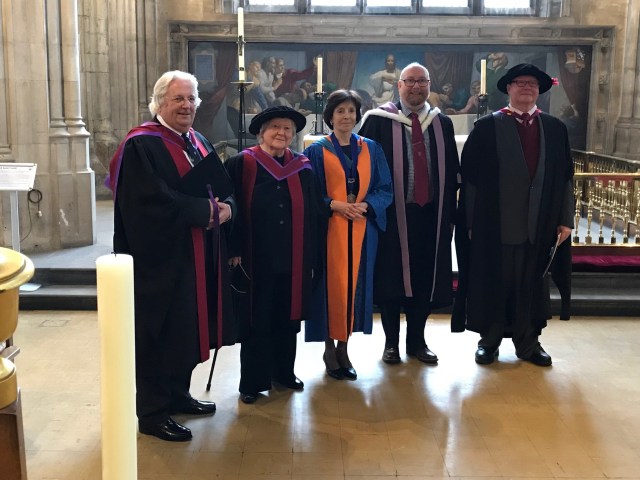
I was saddened to hear of the death of Dame Patricia Routledge at the grand old age of 96 today. Dame Patricia and I met when we both received the Honorary Fellowship of the Guild of Musicians and Singers in a ceremony in London in April 2018. She subsequently became a Patron of the Guild.

At the ceremony – Dame Patricia is second from left, I am second from right.

The respect in which Dame Patricia was held as an actress reflected her consummate mastery of both comic and serious acting. Everything she did was eminently watchable and I greatly enjoyed her television work over several decades. In person, she was a strong traditionalist, a maintainer of proper standards in speech and a devout Christian. Despite her fame and many recognitions, she was unpretentious and friendly and it was a great pleasure to have met her.

May she rest in peace and rise in glory.

Speech to the Heritage and Destiny Memorial Meeting 2025

With the other speakers

On September 7, I was one of the speakers at the Heritage and Destiny Memorial Meeting in the North of England. Here is the speech I gave.

Video of the speech is at https://odysee.com/@Nationalism:3/04_Prof.-John-Kersey-(7th-Sep-2025)-5MB:e

Our theme today is The Roots of the British, and so let me begin by reminding us just who the British are. Firstly, I want to refer to the work of geneticist Adam Rutherford, who has done extensive work on historical genetics and has applied statistics and probability to questions of descent. His findings are that if you are of predominantly British descent, and were born (or are descended from someone who was born) in the 1970s, it is virtually impossible that you are not directly descended from King Edward III of England[i]. And if you are descended from him, you are also a descendant of William the Conqueror, Alfred the Great, and every ruler of Europe in the 10th century. So, on the basis that I am talking here to an audience comprised of British people of British descent, I have a message for you: the blood of kings runs in your veins. You are the descendants of British men and women of greatness whose names will live evermore in history. You are the connexion between them and future generations. You need not only to know your ancestors but to honour their example. Be truly who you are. And, by the way, that means that almost everyone in this room is related to everyone else. We are all distant cousins.

In our literature, the figure of William Shakespeare is not only the greatest British writer to have ever lived, but in my view, the greatest in the world. And if we want to hear some of his words that speak to us just as clearly today, let us go to the orchard in Swinstead Abbey and listen to the words of Philip the Bastard, son of King Richard I, who has just seen his uncle King John die:

This England never did, nor never shall,
Lie at the proud foot of a conqueror,
But when it first did help to wound itself.
Now these her princes are come home again,
Come the three corners of the world in arms,
And we shall shock them. Nought shall make us rue,
If England to itself do rest but true[ii].

And today, England has again helped to wound itself. We can rightly ask at the moment, “who runs Britain?” The answer isn’t Keir Starmer.

We can find the roots of what has happened in the ideas of the Socialist Workers Party. Its former leader Yigael Glückstein (known as Tony Cliff) devised the concept of “deflected permanent revolution” in a 1963 essay, which holds that where the proletariat cannot take power, a section of the intelligentsia can work towards a bourgeois revolution. Cliff defines very accurately the position of the intelligentsia regarding the working class by saying “The intelligentsia are anxious to belong without being assimilated, without ceasing to remain apart and above. They are in search of a dynamic movement which will unify the nation, and open up broad new vistas for it, but at the same time will give themselves power.” [iii]

So this is not classical Marxism, which is class-based and concerned with the struggle of the working class. Instead, this contemporary ideology addresses itself to issues of race, gender and identity politics, and to what it identifies as oppressed minorities. It operates through the intelligentsia, which can be drawn from any class and is identified by its access to university education and the professions. If we were to analyse it academically, we would most accurately describe it as post-Marxism. It rejects classical Marxism for its reliance on grand narrative, and instead is anti-essentialist, not economically determinist, and strongly based on Gramsci’s concept of hegemony. Although it is primarily directed against the politics of the Right, it is also opposed to the traditional Left. It has no time for the socially conservative elements of Labour or for the socialism of Jeremy Corbyn.

The communist Antonio Gramsci advanced the idea of cultural hegemony, in which a ruling class maintains its power through establishing its ideology as so-called “common sense” so that it becomes a universal norm that is firmly established in the social order, particularly through education and the media[iv]. The idea is that this ideological takeover comes to be seen as natural and inevitable rather than having been achieved by force. For that reason, its proponents take an approach of pushing forward gradually, manufacturing consent, and embedding their ideas through entryism into every public institution.

And so this quiet revolution has been undertaken by the liberal middle class of today. This is a class which defines itself by adherence to specific beliefs and ideological conformity, and it is that which keeps it apart and above. The beliefs are often deliberately absurd – that men can become women, for example – but that is the whole point. These beliefs are shibboleths, and they are used to mark people out as belonging to the middle class. In addition, the choice of shibboleths is deliberate. By making someone believe and pledge public allegiance to something which is obviously false, you destroy their moral fabric and their sense of what is right and wrong. The overall aim is that of culture war, in which everything that is traditional in British life is to be attacked and destroyed. It will be replaced by a society whose members are isolated, atomised, without cultural or moral values, and compliant with whatever their masters want them to do. It seems very clear now that the Covid lockdowns were a trial run for this.

This system doesn’t rely on anything as obvious as state ownership. On the contrary, it spreads its control through a multitude of bodies, many of which are in theory private, but all of which are broadly committed to post-Marxist ideas. They are charities, trade unions, universities, political and special interest lobby groups, and non-government organizations. They are united by their opposition to the nation-state and everything that Britain has stood for culturally. They includes groups that have significant ideological differences, but when it comes to achieving the overall aims, there is an agreement that these differences should be smoothed over and ignored.

Parliament has spent several decades giving away its power to unelected bodies. In doing so, it created the ideal environment for this post-Marxist takeover. In 2012, Christopher Snowden commented on this phenomenon during the Blair era in a paper for the Institute of Economic Affairs, in which he said, “In the last fifteen years, state funding of charities in Britain has increased significantly while restrictions on political lobbying by charities have been relaxed. 27,000 charities are now dependent on the government for more than 75 per cent of their income and the ‘voluntary sector’ receives more money from the state than it receives in voluntary donations.

It has been argued that state funding weakens the independence of charities, making them less inclined to criticise government policy. This paper argues that there is a deeper problem if government funds and/or creates pressure groups with the intention of creating a ‘sock-puppet’ version of civil society which creates the illusion of grassroots support for new legislation. These state-funded activists engage in direct lobbying (of politicians) and indirect lobbying (of the public) using taxpayers’ money, thereby blurring the distinction between public and private action.

State-funded charities and NGOs usually campaign for causes which do not enjoy widespread support amongst the general public (e.g. foreign aid, temperance, identity politics).”[v]

Yes, these charities, which include one with which we are all familiar – Hope not Hate[vi] – do receive money from the state. But more than this, they can easily be funded by other interests who intend to further the post-Marxist agenda. And these other interests can stay in the shadows, without any serious scrutiny.

With so much devolved to these groups, our Parliament is effectively bypassed as a place of cultural influence. Instead, what rules is the web of special interest groups which effectively decides what government policy should be and tells politicians what to do. It is entirely deliberate that this system is out of touch with the electorate. It is being ruled by post-Marxist activists who are working to bring about a position where their ideas form a Gramscian hegemony and will go unchallenged. The electorate has no relevance to these people, since most of them are unelected and unaccountable. Writing recently in The Telegraph, Allison Pearson said “It’s as if we were under occupation by a group of hyper-liberal progressives who have infected every corner of national life with their weird, righteous dogma, endlessly searching for proof of native loathsomeness and treating any pushback as proof of guilt.” [vii]And that is precisely what is happening.

The primary aim of the activists can be summarized as being first to break down any institution they infiltrate, and then to rebuild it with their people and their principles in absolute control. We can see this with the NHS, and with the effect of net zero policies on manufacturing, farming and energy. It is entirely deliberate. Sometimes the destruction is obvious, as with the removal of historical monuments and the renaming of institutions to obliterate the memory of figures who do not fit the post-Marxist agenda. The wider agenda is to destroy tradition and the nuclear family, and to put such a burden of tax, censorship and debt onto people that they will become entirely dependent on the state as the only option that can save them.

And what of mass immigration? There is one reason above all others why the post-Marxists favour mass immigration, and it is because bringing foreigners into this country with no assimilation whatsoever is an extremely effective way to attack and destabilise British culture. For the post-Marxists, the more different the immigrants are from British people, the better. When there is no common people, there is no common culture and a low trust society, allowing those in charge to divide and rule. And when the British people are preoccupied by mass immigration and the problems it causes, it takes their focus off the people and organizations who are encouraging it to happen in the first place.

As part of the post-Marxist project, all resistance to the hegemony must be suppressed. Our culture is deliberately being dumbed-down. Many of us will remember a popular culture of thirty or forty years ago that relied not on formal education but on the native intelligence of our people and their willingness to build on the formidable cultural roots of the British. It was a culture that did not talk down to people and that gave a high priority to the discovery and exposure of working-class talent. There was an assumption that wherever people found themselves in life, they could better themselves.

Since then, our British popular culture has been replaced by a globalist mass culture dominated by the internet, and this consists increasingly of people being told what to think by others. AI is the newest manifestation of this, but what we see as the product of AI is exactly what is decided that we should see by those in power. We have also lost many of the individual voices that once made the online environment a haven for the intellectually curious. Instead, we now have a dominance of online material that is overwhelmingly and crassly commercial, often AI generated, and that is pitched at a moron level of cheap sensationalism. This is the bread and circuses approach that keeps people down. It is not just about turning people into mindless consumers, but it is far more about breaking down their resistance. The ugliness of much modern art and architecture, and the soullessness of much modern commercial music, is part of the same phenomenon.

We also see a loss of aspiration. At one point, it was possible for someone from the British working class to succeed through a combination of talent, hard work and good luck. Now, the system deliberately disadvantages White working class boys in particular[viii]. In the post-Marxist new world order there is no place for those who want to better themselves, and there is no place for those who might have the intelligence to dissent or rebel.

It is still possible for someone from the White working class to learn a trade and do well. But tradesmen have no access to national power. Even the lowest member of the managerial middle class has more access to power than a successful electrician or plumber. And the liberal middle class is there because they have been compliant enough to jump through the post-Marxist ideological hoops of the universities and employment. They compromised early, and learned that if they were to get on and become part of the intelligentsia, they would need to abandon thinking for themselves and fit in to the prevailing establishment.

What also keeps people down is the web of monitoring and control. This was the major change to workplaces during the Blair era and now it dominates every office. It is a culture whereby everything a worker does is pre-planned and monitored. There is an obsession with data as a means of measuring accountability but the reality is that this is a system that knows the cost of everything and the value of nothing. It is an attempt to get rid of any subjective measure of value, and yet it is precisely that subjective measure that makes us human. Everything is now tied up in a stultifying bureaucracy that serves no real purpose in terms of making work better or more effective, but takes up enormous amounts of time and effort. Why should it predominate, then? Because it is a method of ensuring that people are too busy, tired and ground down to complain or revolt. The system is there to control them, and ensure that uniformity is imposed and individuality is destroyed. It’s exactly the same tactic that was employed in the Soviet Union.

This change to our culture also promotes short-termism. This is in contrast to the post-Marxists, whose project is long-term and designed to progress slowly over the course of decades and multiple generations. The long-term outlook is one which can be identified particularly with the principles of faith, folk and family, and understands our generational context as the bridge between the past and the future. We can talk about this in the context of religious belief, but far more important is the residual effect that religious belief and specifically Christianity has had on our national culture. The Christian Faith was there in the background, providing the basic principles by which we lived in every aspect of British life. When this is taken away, because we will find the post-Marxists in the churches just as everywhere else, we have been left with a society that has no common moral foundation and whose members can be easily controlled from above.

Freedom of speech is one of the first casualties of this process. We have already established that the intelligentsia relies on shibboleths to determine its membership, and that these include ideas that are obviously wrong and absurd. For that reason, free speech must be suppressed because if these ideas are subject to challenge, they will be shown openly to be wrong and absurd. In Britain today, we have lost what was one of the foundations of our society – that all should be able to speak freely and that ideas, particularly political ideas, should be subject to robust debate. Now, there is ever-increasing censorship, and as ever, if you seek to know who rules you, ask who you are not allowed to criticize. We have also become a permanently divided nation. It really is a two tier system consisting of the post-Marxist establishment on one side and everyone else on the other. You cannot have compromise and civilised debate with people who believe that anyone who is opposed to them is (in their very limited understanding) “Nazi scum”. The philosopher Hans-Hermann Hoppe advances a proposal for a society based on liberty in his 2001 book “Democracy, The God that Failed”, and says that democrats and communists, as well as those who advocate alternative, non-family and non-kin-centered lifestyles, will need to be physically removed from society[ix].

Every working day the Prime Minister is greeted by a procession of men and women in suits telling him what he should do and what he should say. These are the people who are pulling the strings that make the politicians jump, and the post-Marxists have significant direct or indirect influence on them. They are embedded inside the Civil Service, and because most government ministers have no actual expertise in their fields, they are the ones with the power.

How do the post-Marxists do it? Well, they have worked tirelessly to get their ideology into every institution that has power. Think, for example, of the police. The 1999 Macpherson Inquiry branded the police “institutionally racist” and the response was that the police were then taken over by post-Marxist ideology in order to purge themselves. If you were to ask most public institutions before the Black Lives Matter protests whether they were racist, they would respond by telling you that they did not discriminate on the grounds of race, and tried to treat people of different racial backgrounds equally. But since the post-Marxists have imposed Critical Race Theory on them, those institutions will now tell you that they are not merely “non-racist”, they are “anti-racist”. And what they mean by “anti-racist” is that they have now completely adopted post-Marxist teachings on race.

It might be thought that if we simply elect the right government, this could change. Well, in order for that to happen, we will need politicians who actually understand the problem. One of the few people in politics who did articulate something on these lines was Dominic Cummings, who referred to the web of influence I have described as “the blob”[x]. If any politician is to succeed in changing Britain, they must have a strategy for not only purging but replacing the blob, and ensuring that it cannot become a mere vehicle for post-Marxist entryism. And if Reform are going to win the next election, I hope they are listening.

As the electorate, we must also have a realistic view of the limits of what Members of Parliament can do. If we ask why there is no significant progress in our country despite changes of government, why we remain culturally stagnant, and why no matter who is nominally in power, the ideology is the same, then we need to look to the fact that politicians are only the public face of the problem, and too often they are simply puppets. The real control, and the real damage, is going on all around them, but they have no willingness, nor perhaps the capability, to resist it. If we support the mainstream parties, our choice is between what we have now, which is a government of activists who are going to support the agenda of the blob, or what we saw with the last Conservative government, which gave up challenging the blob and simply went along with it. In other words, you get exactly the same outcomes whichever party is in power, but with the Conservatives it happens slightly slower.

Many of us have argued in the past for a small state. I think we can now see that this argument has caused the problems we now face. When government devolves its responsibilities to unelected and unaccountable bodies, they get taken over by post-Marxist ideology, and then government either supports this ideology or else does not have the power or the will to do anything to oppose it. There is no alternative but for government to take back what it has given away.

So our country is in an emergency situation, and we therefore need appropriate solutions. There is an immediate need for a strong patriotic national government that will make it its business to tackle the blob, and that will take back power from the post-Marxists by whatever means necessary. It will need to make itself an enemy of the middle classes which have come to depend on post-Marxist ideology, and to instead ally itself with the working class of this country, and that will mean that it cannot be composed of career politicians. It will need to be prepared to fight every dirty trick that the professional classes can throw at it, and it will need to abolish many of the laws that have been introduced since 1997. It will also need to oppose the powerful financial interests that are working through charities and NGOs to push post-Marxist ideas into national policy. It will need to put a complete stop to illegal immigration and begin an extensive programme of repatriation. Lastly, it will need to rebuild our economy so that we are no longer dependent on foreign ownership, because this always comes with strings attached.

It will not be easy and it will not be quick, but we are now in an existential crisis where this is the only option, and we need men and women who are able to commit to making Britain great again and restoring a decent and civilised society.

So let us end by going back to the Bard,

And you, good yeoman,
Whose limbs were made in England, show us here
The mettle of your pasture; let us swear
That you are worth your breeding; which I doubt not;
For there is none of you so mean and base,
That hath not noble lustre in your eyes.
I see you stand like greyhounds in the slips,
Straining upon the start. The game’s afoot:
Follow your spirit, and upon this charge
Cry ‘God for Harry, England, and Saint George!”[xi]

NOTES:

[i] See https://www.waterstones.com/blog/family-fortunes-adam-rutherford-on-how-were-all-related-to-royalty
[ii] Shakespeare: King John – Bastard, Act 5 Scene 7
[iii] Tony Cliff: “Deflected Permanent Revolution” (1963) retrieved from https://www.marxists.org/archive/cliff/works/1963/xx/permrev.htm
[iv] See Thomas R. Bates: “Gramsci and the Theory of Hegemony”, Journal of the History of Ideas Vol. 36 no. 2 (Apr-Jun 1975), University of Pennsylvania Press, pp. 351-366, retrieved from https://www.jstor.org/stable/2708933
[v] Christopher Snowdon: “Sock puppets; how the government lobbies itself and why”, Institute of Economic Affairs Discussion Paper no. 39, June 2012, retrieved from https://iea.org.uk/wp-content/uploads/2016/07/DP_Sock%20Puppets_redesigned.pdf
[vi] https://register-of-charities.charitycommission.gov.uk/en/charity-search/-/charity-details/1013880
[vii] Allison Pearson: “Nigel Farage speaks for the millions ashamed of what Britain has become”, The Telegraph, 2 September 2025, retrieved from https://www.telegraph.co.uk/news/2025/09/02/nigel-farage-house-judiciary-committee-free-speech-starmer
[viii] See Julie Henry “Why White working-class children fail: The race divide in English schools”, The Telegraph, 30 August 2025, retrived from https://www.telegraph.co.uk/news/2025/08/30/why-white-children-fail-the-race-divide-in-english-schools/
[ix] Hans-Hermann Hoppe, “Democracy: The God That Failed: The Economics and Politics of Monarchy, Democracy and Natural Order”. New Brunswick, NJ: Transaction Publishers (2001), pp. 216–218 “”There can be no tolerance toward democrats and communists in a libertarian social order. They will have to be physically separated and removed from society.”
[x] See for example https://www.dailymail.co.uk/news/article-8458865/New-report-blames-Whitehalls-blob-civil-servants-scientists-coronavirus-failures.html
[xi] Shakespeare: King Henry, Henry V – Act III, Scene I

This speech is released under a Creative Commons CC BY 4.0 licence, which means it can be freely reproduced and quoted from providing the author is acknowledged.

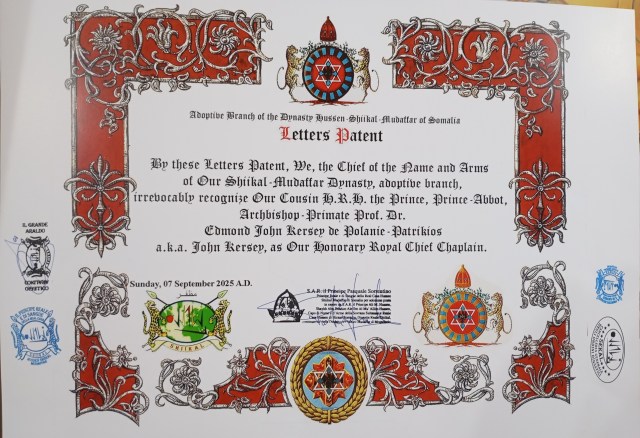
Honours and awards: Honorary Royal Chief Chaplain to the Adoptive Brance of the Dynasty Hussen-Shiikal-Mudaffar of Somalia

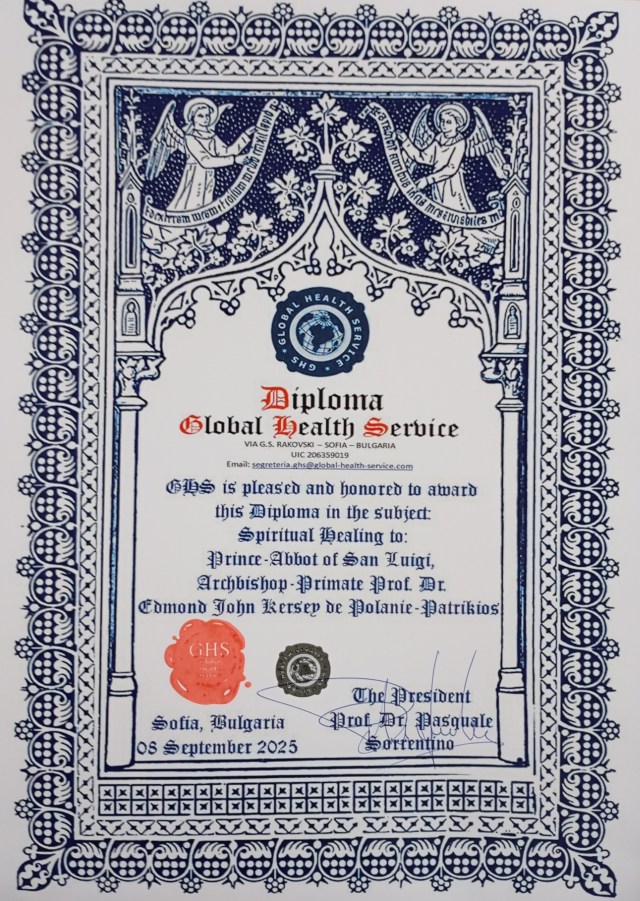
The Royal House of Hussen-Shikal-Mudaffar of Somalia was led by the late Prince Ali M. Hussen (Shaykh Abu Ibrahim Ale Ibn Al Mu’Allim Hussen) who was Chief of the Name and Arms of this Sultanate and Royal House. The Royal House represents the descent from the Sultans Mudaffar of Mogadishu. Prince Ali adopted as his heir to all his titles Prince Pasquale Sorrentino of Rome, Italy. Prince Pasquale is a senior member of the San Luigi Orders and my adoptive cousin in the Royal House Polanie-Patrikios, and has entered into wide-ranging mutual treaties of recognition with the institutions for which we have respective responsibilities. I have been honoured with the appointment of Honorary Royal Chief Chaplain to the Royal House, which represents both an Islamic and Christian heritage and thus serves as an example of interfaith co-operation.

Honours and awards: Honorary Life Fellow and Professor Emeritus in Music (Pianoforte) of the Università Popolare e della Terza Eta “Evy Delia Tommassini”, Milan, Italy

The Università Popolare e della Terza Eta “Evy Delia Tommassini” is an institution of the Imperial and Royal House of Tommassini-Leopardi of Constantinople, of which I am a member. It is a private Italian institution of higher education in the tradition of the “universities of the people” there, based in Milan.

The University has appointed me as Honorary Life Fellow and Professor Emeritus of Music (Pianoforte):

Honours and awards: Honours from the Royal House of Epirus

The Royal House of Epirus is the descendant of the independent state of Epirus that existed between February and October 1914 before being occupied successively by Greece and Albania. The Royal House has continued a representation in exile and the current head is Prince Davide Pozzi Sacchi di Santa Sofia who is Grand Prince of Epirus. The website of the Royal House gives much historical and current information and in addition the book “Le Royaume d’Epire, son Histoire et sa Monarchie au XXIe siècle” by Prof. Claude Chaussier (Brussels, 2005) explores these subjects in further detail.

A recent wide-ranging agreement between our respective jurisdictions has been marked by an exchange of honours and distinctions.

Prince Davide has appointed me as his honorary cousin, and as a Royal Prince in the Royal House of Epirus:

He has further appointed me to the rank of Hereditary Grand Cross of Justice with Grand Collar of the Constantinian Order of Epirus:

I have also been appointed as Honorary Life Member of the International Cultural Association of Royal Epirus and Honorary Life Academician of the Royal Academy of Epirus.

In the Royal Academy of Epirus, I have been appointed as a Professor Emeritus in Music/Musicology.

Prince Davide has also issued Letters Patent of recognition of my religious offices as Prince-Abbot of San Luigi and Catholicos of the West:

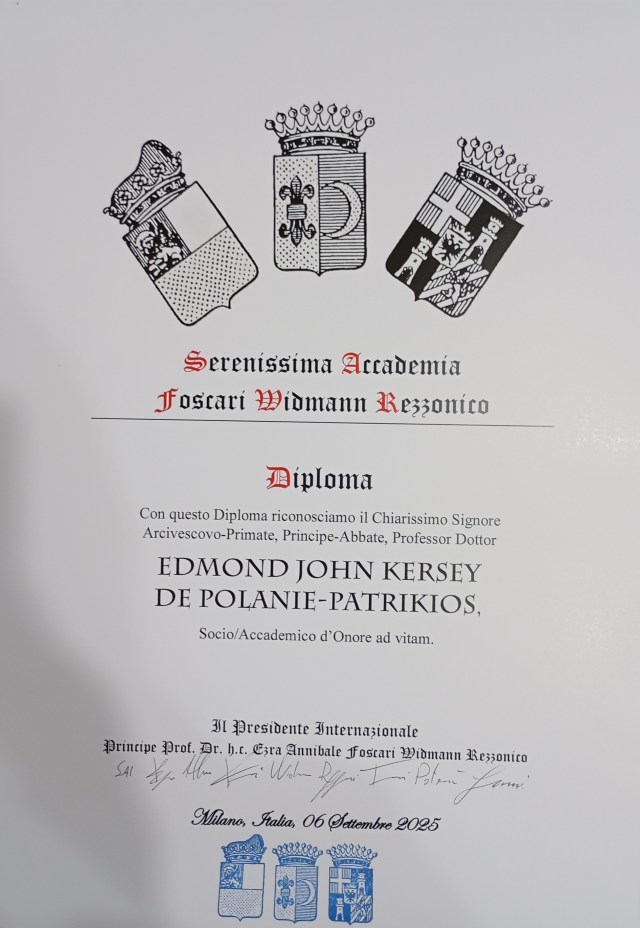
Honours and awards: Honours from the Imperial and Royal House of Tommassini-Leopardi of Constantinople and the Royal House Foscari Widmann Rezzonico

I am a member of the Imperial House of Tommassini-Paterno (Tomasi-Leopardi or Tommassini-Leopardi) of Constantinople.

Honours and awards: Imperial House of Tommassini-Leopardi of Constantinople (Justinian and Heraclian Dynasties)

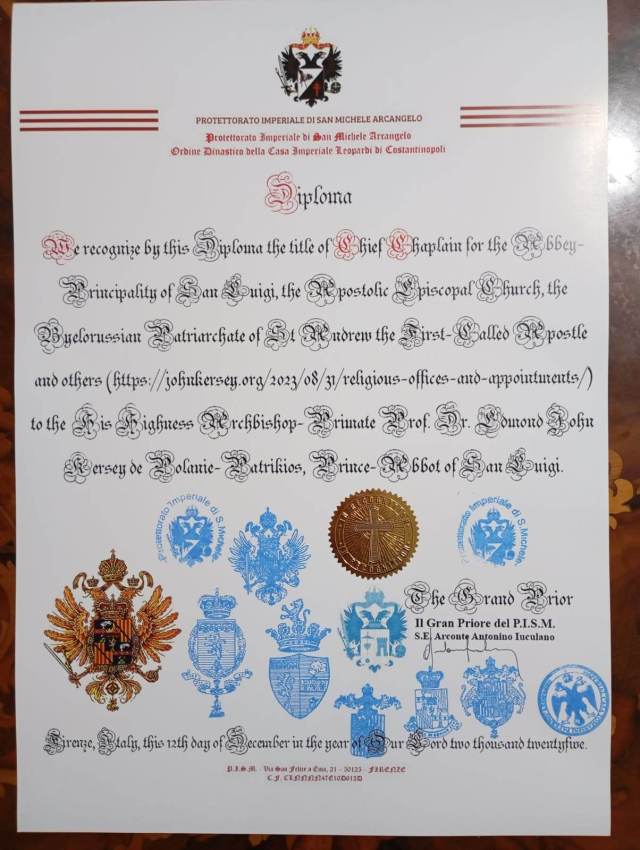
The Imperial and Royal House has appointed me as Honorary Chief Chaplain:

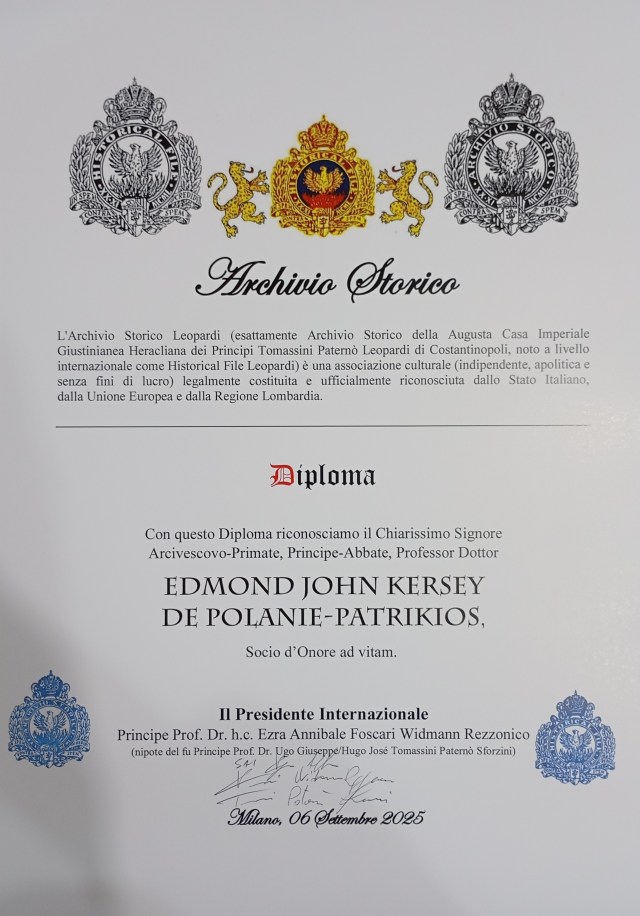
The Historic Archive of the Imperial and Royal House (Archivo Storico) has appointed me as an Honorary Life Fellow:

The Accademia Costantiniana Leopardiana of the Royal and Imperial House has appointed me as an Honorary Life Fellow/Academician:

The Nobile Accademia Heracliana of the Imperial and Royal House has appointed me as an Honorary Life Fellow/Academician:

The Nobile Accademia Giustinianea of the Imperial and Royal House has appointed me as an Honorary Life Fellow/Academician:

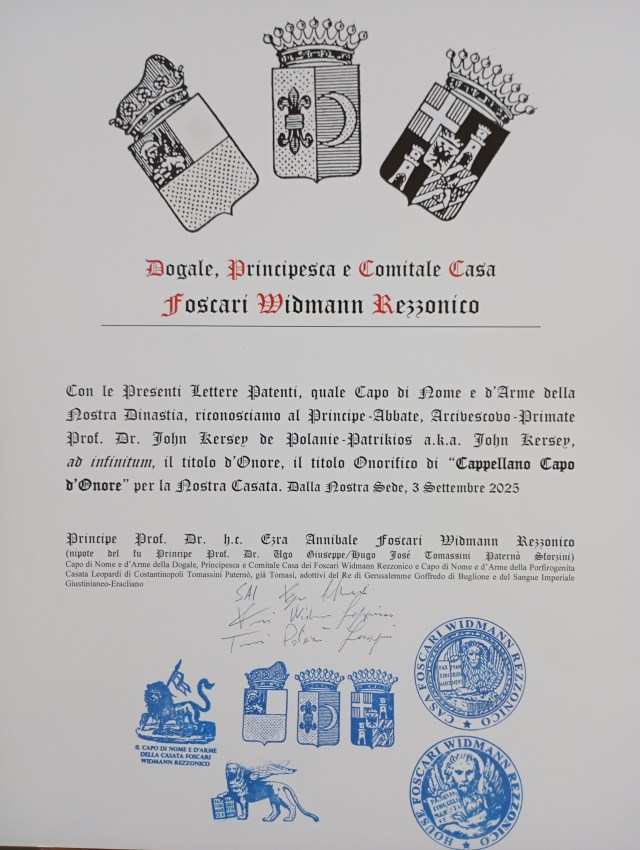
The House is united in the person of its head, H.I.R.H. Prince don Ezra Annibale Foscari Widmann Rezzonico, with the Princely, Ducal and Comital House of Foscari Widmann Rezzonico, in which Royal House I have also been appointed Honorary Chief Chaplain.

The Serenissima Accademia Foscari Widmann Rezzonico of the Royal House has appointed me as an Honorary Life Fellow/Academician:

Setting the record straight about my old school

There are many curious and not a few inaccurate entries in the online encyclopedia Wikipedia. One of the latter has concerned the entry on my old school The Latymer School, Edmonton, where we have been able to read the following wholly unsourced and largely inaccurate material which I will correct and respond to in this post.

In 1967 the school switched to a comprehensive intake as a result of Circular 10/65, a request from the Labour government to local education authorities to plan for conversion to a fully comprehensive education system. However, a certain amount of informal selection still took place in liaison with local primary schools.

In 1988, Latymer took advantage of the Education Reform Act 1988 to become a Grant-Maintained school with selective entrance exams once more.

The first point of error is that Latymer did not become a grant maintained school in 1988. The School Prospectus for 1990-91 gives the school status as “Voluntary Aided, Secondary Grammar, Co-educational, Day School.”

It was not until some years later that the prospect of obtaining Grant Maintained Status was mooted. The End of Term Newsletter for Summer 1992 says,

Grant Maintained Status: At a recent meeting of the Governing Body the Governors discussed the future of the school and in particular whether it would be to Latymer’s advantage to seek Grant Maintained Status. The Governors decided to hold special meetings at which resolutions to proceed with a ballot of parents on the issue will be discussed and voted on.

Latymer did indeed obtain Grant Maintained Status in 1993 (see Hansard listing of 8 February designating it as having voted Yes and published proposals) and held this status until it was abolished in 1998. In the latter year, the Education (Grammar School Designation) Order 1998 came into force and officially confirmed Latymer as one of the remaining grammar schools in England.

The implication of the anonymous Wikipedia author is that after 1967 Latymer became a comprehensive school and thus that it accepted pupils of all abilities. This was not the case. While a comprehensive school is not permitted to select its intake by ability, Latymer, by contrast, remained a voluntary aided grammar school and accepted only those of high academic ability.

The authoritative reference on these matters is “A History of the Latymer School at Edmonton” by J. A. Morris (Latymer Foundation at Edmonton, 1975) which discusses matters as they actually were. Turning to page 300, we read,

…one feels certain that the School will always owe a great debt to [Dr Trefor Jones, Headmaster 1957-70] for asserting vigorously and uncompromisingly its special claims to uniqueness in a comprehensive world. His predecessor and an earlier generation of governors had first faced the problem…The full force of the attack was felt in 1964. In this year, a new Labour Government was elected pledged to end selection at age 11 and to eliminate separation in secondary education. The Government’s White Paper issued in 1965 referred to the anomalous position of voluntary schools. Paragraph 38 stated, “It is not essential that the same pattern should be adopted for denominational and other schools in any given area as is adopted for that area’s county schools. The disposition and nature of the existing voluntary school buildings might dictate a different solution”.

The Governors and the headmaster felt that such was the case at the Latymer School of Edmonton. The immense size of the building may have satisfied the spatial requirements of a large neighbourhood school, but Latymer’s interior arrangements and furnishings – such as the twelve laboratories for advanced science – were designed for a school having 240 sixth formers in mind. Their main objection to the plans of the local authority (since 1965, the Greater London Borough of Enfield) was that the Latymer endowment was the birthright of every child in the parish…’to the end of the world’. It should not be restricted to the children of any limited area. A compromise plan was finally agreed extending the benefits of the Foundation to the whole of the Greater London Borough of Enfield, i.e. to the children of the old parish of Enfield as well as those in Edmonton and Southgate.

In every year after the end of the 11+ examination the Governors received far more applications than there were places available, and from parents who approved of the headmaster’s drive towards academic achievement and examination success, with firm discipline and the minimum concession to the current trendiness. Though the intake was not being selected in the old 11+ way, the School was attracting the most highly motivated parents and pupils, and attracting them from over a much extended catchment area.

It can therefore be seen that voluntary aided schools, including Latymer, could and did still maintain a selective intake post-1967, despite the changes in government policy. There was nothing “informal” about this selection; it was the published policy of the school.

Reference to the School Prospectus above finds the following described under Admissions Policy and Procedure,

The admission of pupils is the responsibility of the Governing Body, acting in accordance with the arrangements agreed with the Local Education Authority. Pupils admitted are required to be capable of following an education directed towards the highest grades of the G.C.S.E. Most are expected to proceed to Advanced level and subsequently to University or Polytechnic degree courses.

Primary Secondary Transfer
Reference is made to aptitude and ability with emphasis on academic attainment and potential. Those admitted are normally among the most able in their year group. The School has an outstanding musical tradition and the Governors give consideration to the admission of pupils of exceptional musical talent provided that they are also capable of following the academic courses offered. Other aptitudes and interests are also relevant. Family connections with the School are considered but are not a dominant factor in the decisions of the Governors.

Parents are invited to complete a questionnaire giving information of their child’s special interests and aptitudes. All applicants take a non-verbal reasoning test at Latymer School in late October. Reports from primary Headteachers are then requested on approximately 500 candidates who have the highest standardised scores on the non-verbal test.

On the basis of the information received the Governors choose those pupils (up to the Standard Number) who, in their judgement can best be served by the School and on the evidence are likely to respond best to what the School has to offer.

It may therefore be seen that admission to Latymer in those years was a highly selective and competitive process in which academic merit was the chief criterion. I entered the school in 1984, when only four pupils from my year at primary school were accepted. My parents were opposed to comprehensive education for me, and had considered several local independent schools as alternatives to Latymer before concluding that Latymer was in many aspects the superior option.

As well as the School Prospectus referenced above, we can also refer to the Annual Report of the Governors for 1990-91 which states plainly that Latymer was a Voluntary Aided Grammar School under the Education Act 1944.

The promulgation of inaccurate information via Wikipedia does a considerable disservice to the very real achievement of several generations of Latymerians whose ability and hard work earned them the opportunity to become part of an exceptional grammar school. In my view, grammar schools are something to celebrate as an antidote to the often stultifying egalitarianism that dominates modern education. Their role in promoting academic achievement and social mobility is often underestimated and should be more widely recognized.

Honours and awards: Pilgrim of Hope certificate from the Archbishop of Cracow

I have been honoured to receive the Pilgrim of Hope certificate from the Archbishop of Cracow, Poland. The certificate recognizes my participation in the Jubilee Route (following St Philomena’s Way in the West Midlands of England) designated by the Pope for the Holy Year 2025. The Pilgrimage is recognized as an opportunity for a personal encounter with Jesus and to bring the message of Jesus to others. The certificate ends with a pastoral blessing. The award of this certificate further emphasises unity with other Catholics and our common hope in our Lord and Saviour through the ancient and honoured path of pilgrimage.

Honours and awards: Prince of Buloberde from the Royal Dynasty Hussen-Shiikal-Mudaffar of Somalia

The Royal House of Hussen-Shikal-Mudaffar of Somalia was led by the late Prince Ali M. Hussen (Shaykh Abu Ibrahim Ale Ibn Al Mu’Allim Hussen) who was Chief of the Name and Arms of this Sultanate and Royal House. The Royal House represents the descent from the Sultans Mudaffar of Mogadishu. Prince Ali adopted as his heir to all his titles Prince Pasquale Sorrentino of Rome, Italy. Prince Pasquale is a senior member of the San Luigi Orders and my adoptive cousin in the Royal House Polanie-Patrikios, and has entered into wide-ranging mutual treaties of recognition with the institutions for which we have respective responsibilities.

The Royal House has previously honoured me with the title of Prince. This year I was delighted to receive the further title of Prince of Buloberde (Somalian: Buuloburde, also rendered Buloburti, Bulo Berti or Bulobarde) from the Royal House, with remainder to my male and female descendants. I have also been adopted as a Cousin of Prince Pasquale and member of the Royal House of Hussen-Shikal-Mudaffar of Somalia with the right to use and quarter the arms of the Royal House.

In addition, the Royal House has issued further Letters Patent of recognition in respect of the royal and ecclesiastical offices that I hold:

Index to John Kersey’s online piano recordings

This is an index to the online recordings made by me as pianist that are available to listen via YouTube. My YouTube channel is at https://www.youtube.com/@JohnKerseypiano.

The recordings marked * are believed to be the first recording of the work in question. In some cases they are the first complete recording of a work of which one or more movements have been previously recorded by others. Although many of these recordings have been issued on CD by Romantic Discoveries Recordings there are also some world première recordings that have been released to the public online via YouTube.

Designation as a world première recording means that the recording has been released to the public in a permanent format, whether digitally online or on CD. The designation is independent from any commercial consideration. It also means that it is the first such release to be made by a human pianist using an acoustic piano; artificial intelligence and MIDI recordings as well as those made on electric keyboards are discounted.

Transcriptions are listed under the name of the transcriber.

My thanks to everyone who has kindly contributed copies of scores for use in these recordings, in particular the late Klaus Zehnder-Tischendorf, Peter Cook, Robert Commagère, Denis Waelbroeck, Nicolo Figowy and Steffen Herrmann.

The highest goal of music is to connect one’s soul to their Divine Nature, not entertainment.
– Pythagoras

ALKAN, Charles-Valentin (1813-88)

ANSELL, John (1974-1948)

ARNOLD, Charles

ASHTON, Algernon (1859-1937)

AUSTIN, Ernest (1874-1947)

BARGIEL, Woldemar (1828-97)

BATE, Stanley (1911-59)

BEETHOVEN, Ludwig van (1770-1827)

BELICZAY, Julius von (1835-93)

BENDEL, Franz (1833-74)

BENDIX, Victor (1851-1926)

BENTZON, Niels Viggo (1919-2000)

BERGER, Emile (1838-1900)

BERGER, Francesco (1834-1933)

BERGT, Adolph (1822-62)

BILLAM, Peter (1948-)

see SCHOENBERG

BLANCHET, Emile-Robert (1877-1943)

BLISS, Sir Arthur (1891-1975)

BOCHSA, Nicholas Charles (1789-1856)

BOUILLET, Jean-Marc (1958-)

BRAHMS, Johannes (1833-97)

BRINLEY RICHARDS, Henry (1817-85)

BRONSART VON SCHELLENDORF, Hans (1830-1913)

from D. BROWNE’s Selection

BRÜLL, Ignaz (1846-1907)

BÜLOW, Hans, Freiherr von (1830-94)

BUNGERT, August (1845-1915)

BÜRGMULLER, Friedrich (1806-74)

BUSONI, Ferruccio (1866-1924)

BUSSMEYER, Hugo (1842-1912)

BUTLER, Leonard (1869-1943)

CARDEW, Cornelius (1936-81)

CHARLOT, Jacques (d.1915)

CHOPIN, Fréderic (1810-49)

COWEN, Sir Frederic Hymen (1852-1935)

CZERNY, Carl (1791-1857)

CZIFFRA, György (1921-94)

DEBUSSY, Claude (1862-1918)

DIETRICH, Albert (1829-1908)

DOVE, Jonathan (1959-)

DURAND, Jacques (1865-1928)

DURAND DE GRAU, Edouard (fl. 1829-80)

ELLIOTT, Percy (1870-1932)

ESCHMANN, Johann Carl (1826-82)

EWING, Montague (1890-1957)

FAURE, Gabriel (1845-1924)

FRANCK, César (1822-90)

FRANCK, Eduard (1817-93)

FRYER, Herbert (1877-1957)

FUCHS, Robert (1847-1927)

GÄRTNER, Hermann (1865-ca.1920)

GERMAN, Sir Edward (1862-1936)

GERNSHEIM, Friedrich (1839-1916)

GLAZUNOV, Alexander (1865-1936)

GODFREY, Sir Dan (1868-1939)

GOLINELLI, Stefano (1818-91)

GRÄDENER, Carl Georg Peter (1812-83)

GRIMM, Julius Otto (1827-1903)

GROSSE, W.

GURDJIEFF, Georges Ivanovich (1877-1949) and HARTMANN, Thomas de (1885-1956)

HALM, August (1869-1929)

HARRIS, Cuthbert (1870-1932)

HARTMANN, August Wilhelm (1775-1850)

HARTMANN, Emil (1836-98)

HARTMANN, Johann Peter Emilius (1805-1900)

HARTMANN, Thomas de (1885-1956)

  • see under GURDJIEFF, Georges Ivanovich

HEIMBERGER, E.

HELLER, Stephen (1813-88)

HERZOGENBERG, Heinrich von (1843-1900)

HESSEN, Alexander Friedrich Landgraf von (1863-1945)

HILLER, Ferdinand (1811-85)

HOFMANN, Heinrich (1842-1902)

HOLSTEIN, Franz von (1826-78)

HOUGH, Sir Stephen (1961-)

HUBER, Hans (1852-1921)

HYNAIS, Cyrill (1862-1915)

ILYINSKY, Alexander (1859-1920)

JADASSOHN, Salomon (1831-1902)

JANACEK, Leos (1854-1928)

JENSEN, Adolf (1837-79)

KARGANOV, Gennari Ossipovich (1858-90)

KATZ, Richard T. (1956-)

KAUN, Hugo (1863-1932)

KETTERER, Eugene (1831-70)

KIRCHNER, Theodor (1823-1903)

KLAUWELL, Otto (1851-1917)

KLENGEL, Paul (1854-1935)

KOPYLOV, Alexander Alexandrovich (1854-1911)

KRUG, Dietrich (1821-80)

KUHE, Wilhelm (1823-1912)

KULLAK, Theodore (1818-82)

LACHNER, Franz (1803-80)

LEDUC, Alphonse (1804-68)

LEYBACH, Ignace Xavier Joseph (1817-91)

LISZT, Franz (1811-86)

LOESCHHORN, Albert (1819-1905)

MACFADYEN, Alexander (1879-1936)

MARSH, Henry (1824-73)

MARTIN, E.C.

MEDTNER, Nikolai (1880-1951)

MENDELSSOHN BARTHOLDY, Felix (1809-47)

MOMPOU, Federico (1893-1987)

MOSCHELES, Ignaz (1794-1870)

MOTTL, Felix (1856-1911)

  • see under SINGER, Otto

MOZART, Wolfgang Amadeus (1756-91)

MULLEN, Alfred Frederic (1868-1936)

NICHOLLS, Heller (1874-1939)

NIEMANN, Rudolph (1838-98)

NIEMANN, Walter (1876-1953)

NIETZSCHE, Friedrich (1844-1900)

NORMAN, Ludvig (1831-85)

NOTTEBOHM, Gustav (1817-82)

NYIREGYHAZI, Ervin (1903-87)

OESTEN, Theodor (1813-70)

PAUER, Ernst (1826-1905)

PERRY, E.C.

PHIPPS, T.B. (fl. 1830)

PINNA, Joseph de (1798-1885)

PROKOFIEV, Sergei (1891-1953)

QUILTER, Roger (1877-1953)

RACHMANINOFF, Sergei (1873-1943)

REGER, Max (1873-1916)

REINECKE, Carl (1824-1910)

REINHOLD, Hugo (1854-1935)

REUSS ZU KÖSTRITZ, Heinrich XXIV, Prinz (1855-1910)

RHEINBERGER, Josef (1839-1901)

RIMBAULT, Edward Francis (1816-76)

RÖCKEL, Joseph Leopold (1838-1923)

ROGER-DUCASSE, Jean (1873-1954)

RÖNTGEN, Julius (1855-1932)

ROSENFELD, Leopold (1849-1909)

ROSENHAIN, Jakob (1813-94)

ROWLEY, Alec (1892-1958)

RUBINSTEIN, Joseph (1847-94)

RUDORFF, Ernst (1840-1916)

RUMMEL, Christian (1787-1849)

SAHR, Heinrich von (1829-98)

SATTER, Gustav (1832-?)

SCHNEIDER, Friedrich Hermann (1860-1930)

SCHOENBERG, Arnold (1874-1951)

SCHOLTZ, Herrmann (1845-1918)

SCHUBERT, Franz (1797-1828)

SCHULTZ, Charles (ca.1835? — fl.1885)

SCHULZ-EVLER, Adolf ((1852-1905)

SCHUMANN, Clara (1819-96)

Transcriptions of songs by Robert Schumann (*complete)

SCHUMANN, Robert (1810-56)

SCHÜTT, Eduard (1856-1933)

SCHYTTE, Ludvig (1848-1909)

SCOTT, Harold E. (fl. 1900-30)

SEELING, Hans (1828-62)

SIBELIUS, Jean (1865-1957)

SINGER, Otto (1863-1931)

SMITH, Sydney (1839-89)

SPEIDEL, Wilhelm (1826-99)

STARK, Ludwig (1831-84)

STERNDALE BENNETT, Sir William (1816-75)

STEVENS, Bernard (1916-83)

STRADAL, August (1860-1930)

TAUBMANN, Otto (1859-1929)

TEMPFLI, Zsolt (1983-)

see SCHOENBERG

TOMLINSON, I.

VALENTINE, Thomas (1790-1878)

VAUGHAN WILLIAMS, Ralph (1872-1958)

VIOLE, Rudolf (1825-67)

WARLOCK, Peter (Philip Heseltine 1894-1930)

WEBER, Gustav (1845-87)

WESLEY, Samuel Sebastian (1810-76)

WESTROP, East John (1804-56)

WILLNER, Arthur (1881-1959)

WILM, Nicolai von (1834-1911)

WINDING, August (1835-99)

WOLF, Hugo (1860-1903)

WRANGELL, Basile, Baron (1862-1901)

Honours and awards: Diploma of Merit from the Accademia Universitaria Internazionale

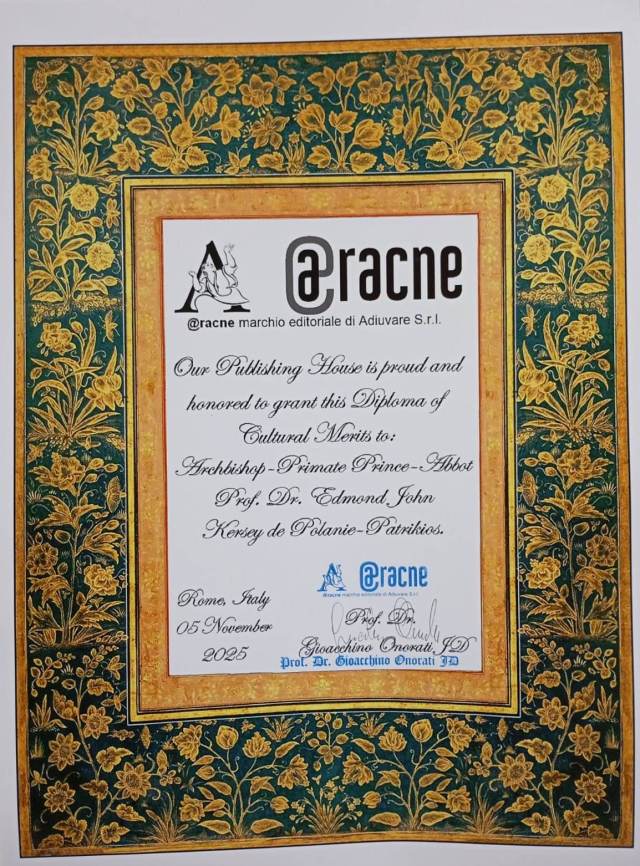
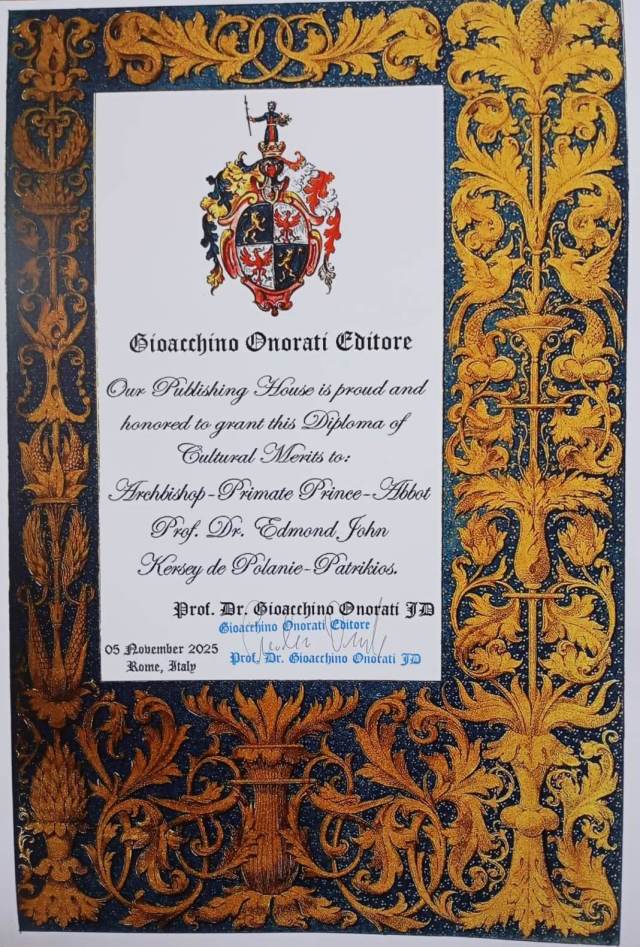
The Accademia Universitaria Internazionale was established in Italy in 1939 by the late Prince Hugo-José Tomassini Paternò, Head of the Tomasi-Leopardi (Justinian-Heraclian) Imperial House. It was registered with the Ministry of Public Instruction and established partnerships with other educational institutions internationally. Today under Prince Ezra, the current Head of the Imperial House, the Accademia has established reciprocal relationships of partnership, accreditation and recognition with a number of my educational institutions. It was with particular pleasure that I received a Diploma of Merit (Diploma de Benemerenza) from the Accademia, which is based in Milan, Italy.

Obituary – Maurice Merrell

Professor Maurice Merrell, DLitt, DMus, FGMS, FCCM, FISOB, FSCO, FIGOC, FGCO, FNSCM, HonFASC, HonFNCM, MNCMSoc, FMCM, FRSA, FWOU, FEAU, CompCIL, Emeritus Fellow and Leonard Henderson Memorial Professor of Organology at European-American University, died on 28 May 2025 aged 89.

Maurice Edward Merrell was born in February 1936. He was both an organist and an organ builder. In 1951, aged sixteen, he was apprenticed to the organ builders Bishop and Sons under the late Miss Hilda Mary Suggate, and after some time dealing with their business in the Midlands and Wales took over as London Manager at their premises in Beethoven Street in Queen’s Park. After Miss Suggate died, he became Principal of Bishop and Sons and completed seven decades with the company, retiring in 2022. He was a Fellow of the Incorporated Society of Organ Builders, also serving on the Society’s Council. It could truly be said that there was nothing concerning the construction of pipe organs with which he was not familiar, and he subsequently trained several generations of apprentices. Even in advanced years he would still be found clambering around in organ lofts and ensuring that the instruments were maintained in good order.

He served as organist of St George’s Church, Bloomsbury, for over thirty years, also being a Churchwarden and Treasurer there. He had previously been appointed as organist of St James, Bermondsey, at the age of fourteen, and then moved to St Peter, Islington. He was an able improviser and could effectively evoke the style of Howells. He was president of the London Organists’ Guild.

He was also active in the Church Lads’ Brigade, where he was an instructor and held the rank of captain.

Maurice was always ready to give his support to societies of musicians. He was a founder member and served on the Council of the Guild of Musicians and Singers for three decades, eventually becoming Master of the Guild. He was also a founding Fellow of the British Academy of Music and the Faculty of Church Organists. As a Fellow, he gave his support to the Institute of Arts and Letters, London, and was also a Fellow of the Curwen College of Music, where he was Hon. Treasurer. He was President of the Society of Crematorium Organists.

He received honorary Fellowships from the National College of Music and the Academy of St Cecilia, was elected to the Fellowship of the Metropolitan College of Music for distinguished service to music, and in 2003 received the degree of Doctor of Music from St Katharine’s Institute, Wyoming, USA, on the basis of his service to music. He was appointed a Companion of the Central Institute, London, and received the knighthood of the International Knightly Order Valiant of St George in a ceremony at Rochester Cathedral.

Maurice in 2008 wearing his DMus robes

On 21 November 2015 there was a Presentation Lunch in his honour at the Civil Service Club in which he received the degree of Doctor of Letters of the Western Orthodox University and was appointed Emeritus Fellow and Leonard Henderson Memorial Professor of Organology at European-American University, reflecting his long and distinguished  service to the musical profession.

Maurice and I at the 2015 presentation lunch at the Civil Service Club

At the meetings of the societies with which he was involved, Maurice was notable for his depth of knowledge, friendliness and considerable social skills. He was a great conversationalist, and would make time to speak with everyone. With his optimistic attitude and sound foundations in the Church, he was a reassuring and respected presence who maintained the highest of standards in dress and deportment. In the nearly thirty years that I knew him he did not seem to change at all. He was also a pipe smoker, and at the various society meetings would join others outside the church in question for a smoking break and conversation. His contributions to the Guild meetings in the form of addresses on musical matters were always interesting and often included moments of humour.

Maurice was unmarried and lived in a flat near Regent’s Park. He suffered a stroke in 2020 which marked a significant deterioriation in his health, but continued to be involved with the work of Bishop and Sons and his musical institutions. He will be much missed, since he was a pillar of this particular corner of the musical world and a gentleman of the old school.