New CD published – Piano Music of Walter Niemann volume 1

A new CD recording has been issued by Romantic Discoveries Recordings

Piano Music of Walter Niemann volume 1
Gartenmusik, op. 117 • Kleine Suite, op. 102 • Kleine Marburger Sonate, op. 162 • Transcription of Handel’s Pastoral Symphony • Two Sonatinas, op. 152 (includes first recordings)
John Kersey, piano
RDR CD111

Total time: 66 minutes 15 seconds

1. Gartenmusik, after a text by Oscar Wilde, op 117 (14:27)
i. Allegretto moderato ed amabile ii. Andante tenuto e molto tranquillo iii. Moderato e liquido

2. Kleine Suite (Suite miniature), op 102 (15:44)
i. Praeludium ii. Tempo di Minuetto iii. Tempo di Tango iv. Elegia v. Alla Marcia fantastica vi. Basso ostinato vii. Postludium

3. Kleine Marburger Sonate (Piano Sonata no. 12), op 162 (15:45)
i. Allegro amabile ii. Poco adagio notturnale iii. Moderato con moto – Im behaglichen Wanderton

4. George Frederick Handel (1685-1759): Pastoral Symphony from “Messiah” transcribed for piano by Walter Niemann (2:45)

5. Sonatine op 152 no. 1 “Forest Music” (10:04)
i. Moderato espressivo – Easy going and graciously ii. Short Ballad – Andantino mosso iii. Rondino – Allegro non troppo, ma con anima – With good humour

6. Sonatine op 152 no 2 “Country Music” (7:18)
i. Poco allegretto giocoso e rusticale ii. Alla Musette – Allegretto moderato iii. Alla Giga – Vivo e giocoso

Walter Niemann was regarded in 1927 as “the most important living piano composer who knows how to make music from the piano in a subtle and colorful way, although he often enters the field of salon music” (H. Abert, Illustrated Music Lexicon). This most sensitive and introverted master of the piano devoted his life to composition and musical scholarship, also performing his music in concerts and radio broadcasts. Niemann’s vast output for the piano is only now starting to become more widely known. Although his style is generally unashamedly conservative, he was one of the very few German composers to explore Impressionism in music, and this also reflected a fascination with the Far East. Elsewhere, Niemann’s imagination takes us from much Baroque recreation to large-scale epic sonatas, Schumannesque miniatures and even the exploration of early jazz styles. His understanding of the capabilities of the piano was complete, and his works include both collections for young pianists and mature works that exploit the full range of pianistic effect and make significant demands on the performer.

New CD published -Piano Music of Heller Nicholls (1874-1939), Cuthbert Harris (1870-1932) and Ernest Austin (1874-1947)

A new CD has been issued by Romantic Discoveries Recordings.

Piano Music of Heller Nicholls (1874-1939), Cuthbert Harris (1870-1932) and Ernest Austin (1874-1947)
John Kersey, piano
RDR CD110

Total time: 70 minutes 6 seconds.

(WILLIAM) HELLER NICHOLLS
1. Alsatian Echoes (9:52)
i. The Old Gateway ii. In the Cathedral iii. Flight of Storks iv. La belle ville Strasbourg – Alsatian Melody v. Mont St. Odile
2. Evesham Vale: Suite for pianoforte (12:23)
i. The Abbey Tower ii. On the Avon iii. Plum Pickers’ Dance iv. Apple Blossoms v. A Walk in the Fields
3. Changing Moods (4:45)
4. In the Wood; three pieces (7:56)
i. Swaying Trees ii. Night iii. Running Water

CUTHBERT HARRIS
5. Poetic Pictures (11:34)
i. Memories ii. The Wreck iii. The Angelus iv. Evening Shadows v. An Old Minster vi. Prelude
6. Moonlight (3:05)
7. Five Impressions for pianoforte (8:36)
i. The Sea ii. In a Swiss Valley at Night iii. The Faun iv. The Setting Sun v. In Shady Woodlands
8. Toccatina (2:07)

ERNEST AUSTIN
9. English Pastorals, op. 43 (9:27)
i.In Sun-Lit Forest Glades ii. A Quiet Valley iii. Sunset Harmonies iv. On the Hilltops

New CD published – Piano Music of Leonard Butler

A new CD has been issued by Romantic Discoveries Recordings.

Piano Music of Leonard Butler (1869-1943)
John Kersey, piano
RDR CD109

Total time: 78 minutes 27 seconds.

1. In the Heart of the Garden (10:11)
i. In the Sunshine ii. In the Heart of the Garden iii. Song of the Sun-Dial iv. To the Maid of the Garden v. The Song of the Garden vi. May-Bells

2. Sweet Auburn, The Deserted Village, suite for piano (after Goldsmith) (13:48)
i. The Village Bells ii. A Spring Phantasy iii. On the Village Green iv. A Meditation v. A Remembrance vi. The Weeping Willow vii. The Deserted Village – A Lament

3. From the Surrey Hills: Fifteen Tone-Pictures for Piano (28:48)
i. Sunday Morning (Ranmore, Dorking) ii. The Meadow Path iii. Where Primroses Grow iv. Through “Bluebell Land” v. In the Merry Month of May vi. Through the Pines vii. Swaying Tree-Tops viii. A Song of my Homeland ix. The Song of the “Tillingbourne” x. The Song of the Old Windmill xi. In the Noontide Heat xii. The Dance in the Harvest-Field xiii. Sunset xiv. Brownies xv. As the Children Fall Asleep

4. Monastique (Tintern Abbey) (1:50)

5. On a Summer Shore (9:33)
i. On a Summer Shore ii. In Saint Martin’s Summer iii. Arietta iv. Rondel

6. Rhapsody: At Twilight (3:44)

7. Outdoor Life – five sketches for pianoforte (10:18)
i. Sunrise ii. The Bird by the Brooklet (“Bury Hill”, Dorking) iii. Through the Forest (Souvenir of a Holiday in the High Pyrenees) iv. By the River (The Fisherman’s Path – Fowey River – Bodmin Road, Cornwall) v. In the Silver Haze (Lantivet Head – Fowey)

New CD published – Piano Music of Percy Elliott

A new CD has been issued by Romantic Discoveries Recordings.

Piano Music of Percy Elliott (1870-1932)
John Kersey, piano
RDR CD108

Total time: 57 minutes 16 seconds.

1. Under the summer moon; idyll (4:23)

2. The Glamour of the East – A Kashmiri Suite (13:03)
i. By the Lake of Dal ii. The Dancer of Jamu iii. In The Hills iv. The Maharajah Passes

3. My Garden of Dreams; Three Imaginations, Suite for pianoforte (9:29)
i. In My Lady’s Rose Bower ii. Hammock Song iii. Floral Dance

4. Dream Lagoon Suite (14:16)
i. Yellow Jasmine – Intermezzo Gracieuse ii. Queen of the Roses – Petite Valse Caprice iii. The Dream Lagoon – Barcarolle

5. Sunbeams and Moonbeams: Four more Contrasts for piano (15:54)
i. Dancing Sunbeams ii. Moonrise O’er the Lake iii. Flaming June iv. Moonset

New CD published – Piano Music of Alfred Frederic Mullen (1865-1936) volume 3

A new CD has been issued by Romantic Discoveries Recordings.

Piano Music of Alfred Frederic Mullen (1865-1936) volume 3
John Kersey, piano
RDR CD107

Total time: 63 minutes 49 seconds.

1. Saga (5:22)

2. writing as “Gustave Lind”: Rubaiyat, suite for piano (10:22)
i. Sunrise ii. The Flower Garden iii. Lovers’ Meeting iv. The Farewell

writing as “Gustave Lind”: Spring Tales – suite for piano
3. The voice of Spring (1:51) 4. One Spring morning (2:47) 5. The pleasant month of May (2:21) 6. Around the maypole (2:18)

writing as “Gustave Lind”: The silent mere, three impressions for piano
7. Once upon a time (2:26) 8. The Woodnymph (1:44) 9. Moonrise (3:10)

writing as “Pierre Lescaut”: The city of dreams
10. In the Palace of Happiness (2:47) 11. The Princess (1:37) 12. The City of Dreams (3:23) 13. Love’s Awakening (1:35)

writing as “Gustave Lind”: Edda, suite for piano
14. Frigga and the Shepherd (2:35) 15. The Magic Mead (3:52) 16. In Flower Land (2:27) 17. The New World (2:03)

writing as “Gustave Lind”: In an old world city – a suite for pianoforte
18. By the old lily pond (1:53) 19. Where the hedgeroses grow (1:29) 20. Starlight through a little window (2:52) 21. When all the world was young (1:18) 22. In a little churchyard (2:46)

New CD published – Piano Music of Alfred Frederic Mullen (1865-1936) volume 2

A new CD has been issued by Romantic Discoveries Recordings.

Piano Music of Alfred Frederic Mullen (1865-1936) volume 2
John Kersey, piano
RDR CD106

Total time: 72 minutes 38 seconds.

PIANO MUSIC OF ALFRED FREDERIC MULLEN (1868-1936) volume 2
John Kersey, piano

1. writing as “Pierre Lescaut” The Valley of Repose, four impressions (11.16)
i. Night Thoughts ii. The Water Nymph iii. At Twilight’s Magic Hour iv. The Meeting of the Waters

2. Twelfth Night – three incidental dances (9:50)
i. Shadow Dance ii. Twilight Dance iii. Torchlight Dance iv Roses and Rue

3. writing as “Jean Morel” O’er Moorland and Mountain, suite for pianoforte (7:49)
i. Purple Heather ii. Thistledown iii. A Passing Cloud iv. A Freshening Breeze

4. writing as “Victor Salcède” Three Romantic Idylls (9:01)
i. The River of Dreams ii. Serenade iii. Peep O’Dawn – Scène de Ballet

5. Venetian Suite (6:29)
i. On the Grand Canal ii. Serenade iii. Tarantella

6. writing as “Pierre Lescaut” Indian Scenes, four impressions (7:51)
i. Snake-charmer ii. Siva iii. By the Taj Mahal iv. Nautch Dance

7. writing as “Jean Morel” In fancy’s realm, lyric suite for piano (10:22)
i. Day-Dreams ii. Stepping Stones iii. Nature’s Mirror iv. Dragon Flies

New CD published – Piano Music of Alfred Frederic Mullen (1865-1936) volume 1

A new CD has been issued by Romantic Discoveries Recordings.

Piano Music of Alfred Frederic Mullen (1865-1936) volume 1
John Kersey, piano
RDR CD105

Total time: 62 minutes 14 seconds.

1. Highways and Byways, four sketches for piano (9:12)
a. In the Still Woodland b. The Little Shepherdess c. By the Lych-Gate d. On the Broad Highway

2. writing as “Gustave Lind”: In an old Italian garden (Piacenza, 1914) (9:14)
e. By a Forgotten Well f. In Bocaccio’s Days g. A Deserted Temple h. A Shepherd’s Song i. In Brocade and Silk

3. A Garland of Memories (7:58)
j. For Remembrance k. Columbine l.. ‘Neath the Pergola m. Snapdragon

4. writing as “Gustave Lind”: Eventide (10:38)
n. Forest Piece o. The Heart of the Sunset p. Chant Poetique q. The Queen’s Minuet

5. writing as “Pierre Lescaut”: The Enchanted Isle; four impressions (10:35)
r. By the Pools of Silence s. Elfin Glade t. Mystic Night u. Roseate Dawn

6. writing as “Gustave Lind”: The Black Iris Suite (9:15)
v. The Black Iris w. Ayesha x. The Lotus Pond
“Thus said Vikrama, the Godborn: ‘When after a thousand times thousand Karmas the black Iris will appear in the Lotus cup of the sacred lake Manassorowa, bathed by the beams of Arjana, then shall thy soul obtain the Nibhanam.” – From an old M.S. of Brahmacharya Yengar

7. A Hunting Morn (3:25)

Recorded in 2014.

New CD published – August Wilhelm Hartmann: Piano Sonata in C minor, with works by Lachner, von Hessen and Sterndale Bennett

A new CD has been issued by Romantic Discoveries Recordings.

August Wilhelm Hartmann: Piano Sonata in C minor, with works by Lachner, von Hessen and Sterndale Bennett
John Kersey, piano
RDR CD104

Total time: 62 minutes 14 seconds.

A.W. Hartmann (1775-1850): Piano Sonata in C minor (unpublished, prepared from the composer’s manuscript)
1. (6:49)
2. (5:36)
3. (4:33)

4. Alexander Friedrich Landgraf von Hessen (1863-1945): Fantasiestuck, op 2 (8.36)

Franz Lachner (1803-80): Suite, op 142
5. Praeludium: Allegro moderato (3:45)
6. Andantino (6:48)
7. Menuetto: Allegretto (8:33)
8. Allegro agitato (4:04)

Sir William Sterndale Bennett (1816-75): 4 Studies in the form of Capriccios from op 11
9. no. 1 Allegro con Precisione (4:24)
10. no. 3 Allegro Brillante (2:12)
11. no. 4 Vivace Giocoso (3:05)
12. no. 6. Allegro Agitato (3:24)

Our thanks to Klaus Zehnder-Tischendorf for supplying scores of these rare works. Recorded in 2014.

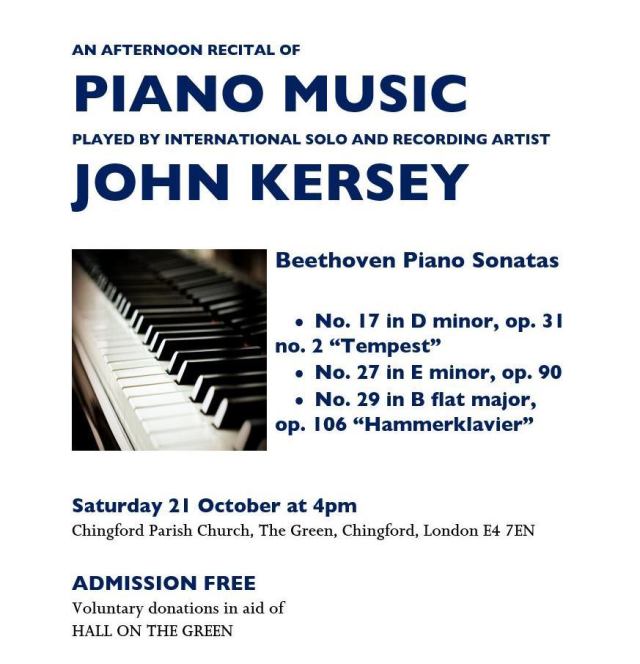
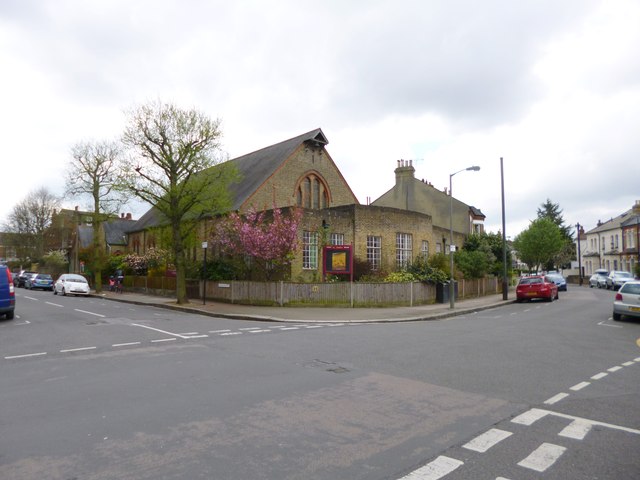
Piano recital in Chingford

Comments from members of the audience:

“The D minor sonata was so beautifully played and in particular the crucial bars 143 – 148 and 153 – 158 in the first movement, which present much difficulty for we mere mortals in trying to convey the ghostly and spiritually contemplative atmosphere intended by the composer, were hauntingly beautiful. I have always felt the difficulty with these passages is more to do with the artist’s ability to empathise perfectly with Beethoven’s emotions than with technique; I felt your communion with Beethoven was at its height in those bars. You told me it was this sonata which set you on the road – at the age of nine, I think; certainly your special connection and affinity with it shone through. Your performance of the Hammerklavier was a tour-de force and your control, especially in the last movement, was astonishing. What a work that is! And what a challenge! Again, I’ve not heard this sonata played better than I did yesterday. We could not stop talking about it on the way home.”

“I was mesmerised by your magnificent playing on Saturday afternoon at Chingford.. I leaned closer to the keyboard because I could hardly believe what was happening! What a stupendous mind Beethoven must have had to write that fugue in the last Movement of the Hammerklavier and what a formidable technique and musical understanding you John must have to play it! Bravo and congratulations. I so enjoyed all three sonatas and  was especially captivated by the last lyrical and beautiful movement of the Tempest.”

Dr Ray Steadman-Allen: obituary

The obituary of Dr Ray Steadman-Allen in today’s Sunday Telegraph mentions his service as a Patron of the London Society for Musicological Research, which I founded in 2002. Ray was always ready to give his support to musicians, and has left a rich legacy as composer and arranger. He will be fondly remembered above all for his masterly works for brass band.

http://www.telegraph.co.uk/news/obituaries/11321716/Ray-Steadman-Allen-obituary.html

Recital at the Guild of Musicians and Singers, 17 May 2014

GMS newsletter coverGMS programmeA CD recording of this recital is now available from Romantic Discoveries Recordings.

Recital at the 41st General Meeting of the Guild of Musicians and Singers, 17 May 2014
John Kersey, piano
RDR CD103

Audio samples:
Faure: Barcarolle no. 2
Faure: Barcarolle no. 3
Faure: Nocturne no. 6
Alkan Symphony: movt. 1; movt. 2; movt. 3; movt 4

Total time: 71 minutes 15 seconds

Gabriel Fauré (1845-1924):
1. Barcarolle no. 2 in G major, op. 41 (1885) (6’16”)
2. Barcarolle no. 3 in G flat major, op. 42 (1885) (8’59”)
3. Barcarolle no. 4 in A flat major, op. 44 (1886) (4’06”)
4. Barcarolle no. 5 in F sharp major, op. 66 (1894) (6’28”)
5. Nocturne no. 6 in D flat major, op. 63 (1894) (+ applause) (10’32”)

Charles-Valentin Alkan (1813-88):
Symphonie for solo piano, from 12 Etudes in the minor keys, op. 39 nos. 4-7
6. Allegro moderato (10’14”)
7. Marcia funebre: Andantino (6’27”)
8. Menuet (5’56”)
9. Finale: Presto (+ applause) (5’28”)

10. (encore) Faure: Nocturne no. 3 and concluding remarks by Master of the Guild Dr. David Bell (6’59”)

Recorded at the concert on 17 May 2014 and the rehearsal concert preceding it.

gms 1

Membership and other details of the Guild and Musicians and Singers can be found on the Guild’s website: www.musiciansandsingers.com.

New CD published – Franz von Holstein (1826-78): Piano Sonata in C minor, op. 28

A new CD has been issued by Romantic Discoveries Recordings:

Franz von Holstein (1826-78): Piano Sonata in C minor, op. 28
John Kersey, piano
RDR CD102

Total time: 76 minutes 54 seconds

Franz von Holstein (1826-78): Piano Sonata in C minor, op. 28
1. Allegro con brio, un poco maestoso (9’58”) 2. Andante (7’35”) 3. Allegro appassionato (8’43”)
Otto Klauwell (1851-1917): Drei Stücke in Kanonform, op. 38:
4. Praeludium (2’43”) 5. Scherzo (1’13”) 6. Romanze (2’30”)
7. Variations in D minor, op. 22 (10’36”)
Hans Seeling (1828-62):
8. Impromptu, op. 8 no. 1 (1’42”) 9. Romance, op. 8 no. 2 (6’18”)
Wilhelm Speidel (1826-99): Suite (quasi Sonata), op.111:
10. Praeludium (2’24”) 11. Andante espressivo (3’03”) 12. Scherzo (3’27”) 13. Marcia funebre (9’41”) 14. Finale (6’30”)

Our thanks to Klaus Zehnder-Tischendorf for supplying scores of these rare works.

Franz von Holstein was destined for an army career at the insistence of his father, but during his officer training he composed the opera ‘Zwei Nächte in Venedig’ as well as songs and ballads, and for a time, encouraged by his friendship with Griepenkerl, continued to compose in the free time allowed by his military duties. By 1853 he was free to pursue a musical career, and came to Leipzig where he studied with Moritz Hauptmann and, as a pianist, with Plaidy and Ignaz Moscheles. He then lived for a time in Rome, Berlin and Paris before becoming manager of the Leipzig Bach-Gesellschaft. Although chiefly known as a composer of songs, he was also responsible for several operas, orchestral works and chamber music, and wrote a significant amount of poetry. During his last six years he suffered with stomach cancer, and it was his wish that a bequest should establish a fund for impecunious musicians at the Leipzig Conservatoire. His Piano Sonata is a major composition of some ambition and achievement, with a clear influence of Schumann and Brahms evident.

Wilhelm Speidel is best remembered today as founder of the Stuttgart Music School. His father was a singer and composer and it was by him that his early musical talent was first nurtured. At Munich, he became a composition pupil of Ignaz Lachner and studied piano with Christian Wanner. After spending 1846-7 as a private teacher in Alsace, he returned to Munich, where he taught, also undertaking a tour throughout Germany as a pianist. He was known as an interpreter of Beethoven, who is also a major influence on his compositions. At Ulm, he founded and conducted the Liedertafel, and became active as a choral conductor. In 1857 he moved to Stuttgart where, together with Lebert, Stark, Faisst and others the Stuttgart Music School, today the Hochschule für Musik und Darstellende Kunst in Stuttgart. Here he taught and conducted the Stuttgart Liederkranz; his pupils included the American composer Edgar Stillman Kelley. However, after a quarrel with Lebert in 1874 he resigned his post and started his own conservatoire. He accepted reinstatement at the Music School upon Lebert’s death in 1885. Speidel composed in almost every form and was chiefly known in his lifetime as a composer of songs and choral music, adopting the popular idioms of German folk song.

Hans Seeling was born and studied in Prague, and suffered from delicate health from an early age. In 1852 he made his first public appearance as a pianist, in Italy, and then toured the Orient in 1856, followed by concerts in Germany. In 1859 he came to Paris. The lung condition from which he was suffering worsened and he returned to his native town, where he died. Seeling’s youth means that his compositions, all of which are for piano, are relatively few in number, but merited comparison with Chopin and Henselt in his time.

Two new CDs published – Piano Music of Friedrich Gernsheim (1839-1916) vols. 1 and 2

Two new CDs have been issued by Romantic Discoveries Recordings:

Piano Music of Friedrich Gernsheim (1839-1916), volume 2
John Kersey, piano
RDR CD100

Audio sample: Fantasie, op. 81 (from vol. 1)

Total time: 76 minutes 13 seconds

Sonata in F minor, op. 1
1. Langsam, getragen (7’49”) 2. Lebhaft (3’31”) 3. Leidenschaftlich bewegt (10’06”)
Zwei Klavierstücke, op. 39
4. Lied (4’34”) 5. Gavotte (4’40”)
Tondichtung, op. 72
6. Hymnus (3’11”) 7. Romanze (5’45”) 8. Intermezzo (6’25”) 9. Jubilate (5’18”)
10. Waltz, op. 70 (4’50”)
Symbole, op. 59
11. Nachtstück (5’13”) 12. Elegie (5’11”) 13. Im Schilf (3’36”) 14. Romanze (3’00”) 15. Aeolus (2’55”)

Piano Music of Friedrich Gernsheim (1839-1916), volume 1
John Kersey, piano
RDR CD100

Total time: 72 minutes 16 seconds

1. Fantasie, op. 27 (21’04”)
Ins Stammbuch, op. 26
2. Andantino (1’49”) 3. Allegretto grazioso (1’40”) 4. Andante (3’39”) 5. Allegro con brio e giocoso (2’27”) 6. Andante espressivo (2’53”) 7. Allegro (6’34”) 8. Lento e sostenuto (2’57”)
9. Fantasie, op. 81 (8’11”)
10. Legende, op. 44 (12’06”)
11. Romanze, op. 15 (8’51”)

Friedrich Gernsheim was born of a Jewish family in Worms and studied there with Louis Liebe, who had been a pupil of Spohr. Following the 1848 revolutions, his father moved the family to Frankfurt, where he studied with Edward Rosenhain. His debut in 1850 was followed by two years of touring, before he undertook advanced studies with Moscheles. Between 1855-60 he was in Paris, where he met Lalo, Rossini and Saint-Saëns. In 1861 he succeeded Hermann Levi as music director in Saarbrücken, and in 1865 Hiller appointed him to the staff of the Cologne Conservatoire, where he taught Engelbert Humperdinck among others. In 1868 he met Brahms for the first time, and his compositions, which include four symphonies (the third based on the Jewish theme of the Song of Miriam), concertos and much chamber music, show a notable Brahmsian influence. He spent the years 1874-90 as director of the Rotterdam Philharmonic Society, before joining the faculty of the Stern Conservatoire in Berlin, finally leaving to teach at the Academy of Arts in 1897, the year he was elected to the senate.

New CD published – Piano Music of Sydney Smith (1839-89) volume 2

A new CD has been published by Romantic Discoveries Recordings.

Piano Music of Sydney Smith (1839-89) volume 2
John Kersey, piano
RDR CD99

Total time:

Total time: 76 minutes 47 seconds

1. Nadeshda, fantasia on the opera by Arthur Goring Thomas (1850-92), op. 211b 2. Aspiration (mélodie), op. 208 no. 1 3. Inquiétude (impromptu), op. 208 no. 2 4. Gavotte and Musette, op. 188 5. Vie orageuse (Deuxième ballade), op. 203 6. Chant de berceau, op. 156 7. Harmonies du soir (morceau élégant), op. 54 8. Menuet romantique, op. 174 9. Rayons d’or (Bagatelle), op. 176 10. Happy memories (morceau de salon), op. 77 11. Kermesse (Scène hollandaise), op. 181 12. Voix du coeur (Mélodie), op. 178 13. Zeffiretta (Morceau de salon), op. 159 14. Bacchanale, op. 170

Our thanks to the Sydney Smith Archive for supplying scores of these rare works.

Sydney Smith represents a lost generation of English composer-pianists who enjoyed both critical and commercial success in his heyday, only to be eclipsed by a rapid change in musical fashion that was compounded by his own ill-health. Born in Dorchester, in close proximity to Thomas Hardy, Smith won a place at the Leipzig Conservatoire aged seventeen and studied there for three years under Moscheles and Plaidy (piano) and Grutzmacher (cello). The Crown Prince of Prussia was apparently greatly impressed with his talent, and Smith’s move to London in 1859 marked the beginning of a career as a recitalist (notably at the Crystal Palace) and teacher. Added to this was the beginning of a prolific career as a melodic and effective composer of works for the salon and concert hall, many of which became included in popular anthologies of piano music of the day. This oeuvre made Smith one of the most famous musicians of his day, not only in England, but in Australia, America and continental Europe, and his name became a household word. Smith was particularly known for his virtuoso opera transcriptions, but as this album will show, was also gifted in a variety of short original forms, including characteristic dances and evocative mood-pieces. These works are written in a masterly way for the piano, showing a mature understanding of pianistic effect (with a good deal of influence from Chopin and Liszt) and providing a considerable technical challenge for the performer. The present recital offers probably the only opportunity at the moment to hear any of Arthur Goring Thomas’s last opera “Nadeshda” and is otherwise devoted to a varied selection of Smith’s original works, concentrating particularly on those from his later years.

New CD published – Piano Music of Herrmann Scholtz (1845-1918)

A new CD has been published by Romantic Discoveries Recordings.

Piano Music of Herrmann Scholtz (1845-1918)
John Kersey, piano
RDR CD98

Total time: 74 minutes 50 seconds

1. Nocturne op 41 no 1. 2. Nocturne op 41 no 2. 3. Variationen über ein norwegisches Volklied, op 27. Traumbilder, op 22: 4. Langsam 5. Im mässigen Tempo 6. Langsam 7. Sehr rasch. 8. 14 Variationen über ein Original-Thema, op 31. Albumblätter, op 20: 9. Ziemlich langsam 10. Mässig bewegt 11. Innig bewegt 12. Ziemlich bewegt 13. Innig bewegt 14. Ziemlich langsam und äusserst zart zu spielen 15. Nicht zu langsam und etwas graziös 16. Ziemlich belebt und sehr gesangvoll zu spielen 17. Still und träumerisch 18. Ziemlich bewegt 19. Ziemlich langsam und mit innigem Ausdruck 20. Freudig bewegt.

Our thanks to Peter Cook for supplying scores of these rare works.

Herrmann Scholtz was born in Breslau and studied there with Brosig and subsequently at the Leipzig Conservatoire with Plaidy (1865-67). On the advice of Liszt, he completed his studies at Munich with von Bülow and Rheinberger. He taught at Munich for six years after graduation, before moving to Dresden where he was appointed Sächsischen Kammer-virtuose in 1880 and professor in 1910. Scholtz’s posthumous reputation rests upon his edition of the works of Chopin, but he was also a versatile composer. For piano, he composed a sonata and a piano concerto (unpublished) and a number of shorter works from which this disc presents a selection. There is also a piano trio and several orchestral Suites.

Scholtz’s American pupil Mary Y. Mann wrote in a reminiscence of him, “I wish it lay in my power to teach all here to appreciate and honor him in the same degree that all who know him do…so ever courteous, gentle and friendly, possessed of so great musical intelligence and feeling, yet so modest with all that it humbled one to think of one’s own diminutiveness…in every way Professor Scholtz is a most delightful teacher, and his music room where he always gives his lessons is enough to delight a musician’s heart so full of mementos of the old masters and music of all kinds; and to crown all two grand pianos, at one of which he always sits with a copy of the pupil’s lesson, thus sparing you the nervous feeling of having some-one “look over your shoulders,” and at times playing with you, imbuing you with his spirit and tempo.” Regarding Scholtz as a player, she tells us, “He plays rather seldom as his time is fully occupied and of late has had an affection of the hand aside from an injury to one of his fingers that has debarred him from overuse of them, but he is always a warmly-welcomed and a very sympathetic performer, and so generous to his brother-artists that one appreciates his greatness the more.”

New CD published – The Little Russians

A new CD has been published by Romantic Discoveries Recordings.

The Little Russians
John Kersey, piano
RDR CD97

Alexander Alexandrovich Kopylov (1854-1911): 1. Feuille d’album in G Gennari Ossipovich Karganov (1858-90): 2. Serenade, from “Album lyrique”, op 20 no 4 3. Menuet all’antico, op 20 no 5 4. Dans le gondole, op 20 no 6 5. Kopylov: Polka de salon on the theme B-la-F, op 16 6. Karganov: Reverie du soir, op 20 no 7 7. Scherzino, op 20 no 8 8. Berceuse, op 20 no 11 9. Kopylov: Album leaf in C minor, from “3 Album Leaves”, op 26 no 3 10. Karganov: Romance, op 20 no 9 11. Nocturne, op 18 no 1 12. Kopylov: Chanson sans paroles 13. Karganov: Valse-caprice, op 16 14. Kopylov: A drop of rain, op 13 no 4 15. Mazurka 16. Karganov: Capriccietto, op 20 no 10 17. Mazurka, op 20 no 12 18. Nocturne, op 18 no 2 19. Kopylov: Feuille d’album in C 20. Karganov: Berceuse, from “Aquarelles”, op 22 no 3 21. Polka, from “For the Youth”, op 21 no 7

Our thanks to Peter Cook for supplying scores of these rare works.

Gennari Ossipovich Karganov was born in Kvarely in Georgia in 1858 (or possibly 1852). He was of Armenian nationality but subsequently became a naturalized Russian. He was professor of piano at the conservatoire in Georgia and composed mainly for the piano, including many miniatures and some instructional works. He died at Rostov-on-Don in 1890, aged just 31.

Alexander Alexandrovich Kopylov studied privately with Rimsky-Korsakov and Liadov. Principally a singer and violinist, he taught at the Imperial Court Choir where he had formerly been a chorister. Composer of symphonies and string quartets, he also composed a number of miniatures for piano.

Two new CDs published – Piano Music of Jakob Rosenhain (1813-94) vols. 1 and 2

Two new CDs have been published by Romantic Discoveries Recordings.

Piano Music of Jakob Rosenhain (1813-94), vol. 1
John Kersey, piano
RDR CD95

Total time: 60 minutes 47 seconds

Sonata in F minor, op 40: 1. Allegro con fuoco 2. Andantino 3. Scherzo – Allegro molto 4. Rondo – Presto 5. Slavonic Dance, op. 67 no. 1 6. Poeme, op. 24 Deux Morceaux de Salon, op. 28: 7. Nocturne 8. Rondo-valse 9. Grande valse de concert, op. 33

Piano Music of Jakob Rosenhain (1813-94), vol. 2
John Kersey, piano
RDR CD96

Total time: 61 minutes 46 seconds

1. Grand Caprice brillant, op. 23 Deux Reveries, op. 26: 2. Andantino doloroso 3. Andantino con moto Quatre Romances, op. 14: 4. Allegro non troppo 5. Andantino 6. Scene suisse au bord du lac de Genève 7. Andante espressivo 8. Etude op 17 no 6 – The Fisher’s Serenade 9. Etude op 17 no 8 – Lied 10. Etude op 17 no 11 – Con passione, tempo rubato.

Our thanks to Dr Klaus Tischendorf for supplying scores of these rare works.

The German-Jewish composer and pianist Jakob Rosenhain was born at Mannheim in 1813 and made his debut aged eleven. Piano studies with Jacob Schmitt in Mannheim and Schnyder von Wartensee in Frankfurt followed culminating in final studies with Kalliwoda. By 1832 he was settled in Frankfurt. He subsequently developed a concert career, appearing with the London Philharmonic Orchestra in the 1837 season and also enjoying success with his one-act opera “Der Besuch im Irrenhauses” which was first given in Frankfurt in 1834 and afterwards taken up at Weimar under Hummel. However, he was unable to repeat the success of this work with his second opera, “Liswenna” (1835) even though he reworked this as “Le Demon de la Nuit” in 1851. From at least 1839 he was a friend of Mendelssohn, and also knew Hiller and Moscheles, with whom he stayed. From the autumn of 1837 he settled in Paris, where he worked on writing a school of piano playing with the well-known pedagogue John Baptist Cramer and gave chamber music evenings that were attended by such luminaries as Berlioz, Rossini and Cherubini. Continuing to hope for another operatic success, his third opera, “Volage et Jaloux” was given at Baden in 1863, but again failed to make the desired impression, and after this time Rosenhain concentrated on instrumental music. In 1870 the Franco-Prussian War forced him to relocate to Baden, where he had a villa. He received honours from Holland, France, Spain, Portugal and Baden and was elected an honorary member of the St Cecilia Society of Rome.

Rosenhain’s output includes three symphonies, one of which the London Philharmonic Orchestra performed in 1854. The second symphony, his op. 43, was performed by Mendelssohn in Leipzig in 1846; the first had been given by the same forces in 1840. There is a piano concerto in D minor, four piano trios, Lieder,  and a quantity of solo piano music including three known sonatas, of which that recorded on RDR CD 95 is the first. Several works were reviewed by Schumann in his capacity as a critic.

The two disc set of piano works by Rosenhain comprising RDR CD 95 and 96 represents a cross-section of his output for which scores can be sourced at present. The F minor sonata is the largest-scale work here, and in the dramatic gestures and taut structure of its first movement suggests a composer of considerable accomplishment. After this, the other movements represent a significantly calmer and more optimistic outlook, with a scherzo that features bell-effects in its trio section and a rapid finale with something of a rustic character. Evidently, Rosenhain intended through this contrast to demonstrate his full range of expressive writing; at times he certainly recalls his contemporary Mendelssohn, particularly in the latter movements, but in the first movement there is a tougher quality to his gestures that suggests a more Beethovenian spirit.

The other works in extended forms are the Poeme, op. 24, the Two Reveries comprising op. 26 and the Grande Caprice brillant, op. 23. These are ambitious concert works that develop a subtle but individual voice, characterized by an able and varied approach to structure and a convincing handling of chromatic harmony. While there are demanding passages in some of Rosenhain’s music, particularly in the extrovert Grande Caprice brillant, he is not generally concerned with virtuoso display and adopts a more Chopinesque style in which the achievement of expressive effect is paramount.

Rosenhain’s Parisian world was one where the salon was central to the life of the pianist, and his shorter works, even where not explicitly designated as morceaux de salon, were likely intended for performance in these intimate, atmospheric surroundings before poets, artists and fellow musicians. The Quatre Romances are striking examples of this genre, with one of their number depicting a rustic scene at Lake Geneva, complete with alpine effects.

Rosenhain’s Etudes, op. 17, achieved recognition in his lifetime as worthy examples of the concert etude, and his Fisher’s Serenade was probably the best known of this set. Equally notable, however, is the etude op. 17 no 11, which is a passionate and effective study in octaves and chords.

New CD published – The Circle of Brahms, vol. 6

A new CD has been published by Romantic Discoveries Recordings.

The Circle of Brahms, vol. 6
John Kersey, piano
RDR CD94

Total time: 73 minutes 41 seconds

1. August Bungert (1845-1915): Aus meinem Wanderbuch: Unter Palmen (Bordighera), op. 53 no 1
2. Bungert: Variations and Fugue on an original theme, op. 13
3. Woldemar Bargiel (1828-97): Nachtstück, op. 2
Bungert: Albumblätter: Characterstücke, op. 9 book II
4. Allegro moderato, op. 9 no. 4 5. Andante, op. 9 no. 5 6. Moderato, op. 9 no. 6
7. Heinrich von Herzogenberg (1843-1900): Eight Variations, op. 3
8. Ernst Rudorff (1840-1916): Impromptu, op. 51

The quintessential German Romantic, August Bungert, a pupil of Friedrich Kiel, came to the attention of Brahms when his Piano Quartet, op. 18, was awarded the Florentine Quartet Prize in 1877, the judges being Brahms and Robert Volkmann. This success proved extremely important for Bungert, since it provided him with the means to move to Italy, where he formed significant connexions with Verdi and Friedrich Nietzsche (who was his neighbour). Here also he met the Queen of Romania, known in artistic circles by the name Carmen Sylva, who became his patron, providing him with a Bechstein grand piano, a house, and organising a group of supporters known as the Bungert-Bund. In return, Bungert set many of her poems to music (composing some 362 songs in all), and also began to work on a series of epic operas. Although seen initially as an opposing pole to Wagner, Bungert became increasingly influenced by him, and his operas treat the world of Homer in the same way as Wagner’s own operas on mythic subjects.

Earlier on, it had been Brahms who had been Bungert’s stylistic model. His major set of Variations, op. 13, can be considered a response to Brahms’ own works in that form but attempts a more contemporary symphonic style, with many striking moments and a crowning fugue that is complex both technically and musically. The neglect of this work is difficult to understand; in post-war Germany Bungert was considered the inferior of Wagner, but nowadays we can see his work for its individual qualities rather than merely in comparison with others.

Woldemar Bargiel was not a prolific composer, but his works deserve greater attention than the almost complete neglect they fell into in the years immediately following his death. Similarly, if he is known at all these days, it is as the half-brother of Clara Schumann (as a result of her mother’s second marriage to music teacher Adolf Bargiel), with the implication that not only was the success of his career due to this connexion (which was undoubtedly the case) but also that such reputation that he enjoyed was merely the result of this nepotism (which was certainly not so).

Bargiel studied under Moscheles, Hauptmann, Rietz and Gade at the Leipzig Conservatoire (being noted among the younger generation in Schumann’s Neue Bahnen in 1853) and from 1859 took up a teaching position as a theorist at the conservatoire in Köln. 1866 saw him move to Rotterdam where he concentrated on conducting and musical direction, and 1874 (at the invitation of Joachim) back to Berlin (where he had taught privately throughout the 1850s) as professor of composition at the Royal Hochschule. He attained the peak of professional recognition as a senator of the Akademie der Künste, teaching up until his death at the age of sixty-nine.

Bargiel’s well-crafted and distinctive music enjoyed wide popularity during his lifetime. As well as piano music, he wrote a number of chamber works, songs, and orchestral pieces. His Notturnos date from 1853 and show a command of the Gothic style he had inherited from Schumann, but in the first, particularly, adding a rhetorical element that creates an individual impression.

Ernst Rudorff studied piano under Woldemar Bargiel and then entered the Leipzig Conservatoire under Moscheles, Plaidy and Rietz. He undertook further study with Hauptmann and Reinecke. Appointment as professor of piano at the Cologne Conservatoire in 1865 was followed by the senior piano position at the Berlin Hochschule between 1869 and his retirement in 1910. A prolific composer, arranger and editor, Rudorff was a friend of both Brahms and Joachim.

Heinrich von Herzogenberg studied composition under Dessoff and, influenced by his studies of Bach, became an ardent admirer of Brahms. He married one of Brahms’s piano pupils, and it is suggested by some that Brahms’s resentment of this union played a part in his generally curmudgeonly attitude towards Herzogenberg. In 1872, Herzogenberg moved to Leipzig where, along with Philip Spitta, he founded the Leipzig Bach-Verein, which did much to revive Bach’s cantatas. From 1885 he was professor of composition at the Berlin Hochschule für Musik, and in his last years, although a Roman Catholic, composed extensively for the Lutheran church. Herzogenberg’s works include several important pieces for solo piano and piano four hands. His early Variations, op. 3, show an ambitious young composer with plenty to say, and suggest that he had absorbed much of the Brahmsian style.