
I have been awarded the Presidential Active Lifestyle Award by President Barack Obama. The Presidential Active Lifestyle Award was an eight-week program of assessed participation in physical activity, designed to promote health and fitness.
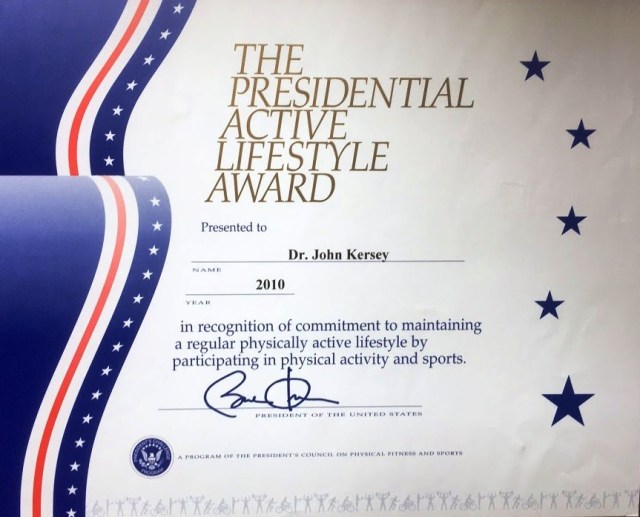

I have been awarded the Presidential Active Lifestyle Award by President Barack Obama. The Presidential Active Lifestyle Award was an eight-week program of assessed participation in physical activity, designed to promote health and fitness.
Two new CDs have been issued by Romantic Discoveries Recordings.

Piano Sonatas of Alexander MacFadyen (1879-1936) and Eduard Franck (1817-93)
with other works of MacFadyen and Adolph Bergt
John Kersey, piano
RDR CD72
Alexander MacFadyen was born in Milwaukee, Wisconsin, and studied there under William Borchert and the theorist Julius Klauser. MacFadyen’s compositions are mainly small-scale songs and piano works, but this Piano Sonata, a mature work dating from 1921 despite its opus number, is on the grandest of epic scales. It was performed in concert by legendary pianist Josef Hofmann. Stylistically, it shows a strong influence of MacDowell and Grieg, and an ambitious use of episodic form, with the outer movements comprising a set of interconnected sections. MacFadyen’s work must be reckoned among the more imposing of the sonatas of the American late Romantic era and its neglect is puzzling.
Eduard Franck was born in Silesia into a wealthy and cultured family that numbered Mendelssohn and Wagner among its acquaintances. He studied with Mendelssohn as a private student and then began a long career as a concert pianist and teacher. He was regarded as one of the leading pianists of his day and also as an outstanding teacher.
Franck was not forthcoming about his compositions, and failed to publish many of them until late in life. He was a perfectionist and would not release a work until he was absolutely satisfied that it met his standards. Yet what survives is extremely high in quality. Writing of his chamber music, Wilhelm Altmann said, “This excellent composer does not deserve the neglect with which he has been treated. He had a mastery of form and a lively imagination which is clearly reflected in the fine and attractive ideas one finds in his works.”

Piano Sonatas of Gustav Weber and Hugo Kaun
with works of Alkan and Loeschhorn
John Kersey, piano
RDR CD71
We know little of Gustav Weber’s life other than that his lack of posthumous recognition is likely the result of his premature death aged forty-one. Born in Switzerland, he studied at the Leipzig Conservatoire and became a professional organist and conductor as well as a composer. Much of his career was spent as a teacher of singing in the Zurich public schools, and towards the end of his life he became editor of the Zurich journal Schweizerische Musikzeitung. Of his piano trio, op 5, Liszt, who was the dedicatee, wrote in 1882 that “I consider [it] an eminent work, worthy of recommendation and performance.”
The Piano Sonata op. 1 is in the grandest of styles, and occupies a similar coming-of-age role in Weber’s output to the early sonatas of Brahms. It is clear that Weber had absorbed elements of the “orchestral” piano style, with many passages featuring massive chords and double octave figurations. His melodic material recalls previous B flat Sonata monuments such as the opp. 106 by both Beethoven, and more particularly, Mendelssohn. Throughout the four movements a high level of invention and creativity is sustained, with the return of the opening motif at the end of the finale marking a satisfying cyclical aspect to the work. This sonata could well be revived in concert to good effect.
By the side of Weber’s monumental work, the early Sonata by Hugo Kaun is more obviously lyrical and inward in intent. Kaun was born in Berlin and studied piano there with Oscar Raif. Around 1886, he left Germany for the United States, where he settled in Milwaukee. Here he taught at the conservatory and conducted local choirs, but was prevented from following a career as a pianist by a hand injury. Perhaps feeling the pull of his homeland, he returned to Germany at the turn of the twentieth-century and remained there for the rest of his life. He was appointed to the Prussian Academy of Arts in 1912 and in 1922 joined the staff of the Berlin Conservatoire.
Kaun’s works span all the major genres, and generally occupy a neo-Wagnerian niche that opposed the modernism of the post-First World War years. His piano concerto was dedicated to his friend Godowsky. Some of his works, particularly those for male choir, have a nationalist quality. The Piano Sonata op. 2 is a reflective, expansive work that epitomises the confident late Romantic style with a notable debt to Beethoven in its formal structure and sensitive use of texture.

The Universidad Internacional, Panama (also known by its English name International University) was a government-accredited private university in Panama in existence between 2000 and 2012. The university was founded on 27 March 2000. It was accredited and authorized by an act of the Panamanian government (Decreto Ejecutivo no. 225, of 29 May 2003, following the Decreto Ley no. 16 of 11 July 1963). All university-level programs offered in Panama are subject to approval by the CONEAUPA (the National Council for Accreditation of the University of Panama).
The University was listed in the list of recognized universities provided by the Dirección Nacional de Educación Superior. The link below is to the 2009 edition of the list.
>>Listado de Universidades Reconocidas (2009)
The University was also listed in the World Higher Education Database published by the International Association of Universities and UNESCO. The screenshot below is taken from the database as it appeared in April 2009.

As of 2009, the Rector of the University was Ingeniero Pablo Tuñon Vegas and the President was Jorge Laurencena, former rector of Columbus University, Panama. The University positioned itself as a progressive and forward-looking institution offering programs of study at Licenciatura, Maestria and Doctorado levels. There were two campuses, in Panama City (Calle 55 El Cangrejo) and in La Chorrera (Avenida de Las Américas, al lado de Rodelag). Programs were offered either fully on-campus, by mixed campus and distance mode, or fully by distance learning. The on-campus programs included evening classes for working students.
The Doctor of Education with specialization in Higher Education (Doctorado en Educación con Especializacion en Docencia Superior) program was marketed to educational practitioners within Panama and to both Spanish and English-speaking students in the United States of America. The aims of the program were as follows:
The Study Plan was designed to be offered in six four-month periods of sixteen weeks each, plus a final thesis. The majority of courses required forty-five sixty-minute academic hours (or equivalent) and granted three academic credits; others were assigned two credits. The total of credits for the program was seventy-two.
I was a candidate for the Ed.D. degree via the University’s then-appointed representative office in the United States of America. This meant that, although I am competent in the Spanish language, I could also submit materials in English for assessment. I completed the degree requirements under the guidance and assessment of three professors and undertook a final dissertation, which was an expansion of my earlier published work on the history of American distance learning pioneer Central University, Indiana. Other aspects of the program that particularly interested me were the opportunity to focus on my principal professional interests of comparative international education and distance education, and to draw upon my experience of administration and management in further and higher education settings. I began to formalize most of my work for the program in 2005, although my thesis drew upon earlier research, and the final submission was made in April 2009. I received notification of my successful result from Dr Laurencena, and my degree was duly awarded on 25 June 2009. I transcripted seventy-three semester hours of graduate credit with a grade point average of 2.88 out of the maximum 3.0 used in the University’s grading scale, equivalent to an overall A grade.

My Doctor of Education degree certificate (obverse)

My Doctor of Education certificate (reverse, showing the Apostille issued by the Panamanian Ministry of Foreign Relations)
Several years after my graduation, in 2011, the University was admonished by the CONEAUPA for offering programs that it had not approved. In August 2012, it was determined by CONEAUPA that the University had repeated this behaviour and CONEAUPA passed a resolution determining that the University had committed a serious offence. On 4 December 2012, the President of the Republic of Panama, Ricardo Martinelli, signed Decreto Ejecutivo no. 1205 (promulgated in the Official Gazette no. 27,177 of 5 December 2012), which cancelled the University’s operating license. No information was provided to alumni concerning these issues at the time, and I did not become aware of the University’s problems until after the University had ceased to exist. It appears that some form of operation by the University continued for a period after 2012, but I do not know under what authority this was undertaken.
It remains the case that those degrees issued by the University between its accreditation in 2003 and its closure in 2012, including my own Ed.D. degree in 2009, were issued by an university that was fully accredited by the Panamanian government.
 The Universidad San Juan de la Cruz (University of St John of the Cross or USJDLC) is a fully accredited private university in Costa Rica.
For some general remarks on Costa Rican private universities, their legal context and international comparability, please see this article.
The University has been continuously accredited by the Consejo Nacional de Enseñanza Superior Universitaria Privada (CONESUP) of the Ministry of Education, Costa Rica, since 20 May 1996. An officially certified and Apostilled copy of the complete listing of private universities accredited by CONESUP as of 2017, including the Universidad San Juan de la Cruz, can be downloaded here:
>>Officially certified list of CONESUP-accredited private universities (April 2017).pdf
As of 2015, the University was listed in the International Association of Universities/UNESCO International Handbook of Universities:
>>International Handbook of Universities listing (2015 edition)

The University has graduated over 8,000 students since its inception, the majority of whom are of Costa Rican nationality. The University specializes in programs aimed at working adults who wish to study in a classroom setting, by distance learning, or by mixing the two study modes.

Class in progress of the Universidad San Juan de la Cruz
The University has maintained various teaching campus centres over the years. At the time of writing, the campus is at Guachipelín de Edificio VMG, Piso 1, San José Province, Escazu, Costa Rica. Most of the offered degree programs are at Bachiller, Licenciatura and Maestria levels with the key areas being Law, Business Administration and Public Accounting.
In 2009, the university which I co-founded and head today, European-American University, established a relationship of academic collaboration and subsequently validation with the Universidad San Juan de la Cruz, which continues at the time of writing. As such, I was offered the opportunity to become a candidate for a degree on the same terms as other members of the faculty. Accordingly, I was a candidate for the degree of Doctorado en Humanidades (PhD in Humanities) in 2009. At the time of my candidacy, the President of the University was Fernando Trejas Castro and the Secretary was Juan Pedro Chavarria Otárola. The University agreed to award the degree by incorporation of my previously-earned French PhD.
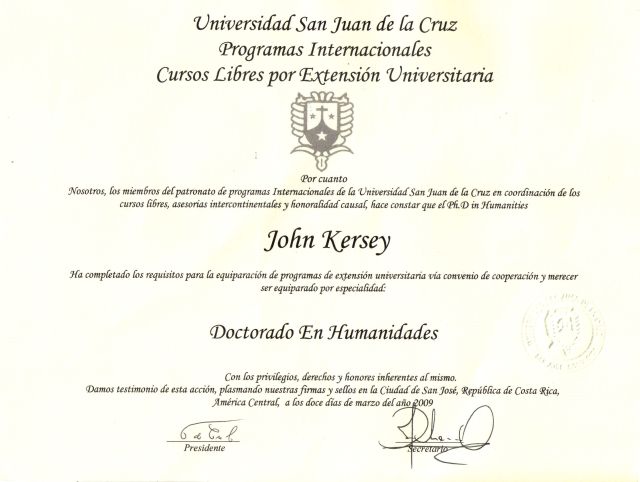

Together with my doctoral certificate, the University issued me with a certified statement of its status as an accredited institution from CONESUP, signed by the Executive Director of that body, Ms Evelyn Chen Quesada.

 The case of Saint Regis University (SRU), an online distance-learning school which between 2002 and 2004 held recognition by the government of Liberia, is uniquely complex and problematic in the study of transnational education and the questions of legitimacy and authority that it raises.
SRU was a radical and iconoclastic interloper in the higher education establishment. It was established by the owners of a successful trade school and brought the direct, no-nonsense approach of a trade school to the university sector. It did not so much challenge academia as threaten to destabilize it altogether. In the middle-class circles of university education, SRU was a blue-collar outsider not inclined to mind its manners. SRU was hugely successful, with many satisfied graduates, and made millions of dollars. It also made some extremely powerful enemies, determined not only to close it down but to demonize everything it had stood for.
In 2004, SRU found itself denounced by its opponents as a diploma mill in US Congressional hearings, with no right of reply and no attempt at a balanced presentation. Subsequently, the United States government let it be known to the Liberian Ministry of Education that if it did not withdraw support for SRU, US funding to the Ministry might be withdrawn. Mired in legal troubles. SRU closed in late 2004. Then, in 2005, criminal charges were filed against eight US citizens involved in the operation of SRU. All eight subsequently pleaded guilty, thus meaning that no trial took place and many of the most significant arguments surrounding the case were not tested in court.
There remain troubling questions about the role of the US government in the whole saga. The case itself raises serious issues of bias and due process. Its conclusions have also been subject to a great deal of politicization, both by the media and by the education establishment.
In the discussion below, I intend to tell the story of SRU, focussing on the following issues:
1. The birth of a revolutionary idea
The principals behind SRU were a married couple called Dixie Ellen Randock and Steven Karl Randock from Spokane, Washington. Before starting SRU, Dixie Randock had started and grown a real estate school to a position of significant success. She was smart, ambitious, single-minded and dedicated to making SRU a revolution in online schools. She was the educational mastermind behind what would become SRU, while Steve Randock handled the finances.
Dixie recalls,
I attended college quite a few years and was a very successful real estate broker with multiple offices and member of Spokane Club, Country Club, etc. My husband and I were millionaires long before ever starting SRU, had very successful businesses and exceptional reputations.
It was after we were embezzled [by their former accountant, who went to jail as a result] that I began putting together SRU, even though I had thought about it for a few years prior. The embezzlement of what police said was $600,000+ (actually much more) caused me to close my brokerages in WA and ID, although I kept the real estate/law school open. I had written all the State approved texts and courses for these schools myself, which are still in use in the school and other colleges to this day.
In 1999, Dixie had branched out and become the proprietor of AdvancedU.org. This offered degree programmes by using life experience credit. It asserted, “Our Evaluation & Endorsement Advisors evaluate and match your life experience with traditional college curriculums to provide you a wide variety of 100% verifiable degrees, certifications, credentials, designations and awards for “self-made” and “self-taught” experts in all fields. No classes or attendance is required, because this is NOT a school. Unlike school programs, The Evaluation & Endorsement Program is an evaluation process, which is done by only a few specialized organizations.”
The Evaluation and Endorsement Program used a concept described as “peer evaluation”, conducted by a “peer advisory” and administered by the Evaluation & Endorsement Peer Advisory Trust. By 2001, the evaluation body had developed into the Advanced Education Institute Trust (AEIT). The peer advisory idea was radical, for it suggested that rather than assessment being conducted by individuals of higher status than the candidate (as in traditional academia), it would actually be conducted by peers of similar status. Cohort or peer assessment had precedent in short-residency non-traditional mainstream programmes such as the University of Phoenix, and also at the Union Institute, whose doctoral committees were composed not only of mentors but also of peers. The Trust said of its process,
Our clients describe accreditation by their peers as the ultimate validation of their own knowledge and achievements, and their credentials as extremely valuable and proven in enhancing personal careers, gaining confidence to increase earning potential, improving self esteem, and heightening recognition, respect and appreciation by others.
Clearly, peer evaluation was a radical and nontraditional statement of educational philosophy – effectively asserting that any person who had received the proper training could be competent to recognize educational achievement gained through life experience and to map it to a degree curriculum. It also avoided some obvious problems in recruiting faculty. The faculty and doctoral graduates of mainstream universities were unlikely to have specialist expertise in experiential credit assessment or to be sympathetic to its revolutionary implications, rendering them unsuitable for appointment. Dixie said,
I researched the many ways available to earn college credits through an evaluation process of experience, self-study, independent studies and research, etc. I collected and studied the processes (e.g.; x years practical experience equaled x credits) and began creating a sort of matrix for our advisors to use that closely matched US and European universities.
Although not all our advisors held mainstream degrees, they did understand the equivalency matrix and also had access to sources when the credit might be given for research, dissertations, other papers, or independent studies.
The Trust made it quite clear that what was being offered was a non-traditional challenge to the mainstream.
This is a unique process, established for deserving individuals who for one reason or another did not obtain a degree in the traditional fashion.
Even the most stringent educators are coming to the realization that in today’s information age, an individual can reach and surpass college graduate levels of knowledge without ever stepping inside a “brick and mortar” classroom.
Many talented, intelligent, and creative individuals have attained more education than a college graduate by self-teaching, and learning through their own research, practice and work experience.
It is common knowledge that many of our world’s most innovative pioneers in technology, science, and practices belong to this group of individuals.
However, most universities arrogantly insist that you can ONLY attain a degree level education by enrolling, paying and attending a college for years.
Perhaps this thinking is meant to prevent a perceived conflict of the school’s own best interest, in that granting a degree to a self-educated person may take away tuition that might have otherwise been paid to the school.
Initially, AdvancedU.org awards said on the diploma that they were not degrees, and that the Evaluation & Endorsement Peer Advisory Trust was “a process, not a school”. Nevertheless, the market was looking for a product that would fit into the mainstream of credentials, and that meant awards that were described as degrees and, if they were not actually to be issued by schools, at least used names that were similar to schools. As of 2000, the website stated,
These are NOT schools, and they should not be confused with the names of any University. Please let us know which Peer Advisory Program name you prefer. You may choose from any of the Peer Advisory Programs:
Holy Acclaim University, Saint Lourdes University, Holmes University, Cathedra University, Audentes Technical College, Concorda Graduate Institute, Saint Concordia University or Valorem University.
Peer Advisories are assembled into groups of individuals who are considered to be experts in their subject areas.
These lines came to be further blurred, however. A year later, the same section read:
You may choose from many established Peer Advisory names, or you may choose a Custom Name. A custom name is any name that you choose or create and is not in use by an existing, accredited university or one that would infringe upon registered trademarks, symbols, etc. [A link was provided to unavailable names that were members of the Collegiate Licensing Company]
To view a list of names that AVAILABLE names that are no longer used, and are available, click the link for a list of Closed Universities & Colleges.
It must be stressed that the Academic Peer Advisories use words including “college”, “university”, “academy” etc., not as nouns, but as the lexis in their descriptive titles. The names are titles of Academic Peer Advisories, NOT schools. The programs do not offer courses or classes and are not for those who are beginning or continuing their academic education.
Viewed with the benefit of hindsight, this justification was too subtle a distinction to be grasped by most consumers. Documents that were the result of the peer advisory process continued to bear the seal of the Trust, and were worded so as to state that it was the awarding body, but started also to bear the names of genuine schools when these were chosen as Academic Peer Advisories. Moreover, they could be verified by the official verification centre (also maintained by AEIT) in whatever institution’s name was on the certificate.
While this might be ethically problematic, it was not a legal difficulty – at least not for AEIT as the issuing body, since there was no law against doing this in either Washington or Idaho. The documents from AEIT presented as exhibits in the SRU case are not similar to those provided by “replacement diploma” or “fake diploma” services that mimic the look and the signatures that appear on actual diplomas issued by the schools in question. Rather, they all use an identical and distinctive typeface and format. They bear the AEIT seal and state that the awarding body is “The Regents of the Evaluation and Endorsement Advisory and the President and Chief Provost” Other wording states, “Be it known that knowledge and proficiency has been demonstrated by completing and satisfying all requirements of the Regents of the Evaluation and Endorsement Advisory”. One transcript using the peer advisory name of “University of Maryland” gives Dominica as its address. The documents might well have produced confusion, but a straightforward reading would be unlikely to give the impression that they had been created to deceive.
At AEIT, as would be the case at SRU, each candidate was assigned an advisor for the duration of their programme. These peer advisors carried out assessment of the candidates and assigned credit to them. They had all received a full training programme and were equipped with a kit consisting of hundreds of electronic letters that were scripted responses to likely enquiries. Where an issue arose that they could not handle themselves, they would pass this on to senior management.
Peer advisory degrees could be backdated. The rationale was that if the applicant was qualifying on the basis of their experience, then their degree would logically have been earned at the point in time when that experience had reached the level required by their degree, rather than at the point when it was presented for credentialling,
Your degrees and transcripts will be dated as closely as possible to the time that you attained your education.
For example, if you reached a Bachelor Degree level education (without attending classes) by 1996, we recommend that your degree be dated no earlier than 1996. Then, if you attained a Master Degree level education by 1998, your degree should be dated 1998 or later, and so forth as your education level increased up to a Doctorate level.
The peer advisories allocated experiential credit by creating formal transcripts listing coursework that, according to them, were comparable to the applicant’s experience. These transcripts were based on the standard degree curriculums of mainstream universities. The final result did not indicate that credit had been earned through experiential assessment, and simply gave a list of courses, credits, grades and a grade point average.
Transcripting experiential credit in this way was in keeping with the practice of several mainstream schools that granted credit for experiential learning. For example, Charter Oak State College in Connecticut (www.charteroak.edu), a regionally accredited US institution, had at that time (and still has today) a bachelor’s degree programme in which it is possible to submit a portfolio of experiential learning credit to challenge a wide variety of courses that would otherwise be completed via examination or coursework.
In addition, applicants could transfer credit into the AEIT programme from other universities, which was permitted without limits on the age or amount of credit that could be transferred in. Many other institutions place artificial limits on credit transfer in order to compel the student to take a minimum number of credit-bearing courses with their school, irrespective of whether such a learning experience is academically necessary from the student’s perspective.
As was explained,
…you will receive transcripts for each degree, showing representative courses that correspond to your experience as compared to a traditional classroom setting. The transcripts show a traditional curriculum of courses that are the equivalent of the skills you have acquired as though you attended. There is no mention of “equivalency”. The dates and grades and grade point average will appear.
An enormous amount of research and labor is required for each individual transcript. Transcripts are carefully compiled to match the candidate’s qualifications and education.
Based on the educational information and description of experience supplied by the candidate, the peer advisory can determine if the candidate’s knowledge level is on par, or exceeds that of a college graduate.
When the advisors are not provided with certain information, or if the candidate cannot provide information concerning former grades or other documentation, the advisory will make their judgment based on the available data and their own research.
When the candidate does not provide grades, the advisory may also make their own recommendations as to grades in each course, based on whatever information the candidate has provided.
There was also significant input from the candidate, who was expected to self-evaluate as part of the process:
…we always provide the candidate with a “proof” of the transcript and other documents, before original documents are produced.
When your “proof” is emailed to you for your approval, you may request changes to ensure accuracy. You may also submit your grades and other documentation at the same time of your acceptance.
We welcome and encourage your participation in the selection of representative courses that best fit your skill levels, as well as your overall and specific grades.
Your original transcript will not be completed until you are completely satisfied and have given final approval.
If you feel that certain courses (or degrees) do not fit your skill level, please let us know.
Your peers will review your data and based upon the certain criteria, they may either replace courses with those you recommend, or our advisors will research other representative courses (or degrees) to better match your circumstances.
If you wish for the advisory to modify or replace courses, please and identify the courses and provide additional as to your strengths.
Self-evaluation is again a concept encountered in non-traditional education, usually as part of a philosophy of democratization and a critique of educational hierarchy. To do this outside of a school setting is reasonably widespread. To do it as part of a process leading to the award of a degree would be an open challenge to traditional academia.
2. St Regis becomes a Liberian university
The success of AEIT made it clear that there was significant demand for experience-based credentials from a school that was real and verifiable. The next step would be to create a legitimate online university targeting working adults and offering degrees at all levels via an accelerated experiential assessment at low cost, and Saint Regis University was designed specifically for this purpose. As of 2001, SRU was one of the AEIT peer advisory names that could be used on peer advisory degrees. Later that year, it developed an independent life of its own. While its website did not include much of the information about the peer advisory process that had appeared at AEIT, the concepts and methodology were the same.
Institutions that award college credit based on the assessment of experience gained outside a formal classroom setting (referred to as the accreditation of prior learning (APEL) or prior learning assessment (PLA)) are engaged in the most revolutionary aspect of non-traditional education. College credit for experiential learning democratizes education by changing the role of the university from education provider to education assessor. It is this process, when used by schools outside the mainstream, that is most vociferously attacked by mainstream advocates, because it poses the greatest threat to the mainstream. It offers the prospect of radically cutting the duration, resources and cost of degree programmes in many areas for experienced adults, and when allied to distance learning methodologies, can potentially be expanded to meet an international market. In a key example of disruptive innovation, the non-traditional movement pioneered experiential credit as early as the nineteenth-century. Gradually, the mainstream took on elements of APEL, though still with obvious resistance to the ideology, and in a patchy manner that has left areas such as graduate-level credit poorly served. That particular market niche then became a focus for a number of non-traditional schools working outside the mainstream.
There had been “assessment universities” before SRU. One of the leading examples was the former Summit University of Louisiana under the late Raymond Chasse. Summit was a genuinely alternative distance learning school operating outside the accredited sector. At Summit, experiential learning received full credit and adult learners were placed in charge of their degree programs. Summit in turn was an extension of the University without Walls project that had begun in California in 1974 under the late Melvin Maier Suhd. Eventually, Summit and most similar schools were driven out by legislative changes. Even with the significant respect in which Suhd was held as an educational theorist and humanitarian thinker, Summit had faced constant battles with the education establishment and the lawmakers who were protecting that establishment. What they did was considered not to look like a university, nor to behave like one. It was determinedly alternative and challenging, in an area that promotes conformity – through the standardization process that is accreditation – and fears substantive change.
Ray Chasse also founded a very similar school to Summit called American Coastline University, and ran the two in parallel from his home in Louisiana. While Summit closed, American Coastline survived for a time after Chasse’s death.
When SRU first appeared online in late 2001, it asserted that it was chartered in the Commonwealth of Dominica and also derived authority from being a branch campus of the International University of Fundamental Studies in Russia (as did American Coastline University). It also cited a number of accreditations from private bodies (which did not hold government recognition) which also accredited American Coastline University. Dr Richard J. Hoyer of American Coastline University served in an uncompensated role as Provost of SRU between February and October 2002.
While its Dominican corporation would be maintained behind the scenes, this period, however, was to be brief. Clearly, it was impossible for SRU to become accredited by the conservative accrediting associations in the USA, which were extremely hostile to experiential credit for degrees. The question was then, what would be an acceptable foreign alternative? Accreditation by a national government was held by key authorities in the USA – foreign credential evaluators – to be the equivalent of recognized US accreditation. Well-known distance education author John Bear had devised the concept of GAAP – generally recognized accreditation principles – and said that for non-US schools, this meant, “recognized by (or more commonly a part of) the relevant national education agency”. Moreover, “schools the agency accredits are routinely listed in one or more of the following publications: the International Handbook of Universities (a UNESCO publication), the Commonwealth Universities’ Yearbook, the World Education Series (published by PIER), or the Country Series (published by NOOSR in Australia).”(1)
The search was therefore on for a national government that would be prepared to support SRU and grant it accreditation. Dixie said of this,
“I chose Liberia, for many reasons, one of course because they are English speaking, their constitution was very close to our US constitution, many laws are similar, and I had an idea they may be open minded as to how any person may earn a degree. It may be that many Liberians are uneducated, but there were and still are many highly intelligent people with drive and ambition, whose actual education levels are on par with those in the US and other countries with college degrees. But, these people had little to no chance of ever moving up without any documentation or evaluation of their knowledge.”
Other American non-traditional providers had also sought a home in Africa. At one time the largest non-traditional distance learning university in the USA had been Columbia Pacific University of California, which was closed in that state in what many saw as a politically motivated process. A successor institution, Columbia Commonwealth University, had sought and gained accreditation from the African nation of Malawi in 2001, and continued to offer programmes to American students on the basis of this status. Another non-traditional distance learning university offering programmes to an American as well as international base, Adam Smith University, had been established by an act of the legislature in Liberia in 1995.
On 12 June 2002, the National Board of Education, Inc., was incorporated as a non-resident domestic corporation in Liberia with its registered address as 80, Broad Street, Monrovia. The directors were listed as F. Derradji, C. Dreyer and M. Fuchs, all of the aforementioned address, with Derradji the sole shareholder. This corporation was to be the legal owner of SRU in Liberia.

Around September 2002, all mention of Russia and Dominica was removed from the SRU website and it was asserted that SRU was chartered and accredited by the government of Liberia. Specifically, the following claim was made:
“St. Regis University was originally Chartered January 10, 1984, Created by Decree of the People’s Redemption Council Government of Liberia, as a private school with a physical campus. In 1998, St. Regis University closed the physical campus and moved to a virtual location to better serve students by offering affordable programs without sacrificing quality, and began a four year accreditation process toward formal recognition.
(Prior to 1998 no process existed for the accreditation of online universities.)
On August 28, 2002, St. Regis University completed all accreditation requirements and received formal recognition by the Higher Education Commission of the Education Ministry of Liberia as a legal, valid and authentic university, operating under the authority and in conformity with all current laws and regulations ruling educational competency certification of the Republic of Liberia. The Higher Education Commission of the Education Ministry of Liberia is solely responsible for granting recognition to post-secondary education institutions in Liberia including St. Regis University, University of Liberia and Cuttington University College…
St. Regis places less emphasis on “systems” and more emphasis on “outcomes”.
St. Regis University has submitted documentation of degree programs, descriptions of course/course equivalency completion, curriculum, catalog, assessment manual, policies and all required criteria meeting the very high standards required to gain recognition by the Education Ministry of Liberia.”
(Source: http://www.saintregisuniversity.ac/accreditation.htm as retrieved on 2 December 2003)
What had happened was that the NBOE had purchased a semi-defunct school in Liberia and renamed it St Regis University. According to Dixie,
The Liberian government was eager to work with us, and it was they who recommended that we buy an existing accredited school (accredited in 1984) to become established.
The school was in Monrovia, the same building as the Liberia Department of Education, and had a small staff and phone system, but because of the ongoing war, there were no longer any students or teachers. But our intention was never to teach, but to offer online equivalency programs. So, we agreed to keep the small staff and equipped it with computers/servers, filing system and used the school in the beginning, as a base. They told us we could change the name, which we did, paid all back fees and taxes owing plus accreditation transfer, keeping the original accreditation date.
Aside from all the other costs, the accreditation for SRU had cost a mere US$300. The school had originally been named after James Monroe and was owned by the mother of one of the Liberian officials, possibly Dr Lawrence Bestman. Before long, the Randocks bought a second school, named after Joseph Jenkins Roberts, which had been accredited in 1982. The Liberian Ministry of Education suggested that this should be renamed Robertstown University.
It was news to many that SRU had had any existence in Liberia in the 1980s (albeit under a different name) before it first appeared on the Internet as a Dominican entity in 2001. However, even SRU’s harshest critics acknowledged that this was the case at that time.
“George Gollin, a professor of physics from the University of Illinois at Urbana-Champaign, has researched Saint Regis University and “diploma mills” like it. Despite its claims to Liberia, he says the school is based in the United States, and has a network of more than 100 Web sites. “These were real schools in Liberia, but they folded in the ’80s,” Gollin said.”(2)
In support of the accreditation, a number of documents were made available to enquirers. The first of these was an accreditation certificate issued by the Liberian Ministry of Education to the National Board of Education, Inc., as operator of SRU, and signed by two officials, supplemented by a document giving further particulars.
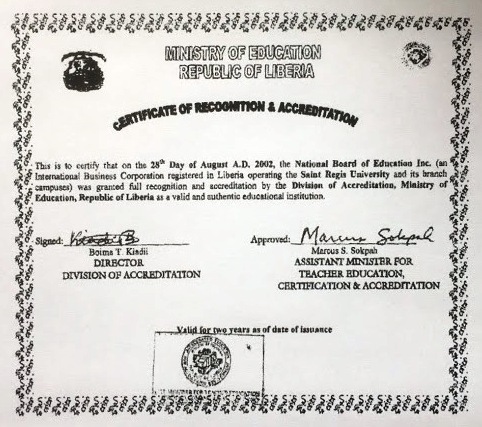

A further, similarly worded certificate would follow, signed by Dr Lawrence Saydee Bestman, the Executive Director of the National Commission of Higher Education of Liberia:

The motto adopted by the Minister of Education was “Accelerated Education for Accelerated Development”. This would exemplify the synergy between SRU and the Liberian government. As it emerged from the destruction of civil war, Liberia saw there was an urgent need to expand its higher education sector and to embrace new technologies such as distance learning and experiential assessment in order not only to meet its domestic needs but to compete internationally.
Before long, SRU acquired an official .edu.lr suffix, and its main website became saintregis.edu.lr. The .edu.lr domain was restricted to institutions with official standing as a recognized Liberian educational entity.
Gaining recognized accreditation transformed SRU. Its initial home in Dominica had offered legality, but not the acceptance that would come with government accreditation. Liberia offered membership of the cartel of accredited institutions, and a route into the acceptance that came with being part of the academic mainstream. It was a step that few other experience-based universities had previously made.
In addition, there was a market for a whole range of ancillary services. During the 2002-05 period, the Randocks not only operated SRU but a vast range of other websites, not only of other online universities but offering accreditation (through the National Board of Education, SRU’s parent body – this was available for $50,000), turnkey online universities for entrepreneurs, apostilles, an association and journal for online universities, credential evaluation and degree verification services.
Student enquiries started to pour in from around the world. Suddenly, what had been a small-scale family-run enterprise was making millions of dollars. The Randocks were unapologetic about making money. They marketed SRU with great energy and complete confidence. However, there was more to SRU than simply the drive to profit. Its success was because it was meeting market need head-on, and in doing this it was also serving to promote experiential and non-traditional education to those who would not previously have considered them.
Because so many requests for verification of SRU’s accreditation were being directed to the Liberian government, SRU made arrangements with members of the Liberian diplomatic corps and Ministry of Education staff whereby they would be paid a retainer in order to answer questions and verify the accreditation when needed.
On 13 September 2002, some two weeks after the accreditation documents were issued, Liberia’s National Commission on Higher Education published a National Policy on Higher Education:
>>National Policy on Higher Education in the Republic of Liberia (13 September 2002)
The National Policy defined the process for creating new universities thus:
The National legislature has the statutory authority for chartering institutions of higher learning only following recommendation from the National Commission of Higher Education.
The process for accreditation was described as follows:
The National Commission of Higher Education will evaluate the missions, objectives, academic programs, physical resources, finances and qualifications of administrative and instructional staff of an institution of higher learning and subsequently accredit the same. Physical resources will include campuses, classrooms and office furniture, libraries. adequate and relevant books, instructional material, laboratory equipment, conductive working environment, safe drinking water, electricity aid sanitary facilities. Evidence of accreditation will be the issuance of a certificate of accreditation by the National Commission of Higher Education or use of another official instrument by the Commission to be considered a legal document of permission to operate.
Further provisions of the National Policy dealt with financing, curriculum and the other expected aspects of tertiary accreditation. It certainly gave a clear impression that Liberian accreditation involved the operation of meaningful standards and was not merely a rubber stamp. However, SRU had been accredited just before the issuance of the National Policy.
3. SRU’s educational processes
SRU offered several routes to a degree. As of 2003, these were listed as “assessment of knowledge; “testing out” (summative examinations); Independent Study – Thesis Research; Transfer of Credit; Coursework”. A number of alumni dissertations and theses were placed online; these included some accomplished work as well as some that would admittedly have been unlikely to have met the standards of a recognized US university. Some graduates were also known to have completed a coursework route to a degree.
The majority of degrees, however, were awarded by assessment of the applicant’s prior education and experiential learning. Up to 100% of a degree could be earned through the submission of prior learning and experience, including at the masters and doctoral levels. These processes were explained at length on the website with examples of the conversion of experience to college credit.
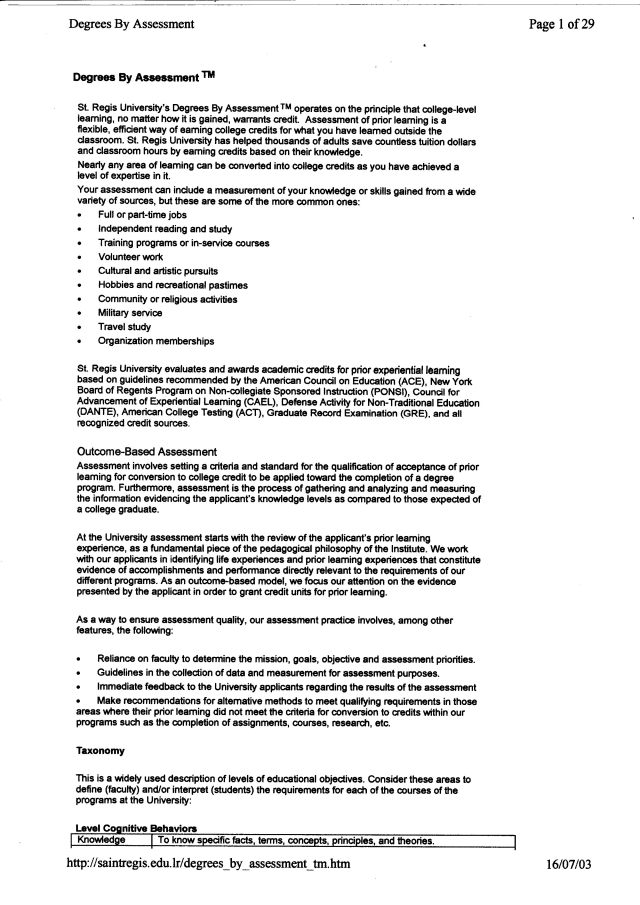
 This was followed by a series of detailed breakdowns for a number of common degree programmes.
Concerning what was required of the applicant, SRU said,
These are general principles for conducting assessment.
Apply online for a FREE Evaluation Include your resume/CV and references.
It is rare, but occasionally applicants qualify using through assessment alone (Pre-Approval). But, more often additional credit is required which can be earned through instructions/guidelines provided by the Assigned Professor. (Conditional Approval).
Applicants will be emailed a notice of either Pre-Approval or Conditional Approval. If the applicant receives Pre-Approval he/she will be give directions for acceptance and payment of graduation fees.
If the applicant receives a Conditional Approval, he/she will also receive details about the ways to proceed to meet the desired degree graduation requirements.
The applicant’s evaluation results, resume/CV will be assessed and validated by the assigned Professors and an evaluation results report will be emailed.
Once the applicant has received the required credits for graduation, he/she may accept the degree by paying the proper graduation fee.
If the applicant’s scores and assessment do not meet the number of credits required, his/her assigned Professors will suggest courses, alternative learning sources and/or supplemental submissions to complete the graduation requirements.
Also,
Send us your resume, CV, thesis, and description of your skills and experiences for a FREE EVALUATION. Your appointed advisor will compare your knowledge to levels of education required in traditional college curriculums.
The application form allowed the applicant to submit a resume, but in addition they were asked in a section allowing for free-form text (which could be added to by email if needed) to,
Please describe your life and work experience, and/or qualifications, and/or other education you have acquired, and/or any other justification you feel is important and should be considered by your advisor in your evaluation for credit.
Two references were also required. One notable omission was that there was no attempt to verify the identity of the applicant through examining official identity documents. This would prove a costly error in the light of subsequent events.
SRU’s failure was not in its willingness to promote experiential college credit or boldly to proclaim it the direct equivalent of a traditional curriculum. That process won it friends and supporters, including me, among those who favoured that methodology and who wanted to see it furthered, as well as enemies among those who wished to see it curtailed. Too often, the attacks made on SRU graduates were the result of envy and resentment from those who were unshakeably wedded to the time-serving vision of university education, and could not accept that someone might have gained experience that was judged to be the equivalent of many hours of classroom instruction. For them, it was “unfair” that SRU graduates had qualified for degrees by APEL assessment rather than doing college “the hard way”. They privileged processes over outcomes, and their outrage was easily manipulated by the media and opponents of SRU.
3. Recognized American academic authorities that accepted SRU
When some enquirers made contact with SRU from mid-2003 onwards, they were given a file of documents that indicated wide acceptance of SRU in the United States academic community. Firstly, there was a series of letters and faxes from accredited United States and Canadian universities. Secondly, there was a series of evaluations from foreign credential evaluators in the United States.

Acceptance of an SRU degree for graduate study by Vanguard University, California
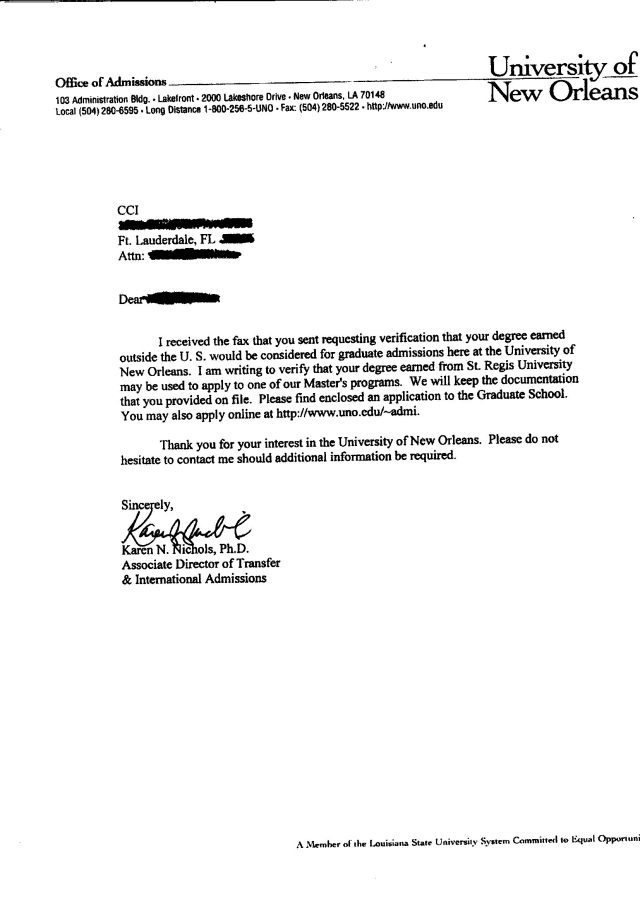
Acceptance of an SRU degree for graduate study by the University of New Orleans, Louisiana.
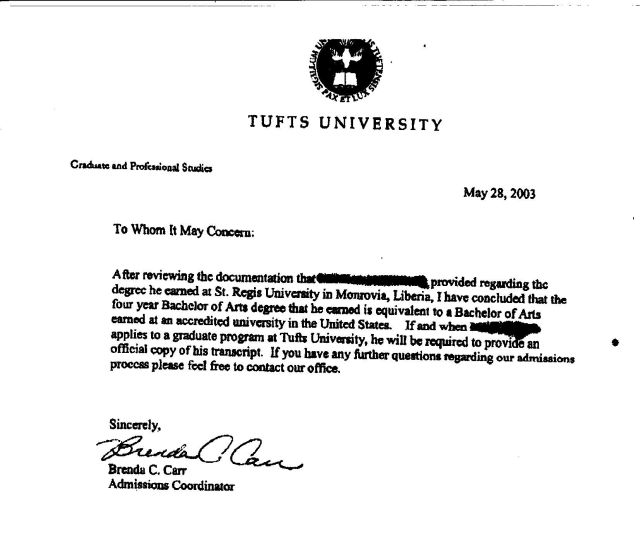
Acceptance of an SRU degree for graduate study by Tufts University, Massachusetts

Acceptance of an SRU degree for graduate study by Northern State University, South Dakota

Acceptance of an SRU degree for graduate study by Lasell College, Massachusetts
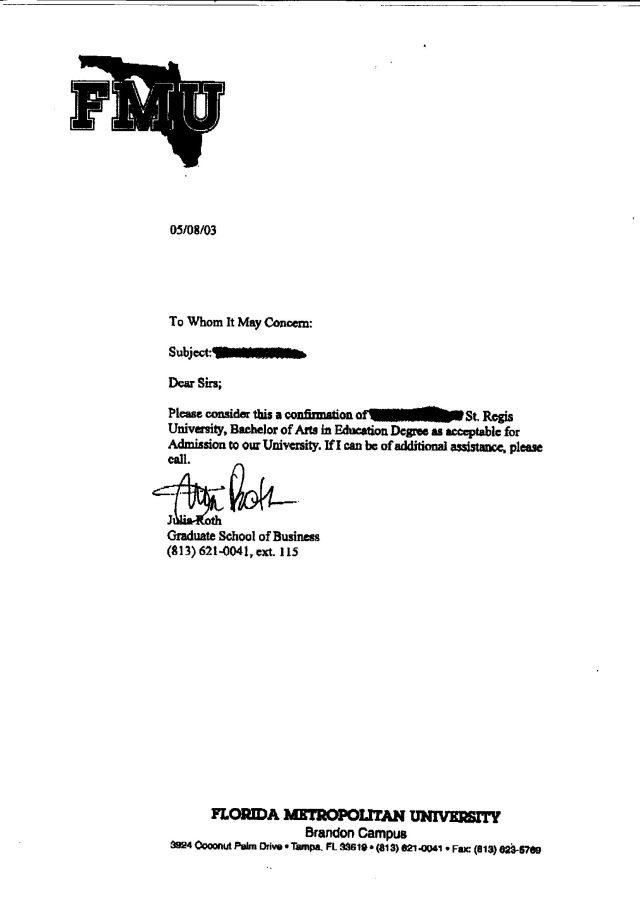
Acceptance of an SRU degree for graduate study by Florida Metropolitan University

Acceptance of an SRU degree for graduate study by Eastern New Mexico University
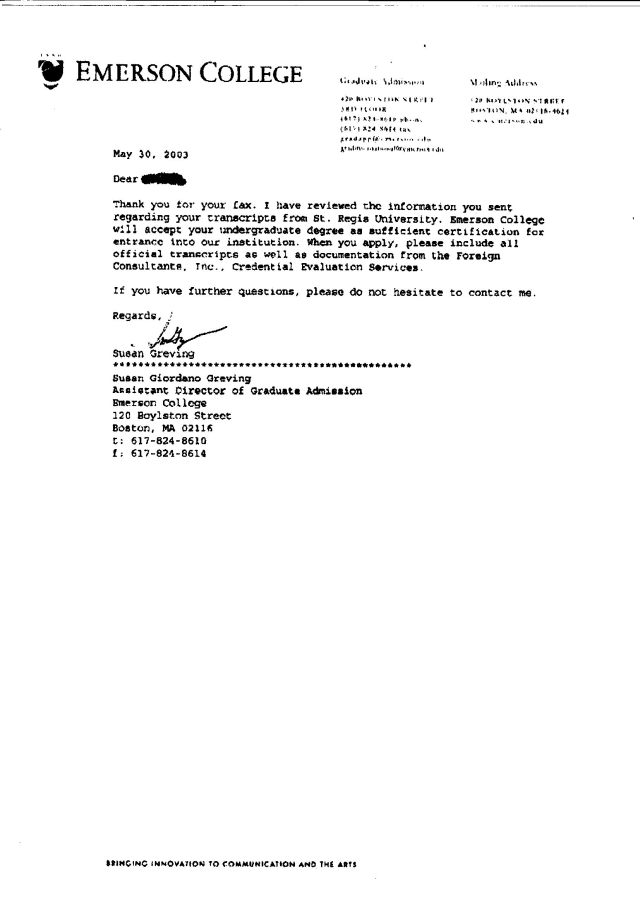
Acceptance of an SRU degree for graduate study by Emerson College, Massachusetts

Acceptance of an SRU degree for graduate study by Concordia University, Wisconsin

Acceptance of an SRU degree for graduate study by the Canadian School of Management, Ontario

Foreign credential evaluation of SRU degree by SDR Educational Consultants
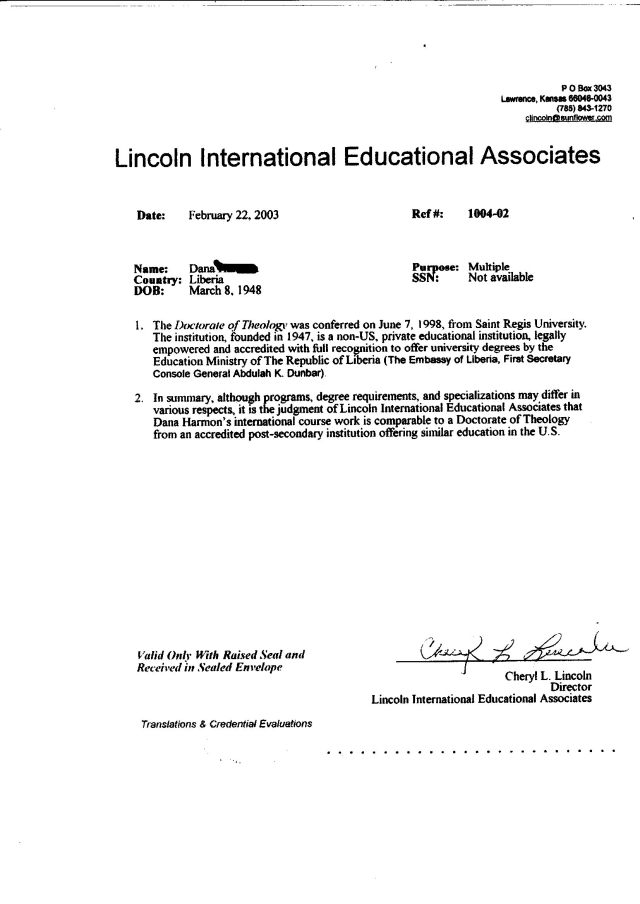
Foreign credential evaluation of SRU degree by Lincoln International Educational Associates. It is not clear how they determined that SRU was founded in 1947!

Foreign credential evaluation of SRU degree by Foreign Consultants, Inc.

Foreign credential evaluation of SRU degree by AUAP Credential Evaluation Services
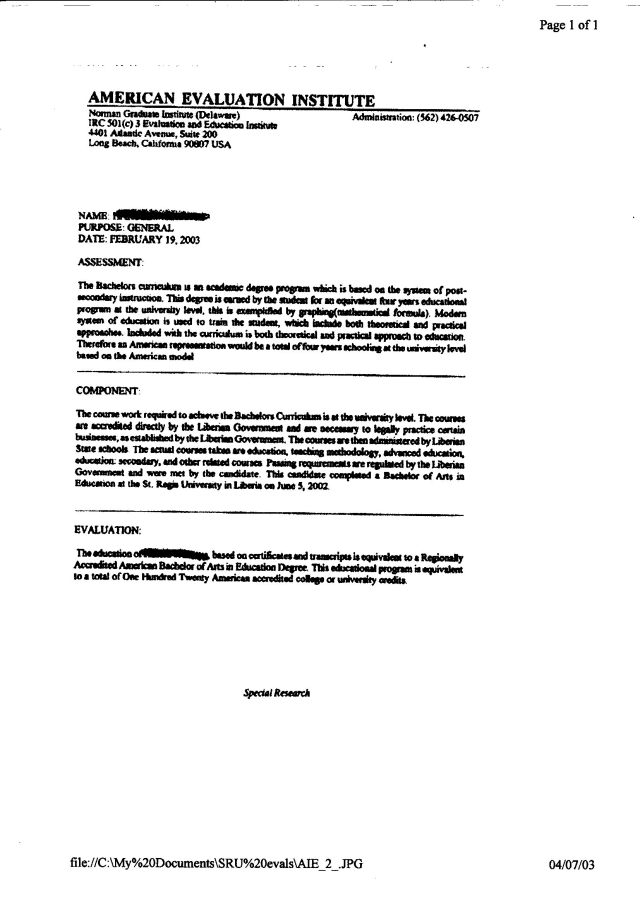
Foreign credential evaluation of SRU degree by the American Evaluation Institute
With respect to the universities, it should be noted that detractors of SRU, notably Dr John Bear, commonly used to ask its defenders to produce just one accredited university that would accept its credits or degrees. It will be clear that there were, in fact, several, and there were others besides those that have been documented above. Directly such information was made public, however, it would lead to the targeting of the institutions concerned by those opposed to SRU in a bid to reverse the situation; it is doubtful that any of the universities above were still accepting SRU degrees beyond 2003. For example, the University of Connecticut’s response to a SRU graduate’s admissions enquiry was made available on the web in April 2003; it is reproduced below:

After Bear contacted the author, however, things changed:
[Bear] Following an inquiry as to whether Ms. Balinskas had in fact written this memo, and whether her office did, in fact, accept the degrees of St. Regis University, Ms. Balinskas replied as follows:
Date: 2003-04-30 17:36:33 PST
“I have gone back through my e-mail archives to try to find the original question regarding St. Regis. All I was able to find was this e-mail that was written after I faxed back the response to the question. As is evident, the Subject of this e-mail was Bachelor’s Equivalence in general, and not St. Regis. I am truly sorry for this misunderstanding.
My information indicates that there are two national academic bodies in Liberia authorized to accredit educational institutions: the Ministry of Education and the Liberian National Commission for Unesco. There are only 2 institutions recognized by these bodies as legitimate: University of Liberia and Cuttington University College. I also have an e-mail from an educational advising assistant at the U.S. Embassy in Monrovia, Liberia that the African Methodist Episcopal Zion Univ. has the approval of the Ministry of Education to operate in Liberia. Unless there are other (more recent than my references) educational institutions that have been LEGITIMATELY ACCREDITED we would only consider applicants from the institutions I have listed above.
Marylou Balinskas, Director, Graduate Admissions
University of Connecticut, 438 Whitney Rd. Ext. Unit 1006
Storrs, CT 06269-1006, E-Mail: mary.b…@uconn.edu
Phone: (860) 486-0988, Fax (860) 486-6739″(https://groups.google.com/d/msg/alt.education.distance/Gsyq62KOjYE/mnoDHFjdZ_kJ)
It will be obvious that this response was at complete variance with the memo; it was also factually incorrect, in that the Liberian National Commission for UNESCO never had any role in the accreditation of educational institutions. But the strategy for SRU’s opponents was clear and proceeded by several steps:
This activity further inflamed the conflict between SRU and its opponents.
The positions of foreign credential evaluators changed, too, though this was prompted more by the 2004 disclaimer (that will be discussed below) and negative publicity. The former American Evaluation Institute was the last evaluator known to accept SRU degrees and was still doing so at the point of SRU’s closure.
There were several cases of SRU graduates being accepted to postgraduate degree programmes at accredited universities in the USA and elsewhere, and going on to complete those programmes successfully. They were the fortunate ones. Other postgraduate students were targeted and expelled from their programmes once activists had seized on their SRU degrees and made trouble for them.
4. SRU and the Liberian government
The Second Liberian Civil War had reached a point of relative stability by September 2002 when the government lifted the state of emergency in Monrovia. 2003 started quietly but then degenerated into further fighting in March. At this stage the USA and others exerted pressure to bring about peace talks. These took place in Ghana from June 2003 and after US forces had ended the siege of the capital in July, President Charles Taylor agreed to resign in August. This was not the end of hostilities and conditions in Liberia continued to be hazardous and characterized by violence, shortages, and poverty. Amid this situation, members of the civil and diplomatic services went unpaid for long periods of time.
SRU was in touch directly with President Charles Taylor both by phone and email prior to his resignation.
SRU was represented at the peace talks in August by Richard Novak, its Executive Vice-Chancellor, who travelled from his home in the USA with Abdulah K. Dunbar of the Liberian Embassy in Washington, D.C. As a result of SRU’s representation at the talks, the Liberian Embassy in Ghana agreed also to act as a verification source for the accreditation and status of SRU, with the contact details of the Chargé d’Affaires, Andrew Kronyanh, being listed on the SRU website. In addition, Novak met with Kabineh Ja’neh, who would be appointed Minister of Justice in the new administration, and who was supportive of SRU’s educational mission. A group of SRU’s alumni had expressed a wish to assist Liberia in its reconstruction efforts, and it was put to Ja’neh that the funds alumni had raised could be used to set up a scholarship fund for students at the University of Liberia, which had been largely destroyed during the fighting. Ja’neh informed Novak that the Ministry of Education would be the responsible body for any such arrangement. An agreement for the acceptance of academic credits was also to be negotiated by Ja’neh between SRU and the University of Liberia in 2004, but this was not concluded. A similar credit agreement with the African Methodist Episcopal University had been mooted in 2003.
At the Liberian Embassy in Washington, D.C., there was confusion for a period in 2003 as to who was in charge between Abdulah Dunbar, the First Secretary and Consul, and his rival Aaron Kollie, who as Chargé d’Affaires was head of the mission. Dunbar had come to the embassy in the 1990s under the Tolbert administration and was opposed to the Taylor regime, while Kollie had been appointed under the Taylor regime in 1998. Dunbar had been a key figure in obtaining accreditation for SRU and was paid a retainer by SRU to answer the many requests for verification of SRU directed to the embassy as well as additional fees for extra work when required. Kollie, meanwhile, would later be cited as having provided assistance to the US authorities in the SRU prosecutions(3).
Dunbar was responsible for sending official letters to several US-based critics of SRU, defending the university and its accreditation.
>>Dunbar to Oregon Office of Degree Authorization, 10 March 2003
>>Dunbar to Ten Speed Press, 10 March 2003
In June 2003, Dunbar was recalled to Monrovia, but refused to go. He maintained that the recall was void because it was part of a plot by Kollie and others to sack him. When he attended the Liberian peace talks with Novak in Ghana in August 2003, Novak lobbied for Dunbar’s reinstatement. Meanwhile, the US State Department confirmed Dunbar’s recall and withdrew his diplomatic status, with the result that Dunbar returned to Monrovia in October 2003.
During Aaron Kollie’s time in charge of the Embassy, he had refused to confirm the accreditation of SRU to enquirers and issued the following statement in September 2003,
The Embassy of Liberia in Washington, DC wishes to dissociate itself and to announce that it has no official dealings with the online St. Regis University. The Embassy of Liberia is not a source to verify or authenticate the accreditation status of St. Regis University, and would as such assume no responsibility for any reference to the Embassy. Anyone seeking clarification on the status of St. Regis University should channel same directly to St. Regis.
Sgd: Aaron B. Kollie, Charge d’Affaires
After this, Kollie was contacted by SRU, and it became clear that he would be prepared to confirm SRU’s accreditation, so long as SRU arranged to pay him a similar retainer to that which they had paid Dunbar. Kollie was paid a sum of money, but events overtook the arrangement.
Dunbar arrived back in the Washington embassy shortly after his departure, this time bearing two letters from the new administration, one confirming his appointment as Chargé d’Affaires, and the other recalling Kollie. This time, Kollie refused to depart, and the two men ran rival administrations from the same embassy until the matter was finally resolved in Dunbar’s favour in December 2003(4). Dunbar would serve as head of the mission until the appointment of S. Prince Porte as Chargé d’Affaires in February 2004. Porte served until the appointment of Charles A. Minor as Ambassador in June 2004. According to Dunbar, Charles Minor was opposed to him, just as Kollie had been, because of Dunbar’s known antipathy to the Taylor regime.
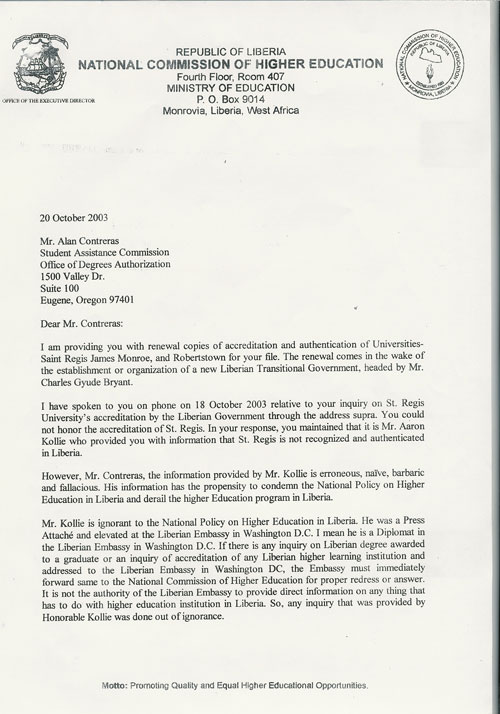
Because of the confusion Kollie’s statement had brought about, Dr Bestman of the National Commission of Higher Education wrote the following letter to Oregon’s Office of Degree Authorization on 20 October 2003:

On 11 September 2003, the National Commission of Higher Education under Dr Bestman issued a document recognizing and authenticating SRU as a further measure to combat Kollie’s disinformation.

This document was authenticated by the Liberian Ministry of Justice on 2 February 2004:

and by the Ministry of Foreign Affairs the following day:

On 16 October 2003, SRU was awarded accreditation for a further five year period by the National Commission of Higher Education. This took it beyond the two year accreditation period awarded by the Commission on 28 August 2002, which would have expired on 27 August 2004.

The accreditation document and the charter that accompanied it would bring SRU into compliance with the published National Policy requirements. The Charter was very obviously not created in 1984, since it makes reference to delivering programmes via the Internet. However, this document was backdated to the original date of the creation of the Liberian school that subsequently became SRU with the full knowledge and blessing of the National Commission on Higher Education and its Executive Director, Dr Lawrence Bestman. Governments can and do enact retrospective provisions, and may also provide for the legality and validity of backdated documents.
In mid-2003, I spoke to Dr Lawrence Bestman, Executive Director of the National Commission on Higher Education, on the telephone. My purpose in speaking with him was to establish the authenticity of SRU’s accreditation documents and also to gain some impression of the position of the Ministry of Education on distance learning and related matters. Our conversation lasted the best part of an hour, during which he confirmed that SRU was a totally legitimate Liberian university, and stated that he had dealt with them for about five years. Indeed, he had himself graduated from SRU during the 1990s. He confirmed that the National Commission of Higher Education under him was the only entity licensed to accredit universities in Liberia, and informed me that the accreditation process was “rigorous”. He was insistent that I should refer all enquiries to him directly, and that he was the authorized authority of the Ministry of Education to deal with all accreditation matters. He stated emphatically that the charter and the accreditation certificates that bore his signature were authentic.
Ambassador Prince Porte also issued a document on 18 March 2004 disclaiming Kollie’s actions and reaffirming the accreditation of SRU by Dr Bestman on 16 October 2003, including a list of recognized Liberian universities that had been prepared Dr Roland at the Ministry of Education:


I spoke by telephone to Abdulah Dunbar in January 2004, and to the Chargé d’Affaires at the Liberian Embassy in Ghana, Andrew Kronyanh. They both confirmed the accreditation to me and spoke highly of SRU. I spoke on two occasions to the Liberian Embassy in London, UK. On the first occasion, they told me that they had never heard of SRU. I reported this when speaking with Dunbar, who assured me he would deal with the matter. On the second occasion I called the London embassy in May 2004, they confirmed that SRU was on the list of recognized universities in Liberia.
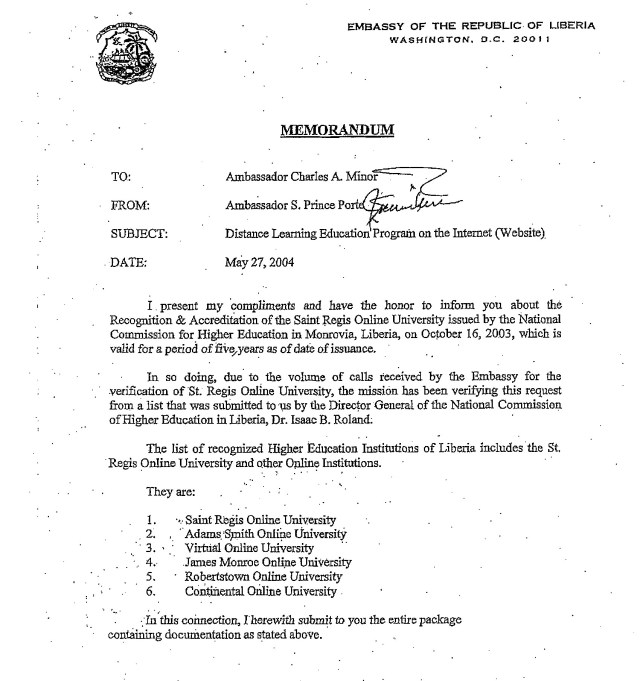
On 27 May 2004, Prince Porte wrote to the newly appointed Liberian Ambassador in Washington, D.C., Charles Minor, confirming the authenticity of SRU and its accreditation as issued by Dr Bestman on 16 October 2003:
5. Trouble for SRU
One aspect of SRU that caused controversy was the anonymity of its advisors, who were referred to either by their first names or by aliases. Dixie explained this by saying,
“Most of the advisors were female, and wanted online anonymity. I came to know Kristiaan De Ley, owner of Concordia College & University, and he recommended the use of online names, and did this also at his university. He found the males were treated differently, and many females were often dismissed as “secretaries” or even harassed. He told me that females faced some discrimination and were not always treated with the same respect as the males. I also noticed many online schools, businesses and universities used only first names or screen names, so it made sense at the time.”
Dixie herself used a number of male aliases, including “Dr Thomas Carper” and “Patrick O’Brien”. At that time, entrepreneurs in postsecondary education were rare and female entrepreneurs vanishingly so.
As SRU got bigger, so it ran into difficulties. According to Dixie,
In the beginning, all advisors were well trained, some with teaching degrees, and others with experience in related fields.
But, as SRU grew and became very successful, many people came to us wanting to be “affiliates.” This was a time that online affiliate programs were quite new, but we had people from countries all over the world who wanted to be a part of this great new enterprise. I spent hours, weeks, months, training these new affiliates, and at first I saw no problems. But, as I am sure you are aware, some had other ideas….bad ones. One advisor, who was actually working on our Spokane office, using my equipment, staff, everything, simply copied my website. Word for word, and connected it all to his email addresses and credit card accounts and began issuing degrees – based on nothing at all.
We discovered this, by accident, got rid of him and shut down his fake sites, but damage was done. Then, some similar things happened with affiliates overseas, and I soon found I was losing control of what these people were doing.
At times I did have to speak to advisors for giving credit for fake submissions, or getting greedy and accepting just money without careful evaluation for equivalency. I believe overall, our staff did an excellent job, but it may be that some sloppy work got through from affiliates and people who just copied and stole our identity.”
Realistically, SRU had now developed into a major international enterprise that could only have been kept under control through building an equally significant administrative network through which authority could be delegated and each aspect of its operations managed closely and effectively. This would also need better systems designed to prevent the assessment processes from being abused. The problems were compounded by the fact that any failure was, of course, eagerly seized upon by the academic establishment and the newspapers.
SRU worded its application and disclaimers very carefully to avoid misleading clients. Dixie recalls,
SRU degrees were granted to politicians, judges, several prison wardens, CEOs, clergy, and people from all walks of life. We knew of no problems at all from any degree holder. When degrees were confirmed the inquirer was simply told the person had a degree and never were they told that anyone attended classes or took courses, or that SRU or other universities were “schools.” Every degree holder knew exactly how they earned their degree and was involved in the process.
In 2003, SRU created an alumni forum, and strong bonds began to develop among the eclectic mix of characters that emerged there, who included some who were now professors at SRU. It was not long before there was a concerted effort by this group to try to address external concerns regarding SRU and to help it achieve its potential. There was also much internal criticism and suggestions for improvement, some of which were acted upon.
There was also a movement to try to supply aid to Liberia to help with regeneration after the civil war, and some US$28,000 was raised for this purpose. Robert Stefaniak, one of SRU’s graduates and professors, who co-ordinated the effort, said this of it,
“Every dollar donated is matched with SRU matching funds. One dollar is then worth two and that becomes $120.00 Liberian.
Where else can you donate say $10.00 to a needed charity and have that ten bucks turn into $20 US and turn into a Liberian total of $1,200.00 worth of aid to people recovering from years of civil war, food shortages, water pollution, and outbreaks of cholera and dysentery? Getting kids back to school with education assistance is a major thrust of our goal as we work with the African Methodist Episcopal University in Monrovia, Liberia through their director Dr. Louise York.
Children in Liberia need to get healthy before they can return to the business of education and focus on rebuilding their lives, now that peacekeepers are in place and a new transitional government restores constitutional law and order under the watchful eye of the UN and the worldwide community.
You may want to give directly through the UN or other NGO non government organizations often faith based. But, your gift through our alumni association drive is automatically doubled with SRU matching all donations.”
SRU’s enemies were quick to try to portray SRU as exploiting Liberia in conditions of war and poverty. However, the reality was not only that Liberia had given SRU strong support from the outset but also that there was a sincere wish among many involved to see Liberia recover and strengthen from the recent conflict. When SRU was represented at Liberia’s peace talks, it was as a valued NGO with contacts at every level of government, seen as a key player in Liberia’s development and in the bid to credential its citizens.
Professorship at SRU was, for most holders, not a remunerated position. The advisors handled the assessment of candidates, and one role of the professors was intended to be to deal with any candidates who did not qualify based on initial assessment, and then needed to complete some form of top-up coursework or dissertation to qualify. Some professors did advise candidates in this way.
For most SRU professors, however, professorship was an honorary title, which could also be obtained by purchase for qualified candidates. Only a minority of professors were listed on the websites, some of whom were highly accomplished individuals. The alumni forum had called for more Liberian professors to be added to the faculty, and as a result a number from the African Methodist Episcopal University were appointed in 2003-04. These were remunerated by SRU, but were unable to do much for it since the poor state of telecommunications networks in Liberia meant that the Internet was often inaccessible for long periods.
The professors were encouraged subsequently to develop distance learning courses. In October 2004, SRU relaunched with a series of schools – business, marketing, behavioural sciences etc. which were independently-run on a franchise model. This model would transfer to James Monroe University on SRU’s closure. It addressed long-held criticism that SRU did not teach or offer courses.
Some of those involved in course development had also been involved with the University College for Advanced Studies, which had launched in January 2004 from a base in Greece, owned by one of the SRU professors. This prepared students for degrees awarded by SRU and several other universities. In 2005, the majority of this work was transferred to a short-lived new affiliated school incorporated in Panama called Athenaeum University International. This had prepared students for JMU degrees. It closed in 2006.
At an early stage, SRU had come up against opposition from individuals and powerful institutions with a specific agenda. On the surface, that agenda was consumer protection and the combatting of fraud and criminal activity in education. Beneath the surface, what was really going on was specific advocacy against those schools and individuals who threatened the vested interests of the American educational establishment, with SRU perceived as constituting the greatest danger. Too often, the tactics of “diploma mill hunters” have blurred the distinction between diploma mills and legitimate alternative schools, and between those who use degrees with the intent to commit fraud and those who are in fact unwitting victims of that fraud.
Most obviously, the matter is deeply personal for those concerned. The inherent subjectivity of education leads to the situation where one man’s diploma mill is another’s alternative university. Such clashes do not stay dormant for long. They find expression in vendettas, rivalries, trolling and abuse that are all too familiar to readers of internet discussion forums. And at times, this behavior goes offline, sometimes with serious consequences. SRU was never given a fair hearing, with its defenders ridiculed, banned and attacked on and offline from the outset, and this sparked a predictable reaction. In retrospect, by far the best strategy would have been simply to have ignored much of what was being said, and yet those involved on SRU’s side felt, understandably, that there was a strong chance (given the evidence) that they could prevail. In the course of this process, the most vociferous of the anti-SRU internet forums, degreeinfo.com, would unexpectedly be exposed as having close links with epebophile pornography, a preference that has always been suspected to be close to the hidden circles of the deep establishment.
The discussion forums included members of the academic establishment and others whose networks included the gatekeepers of that establishment – college registrars, admissions officers, some foreign credential evaluators, and others involved in activism. A further category was those officials involved in administering laws in certain US states against the use of degrees from domestic and foreign universities that were not considered to have the equivalent of recognized US accreditation. The judgements involved were based on opinion, but were too often presented with the certainty of the zealot.
In July 2003, the American Association of Collegiate Registrars and Admissions Officers (AACRAO) issued a statement concerning SRU:
“Saint Regis University” is a virtual university claiming recognition by the Ministry of Education of Liberia. Recently, the Ministry of Education in Liberia has recognized a number of virtual universities, few of which have any actual physical entity in Liberia. Most of these virtual universities use the same address in Monrovia. Recognition of an institution by the appropriate educational authority of a country is usually strong evidence of the credibility of its issued academic awards as comparable to similar awards in the United States. However, as the standards of recognition of institutions in some countries may vary due to local conditions such as civil war and economic hardship, simple recognition by a foreign government alone cannot be considered an automatic guarantee of comparability to a United States academic award and each country’s system must be judged on its own merits in this regard. Therefore, while we acknowledge previous recognition by the Ministry of Education of Liberia of the following universities – the University of Liberia, Cuttington University College, and the African Methodist Episcopal University – we do not accept the recognition of Saint Regis University by the Ministry of Education on Liberia as comparable with the recognition afforded the three above referenced universities and AACRAO considers Saint Regis University to be comparable to an entity in the United States that does not have regional academic accreditation.
AACRAO importantly did not deny that SRU was accredited by the Liberian government; rather, it questioned the meaning of that accreditation and its comparability to US standards. Others concerned with foreign credential evaluation, as has been shown above, did not find those aspects to be problematic.
In mid-2003, Dixie created websites at the domains liberiaembassy.com and liberianembassy.com. She has said of this,
One question that came up almost every day – “Is SRU accredited”? We had a certificate and accreditation was genuine but there was no way to verify it. So, I asked someone in the Department of Education, I think it was Isaac Roland, if they’d post accreditations at their website. I was told they had no website. I asked if they might have one soon, and there was no plan for this. We discussed that there was no way for the public to see the accreditation of any Liberian schools so they needed a website for this and many other uses. I had Rick [Novak] meet with Bestman, Prince Porte and Roland, in Monrovia, to offer to build one for them, as we had a good relationship and they did a lot for us.
So, one of our techs built it but it was put into control of one of their government officials. They not only knew, they wanted us to do this, and seemed to be happy with it.
The websites gave general information about Liberia and a list of recognized universities, including SRU, with a verification email. The contact for the websites at the Liberian Embassy in Washington, DC, was the Consul General, Mrs Stataria Cooper, who answered all telephone enquiries arising from them.
An email address associated with these websites was used by Dixie to send email to the University of Illinois at Urbana-Champaign, complaining that Dr George Gollin was using his faculty webpage to publish material attacking SRU. Gollin reported that in August 2003 he had taken the online test for SRU’s high school division twice, scoring 26 and 21 per cent respectively, and being offered an associate’s degree both times. UIUC initially sided with SRU and ordered Gollin to remove the material from his website(5), an act which he has referred to as trying to “drop the University of Illinois on me like an anvil.”(6) Subsequently, after protest, UIUC reversed its decision. But by then, SRU had made a mortal enemy in Gollin, and one who would develop a host of contacts with accreditation agencies, education regulators, the academic establishment, government and assorted diploma mill vigilantes. Gollin had no doubt that he was morally in the right. He said of SRU, “These sons of bitches who smell money are just using the situation [in Liberia] there for their own ends,” says Gollin. “They’re monsters. They’re just disgusting monsters.”(7) Gollin was quoted in a later interview as saying, “My anger about all this just stuck.” So did his thirst for revenge. “I was going to fuck them.”(8)
In October 2003, George Gollin tried unsuccessfully to get the FTC to sue SRU. That winter, he wrote a document entitled “Information about the “National Board of Education”, Saint Regis University and American Coastline University”. This was added to by John Bear, the author of a well-known distance learning guide, who had both operated diploma mills and subsequently acted as a consultant to the FBI in diploma mill prosecutions. Alan Contreras, administrator of Oregon’s Office of Degree Authorization, also became involved in the anti-SRU campaign. Gollin’s document reached Washington’s Attorney-General, but there was no willingness to file suit. In time, all three antagonists would correspond privately with Dixie. She recalls,
I did try to talk to Bear, because I wanted his help to make any corrections he thought were needed to stop all the issues with Gollin. But, he was more interested in being Gollin’s friend…it almost seemed he was envious of SRU.
Unfortunately, the document was inaccurate in some respects. It named Dr Richard J. Hoyer, who had been SRU’s provost on a volunteer basis between February and October 2002, as a major force behind SRU. In fact, Hoyer had discontinued his involvement and stepped down soon after SRU became accredited in Liberia, and was never an owner or manager of SRU. John Bear had other ideas, however. Writing at degreeinfo.com in August 2003, he said, “For the record, Richard Hoyer, who at one time controlled American Coastline University is also a (or the) founder of St. Regis University.”(9) This produced a furious remonstration from Hoyer, which Bear proceeded to ridicule and then ignore. In October 2003, Bear would wrongly attribute the Liberian Embassy website to Hoyer too, stating “Richard Hoyer sets up a a Liberian embassy site, which supports the accreditation of St. Regis University.”(10) In fact, the Liberian Embassy website had absolutely nothing to do with Hoyer. Did the accusers check? Did they care? Not if it suited their agenda. Hoyer would eventually publish his own reply on the forums, entitled “Stalking in the Guise of Academic Freedom”.
SRU graduates began to be targeted, too. Eleven teachers in Georgia with SRU degrees had been awarded pay raises on the basis of their new degrees. What had once been acceptable to the board ceased to be so once activists and journalists started their campaign, and all were banned from working in Georgia public schools.
It was easy for those opposed to SRU to convince the majority that SRU was not legitimate. Most people know little or nothing of higher education methodology beyond the practices of traditional brick-and-mortar schools. The idea of a progressive non-traditional distance-learning establishment that challenges these practices in a controversial way is not what people expect from education, largely because their expectation is rooted in state control and time-serving. The public view of educational standards is largely a detached one, and the idea that those standards might be highly subjective is disconcerting to them. They are readily persuadable that experiential credit is at best “easy” and at worst fraudulent, and that “real” education consists of sitting in a classroom receiving instruction, doing assignments and taking exams. They are unfamiliar with theorists such as Elizabeth Monroe Drews, who wrote “It is immoral for us to squander [the learner’s] time by asking him to learn what he already knows”(11). They are also used to taking national accreditation as a definitive indicator of acceptability. In some countries, practices just as controversial as those of SRU are undertaken at nationally accredited schools, but because those schools do not target the US market, they pass without notice.
Moreover, higher education is highly unionized and operates as a cartel. It could not be less market-friendly if it tried, and that is before we get to the overwhelmingly left-wing bias of academics. Indeed, the unfettered free market is the enemy of mainstream education as currently constituted. SRU met that market directly at its point of need, rather than funneling the market through the narrow and artificial aperture that mainstream academia imposed. The cognitive dissonance this created could only be met with condemnation from those who had something to lose from SRU’s innovation.
SRU had hoped to be included in the authoritative International Association of Universities/UNESCO World Handbook of Universities. Listing of institutions is based on their forwarding by the government ministry responsible, and the following letter was issued on 18 October 2003,

Despite this, the intervention of opponents soon meant that SRU’s inclusion in the Handbook was not to be.
During May 2004, Senator Susan Collins held US Senate hearings on the subject of diploma mills. SRU’s enemies in the US accreditation cartel ensured that it was mentioned unfavourably and given no opportunity for right of reply or a balanced presentation. Bear’s former colleague Allen Ezell, a retired FBI agent, spoke on SRU, and inter alia repeated the false statement that Richard Hoyer operated SRU.
This was the point when, according to Dr Roland, problems with SRU began. In fact, as has been shown, it was well before then that the US education establishment had determined to put SRU out of business in any way possible. Its public denunciation now gave legitimacy and impetus to that mission.
In October 2004, Dr Roland would subsequently write in an email, “At the moment, the U.S. Embassy has and continues to raise serious concerns regarding St Regis. The Embassy has expressed, with grave concern, that the U.S. Government may likely withhold certain financial and technical support for the Ministry of Education.” (Isaac Roland, email to Robert Stefaniak, 6 October 2004) There was a clear trade-off here; if the Liberians continued to support SRU, it would come at the cost of losing much more valuable American foreign aid.
Accordingly, Dr Roland and Chairperson Dr Evelyn S. Kandakai issued a disclaimer of the accreditation of SRU, declaring its documentation null and void.


Dr Roland now further asserted that Dr Lawrence Bestman, who had issued the five-year accreditation certificate to SRU, had been dismissed from his position on 14 October 2003. This was not credible; Dr Bestman was in touch with SRU in his official capacity well after that date, and moreover he was referenced by Justice Kabineh Ja’neh and by Abdulah Dunbar in their communications. The documents he had issued after 14 October 2003 had been authenticated in Liberia and given credence by Liberian government sources, an unlikely position if he had not had the authority to issue them.
The disclaimer was dated 22 July 2004, but it was not published to the web or publicized until October 2004. It was posted at degreeinfo.com on 5 October. Given its supposedly “urgent” status, the delay of several months was curious. It might be speculated that the document was most likely backdated, and that its creation was prompted by pressure from the US government in the wake of the Senate hearings.
All was not lost for SRU. Dr Roland subsequently showed that he was trying to square the circle of standing by the 22 July statement while reconciling it with a more honest account of what had really happened regarding the accreditation. Consider this email from Dr Roland from 3 January 2005, for example:
Because St Regis University, James Monroe University and Robertstown University first applied for accreditation prior to [14 October 2003] it is certain that the school’s officials had no knowledge that their accreditation certificates signed after Bestman was dismissed were not effective. This does not mean that the schools did not meet the criteria to be accredited, and in fact it appears that they each do operate in compliance with all Liberian laws and regulations.
SRU enlisted Prince Porte to intercede on its behalf as well as Novak and Robert Stefaniak, and there was an exchange of emails with Dr Roland leading eventually to his issuing a disclaimer of the disclaimer on 20 December 2004, the text of which had been worked-out with SRU beforehand:


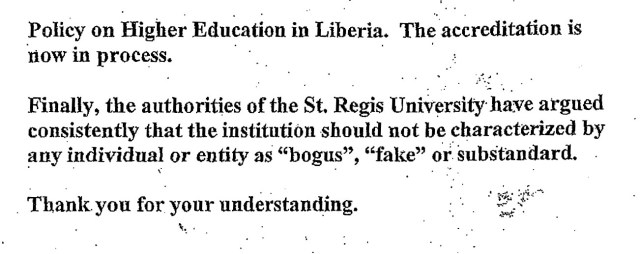
This now meant that SRU was “recognized” but not “accredited” by Liberia – a distinction that had not previously existed. However, it was a distinction largely without significance. No schools in Liberia were now “accredited” since none had yet completed the new process. “Recognized” schools were still fully authorized by the Liberian government to award degrees. The verification of the recognition was still available from Liberian embassies.
Dr Roland’s position was established through interview, recorded in a defence memorandum in the SRU case,
“Dr. Roland stated that because the St. Regis people had been mislead by the previous MoE administration during the Charles Taylor regime, they were not aware that two signatures were required on the accreditation documents and based on the documents they had obtained from the Liberian government should have reasonably believed they were accredited by the Liberian government.
Dr. Roland went on to state that after the disclaimer signed by he and Evelyn Kandakai as posted on the Embassy web site the St. Regis people tried to resolve the situation by interacting with him and Ambassador Prince Porte. Dr. Roland did state that he visited the offices of St. Regis University in Monrovia along with Porte to establish the schools presence in Liberia. After reviewing documents and establishing the presence he subsequently prepared the letter dated December 20, 2004. Roland stated that there was no specific documented process established by the MOE for online schools during the time St. Regis was going through this process, and to this day there is no defined policy or process for the accreditation of online universities.
Dr. Roland stated that his position is that there is a difference between Accreditation and Recognition and although St. Regis was “Recognized” they were not fully accredited, so the list of “Recognized Higher Education Institutions of Liberia” which was- posted on the Embassy web site, which he prepared and signed, was accurate.”
>>Affidavit of Brian R. Breen, filed 7 December 2007
The view taken by Dr Roland in his private correspondence with SRU was that SRU urgently needed to address the concerns about its operations that had been raised in the USA. But once this was done, he foresaw bright prospects. In an email to Stefaniak of 6 October 2004, Dr Roland said, “I have seen the St. Regis catalogue, and the programs and professors are excellent and fantastic; hence, I do not doubt the credibility of the institution.” Dr Roland knew of what he was speaking; he too was a graduate of SRU.
There were also efforts made by Ambassador Prince Porte on his return to Liberia. According to the defence report of interview with Porte, after the disclaimer had been published, “Richard Novak seeking assistance contacted Porte, and Porte agreed to assist Novak through the process of accreditation, including setting up an office for St. Regis University in Monrovia [which was one of the conditions of the accreditation process]. Ambassador Porte did make arrangements for various items of office furniture and computers for the office, which were paid for by Novak via wire transfer. He also made arrangements for staff and once the office was set up went with Dr. Roland to inspect the office. Ambassador Porte stated that once Dr. Roland saw the office he stated that it was better then all of the other ones he had inspected.”
Porte confirmed the views expressed by Dr Roland earlier in response to interview, “Ambassador Porte specifically stated to me that based on the documents provided to St. Regis University prior to the disclaimer from the Ministry of Education, the people associated with St. Regis would have reasonably believed that the University was in fact accredited and recognized by the Liberian Government, and that even after the disclaimer based on Dr. Roland’s list of “Recognized Higher Education Institutions of Liberia”, that they were at the least “Recognized”.’
Abdulah Dunbar was also interviewed concerning the accreditation status of SRU. He said, “Dunbar stated that the [accreditation] documents were legitimate and that it was “impossible for the St. Regis people not to think they were accredited by the Liberian Government”.
In 2004, I telephoned Jallah Faciann in Liberia, who was then listed as the Director of SRU. I was not aware of it at the time, but Faciann was Dunbar’s brother-in-law. Prior to becoming SRU Director, he had been the manager of an internet café. After SRU ceased operations, he went to work for the United Nations High Commission for Refugees. Faciann was again strongly defensive of SRU’s operations and standards. He informed me that he was speaking from SRU’s office in Monrovia and that this office was functioning as best it could in the difficulties of the post-war environment.
During mid-2004, following the Senate hearings, Dr Gollin’s efforts to haul SRU into court began to bear fruit. Himself a Democratic Party activist, a decade later he would be a future candidate in a Democratic senate primary(12). He lobbied Christine Gregoire, Washington’s attorney-general, who was now the Democrat candidate for governor of Washington, to take on the SRU case. As a result, in July 2004, the Spokane Office of Consumer Protection opened an investigation based on the earlier Gollin/Bear report. In September 2004, Gollin was brought in as an unpaid expert consultant. Significantly, his expertise with respect to this case was not in distance education, experiential credit or non-traditional degree programmes, but in the protection of the academic establishment from those entities considered to be “diploma mills” that threatened it. The case was pitched to the FBI, who were not interested, and then to the US Secret Service, who were, based on the alleged implications for foreign terrorists using SRU degrees to obtain US visas. In January 2005, a major multi-agency investigation was initiated, called Operation Gold Seal.
Meanwhile, Regis University, a non-profit regionally accredited Jesuit university in Colorado, had been persuaded to file a trademark infringement lawsuit against several staff members of SRU and Dr Richard Hoyer in the state of Washington on 6 December 2004. Interestingly, Regis had first made a similar complaint to SRU as early as 2002, which had been resolved when SRU agreed to include a disclaimer on its websites stating that it had no affiliation with Regis University. However, SRU had since omitted the disclaimer. The timing of the lawsuit was not coincidental. Gollin would write that the disclaimer of SRU issued on 22 July (that became public in October) had permitted the filing of the lawsuit, and it was quoted in an exhibit to the complaint filed, along with a slew of negative press coverage of SRU. Subsequent coverage on the Regis University website suggested that Gollin had directly prompted them to file suit.
The Regis suit prompted an escalation of the flamewar between SRU and Gollin, and supporters of SRU focused on online material concerning Gollin and his family. Gollin responded on his webpage with a graphic consisting of a rifle-sight superimposed next to the names of the defendants. This was taken by the defendants to be a death threat. A similar crosshairs image had been used as a signature by the so-called Zodiac Killer.

Dixie called both the police and the University of Illinois concerning this threat, but neither took any action. Legal counsel, consisting of attorney Cyril Jones of the firm Jones & Jones in Monrovia, was retained by SRU with a view to gathering evidence and potentially filing suit against Gollin and/or the University of Illinois for harassment and interference with business relationships.
The Regis case did not proceed to trial and was settled out of court in June 2005, with the defendants admitting none of the allegations against them but agreeing not to use the name “St Regis” or any similar name in the future. According to one of the defendants, the Regis University attorneys called Gollin a “loose cannon”. Since the judge made no award of costs, Regis University had lost around $200K in lawyers’ fees for very little return.
On 12 December 2004, SRU had announced its closure on its website,
“Sadly, it has come to our attention that after an agreement made several years ago with the Jesuit Monks of Regis University of Colorado, and after many years of voluntarily posting at our website that St. Regis University is not connected in any way to any similarly named universities or colleges, that the Jesuit Monks of Regis University of Colorado are now making a complaint that St. Regis is infringing upon their name “Regis” University.
While is true that this longstanding notice was inadvertently left out by a webmaster or designer after a recent remodel of our website, it is also true that at no time did any Regis University official, student, applicant, etc or any other individual from any other similarity named entity ever once complain to St. Regis University of the missing notice nor has there been even one complaint or report of any confusion in names made by Regis University of Colorado or by any individual. Had anyone contacted us with a complaint that the notice had been removed in the new design it would have been replaced on the index page without hesitation, as it had been placed as originally agreed upon several years ago and had remained for years afterward.
It is also true that St. Regis University has never used any similar logo or trademark ever held by the Jesuit monks of Regis University or used their name or trademarks in any practices.
At no time has St. Regis University held itself out to be any US entity, and in fact is a Liberian university.
Contrary to their complaint, St. Regis University has never had any presence in Washington State, nor Colorado. St. Regis University, a non-US entity is located and incorporated in the Republic of Liberia. Our website has clearly states that in the case of ANY dispute the laws of Liberia shall prevail, as St. Regis University is a legally registered corporation in the Republic of Liberia.
St. Regis University is also in the final stages of re-accreditation by the Ministry of Education of the Republic of Liberia and has always legally operated.
If any entity using the name St. Regis University does indeed exist within the United States please notify us as St. Regis University and/or individuals named in the Regis complaint will take legal action against any such entity for infringement and damages against us. Any such entity (if one exists) has NO connection to St. Regis University of Liberia nor does St. Regis University and/or individuals named in the Colorado Regis complaint defend nor claim any responsibility or ownership in any university similarly named (if any exist).
We are aware of only one instance where there was any confusion at all and this was when our school, St. Regis University of Liberia gave a donation of $1000 to a humanitarian cause and the acknowledgement of thanks was mistakenly given to Regis University of Colorado.
No student or applicant has ever reported to us or claimed to be confused of any similarities in the school’s names, even though there are many such similarly named schools throughout the world.
St. Regis University is unique in that it is a Liberian online school, completely unlike Regis of Colorado which is a religious school of bricks and mortar located in the U.S..
We believe this complaint (and others) are being instigated by a group of individuals including a University of Illinois professor, an Oregon government official known for his admittedly non-researched and controversial list of online schools he labels as “mills” and “substandard”, and a two writers capitalizing on the sale of books about online degrees. This group is well-known to us for their apparent hatred toward many nontraditional online universities, particularity those located in the African country of Liberia.
Contrary to the claims made by these cohorts and news story reporters (including one who admits publicly that he need not be truthful in his stories) St. Regis University has always been a legally operating entity and has never “sold” degrees or broken any laws. St. Regis University operates in full compliance with all laws and regulations of the Ministry of Education of The Republic of Liberia and is not a U.S. entity nor operating in the U.S.
Out of respect for the feelings and wishes of the Jesuit Monks at Regis University of Colorado, St. Regis University Liberia is voluntarily discontinuing the use of our legally registered name and moving voluntarily all programs, curriculum and services to another University until this matter is completely resolved.
We pray that the Jesuit Monks at Regis University of Colorado will remember our acts of sincerity, cooperation and respect of their wishes since our first contact with them years ago, and that again our immediate cooperation and willingness to end any conflict will help to bring this matter to closure.”
Having first obtained the permission of the Liberian Ministry of Education, SRU’s programmes and infrastructure were transferred to another Randock-operated institution, James Monroe University. Robertstown University was also now being operated by the Randocks. James Monroe and Robertstown had both been awarded accreditation by Dr Bestman on 16 October 2003. In due course Robertstown received a charter dated 1982 that was very similar to that of SRU. However, Robertstown had been disclaimed by Dr Roland, citing Dr Bestman’s alleged dismissal, in October 2004, and Dr Roland’s letter of 20 December 2004 only addressed SRU, not Robertstown.
At the beginning of 2005, former Ambassador Prince Porte, who had no further assignment with the Liberian diplomatic service, was offered and accepted the position of Director of James Monroe University. He worked daily from the University’s office in Monrovia.
On 18 January 2005, SRU’s leading antagonist Dr George Gollin wrote on the letterhead of his university to Ambassador Charles Minor, copying the letter to Dr Roland, Dr Kandakai, and others. In part the letter states: “A brief statement from Liberia, confirming the lack of Liberian recognition of any of the entities in the Saint Regis group and posted to the Embassy web site, will help the American authorities take action”. The letter also states: “The announcement “Urgent Disclaimer On The Illegal Establishment And Recognition Of Higher Education Institutions In The Republic Of Liberia” posted to the Embassy web site last October had some effect.”
>>Gollin to Ambassador Charles Minor, 18 January 2005
The Liberian Ministry of Education initiated a meeting with the US State Department in Monrovia that took place on 26 January 2005. The purpose of the meeting was to establish what the US position was now regarding SRU and the other NBOE schools, and the potential withdrawal of US funding. Dr Roland represented the Liberian Ministry of Education, while Porte and Novak represented the NBOE. According to interview, Porte said that “apparently the US Government was going to withhold money to Liberia and St. Regis was trying to get through the accreditation process, so that is why the meeting was organized. Porte stated that during the meeting the US representatives never specifically answered the question as to whether money would be withheld from Liberia if the St. Regis issue were not resolved.”
Defence investigator Brian R. Breen notes, “Another interesting aspect of this case is that on the same date (1/26/05) that the meeting is held in Monrovia with State Department Staff, [US Secret Service Resident Agent in Charge] Kevin Miller contacts [State Department Officer] Andrew Silski und Silski advises Miller “that in his opinion Ambassador Minor would be receptive to meeting in the future to discuss and disassociate his government from “Saint Regis University.”” Gollin’s letter to Ambassador Minor on 18 January had been copied to Silski. This was the same month that the Secret Service had initiated Operation Gold Seal.
The universities were clearly in trouble. In mid-2005, James Monroe University was replaced for a few months by “James Monroe International University”, claiming authority from both Liberia and the Principality of Seborga, but in early October 2005, it announced its closure. Both James Monroe and Robertstown issued the following statement:
The University has discontinued its online programs and will not reopen until conflicting information surrounding the authority under which all Liberia universities were re-accredited since 2004 has been completely clarified.
The major problems seem to be the inability of the Commission to develop a policy on distance learning, and the constant and unpredictable changes in officials, making verification of authority difficult, if not impossible.
Without the policy in place, and without the establishment of an official and reliable Liberian Government website for access to critical information regarding Liberian education and accreditation, the University does not wish to continue to be subjected to the issues of this confusion.
Even though the causes of this situation are no fault of this or any other Liberian university, James Monroe University will remain closed until proper and full support from the Commission is assured.
The real closure, however, had predated this by some months. On 11 August, US Secret Service agents had raided premises in Washington and Idaho and the evidence seized would form the basis for the subsequent indictment of the eight US citizens. Added to this was the evidence from undercover investigations by the USSS who had obtained degrees from James Monroe University and had sought to enter into business relationships with its principals.
One last document remains to be examined. This was a letter from Dr Roland to USSS Special Agent John Neirinckx dated 1 February 2006.
>>Isaac Roland letter to USSS, 1 February 2006
The letter is clearly written in a clumsy attempt to delegitimize the SRU 1984 charter. To take a few points in turn:
Interestingly, at no point does the letter state, as SRU’s enemies might have expected it to, that the 1984 charter was false or fraudulent.
SRU in India
On 10 March 2004, SRU additionally incorporated as a charitable educational trust in India.

An office was established in Bangalore and an affiliation obtained with an organization called the Institution of Educators there. In India as of 2004, no government permission was required for a private body to confer degrees in non-technical subjects by distance learning, since the regulatory system then in force for distance learning programmes was voluntary. After SRU had transferred to James Monroe University, JMU obtained accreditation from the Distance Education Council of the Indian Board of Alternative Medicines, a large and well-regarded body.
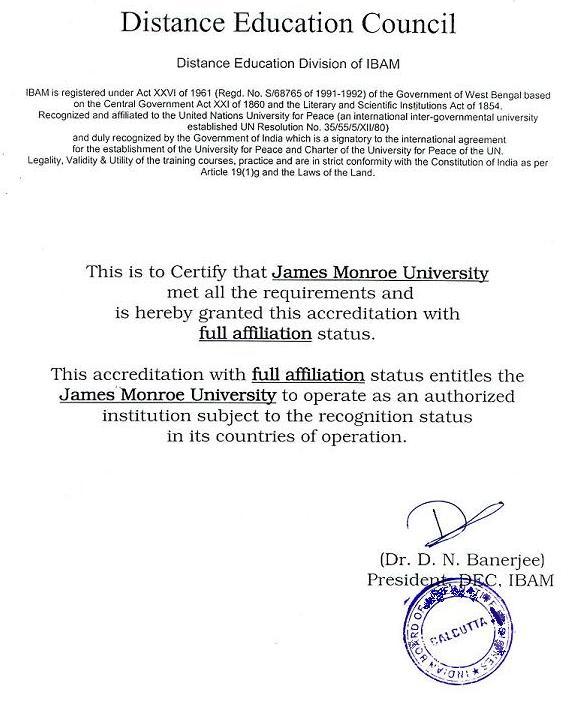
JMU established a reciprocal credit transfer agreement with the accredited Kalinga University in Chhattisgarh. Unfortunately, in an unrelated development, the government in Chhattisgarh promptly closed all its universities and retrospectively annulled their accreditation. It would not be until 2011 that Kalinga University reopened, and by that time JMU was no more.
In the event, JMU’s operations in India ceased when its director, Abul Kalam Azad, broke acrimoniously with the SRU/JMU organization.
6. The legitimacy of the Liberian accreditation
Based on the discussion above, what conclusions can be drawn?
Firstly, between the dates of 28 August 2002 and 22 July 2004, SRU was fully accredited by the Liberian government, and this accreditation was confirmed by multiple Liberian government sources.
Faced with pressure from the United States authorities, Liberia disclaimed the accreditation of SRU as “null and void” with effect from 22 July 2004. However, on 20 December 2004, the Ministry of Education clarified that SRU was still “recognized” and therefore that it had government authority to operate as a university and issue degrees. While steps were taken by SRU to complete the Liberian accreditation process, these were incomplete at the time of SRU’s closure on 12 December 2004.
Even in light of the disclaimer, the degrees issued by SRU were still issued legally so far as Liberia was concerned, and in respect of their international status were issued by a university officially recognized by its national Ministry of Education, which is generally the standard required for acceptance universally.
The status of degrees that were backdated by SRU to dates before the award of accreditation in 2002 also appear to be legal. Backdated documents were considered to be valid in Liberia at that time. However, it would clearly not be possible for degrees issued prior to the grant of accreditation to be covered by that accreditation. Their only authority would be the SRU charter dated 1984. Given that this document had legal effect in Liberia, it would legitimize SRU degrees dated between 1984 and 2002.
Dr Roland’s statements of 2004 and 2006 were clearly issued under conditions of duress. Had the United States not issued an implicit threat of the withdrawal of funding to the Liberian Ministry of Education, Liberia would not have moved to disclaim SRU. The documents should be considered accordingly.
Was SRU a Liberian university? It was a crucial aim of the prosecution case in and following the indictment to establish that SRU was not a Liberian entity and that the documentation presented to the public that suggested otherwise was fraudulent. Charge 1, item 13 of the indictment reads in part, “It was further part of the scheme and artifice to defraud that defendants…led consumers, potential consumers, and others throughout the world to believe that “St Regis University,” “James Monroe University,” and “Robertstown University” were legitimate academic institutions of higher learning which had been officially accredited by the Ministry of Education in Liberia.” (Indictment of 5 October 2005, p. 5.)
But the answer from the Liberian Ministry of Education prior to 22 July 2004 was that SRU was a Liberian university and that its accreditation documentation was genuine and authentic. Even after that date, Liberia still “recognized” SRU as a legitimate university. Neither SRU nor its principals were ever charged with or convicted of any criminal offence in Liberia. Moreover, Liberia took no effective action to close SRU despite coming under US pressure to do so. Liberian government officials also repeatedly stated in official documentation that SRU was a Liberian university and not a US university.
Was the accreditation meaningful? Yes, but with a strong caveat. The issuing of accreditation in 2002 and 2003 was complicated by the fact that there were no established processes for evaluating applicants for accreditation that were operating entirely by distance learning, leaving those decisions to be taken ad hoc while Liberia was in a position of instability. In that context, the catalog of the university and the presentation by Richard Novak as its officer was the basis of the decision to accredit rather than a deeper analysis that would not have simply relied upon the university’s own statements and assurances.
But when in 2004 the National Commission of Higher Education set new criteria for SRU to achieve accreditation, there is evidence that SRU adapted and made the changes necessary to succeed in this process. Not merely this, but its physical facilities, programmes and professors were praised by Dr Roland of the Commission. By that time, however, US pressure on Liberia meant that SRU’s accreditation – and that of any other distance learning university – was effectively placed on indefinite hold.
It is also important to remember what accreditation does and does not do. Accreditation is primarily an examination of inputs. It is not a system of quality assurance. In many respects, accreditation is comparable to membership of an exclusive cartel. That cartel consists of the mainstream academic community worldwide. The cartel has its own rules, practices and expectations of newcomers. It is suspicious of outsiders who gain access to its privileges and who disrupt its way of doing things. Moreover, the cartel has influence, and access to political and legal enforcement. SRU entered the cartel through a legitimate route, but it was quickly apparent that it was such a threat to the established membership that it was imperative that it be ejected. That threat, despite SRU’s international reach, was most acutely felt in the USA, since SRU made dramatic and successful headway in the sector of the US market most targeted by lower-quality US accredited institutions operating through distance learning or short residency – mid-career adults.
Was the accreditation obtained by bribery? Retired detective Brian R. Breen was appointed by the court to assist the defence as an investigator. In his report to the court, Breen stated that he had visited Liberia and personally interviewed those alleged to have accepted bribes.
Throughout this case, a significant issue is whether the defendants in this case bribed foreign officials to obtain accreditation. The issue was so central to the case that we spent a great deal of time investigating it. Depositions of the relevant officials were authorized to be conducted in Liberia and would have been accomplished had this matter proceeded to trial. I was authorized to visit Liberia and in so doing I interviewed several former high-ranking Liberian government officials with whom these defendants transacted business. Those persons were Associate Justice of the Liberian Supreme Court, Kabineh Ja’neh, former ambassador Prince Porte, former Ambassador-in-Charge Abdulah Dunbar, and former Minister of Education Isaac Roland. All were confronted with the allegations made by Richard Novak that he bribed them and that are repeated without qualification in the [pre-sentence report]. All four of these men emphatically denied that they received bribes. All four readily acknowledged that they had accepted money from these defendants. However, all four explained clearly that these funds represented payments for services rendered.
It seems likely that, had the Liberian officials given evidence and the case proceeded to trial, there would have been no basis for the court to have concluded that they had been bribed. The testimony to the contrary from Richard Novak, as will be discussed below, was the testimony of a terrified and threatened man desperate to keep himself and his wife out of jail.
It is also worth emphasising that the sole way of legitimately transacting business in Liberia at this period in time was actually simply to pay cash to individuals in return for their professional services and assistance. Moreover, at a point where Liberian government officials were working without pay, it was expected that when they received money for services that they would use some of this to support themselves and their families. As Abdulah Dunbar would say in his response to the allegations, including those arising from a meeting with Novak and US Secret Service undercover agents, “we also used our good offices to negotiate with investors, and traveled with them to Liberia, to scout out and establish businesses in our country…there is a dire need for investors to go and help in rebuilding our country in all aspects.”
>>Statement of Abdulah K. Dunbar, 22 August 2005
>>Declaration of Brian R. Breen, 5 June 2008
7. Some further aspects
Dixie Randock possessed very significant drive and ambition. Once SRU had become financially successful, she wanted to make it even bigger, targeting the corporate education fund at Chrysler in particular. She approached the operation of SRU as if it were a trade school. It was brash and unashamed in selling its products, and marketed them both directly and successfully in a way that was not usually associated with the refined, middle class world of universities and degrees. There was an emphasis throughout on the ease of the process, the likelihood that many adults would qualify based on what they already knew, and the utility of the degrees in employment. It is notable that in the post-SRU era, this marketing style has come to be more visible within mainstream academia.
The position that was taken by SRU was that printing degree documents, maintaining websites, and conducting experiential assessments, were merely outsourced functions. On paper, there was nothing necessarily unreasonable in a Liberian online university employing a printer or academic staff in the USA, or basing its servers there. Certainly, Liberia had no problem with it. Nor did it obviously contravene any law in Washington or Idaho, where these resources were based. It was difficult to see that these things made SRU into an American university rather than a Liberian one.
It is interesting to note that during the First Liberian Civil War from 1989 to 1996, Cuttington University was looted and its buildings damaged. The campus was used as a training facility for militias. As a result, from 1990 to 1997, the school operated only at an office in the US state of Virginia. There was therefore precedent for the removal of a Liberian university to the USA under conditions of war. That removal did not make Cuttington cease to be a Liberian university, nor become a US university, and as a purely brick and mortar institution, these aspects were of greater significance for Cuttington than for an online entity.
Conceivably, since it was accredited in Liberia, SRU could have gone through the state licensing process for foreign-accredited universities in one or more states of the USA and then operated there without obvious difficulty. However, this would have meant that it would have become an onshore entity for tax purposes rather than remaining a non-US tax concern.
It is not difficult to see a strong theme of social class running through the SRU case. Dixie Randock and her associates were outsiders to the academic establishment, and Dixie had made her own money as a successful entrepreneur. Armed with the successful techniques that had built a trade school, they gatecrashed into academia, which remains one of the greatest middle-class strongholds. Criticism of SRU was predominately from the elitist middle-class; from academia and its representatives who were well-established inside the system and were easily able to identify SRU and its people as an out-group to be demonized and ridiculed for their comparative lack of sophistication. The media that denounced SRU was the mouthpiece for middle-class outrage, taking the side throughout of the establishment. Alan Contreras referred to the principals of SRU as “trailer-park hounds”(13).
For Dixie to be running a university with profit as a main objective was seen as anathema. Yet the mainstream is not always so shy of getting its hands dirty. University education is a business like any other, with billions at stake, and some exceptionally aggressive for-profit players within the mainstream. When they saw SRU trespassing on their turf, they determined to finish it once and for all.
8. The aftermath
In 2005, US Secret Service agents using false names and identities obtained degrees from James Monroe University, in one case following examination and in two cases on the basis of experiential assessment. The processes as described by them appear to have followed SRU’s published descriptions. They did not simply buy degrees outright, and indeed a request for a degree in chemical engineering was refused. However, the weakness of SRU’s systems was exposed. SRU failed to verify the identity of candidates and the truthfulness of their claims, and also, in the examination case, gave an award for a very low percentage pass. In addition, the agents attended meetings with Novak in which Novak made a series of highly compromising statements concerning tax evasion and other matters.
The eventual indictment, which was filed on 5 October 2005, seemed to me to contain much that was readily contestable and I suspected that the prosecution would find it difficult to obtain a conviction at trial. Indictments tend to take an extreme view of the case at hand, in the expectation that some at least of what is alleged will subsequently stick. The SRU indictment was extraordinary because it essentially presented the proposition that anything done by SRU in the name of academia that did not conform to the most conservative rules and norms of the accreditation cartel was thereby to be deemed fraudulent. Such an approach would outlaw any substantial experimentation or non-traditional offering within education. It was deeply ironic that Gollin’s earlier protests against his censorship by UIUC were in the name of academic freedom, whereas the indictment made it clear that for SRU, academic freedom was non-existent. In short, any school that attempted to break the mould of the norms of university education, or to contract with “unsophisticated consumers”, was to be deemed a diploma mill and condemned accordingly.
According to the government case, the Randocks’ degree-granting entities had issued 10,815 degrees to 9,612 recipients in 131 countries. They calculated the income from this as being some US$7,369,907.
It was also significant that it was not alleged that SRU had broken any law governing the operation of educational institutions in the USA. The states of Washington and Idaho, at the time of SRU’s operation there, did not prevent universities with foreign accreditation, or indeed no accreditation, from carrying out some or all of their functions within certain legal boundaries. There were no laws against granting degrees on the basis of the assessment of experiential learning either.
Count one against the defendants consisted of conspiracy to commit mail fraud and wire fraud. Count two consisted of conspiracy to launder monetary instruments. The indictment alleged that there had never been any Liberian accreditation; that SRU had never been a Liberian school, and that consumers had simply been defrauded into believing otherwise.
The United States system of justice relies on plea bargaining, and that system in turn encourages the filing of as many charges as possible against the accused in the awareness that some can then be used as bargaining collateral. Novak and another defendant pleaded guilty early, offered full assistance with the prosecution, and served no jail time. A further defendant did similarly at a later stage of the process and received a reduced sentence. The Randocks, however, were advised that they could be facing up to thirty years imprisonment.
Novak’s testimony was key to the prosecution case. When I had spoken to Novak in July 2003, he had impressed me as relaxed and competent, at home in his role dealing with members of the Liberian government and fully supportive and knowledgeable about SRU and its processes. The Novak that came through in the testimony was a very different character. In the USSS raids on 11 August, Novak and his wife, who has a serious long-term health condition and is cared for by her husband, had their house stormed by around thirty SWAT operatives. They were held at gunpoint and Novak was made to telephone Dixie with a gun to his head in the hope that this would produce incriminating evidence. None was forthcoming. However, Novak was the only one of the defendants to have substantially incriminated himself through his exchanges with Secret Service agents. In March 2006, additional charges that he had bribed foreign officials were brought against him. Now he was potentially facing even more jail time than the Randocks.
Novak was arguably the most vulnerable of the defendants and it is not difficult to imagine the psychological pressure put on him, particularly with respect to his wife, who had been an advisor for some of the degree candidates. He was offered a deal whereby if he provided substantial assistance to the government, he would stay out of jail. His wife was also kept out of things. Not only did he sing like a canary, he sang to the prosecution’s tune. His admissions in testimony seemed to be directly inspired by a wish to substantiate the allegations of the indictment. It seems likely, though, that they were the actions of a terrified man placed under unbearable stress.
Nevertheless, the Randocks held out. With all their assets sequestered as part of the investigation, they could not put together the legal team they would ideally have wished for, who would in their view have been able to have the case thrown out at the first court appearance. The team they did obtain lost interest in defending them when the money ran out. Before then, Dixie had noticed some worrying aspects. The defence team appeared to be very close pals with the prosecutors. They played hockey and drank together, and went to the Spokane Club for lunch together almost every day. She recalls, “We had no prior experience with this kind of situation, so even though it seemed strange and made us uncomfortable, we didn’t say much for fear it may alienate our own attorneys. When we did mention our feelings about the palling around with the other side, we were pretty much treated as though we knew nothing, and all this was ‘normal’.”
Of greater concern was the unavailability of crucial defence evidence, “When we requested documents, the feds always (every single time) told us “We can’t find this, or there is nothing like that here.” We had no way to prove anything because even the computers were taken and everyone who possibly could help us was afraid to get involved.”
The judge, Hon. Lonny R. Suko, had significant involvement with the academic establishment. He was a member of the Advisory Council of the College of Liberal Arts at Washington State University and also served as a member of the Board of Trustees for the WSU Foundation(14). WSU also recorded Judge Suko and his wife as significant donors(15). Dixie recounts, “I asked [my attorney] to ask for a recusal, but he said “Oh, I think he can be fair.” I surely didn’t think so, and it was apparent in every motion.” Read correctly, the position was simple; the judge was aligned with the forces of mainstream academia that were ranged against SRU.
The defendants were alleged to have violated the Foreign Corrupt Practices Act by paying the Liberian Ministry of Education US$4,000 to facilitate accreditation. The fee for accreditation had actually been a mere US$300; most of the remainder of the money had been spent on the purchase of the Liberian school and paying its back taxes. However, the FCPA does not apply to any “facilitating or expediting payment” the purpose of which is to expedite or secure the performance of a “routine governmental action,” i.e., “greasing” the local officials. What constitutes routine governmental action is described in “Investor bulletin” (n.d.)(16). Fox (2011)(17) explains some of the factors the Department of Justice will look at when reviewing a company’s FCPA compliance. Here is the pertinent point: bribe size is typically determined as a percentage of the value of the contract or the advantage itself. Bribes paid in transnational business may range from 5 to 25 percent or more, although the average benefit-bribe ratio calculated for the 18 FCPA cases studied was 20 percent. The bribes allegedly paid by SRU in Liberia had a benefit-bribe ratio calculated at 1.9 percent, the lowest of those studied (Manacorda, Centonze & Forti, 2014, p. 210)(18). SRU was clearly an “outlier,” to say the least. This seems like a strong indicator that the prosecution was actually politically motivated.
Another pillar of the prosecution case was the alleged risk that terrorists might use a SRU degree to immigrate to the USA. But this again was based on the flimsiest of evidence. Breen’s declaration also addressed this, “It is implied that the activities of these defendants allowed the issuance of inappropriate H-1B visas to foreign “victims”. Indeed the indictment alleges as much. However, there is no evidence provided in the discovery that more than one H-1B visa was issued to any of the persons who purchased degrees from these defendants.” The one case was not a terrorist, but an undercover US Secret Service agent posing as a man from Syria.
>>Declaration of Brian R. Breen, 5 June 2008
Much of the pre-trial argument also centred on seizures by US Secret Service Agents that were made contrary to the terms of the warrant and policy. This was argued vigorously by the defence but was ultimately overruled by the judge. It seemed to me, however, that this aspect would have provided a key basis for an appeal had the case proceeded. According to Dixie, “Even though the feds did break into our Idaho office, they said a door “just popped open” and of course the judge believed this. Even our attorneys admitted had it been ANY other judge it would have thrown out.”
Dixie and Steve both testified as part of the pre-trial hearings. Dixie recalls, “We never once blamed each other in any way, nor did it cause us any marital problems and never has to this day.”
Some key points were won by the defence in the pre-trial process. The most important of these was in February 2008, when the judge agreed to preserve the testimony of the Liberian government officials by deposition where necessary. The prosecution had opposed this strongly, aware that if it went ahead, it would reveal the role of the US government in pressurizing the Liberians to withdraw SRU’s accreditation. Not only that, it would show the majority of Novak’s testimony to have been false. Surprisingly, Dixie has said that her attorneys did not make her aware of this development.
Immediately afterwards, the defence then moved for further discovery, inter alia requiring the government to reveal any promises made or “deals” with government witnesses, and the identities of confidential informants. A further item read, “It is requested that the United States state whether the defendant was subject to any electronic surveillance by George Gollin or any other private person or entity, and, if so, set forth in detail the circumstances to such surveillance.”
The next move was what one would expect from a prosecution on the ropes. In March 2008, the Randocks were offered a deal; if they agreed to plead guilty to conspiracy to commit mail fraud and wire fraud, the money laundering charges would be dropped and they would serve three years imprisonment, either in jail or in home confinement. Dixie said,
We were told we have 30 minutes to accept the plea deal. It was pretty much like you see in horrible movies of people being terrified and extremely pressured, even threatened if we didn’t take the deal. We absolutely knew we were guilty of nothing. We broke no laws. How can anyone be convicted for doing something that was not illegal?
But, the attorneys told us that a jury would convict us because we made a lot of money, and we were well known successful businesspeople before this – and there was jealousy.
Both Dixie and Steve Randock duly served three years in jail plus three years supervision. After three long years of pre-trial argument and hearings it was all over. There was no trial, and consequently no argument was heard on some of the most important aspects of the case. The guilty pleas to the wording of the indictment offered the academic establishment everything it could have wanted in the way of an outcome. It also offered a clear opportunity for the politicization of the whole case and the demonization of SRU’s graduates and faculty.
The Randocks were not ordered to pay any restitution to their victims. Indeed, there were no “victims” other than the education establishment. That is not to say that every graduate was satisfied, but rather that the source of their dissatisfaction did not properly rest with SRU. Brian R. Breen’s declaration of 5 June 2008 states that the US government conducted national advertising to search for “victims” of the defendants, providing a toll-free number, “Of the thousands of alleged degree holders, the government received approximately only 18 calls. The majority of these calls were the result of the government specifically and individually contacting “victims” or the owners of affiliate schools and instructing them to call or have their clients call the 1-800 number.” Dixie says, “I loved our clients, many became good friends, and all that I ever had contact with were extremely happy.” Legally, the terms and conditions accepted by clients when they entered into a relationship with SRU had been very clear. There was no scope for clients to misunderstand either the process or the resulting award.
I was not contacted at any stage of the investigatory or pre-trial process by any authority, and did not have contact with any of the defendants at that time. Had I been contacted, I would have co-operated fully with any investigation and offered any assistance that I could have provided. None of the vast number of court papers that I have seen identify me or any of my business concerns, which were always fully separate from those of SRU. Nevertheless, it is clear that certain individuals who are opposed to my academic and political work and resentful of my success have sought to make capital out of the SRU case. They cannot do so through anything other than the lies, smears and personal attacks that have been the stock-in-trade of the arguments surrounding SRU from their outset.
My business partner Dr Sheila Danzig – our business relationship began in 2005, after SRU had closed – had been involved in evaluating SRU degrees in her capacity as an evaluator of foreign credentials. She used the registered business name Liz Ross for this work. She was interviewed as part of the investigation, and fully exonerated from any wrongdoing. No charges were ever brought against her or anyone else who had been involved in her business.
9. Conclusions
The entire case gives rise to major concerns. It seems clear that the US Government contrived to persuade Liberia to declare SRU’s accreditation “null and void”. Once this had been done, they were able to bring fraud charges against the defendants on the grounds that they never had the accreditation that they had claimed. Lastly, they would see that the case was tried before a judge who was sitting on the board of trustees of one of SRU’s competitors. Because there was no trial, incidentally, the 300+ US Federal government employees who held SRU degrees were allowed to sweep the whole episode quietly under the carpet.
The result cannot have been what those supporting the prosecution had hoped for. Gollin’s book about the SRU case, which has yet to appear, is apparently entitled “A Dream of Serpents”. According to the astrologers of The Times of India, to dream of serpents denotes disappointments in the future(19). Federal lawmakers did agree to write a definition of a diploma mill into statute (and by the evidence above, SRU did not qualify), but they saw the cartel’s other protectionist efforts for what they were, and rejected them wholesale. For those who had wanted to make major capital out of SRU, the results can only have been disappointing.
Gollin’s account of the case in a chapter of a book by Bear and Ezell makes for interesting reading. Gollin’s approach is that of the research scientist. His writing is hugely detailed, immaculately referenced and constructed with logic. Its Achilles heel is that it offers little in the way of a humane perspective. The defendants are presented as one-dimensional villains with their every flaw or bad decision magnified. There is no insight into their complex motivations and no empathy. The result is simply a polemic that reflects Gollin’s own strong convictions and his unshakeable belief that he was morally in the right throughout. There is no attempt to address the topics of non-traditional education, experiential credit, or the reasons why market-driven or democratic reforms of the educational establishment might be advanced.
As a tenured professor in the hard sciences at a leading mainstream university, Gollin is a prime example of those who benefit from the protection of the academic status quo. As a graduate of Harvard and Princeton, which are both academically and socially elite institutions, he is also proof that the most vociferous criticism of SRU was class-based, consisting of an academic ruling class outraged by blue-collar upstarts on “their” turf.
The politicization of the case was nowhere more clear than in the statement by Barmak Nassirian, associate executive director of the American Association of Collegiate Registrars and Admissions Officers, who stated regarding the SRU case, “People who buy diplomas from diploma mills are not victims; they are co-conspirators.”(20)
This article presents a different view. I believe that I have shown that, (a) on the evidence that was available to the public prior to 22 July 2004, that it was wholly reasonable for an inquirer to conclude that SRU was accredited by the Liberian government, and even after that date it was still “recognized”; and (b) that most of those who graduated from Saint Regis University went through processes that were radical and academically unorthodox, but nevertheless were genuine and legitimate by the standards of progressive non-traditional education that SRU espoused. Lastly, I have shown that there is good reason to believe that the problems SRU experienced with regard to its accreditation were the result of pressure on Liberia from the US government.
In 2008, a list of some 9,612 individuals was leaked on condition of anonymity by a state government official to the press. This list was then published by at least one newpaper with the assertion that the individuals listed had “bought” a degree from Saint Regis University. However, as reported by the Washington Post, “Names on the list might include some people who only inquired”(20). A further clarification was published excluding the 27 names of those who had purchased degrees as part of the criminal investigation or otherwise to assist the US authorities. Examination of the list also shows that some of the information on it regarding degrees apparently issued and the names of those concerned is manifestly inaccurate.
The list alleges that I was awarded a PhD by SRU. I was never awarded a PhD by SRU, nor did I ever inquire about receiving one. On the contrary, I received the degree of Doctor of Education from SRU on 3 July 2003. To earn the degree, which I pursued purely from personal interest, I submitted a substantial portfolio of work relating to my teaching career, including several book-length pedagogical guides. This was then assessed through peer evaluation, and I also had a substantial input in the process through self-evaluation to prepare the transcripts. Anyone who alleges that I – or many others on the list – knowingly “bought” a degree does so falsely and commits libel. I remain of the view that I earned a real and meaningful degree from a university fully accredited by the Government of Liberia through a progressive, non-traditional (and inevitably controversial) educational process. It was a process that I believe in and that I continue to support.

It’s not a PhD
Some six years later, I would earn a second Doctor of Education degree in a different concentration from a further government-accredited university via distance learning, this time in a much more conventionally-structured programme.
I have consistently advocated for non-traditional distance education for more than twenty years, and in the course of this have exchanged opinions with many who have been involved in non-traditional education and distance learning both as owners of schools, faculty and students. In my professional practice, I have provided expert opinion on both traditional and non-traditional credentials from all over the world. I have founded and administered several non-traditional schools myself, and served on the faculties and boards of others. In my exploration of distance education, I have sought quality and distinctive provision among schools that are not part of the mainstream sector, and on quite a few occasions I have found it. At the time that SRU was operating, I served as head of a private religious school and a non-traditional university. I do not regret my support for SRU. I have known schools with problems similar to SRU overcome those problems and turn around with the right management. I have also known schools that today are very much an established part of the educational mainstream that did not look so very different from SRU during the 1980s and 1990s. It is a tragedy that SRU’s potential was never truly realized.
How then should the graduates of SRU be treated? Since their degree requirements were completely individualized, they must be taken on a case by case basis. As discussed above, all SRU’s degrees so far as can be established were from an institution accredited and/or recognized in Liberia, and so they hold governmentally recognized degrees. Some presented dissertations and coursework, which were sometimes considerable, to earn them. Some combined credits from previous formal studies. Others had experiential learning that legitimately qualified them for the degrees they were awarded. However they earned their degrees, these graduates deserve recognition for their achievements rather than the hostile treatment they have received at the hands of the media, the education establishment, and their allies.
SOURCES AND REFERENCES
Websites at saintregis.edu.lr, saintregisuniversity.ac, advancedu.org and other URLs associated with SRU were consulted via a collection of saved webpages made in 2003-04 and the Internet Wayback Machine.
Court documentation regarding the SRU case was consulted via http://www.gpo.gov. In addition, much court documentation and other useful information can be found at the website of Dr George Gollin at http://www.hep.uiuc.edu/home/g-gollin/pigeons/#usss_sru
Interviews were conducted electronically with Mrs Dixie Ellen Randock on the record, and with other sources off the record.
(1) Bear, John B. and Mariah P, Bears’ Guide to Earning Degrees by Distance Learning, 14th ed, Ten Speed Press, Berkeley, CA, 2001, p. 45.
(2) College president among those with questionable degree, Associated Press, 26 March 2004.
(3) In brief: Not everybody on the list bought degrees, Spokesman Review, 30 July 2008.
(4) Jones, Mohamedu F., Who is the Lawful Chargé d’Affaires at the Liberian Embassy in Washington, DC? in The Perspective, Atlanta, GA., 12 December 2003.
(5) Andrea L. Foster, U. of Illinois Administrators Ask Professor to Remove Web Site About Diploma Mills, Chronicle of Higher Education, 13 October 2003.
(6) Gollin, George D., “Burning St Regis” in Bear, John B., and Ezell, Allen, “Degree Mills: The Billion-Dollar Industry That Has Sold Over a Million Fake Diplomas“, New York, Prometheus Books, 2012.
(7) Wilson, John K. Fear of a Website at UIUC in Illinois Academe, Fall 2003. Retrieved from https://ilaaup.org/news/IllinoisAcademe/FIA_2003_IL_REPORT.pdf
(8) Wolman, David FraudU: Toppling a Bogus-Diploma Empire in Wired, 21 December 2009. Retrieved from https://www.wired.com/2009/12/ff-fake-physics.
(9) https://www.degreeinfo.com/index.php?threads/american-coastline-university.4967
(10) https://www.degreeinfo.com/index.php?threads/please-destroy-or-return-your-copy-of-my-book.9418/
(11) Drews, Elizabeth Monroe Quality is Next, Association for Supervision and Curriculum Development, 1960.
(12) https://ballotpedia.org/George_Gollin
(13) https://www.degreeinfo.com/index.php?threads/professor-george-gollin.18986
(14) http://www.collegesuccessfoundation.org/foundation.htm retrieved August 2008.
(15) http://www.collegesuccessfoundation.org/forms/CSF_annualreport_2007.pdf retrieved August 2008.
(16) Investor bulletin: The Foreign Corrupt Practices Act–prohibition of the payment of bribes to foreign officials. (n.d.). Securities and Exchange Commission. Retrieved from https://www.sec.gov/investor/alerts/fcpa.pdf
(17) Fox, T. When does a grease payment become a bribe under the FCPA? FCPA Compliance & Ethics, 2 February 2011. Retrieved from http://fcpacompliancereport.com/2011/02/when-does-a-grease-payment-become-a-bribe-under-the-fcpa/
(18) Manacorda, S., Centonze, F., & Forti, G. (Eds.). Preventing corporate corruption: The anti-bribery compliance model. 2014, New York: Springer.
(19) https://timesofindia.indiatimes.com/astrology/others/dream-interpretation-beginning-with-alphabet-s/articleshow/68205686.cms Dr Gollin explains that his inspiration for the title was, in fact, Arthurian legend at https://downwithtyranny.blogspot.com/2014/02/winning-back-il-13-meet-george-gollin.html
(20) Strauss, Valerie, Hundreds linked to diploma mill, The Washington Post, 31 July 2008.
“There is no time, sir, at which ties do not matter.”
– P.G. Wodehouse – Much Obliged Jeeves
As an inveterate tie-wearer, I have long regarded the ties of Turnbull and Asser as representative of the finest examples of English style and manufacture. My collection, which extends to several hundred, includes not only their principal glory – jacquard woven silk in great variety – but also rarer items in cashmere and knitted silk with some vintage items dating from the 1970s and 1980s.
During the time I lived in London, I was a long-standing customer of Turnbull and Asser’s Jermyn Street store, where in those days one could discuss the style, design and manufacture of ties at the level of the connoisseur. As well as the current stock, periodically older and rarer ties would appear from the archives to my delight.
The ties of Turnbull and Asser are hand-made to the highest standard. It was with particular pleasure that I was invited to tour the tie factory in Southwark in October 2008 and meet some of the dedicated men and women whose art made these glorious creations possible. The photographs below were taken by me on this occasion when I saw some of the ties being made as well as the pattern books and swatches.






 St Ephrem’s Institute of Eastern Church Studies was established in 1974 as the Scandinavian extension of the People’s University of the Americas. For much of its history, it was closely associated with the Scandinavian representation (Svea Synod) of the Apostolic Episcopal Church and with the American World Patriarchs; like those communions, its character was ecumenical.
The People’s University of the Americas (PUA) was founded in San Juan, Commonwealth of Puerto Rico, in 1967 (and incorporated as a non-profit educational institution there in 1973) by Archbishop Uladyslau Ryzy-Ryski (1925-78), Chancellor to the Holy Orthodox Catholic Patriarchate of America and first Patriarch of the American World Patriarchs (as Patriarch Uladyslau I). At its inception, PUA opened with two schools: the Faculty of Theology & Canonic Law and the Faculty of Philosophy & Literature. Further faculties in American History and Government, Law, and Naturopathy were added during the 1980s and 1990s.
Patriarch Uladyslau addresses the graduating class at the People’s University of the Americas, 1975
The University offered degrees at bachelor, master and doctorate levels. Instruction was offered on campuses in Ponce, Cayey and El Verde, with a particular social emphasis dedicated to the education of the poor. Working adults were catered for through evening classes. The University took a position that it was opposed to distance learning and all its academic activity took place on campus. In 1989, the United States Attorney-General issued a letter recognizing PUA as an established institution of learning recognized as such by a qualified state agency. With the turn of the century the construction of a new campus in Ponce was announced.
PUA applied for regional accreditation in the United States in 2004 and suspended enrolments pending the outcome of this process. During the same year, the University was acquired by the National Association for Foreign Attorneys in Florida and renamed UNPAM University. The University continues to exist today but no longer grants degrees.
In Scandinavia, St Ephrem’s Institute was under the direction of Archbishop Professor Bertil Persson, who was both a presbyter in the Church of Sweden and a bishop in the Apostolic Episcopal Church (which was in intercommunion with the American World Patriarchs). As such, it served primarily as a means of promulgating research and scholarly publications, focusing on the principal areas of church history and the Aramaic language. In addition, it was the repository for a substantial archive of records and information concerning the smaller independent churches, much of which would eventually be consolidated in Independent Bishops: An International Directory (Persson, Bertil; Bain, Alan; Ward, Gary L.; preface by Melton, J. Gordon; Detroit, Apogee Books, 1990), which was produced with the Institute for the Study of American Religion at the University of California at Santa Barbara.
St Ephrem’s Institute functioned both in Sweden and in Norway, where its degrees were awarded principally to churchmen and theological scholars. The degrees were generally awarded by Diploma, which meant that, although they were full earned degrees, they were awarded based on the Institute’s assessment of the work and standing of the graduate rather than after examination or supplication.
The Honorary Fellows of St Ephrem’s Institute included HH Pope Shenouda III of the Coptic Orthodox Patriarchate; Mt Revd Mar Aprem, Metropolitan of the Church of the East; HH Patriarch Ignatius Zakka I Iwas of the Syrian Orthodox Patriarchate; and HB Patriarch Maximos V Hakim of the Melkite Greek Catholic Church. There was also a distinguished board of Research Professors.
I was awarded the degree of Doctor of Divinity by St Ephrem’s Institute in 2008, the year in which I was also appointed as a bishop in the Apostolic Episcopal Church. As will be seen from the diploma below, the basis for the award was “his Outstanding Works on Church History”. My work in that area has concentrated on a continuation and expansion of topics that in some cases were previously also the subject of publications of the Institute, particularly the histories of the smaller independent churches and the biographies and ministries of their clergy. Subsequently, I would publish my biographies of ecclesiastical pioneers Arnold Harris Mathew and Joseph René Vilatte.

The death of the Institute’s Vice-President in 2008 led me to understand that mine would be the final degree of St Ephrem’s Institute to be awarded.
In India, meanwhile, an institution founded under the inspiration of St Ephrem’s Institute has outlived its European progenitor. St Ephrem’s Ecumenical Research Institute (SEERI), which is situated in Kottayam, Kerala, and affiliated as a research centre to the Mahatma Gandhi University, was inaugurated on 14 September 1985 by Mar Thoma Mathews I, Catholicos of the Orthodox Syrian Church and an ecumenical collaborator of Archbishop Persson. It is a centre for the study of the Syriac language and cognate subjects.
 In 2005, I sought to consolidate the various strands of my educational work by forming a private limited company in the UK called Marquess Educational Consultants, Ltd. This was incorporated in England and Wales on 13 July 2005 with company registration number 05507264. I was the sole director of the company.

The first work that the company undertook was educational consultancy with respect to the equivalency of international credentials I had begun to work remotely online as a senior consultant and expert on international credentials for several foreign credential evaluation agencies in the United States, where we served clients in the fields of educational admissions, employment and immigration. Through Marquess Educational Consultants, Ltd., I provided several hundred expert opinions on credentials and their equivalencies, advised extensively on the handling of complex immigration matters involving credentials, and also undertook research in this area leading to industry publications. Working in a small team, I also had responsibility for the online training and mentoring of staff who were new to the area of foreign credential evaluation.
 In addition to this, the company undertook several projects concerned with the provision of distance and blended education. Marquess College, London (MCL), was established as a division of the company and focused upon offering qualifications based on the mentored assessment of experiential learning through portfolio, coursework and dissertation methods. It defined its mission as “to be a leading resource for the development of professional competencies worldwide and to serve those who will be the leaders of tomorrow.” Before long it had attracted an excellent and diverse faculty, a number of whom who were experienced in alternative and nontraditional education and advocates for its merits. In January 2006, MCL absorbed the formerly independent Free College of the Divine Spirit and the Faculty of Independent Funeral Ministry, which became the Faculty of Free Christian Studies of MCL.
MCL was founded with the awareness that today’s professionals seek an educational solution that is flexible, responsive and that embodies the concepts of modern professional life. The MCL learning solution is designed to add value, and to empower decision-makers so that their leadership is informed by an international outlook. Programs are offered both on campus, and through distance learning, with the latter route requiring no residency at any time. The concept of mentorship is key throughout.
Our programs have been designed with key leadership objectives in mind, with input from both educators and practitioners. As a participant, you will benefit from an advanced and forward-looking approach to education, and prepare to meet the challenges of twenty-first century professional life. The programs are strongly practical and vocational in nature. They apply a professional model to education, not an academic model to professional life.
Following the practice of other comparable career institutes and similar schools, we have routes to our awards both for those who hold existing formal post-secondary qualifications, and for those who do not, but can show us that their experience and background means they are likely to succeed on the program.
MCL awards stand in a long tradition of self-directed independent education. Although we impose no philosophy on the candidate, the ideas of educationalists such as Steiner, Montessori and particularly Karl Popper have influenced the programs and structure of the College. The emphasis is on empowering the adult as an active learner under mentorship rather than a passive learner under instruction.” (Marquess College, London, website)
In order to offer programmes on campus, MCL entered into a partnership with St George’s College, London, which had campus premises in Marylebone, whereby St George’s became an accredited campus centre for MCL programs. The academic staff of St George’s College liaised closely with MCL management with all programmes subject to external examination as an integral feature.
 Distance and blended learning programmes were designed in particular so that they could be integrated into the professional workplace. The programmes could be based entirely around a particular company, with projects based on working life and emphasis on analytical, interpersonal and integrative competencies. Focus was possible on both the individual and the individual as part of a team. The structure of the programme drew on best practice in progressive institutions in Britain, Europe and the USA to create a holistic – yet easily understood – route to the assessment of professional competencies in practical terms. The business focus led to the development of a sister organization to MCL, the London Academy of Professional Management, which was designed as a professional organization that offered an assessed membership based on prior experience and learning.
Marquess College, London, was registered on the Department for Education and Skills Register of Learning Providers with provider number 10009520. In order to provide quality assurance for its distance learning programmes, Marquess College, London, became an associate member of the British Learning Association, which meant that it was bound by the BLA’s Code of Conduct for the provision of educational programmes to which students could have recourse if necessary.

Marquess Educational Consultants, Ltd., also sought and obtained certification of its quality assurance systems following assessment by the independent standardizing body International Charter, with respect to their standard IC9200 for organizations.

The programmes of MCL were listed in LearnDirect, the UK national learning directory, and by Hobsons/Trotman Information Services, then the most comprehensive database of further, undergraduate and postgraduate courses and institution information, covering the UK and Eire. In addition, MCL became a member of the Alternative Education Resource Organization, a non-profit organization in New York, USA, founded in 1989 in order to advance learner-centred approaches to education. AERO was considered at that time by many to be the primary hub of communications and support for educational alternatives around the world.
In addition, discussions were opened with several recognized university-level institutions, one in Australia and another in Denmark, who agreed to recognize MCL diplomas for credit towards their degrees by distance learning. Several evaluators of foreign credentials in the USA recognized MCL diplomas as being of a standard equivalent to recognized degrees.
While MCL was quickly recognised as one of the first educational institutions to offer prior learning assessment to working professionals, it also became a focus for online controversy, much of which reflected the vested interests of the educational establishment in stifling any potentially disruptive innovation outside it. This took the form of a smear campaign consisting largely of personal attacks and inaccurate statements. In a newsletter to faculty and students, I wrote the following, “What we are aiming to achieve at MCL is highly innovative and something of a challenge to the educational establishment. The idea of taking power from the educational institution and giving it to students remains revolutionary today, despite many significant precedents, as does running education on an enlightened business model. I hope that you will take pride in your association with an educational experiment that could well go on to have widespread influence for the better. In the words of Pericles, “The secret of Happiness is Freedom, and the secret of Freedom is Courage.”
In an unrelated development, our partner St George’s College, London, changed ownership in March 2006, and left the Marylebone campus. This brought about the end of our working partnership and left us without a campus.
In general, the calibre of applicants and graduates of MCL was high, but their numbers were always small. The market at that time was seeking either degree programmes, which we were not legally able to offer, or short courses, and our diplomas and certificates fell somewhere between the two. On recommendation from a faculty advisor, we increased the number of short courses on offer and placed less emphasis on the APEL diploma programmes. However, this strategy had the opposite effect from that intended and reduced applications still further.
Since 2003, work had also been progressing on what would become European-American University, which would in June 2007 obtain overseas degree-granting authority in the Commonwealth of Dominica, and it was always planned that there would be an eventual synchronization of institutions in consequence of this anticipated development.
The EAU project had several different working names during its pre-launch period, one of which was Marquess University (under which name it was briefly incorporated as a private international university in Panama in 2005). While at one point a draft of a website for Marquess University was accidentally uploaded to the internet, it was never open to the public and did not recruit or graduate any students. Nor was it organizationally connected with MCL except in terms of sharing faculty and management. Rather, it had been intended that Marquess University would eventually appoint Marquess Educational Consultants, Ltd., as its British agent to offer its programmes in the UK. However, this did not in the event happen.
Reflecting the developments with MCL, it was decided in September 2006 to refocus energies upon the EAU project, and most of the work that had been planned for MCL was consequently diverted pending the launch of EAU to the public later in 2007.
 With respect to the MCL organization itself, I consequently undertook a major revision that relaunched it in September 2006 as a specialist rather than generalist college devoted to theology and church music called St Simon’s College, London. This preserved much of the assessment methodology and educational principles of MCL, but in a more restricted context that was in keeping with my ministerial work of the time. A number of short courses in Liberal Christian Theology and Ministry were added to the programmes being offered. St. Simon’s College served as the seminary for The Independent Old Catholic Church of the Utrecht Succession and The Liberal Rite which were the denominations within which my ministry was at that time carried out.
With the launch of the educational programmes of European-American University to the public in late 2007, St. Simon’s College, London, and its predecessor Marquess College, London, ceased their independent existence and were absorbed into the University. Their graduates continue to be verifiable through the University today. For some time, I continued my credential-related work through Marquess Educational Consultants, Ltd., but in late 2009 I transferred this elsewhere.
On 26 January 2010, Marquess Educational Consultants, Ltd., was dissolved. The company was in good standing at the time of its dissolution and had settled all debts and ceased trading before the dissolution process was started.
Status
Marquess College, London, the London Academy of Professional Management and St. Simon’s College, London, were defined as colleges of further education and awarded certificates and diplomas under English law. They did not offer degree awards since they did not have the necessary legal powers to do so, although some of the diploma and certificate awards that were offered were examined at an advanced level corresponding to that of undergraduate and postgraduate awards.
Text of a public lecture delivered by John Kersey in the Cafe Philo series at the Institut Français, London, UK, June 2007.
“…a dense and brilliant talk. You managed to keep the audience suspended to your every word for more than an hour.”
Christian Michel, convenor of the Cafe Philo series
Deserting the muse; what happened to music education?
Abstract
Why can’t many of today’s music graduates play and write music? Why can they talk fluently about cultural theory yet not write a simple fugue? Why have university music departments lost confidence in historical and applied models of musicology? In this talk, Professor Kersey traces the development of British music education over the past 150 years with particular reference to higher education. He will explore the ways in which a socialist agenda has caused music education to lose touch with its roots in the applied art, and how political influence has played a large part in destroying the uniqueness of the elite musical education once offered by the major conservatoires.
Introduction
During the majority of the post-Enlightenment period up to at least the 1970s there has been a reasonable degree of consensus on the aims of postsecondary musical education in favour of equipping its graduates with the ability to perform and/or write music, or to teach others to do these things. This consensus has come about as a result of societies that have valued music that is written with cogency, formal command and structure, and that communicates the higher values of those societies – in which respect we might refer to such words as nobility, beauty and complexity, by which latter term I mean the capacity to reveal hidden levels of meaning upon greater exploration.
Good music lifts the spirits, challenges the mind and opens us to the riches of Western civilization. Even works which may be considered of lesser stature in that they express matters of no great emotional import have the capacity to accord enjoyment from their craft and charm of execution, in the same way that we may derive pleasure from an Agatha Christie novel despite being aware of its formulaic nature. In the best composers we discover a capacity to surprise and constantly renew their chosen forms. This renewal leads to organic development and also to experimentation, sometimes with dramatic and effective results.
Music education
Although an appreciation of music is probably innate to mankind, it would be a mistake to believe that Western art music will yield up its secrets without an appreciation of its context and techniques. Certainly we can appreciate music that is strongly rhythmic, or that relies on simple repetition for its effects – such as that which underlies most commercial television advertising – without much in the way of specialist knowledge. But when encountering a Bach fugue for the first time, many of the uninitiated will be put off by what appears impenetrable and difficult to follow. To traverse the unknown region, a roadmap is necessary.
The roadmap comes in the form of understanding both the circumstances in which that piece came to be written – the details of the composer’s biography and the way in which the work in question fits into his output and the genre in question – and the means by which the piece makes its effect. The first consideration belongs to the realms of history and musical appreciation. The second belongs to the realm of musical techniques.
If our aim is merely to appreciate music at the level of the amateur, so that we can enrich our lives as a result, we need to go down both of these routes on the roadmap. If our aim is either to write music that is worthy of comparison with that of the masters, or to perform it in some way that does it justice, we need to travel further and explore more widely. I also believe, without apology, that those who aim to teach need to travel just as far as those who compose or perform if they are to be able to convey the fullest sense of the art and science of music to their students.
The conservatoire system
In 1843, Felix Mendelssohn founded the Leipzig Conservatoire, the first specialist institution of postsecondary musical instruction in Germany. During the remainder of the nineteenth-century, other major capitals followed suit in establishing institutions where musicians might be trained to a high level. In England these included the Royal College, Royal Academy and Royal Northern College of Music, the Guildhall School and Trinity College of Music.
The conservatoire system supplemented a previous tradition of private study with an eminent teacher, although this remained a frequently-exercised option for musicians before, as an alternative to, and after conservatoire study, which I will return to later. The object of the conservatoire was to provide an environment in which the values of Western classical music could be explored and talent nurtured so as to provide the musical profession with a high standard of entrants.
At this point in time, the universities in the UK did not offer any form of instruction in music. Although they retained the power to confer degrees in music, and appointed a professor of music and outside experts to examine those degrees, for the best part of one hundred years the role of the university as far as music was concerned was to be the validator of external study, as well as providing music for internal functions such as chapel foundations. It was quite possible at the turn of the twentieth-century to take the Bachelor and Doctor of Music examinations of the University of Cambridge without ever having been a student in residence there, but instead having prepared for the examinations privately under a teacher or teachers of one’s own choice. Indeed, one of the main roles of the conservatoires by the beginning of the twentieth-century was to prepare students for these degrees.
The consequence of this system was that the conservatoires were largely independent from government interference and indeed, from wider university culture. This independence led to their development as notable centres of musical excellence which, in time, would go on to produce the majority of orchestral players for the top British orchestras as well as noted soloists and successful teachers. Because the curriculum of the conservatoires was deliberately specialist, it offered an unusual degree of freedom to the student, who if he or she chose, could also read widely at their own choice, take extension classes at other institutions, learn on the job by taking on voluntary or professional engagements, or even, as I did in the latter part of the twentieth-century, pursue parallel qualifications in other subjects for the sake of interest. The great virtuoso pianist Moriz Rosenthal, who was born in 1862, studied privately with Mikuli and Joseffy and with Liszt, but also in his twenties attended the University of Vienna and took a degree in philosophy purely from intellectual interest as well as an awareness that an artist should be a well-rounded person.
At the same time as the conservatoire system was developing, a second system of musical education was in operation that was aimed primarily at intending teachers and those performers who opted to study privately. This was the system of “taking one’s letters”, whereby external diplomas at various levels were available from a large variety of examining boards. Almost all of these boards operated wholly within the private sector, with some also offering tuition. More usually, the student would prepare for the examination privately and then, if successful, acquire what amounted to a license to teach or perform. Because these were grass roots organizations and because they were wholly in the private sector, with no government funding to prop them up, these institutions were compelled to charge prices that were affordable even to many who could not afford to go to university or conservatoire full-time, and drew their most substantial following from the working and lower-middle classes. Several of these independent examination boards survive today, including the Victoria College of Music, founded in 1890, and the National College of Music, founded in 1894. Following their lead, the conservatoires introduced their own parallel system of diploma awards, most of which were available to external candidates just as they were to those who had studied there full-time. Equally, many good performers and composers chose not to take qualifications at all, relying purely on their education, skill and contacts to make their way in the profession.
We can therefore see that, up to the 1940s, English musical education was focused on specialist institutions functioning largely independently, a thriving private sector and a university sector whose role was largely as a validator of independent study. This was the system that gave us the great figures of twentieth-century English music – among them Holst (who studied at the Royal College), Elgar (who studied privately), Vaughan Williams (who was at the Royal College and also read history at Cambridge), Bax (who studied at the private Hampstead Conservatoire and later at the Royal Academy) and many others. Notably, it also contributed to a high standard of music teaching and of musical literacy in the general public. Even as the growth of radio and television made concert-going less popular, the following for Western art music among all sectors of society remained strong, as witnessed by the continuation of the private music clubs (which were a leading employer of young artists), music appreciation societies and amateur choirs and orchestras.
In hindsight
We can now look back at this as something of a golden era in musical education. One of the main aspects that characterizes it as such is its confidence. Musicians and music educators were not generally beset by existential angst as to the justification for their art. There was a distinctively English approach to music-making, though regrettably this was much decried by critics of the time who preferred the allure of foreign names and flashier approaches. Although there was certainly public funding of the arts, there was also an extensive private sector that provided employment for many performers and teachers. Above all, music was localised and not centralised, and an understanding of the Western tonal tradition was accepted as an essential element of what it was to be educated and civilised.
I want in particular to point out one particularly significant aspect of the music education that has been discussed hitherto. This is that within it, in and of themselves, musical composition and performance are considered assessable disciplines within the academy. As will be seen, this position is not the outcome of a rejection of the essential subjectivity of these disciplines; rather it is a recognition that this subjectivity is in fact no more nor less than would be the case in the assessment of anything else within the arts and humanities. In 1910, it was possible to take the Doctor of Music degree at Edinburgh in musical performance and in that discipline alone (with no written component to the assessment); now the same feat is impossible at any institution.
In 1974, an official report of the Liberal Party said,
It is indeed difficult to imagine any political party of today, and certainly not the modern Liberal Democrats, coming out with such a statement. What has changed in the intervening years? In 1974, it would be easy for a reasonably educated member of the public to name half a dozen English classical composers or performers who were prominent internationally and whose artistic output was genuinely popular. These days, I would suggest it would be more difficult to achieve the same result, and where artists were indeed named, they would generally be from the “crossover” category. A decline has occurred, and I will now endeavour to trace its origins.
Popular vs. classical
One substantial change, of course, is in the growth and nature of popular music. The sound of popular music at various points has not been so different from that of classical music. In the 1950s and before, popular singers performed to orchestral backing or to a jazz rhythm section. Early jazz also borrowed heavily from the classical soundworld and used classical forms, particularly variations and the improvisatory cadenza, as models.
Where jazz and the more sophisticated elements of popular music succeeded in absorbing the Western art heritage was in their adoption of spontaneity and individual freedom as interpretative models. These models were a key element of the Romantic aesthetic and led to a great flowering of individuality in performance and composition. In early classical recordings of pianists and violinists, for example, each performer can easily be distinguished by their own personal timbre and approach in a way that is impossible today.
Just as popular music – with the age of the teenager from the mid-1950s onwards – absorbed this creative energy, so classical music sought to divorce itself further from popular sensibility, indeed regarding popularity itself as a mark of disdain and corruption. The music of the Second Viennese School and of Darmstadt and its successors, which became the prevailing fashion in the post-war years, was defiantly inaccessible to the general public, and for all its complexity, seemed and seems to many devoid of any emotional connexion to those finer aspirations of mankind which I outlined earlier. It is notable that when the general public most often encounter music written in these styles it is as the soundtracks to films where horror and chaos are being depicted.
Parallel with these developments in composition, the interpretation of classical music was becoming progressively more conservative following the First World War, with the rise of the concept of a reductive aesthetic – a “correct way” of playing Beethoven, Bach etc. and the decline of individualism in interpretation. This concept was in itself an extended reaction against Romanticism, and its effect was to create a more establishmentarian profile for the classical music world. Individuals could and did still break through that world to express a personal response to music, but unsurprisingly many considered it stuffy and class-ridden, and many were marginalized as a result of its prejudices. These were, after all, the days when Liszt’s music was frowned upon because of his love affairs, and where music written to entertain or display technical skill was looked upon as second-rate. Where the divine spark of Romanticism had been essential to an understanding of the very purpose of music, now music was been written and promoted that denied that nature and sought to destroy it.
Composers such as Bax, Elgar and Walton had a very difficult time being heard on Radio 3 and its predecessor the Third Programme, since under the direction of Sir William Glock, this station had become a champion of the values of modernism and postmodernism. Glock, incidentally, as an accomplished pianist, did not play this music for his private pleasure, instead revealing himself as a Haydn aficionado.
Fortunately, the private sector continued to value the output of tonal composers and local musical events in England continued to focus upon tonal repertoire both classic and modern. Others understandably tended to regard jazz and popular music as preferable outlets of energy and emotion.
Adornoism
For this misconception about the nature of Western art music we have largely the Frankfurt school to thank, and in particular the legacy of Theodor Adorno. Adorno as a pupil of Berg believed that composers should relate to the past as a canon of taboos rather than a canon of models for emulation. His concept of art was also structured on that of Marxist Kulturkampf, in that he saw the duty of art to be “corrosively unacceptable” to the sensibilities of the middle class, and therefore to be a succession of shocking, difficult and obscure events.
This is not merely an idea that is wrong, it is one that is deeply patronising. At its root is the idea that the masses, given the choice, will discard Bach and Beethoven in favour of the fad of the day unless their political masters tell them what is good for them. This idea has no historical basis in fact. During the nineteenth-century, when music was largely kept within the private sector, composers of all kinds flourished and prospered, and even those who were not in the front rank produced music whose craft and appeal has put much written since in the shade. Above all, good music was as much a part of working-class life as for the rich. Almost everyone, but particularly women, learned to play an instrument or sang in choirs or amateur societies. It was this indigenous working-class musical culture that Adornoism was to attack most pervasively.
The Adornoist concept has the advantage of wrapping music up in an impenetrable web of self-meanings. It means that music structured on these lines is likely to be theoretically extremely complex, divorced from significant cultural reference, emotionally arid and exceptionally difficult both to play and to listen to. Of the thousands of works written during the post-war years in this style, not a single one has attained genuine public popularity. They speak only to an elite, and that elite is specifically ideologically driven. As far as many executant musicians are concerned, they are indeed tolerated but not loved. Indeed, many would say that one might just as well love industrial noise or the random clatter of tin cans as the work of Boulez or Stockhausen, for all the intellectual accomplishment of both. What is created is effectively non-music, non-art, because of its rejection of the musical values that I outlined at the beginning of this lecture. It preserves the colour, the instrumentation, the dynamic variety, but it ignores what David Hellewell has called “music’s unique language; the dialectic of notes.”
The effect of this movement on classical music has been disastrous. Because Adornoist music cannot exist without significant public subsidy and is explicitly Marxist in its aesthetic, the general tendency of governments to become more controlling with regard to the arts in the post-war period has had a field-day. Without the government supporting the Adornoists, they would fail in a blink of an eye when subjected to the popular market. Yet this support has achieved nothing in terms of producing a wider popularity outside the limited circle of initiates. People today listen to Elgar, Beethoven, Frank Sinatra and the Kaiser Chiefs for pleasure – all representing work which has clear form, emotional import and the power to rouse the spirits. They do not listen to Boulez, Carter and Lachenmann (unless they are really depressed). Yet it is the latter that receive the accolades of the musical establishment, while deserving figures such as the late George Lloyd are shamefully neglected.
As an Austrian in economic terms, I conceive most forms of government interventionism in the free market as undesirable. In terms of that influence in English musical culture, it has been all but fatal. A combination of centralising tendencies and Marxist ideology with a decline in support for composers who do not fit the Adornoist and government image of what they should be, has left several generations without access to new music in the classical tradition which has the prospect of speaking directly to them. I can assure you that this tradition has been there – in the music of such post-war figures as Howells, Hadley, Ferguson, Arnold, Lloyd and Stevenson – all of which have written vital and much underrated music – but even though all but the last are dead, their music remains largely sidelined by the mainstream today. And the concept of an official line on what composition should be – so very Soviet in its way – has led also to a situation where it is axiomatic that musicians be if not actively Marxist, then at least tolerant of that ideology. This gives us “luvvies for Labour”; it also means that those who doubt the left-wing consensus are afraid to speak out for fear of losing their livelihoods.
For a time the classical tradition was present within mainstream pop – reaching its zenith in the progressive rock years where popular music started to adopt classical form and aspirations, albeit with a strongly improvisatory element – but this was swept aside by the untutored, uncontrolled energy of punk, which to my mind remains much more interesting as a social phenomenon than it ever was musically. With the coming of MTV and the pop video, the image finally took over from the music as the key message, and with the exception of examples of good craftsmanship and occasional felicity, the serious musician will find limited interest in much mass market pop music of today.
What is significant, however, is that when the Adornoists want to prove that they, too, can be popular, they ape the techniques of popular music. The contemporary focus on the physical appearance of classical artists and on short, memorable pieces as the vehicle for their success belongs to the world of pop. What it is not is the popularisation of classical music. Rather, it is the presentation of classical music or something passing for such as pop music, with attendant assumptions of limited shelf-life and quick profits rather than long-term viability. Perhaps that lack of long-term viability points to the paucity of the concept; when these artists turn to pop, their models are bubblegum pop acts. This effect also makes itself felt in other ways; the Royal College of Music Magazine twelve years ago was a serious journal of record; now their alumni tabloid sheet consists merely of shallow PR and speaks of desperation for approbation by the outside world.
Education post-1945
We should now catch up with the effects of these developments on music education. Although some universities had started a limited teaching of music for degrees before the Second World War, it was the post-war period that saw the universities seek to mount a genuine challenge to the conservatoires and the private institutions. This period, of course, coincided not only with a general move towards the control of education by the state, but with the rise of Adornoist music which required the support of the state in order to maintain its stranglehold.
University music departments
Given that many university music departments had at best limited facilities for the performance of music, and did not attract the best teachers of performance or composition, they were largely forced to find other rationales for their existence. These rationales tended to centre upon the theory and history of music, with compositional techniques, keyboard harmony and a certain amount of free composition thrown in. Some institutions, notably York, made a concerted attempt to create performance-based degrees, but these were the exception.
In hindsight it is surprising that the obvious pattern adopted in the teaching of fine art was not applied to music. Just as the art school could be seen as equating to the conservatoire in concentrating on the applied aspects of the discipline, so the history of art department could be balanced by a department of musicology concentrating on the history and theory of the subject.
The failure to make this sensible distinction has led to two developments which are inherently highly undesirable. The first is the phenomenon of university graduates who have so-called degrees “in music” but cannot play or compose music to any significant level of competence, and the second is a denigration of the applied aspects of music as being not worthy or not assessable within the university purview – a view which you will recall is in direct opposition to that of the university at the turn of the twentieth-century. Being staffed generally with individuals whose competence has lain outside applied music, universities have not fully understood musical performance in particular as a discipline, and as a result have not embraced it and have regarded it as the sole preserve of the conservatoire sector.
Pressures on the conservatoires
Into this messy situation we must add the plight of the conservatoires, which by the 1990s, when I was most involved in that sector, were entirely beholden to government subsidy. This led directly to the pressures they were to face both academically and ideologically. These were pressures that could not be withstood largely because independence had by now been ceded to the state to the point where it could not be regained.
There was great pressure in that era for conservatoires to close or merge; as a result the London College of Music became the music department of Thames Valley University, the RAM was absorbed into the University of London with an affiliation with King’s College, and the RCM, having held out the longest, eventually accepted an affiliation with Royal Holloway. The long-standing external diplomas of the conservatoires such as the Guildhall and Trinity College were replaced as internal qualifications by degrees validated by the post-1964 universities, and the University of London withdrew its entire external degrees programme in music.
There was a palpable loss of confidence within the sector. No longer did the conservatoires believe that they could set the standard. Now the politicised arts establishment led, and they begged for its acceptance. Strikingly, one aspect that had already begun to make itself felt in the conservatoires was that those institutions only became interested in promoting students when they won external competitions or attracted external sponsorship. They were examining all the time, as a key function of their activity, but seemed to have no confidence in backing their internal judgements.
Governmental interference
This process was exacerbated with the coming of the New Labour government in 1997. Shortly afterwards, those responsible for music education were essentially told that they would be compelled to embrace the Government’s educational priorities. Those priorities were towards Leftist multiculturalism and political correctness, and to the replacement of education with vocational training in pursuit of a social engineering agenda. Institutions would no longer be permitted to be determinedly exclusive in their admissions policies; the focus on excellence was seen as “disenfranchising people”. Yet, of course, the public in the form of the free market could not be allowed to have what they wanted; government must tell them what it considered best for them.
Interestingly, this development presaged the cult of the amateur and the disparaging of expert status that has since become such a prevalent feature of the Internet. It owes its roots, of course, to the prevalence of postmodernism, itself an ideology owing much to Marx. Once the idea that there are central concepts of value or meaning that run through all good music can be thrown aside, or that critical rationalism is a basis for assessing the worth of a statement that lies outside of the realm of pure opinion, the ground is clear for all sorts of phony replacements. Minimalism takes over where progressive rock left off, offering a dazzling surface but no depth as an Adornoist attempt to subvert the inevitable return to tonality and the popularity of popular music, to which it offers a counterpart without soul. Adornoism re-models itself into what has been called “the new complexity” and produces various hybrids of composers steeped in the Boulez tradition but groping towards some kind of accessible interface with the public.
Above all, what is promoted is a closed, totalitarian system in contrast to the Popperian open society. It is a system where government funding creates an expensive elite based on ideology, not ability. That elite is dedicated to the promotion, by definition, of that which is not popular, and of that where complexity and obscurity of method are valued over any reasonable results. Those who point out that the emperor has no clothes find themselves out in the cold. The last major attempt at bringing this situation to public notice was in the short-lived Hecklers movement led by tonal composers Frederick Stocken and Keith Burstein in the mid-1990s. Both are now not involved in challenging the status quo through protest, and Stocken in particular seems keen to de-emphasise his past activities in order to bid for acceptance by the musical establishment. Presumably both have found this to be a price worth paying.
Effects on schools
To some extent the rot had set in earlier. The imposition of the national curriculum in schools led to the marginalisation of music, a situation that got worse with the New Labour emphasis on numeracy and literacy. Music in primary schools had generally been taught by non-specialists, but now those non-specialists were significantly less likely to have musical general knowledge or the ability to play an instrument to a reasonable standard. A further problem was the replacement of the O level by GCSE in 1988, again the outcome of Leftist pressure by the teaching unions and incompetence by the Conservatives.
Part of this cultural shift was towards concepts such as “diversity” and multiculturalism in general. In his excellent book, “Cultural Revolution, Culture War”, Sean Gabb reminds us that,
“In October 2003, the Association of British Orchestras organised a symposium on Cultural Diversity and the Classical Music Industry, and effectively required attendance from every classical music organisation in England larger than a string quartet. Among those addressing the symposium was Professor Lola Young, Head of Culture at the Greater London Authority. She said: “We must change the look of the classical music industry”. She was supported by Roger Wright, head of BBC Radio 3, who confessed that everyone at the BBC now underwent “diversity training”.”
The GCSE examination, in contrast to the O level that preceded it, lays limited emphasis on the ability to play and write Western tonal music to a high standard. Instead it draws a false analogy between Western tonal music, popular music and music from other cultures, maintaining that all are equally worthy of study. In doing so, it illustrates a key postmodern dilemma. Individuals in the music establishment feel that they cannot any longer make the statement that the music of Beethoven, itself the outcome of Enlightenment thought, hundreds of years of artistic and spiritual experience, and of one of the most original and humane minds that ever lived, is of greater significance to Western students than a piece of commercial pop music or the repetitious communality of African drumming. They feel that they must pander to the perceived sensibilities of ethnic minority groups in order to satisfy themselves that they are sufficiently politically correct to please their masters and that their curriculum does not concentrate solely on dead white men.
Further to this, the emphasis on free composition without significant structural requirements means that music in many schools is now reduced to mindless pounding on percussion and synthesisers in the hope that this more-or-less random, untutored activity will produce something worthwhile. Within this atmosphere of the glorification of unstructured creativity governments have felt free to cut one of the last lifelines of the Western tonal tradition – subsidised instrumental tuition at school. Many local authorities discontinued their music services and, driven by opposition to elitism, ended their support of assisted places at the junior departments of the conservatoires. Meanwhile, the provision of private sector music-making, such as good church choirs and amateur orchestras, was also suffering from ideological shift as evangelical churches developed opposition to the concept of employing professional musicians and replaced well-written music with insipid pop, and amateur orchestras found the number of musicians coming from the school sector dwindling. The local music clubs and societies were centralized under a single national organization run by the arts establishment, which would then arrange for the artists and music it wished to promote to be hired by them, effectively putting the final nail in the coffin of private sector alternatives to the arts establishment in concert promotion. This further diminished the opportunity to hear classical music in live performance.
A further exemplification of this situation is in the increasing resources devoted by musical organizations to outreach work. This is effectively a piecemeal attempt to patch over the deficiencies in state music education provision. Where at one point schools would have had their own orchestras and choirs, and the local authorities would have supplemented this with borough-wide ensembles, now an occasional flying visit by a professional orchestra for workshops is taken as a substitute.
This dilution of musical education – effectively robbing the young of their heritage as Englishmen and women within the Enlightenment tradition – has been carried through to A level to a lesser extent. However, the greatest problem has been that universities are now compelled to accept not merely the A level and the Scottish Higher as a qualification to enter a degree course in music, but a variety of “vocational courses” such as A level “music technology” and BTEC which offer nothing in the way of a theoretical or historical basis for the study of music and no real test of practical ability as a composer, instrumentalist or singer.
I well remember my first appointment as a lecturer in music on a new degree course validated by a new university. Of the ten students in my class, only one had done A level music. All the rest had come the way of BTEC or access courses. Their knowledge of the theory of music was zero and their executant ability as musicians was largely limited to the cushioned confines of the recording studio with its copious electronic assistance. It became clear fairly quickly that some of those present were there because of the financial benefits that education offered as an alternative to the dole, and had no interest in what was being taught, one or two turning up to class under the influence of recreational pharmaceuticals of various kinds. My task was effectively to cram a theoretical basis for music as well as some basic aural training – material that used to occupy the curriculum from ages 14 to 18 – into their first year of undergraduate study. At the end of the year, the numbers having dwindled in the meantime, I was told that if the remaining students did not pass, the funding for the course would be withdrawn and I would consequently be out of a job, with the implication that I had better inflate their grades until they got through. In a moment of weakness, I agreed to pass them and then resigned, vowing never to teach in the state sector again.
Deserting the muse
At university level, the post-1997 era has been notable for two parallel influences that have come close to destroying significant musical education in this country. The first is the Research Assessment Exercise and its cognate processes, which have imposed a narrow definition of acceptability on music degree courses – of course, imposed by the universities, not the conservatoires. As a result of this, in order to meet government-imposed “quality criteria”, pure performance or composition cannot now be considered the sole criterion for the award of a degree except in very rare, almost never awarded cases of higher doctorates. The Royal College introduced a Doctor of Music programme in my last year there, and as part of it insisted that all submissions must have a written component. Effectively, it was acknowledging that it had no confidence in its ability to assess the very arts of performance and composition that it was set up to specialise in. Those degree courses where group and individual performance were a significant part of assessment also found themselves under threat; this was the case at Bristol where a bachelor’s degree with a strong performing basis found itself effectively replaced by one where the basis was in the more easily assessable musicology. Cardiff offers a PhD option in composition, but only if you also submit a dissertation. And at Cambridge, where the Doctor of Music in Composition remains on the statute books, potential applicants via the Faculty are told, quite contrary to the written regulations, that they need to undertake a PhD before they will be considered.
The new musicology
The musicology that is taught now bears little relationship to that of even ten years ago. Its chief difference is that, following upon the flight from applied music, it talks about everything except music itself.
Presaging New Labour by a couple of years came the movement entitled the “new musicology”, a jackdaw hybrid of gender and queer studies, cultural theory, post-structuralism, postcolonial studies and the theorising of Adorno and Walter Benjamin. When I arrived as a postgraduate at Cambridge, I found to my dismay that the music historians had either decamped elsewhere or resolved to keep a low profile while their faculty was effectively hijacked by those who stood to benefit from the bandwagon – invariably those who published the least and were the most aggressive in defending their turf. The new musicology was in its pomp, and criticism from outside was not to be tolerated. My objections that I had made it clear in my application to undertake research there that I was a music historian and not at all sympathetic to left-wing pseudo-disciplines such as “cultural studies” were answered in simple terms by “that’s what we do here” and the implication that if I disagreed with the totalitarian direction in which the faculty was being pushed I should leave. What was happening was that an ideology which had no defence in rationality was being protected from criticism by individuals who had much to lose from its failure. This was crude academic bullying and it was not something I intended to tolerate; accordingly I completed my doctorate elsewhere.
What is notable in the “new musicology” is how little of originality it contains. It is as if someone were to gather up the most leftist elements of university teaching and then unite them in a single Marxist behemoth. There is psychology, of course, and pointless theorising as to whether one can tell whether Schubert was gay or not from his use of the German sixth. There is cultural theory a-plenty, the return of extended prose written in numbered paragraphs, and the meaningless, self-referential cant of structuralism and post-structuralism. Indeed, Laurence Kramer says that in order to survive, musicology must embrace a network of “postmodernist strategies of understanding”. To appease the multiculturalists, ethnomusicology has now taken much of the space and funding formerly allocated to dead white males, meaning that the folk songs of obscure Third World tribes are now accorded the importance that the powers that be feel they deserve. Feminism of a particularly assertive kind has been allowed free rein, determining among other things that sonata form is sexist and misogynist. Because we are no longer talking about music as music, but instead music, in the words of Susan McClary, “as a medium that participates in social formation”, pop music is suddenly OK again – this is of course a point where Adorno’s objections to it are conveniently forgotten. And actual performance and composition can be reduced to the margins without guilt or hindsight.
The straw man
What the new musicologists have done is effectively set up a straw man in order to justify their ideological lurch. That straw man is the idea that music has no meaning and no political or social significance. As Charles Rosen points out, with the exception of nineteenth-century critic Hanslick, it is doubtful whether anyone has ever actually believed this. Rather, there has always been what we might refer to as a divine fusion in the performance of music between what is deemed to be the composer’s meaning and significance and that overlaid or recreated by the performer, and then a third overlay of meaning and significance by the listener. Not only are those perceptions likely to differ between individuals, they may well differ among the same individuals on different occasions, depending on emotional state. Even the eminent may legitimately see different and contradictory things in a musical work.
New musicology as authoritarian Adornoism
Earlier, I mentioned control as a key element of the changes in musical education with respect to government activity. It is equally prevalent in the new musicology. New musicologists usually seem to be telling us what to think and what to feel when we listen to music. By imposing meaning they present their opinion as dogma. By refusing to acknowledge the essential subjectivity that is at the heart of musical meaning they deny the individual the right to experience music in his or her own way and – heaven forbid – to use cultural references that are not chosen from the fashionable Left. The result is an edifice built on sand; once one does not accept the authority of the critic to dictate significance and meaning, much of what remains is merely ideological cant. Does the recapitulation of the first movement of Beethoven’s Ninth represent “the throttling murderous rage of a rapist incapable of attaining release”? Susan McClary published just that analysis, which to my mind is an excellent illustration of the way that this mode of discourse has a tendency to lapse into self-indulgent fantasy.
The aim of all this is, of course, to offer a further justification for the Adornoist position on music as high art inaccessible to all but the elite. By connecting music with other disciplines, links are created that are harder to break and that make music harder to isolate within the academy. By borrowing highly obscure modes of language and reference from those disciplines, and effectively talking about everything except music, new musicologists make it more difficult to discuss their work in anything other than its own terms, unless (as I do) one stands wholly outside their viewpoint. They also fulfil Marxism’s inherent self-hatred by focussing on the effort expended in method and execution rather than the value or intelligibility of the results. And by ensuring that those disciplines chosen support the broadly Adornoist view – in other words that they support the concept of paternalistic, nanny-knows-best culture ruled by experts who tell the underclass what to like and what to think, they create a perfect ideological fit with academia’s Leftist zeitgeist and with the culture industry as defined by New Labour.
The effects of the new musicology
It is a testament to the qualities of musical educators that they managed to withstand such nonsense for as long as they did. But from the late 1990s the onslaught came at them with a vengeance. Around five years after I had left the RCM, I looked out of curiosity at its list of teaching staff posted on its website, thinking that the exceptionally low staff turnover that I had noted during my time there would have continued. By contrast, I found and confirmed through subsequent enquiry that most of those responsible for the teaching of musicology – a very competent faculty, by the way, representing a good deal of expertise in analysis, history and musical techniques – had either retired, been sacked or left. In their place were individuals who were overwhelmingly graduates of institutions that taught the new musicology and presumably advocates of the same from the indications of the course changes that had taken place. In the case of the RCM – and this is surely astonishing – none of these new members of staff had been through a competitive process of external appointment. They had simply been recommended and chosen from the inner circle of the establishment. A similar pattern of ideological appointments has been repeated at other music departments around the country.
What we are witnessing is effectively the continuation of the process that drove Western tonal music underground under the weight of post-war ideology. Traditional musicologists and music historians are no longer welcome in British academia unless they are willing to accept the new musicology. Indeed, Laurence Kramer has said,
“The theories that ground [postmodernist] strategies are radically anti-foundationalist, anti-essentialist, and anti-totalizing. They emphasize the constructedness, both linguistic and ideological, of all human identities and institutions. They insist on the relativity of all knowledge to the disciplines–not just the conceptual presuppositions but the material, discursive, and social practices–that produce and circulate knowledge. While often disagreeing with each other, poststructuralists, neopragmatists, feminists, psychoanalytic theorists, critical social theorists, multiculturalists and others have been changing the very framework within which disagreement can meaningfully occur.”
Once you can control disagreement, there’s not much else that isn’t within your power.
It will perhaps not come as a surprise that those who like myself regard this sort of thing as an irresponsible waste of public funds (and are not afraid to say so) have had to seek academic positions abroad (in my case in a privately-funded institution that is fully supportive of my views). Most have accepted that kow-towing to the musical establishment’s chosen fads and cults is the price they pay for having a job in the area at all, particularly given that the glut of post-1997 music graduates has resulted in greater competition in the areas of lesser competence such as arts administration.
Conclusions
Until around 1945, English musical education consisted of a hybrid of private tuition, private sector diplomas and the conservatoires, with universities performing a validating rather than teaching role and the government not involved in the process to any significant extent. This system produced composers and performers who achieved lasting and continuing recognition at both a popular and initiate level.
Today, English musical education consists of an emasculated conservatoire sector increasingly subordinate to the universities, a university sector subordinate to the government which in turn controls the arts establishment, and an arts establishment subordinate to Marxist ideology. This ideology is committed to the promotion of the obscure and the unpopular provided such are the outcome of complex intellectual methods and do not challenge the ideology itself. It recognises that the applied art of music is a threat to ideology because it relies primarily on individual, rather than collective interpretation. It remodels musicology as an insecure art reliant on dogma and resting on other disciplines for its validity. It has produced few composers and performers whose popular success is not the result of aping popular music.
I generally try to end occasions like this with some kind of constructive suggestions for improvement. In this case, the issue is probably not so difficult to deal with. Without state funding of universities and of the arts establishment, the new musicology will fall into the dust where it belongs. Perhaps then we can get back to understanding that music consists of performance and composition and the means by which these are achieved first and foremost, and as a support to these the historical and analytic contexts which enable us better to understand and benefit from their creative power.
 Originally published by the Libertarian Alliance in June 2006 as Educational Notes No. 38: ISBN: 1 85637 652 4, ISSN: 0953-7775
Introduction
Homeschooling in Belgium is on the increase. During the past five years, the number of children being homeschooled has quadrupled, bringing the present total to a small if significant minority of 513 in both primary and high schools.
While homeschoolers are generally a highly diverse group, choosing alternatives to mainstream education for a variety of reasons, it is not unreasonable to speculate that at least part of this increase may be attributed to a state education system that has become dominated by socialist and politically correct ideas, and that has serious problems with drugs and violence. The decision to opt out may be one of conscience; it may equally be one of survival.
The case for homeschooling has been put vigorously in many other places; as a result there is no need to repeat it in detail here. Summative data concerning the academic results of homeschooling has been presented, for example, in “Home Schooling Achievement”, published by the Home School Legal Defense Association (HSLDA) in the United States.(1) Data concerning the social results of homeschooling is presented in the National Home Education Research Institute (NHERI) survey of 2003 (2). These studies find strongly in favour of homeschooling on both academic and social grounds, and that in particular areas the performance of homeschooled individuals substantially surpasses their institutionally-educated peers. Homeschoolers do not suffer adverse social effects from their mode of education (quite the reverse, with the majority actively involved with community life as adults to a far greater proportion (71%) than those who have attended school (37%)(3), and are typically academically advanced for their age.
Homeschooling is, of course, a method of schooling far older and historically more widespread than collective education, which is largely a phenomenon of the late nineteenth-century onwards. It is presumably in recognition of its history, importance and value as a movement that the Belgian Constitution of 1831 permits homeschooling. Its Central Examination Board enables students who have been homeschooled or who have retaken high school examinations to obtain a state high school certificate.
Two Belgian dissidents
This now brings us to the case of Dr Alexandra Colen and her husband Dr Paul Belien.(4) Both are currently homeschooling their youngest child, having successfully done so with their other four children, who are currently at university. Viewing the position empirically, it would appear that they have chosen a path that has benefited their children and that as homeschoolers they can count themselves highly competent.
Unfortunately, life is not so simple in Belgium. Dr Colen is a member of parliament for the conservative Vlaams Belang party and a former university lecturer. Dr Belien is a prominent journalist of conservative and libertarian views, co-founder of the Centre for a New Europe and a trained lawyer. Neither is a supporter of the authoritarian socialist views of the current powers-that-be in Belgium, instead advocating positions which are generally economically libertarian and morally conservative. Both are people whom those powers-that-be find inconvenient at best.
Two months ago, Dr Belien received a registered letter from the government Centre for Equal Opportunities and Opposition Against Racism (CEOOR) ordering him to take down an article from his website and informing him that they were considering prosecution.(5) This was followed by similar calls from politicians of the governing parties and journalists from the mainstream press (including radio and television) that he be prosecuted. He has not heard from the CEOOR since, but would not be surprised if they do indeed prosecute him.
What has Dr Belien done to deserve this? Well, he opposes the immigration into Europe of islamic fundamentalists, and he is not afraid to argue this case publicly. He and his website, Brussels Journal,6 have been assiduous and consistent in pointing out that the contemporary state cultural landscape in Belgium, and particularly the CEOOR, has assumed an aggressive partisanship that is explicitly Marxist and follows the long-discredited methods of Marcuse. Under this ideology, the values of the majority are systematically attacked while those of minority groups, including muslim fundamentalists, are defended, with the aim being to destroy the culture of the majority and then reformulate it on Marxist lines.
Throughout this, Brussels Journal has called for free speech for all, tolerance of all viewpoints (including both those that advocate discrimination and those that oppose it) and an end to state partisanship in favour of minority groups. In short, it has stood up for the civilised values of an open society in which opinions, whether popular or not, are subject to rational debate rather than being shouted down by those with the loudest voices. This is the sort of language that Marxist authoritarians least like to hear.
And so Dr Belien was summoned to the police station on June 13th, this time to face a different set of accusations. This time, the state turned directly to his family.
The state versus the homeschooler
Dr Belien has been accused of neglecting his duty as a parent by failing to educate his children adequately. He has been told that the Ministry of Education has asked the judiciary to press charges and the judiciary have therefore asked the police to investigate and collect a statement from him.
Three years ago, presumably prompted by concern that a growing number of children were escaping the clutches of the state, Belgium passed a law requiring homeschooling parents to fill out a questionnaire and sign a declaration. The declaration requires them to agree to school their children “respecting the respect [sic] for the fundamental human rights and the cultural values of the child itself and of others.” This is directly inspired by the United Nations Convention on the Rights of the Child.(7)
At first glance the declaration looks pretty innocuous. Then the small print kicks in. The definition of “respecting the respect” etc. is formulated by government inspectors. If two of them report negatively on a child’s homeschooling, the state has the right to force the child to attend a government school. In other words, parental autonomy over homeschooling in Belgium is at an end. The state has assumed the right to impose its own educational agenda, and its definitions of “respecting the respect”, in an act designed to ensure that no-one has the opportunity to question its opinions.
Dr Belien and Dr Colen have refused to sign such a declaration in protest. This has allegedly placed them in breach of the law. Dr Belien has refused to sign a statement for the police, and has been told he may soon be asked to appear in court.
Dr Colen presents a powerful case that this is part of a move that is intended effectively to eliminate homeschooling as an option. She writes that,
“Parents who sign away their right to educate their own children are subsequently harassed and intimidated. Three families that we know have had to allow inspectors into their homes who interrogate and intimidate their children, then write a report that they are not in compliance with the minimum requirements (viz. the cultural values clause) set out in the signed document, announce that they will return for further inspection and that the children who fail to qualify will be forcibly sent to schools that are officially recognised by the government.”(8)
The inspectors are held to no objective standards. They are not required to state what they are inspecting, what criteria they apply, and what levels of performance need to be met. Their questioning of children is reported as being random and arbitrary. Their only purpose, it seems, is to act as a state rubber stamp for the purpose of removing children from homeschooling and forcing them into state schools. What is more, there is no right of appeal against their verdict, because by signing the declaration, parents have signed away their right to appeal to a higher educational authority or to the courts. And if, like Dr Belien, they refuse to sign the declaration in the first place, they are regarded as failing to educate their children at all and thus are guilty of a criminal offence.
The threat to homeschooling from the UN Convention
The UN Convention on the Rights of the Child has been identified by homeschooling groups as a potential threat to homeschoolers. Michael Farris of the Home School Legal Defense Association writes that activist judges may seek to apply the convention to the United States even though the United States has not ratified it. Moreover,
“Under the Convention, severe limitations are placed on a parent’s right to direct and train their children. As explained in a 1993 Home School Court Report by the HSLDA, under Article 13, parents could be subject to prosecution for any attempt to prevent their children from interacting with material they deemed unacceptable. Under Article 14, children are guaranteed “freedom of thought, conscience and religion”—in other words, children have a legal right to object to all religious training. And under Article 15, the child has a right to “freedom of association.” “If this measure were to be taken seriously, parents could be prevented from forbidding their child to associate with people deemed to be objectionable companions,” the HSLDA report explained.
Farris explains that, in 1995, “the United Kingdom was deemed out of compliance” with the Convention “because it allowed parents to remove their children from public school sex-education classes without consulting the child”. Farris argues that, “by the same reasoning, parents would be denied the ability to homeschool their children unless the government first talked with their children and the government decided what was best. This committee would even have the right to determine what religious teaching, if any, served the child’s best interest.”(9)
It may be seen, then, that the combination of this convention with socialist legislators is one with profound and negative implications for the freedom of parents to decide the education of their children.
Conclusion
This may well sound like something out of the farther reaches of Orwell, but the fact is that it is happening in a country that makes at least the outward pretence of being a liberal democracy.
Some may say that this case is not actually about homeschooling at all. Dr Belien has incurred the wrath of the authorities as a result of expressing opinions that they find inconvenient, and as a result, any cause is being found to make his life difficult. This is not an unreasonable explanation, and calls for the general resistance to the authoritarian state that accompanies a commitment to democracy, human rights, free speech and an open society.
Equally, that this case has revealed such a palpable threat to the homeschooling movement should be a major concern to homeschoolers in Europe and beyond. In countries where homeschooling is presently permitted, legal steps need to be taken to ensure that it is not subsumed under commitments to international law that ride roughshod over individual rights and freedoms, and that it cannot be destroyed by those who would ensure that state power and ideology goes unchecked and unopposed.
Since Dr Colen’s article detailing these matters first appeared, other Belgian homeschoolers being threatened with prosecution have come forward. One has been told categorically by two inspectors that he is not allowed to homeschool his son. The inspectors give no reason for their interference with what, in Belgium, is a constitutional right. The family is now considering moving to Poland.
It is difficult to offer Dr Belien and Dr Colen anything more concrete than a generalised pledge of support at this stage. They face in the state an opponent which has stacked the deck comprehensively in its favour. If they do not succeed, it will be a dark day indeed for freedom. There are already countries in the world where homeschooling is an underground movement, carried out in secrecy and hidden from the repression of the authorities. Belgium should be ashamed to join their ranks.
Notes
(1) HSLDA, 2001. Available at http://www.hslda.org/docs/study/comp2001/HomeSchoolAchievement.pdf
(2) Brian D. Ray, Ph.D., “Home Educated and Now Adults”, National Home Education Research Institute, Oregon, USA, 2004. Details at http://www.nheri.org/content/view/171/47/
(3) Ray, ibid.
(4) Alexandra Colen, “Brussels Journal Editor Threatened with Prosecution over Homeschooling”, Brussels Journal, 15 June 2006, http://www.brusselsjournal.com/node/1114
(5) See discussion in “Dirty Hetero”, Luc Van Braekel, Brussels Journal, 27 May 2006, http://www.brusselsjournal.com/node/1084, section commencing half-way down the page.
(6) http://www.brusselsjournal.com
(7) UN Convention on the Rights of the Child, 1989, http://www.unhchr.ch/html/menu3/b/k2crc.htm
(8) Alexandra Colen, “Brussels Journal Editor Threatened with Prosecution over Homeschooling”, Brussels Journal, 15 June 2006, http://www.brusselsjournal.com/node/1114
(9) Terry Vanderheyden, ‘International Law Threatens Home Schooling Warns Home School Legal Defense’, 25 May 2006, http://www.lifesite.net/ldn/2006/may/06052502.html
In 2006, I took a short online distance learning course entitled Managing People/Managing Others from the leading French business school INSEAD. I was both interested in the course content and also curious to establish how an elite school approached the delivery of distance education. The course was outstanding in both content and delivery. It was both informative and extensively supported by course documentation, and I felt I gained a lot from it.

 Originally published by the Libertarian Alliance in January 2006 as Educational Notes no. 37. ISBN 1 85637 705 9, ISSN 0953-7775
Introduction
Knightsbridge University[1] is one of a small handful of private universities operating outside the state system in Denmark. Founded in 1991[2] by Henrik Fyrst Kristensen, who remains its Vice Chancellor, its mission was straightforward; to create an international institution operating primarily via the then-emerging technology of distance learning that would cater for the mature, mid-career professional.
Offering taught and research programmes in a wide variety of subject areas, the University has produced graduates including royalty, senior diplomats and leaders in the business world and attracted a distinguished adjunct faculty, many of whom also teach at mainstream universities. Amongst the disciplines for which it is now best known are Military Studies and Intelligence, Security and Terrorism. Knightsbridge has remained determinedly elitist in its admissions policy and general approach; operating as a counterblast to the open admissions policies of its Danish state counterparts.
The interview was conducted in November and December 2004 by email and telephone[3].
The interview
JK: Danish education in 1991 was dominated by egalitarian principles, and this factor has intensified considerably in subsequent years. In setting out a deliberately elite vision for Knightsbridge, you were very consciously swimming against the stateoriginated tide. How did you conceive this mission and what specifically did you set out to achieve in Knightsbridge’s foundation?
HFK: Knightsbridge University originated from the concept of supplying a niche market. There are providers aplenty for the mainstream. There are providers for a range of non-mainstream requirements. But there are only very few quality providers for the mature individual with relevant experience who entertains higher education from a different motivation basis to the majority of students.
Denmark was never a target market, although certainly a good deal of inspiration came from the way higher education is organised here. Knightsbridge represents the diametrically opposite stance to the Danish public university system. Small, flexible, market orientated, accessible, free from political dictate. Granted, free also from subsidies and the possibilities that would bring, but you cannot have everything.
The purpose is to be and remain independent of influence by external authorities. We wish to retain the right to decide what we offer, to whom, where and when. We do not wish to be dictated specific entry or gender quotas, minimum or maximum student numbers, academic year dates, exam dates, or anything else. This desire for total autonomy determines our range of options relative to external bodies. In short, we have no options. Summing up, our approach is a pragmatic one, albeit one solidly supported by both philosophy and dogma. We have identified and reasonably accurately described a potential market segment, and have developed products and processes to serve this segment. We have been quite successful in attracting highly accomplished individuals to our programmes, individuals for whom the award pursued with us is not necessarily the pinnacle of their life so far, but most often simply one of many milestones in the life of a high achiever.
The quality and integrity of our programmes and provision is borne out by the high number of candidates referred by graduates or other candidates. When people in senior positions in their respective organisations, people used to reviewing options, competent at sorting the wheat from the chaff, contact us on the basis of recommendation by their colleagues, there is no better feeling. Quality and integrity are also supported and documented every day by the associated adjunct faculty, working to the internal procedures in place. It is self-evident that reputable academics would never agree to collaborate with us if our processes were not at least on a par with what they already know and are used to working to. This is really where the main element of validation originates, in the constant scrutiny of our processes by people who are essentially external to the organisation, people who have nothing to gain and a great deal to lose by not identifying and constantly promoting best practice in our systems.
JK: Do you see the mission of Knightsbridge as being characterised by a dynamism born of an independent agenda, or one that is primarily the product of a conscious attempt to react to developments in the state sector?
HFK: This is not a matter of responding to “ the system”, but of being not compatible with it, and having no wish to change to achieve such compatibility. Even if compatibility existed which allowed us to be part of said system, we would still have to consider if being part would in any way benefit our target market, or simply give us the opportunity to move into other segments.
The French philosopher Jean-Francois Lyotard, who was hardly an elitist, predicted such a development in The Postmodern Condition: A Report on Knowledge[4] when he commented— in easily one of the least convoluted passages of the entire text— as follows:
“Outside the universities, departments, or institutions with a professional orientation, knowledge will no longer be transmitted en bloc, once and for all, to young people before their entry into the work force: rather it is and will be served ‘a la carte’ to adults who are either already working or expect to be, for the purpose of improving their skills and chance of promotion, but also to help them acquire information, languages, and language games allowing them both to widen their occupational horizons and to articulate their technical and ethical experience.
The new course that the transmission of knowledge is taking is not without conflict. As much as it is in the interests of the system, and therefore of its ‘decision makers’, to encourage professional advancement … any experimentation in discourse, institutions, and values…is regarded as having little or no operational value and is not given the slightest credence in the name of the seriousness of the system. Such experimentation offers an escape from functionalism; it should not be dismissed lightly since it was functionalism itself that pointed the way. But it is safe to assume that responsibility for it will devolve upon extrauniversity networks.[5]”
In other words, what we do needs to be done, it serves a greater purpose, and it has been predicted that “ the system” will not do it; therefore somebody else has to.
JK: In the light of that, can I ask you to be explicit about exactly how the Danish state system does not provide an environment in which Knightsbridge could happily exist?
HFK: It is very straightforward, really. The Danish state system consists of a range of institutions conceived, established and funded directly by the state. The relevant ministry deals exclusively with these institutions, and wishes to have no dealings with the private providers. The institutions are not “ validated”, “ recognised” or “ accredited”, but simply have been invested with the credibility resulting from being “ of the state”.
Private providers are allowed to exist, with the freedom to call themselves, say, “ University”, and to offer to the public any educational programmes they see fit. This is a sensible free market approach, and one which must be lauded.
Private providers have only one possibility of engaging with the public system, namely, via student support loans, paid directly by the state to the student. This entails submitting the specific course for evaluation, and subsequently, if successful, to no end of external control. There is no access to any kind of institutional validation. And, it should be mentioned, the course is approved only if it is seen by the evaluators as being of socio-economic value. In other words, the private provider is submitting to the public system a proposal which it may well be in the system’s interest to suppress or not support.
The state institutions are permitted to compete directly with private providers, insofar as they may offer fee-bearing programmes that have not been evaluated for student support loan purposes. So, in fact, we have a situation where the state system is allowed to compete directly with the private providers, but private providers have no access to any form of external validation except where related to funding options for students, and thus have no way of competing directly with state institutions, except in the market where they naturally belong. When state institutions enter the market of the private provider, they are in exactly the same situation as the private provider: a non-externally validated institution offering a non-externally validated programme against a fee.
Lyotard also wrote, in the same work:
“ In any case, even if the performativity principle does not always help pinpoint the policy to follow, its general effect is to subordinate the institutions of higher learning to the existing powers. The moment knowledge ceases to be an end in itself— the realisation of the Idea or the emancipation of men— its transmission is no longer the exclusive responsibility of scholars and students…The ‘autonomy’ granted the universities after the crisis of the late 1960s has very little meaning given the fact that practically nowhere do teachers’ groups have the power to decide what the budget of their institution will be; all they can do is allocate the funds that are assigned to them, and only then as the last step in the process.[6]”
He then goes on to discuss the basics of pedagogy in distance education. I can recommend the title very highly.
JK: What key aspects of innovation in curriculum and programme structure do you believe have originated or been assisted by your freedom from state control? I note in particular that Knightsbridge was among the first to introduce a degree in Martial Arts Studies, which concept has now been taken up by a number of other institutions.
HFK: Freedom from funding means freedom from control, particularly political control. We do not have to bow to masters telling us that now we must focus on this or that particular approach or area of study.
The most important result of this is that we have had the freedom to decide which system of provision we wanted to model our own offerings on. The natural choice was, and still is, the UK system.
The freedom from external control or dictate means that we have been able to decide what we wish to offer to the market, and to let course designers be the final judges of content (although, of course, external expert opinions have been a major element in the design phase). We have not had to cater to any form of massaging of the figures by whichever government happened to be in charge of educational policy making, in their constant search for ways to influence socio-economic trends. The BSc in Martial Arts Studies is an excellent example of this.
JK: What benefits or disadvantages do you see to your students of your independence? Does it facilitatea more personal focus to their studies?
HFK: The main benefit is that we are able to offer up a combination of attributes not often found. The same dictates and controls that come with external funding automatically reduce flexibility. In Denmark, they also mean that the state institutions are over-subscribed, and so entry requirements are based on very specific quotas, which are based again on past exam results, meaning that only the very best grades may be reasonably expected to secure entrance, although mechanisms are in place for mature students, merits and credit points for non-academic work etc.
The main disadvantage to potential candidates is a result of our freedom to choose. We are deliberately very selective, allowing only those to join whom we feel reasonably certain will be absolutely capable of completing. This is not a result of merely looking at past academic achievement, but of a whole-person evaluation. We have a duty to all candidates and graduates to ensure that the best possible experience is received when studying with Knightsbridge. This would not be the case for the borderline applicant.
Elitism? Perhaps in the sense that it represents the opposite of egalitarianism, and that it seeks to create and promote a learning environment where highly qualified people can produce very high quality work in collaboration with dedicated professionals.
What you must understand is that we apply far stricter requirements in terms of work assessment than do the majority of traditional institutions. Knightsbridge University alumni must feel they have earned their awards. Providing this experience gives us the best possible ambassadors, and we do enrol a fair number on the basis of references.
There is a very distinct personal focus on the individual candidate. From the moment they make their first enquiry and until they complete, they will likely be communicating with no more than three or four people in the administration and faculty, all of whom will have at least a fair idea of who they are, what they are studying, roughly where they are in their programme, who their tutor/supervisor is, etc. This means also that we have a very short turn-around time for communications and work.
JK: What attracted you in particular to the means of distance education for programme delivery? How do you reflect on the growth and increasing adoption of that means by state-sponsored institutions?
HFK: Distance education is the perfect partner to our aims and objectives. It offers a global reach, catering to mature individuals with a career to attend to. Such people will not accept having to take years out of their calendar to attend residential study.
There are added benefits. We do not have to spend enormous amounts on infrastructure, or maintain most of the overheads held by residential institutions. This means we can keep our fees at a reasonable level, even if we receive no forms of funding or grants.
It is only logical that traditionally residential institutions should find that distance education is a worthwhile addition to their portfolio. There is perhaps even the risk that in embracing this, they could encroach on what we see as “ our” market. That is just a reality we will have to adapt to, and then find ways to offset any potential negative effect. I am not really concerned about this at all. The type of person we tend to attract would be very unlikely to choose such an institution anyway. It is the mix of attributes that attracts them to Knightsbridge, not the distance education provision exclusively.
As Börje Holmberg puts it in Theory and Practice of Distance Education:
“The reasons why adults choose distance education… are primarily the convenience, flexibility and adaptability of this mode of education to individual students’ needs.[7]”
The fact is, most of the traditional institutions may offer distance education, but have not quite managed to get the “ convenience, flexibility and adaptability” factors straight. Indeed, even the UK Open University is becoming increasingly less flexible, less convenient and seemingly determined to adapt primarily to the requirements of its traditional counterparts.
In reference to a 1980 study by R. Flinck, Holmberg writes:
“Free pacing, although a privilege not given to all distant students, was found to be an even more important argument [than ‘the support given by the distance-teaching organisation’] in favour of distance education.[8]”
Nonetheless, free pacing is being increasingly eradicated.
In Rethinking University Teaching[9], Diana Laurillard writes, among many other pointed questions and observations:
“Why aren’t lectures scrapped as a teaching method? If we forget the eight hundred years of university tradition that legitimises them, and imagine starting afresh with the problem of how best to get a large percentage of the population to understand difficult and complex ideas, I doubt that lectures will immediately spring to mind as the obvious solution.[10]”
And she has the answer:
“ For the individual learner, the lecture is a grossly inefficient way of engaging with academic knowledge. For the institution it is very convenient, and so it survives.”
Laurillard goes on to discuss methods available to “ a university not enfeebled by tradition”.
It seems clear to me that as long as the traditional providers adding distance education to their portfolio do not do enough, if anything, to understand their potential student and what they want, there will always be a space for what Knightsbridge has to offer.
JK: Which educational philosophies have influenced the direction of Knightsbridge to the greatest extent? Do you feel an identification with a particularly free-market or libertarian agenda?
HFK: I am personally very closely attuned to the points brought forth by Alison Wolf in Does Education Matter?, and wholeheartedly embrace the following quote:
“ … what governments could and should do, ideally, is to concentrate on their core educational responsibility, which is to provide their citizens with a good basic education at primary and secondary levels. An end to myriad initiatives and micro-management would give both politicians and bureaucrats more time, energy and money to do this properly, and would also allow people to develop the variety of educational approaches, curricula and purposes that a large and complex society demands.[11]”
Given half a chance, I tend to urge people to read Cardinal Newman’s The Idea of a University[12]. One quote is:
“ I am asked what is the end of University Education, and of the Liberal or Philosophical Knowledge which I conceive it to impart: I answer, that what I have already said has been sufficient to show that it has a very tangible, real, and sufficient end, though the end cannot be divided from that knowledge itself. Knowledge is capable of being its own end. Such is the constitution of the human mind, that any kind of knowledge, if it be really such, is its own reward.”
The study, the pursuit of knowledge for its own sake, is a principal concern for us. This is an extension of the notion of freedom of choice. If Student X wishes to study, say, Astronomy for the sake of it, they usually cannot do this in the state system, they have to have a long-term objective, a plan for putting the result of the study into real life. This is because the state must get a return on its investment.
I once, when commenting on an on-line discussion forum that a large percentage of our candidates were on a programme simply for the sake of pleasing their own educational desires, was met with the comment that that was surely the worst possible reason to do any study. There I saw the noblest motive, the motive that supports the idea that man should strive to better himself for the sake of it, described as the absolute opposite.
One wonders what such a commentator would think of Cardinal Newman. Or Cicero, whose thinking Newman obviously derived inspiration from. Or The Academy[13].
We are here to provide “ higher education opportunities for the capable”. There is a very strong identification with the idea that institutions such as Knightsbridge must be allowed to exist, to enable us to service the segments not adequately catered to by the state sponsored establishment, whichever nation it happens to be in.
Being in a free market guarantees one thing: if we do not provide what people want, we cease to exist. We cannot count on a monopolistic ‘right of way’ to the very large majority of potential candidates to save us if we do not come up to scratch. The market decides, and the market is merciless. Being in the state sponsored market guarantees demise if not providing what the state wants. State institutions do not provide what the potential applicant wants, but what the state has decided it is desirable to spend its money on. The state shows as little mercy as the market, if it does not get what it wants.
For some people, the “ stamp of approval” inherent in a state sponsored qualification is not an essential element in their decision making process. Someone who already holds (perhaps several) advanced qualifications, whether they are from a university or similar or not, who is already a goodly way up their career ladder, perhaps already at the top, does not need to rely on that form of hoped-for guarantee that “ the next stop” will accept them. This gives them that most delicious of all prerogatives, the freedom of choice. This is the someone we cater to, and when someone who can choose freely chooses Knightsbridge, then obviously we must be offering something worthwhile.
Ironically, while the “ establishment” seems to think that we are potential competition, we are in fact merely complementary to their provision. The vast majority will still enrol with them, and those who enrol with us would have very likely not enrolled with them anyway.
JK: Your statement that the “ establishment” regards you as potential competition is worth exploring in greater depth. Do you feel that your position in the market means that you are a leaner, fitter rival to institutions whose adaptation to market forces is constrained by state policy, and that this occasions disquiet on that account?
HFK: It is my experience that there are several reactions, and several reasons for them. One of them is fear. Another is arrogance. A third is a grudging “ if only we could do that” respect. A fourth is a “ how do I join you?” enquiry. The latter of these is obviously most pleasant.
Some are afraid that we may somehow be a threat to their comfortable little life. One must not be blind to the fact that an awful lot of people in academia are quite aware that theirs is a most comfortable bubble, and one they do not wish to see burst. They are happy that the establishment controls the system, as they and their kindred spirits are the very people who control the establishment. Not many politicians nowadays are not graduates of a state funded university system. In whose best interest is it to maintain the status of these institutions, then?
Others are simply arrogant. “ You will never be as good as us,” or whatever the phrase. They simply fail to see that we do not aim to be facsimiles of them and their provision. We aim to be better at what we do, and to be a credible alternative to what they offer.
As for fitter, yes, we can reach and act on decisions very, very quickly. Traditional universities may need months and even years to decide on policy changes, even minor changes. What they largely fail to realise is the accuracy of Desmond Keegan’s characterisation of changes needed in traditional institutions to enable them to adapt to distance education, as follows:
Knightsbridge was tailor made to meet these criteria, whilst the establishment needs serious change to be able to adapt. Many will not be willing to make such changes, or willing to, and be able to stay in the system that bred and nurtures them.
JK: Do you believe as a consequence of your own experience with Knightsbridge that the complete removal of state controls on higher education would be advantageous on the whole?
HFK: Generally, yes. I am firmly convinced that as long as the populace is given a very solid and internationally competitive primary education, and access to similar quality secondary education, then they would be perfectly capable of working out for themselves what form of tertiary education would be suitable for them, if any.
Professor Wolf makes the point time and again that the obsession of governments in various countries with pushing the maximum number of people into higher education is borne out of an irrational and entirely unsubstantiated belief that this will boost “production” and “economic growth”. In fact, as amply demonstrated, the higher the workforce is qualified on average, the more the output per hour falls. The enormous amounts of money poured into higher education could be put to much better use elsewhere. The response, however, is always for the system to shout “ It’s because we do not get enough money”, and so more is thrown at it. And, of course, it would be extremely advantageous to the likes of Knightsbridge. With nothing to force those people to choose a state institution, we would benefit tremendously. So that is hardly going to happen!
JK: How can quality assurance be delivered within an institution not subject to state oversight?
HFK: I can show you pages and pages and pages of quality assurance documents, policy documents, assessment documents, questionnaires, etc. The main guarantee of our inherent quality is the quality of the people involved, however. No reputable academic would engage with Knightsbridge if our processes and procedures were not in order. We model our processes on those described by the UK Quality Assurance Agency, and faculty are very pleased with the experience. Whether engaged as course designers, tutors, supervisors or external examiners, none ever make negative comments about the procedures related to programmes or awards.
Just to play devil’s advocate, how can the same be achieved in a state system where it is the state which decides what is “ quality” from the point of view of satisfaction of the state’s perceived need for “ x” number of graduates per year? Which of the two parties has the greater incentive to ensure high quality in all aspects, and which to change the criteria from time to time, to suit current needs?
JK: Is it your impression that Knightsbridge has succeeded in its mission thus far to the extent that you would have wished? What are some of your plans for the future of the University?
HFK: Knightsbridge has succeeded as far as I have wanted it to. One can always desire more candidates, but it is our policy to aim for the right candidates, and then more of the same. Planning activities have been such for the past couple of years that growth has been not desirable, as it would have likely been growth resulting in enrolment of candidates for whom we’d not be the best match. What we have been planning for, of course, is the future.
It is now time that we put in place planned measures to take us to “ the next level”. We wish to double our student intake every year for the next five years, to bring us to a certain comfort level. In order to achieve this, a range of new programmes have been and will be introduced. For example, a very interesting MA in Military Studies and a BSc (Hons) in Intelligence, Security & Terrorism Studies, both with world-class faculty, are now available, and receiving considerable interest. The new Master of Healthcare Administration comes with the option of a practicum period with a US hospital, something entirely new to us, and a perfect addition, as it is handled elsewhere.
We have also started a new marketing campaign, utilising almost exclusively the vast potential of the Internet. The fee schedule has been re-structured so that it provides quite significant incentive to complete within the standard period, again something we expect to have an effect on enrolment figures.
We are also looking into ways of maximising the benefit of the award for alumni, including seeking recognition for individual programmes with relevant professional bodies. Professional body accreditation/recognition is a major sales point, and something that would instantly put a much closer weave to our marketing net. Such arrangements would leave us independent of external control, so offering a situation where all win, the candidate, the professional body, and the University.
Our range of partnerships with local schools and colleges around the world is steadily growing, and current negotiations are expected to result in a significant addition in this respect.
Notes:
[1] Homepage at http://www.knightsbridgeuniversity.com.
[2] An earlier entity by the same name operated in the UK from 1986 onwards; although Kristensen undertook marketing consultancy for this entity, he was not concerned in its management. By 1991, the 1986 entity had ceased operation, and so Kristensen formed the present Knightsbridge University in Denmark, also taking on the former’s student records.
[3] Professor Kersey served as Adjunct Professor of Music at Knightsbridge University between 2003 and December 2008, and as Dean of the Department of Music from 2004 until 2008. In 2003, he earned a PhD in Music by submission of published work as a faculty candidate of the University.
[4] Jean-Francois Lyotard, The Postmodern Condition: A Report on Knowledge, first published in French in 1979, this version from Manchester University Press, 1984.
[5] Lyotard, op. cit., pp. 49-50.
[6] Lyotard, op. cit., p. 50.
[7] Börje Holmberg, Theory and Practice of Distance Education, London, Routledge, 2nd ed. , 1995, p. 13.
[8] Holmberg, op cit.
[9] Diana Laurillard, Rethinking University Teaching, London, Routledge, 1993.
[10] Laurillard, op. cit. , p. 108.
[11] Alison Wolf, Does Education Matter?, London, Penguin Books, 2002, p. 256.
[12] Available at http://www.newmanreader.org.
[13] See also http://www.iep.utm.edu/a/academy.htm.
[14] Desmond Keegan, A Theoretical Framework for Distance Education, London, 1986.
ACADEMICAL DRESS OF MUSIC COLLEGES AND SOCIETIES OF MUSICIANS IN THE UNITED KINGDOM
with notes on certain other Institutions
Second Edition
John Kersey
First edition (co-authored with Nicholas Groves) published in 2002 by The Burgon Society.
Second edition published 2007 by European-American University Press.
Copyright © 2002, 2005, 2007, John Kersey.
John Kersey asserts the moral right to be identified as Author of this work. All rights reserved. No part of this publication may be reproduced, stored in a retrieval system, or transmitted, in any form or by any means, electronic, mechanical, photocopying, recording or otherwise, without prior permission of the publisher. This electronic file may not be sold or resold in any manner whatsoever; it is designated for free distribution and no charge may be made for access to it.
Introduction
This work is a celebration of the many British institutions dedicated to the art of musical performance and composition (hereafter referred to by the American term of “applied music”) and the robes that they have used to signify their corporate identities and record the distinctions of their members.
Musical education in Britain has a much older history within the conservatoire system than within universities, for, despite the fact that university degrees had been offered in Music since Cambridge’s earliest known example of 1463, no tuition was offered by the universities for such degrees, their role being confined to examining the work presented by external candidates (who were not admitted as members of the university; thus creating the absurd situation, in the case of Oxford DMus and some Cambridge MusD graduates of their having to sit for a pass BA degree in some other subject before they could take up a teaching post at their respective universities. Thus both Sir William Harris (who was DMus Oxon by examination) and Dr H.K. Andrews (who was DMus Oxon by incorporation from the DMus of Trinity College, Dublin) had to take the Oxford degree of BA upon becoming organists of New College, Oxford. Indeed, the work of the conservatoires formerly included (as well as preparation of candidates for their own diploma awards) preparation for these external university degrees. This situation persisted until the middle years of the twentieth-century (and external degrees in music continued to be offered beyond then) at which point the universities, perhaps spurred on by the increasing success of the conservatoires, were eventually minded to form teaching faculties in music. Even then, the nature of the university undergraduate music courses, especially at the ancient universities, was usually such as to exclude performance and free composition almost entirely in favour of studies in music history, analysis and pastiche composition, and at the graduate level to wholly reject the admission of work in applied music to research degrees.
Fortunately, the more progressive university courses now firmly establish applied music within a comprehensive study of the subject at undergraduate level, and several institutions have now introduced the American-originated DMA degree as an alternative to the PhD (although few so far grant it equal status). Meanwhile, the most senior of the conservatoires, now drawing on over a hundred years of experience of teaching music and with some of the most illustrious names in the profession numbered among their alumni, have introduced searching and broadly-based undergraduate courses that are designed to meet the needs of the dynamic musical profession of today, at the same time as developing international research profiles in their fields of expertise; the DMusRCM programme being a leading example of a progressive higher doctorate that admits cognate work in applied music in addition to the customary research thesis to its requirements.
There are several distinct categories of institution that may be found within these pages. These may be defined as the conservatoire, which to all intents and purposes is an institution offering full-time courses devoted primarily to applied music (including those of graduate status and beyond) that is national or international in its reputation, outlook and level of activity, and which may be seen as a specialist university-level institute. There are also smaller bodies, often having originally performed some of the teaching functions of a conservatoire, but whose activities may now be confined to functioning as examining boards. Then there are those institutions that have been founded solely as examining boards and whose main work is to be found in the provision of examinations from local graded schemes to diploma level. Lastly, there are numerous learned societies of musicians, often founded with a particular specialism within the field in mind, which encourage musical performance through their activities and also promote debate and fellowship among their members. It will generally be apparent to the reader into which category a particular institution falls.
The prescription of Academical Dress is a practice inherited by musical institutions from the universities, and there is evidence that a number of institutions (notably the Tonic Sol-Fa College of Music and the Victoria College of Music) had introduced their own robes by the late nineteenth-century. Others were slower to take up the practice, and it used to be said (up to the 1960s) that graduates of the London Royal Schools would take the diplomas of the Tonic Sol-Fa College simply so that they might have a hood to wear! There is enormous diversity in the robes used, from the elaborate and quasi-doctoral to the simple and self-effacing, and the systems involved include fully logical (eg. NSCM) as well as semi-logical (eg. NMSM) examples. The GSMD is unusual in that it uses the American system of chevrons on the hood and sleeve-bars for the GGSM. It may also be seen that some institutions preserve an old tradition of Academical Dress, whereby the highest grades of award are granted fur on their hoods. This recalls the original system whereby doctoral hoods were granted fur, which persisted (at Cambridge) well into the nineteenth-century but can now only be found (amongst UK institutions) on the DrRCA hood of the Royal College of Art. The specifications of the robes is given using the Groves system of classification, which is explained before the institutional entries and offers an easy method of identifying a particular style of robe. Headgear is generally excluded from this study, but is only rarely prescribed by the institutions.
The inclusion of institutions within this work is subject to several criteria. In the first place, the institutions included in the main section have awarded their own autonomous qualifications or grades of membership as independent colleges, without being part of the mainstream university system. Secondly, the institutions included in this section have their own distinct scheme of Academical Dress. A few colleges whose status as far as conferring diplomas and prescribing Academical Dress is uncertain have been included, generally in footnotes to the main text. We have also included certain other institutions of interest; mainly the principal overseas music colleges. Where an institution in the first section awards, as well as its own diplomas, qualifications validated by an external body such as an university, but there is no difference in the robes prescribed by that institution from the usual robes of that university, the robes in question are omitted from our survey. Similarly, where an award is bestowed both ordinarily and honoris causa, but there is no difference in the robes, only the ordinary award is listed. Webpages and contact details were correct as at July 2004, but readers should be warned that these tend to change frequently in the case of some institutions.
During the course of preparing this work, a number of difficulties have been encountered on account of the extremely obscure nature of some of the bodies involved and the paucity of information available on them. I would be most grateful for any further information from readers on these institutions for inclusion in a subsequent edition.
It should be noted that the opinions expressed herein are solely those of the author, except where otherwise indicated.
The first edition of this book was jointly authored by Nicholas Groves and myself, in that the text was principally my work but was based on joint research carried out by Nick and myself. Shortly after it had been published, new information came to light that suggested that, at least, a further booklet of addenda and corrigenda should be prepared, and this was duly proposed by Nick to the original publishers, the Burgon Society, of which he was at that time a Council member. On 2 February 2004, Nick wrote to me, “I raised the question of the music book addenda/corrigenda at Council on Saturday – it was felt that a duplicated pamphlet was not desirable, but that a second edition can be produced in a year’s time!” I duly prepared this second edition with the invaluable assistance of Nick’s research notes and comments. This resulted in a much improved book, which included a number of newly included specifications and institutions. The concluding section, which had included a number of institutions that were beyond the proper scope of the work, was also rationalized.
As late as 10 March 2005, Nick was writing to me, “The Society feels very strongly that it must remain as a BS [Burgon Society] publication.” (this in response to my suggestion that as an alternative the second edition might be issued online by the London Society for Musicological Research in which Nick and I were both at that time involved as council members). The second edition had by then been completed by me and was sent to Nick for submission to the publishers.
In the ensuing days, Nick decided, without informing me of his reasons, to withdraw his support from the book completely. The Burgon Society colluded with him and furthermore bizarrely denied ever having agreed to support the second edition, which nevertheless they attempted to suppress through ill-founded legal threats. I took the view that this was entirely disreputable conduct that reflected very poorly on those concerned, and duly terminated my connexions with them. However, it has been my determination that their actions should not prevent this potentially useful work from seeing the light of day.
John Kersey
London
Acknowledgements
The author wishes to thank the following for their advice, information and encouragement, which has proved invaluable in the preparation of this book: Dr Michael Barkl, Dr John Birch, Maureen Forster, Revd. Philip Goff, Revd. Canon Dr Mark Gretason, Nicholas Groves, Dr Donald Heath, Dr Peter Horton, Dr Stephen James, Dr Frances Knight, Andrew Linley, Philip Lowe, Dr John Lundy, William McArton, Edward Moroney, Andrew Nardone, Br. Dr Michael Powell cj, Dr Robin Rees, Dr Stuart Sime, Amanda Townsend, Dr Terry Worroll, Ede and Ravenscroft Ltd., Wm. Northam and Son and the websites of the organisations included; also various directories of music, notably the various editions of Who’s Who in Music and the British Music Education Yearbook. The assistance of numerous works on Academical Dress by such authors as Wood, Haycraft, Stringer, Smith and Sheard, and Shaw, amongst others, has been invaluable.
I have endeavoured to acknowledge the sources of information contained in this book. If I have unintentionally omitted to do so, I apologise for this and will gladly correct this information in subsequent editions.
Hood and Gown Classification
This is the Groves system, designed to make each hood or gown pattern instantly recognisable. Certain distinctions have been simplified for ease of classification; Cambridge MusD and St Andrews doctors are recorded as identical here and all full hoods with a square cape are recorded as [f1] except Glasgow’s hood, which is distinctive.
Simple hoods have a cowl only and are designated [s]. Full hoods are those with both cape and cowl, and are designated [f]. A third category is [a] which is the Aberdeen type of hood consisting of a cape only.
Gowns are defined as [u] undergraduate, [b] bachelor, [m] master and [d] doctor.
An explanation of the different shapes of hood and gown may be found in Nicholas Groves’ Key to the Identification of Academic Hoods of the British Isles (published by the Burgon Society).
Simple hoods
s1: Oxford simple
s2: Burgon
s3: Belfast
s4: Edinburgh
s5: Wales bachelors
s6: Leicester bachelors
s7: Leeds
s8: Sussex
s9: Manchester
s10: Aston
s11: Glasgow Caledonian
Full hoods
f1: Cambridge
f2: Dublin
f3: London
f4: Durham doctors
f5: Oxford doctors
f6: Durham BA
f7: Durham BCL etc.
f8: Edinburgh DD
f9: Glasgow
f10: NCDAD
f11: Warham Guild
f12: St Andrews
f13: UMIST doctors
f14: American Intercollegiate Code doctors
Aberdeen hoods
a1: Aberdeen
a2: Leicester masters
a3: Kent
a4: East Anglia
a5: Leicester doctors
a6: Dundee
Undergraduate gowns
u1: Cambridge
u2: Oxford scholars
u3: London
u4: Durham
u5: Oxford commoners
u6: Sussex
u7: East Anglia
Bachelors’ gowns
b1: Oxford BA
b2: Cambridge BA
b3: Cambridge MB etc.
b4: London BA
b5: Durham BA
b6: Wales BA
b7: Bath BA
b8: Imperial College diplomas
b9: Belfast BA
b10: Dublin BA
b11: Reading BA
b12: Sussex BA
Masters’ gowns
m1: Oxford MA
m2: Cambridge MA
m3: Dublin MA
m4: Wales MA
m5: London MA
m6: Manchester MA
m7: Leeds MA
m8: Leicester MA
m9: Bristol MA
m10: CNAA MA
m11: Lancaster MA
m12: St Andrews/Glasgow MA
m13: Liverpool MA
m14: Open University (all degrees)
m15: Warwick MA
m16: Bath MA
m17: Sussex MA
Doctors’ gowns/robes
d1: Cambridge/London
d2: Oxford
d3: Cambridge MusD/St Andrews
d4: Oxford lay/gimp gown
d5: Oxford convocation habit
d6: Sussex
MUSIC COLLEGES AND SOCIETIES OF MUSICIANS
The Academy of St Cecilia
Founded 1999
Master: Mark Johnson
71c, Mandrake Road, London SW17 7PX
020 8265 6703
www:academyofsaintcecilia.com
The Academy of St Cecilia was founded as a learned and social society with a particular interest in Early Music, loosely interpreted as music before 1825. Since its foundation it has included a number of distinguished figures in the field of Early Music amongst its Honorary Fellows, and has enjoyed the association of patrons who include James Bowman, Monica Huggett, Naji Hakim, Professor Reinhard Strohm (Heather Professor of Music, Oxford University) and Sir Peter Maxwell Davies. The Master of the Academy, Mark Johnson, has pursued a career in music education and is a singer with professional choirs.
The activities of the Academy centre upon the UK, but in recent years, in response to a continuing growth in membership, Regional Representatives have been appointed for Australia and Canada. In the UK, the Academy’s twice yearly General Meetings are usually held in London’s historic Church of St Margaret, Lothbury, where the formal business of the Academy is followed by musical entertainment of a high standard. This has recently included vocal and organ recitals, choral concerts and illustrated lectures.
The Academy produces a regular newsletter, Vox, which includes articles written by members and relevant items of interest.
The honorary award of FASC is reserved for heads, officers and staff of musical organisations, universities, examining bodies etc. who have made a significant contribution to early music.
Since 2002 the Academy has established an Early Music Advisory Panel consisting of Honorary Fellows, who are available to answer specialist questions in that area.
Academical Dress
Gowns:
These are common to all; which is worn depends on the type of function being attended.
Performing: Cambridge BA in black [b2], with gold cord around the arm-slit and along the facings. There is a cord and button on the yoke.
Festal: Oxford MA in black [m2], with gold cord along the facings and around the armholes. There is a cord and button on the yoke.
Hoods:
FASC (until 2000): dark blue, lined and the cape bound 2” old gold [f9].
FASC (honorary & foundation Fellows only until 2000; all Fellows since 2000): as FASC above, but the cowl faced 3” cerise also.
AASC (since 2003): dark blue, lined and bound old gold [s2].
Members of Council: as for FASC (post-2000) but with the body of the hood in blue brocade.
The Academy also awarded one Honorary Membership in 2001, but that award does not carry the right to academical dress.
A scheme of corporate robes for choirs was introduced in 2003; this is as follows:
Gown:
A black gown with gold cord on the sleeve and the yoke [u5].
The Associated Board of the Royal Schools of Music
Founded 1889
Chief Executive: Richard Morris
14 Bedford Square, London WC1B 3JG
020 7636 5400
www:abrsm.ac.uk
The Associated Board arose out of a desire by the Royal College and Royal Academy and their respective Director and Principal, Sir George Grove and Sir Alexander Mackenzie, to join together to provide an examining body of integrity and high standards. The efforts of this body were directed towards a rigorous system of local graded examinations, of whose first syllabus it was said that the standard was so high “…that the certificate granted may be regarded as a distinction worthy of attainment.” Originally the minimum age at which candidates might be presented for the examinations of the Board was twelve, with the examinations divided into Junior and Senior grades, but soon a demand for examinations suitable for younger children caused the introduction of a new system of division into Lower, Higher, Intermediate and Advanced sections. This system persisted until 1949, when the present system of division into Grades I to VIII was introduced. In recent years the Advanced Certificate has been introduced beyond Grade VIII.
In 1947 the other Royal Schools, the Royal Scottish Academy and the Royal Manchester College, also became members of the Associated Board.
The diplomas of the Royal Schools have an interesting history. The distinction Graduate of the Royal Schools of Music was introduced at the RAM and RCM for those who had completed the searching full-time course of three years’ duration and of graduate level that was originally designed for intending teachers. From 1975 until its final award in 1995 it was awarded with classed honours rather than by the previous system of unclassed pass, pass with merit and pass with distinction. The diploma of LRSM (originally LAB) was introduced as an overseas equivalent to the diplomas of ARCM and LRAM and was awarded in all the normal divisions of performing and teaching.
In the recent past the diplomas of the Royal Schools have been re-designated, with the previous diplomas of ARCM, DipRCM (Teacher), LRAM (which, however, remains available to internal RAM students) and the former LRSM (for overseas candidates) all being replaced by a new LRSM diploma that is available to UK as well as overseas candidates. The recently-introduced diplomas of DipABRSM and FRSM are now also available by examination. It will be seen that in the Academical Dress of the ABRSM the RAM colour of scarlet is allied to the RCM colour of royal blue.
Since its outset the Board has maintained a panel of examiners largely drawn from the staff of the Royal Schools and their former students. It has in recent years expanded its range of examinations to include early grades in jazz piano.
Academical Dress
Gown:
a black stuff gown of Oxford BA pattern [b1].
Hoods:
ARSM: scarlet, lined black, with a gold tipping [a1]
LRSM: scarlet, lined white watered, with a gold tipping [a1]. This diploma was originally known as LAB (Licentiate of the Associated Board).
DipABRSM (awarded post-2000 only): scarlet, faced 3” royal blue, with a reversed (to shew royal blue) neckband [f1].
GRSM: scarlet russell cord, faced 3” royal blue silk [f1]; diploma last awarded 1995.
FRSM (awarded post-2000 only): scarlet, lined royal blue, with a reversed neckband [s2].
Academical Dress for GRSM was introduced at some point between 1948 and 1970, and for LRSM after 1970.
Association of Church Musicians
Now incorporated into the North and Midlands School of Music (q.v.)
Revd. Stephen Callander writes:
“The ACM evolved from a small group of singers in Worcester in the early 1980s and was incorporated into the NMSM in 1999. The last Fellows were created just before the incorporation. The ACM never had more than 20 members.
The original Foundation Fellows’ hood was Aberdeen shape [a1], Mary blue, fully lined red brocade. The inside of the “cowl” was faced 1″ fur. Fellows were the same sans fur. Latterly the hoods were changed to London shape [f3], dark blue, fully lined/bound pale pink.”
The ACM was founded in 1984 by Revd. Roger Francis.
Birmingham Conservatoire
Founded 1859 as the Birmingham and Midland Institute School of Music, often known simply as the Birmingham School of Music. Re-constituted in 1886.
From 1969-93 the BSM was part of the City of Birmingham Polytechnic.
In 1993, the BSM became the Birmingham Conservatoire, a faculty of the University of Central England in Birmingham.
Vice-Principal: Professor Alastair Pearce,
Birmingham Conservatoire, Faculty of the University of Central England in Birmingham, Paradise Place, Birmingham B3 3HG
0121 331 5901/2
www:conservatoire.uce.ac.uk
The Birmingham School of Music has, since its inception, been Birmingham’s foremost institution devoted to applied music. For much of its history it has offered full-time courses for music teachers and performers as well as part-time courses in instrumental studies. The School also formerly offered instruction in speech training.
Former Principals of the School include the composer Dr Christopher Edmunds (1945-56), who was himself a native of Birmingham, and the baritone Gordon Clinton (1960-73), who held the post concurrently with a Professorship at the Royal College of Music. The violinist Louis Carus, who had been Head of Strings at the RSAMD, became Principal in 1973, and his successor in the new post of Director, Damian Cranmer (1983) was to go on to the position of Director of Music at the Guildhall School of Music and Drama.
In the 1960s the School achieved official recognition by the Ministry of Education as the West Midlands Regional College of Music for its diplomas in teacher training. In 1969 the BSM became part of the City of Birmingham Polytechnic. Upon the creation of the University of Central England in 1993, incorporating the former Polytechnic, the BSM enhanced its role and reputation by adopting the title of the Birmingham Conservatoire as a faculty of the UCE. There are now over 400 students, and courses are offered in jazz and music technology as well as the other musical disciplines. There is also a Junior School which provides instruction for students of school age.
The Conservatoire is fortunate in its premises, which include four organs and the Adrian Boult Hall, which seats 525. In 1994 a new extension was opened containing 40 teaching and practice rooms.
The Birmingham Conservatoire is now firmly established among the country’s music colleges and has strong links with the City of Birmingham Symphony Orchestra.
The diplomas of the Birmingham Conservatoire use the normal robes of the University of Central England at Birmingham.
Academical Dress
Robes of the Birmingham School of Music
Gowns:
Oxford BA in black [b1]. For ABSM, there is a 2” V-shaped slit in the forearm seam.
Hoods:
ABSM: dark green, faced 3” yellow [f1].
LBSM: not known
FBSM and GBSM: dark green, lined yellow [f1].
Blessed Guild of St Cecilia
Early twentieth-century.
Academical Dress
Hood:
Purple lined claret, faced 2” gold on the turn-out [s7].
British Academy of Music
Date of foundation c.1989. Currently in abeyance.
The BAM was founded by David Wilde, who had been involved with the Curwen College of Music (q.v.) but had left after differences with Revd. Canon Dr Paul Faunch. Wilde became Secretary of the Academy, in which the late Barry St John Neville was also a prime agent.
The Patron was Sir Anthony Harris, Bart. Other Fellows of the Academy included Professors Gordon Phillips, Ian Tracey and Leonard Henderson, Della Jones, Dr David Bell, Dennis Puxty and Dr Maurice Merrell (q.v. under Guild of Musicians and Singers). There is currently only one FBAM hood in existence, owned by Dr Maurice Merrell. Due to conflict among its founders, the BAM was dissolved after a brief existence that consisted largely of planning meetings for its future activities. Despite some talk of its restarting under new management, it remains a dormant institution.
The BAM name is currently used by an unrelated body conferring awards on popular music artists.
Academical Dress
Hood:
FBAM: scarlet watered taffeta, lined old-gold satin [f1]. No gown was prescribed.
It is not known whether there were any other diploma awards; if there were, no Academical Dress was prescribed for them.
British College of Music
Date of foundation unknown, but was extant in the 1920s. Now presumably defunct.
Academical Dress
Gowns:
FBCM: black, with 3 red chevrons on each sleeve. – presumably [b1]
LBCM: black with 2 pink chevrons on each sleeve. – presumably [b1]
ABCM: black with 1 white chevron on each sleeve. – presumably [b1]
All wear a black square cap, with tassels:
FBCM: blue, orange, red,
LBCM: blue, orange, pink.
ABCM: blue, orange, white.
Hoods:
ABCM: dark blue, lined orange and bound 1” white [s1].
LBCM: dark blue, lined orange and bound 2” pink [s1].
FBCM: dark blue, lined orange and bound 3” red [s1].
Cambridge School of Music
Founded 1990; ceased operating in 1991.
The Cambridge School of Music was founded at Peterhouse, Cambridge, by the two Organ Scholars there, John Shooter and Lee Longden.
Honorary Fellows of the School included Professor Ian Tracey. Honorary Life Members included Revd. Norman Young, who served as Chaplain to the School.
Academical Dress
Gowns:
ACSM: Cambridge BA in black [b2].
LCSM: London MA in black, with 1” white facings [m5].
FCSM: Cambridge MA in black, with 4” white facings [m2].
HonCSM: Cambridge BA in black, with 1” white facings [b2].
DipMusCSM: Cambridge MA in black, with white facings and white ribbon over armhole* [m2].
DipMusTh: as for DipMusCSM, but with red ribbon over armhole*
*The ribbon was 2” wide, and ran the length of the armhole, similar to the Cambridge ScD undress gown.
Hoods:
ACSM: navy blue, bound 2” white on all edges [s1].
LCSM: navy blue, bound 1” white on all edges [f1].
FCSM: navy blue, lined and bound ¼” white [f1].
HonCSM: navy blue, lined white [a1].
DipMusCSM: navy blue, lined scarlet cloth, bound fur on the cowl only [f1].
DipMusTh: navy blue, lined scarlet cloth, bound fur on the cape only [f1].
The robes for other awards bestowed by the School (reported by Nicholas Groves to have included awards at the doctoral level) have not been ascertained. Awards of the Cambridge School of Music were transferred to those of the Cambridge Society of Musicians upon the demise of the School.
Cambridge Society of Musicians
Founded 1991
From 1995-2000 the CSM also maintained a teaching college known as Phillips College, presently suspended.
Chief Executive and Director: Lee Longden,
Music Management International Ltd, MMI House, 8 Quarry Street, Shawforth, Rossendale OL12 8HD
01706 853664
www:music-services.demon.co.uk (website was defunct as of July 2004)
The Cambridge Society of Musicians is a learned society of musicians and music educators, and restricts its membership to those who can prove an active involvement in the practice of music. Election to the various grades of membership is on the basis of the applicant’s prior qualifications and experience; for example, Fellowship is restricted to graduates in music or music education or those who can prove equivalent experience.
The Chief Executive of the CSM, Lee Longden (q.v. under Cambridge School of Music), is a former Organ Scholar of Peterhouse, Cambridge, and it is the Peterhouse colours of blue and white that may be found in the Society’s Academical Dress. Like the Deputy Chief Executive, Dr Ian Roche, he is a member of the teaching staff of the Faculty of Church Music of the Central School of Religion (q.v.). Dr David Bell (q.v. under Guild of Musicians and Singers) was Warden of the Society during the early 1990s.
CSM now has a large membership worldwide, and in countries where the size of the membership warrants it, National Directors may be appointed. A newsletter has been sent to members in the past and local social meetings are encouraged. The Society also announced some time ago that it plans to enhance its online facilities, which will include a discussion group and online archive of musical resources, and aims to make these its primary means of communication with the membership.
In 1995 CSM established Phillips College as its teaching branch, named after the late Gordon Phillips, HonFCSM, Professor of Organ and Harpsichord at the London College of Music (q.v.). During its period of operation Phillips College provided pilot schemes for accreditation of special needs music courses in schools and colleges and a scheme of school-based diploma and certificate awards for serving teachers. Since 2000, the College has been in the process of preparing its awards for accreditation by the Qualifications and Curriculum Authority, and its activities have consequently been suspended.
In 2004 its website was removed, and the current status of the Society is not known.
From about 2000, CSM has additionally offered the rank of Companion, and the awards of Merit, Silver and Gold Medals for individuals who have made a substantive contribution to music.
Honorary Fellows of CSM include Wendy Eathorne, Lady Walton, George Melly, Sir David Lumsden, Professor Ian Parrott and David Flood.
Academical Dress
Robes of the Cambridge Society of Musicians
1. 2000-: certain specifications revised from rescension 2: other awards still use the robes in that rescension.
Gowns:
ACSM, AMCSM, MCSM: a black gown of Cambridge BA pattern [b2], with a blue cord and button on the yoke.
FCSM: a black gown of Cambridge MA pattern [m2], with a blue cord and button on the yoke.
HonAffFCSM: a black gown of Oxford MA pattern [m1], with a blue cord and button on the yoke.
HonCSM: a black gown of London MA pattern [m5], with a blue cord and button on the yoke.
HonFCSM: a black silk gown of Oxford MA pattern [m1], with a blue cord and button on the yoke; the upper edge of the sleeves and outer edges of the facings and yoke are trimmed with Cambridge doctors’ lace.
Companion: not known.
Hoods:
MCSM: black, lined blue, bound 2” inside and out with white [s2].
AMCSM: black, lined white, bound 2” inside and out with blue [s2].
AffFCSM: blue, lined and the cape bound white, the cowl bound 2” scarlet [f1].
HonFCSM: blue, lined scarlet, the cowl bound 1” white fur [f1].
2. 1991-2000
Gowns:
MCSM (discontinued before 2000): a gown similar to ACSM, but of undergraduate size.
ACSM: a BA pattern gown in black [b2], with the whole front sleeve seam split, and joined at the wrist by a blue button and loop. There is a blue cord and button on the yoke.
FCSM: a black stuff gown of the Cambridge doctors’ dress pattern [d1], with the facings covered and the sleeves lined with black; there are blue cords and buttons on the sleeves. There is doctors’ lace along the turned-back portion of the sleeve.
HonCSM: a black gown of London MA pattern [m5], with a 1” white ribbon along the outer edge of the facings.
HonFCSM: a black gown of Cambridge MA pattern [m2], with detachable white silk facings.
Hoods:
MCSM: (discontinued before 2000): black, faced 1” blue inside and out, and the cowl bound ½” white [s1].
ACSM: blue, lined self-colour, bound 2” white on the cowl, and with a light blue ribbon, ½” wide set ½” away [s2].
FCSM: blue, lined and the cape bound ½” white [f1].
HonCSM: blue, lined white [a1].
HonFCSM: as FCSM, but the cape bound ½” scarlet.
Note 1: Councillors have special robes: the gown is as for FCSM, but the facings and sleeve-linings are blue; the hood is blue, lined scarlet (cloth originally, subsequently silk), the cowl faced 1” white watered silk (fur originally, until 1995) [f1].
Note 2: Originally, teachers who held a diploma of the CSM were permitted to bind their hoods with ½” gold.
3. American hood scheme for certain awards, applicable to members residing in the USA only
MCSM: American Intercollegiate Code Bachelors’ shape, black, lined blue with a white chevron and music faculty (pink) binding.
AMCSM: AIC Bachelors’ shape, black, lined blue with a gold chevron and music faculty binding.
ACSM: AIC Bachelors’ shape, blue, lined white with a black chevron and music faculty binding.
FCSM: AIC Doctors’ shape [f14], blue, lined white with a scarlet chevron and music faculty binding.
HonCSM: AIC Bachelors’ shape, blue, lined white with a scarlet chevron and music faculty binding.
AffFCSM: AIC Doctors’ shape [f14], blue, lined white with one gold and one scarlet chevron and music faculty binding.
HonFCSM: AIC Doctors’ shape [f14], black, lined gold, with two scarlet chevrons and music faculty binding. The gown is of AIC Doctors’ pattern, in black, with three black chevrons on the sleeves piped in scarlet.
Robes of Phillips College
Graduates of the College, whatever their diploma, wear a black gown of Oxford BA pattern [b1] with a purple cord and button on the yoke, and a black hood, lined purple with a 3” gold chevron [s1].
Honorary Fellows (FPC) wear an Oxford MA gown in black [m1], with three purple buttons set horizontally over the armhole, and joined by a purple cord; there is a gold cord and button on the yoke. The hood is of Durham doctors’ pattern [f4], in purple silk, lined cream brocade, bound on all edges with gold cord.
Staff Members wear a special hood: scarlet stuff, lined purple, bound on all edges with 1/8” gold cord. [f4]
There are no special robes as yet for Honorary Members and Associates.
Central Academy of Music[i]
Founded 1985
Principal and Director of Examinations: Dr Donald Heath
Empire House, 175, Piccadilly, London W1J 9TB
www:centralacademy.org
The Central Academy of Music was founded as an examining board by Dr Donald Heath and the late Ray Turnecliffe in order to encourage the playing of the electronic keyboard. Its Director of Administration is Stephen Rhodes. It offered Grades 1 to 9 initially, and later on diplomas were introduced. At that time no other college offered examinations in electronic keyboard[ii]. Today the Academy also offers examinations in piano and electronic organ, and has centres throughout the UK and Ireland leading to a busy programme of examining throughout the year.
CAM syllabuses are wide-ranging and flexible, and the Academy’s friendly but rigorous approach has won a loyal following in the popular organ world and beyond.
CAM is a company limited by guarantee in the United Kingdom.
Academical Dress
Gown:
Oxford MA in black [m1]. For FCAM, the facings are purple.
Hoods:
ACAM, AMusCAM: dark green, lined light green faced 2½” rose [f1].
LCAM, LMusCAM: dark green, lined rose faced 2½” gold [f1].
FCAM: gold slipper satin, lined purple bound 1” white fur [f1].
HonCAM: white, lined purple faced 2½” gold [f1].
Church Choral Society and College of Church Music; see Trinity College of Music
Church Organists’ Society
(sometimes called the Guild of St Cecilia, later appears to have been known as the Society of Church Organists)
Date of foundation unknown, but active in the early twentieth-century. Now defunct.
Academical Dress
Hood:
FCOS: black silk, lined white silk bound 1½” red silk [s1]. This diploma had been renamed FSCO by 1927.
College of Church Musicians
Early twentieth-century. Described as affiliated to the Guild of Church Musicians in Northam’s MS copybook. Likely the British branch of the Kansas, USA, institution described below.
Academical Dress
Northam[iii] gives the following hood:
FCCM: dark slate blue lined and bound light blue. [?]
The Ede and Ravenscroft Chancery Lane “bible” gives the following hoods:
ACCM: black lined and edged blue, the cowl bound fur.
Master: blue ‘tabby[iv]’ lined and bound London Laws blue.
Doctor: blue ‘tabby’, lined and bound London Science gold.
College of Liturgical Arts
Founded 2003.
www:sfrc.org
The College of Liturgical Arts was founded by Revd Stephen Callander and others as an examining body in theology and liturgical arts and related areas. It appoints to named fellowships, among which appointees are Aaron Kiely, Philip Allison, Peter Halliday and Revd. Andrew Linley. Its Faculty of Musicians in Worship was a dependent body functioning as a learned society that elected members without examination, now (2004) ceased.
Academical Dress[v]
Gowns:
FCLA jure dignitatis: black with facings and 4” sleeve trim of red purple St Aidan brocade [d2].
FCLA: black with facings of red purple St Aidan brocade [d2].
FFMW: none specified.
LCLA, ACLA, DipLitArts, CertLitArts, DipTheol, CertTheol: Oxford MA in black [m1].
Hoods:
FCLA jure dignitatis: black lined red purple St Aidan brocade [f5].
FCLA: black lined red purple St Aidan brocade [f5] with the inside of the cowl only edged 3″ of taffeta in the relevant discipline colour.
FFMW: black art silk, lined pale blue taffeta, and faced inside with 2″ red-purple St Aidan brocade [f5].
LCLA: black lined red purple St Aidan brocade [s2] with the inside of the cowl only edged 3″ of taffeta in the relevant discipline colour.
ACLA: black with the inside of the cowl only edged 1″ of taffeta in the relevant discipline colour and 4” red purple St Aidan brocade set next to the taffeta [s2]
DipLitArts, DipTheol: black cotton viscose, fully lined red purple St. Aidan brocade. The inside of the cowl is edged 2” white fur [a1].
CertLitArts, CertTheol: black cotton viscose, fully lined red purple St. Aidan brocade [a1].
Discipline colours:
Music: gold
Theology: purple
Practical liturgy: red
Vesture: green
Liturgical design: black
Faculty members wear an amaranth red cincture with fringed fall.
College of Music and Drama, Cardiff; see Welsh College of Music and Drama
College of St Nicolas; see Royal School of Church Music
College of Violinists; see Victoria College of Music
Correspondence College of Church Music
Founded as the Williams School of Church Music in 1971.
The WSCM closed c.1985 but the Williams charity is still extant (see below). The CCCM was established c.1985, and closed c.1990.
The Williams School of Church Music was founded with a bequest from G.H.T. Williams, a wealthy Methodist amateur organist. He built a substantial extension to his house at 20, Salisbury Avenue, Harpenden, in order to house an organ that he had acquired from his former church in East London. This concert hall could accommodate about 150 people, but was seldom used in Mr Williams’ lifetime. Teaching took place there from around 1961 onwards. After his death his home became the Williams School of Church Music, with Dr Francis Westbrook (1903-75), also a Methodist and professor of counterpoint at the London College of Music (1968-75), as its first Principal. The School was a registered charity governed by a Trust Deed of 20 March 1970.
The School remained relatively inactive until Clive Bright was appointed Principal in 1976, following the death of Dr Westbrook. Clive Bright was a London-based consort conductor who was resident in Harpenden. Under his leadership musical activities of all kinds expanded hugely, and the WSCM went from having no pupils to some 600, ranging in age from 5 to 72. In addition to individual instrumental tuition leading to a variety of examinations, there were brass groups, choirs, string and wind bands. There was also a chapel choir which sang Choral Evensong every Wednesday during term-time and on some Sunday evenings as well.
Clive Bright was the driving force behind all this activity, and the School closed down some eighteen months after his departure in 1984, by which time the School was suffering from financial problems. Unfortunately little was done by the Williams trustees to support the School or perpetuate the wishes of its founder. The concert hall was demolished in 2001, and its site is now being re-developed for housing. Parts of the organ were used in the re-building of the organ at High Street Methodist Church, Harpenden.
The Correspondence College of Church Music was established after the WSCM had closed in order to allow WSCM distance learning students to finish their courses, also offering some new distance learning courses. It was an extremely small-scale enterprise of far less significance than the WSCM had been, administered by Clive Bright and the former Registrar of the WSCM, Barbara Fairs, with support from Dr John Winter and Dr Frances Knight. All staff worked on a voluntary basis. Its activities ceased around 1990.
In recent years the Williams School of Church Music has resumed some activity in the guise of the Williams Church Music Trust, which continues the original registered charity. This is a grant-making body concentrated upon music within the Church of England. In 2005 its trustees were listed as sponsor for, among others, the St Albans Choral Society and Bach Choir, a recital at Lichfield Cathedral and the top prize at the St Albans International Organ Festival (£5,500).
Note: The author is indebted to Dr Frances Knight for the main body of this article.
Academical Dress
Hoods of the Correspondence College of Church Music
DipCCCM: black, faced 3” purple, the cowl bound 1½” gold, the gold edging folded to shew ¾” either side [f1][vi].
ACCCM: black, lined purple, bound 1½” gold on all edges, the gold edging laid flat inside the cowl and outside the cape so as to shew 1½” when worn [f1].
Hoods of the Williams School of Church Music
LWSCM: black, faced 3” violet, edged gold [f3].
FWSCM: black, lined violet, edged gold [f3].
Note 1: HonWSCM had no robes.
Note 2: There were no prescribed gowns.
The Curwen College of Music
Founded 1863 as the Tonic Sol-Fa College of Music.
Re-named the Curwen Memorial College in 1944, but also continued to use the original name.
Re-organised as the Curwen College of Music in 1972.
Warden: Dr Terry Worroll
259, Monega Rd, Manor Park, London E12 6TU
http://mysite.wanadoo-members.co.uk/Curwen
The Tonic Sol-Fa College of Music was founded by the Revd. John Curwen (1816-80) at Forest Gate, east London, in 1863. The instrument of government was drawn up in 1869 and incorporation followed in 1875. Curwen had taught himself to read music from a book by the originator of tonic sol-fa, Sarah Glover. He was responsible for developing and integrating the tonic sol-fa method into a comprehensive educational vision for all classes and ages of people that, in his plans for the College, would embrace the training of teachers, the education of students and the provision of a rigorous series of examinations using tonic sol-fa extending from the first grades up to Fellowship. From the outset, the College has always taken a strong interest in choral music. The activities of Curwen’s college were complimented by those of his publishing house, J. Curwen and Sons, which continued as a publisher of educational music until the 1970s.
It was found that the original premises were too far from the centre of London to carry out the College’s mission effectively and therefore new premises were sought. In the early years of the twentieth-century the College was to be found at 27, Finsbury Square, London EC1. From 1939-44 it was housed in Great Ormond Street and in 1944 moved to more spacious accommodation at Queensborough Terrace. During this period, the College was afforded continuity by its long-serving Secretary, Frederick Green, who had been involved with the College from its early years. At one point those wishing to submit for diplomas had first to become shareholders of the College.
In 1967 a decisive development in the College’s history was marked by the appointment of the Revd. Canon Dr. Paul Faunch as Principal of the TSC and Chairman of the separate Curwen International Music Association (a fellowship with especial interest in choral music for past and present students of the College, under the patronage of Dr Zoltan Kodaly). In 1972, he presided over a major re-organisation of the College which saw it re-named and renewed in its pursuit of Curwen’s method.
This period saw the College once again housed in the London suburbs, it having moved to Bromley. Previously, in the 1960s, largely due to the energetic influence of the late Dr Rupert Judge (d.1986), the Curwen College had became affiliated to the Geneva Theological College (q.v.), which affiliation continued until the Geneva Theological College became a part of Greenwich University, Hawaii (now Norfolk Island), in 1990. At this time the College’s activities were diverse, so that it offered not only tuition for its own examinations (which were also available to external candidates), but also preparation for GCE Music and other public examinations. Further training for qualified teachers was offered by means of the School Teachers’ Music Certificate, which offered an introduction for those who wished to teach class singing. There were then twelve different pathways to the College’s diplomas.
Concurrently with the 1972 re-organisation a number of members of the College broke away to form a new Curwen Institute (under the leadership of the educationalist Bernarr Rainbow) which has since concentrated its work on the applicability of the Curwen method to primary education. It has awarded a diploma in tonic sol-fa teaching (presently suspended) as listed below.
Dr Faunch continued at the helm of the College until his death in 1997. In the succeeding period, under the guidance of Dr Terry Worroll, the present Warden, the College has been the subject of an ongoing revision, reflecting its contemporary nature as an examining body rather than a teaching institute.
Academical Dress
Current robes (1997-)
Gowns:
AMusCCM: London BA in black [b4] ([b1] until 2003).
LCCM: London BA in black [b4].
FCCM, HonCCM and HonFCCM: CNAA MA in black [m10].
Hoods:
AMusCCM: light blue, faced 2” crushed strawberry, the cowl bound ½” old gold [s1 until 2002; s2 since 2002].
LCCM: light blue, faced 4” crushed strawberry, the cowl bound ½” old gold [f1].
FCCM: light blue, lined crushed strawberry, bound 1” old gold on all edges [f1].
HonCCM: light blue, lined old gold, faced 4” crushed strawberry [f1].
HonFCCM: light blue, lined old gold, bound 1” crushed strawberry on all edges [f1] (now obsolete).
Note: in 2002, the award of HonFCCM was withdrawn; now all new Fellows, whether admitted ordinarily or honoris causa, wear the FCCM robes.
Previous robes (1972-97)
Gowns:
ACCM and HonCCM: a black gown with bell-sleeves [d2].
LCCM: London BA in black [b4], with brown cords and buttons on the sleeves and yoke.
FCCM: Oxford lay gown in black [d4], with brown watered facings.
Hoods:
ACCM: brown watered taffeta, lined dark brown [s1].
LCCM: brown watered taffeta, faced 3” old gold*
FCCM: brown watered taffeta, lined old gold*.
HonCCM: brown watered taffeta, lined dark brown, bound ½” old gold on all edges.*
*These were made in the Warham Guild shape until 1997, when they were changed to [f1].
Robes of the Tonic Sol-Fa College (18—1972)
Gowns:
FTSC: a black gown of Oxford BA pattern [b1], with three black cords and buttons on each sleeve.
Others: a black gown with bell sleeves [d1].
Hoods:
ATSC/AMusTSC: no hood.
LTSC/LMusTSC: light blue, bound 2½” dark pink on all edges [f1].
FTSC: light blue, lined dark pink [f1].
HonTSC: light blue, bound ½” dark pink, and faced 1” dark blue velvet [f1].
DipMusEdTSC: light blue, lined slate blue[vii], faced outside 1” dark pink and 1” slate blue [f1].
Original robes (1863-18–) (as given in Haycraft)
Hood:
FTSC: ruby poplin, bordered white fur [s1].
Northam gives:
FTSC: puce silk edged fur. [?]
The Ede and Ravenscroft Chancery Lane “bible” gives:
Gowns:
ATSC: black, with blue cord and button on yoke.[b1 or d4?]
LTSC: black, with blue cord and button on sleeves [b4]
FTSC: was as given above, but then as London MA, but with an upright cut to the armhole, extending to the sleeve head, and a black cord and button on the yoke.
Hoods:
ATSC: none.
LTSC: blue, bound 3” Sheffield Arts pink.
DipMusEd: lined Wales Divinity silk.
Revd. Philip Goff’s small MS book gives:
Hoods:
LTSC: London music blue bound 3” Cambridge Laws pink inside [s1]. Altered in 1937 to London music blue, bound 3” in and out on all edges Sheffield arts pink (crushed strawberry). [f1].
FTSC: London music blue lined Cambridge Laws pink [f1]. Altered in 1937 to London music blue lined Sheffield arts pink (crushed strawberry). [f1]; the neckband is pink.
Robes of the Curwen Institute (1973-?)
Hood:
Diploma in Tonic Sol-Fa: black, lined pink and edged with blue silk [s1].
Derby Institute of Music
A diploma of this institution is in the possession of Dr Terry Worroll. He writes:
“Its President was The Most Hon. The Marquess of Hartington. The diploma I have was awarded to Francis Cotter Lapthorne (he was known as Frank) in November 1950. The diploma (Associate) was awarded honoris causa! The designatory letters were AIMD.
The names of the ‘Founder Patrons’ are given at the top of the certificate which is printed on very good watermarked paper. The watermark has a crown in it (possibly the Marquess’s very own paper?) but it is upside-down or, rather, it has been printed upside-down.”
If academic dress was used, it is not known.
Examining Board for Music
Founded 1996. Now defunct.
The Examining Board for Music was founded by Paul Carter and Lee Longden (q.v. under Cambridge School of Music) as an attempted breakaway movement from another institution with which Paul Carter had been involved. As far as can be ascertained, few if any diplomas were awarded and the Board never commenced serious activity. It became defunct within a short time of its inception.
Academical Dress
Gown:
a black gown of Dublin MA pattern [m3]. Honorary fellows wear a gown of American Intercollegiate Code doctors’ pattern in cherry, with black velvet sleeve-bars and facings.
Hoods:
AEBM: black, faced 2” gold [s1].
LEBM: black, lined gold [s1].
FEBM: black, lined gold faced 2” cherry [s1].
HonFEBM: black, lined cherry faced 2” gold [s1].
Faculty of Church Music
Founded 1956; since post-1968 part of the Central School of Religion (q.v.)
In 1980 it incorporated the Society of Church Musicians, founded c.1970.
Registrar and Treasurer of the CSR: Revd. Geoffrey Gleed,
27, Sutton Park, Blunsdon, Swindon, Wiltshire SN2 4BB
What is now the Faculty of Church Music of the Central School of Religion was originally formed as a diploma-awarding body called the Faculty of Church Music in order to provide the Free Churches with an alternative to the Guild of Church Musicians (q.v.). The first President (from 1957) was the Rt. Revd. G.F.B. Morris, who was a Bishop of the Church of England in South Africa and a leading evangelical. The Acting Chairman in 1958 was Alfred H.C. Stevens and the Council included Dr C. Bendall, C.M. Hansen and Dr F.R. Thornton. The founding Honorary Secretary and Executive Officer was Dr Douglas Geary, who in 1967 became President of the Central School of Religion (q.v.) A few years after this the FCM was absorbed into the CSR, where its diploma programmes continue alongside the degrees in Church Music that were introduced in 1980. The current Director of the FCM, Dr Andrew Padmore, was formerly Organist of Belfast Cathedral.
Former Presidents of the FCM include Revd. Dr John Styles, formerly Precentor of St Mary’s Cathedral, Edinburgh and also sometime Principal of Victoria College of Music (q.v.) and Revd. Canon Dr Paul Faunch, who was also Warden of the Curwen College of Music (q.v.)
The awards of the original grades of Associate and Fellow were made after examination; this was changed in 1958 to a system of accreditation of prior learning and experience and this method of award has continued ever since, supplemented by teaching and coursework. The award systems were revised in about 1997. A scheme of examinations for lay readers and their counterparts in the Free Churches has also been operated, leading to the former Bronze and current Silver and Gold Medals of the FCM in the Spoken Word and to the AFCM and LFCM in the same discipline.
The Society of Church Musicians was formed along similar lines to the FCM circa 1970 and merged with the FCM in 1980. This merger saw the FCM introduce a greater level of support and teaching in theoretical aspects of church music.
Honorary Fellows of the FCM have included Rodney Baldwyn, Richard Fenwick, Colin Mawby, Lt-Col. Dr Ray Steadman-Allen (q.v. under National College of Music and London Society for Musicological Research), John Ewington (q.v. under Guild of Church Musicians) and Professor Ian Tracey. The award of Life Member was previously made in recognition of meritorious service; it has not been awarded in recent years.
Academical Dress
Robes of the Faculty of Church Music
Gowns:
1958-
a black gown with bell-sleeves [d2], faced navy blue.
1956-58
AFCM: black stuff, with the sleeves looped by a twisted purple cord and button, and a twisted purple cord and button on the yoke [b4?].
FFCM: black stuff, with the sleeves looped by a twisted purple cord and button, and a pink cord and button on the yoke [b4?]
Hoods:
1999-
AFCM: navy blue silk, faced 3” black velvet [f3].
LFCM: navy blue silk, lined black velvet [f3].
FFCM: black velvet, lined navy blue silk [f3].
1980-99
AFCM: navy blue, lined self-colour [s1].
LFCM (introduced post-1980): navy blue, faced 3” black velvet [s1].
FFCM: black velvet, lined navy blue [s2].
1958-80
AFCM: pink rayon, lined purple [f1].
FFCM: pink rayon, lined purple, the cowl bound 1” fur [f1].
1956-58
AFCM: black stuff, lined purple, the cowl bound 1½” pink rayon [shape unknown]
FFCM: pink rayon, lined purple [shape unknown].
Note 1: in 1980 the original hoods for AFCM and FFCM were transferred to become the hoods for MMus and BMus of the Central School of Religion (q.v.) and the FCM adopted the hoods of the SCM (see below).
Note 2: post-1980, holders of the ChM diploma were entitled to bind the cowl of the hood with 1” fur; life members with 2” old gold. This no longer applies.
Note 3: Canon Dr Paul Faunch had an FFCM hood in black velvet lined cherry [s2]. This may have been a prototype, or the cherry may have faded from navy.
Robes of the Society of Church Musicians
MSCM: as for AFCM (1980-99).
FSCM: as for FFCM (1980-99).
Faculty of Church Organists
Founded 1989. Currently dormant.
The Faculty of Church Organists was founded by Dennis Puxty (q.v. under Guild of Musicians and Singers). Originally it was limited to four Fellows: Puxty, Nicholas Groves (q.v. under Norwich School of Church Music), Lee Longden (q.v. under Cambridge Society of Musicians) and Dr Maurice Merrell, with a fifth Fellow later added in the person of Professor Ian Tracey. Dennis Puxty acted as Presiding Fellow until his death, when this position was taken over by Professor Ian Tracey. The Faculty is not active at present.
Academical Dress
Gowns:
MFCO: a black gown of Cambridge BA pattern [b2] (not awarded).
FFCO: a black gown of Cambridge MA pattern [m2].
Hoods:
MFCO: black, lined black watered, the cowl bound 2” lilac [s1].
FFCO: lilac, lined black watered, the cowl faced ½” old gold [s2]. Originally this hood had no gold facing and was made in the Glasgow shape [f9].
Faculty of Liturgical Musicians
Founded 2001.
Assistant Director: Revd. Andrew Linley,
37, Acacia Road, Enfield, Middlesex EN2 0LY
http://mysite.wanadoo-members.co.uk/facultylm
Originally founded as a subsidiary society of the Central Institute London[viii], the FLM has been independently administered since 2003. Fellowship of the FLM was originally open only to existing members of the CIL who held a musical qualification; now the CIL restriction has been lifted and all who are musically qualified may apply. Associateship is open to all who support the aims of the Faculty. There are no fees payable for membership. The FLM exists to promote liturgical music and support those involved in its practise.
The Director of the FLM, Stephen Crosbie, is organist and choirmaster of Kirkcudbright Parish Church, Dumfries.
Academical Dress
Hoods:
FFLM: dark red cotton viscose, the cowl faced 3” red shot green silk, the neckband lined and bound 3/8” red shot green silk top and bottom [f3].
AFLM: dark red cotton viscose, faced red shot green silk [s1].
Forest Gate College of Music; see Incorporated London Academy of Music
Glasgow Athenæum School of Music; see Royal Scottish Academy of Music and Drama
Guild of Church Musicians
Founded 1888 as the Church Choir Guild
Known as the Incorporated Guild of Church Musicians from 1905.
Now known by its present title.
General Secretary: John Ewington, OBE,
St Katharine Cree, 86 Leadenhall Street, London EC3A 3DH
01883 741 854
www:churchmusicians.org
The Guild of Church Musicians was founded as the Church Choir Guild under the patronage of the Archbishop of Canterbury (Dr Frederick Temple) and Sir George Elvey (Organist of St George’s Chapel, Windsor). It exists to promote Church Music in all its forms and to raise the technical and general proficiency of those who practise it.
Formerly, the Guild offered examinations leading to the award of its diplomas as an incorporated institution. Now it administers the awards of the Preliminary Certificate (designed for younger musicians), the Archbishops’ Award (introduced 1994), which examines by tests of practical musicianship, portfolio submission and viva voce, and the more searching Archbishops’ Certificate, (administered by the Guild since 1961), which consists of the requirements for the Award plus two prepared essays and a written examination in worship and church music. The award of FGCM is a higher award available through distance learning. Holders of the Preliminary Certificate and Archbishops’ Award may wear a badge suspended from a ribbon of the Guild’s colours. The Guild’s examinations are open only to its members.
To aid those preparing for its awards the Guild runs courses and publishes works of guidance. One such is the recent “Landmarks in the development of Christian Worship and Church Music” by John Ewington, OBE, and Revd. Canon Arthur Dobb, which is of particular help to ACertCM candidates.
Membership of the GCM was originally open to members of any church in communion with Canterbury; since 1988 it has been open to all Christians. There is currently a substantial membership overseas. In the centenary year of 1988 the then Archbishop of Canterbury invited the Cardinal Archbishop of Westminster to become joint patron of the Guild. The Archbishop of Canterbury is now no longer patron.
The Guild’s magazine, “Laudate”, is sent to members three times a year, together with the annual Year Book.
The President of the Guild is Dr Mary Archer and the Warden is the Dean of Monmouth.
Academical Dress
Fellowship (FGCM):
Hood:
royal blue, lined self-colour, faced 3” terra-cotta [f1][ix]. There is no gown specified.
Associateship (AGCM)[x]
not known.
The Guild administers the Archbishops’ Certificate in Church Music (ACertCM), for which the hood is black lined black stuff, the cowl faced 1” spectrum blue, bound terra-cotta cord on all edges [was [s2] modified; now [f1]]. There is no special gown. The recently-introduced Archbishops’ Certificate in Public Worship (ACertPW) is also administered by the Guild; its hood is black lined black stuff, the cowl faced 1” terra-cotta, bound spectrum blue cord on all edges [was [s2] modified; now [f1]].
See under Royal School of Church Music for the Archbishop’s Diploma in Church Music (ADCM, formerly ACDCM).
The diplomas of the Incorporated Guild were as follows:
Gown:
Oxford BA pattern in black [b1], with terra-cotta velvet stripes placed horizontally on the sleeves, 6” x 1”; 2 for AIGCM, 3 for LIGCM and 4 for FIGCM.
Hoods:
AIGCM: black, bound ½” terra-cotta on all edges [f1].
LIGCM: as AIGCM, with a extra band of terra-cotta, 1” wide, set inside the cowl 1” away form the binding [f1].
FIGCM: royal blue, lined self-colour, bound ½” terra-cotta on all edges [f1].
Previous hoods (these had changed by 1947):
AIGCM: black corded, faced old gold, the neckband edged crimson silk [s1].
LIGCM: black, lined old gold [s1].
FIGCM: crimson, lined gold shot silk, the neckband edged ¼” gold shot silk [s1].
HonFIGCM, also Fellows by examination who were Life Members: as for FIGCM, but also bound fur [s1].
Original robes (1888-18–)
Hood:
FCCG: crimson silk, bound fur [s1].
There were no robes for other awards.
Robes as given in Northam
Guild of Church Musicians
Gowns:
FGCM (Hon & council): black, with three strips of black velvet, 6” x 1”, with pointed ends. [b1]
FGCM(ChM): black, with three strips of black velvet, 6” x 1”, with pointed ends. [b1]
FGCM(Org): black, with three strips of black velvet, 6” x 1”, with pointed ends. [b1]
Hoods:
FGCM (Hon & council): crimson corded silk, lined shot gold silk, edged fur.
FGCM(ChM): crimson corded silk, edged fur
FGCM(Org): crimson corded silk, the neckband bound ½” shot gold silk, edged fur
Church Choir Guild
Robes as for GCM above, but designated FCCG. There was a black square cap with crimson tassel. ACCG: a gown as for FCCG/FGCM, but with two strips of velvet. A cap with black tassel; no hood.
Later in the book is another entry for the FCCG, where the hood is described as being lined with London Science shot gold. The hood shape is a special simple, like Wales [s5], but with the liripipe removed.
Also on the same page is an entry for the GCM:
FGCM: London music blue[xi], lined London science gold [f5].
AGCM: black, lined Dublin MA blue, bound all edges 1” in and out with fur. [s1 or 2].
Guild of Concert Performers
Founded by James Holt (q.v. under North and Midlands School of Music) in about 1999.
Academical Dress
FGCP: not known.
The Guild of Musicians and Singers
Founded 1993
Master: Dr David Bell
8, Clave Street, London E1W 3XQ
020 7488 3650
www:musiciansandsingers.org.uk
It was with an awareness of the traditional role of guilds and fraternities in the lives of professional musicians that the late Dennis Puxty founded the Guild of Musicians and Singers. Dennis Puxty was both an accountant and an organist, and he established as a guiding principle of the Guild that it should draw its membership equally from professional and amateur musicians, allowing through its meetings the productive discourse that characterizes a learned society. Other leading members have included Dr David Bell, late organist to Herbert von Karajan, and Dr Maurice Merrell, chairman of the organ builders Bishop and Son.
The twice-yearly meetings of the Guild take place in central London and are committed to celebrating a high standard of musical performance throughout. To that end, recent programmes have included recitals on both the church and theatre organs, a piano recital of Chopin and concerts by chamber and brass ensembles. Illustrated lectures and talks are also an important feature of the Guild’s activities.
The Guild’s newsletter is lively in style, including both articles on performance-related subjects and reviews of live and recorded music.
The membership now stands at around 300 and includes a number of distinguished musicians. Candidates are elected to one of three levels of membership. As well as its distinctive Academical Dress, the Guild has its own tie.
Academical Dress
Gown:
a black gown of London BA pattern [b4], with crimson facings and purple cords and buttons on the sleeves.
Hoods:
AGMS: crimson, lined purple [s1].
LGMS: crimson, lined purple [f1].
FGMS: crimson, lined and the cape bound 1” purple [f1].
Note: founding fellows wear the FGMS hood with 1” fur on all edges; councillors with 1” fur on the cowl.
Guild of Organists
Date of foundation unknown, but active in the late nineteenth-century. Now defunct.
The Guild was confined exclusively to the Episcopal Church of England and those churches in communion with it.
Academical Dress
Hood:
FGldO: black poplin, lined crimson satin, faced 6” fur [s1].
Northam gives the following:
FGldO: black lined rose pink edged fur.
The Guildhall School of Music and Drama
Founded 1880 as the Guildhall School of Music
Known by present title since about 1935.
Principal: Professor Barry Ife
Silk Street, Barbican, London EC2Y 8DT
020 7628 2571
www:gsmd.ac.uk
The Guildhall School of Music and Drama evolved from the Guildhall Orchestral Society and was founded by the Corporation of the City of London. The Corporation’s Music Committee has controlled the affairs of the School since its foundation.
Having initially been accommodated in a disused warehouse in the City of London, in 1886 the School moved to premises on the Thames Embankment, with a further extension to these premises reflecting an expansion in student numbers following in 1889. Throughout the early life of the School part-time students only were accommodated in the School’s programmes of study. In 1920 full-time courses were introduced by public demand, with drama now occupying a substantial part of the School’s activities. The School has since 1977 been accommodated in large purpose-built premises in the Barbican Centre, a striking concrete listed building in the heart of the City.
In addition to the performers’ course, the School formerly offered a three-year course of graduate status leading to the diploma of GGSM intended for school teachers. Since 1991 it has offered degree courses validated by the University of Surrey and City University, including a DMA course which is jointly taught by the two institutions. The Concert Recital Diploma is reserved for elite postgraduate students and is the equivalent of the European premier prix. The School has also established a reputation as a centre for training in Music Therapy at postgraduate level. The student body is substantial and international in nature; the School has earned a reputation for being both informal and innovative.
The School also operates its own long-standing system of local graded music examinations and external diplomas.
The professorial staff has included a number of distinguished musicians of international standing, amongst which may be counted the violinists Yfrah Neaman and David Takeno and the clarinettist Jack Brymer. Past students of the GSMD can be found in all the major orchestras and many have also pursued successful careers as soloists and in music education. Jazz is now a significant part of the School’s activities.
The office of Principal has been filled by a number of distinguished musicians and musical administrators, including Joseph Barnby, Allen Percival and Sir John Hosier.
Academical Dress
Gowns:
LGSM: a black gown of Oxford BA pattern [b1].
AGSM: as GGSM, but without the braid.
GGSM: a black gown of Oxford BA pattern [b1] with 3 bars of black braid in each sleeve, 4½” wide, set 2” apart. There is a red and white flash on each facing.
FGSM: a black gown of the Oxford MA pattern [m1], with 3 vertical cords and buttons from the armhole to the shoulder, 1 red between 2 white.
HonGSM: no robes.
Hoods:
LGSM: black, lined white, with a red chevron [s1].
AGSM: black, lined red, with a white chevron [s1].
GGSM: black, lined red, with a white chevron [f1].
FGSM: black, lined and bound red, with three chevrons, white, blue, white, each 1” wide on the lining [f1].
Note: previously only those holding Teachers’ diplomas were permitted to wear Academical Dress; those with Performers’ diplomas wore no robes. In 1970, the GGSM diploma was the only one to use robes.
Hampstead Academy; see Incorporated London Academy of Music
Huntingdonshire Regional College, School of Music
Awards ceased at some point after 1988.
The Director of Music, Dr Roger Tivey, made a very small number of awards to colleagues and close friends.
Gowns:
HonDMus: light violet watered silk, the facings and sleeves covered with magenta[xii]. [d2]
Honorary Fellowship: none specified.
Hoods:
HonDMus: light violet watered silk, lined and bound ¼” magenta. [f1]
Honorary Fellowship: mid-green panama, lined white silk. [a1]
Imperial Conservatoire of Music
Early twentieth-century.
Academical Dress
Gown:
FICM: black, with gold cord and green button on each sleeve. [b4]
Hood:
FICM: green, lined old gold watered. [s1]
Incorporated Association of Organists
Founded 1913 as the National Union of Organists.
Known by present title since 1929.
Hon. General Secretary: Richard Popple,
11, Stonehill Drive, Bromyard, Herefordshire HR7 4XB
01885 483 155
www:allegro.co.uk/iao
This hood is unofficial, and is believed to have been designed by a member of the IAO. Both it and the use of the letters MIAO to signify membership have never been sanctioned in any way by the Incorporated Association of Organists. For this reason the history of the IAO is not included here.
Academical Dress
Hood:
MIAO: light green, part lined and bound fur [s1].
Incorporated Guild of Church Musicians; see Guild of Church Musicians
Incorporated London Academy of Music
Founded 1861.
In 1904 it incorporated the London Music School, founded 1865, the Forest Gate College of Music, founded 1885, and the Metropolitan College of Music, founded 1889. In 1905 it incorporated the Hampstead Academy.
Since 1935 known as the London Academy of Music and Dramatic Art.
www:lamda.org.uk
The Incorporated London Academy was founded by Henry Wylde and soon established a high reputation as a centre for general musical training. Having incorporated a number of smaller institutions in 1904-05, the Academy gained a new principal in Dr Thomas Henry Yorke Trotter, who was instrumental in developing new approaches to music education for children. The Academy was at this time based at St George’s Hall, Langham Place, London W1.
In 1935, by which time the Academy was under the direction of Wilfrid Foulis, its name was changed to reflect the importance of dramatic training in its mission; speech and drama had in fact been taught since the Academy’s early years. The outbreak of war in 1939 saw the Academy close and move from London for the duration of the hostilities. When it re-opened in 1945 it abandoned musical training altogether and began to operate purely as a drama school, and thus it continues up to this day. Since its re-opening, the College has awarded additional diplomas to the one listed below; these are omitted from the listings because they are awarded purely in speech and drama and do not use Academical Dress.
Academical Dress
Hood:
ALAM: black, lined blue [s1]. This hood is no longer used.
ICMA (Independent Contemporary Music Awards)
Founded 1984-5
Registrar: Margaret Woolway, PO Box 134, Witney, Oxon. OX29 7FS
07000 780728/08704 599698
www:icma-exams.co.uk
It may justly be said that ICMA was one of the first examining bodies to take seriously the concept of examinations combining both serious and popular music, through the grades to diploma level, a concept that has since been widely adopted by the “traditional” institutions. They were the first to offer an options list of supporting tests for practical examinations, and candidates are able to offer alternative pieces for approval to play at the examination.
ICMA is notable for its highly flexible approach to examining, arranging times at the candidate’s convenience and conducting the examination in surroundings familiar to the candidate. It has a substantial and loyal following throughout the UK.
In addition to its principal work of examining, ICMA offers an advice line, a regular newsletter and endeavours to organise both formal and informal social events for students and teachers.
As well as their main office in Witney, ICMA also maintains a base in Scotland.
Academical Dress
There have been four rescensions, as follows:
2002-
All awards unchanged from the 1998 rescension, except:
FDipMusP/T was replaced by AdvDipMusP/T – with no change in the prescribed robes.
Gowns:
HonPDMusEd, PPICMA (which replaced the former PDMusEd): Cambridge MA in black stuff [m2].
All other honorary awards except HonFMusICMA (which is unchanged): Cambridge BA in black stuff [b2].
Hoods:
PPICMA: grey watered silk, lined red watered silk, faced 2” white watered silk inside cowl and on outside of cape [f1].
HonPDMusEd: red watered silk, lined grey watered silk, faced 2” white watered silk inside cowl and outside cape [f1].
All other honorary awards except HonFMusICMA (which is unchanged): red watered silk, lined grey watered silk [s1].
1998-
Gowns:
Certificated Teacher (CT,ICMA) DipMus and FDipMus; also HonICMA: Cambridge BA in black stuff [b2].
DASM, PDMusEd and HonFMusICMA: Cambridge MA in black stuff [m2].
Chief Executive: as for 1993-98 rescension.
Hoods:
CT: grey watered silk, lined self-colour, the cowl bound red cord [s1].
DipMus: grey watered silk, lined red watered silk [s1].
FDipMus: grey watered silk, lined red watered silk, faced on all edges with 2” white watered silk [s1].
DASM; PDMusEd: grey watered silk, lined red watered silk, faced 2” white watered silk inside cowl and on outside of cape [f1].
HonICMA: red watered silk, lined grey watered silk, faced on all edges 2” white watered silk [s1].
HonFMusICMA: red watered silk, lined grey watered silk, faced 2” with white watered silk inside cowl and outside cape [f1].
Chief Executive: as for 1993-98 rescension.
Note: a “hire hood” used to cover all diplomas is also used; it is of grey stuff, lined red for earned and red stuff lined grey for honorary diplomas; it is of Aberdeen pattern [a1].
1993-98
Gowns:
CertMus: a black gown of basic Cambridge undergraduate pattern [u2].
DipMus, HonICMA: a black gown of Cambridge BA pattern [b2].
FDipMus, DASM, HonFMusICMA, ProfDipMusEd: Cambridge MA in black [m2].
Chief Executive: a black gown of Cambridge MA pattern [m2] with cherry watered facings. There is a white cord and button on the yoke.
Hoods:
CertMus: grey silk, lined self-colour, bound pink silk, 2” inside and ¼” outside [s1].
DipMus: grey silk, lined white silk, bound kingfisher blue silk, 2” inside and ¼” outside [s1].
FDipMus: grey silk, lined white silk, faced 2” gold silk inside cowl and outside cape [f1].
DASM: as FDipMus, but faced bright cherry watered silk.
ProfDipMusEd: as FDipMus, but faced dark cherry watered silk.
HonICMA: originally red silk, lined grey silk [s1]; later white silk, lined grey silk, faced 2” gold silk on all edges [s1].
HonFMusICMA: white watered silk, lined grey silk, faced 2” gold silk inside cowl and outside cape [f1].
Chief Executive: cherry watered silk, lined white silk, faced 2” grey silk inside cowl and outside cape [f1].
1985-93
Gowns:
CertMus, DipMus, FDipMus: Cambridge BA in black [b2].
AdvDipMus, HonFMusICMA: Cambridge MA in black [m2].
Hoods:
CertMus: gold silk, lined black silk [s1].
DipMus: gold silk, lined black silk, the cowl bound 2” fur [s1].
FDipMus: gold silk, lined red silk, the cowl bound 2” fur [f1].
AdvDipMus: gold silk, lined pale blue silk, cape and cowl bound fur [f1].
HonFMusICMA: gold silk, lined black silk, cape and cowl bound fur [f1].
Note: originally there were also honorary diplomas of HonAICMA, HonLICMA and HonFICMA.
Lancashire College of Music (1935)
Academical Dress
Hood:
LLCM: black lined black, with 2 strips of black, 4” x 36” hanging in front from the join of the neckband and hood, with 2 bands of violet ribbon. The ends of the strips are ‘fishtailed’.
Lancashire College of Music (1986); see North and Midlands School of Music
London Academy of Music
Now part of the North and Midlands School of Music (q.v.)
Revd. Stephen Callander writes:
“The London Academy of Music (not LAMDA), was, I believe, a resurrection of an earlier body of the same name. I came across them in 1986 on a visit to London. Their small ad was on the noticeboard of the Westminster Music Library. They operated from an address in N1 – alas, I can’t find the details. It was run by a chap called Martin Glover and his wife, Sally, and offered only the award of Fellow Musician (FMusLAM). There were no membership fees. The Academy ceased to function in about 1991. I inherited the remaining certificates and a list of about 30 names (mostly in USA – Florida, in fact) when the Glovers retired to Vancouver in June 1994.
When the NMSM offered to adopt it, the NMSM council at the time were given FMusLAM. The remaining certificates were then destroyed. The certificates were large (larger than A3), heavy buff card, with engraved-script text.
There were no robes – the thought had not occurred to the Glovers, however, I designed, at the NMSM’s request a green Cambridge full-shape hood, fully lined terracotta taffeta. Fortunately it did not leave the launch pad!”
London College of Music
Founded 1887
Since 1993 part of Thames Valley University; now known as the London College of Music and Media (LCM2, now LCMM)
Pro-Vice Chancellor: Professor Colin Lawson (until 2005)
Thames Valley University, St Mary’s Road, London W5 5RF
020 8231 2364
www:tvu.ac.uk
The London College of Music was established as a teaching and examining institution in 1887, and for much of its history occupied premises in Great Marlborough Street in central London. From its outset it was committed to the tuition of both full and part-time students in music, speech and drama, and was open into the evening in order to fulfil the latter objective. Correspondence lessons in theoretical aspects of Speech Training were also offered.
The College offered tuition for teachers leading to the diplomas of GLCM (Graduate Diploma) and from 1957 a School Music Diploma Course extending over two years was introduced leading to LLCM in School Music. Dr Reginald Hunt, Director 1954-64, was instrumental in promoting these developments.
The London College was fortunate in obtaining the services of a number of distinguished musicians on its professorial and administrative staffs. The composer Dr William Lloyd Webber was associated with the College from 1964 as Director, simultaneously holding a Professorship at the Royal College of Music, and his successor in the office of Director was the well-known pianist and composer John McCabe.
Following John McCabe’s retirement in 1993, the College amalgamated with Thames Valley University and moved to its present base in Ealing. It has since developed particular strengths in Media Studies and in popular music, with specialist units now devoted to teaching electric guitar, electric bass and drums.
Academical Dress
Gowns:
GLCM (now defunct): the London BMus gown in black [d4].
Other diplomas: the London BA gown [b4] in black, with light blue cords and buttons on the sleeves, 1 for ALCM, 2 for LLCM and 3 for FLCM.
Hoods:
ALCM, AMusLCM: no hood.
LLCM, LMusLCM: black, lined light blue [f1].
FLCM: black, lined light blue faced 2” lemon [f1].
GLCM: black, lined light blue faced 2” white [f1].
Note: until 1978, the FLCM had no lemon facing (i.e. as LLCM) and the LLCM was black, faced 2” light blue [s1].
Northam gives the following:
Gowns:
LMusLCM: as London BA, but with 3 light blue cords and buttons on each sleeve.
ALCM: as LMus, but only 1 cord on each sleeve.
Hoods:
LMusLCM: black silk lined light blue. [?]
ALCM: black, lined and bound sky blue, [‘special shape’].
London Music School; see Incorporated London Academy of Music
London School of Music
Date of foundation unknown, but active in the 1950s. Presumably defunct.
A clergyman of Nicholas Groves’s acquaintance was known to hold the ALSM diploma; he is the only link to this school that has been traced.
A limited company of this name (no. 03455861) was dissolved on 14 September 1999.
Academical Dress
Hoods:
ALSM: royal blue, faced 2” pale gold [f1].
FLSM: not known
London Society for Musicological Research
Founded 2002
Director: Professor John Kersey
BM1867, London WC1N 3XX
www:johnkersey.org/lsmr.html
The London Society for Musicological Research is an independent learned society which aims to encourage the pursuit of research of all kinds into subjects of a musicological nature. It interprets this aim in a broad and liberal manner so as to include all research that has a bearing on the understanding of the phenomenon of music.
Election to Associateship and Fellowship of the Society is dependent on the submission of an appropriate research dissertation of a high standard; for Associates of 10,000 words in length and for Fellows of 20,000 words. The Society aims to encourage candidates to consider research of a more experimental and searching nature than institutional constraints often allow. It is not a requirement that candidates should have obtained any specific qualification before submitting work for the Society’s diplomas. There is also provision for admission to the diplomas of the Society on the basis of previously published work.
The Society administers two prizes available to diploma candidates or other nominees.
The Society also elects persons who have made a distinguished contribution to musicological research, or to the work of the Society, or who are judged in the opinion of the Council to be generally deserving of such distinction, to Honorary Fellowship and Associateship.
The Society supports research projects that have included the “Romantic Discoveries” series of world première recordings of nineteenth-century piano music, research into the music of St Anne’s Cathedral, Belfast, and the organ-builder Richard Bridge.
The Patrons are Dr David Baker, Pro-Vice-Chancellor of the University of East Anglia and Lt-Col. Dr Ray Steadman-Allen (q.v. under National College of Music). The Executive Council includes Giles Brightwell (former organist of Glasgow University), Dr Terry Worroll (q.v. under Curwen College of Music) and Gerald Pieti (Director of Music, St James, Spanish Place). Honorary Fellows include the distinguished Liszt pianist Leslie Howard, Professors Ian Tracey, Elena Gorokhovik and Linda Burman-Hall.
Academical Dress
Gowns:
ALSMR: a black gown of Cambridge BA pattern with a white cord and button on the yoke [b2].
FLSMR: a black gown of Cambridge BA pattern with an old gold cord and button on the yoke [b2] (this was the undress robe until 2005).
Until 2005:
Full dress robe: a scarlet gown of Cambridge BA pattern with a white cord and button on the yoke [b2].
Hoods:
ALSMR: black, lined scarlet taffeta, faced 1” white watered taffeta set 1” in [s2].
FLSMR: scarlet, lined old gold taffeta, faced 1” white watered taffeta set 1” in [f1].
Matthay School of Music; see Royal Northern College of Music
Metropolitan College of Music (1889); see Incorporated London Academy of Music
Metropolitan College of Music (1996)
Founded 1996. Re-constituted 2002.
Registrar: Brother Dr Michael Powell,
St George’s College, Weybridge, Surrey KT15 2QS
http://mysite.wanadoo-members.co.uk/Metropolitan
The Metropolitan College of Music was founded by Nicholas Groves (q.v. under Norwich School of Church Music), Lee Longden (q.v. under Cambridge School of Music) and Dr Terry Worroll (q.v. under Curwen College of Music). Since its re-constitution in 2002 it has awarded the diploma of FMCM only, on the basis of service to music, with a special emphasis on recognising the “ordinary” musician. The Governing Council currently includes Giles Brightwell (Organist, Glasgow University), Gerald Pieti (Director of Music, St James, Spanish Place), Brother Dr Michael Powell (Josephite Community, St George’s College, Weybridge) and Professor John Kersey (q.v. under London Society for Musicological Research).
Academical Dress
1. 2002-
All diplomas except FMCM abolished
Gown:
FMCM: a black gown of Oxford MA pattern [m1].
Hood:
FMCM: crimson, lined sky blue, faced 4” University of Bradford saffron [f7].
2. 1996-2002
Gowns:
AMCM: a black gown of Oxford BA pattern [b1].
LMCM: a black gown of London BA pattern [b4].
FMCM, HonMCM: a black gown of CNAA pattern [m10].
Hoods:
AMCM: spruce green, bound ½” scarlet on all edges [s1].
LMCM: spruce green, faced 4” scarlet on the cowl [s2].
FMCM: spruce green, lined scarlet [f7].
HonMCM: spruce green, bound 2” scarlet on all edges [f1].
Musical International College
Date of foundation unknown, but believed to have been active in the early twentieth-century. Now defunct.
This was under the control of Dr Edwin Lott, who was organist of St Sepulchre, Holborn Viaduct, and who taught Sir Henry Wood, who was his assistant. In the 1890s it was suggested that the Fellowship diploma ranked higher than the equivalent diploma of the VCM.
Academical Dress
Hoods:
LMusMIC: purple poplin, lined and bound 1” white silk [s1].
FMIC: purple silk, lined and bound 1” white silk [s1].
National Academy of Music
Date of foundation unknown but active from at least the 1920s until the 1990s, presumably now defunct. The last known Principal was the late Revd. Canon W. Donald Baker, also quondam Principal of the Victoria College of Music (q.v.) The similarity of these hoods to those of the VCM will be noted.
Academical Dress
Hoods:
ANAM: navy blue silk, lined red silk [s1].
LNAM: navy blue silk, lined red silk, either bound fur (1920s) or bound white (1970s) [s1].
FNAM: navy blue silk, lined red silk, bound fur [s1].
National College of Music
Founded 1894.
General Secretary: Eric Hayward,
4, Duffield Road, Chelmsford, Essex CM2 9RY
01245 354596
www:nat-col-mus.org
The National College of Music and Arts, London, was established in 1894 by the Moss family and friends and incorporated in 1898. A number of eminent musicians, aristocrats and other distinguished people of the day were persuaded to become Founder Patrons.
As a result of the wish of Mr William J. Moss, the senior member of the family, for the College to remain in the hands of the founders for as long as possible, a company was established entitled The Musical Reform Association in order to secure this objective. The design of the unusually large certificates of the NCM continues to follow the pattern established by Mr William J. Moss.
Until the Second World War the College operated from premises in London and established many centres throughout the country for the conduct of external examinations. During the war, the College lost its London building and since then has concentrated upon the work of examining, carrying out this activity not only within the UK but also increasingly overseas.
The position of General Secretary was held successively by Messrs Harold and Noel Moss and then by Mr Noel Moss’s widow Violet until she was well into her eighties. The current management of the College is in the hands of its Academical Board of six, comprising the President, Director of Studies, General Secretary and three senior Area Representatives. The Board meets a number of times each year in order to formulate policy.
In 1994 the NCM celebrated its centenary with a concert and service of thanksgiving in the Archway Central Hall in London. That year also saw the recognition of the College’s diplomas by what is now the Qualifications and Curriculum Authority.
The ethos of the NCM is firmly towards the creation of the well-rounded musician, and the College encourages the enjoyment of the candidates’ studies in both music and speech subjects. A very wide range of syllabuses is offered, covering all major disciplines at Grades 1-8, Medal and Diploma examinations. Diplomas are available by examination, composition and thesis.
The current President of the NCM is Lt-Col. Dr Ray Steadman-Allen, who is well-known for his work as a composer and arranger for the Brass Band movement and is also an Assistant Professor of Church Music of the Central School of Religion (q.v.) and Patron of the London Society for Musicological Research (q.v.). Dr Steadman-Allen pursued a distinguished career within the Salvation Army, in which he attained the rank of Lieutenant-Colonel and ran its music publishing division. The Director of Studies was formerly Professor Leonard Henderson; since Professor Henderson’s death in 2000 this post has been held by James Holt (q.v. under North and Midlands School of Music).
Academical Dress
1. 2002-
Gowns:
ANCM, AMusNCM, LNCM, LMusNCM: a black gown [b4], the sleeves gathered by two lavender ribbons and buttons.
FNCM, FMusNCM: a black gown [b4] faced lavender, the sleeves gathered by three lavender ribbons and buttons.
Hoods:
ANCM, AMusNCM: black, faced 2½” lavender [s1].
The other hoods are unchanged.
2. 1894-2001
Gown:
a black gown of London BA pattern [b4], with the sleeves gathered by a lavender ribbon and button.
Hoods:
ANCM, AMusNCM: no hood.
LNCM, LMusNCM: black, lined lavender [s1].
FNCM, FMusNCM: black, lined lavender, bound fur on the cowl [s1].
National College of Music and Drama, Wales; see Welsh College of Music and Drama
National Conservatoire of Music[xiii]
Founded 1900. Now defunct.
The National Conservatoire of Music was established as a limited company by Alexander Phipps, who had been educated at the RAM and obtained the degree of MusBac Toronto, and who thereafter became Principal and Professor of the Conservatoire. Initially based at 5, Hardman Street, Liverpool, the NCM moved shortly afterwards to 124, Princes Road, Toxteth. Phipps was assisted in the running of the NCM by his wife Elizabeth, who held the appointment of Professor of Physical Culture and Scientific Physical Education at the College, and their daughters Alice, Bessie and Lily. As well as the disciplines of music and physical culture, the NCM also taught foreign languages, and its memorandum of association further provided for it to carry on business as a concert agent and musical instrument maker.
The NCM offered local grade and medal examinations as well as diplomas, and held an annual presentation ceremony at the Methodist Central Hall in Liverpool. There was a system whereby teachers received a financial incentive for entering their students for examinations of up to one half of the original entry fees. Tuition was also offered at the Conservatoire itself.
The editors of Musical News and Truth became the recipients of threats from Professor Phipps’s lawyer on account of their published comments in 1901 regarding the apparent ease with which the Conservatoire’s awards could be obtained. During the course of this year new syllabuses were prepared.
The Academical Dress of the NCM was offered with “prices from one guinea – fur trimming extra”. In an article in the Organist’s Review, Alex McMillan suggests that the hoods, which were obtainable from the Conservatoire, were probably manufactured by the Phipps daughters.
The NCM withstood its early conflicts to become an enterprise of very considerable financial success. It is not known exactly when it ceased activity, but it was probably defunct by the 1920s if not before.
Academical Dress
Gowns:
not known
Hoods:
AMusNCM: black reppe, bound inside and out ½” old gold silk [s1].
LMusNCM: black corded reppe, bound 2” old gold silk, the neckband bound old gold silk [s1].
FMusNCM: black reppe, lined old gold silk [s1].
Note: fur trimming was an optional addition.
National Training School of Music; see Royal College of Music
North & Midlands School of Music
Founded 1986 as the Lancashire School of Music
Re-constituted under present title since 1994.
In 1999 it incorporated the London Academy of Music and the Association of Church Musicians.
Principal: Dr Colin Parsons,
“Counterpoint”, 10, Whernside Road, Scale Hall, Lancaster LA1 2TA
www:nmsm.org.uk
The Lancashire School of Music was founded by the noted organist of the Blackpool Tower Ballroom, Reginald Dixon, and soon established itself as an examining body within Lancashire. Its original purpose was to encourage young keyboard musicians. The LSM was run by Dixon from Blackpool and then from Manchester where premises were purchased. There was a strong emphasis on encouraging players of the electronic home organ. Upon Dixon’s death the LSM was carried on by John Dickinson until his own death in about 1989. Dickinson introduced a graded examination scheme that was recognised by the then Department for Education and Science. There was also a wide range of diploma awards, notably the graduate diploma of GLSM and the two higher-level diplomas of Master Musician and Master Technician. Diplomas were awarded largely on the basis of accreditation of prior learning.
Upon the death of Dickinson the LSM fell into abeyance. Although restarting it was discussed, it was eventually felt that the desired aims and objectives would be better served by a new institution.
Consequently the North and Midlands School of Music opened in 1993, in which Dr Colin Parsons, James Holt, Neil Shepherd and the late Michael Howard were the leading forces. Today the NMSM is active as an examining body, differing radically from other colleges in that it does not prescribe a set syllabus for its awards, instead allowing candidates a great deal of flexibility in the way they choose to present themselves for examination. This unique methodology has attracted considerable attention from other institutions. Admission at member level is possible without examination. The NMSM also encourages musical performance through occasional concerts and recitals. The Thomas Memorial Fund, which assists young performers from disadvantaged backgrounds with the costs of NMSM examination fees, is administered by the School. Membership stands at around 300.
The NMSM maintains regional representatives in the UK in order to assist in its administration, and has an increasing number of members abroad. It issues a newsletter, “News and Notes” twice a year. Current plans include a vocal training scheme for members. The present Principal is Dr Colin Parsons, who is also an organist with a teaching practice in Lancaster. James Holt was formerly Vice Principal and is now Director of Studies of the National College of Music (q.v.) There are close links with the Australian Society of Musicology and Composition (q.v.)
In 1999 the NMSM incorporated the Association of Church Musicians (q.v.) (which had been founded under the patronage of the late Sir John Gielgud) and the London Academy of Music (q.v.)
The NMSM has a number of distinguished patrons, including Professor Ian Tracey, Evelyn Glennie and Peter Wright.
To commemorate the 10th Anniversary of the NMSM in 2003, ten Senior Fellowships (SnrFNMSM) were conferred. It is anticipated that ten more will be conferred in 2013 and so on every ten years. Dr Colin Parsons was advanced to Professor in recognition of his service as Principal. In 2004, he announced that he was to step down from that position.
Academical Dress
Current robes:
Gown: a black gown of London BA pattern with a red cord and button at the sleeves and the yoke [b4]. The President wears a gown with scarlet facings edged with ¼’’ gold [b4].
Hoods:
ANMSM: black, lined scarlet taffeta [f1].
LNMSM: black, lined and bound on cape and cowl 2” scarlet taffeta [f1].
AdvDipMT, AdvDipCT: black, lined scarlet taffeta, the cowl bound ½” white watered silk for AdvDipMT and ½” grey silk for AdvDipCT [a1].
FNMSM: as LNMSM, the cowl also bound 2” fur.
SnrFNMSM: as for FNMSM but with ½” of gold between the scarlet taffeta and the black.
Schools’ Membership (2001 onwards): mid-blue, lined silver satin [s2].
Management Committee (Academic Registrar, Treasurer, General Secretary): blue St Margaret brocade lined silver satin, cape and cowl bound 2” fur [f1].
Management Committee (Principal, Vice Principal): blue St Margaret brocade lined silver satin, cape bound 2” fur and cape bound 5½” fur [f1].
Regional Representative: as for Management but without the fur.
President’s Ceremonial: wine shot silk embossed with 22 carat gold lyres, lined black brocade, the neckband with two gold lyres on each side [f1].
Companion: mid-blue cloth, lined fur and the cape bound 2” fur [f1].
Millennium (available from 2000 to all members): sea-green, lined old gold [s2].
Until 200?: Management: black, lined emerald watered taffeta, the cowl bound 2” fur [f1].
Original robes:
Gown: a black gown of flap collar pattern [d4]. The facings and collar are covered with red satin; the sleeve openings are lined with red satin, and there is a 2” bar of red satin across the base of each sleeve. The facings fasten in front.
Hoods:
ANMSM: black, lined red satin [f1].
LNMSM: black, lined and bound 2” red satin [f1].
FNMSM: as LNMSM, the cowl also faced 3” fur.
Robes of the Lancashire School of Music
Gown:
a black gown of Oxford BA pattern [b1].
Hoods:
ALSM: mid-blue, lined gold [s2].
AChLSM: mid-blue, lined self-colour, bound 2” gold [s2].
LLSM: mid-blue, lined gold bound ½” royal blue [s2].
GLSM: mid-blue, lined gold, bound ½” crimson [s2].
MMusLSM/MTechLSM (Master Musician/Master Technician): mid-blue, lined white [s2].
FLSM: mid-blue, lined red brocade, bound white watered silk [s2].
Note: there were several associate and licentiate diplomas – AMusLSM, ALSM(Tech), etc: all used the ALSM or LLSM hood as appropriate.
Northern School of Music and Northern College of Music; see Royal Northern College of Music
Norwich School of Church Music[xiv]
Founded 1981
Provost: Nicholas Groves
43, Normandie Tower, Norwich NR1 1QR
http://mysite.freeserve.com/NSCM
The Norwich School of Church Music was founded in 1981 by some local church musicians in Norwich. Its diplomas are awarded either after examination or by recommendation. The diploma of Associate of the School is awarded after successful completion of two essays of between 5,000 and 7,000 words each. The titles are published by the School; one must be on History of Church Music, and the other on Liturgy and Practice. The entry requirement is five years’ experience as a church musician in whatever capacity. The diploma of Fellow of the School is awarded after successful submission of an extended essay of about 10,000 words, or of a portfolio of compositions. Entry requirements for Fellowship are the ANSCM with two extra years’ experience, or five years’ experience with certain approved qualifications.
Diplomas may also be awarded on the basis of work done, with recipients being recommended to the Council for election, usually by existing Fellows of the School. In this way they resemble somewhat the manner in which “Lambeth” degrees are awarded. The Fellowship is awarded to church musicians of long standing or of prominence; the Associateship is awarded to those who, while not necessarily musicians in the first case, have the interests of church music at heart. There is no difference in standing of recipients of diplomas by this method as opposed to those who gain them by examination.
There are now just the two diplomas: Fellow (FNSCM) and Associate (ANSCM); the former diploma of Honorary Life Member (HonNSCM) has been discontinued.
Amongst the Fellows of the School are Professor Ian Tracey (q.v.), Dr Maurice Merrell (Bishop & Sons, Organ Builders), Giles Brightwell (q.v. under London Society for Musicological Research); Nigel Kerry (Director of Music, Church of Our Lady & the English Martyrs, Cambridge); Dr Terry Worroll (q.v. under Curwen College of Music), Professor John Kersey (q.v. under London Society for Musicological Research) and Lt-Col. Dr Ray Steadman-Allen (q.v. under National College of Music).
Academical Dress
Gowns:
ANSCM: a black gown of Cambridge BA pattern [b2].
FNSCM and ANSCM: a black gown of Cambridge MA pattern [m2]; HonNSCM, and the FNSCM if honorary, also have a pink cord and button on the yoke.
Hoods:
1995-
ANSCM: black, faced 4” salmon pink [f1].
FNSCM: black, lined salmon pink [f1].
HonNSCM (1995-99): black, bound on all edges 2” salmon pink [f1].
The neckbands of all hoods are lined and bound pink.
The Provost’s hood is unchanged from the previous rescension.
1981-95
ANSCM: magenta, faced 4” silver [f1].
FNSCM: magenta, lined silver [f1].
HonNSCM: magenta, bound 1” silver on all edges [f1].
The Provost wears a hood of Medici crimson, lined silver, the cowl faced 3” and the cape bound fur [f1].
There was no difference for the honorary gown.
Note 1: in 1999 the HonNSCM diploma was abolished, and its hood transferred to ANSCM, whose hood became defunct.
Note 2: there is also a School scarf, in grey and magenta.
Phillips College; see Cambridge Society of Musicians
The Royal Academy of Music
Founded 1822
Principal: Professor Curtis Price
Marylebone Road, London NW1 5HT
020 7873 7372
www:ram.ac.uk
The Royal Academy of Music was formed in 1822 following a meeting of noblemen and gentlemen and was opened in Tenterden Street, London, in the following year. A Royal Charter was granted by HM King George IV in 1830 and this was subsequently renewed in 1910 and 1928. The RAM is therefore the oldest institution solely concerned with music education in the British Isles.
The President has always been a member of the Royal Family and is currently HRH the Duchess of Gloucester. From the outset the Academy has enjoyed the service of distinguished musicians in the office of Principal, including Dr William Crotch, Sir William Sterndale Bennett, Sir Alexander Mackenzie and Sir David Lumsden.
During its early history the Academy functioned as a school for musically-gifted children, educating those aged between ten and fourteen. By 1900 its operations had expanded to include older students as well.
Being without degree-granting authority itself, the Academy has prepared its students for the external degrees of the Universities, and for many years was a recognised School of the University of London. Students on the undergraduate Performers’ Course, which was of four years’ duration (three years until 1989), gained the Professional Certificate at the conclusion of their studies, whilst others read for GRSM or BMus(London). Admission to these courses was discontinued in 1991 (see below). All past students of the Academy are eligible for election to Associateship or Fellowship if they distinguish themselves in the musical world. However, until the early twentieth-century the diploma of ARAM was also available by examination. The Recital Diploma is reserved for elite postgraduate students and is the highest RAM award in performance or composition obtainable by examination. Other postgraduates gained the Diploma of Advanced Studies until the revision of postgraduate programmes in 1996. The diploma of LRAM, originally available in all the main divisions of performing, teaching and speech and drama, has since 1991 been restricted to internal applicants and is now only available in teaching.
In 1991, at which time the Principal was Sir David Lumsden, the Academy formed the Centre for Advanced Performance Studies with King’s College, London, as a consequence of which the Academy’s awards were largely replaced with purpose-designed qualifications validated by King’s College London. After a period of rapid change during the mid-1990s, marked by the brief Principalship of the cellist Dr Lynn Harrell, the Academy appointed Dr Curtis Price, formerly King Edward VII Professor of Music in the University of London, as Principal. Since his appointment Dr Price has been instrumental in stabilising the Academy and in assembling a strong professorial staff. This period has also seen the Academy achieve full collegiate status within the University of London in 1999, appointing its first Professors under the new scheme in 2001.
Many musicians who have since found international recognition received their training at the Academy. Among these names might particularly be mentioned Sir Henry Wood, Sir Arthur Sullivan, Sir John Barbirolli and Sir Arnold Bax. In the recent era we may find Sir Harrison Birtwistle, Sir Simon Rattle and Richard Rodney Bennett.
The Academy moved to a striking building on Marylebone Road in 1912, which includes the Duke’s Hall, used for major concert performances, and the Sir Jack Lyons Opera Theatre. In recent years the Academy has broadened its curriculum to embrace studies in jazz and musical theatre. It continues to attract a notably international student body.
Academical Dress (introduced post-1970)
Gown:
a black gown of Oxford BA pattern [b1].
Professional Certificate, Diploma of Advanced Studies: no robes.
Hoods:
LRAM: scarlet, faced 3” gold [s1].
DipRAM: scarlet, lined gold [s1].
ARAM: scarlet, bound 2” gold on all edges [f1].
FRAM: scarlet, lined gold [f1].
The Royal College of Music
Founded 1883
Successor to the National Training School of Music, founded 1873.
Director: Dame Janet Ritterman (until 2005); Professor Colin Lawson (from 2005)
Prince Consort Road, London SW7 2BS
020 7589 3643
www:rcm.ac.uk
The Royal College of Music was founded by the Prince of Wales, later HM King Edward VII. His Royal Highness was to become the College’s first President and continued actively in that office until acceding to the throne. The President has since this time always been a member of the Royal Family and is currently HRH the Prince of Wales.
The origins of the RCM may be found in the National Training School of Music, which had been founded following a report of the Royal Society of Arts, and was largely brought into being by the Royal Commissioners for the Exhibition of 1851. It occupied the striking premises later to become the home of the Royal College of Organists (q.v.) immediately adjoining the Royal Albert Hall, and opened its doors in 1876. It was founded on the principle of providing free education for talented musicians by means of public subscriptions, although it later admitted some paying students. The first Principal was Sir Arthur Sullivan, who was succeeded in 1882 by Dr John Stainer. In 1882 the School announced its intention to close in order to hand over its assets to the new Royal College of Music.
A meeting in 1878 had outlined the intention of the Prince of Wales to establish the RCM as his personal concern, and to that end he successfully petitioned the Privy Council in 1880 for the Draft Charter. In 1883 his scheme came to fruition with the opening of the College, which in 1894 removed to imposing premises in Prince Consort Road. These include a magnificent Concert Hall and have since been augmented by further teaching rooms and the Britten Opera Theatre, opened in 1986.
The College’s Royal Charter, granted in 1883, marked it out as unique among conservatoires at that time in that it was given the power in its own right to confer the degrees of Bachelor, Master and Doctor in Music either after examination or honoris causa. The RCM first used these powers in 1933 when it conferred the degree of DMusRCM, honoris causa, upon HM Queen Mary. From then until 1982 this degree was conferred only on members of the Royal Family. The degree of MMusRCM was first awarded in the 1940s and that of BMusRCM in 1995.
Since its initial Director, Sir George Grove, the RCM has been served in that office by several distinguished musicians, including Sir Hubert Parry, Sir Keith Falkner and Sir David Willcocks.
Many famous musicians have received their training at the College, including Sir Michael Tippett, Dame Joan Sutherland, Sir Neville Marriner and Dame Gwyneth Jones. The professorial staff has also been fortunate in securing the service of such musicians as Sir Adrian Boult, Sir Malcolm Sargent and Professor Norman Del Mar. The RCM maintains a pre-eminent place amongst the world’s conservatoires today and its student body reflects its international reputation for musical training.
A number of the robes below were designed by Dr John Birch, Organist of Chichester Cathedral (1958-80) and of the Temple Church (from 1982) who was a Professor at the RCM (1959-97). In 1970 the only qualifications to be granted robes were DMusRCM hc, MMusRCM and FRCM; the others have been added since.
Academical Dress
Gowns:
MMusRCM: a black gown of Cambridge MA pattern [m2]. Originally (1970) this degree wore the Cambridge MA gown without the strings.
DMusRCM: a robe of Oxford pattern in cream brocade, with facings and sleeves of royal blue silk [d2]. Doctors honoris causa have gold strings and a gold cord and button on the yoke; doctors by examination have royal blue strings and a royal blue cord and button on the yoke. Until 2000 (when the degree was conferred honoris causa solely), a robe of Oxford pattern in royal blue brocade, with facings and sleeves of gold [d2].
HonRCM: as MMusRCM, but with blue strings.
FRCM: as MMusRCM, but with facings of royal blue edged with gold, and a royal blue cord and gold button on the yoke. Originally (1970) this diploma wore a black gown of Oxford BA pattern [b1].
GRCM (defunct by 1930s): no robes.
All other qualifications: a black gown of Oxford BA pattern [b1]. BMusRCM holders may also wear a full dress robe of this pattern in royal blue.
Hoods:
ARCM: royal blue, faced 3” gold [s1].
ARCM(PG) (now PGDipRCM): royal blue, bound 2” gold [f1].
DipRCM (Teacher): royal blue, lined gold, faced 1” white [s1]. (Performer): gold, lined royal blue [s1]
Artist Diploma RCM (2002-): not known.
HonRCM: royal blue, lined and bound gold [s2].
FRCM: royal blue, lined gold [f1]. Originally (1970): dark blue cloth, the cowl faced 3½” gold silk and the cape bound ¼” gold silk [f1].
BMusRCM: royal blue, bound fur on all edges, with 1” gold laid next to the fur [f7].
MMusRCM: cream damask, lined and the neckband bound gold [s2]. Until 2000 black, lined royal blue silk, the cowl bound 1” gold [f1].
DMusRCM (post-2000): cream brocade, lined royal blue silk, the neckband bound royal blue [f1].
DMusRCM honoris causa: cream brocade, lined royal blue silk, the neckband bound gold [f1]. Until 2000, royal blue brocade, lined gold [f1].
The gold used is London Pharmacy (old) gold.
Note 1: The Director wears a robe of Oxford doctors’ shape [d1] in royal blue, with facings and sleeves of gold.
Note 2: There is no hood for PGCertRCM; the standard gown is worn.
The Royal College of Organists
Founded 1864 as the College of Organists. Known by present title since 1893.
Alan Dear, Chief Executive
Millennium Point, Curzon Street, Birmingham B4 7XG
www:rco.ac.uk
The Royal College of Organists exists to encourage and maintain high standards in organ playing and teaching and, through its activities, to stimulate interest in the organ and its repertoire. Its home for much of its history was the remarkable building in Kensington Gore adjacent to the Royal Albert Hall that had originally been designed by Lt-Col. H. H. Cole, RE, for the National Training School of Music (q.v.), which was described as “in an English style of the sixteenth-century, with panels in sgraffito”. There were some thirty classrooms, which in the latter years of the RCO’s occupation included a library, a record listening room and three organs, the largest of which was used for examinations. The College was granted a Royal Charter in 1893.
From its outset, the College was committed to providing examinations that would, by their demanding nature, establish improvements in the national standard of organ playing and choirmastership. The diploma of FRCO was introduced in 1866; that of ARCO in 1881 and that of ChM in 1924. The practical organ playing requirements for the examinations of ARCO and FRCO were supplemented by paper work in harmony, counterpoint and history of music. Exemptions from the paper work sections of the ARCO were formerly offered for graduates in music of any UK university; these were subsequently rescinded.
In order to sit for ARCO candidates must first be elected members of the College; in order to sit for FRCO they must first have obtained the ARCO diploma. The diploma of FRCO has been conceded pass degree status by the Department of Education. Holders of either ARCO or FRCO may be candidates for the further diplomas of Choir Director (previously Choir Master) and of Teacher. Those who attain the FRCO and ChM (now ChD) diplomas may be candidates for the Archbishop of Canterbury’s Diploma in Church Music (see RSCM).
A number of prizes and scholarships are bestowed by the RCO chiefly upon persons who have distinguished themselves in their examinations (including several reserved for young candidates). Honorary awards are bestowed, rarely, upon organists of international distinction who are not diploma holders of the College, and upon those who have rendered signal service to the College.
Since its foundation the College has been fortunate in securing the services of many distinguished organists as members of its Council. Past Presidents include Sir David Willcocks and Sir David Lumsden.
In 1990, faced with mounting costs, the College negotiated an early surrender of its lease on its premises in Kensington Gore and moved to rooms in St Andrew’s Church, Holborn. It announced in January 2002 that it was to relocate to premises in the former Curzon Street station in Birmingham.
Academical Dress
Gown:
a black gown of London MA pattern [m5], but with a inverted-T armhole.
Hoods:
2000- (revised by Dr John Birch (q.v. under Royal College of Music))
ARCO: black, bound 2” crimson damask on all edges [f1].
ARCO(ChD): as ARCO, lined pearl shot (a shot silk of three hues) [f1].
ARCO(TCR): as ARCO, lined light blue [f1].
LTRCO (2003-): not known
ChD (as stand-alone diploma): black, lined pearl shot [f1].
FRCO: unchanged from previous rescension.
HonRCO: crimson damask, lined and bound ¼” pearl shot [s2].
1971-2000
ARCO: black, the cowl bound 2” crimson damask [s1].
FRCO: crimson damask, lined pearl shot [f3].
HonRCO (introduced c.1996): crimson damask, lined edge to edge pearl shot [s2].
The additional diplomas of ChM (Choir Master) and TCR (Teacher) did not have separate robes.
1866-1971
ARCO: no hood.
FRCO: brown, lined light blue [s5].
Both used the Oxford BA gown.
Royal Manchester College of Music; see Royal Northern College of Music
The Royal Northern College of Music
Formed in 1972 as the Northern College of Music from the Northern School of Music, founded as the Matthay School of Music in 1920 and incorporated 1942, and the Royal Manchester College of Music, founded 1893. Since 1973 known by its present title.
Principal: Dr Edward Gregson
124, Oxford Road, Manchester M13 9RD
0161 907 5200
www:rncm.ac.uk
The Royal Northern College of Music is the North of England’s pre-eminent conservatoire, but its reputation is also strong internationally, with a high proportion of its students coming from overseas. It offers training at both undergraduate and postgraduate level to the highest standards of applied music, and amongst a strong professorial staff in recent years have been numbered such musicians as the cellist Ralph Kirschbaum and the violinist Lydia Mordkovich.
Plans to amalgamate the Manchester-based Northern School of Music with the Royal Manchester College had been advanced as early as 1962, but the process of creating the new college was a long and complex one, involving the Royal Manchester College in the surrender of its Royal Charter. Work commenced in 1969 on a building that was to include an opera theatre, concert hall and some ninety teaching rooms. In 1970 the composer and administrator Sir John Manduell succeeded Frederic Cox as Principal of the RMCM, and it was he that would become Principal of the united Northern College of Music when the latter opened in 1972, serving the College in that capacity for over twenty years.
The constituent institutions that were to form the RNCM were quite different in character, although both had established strong reputations within the North of England and beyond. The Northern School of Music developed from the Matthay School founded by Hilda Collens and in its earlier years offered training in both music and speech, with especially high numbers of part-time students. In 1957 Hilda Collens was succeeded by Ida Carroll, under whose leadership the School acquired a higher profile and earned considerable respect for the quality of its musical training.
The Royal Manchester College was founded by Sir Charles Hallé and from its outset concentrated on providing its students with a full and complete musical education extending over several years. Its Royal title was conceded by HM Queen Victoria in 1893 and in 1923 the College was accorded the status of incorporation by Royal Charter. Its early professorial staff included a number of internationally distinguished musicians, including the pianists Egon Petri, Wilhelm Backhaus and Arthur Friedheim. Later in the century, the pianist Gordon Green established a high reputation as a teacher. Close links were established between the College and the Hallé Orchestra, with that orchestra having consisted at times to a large extent of RMCM alumni, many of whom returned to teach at their alma mater.
A similar link existed since the College’s inception with the Victoria University of Manchester, and from the 1950s an element of collaboration was introduced whereby certain students studied jointly at both institutions receiving the MusB of the University together with a diploma of the College. This scheme was to continue and strengthen over the years. In 1947 the RMCM became a member of the Associated Board of the Royal Schools of Music.
During the 1950s and 1960s the College produced a number of students who were to become internationally influential, including the composers Sir Peter Maxwell Davies and Professor Alexander Goehr, and the pianist-composer John Ogdon.
Since the formation of the RNCM in 1973 the mission of the College has continued apace. In the modern era all undergraduate students of the College gain a degree from the Victoria University of Manchester together with one of the College’s own diplomas. The current Principal is the composer Edward Gregson, who is particularly known for his work with the Brass Band Movement.
Academical Dress
Robes of the Northern (1972-73)[xv] and Royal Northern College of Music (1973-)
Gown:
CRNCM: a black silk gown of Oxford lay pattern [d4] with facings and flap collar covered with purple damask and also edged with 2” gold oakleaf braid. There is a small panel at the top of each sleeve of purple damask edged with 1” gold oakleaf braid on which is embroidered the college crest. The inverted T-shape sleeve opening is edged, and the lower part of the sleeve decorated with four bars of 1” gold oakleaf braid (a double row for each bar). There is no hood.
President: a gown of the same pattern as for CRNCM but made of purple damask with the facings and flap collar edged with 2” gold oakleaf braid. The college crest is embroidered at the head of each sleeve, which is trimmed with braid in a similar style to CRNCM, except that there are 3 gold metallic “frogs” at the bottom of each sleeve. There is no hood.
All other qualifications: a black gown of Cambridge BA pattern [b2].
Hoods:
ARNCM: no hood.
GRNCM: purple, lined and bound saffron [s9].
GMusRNCM: purple, lined saffron piped white [s9].
PPRNCM: purple, lined white [s9].
PGRNCM: purple, lined blue faced 1” gold [f1].
HonRNCM: purple, lined gold, faced 3” white [f1].
FRNCM: purple, lined saffron, the cowl faced 3½” fur [f1].
Robes of the Royal Manchester College of Music (1893-1972)
Gown:
a black gown of Oxford BA pattern [b1].
Hoods:
ARMCM: royal blue, the cowl bound gold silk 1” inside, ½” outside, with a reversed neckband [s9].
FRMCM: royal blue, lined gold [f1].
Robes of the Northern School of Music (1920-72)
Gown: a black gown of Oxford BA pattern [b1].
Hoods:
ANSM: no hood.
GNSM: grass green, faced 3” yellow-gold [f1].
FNSM: grass green, lined white, faced 3” yellow-gold [f1].
Royal School of Church Music
Founded 1927 as the School of English Church Music, with the College of St Nicolas as its teaching college. Known by present title since 1945.
Director of Studies: Geoff Weaver,
Cleveland Lodge, Westhumble, Dorking, Surrey RH5 6BW
01306 877676
www:rscm.com
The School of English Church Music was founded through the efforts of Sir Sydney Nicholson, Organist of Westminster Abbey, supported by Sir Walford Davies (Master of the King’s Musick) and Sir Hugh Allen (Director of the RCM and Heather Professor of Music of Oxford University), on St Nicolas’ Day, 1927. Sir Sydney resigned his post at the Abbey to devote himself to the new venture.
The School originally intended to train Anglican church musicians in London, but upon consulting with parish churches, Sir Sydney established that the greater need was for assistance within the parishes themselves. Consequently this became and has remained one of the central objectives of the School, with choirs being able to affiliate to the RSCM in order to make use of its help, and a series of medal awards being offered to encourage choristers. Meantime, the RSCM’s College of St Nicolas, founded at Chislehurst and accepting its first students in 1929, provided residential training on a wide range of subjects of interest to the church musician. The choir of the College sang regularly during this period at St Sepulchre’s Church, Holborn Viaduct, which became its London centre.
The outbreak of war in 1939 caused the closure of the College because all of its students were of an age to make them eligible for military service. When it re-opened in 1946 it was resolved to transfer its premises to Canterbury, where the full course prepared students for the examinations of the Royal College of Organists and numerous short courses addressed the needs of both laymen and clergy.
Dr Gerald Knight, Organist of Canterbury Cathedral, succeeded Sir Sydney Nicholson as Warden of the College of St Nicolas in 1945, in which year HM King George VI graciously permitted that the prefix “Royal” be added to the College’s name. Sir Sydney continued as Director of the RSCM until his death in 1947. After an interregnum Dr Gerald Knight succeeded him in 1952 and held office until 1972, when he was succeeded by Dr Lionel Dakers. The School had removed in 1954 to Addington Palace, Croydon, and in the early 1990s removed again to premises in Dorking, formerly the home of the organist Susi, Lady Jeans. Today the mission of the RSCM is non-denominational. There are currently over 7000 affiliated members and over 4000 Friends. The RSCM publishes the magazine “Church Music Quarterly” and offers a plethora of advice and services for the liturgical musician.
The awards of the RSCM (except ADCM) are bestowed honoris causa upon those who have rendered distinguished service to church music.
Academical Dress
Gown:
a black stuff gown of Cambridge BA pattern [b2], with blue strings.
Hoods:
CertRSCM (2004-): blue, lined blue [a1].
DipRSCM (2004-): blue, lined terra-cotta [a1].
ARSCM: mid-blue, lined and bound ¼” ivory [f1].
LRSCM (2004-): blue, lined gold [a1].
FRSCM: mid-blue, lined and bound ¼” red [f1].
HonRSCM: mid-blue, lined and bound ¼” silver [f1].
The School also administers the Archbishop’s Diploma in Church Music (ADCM, formerly ACDCM), (introduced in 1936) which is open only to FRCO(ChM (now ChD)) holders; the hood is full [f1] in blue velvet, lined with white satin; there is no gown prescribed.
The Royal Scottish Academy of Music and Drama
Founded 1890 as the Glasgow Athenaeum School of Music.
Re-named as the Scottish National Academy of Music in 1930.
Further re-named as the Royal Scottish Academy of Music in 1944.
Known by its present title since 1968.
Principal: John Wallace
100, Renfrew Street, Glasgow G2 3DB
0141 332 4101
www:rsamd.ac.uk
The origins of the RSAMD, Scotland’s premier conservatoire, may be traced back to the inauguration of the Glasgow Athenaeum, an institute for adult education, in 1847. In 1890 the School of Music of the Athenaeum was established under the Principalship of Allan Macbeth and a three-year course for intending professional musicians instituted. Macbeth resigned in 1902 to be succeeded by Dr Edward Harper, who in turn resigned in 1904. From that year until 1930 the School functioned without a Principal, but up to about 1920 there was a reasonably steady expansion in numbers and activities.
In 1929 a scheme was brought forward by Sir Daniel Stevenson, Bart., to combine a Chair of Music at the University of Glasgow with a Scottish National Academy of Music that would prove to be the successor of the Athenaeum. In consequence the following year saw the appointment of Dr Whittaker to the joint positions of Professor and Principal. In 1939 the Academy was recognised as a Central Institution under the terms of the Education (Scotland) Act of 1908 and in 1944 HM King George VI approved that the prefix Royal should be added to its name.
A College of Dramatic Art was established as an integral part of the Academy in 1950. It was agreed that the joint positions of Professor at the University and Principal of the Academy should be separated and in 1952, upon the appointment of the then holder of those offices, Sir Ernest Bullock, to the Directorship of the Royal College of Music, effect was given to this decision. The further change in the name of the Academy in 1968 caused the creation of two separate departments for administrative and teaching purposes, styled the School of Music and the School of Drama.
From 1982 onwards the RSAMD was served in the office of Principal by Sir Philip Ledger, formerly Fellow and Director of Studies in Music at King’s College, Cambridge. Sir Philip was succeeded by the distinguished Scottish trumpeter John Wallace in 2002.
Academical Dress
Gowns:
Diplomates and bachelors wear a purple stuff gown of Oxford BA pattern [b1].
Masters wear a purple stuff gown of Scottish MA pattern [similar to m1].
Doctors wear a purple robe, with facings and sleeves to match the hood linings.
Hoods:
Diplomas: a dark red hood of Edinburgh pattern [s4], lined as follows:
DipStageMgmt: part lined pink
DRSAMD: part lined white
DipDramArt: fully lined white
Bachelors: a purple hood of full shape [f1], lined as follows:
BA(Drama): deep turquoise brocade
BA(Music): red brocade
BEd: red brocade, faced ½” white
MMus: red brocade, lined purple [f1].
Doctors: a purple hood of full shape[f1], fully lined and bound 1” with:
DMus: red brocade
DDramArt: deep turquoise brocade
Note: formerly, all diplomas used a black Oxford BA gown [b1] and a maroon hood of Edinburgh pattern [s4], faced 2” caroline rose.
Royal Welsh College of Music and Drama[xvi]
Founded 1949
Known as the National College of Music and Drama until 1950.
Known as the College of Music and Drama, Cardiff from 1950 until about 1973.
Known as the Welsh College of Music and Drama since about 1973.
Known by present title since 2002.
Principal: Edmond Fivet,
Castle Grounds, Cathays Park, Cardiff CF1 3ER
01222 640 054
www:wcmd.ac.uk
The Welsh College of Music and Drama is Wales’ national conservatoire. Its history begins after the end of the Second World War, when the Bute family made a gift of Cardiff Castle to the city council. The council resolved to use the castle as an educational establishment, and thus it opened as such in 1949 under the Principalship of Harold Hind (1949-59). However, proposals to establish a National Centre for Music and Drama at the College were unsuccessful, and consequently the word “National” was dropped from the College’s title in 1950. That year also saw the appointment of Raymond Edwards as Head of Drama and the establishment of full-time courses. By 1959 there were 99 full-time students and many more part-time students.
In 1959 Harold Hind retired, to be succeeded by Raymond Edwards (1959-84). Edwards found his chief challenge to be the College’s accommodation, which was no longer sufficient to contain the number of students enrolled. In consequence, the College moved to new purpose-built premises in the Castle grounds in 1973. The Bute Theatre was opened in 1977.
By the time of Raymond Edwards’ retirement in 1984 the College roll had increased to nearly 300 students. He was succeeded by the conductor and composer Peter Fletcher (1984-89) who in turn was succeeded by the trombonist and conductor Edmond Fivet (1989-) who had previously been Director of the Royal College of Music Junior Department. Edmond Fivet has presided over a further increase in student numbers to 500 or so, an enhancement of the academic programme of the College (which now includes courses validated by the University of Wales) and further developments to the College’s buildings including the new Anthony Hopkins Centre. In 2002 HM the Queen graciously permitted that the prefix “Royal” be added to the name of the College.
Academical Dress
There have been at least two schemes of academical dress.
Gowns:
Diplomates wear a black gown [b..?]. Honorary Fellows wear a purple robe of [d4] pattern, trimmed with ribbon in red and white, each colour occupying 1”.
Hoods:
LWCMD: black, part-lined blue and white [s1] (until 2001, when it became defunct).
GWCMD: not known.
PGDipWCMD: purple, lined gold [s1?]
FWCMD: purple, lined gold [s1?].
ADWCMD: black, part-lined red and white [s1] (until 2002) (2002-:) gold, lined purple [s1].
Other qualifications use the appropriate robes of the University of Wales.
School of English Church Music; see Royal School of Church Music
Society of Church Musicians; see Faculty of Church Music
Southern Music Training Centre
Founded 1946 as the Surrey School of Music, closed 1995.
The Centre was founded by Reginald Jevons, Senior Lecturer and Music Adviser of the Department of Adult Education at Goldsmiths’ College, London and former Director of Music at Epsom College, who remained its Principal thereafter. The Centre was housed in Bromley, Kent and offered general musical training, as well as international correspondence courses and Teachers’ Handbooks on all musical subjects.
Academical Dress
Gown:
a black gown of Oxford BA pattern [b1].
Hoods:
ASMTC, LSMTC: a burgundy hood, part lined with grey [s1].
FSMTC: burgundy, part lined grey, bound fur [presumably s1].
The rank of ATM(SMTC) (Associate Teacher Member) did not have robes.
Surrey School of Music; see Southern Music Training Centre
Tonic Sol-Fa College of Music; see Curwen College of Music
Trinity College of Music
Founded 1872 as The Church Choral Society and College of Church Music, subsequently known as Trinity College London. Known by present title since 1904.
Principal: Gavin Henderson
King Charles Court, Old Royal Naval College, Greenwich, London SE10 9JF
020 8305 3888
www:tcm.ac.uk
(external examinations section separate, now known as Trinity College London)
Chief Executive: Dr Roger Bowers
89, Albert Embankment, London SE1 7TP
020 7820 6100
www:trinitycollege.co.uk
In the early 1870s a group of church musicians under the leadership of the Revd. Dr Henry Bonavia Hunt formed a plan to organise instructional courses in organ playing and choir training, with a particular interest in the use of plainsong in worship. As a consequence The Church Choral Society and College of Church Music was formed in Ridinghouse Street, London in 1872 and incorporated in 1875. In 1874 this foundation was followed by the institution of the first major series of local graded examinations. Examination centres overseas, which were quickly to extend throughout the Empire, were set up from 1876.
Major G.A. Crawford, writing in the 1899 edition of Grove, informs us that: “In the following year [vidz 1873] examinations of a practical and theoretical nature were established for admission to the position of Fellow of the Society, and in 1874 to that of Associate, diplomas or certificates being granted to the successful candidates, who were subsequently classed as ‘Licentiates’, ‘Associates’, and ‘Students’.”
It thus appears at this point as though everyone did the same exam, and the best performers became LCCS, the less good ACCS, and the least good SCCS.
In 1875 a Memorial bearing the signatures of some sixty musicians was sent from the College to the Senate of the University of London, in support of the concession of University status to scholarship in Music. This was approved and as a result a scheme of degree examinations was instituted. The College also provided the funds needed for the establishment of the King Edward VII Professorship in Music, of which Sir Frederick Bridge, then Chairman of the Governing Body of the College, became the first holder. Originally, the College offered a complete training for church musicians, educating both in music and other arts subjects. Until the 1990s the College offered the degrees of the University of London together with the Graduate Diploma of GTCL. Now the College offers qualifications validated predominantly by the University of Westminster.
From the outset, the training of teachers was an important element of the College’s activities and this continues to the present day. In addition the College was swift to create a Junior Department providing for the education of gifted young musicians from the London County Council area, and after this innovation in 1906 other colleges followed suit. During the first twenty years of its existence the College provided this tuition free of charge.
In 1936 the College pioneered the study of early music performance by setting up a Department of Sixteenth and Seventeenth-Century Music, later to become the Department of Renaissance and Baroque Music.
The system of local and external examinations in music, speech and drama, which extends up to Fellowship diploma level, is now separately run from the main College and is known as Trinity College London. The main College was housed until 2001 in attractive premises in Mandeville Place but has recently moved to the imposing surroundings of the former Royal Naval College in Greenwich.
Recently, under the Principalship of the arts administrator Gavin Henderson, Trinity has begun to enjoy a higher profile for its activities within the musical life of the capital. The College is now also active in the teaching of jazz.
Academical Dress
Gowns:
MA: a black gown of University of Westminster MA pattern [m10].
All other qualifications: a black stuff gown of Oxford BA pattern [b1], but with two points at the base of the sleeve.
A purple brocaded robe [d…?] has recently been designed for the Principal.
Hoods:
ATCL and HonTCL: no hood.
LTCL: purple, faced 3” mauve [f1].
FTCL: purple, lined mauve [f1].
DipTCL (now defunct): purple, lined self-colour, faced 6” mauve and with 1” purple inset on the mauve facing [f1].
GTCL (now defunct): purple, bound 2” mauve on all edges [f1].
BMusTCL (validated by the University of Westminster): black, lined lilac, bound fur [s2].
MA (validated by Westminster): claret, lined lilac [s2].
PGDipTCL: (from 2002) as FTCL, the cowl bound 1” fur.
PGADipTCL: (from 2002) as FTCL, the cowl faced 5” fur, the cape bound 1” fur.
Note: the mauve now used is a very light shade.
Hoods until c.1920 (see note) were as follows:
LMusTCL (Licentiate in Music): black, lined violet satin, bound fur [s1].
HonLMusTCL: as LMusTCL, but without the fur [s1]. By 1927, this had changed to violet satin, lined mauve silk [s1].
LA (Licentiate in Arts): black satin, lined rose pink silk, bound fur [s1].
HonLA: as LA, but without the fur [s1].
Robes from 1872-18– were as follows:
Gowns:
Choral Associate (ChA or ChATCL): a black stuff gown.
Choral Fellow (ChF or ChFTCL): a black stuff gown with violet velvet facings.
Senior Choral Fellow (SCF or SChFTCL): a black silk or stuff gown with violet silk facings. This diploma appears to have been awarded well into the twentieth-century.
Hoods:
ChA and ChF: no hoods.
SCF: a black silk hood, lined with violet silk and edged on the outside with fur.
The shapes are not known.
Note:
The exact dates when these robes were replaced are not known – the records were destroyed in the Blitz. However, it is believed that in the 1920s the college stopped using robes for a time for the ordinary LA and LMusTCL diplomas at least.
Robes as given in Northams’ MS Workbook (dated 1850)
Gowns:
LMusTCL, LA: black ‘with tapering sleeves’ [?b1]
LMusTCL(Hon), LA(Hon): black ‘with embroidered sleeves’
Student: as AKC [d4], with gimp around armhole.
Hoods:
LMusTCL: black lined violet satin trimmed white fur.
LMusTCL(Hon): violet satin lined silver grey.
LA: black lined rose pink silk trimmed white fur.
LA(Hon): black lined rose pink silk.
A later entry:
LTCL: black lined violet faced 4” fur outside.
FTCL & HonLTCL: violet satin lined mauve silk.
Victoria College of Music
Founded 1890
It incorporates the College of Violinists and Victoria College of Arts
Director of Examinations: Dr Jeffrey Tillett,
9, Staple Inn, London WC1V 7QH
020 7405 6483
www:webcymrudesign.com/vcmexams
The Victoria College of Music is nowadays active only as an examining body; however, earlier in its foundation it had performed many of the other functions of a conservatoire. Its founding Principal was Dr J.H. Lewis, who remained in charge of the VCM for thirty-four years. From its outset the mission of the VCM has been extremely broadly-based, so that, as well as examining in all musical disciplines, it also examines in Bible reading and in a range of speech and drama subjects, currently including Shakespeare, mime, Group Discussion and Business English, and interview technique.
Although the local grades 1 to 8 of the VCM are intended to be comparable in standard with the equivalently-named examinations of other examination boards, special attention is given to the early grades. Grades 1 and 2 are supplemented by Grades 1A and 2A, thus offering particular encouragement to young children. The College is also active in enabling candidates with a disability to take its examinations. There is a Grade 9 examination, which provides a bridge to the diploma of AVCM, as well as a series of medal awards. The College of Violinists, incorporated into the VCM, is no longer active as an independent body, although its diplomas are still used by the VCM as honorary awards.
The College maintains the London Music Press, which is the in-house publisher of music for its examinations, and keeps in touch with teachers via its newsletter “College Noticeboard”. A widespread network of local secretaries is used to administer its examinations, which are usually held twice a year. The certificate design used for diplomas is identical to that first established in 1890.
The present Principal is Martin Ellerby, the composer, who is also Head of Composition at the London College of Music and Media at Thames Valley University (q.v.) Former holders of the office of Principal include the Revd. Canon Donald Baker (1989-97), who was also Principal of the National Academy of Music (q.v.), Revd. Dr John Styles (1977-88), who was also President of the Faculty of Church Music (q.v.), the composer Sam B. Wood (1968-77) and the organist Purcell J. Mansfield (1958-68).
The current President of the VCM is the distinguished composer Sir Malcolm Arnold.
Academical Dress
Gowns:
a black gown with bell sleeves [d1], the sleeves lined as follows:
AVCM: 1” royal blue.
LVCM: 2” maroon.
FVCM and CT,VCM: 3” scarlet.
HonVCM: no robes
Hoods:
AVCM/AMusVCM: royal blue, lined self-colour [s1[xvii]].
LVCM/LMusVCM: royal blue, lined maroon [s1].
FVCM: royal blue, lined scarlet, the cowl bound fur [s1].
CT,VCM: red[xviii], lined scarlet [s1].
Original hoods included the following (all were [s1] in design):
Graduate in Elocution: as FVCM, but the neckband bound gold.
Associate Artist, VCM: royal blue, lined scarlet bound white satin.
AVCM and AMusVCM (until about 1905): royal blue, lined light blue.
LVCM (until about 1905): royal blue, lined white damask, the neckband bound red.
AVCA (Associate, Victoria College of Arts): royal blue, lined emerald.
FVCA (Fellow, Victoria College of Arts): as FVCM.
DipTeachingVCM: red satin, lined red silk.
There were also Associate, Licentiate and Fellowship diplomas in Elocution, designated AElocVCM etc. which used the standard robes for AVCM, LVCM and FVCM.
Certificated Teachers add this qualification to their highest VCM diploma, viz. CT, FVCM.
Hoods as given in Northam:
FVCM: royal blue corded silk, lined white satin damask, the neckband edged red.
LVCM: as FVCM, but of poplin.
Note: The College of Violinists uses the relevant VCM robes for its diplomas of ACV, LCV and FCV.
Williams School of Church Music; see Correspondence College of Church Music
The Worshipful Company of Musicians
Founded c.1500
Master: Jonathan Rennert
6th Floor, No. 2, London Wall Buildings, London EC2M 5PP
020 7496 8980
www:wcom.org.uk
The Worshipful Company of Musicians traces its history from the medieval fraternities of musicians in London, most notably the Minstrels of London, to whom HM King Edward III granted an agreement in 1350. In 1500 Articles of Incorporation were granted by the Lord Mayor and Aldermen to the Fellowship of Minstrels, which gave them power to control the activities of all practising the art of Music in the City of London. During the seventeenth-century there was intense rivalry between what had become the Company and the King’s Minstrels. This centred on the grant of a Royal Charter to the Company in 1604, which, the King’s Minstrels were successfully to argue, conflicted with their own existing chartered rights. Consequently the Company’s charter was revoked in 1634.
The Company continued in existence throughout the succeeding centuries, although it had by then fallen from its former position of influence.
In the 1870s, William Chappell was responsible for the resurgence of the Company by involving a number of prominent musicians and lovers of music in its work, and placed at its heart the aim of assisting young musicians by means of charitable activities. Today the Company controls a number of scholarships, awards and bequests that mean that it is able to offer help in the crucial early stages of a musician’s career as well as recognising excellence at whatever stage it manifests itself.
A new Royal Charter was granted in 1950 by HM King George VI, and this marked the movement towards the Company’s present strength and influence. Many prominent individuals have been amongst its membership, and today the Company draws upon the expertise not only of those who make music their profession, but also many others in positions of influence for whom music is a lifelong interest. Membership is by invitation and is at two levels; the introductory position of Freeman and the full membership status of Liveryman. Members must be Freemen of the City of London. The Court of Assistants, from which the Master and Wardens are chosen annually, is appointed from the Livery.
The robes of the Company date from the early years of the twentieth-century.
Academical Dress
Gowns:
Freemen: no robes
Liverymen: A gown of Common Councillors’ shape [similar to d2] in dark blue wool panama faced gold corded silk. The facings continue around the yoke. The sleeves are cut in a V-shape and are lined gold, with the gold lining turned back so as to show ¼” at the edge of the sleeve. There is a simpler robe used as a clothing robe. Liverymen wear the Livery Medal, depicting a silver swan surrounded by the dates 1500, 1604 and 1950, dependent from a ribbon of the colours, gold, red, blue, on the right breast. The Court of Assistants wears the Livery Medal attached to a neck ribbon of the colours.
There are special robes for the Master, Wardens and Beadle. The Master wears a robe of black silk, with the facings and yoke covered with brown fur. There is 2” of black velvet laid next to the fur on the lower half of the gown, culminating in two black velvet panels on the upper portion. The ends of the sleeves (which are V-cut) are edged with 1” brown fur, with ½” gold laid next to the fur and 2” black velvet laid next to the gold. There is a neck jewel consisting of a shield depicting the arms of the Company depending from the arms of the City of London, the whole attached to a neck chain. The Wardens also wear neck jewels and black silk robes trimmed with brown fur. The Beadle wears a robe in black silk with gold frogging on the sleeves.
Hoods:
These are of a small [s1] shape attached to the yoke of the gown by means of two loops and buttons on opposite sides – a standard livery hood. There is no neckband.
Liverymen: dark blue silk lined scarlet silk.
Court of Assistants: as for Liverymen, but also edged white fur.
Master: as for Liverymen, but also edged brown fur.
DEGREES AND DIPLOMAS IN MUSIC OF OTHER INSTITUTIONS
The American Guild of Organists
Founded 1896
Executive Director: James E. Thomashower
Suite 1260, 475 Riverside Drive, New York NY 10115, USA
(USA) 212-870-2310
www:agohq.org
The American Guild of Organists was chartered by the Board of Regents of the University of the State of New York in 1896. It has offered a nationally-recognised certification programme for organists since its foundation.
The AGO now has 20,000 members organised in 348 chapters in the USA, as well as in Europe, Korea and Argentina. It maintains a national headquarters in New York, where it employs a permanent staff, but otherwise is a predominantly voluntary organisation. It publishes “The American Organist”, one of the most widely-read magazines of its kind and sponsors competitions in organ performance and improvisation. It organises regular national and regional conventions.
Academical Dress
1. 1996-
Gowns:
FAGO: AIC doctors’ shape in black, with black velvet sleeve-bars and facings. The Guild emblem may be sewn on each facing, with the letters FAGO below. Those who hold the ChM diploma as well may have FAGO on one facing and ChM on the other.
AAGO, ChM: AIC bachelors gown in black.
Tippet:
AAGO, ChM: may wear the badges AAGO and ChM on a tippet (scarf).
Hoods:
FAGO: a silver satin hood of modified [f1] pattern, lined crimson satin.
AAGO: a silver satin hood of AIC bachelors pattern, lined crimson satin.
2. 1896-1996
Gown:
Ordinary: AIC doctors’ shape in black, with the sleeves slit from shoulder to wrist; the sleeves are lined with black satin and have three bars of black velvet.
Ceremonial: As for the ordinary gown, but with facings of black satin also. For FAGO the sleeve-bars are edged black and silver cord. The Guild emblem may be sewn on the left facing, with the letters AGO below it, and F, A or ChM above, as appropriate.
Hoods:
AAGO: [small s1] grey, lined rose.
FAGO: [larger s1] grey, lined rose.
ChM: as for either AAGO or FAGO as appropriate, with a black and silver twisted cord along all edges.
Colleagues of the AGO do not wear academical dress.
Australia and New Zealand Cultural Arts
Founded 1983
Maureen Forster, Administrator
PO Box 70, Greensborough, Victoria 3088, Australia.
E-mail: admin@anzca.com
An active examining board at all levels.
Academical Dress
Gown:
A plain black gown.
Hoods:
ADipA(Perf): A black hood with apricot border.
LDipA(Perf): A black hood fully lined apricot.
FDipA(Perf): A burgundy stole.
ATDA(Teacher): A black hood with green border.
LTDA(Teacher): A black hood fully lined green.
Note: the shapes are not known.
Australian Music Examinations Board
Founded 1918, formerly the Board of the Universities of Adelaide and Melbourne, founded 1887
Federal Chair: Mark Coughlan
5th Floor, 175, Flinders Lane, Melbourne, Victoria 3000, Australia
(Australia) 03 9650 2833
www:ameb.edu.au
The Australian Music Examinations Board is Australia’s principal indigenous examining board and has the support of many leading institutions of higher education there. In addition to its two original partners, it also came to include the Universities of Queensland, Tasmania and Western Australia, and the State Conservatory of New South Wales.
Today the AMEB is represented by Boards in every state in Australia and offers recognised diplomas up to tertiary level in both music and in speech and drama.
Academical Dress
Gown:
A plain black Australian undergraduate-style gown
Epitoges:
LTMusA: not known, appears to have been discontinued.
LMusA: rose pink
LSDA: old gold
ATMusA: peacock
AMusA: lilac
ASDA: grass green
TMusA: Stewart blue
FMusA: royal purple, the epitoge edged on the outside edge only 1” gold braid
FSDA: garnet, the epitoge edged on the outside edge only 1” gold lace
There is no Academical Dress for the CTMusA.
Australian Society of Musicology and Composition
Founded 2000
Director: Robert Nixon
16 Baralga St, Cranbrook, Queensland 4814, Australia
E-mail:robertnixon40@hotmail.com
The Australian Society of Musicology and Composition offers a diverse method of examination in most musical areas free from institutional constraints and without a set syllabus. Uniquely, candidates do not enter for a specific level of diploma, their level instead being determined by the examiner who considers their submission. They may enter from anywhere within Australia, or from overseas. ASMC examiners are required to hold a higher degree from an Australian university and Fellowship diploma, and to have been employed on the staff of an Australian tertiary-level educational institution. Those who are accepted as Fellows are invited to join the Council of the Society. The disciplines examined are composition, musicology, performance and music education (this latter originally only available to Licentiateship level). Diplomas may additionally be awarded with Honours at the examiner’s discretion. The Society does not confer honorary awards, but may admit suitable persons to a diploma without examination or suspend the relevant fees in special cases.
ASMC diplomas have been accepted by the Cambridge Society of Musicians (q.v.) as fulfilling the qualification requirements for election to the CSM at Associateship and Fellowship levels. The Society is also a link partner of the North and Midlands School of Music. The Patron is His Excellency the Rt. Revd. Dr Peter Hollingworth, the Governor-General of Australia.
Academical Dress
Gowns:
A (and AMusEd)ASMC, L(and LMusEd)ASMC: a black cloth gown of the Cambridge BA pattern [b2].
F(and FMusEd)ASMC: a black cloth gown of the Cambridge MA pattern [m2].
Hoods:
A(and AMusEd)ASMC: black cloth, the cowl lined violet silk and faced 4cm gold silk [f1].
L(and LMusEd)ASMC: black cloth, the cowl lined violet silk and faced 5cm gold silk [f1].
F(and FMusEd)ASMC: scarlet cloth, the cowl lined violet silk and faced 5cm gold silk [f1].
Mr Robert Nixon also writes in explanation of the designation OM-ASMC as follows:
“These postnominals refers to the title of ‘Officer of Merit’, i.e. a person appointed as a representative and/or examiner. It is not a diploma in music and does not constitute membership of the ASMC, rather a certificate of appointment. The authorisation of postnominals is no longer issued in this context (for the reason of difficulty of recognition and possible confusion), but not discontinued for the very small number of persons who received such certificates of appointment.”
College of Church Music and Intercollegiate University, Kansas
Founded 1890. Now defunct.
Academical Dress
Hoods:
MusBac: Sepia silk, lined crimson satin [s1].
MusDoc: Scarlet cloth, lined gold silk or satin [f…].
Conservatory Canada
Formed c.1995-96 from the former Western Ontario Conservatory of Music and the Western Board of Music, Calgary
645 Windermere Road, London, Ontario, N5X 2P1, Canada
(Canada) 519 433 3147
www:conservatorycanada.ca
Conservatory Canada is a nationally-active examining board at all levels and also provides tuition in music at its headquarters above. It maintains a national network of music teachers and publishes a regular newsletter, Hi Notes, and other texts of interest.
Academical Dress
Hoods of Conservatory Canada
ACC: black, lined green, bound white [a1].
LCC: black, lined green, bound pink [a1].
Hoods of the Western Ontario Conservatory of Music
LWOCM: purple, lined cream [a1].
AWOCM: red, lined cream [a1].
The gowns are not known, but it is not believed that any were prescribed.
Note: the Western Board of Music did not use academical dress.
Graz: Academy for Music and Dramatic Art
www:kug.ac.at
Academical Dress
The President wears a gold chain of office from which is suspended an oblong gold medallion in the form of a stylised lyre between the masks of comedy and tragedy.
There is no Academical Dress for other members of the Academy.
Moray House College of Education, Edinburgh
Founded 1835; as the Free Church Training College and the Church of Scotland Training College formed the Edinburgh Provincial Training Centre in 1907; adopted Moray House name in 1959; merged with the University of Edinburgh in 1998.
The Moray House College of Education was a leading institute for the training of teachers, with campuses at Holyrood and Barnton. Its graduates included Revd. Dr John Styles (q.v. under Victoria College of Music).
Academical Dress
Gown:
not known
Hood:
Teachers’ Certificate in Music: a black hood of Edinburgh shape [s4], lined with saffron and faced inside the cowl for 3” with maroon.
New South Wales State Conservatorium of Music
Founded 1916; now part of the University of Sydney
Professor Sharman Pretty, Principal and Dean,
Building C41, The University of Sydney NSW 2006, Australia.
(Australia) 61 29351 1222
www:usyd.ed.au/su/conmusic
The New South Wales Conservatorium offers a complete musical education at tertiary level and also has a state high school that educates musically gifted young people. Currently there are over 600 students in the senior department and over 200 members of staff.
The Conservatorium has produced many graduates who have gone on to occupy a prominent place in music. Past Directors of distinction include Sir Eugene Goossens (1948-55), Sir Bernard Heinze (1957-66) and Rex Hobcroft (1972-82).
Academical Dress
Hoods:
DSCM: Union Jack red edged 6cm buttercup [shape not known].
DipMusEd: Union Jack red edged 6cm white [shape not known].
Other diplomas: not known.
BMus: blue silk bound fur [f…]. (1948) buttercup edged 6cm Union Jack red (1977-81) [shape not known].
MMus: not known.
DMus: white brocade, lined blue silk [f…]. (1948)
Royal Canadian College of Organists
Founded 1909 as The Canadian Guild of Organists; renamed the Canadian College of Organists in 1920. Since grant of Royal Charter in 1959 known by present title.
Executive Director: James Lee
112, St Clair Avenue West, Suite 403, Toronto, Ontario M4V 2Y3, Canada.
(Canada) (416) 929 6400
www:rcco.ca
The Royal Canadian College of Organists consists today of 31 centres grouped into 8 regions throughout Canada. It organises workshops and scholarship programmes, as well as preparing documents giving appropriate standards for the employment of church musicians.
Past Presidents include Sir Ernest Macmillan (1927-28) and Dr Healey Willan (1922-23, 1933-35). The current President is Dr Marnie Giesbrecht.
Academical Dress
Gown:
A gown of London bachelors’ pattern [b4] in black, with the sleeves looped up with a blue cord and button, and a blue cord outlining the yoke.
Hoods:
1996-:
Colleague: small [f5] in royal blue bengaline, the cowl edged 1” white silk.
ARCCO: small [f5] in royal blue bengaline, the cowl edged 2” white velvet.
FRCCO: larger [f5] in royal blue bengaline, lined and the cape edged ½” white silk, the cowl edged 3” white velvet.
CHM: the Associate or Fellow hood is worn as applicable with the addition of a bright yellow cord on the cowl, where the velvet meets the bengaline.
Until 1996:
Colleague: small [f5] in dark blue, the cowl edged 1” white.
ARCCO: small [f5] in dark blue, the cowl edged 2” white.
FRCCO: small [f5] in dark blue silk, lined and bound ½” white silk.
Until the 1970s, Colleagues and ARCCO had no hoods. From 1913-96 a dark blue shade was used; this is now much brighter.
Revd Philip Goff’s small MS book gives:
FRCCO (1925): blue silk lined Birmingham arts blue watered. [f1].
Royal Conservatory of Music, Toronto
Founded 1886 as the Toronto Conservatory of Music.
273, Bloor Street West, Toronto, Ontario M5S 1W2, Canada
(Canada) (416) 408 2824
www:rcmusic.ca
This was established in 1886 as the Toronto Conservatory of Music. The Canadian Academy of Music (1911-24), founded by Sir Albert Gooderham, which awarded diplomas of ACAM and LCAM, absorbed the Toronto College of Music (which was affiliated with the University of Toronto) in 1918 following Torrington’s death, and the CAM was in turn absorbed by the Toronto Conservatory in 1924. The Conservatory awarded diplomas of ATCM and LTCM. The Royal Charter was granted in 1946 to mark its diamond jubilee. The ARCT hood was designed in 1971. An honorary FRCT diploma was introduced in 2000.The ARCT diploma is awarded in all the usual divisions of performing and teaching.
Academical Dress
Gown:
There is no gown prescribed.
Hood:
ARCT: mid-blue, part-lined white [a1][xix].
The robes for the honorary FRCT diploma are not known. An LRCT diploma was formerly awarded; it had no robes.
Royal Danish Academy of Music
Rector: Steen Pade
Niels Brock Gade 1, DK-1574 København V, Denmark
(Denmark) 33 69 22 69
www:dkdm.dk
Academical Dress
The Rector wears a gold chain of office from which is suspended a badge bearing a stylised lyre circumscribed by an oval band.
There is no Academical Dress for other members of the Academy.
Salzburg: Mozarteum Academy for Music and Dramatic Art
www:moz.ac.at
Academical Dress
The President wears a gold chain of office from which is suspended a medallion bearing on its obverse a portrait of W.A. Mozart, and on its reverse the Austrian State Arms with the circumscription “Akademie fur Musik und Darstellende Kunst Mozarteum”. Beneath the State Arms are the words “Gestiftet von Bundesministerium fur Unterricht MCMLXVII”.
There is no Academical Dress for other members of the Academy.
St James Ecumenical Institute
This entity appeared on a very short-lived website in 2004. Thomas Wilson, Registrar, informed us that the Institute was founded in the USA in 1985 and established a presence in the UK in 1999. The UK wing became independent of the US body in 2001 and was (is?) based in Bournemouth. According to Mr Wilson, the Institute was undergoing major revision at the time of writing.
The website stated, “We are a non-denominational, inclusive progressive liberal Christian learned society, specialising in the study of all aspects of religious belief, worship, practice and literature (including but not restricted to sacred scriptures), with particular reference to the Judaeo-Christian tradition. Our aim is to promote the impartial study of any aspect of religious experience and practice, although our area of expertise currently lies mainly within the Western Christian tradition. We are essentially an academic research and educational organisation and not a lobbying or campaigning group. Membership is open to all students and scholars (professional academics, clergy and laity) who embrace the ideals of impartiality, non-discrimination and inclusivity in the approach to religion.”
Academical Dress
Gowns:
SeniorFSJI, FSJI: Oxford or any other master’s gown in black.
ASJI: a black bachelor’s gown.
Hoods:
SeniorFSJI: red Winchester brocade, lined and the cape bound 2” crimson art silk, the cowl edged 2” fur. The neckband is bound ⅛” crimson art silk top and bottom [f1].
FSJI: red Winchester brocade, lined and the cape bound 1” crimson art silk, the cowl edged 2” fur. The neckband is plain Winchester brocade lined crimson art silk [f1].
ASJI: red Winchester brocade, lined and bound ½” on all edges crimson art silk. The neckband is plain Winchester brocade lined crimson art silk.
St Mark’s Institute of Theology
Founded 1869. Present status uncertain.
St Mark’s Institute traces its origins back to 1869, when a group of men, reading privately for ordination under Dean C.J. Vaughan, formed the “Association of Non-College Theological Students” (ANCTS). They were joined by the private students of other clergy – both Anglican and Nonconformist. The Association started by circulating prayer-lists, copies of sermons and personal news about members. In the later 1870s, it subsumed the Divinity Studies Institute, and a few years later the Scottish-based Overseas Missionary Academy. By this time (late 1880s) the ANCTS had its own premises, and extended its activities to correspondence courses, publication of tracts and provision of touring lecturers. It was particularly proud of its interdenominational status at a time when denominationalism was very strong. From 1916 until 1919 it temporarily ceased its activities.
On its reopening in 1919, it amalgamated with some more small theological institutions which had fallen into difficulties – specifically the Independent Theological Faculty, the British Divinity School, the Reformed Church College and the Working Man’s Bible Study Circle. The various bodies each wanted their name perpetuated in that of the new body, which was clearly impractical, so, given that the amalgamation took place on St Mark’s Day 1920, the title St Mark’s Theological College was adopted. Many of the activities of the former bodies were continued, but the principal work of the new college was to train and examine men and women for religious work, and it had hopes of becoming an interdenominational theological university, though this was not to be. It awarded four graded diplomas – ATh, LTh, GTh and FTh, for which academical dress was designed; in 1928 the GTh was abolished and students prepared instead for the external London BD. The FTh was awarded after successful submission of a thesis (presumably at postgraduate level), and was also awarded as an honorary distinction.
The Second World War again forced the closure of the College in 1940, and it was not to re-open until 1946, when the three surviving very elderly trustees appointed a Governing Council to carry out its work, which, in addition to tuition at the London premises, also included postal courses and lecture tours. The awards in Church Music (AChMus and MChMus) were introduced in the 1950s, but the College was not as successful as it had been, and existed on a nominal basis only for some years.
In 1969 a complete re-organisation took place. Teaching ceased, and the examined awards were abolished. All diplomas were to be awarded on an honorary basis from then on. To reflect this, on St Mark’s Day 1969, the College was renamed as St Mark’s Institute of Theology. The awards, which retained the same titles, were made to persons who had given notable service in religious work. The list of Governors was not published, so that no self-canvassing might take place. All nominations were obtained without the knowledge of the candidate, and this led to accusations of secrecy.
Despite the fact that the 1974 document says that the hoods are seen “increasingly in the churches of various denominations…in Britain” and even “regularly at Evensong in four cathedrals”, and several enquiries in Hoodata of the 1980s, specific information about diploma holders or about the current status of the Institute was impossible to come by. Perhaps the Institute is now defunct; perhaps it continues to go about its work in secret.
Academical Dress
Gowns:
ATh: a black gown with bell-sleeves [d2], which are trimmed with grey silk.
LTh: a black gown of London BA pattern [b4], with a grey cord and button on the yoke.
GTh: not known
FTh: a black gown of London MA pattern [m5], with a grey cord and button on the yoke.
AChMus: a black gown with bell sleeves [d2], which are trimmed with grey velvet.
FChMus: a black gown of London MA pattern [m5], with grey velvet facings.
Hoods:
ATh: black, bound on all edges grey silk 1” inside and out [f1].
LTh: black, lined and bound 1” grey silk [f1].
GTh: scarlet, bound on all edges grey silk 1” inside and out [f1].
FTh: scarlet, lined and bound 1” grey silk [f1].
AChMus: black stuff, faced grey velvet [s1].
MChMus: scarlet stuff, faced 3” grey velvet [s1].
Society of Science, Letters, and Arts, South Kensington
Early twentieth-century
Academical Dress
Northam gives:
Hood:
‘like an Oxford MA, but lined throughout in brownish-red silk.’
Another entry in the same book gives:
Gowns:
FSSAL: as London BA, but with crimson cord and button on the sleeves, and crimson facings [b4].
LSSAL: as Oxford BA, but with crimson facings [b1].
MSSAL: as London undergraduate, but with crimson facings [u3].
Hoods:
FSSAL: black faced 3” crimson [f3].
LSSAL: black lined crimson. [f3].
MSSAL: black faced 3” crimson [f3].
A third entry (which may or may not refer to the same society) gives:
‘To L Wilson BA(Lond), St John’s Hill, Clapham, for a new Society of Lit and Art’:
Hood:
Black silk lined Brussels sky blue silk. [f1].
This is the Brussels MD silk, of which a specimen is in the book. It is a little less greenish than Hull turquoise.
Wessex Theological College
Founded 1987. Defunct 1991.
We quote from the prospectus of this institution, “The concept of a theological college based in the Wessex region, administered from Sherborne but operated solely on the principle of home-based study, was formed when a group of theologians identified the potential for a world-wide sharing of their particular interests and specialisations with suitable students. Though initially with an Anglican bias, it now possesses faculty members from most denominations in keeping with the gradual emergence of a truly inter-denominational Church.”
The College was a limited company accredited by the American Accrediting Association of Theological Institutions (AAATI) (an institution based in Rocky Mount, North Carolina). It awarded the earned AWTC, DipTh, LTh and FWTC diplomas in theology and church music, and the honorary award of HonFWTC.
WTC Ltd. had planned to reopen as an unincorporated business, but in the event ceased trading on 31 March 1991. It was run by David Rogers, who was also involved with Somerset University. The President was Revd. Dr Clifford Waite, DFC.
Academical Dress
Hood:
College hood: black, lined silver, tipped maroon, and faced 1” old gold [a1].
NOTES
[i] There was also an earlier, unrelated Central Academy of Music that flourished circa 1930. Its advertisement read “Central Academy of Music. Tuition daily on all Instruments by Eminent Professors. Reasonable terms. 3a, Tottenham Court Road, London. If there were diplomas or academic dress, their details are not known.
[ii] Although ICMA (q.v.) was founded at a similar time.
[iii] MS workbook of Wm. Northam and Son, dated 1850.
[iv] Watered silk.
[v] Revd. Andrew Linley writes: “The Faculty hoods were designed by Stephen Callander. The idea for the shot silk came from the Warwick PhD robes which use the same material, which is the only shot silk stocked by Wippell’s.”
[vi] Revd Dr Paul Faunch suggested that this hood had no gold edging, but the example seen would indicate otherwise.
[vii] Almost black.
[viii] A society founded in 1999 for those interested in academical dress and related ceremonial.
[ix] On an example seen in 2004 the lining was a slightly different colour from the outer, and the terracotta was a bright orange.
[x] This was an unique award made in 2002 to a Mrs Newell, who had completed “study over several years of a demanding post-graduate course in church music, and was conferred after both written and practical examinations.” Mrs Newell apparently had a special hood designed for her. The situation was reported in the Church of Ireland Gazette in January 2003.
[xi] It is not clear whether this refers to the London BMus or the MMus, which use different shades of blue.
[xii] Very similar to the colour of the Oxford MTh lining.
[xiii] Note: The author is indebted to an article about the NCM in the “Organists’ Review”, February 1993, by Alex McMillan, which also incorporated information gathered by the late Stainton de Boufflers Taylor. This author takes a strongly negative view of the NCM, possibly unfairly.
[xiv] There was an earlier and unrelated Norfolk and Norwich School of Music: This was set up in response to the large number of ‘unqualified persons’ setting themselves up as teachers of music, which was causing the standard of music in the City to fall. A meeting convened in the Guildhall on 17 July 1894 led to establishment of the School which opened at 14 Rampant Horse Street on 4 March 1895. It was a limited liability company, with a capital of £1000. It awarded ‘certificates of competency’ to those students capable of teaching – but does not seem to have awarded formal diplomas. It had a ‘commodious’ concert room attached; also an organ. Lessons were 25/- to 3 gns per term, for which each student received 40 minutes of tuition per week. Evening classes were planned for choral, orchestral and harmony tuition at 12/6 per term. One of the shareholders and professors was Horace Hill, who was also the local representative for the London College of Music, and in 1895 the LCM held examinations at the School. By 1898, it had reached 100 students, and at least one was successful in gaining the LRAM in piano that year. In 1899, Hill was elected a Member of the College, to fill a vacancy, by now Trinity was also using the School as an examinations centre. In November 1899, Dr EH Turpin, the Warden of Trinity, was invited to the School to distribute the prizes and certificates, to 61 successful students. The NNSM was active in raising funds for the RCM, and at one point there was a Norfolk and Norwich Scholarship there. Details from Mr Hill the Chorus Master by Pauline Stratton; Wymondham, 2001; 0-900616-61-X
[xv] A mystery hood has come to the attention of the author; it is [f1], purple, lined white bound gold on all edges, designated simply “Northern College of Music”. It appears to be an unadopted prototype.
[xvi] There were at least two earlier music colleges in Wales. The Music College of Wales was founded in Swansea in 1881; Joseph Parry became its Principal when he left Aberystwyth in 1882. He remained there until 1888. The South Wales School of Music was founded by Parry himself, in Cardiff, at some point after 1888. It is not known whether they awarded diplomas or what became of them.
[xvii] Revd Dr Jack Styles told Revd Dr Mark Gretason that he had persuaded Dr Tillett to change the VCM hood shape to [s2]. This appears, however, not to have been followed through.
[xviii] The red is a very bright shade, so there is little difference between that and the scarlet.
[xix] This hood was introduced in 1971.
Other Canadian institutions include the Royal Hamilton Conservatory of Music (1965-80) formerly the Hamilton Conservatory (1897-1965) which awarded the diplomas of ARHCM and LRHCM together with the honorary diploma of FRHCM from 1965.
 Adam Smith University of Liberia was a fully accredited private university in Liberia, active from its chartering by Act of the Liberian Legislature on 31 October 1995 until the expiry of its accreditation in December 2007.
Adam Smith University was the creation of American educator Donald Grunewald, who earned his Master of Arts in History, and Master and Doctor of Business Administration degrees, at Harvard and held tenured academic positions at Rutgers and Suffolk University. Grunewald served as President of Mercy College, a regionally accredited institution in New York, between 1972 and 1984. In an appreciation of his work (Williams, Lena: Mercy’s President Leaves His ‘Calling’, The New York Times, August 26, 1984, Section WC, Page 11) the facts spoke for themselves:
WHEN Dr. Donald Grunewald arrived at Mercy College as its president in 1972, he found a one-campus college struggling to survive on a $2.25 million budget. There were 1,500 students at the college. Classes were held in one building, which also housed the administrative offices. The college had a full-time faculty of less than 60 – 25 percent of whom had doctorates – a library of 60,000 volumes and offered only one degree program, in education.
Dr. Grunewald resigned as president of Mercy in July, explaining that ”the time has come.” He is leaving an institution that has more than doubled its faculty, raised its enrollment by seven times its original size and expanded its physical plant and library.
Dr. Grunewald’s successor will arrive at a college with an enrollment of 9,400 undergraduate and 1,000 graduate students, a faculty of 230 – 56 percent of whom have doctorates – a library with more than 385,000 volumes and a physical plant that includes four buildings owned by the college and several more rented or leased on its main campus at 555 Broadway in Dobbs Ferry, and five extension centers in Peekskill, Yonkers, Yorktown Heights, White Plains and the Bronx. The budget has grown to $25 million.
The New York Times tells us that Grunewald’s success at Mercy “had earned him a reputation as an ”educational innovator and entrepreneur.”’ This pro-active approach was not without its critics. Some were unhappy that Mercy became the first college in the county to recruit students via direct mail. Others questioned the quality of education on offer. Grunewald defended his approach and Mercy’s academic standards vigorously, and the perspective of our present century shows his approach to have been pioneering. President Gerald Ford and the Academy for Educational Development both cited Mercy College as one of the most innovative colleges in the USA during Grunewald’s leadership.
Grunewald did not retire from education when he stepped down as Mercy’s president. He remained at Mercy for two further years as Distinguished Professor of Business Administration, before taking up a professorship at Iona College. But before long he was occupied with what would be his most innovative, and most controversial, educational project. Mercy had catered extensively to adult students; now Grunewald would go on to establish Adam Smith University – named for the father of the free market – in 1991 as an adult university aimed principally at the learner who wished to bring together educational credits from diverse sources and apply them to earning a degree. This process was offered via distance learning, although structured distance learning classes were also available, and in time a number of institutions all over the world began to offer classroom instruction leading to Adam Smith University degrees. Grunewald’s wife, the late Barbara S. Frees, who held a Juris Doctor from Fordham University and an MA from Yale, and who had met her husband while teaching at Mercy, served alongside him as Dean of Adam Smith University.
The 1990s were a heyday for “university without walls” projects as non-traditional distance and correspondence learning for adults in new private-sector universities soared in popularity. Such institutions offered the opportunity to apply learning, particularly at the graduate level, that had been self-directed (and that was evidenced by publication and other permanent evidence of educational process, not simply “life experience” in a nebulous sense). The attraction of this model to the student was primarily its flexibility, bringing about the possibility of a self-designed program and the inclusion of previous project-based or other work in a portfolio. Even today, mainstream institutions offer very limited graduate-level credit for independent work. Since the 1990s, the tendency towards both self-paced programs and non-residential opportunities at the graduate level has steadily dried up as “university without walls” institutions have either gone out of business or been “regulated out” of these practises by accreditors. Traditional institutions have become increasingly concerned at a challenge to their highly lucrative monopoly on university education from an unregulated or lightly-regulated non-traditional private sector that can use distance learning to eliminate the overheads of a campus and tenured faculty, and, usually acting under the pretext of consumer protection, have sought to eliminate or neuter their competition.
Adam Smith University found early praise when it was listed in “College Degrees by Mail: 100 Good Schools that offer bachelor’s, master’s, doctorates, and law degrees by home study” by Dr John Bear (Berkeley, California, Ten Speed Press, 1995).
Adam Smith University would eventually come to encompass three institutions: the parent body Adam Smith University of America, whose authority was derived from charters conferred by the Commonwealth of the Northern Mariana Islands and the British Virgin Islands respectively; Adam Smith University of Liberia; and Ecole Superiéure Universitaire Adam Smith in France. Because these schools were under common ownership, shared faculty and resources, and maintained a single website, they were often conflated. However, the criticisms sometimes directed at Adam Smith University of America for choosing to remain unaccredited by a recognized United States authority have absolutely no applicability to Adam Smith University of Liberia, which had sought and gained full accreditation from its national government.
In Liberia, “An Act to Incorporate the Adam Smith University of Liberia, Republic of Liberia, and to Grant it a Charter” was approved by the Transitional Legislative Assembly on October 31, 1995 and thereby passed into law. A copy of the Act and Charter issued by the Liberian Ministry of Foreign Affairs in 2003 is provided at the link below, together with the letters of confirmation issued by the House of Representatives and the Senate.
>>Act and Charter of the Legislature in favour of Adam Smith University of Liberia and confirmations
Liberia subsequently introduced an accreditation process for universities, conducted by the Ministry of Education. Adam Smith University was granted accreditation by the Ministry of Education on October 8, 2001. The accreditation permitted the offering of degrees in specific majors by distance education as well as the award of honorary doctorates.

The board of Adam Smith University of Liberia included two former presidents of the University of Liberia, one of whom, Dr Frederick Gbegbe (PhD, University of Illinois), served as Chair. The chief of staff, Professor Viama J. Blama, served as a high school principal in Liberia and held a law degree from the University of Liberia as well as a master’s degree in education from the Tubman teachers’ college in Liberia. In addition to his duties at Adam Smith University of Liberia, he practised law and acted as an advisor to the Ministry of Education.
The campus of Adam Smith University of Liberia was located in Monrovia and consisted of one floor of the Methodist Womens’ Compound building, which was divided into several rooms. The most popular program offered in Liberia was paralegal studies.
During 2004, I undertook some consultancy work for Adam Smith University on a pro bono basis. It came as a particular pleasure to learn that the University had decided to confer the degree of Doctor of Laws honoris causa upon me, and the letter of citation gave the basis of the award as “in appreciation of your help for Adam Smith University and in recognition of your many accomplishments as a teacher, writer and musician”. I was further appointed to the adjunct faculty.
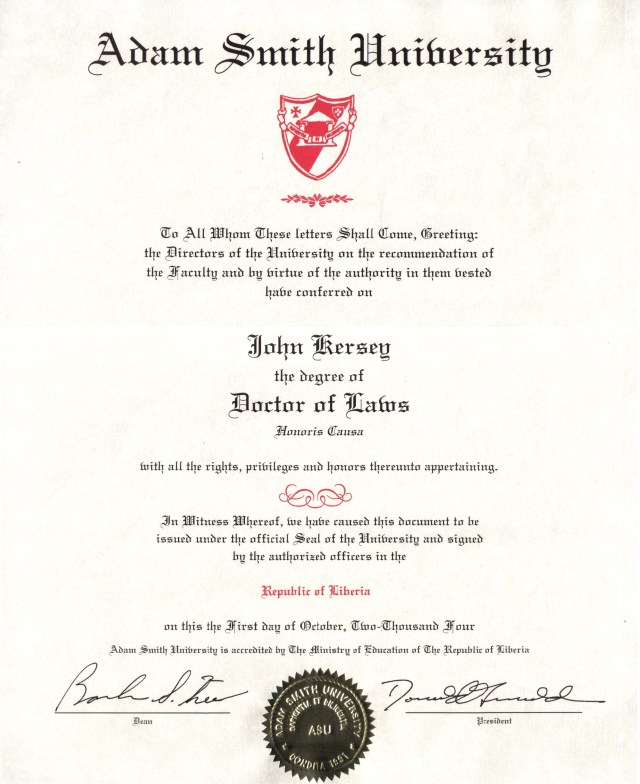
I had noted that among the degree programs that the Ministry of Education had accredited was a master’s program in History. My previous bachelor’s and master’s degrees in the United Kingdom had included significant work in history, and I enquired as to whether I might be accepted to become a distance learning candidate for the Master of Arts in History at Adam Smith University of Liberia as a faculty candidate. The work that I presented for the degree comprised two research reports, a research thesis, two assessed practicums, and assessed field experience based on my history teaching at the school level. The majority of the submission was concentrated in the history of education. Thirty semester credit hours were required for the award of the degree; I transcripted thirty-one, and was awarded A grades in all graded assessments, the degree being awarded on March 15, 2005. My advisor during my candidacy was Dr Grunewald himself.

Some time after my graduation, Liberia announced the formulation of a new national policy on distance education. The National Commission on Higher Education, which had been established as a division of the Ministry of Education to oversee the university sector, issued a statement concerning Adam Smith University of Liberia, which was received by fax on September 17, 2005.
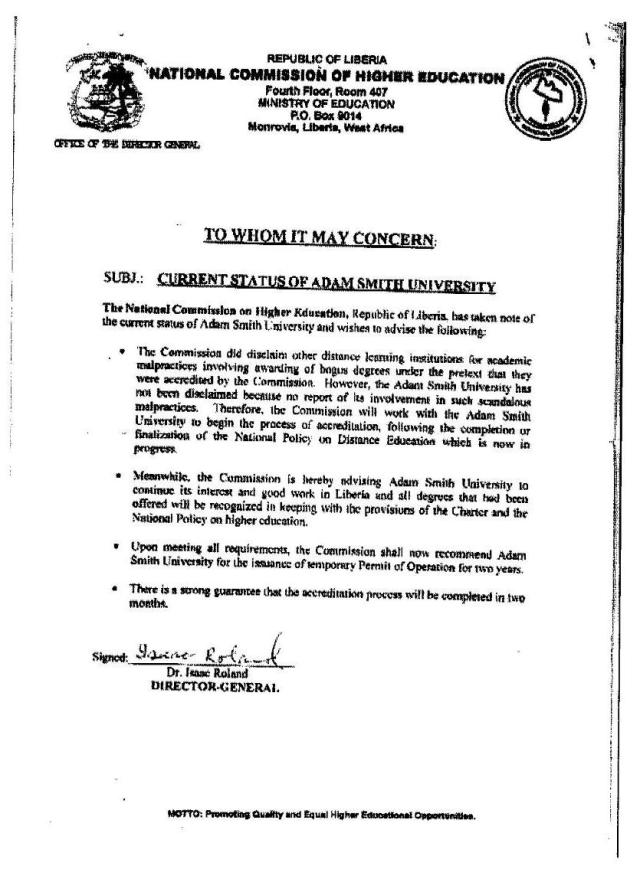
In fact, at the time of the issuing of that statement, Adam Smith University was the only remaining legally operating distance learning university in Liberia, all others having been disclaimed or revoked for academic malpractice. The tone of the statement makes it clear that Adam Smith University was regarded positively by the Ministry of Education, and gave the assurance that the degrees it had awarded would continue to be recognized.
Adam Smith University acquired land for a new campus in Monrovia and construction commenced on April 22, 2007 on the first building, which was intended to include classrooms, a library, administrative offices and an auditorium. This would permit the University to offer courses in Liberia in a traditional classroom environment as well as to facilitate the offering of distance learning and independent study from this campus. Students would have available use of computers and other instructional aids as well as a library of books and CDs for research.
Unfortunately, the National Policy on Distance Education mentioned in the statement was very slow to materialize, largely due to the opposition of traditional educators to distance learning and the fear of competition for jobs for university graduates in Liberia if there were to be more university graduates. At the time of the expiry of the two year temporary permit issued to Adam Smith University of Liberia, it had not yet been put in place. Accordingly, the University ceased offering instruction in Liberia in December 2007, and work on the new campus was also suspended sine die.
In December 2019, the website for Adam Smith University (www.adamsmith.edu) became unavailable, and it would appear that after twenty-eight years, the University had finally closed its doors.
 St Katharine’s Institute of Theology and Religious Studies was an independent, privately-owned Christian theological institute founded and incorporated in Wyoming, United States of America, and controlled by the Religious Society of St Katherine, a religious teaching congregation.
St Katherine’s Institute of Theology and Religious Studies was founded and chartered in 2003. The Institute was empowered under the law of the State of Wyoming to award collegiate degrees to the doctoral level in the areas of Theology, Religious Studies, Church History and Church Music. Such titles could be awarded after examination, honoris causa or de facto upon persons who, in the opinion of the Institute, were deserving of such an award in recognition of their work as a theologian, exponent of religious studies, church historian or church musician. The Institute was an independent interdenominational institution providing both traditional and innovatory programmes of study at the postgraduate level.
The Institute offered its programmes mostly through correspondence study and distance learning, although some programmes in Church Music were offered by examination. A panel of tutors and examiners approved by the Institute prepared students for awards, functioning as an independent guild with most tutors being based in the United Kingdom.
The By-Laws of the Institute defined its aims as follows: “St Katherine’s Institute of Theology and Religious Studies shall exist for the purpose of offering Biblical and religious instruction, and basic instruction in other subjects or disciplines as may be felt appropriate in compliance with statute W.S. 21-4-101(a)(iv) of the state of Wyoming, to students in any state or country, within or beyond the United States of America, where the Directors of this Corporation may determine there is a sufficient cause and opportunity for opening and maintaining work; to carry out such instruction by extension courses, correspondence, the internet, lectures and any other appropriate method, by the publication of papers, bulletins, magazines, books or other publications; or by any other means the Corporation may determine to be fruitful; to employ teachers, officers, extension lecturers, correspondence tutors, or such other workers as may be necessary; to establish and maintain such educational institutions, chapels and dormitories as may be found useful in promoting the cause of religious education; to grant diplomas, academic or honorary degrees in any subject for work done in the institution of the Corporation, under its guidance, or for merit.”
The Institute functioned as a private theological college, and its courses were not open to the public. Candidature for degrees was by personal invitation from a member of the Religious Society of St Katherine only (if the applicant was not him or herself a member of that body). No fees were charged for tuition or examination. As an institution not open to the public and not charging fees, the Institute was not eligible for any recognized accreditation system within the USA or elsewhere. It was always an intentionally small institution.
The Religious Society of St Katherine numbered ten members. Its President was the Assistant Superior of the Josephite Community in the UK, Br. Michael Powell, cj, and the Warden was Nicholas Groves, MA.
The Institute was incorporated in the state of Wyoming as a religious nonprofit corporation on 16 April 2003, with corporate number 200300448935. All four Directors of the Institute were members of the Religious Society of St Katherine, and I served as its President. The Institute was granted a religious exemption from private postsecondary school licensing by the Wyoming Department of Education on 10 July 2003.
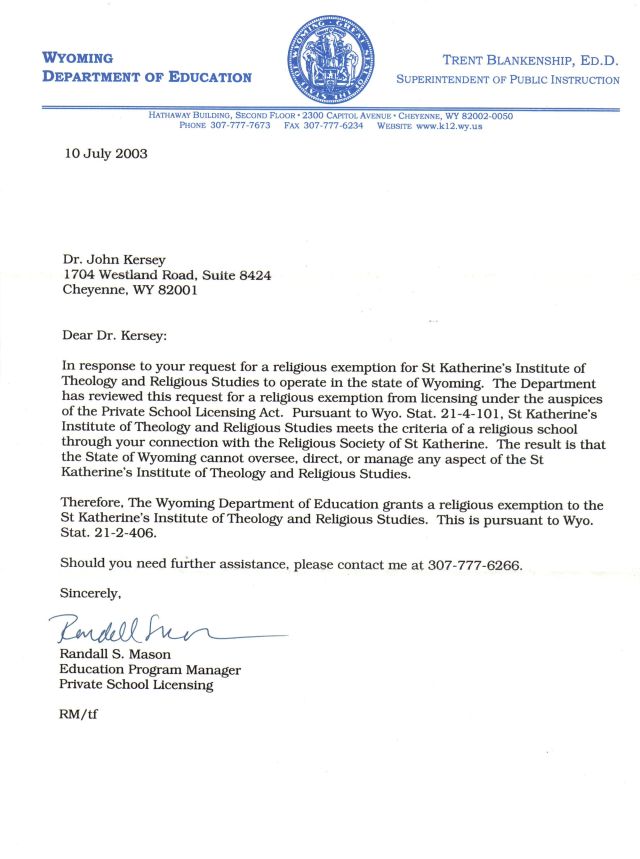
In 2004, the State of Wyoming, concerned primarily by national publicity that had highlighted the abuse of its religious exemption by the diploma mill “Hamilton University”, legislated to prohibit religious exempt schools from offering degrees by distance learning. This made it impossible for the Institute to continue operating on the basis of its Wyoming authority, and its corporation was consequently dissolved. An approach was next made to Knightsbridge University, Denmark, where I served on faculty. Knightsbridge agreed to act as validating body for the Institute and, in an extremely generous gesture, awarded a reciprocal degree to the majority of the Institute’s existing dozen graduates without charge.
Later that year, it was decided that the Institute should cease preparing students for degrees and should be re-constituted in the United Kingdom. A very small number of Fellowships in Theology and Church Music were awarded to members under this re-constitution. In 2005, serious differences emerged between members of the Society, and both the Society and the Institute ceased activity.
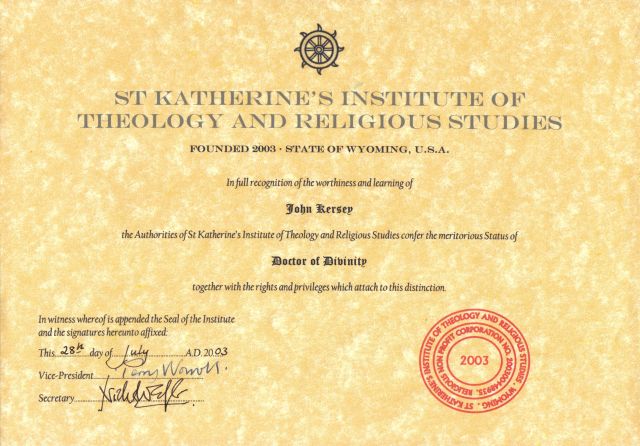
I was awarded the degree of Doctor of Divinity jure dignitatis by the Institute in 2003.
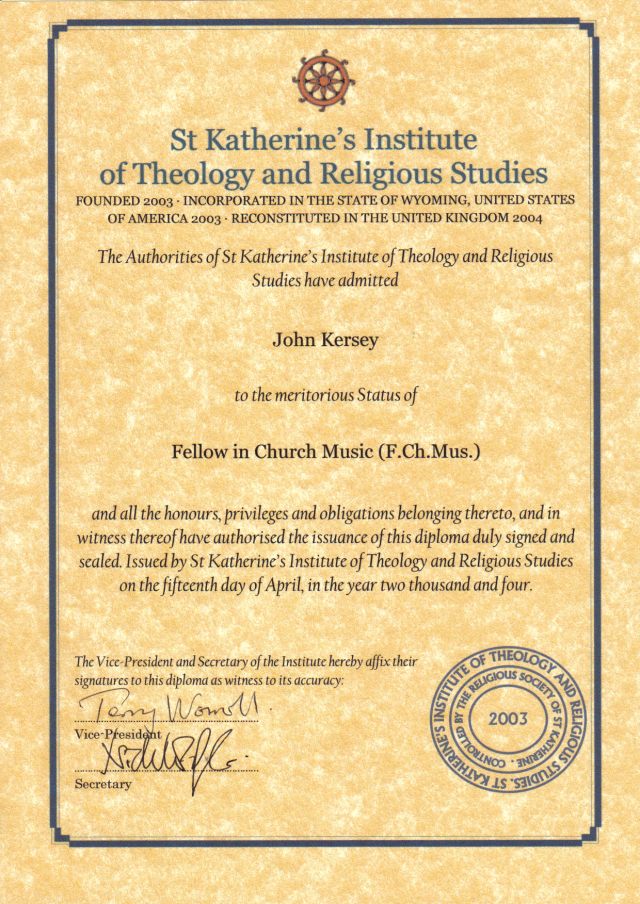
When the Institute was re-constituted in 2004, I was awarded a Fellowship in Church Music jure dignitatis.
The London Society for Musicological Research was an independent learned society founded by me in 2002 which aimed to encourage the pursuit of research of all kinds into subjects of a musicological nature. It interpreted this aim in a broad and liberal manner so as to include all research that had a bearing on the understanding of the phenomenon of music. At the time, it was felt that there was insufficient encouragement for the independent musicological researcher outside the academic establishment. LSMR was intended to recognize externally-completed research and to provide a means for the dissemination of work that would otherwise lack a platform.
Election to Associateship and Fellowship of the Society was dependent on the submission of an appropriate research dissertation of a high standard; for Associates of 10,000 words in length and for Fellows of 20,000 words. The Society aimed to encourage candidates to consider research of a more experimental and searching nature than institutional constraints often allowed. It was not a requirement that candidates should have obtained any specific qualification before submitting work for the Society’s diplomas. There was also provision for admission to the diplomas of the Society on the basis of previously published work. The Society administered several prizes available to diploma candidates, named after Cuthbert Girdlestone, Arthur Fox-Strangways, Violet Gordon Woodhouse and John Alexander Fuller Maitland, the Annie O. Warburton and Rosa Newmarch Memorial Scholarships and the Eaglefield Hull Exhibition.
The Society also elected persons who had made a distinguished contribution to musicological research, or to the work of the Society, or who were judged in the opinion of the Council to be generally deserving of such distinction, to Honorary Fellowship and Associateship.
The Society supported research projects that included my “Romantic Discoveries” series of world première recordings of nineteenth-century piano music, research into the music of St Anne’s Cathedral, Belfast, and the organ-builder Richard Bridge.
In 2003, the Society became a constituent body of Claremont International University (Seychelles) under my direction. However, after the change of management of the University in 2004, it was agreed that the Society would return to the status of an independent body under my direction.
The Patrons of the Society were Dr David Baker, Pro-Vice-Chancellor of the University of East Anglia, and the composer and arranger Lt-Col. Dr Ray Steadman-Allen. As of 2005, Executive Council numbered six persons, the associated Advisory Council eight, and the body of Fellows and Associates twenty-three. Unfortunately, serious differences between members of the Executive Council of the Society emerged in 2005, and these resulted in the Society ceasing activity.
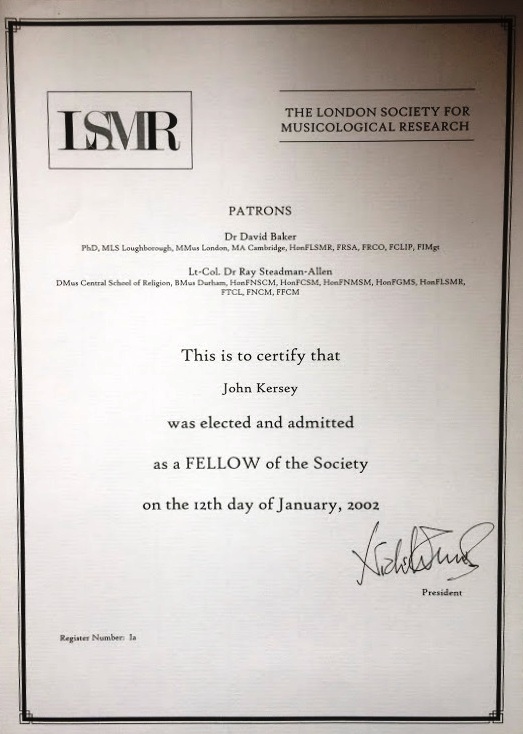
In January 2002, the Executive Council elected me to the Fellowship and I was issued with this certificate signed by the President, Nicholas Groves.
In 2002, France’s Loi de Modernisation Sociale (Law of Social Modernization) of 17 January 2002 specifically authorized universities and other “établissements d’enseignement supérieurs” (higher education institutions) to grant degrees based entirely on an assessment of the candidate’s work experience. The process is known in French as Validation des Acquis de l’Expérience (VAE).
The VAE has since been incorporated into the French Code of Education (Legislative Part, Third Part, Book VI, Title I, Chapter III, Section 2, Art. L613-3 to L613-6.) It is important to note that Art L613-4 states: “The validation produces the same effects as the knowledge or aptitude testing process that it replaces.” Moreover, the academic titles granted through VAE are identical to those gained by conventional study and any mention of VAE in those titles is considered discriminatory and is prohibited by law. All universities and other higher education institutions in France are legally required to apply the VAE if requested.
VAE has proved extremely popular in France. The candidate, who must have a minimum of three years of work experience, submits a portfolio of achievement which is then considered by a jury of professors, who meet either in person or electronically. Any false document submitted by the candidate during the process carries the possibility of heavy fines and three years imprisonment.
The wider French-speaking world has also embraced VAE. Those countries that are members of the Organisation internationale de la Francophonie typically include educational institutions that operate according to the French education system. In 2004, I was a candidate for the VAE process at the Université Francophone Robert de Sorbon. This institution was a virtual university, specializing exclusively in VAE, that was accredited by the government of Anjouan, which was one of the members of the Union of the Comoros and a member of the Organisation internationale de la Francophonie. The university was also incorporated as a nonprofit corporation in the state of Maine, USA (charter no. 20040586ND). Maine exempted privately-owned nonprofit correspondence schools from licensing under Maine Department of Education Rule #05-071, CMR 150, 2A.
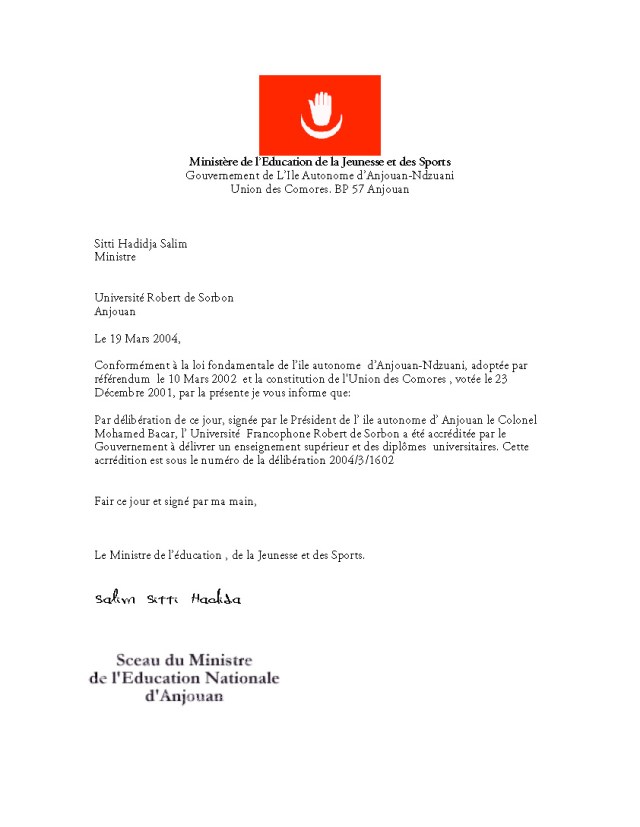
The jury for my VAE assessment had as its Dean the President of the University, Christian Jean-Noël Prade, who is now a United States citizen and uses the registered business name John Thomas. He earned his DES at the Universitê de Paris II and undertook further studies in education at Harvard, leading to extensive work in foreign credential evaluation and American university admissions for foreign students. In 1988, he was decorated by the President of France as a Chevalier of the Ordre National du Mérite. He was a veteran of the political Right in France, being a founder of the Union Défense Group (GUD), the leading direct action organization of the Right in opposition to the Paris 68 left-wing student riots. He was also a noted sportsman, having completed the Cresta Run on multiple occasions and endowed a trophy at the event.
Dr Thomas was assisted on the jury by Dr Maria de Lourdes Nunes and by the Vice-Dean of Arts, Régis Bouvier de Cachard. Bouvier de Cachard was a symbolist and magic realist artist who had been acclaimed by critics in the 1960s and 1970s and whose works were to be found in the Tate Gallery and the Museum of Modern Art in Paris, among others.
>>Bouvier de Cachard, by Colin Wilson (author of “The Outsider”, etc.)
The jury decided to award me the degree of Docteur ès Lettres en Humanités with the highest accolade of mention très honorable (equivalent to summa cum laude).
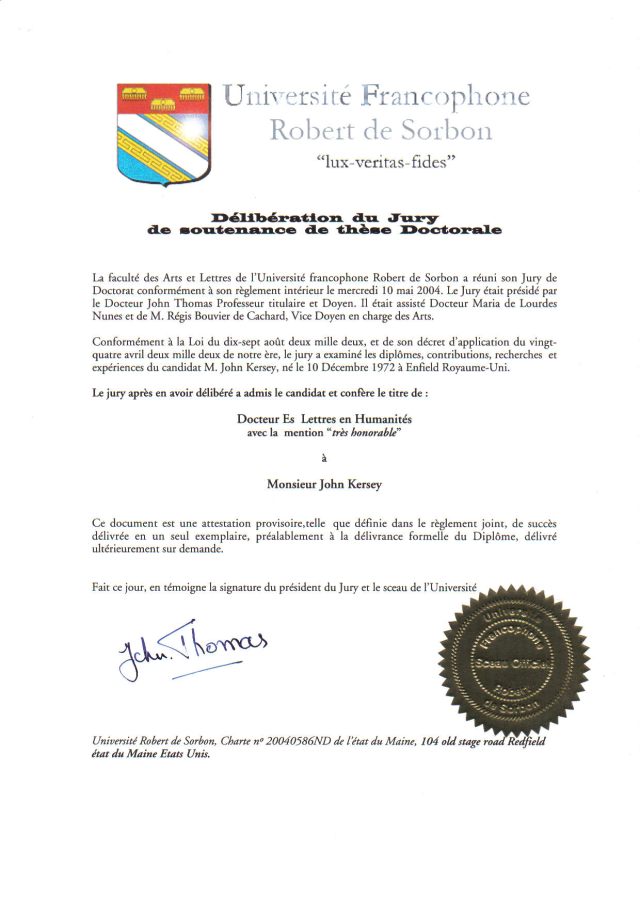
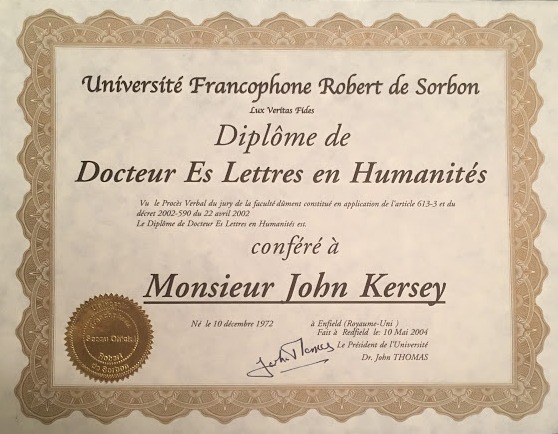
Unfortunately the University was to be short-lived, and it closed the following year. It had been replaced, however, by a new French institution, the Ecole Supérieure Robert de Sorbon. This was registered in France as a non-profit association under the law of 1901, and is classified in the French education system as an “établissement d’enseignement supérieur privé” (private institution of higher education). In France, the opening of higher education to the private sector means that under article L-731-14 of the Code of Education, private institutions may offer programmes and grant academic titles (the French system does not have an exact equivalent to the word “degree”). They are prevented from using the designation “université” and certain academic titles (baccalaureat, licence, master and doctorat) are forbidden from use on pain of fines. Other academic titles (DEUG, DES, MBA, PhD for example) may be used freely. There are many institutions in the category of établissements d’enseignement supérieur privés, particularly business schools, of which INSEAD is probably the most famous.
The official and legal status of academic awards made by the Ecole Supérieure Robert de Sorbon and other établissements d’enseignement supérieur privés is that of certificats (or diplômes) d’enseignement supérieur privés. These awards are distinct from titres ou grades universitaires (university titles or levels) which may only be awarded by public, state universities. Certificats d’enseignement supérieur privés are covered by the Lisbon Convention on the recognition of credentials in Europe and may be designated as representing any postsecondary level of achievement.
There are several schemes by which certificats d’enseignement supérieur privés can be given further recognition by the French Ministry of National Education. These include homologation in which a given curriculum is submitted for approval by the authorities, leading to the recognition of that specific award by the Ministry. However, awards made by VAE are prima facie ineligible for these schemes, since there is no curriculum to be recognized and the institution only administers the VAE assessment without needing to deliver classes. For this reason, the certificats d’enseignement supérieur issued by the Ecole Supérieure Robert de Sorbon are fully legal French academic awards in their own right, but are not awards carrying official recognition from the Ministry of National Education. Their comparability to other academic awards is inevitably subjective, but certainly some authorities both within and outside France have considered them to be comparable to accredited degrees.
As a graduate of the Université Francophone Robert de Sorbon, I received a reciprocal award from the Ecole Supérieure Robert de Sorbon in November 2004.
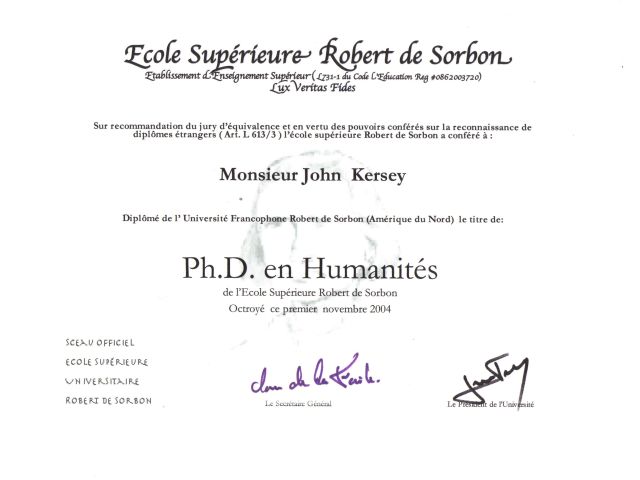
In 2009, a government-accredited university in Costa Rica agreed to accept my ESRDS PhD as the basis for a doctorate awarded by incorporation.
In 2013, the Ecole Supérieure Robert de Sorbon was granted a trademark and consequent legal protection for its name by the French authorities. It is one of a number of French institutions named after Robert de Sorbon, the chaplain of King St Louis IX, who in 1253 established the College de Sorbon. However, it is the only one of these to have been granted a trademark in the present day.
The concept of a specialist VAE institution, particularly one operating solely by distance learning, is pioneering and has proved highly controversial, attracting particular opposition from the education establishment both within and outside France. Inevitably, given the leftist nature of this establishment, there is a negative focus on the political affiliations and personal profile of Dr Thomas. Nevertheless, the Ecole Supérieure Robert de Sorbon has shown itself willing to enter into this controversy and to defend its position. It will celebrate its twentieth anniversary in 2024.
The International High IQ Society is a high IQ society which was founded in 2000 in New York by the late Nathan Haselbauer. Under his leadership it became the second largest high IQ society in the world. Membership in the International High IQ Society is open to persons who have an IQ in the top five percent of the world population, assessed by passing the IHIQS admissions test or other qualifying IQ test.

During my time as President of Claremont International University an articulation agreement was formed between the University and Trinity International University for the reciprocal acceptance of credit between the two institutions. Trinity International was incorporated in Delaware, USA, but ran its degree-granting programme from France, where it was registered as a non-profit association of higher education operating through correspondence.
The methodology of awards was through the assessment of prior experience for academic credit with supplementary correspondence study. Candidates could qualify through the accumulation of academic credits including awards issued by partner institutions around the world.
My dealings with Trinity were primarily via its principal Father Cornelius Anthony Gillick. Father Gillick, an Irishman by birth, attended the universities of Dublin and Manchester before earning his doctorate in theology at Adam Smith University, where I would also study, and the President of ASU, Dr Donald Grunewald, spoke very highly to me of the quality of his academic work. In 1988 he became an Associate of the Institute of Counselling, and previously he had also been an Overseas Welfare Officer looking after the interests of overseas students in Manchester. He was also a bishop in the Independent Catholic tradition and ran a house mission as well as undertaking community work. He had also previously been a magistrate in Manchester.
Some years earlier he had self-published a guidebook to distance learning degree providers called “Degrees by Post” and generously sent me a copy of this useful book. He was devoted to the care of cats, and I understand that for some years he established a cat sanctuary that did a good deal of valuable and humane work.
I became a candidate for the Doctor of Letters degree, which was the senior earned degree awarded by the University, and received this in June 2004.
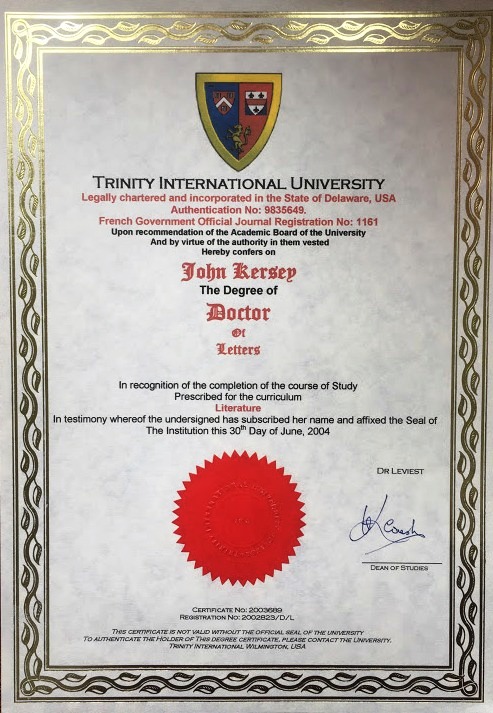
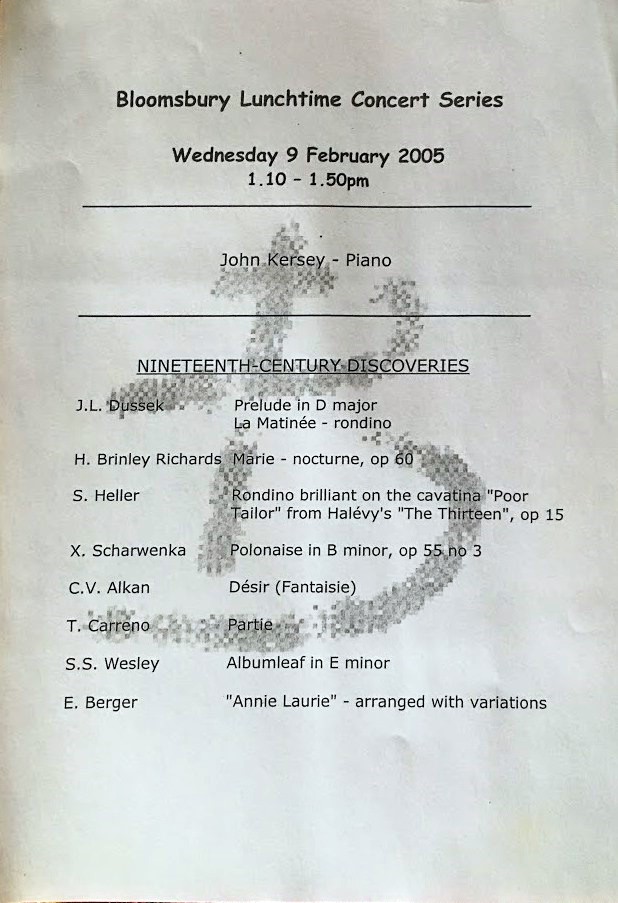
 Professor John Kersey
