My education: St Ephrem’s Institute of Eastern Church Studies

St Ephrem’s Institute of Eastern Church Studies was established in 1974 as the Scandinavian extension of the People’s University of the Americas. For much of its history, it was closely associated with the Scandinavian representation (Svea Synod) of the Apostolic Episcopal Church and with the American World Patriarchs; like those communions, its character was ecumenical.

The People’s University of the Americas (PUA) was founded in San Juan, Commonwealth of Puerto Rico, in 1967 (and incorporated as a non-profit educational institution there in 1973) by Archbishop Uladyslau Ryzy-Ryski (1925-78), Chancellor to the Holy Orthodox Catholic Patriarchate of America and first Patriarch of the American World Patriarchs (as Patriarch Uladyslau I). At its inception, PUA opened with two schools: the Faculty of Theology & Canonic Law and the Faculty of Philosophy & Literature. Further faculties in American History and Government, Law, and Naturopathy were added during the 1980s and 1990s.

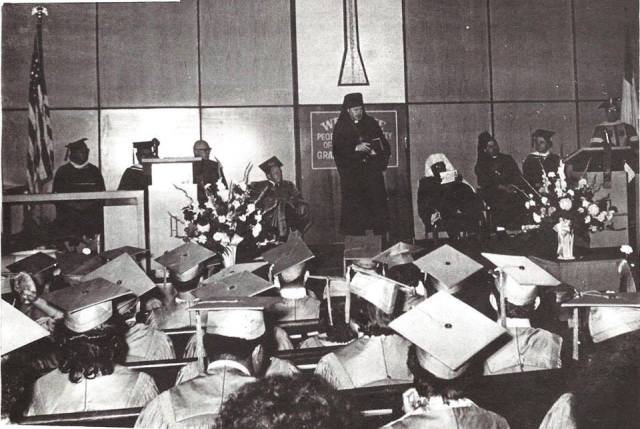
Patriarch Uladyslau addresses the graduating class at the People’s University of the Americas, 1975

The University offered degrees at bachelor, master and doctorate levels. Instruction was offered on campuses in Ponce, Cayey and El Verde, with a particular social emphasis dedicated to the education of the poor. Working adults were catered for through evening classes. The University took a position that it was opposed to distance learning and all its academic activity took place on campus. In 1989, the United States Attorney-General issued a letter recognizing PUA as an established institution of learning recognized as such by a qualified state agency. With the turn of the century the construction of a new campus in Ponce was announced.

PUA applied for regional accreditation in the United States in 2004 and suspended enrolments pending the outcome of this process. During the same year, the University was acquired by the National Association for Foreign Attorneys in Florida and renamed UNPAM University. The University continues to exist today but no longer grants degrees.

In Scandinavia, St Ephrem’s Institute was under the direction of Archbishop Professor Bertil Persson, who was both a presbyter in the Church of Sweden and a bishop in the Apostolic Episcopal Church (which was in intercommunion with the American World Patriarchs). As such, it served primarily as a means of promulgating research and scholarly publications, focusing on the principal areas of church history and the Aramaic language. In addition, it was the repository for a substantial archive of records and information concerning the smaller independent churches, much of which would eventually be consolidated in Independent Bishops: An International Directory (Persson, Bertil; Bain, Alan; Ward, Gary L.; preface by Melton, J. Gordon; Detroit, Apogee Books, 1990), which was produced with the Institute for the Study of American Religion at the University of California at Santa Barbara.

St Ephrem’s Institute functioned both in Sweden and in Norway, where its degrees were awarded principally to churchmen and theological scholars. The degrees were generally awarded by Diploma, which meant that, although they were full earned degrees, they were awarded based on the Institute’s assessment of the work and standing of the graduate rather than after examination or supplication.

The Honorary Fellows of St Ephrem’s Institute included HH Pope Shenouda III of the Coptic Orthodox Patriarchate; Mt Revd Mar Aprem, Metropolitan of the Church of the East; HH Patriarch Ignatius Zakka I Iwas of the Syrian Orthodox Patriarchate; and HB Patriarch Maximos V Hakim of the Melkite Greek Catholic Church. There was also a distinguished board of Research Professors.

I was awarded the degree of Doctor of Divinity by St Ephrem’s Institute in 2008, the year in which I was also appointed as a bishop in the Apostolic Episcopal Church. As will be seen from the diploma below, the basis for the award was “his Outstanding Works on Church History”. My work in that area has concentrated on a continuation and expansion of topics that in some cases were previously also the subject of publications of the Institute, particularly the histories of the smaller independent churches and the biographies and ministries of their clergy. Subsequently, I would publish my biographies of ecclesiastical pioneers Arnold Harris Mathew and Joseph René Vilatte.

The death of the Institute’s Vice-President in 2008 led me to understand that mine would be the final degree of St Ephrem’s Institute to be awarded.

In India, meanwhile, an institution founded under the inspiration of St Ephrem’s Institute has outlived its European progenitor. St Ephrem’s Ecumenical Research Institute (SEERI), which is situated in Kottayam, Kerala, and affiliated as a research centre to the Mahatma Gandhi University, was inaugurated on 14 September 1985 by Mar Thoma Mathews I, Catholicos of the Orthodox Syrian Church and an ecumenical collaborator of Archbishop Persson. It is a centre for the study of the Syriac language and cognate subjects.

Work in education: Marquess College, London and Marquess Educational Consultants, Ltd.

In 2005, I sought to consolidate the various strands of my educational work by forming a private limited company in the UK called Marquess Educational Consultants, Ltd. This was incorporated in England and Wales on 13 July 2005 with company registration number 05507264. I was the sole director of the company.

The first work that the company undertook was educational consultancy with respect to the equivalency of international credentials I had begun to work remotely online as a senior consultant and expert on international credentials for several foreign credential evaluation agencies in the United States, where we served clients in the fields of educational admissions, employment and immigration. Through Marquess Educational Consultants, Ltd., I provided several hundred expert opinions on credentials and their equivalencies, advised extensively on the handling of complex immigration matters involving credentials, and also undertook research in this area leading to industry publications. Working in a small team, I also had responsibility for the online training and mentoring of staff who were new to the area of foreign credential evaluation.

In addition to this, the company undertook several projects concerned with the provision of distance and blended education. Marquess College, London (MCL), was established as a division of the company and focused upon offering qualifications based on the mentored assessment of experiential learning through portfolio, coursework and dissertation methods. It defined its mission as “to be a leading resource for the development of professional competencies worldwide and to serve those who will be the leaders of tomorrow.” Before long it had attracted an excellent and diverse faculty, a number of whom who were experienced in alternative and nontraditional education and advocates for its merits. In January 2006, MCL absorbed the formerly independent Free College of the Divine Spirit and the Faculty of Independent Funeral Ministry, which became the Faculty of Free Christian Studies of MCL.

MCL was founded with the awareness that today’s professionals seek an educational solution that is flexible, responsive and that embodies the concepts of modern professional life. The MCL learning solution is designed to add value, and to empower decision-makers so that their leadership is informed by an international outlook. Programs are offered both on campus, and through distance learning, with the latter route requiring no residency at any time. The concept of mentorship is key throughout.

Our programs have been designed with key leadership objectives in mind, with input from both educators and practitioners. As a participant, you will benefit from an advanced and forward-looking approach to education, and prepare to meet the challenges of twenty-first century professional life. The programs are strongly practical and vocational in nature. They apply a professional model to education, not an academic model to professional life.

Following the practice of other comparable career institutes and similar schools, we have routes to our awards both for those who hold existing formal post-secondary qualifications, and for those who do not, but can show us that their experience and background means they are likely to succeed on the program.

MCL awards stand in a long tradition of self-directed independent education. Although we impose no philosophy on the candidate, the ideas of educationalists such as Steiner, Montessori and particularly Karl Popper have influenced the programs and structure of the College. The emphasis is on empowering the adult as an active learner under mentorship rather than a passive learner under instruction.” (Marquess College, London, website)

In order to offer programmes on campus, MCL entered into a partnership with St George’s College, London, which had campus premises in Marylebone, whereby St George’s became an accredited campus centre for MCL programs. The academic staff of St George’s College liaised closely with MCL management with all programmes subject to external examination as an integral feature.

Distance and blended learning programmes were designed in particular so that they could be integrated into the professional workplace. The programmes could be based entirely around a particular company, with projects based on working life and emphasis on analytical, interpersonal and integrative competencies. Focus was possible on both the individual and the individual as part of a team. The structure of the programme drew on best practice in progressive institutions in Britain, Europe and the USA to create a holistic – yet easily understood – route to the assessment of professional competencies in practical terms. The business focus led to the development of a sister organization to MCL, the London Academy of Professional Management, which was designed as a professional organization that offered an assessed membership based on prior experience and learning.

Marquess College, London, was registered on the Department for Education and Skills Register of Learning Providers with provider number 10009520. In order to provide quality assurance for its distance learning programmes, Marquess College, London, became an associate member of the British Learning Association, which meant that it was bound by the BLA’s Code of Conduct for the provision of educational programmes to which students could have recourse if necessary.

Marquess Educational Consultants, Ltd., also sought and obtained certification of its quality assurance systems following assessment by the independent standardizing body International Charter,  with respect to their standard IC9200 for organizations.

The programmes of MCL were listed in LearnDirect, the UK national learning directory, and by Hobsons/Trotman Information Services, then the most comprehensive database of further, undergraduate and postgraduate courses and institution information, covering the UK and Eire. In addition, MCL became a member of the Alternative Education Resource Organization, a non-profit organization in New York, USA, founded in 1989 in order to advance learner-centred approaches to education. AERO was considered at that time by many to be the primary hub of communications and support for educational alternatives around the world.

In addition, discussions were opened with several recognized university-level institutions, one in Australia and another in Denmark, who agreed to recognize MCL diplomas for credit towards their degrees by distance learning. Several evaluators of foreign credentials in the USA recognized MCL diplomas as being of a standard equivalent to recognized degrees.

While MCL was quickly recognised as one of the first educational institutions to offer prior learning assessment to working professionals, it also became a focus for online controversy, much of which reflected the vested interests of the educational establishment in stifling any potentially disruptive innovation outside it. This took the form of a smear campaign consisting largely of personal attacks and inaccurate statements. In a newsletter to faculty and students, I wrote the following, “What we are aiming to achieve at MCL is highly innovative and something of a challenge to the educational establishment. The idea of taking power from the educational institution and giving it to students remains revolutionary today, despite many significant precedents, as does running education on an enlightened business model. I hope that you will take pride in your association with an educational experiment that could well go on to have widespread influence for the better. In the words of Pericles, “The secret of Happiness is Freedom, and the secret of Freedom is Courage.”

In an unrelated development, our partner St George’s College, London, changed ownership in March 2006, and left the Marylebone campus. This brought about the end of our working partnership and left us without a campus.

In general, the calibre of applicants and graduates of MCL was high, but their numbers were always small. The market at that time was seeking either degree programmes, which we were not legally able to offer, or short courses, and our diplomas and certificates fell somewhere between the two. On recommendation from a faculty advisor, we increased the number of short courses on offer and placed less emphasis on the APEL diploma programmes. However, this strategy had the opposite effect from that intended and reduced applications still further.

Since 2003, work had also been progressing on what would become European-American University, which would in June 2007 obtain overseas degree-granting authority in the Commonwealth of Dominica, and it was always planned that there would be an eventual synchronization of institutions in consequence of this anticipated development.

The EAU project had several different working names during its pre-launch period, one of which was Marquess University (under which name it was briefly incorporated as a private international university in Panama in 2005). While at one point a draft of a website for Marquess University was accidentally uploaded to the internet, it was never open to the public and did not recruit or graduate any students. Nor was it organizationally connected with MCL except in terms of sharing faculty and management. Rather, it had been intended that Marquess University would eventually appoint Marquess Educational Consultants, Ltd., as its British agent to offer its programmes in the UK. However, this did not in the event happen.

Reflecting the developments with MCL, it was decided in September 2006 to refocus energies upon the EAU project, and most of the work that had been planned for MCL was consequently diverted pending the launch of EAU to the public later in 2007.

With respect to the MCL organization itself, I consequently undertook a major revision that relaunched it in September 2006 as a specialist rather than generalist college devoted to theology and church music called St Simon’s College, London. This preserved much of the assessment methodology and educational principles of MCL, but in a more restricted context that was in keeping with my ministerial work of the time. A number of short courses in Liberal Christian Theology and Ministry were added to the programmes being offered. St. Simon’s College served as the seminary for The Independent Old Catholic Church of the Utrecht Succession and The Liberal Rite which were the denominations within which my ministry was at that time carried out.

With the launch of the educational programmes of European-American University to the public in late 2007, St. Simon’s College, London, and its predecessor Marquess College, London, ceased their independent existence and were absorbed into the University. Their graduates continue to be verifiable through the University today. For some time, I continued my credential-related work through Marquess Educational Consultants, Ltd., but in late 2009 I transferred this elsewhere.

On 26 January 2010, Marquess Educational Consultants, Ltd., was dissolved. The company was in good standing at the time of its dissolution and had settled all debts and ceased trading before the dissolution process was started.

Status

Marquess College, London, the London Academy of Professional Management and St. Simon’s College, London, were defined as colleges of further education and awarded certificates and diplomas under English law. They did not offer degree awards since they did not have the necessary legal powers to do so, although some of the diploma and certificate awards that were offered were examined at an advanced level corresponding to that of undergraduate and postgraduate awards.

My education: Certificate in Managing People/Managing Others from INSEAD

In 2006, I took a short online distance learning course entitled Managing People/Managing Others from the leading French business school INSEAD. I was both interested in the course content and also curious to establish how an elite school approached the delivery of distance education. The course was outstanding in both content and delivery. It was both informative and extensively supported by course documentation, and I felt I gained a lot from it.

A case study of education in the private sector: An interview with Henrik Fyrst Kristensen, Vice Chancellor of Knightsbridge University, Denmark

Originally published by the Libertarian Alliance in January 2006 as Educational Notes no. 37. ISBN 1 85637 705 9, ISSN 0953-7775

Introduction

Knightsbridge University[1] is one of a small handful of private universities operating outside the state system in Denmark. Founded in 1991[2] by Henrik Fyrst Kristensen, who remains its Vice Chancellor, its mission was straightforward; to create an international institution operating primarily via the then-emerging technology of distance learning that would cater for the mature, mid-career professional.

Offering taught and research programmes in a wide variety of subject areas, the University has produced graduates including royalty, senior diplomats and leaders in the business world and attracted a distinguished adjunct faculty, many of whom also teach at mainstream universities. Amongst the disciplines for which it is now best known are Military Studies and Intelligence, Security and Terrorism. Knightsbridge has remained determinedly elitist in its admissions policy and general approach; operating as a counterblast to the open admissions policies of its Danish state counterparts.

The interview was conducted in November and December 2004 by email and telephone[3].

The interview

JK: Danish education in 1991 was dominated by egalitarian principles, and this factor has intensified considerably in subsequent years. In setting out a deliberately elite vision for Knightsbridge, you were very consciously swimming against the stateoriginated tide. How did you conceive this mission and what specifically did you set out to achieve in Knightsbridge’s foundation?

HFK: Knightsbridge University originated from the concept of supplying a niche market. There are providers aplenty for the mainstream. There are providers for a range of non-mainstream requirements. But there are only very few quality providers for the mature individual with relevant experience who entertains higher education from a different motivation basis to the majority of students.

Denmark was never a target market, although certainly a good deal of inspiration came from the way higher education is organised here. Knightsbridge represents the diametrically opposite stance to the Danish public university system. Small, flexible, market orientated, accessible, free from political dictate. Granted, free also from subsidies and the possibilities that would bring, but you cannot have everything.

The purpose is to be and remain independent of influence by external authorities. We wish to retain the right to decide what we offer, to whom, where and when. We do not wish to be dictated specific entry or gender quotas, minimum or maximum student numbers, academic year dates, exam dates, or anything else. This desire for total autonomy determines our range of options relative to external bodies. In short, we have no options. Summing up, our approach is a pragmatic one, albeit one solidly supported by both philosophy and dogma. We have identified and reasonably accurately described a potential market segment, and have developed products and processes to serve this segment. We have been quite successful in attracting highly accomplished individuals to our programmes, individuals for whom the award pursued with us is not necessarily the pinnacle of their life so far, but most often simply one of many milestones in the life of a high achiever.

The quality and integrity of our programmes and provision is borne out by the high number of candidates referred by graduates or other candidates. When people in senior positions in their respective organisations, people used to reviewing options, competent at sorting the wheat from the chaff, contact us on the basis of recommendation by their colleagues, there is no better feeling. Quality and integrity are also supported and documented every day by the associated adjunct faculty, working to the internal procedures in place. It is self-evident that reputable academics would never agree to collaborate with us if our processes were not at least on a par with what they already know and are used to working to. This is really where the main element of validation originates, in the constant scrutiny of our processes by people who are essentially external to the organisation, people who have nothing to gain and a great deal to lose by not identifying and constantly promoting best practice in our systems.

JK: Do you see the mission of Knightsbridge as being characterised by a dynamism born of an independent agenda, or one that is primarily the product of a conscious attempt to react to developments in the state sector?

HFK: This is not a matter of responding to “ the system”, but of being not compatible with it, and having no wish to change to achieve such compatibility. Even if compatibility existed which allowed us to be part of said system, we would still have to consider if being part would in any way benefit our target market, or simply give us the opportunity to move into other segments.

The French philosopher Jean-Francois Lyotard, who was hardly an elitist, predicted such a development in The Postmodern Condition: A Report on Knowledge[4] when he commented— in easily one of the least convoluted passages of the entire text— as follows:

“Outside the universities, departments, or institutions with a professional orientation, knowledge will no longer be transmitted en bloc, once and for all, to young people before their entry into the work force: rather it is and will be served ‘a la carte’ to adults who are either already working or expect to be, for the purpose of improving their skills and chance of promotion, but also to help them acquire information, languages, and language games allowing them both to widen their occupational horizons and to articulate their technical and ethical experience.

The new course that the transmission of knowledge is taking is not without conflict. As much as it is in the interests of the system, and therefore of its ‘decision makers’, to encourage professional advancement … any experimentation in discourse, institutions, and values…is regarded as having little or no operational value and is not given the slightest credence in the name of the seriousness of the system. Such experimentation offers an escape from functionalism; it should not be dismissed lightly since it was functionalism itself that pointed the way. But it is safe to assume that responsibility for it will devolve upon extrauniversity networks.[5]

In other words, what we do needs to be done, it serves a greater purpose, and it has been predicted that “ the system” will not do it; therefore somebody else has to.

JK: In the light of that, can I ask you to be explicit about exactly how the Danish state system does not provide an environment in which Knightsbridge could happily exist?

HFK: It is very straightforward, really. The Danish state system consists of a range of institutions conceived, established and funded directly by the state. The relevant ministry deals exclusively with these institutions, and wishes to have no dealings with the private providers. The institutions are not “ validated”, “ recognised” or “ accredited”, but simply have been invested with the credibility resulting from being “ of the state”.

Private providers are allowed to exist, with the freedom to call themselves, say, “ University”, and to offer to the public any educational programmes they see fit. This is a sensible free market approach, and one which must be lauded.

Private providers have only one possibility of engaging with the public system, namely, via student support loans, paid directly by the state to the student. This entails submitting the specific course for evaluation, and subsequently, if successful, to no end of external control. There is no access to any kind of institutional validation. And, it should be mentioned, the course is approved only if it is seen by the evaluators as being of socio-economic value. In other words, the private provider is submitting to the public system a proposal which it may well be in the system’s interest to suppress or not support.

The state institutions are permitted to compete directly with private providers, insofar as they may offer fee-bearing programmes that have not been evaluated for student support loan purposes. So, in fact, we have a situation where the state system is allowed to compete directly with the private providers, but private providers have no access to any form of external validation except where related to funding options for students, and thus have no way of competing directly with state institutions, except in the market where they naturally belong. When state institutions enter the market of the private provider, they are in exactly the same situation as the private provider: a non-externally validated institution offering a non-externally validated programme against a fee.

Lyotard also wrote, in the same work:

“ In any case, even if the performativity principle does not always help pinpoint the policy to follow, its general effect is to subordinate the institutions of higher learning to the existing powers. The moment knowledge ceases to be an end in itself— the realisation of the Idea or the emancipation of men— its transmission is no longer the exclusive responsibility of scholars and students…The ‘autonomy’ granted the universities after the crisis of the late 1960s has very little meaning given the fact that practically nowhere do teachers’ groups have the power to decide what the budget of their institution will be; all they can do is allocate the funds that are assigned to them, and only then as the last step in the process.[6]

He then goes on to discuss the basics of pedagogy in distance education. I can recommend the title very highly.

JK: What key aspects of innovation in curriculum and programme structure do you believe have originated or been assisted by your freedom from state control? I note in particular that Knightsbridge was among the first to introduce a degree in Martial Arts Studies, which concept has now been taken up by a number of other institutions.

HFK: Freedom from funding means freedom from control, particularly political control. We do not have to bow to masters telling us that now we must focus on this or that particular approach or area of study.

The most important result of this is that we have had the freedom to decide which system of provision we wanted to model our own offerings on. The natural choice was, and still is, the UK system.

The freedom from external control or dictate means that we have been able to decide what we wish to offer to the market, and to let course designers be the final judges of content (although, of course, external expert opinions have been a major element in the design phase). We have not had to cater to any form of massaging of the figures by whichever government happened to be in charge of educational policy making, in their constant search for ways to influence socio-economic trends. The BSc in Martial Arts Studies is an excellent example of this.

JK: What benefits or disadvantages do you see to your students of your independence? Does it facilitatea more personal focus to their studies?

HFK: The main benefit is that we are able to offer up a combination of attributes not often found. The same dictates and controls that come with external funding automatically reduce flexibility. In Denmark, they also mean that the state institutions are over-subscribed, and so entry requirements are based on very specific quotas, which are based again on past exam results, meaning that only the very best grades may be reasonably expected to secure entrance, although mechanisms are in place for mature students, merits and credit points for non-academic work etc.

The main disadvantage to potential candidates is a result of our freedom to choose. We are deliberately very selective, allowing only those to join whom we feel reasonably certain will be absolutely capable of completing. This is not a result of merely looking at past academic achievement, but of a whole-person evaluation. We have a duty to all candidates and graduates to ensure that the best possible experience is received when studying with Knightsbridge. This would not be the case for the borderline applicant.

Elitism? Perhaps in the sense that it represents the opposite of egalitarianism, and that it seeks to create and promote a learning environment where highly qualified people can produce very high quality work in collaboration with dedicated professionals.

What you must understand is that we apply far stricter requirements in terms of work assessment than do the majority of traditional institutions. Knightsbridge University alumni must feel they have earned their awards. Providing this experience gives us the best possible ambassadors, and we do enrol a fair number on the basis of references.

There is a very distinct personal focus on the individual candidate. From the moment they make their first enquiry and until they complete, they will likely be communicating with no more than three or four people in the administration and faculty, all of whom will have at least a fair idea of who they are, what they are studying, roughly where they are in their programme, who their tutor/supervisor is, etc. This means also that we have a very short turn-around time for communications and work.

JK: What attracted you in particular to the means of distance education for programme delivery? How do you reflect on the growth and increasing adoption of that means by state-sponsored institutions?

HFK: Distance education is the perfect partner to our aims and objectives. It offers a global reach, catering to mature individuals with a career to attend to. Such people will not accept having to take years out of their calendar to attend residential study.

There are added benefits. We do not have to spend enormous amounts on infrastructure, or maintain most of the overheads held by residential institutions. This means we can keep our fees at a reasonable level, even if we receive no forms of funding or grants.

It is only logical that traditionally residential institutions should find that distance education is a worthwhile addition to their portfolio. There is perhaps even the risk that in embracing this, they could encroach on what we see as “ our” market. That is just a reality we will have to adapt to, and then find ways to offset any potential negative effect. I am not really concerned about this at all. The type of person we tend to attract would be very unlikely to choose such an institution anyway. It is the mix of attributes that attracts them to Knightsbridge, not the distance education provision exclusively.

As Börje Holmberg puts it in Theory and Practice of Distance Education:

“The reasons why adults choose distance education… are primarily the convenience, flexibility and adaptability of this mode of education to individual students’ needs.[7]

The fact is, most of the traditional institutions may offer distance education, but have not quite managed to get the “ convenience, flexibility and adaptability” factors straight. Indeed, even the UK Open University is becoming increasingly less flexible, less convenient and seemingly determined to adapt primarily to the requirements of its traditional counterparts.

In reference to a 1980 study by R. Flinck, Holmberg writes:

“Free pacing, although a privilege not given to all distant students, was found to be an even more important argument [than ‘the support given by the distance-teaching organisation’] in favour of distance education.[8]

Nonetheless, free pacing is being increasingly eradicated.

In Rethinking University Teaching[9], Diana Laurillard writes, among many other pointed questions and observations:

“Why aren’t lectures scrapped as a teaching method? If we forget the eight hundred years of university tradition that legitimises them, and imagine starting afresh with the problem of how best to get a large percentage of the population to understand difficult and complex ideas, I doubt that lectures will immediately spring to mind as the obvious solution.[10]

And she has the answer:

“ For the individual learner, the lecture is a grossly inefficient way of engaging with academic knowledge. For the institution it is very convenient, and so it survives.”

Laurillard goes on to discuss methods available to “ a university not enfeebled by tradition”.

It seems clear to me that as long as the traditional providers adding distance education to their portfolio do not do enough, if anything, to understand their potential student and what they want, there will always be a space for what Knightsbridge has to offer.

JK: Which educational philosophies have influenced the direction of Knightsbridge to the greatest extent? Do you feel an identification with a particularly free-market or libertarian agenda?

HFK: I am personally very closely attuned to the points brought forth by Alison Wolf in Does Education Matter?, and wholeheartedly embrace the following quote:

“ … what governments could and should do, ideally, is to concentrate on their core educational responsibility, which is to provide their citizens with a good basic education at primary and secondary levels. An end to myriad initiatives and micro-management would give both politicians and bureaucrats more time, energy and money to do this properly, and would also allow people to develop the variety of educational approaches, curricula and purposes that a large and complex society demands.[11]

Given half a chance, I tend to urge people to read Cardinal Newman’s The Idea of a University[12]. One quote is:

“ I am asked what is the end of University Education, and of the Liberal or Philosophical Knowledge which I conceive it to impart: I answer, that what I have already said has been sufficient to show that it has a very tangible, real, and sufficient end, though the end cannot be divided from that knowledge itself. Knowledge is capable of being its own end. Such is the constitution of the human mind, that any kind of knowledge, if it be really such, is its own reward.”

The study, the pursuit of knowledge for its own sake, is a principal concern for us. This is an extension of the notion of freedom of choice. If Student X wishes to study, say, Astronomy for the sake of it, they usually cannot do this in the state system, they have to have a long-term objective, a plan for putting the result of the study into real life. This is because the state must get a return on its investment.

I once, when commenting on an on-line discussion forum that a large percentage of our candidates were on a programme simply for the sake of pleasing their own educational desires, was met with the comment that that was surely the worst possible reason to do any study. There I saw the noblest motive, the motive that supports the idea that man should strive to better himself for the sake of it, described as the absolute opposite.

One wonders what such a commentator would think of Cardinal Newman. Or Cicero, whose thinking Newman obviously derived inspiration from. Or The Academy[13].

We are here to provide “ higher education opportunities for the capable”. There is a very strong identification with the idea that institutions such as Knightsbridge must be allowed to exist, to enable us to service the segments not adequately catered to by the state sponsored establishment, whichever nation it happens to be in.

Being in a free market guarantees one thing: if we do not provide what people want, we cease to exist. We cannot count on a monopolistic ‘right of way’ to the very large majority of potential candidates to save us if we do not come up to scratch. The market decides, and the market is merciless. Being in the state sponsored market guarantees demise if not providing what the state wants. State institutions do not provide what the potential applicant wants, but what the state has decided it is desirable to spend its money on. The state shows as little mercy as the market, if it does not get what it wants.

For some people, the “ stamp of approval” inherent in a state sponsored qualification is not an essential element in their decision making process. Someone who already holds (perhaps several) advanced qualifications, whether they are from a university or similar or not, who is already a goodly way up their career ladder, perhaps already at the top, does not need to rely on that form of hoped-for guarantee that “ the next stop” will accept them. This gives them that most delicious of all prerogatives, the freedom of choice. This is the someone we cater to, and when someone who can choose freely chooses Knightsbridge, then obviously we must be offering something worthwhile.

Ironically, while the “ establishment” seems to think that we are potential competition, we are in fact merely complementary to their provision. The vast majority will still enrol with them, and those who enrol with us would have very likely not enrolled with them anyway.

JK: Your statement that the “ establishment” regards you as potential competition is worth exploring in greater depth. Do you feel that your position in the market means that you are a leaner, fitter rival to institutions whose adaptation to market forces is constrained by state policy, and that this occasions disquiet on that account?

HFK: It is my experience that there are several reactions, and several reasons for them. One of them is fear. Another is arrogance. A third is a grudging “ if only we could do that” respect. A fourth is a “ how do I join you?” enquiry. The latter of these is obviously most pleasant.

Some are afraid that we may somehow be a threat to their comfortable little life. One must not be blind to the fact that an awful lot of people in academia are quite aware that theirs is a most comfortable bubble, and one they do not wish to see burst. They are happy that the establishment controls the system, as they and their kindred spirits are the very people who control the establishment. Not many politicians nowadays are not graduates of a state funded university system. In whose best interest is it to maintain the status of these institutions, then?

Others are simply arrogant. “ You will never be as good as us,” or whatever the phrase. They simply fail to see that we do not aim to be facsimiles of them and their provision. We aim to be better at what we do, and to be a credible alternative to what they offer.

As for fitter, yes, we can reach and act on decisions very, very quickly. Traditional universities may need months and even years to decide on policy changes, even minor changes. What they largely fail to realise is the accuracy of Desmond Keegan’s characterisation of changes needed in traditional institutions to enable them to adapt to distance education, as follows:

  • The industrialisation of teaching.
  • The privatisation of institutional learning.
  • Change of administrative structure.
  • Different plant and buildings.
  • Change of costing structures[14].

Knightsbridge was tailor made to meet these criteria, whilst the establishment needs serious change to be able to adapt. Many will not be willing to make such changes, or willing to, and be able to stay in the system that bred and nurtures them.

JK: Do you believe as a consequence of your own experience with Knightsbridge that the complete removal of state controls on higher education would be advantageous on the whole?

HFK: Generally, yes. I am firmly convinced that as long as the populace is given a very solid and internationally competitive primary education, and access to similar quality secondary education, then they would be perfectly capable of working out for themselves what form of tertiary education would be suitable for them, if any.

Professor Wolf makes the point time and again that the obsession of governments in various countries with pushing the maximum number of people into higher education is borne out of an irrational and entirely unsubstantiated belief that this will boost “production” and “economic growth”. In fact, as amply demonstrated, the higher the workforce is qualified on average, the more the output per hour falls. The enormous amounts of money poured into higher education could be put to much better use elsewhere. The response, however, is always for the system to shout “ It’s because we do not get enough money”, and so more is thrown at it. And, of course, it would be extremely advantageous to the likes of Knightsbridge. With nothing to force those people to choose a state institution, we would benefit tremendously. So that is hardly going to happen!

JK: How can quality assurance be delivered within an institution not subject to state oversight?

HFK: I can show you pages and pages and pages of quality assurance documents, policy documents, assessment documents, questionnaires, etc. The main guarantee of our inherent quality is the quality of the people involved, however. No reputable academic would engage with Knightsbridge if our processes and procedures were not in order. We model our processes on those described by the UK Quality Assurance Agency, and faculty are very pleased with the experience. Whether engaged as course designers, tutors, supervisors or external examiners, none ever make negative comments about the procedures related to programmes or awards.

Just to play devil’s advocate, how can the same be achieved in a state system where it is the state which decides what is “ quality” from the point of view of satisfaction of the state’s perceived need for “ x” number of graduates per year? Which of the two parties has the greater incentive to ensure high quality in all aspects, and which to change the criteria from time to time, to suit current needs?

JK: Is it your impression that Knightsbridge has succeeded in its mission thus far to the extent that you would have wished? What are some of your plans for the future of the University?

HFK: Knightsbridge has succeeded as far as I have wanted it to. One can always desire more candidates, but it is our policy to aim for the right candidates, and then more of the same. Planning activities have been such for the past couple of years that growth has been not desirable, as it would have likely been growth resulting in enrolment of candidates for whom we’d not be the best match. What we have been planning for, of course, is the future.

It is now time that we put in place planned measures to take us to “ the next level”. We wish to double our student intake every year for the next five years, to bring us to a certain comfort level. In order to achieve this, a range of new programmes have been and will be introduced. For example, a very interesting MA in Military Studies and a BSc (Hons) in Intelligence, Security & Terrorism Studies, both with world-class faculty, are now available, and receiving considerable interest. The new Master of Healthcare Administration comes with the option of a practicum period with a US hospital, something entirely new to us, and a perfect addition, as it is handled elsewhere.

We have also started a new marketing campaign, utilising almost exclusively the vast potential of the Internet. The fee schedule has been re-structured so that it provides quite significant incentive to complete within the standard period, again something we expect to have an effect on enrolment figures.

We are also looking into ways of maximising the benefit of the award for alumni, including seeking recognition for individual programmes with relevant professional bodies. Professional body accreditation/recognition is a major sales point, and something that would instantly put a much closer weave to our marketing net. Such arrangements would leave us independent of external control, so offering a situation where all win, the candidate, the professional body, and the University.

Our range of partnerships with local schools and colleges around the world is steadily growing, and current negotiations are expected to result in a significant addition in this respect.

Notes:

[1] Homepage at http://www.knightsbridgeuniversity.com.

[2] An earlier entity by the same name operated in the UK from 1986 onwards; although Kristensen undertook marketing consultancy for this entity, he was not concerned in its management. By 1991, the 1986 entity had ceased operation, and so Kristensen formed the present Knightsbridge University in Denmark, also taking on the former’s student records.

[3] Professor Kersey served as Adjunct Professor of Music at Knightsbridge University between 2003 and December 2008, and as Dean of the Department of Music from 2004 until 2008. In 2003, he earned a PhD in Music by submission of published work as a faculty candidate of the University.

[4] Jean-Francois Lyotard, The Postmodern Condition: A Report on Knowledge, first published in French in 1979, this version from Manchester University Press, 1984.

[5] Lyotard, op. cit., pp. 49-50.

[6] Lyotard, op. cit., p. 50.

[7] Börje Holmberg, Theory and Practice of Distance Education, London, Routledge, 2nd ed. , 1995, p. 13.

[8] Holmberg, op cit.

[9] Diana Laurillard, Rethinking University Teaching, London, Routledge, 1993.

[10] Laurillard, op. cit. , p. 108.

[11] Alison Wolf, Does Education Matter?, London, Penguin Books, 2002, p. 256.

[12] Available at http://www.newmanreader.org.

[13] See also http://www.iep.utm.edu/a/academy.htm.

[14] Desmond Keegan, A Theoretical Framework for Distance Education, London, 1986.

My education: Adam Smith University of Liberia

Adam Smith University of Liberia was a fully accredited private university in Liberia, active from its chartering by Act of the Liberian Legislature on 31 October 1995 until the expiry of its accreditation in December 2007.
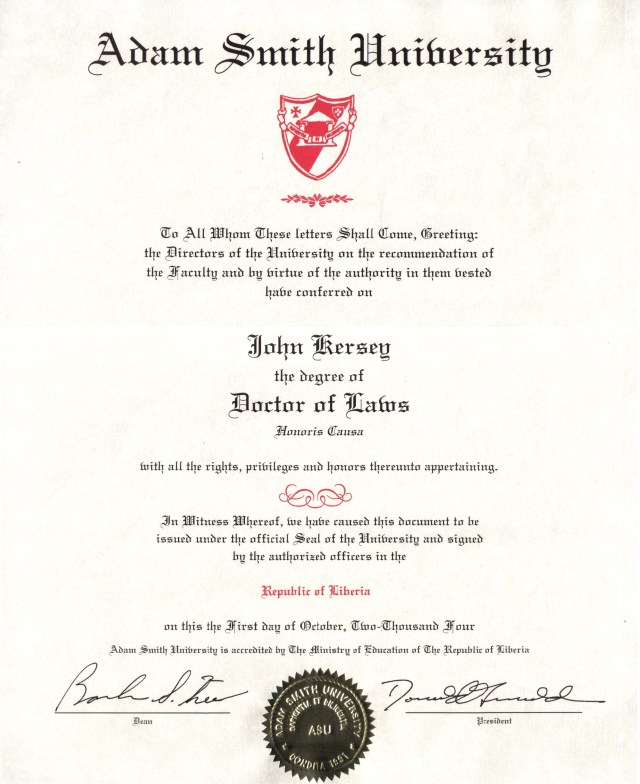
Adam Smith University was the creation of American educator Donald Grunewald, who earned his Master of Arts in History, and Master and Doctor of Business Administration degrees, at Harvard and held tenured academic positions at Rutgers and Suffolk University. Grunewald served as President of Mercy College, a regionally accredited institution in New York, between 1972 and 1984. In an appreciation of his work (Williams, Lena: Mercy’s President Leaves His ‘Calling’, The New York Times, August 26, 1984, Section WC, Page 11) the facts spoke for themselves:

WHEN Dr. Donald Grunewald arrived at Mercy College as its president in 1972, he found a one-campus college struggling to survive on a $2.25 million budget. There were 1,500 students at the college. Classes were held in one building, which also housed the administrative offices. The college had a full-time faculty of less than 60 – 25 percent of whom had doctorates – a library of 60,000 volumes and offered only one degree program, in education.

Dr. Grunewald resigned as president of Mercy in July, explaining that ”the time has come.” He is leaving an institution that has more than doubled its faculty, raised its enrollment by seven times its original size and expanded its physical plant and library.

Dr. Grunewald’s successor will arrive at a college with an enrollment of 9,400 undergraduate and 1,000 graduate students, a faculty of 230 – 56 percent of whom have doctorates – a library with more than 385,000 volumes and a physical plant that includes four buildings owned by the college and several more rented or leased on its main campus at 555 Broadway in Dobbs Ferry, and five extension centers in Peekskill, Yonkers, Yorktown Heights, White Plains and the Bronx. The budget has grown to $25 million.

The New York Times tells us that Grunewald’s success at Mercy “had earned him a reputation as an ”educational innovator and entrepreneur.”’ This pro-active approach was not without its critics. Some were unhappy that Mercy became the first college in the county to recruit students via direct mail. Others questioned the quality of education on offer. Grunewald defended his approach and Mercy’s academic standards vigorously, and the perspective of our present century shows his approach to have been pioneering. President Gerald Ford and the Academy for Educational Development both cited Mercy College as one of the most innovative colleges in the USA during Grunewald’s leadership.

Grunewald did not retire from education when he stepped down as Mercy’s president. He remained at Mercy for two further years as Distinguished Professor of Business Administration, before taking up a professorship at Iona College. But before long he was occupied with what would be his most innovative, and most controversial, educational project. Mercy had catered extensively to adult students; now Grunewald would go on to establish Adam Smith University – named for the father of the free market – in 1991 as an adult university aimed principally at the learner who wished to bring together educational credits from diverse sources and apply them to earning a degree. This process was offered via distance learning, although structured distance learning classes were also available, and in time a number of institutions all over the world began to offer classroom instruction leading to Adam Smith University degrees. Grunewald’s wife, the late Barbara S. Frees, who held a Juris Doctor from Fordham University and an MA from Yale, and who had met her husband while teaching at Mercy, served alongside him as Dean of Adam Smith University.

The 1990s were a heyday for “university without walls” projects as non-traditional distance and correspondence learning for adults in new private-sector universities soared in popularity. Such institutions offered the opportunity to apply learning, particularly at the graduate level, that had been self-directed (and that was evidenced by publication and other permanent evidence of educational process, not simply “life experience” in a nebulous sense). The attraction of this model to the student was primarily its flexibility, bringing about the possibility of a self-designed program and the inclusion of previous project-based or other work in a portfolio. Even today, mainstream institutions offer very limited graduate-level credit for independent work. Since the 1990s, the tendency towards both self-paced programs and non-residential opportunities at the graduate level has steadily dried up as “university without walls” institutions have either gone out of business or been “regulated out” of these practises by accreditors. Traditional institutions have become increasingly concerned at a challenge to their highly lucrative monopoly on university education from an unregulated or lightly-regulated non-traditional private sector that can use distance learning to eliminate the overheads of a campus and tenured faculty, and, usually acting under the pretext of consumer protection, have sought to eliminate or neuter their competition.

Adam Smith University found early praise when it was listed in “College Degrees by Mail: 100 Good Schools that offer bachelor’s, master’s, doctorates, and law degrees by home study” by Dr John Bear (Berkeley, California, Ten Speed Press, 1995).

Adam Smith University would eventually come to encompass three institutions: the parent body Adam Smith University of America, whose authority was derived from charters conferred by the Commonwealth of the Northern Mariana Islands and the British Virgin Islands respectively; Adam Smith University of Liberia; and Ecole Superiéure Universitaire Adam Smith in France. Because these schools were under common ownership, shared faculty and resources, and maintained a single website, they were often conflated. However, the criticisms sometimes directed at Adam Smith University of America for choosing to remain unaccredited by a recognized United States authority have absolutely no applicability to Adam Smith University of Liberia, which had sought and gained full accreditation from its national government.

In Liberia, “An Act to Incorporate the Adam Smith University of Liberia, Republic of Liberia, and to Grant it a Charter” was approved by the Transitional Legislative Assembly on October 31, 1995 and thereby passed into law. A copy of the Act and Charter issued by the Liberian Ministry of Foreign Affairs in 2003 is provided at the link below, together with the letters of confirmation issued by the House of Representatives and the Senate.

>>Act and Charter of the Legislature in favour of Adam Smith University of Liberia and confirmations

Liberia subsequently introduced an accreditation process for universities, conducted by the Ministry of Education. Adam Smith University was granted accreditation by the Ministry of Education on October 8, 2001. The accreditation permitted the offering of degrees in specific majors by distance education as well as the award of honorary doctorates.

The board of Adam Smith University of Liberia included two former presidents of the University of Liberia, one of whom, Dr Frederick Gbegbe (PhD, University of Illinois), served as Chair. The chief of staff, Professor Viama J. Blama, served as a high school principal in Liberia and held a law degree from the University of Liberia as well as  a master’s degree in education from the Tubman teachers’ college in Liberia. In addition to his duties at Adam Smith University of Liberia, he practised law and acted as an advisor to the Ministry of Education.

The campus of Adam Smith University of Liberia was located in Monrovia and consisted of one floor of the Methodist Womens’ Compound building, which was divided into several rooms. The most popular program offered in Liberia was paralegal studies.

During 2004, I undertook some consultancy work for Adam Smith University on a pro bono basis. It came as a particular pleasure to learn that the University had decided to confer the degree of Doctor of Laws honoris causa upon me, and the letter of citation gave the basis of the award as “in appreciation of your help for Adam Smith University and in recognition of your many accomplishments as a teacher, writer and musician”. I was further appointed to the adjunct faculty.

I had noted that among the degree programs that the Ministry of Education had accredited was a master’s program in History. My previous bachelor’s and master’s degrees in the United Kingdom had included significant work in history, and I enquired as to whether I might be accepted to become a distance learning candidate for the Master of Arts in History at Adam Smith University of Liberia as a faculty candidate. The work that I presented for the degree comprised two research reports, a research thesis, two assessed practicums, and assessed field experience based on my history teaching at the school level. The majority of the submission was concentrated in the history of education. Thirty semester credit hours were required for the award of the degree; I transcripted thirty-one, and was awarded A grades in all graded assessments, the degree being awarded on March 15, 2005. My advisor during my candidacy was Dr Grunewald himself.

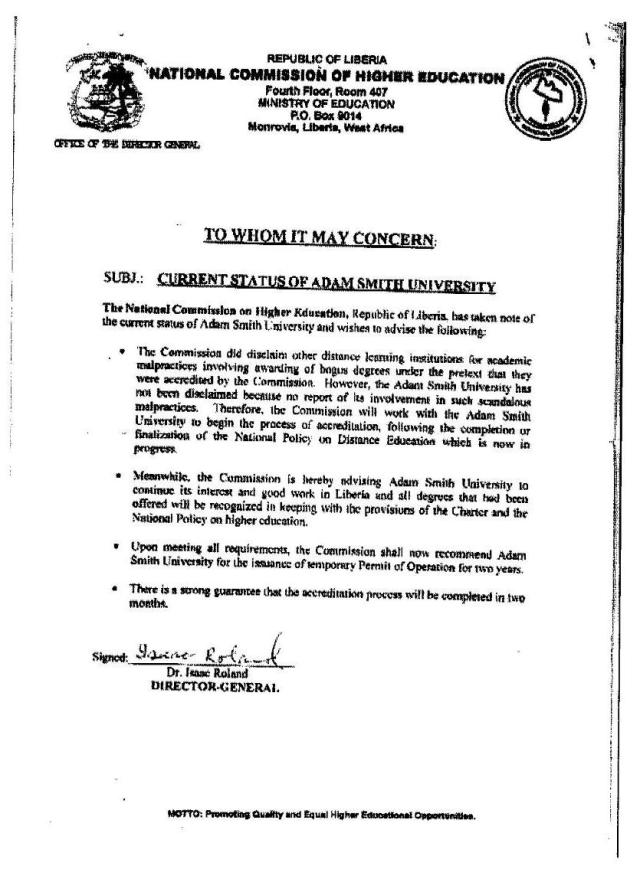
Some time after my graduation, Liberia announced the formulation of a new national policy on distance education. The National Commission on Higher Education, which had been established as a division of the Ministry of Education to oversee the university sector, issued a statement concerning Adam Smith University of Liberia, which was received by fax on September 17, 2005.

In fact, at the time of the issuing of that statement, Adam Smith University was the only remaining legally operating distance learning university in Liberia, all others having been disclaimed or revoked for academic malpractice. The tone of the statement makes it clear that Adam Smith University was regarded positively by the Ministry of Education, and gave the assurance that the degrees it had awarded would continue to be recognized.

Adam Smith University acquired land for a new campus in Monrovia and construction commenced on April 22, 2007 on the first building, which was intended to include classrooms, a library, administrative offices and an auditorium. This would permit the University to offer courses in Liberia in a traditional classroom environment as well as to facilitate the offering of distance learning and independent study from this campus. Students would have available use of computers and other instructional aids as well as a library of books and CDs for research.

Unfortunately, the National Policy on Distance Education mentioned in the statement was very slow to materialize, largely due to the opposition of traditional educators to distance learning and the fear of competition for jobs for university graduates in Liberia if there were to be more university graduates. At the time of the expiry of the two year temporary permit issued to Adam Smith University of Liberia, it had not yet been put in place. Accordingly, the University ceased offering instruction in Liberia in December 2007, and work on the new campus was also suspended sine die.

In December 2019, the website for Adam Smith University (www.adamsmith.edu) became unavailable, and it would appear that after twenty-eight years, the University had finally closed its doors.

Work in education: St Katharine’s Institute, Wyoming, USA

St Katharine’s Institute of Theology and Religious Studies was an independent, privately-owned Christian theological institute founded and incorporated in Wyoming, United States of America, and controlled by the Religious Society of St Katherine, a religious teaching congregation.
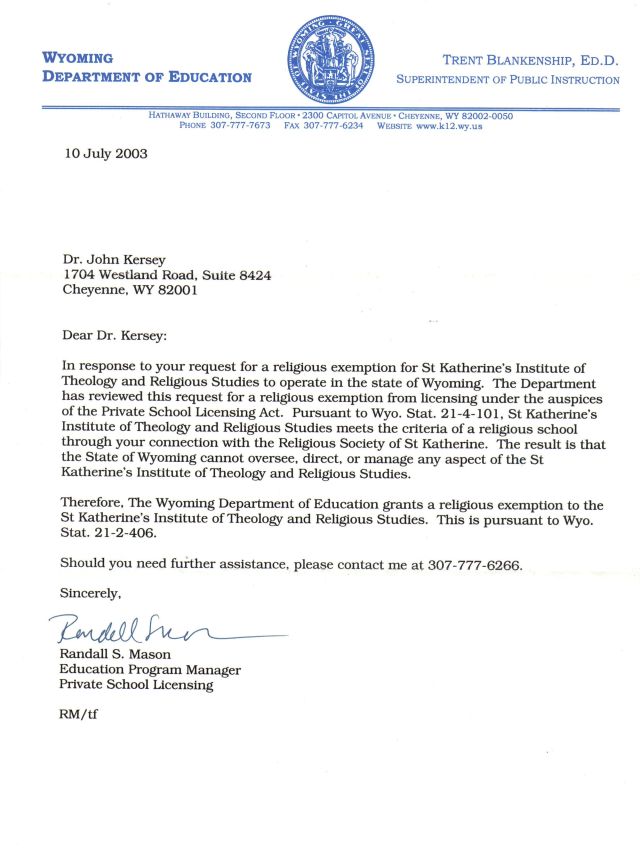
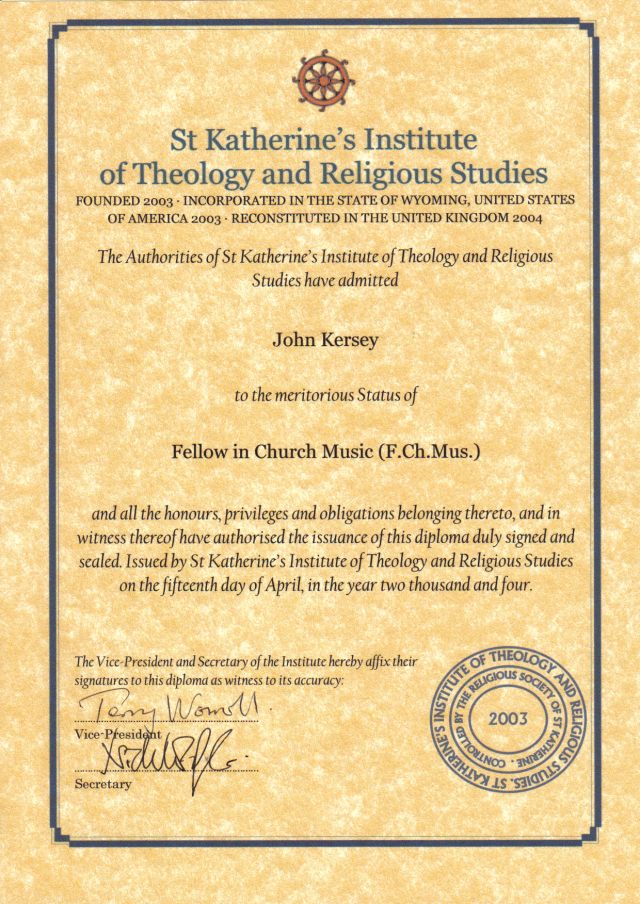
St Katherine’s Institute of Theology and Religious Studies  was founded and chartered in 2003. The Institute was empowered under the law of the State of Wyoming to award collegiate degrees to the doctoral level in the areas of Theology, Religious Studies, Church History and Church Music. Such titles could be awarded after examination, honoris causa or de facto upon persons who, in the opinion of the Institute, were deserving of such an award in recognition of their work as a theologian, exponent of religious studies, church historian or church musician. The Institute was an independent interdenominational institution providing both traditional and innovatory programmes of study at the postgraduate level.

The Institute offered its programmes mostly through correspondence study and distance learning, although some programmes in Church Music were offered by examination. A panel of tutors and examiners approved by the Institute prepared students for awards, functioning as an independent guild with most tutors being based in the United Kingdom.

The By-Laws of the Institute defined its aims as follows: “St Katherine’s Institute of Theology and Religious Studies shall exist for the purpose of offering Biblical and religious instruction, and basic instruction in other subjects or disciplines as may be felt appropriate in compliance with statute W.S. 21-4-101(a)(iv) of the state of Wyoming, to students in any state or country, within or beyond the United States of America, where the Directors of this Corporation may determine there is a sufficient cause and opportunity for opening and maintaining work; to carry out such instruction by extension courses, correspondence, the internet, lectures and any other appropriate method, by the publication of papers, bulletins, magazines, books or other publications; or by any other means the Corporation may determine to be fruitful; to employ teachers, officers, extension lecturers, correspondence tutors, or such other workers as may be necessary; to establish and maintain such educational institutions, chapels and dormitories as may be found useful in promoting the cause of religious education; to grant diplomas, academic or honorary degrees in any subject for work done in the institution of the Corporation, under its guidance, or for merit.”

The Institute functioned as a private theological college, and its courses were not open to the public. Candidature for degrees was by personal invitation from a member of the Religious Society of St Katherine only (if the applicant was not him or herself a member of that body). No fees were charged for tuition or examination. As an institution not open to the public and not charging fees, the Institute was not eligible for any recognized accreditation system within the USA or elsewhere. It was always an intentionally small institution.

The Religious Society of St Katherine numbered ten members. Its President was the Assistant Superior of the Josephite Community in the UK, Br. Michael Powell, cj, and the Warden was Nicholas Groves, MA.

The Institute was incorporated in the state of Wyoming as a religious nonprofit corporation on 16 April 2003, with corporate number 200300448935. All four Directors of the Institute were members of the Religious Society of St Katherine, and I served as its President. The Institute was granted a religious exemption from private postsecondary school licensing by the Wyoming Department of Education on 10 July 2003.

In 2004, the State of Wyoming, concerned primarily by national publicity that had highlighted the abuse of its religious exemption by the diploma mill “Hamilton University”, legislated to prohibit religious exempt schools from offering degrees by distance learning. This made it impossible for the Institute to continue operating on the basis of its Wyoming authority, and its corporation was consequently dissolved. An approach was next made to Knightsbridge University, Denmark, where I served on faculty. Knightsbridge agreed to act as validating body for the Institute and, in an extremely generous gesture, awarded a reciprocal degree to the majority of the Institute’s existing dozen graduates without charge.

Later that year, it was decided that the Institute should cease preparing students for degrees and should be re-constituted in the United Kingdom. A very small number of Fellowships in Theology and Church Music were awarded to members under this re-constitution. In 2005, serious differences emerged between members of the Society, and both the Society and the Institute ceased activity.

I was awarded the degree of Doctor of Divinity jure dignitatis by the Institute in 2003.

When the Institute was re-constituted in 2004, I was awarded a Fellowship in Church Music jure dignitatis.

Work in education: The London Society for Musicological Research

The London Society for Musicological Research was an independent learned society founded by me in 2002 which aimed to encourage the pursuit of research of all kinds into subjects of a musicological nature. It interpreted this aim in a broad and liberal manner so as to include all research that had a bearing on the understanding of the phenomenon of music. At the time, it was felt that there was insufficient encouragement for the independent musicological researcher outside the academic establishment. LSMR was intended to recognize externally-completed research and to provide a means for the dissemination of work that would otherwise lack a platform.

Election to Associateship and Fellowship of the Society was dependent on the submission of an appropriate research dissertation of a high standard; for Associates of 10,000 words in length and for Fellows of 20,000 words. The Society aimed to encourage candidates to consider research of a more experimental and searching nature than institutional constraints often allowed. It was not a requirement that candidates should have obtained any specific qualification before submitting work for the Society’s diplomas. There was also provision for admission to the diplomas of the Society on the basis of previously published work. The Society administered several prizes available to diploma candidates, named after Cuthbert Girdlestone, Arthur Fox-Strangways, Violet Gordon Woodhouse and John Alexander Fuller Maitland, the Annie O. Warburton and Rosa Newmarch Memorial Scholarships and the Eaglefield Hull Exhibition.

The Society also elected persons who had made a distinguished contribution to musicological research, or to the work of the Society, or who were judged in the opinion of the Council to be generally deserving of such distinction, to Honorary Fellowship and Associateship.

The Society supported research projects that included my “Romantic Discoveries” series of world première recordings of nineteenth-century piano music, research into the music of St Anne’s Cathedral, Belfast, and the organ-builder Richard Bridge.

In 2003, the Society became a constituent body of Claremont International University (Seychelles) under my direction. However, after the change of management of the University in 2004, it was agreed that the Society would return to the status of an independent body under my direction.

The Patrons of the Society were Dr David Baker, Pro-Vice-Chancellor of the University of East Anglia, and the composer and arranger Lt-Col. Dr Ray Steadman-Allen. As of 2005, Executive Council numbered six persons, the associated Advisory Council eight, and the body of Fellows and Associates twenty-three. Unfortunately, serious differences between members of the Executive Council of the Society emerged in 2005, and these resulted in the Society ceasing activity.

In January 2002, the Executive Council elected me to the Fellowship and I was issued with this certificate signed by the President, Nicholas Groves.

My education: Université Francophone Robert de Sorbon/Ecole Supérieure Robert de Sorbon

In 2002, France’s Loi de Modernisation Sociale (Law of Social Modernization) of 17 January 2002 specifically authorized universities and other “établissements d’enseignement supérieurs” (higher education institutions) to grant degrees based entirely on an assessment of the candidate’s work experience. The process is known in French as Validation des Acquis de l’Expérience (VAE).

The VAE has since been incorporated into the French Code of Education (Legislative Part, Third Part, Book VI, Title I, Chapter III, Section 2, Art. L613-3 to L613-6.) It is important to note that Art L613-4 states: “The validation produces the same effects as the knowledge or aptitude testing process that it replaces.” Moreover, the academic titles granted through VAE are identical to those gained by conventional study and any mention of VAE in those titles is considered discriminatory and is prohibited by law. All universities and other higher education institutions in France are legally required to apply the VAE if requested.

VAE has proved extremely popular in France. The candidate, who must have a minimum of three years of work experience, submits a portfolio of achievement which is then considered by a jury of professors, who meet either in person or electronically. Any false document submitted by the candidate during the process carries the possibility of heavy fines and three years imprisonment.

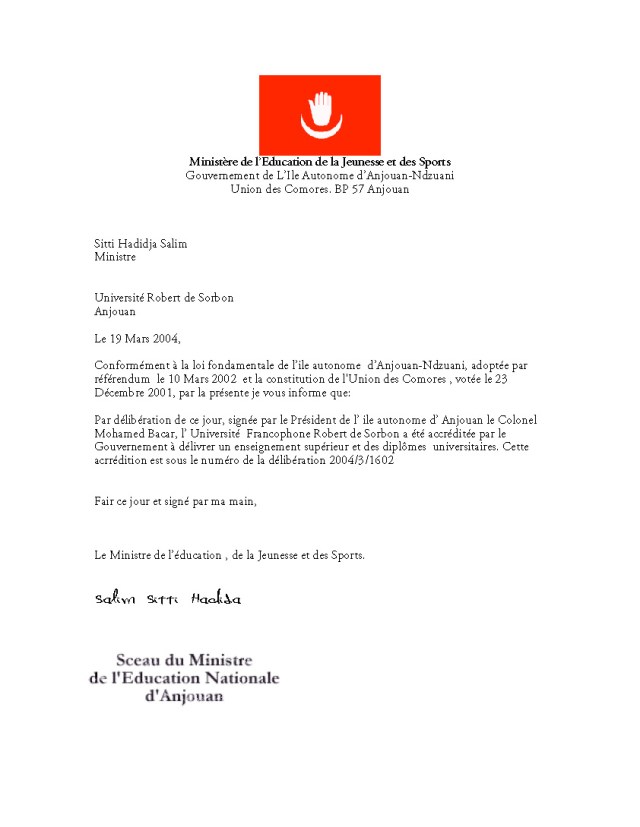
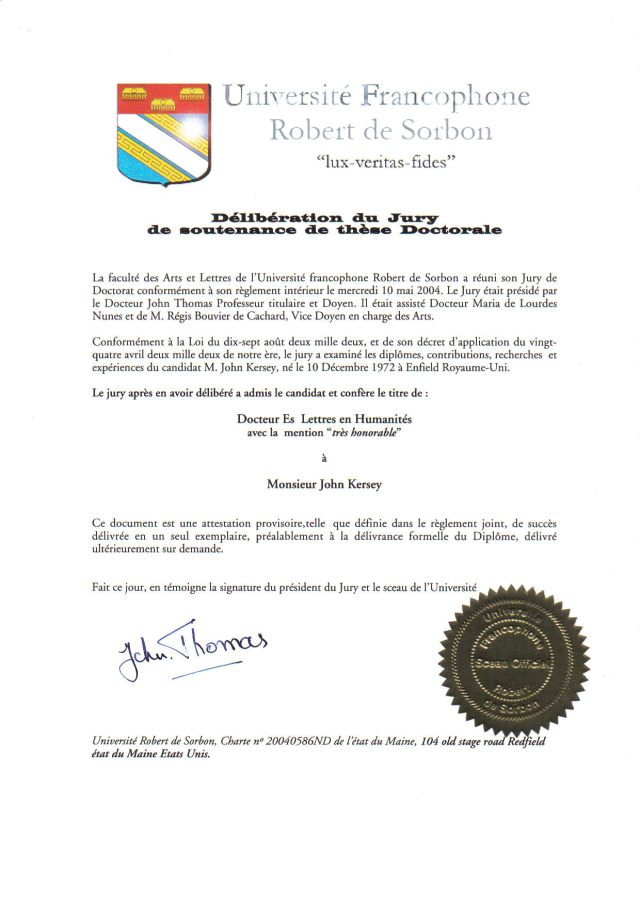
The wider French-speaking world has also embraced VAE. Those countries that are members of the Organisation internationale de la Francophonie typically include educational institutions that operate according to the French education system. In 2004, I was a candidate for the VAE process at the Université Francophone Robert de Sorbon. This institution was a virtual university, specializing exclusively in VAE, that was accredited by the government of Anjouan, which was one of the members of the Union of the Comoros and a member of the Organisation internationale de la Francophonie. The university was also incorporated as a nonprofit corporation in the state of Maine, USA (charter no. 20040586ND). Maine exempted privately-owned nonprofit correspondence schools from licensing under Maine Department of Education Rule #05-071, CMR 150, 2A.

The jury for my VAE assessment had as its Dean the President of the University, Christian Jean-Noël Prade, who is now a United States citizen and uses the registered business name John Thomas. He earned his DES at the Universitê de Paris II and undertook further studies in education at Harvard, leading to extensive work in foreign credential evaluation and American university admissions for foreign students. In 1988, he was decorated by the President of France as a Chevalier of the Ordre National du Mérite. He was a veteran of the political Right in France, being a founder of the Union Défense Group (GUD), the leading direct action organization of the Right in opposition to the Paris 68 left-wing student riots. He was also a noted sportsman, having completed the Cresta Run on multiple occasions and endowed a trophy at the event.

Dr Thomas was assisted on the jury by Dr Maria de Lourdes Nunes and by the Vice-Dean of Arts, Régis Bouvier de Cachard. Bouvier de Cachard was a symbolist and magic realist artist who had been acclaimed by critics in the 1960s and 1970s and whose works were to be found in the Tate Gallery and the Museum of Modern Art in Paris, among others.

>>Bouvier de Cachard, by Colin Wilson (author of “The Outsider”, etc.)

The jury decided to award me the degree of Docteur ès Lettres en Humanités with the highest accolade of mention très honorable (equivalent to summa cum laude).

Unfortunately the University was to be short-lived, and it closed the following year. It had been replaced, however, by a new French institution, the Ecole Supérieure Robert de Sorbon. This was registered in France as a non-profit association under the law of 1901, and is classified in the French education system as an “établissement d’enseignement supérieur privé” (private institution of higher education). In France, the opening of higher education to the private sector means that under article L-731-14 of the Code of Education, private institutions may offer programmes and grant academic titles (the French system does not have an exact equivalent to the word “degree”). They are prevented from using the designation “université” and certain academic titles (baccalaureat, licence, master and doctorat) are forbidden from use on pain of fines. Other academic titles (DEUG, DES, MBA, PhD for example) may be used freely. There are many institutions in the category of établissements d’enseignement supérieur privés, particularly business schools, of which INSEAD is probably the most famous.

The official and legal status of academic awards made by the Ecole Supérieure Robert de Sorbon and other établissements d’enseignement supérieur privés is that of certificats (or diplômes) d’enseignement supérieur privés. These awards are distinct from titres ou grades universitaires (university titles or levels) which may only be awarded by public, state universities. Certificats d’enseignement supérieur privés are covered by the Lisbon Convention on the recognition of credentials in Europe and may be designated as representing any postsecondary level of achievement.

There are several schemes by which certificats d’enseignement supérieur privés can be given further recognition by the French Ministry of National Education. These include homologation in which a given curriculum is submitted for approval by the authorities, leading to the recognition of that specific award by the Ministry. However, awards made by VAE are prima facie ineligible for these schemes, since there is no curriculum to be recognized and the institution only administers the VAE assessment without needing to deliver classes. For this reason, the certificats d’enseignement supérieur issued by the Ecole Supérieure Robert de Sorbon are fully legal French academic awards in their own right, but are not awards carrying official recognition from the Ministry of National Education. Their comparability to other academic awards is inevitably subjective, but certainly some authorities both within and outside France have considered them to be comparable to accredited degrees.

>>Attestation by the French Embassy in Greece stating that the Ecole Supérieure Robert de Sorbon is an établissement d’enseignement supérieur privé functioning under the control of the French State (2008).

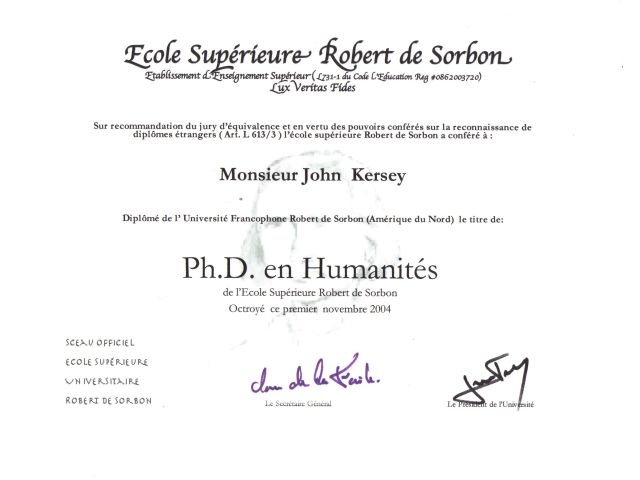
As a graduate of the Université Francophone Robert de Sorbon, I received a reciprocal award from the Ecole Supérieure Robert de Sorbon in November 2004.

In 2009, a government-accredited university in Costa Rica agreed to accept my ESRDS PhD as the basis for a doctorate awarded by incorporation.

In 2013, the Ecole Supérieure Robert de Sorbon was granted a trademark and consequent legal protection for its name by the French authorities. It is one of a number of French institutions named after Robert de Sorbon, the chaplain of King St Louis IX, who in 1253 established the College de Sorbon. However, it is the only one of these to have been granted a trademark in the present day.

The concept of a specialist VAE institution, particularly one operating solely by distance learning, is pioneering and has proved highly controversial, attracting particular opposition from the education establishment both within and outside France. Inevitably, given the leftist nature of this establishment, there is a negative focus on the political affiliations and personal profile of Dr Thomas. Nevertheless, the Ecole Supérieure Robert de Sorbon has shown itself willing to enter into this controversy and to defend its position. It will celebrate its twentieth anniversary in 2024.

My education: Doctor of Letters from Trinity International University

During my time as President of Claremont International University an articulation agreement was formed between the University and Trinity International University for the reciprocal acceptance of credit between the two institutions. Trinity International was incorporated in Delaware, USA, but ran its degree-granting programme from France, where it was registered as a non-profit association of higher education operating through correspondence.

The methodology of awards was through the assessment of prior experience for academic credit with supplementary correspondence study. Candidates could qualify through the accumulation of academic credits including awards issued by partner institutions around the world.

My dealings with Trinity were primarily via its principal Father Cornelius Anthony Gillick. Father Gillick, an Irishman by birth, attended the universities of Dublin and Manchester before earning his doctorate in theology at Adam Smith University, where I would also study, and the President of ASU, Dr Donald Grunewald, spoke very highly to me of the quality of his academic work. In 1988 he became an Associate of the Institute of Counselling, and previously he had also been an Overseas Welfare Officer looking after the interests of overseas students in Manchester. He was also a bishop in the Independent Catholic tradition and ran a house mission as well as undertaking community work. He had also previously been a magistrate in Manchester.

Some years earlier he had self-published a guidebook to distance learning degree providers called “Degrees by Post” and generously sent me a copy of this useful book. He was devoted to the care of cats, and I understand that for some years he established a cat sanctuary that did a good deal of valuable and humane work.

I became a candidate for the Doctor of Letters degree, which was the senior earned degree awarded by the University, and received this in June 2004.


Work in education – Claremont International University (Seychelles)

Claremont International University, also known as Claremont International University of Arts (CIUAS), was incorporated in the Seychelles on 14 October 2003. The power to confer degrees was contained in the Memorandum of Association of the corporation, and this was specifically approved by the Seychelles International Business Authority as an agency of the Seychelles government. The university name was inspired by the historic Claremont House in Surrey, England. A disclaimer on the website made it clear that there was no connexion with any institution with a similar name in the United States or elsewhere.

The University was an institution where the long-established principles of the conversion of experiential learning into academic credit were realised with integrity for the benefit of mature adults with significant prior learning. The University was consciously set up as an Internet-based entity operating internationally; it maintained no campus and its functions of assessment and administration were decentralized.

Behind the concept of the University was the viewpoint that experiential analysis (APL/APEL) was too often being undertaken to an indifferent standard by other institutions, or used merely as a front for the sale of degrees with little or no due process. The University was intended to implement a thorough experiential credit process under the supervision of qualified faculty, thereby allowing experienced adults to access an accelerated educational process in which their programme was effectively personalized.

The University’s prospectus put the matter thus:

We believe that the lifelong learning that occurs through experience is the most fundamental to personal development, and yet such applied learning is often not sufficiently highly regarded by the educational establishment. In effect, such lack of regard is tantamount to a denial of the rights of the student to have what they can demonstrate that they know recognised through the award of academic credit at the appropriate level, representing instead a reaffirmation of the privileging of the “educated” academic over hoi polloi. For many years the non-traditional movement in education has presented the contrary argument that learning gained in whatever context, be that inside or outside the classroom, is worthy of academic credit. It does not matter, for example, whether your proficiency in playing the organ was gained through college study, through private lessons or through being self-taught. Under this argument, which we enthusiastically support, your proficiency is equally academically valid, and equally worthy of conversion to academic credit, whatever the route taken to acquiring it. In short, we believe that education is about outcomes, not processes.

The concept of an Internet-based university built on experiential assessment was rightly regarded as highly controversial, and from its outset, the University attracted opposition and hostility from those favourable to the mainstream education establishment. Since its intention was to promote disruptive innovation from outside the establishment, this was accepted as inevitable. It quickly also became clear, however, that certain school operators who viewed the University as a challenge to their own substandard product were also determined to attack the University.

Under my Presidency, the University appointed as joint Chancellors my friends the Hungarian war hero General vitez Janos Karászy-Kulin, Grand Master of the International Order of St George, and his wife Dame Iris. They accepted their positions enthusiastically, and the General penned an address to future students.

The work I undertook for the University involved responsibility for all academic matters at strategic level during the phase prior to students being admitted. I was responsible for specification of the University’s academic methodologies based on research and practice evolved in the USA by leading non-traditional institutions and their application to curricular issues in consultation with faculty and board members. I was also responsible for the appointment of faculty, who included senior academics from UK and South African universities, and for supervising all aspects of faculty interface with students, as well as encouraging faculty research, collaboration and professional development.

I was further responsible for the negotiation of agreements with other institutions to bring about an emerging research profile. Using contacts gained through my other academic positions, I completed memorandums of understanding with Knightsbridge University, Denmark, and Ansted University, British Virgin Islands. The scope of these agreements included faculty exchange, credit reciprocation, joint professional development and joint research programmes.

Lastly, I was responsible for quality assurance matters, establishing models for good practice and benchmarking. Several recognised American credential evaluators agreed to evaluate the University’s degrees as equivalent to those issued by regionally accredited universities in the USA, which was a mark of the seriousness and commitment to quality that had been the hallmark of the University from the outset.

I was a member of the following University committees: Academic Council (Chair); Academic Standards (Chair); Institutional Review Board; Long Range Planning (Chair); Student Evaluation and Grievance.

In January 2004, I received an attractive offer from a consortium of educators to purchase the University outright. This was a surprise, since the University had only been launched for a few months. While a handful of internal candidates had been put through the University’s systems free of charge in order to test processes and procedures, the University had yet to embark on marketing or the recruitment of students.

One other factor that was a concern to me was that I had recently received legal advice that the current operating structure of CIUAS was not in compliance with relevant legislation. I disagreed with this advice, and sought further guidance both from other legal experts and from the relevant government departments. This process took some months, but concluded with a consensus that the advice I had previously received was wholly incorrect, and that the operating structure that had been in force had indeed been legally compliant after all. This caused me to question the motivation and possible bias of the lawyer I had initially consulted, whose firm had also acted for competitor institutions, and I came to believe that there had been a deliberate attempt to sabotage the University.

Meantime, however, the Board decided to accept the offer to purchase CIUAS. As part of the transfer agreement, I stepped down from my Board position but was to remain as President on a contracted basis. A new administrative and faculty team was put in place, and a new website instituted by the new Board. Unfortunately, the new Board soon developed other priorities and decided not to continue with CIUAS. While the website remained online for a year or so, no students were recruited and the University had effectively ceased activity.

I learned much from the work that had been done at CIUAS and would put this into effect some years later when the broader-based European-American University would launch to the public.

My education: Knightsbridge University, Denmark

Knightsbridge University was a private distance learning university that was based for most of its history in Denmark.

The history of the University can be divided into two separate phases, consisting respectively of its foundation and first few years, and then the post-1991 Danish-owned era. Knightsbridge University was initially established as a private university in England in 1986 by a group of businessmen who also operated the University de la Romande. In 1988, the Education Reform Act effectively banned private universities in the United Kingdom, but continued to allow foreign private institutions to operate there providing they did not represent that their degrees were UK degrees. Degrees issued by United Kingdom private universities prior to 1988, including those issued by Knightsbridge University, therefore have the same legal status as any other public or private degree issued in the UK before that date.

The second phase of the University’s history began when Danish businessman Henrik Fyrst Kristensen and his English business partner registered Knightsbridge University in Denmark in 1991. In 1993, Kristensen acquired sole control of the University, and became its President (subsequently Vice-Chancellor). Kristensen was a veteran of the Royal Danish Navy and has owned and managed various  trading and import-export companies.

Under Kristensen’s leadership, Knightsbridge University underwent a complete revision designed to position it as an elite private European institution whose offering, according to its explanatory materials, was of “high quality programmes to high calibre candidates, aiming for a global market.” This also meant a strongly business-oriented outlook at a time when this was less usual in academia than it has subsequently become. Knightsbridge University presented a direct and straightforward path to earning a degree, emphasising flexible routes for experienced adults, and its presentation was both well-written and understated. When a website came along in due course, it was notable for its unfussy design and economy of style, rather in keeping with a modern Scandinavian aesthetic.

Throughout the time of Knightsbridge University’s operation there, Denmark’s education system permitted the existence of higher education institutions in the private sector that were wholly self-regulating, as had the United Kingdom prior to 1988. There was no legal restriction on the use of the title of university nor on the award of degrees. Such accreditation systems as were available were directed purely at the obtaining of state funding. No accreditation was available for a private institution that did not seek to make its students eligible for state study grants.  Nor was Knightsbridge University the only private degree-granting institution in Denmark; that sector included several well-regarded business schools. In my view, the application of the term “unaccredited” to such institutions is entirely incorrect. Such a term would only be applicable where there was accreditation available; otherwise it criticizes an institution for not having something that does not actually exist. It was not until 2018, a decade after Knightsbridge University had ceased activity, that Denmark legislated to prevent private organizations from using the title “university” (University Act, section 33a); at the time of writing there still remains no prohibition on private organizations granting degrees.

From time to time, the status of private universities and their degrees was raised with the Danish government. In the Answer to Question no. 103 from the Committee on Science & Technology on 20 March 2003 to the Minister for Science, Technology & Innovation (L125 – appendix 77 (later also called Appendix 96)), the then Minister made it very clear that “…neither the current nor the proposed future legislation gives any possibility for the approval of private providers of education. Such education is provided without state funding and thusly are equal to the courses which [state] universities may offer without state funding and which also need not be nor can be approved by the Ministry…” In a statement explicitly addressing Knightsbridge University, the Danish government qualifications authority CIRIUS stated, “Private institutions without public funding may operate legally without approval or accreditation by Danish authorities. However, if they want to make their students eligible for state study grants they must abide by an accreditation procedure. No state study grants are available for ‘Knightsbridge University’ clients.”(1) In its statement, CIRIUS therefore explicitly acknowledged that Knightsbridge University was legally permitted to operate as a private higher education provider in Denmark. The accreditation procedure referenced in the statement that allowed access to state study grants was a limited scheme for private institutions that was not available for the distance learning degree programmes that made up the entirety of Knightsbridge University’s provision.

Consequently, degrees issued by Knightsbridge University in Denmark are legally issued Danish degrees, with exactly the same legal status as degrees from private accredited providers or indeed Danish state universities, even though they are not part of the Danish state higher education system. They are covered by the Lisbon Convention on the recognition of credentials in Europe, which was signed by Denmark in 1997 and ratified in 2003.

Kristensen’s achievements at Knightsbridge University were considerable. He assembled a body of adjunct faculty and examiners that extended to some three hundred persons, many of whom also served on the faculty of traditional universities. These were augmented by a number of Knightsbridge’s own graduates. The range of programmes was wide and included a number of unusual and niche subjects, such as bibliotherapy and military studies; the University was one of the first to offer a degree in martial arts. Academic standards were strengthened, with internal quality assurance measures and the input of external faculty key to the maintenance of program comparability with “the quality and content expectations one might have of a better-reputed representative of ‘the establishment’.” From the outset, Knightsbridge University had attracted some high achievers, and Kristensen would come to include several members of royal families, government ministers, public and private sector leaders, and individuals of significant achievement who did not always fit into the traditional model of academia. The University gained a reputation for quality over quantity. It was selective in accepting applications, and the reports of a number of graduates indicated that they had found their programs both demanding and worthwhile.

It was clear that what was on offer at Knightsbridge University was significantly different from the low-quality product available from some other private distance-learning universities, and there were a number of reports of graduates using a Knightsbridge degree as the basis for further study in mainstream universities. A Knightsbridge master’s degree was positively evaluated by the German state evaluator of foreign credentials. The Bachelor and Master of Business Administration programmes achieved validation by the Hungarian state university Debrecen Agricultural University, and several specialist Bachelor and Master of Laws degrees were accredited by the UK Association of Lawyers and Legal Advisors. A dual award agreement established that holders of the Knightsbridge Bachelor of Arts in English and in Spanish could obtain the same degree from the state Evangelical University of Paraguay.

In 2004, Kristensen was asked by me to comment on the principles and mission of Knightsbridge University, and replied as follows,

The purpose is to be and remain independent of influence by external authorities. We wish to retain the right to decide what we offer, to whom, where and when. We do not wish to be dictated specific entry or gender quotas, minimum or maximum student numbers, academic year dates, exam dates, or anything else. This desire for total autonomy determines our range of options relative to external bodies. In short, we have no options.

Summing up, our approach is a pragmatic one, albeit one solidly supported by both philosophy and dogma. We have identified and reasonably accurately described a potential market segment, and have developed products and processes to serve this segment. We have been quite successful in attracting highly accomplished individuals to our programmes, individuals for whom the award pursued with us is not necessarily the pinnacle of their life so far, but most often simply one of many milestones in the life of a high achiever.

The quality and integrity of our programmes and provision is borne out by the high number of candidates referred by graduates or other candidates. When people in senior positions in their respective organisations, people used to reviewing options, competent at sorting the wheat from the chaff, contact us on the basis of recommendation by their colleagues, there is no better feeling.(2)

In 1993, Kristensen decided to relocate from Denmark to the United Kingdom. This involved some changes to the University’s registration, since it was necessary to operate under the legal framework for foreign degree-granting institutions that then applied in England, and it would not be possible to maintain the University’s status in Denmark. As a transitional measure, the University had been incorporated in Liberia for a few months in 1993, before incorporation in the Commonwealth nation of Antigua and Barbuda later that year. For several years after the relocation, a European Branch Office was maintained, initially in commercial premises in Torquay and latterly at the Grade II listed Victorian clifftop house there that also served as Kristensen’s home. Alongside the University’s programs at degree level, Knightsbridge College operated from Scotland as a parallel institution offering non-degree courses between 1999 and 2004. After its closure, its courses were offered as part of a turnkey package to budding educational entrepreneurs.

It was believed that some form of governmental recognition would be helpful to Knightsbridge students and graduates. Accordingly, the University made application to the authorities in Antigua and Barbuda, and was granted approval status by its Cabinet in August 1995. Unfortunately, the University then became the centre of a political row, with senior civil servants in the Antiguan Ministry of Education denouncing the Cabinet’s decision to approve the University and failing to confirm its accreditation to enquirers, despite the relevant records and documents from the Cabinet being readily available.

With the new century came the return of the administration from the United Kingdom to Spentrup in Denmark, where the University was registered once more in 2002. It was noted that some graduates held that the University’s private status in Denmark was more prestigious than the Antiguan recognition in any case. In Spentrup, the University again was administered from a home office, and Kristensen said of the approach to facilities, “We do not have to spend enormous amounts on infrastructure, or maintain most of the overheads held by residential institutions. This means we can keep our fees at a reasonable level, even if we receive no forms of funding or grants.”(3)

While there remained a strong element of hostility towards Knightsbridge University and its graduates from those opposed to private sector higher education, there was also some progress to report. Writing in Bears’ Guide to Earning Degrees by Distance Learning at the turn of the century, Dr John Bear said “It is hard not to like Knightsbridge”.(4)

I first came into contact with Knightsbridge University when I answered its website advertisement for new faculty. At the time I was coming to the end of my time in college teaching and looking to explore other career options more suited to my ideology and abilities. I passed the appointment process for the position of adjunct professor and began a long and friendly correspondence with Henrik Fyrst Kristensen. In 2004, I was appointed Dean of the Department of Music, a position I would hold until 2008, and developed a suite of innovative degree and diploma programmes that offered not only the assessment of research and written assignments but also that of applied music in the form of composition and performance.

I corresponded with Dr Wally Willies regarding some of the University’s philosophy and approach. Wally had been head of department at a South African university and earned his doctorate at Knightsbridge. He continues to be a friend and colleague to this day. I found some of his comments particularly pertinent,

Cioran wrote ‘for a writer, university is death’, and I applaud that remark. Fortunately, institutions like KU help a writer to sharpen the claws of creativity, because, somewhere along the line, battle you will. Almost certainly, someone will want to throw mud for their own reasons. If you have the strength and the persistence, you will begin to notice the difference between the cart-horses and the Camargue horses of intellect. I have stopped believing that intellect has any great leadership over our other abilities, but I still feel strongly that engaging in educative activity will bring change, which is the hallmark of growth. A senior degree means that you take on your context, not find your niche…

What I’m saying, I suppose, is that there  is a price to be paid for intellectual freedom, and whether it is worth it, is a matter of individual reality.

My own pithy summary is that, for me, it is better to pay a lot of money to be recognized for meaningful sweat, than to pay a lot of money to be recognized for meaningless sweat. KU will take you along the former rather than the latter road. Not nearly as safe, but a lot more definitive. (5)

Following this, I decided to supplicate for the Doctor of Philosophy degree by published work as a faculty candidate in 2003. In a varied submission, I included work on the history and management of institutions delivering musical education, and also some work that was directly concerned with business education. Added to this was further published work concerned with music criticism and several in-depth studies of musical performances and recordings that had appeared in professional journals.

The PhD by published work is restricted at most institutions to graduates or faculty members, and at Knightsbridge University was examined at the same level as the PhD by thesis. I was assigned to Professor Reginald von Zugbach de Sugg, formerly of Paisley University, the University of Glasgow and the Royal Army Ordnance Corps. Reggie had become something of a legend among his Scottish students and was held in similarly high regard at Knightsbridge. It was not difficult to see why. He combined a remarkable breadth of expertise with charm and an utter dedication to his students. I was delighted when, after my graduation, he was willing to assist me by serving on faculty for some of my other educational projects.

From the outset of my involvement with Knightsbridge University, I was interested to know more about its people. Over the years, I spoke and corresponded with graduates and faculty, read their theses, papers and other published work, and learned of their diverse and often accomplished careers. They must form one of the most unusual and interesting bodies of institutional alumni, with a substantial proportion of high achievers, free thinkers and independent spirits. At the centre of it all was Henrik Fyrst Kristensen himself, who was exceptionally well read in education and its philosophy, and many other subjects as well; witty, humorous and on a number of occasions extremely generous.

My own educational work involved collaboration with Knightsbridge University on a number of occasions, and indeed Knightsbridge was an important support in the early days of European-American University, where a number of Knightsbridge faculty and alumni have since served as Fellows.

Without any prior announcement, the website for Knightsbridge University became unavailable in late 2008, and its Danish registration appears to have been cancelled in June 2010.

Notes:
(1) http://www.ciriusonline.dk/Default.aspx?id=9276, retrieved November 2007.
(2, 3) Kersey, John: A case study of higher education in the private sector: an interview with Henrik Fyrst Kristensen, Vice Chancellor of Knightsbridge University, Denmark, London, Libertarian Alliance Educational Notes no. 37, 2006 ISBN 1 85637 705 9
(4) Bear, John and Mariah: Bears’ Guide to Earning Degrees by Distance Learning, 14th edition, California, Ten Speed Press, 2000, p.220.
(5) Dr Wally Willies, email to the author, 25 August 2003.

Honours and awards: Fellowship of the Irish Guild of Organists and Choristers

The Irish Guild of Organists and Choristers was founded in 2003 as an independent interdenominational learned society, composed of church musicians and others interested in church music. It was based on the medieval concept of the Guild, which was a group of professionals who gathered together for working and fraternal reasons. The Patron was the Archbishop of Dublin.

The aims of the Guild were to raise awareness of the history of Church music and to promote the highest standards in its practice. The Guild also existed to encourage members in their spiritual lives, and to provide a means whereby they could share experience and resources with other musicians.

Individual membership of the Guild was available at two levels: Associate and Fellow. Although it still exists, it is largely dormant and does not admit new members.

I was elected a Fellow of the Guild in 2003.

My education: Fellowship of the Curwen College of Music

The Tonic Sol-Fa College of Music was founded by the Revd. John Curwen (1816-80) at Forest Gate, east London, in 1863. The instrument of government was drawn up in 1869 and incorporation followed in 1875. Curwen had taught himself to read music from a book by the originator of tonic sol-fa, Sarah Glover. He was responsible for developing and integrating the tonic sol-fa method into a comprehensive educational vision for all classes and ages of people that, in his plans for the College, would embrace the training of teachers, the education of students and the provision of a rigorous series of examinations using tonic sol-fa extending from the first grades up to Fellowship. From the outset, the College has always taken a strong interest in choral music. The activities of Curwen’s college were complimented by those of his publishing house, J. Curwen and Sons, which continued as a publisher of educational music until the 1970s.

It was found that the original premises were too far from the centre of London to carry out the College’s mission effectively and therefore new premises were sought. In the early years of the twentieth-century the College was to be found at 27, Finsbury Square, London EC1. From 1939-44 it was housed in Great Ormond Street and in 1944 moved to more spacious accommodation at Queensborough Terrace. During this period, the College was afforded continuity by its long-serving Secretary, Frederick Green, who had been involved with the College from its early years. At one point those wishing to submit for diplomas had first to become shareholders of the College.

In 1967 a decisive development in the College’s history was marked by the appointment of the Revd. Canon Dr. Paul Faunch as Principal of the TSC and Chairman of the separate Curwen International Music Association (a fellowship with especial interest in choral music for past and present students of the College, under the patronage of Dr Zoltan Kodaly). In 1972, he presided over a major re-organisation of the College which saw it re-named and renewed in its pursuit of Curwen’s method. This period saw the College once again housed in the London suburbs, it having removed to Bromley. Dr Faunch died in 1995 and was succeeded by the present Warden, Dr Terry Worroll.

Today, the Curwen College of Music  offers external diploma examinations in practical and theoretical music. In 2003, I was a successful candidate for the Fellowship examination in pianoforte. I was also appointed an Examiner to the College in piano and for dissertations.

My education: Fellowship of the Norwich School of Church Music

The Norwich School of Church Music (archived website from 2004) was founded in 1981 by some local church musicians in Norwich. Its diplomas were awarded either after examination or by recommendation. The diploma of Associate of the School was awarded after successful completion of two essays of between 5,000 and 7,000 words each. The titles were published by the School; one must be on History of Church Music, and the other on Liturgy and Practice. The entry requirement was five years’ experience as a church musician in whatever capacity. The diploma of Fellow of the School was awarded after successful submission of an extended essay of about 10,000 words, or of a portfolio of compositions. Entry requirements for Fellowship were the ANSCM with two extra years’ experience, or five years’ experience with certain approved qualifications.

Diplomas could also be awarded on the basis of work done, with recipients being recommended to the Council for election, usually by existing Fellows of the School. In this way they resembled somewhat the manner in which “Lambeth” degrees are awarded. The Fellowship was awarded to church musicians of long standing or of prominence; the Associateship was awarded to those who, while not necessarily musicians in the first case, had the interests of church music at heart. There was no difference in standing of recipients of diplomas by this method as opposed to those who gained them by examination.

The School closed in 2010.

The status of Master of Arts at Cambridge

The degree of Master of Arts at the University of Cambridge is unusual in that, although it is a full degree, it is conferred without examination, reflecting its mediæval origin whereby its holders became full members of the University. Indeed, until 1851, students of King’s College were also permitted to proceed to the Bachelor of Arts degree without examination. The majority of those who proceed to the conferral of the degree today are holders of the degree of Bachelor of Arts who are eligible to proceed MA in the sixth term after they came into residence and two years after proceeding BA. There is also provision for conferral of the MA upon senior academic members of the University and certain other officers, and for its conferral by incorporation on holders of the same degree at the Universities of Oxford and Dublin.

Statute B II 2(d) permits the University to make an Ordinance “prescribing conditions under which the status of Bachelor of Arts and or Master of Arts may be held or may be granted by the Council.” The Ordinance in question is contained in Chapter II, pp. 169-170.

The status of a degree is not the same either as the conferral of the degree proper, or the conferral of the title of a degree (which was formerly done in the case of female students and is today retained under Statute A II 14 for conferring degrees honoris causa, whereby the degree is conferred without its full privileges). Status might best be defined as admission to the privileges of a degree without that degree having been formally conferred. However, at Cambridge, the privileges of those who hold BA and MA status are more restricted than those who have had the degree conferred upon them. For example, those who hold MA status are not members of the Senate, whereas those who have been admitted to the full MA degree are.

The status of Bachelor of Arts is either had, by virtue of a person’s status as a Graduate Student, or granted for a set period of time upon recommendation by the Head or a Tutor of a College. Where it is had, the person in question is a Graduate Student who is not a graduate of the University. For such persons, the status of Bachelor of Arts ends when they cease to be registered as a Graduate Student or when they are eligible to have the status of Master of Arts. The status of Bachelor of Arts allows the privileges of wearing the BA gown without its strings, but not the BA hood, and to have the same privileges as a BA so far as access to the University’s libraries, museums and Botanic Garden is concerned. It restricts the holder, however, from being a candidate for the degrees of Bachelor of Arts or Bachelor of Music.

The status of Master of Arts may again either be had or granted. Where it is had, the person in question must either be a Graduate Student or an “other person who has previously had the status Bachelor of Arts” who has attained the age of twenty-four years. Where it is granted, which is for a set period of time in each case, the recipient is a Fellow of a College, a University officer, another University officer or employee of a specified category, or a graduate or visiting scholar from another university recommended for the grant by the Chair of a Faculty Board or the Head of a Department. The status of Master of Arts allows the holder to wear the MA gown without its strings, but not its hood, and to have the same privileges as an MA with respect to the University’s libraries (except the University Library), museums and Botanic Garden. They may also certify their own residence, and are not subject to the regulations for motor vehicles, bicycles or boats. As with BA status there is a restriction on holders becoming candidates for the degrees of Bachelor of Arts or Bachelor of Music.

It is not in question that the status of Bachelor of Arts is either had or granted on a temporary basis. It will end in each case when the holder either receives a degree of the University, ceases to be a Graduate Student, qualifies to have MA status or when their grant of BA status expires.

However, it is not widely realized that there are certain circumstances whereby the status of Master of Arts may be held indefinitely. Consider, for example, my own position as a Graduate Student at Cambridge for a term during 1996. At the time of my matriculation in October, I was aged twenty-three years, and by virtue of my being a Graduate Student, duly had the status of Bachelor of Arts. But in December during that term, I celebrated my twenty-fourth birthday and consequently qualified to have Master of Arts status. I ceased to be a registered Graduate Student at the end of the term, and during my time at the University did not take any exams or become a candidate for a degree.

The question then arises as to when the status of Master of Arts will end in those cases where it is had rather than granted (since all grants are for a fixed term). The position is not the same as that for had BA status, whereby that status definitively ends when the holder ceases to be registered as a Graduate Student. Indeed, someone in my position would continue to qualify to hold MA status after ceasing to be a registered Graduate Student, given that I then fulfilled the alternative qualification of being an “other person who has previously had the status of Bachelor of Arts”. The phrase “other person” is not further defined, nor, since membership of the University is for life, could it logically be interpreted as being limited to those in statu pupillari. Moreover, it refers to those who have had BA status rather than those who have been granted it. It must, therefore, include former Graduate Students. This indefinite MA status would also appear to apply to any other former Graduate Student who has had BA status and subsequently attained the age of twenty-four, at which point they would have become, if not still a Graduate Student, an “other person who has previously had the status of Bachelor of Arts”.

The conditions under which MA status continues to be held are set out as being “for so long as he or she is not of standing to proceed to the degree of Master of Arts”. It will be clear that there are those who would never be of such standing, since they are prima facie ineligible to proceed to the degree of Master of Arts, and are forbidden by the regulations for MA status from being a candidate for the degree of Bachelor of Arts. In those cases, including my own, the status of Master of Arts would therefore appear to be held indefinitely.

To summarize, the holding of indefinite Master of Arts status occurs when a person fulfils  the following conditions:

1. They have had BA status.
2. They have subsequently attained the age of twenty-four years (at which point they will either be a Graduate Student for as long as they remain as such, or an “other person who has previously had the status of Bachelor of Arts”)
3. They are ineligible to proceed to the degree of MA.

Whether this situation has arisen intentionally or not is a matter for speculation, and naturally it is open to the University to change its regulations on this point should it see fit to do so. However, the number of people affected is certainly small, and it is doubtful whether, in practice, any privilege extended to them by virtue of holding MA status would be of significance when compared to the general privileges extended to all alumni by the University and the Colleges. Doubtless some of those affected will, like me, have since proceeded to the substantive degree of Master of Arts at another University.

This article is based on the 2019 edition of the Statutes and Ordinances of the University of Cambridge, available online at https://www.admin.cam.ac.uk/univ/so/index.shtml

My education: Cambridge

When I had completed the requirements for my Master’s degree at the Royal College of Music, I intended primarily to continue, and hopefully expand, the freelance performing work as a pianist and organist that I had been doing throughout my time at the RCM. However, I also felt that I did not want to rule out opportunities for further musicological research, which would require a continuing institutional affiliation. It was with this in mind that I decided to undertake a period of postgraduate research at the University of Cambridge, which I would pursue during the Michaelmas Term of 1996.

At that time, the Music Faculty at Cambridge gave limited emphasis to the performance of music as part of its curriculums. However, it had been the home of some significant work in eighteenth-century historical musicology, organology and performance practice concerned with Mozart’s keyboard music, much of which I had encountered and referenced in the dissertation I had previously prepared at the RCM on the cadenzas and Eingänge in Mozart’s C minor piano concerto K491. My supervisor at the RCM, Gerald Gifford, had also been a member of the Faculty of Music at Cambridge, although he had retired by the time of my arrival, and he encouraged my application to undertake further research on keyboard performance practice in Mozart.

In general terms, I took the view that membership of the University and of one of the colleges (which is conferred for life at Cambridge) would be a considerable future asset to me in its own right, as would access to the libraries and research collections, which would remain open to me as an alumnus after I had ceased to be a student. If my research developed sufficiently, I considered that it might lead on to book or article publications. Having already earned a research-based master’s degree at the RCM, I had been advised that a doctorate was not necessary and might even be seen as undesirable for teaching positions in the conservatoire sector. I was also aware that so far as Cambridge and the general university sector were concerned, conservatoire people like myself were generally seen as outsiders. With this in mind, I did not take a degree at Cambridge, but pursued a shorter and less prescriptive course of study with an open mind as to where it might lead.

While nowadays most students intend to obtain a degree at the conclusion of their university studies (and may well be obliged to do so as a condition of their funding), there is a long and honourable history of students pursuing research and related studies for the purposes of personal or professional development, or with a particular scholarly aim in mind, without becoming candidates for a degree. Indeed, several professors at the RCM had previously undertaken such periods of study at Cambridge as part of their education.

My agenda at Cambridge was therefore my own. I chose to follow the curriculum for research master’s students (the M.Phil. in musicology) during my term at Cambridge, consisting of research, analysis and seminars, but did not take any exams or formal assessments. I also attended a wide range of lectures and events, and experienced Cambridge’s legendary choral tradition at first hand as well as the variety of worship offered by the various college chapels and churches. I became a life member of both the Union Society and the University Conservative Association, enjoyed a variety of formal dining and was introduced to blind wine tasting.

Matriculation at Christ’s College. I am seated in the front row, tenth from the right.

Although I did not take a degree at Cambridge, on matriculation, I acquired the status of Bachelor of Arts in the University under the relevant statute, and on my twenty-fourth birthday that December, I proceeded to the status of Master of Arts, which I still have today.

To my surprise, I found on arrival that I had not been assigned to either of the supervisors whom I had requested, and indeed I was never to meet them during my time at Cambridge. Instead, I was assigned to a supervisor who was wholly unsympathetic to my conservative intellectual approach, uninterested in my proposed research, and with whom I was unable to establish an effective working relationship. This did not entirely prevent me from undertaking useful work during my period of study (and indeed some of this work formed part of my subsequent doctoral studies), but it meant that I did so on my own.

My term at Cambridge was in many respects the most valuable of my education, because being exposed to an academic climate of adversity compelled me to define exactly where I stood intellectually and why. The graduate seminars in the Faculty of Music that I attended were dominated by the so-called “new musicology”. It seemed to me, and I was not the only one of this opinion, that the Faculty had suddenly found itself in the grip of an ideological craze that had clearly attracted its fair share of zealots. Those who did not share this zeal, including the historical musicologists and performance practice experts who had attracted me to Cambridge in the first place, appeared to be keeping their heads down.

Unlike historical musicology, which was seen as largely an apolitical discipline, the “new musicology” was explicitly political, and the politics behind it were Marxist in origin, having been imported from other disciplines of cultural studies, and being composed in large part of Critical Theory as formulated by the Frankfurt School. As an outsider following my own path, I had less to lose than others, and I challenged this robustly as a traditionalist of the Right. The response I received from my supervisor was in essence that the Faculty was now committed to this particular ideological cause, and that if I did not like it, I should leave. My academic style was said to be too reminiscent of that of the eminent musicologist Donald Jay Grout, who was regarded negatively since as a traditionalist historical musicologist he was the antithesis of the vaunted “new musicology”. This was taken by me as a high compliment, for I have always admired and respected Grout’s work. But when this approach was compared by my supervisor (entirely wrongly) to fascism, I concluded that it was time to go. I returned to the RCM where I was elected to a Junior Fellowship for the following academic year.

I had hoped that Cambridge would have offered some element of respect for different intellectual approaches including my traditionalism, since it had offered a home for historical musicologists of a similar viewpoint to my own in the recent past. Instead, I was confronted by a doctrinaire imposition of the new Marxist orthodoxy in which the past was rejected and any dissenting voices were condemned and silenced.

At the conclusion of my studies, I was left with the view that my experience with the Faculty of Music had not been what I had hoped for academically, but that nevertheless I had taken much away with me overall that was worthwhile in terms of my broader education. I continue to regard the University and my College with affection.

Today, I am a member of the Christ’s College Association (for alumni) and the Christ’s College Fisher Society (for testators making bequests to the College).

A few years on from my studies, I was elected a fellow of the Cambridge Society of Musicians, which had been established by several Cambridge graduates. Twenty years later, when living nearby, I often returned to Cambridge to enjoy the ambience of the city and its many attractions.

My education: Royal College of Music

The Royal College of Music (RCM) is a public conservatoire in London, England, constituted by Royal Charter of Queen Victoria on 23 May 1883. The Royal Charter marked the RCM out as unique among conservatoires at that time, in that it was given the power in its own right to confer the degrees of Bachelor, Master and Doctor in Music either after examination or honoris causa. The RCM first used these powers in 1933 when it conferred the degree of Doctor of Music in the Royal College of Music, honoris causa, upon HM Queen Mary. From then until 1982 this degree was conferred only on members of the Royal Family. The degree of Master of Music in the Royal College of Music was first awarded in the 1940s and that of Bachelor of Music in the Royal College of Music in 1995.

I was associated with the RCM successively as a Junior Exhibitioner, undergraduate student, postgraduate student and Junior Fellow for eleven years, between 1987 and 1998. During my time there, the RCM maintained a pre-eminent place amongst the world’s conservatoires and its diverse student body, with many coming from overseas to study, reflected its international reputation for musical training. It was highly selective in its admissions processes, and entry was by competitive audition. The RCM was generally regarded as having the strongest piano faculty of the London conservatoires at that time, and it was exceptionally difficult for a British pianist to win a place there. Once there, the atmosphere was intense and at times highly competitive. The College had a close relationship with the Royal Family, reflecting the foundation of the RCM under the personal initiative of King Edward VII (when Prince of Wales), and during my time I was present during multiple official visits by HM the Queen, HM the Queen Mother and HRH the Prince of Wales.

The Local Authority Junior Exhibition Awards were scholarships awarded by the London boroughs that allowed musically gifted school pupils to begin their training at the London conservatoires alongside their regular schooling, by attending the conservatoires’ Junior Departments free of charge on a Saturday. These awards, too, were subject to competitive audition, and I was fortunate to win a London Borough of Enfield Junior Exhibition Award to the Royal College of Music in 1987. I was then aged fourteen, and, as a late starter, was only in my fourth year of piano lessons.

Prior to entering the RCM, I had spent a very enjoyable year studying privately with the concert pianist Paul Coker, who apart from his work as a soloist was Yehudi Menuhin’s accompanist. Paul was an alumnus of the RCM and it was at his suggestion that I applied to study with his professor, Yu Chun-Yee. This was still more of a challenge since Yu Chun-Yee did not teach regularly at the RCM Junior Department and only accepted two junior students in addition to his undergraduates and postgraduates. Having successfully auditioned for him, I found myself at the RCM twice a week; on Friday evenings for my piano lesson with Mr Yu, and then all day on Saturday for the other activities of the RCM Junior Department.

In all, I would study with Yu Chun-Yee for nine years. He had one of the finest analytical minds I have ever come across. He could be fiercely demanding, and was often quite right to be so in setting the highest of standards, but was also extremely supportive and expressed great confidence in my abilities. Under his guidance, I developed both as a musician and as a person, and his detailed and exacting approach to study and interpretation has remained a cardinal influence on me ever since. What I valued in particular was that he taught me how to work out the answers to musical and technical problems for myself, providing me with an interpreters’ toolkit that has served me well ever since. The transferability of this training to other aspects of life has also proved to be considerable.

In my final year at the Junior Department I won the Teresa Carreño Memorial Piano Prize, the major competition award for pianists, and was also awarded the Constance Poupard Prize. After another set of competitive auditions, I was offered a place at the RCM to read for the Bachelor of Music degree, which was for the first time to be awarded by the RCM itself, rather than as previously by the University of London. This was a four year degree, in contrast to the usual three year duration of British first degrees.

The great strength of studying at the RCM in those days was the fundamental emphasis on one-to-one tuition with leading professors. Most of those in the piano faculty were of many years’ standing and considerable eminence. Providing one made satisfactory progress, there was a great deal of freedom; obviously much time had to be devoted to individual practice and preparation for examinations and competitions, but outside this, there was the chance to read and listen widely, and to explore new repertoire with the aid of one of the best-stocked libraries of its kind. The overall ethos was dedicated to the applied musician. It was well suited to a pianist like myself who wanted in essence to be left alone to develop and grow under expert guidance, rather than to seek a more conventional “student experience”, and although I had a lively social life in those years, it was almost all outside the RCM. There was also a confidence in the RCM’s position as guardian of the traditions of Western art music, and in particular as the artistic home of several generations of distinguished English composers and pianists.

The RCM’s outlook of determined independence had been reinforced because at that time its closest rival, the Royal Academy of Music (RAM), had mounted what was in effect a takeover bid for the RCM. This seemed for a time to have government support. The RCM resisted the resulting pressure to create a London “superconservatoire” fiercely, and other than a joint vocal faculty with the RAM which lasted for a few years before being abandoned, was successful in maintaining its separate identity.

The RAM had deliberately jettisoned the conservatoire tradition that it had inherited in favour of a bid to create a “centre of excellence” on the model of Philadelphia’s Curtis Institute. This involved inter alia a reduction in student numbers, an academic partnership with King’s College, London, and an emphasis on masterclasses by international classical superstars, despite complaints that these were disruptive to first study teaching. In contrast to the RCM’s emphasis on the codified Western tradition, the RAM had also begun to teach jazz. Whilst I greatly enjoyed listening to jazz (and was a member of Ronnie Scott’s club for several years), I did not take the view that it should be taught in conservatoires or given equal standing with the interpretation of codified music. Largely out of a sense of obligation, I had auditioned for the RAM, but disliked the atmosphere and approach strongly, and never seriously considered studying there.

It was in this context that the RCM had decided to exercise its own degree-granting powers in respect of the new Bachelor of Music programme, which was introduced in 1991. When I was able to add input to the RCM’s direction – chiefly as a member of student review panels for my degree courses, as well as more informally in conversation with members of the administration – I sought to argue for the vision of the conservatoire in its historic context as a wholly independent entity dedicated to applied music, separate both from the university sector and the wider higher education establishment. This was a view that also enjoyed support among a significant number of the RCM’s staff, but that was increasingly coming to be seen as reactionary and anachronistic given the prevailing political winds.

During my second year at the RCM, I was given the opportunity concurrently to undertake the Répétiteurs’ Course at English National Opera, which was usually open only to postgraduates. Not only was this fascinating and useful, it also carried with it a free rehearsal pass to all of ENO’s productions. I spent a good deal of time there during the year immersing myself in some glorious music-making, of which a marvellous and innovative production of Humperdinck’s Hansel and Gretel made a particular impression.

My studies at the RCM were pursued alongside a good deal of professional freelance work as a pianist and organist. Both as soloist and as a member of various duo partnerships, I played concerts at music clubs and societies around the country and also worked as a choral accompanist and pianist for musical theatre. One of my duos led to my playing on several occasions for the cellist William Pleeth at his home in north London. I found Pleeth’s energetic approach fascinating and loved his passionate, committed engagement with the music. Of course he was well-known as the teacher of Jacqueline du Pré, and a further close connexion with the circle of du Pré and Finzi was my supervisor at the RCM, the composer Jeremy Dale Roberts, who encouraged my developing interest in British music of the twentieth-century. Some years later, I would meet another member of the Finzi circle, the poet Ursula Vaughan Williams, when my duo partner and I gave the first performance of the song cycle All the Future Days in which the composer Jonathan Dove  set her poems.

I was continuing to develop as a pianist, and several key performances in RCM concerts included Rachmaninov’s Second Sonata in the original 1913 version, and his Symphonic Dances in the version for two pianos. As well as concerts, the RCM placed much emphasis on competitions, which are often seen as a means to gain exposure for young pianists. However, the competitive spirit did not sit well with me. Competitions were deeply opposed to my own philosophical approach to music and I thought they did a profound disservice to music itself. During my time at the RCM, I entered internal competitions largely out of a sense of obligation and without ever feeling that they brought out the best in my playing. I certainly had no inclination to enter external competitions or to play the international piano competition circuit. Notwithstanding this, I managed to win some of the RCM’s prizes and awards. At the end of my second year, I was awarded the Margot Hamilton Prize for piano and the prizes for second year techniques and practical skills. A year on, I won the third year examination prize for piano, the Pauer Prize.

In addition to my degree studies, it was then a requirement for piano undergraduates that they should take the RCM’s teaching diploma. This was designated as the DipRCM(Teacher) for internal full-time RCM candidates, but followed the same syllabus and was examined to the same standard as the Associateship of the RCM in teaching that was available to external candidates. I attended some excellent Art of Teaching lectures with Peter Element, whose confident and authoritative approach appealed greatly to me, and the splendid Patricia Carroll, who I had known from the Junior Department. I was a successful candidate for the diploma at the end of my third year.

My interest in historical musicology was developed during my final year with a stimulating elective study in Advanced Performance Practice and Editorial Method under the organist and harpsichordist Gerald Gifford. As well as being a professor at the RCM, Gerald was also Fellow and Director of Music at Wolfson College, Cambridge, where I was invited to give a chamber music concert with fellow students that included Brahms’ wonderful late Clarinet Trio. Under Gerald’s guidance, I prepared a dissertation on cadenzas and related performance practice issues in Mozart’s piano concertos, focusing particularly on the C minor concerto K491. The RCM has Mozart’s autograph score of that work in its library, and the experience of seeing this familiar music in Mozart’s own handwriting left a deep impression on me.

Gerald Gifford was in charge of the RCM’s Master of Music programme in Performance Studies, which he had been responsible for designing. This combined advanced performance studies with research into cognate subjects. The programme had an excellent reputation and I had no reservation in applying for a place. Having been accepted, it remained only to undertake the remaining requirements for my BMus.

My degree studies culminated with a public final recital of some fifty minutes. I presented a varied programme including music by Bach, Berio, Schubert and Rachmaninov. I was awarded the Marjorie and Arnold Ziff Prize for the best piano final recital, and was the only first study pianist to be awarded a First. I was also the only first study pianist of the 1991 undergraduate intake to take First Class Honours overall in my degree.

I received an official congratulatory letter from the RCM on achieving my First.

That autumn, I began my studies on the Master of Music programme. This required a final recital, a lecture recital and a research dissertation, with viva voce examinations on each component. The programme was unusually structured. The degree was not awarded until the end of the second year after enrolment, but formal studies extended only over thirteen months, leaving most of the second year vacant. This time, my research focused on performance practice in recordings of Liszt’s piano music by his pupils, and my lecture-recital was on aspects of rhythm in Alkan’s piano music. For my final recital, I presented two works, the Piano Sonata by the remarkable composer (and former professor at the RCM) Bernard Stevens (1916-83), and Schumann’s Humoreske. Both this and the viva that followed were awarded distinctions.

I was fortunate to be one of the winners of the RCM Concerto Trials, which offered the opportunity to play a concerto with one of the RCM orchestras. I had chosen Liszt’s Totentanz, a demanding and demonstrative virtuoso work, and performed this with the RCM Symphony Orchestra conducted by Andrea Quinn on 23 January 1996. I chose to use the expanded performing edition by Liszt’s pupil Alexander Siloti, which adds a number of interesting passages to the original.

During the year, I won the Sir Arthur Bliss Solo Piano Prize and was also awarded the Bernard Stevens Performance Prize for performances of those composers’ piano sonatas. The Bliss Prize led to a recital at the West Road Concert Hall in Cambridge and a meeting with the composer’s widow, who wrote “your interpretation of the Bliss piano sonata is one which would, I know, have delighted the composer.” I was also awarded the Sir Percy Buck Prize for a postgraduate who had previously studied in the RCM Junior Department.

As I reached the end of my studies, Yu Chun-Yee told me that I had now arrived at the point where I could play anything in the pianist’s repertoire. He meant by this not that I would not have to work hard at whatever I had chosen to attempt, but that I now knew how to do that work and was in possession of the necessary interpretative skills, musicianship and technique. This was the fulfilment of what I had set out to do when I first began studying the piano seriously, and although I would subsequently seek advice from other professors when preparing for concerts, notably John Blakely and Yonty Solomon, I regarded my formal piano studies as now being complete.

I was notified that I had been successful in the Master of Music degree that autumn, and would await formal graduation the following summer.

The question inevitably arose as to what I should do next, both immediately in the eleven months that remained until my MMus would formally be awarded, and beyond this. There was the option of simply continuing (and hopefully expanding) the freelance performing work that I had been doing throughout my time at the RCM, but I also felt that I did not want to rule out opportunities for further research, which would require a continuing institutional affiliation.

In considering my options, I had to face the fact that the RCM was no longer the same institution that I had joined almost a decade earlier. The higher education funding and regulation authorities, driven by the universities and by ministers who neither understood nor were sympathetic to the conservatoire way of doing things, were no longer happy to see the RCM plough its own furrow, and the postgraduate provision had been particularly (and in my view unfairly) criticized. These criticisms seemed to me to be designed to curb the RCM’s independent viewpoint and fully integrate it into the higher education establishment. Although the RAM’s “centre of excellence” plans had not directly provided the model for what was to come, it was not difficult to see that the reformed RAM was more obviously suited to the new regime, and that the RCM was to be compelled in a similar direction. The first signs of this were an increase in administrative and bureaucratic requirements culminating in a fairly brutal round of staff departures. Two further changes that I considered key were the effective abolition of its alumni association*, and of the RCM Magazine. It seemed to me that these moves were attempts to keep a lid on staff and alumni dissent, which had previously proved a significant issue during the RAM’s period of radical change.

These changes were not happening in isolation. The British musical tradition was under attack from a press that considered it mediocre in comparison to the glitzier product on offer abroad. My chief research interests in rare music of the Romantic era, in piano performance history and in twentieth-century British tonal music were deeply unfashionable. It was also clear that the concert infrastructure that had supported British pianists for generations, in particular the music clubs and societies, was diminishing significantly as its members grew older, and there was an increasing demotic shallowness to the way in which classical music was now being sold to the public that did not sit well with me. As society itself became more consumerist and fixated upon youth, the virtues of maturity and reflection, which are cardinal to musical interpretation, all but disappeared from view. More practically, even pianos themselves were changing. The pianist is hypersensitive by nature; so is ivory, which is the ideal material for piano keys since it not only absorbs perspiration but is highly responsive. In the wake of the international ban on ivory, the top manufacturers had turned to making piano keys from resins and various forms of plastic instead, which lacked the responsiveness of ivory and also left drips of perspiration on their surfaces. For me, it was like replacing gold with brass.

That autumn, I had the opportunity to undertake a term of postgraduate research at Cambridge, which I have written about elsewhere. After Christmas, I returned to a life of freelance musical engagements in London, and before long also began to do some voluntary work at the RCM Library, where I covered staff vacancies and undertook several cataloguing projects of historic materials concerning British musicians of the nineteenth and twentieth-centuries. The Library had not yet been computerized, and was still using handwritten card indices and catalogues. This suited me well, since I had an innate dislike of computers, and my time there was both happy and productive.

A new development at the RCM was the introduction of Junior Fellowships. These were intended to support young musicians after the conclusion of formal studies and their holders were attached to the staff rather than to the student body. I was offered the Geoffrey Parsons Junior Fellowship for the academic year 1997-98, and as a result was presented to HRH the Prince of Wales, President of the RCM.

There was a sense in which my Junior Fellowship year felt valedictory as soon as it had begun, and I was certainly aware that I needed to make the most of all the opportunities that it offered. I undertook a great variety of ensemble and accompaniment work, and also toured with the RCM in Portugal, playing before the President and Prime Minister there at the British Embassy. All this was combined with my existing external commitments as a performing musician, to which I had now added regular work as a record critic and a teaching position at a nearby sixth-form college. I enjoyed the atmosphere of the RCM’s Senior Common Room, and formed good relationships with a number of the professors.

Although Junior Fellows were not permitted to perform as soloists in RCM concerts, I considered it vital that I should continue my work as a solo pianist alongside my other commitments. The RCM had recently built a professional recording studio, and I was given the opportunity to record a CD of some works of my choice there. I devised a programme of twentieth-century British piano sonatas by Arthur Bliss, Bernard Stevens and Stanley Bate. Bate’s unpublished second piano sonata was part of his manuscript collection now in the RCM Library. I prepared the work from the composer’s autograph, and played it in concert at St Martin-in-the-Fields. Although Bate was an accomplished pianist who was often to be heard in his own works, there was no record of him having performed this sonata in public, and accordingly both my performance and recording were premières.

I returned to the RCM on a few occasions in the year after my Junior Fellowship. I was delighted to be asked back to join a group of postgraduates in playing the demanding piano part in Webern’s arrangement of Schoenberg’s First Chamber Symphony for the Pierrot Lunaire combination of instruments, and much enjoyed the resulting performance. I also undertook some occasional deputy teaching to cover the absence of one of the keyboard professors. This, however, was to be my final involvement with the RCM.

In my view, the RCM as it is now has changed immensely from the institution as it was during my time. The change has not merely been of a kind that one would normally expect of an institution over time but has been radical and at times iconoclastic in response to external pressures on higher education, meaning that the concept of what the RCM is and how it fulfils its mission now is quite different from the conservatoire tradition that I experienced and inherited there. My loyalties continue to remain with the principles that the RCM upheld during my era, and as an old Royal Collegian, I have tried to bring those principles to bear on my other work in music and education since then.

* The initial alumni and former staff association of the RCM was the RCM Union, founded in 1906, which also included as members all current students and staff of the RCM. The RCM Union was the body responsible for the RCM Magazine. In 1992, the RCM Union was closed. The alumni association element was continued by a new RCM Society, which like the RCM Union was a subscription-based association, but in 2001 this was repurposed as a non-subscription body of wider scope including all former students and staff. In 2009 it was abolished altogether. The RCM Magazine was initially taken over by the RCM Society but was discontinued in 1994, to be replaced by an Annual Review that was issued as an official publication of the RCM’s governing administration rather than being under the editorship of a member of the professorial staff as had been the case with the RCM Magazine.