
There are many curious and not a few inaccurate entries in the online encyclopedia Wikipedia. One of the latter has concerned the entry on my old school The Latymer School, Edmonton, where we have been able to read the following wholly unsourced and largely inaccurate material which I will correct and respond to in this post.
In 1967 the school switched to a comprehensive intake as a result of Circular 10/65, a request from the Labour government to local education authorities to plan for conversion to a fully comprehensive education system. However, a certain amount of informal selection still took place in liaison with local primary schools.
In 1988, Latymer took advantage of the Education Reform Act 1988 to become a Grant-Maintained school with selective entrance exams once more.
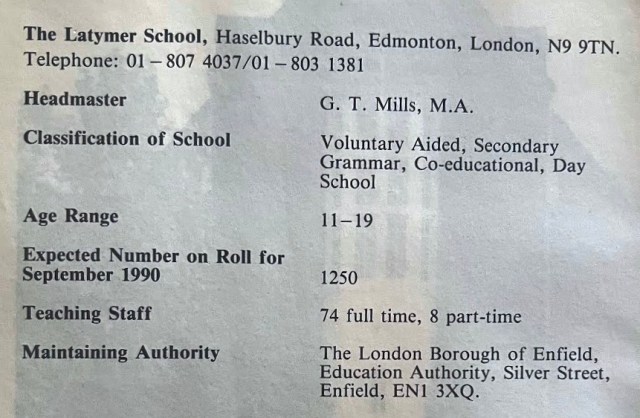
The first point of error is that Latymer did not become a grant maintained school in 1988. The School Prospectus for 1990-91 gives the school status as “Voluntary Aided, Secondary Grammar, Co-educational, Day School.”

It was not until some years later that the prospect of obtaining Grant Maintained Status was mooted. The End of Term Newsletter for Summer 1992 says,
Grant Maintained Status: At a recent meeting of the Governing Body the Governors discussed the future of the school and in particular whether it would be to Latymer’s advantage to seek Grant Maintained Status. The Governors decided to hold special meetings at which resolutions to proceed with a ballot of parents on the issue will be discussed and voted on.
Latymer did indeed obtain Grant Maintained Status in 1993 (see Hansard listing of 8 February designating it as having voted Yes and published proposals) and held this status until it was abolished in 1998. In the latter year, the Education (Grammar School Designation) Order 1998 came into force and officially confirmed Latymer as one of the remaining grammar schools in England.
The implication of the anonymous Wikipedia author is that after 1967 Latymer became a comprehensive school and thus that it accepted pupils of all abilities. This was not the case. While a comprehensive school is not permitted to select its intake by ability, Latymer, by contrast, remained a voluntary aided grammar school and accepted only those of high academic ability.
The authoritative reference on these matters is “A History of the Latymer School at Edmonton” by J. A. Morris (Latymer Foundation at Edmonton, 1975) which discusses matters as they actually were. Turning to page 300, we read,
…one feels certain that the School will always owe a great debt to [Dr Trefor Jones, Headmaster 1957-70] for asserting vigorously and uncompromisingly its special claims to uniqueness in a comprehensive world. His predecessor and an earlier generation of governors had first faced the problem…The full force of the attack was felt in 1964. In this year, a new Labour Government was elected pledged to end selection at age 11 and to eliminate separation in secondary education. The Government’s White Paper issued in 1965 referred to the anomalous position of voluntary schools. Paragraph 38 stated, “It is not essential that the same pattern should be adopted for denominational and other schools in any given area as is adopted for that area’s county schools. The disposition and nature of the existing voluntary school buildings might dictate a different solution”.
The Governors and the headmaster felt that such was the case at the Latymer School of Edmonton. The immense size of the building may have satisfied the spatial requirements of a large neighbourhood school, but Latymer’s interior arrangements and furnishings – such as the twelve laboratories for advanced science – were designed for a school having 240 sixth formers in mind. Their main objection to the plans of the local authority (since 1965, the Greater London Borough of Enfield) was that the Latymer endowment was the birthright of every child in the parish…’to the end of the world’. It should not be restricted to the children of any limited area. A compromise plan was finally agreed extending the benefits of the Foundation to the whole of the Greater London Borough of Enfield, i.e. to the children of the old parish of Enfield as well as those in Edmonton and Southgate.
In every year after the end of the 11+ examination the Governors received far more applications than there were places available, and from parents who approved of the headmaster’s drive towards academic achievement and examination success, with firm discipline and the minimum concession to the current trendiness. Though the intake was not being selected in the old 11+ way, the School was attracting the most highly motivated parents and pupils, and attracting them from over a much extended catchment area.
It can therefore be seen that voluntary aided schools, including Latymer, could and did still maintain a selective intake post-1967, despite the changes in government policy. There was nothing “informal” about this selection; it was the published policy of the school.
Reference to the School Prospectus above finds the following described under Admissions Policy and Procedure,
The admission of pupils is the responsibility of the Governing Body, acting in accordance with the arrangements agreed with the Local Education Authority. Pupils admitted are required to be capable of following an education directed towards the highest grades of the G.C.S.E. Most are expected to proceed to Advanced level and subsequently to University or Polytechnic degree courses.
Primary Secondary Transfer
Reference is made to aptitude and ability with emphasis on academic attainment and potential. Those admitted are normally among the most able in their year group. The School has an outstanding musical tradition and the Governors give consideration to the admission of pupils of exceptional musical talent provided that they are also capable of following the academic courses offered. Other aptitudes and interests are also relevant. Family connections with the School are considered but are not a dominant factor in the decisions of the Governors.Parents are invited to complete a questionnaire giving information of their child’s special interests and aptitudes. All applicants take a non-verbal reasoning test at Latymer School in late October. Reports from primary Headteachers are then requested on approximately 500 candidates who have the highest standardised scores on the non-verbal test.
On the basis of the information received the Governors choose those pupils (up to the Standard Number) who, in their judgement can best be served by the School and on the evidence are likely to respond best to what the School has to offer.
It may therefore be seen that admission to Latymer in those years was a highly selective and competitive process in which academic merit was the chief criterion. I entered the school in 1984, when only four pupils from my year at primary school were accepted. My parents were opposed to comprehensive education for me, and had considered several local independent schools as alternatives to Latymer before concluding that Latymer was in many aspects the superior option.
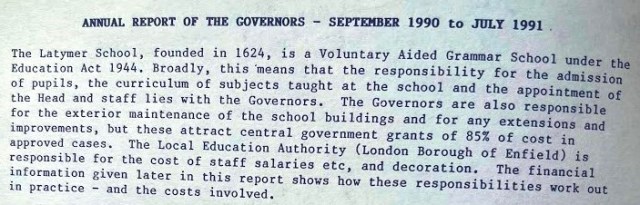
As well as the School Prospectus referenced above, we can also refer to the Annual Report of the Governors for 1990-91 which states plainly that Latymer was a Voluntary Aided Grammar School under the Education Act 1944.
The promulgation of inaccurate information via Wikipedia does a considerable disservice to the very real achievement of several generations of Latymerians whose ability and hard work earned them the opportunity to become part of an exceptional grammar school. In my view, grammar schools are something to celebrate as an antidote to the often stultifying egalitarianism that dominates modern education. Their role in promoting academic achievement and social mobility is often underestimated and should be more widely recognized.
 Professor John Kersey