
My recording of the Willner transcription of Bruckner’s Third Symphony for piano solo is Download of the Month for August 2025 at the excellent and informative website abruckner.com

My recording of the Willner transcription of Bruckner’s Third Symphony for piano solo is Download of the Month for August 2025 at the excellent and informative website abruckner.com
A new CD recording has been issued by Romantic Discoveries Recordings.
 Bruckner: Symphony no. 5 transcribed for solo piano by August Stradal
(first recording)
John Kersey, piano
RDR CD149
Total time: 77 minutes 8 seconds.
Anton Bruckner (1824-96) Symphony no. 5 in B flat major, WAB 105 transcribed for solo piano by August Stradal (1860-1930)
1. Adagio-Allegro (00:00)
2. Adagio (23:09)
3. (Scherzo) Molto vivace (41:04)
4. (Finale) Adagio-Allegro (52:47)
Artwork: Landscape in the moonlight by Carl Johan Fahlcrantz (1774-1861)
August Stradal was a Czech pupil of Bruckner and also studied piano with Liszt and Leschetizky. He was known for his ability to perform the most technically demanding piano works of Liszt, and made piano transcriptions of Liszt’s symphonic poems. He transcribed five of Bruckner’s symphonies for solo piano, following the performing versions prepared by fellow Bruckner pupil Franz Schalk.
A new CD recording has been issued by Romantic Discoveries Recordings.
 Bruckner: Symphony no. 7 transcribed for solo piano by Cyrill Hynais
(first complete recording)
John Kersey, piano
RDR CD148
Total time: 65 minutes 41 seconds.
Anton Bruckner (1824-96) Symphony no. 7 in E major, WAB 107 transcribed for solo piano by Cyrill Hynais (1862-1913)
1. Allegro moderato (00:00)
2. Adagio: Sehr feierlich, aber nicht schleppend (In memoriam +Richard Wagner, 13 February 1883.) (18:28)
3. Scherzo: Sehr schnell (42:42)
4. Finale: Bewegt, doch nicht zu schnell (52:59)
John Kersey, piano
Artwork: Max Brückner and Otto Henning – Final scene of Wagner’s Götterdämmerung
Cyrill Hynais was a pupil and friend of Bruckner. He transcribed three of Bruckner’s symphonies for solo piano. This is the first complete recording of his transcription of the Seventh.
A new CD recording has been issued by Romantic Discoveries Recordings.
 Piano Music of Walter Niemann volume 28
(includes first recordings)
John Kersey, piano
RDR CD147
Total time: 60 minutes 24 seconds
1. Venezia – Barcarole from Zwei Klavierstücke, op. 94 no. 1
2. Stürmische Vorfrühling in der Heide (Stormy early spring morning on the heath) from Heidebilder, op. 12 no. 1
3. Mein Klavierbuch, twenty little pieces from the life of children, op. 114
i. Good Morning! (Praeludium)
ii. Little Clementi in Great Difficulties
iii. March of the Boy Scouts
iv. Chimes
v. What the Giant’s Grave Relates
vi. A Little Tango
vii. The Old Musical-Box
viii. The Cuckoo-Boston
ix. Song on the Water
x. Old Viennese Waltz
xi. Russian Troika Journey
xii. Jackie Coogan Dances the Blues
xiii. Blackbirds in the Garden
xiv. A Little Shimmy
xv. A Ghost
xvi. Circus
xvii. Butterfly
xviii. Teddy is to Sleep
xix. A Gallant Play of Colours
xx. Good Night! (Finale)
4. From Classical Christmas Music
i. Johann Sebastian Bach (1685-1750) transc. Walter Niemann: Pastoral Symphony from the Christmas Oratorio, BWV 248
ii. Francesco Manfredini (1684-1762) transc. Walter Niemann: Christmas Symphony
iii. Arcangelo Corelli (1653-1715) transc. Walter Niemann: Pastorale from the Christmas Concerto, op. 6 no. 8
5. Spielt es mal, 12 little pieces for youth, op. 142
i. Teddy Bear is sick
ii. A half penny’s worth on the Merry-go-round
iii. Christmastree nicknacks
iv. We wish you many happy returns of the day
v. The Humming-Top
vi. Granny’s Musical Clock
vii. Oh dear! I am so tired
viii. Have an Orange?
ix. Claudina on her Circuspony
x. Black-cap at his little food-bowl
xi. Micky-Mouse
xii. The Man with the Balloons
John Kersey, piano
Our thanks go to Nicolo Figowy and Steffen Herrmann for their generous loan of scores.
Walter Niemann was regarded in 1927 as “the most important living piano composer who knows how to make music from the piano in a subtle and colorful way, although he often enters the field of salon music” (H. Abert, Illustrated Music Lexicon). This most sensitive and introverted master of the piano devoted his life to composition and musical scholarship, also performing his music in concerts and radio broadcasts. Niemann’s vast output for the piano is only now starting to become more widely known. Although his style is generally unashamedly conservative, he was one of the very few German composers to explore Impressionism in music, and this also reflected a fascination with the Far East. Elsewhere, Niemann’s imagination takes us from much Baroque recreation to large-scale epic sonatas, Schumannesque miniatures and even the exploration of early jazz styles. His understanding of the capabilities of the piano was complete, and his works include both collections for young pianists and mature works that exploit the full range of pianistic effect and make significant demands on the performer.
A new CD recording has been issued by Romantic Discoveries Recordings.
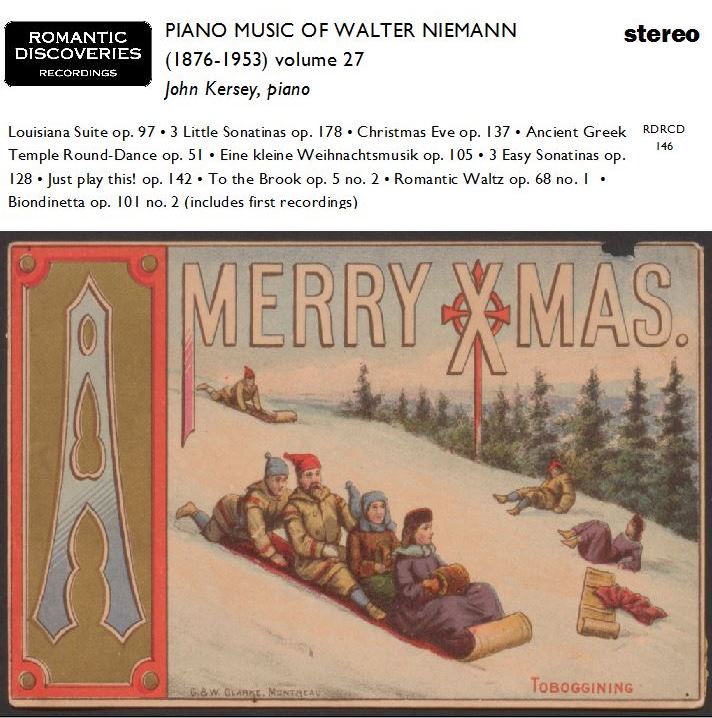 Piano Music of Walter Niemann volume 27
(includes first recordings)
John Kersey, piano
RDR CD146
Total time: 67 minutes 39 seconds
1. Louisiana Suite, op. 97
i. The Mississippi Steam-Boat’s in Sight
(“The Glendy Burke” – Stephen C. Foster)
ii. My Old Kentucky Home (Stephen C. Foster)
iii. The Interrupted Serenade
(“Old Black Joe” – Stephen C. Foster; “Massa’s in the Cold Ground” – Stephen C. Foster; “Oh! boys carry me ‘long” – Stephen C. Foster; “Gentle Nettie Moore” – Pike)
iv. Longing for Home
(“Old Folks at Home” (Way down upon the Swanee River) – Stephen C. Foster)
v. Mardi Gras in New Orleans
(“Dixie’s Land” – Dan Emmet)
Foreword by Walter Niemann (1924)
The following Suite contains eight of the finest and best-known popular Negro-Songs, such as were chiefly sung on the vast Cotton- and Sugar-plantations in the Southern States of North America, and arranged by the composer.
By far the finest songs, born of and permeated with the national spirit, both as regards the words and the music, are those written by America’s most popular and earliest song-composer, Stephen C. Foster (1826 to 1864). His chief aim throughout was to counter-balance the predominating number of sad or religious songs with merry, cheerful tunes. Both kinds breathe the very soul of these great big grown-up black children, whose spirit feels, pulsates and responds just as vividly and deeply, as cheerfully and tenderly to the joys and sorrows of life, as our own.
The grief and sorrow for the old abandoned country is mostly done full justice to and pulsates in most of these songs; thus, for instance, in the heart-touching tune “My old Kentucky Home” or in the early “Song of Home”; The “Old Folks at Home”, the rendering of which is so beautifully described by the German poet Paul Keller, when he says “She sang this most pathetic of all Songs of Home with deep heart-born emotion, and Mr. Brown hummed the accompaniment with a nasal tone, as the negroes do, when, far from home, one of them, leaning against the wall, allows his inmost, heart-felt sorrow and the grief of his enslaved soul to flow forth in song. Then all, with motionless body, like rigid statues, join in the humming-part, their large eyes fed with burning tears gazing, staring at the yellow light of the dim lamps.”
The tunes or melodies upon which “The Interrupted Serenade” is based, belong to the series or class of songs expressive of: the heart, forlorn and longing for death (“Old black Joe”), -lamenting the dead (“Massa’s in the cold ground”), –farewell to life (“Oh boys, carry me ‘long!”) They all impressed the minstrel accompanying himself on the banjo, the national instrument of the negroes, as being too sad, hence his ever-increasing desire, his demand for something merry and cheerful, resulting in his winding up with a little serenade to his sweetheart: “Nettie Moore”. This leads to the class of cheerful songs, as delightful in their simple, childlike purity and mirth, as they are fascinating in their charm of melody and rhythm.
Such a one is “Dixie Land” – that beautiful, tropical Florida in the South, where the minstrel’s cradle stood, and finally that delicious melody in praise of the famous old Mississippi Express-boat “Glendy Burke”
2. Drei kleine Sonatinen, op. 178
no. 1 in F major:
i. Morgentlich frisch und munter
ii. Rondino (Pastorale)
no. 2 in D major
i. Munter und frisch
ii. Im alten Menuett-Tempo
iii. Lebhaft und heiter
no. 3 in C major
i. Mässig bewegt
ii. Kinderliedchen (aus Alt-Hamburg)
3. Der Weihnachtsabend, op. 137
i. Christmas is ringing in
ii. Shepherds’ music
iii. The boys play soldiers
iv. Dolls’ waltz for the girls
v. To bed
4. Altgriechischer Tempelreigen, op. 51
5. A little Christmas music on old Christmas melodies, op. 105
i. O Holy Night
ii. Under the Christmas tree – little variations on the German Christmas carol “O Tannenbaum”
iii. At the Christmas market
iv. The Christmas Mass
v. Farmhand Rupert
vi. The Christmas Bells
6 Drei leichte Sonatinen, op. 128
no. 1 in C major
i. Moderato ma energico
ii. Minuetto
iii. Giga alla caccia (A little Hunting Air). Presto.
no. 2 in G major
i. Amabile con moto
ii. Siciliano per la notte de natale. Un poco lento.
iii. Giocoso ed animato alla burla
no. 3 in F major
i. Allegro non troppo, ma giocoso
ii. Pastorale “Die Schalmei”. Moderato ed amabile con moto.
iii. Finale. Molto animato e giocoso
7. To the brook from Pastellbilder, op. 5 no. 2
8. Romantic Waltz from Three Modern Pieces, op. 68 no. 1
9. Biondinetta – Graceful Waltz from Zwei kleine Waltzer, op 101 no. 2
John Kersey, piano
Our thanks go to Nicolo Figowy and Steffen Herrmann for their generous loan of scores.
Walter Niemann was regarded in 1927 as “the most important living piano composer who knows how to make music from the piano in a subtle and colorful way, although he often enters the field of salon music” (H. Abert, Illustrated Music Lexicon). This most sensitive and introverted master of the piano devoted his life to composition and musical scholarship, also performing his music in concerts and radio broadcasts. Niemann’s vast output for the piano is only now starting to become more widely known. Although his style is generally unashamedly conservative, he was one of the very few German composers to explore Impressionism in music, and this also reflected a fascination with the Far East. Elsewhere, Niemann’s imagination takes us from much Baroque recreation to large-scale epic sonatas, Schumannesque miniatures and even the exploration of early jazz styles. His understanding of the capabilities of the piano was complete, and his works include both collections for young pianists and mature works that exploit the full range of pianistic effect and make significant demands on the performer.
A new CD recording has been issued by Romantic Discoveries Recordings.
 Piano Music of Walter Niemann volume 26
(includes first recordings)
John Kersey, piano
RDR CD145
Total time: 77 minutes 25 seconds
1. Tafelmusik, op. 125
i. Intrada
ii. Pavane
iii. Inventione fugata
iv. Allemanda
v. Courante
vi. Sarabande
vii. Rigaudon
viii. Menuett
ix. Gigue
2. Variationen über eine altholländische Sarabande, op. 118 no. 2 (Theme and Variations 1-7 by Gisbert Steenwick (c. 1670))
Tema (Tempo di Sarabande)
Var. 1: Un poco allegro
Var. 2: L’istesso tempo
Var. 3: Più allegro
Var 4: Più tranquillo
Var. 5: Un poco Andantino
Var. 6: Molto allegro e scherzando
Var. 7: Tempo del tema
Var. 8: Allegro leggiero
Var. 9: Moderato, ma energico marcato
Var. 10: Vivo (molto allegro)
Var. 11: Moderato, ma energico marcato
Var. 12: Andante mosso
Var. 13: Giga (molto allegro e chiaro)
Var. 14: Canarie (l’istesso tempo, giocoso)
Var. 15: Almand (molto moderato)
Var. 16: Pavana (Sostenuto con grazia)
Var. 17: Gagliardo (Con moto e giocoso)
Var. 18: Courante (Allegro molto e con grazia)
Var. 19: Minuetto (Moderato)
Var. 20: Siciliana (Tempo di Siciliano)
Var. 21: Rigaudon (animato e marcato)
Var. 22: Molto allegro marcato e appassionato
Var. 23: Moderato pesante
Var. 24: L’istesso tempo
Var. 25: Tempo del tema, ma più largamente e pesante
3. Menuett und Bourrée, op. 111
4. Die Gespensterbark, Traumballade, op. 160
5. Impromptu-Caprice, op. 94 no. 2
6. Erinnerungen, Stimmungen und Bilder, op. 9
i. On the Fjord (Norwegian Idyll)
ii. Hermitage (A little Gavotte)
iii. When our grandfather met our grandmother
iv. A sad hour (In memory of my dear cousin Carl Warnke (obit. Kiel, May 1908))
v. A little dance on the green
7. Sturm und Drang Etude
8. Zwei Romantische Impressionen, op. 56
i. The blue grotto
ii. Der Goldsoot*
Er stand und sah ins Wasser, das mit stillem, traurigem Auge ihn ansah, als hielte es wehmütig sein Geheimnis fest. – Gustav Freussen
He stood and looked into the water, which looked at him with quiet, sad eyes, as if it were wistfully holding on to its secret.
*According to a Schleswig-Holstein folk legend, the Goldsoot (Soot = spring), located in the deepest heathland solitude, keeps immeasurable treasures at its bottom.
John Kersey, piano
Our thanks go to Nicolo Figowy and Steffen Herrmann for their generous loan of scores.
Walter Niemann was regarded in 1927 as “the most important living piano composer who knows how to make music from the piano in a subtle and colorful way, although he often enters the field of salon music” (H. Abert, Illustrated Music Lexicon). This most sensitive and introverted master of the piano devoted his life to composition and musical scholarship, also performing his music in concerts and radio broadcasts. Niemann’s vast output for the piano is only now starting to become more widely known. Although his style is generally unashamedly conservative, he was one of the very few German composers to explore Impressionism in music, and this also reflected a fascination with the Far East. Elsewhere, Niemann’s imagination takes us from much Baroque recreation to large-scale epic sonatas, Schumannesque miniatures and even the exploration of early jazz styles. His understanding of the capabilities of the piano was complete, and his works include both collections for young pianists and mature works that exploit the full range of pianistic effect and make significant demands on the performer.
A new CD recording has been issued by Romantic Discoveries Recordings.
 Piano Music of Walter Niemann volume 25
Heitere Sonate (Piano Sonata no. 5), op. 96 • Wood-Pictures from the Fichtelgebirge, op. 141 • The Ruby, op. 161 • Modern Miniatures, op. 95 • Venetian Gardens, op. 132 (includes first recordings)
John Kersey, piano
RDR CD144
Total time: 71 minutes 11 seconds
1. Sonatina giocosa (Heitere Sonate) (Piano Sonata no. 5), op. 96
i. Moderato e lusinghando
ii. Canzona – Larghetto con intimissimo sentimento
iii. Allegro non tanto, ma giocoso
2. Waldbilder aus dem Fichtelgebirge (Wood-Pictures from the Fichtelgebirge), op. 141
i. Juni-Morgen (June Morning)
ii. Einsamer Weiher im Hochmoos (Lonely pond in Hochmoos)
iii. Siebenstern
iv. Felsenmeer
v. Waldbächlein (Little Wood Brook)
vi. Rosarote Abendwolken (Pink evening clouds)
vii. Farren im Wind (Bullocks in the wind)
viii. Heroische Landschaft (Vogelruf in der Luisenburg) (Heroic Landscape – Birdsong in the Luisenburg)
ix. Abschied (Farewell)
3. Der Rubin (The Ruby) (after Friedrich Hebbel), op. 161
i. Assad
ii. Fatime
iii. Soliman der Juwelier
iv. Der Kadi
v. Der Sultan
4. Modern Miniatures, op. 95
i. An Old Spanish Mission
ii. The Mirror Lake
iii. A Chinese Quarrel
iv. A Dickens Story
v. Catalonian Serenade
vi. A Lonely Pine Tree (Via Appia)
vii. The Lady in Old Brocade
viii. Dance of the Odalisque
ix. Mid-Autumn
x. Delft (Boerendans)
5. Venezianische Gärten (Venetian Gardens), Imaginary Drama in Two Scenes after Schiller’s “Visionary”, op. 132
“A maiden, fair as a houri, wandering beneath my windows, at break of day, with her lover – and a lover, who did not know to make better use of such an hour; surely these supplied materials for the composition of a picture which might well occupy the fancy of a dreamer.” – Schiller
i. Very stirring scene before the playing fountain
They were standing before the basin of a fountain, some distance apart, both wrapped in deep silence.
ii. The Flight
With a speed that her companion cannot use, she hastens to the shore. Too late! Quick as the arrow in its flight, the gondola bounds forward; and soon, nothing is visible but a white handkerchief fluttering in the air from afar.
John Kersey, piano
Our thanks go to Nicolo Figowy and Steffen Herrmann for their generous loan of scores.
Walter Niemann was regarded in 1927 as “the most important living piano composer who knows how to make music from the piano in a subtle and colorful way, although he often enters the field of salon music” (H. Abert, Illustrated Music Lexicon). This most sensitive and introverted master of the piano devoted his life to composition and musical scholarship, also performing his music in concerts and radio broadcasts. Niemann’s vast output for the piano is only now starting to become more widely known. Although his style is generally unashamedly conservative, he was one of the very few German composers to explore Impressionism in music, and this also reflected a fascination with the Far East. Elsewhere, Niemann’s imagination takes us from much Baroque recreation to large-scale epic sonatas, Schumannesque miniatures and even the exploration of early jazz styles. His understanding of the capabilities of the piano was complete, and his works include both collections for young pianists and mature works that exploit the full range of pianistic effect and make significant demands on the performer.
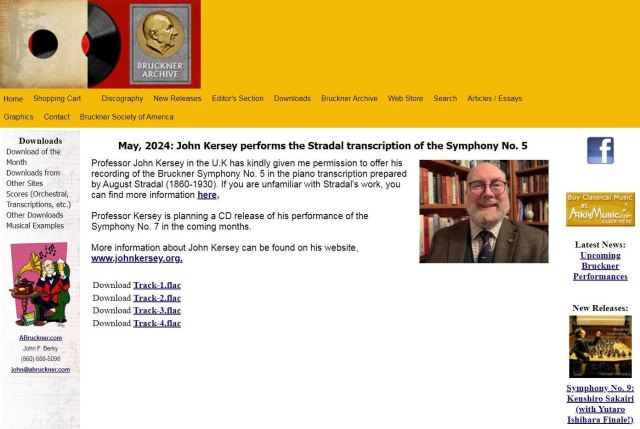
My recording of the Stradal transcription of Bruckner’s Seventh Symphony for piano solo is Download of the Month for May 2024 at the excellent and informative website abruckner.com
A new CD recording has been issued by Romantic Discoveries Recordings.
 Beethoven Piano Sonatas volume 2
Piano Sonata no 30 in E major, op. 109 • Piano Sonata no. 31 in A flat major, op. 110 • Piano Sonata no. 32 in C minor, op. 111
John Kersey, piano
RDR CD143
Total time: 68 minutes 45 seconds
1. Piano Sonata in E major, op 109 (1820) (20:01)
i. Vivace ma non troppo – Adagio espressivo
ii. Prestissimo
iii. Gesangvoll, mit innigster Empfindung. Andante molto cantabile ed espressivo
2. Piano Sonata in A flat major, op 110 (1821) (19:27)
i. Moderato cantabile e molto espressivo
ii. Allegro molto
iii. Adagio ma non troppo – Fuga
3. Piano Sonata in C minor, op 111 (1821-22) (29:12)
i. Maestoso – Allegro con brio ed appassionato
ii. Arietta – Adagio molto semplice e cantabile
A new CD recording has been issued by Romantic Discoveries Recordings.
 Beethoven Piano Sonatas volume 1
Piano Sonata no 27 in E minor, op 90 • Piano Sonata no. 29 in B flat major, op. 106 “Hammerklavier”
John Kersey, piano
RDR CD142
Total time: 66 minutes 40 seconds
1. Piano Sonata in E minor, op. 90 (1814) (14:55)
i. Mit Lebhaftigkeit und durchaus mit Empfindung und Ausdruck
ii. Nicht zu geschwind und sehr singbar vorgetragen
2. Piano Sonata in B flat major, op 106 “Hammerklavier” (1818) (52:21)
1. Allegro
2. Scherzo: Assai vivace
3. Adagio sostenuto
4. Largo – Allegro risoluto
A new CD recording has been issued by Romantic Discoveries Recordings.
 In Recital at Chingford Parish Church
Bach-Busoni Prelude and Fugue in E flat major, BWV552 “St Anne” • Beethoven Sonata no 30 in E major, op 109 • Fauré Barcarolles 6 and 8 • Beethoven: Bagatelles, op. 126 • Alkan: La Vision • Beethoven: Bagatelle in F minor (1826)
John Kersey, piano
RDR CD141
Total time: 67 minutes 20 seconds
1. Johann Sebastian Bach (1685-1750) transcribed by Ferruccio Busoni (1866-1924): Prelude and Fugue in E flat major, BWV552 “St Anne” (15:38)
2. Ludwig van Beethoven (1770-1827): Piano Sonata no. 30 in E major, op. 109 (1820) (19:48)
i. Vivace ma non troppo – Adagio espressivo
ii. Prestissimo
iii. Gesangvoll, mit innigster Empfindung. Andante molto cantabile ed espressivo.
3. Gabriel Fauré (1845-1924):
i. Barcarolle no. 6 in E flat major, op. 70
ii. Barcarolle no. 8 in D flat major, op. 96 (8:24)
4. Ludwig van Beethoven (1770-1827): Six Bagatelles, op 126 (19:58)
i. Andante con moto
ii. Allegro
iii. Andante
iv. Presto
v. Quasi allegretto
vi. Presto – Andante amabile e con moto – Tempo I
4. Charles-Valentin Alkan (1813-88): Esquisses, op. 63 (2:27)
i. no. 1 La Vision
5. Ludwig van Beethoven (1770-1827): Bagatelle in F minor (1826; unpublished)* (0:53)
Live recording taken from performances at Chingford Parish Church, London, May 2015 and *2017.
A new CD recording has been issued by Romantic Discoveries Recordings.
 Brahms Piano Works volume 2
Piano Sonata no 3 in F minor, op 5 • Variations and Fugue on a theme by Handel, op. 24
John Kersey, piano
RDR CD140
Total time: 68 minutes 50 seconds
1. Piano Sonata no. 3 in F minor, op 5 (38:20)
i. Allegro maestoso
ii. Andante
iii. Scherzo. Allegro energico
iv. Intermezzo (Rückblick)
v. Finale. Allegro moderato ma rubato
2. Variations and Fugue on a theme by Handel, op. 24 (20:27)
i. Theme
ii. Variation 1
ii.i Variation II
iv. Variation III
v. Variation IV
vi. Variation V
vii. Variation VI
viii. Variation VII
ix. Variation VIII
x. Variation IX
xi. Variation X
xii. Variation XI
xiii. Variation XII
xiv. Variation XIII
xv. Variation XIV
xvi. Variation XV
xvii. Fugue
A new CD recording has been issued by Romantic Discoveries Recordings.
 Brahms Piano Works volume 1
Seven Fantasias, op. 116 • Six Piano Pieces, op. 118 • Four Piano Pieces, op. 119
John Kersey, piano
RDR CD139
Total time: 71 minutes 17 seconds
1. Seven Fantasias, op. 116 (27:02)
i. Capriccio in D Minor (Presto energico)
ii. Intermezzo in A Minor (Andante)
iii. Capriccio in G Minor (Allegro passionato)
iv. Intermezzo in E Major (Adagio)
v. Intermezzo in E Minor (Andante con grazia ed intimissimo sentimento)
vi. Intermezzo in E Major (Andante teneramente)
vii. Capriccio in D Minor (Allegro agitato)
2. Sechs Klavierstücke, op 118 (26:57)
i: Intermezzo in A minor
ii: Intermezzo in A major
iii: Ballade in G minor
iv: Intermezzo in F minor
v: Romanze in F major
vi: Intermezzo in E-flat minor
3. Vier Klavierstücke, op. 119 (17:13)
i. Intermezzo in B Minor
ii. Intermezzo in E Minor
iii. Intermezzo in C Major
iv. Rhapsodie in E Flat Major
A new CD recording has been issued by Romantic Discoveries Recordings.
 Brahms Violin Sonatas 1 and 2 transcribed for piano solo by Paul Klengel
Sonata in G major, op. 78 “Rain Sonata” • Two Rhapsodies, op. 79 • Sonata in A major op 100 “Meistersinger” (includes first recordings)
John Kersey, piano
RDR CD138
Total time: 72 minutes 3 seconds
1. Johannes Brahms (1833-97) Sonata for violin and piano no. 1 in G major, op. 78 “Rain Sonata”, transcribed for solo piano by Paul Klengel (1854-1935) (31:54)
i. Vivace ma non troppo
ii. Adagio
iii. Allegro molto moderato
2. Johannes Brahms (1833-97): Two Rhapsodies, op 79 (15:49)
i. Agitato in B minor
ii. Molto passionato, ma non troppo Allegro in G minor
3. Johannes Brahms (1833-97) Sonata for piano and violin no. 2 in A major, op. 100 “Meistersinger” (1886), transcribed for solo piano by Paul Klengel (1854-1935) (24:14)
i. Allegro amabile
ii. Andante tranquillo – Vivace
iii. Allegretto grazioso, quasi Andante
A new CD recording has been issued by Romantic Discoveries Recordings.
 Piano Music of Frédéric Chopin (1810-49) volume 2
Polonaise-fantaisie, op. 61 • Scherzos nos. 2 and 4 • Barcarolle, op. 60 • Polonaise op. 44 • Two Nocturnes, op. 62
John Kersey, piano
RDR CD137
Total time: 76 minutes 15 seconds
1. Polonaise-fantaisie in A flat major, op 61 (16:04)
2. Scherzo in B flat minor, op. 31 (11:00)
3. Barcarolle in F sharp major, op. 60 (10:03)
4. Polonaise in F sharp minor, op. 44 (12:08)
5. Two Nocturnes, op 62 (14:16)
i. Andante in B major
ii. Lento in E major
6. Scherzo no. 4 in E major, op. 54 (12:32)
A new CD recording has been issued by Romantic Discoveries Recordings.
 Piano Music of Frédéric Chopin (1810-49) volume 1
Piano Sonata no. 3 in B minor, op. 58 • Two Nocturnes, op. 32 • Two Polonaises, op. 26
John Kersey, piano
RDR CD136
Total time: 70 minutes 14 seconds
1. Piano Sonata no. 3 in B minor, op. 58 (38:04)
i. Allegro maestoso
ii. Scherzo: Molto vivace
iii. Largo
iv. Finale: Presto non tanto
The variant passages in the first movement exposition are taken from the 1845 first edition published by J. Meissonier in Paris.
2. Two Nocturnes, op 32 (11:17)
i. Andante sostenuto in B major
ii. Lento in A flat major
3. Two Polonaises, op 26 (20:49)
i. Allegro appassionato in C sharp minor
ii. Maestoso in E flat minor
A new CD recording has been issued by Romantic Discoveries Recordings.
 Piano Music of Nikolai Medtner (1880-1951)
Canzona matinata and Sonata tragica from op 39 • Sonate-elegie (Sonata no. 3) op 11 no 2 • Sonata reminiscenza, op 38 no 1 • Sonata no. 4 in C major, op. 11 no. 3 • Sonata no. 9 in A minor “War Sonata”, op. 30
John Kersey, piano
RDR CD135
Total time: 70 minutes 35 seconds
1. from Forgotten Melodies book 2, op. 39 nos. 4 and 5 (1920) (17:25)
i. Canzona matinata ii. Sonata tragica (Sonata no. 11)
2. Sonate-elegie (Sonata no. 3), op. 11 no. 2 (7:09)
3. from Forgotten Melodies book 1, op. 38 no. 1 (1920) (17:38)
i. Sonata reminiscenza (Sonata no. 10)
4. Sonata no. 4 in C major, op. 11 no. 3 (11:38)
“Und so das Herz erleichtert merkt behende,
Daß es noch lebt und schlägt und möchte schlagen,
Zum reinsten Dank der überreichen Spende
Sich selbst erwidernd willig darzutragen.
Da fühlte sich – o daß es ewig bliebe! –
Das Doppelglück der Töne wie der Liebe.”
Johann Wolfgang von Goethe
5. Piano Sonata no. 9 in A minor “War Sonata”, op. 30 (16:35)
“I want to speak of music….as a country, our native country which determines our musicians’ nationality, our musicality, a country in relation to which all our ‘ideologies’, schools, individualities, are merely sides.” – Nikolai Medtner, The Muse and the Fashion.
A new CD recording has been issued by Romantic Discoveries Recordings.
 Piano Music of Walter Niemann volume 24
Tchaikovsky Symphony no. 6 in B minor, op. 74, transcribed by Walter Niemann • The Abode of Happiness, op. 163 (includes first recordings)
John Kersey, piano
RDR CD134
Total time: 78 minutes 35 seconds
1. Peter Ilyich Tchaikovsky (1840-93): Symphony no. 6 in B minor, op. 74 “Pathetique”, transcribed for solo piano by Walter Niemann (49:10)
I. Adagio – Allegro non troppo
2. Allegro con grazia
3. Allegro molto vivace
4. Finale. Adagio lamentoso – Andante
2. Die Wohnung des Glücks, op. 163 (13:06)
In grateful memory of his sister Elisabeth (1866-1942), with whom he had lived all his life.
i. Home
ii. Summerland
iii. A Birthday
iv Grief and Consolation
v. Epilogue
Our thanks go to Nicolo Figowy and Steffen Herrmann for their generous loan of scores.
Walter Niemann was regarded in 1927 as “the most important living piano composer who knows how to make music from the piano in a subtle and colorful way, although he often enters the field of salon music” (H. Abert, Illustrated Music Lexicon). This most sensitive and introverted master of the piano devoted his life to composition and musical scholarship, also performing his music in concerts and radio broadcasts. Niemann’s vast output for the piano is only now starting to become more widely known. Although his style is generally unashamedly conservative, he was one of the very few German composers to explore Impressionism in music, and this also reflected a fascination with the Far East. Elsewhere, Niemann’s imagination takes us from much Baroque recreation to large-scale epic sonatas, Schumannesque miniatures and even the exploration of early jazz styles. His understanding of the capabilities of the piano was complete, and his works include both collections for young pianists and mature works that exploit the full range of pianistic effect and make significant demands on the performer.
A new CD recording has been issued by Romantic Discoveries Recordings.
 Piano Music of Walter Niemann volume 23
Before the forest smithy • Six Rondinettos, op. 130 • The Yellow Tango • From a little city, op. 154 • Variations on an old English minuet, op. 118 no. 1 • Masks, op. 59 (includes first recordings)
John Kersey, piano
RDR CD133
Total time: 60 minutes 48 seconds
1. Vor der Waldschmiede (published 1907) (3:50)
2. Six Rondinettos, op. 130 (8:47)
i. Amabile con moto, in modo pastorale ii. Allegro alla caccia ii. Moderato con moto e un poco malinconico iv. Amabile con moto v. Giocoso con moto vi. Allegro liquido
3, Der gelbe Tango (1933) (3:55)
4. Aus einer kleinen Stadt, op. 154 (after Wilhelm Raabe’s “Das Horn von Wanza”) (10:34)
i. The little city ii. The old gate iii. The peasant jug iv. Dance in the old patrician house (17th century) v. The worthies in the “Great Bear” vi. The little river in front of the city vii. Night and watchman’s call
5. Variations on an old English minuet (Theme (Minuet) from Sonata VIII by Thomas Augustine Arne (1710-78)), op. 118 no. 1 (7:07)
6. Masken, a cycle of twenty little character pieces, op. 59 (26:21)
i. Praeludium in Schumann’s style ii. Chinese Mandarin iii. Coquette iv. The Spanish Woman v. Johann Strauss vi. Louis XIV vii. Russian Folk Dances viii. The Timid One ix. German Girls x. Winter xi. Tarantella dance xii. Debussy xiii. The Jolly Dutch Gentleman xiv. The Black Larva xv. Grieg xvi. Biedermeier xvii. The Irascible One xviii. The Swiss Milkmaid xix. Italian Pipers xx. To End
Our thanks go to Nicolo Figowy and Steffen Herrmann for their generous loan of scores.
Walter Niemann was regarded in 1927 as “the most important living piano composer who knows how to make music from the piano in a subtle and colorful way, although he often enters the field of salon music” (H. Abert, Illustrated Music Lexicon). This most sensitive and introverted master of the piano devoted his life to composition and musical scholarship, also performing his music in concerts and radio broadcasts. Niemann’s vast output for the piano is only now starting to become more widely known. Although his style is generally unashamedly conservative, he was one of the very few German composers to explore Impressionism in music, and this also reflected a fascination with the Far East. Elsewhere, Niemann’s imagination takes us from much Baroque recreation to large-scale epic sonatas, Schumannesque miniatures and even the exploration of early jazz styles. His understanding of the capabilities of the piano was complete, and his works include both collections for young pianists and mature works that exploit the full range of pianistic effect and make significant demands on the performer.
A new CD recording has been issued by Romantic Discoveries Recordings.
 Piano Music of Walter Niemann volume 22
Pickwick, op. 93 • Pictures from Chiemsee, op. 131 • Der Artushof, op. 158 • Tales from the Mountains, op. 41 • Scarlattiana, op. 126 (includes first recordings)
John Kersey, piano
RDR CD132
Total time: 78 minutes 35 seconds
1. Pickwick, a cycle after Charles Dickens, op. 93 (21:03)
i. Mr Pickwick ii. Mr Tupman Waltzes iii. The poetic Mr Snodgrass iv. Mr Winkle, the friend of the woods and hunts v. Sam and Mary (Duettino) vi. A morning in the country (Manor Farm) vii. The fat Joe viii. How Mr Weller drives his stagecoach ix. The Ball at Bath x It is over (A backwards glance)
2. Bilder vom Chiemsee, op. 131 (11:39)
i. Summer morning ii. In the monastery church (Fraueninsel) iii. Highland – Dirndl iv. Castle Herrenchiemsee (Herreninsel) v. On the lake vi. Highland – Bua vii. Mending the fishing nets (Fraueninsel) viii. Market day in Prien
3. Der Artushof – suite from old Danzig, op. 158 (11:36)
i. Praeludium (Moderato con moto) ii. Sarabande (Tempo di Sarabanda, largamente e solenne) iii. Menuett (Tempo di Minuetto, Allegretto amabile) iv. Alla Giga (Giocoso animato)
“Now a magical chiaroscuro crept through the murky windows, all the strange pictures and carvings with which the walls are richly decorated, became active and alive.” – E.T.A. Hoffmann, Der Artushof
4. Geschichten aus den Bergen, little Ländler and dances, op. 41 (14:14)
i. Sehr gemütlich und gemächlich ii. Anmutig, in mässigem Zeitmass iii. Ein wenig gehalten und trübe erregt iv. Mit Wärme, night zu schnell v. Ein wenig gehalten, mit sanft verhaltener Melancholie vi. Mit feurigem Aufschwung vii. Ein wenig gehalten, in stiller Wehmut viii. Anmutig und leicht bewegt ix. Mit sanfter Melancholie, ein wenig gehalten x. Den Manen Edvard Griegs – Sehr mässig, mit grösster Wärme xi. Schmerzlich gehalten xii. Mit derb-übermütiger Lustigkeit in Holzschuhen
“On the Wiesenanger, which, walking gently downhill, came up against the wood, and partly also on the harvested fields, there were stalls, tables with people feasting, there were bowling alleys, target shooting, swings, music stages, dance floors and I don’t know what else , towered over by poles with waving flags and swarming with colourful people.” – – Adalbert Stifter
Scarlattiana, three little Sonatas in the style of Domenico Scarlatti, op. 126
5. Sonata no. 1 in D major (4:23)
6. Sonata no. 2 in A minor – i. Allegro marcato, ma leggiero ii. Pastorale – Molto moderato ed amabile iii. Presto leggiero (8:29)
7. Sonata no. 3 in G major – i. Pastorale – Molto moderato e malinconico ii. Allegro capriccioso (6:57)
Our thanks go to Nicolo Figowy and Steffen Herrmann for their generous loan of scores.
Walter Niemann was regarded in 1927 as “the most important living piano composer who knows how to make music from the piano in a subtle and colorful way, although he often enters the field of salon music” (H. Abert, Illustrated Music Lexicon). This most sensitive and introverted master of the piano devoted his life to composition and musical scholarship, also performing his music in concerts and radio broadcasts. Niemann’s vast output for the piano is only now starting to become more widely known. Although his style is generally unashamedly conservative, he was one of the very few German composers to explore Impressionism in music, and this also reflected a fascination with the Far East. Elsewhere, Niemann’s imagination takes us from much Baroque recreation to large-scale epic sonatas, Schumannesque miniatures and even the exploration of early jazz styles. His understanding of the capabilities of the piano was complete, and his works include both collections for young pianists and mature works that exploit the full range of pianistic effect and make significant demands on the performer.
 Professor John Kersey