I was saddened to hear of the death of Dame Patricia Routledge at the grand old age of 96 today. Dame Patricia and I met when we both received the Honorary Fellowship of the Guild of Musicians and Singers in a ceremony in London in April 2018. She subsequently became a Patron of the Guild.
At the ceremony – Dame Patricia is second from left, I am second from right.
The respect in which Dame Patricia was held as an actress reflected her consummate mastery of both comic and serious acting. Everything she did was eminently watchable and I greatly enjoyed her television work over several decades. In person, she was a strong traditionalist, a maintainer of proper standards in speech and a devout Christian. Despite her fame and many recognitions, she was unpretentious and friendly and it was a great pleasure to have met her.
Yu Chun-Yee, formerly professor of piano at the Royal College of Music, and with whom I studied piano for ten years, died on 23 December 2023 from cancer, aged eighty-six. It is rather surprising that no obituary of this remarkable pianist and teacher has yet appeared in the mainstream press.
Yu Chun-Yee was born in Shanghai on 12 July 1936. He grew up in Singapore, where he attended the Chinese High School and then the Raffles Institution. Aged eighteen, he won the Singapore Musical Society competition where the judge was Julius Katchen, and also represented Singapore at the first Asian Music Festival in Hong Kong. He further obtained the diploma of Licenciate of the Royal Schools of Music.
In 1956, he was awarded a grant of financial support that enabled him to come to England and become the first Singaporean pianist to study at the Royal College of Music. His professor was the noted Beethoven exponent Kendall Taylor, and Yu would follow him as an exceptional interpreter of that composer. At the RCM, where he studied for four years, he won the McEwen Prize for piano and the Ricordi Prize for conducting. His performances in RCM concerts included works by Bach, Brahms, and Chopin.
At the end of his time in England, he was awarded the opportunity to study in Siena with Busoni pupil Guido Agosti, and then went on to complete his studies in Paris with Magda Tagliaferro. His Wigmore Hall debut followed in 1961 and in 1963 he was the soloist in Beethoven’s Fourth Piano Concerto with the London Philharmonic Orchestra at the Royal Festival Hall. This performance was still described in superlative terms many years later. 1963 also saw his only solo broadcast for the BBC Home Service with an all-Bach programme.
At this time, Yu also became the pianist in the Tagore Piano Trio with violinist Frances Mason and cellist Jennifer Ward-Clarke, and the trio broadcast on a number of occasions on the BBC. His last broadcast with them was in 1969.
Yu’s performing career was seriously curtailed by a hand injury that I was told had occurred as a result of practising the demanding double octave passages in the Tchaikovsky First Piano Concerto. Had this not happened, there can be little doubt that he would have further established himself among the front rank of pianists of his generation. It certainly did not altogether stop him; a demanding solo recital programme in Singapore in 1978 featured a programme including Beethoven’s “Appassionata” sonata and Chopin’s second piano sonata. But by the time I came to study with him he only very rarely demonstrated at the keyboard, and that more often with his left hand than his injured right.
Perhaps initially out of necessity, Yu’s focus shifted to teaching, but it was soon apparent that he had just as much ability in that field as in performance. In 1972 he was appointed to the professorial staff of the RCM, and in the mid-1970s was also teaching piano at the University of Reading, which in those days had a music department. He combined these appointments with examining for the Associated Board of the Royal Schools of Music, and would regularly examine overseas, combining this with concert tours. He often visited the Far East and returned to Singapore on numerous occasions, also touring Japan and Taiwan.
To convey something of Yu’s impact as a teacher, it would be sufficient to say that there was no problem that a pianist might encounter in technique or interpretation to which he could not offer a well thought-out and effective answer. He excelled in the analysis of thorny difficulties and subtle gradations of style, always demanding the highest of standards and absolute dedication to the music. He did not impose a particular interpretative style, nor belonged to any particular school of pianism, but expertly aided the student to bring out their own qualities in response to the music. His authority extended over the entire piano repertoire, from the established canon to contemporary music, and even when a work was new to him he could quickly grasp its essence and offer insightful comment on it.
There was great competition to study with him, particularly among those students at the RCM who had come from the Far East, and many of his students went on to successful musical careers. As well as the three days a week that he taught at the RCM, he also taught privately at his home in Golders Green, where his mahogany-cased Steinway had a particularly beautiful tone but also one of the heaviest actions I had encountered – which makes some things more difficult for the pianist but others easier.
Yu projected an air of urbane civility and wisdom that made him an engaging personality. He had mastered the often difficult politics of working within institutions and with the assistance of a number of exceptional colleagues ensured that the RCM’s piano faculty achieved a pre-eminent place among the London conservatoires. There were many accounts of his kindness and generosity towards his students and I was certainly among those who had reason to be grateful for his support.
In 1988, the RCM appointed Yu to its Fellowship in recognition of his contribution to the institution and to music. But in 1998, faced with the iconoclastic changes now being implemented at the RCM as well as his long-held promise to return permanently to Singapore one day, he decided to leave for home, initially taking up the Vice-Principalship of the Nanyang Academy of Fine Arts and later founding the School of Young Talents. He remained an advisor to the RCM for some years.
Away from the piano, he was a player of bridge to a high level, and competed on many occasions for high stakes. When travelling, he would often seek out opportunities to play bridge both for its social benefits and as an intellectual discipline. He was also a connoisseur of the cuisine of the Far East, and a memorable lunch of dim sum with him included a number of dishes that I have never encountered in England since.
He was married twice, firstly in December 1963 to Isabella Miao, by whom he had two sons, and secondly in June 1982 to Jung Chang.
Many years ago, this interesting manuscript came into my possession. It is an essay by the great American pianist Raymond Lewenthal (1923-88) entitled “Remembrance of Nyiregyhazi Past” in which he gives his personal recollections of the remarkable pianistic genius Ervin Nyiregyhazi (1903-87).
My manuscript is a rather poor quality photocopy of Lewenthal’s twelve-page typescript with his handwritten annotations. The last page is incomplete, but is clearly headed towards its conclusion. It is reproduced here for educational purposes in the hope that the insights it contains will be of benefit to all who are fascinated by the phenomenon that was Nyiregyhazi.
The use of distinctive ties to establish an institutional association is a notable element of British culture, having begun at Cambridge in the nineteenth-century. In respect of our schools, colleges and universities, ties form a part of academic dress.
Today, many educational institutions continue to prescribe one or more ties that may be worn by those who have attended them, or in some cases also by former staff and other associated persons. The Royal College of Music, which I attended as a student and was later associated with as a Junior Fellow, was formerly among these.
During my time at the RCM I carried out some research into the ties that had been prescribed in the past. In the RCM Magazine of 1929 (Vol.3 no. 23) reference is made to badges, ties and blazers in the colours of the RCM Union. The RCM Union comprised the current students and staff, alumni and former staff of the RCM, being formed in 1906 and maintained by annual subscription.
No surviving examples of the tie were known to exist, and therefore I embarked upon a project to reconstruct it, enlisting the help and advice of a doyen of institutional ties, the late Tom Clegg of Benson and Clegg in the Piccadilly Arcade. The royal blue referred to is likely to have been the same shade as is used in the hood of the Associateship of the RCM. Traditionally, royal blue is a deep, dark blue rather than the lighter colour that is more usual these days (and that is also used by the RCM, for example in the former D.Mus.R.C.M. robe and the pre-1998 M.Mus.R.C.M. hood).
The ARCM hood, showing the dark traditional shade of royal blue used by the RCM. This shade is also used in the FRCM hood and in the Director’s robe.
RCM tie after the 1929 specification as made by Benson and Clegg in non-crease silk. This is a most pleasing and distinctive tie and it is difficult to understand why it was discontinued.
In the same RCM magazine of 1929 there is reference to the Union Badge, which had been produced by Mr George Kruger Gray, FSA, some time previously, and which was accompanied by the motto “The Letter killeth, but the Spirit giveth life”.
By the 1970s, a new tie had appeared, bearing the same crest that had been designed for the RCM Union. This was often to be seen worn by Sir David Willcocks as Director of the RCM as well as by staff and students.
To mark the RCM’s Centenary in 1982 a further tie had been introduced. It was described as “plain navy blue with a gold musical motif surrounding the Prince of Wales’ feathers (the motif used on RCM cheques in 1882)”. It was available in silk for £8.50 or polyester for £4.50.
It can be seen that the design that appeared on the cover of the RCM Magazine at that time used several of the same elements:
During my time at the RCM between 1987 and 1998, both of these ties were worn proudly by a number of students and staff (many of the staff at that time were RCM alumni). The crested tie was also worn by the Prince of Wales on his visits to the RCM as President during the 1990s.
The Prince of Wales (now King Charles III) wearing the RCM crested tie and the robes of the D.Mus.R.C.M. These robes use the lighter, more modern shade of royal blue discussed above.
The former RCM scarf also used the crested device and again combines the RCM colours of (lighter) royal blue and gold.
As of 1991, the RCM Union was described as comprising “past students, the teaching and administrative staffs of the College, all members of the Students’ Association and others whom the Committee decide to elect.” Several persons were elected to honorary membership during its history. The RCM Union was abolished in 1992 and replaced by the RCM Society which initially had the same membership composition and aims as the RCM Union, but was converted to a non-subscription model in 2001 and abolished altogether in 2009.
Ties were still available from the RCM until the mid-1990s, but when their stock ran out it was not replenished, and provision appears to have ceased altogether in the late 1990s. While the Prince of Wales continued to wear his RCM crested tie on his visits in his capacity as the RCM’s President for some years, more recent photographs on the RCM website suggest that he ceased to do so in the present century.
Given the extensive and indeed iconoclastic changes that attended the RCM in the last years of the last century, it is perhaps unsurprising that there should have been no place in the new-look institution for an institutional tie. As one who was a part of the RCM before its present incarnation, however (and as a former member of both the RCM Union and RCM Society), I continue to wear the ties above with an awareness that they recall the values of the College as they were then, which values in my view are well worth perpetuating.
Royal Collegian Jonathan Mann informs me that there was in fact a move to reintroduce a RCM tie as a result of alumni suggestions as part of the RCM’s More Music Appeal around 2018. It appears that a few prototypes of this splendid new design were issued, but in the event, it was abandoned without being put into production.
As a postscript, it seems that the subject of RCM ties is not quite exhausted. In the present century the American designer Ralph Lauren produced a tie for his Purple Label that is based on the crest of the RCM and achieves an effect that is both dignified and attractive. Albeit unofficially, this tie nevertheless provides a worthy example of what might, and perhaps should, have been.
Notes from a pianist is my occasional series of essays on aspects of the piano and piano-playing, with a few diversions into spiritual and institutional subjects.
The majority of commercial recordings of classical pianists today are the product of the modern studio and its processes. This involves not only the pianist, but recording editors and producers who will often be deeply involved in the artistic decisions that are integral to recording. The pianist may or may not have the final say as to which takes are used, and will have limited input into issues such as microphone placement and the technical acceptability of particular takes. These are much more likely to be decisions taken on the basis of standard studio practice and the expectations of the recording industry than on the basis of artistic judgement alone.
Let us take a step back, however. Should the point of recording a solo pianist not be to capture the experience of their playing in as natural and unforced a manner as possible, as if he or she were in the room with us? How often does the commercial recording process succeed in capturing intimacy, or a sense of spontaneity? Why do old recordings seem to achieve these things far more successfully than modern ones?
The unfortunate fact is that far too many commercial piano recordings sound exactly the same; they share a standard approach to recording the piano and an interpretative approach that rarely creates any sense of surprise or of an unfolding musical experience born of head and heart rather than of industry expectations.
The first pianist that I am aware of who made extensive private recordings was the late Gunnar Johansen (1906-91), a Danish pianist who settled in the USA. Johansen taught himself how to edit tape, and as a result produced a remarkable and extensive series of LP and cassette recordings (including the collected works of Liszt, Busoni and Ignaz Friedman) for his own recording label, Artist Direct Recordings. Initially, he made recordings in his living room at home, and later built a home studio. Andres Segovia said of this, “Oh, I so wish I had a place like this! I sit there in the professional recording studios, play a work perfectly … and then they tell me, ‘We heard your chair creak at one point,” or” your shoe hit the floor” … and we have to do it over again!’”
Segovia’s point is well-made. Johansen’s recordings do not sound like the clinical products of the studio, but create a very powerful sense of direct presence, as if he is playing directly for you. There are occasional noises off, and not every edit is imperceptible, but the result is honest, real, and a genuine musical experience of the playing of a master pianist. When artists such as Celibidache disdained the recording process as being unable to capture the essence of music-making, they might have paused at Johansen’s achievement.
Glenn Gould, too, foresaw a point where the pianist would also take charge of the studio side of recording. The key to doing so is that there is a unified vision behind the recording in question. No more is there the risk of clash between recording producer, sound engineer and pianist; no more the risk that the finished product might in fact be so far from the pianist’s own interpretation that it was unrecognizable to them. And there would, in all likelihood, be much less of the assembly of a collage-like performance from multiple unrelated takes. On a visit to a major studio, an acquaintance was told that they were also working on a recording of Beethoven’s last piano sonata by an extremely prominent pianist who is rightly esteemed to be among the greatest living today. The studio was littered with what appeared to be hundreds of labelled tape fragments taken from days of sessions. From this would eventually be constructed twenty-five minutes of recorded music that was subsequently released to enduring critical acclaim. Great recording it may have been, but it was the product of the studio and not of anything resembling live performance.
Having now edited many of my own recordings, I would maintain that the editing process involves important artistic choices that are integral to the interpretative process. They are choices that I would now be reluctant to concede to others, however expert they might be (and I certainly make no claims for my own technical expertise as a sound engineer). There are many electronic tricks that could be used to make a recorded performance appear to be something it is not, from the addition of acoustic effects that could make it sound as if it were in a large concert hall, to more subtle but insidious sonic alterations that would probably be imperceptible to most, but would produce a final product that would sound more like the output of a modern studio. My preference is to disdain them all.
There are times when my recordings are affected by factors such as the physical noise of the instrument (keys or pedals); the occasional sound of my children and cats playing (or arguing) in the background; the odd bumpy edit; or my piano not being perfectly in tune (though its colour and character more than compensate for any such deficiency in my view). But these are real performances, by a real pianist passionate about the music, and they aim at an artistic integrity that brings them into line with the experience of hearing the work played in a natural, intimate setting similar to that envisioned by the composers in question.
Likewise, each work is wherever possible recorded in a single session and a single microphone is used (because we as listeners only hear music from a single location in live performance). The recordings use the widest dynamic range possible, meaning that they will often benefit from playback at a slightly louder volume than is usual. And I hope that they succeed in capturing that indefinable quality that drew me to the music in the first place and that makes me want to share it with others; an emotional richness and warmth that creates intimacy and the human touch.
The use of the piano’s sustaining pedal is a vast subject, and in this brief article I wish to mention only a few salient aspects.
It has become fashionable for pianists today to play with very little use of the sustaining pedal and for the prevailing critical taste to praise performances that are predominantly dry and clear in texture as well as fast in tempo. This is in keeping with a modernist sensibility. However, there is an alternative approach to the use of the pedal that is Romantic in origin and spirit.
The editions of Bach and Mozart prepared by leading pianists and musicologists of the Romantic era, typically in the nineteenth-century, are generally shunned by modern pianists who assume that the understanding of such editors as Czerny and Liszt is defective in comparison to their own modernist conceptions of authenticity in the performance of music of the pre-1825 period. Such editions usually include recommendations for pedalling, despite the fact that the modern sustaining pedal (and indeed the modern piano) was not available to the composers in question. Because this is at first sight “inauthentic” a stylistic orthodoxy has therefore developed in which historically-informed performance practice essentially treats the prevailing performing traditions of the nineteenth-century, notably pedalling, as taboo and replaces them with their own concept of what early music should sound like. This aesthetic has since come to encompass much Romantic music as well.
Yet there is another way to see these matters.
In Beethoven, we have the benefit of a number of fortepianos surviving today that represent the traditions of piano-making that Beethoven himself was on record as praising, and also excellent modern copies of the same. Playing and listening to these is often a surprising experience, not least because their sound-world is the opposite of the dryness that now characterizes much Beethoven on the modern piano. Although outside the scope of this article, similar observations might be made of clavichords of Bach’s era, which often resonate very expressively in the right acoustic.
There is a tremendous and extremely attractive resonance built into the Beethoven-era fortepiano. We hear all manner of sympathetic vibrations and related sounds when a chord is played, creating a wider harmonic context. Moreover, Beethoven invites us directly to use and experience that resonance as part of the sound-world of his piano music. The first movement of the famous “Moonlight” Sonata (op. 27 no. 2) contains the direction “Si deve suonare tutto questo pezzo delicatissimamente e senza sordino” (“This whole piece ought to be played with the utmost delicacy and without damper[s]”). This means that the sustaining pedal is to be depressed at the inception of the movement and lifted at its end. This is not a new effect; we find C.P.E. Bach in 1762 advocating a similar use of the undamped effect when playing in an improvisatory and fantasia-like style. Beethoven’s sonata is of course headed “quasi una fantasia”.
It is perhaps testament to the modernism to which I referred earlier that in a search of the many performances of this movement on YouTube it was frequently the case that even those who used fortepianos disregarded Beethoven’s instructions and changed the pedal with the changing harmonies. In the performance of Dmitry Ablogin, however, we can hear rather more of Beethoven’s actual conception:
Schindler, Beethoven’s biographer, tells us that by the 1850s this effect was no longer possible due to the greater volume of the pianos being produced at this time. Most pianists since have agreed with him. And yet, this is surely a challenge to the imagination and technical control of the performer. More modern pianos can be played just as quietly as a fortepiano, and indeed more tonal control is possible in instruments of particularly fine quality. Sustaining pedals on fine instruments are also capable of subtle half-pedalling rather than binary on-off operation. In achieving these effects, it will be obvious that excessive speed is to be avoided if the result is not to be an ugly clash of harmonies.
The control of tonal gradation, speed and expression by the performer can therefore bring about an expressive interpretation of this work on a modern piano, albeit one that may be shocking in its effect. The result may well be a challenge to modern ears, but it will be one that seeks to capture the essence of Beethoven’s imaginative world rather than bowdlerise it for contemporary taste. And it can be applied to much else in Beethoven’s piano works, from the recitatives in the first movement of op. 31 no. 2 to the arioso of op. 110.
In Schubert, too, we can see this resonance at work in the marvellous reading of his last piano sonata by Tobias Koch, who plays an exceptionally sonorous fortepiano by Conrad Graf. Koch takes the first movement at a true molto moderato, unlike many modern pianists, and this expansive tempo allows every expressive nuance to make itself felt, including a much deeper and richer sonority than we usually hear. Is something similar possible on the modern piano? Certainly so.
Such was Romantic taste for resonance that the piano maker Blüthner developed an aliquot system whereby an extra set of strings was provided in the treble that were not struck but instead vibrated sympathetically with the others, producing an expressive silvery haze. I have loved these instruments since I first discovered them many years ago and they provide in many respects an ideal sonority for Romantic repertoire.
For the modern audience, Romantic pedalling is unexpected and often perplexing. Time and again, reviews criticise certain artists for “overpedalling” when in fact the use of the pedal is entirely deliberate as part of their interpretative concept and is authentic within the context of their pianistic tradition. The late John Ogdon, for example, made copious use of the sustaining pedal in Romantic repertoire, drawing on the legacy of such pianistic giants as Busoni and Anton Rubinstein to produce a full-blooded, passionate pianism that could often be colossal in its effect.
Another such artist is Stephen Kovacevich, who often seems to have an orchestral imagination in such composers as Beethoven and Brahms, and uses the sustaining pedal to great expressive effect. His playing is never dry. Indeed, in an interview, he has offered a view that sums up the parsimonious taste of contemporary modernism,
“What do you mean by P[olitically]C[orrect] in a musical context? Fast, mean, spare…
There is nothing politically correct about Romanticism. It calls forth an individual response that, if it is to be spiritually authentic, must be an entirely sincere and committed reflection of the interpreter’s identification with the work in question. It may be too much for a shallow, sound-bite world. The Romantic pianist sees the pedal as an extension of the fingers; a vital expressive dimension to building an edifice in sound.
“In my early days I made the mistake of listening to what everyone said and therefore not following my own feelings about what I was playing. Now I know it’s my business to convince audiences that my view is the right one.” – Peter Katin, quoted in 1969
The pianist has a clear task; to interpret the work at hand in the way that best illuminates and communicates its meaning. Since a work of substance grows with you the more you know and play it, this means that interpretation deepens as our familiarity with the music increases and we perceive new aspects and insights, as well as new ways of communicating these.
The approach that I was raised in as a pianist emphasised considerably that interpretation is a process requiring the utmost integrity, honesty and to some extent humility, as the interpreter places him or herself at the service of the composer. Even in works that require a high degree of virtuosity, the musical message remains paramount – consider the virtuoso works of Liszt as interpreted with ideal balance by Claudio Arrau, for example. To display virtuosity for its own sake, to show off with speed or volume purely in order to excite an audience, or to play in a brash or shallow manner has been regarded rightly as being in poor taste. Towards the end of my student days I sat through a recital by a recent graduate consisting mainly of extrovert works of Liszt and Chopin played with all the subtlety of a sledgehammer. The technical accomplishment was on one level impressive. There was no want of speed, tonal command or power. On the other hand, it did the composers concerned a considerable disservice to be reduced to such a one-dimensional view.
Of course, most pianists are aware of the boundaries of accepted good taste. But in this lies a problem. Firstly, the audience for the classical pianist has grown less attuned to the subtle art of interpretation and, in the shallow spirit of the age, expects the easier option of simply being entertained. Most pianists today seem to play in order to please the audience, rather than developing interpretations that may prove more controversial but are equally more personal and possessing greater integrity. Moreover, because of the prevalence of piano competitions and auditions as gateways to a pianistic career, an orthodoxy is imposed. The pianist is told: this is what the competition jury and the agents want to hear. His or her choice is then between giving the jury and the agents what they want or not having a career. The integrity that should be at the heart of the process is gone, replaced by a consensus judgement born of commercial, not artistic, imperatives.
This is a symptom of the increasing blurred lines between the business worlds of classical and popular music. Both are now concerned with demotic commercialism. If the audience is not pleased, or has been made to work hard for their pleasure, the commercial reward is lessened. This is one reason why so many pianists now sound alike, and play similar repertoire. To play in a different or more personal style, or to choose repertoire that does not have instant audience appeal, is to separate oneself from the mainstream.
The popular musician is often just as intent on personal integrity and artistic expression as the classical musician. For the popular musician, the battle against the restrictions of record labels can take on an epic quality, as the artist struggles to place their creativity ahead of its commercial exploitation. Historically, the classical musician has not had to fight this battle to the same extent, because society has rightly held that high art is an end worthy in itself, and has supported the idealism that is required to achieve it. Now, with high art no longer valued, the non-mainstream classical musician finds him or herself in a similar position to the popular musician who does not find chart success or who fades from fashion; the choice is either between trying to find some form of lasting niche, capitulating to stylistic pressure in the hope of being re-absorbed into the mainstream, or giving up altogether.
Another aspect of this is that the focus is now far more on selling the performer than the music. This again borrows from popular music. It is far easier to sell a personality than it is to focus on the complexities of profound, often elusive music. Again, there is a great deal of conformity in the way pianists are presented today. The agents know what will sell to their audience and what in turn will keep them in business. It is rare that a pianist’s biography these days offers any kind of surprise, for they all follow a very similar formula. Above all, anything controversial or extra-musical is studiously avoided. The result is a blandness and a deliberate concealment of the pianist as a whole person, lest any aspect prove unpalatable to the audience. Gone are the days when Shura Cherkassky, that most individual of pianists, could say “Some people like my playing and some don’t, but nobody can say that I’m boring.” And that recalls the late John Barstow, doyen of piano professors at the Royal College of Music, who opined “the only sin is to be boring.”
There may be no commercial reward for the pianist who prizes integrity above mainstream values that he or she disagrees with, but there is the knowledge that integrity is the more important artistic goal. My view is that the mature artist should concentrate not on what the audience wants but on repertoire that he or she believes in passionately and is capable of advocating to the full in a way that is not merely dutiful but promotes that mystical identification of composer and interpreter such that interpretation truly becomes a recreative activity. The result may challenge the listener, and provoke strong reactions for and against, but if it has integrity, it will ultimately also command respect.
The technical work of becoming a pianist of professional level is unremittingly hard. Most begin with some level of natural facility, but refining this into a flexible and reliable technique is work that demands great concentration and dedication. As a student, having been gifted with a considerable natural facility, I nevertheless usually put in four hours practice a day, which generally achieved what I needed to do without becoming stale or unduly fatigued.
It never occurred to me that there were any short cuts to the goal of a comprehensive technical command. There was no substitute for putting in the physical work, and above all you had to learn how to work not just hard but smart. Progress resulted, and eventually you reached the goal of being able to perform a work not only to a professional standard but in the way that you believed it should be played.
And yet there were always limitations. The most obvious is a natural limitation on the size of the hand and to some extent its flexibility. There are techniques that can be learned to overcome many problems in piano playing. Nevertheless, there are some works that will never lie entirely comfortably under the hands. It is a rare pianist who can, for example, play all of the Chopin Etudes to the same high standard, since they expose different facets of technique mercilessly. Differences in technical emphasis among composers is also a major factor that leads to pianists specializing in the repertoire that best suits them. I remember as a student some pianists whose physique and temperament best suited them for Mozart rather than for Rachmaninoff, and others for whom that position was reversed. What I was taught was that you accepted what nature had given you and did your best with the result, and that in the vast majority of the standard repertoire there were solutions at hand that were interpretatively satisfactory.
But some pianists cheat. It seems, at least according to the internet, that Beethoven and Chopin, as well as some famous pianists of the modern age, all underwent a physical operation in which the webbing between some or all of their fingers was cut. If successful, this meant that the stretch of the hand would increase dramatically as well as aiding its flexibility in certain figurations. If unsuccessful, I suspect it would damage the hands beyond repair.
According to Alan Walker’s biography of Liszt, this practice had become fashionable in the late 1860s. Writing to his student Johanna Wenzel in 1872, Liszt counselled strongly against it,
“My dear young lady, In reply to your friendly lines I earnestly beg of you to think no more of having this barbarous finger operation. Better to play every octave and chord wrong throughout your life than to commit such a mad attack on your hands.”
Liszt was correct to think of such practices as entirely alien to the pianist’s art. Those who knew Liszt uniformly refer to the nobility and artistic integrity of his interpretations and his teaching. Subordinating such values to a diabolical (and medically risky) compromise would be an unforgivable interference with nature.
Walker also tells us that by 1885 the tendons themselves were being cut, and that a description of the procedure involved had appeared in the British Medical Journal. In the United States, surgeon William E. Forbes specialized in the procedure, which was completed in fifteen minutes, and by 1898 estimated that he had performed it 2,500 times.
What of today? I am not aware of any pianist who will admit publicly to having undergone this or a similar procedure. Yet the internet suggests it is rife, both in Europe and in Asia, and the contemporary classical piano world’s emphasis on shallow virtuosity would tend to provide an impetus for such things. Who are the surgeons who (presumably privately) are doing this? Is it ethical for them to do so? In the already mired and corrupt world of piano competitions, should we not be separating those who have given themselves an unfair technical advantage from their uncut peers in the same way as the sports world bans doping? Is it not time to reassert the position that piano playing depends for its very essence on the integrity of the interpreter, both musically and personally?
“There was, he said, “always a mafia running the music world, but when I started my career the mafia was musical. The mafia now calling the shots derives its power not from musical expertise but from money.” – Peter Katin, quoted in his obituary in the Daily Telegraph (1)
There have been few more detrimental aspects to the world of the classical pianist than the domination of that world, during the past two decades in particular, by demotic commercialism. This commercialism has had a profound influence on the life of both prominent and lower-profile pianists, since for many it has resulted in loss of opportunity. It has also seen changes to the audience for pianists, as this audience has been transformed from connoisseurs into one of consumers.
In a perceptive article for The Guardian in 2002, entitled “Why are today’s concert pianists so boring?(2)”, Martin Kettle identified the changes in the place of the piano in society that have led, despite a number of outstanding artists, to a position where many pianists seem not to have anything very interesting to say. The change is not merely cultural, but commercial.
The past few decades have seen classical music become an increasingly homogenized product, in which live performance is secondary to recording and in which the audience is no longer, as once was the case, composed of those who have at least some personal experience of amateur music-making via a piano in the home. Moreover, our education system has no longer placed Western classical music at the heart of a liberal education, instead embracing a false relativism in which popular and non-Western musics are allowed to supplant it. Together with this, we have the indifference of the mainstream establishment to classical music (Desert Island Discs today is full of pop music), and the disappearance of classical music from many everyday situations such as background music and theme music for radio and television programmes.
Lastly, we have the dominance of musical institutions – concert halls, orchestras, conservatoires – by financial rather than musical imperatives, due to the funding regime in which they now operate. But there is more to this than Katin’s analysis of money leading the way. There is also a dominant authoritarian leftist set of values that has taken as its watchwords the modern shibboleths of diversity, equality and anti-elitism. Those pianists whose living depends upon this establishment for work are unlikely to speak out against it, and yet in acquiescing, they are willingly abetting the destruction of classical music as we know it. What has been desperately needed amid the current crisis of ridiculous wokeism is a robust public defence of Western classical music and its values, and a demonstration and proof both of its cultural importance to the British nation and its superiority over politically correct alternatives. Of course, this has not been forthcoming, and we now see the brash promotion of classical artists and music on the basis of their conformity to fashionable woke tropes rather than anything as non-inclusive as their musical superiority.
Where we see the combination of wealth and leftist authoritarianism on the world stage, major political forces are unlikely to be far away. Their strategy is to weaken the West’s values and resilience, and it will not take much reflection to see these factors at work in the piano world.
Because the modern audience is less informed, it is less capable of making genuine distinctions between interpretative values, and less likely to give the benefit of the doubt to performers who do not play in an increasingly narrowly-defined accepted style. It can be led more easily by influencers, and this fact is unlikely to be mere coincidence. It is obvious both in reading published reviews of concerts and recordings and in more informal commentary concerning pianists on the internet to see that standards have coarsened and that reductive assessment is now the order of the day in a world that is sadly dominated by soundbites, inattentiveness and immaturity.
It is quite possible, indeed, to identify many features of this modern accepted style of pianism: rapid tempi, dry textures with little use of the pedal, an emphasis on note-perfection, and an objectivist avoidance of pronounced rubato or anything deemed too personal. Often, it speaks of commendable technical accomplishment. But it is also shallow, dull, and ultimately unrewarding. Too often, it is rather like listening to Glenn Gould with all the personality and individual quirks of Gould’s genius surgically removed.
Above all, it seems to avoid anything that might be taken as expressing the profound or the numinous. In the past, the piano recital (in the right hands) could take on an almost sacred aspect, emphasising the spiritual quality that is inherent in so much great piano music. Nowadays, it too often partakes of the aridness of Western society’s loss of faith and the emptiness of postmodernism. It is not necessary for a pianist to have religious faith. But it is essential for a pianist to have spiritual awareness, to be familiar with the experiences that others gain through the religious life, and to recognise when a composer is drawing upon that legacy.
We might also reflect on a piece of archive tape recently rediscovered. In 1980, the BBC broadcast the presentation ceremony of the Royal Philharmonic Society’s Gold Medal to the great pianist Sir Clifford Curzon, pupil of Schnabel and Landowska and an outstanding exponent of the music of Mozart, Beethoven and Schubert inter alia. In his presentation speech, Sir Michael Tippett firstly cites Curzon’s outstanding musical qualities (“excellence amounting at times to near perfection”). But then, he says something quite remarkable, “and for the moral quality of his musical taste”(3). The idea that musical taste might have a moral quality is alien to many of today’s pianists because they themselves shy away from morality and above all from the idea of an informed taste, which is a quality that anyone may aspire to through study and cultivation. That remark about moral quality could also be applied, of course, to Curzon’s teacher Schnabel himself and to many Schnabel pupils, particularly in my view to Leon Fleisher. It is this ultimately that marks out pianists as great musicians and not merely as great technicians. Curzon had an outstanding technical capability (hear as evidence his 1950 Tchaikovsky First Piano Concerto with Szell(4)), but did not lay great emphasis in performance on mere accuracy. He served the spirit of the music above all else, not simply its letter.
The piano seems today to have departed the world of high culture to arrive in a backwater of mainstream showbusiness. Perhaps what has happened is that classical pianism has become a commodity that is now sold in the same way as pop music. There are many points in common. It would be difficult to listen to BBC Radio 3 for more than a few minutes without becoming aware of the fixation with youth that dominates classical music today. There remains a great deal of money in piano competitions for young performers, most of which are fixed in some way and none of which seem to succeed in producing the great musicians that they are supposedly looking for. I am tempted to suggest that Simon Cowell’s various enterprises are, if not necessarily more fair, at least much more transparent about their business.
Nevertheless, there seems to be a steady stream of highly competent young pianists all too ready to sell out and embrace the system in order to “make it”. None of them seem to question the loss of integrity that is the price of such a reward; it is hardly in their interests to do so. Doubtless they are assisted in this process by those institutions and pedagogues who long abandoned the idea that their responsibility was to set the standard for pianism rather that simply feed the system what it wants. And, as ever, foreign money is never far away, but also never without ideological strings attached. Indeed it is no longer necessary to win a piano competition to launch a career; it is more important to come to the attention of those in a position to promote concert artists – those with the necessary money and connections.
With the showbusiness ethic has come the expected concentration on external appearance and overt selling and promotion that is, to my mind, highly distasteful in this context. The Telegraph obituary of Peter Katin tells us that he “was from a generation of pianists that eschewed publicity and marketing, preferring to allow the integrity of the music to speak for itself.” Without integrity, an artist is nothing.
No longer does Radio 3 content itself with informative comment on the music and artist we are to hear. Now we are told what to think by the continuity announcers, with superlatives and value judgements that are both a form of shallow promotion and an indication of the fragility of the product, which clearly cannot be left to sell itself on its own merits. Here, as so often is the case elsewhere, the BBC lets both itself and the nation down.
In times past, there was a range of concert careers open to the performing pianist. A few would become international touring and recording artists, even global superstars. Far more would have a respected national profile, concertizing principally at home but also regularly abroad, recording and teaching. Some, like the late Bernard Roberts and Edith Vogel, concentrated on broadcast recitals for the BBC while making few commercial recordings. Then there were those who were based more regionally or locally, with the majority of their performing done for music clubs and societies or in an educational setting.
Even without the impact of COVID-19, these performing opportunities had shrunk dramatically in recent years, and the strata of the profession are today much narrowed. I remember talking in the mid-90s to several established professional pianists (who had had significant performing careers but were now primarily teaching) about this trend. Their response was that there was no concert work available for them and none of them could understand why this should be the case. Indeed, I remember reading a desperately sad article by Peter Katin in which he reflected on an empty diary at a time when he still had a great deal to offer in recital and was still making glorious recordings.
Of course some pianists can promote their own concerts and recordings, not infrequently with the assistance of wealthy patrons, and thus gain a foothold in the musical establishment. But Peter Katin was not wrong to speak of a mafia controlling the classical music world. It is a closed world, one that has no tolerance for those who question its norms or its politics, and one whose masters are about as far away from the values of high culture as it would be possible to be. Indeed, it may be argued that the only path towards integrity for the pianist lies in separating altogether from such degeneracy and instead regaining artistic control, however high the cost of doing so may be.
The Ancient Greek Heraclitus was the first Western philosopher to develop a cogent theory of the unity of opposites. In his theory, Heraclitus makes clear that it is possible to see opposites as both divided and connected:
“Collections: wholes and not wholes; brought together, pulled apart; sung in unison, sung in conflict; from all things one and from one all things (B10)
As the same thing in us are living and dead, waking and sleeping, young and old. For these things having changed around are those, and those in turn having changed around are these.(B88)”
In music, we are often confronted with large-scale works, such as sonatas or multi-movement suites, or indeed united works comprised of varied sections. These works will typically involve contrasts of tempo, mood and texture, and the task for the pianist is to bring out those contrasts in full while also holding together the unity of the work as a whole. In this respect, the unity of opposites is a useful philosophical tool for understanding how this may be achieved.
One aspect to this is the idea that both a given thing and its opposite are in fact two elements of the same unity. This is not unlike Jung’s concept of the shadow and the ego; the two are seen as negative versus positive, or unconscious versus conscious, but in fact both form an integral part of the whole person and must be reconciled in order to promote harmony. The movements of a sonata typically explore varied regions, but something that is at times hard to define ties them together and means that the experience of hearing them together is more than merely the sum of the constituent parts.
Schubert’s last piano sonata in B flat major (D.960) offers us two particular challenges that illuminate this. The first of these is in the overall structure of the work. There are four movements; the first two are predominantly moderate or slow in their pace and extended in their material, and the last two faster and shorter. In addition, the first two movements are emotionally intense and at times bleak, whereas the latter two are more positive, purposeful and resolute in mood, providing answers to the questions that had been asked earlier. The pianist must convince the listener not only that these movements belong together, but that they constitute a progression leading to a logical conclusion. This is most challenging in respect of the emotional continuity of the work, because if this is not maintained, it can easily leave the listener feeling that the second half of the sonata is inferior to the first, or that the drama has in fact concluded with the end of the second movement.
The second challenge is in the first movement exposition repeat, where Schubert introduces a transition passage containing intentionally disruptive and disturbing material that appears nowhere else in the movement. This is too much for some pianists, and they simply omit it. And yet disruption is already part of the work; we have barely proceeded past the first phrase, a calm chorale-like melody, when we are confronted by a menacing, uncomfortable trill in the bass. The same interval (the semitone) that describes the trill begins the transition passage. It is not only integral to the movement, but forms an essential part of the whole work.
How can we reconcile what is disparate? By perceiving each aspect as part of a unified whole into which opposites are deliberately introduced in order to expand the horizons of that entity. It is also possible to conceive the progress of a work in the sense of an enantiodromia as defined by Jung, in which when a thing is pushed to an extreme, it causes its unconscious opposite to emerge and eventually is overcome by that opposite. Jungian individuation holds that this process is one of integration and that from it is generated a whole that is complete. We might also recall the discourses of Osho, in which weighty spiritual matters were interspersed with politically incorrect jokes; this deliberate paradox was employed as a tool for transformation by reaching beyond the conscious mind.
The disparate elements in music do not all appear at the same time, but often in sequence, and yet they are all compresent in that they exist together concurrently. One element implies, perhaps causes, perhaps reflects another. And those elements interrelate; that is to say that they change and are changed by each other. Just as one cannot step into the same river twice, it is not possible to simply “repeat” a passage of music. The music on repetition is changed by its context even if it is ostensibly the same textually. An adept interpreter will make this contextual change explicit in performance, by reflecting the passage of the emotional journey in terms of dynamics, phrasing or other changes to the sound-world.
Another means of emphasising unity is to follow the practice of great pianists such as Grigory Sokolov and Radu Lupu of making minimal breaks between the sections or movements of a work. When this is done, it preserves the flow of the work through establishing a continuity of ideas. Sometimes this continuity also makes a harmonic point, as is the case in the transition between the second and third movements of Chopin’s third piano sonata (op. 58). It also forces the listener to pay attention to the transition; rather than the usual coughing and shuffling for a few seconds, they are compelled to concentrate and focus their attention in the same way as is the performer intent on conveying the overall structure and unifying features of the work.
“Her greatest interest in the interpretation and performance of her husband’s music was that feeling should be transmitted through it. She was unimpressed by fingers running up and down the keyboard, and she would sometimes say things that would irritate me. She would say that none of the pianists on the world stage really played with feeling. This was very hard for me to accept, and it took many years for it to really become clear to me, just what she was talking about.” – Elan Sicroff on his lessons with Olga de Hartmann (as quoted in Oksanen, Reijo, Elan Sicroff interview, Gurdjieff Internet Guide, 2010)
If there is one aspect that I consider vital in the interpretation of great piano music, it is the transmission of the sense of the sacred. By this I do not necessarily mean a reverence for the great composers as people (for they were as human and as flawed as any of us) but a reverence for the divine essence as reflected through the medium of their music. It is difficult to overemphasise how powerful this essence is. Through the experience of music – as performer or as listener – it is possible to achieve a state of higher consciousness and to gain an emotional and intellectual insight that is otherwise difficult to attain except through directly religious experience. This is not tied to any specific faith or set of beliefs, but rather reflects a universal spiritual truth that defies categorization.
In my opinion, the primary purpose of music is the communication and creation of an experience that in touching the emotions and the intellect, brings about transformative change in the recipient. Some music, such as that which is subordinate to a technical system or that inhabits a purely abstract world (as is particularly characteristic of some post-1945 Western art music) has little connection with human experience of this kind, and little interest for me as a result. If I do not feel both that music has a genuine and worthwhile message for the listener, and that I have something to say about it, I will leave it alone.
In these conclusions, I am influenced particularly by the late conductor Sergiu Celibidache (1912-96). Celibidache had studied Zen Buddhism, and laid strong emphasis on the performance of music as a transcendant experience. Celibidache had concluded that such transcendance was unlikely to occur through listening to a recording, and concentrated instead upon live performance. However, my own personal experiences (not least in listening to Celibidache’s recorded live performances) have taught me that recordings can quite readily reach these heights if performer and listener are suitably prepared and receptive.
In Zen, Celibidache identified the concept of ichi-go ichi-e as key; this is in brief, the idea that an experience is singular and unrepeatable, and encourages us to focus on the moment. This idea has a natural affinity with the teachings of Gurdjieff, which encourage us to focus our attention through the concepts of conscious labour and “present here now”. Modern life promotes inattention when listening to music; it relegates music often to mere background, and it leads to concerts and recordings being consumed as mere commercial products or entertainment rather than recognized as experiences of spiritual significance. Worse still, much modern piano playing reflects similar values. Mme. de Hartmann was not mistaken. What is missing is firstly that quality of concentrated attention – shared in an intimate bond between performer and listener – and secondly the transmission of essential spiritual and humane truths. Music is forever teaching us, if we are open to learning.
Federico Mompou’s Musica callada is an ideal example of music that seeks to create a transcendent experience in the listener. Not unlike the works of Gurdjieff and Thomas de Hartmann, it eschews traditional ideas of development in order to communicate in purely emotional, spiritual and sensual terms. In that way, it is more accessible than music which relies upon a more formal structure, and more direct in expressing its essence, saying what it has to say with economy and concentration – focusing on the moment.
It should not be thought that these reflections lead to music necessarily being seen as “religious” in any conventional sense. Rather, they lead to an understanding of music as speaking of the higher emotional and intellectual centres of the human faculties; those aspects that connect us most directly both with our Creator and with creation as a unity – with our fellow human beings, through shared experience and empathy, and through an understanding of the natural world which is reflected in sound. Our experience of music will always be essentially subjective. What is of particular importance is that we should recognize that this subjective response is an integral part of our growth as a person; that through music, we can become more, feel more and understand more.
Mark Thomas of the Joachim Raff Society has previously had some positive things to say about my recordings on CD, although it seems from his more recent comments that my interpretations are not always to his taste. Of course, we all have our own preferences in the interpretation of piano music and I welcome the fact that several works of which I made the first recording have since been recorded by other pianists (for example, the Piano Sonata by Victor Bendix, of which I made the first recording in 2010, has since had a further two commercial recordings, both of which are interesting interpretations that add to our understanding and appreciation of the work).
Although I am happy to explain the basis and rationale of my interpretations should this benefit from further clarification (as has been done in this series of posts), I would hope that anyone who hears them would recognize firstly that they reflect conscious and considered interpretative choices, and secondly that as such they are part of an approach to the performance of the music that prizes coherence, integrity and fidelity to the spirit of the composer.
The rest is subjective taste. In some respects, I am an anti-virtuoso pianist, deliberately avoiding exhibitionism and overt display in favour of what I believe are more profound and vital musical qualities. This places me against the prevailing currents in pianism, and is not something everyone will identify with or like. It is, however, the way I believe the music in question should be played if it is to reveal the interpretative aspects that I regard as integral to my personal identification with the work in question.
As I hope will be obvious to any informed surveyor of my work as a pianist, I have the command to do whatever I want at the piano. If I often choose a slower tempo than might possibly be taken by others, I do so not because I cannot play faster, but because I believe the work in question gains from a broader approach and that I can express its emotional content more fully by playing it in this way. If a model is sought for this approach among the great pianists, then I would point to the strong influence on my musical outlook of such artists as Grigory Sokolov and Valery Afanassiev.
Mark Thomas writes, “I’ve found that, if one has the audio software to do it, the flatter performances can be injected with a lot more life by speeding things up by 5-10% (being careful to maintain the original pitch).” In some respects, it would be fair to say that once you purchase a recording you may do whatever you like with it. But I appeal to any who may read this not to do as he suggests.
My interpretative decisions as to speed may be controversially slow on occasion, and some may prefer faster or flashier approaches. If that is what is desired, then it is proper to look to other pianists who are more to one’s taste. The deliberate distortion by speeding up of my recordings, however, disrespects their integrity as interpretations. Please don’t do it.
A number of pianists have responded to the national lockdowns of 2020-21 by producing recordings from their homes. I decided to use the opportunity to do the same, and in doing so to choose music that particularly reflected my response to these events.
This has been the first time in living memory, if not for many centuries, that it has actually been illegal to give or attend a concert in England. As a former council member of the Libertarian Alliance until its dissolution in 2017, I spent a lot of time arguing for the preservation and indeed the extension of our civil liberties, and against governments that – on whatever pretext – would curtail them. The present events have served to emphasise the necessity of that work. I will leave a detailed discussion of lockdowns and their purported effectiveness for another occasion, but will mention that I am one of over 750,000 concerned citizens who are signatories to the Great Barrington Declaration. I also agree with many of the interventions made by Lord Sumption, who has said,
“I feel sad that we have the kind of laws which public-spirited people may need to break. I have always taken a line on this, which is probably different from that of most of my former colleagues. I do not believe that there is a moral obligation to obey the law… You have to have a high degree of respect, both for the object that the law is trying to achieve, and for the way that it’s been achieved. Some laws invite breach. I think this is one of them.”
Wherever one may stand on all this, there is without question a general sense of uncertainty, of transition, of alienation and of loss of control. These are all themes explored in the late sonatas of Beethoven and Schubert, which are written with an unparalleled awareness of human mortality and which reach forward into the world beyond our own. I decided that central to this series of recordings would be the last three sonatas of Beethoven and Schubert, together with other key late works of Beethoven.
In many ways, these works are the ultimate challenge for the pianist. They are, in Schnabel’s phrase, “better than they can be played”. No matter how well one may play them, they will always be bigger than any interpreter, and like Shakespeare, their emotional and humane range is of the widest imaginable. This compels at once a degree of humility on the part of the pianist and also a profound emotional and intellectual identification between interpreter and work as the full gamut of expressive effect is called upon.
Why should the spirits of Beethoven and Schubert still speak to us today? In some respects, they are different sides of the same coin. Schubert is sometimes held up as primarily lyrical and introspective in contrast to Beethoven’s heroic and indomitable style. But as his last piano works clearly show, Schubert also looks into the abyss and responds with optimism and the triumph of the human spirit. His last three sonatas all at various points confront nightmarish visions, with the first movement of the last sonata (D.960) perhaps providing us with the most compelling portrait of human isolation and tragedy. But there is no sense in which the music succumbs to despair. The ending of the last sonata is exuberant, even joyous. It breaks bonds and transcends limitations. It looks grim authority in the face and laughs at it.
Beethoven, too, is concerned with the juxtaposition of extreme contrasts, and the triptych of his last sonatas presents us with music that is concerned above all with transcendence. This is music that can at times return startlingly to convention, but at the same time remains unsettled and questing in spirit. Thomas Mann (borrowing from Adorno) discusses the sonata in chapter 8 of his novel Doctor Faustus, and speaking of the Arietta second movement of the last sonata (op. 111) says,
“But what now becomes of this gentle statement, this pensively tranquil figure, in terms of rhythm, harmony, counterpoint, what blessings its master bestows upon it, what curses he heaps upon it, into what darknesses and superilluminations, where cold and heat, serenity and ecstasy are one and the same, he hurls and elevates it one may well call it elaborate, miraculous, strange, and excessively grand without thereby giving it a name, because in actuality it is nameless…“
It is possible to read an overly religious subtext into Beethoven’s last sonatas, as did Wilfrid Mellers in suggesting that the last movement of the penultimate sonata (op. 110) is a wordless Passion (with its thematic links to the Bach St John Passion). There is surely something of Calvary in it; of suffering and deliverance. There is a sense of suppression in the quiet, slow passages (Arioso dolente), with their evocation of the human voice, that suggest both the impact of pain and the struggle of impaired communication. The sonata bears the date of Christmas Day, 1821.
By the time we reach the final sonata we have moved into more elemental territory. As the variations of the last movement reach an unprecedented level of rhythmic complexity, some hear a prototype of jazz in Beethoven’s anxious exuberance. In fact, this variation is more like a development of the baroque gigue and any resemblance to African-American music of a century later is purely coincidental.
Particularly in Schubert, I feel that this music benefits from a broad conception. In recent decades, pianism has been dominated by what might be referred to as a “modernist school” of interpretation, characterized by fast tempi, clear (and often dry) textures and a degree of emotional detachment. I do not find this approach appealing and my preference is for an altogether more Romantic and subjective aesthetic in which emotional response is the key objective. I do not always aim for an “orchestral” piano sonority, but I do often think in terms of different instrumental and vocal colours and textures.
In particular, the finale of Schubert’s C minor sonata (D.958) tends to be played not at its marked Allegro but more like Prestissimo. This excessive speed robs the movement of its anxious, at times hesitant, character, and the slightly surreal effect of its abrupt contrasts and episodes in distant keys. Another decision that short-circuits Schubert’s intentions is the omission of the exposition repeat in the B flat major sonata, D.960. Many fine pianists do this and it makes no sense to me whatsoever, given not only that Schubert provides a unique transition to the repeat but also that this transition contains material of vital importance to the movement that appears nowhere else.
In the first movement of Beethoven’s Hammerklavier sonata, there is a more immediate controversy in that Beethoven’s metronome marking imposes a breakneck tempo on the music that seems to me – even in the finest “fast” performances – to rob the music of its majesty, its contrasts and its symphonic character. There is certainly a need to give the music a powerful sense of forward momentum in its more dynamic moments, but in a convincing interpretation, Beethoven is not always pushing forward in a relentless manner. There is room to breathe, and indeed much music here that is ruminative and that benefits from a considered rather than hectic treatment.
A personal note is in order with respect to Beethoven’s “Tempest” sonata (op. 31 no. 2). This is the work that inspired me to become a pianist. I first heard it on BBC Radio 3, and thanks to BBC’s Genome project, I can now identify that the date of the broadcast was 10 May 1982, and the pianist was Pascal Rogé. I was nine years old. I was transfixed by the work and became, frankly, obsessed by it. In those days, my local public library had a large collection of music scores available to borrow. I duly took out the second volume of Augener’s complete edition of the Beethoven sonatas, and prevailed on our neighbour (who owned a piano) to allow me to try it out. At that point, my musical education consisted of singing in the school choir and playing the recorder indifferently. I could read the treble clef, and through a combination of luck and judgement managed to pick out the first few bars of Beethoven on the piano, and then improvise a little on the main ideas of the movement, to the astonishment of my neighbour. This was where it all began for me. Within weeks, my parents had bought me a piano and provided me with lessons; four years later I had won a Junior Exhibition Award to the Royal College of Music.
I did not play this, or anything else by Beethoven, in public until I was in my forties. I could play, after a fashion, all of the sonatas by my late teens and was thoroughly au fait with their structure and musical features. I also studied a lot of Beethoven during my time at the Royal College of Music; probably more than any other composer, and with a professor who was notably expert in Beethoven interpretation. Unfortunately, my awareness of the sheer magnitude of the music and of the shortcomings of my youthful approach to it had a deeply inhibiting effect. It was not until many years later that I had sufficient faith in the validity of my interpretation of Beethoven that I could put it before the public without feeling that I had let the composer down. Other pianists have spoken of similar experiences. Beethoven, perhaps more than any other composer, pushes the interpreter to go beyond their limits, in what I see as an essentially creative agon between performer and work. The Beethoven that we play now will not be the same as that which we play in five or ten years’ time. It is changing with us, constantly growing and developing, and is not just part of Beethoven’s creative universe but an organic part of ourselves.
These works carry with them not only their significance as music but also an immense cultural legacy. This is music which generations have held to represent the apex of Western civilization. If we are, as I believe, in a time when that civilization is under grave threat both internally and externally, then one of the most potent responses is for us to re-engage with the richness of this legacy and re-assert its greatness. At the time that I am writing this, it has been reported that some at the University of Oxford consider musical notation “colonialist” and want to “focus less on White European culture”. I have been actively opposed to the delegitimization of Western art music for many years, and find that the arguments and Cultural Marxist academic atmosphere that are encountered now have changed little from those which I first opposed at Cambridge twenty years ago. In such a situation, to play the music of the Austro-German Classical and Romantic schools might be held to constitute an openly reactionary act and stands as an eloquent response to its opponents. We might indeed venture the opinion that here is White European culture at its best.
My music room
Of course there are disadvantages in recording performances in such conditions as we face at the moment. Perhaps the most obvious is that it has been impossible to have pianos tuned during lockdown. Equally, audiences of Beethoven’s and Schubert’s time were probably far more used to compensating for this deficiency than we have become today. My lockdown recordings were made at home, in my music room. The basis for each recording was a live performance immediately followed by a patching session, edited with basic audio editing software. The result is unashamedly a personal view of the works concerned, and moreover a view that is influenced by the present time and circumstances.
I hope that you will find the results interesting and enjoyable. The recordings will be issued on my recording label, Romantic Discoveries Recordings.
When I was training as a pianist at the Royal College of Music, it was unthinkable that a solo pianist would perform anything from the standard repertoire using the score in performance. Indeed, I think it was written into most rubrics in those days that memorization was compulsory, and when a postgraduate contemporary of mine played some Brahms from the score in an internal RCM concert it brought about reactions of strong disapproval bordering on anger in some.
It could validly be argued that in this practice the RCM was merely following the standard of the profession. Most if not all piano competitions require memorization. And while there is more flexibility at the highest levels of the music profession, there is still an assumption on the part of most concert venues and audiences in favour of memorization.
Throughout my student years, I performed from memory. I did so not because I believed in it as a beneficial practice, but because it was both an effective requirement and a professional standard. Fortunately, I have never had problems with my memory in a performance, although I have witnessed at close hand the crippling effect such problems can have on other performers. Nevertheless, since leaving the RCM, I have given the vast majority of my solo performances from the score, and from my thirties onwards have made this a firm point of principle.
The seeds of that principle were sown early. In March 1989, in what would be one of the most formative concert experiences of my life, I had the unique opportunity to see Sviatoslav Richter play two concerts at the Royal Festival Hall and the Barbican Centre. The first recital consisted of Schubert’s Sonata in G major, D894 as well as Prokofiev’s Fourth Sonata, Bartok (the Burlesques) and Schumann (the Nachtstücke). The second consisted of Mozart sonatas and Chopin etudes. Richter played in a hall that was completely dark with the exception of the exit signs and a single spot lamp trained upon the score. He himself was barely visible and his page-turner even more so. The second recital was filmed and its first half can be seen below.
The effect of this experience on me was not merely that of having heard great music interpreted by a genius. It struck me that what Richter was doing was making several important points. The only thing that he wanted the audience to concentrate on was the music, the profound alchemy that he wrought in sound, rather than on the appearance of the performer. Richter, like several other great pianists of his generation, eschewed keyboard histrionics and was personally self-effacing. The second aspect was that Richter’s interpretations, particularly in Schubert and Mozart, created that most paradoxical quality in a packed concert-hall, intimacy. The music was the more moving because we as the audience were compelled to listen actively; sound had become the centre of our experience without any extraneous distractions.
Was Richter’s performance the more remarkable because it was undertaken from the score? I believe so. There are various stories about why Richter, in middle age, began using the score in performance rather than continuing to play from memory. For me, the most important reason was part of the overall aesthetic of performance that he developed in that era of his playing. It was in keeping with the desire to present the music to the audience in as direct, honest and emotionally truthful way possible, often in small venues and with a highly personal choice of repertoire. It was also – despite Richter’s titanic technique – a powerful statement against virtuosity. Even when playing music that is ostensibly about solving technical problems, such as the Chopin Etudes, Richter concentrated on each etude as a musical tone-picture and never as a vehicle for display. Even in his choice of instrument – a Yamaha rather than a Steinway – Richter was avoiding a piano that would impose extravagant tone-colour where he clearly did not want it, offering him something far more neutral as a starting-point.
Some pianists who use scores in performance actually rarely look at them while playing. A study of the film of Richter above will show that this was not his approach. He read the score while playing. However good one’s memory, the score is where our interpretation starts and ends. If we are of the school of interpretation where every decision is predestined before we walk on stage, the score has little to offer us but a crutch. If, alternatively, we are open to the insight of a moment, to the inspiration that can come upon us when amid the energy of an audience, to the capacity for fresh ideas and the ability to convey them, then the score becomes a springboard. We can read it in the same way as we would read a sacred text, and could even construe it as the composer’s physical presence among us, the counterpart to his spiritual presence in the world of sound as interpreted through the performer as his medium.
I do not say that performing from the score is right for every pianist. I could well imagine those whose repertoire features works of great Romantic extroversion regarding memorization as integral to their concept of interpretation and performance. I am also aware that others simply feel that they play better from memory; that perhaps it adds an element that for them is one of liberation. They may not, in fact, want to be tied too closely to the score at all, but to express ideas that go beyond and even contradict the printed note.
These are legitimate approaches, but they do not negate those who do not do likewise. At the back of my mind remains one of the significant changes that has affected music of all kinds in the last few decades; as music has become increasingly commodified, so its marketing has concentrated upon image at the expense of substance, because image is easier to sell. The prevailing image of the youthful, physically attractive piano virtuoso sells, whereas the older, more thoughtful, even spiritual pianist is less of a marketable proposition. Such concentration on image also further entrenches the stereotypes of the profession, producing pressure for pianists to look and sound a particular way in order to appeal to the audience. Against such a background, it takes a level of determination, indeed of integrity, to choose instead to plough one’s own furrow.
The topic of memorization also reminds me of the journey I have been on as a pianist and that continues today. As a young pianist, technique and virtuosity were matters of great interest to me, leading me to the study of countless etudes, transcriptions and concert showpieces. As I grew older, my initial interests in music of communicative substance reasserted themselves. I was less interested in display at the keyboard and more interested in the expression and reception of emotional truths. I looked for music that moved me, and that I believed that I could play in such a way that others would share what I felt. That journey would eventually take me to a concentration – by no means exclusively – on certain works, of which Artur Schnabel said, “I am attracted only to music which I consider to be better than it can be performed. Therefore I feel (rightly or wrongly) that unless a piece of music presents a problem to me, a never-ending problem, it doesn’t interest me too much.” This means the Viennese classics above all, and particularly Mozart, Beethoven and Schubert, but it is not at all difficult to find later works of which the same can be said.
The two giants who did most to standardize memorization in the nineteenth-century – Liszt and Clara Schumann – have a certain amount in common, in that for them (and in respect of Clara Schumann, I am thinking of her husband’s music here) the score was merely a starting-point. If one were to play many piano works of Robert Schumann only adhering to the markings in the score, the result would be dull. Schumann’s many repeats are invitations to the performer to introduce variety, to change tone-colour, to use rubato to expressive effect. These inspirations of the moment could hardly be tied down without becoming unduly prescriptive. Liszt, meanwhile, would re-compose certain passages for greater effect or pianistic ease while performing. His performing editions of Schubert’s “Wanderer” Fantasy and Sonata D894 are illustrative of these practices. Nevertheless, Liszt reserved a far greater respect for the integrity of Beethoven’s scores, as shown both by his edition of Beethoven’s piano sonatas and of course by the piano transcriptions of the symphonies.
The practice of memorization in performing Beethoven is inauthentic. Beethoven himself disapproved of it, believing that the performer could not then address himself to the many expressive markings in the score. Beethoven’s scores are full of detail, and it is surprising how much of that detail does not always come across in performance (the precisely-notated but often ignored accents in Variation IV of the last movement of the Sonata op. 109 are a case in point). Similarly, it is not an authentic practice in Chopin or Mendelssohn.
In an interview, Richter was once asked why he used scores in performance, and answered “out of respect for the composer”. Nor was Richter the only pianist to have come to this conclusion. Myra Hess, Raoul Pugno, Bela Bartok, Clifford Curzon and John McCabe among others have similarly regarded memorisation as a barrier between the composer and the interpreter. The views of the cellist Janos Starker, as told to Janos Gereben are instructive;
“Contrary to the mores of concert life today, I use music to play Bach. It’s not because I don’t know the notes or I am worried about a memory lapse. I will never forget what Fritz Reiner told me when I was first cellist of the Chicago Symphony, and he was conducting the “Eroica.” He had a phenomenal memory, conducted rehearsals of just about everything from his head, but came the evening, and the performance, he put the score up and he was turning pages. It didn’t make sense to me at the time, in the era when the memory wizards came around, careers being made from conducting the “Rite of Spring” from memory – and I asked Reiner why he is using the score. He said: “When I look at the music, it gives me new ideas.” This is precisely what I am doing today. When I look at the music, I keep changing the performance. Instead of making an echo-effect in one bar, I play it in two bars. I differentiate when I repeat something from the second time. Let’s now do the more Germanesque version of the Gigue instead of the light one like at the beginning of the suite. This depends on acoustics, for example, if there is a reverberation in the hall – it’s the split personality of the performer: one who says what to do and the other who listens. One reason I am against playing without music in a group [switching from the topic of the Bach suite] is that sometimes you begin to play in a linear fashion [Starker might have meant “mechanically”], your part, not the totality of the work. My attitude has always been that I am one member of the community, I am the protagonist when I am playing a concerto, but I have only one part of the whole. Composers seldom write for the cello – they write a concerto (unless it’s Boccherini who was a cellist), they hear either vocal sounds or [generic] instrumental sounds. Now, as to the Gigue last night, I sometimes joke about the last movement getting faster because you’re hoping to get to the Scotch bottle. You say it sounded more “free” than the rest, and that’s where the music [the score] helps in that you can “improvise” more, you can take greater chances, you have greater freedom of varying your performance. You’re right, it was totally different from any of my recordings… and that’s what one hopes, that after playing it hundreds and hundreds of times, you can still find new ideas – that’s why Bach is a treasure hunt in a whole lifetime. You look for hidden treasures, and sometimes in the middle of the concert, you say: “How come I never thought of that?!” Mind you: you have to reach a certain age, a certain experience, a stage that you can afford the luxury of looking for new things. But then that’s what keeps one alive musically, artistically.”
Consider also the late John McCabe’s comments in his interview with Christopher Morley:
“JM… in the arts – it’s not only in music, it’s in the arts generally, I think that people are very suspicious of all-rounders. They think that if you play the piano you can’t possibly be a full-time composer, and if you’re a full-time composer, you can’t possibly be a proper pianist. Now one thing I do which people seem to think proves that is that I play from the music, always, never play from memory, but I do that because a) I couldn’t carry the repertoire that I do, which is vast, and b) I know that I’ve got a very quick, superficial memory which I do not trust, and really, if I’m going to play something from memory and forget, I’m not playing the music – I’m playing something else – not playing what the composer wrote. I’ve suffered from this myself as a composer, and I know that if somebody leaves out half a piece, which happened with one of mine, the audience is not actually going to hear what I wrote, and I don’t think it’s fair, and since I’m liable to do that if I play from memory, then that’s why I play from music – it’s not laziness, it’s …
CM: Like Richter, your hero.
JM: Well Richter, Clifford Curzon, Myra Hess … Klemperer actually admired Myra Hess for playing the Beethoven Fourth Concerto from the music – he said so.”
So for these musicians and others, the use of the score was a liberating process that contributed to a greater spontaneity and inspiration in performance, and a means by which a greater repertoire could be maintained. Since these are matters of cardinal importance for me as well, I began to use scores in performance to the point where I, too, experienced an artistic rebirth. I believe that the composer and the audience are certainly the beneficiaries.


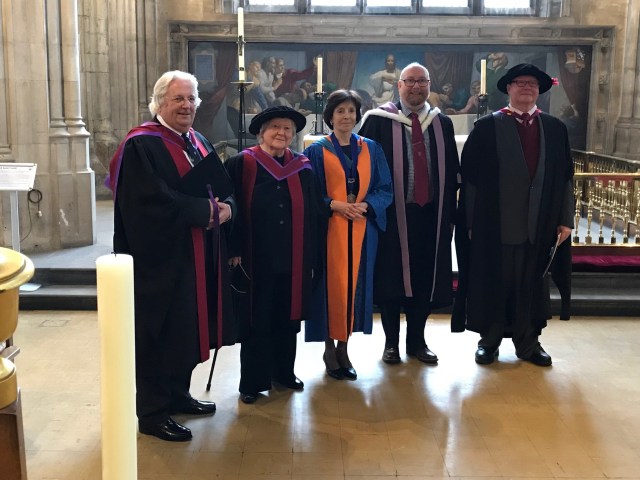

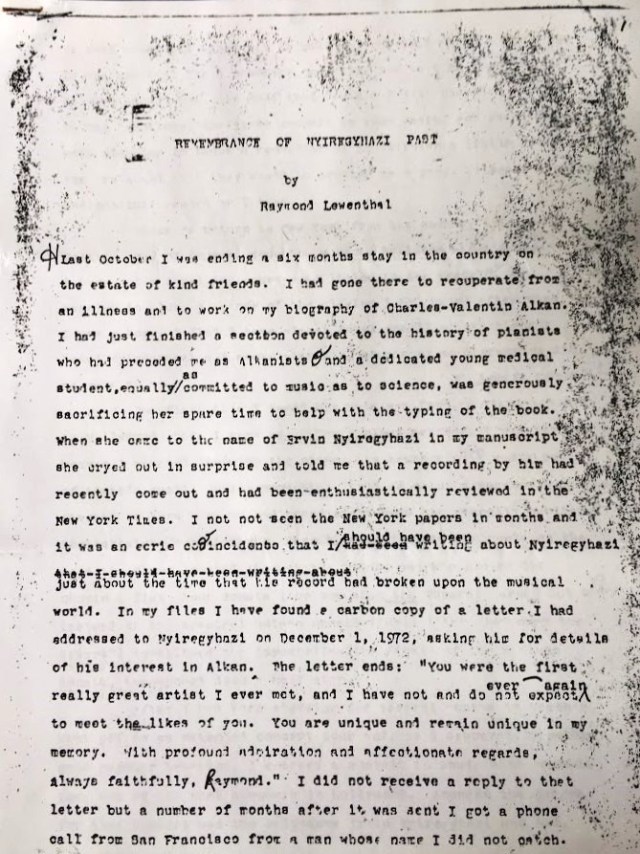


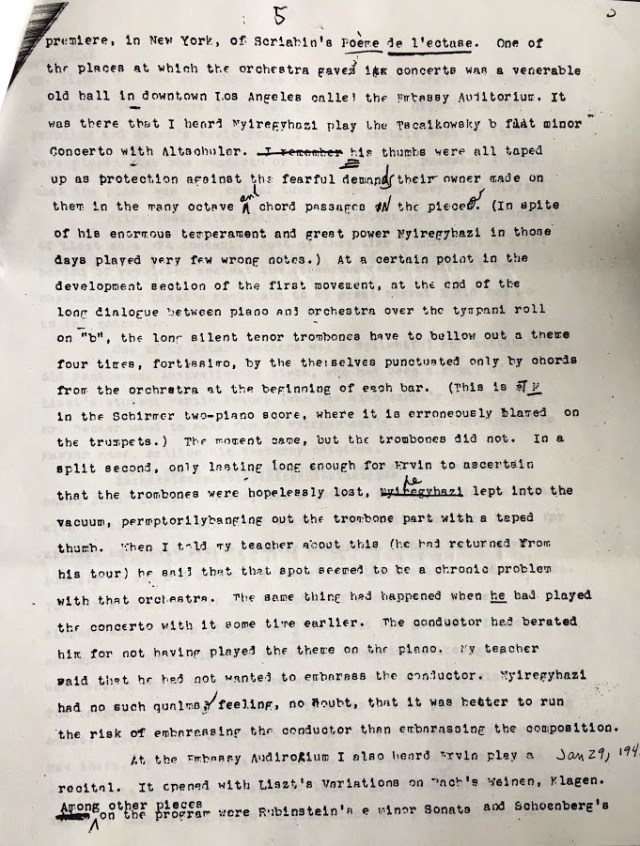

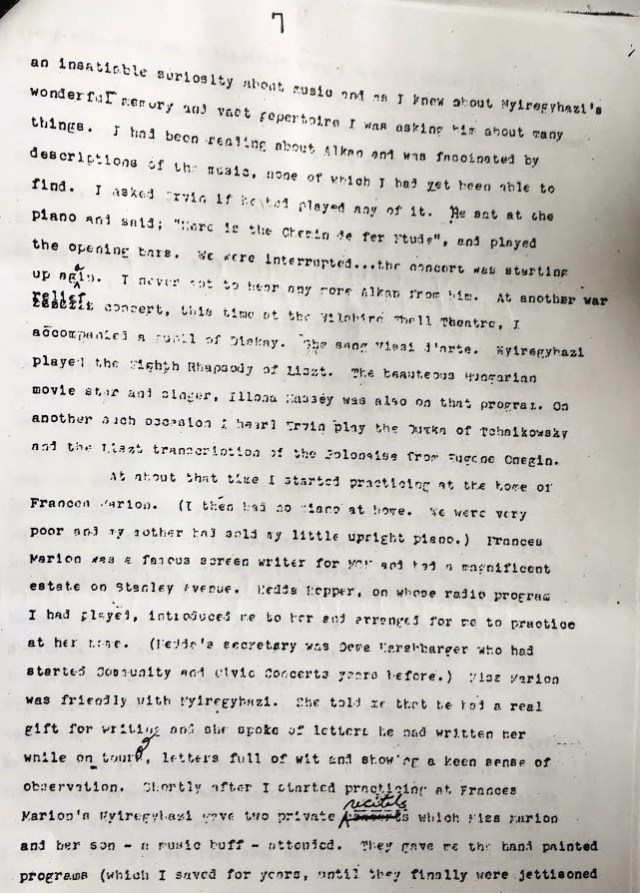


 Professor John Kersey