Death of Dame Patricia Routledge

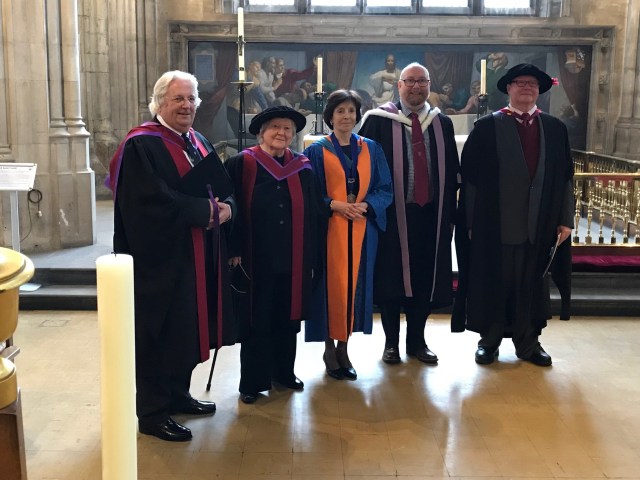
I was saddened to hear of the death of Dame Patricia Routledge at the grand old age of 96 today. Dame Patricia and I met when we both received the Honorary Fellowship of the Guild of Musicians and Singers in a ceremony in London in April 2018. She subsequently became a Patron of the Guild.

At the ceremony – Dame Patricia is second from left, I am second from right.

The respect in which Dame Patricia was held as an actress reflected her consummate mastery of both comic and serious acting. Everything she did was eminently watchable and I greatly enjoyed her television work over several decades. In person, she was a strong traditionalist, a maintainer of proper standards in speech and a devout Christian. Despite her fame and many recognitions, she was unpretentious and friendly and it was a great pleasure to have met her.

May she rest in peace and rise in glory.

Index to John Kersey’s online piano recordings

This is an index to the online recordings made by me as pianist that are available to listen via YouTube. My YouTube channel is at https://www.youtube.com/@JohnKerseypiano.

The recordings marked * are believed to be the first recording of the work in question. In some cases they are the first complete recording of a work of which one or more movements have been previously recorded by others. Although many of these recordings have been issued on CD by Romantic Discoveries Recordings there are also some world première recordings that have been released to the public online via YouTube.

Designation as a world première recording means that the recording has been released to the public in a permanent format, whether digitally online or on CD. The designation is independent from any commercial consideration. It also means that it is the first such release to be made by a human pianist using an acoustic piano; artificial intelligence and MIDI recordings as well as those made on electric keyboards are discounted.

Transcriptions are listed under the name of the transcriber.

My thanks to everyone who has kindly contributed copies of scores for use in these recordings, in particular the late Klaus Zehnder-Tischendorf, Peter Cook, Robert Commagère, Denis Waelbroeck, Nicolo Figowy and Steffen Herrmann.

The highest goal of music is to connect one’s soul to their Divine Nature, not entertainment.
– Pythagoras

ALKAN, Charles-Valentin (1813-88)

ANSELL, John (1974-1948)

ARNOLD, Charles

ASHTON, Algernon (1859-1937)

AUSTIN, Ernest (1874-1947)

BARGIEL, Woldemar (1828-97)

BATE, Stanley (1911-59)

BEETHOVEN, Ludwig van (1770-1827)

BELICZAY, Julius von (1835-93)

BENDEL, Franz (1833-74)

BENDIX, Victor (1851-1926)

BENTZON, Niels Viggo (1919-2000)

BERGER, Emile (1838-1900)

BERGER, Francesco (1834-1933)

BERGT, Adolph (1822-62)

BILLAM, Peter (1948-)

see SCHOENBERG

BLANCHET, Emile-Robert (1877-1943)

BLISS, Sir Arthur (1891-1975)

BOCHSA, Nicholas Charles (1789-1856)

BOUILLET, Jean-Marc (1958-)

BRAHMS, Johannes (1833-97)

BRINLEY RICHARDS, Henry (1817-85)

BRONSART VON SCHELLENDORF, Hans (1830-1913)

from D. BROWNE’s Selection

BRÜLL, Ignaz (1846-1907)

BÜLOW, Hans, Freiherr von (1830-94)

BUNGERT, August (1845-1915)

BÜRGMULLER, Friedrich (1806-74)

BUSONI, Ferruccio (1866-1924)

BUSSMEYER, Hugo (1842-1912)

BUTLER, Leonard (1869-1943)

CARDEW, Cornelius (1936-81)

CHARLOT, Jacques (d.1915)

CHOPIN, Fréderic (1810-49)

COWEN, Sir Frederic Hymen (1852-1935)

CZERNY, Carl (1791-1857)

CZIFFRA, György (1921-94)

DEBUSSY, Claude (1862-1918)

DIETRICH, Albert (1829-1908)

DOVE, Jonathan (1959-)

DURAND, Jacques (1865-1928)

DURAND DE GRAU, Edouard (fl. 1829-80)

ELLIOTT, Percy (1870-1932)

ESCHMANN, Johann Carl (1826-82)

EWING, Montague (1890-1957)

FAURE, Gabriel (1845-1924)

FRANCK, César (1822-90)

FRANCK, Eduard (1817-93)

FRYER, Herbert (1877-1957)

FUCHS, Robert (1847-1927)

GÄRTNER, Hermann (1865-ca.1920)

GERMAN, Sir Edward (1862-1936)

GERNSHEIM, Friedrich (1839-1916)

GLAZUNOV, Alexander (1865-1936)

GODFREY, Sir Dan (1868-1939)

GOLINELLI, Stefano (1818-91)

GRÄDENER, Carl Georg Peter (1812-83)

GRIMM, Julius Otto (1827-1903)

GROSSE, W.

GURDJIEFF, Georges Ivanovich (1877-1949) and HARTMANN, Thomas de (1885-1956)

HALM, August (1869-1929)

HARRIS, Cuthbert (1870-1932)

HARTMANN, August Wilhelm (1775-1850)

HARTMANN, Emil (1836-98)

HARTMANN, Johann Peter Emilius (1805-1900)

HARTMANN, Thomas de (1885-1956)

  • see under GURDJIEFF, Georges Ivanovich

HEIMBERGER, E.

HELLER, Stephen (1813-88)

HERZOGENBERG, Heinrich von (1843-1900)

HESSEN, Alexander Friedrich Landgraf von (1863-1945)

HILLER, Ferdinand (1811-85)

HOFMANN, Heinrich (1842-1902)

HOLSTEIN, Franz von (1826-78)

HOUGH, Sir Stephen (1961-)

HUBER, Hans (1852-1921)

HYNAIS, Cyrill (1862-1915)

ILYINSKY, Alexander (1859-1920)

JADASSOHN, Salomon (1831-1902)

JANACEK, Leos (1854-1928)

JENSEN, Adolf (1837-79)

KARGANOV, Gennari Ossipovich (1858-90)

KATZ, Richard T. (1956-)

KAUN, Hugo (1863-1932)

KETTERER, Eugene (1831-70)

KIRCHNER, Theodor (1823-1903)

KLAUWELL, Otto (1851-1917)

KLENGEL, Paul (1854-1935)

KOPYLOV, Alexander Alexandrovich (1854-1911)

KRUG, Dietrich (1821-80)

KUHE, Wilhelm (1823-1912)

KULLAK, Theodore (1818-82)

LACHNER, Franz (1803-80)

LEDUC, Alphonse (1804-68)

LEYBACH, Ignace Xavier Joseph (1817-91)

LISZT, Franz (1811-86)

LOESCHHORN, Albert (1819-1905)

MACFADYEN, Alexander (1879-1936)

MARSH, Henry (1824-73)

MARTIN, E.C.

MEDTNER, Nikolai (1880-1951)

MENDELSSOHN BARTHOLDY, Felix (1809-47)

MOMPOU, Federico (1893-1987)

MOSCHELES, Ignaz (1794-1870)

MOTTL, Felix (1856-1911)

  • see under SINGER, Otto

MOZART, Wolfgang Amadeus (1756-91)

MULLEN, Alfred Frederic (1868-1936)

NICHOLLS, Heller (1874-1939)

NIEMANN, Rudolph (1838-98)

NIEMANN, Walter (1876-1953)

NIETZSCHE, Friedrich (1844-1900)

NORMAN, Ludvig (1831-85)

NOTTEBOHM, Gustav (1817-82)

NYIREGYHAZI, Ervin (1903-87)

OESTEN, Theodor (1813-70)

PAUER, Ernst (1826-1905)

PERRY, E.C.

PHIPPS, T.B. (fl. 1830)

PINNA, Joseph de (1798-1885)

PROKOFIEV, Sergei (1891-1953)

QUILTER, Roger (1877-1953)

RACHMANINOFF, Sergei (1873-1943)

REGER, Max (1873-1916)

REINECKE, Carl (1824-1910)

REINHOLD, Hugo (1854-1935)

REUSS ZU KÖSTRITZ, Heinrich XXIV, Prinz (1855-1910)

RHEINBERGER, Josef (1839-1901)

RIMBAULT, Edward Francis (1816-76)

RÖCKEL, Joseph Leopold (1838-1923)

ROGER-DUCASSE, Jean (1873-1954)

RÖNTGEN, Julius (1855-1932)

ROSENFELD, Leopold (1849-1909)

ROSENHAIN, Jakob (1813-94)

ROWLEY, Alec (1892-1958)

RUBINSTEIN, Joseph (1847-94)

RUDORFF, Ernst (1840-1916)

RUMMEL, Christian (1787-1849)

SAHR, Heinrich von (1829-98)

SATTER, Gustav (1832-?)

SCHNEIDER, Friedrich Hermann (1860-1930)

SCHOENBERG, Arnold (1874-1951)

SCHOLTZ, Herrmann (1845-1918)

SCHUBERT, Franz (1797-1828)

SCHULTZ, Charles (ca.1835? — fl.1885)

SCHULZ-EVLER, Adolf ((1852-1905)

SCHUMANN, Clara (1819-96)

Transcriptions of songs by Robert Schumann (*complete)

SCHUMANN, Robert (1810-56)

SCHÜTT, Eduard (1856-1933)

SCHYTTE, Ludvig (1848-1909)

SCOTT, Harold E. (fl. 1900-30)

SEELING, Hans (1828-62)

SIBELIUS, Jean (1865-1957)

SINGER, Otto (1863-1931)

SMITH, Sydney (1839-89)

SPEIDEL, Wilhelm (1826-99)

STARK, Ludwig (1831-84)

STERNDALE BENNETT, Sir William (1816-75)

STEVENS, Bernard (1916-83)

STRADAL, August (1860-1930)

TAUBMANN, Otto (1859-1929)

TEMPFLI, Zsolt (1983-)

see SCHOENBERG

TOMLINSON, I.

VALENTINE, Thomas (1790-1878)

VAUGHAN WILLIAMS, Ralph (1872-1958)

VIOLE, Rudolf (1825-67)

WARLOCK, Peter (Philip Heseltine 1894-1930)

WEBER, Gustav (1845-87)

WESLEY, Samuel Sebastian (1810-76)

WESTROP, East John (1804-56)

WILLNER, Arthur (1881-1959)

WILM, Nicolai von (1834-1911)

WINDING, August (1835-99)

WOLF, Hugo (1860-1903)

WRANGELL, Basile, Baron (1862-1901)

Obituary – Maurice Merrell

Professor Maurice Merrell, DLitt, DMus, FGMS, FCCM, FISOB, FSCO, FIGOC, FGCO, FNSCM, HonFASC, HonFNCM, MNCMSoc, FMCM, FRSA, FWOU, FEAU, CompCIL, Emeritus Fellow and Leonard Henderson Memorial Professor of Organology at European-American University, died on 28 May 2025 aged 89.

Maurice Edward Merrell was born in February 1936. He was both an organist and an organ builder. In 1951, aged sixteen, he was apprenticed to the organ builders Bishop and Sons under the late Miss Hilda Mary Suggate, and after some time dealing with their business in the Midlands and Wales took over as London Manager at their premises in Beethoven Street in Queen’s Park. After Miss Suggate died, he became Principal of Bishop and Sons and completed seven decades with the company, retiring in 2022. He was a Fellow of the Incorporated Society of Organ Builders, also serving on the Society’s Council. It could truly be said that there was nothing concerning the construction of pipe organs with which he was not familiar, and he subsequently trained several generations of apprentices. Even in advanced years he would still be found clambering around in organ lofts and ensuring that the instruments were maintained in good order.

He served as organist of St George’s Church, Bloomsbury, for over thirty years, also being a Churchwarden and Treasurer there. He had previously been appointed as organist of St James, Bermondsey, at the age of fourteen, and then moved to St Peter, Islington. He was an able improviser and could effectively evoke the style of Howells. He was president of the London Organists’ Guild.

He was also active in the Church Lads’ Brigade, where he was an instructor and held the rank of captain.

Maurice was always ready to give his support to societies of musicians. He was a founder member and served on the Council of the Guild of Musicians and Singers for three decades, eventually becoming Master of the Guild. He was also a founding Fellow of the British Academy of Music and the Faculty of Church Organists. As a Fellow, he gave his support to the Institute of Arts and Letters, London, and was also a Fellow of the Curwen College of Music, where he was Hon. Treasurer. He was President of the Society of Crematorium Organists.

He received honorary Fellowships from the National College of Music and the Academy of St Cecilia, was elected to the Fellowship of the Metropolitan College of Music for distinguished service to music, and in 2003 received the degree of Doctor of Music from St Katharine’s Institute, Wyoming, USA, on the basis of his service to music. He was appointed a Companion of the Central Institute, London, and received the knighthood of the International Knightly Order Valiant of St George in a ceremony at Rochester Cathedral.

Maurice in 2008 wearing his DMus robes

On 21 November 2015 there was a Presentation Lunch in his honour at the Civil Service Club in which he received the degree of Doctor of Letters of the Western Orthodox University and was appointed Emeritus Fellow and Leonard Henderson Memorial Professor of Organology at European-American University, reflecting his long and distinguished  service to the musical profession.

Maurice and I at the 2015 presentation lunch at the Civil Service Club

At the meetings of the societies with which he was involved, Maurice was notable for his depth of knowledge, friendliness and considerable social skills. He was a great conversationalist, and would make time to speak with everyone. With his optimistic attitude and sound foundations in the Church, he was a reassuring and respected presence who maintained the highest of standards in dress and deportment. In the nearly thirty years that I knew him he did not seem to change at all. He was also a pipe smoker, and at the various society meetings would join others outside the church in question for a smoking break and conversation. His contributions to the Guild meetings in the form of addresses on musical matters were always interesting and often included moments of humour.

Maurice was unmarried and lived in a flat near Regent’s Park. He suffered a stroke in 2020 which marked a significant deterioriation in his health, but continued to be involved with the work of Bishop and Sons and his musical institutions. He will be much missed, since he was a pillar of this particular corner of the musical world and a gentleman of the old school.

Obituary – Yu Chun-Yee

Yu Chun-Yee, formerly professor of piano at the Royal College of Music, and with whom I studied piano for ten years, died on 23 December 2023 from cancer, aged eighty-six. It is rather surprising that no obituary of this remarkable pianist and teacher has yet appeared in the mainstream press.

Yu Chun-Yee was born in Shanghai on 12 July 1936. He grew up in Singapore, where he attended the Chinese High School and then the Raffles Institution. Aged eighteen, he won the Singapore Musical Society competition where the judge was Julius Katchen, and also represented Singapore at the first Asian Music Festival in Hong Kong. He further obtained the diploma of Licenciate of the Royal Schools of Music.

In 1956, he was awarded a grant of financial support that enabled him to come to England and become the first Singaporean pianist to study at the Royal College of Music. His professor was the noted Beethoven exponent Kendall Taylor, and Yu would follow him as an exceptional interpreter of that composer. At the RCM, where he studied for four years, he won the McEwen Prize for piano and the Ricordi Prize for conducting. His performances in RCM concerts included works by Bach, Brahms, and Chopin.

At the end of his time in England, he was awarded the opportunity to study in Siena with Busoni pupil Guido Agosti, and then went on to complete his studies in Paris with Magda Tagliaferro. His Wigmore Hall debut followed in 1961 and in 1963 he was the soloist in Beethoven’s Fourth Piano Concerto with the London Philharmonic Orchestra at the Royal Festival Hall. This performance was still described in superlative terms many years later. 1963 also saw his only solo broadcast for the BBC Home Service with an all-Bach programme.

At this time, Yu also became the pianist in the Tagore Piano Trio with violinist Frances Mason and cellist Jennifer Ward-Clarke, and the trio broadcast on a number of occasions on the BBC. His last broadcast with them was in 1969.

Yu’s performing career was seriously curtailed by a hand injury that I was told had occurred as a result of practising the demanding double octave passages in the Tchaikovsky First Piano Concerto. Had this not happened, there can be little doubt that he would have further established himself among the front rank of pianists of his generation. It certainly did not altogether stop him; a demanding solo recital programme in Singapore in 1978 featured a programme including Beethoven’s “Appassionata” sonata and Chopin’s second piano sonata. But by the time I came to study with him he only very rarely demonstrated at the keyboard, and that more often with his left hand than his injured right.

Perhaps initially out of necessity, Yu’s focus shifted to teaching, but it was soon apparent that he had just as much ability in that field as in performance. In 1972 he was appointed to the professorial staff of the RCM, and in the mid-1970s was also teaching piano at the University of Reading, which in those days had a music department. He combined these appointments with examining for the Associated Board of the Royal Schools of Music, and would regularly examine overseas, combining this with concert tours. He often visited the Far East and returned to Singapore on numerous occasions, also touring Japan and Taiwan.

To convey something of Yu’s impact as a teacher, it would be sufficient to say that there was no problem that a pianist might encounter in technique or interpretation to which he could not offer a well thought-out and effective answer. He excelled in the analysis of thorny difficulties and subtle gradations of style, always demanding the highest of standards and absolute dedication to the music. He did not impose a particular interpretative style, nor belonged to any particular school of pianism, but expertly aided the student to bring out their own qualities in response to the music. His authority extended over the entire piano repertoire, from the established canon to contemporary music, and even when a work was new to him he could quickly grasp its essence and offer insightful comment on it.

There was great competition to study with him, particularly among those students at the RCM who had come from the Far East, and many of his students went on to successful musical careers. As well as the three days a week that he taught at the RCM, he also taught privately at his home in Golders Green, where his mahogany-cased Steinway had a particularly beautiful tone but also one of the heaviest actions I had encountered – which makes some things more difficult for the pianist but others easier.

Yu projected an air of urbane civility and wisdom that made him an engaging personality. He had mastered the often difficult politics of working within institutions and with the assistance of a number of exceptional colleagues ensured that the RCM’s piano faculty achieved a pre-eminent place among the London conservatoires. There were many accounts of his kindness and generosity towards his students and I was certainly among those who had reason to be grateful for his support.

In 1988, the RCM appointed Yu to its Fellowship in recognition of his contribution to the institution and to music. But in 1998, faced with the iconoclastic changes now being implemented at the RCM as well as his long-held promise to return permanently to Singapore one day, he decided to leave for home, initially taking up the Vice-Principalship of the Nanyang Academy of Fine Arts and later founding the School of Young Talents. He remained an advisor to the RCM for some years.

Away from the piano, he was a player of bridge to a high level, and competed on many occasions for high stakes. When travelling, he would often seek out opportunities to play bridge both for its social benefits and as an intellectual discipline. He was also a connoisseur of the cuisine of the Far East, and a memorable lunch of dim sum with him included a number of dishes that I have never encountered in England since.

He was married twice, firstly in December 1963 to Isabella Miao, by whom he had two sons, and secondly in June 1982 to Jung Chang.

Raymond Lewenthal on Ervin Nyiregyhazi

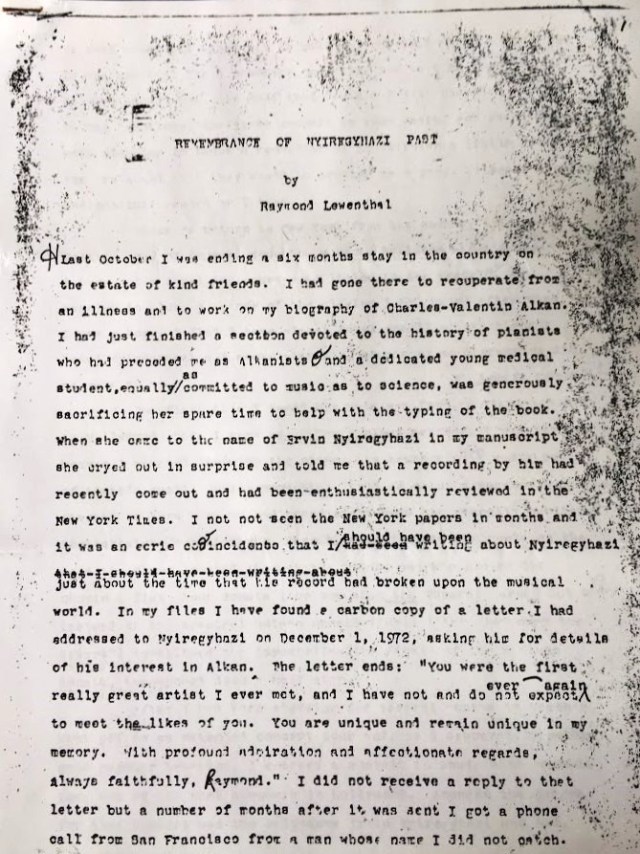
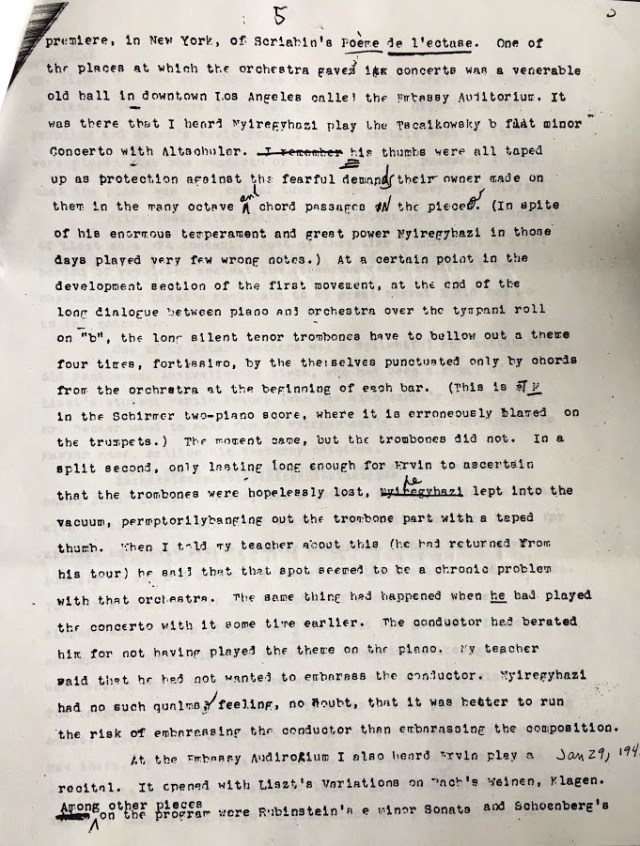
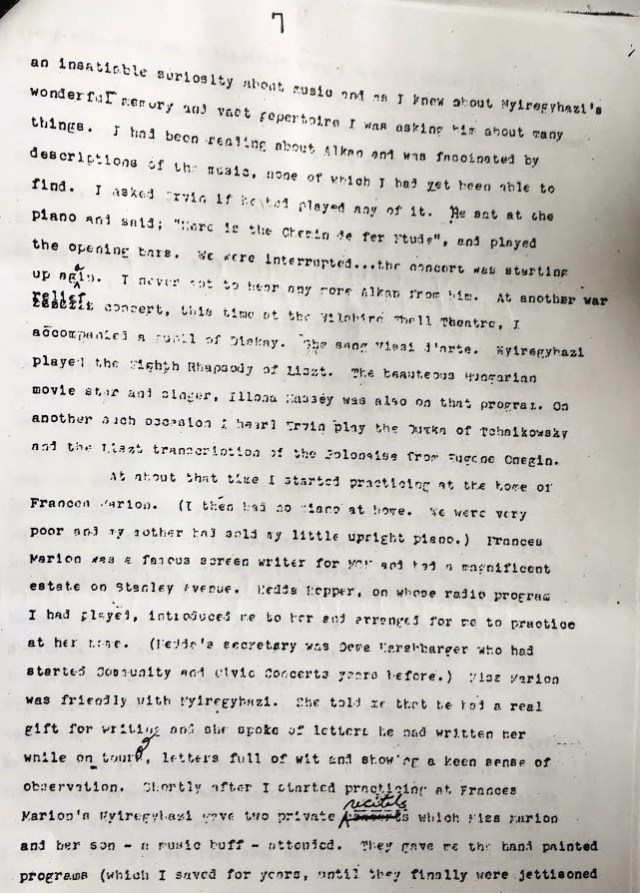
Many years ago, this interesting manuscript came into my possession. It is an essay by the great American pianist Raymond Lewenthal (1923-88) entitled “Remembrance of Nyiregyhazi Past” in which he gives his personal recollections of the remarkable pianistic genius Ervin Nyiregyhazi (1903-87).

My manuscript is a rather poor quality photocopy of Lewenthal’s twelve-page typescript with his handwritten annotations. The last page is incomplete, but is clearly headed towards its conclusion. It is reproduced here for educational purposes in the hope that the insights it contains will be of benefit to all who are fascinated by the phenomenon that was Nyiregyhazi.

The ties of the Royal College of Music

The use of distinctive ties to establish an institutional association is a notable element of British culture, having begun at Cambridge in the nineteenth-century. In respect of our schools, colleges and universities, ties form a part of academic dress.

Today, many educational institutions continue to prescribe one or more ties that may be worn by those who have attended them, or in some cases also by former staff and other associated persons. The Royal College of Music, which I attended as a student and was later associated with as a Junior Fellow, was formerly among these.

During my time at the RCM I carried out some research into the ties that had been prescribed in the past. In the RCM Magazine of 1929 (Vol.3 no. 23) reference is made to badges, ties and blazers in the colours of the RCM Union. The RCM Union comprised the current students and staff, alumni and former staff of the RCM, being  formed in 1906 and maintained by annual subscription.

No surviving examples of the tie were known to exist, and therefore I embarked upon a project to reconstruct it, enlisting the help and advice of a doyen of institutional ties, the late Tom Clegg of Benson and Clegg in the Piccadilly Arcade. The royal blue referred to is likely to have been the same shade as is used in the hood of the Associateship of the RCM. Traditionally, royal blue is a deep, dark blue rather than the lighter colour that is more usual these days (and that is also used by the RCM, for example in the former D.Mus.R.C.M. robe and the pre-1998 M.Mus.R.C.M. hood).

The ARCM hood, showing the dark traditional shade of royal blue used by the RCM. This shade is also used in the FRCM hood and in the Director’s robe.


RCM tie after the 1929 specification as made by Benson and Clegg in non-crease silk. This is a most pleasing and distinctive  tie and it is difficult to understand why it was discontinued.

In the same RCM magazine of 1929 there is reference to the Union Badge, which had been produced by Mr George Kruger Gray, FSA, some time previously, and which was accompanied by the motto “The Letter killeth, but the Spirit giveth life”.


By the 1970s, a new tie had appeared, bearing the same crest that had been designed for the RCM Union. This was often to be seen worn by Sir David Willcocks as Director of the RCM as well as by staff and students.

To mark the RCM’s Centenary in 1982 a further tie had been introduced. It was described as “plain navy blue with a gold musical motif surrounding the Prince of Wales’ feathers (the motif used on RCM cheques in 1882)”. It was available in silk for £8.50 or polyester for £4.50.

It can be seen that the design that appeared on the cover of the RCM Magazine at that time used several of the same elements:


During my time at the RCM between 1987 and 1998, both of these ties were worn proudly by a number of students and staff (many of the staff at that time were RCM alumni). The crested tie was also worn by the Prince of Wales on his visits to the RCM as President during the 1990s.


The Prince of Wales (now King Charles III) wearing the RCM crested tie and the robes of the D.Mus.R.C.M. These robes use the lighter, more modern shade of royal blue discussed above.


The former RCM scarf also used the crested device and again combines the RCM colours of (lighter) royal blue and gold.

As of 1991, the RCM Union was described as comprising “past students, the teaching and administrative staffs of the College, all members of the Students’ Association and others whom the Committee decide to elect.” Several persons were elected to honorary membership during its history. The RCM Union was abolished in 1992 and replaced by the RCM Society which initially had the same membership composition and aims as the RCM Union, but was converted to a non-subscription model in 2001 and abolished altogether in 2009.

Ties were still available from the RCM until the mid-1990s, but when their stock ran out it was not replenished, and provision appears to have ceased altogether in the late 1990s. While the Prince of Wales continued to wear his RCM crested tie on his visits in his capacity as the RCM’s President for some years, more recent photographs on the RCM website suggest that he ceased to do so in the present century.

Given the extensive and indeed iconoclastic changes that attended the RCM in the last years of the last century, it is perhaps unsurprising that there should have been no place in the new-look institution for an institutional tie. As one who was a part of the RCM before its present incarnation, however (and as a former member of both the RCM Union and RCM Society), I continue to wear the ties above with an awareness that they recall the values of the College as they were then, which values in my view are well worth perpetuating.

Royal Collegian Jonathan Mann informs me that there was in fact a move to reintroduce a RCM tie as a result of alumni suggestions as part of the RCM’s More Music Appeal around 2018. It appears that a few prototypes of this splendid new design were issued, but in the event, it was abandoned without being put into production.

As a postscript, it seems that the subject of RCM ties is not quite exhausted. In the present century the American designer Ralph Lauren produced a tie for his Purple Label that is based on the crest of the RCM and achieves an effect that is both dignified and attractive. Albeit unofficially, this tie nevertheless provides a worthy example of what might, and perhaps should, have been.


Index to Notes from a pianist

Notes from a pianist is my occasional series of essays on aspects of the piano and piano-playing, with a few diversions into spiritual and institutional subjects.

New CD published – Beethoven Piano Sonatas volume 2

A new CD recording has been issued by Romantic Discoveries Recordings.

Beethoven Piano Sonatas volume 2
Piano Sonata no 30 in E major, op. 109 • Piano Sonata no. 31 in A flat major, op. 110 • Piano Sonata no. 32 in C minor, op. 111
John Kersey, piano
RDR CD143

Total time: 68 minutes 45 seconds

1. Piano Sonata in E major, op 109 (1820) (20:01)

i. Vivace ma non troppo – Adagio espressivo
ii. Prestissimo
iii. Gesangvoll, mit innigster Empfindung. Andante molto cantabile ed espressivo

2. Piano Sonata in A flat major, op 110 (1821) (19:27)

i. Moderato cantabile e molto espressivo
ii. Allegro molto
iii. Adagio ma non troppo – Fuga

3. Piano Sonata in C minor, op 111 (1821-22) (29:12)

i. Maestoso – Allegro con brio ed appassionato
ii. Arietta – Adagio molto semplice e cantabile

New CD published – Beethoven Piano Sonatas volume 1

A new CD recording has been issued by Romantic Discoveries Recordings.

Beethoven Piano Sonatas volume 1
Piano Sonata no 27 in E minor, op 90 • Piano Sonata no. 29 in B flat major, op. 106 “Hammerklavier”
John Kersey, piano
RDR CD142

Total time: 66 minutes 40 seconds

1. Piano Sonata in E minor, op. 90 (1814) (14:55)

i. Mit Lebhaftigkeit und durchaus mit Empfindung und Ausdruck
ii. Nicht zu geschwind und sehr singbar vorgetragen

2. Piano Sonata in B flat major, op 106 “Hammerklavier” (1818) (52:21)

1. Allegro
2. Scherzo: Assai vivace
3. Adagio sostenuto
4. Largo – Allegro risoluto

New CD published – In Recital at Chingford Parish Church

A new CD recording has been issued by Romantic Discoveries Recordings.

In Recital at Chingford Parish Church
Bach-Busoni Prelude and Fugue in E flat major, BWV552 “St Anne” • Beethoven Sonata no 30 in E major, op 109 • Fauré Barcarolles 6 and 8 • Beethoven: Bagatelles, op. 126 • Alkan: La Vision • Beethoven: Bagatelle in F minor (1826)
John Kersey, piano
RDR CD141

Total time: 67 minutes 20 seconds

1. Johann Sebastian Bach (1685-1750) transcribed by Ferruccio Busoni (1866-1924): Prelude and Fugue in E flat major, BWV552 “St Anne” (15:38)

2. Ludwig van Beethoven (1770-1827): Piano Sonata no. 30 in E major, op. 109 (1820) (19:48)
i. Vivace ma non troppo – Adagio espressivo
ii. Prestissimo
iii. Gesangvoll, mit innigster Empfindung. Andante molto cantabile ed espressivo.

3. Gabriel Fauré (1845-1924):
i. Barcarolle no. 6 in E flat major, op. 70
ii. Barcarolle no. 8 in D flat major, op. 96 (8:24)

4. Ludwig van Beethoven (1770-1827): Six Bagatelles, op 126 (19:58)
i. Andante con moto
ii. Allegro
iii. Andante
iv. Presto
v. Quasi allegretto
vi. Presto – Andante amabile e con moto – Tempo I

4. Charles-Valentin Alkan (1813-88): Esquisses, op. 63 (2:27)
i. no. 1 La Vision

5. Ludwig van Beethoven (1770-1827): Bagatelle in F minor (1826; unpublished)* (0:53)

Live recording taken from performances at Chingford Parish Church, London, May 2015 and *2017.

New CD published – Brahms Piano Works volume 2

A new CD recording has been issued by Romantic Discoveries Recordings.

Brahms Piano Works volume 2
Piano Sonata no 3 in F minor, op 5 • Variations and Fugue on a theme by Handel, op. 24
John Kersey, piano
RDR CD140

Total time: 68 minutes 50 seconds

1. Piano Sonata no. 3 in F minor, op 5 (38:20)
i. Allegro maestoso
ii. Andante
iii. Scherzo. Allegro energico
iv. Intermezzo (Rückblick)
v. Finale. Allegro moderato ma rubato

2. Variations and Fugue on a theme by Handel, op. 24 (20:27)
i. Theme
ii. Variation 1
ii.i Variation II
iv. Variation III
v. Variation IV
vi. Variation V
vii. Variation VI
viii. Variation VII
ix. Variation VIII
x. Variation IX
xi. Variation X
xii. Variation XI
xiii. Variation XII
xiv. Variation XIII
xv. Variation XIV
xvi. Variation XV
xvii. Fugue

New CD published – Brahms Piano Works volume 1

A new CD recording has been issued by Romantic Discoveries Recordings.

Brahms Piano Works volume 1
Seven Fantasias, op. 116 • Six Piano Pieces, op. 118 • Four Piano Pieces, op. 119
John Kersey, piano
RDR CD139

Total time: 71 minutes 17 seconds

1. Seven Fantasias, op. 116 (27:02)
i. Capriccio in D Minor (Presto energico)
ii. Intermezzo in A Minor (Andante)
iii. Capriccio in G Minor (Allegro passionato)
iv. Intermezzo in E Major (Adagio)
v. Intermezzo in E Minor (Andante con grazia ed intimissimo sentimento)
vi. Intermezzo in E Major (Andante teneramente)
vii. Capriccio in D Minor (Allegro agitato)

2. Sechs Klavierstücke, op 118 (26:57)
i: Intermezzo in A minor
ii: Intermezzo in A major
iii: Ballade in G minor
iv: Intermezzo in F minor
v: Romanze in F major
vi: Intermezzo in E-flat minor

3. Vier Klavierstücke, op. 119 (17:13)
i. Intermezzo in B Minor
ii. Intermezzo in E Minor
iii. Intermezzo in C Major
iv. Rhapsodie in E Flat Major

New CD published – Brahms Violin Sonatas 1 and 2 transcribed for piano by Paul Klengel

A new CD recording has been issued by Romantic Discoveries Recordings.

Brahms Violin Sonatas 1 and 2 transcribed for piano solo by Paul Klengel
Sonata in G major, op. 78 “Rain Sonata” • Two Rhapsodies, op. 79 • Sonata in A major op 100 “Meistersinger” (includes first recordings)
John Kersey, piano
RDR CD138

Total time: 72 minutes 3 seconds

1. Johannes Brahms (1833-97) Sonata for violin and piano no. 1 in G major, op. 78 “Rain Sonata”, transcribed for solo piano by Paul Klengel (1854-1935) (31:54)
i. Vivace ma non troppo
ii. Adagio
iii. Allegro molto moderato

2. Johannes Brahms (1833-97): Two Rhapsodies, op 79 (15:49)
i. Agitato in B minor
ii. Molto passionato, ma non troppo Allegro in G minor

3. Johannes Brahms (1833-97) Sonata for piano and violin no. 2 in A major, op. 100 “Meistersinger” (1886), transcribed for solo piano by Paul Klengel (1854-1935) (24:14)
i. Allegro amabile
ii. Andante tranquillo – Vivace
iii. Allegretto grazioso, quasi Andante

New CD published – Piano Music of Frédéric Chopin volume 2

A new CD recording has been issued by Romantic Discoveries Recordings.

Piano Music of Frédéric Chopin (1810-49) volume 2
Polonaise-fantaisie, op. 61 • Scherzos nos. 2 and 4 • Barcarolle, op. 60 • Polonaise op. 44 • Two Nocturnes, op. 62
John Kersey, piano
RDR CD137

Total time: 76 minutes 15 seconds

1. Polonaise-fantaisie in A flat major, op 61 (16:04)

2. Scherzo in B flat minor, op. 31 (11:00)

3. Barcarolle in F sharp major, op. 60 (10:03)

4. Polonaise in F sharp minor, op. 44 (12:08)

5. Two Nocturnes, op 62 (14:16)
i. Andante in B major
ii. Lento in E major

6. Scherzo no. 4 in E major, op. 54 (12:32)

New CD published – Piano Music of Frédéric Chopin volume 1

A new CD recording has been issued by Romantic Discoveries Recordings.

Piano Music of Frédéric Chopin (1810-49) volume 1
Piano Sonata no. 3 in B minor, op. 58 • Two Nocturnes, op. 32 • Two Polonaises, op. 26
John Kersey, piano
RDR CD136

Total time: 70 minutes 14 seconds

1. Piano Sonata no. 3 in B minor, op. 58 (38:04)
i. Allegro maestoso
ii. Scherzo: Molto vivace
iii. Largo
iv. Finale: Presto non tanto
The variant passages in the first movement exposition are taken from the 1845 first edition published by J. Meissonier in Paris.

2. Two Nocturnes, op 32 (11:17)
i. Andante sostenuto in B major
ii. Lento in A flat major

3. Two Polonaises, op 26 (20:49)
i. Allegro appassionato in C sharp minor
ii. Maestoso in E flat minor

New CD published – Piano Music of Nikolai Medtner

A new CD recording has been issued by Romantic Discoveries Recordings.

Piano Music of Nikolai Medtner (1880-1951)
Canzona matinata and Sonata tragica from op 39 • Sonate-elegie (Sonata no. 3) op 11 no 2 • Sonata reminiscenza, op 38 no 1 • Sonata no. 4 in C major, op. 11 no. 3 • Sonata no. 9 in A minor “War Sonata”, op. 30
John Kersey, piano
RDR CD135

Total time: 70 minutes 35 seconds

1. from Forgotten Melodies book 2, op. 39 nos. 4 and 5 (1920) (17:25)
i. Canzona matinata ii. Sonata tragica (Sonata no. 11)

2. Sonate-elegie (Sonata no. 3), op. 11 no. 2 (7:09)

3. from Forgotten Melodies book 1, op. 38 no. 1 (1920) (17:38)
i. Sonata reminiscenza (Sonata no. 10)

4. Sonata no. 4 in C major, op. 11 no. 3 (11:38)
“Und so das Herz erleichtert merkt behende,
Daß es noch lebt und schlägt und möchte schlagen,
Zum reinsten Dank der überreichen Spende
Sich selbst erwidernd willig darzutragen.
Da fühlte sich – o daß es ewig bliebe! –
Das Doppelglück der Töne wie der Liebe.”
Johann Wolfgang von Goethe

5. Piano Sonata no. 9 in A minor “War Sonata”, op. 30 (16:35)

“I want to speak of music….as a country, our native country which determines our musicians’ nationality, our musicality, a country in relation to which all our ‘ideologies’, schools, individualities, are merely sides.” – Nikolai Medtner, The Muse and the Fashion.

New CD published – Piano Music of Walter Niemann volume 24

A new CD recording has been issued by Romantic Discoveries Recordings.

Piano Music of Walter Niemann volume 24
Tchaikovsky Symphony no. 6 in B minor, op. 74, transcribed by Walter Niemann • The Abode of Happiness, op. 163 (includes first recordings)
John Kersey, piano
RDR CD134

Total time: 78 minutes 35 seconds

1. Peter Ilyich Tchaikovsky (1840-93): Symphony no. 6 in B minor, op. 74 “Pathetique”, transcribed for solo piano by Walter Niemann (49:10)
I. Adagio – Allegro non troppo
2. Allegro con grazia
3. Allegro molto vivace
4. Finale. Adagio lamentoso – Andante

2. Die Wohnung des Glücks, op. 163 (13:06)
In grateful memory of his sister Elisabeth (1866-1942), with whom he had lived all his life.
i. Home
ii. Summerland
iii. A Birthday
iv Grief and Consolation
v. Epilogue

Our thanks go to Nicolo Figowy and Steffen Herrmann for their generous loan of scores.

Walter Niemann was regarded in 1927 as “the most important living piano composer who knows how to make music from the piano in a subtle and colorful way, although he often enters the field of salon music” (H. Abert, Illustrated Music Lexicon). This most sensitive and introverted master of the piano devoted his life to composition and musical scholarship, also performing his music in concerts and radio broadcasts. Niemann’s vast output for the piano is only now starting to become more widely known. Although his style is generally unashamedly conservative, he was one of the very few German composers to explore Impressionism in music, and this also reflected a fascination with the Far East. Elsewhere, Niemann’s imagination takes us from much Baroque recreation to large-scale epic sonatas, Schumannesque miniatures and even the exploration of early jazz styles. His understanding of the capabilities of the piano was complete, and his works include both collections for young pianists and mature works that exploit the full range of pianistic effect and make significant demands on the performer.

New CD published – Piano Music of Walter Niemann volume 23

A new CD recording has been issued by Romantic Discoveries Recordings.

Piano Music of Walter Niemann volume 23
Before the forest smithy • Six Rondinettos, op. 130 • The Yellow Tango • From a little city, op. 154 • Variations on an old English minuet, op. 118 no. 1 • Masks, op. 59 (includes first recordings)
John Kersey, piano
RDR CD133

Total time: 60 minutes 48 seconds

1. Vor der Waldschmiede (published 1907) (3:50)

2. Six Rondinettos, op. 130 (8:47)
i. Amabile con moto, in modo pastorale ii. Allegro alla caccia ii. Moderato con moto e un poco malinconico iv. Amabile con moto v. Giocoso con moto vi. Allegro liquido

3, Der gelbe Tango (1933) (3:55)

4. Aus einer kleinen Stadt, op. 154 (after Wilhelm Raabe’s “Das Horn von Wanza”) (10:34)
i. The little city ii. The old gate iii. The peasant jug iv. Dance in the old patrician house (17th century) v. The worthies in the “Great Bear” vi. The little river in front of the city vii. Night and watchman’s call

5. Variations on an old English minuet (Theme (Minuet) from Sonata VIII by Thomas Augustine Arne (1710-78)), op. 118 no. 1 (7:07)

6. Masken, a cycle of twenty little character pieces, op. 59 (26:21)
i. Praeludium in Schumann’s style ii. Chinese Mandarin iii. Coquette iv. The Spanish Woman v. Johann Strauss vi. Louis XIV vii. Russian Folk Dances viii. The Timid One ix. German Girls x. Winter xi. Tarantella dance xii. Debussy xiii. The Jolly Dutch Gentleman xiv. The Black Larva xv. Grieg xvi. Biedermeier xvii. The Irascible One xviii. The Swiss Milkmaid xix. Italian Pipers xx. To End

Our thanks go to Nicolo Figowy and Steffen Herrmann for their generous loan of scores.

Walter Niemann was regarded in 1927 as “the most important living piano composer who knows how to make music from the piano in a subtle and colorful way, although he often enters the field of salon music” (H. Abert, Illustrated Music Lexicon). This most sensitive and introverted master of the piano devoted his life to composition and musical scholarship, also performing his music in concerts and radio broadcasts. Niemann’s vast output for the piano is only now starting to become more widely known. Although his style is generally unashamedly conservative, he was one of the very few German composers to explore Impressionism in music, and this also reflected a fascination with the Far East. Elsewhere, Niemann’s imagination takes us from much Baroque recreation to large-scale epic sonatas, Schumannesque miniatures and even the exploration of early jazz styles. His understanding of the capabilities of the piano was complete, and his works include both collections for young pianists and mature works that exploit the full range of pianistic effect and make significant demands on the performer.

New CD published – Piano Music of Walter Niemann volume 22

A new CD recording has been issued by Romantic Discoveries Recordings.

Piano Music of Walter Niemann volume 22
Pickwick, op. 93 • Pictures from Chiemsee, op. 131 • Der Artushof, op. 158 • Tales from the Mountains, op. 41 • Scarlattiana, op. 126 (includes first recordings)
John Kersey, piano
RDR CD132

Total time: 78 minutes 35 seconds

1. Pickwick, a cycle after Charles Dickens, op. 93 (21:03)
i. Mr Pickwick ii. Mr Tupman Waltzes iii. The poetic Mr Snodgrass iv. Mr Winkle, the friend of the woods and hunts v. Sam and Mary (Duettino) vi. A morning in the country (Manor Farm) vii. The fat Joe viii. How Mr Weller drives his stagecoach ix. The Ball at Bath x It is over (A backwards glance)

2. Bilder vom Chiemsee, op. 131 (11:39)
i. Summer morning ii. In the monastery church (Fraueninsel) iii. Highland – Dirndl iv. Castle Herrenchiemsee (Herreninsel) v. On the lake vi. Highland – Bua vii. Mending the fishing nets (Fraueninsel) viii. Market day in Prien

3. Der Artushof – suite from old Danzig, op. 158 (11:36)
i. Praeludium (Moderato con moto) ii. Sarabande (Tempo di Sarabanda, largamente e solenne) iii. Menuett (Tempo di Minuetto, Allegretto amabile) iv. Alla Giga (Giocoso animato)
“Now a magical chiaroscuro crept through the murky windows, all the strange pictures and carvings with which the walls are richly decorated, became active and alive.” – E.T.A. Hoffmann, Der Artushof

4. Geschichten aus den Bergen, little Ländler and dances, op. 41 (14:14)
i. Sehr gemütlich und gemächlich ii. Anmutig, in mässigem Zeitmass iii. Ein wenig gehalten und trübe erregt iv. Mit Wärme, night zu schnell v. Ein wenig gehalten, mit sanft verhaltener Melancholie vi. Mit feurigem Aufschwung vii. Ein wenig gehalten, in stiller Wehmut viii. Anmutig und leicht bewegt ix. Mit sanfter Melancholie, ein wenig gehalten x. Den Manen Edvard Griegs – Sehr mässig, mit grösster Wärme xi. Schmerzlich gehalten xii. Mit derb-übermütiger Lustigkeit in Holzschuhen
“On the Wiesenanger, which, walking gently downhill, came up against the wood, and partly also on the harvested fields, there were stalls, tables with people feasting, there were bowling alleys, target shooting, swings, music stages, dance floors and I don’t know what else , towered over by poles with waving flags and swarming with colourful people.” – – Adalbert Stifter

Scarlattiana, three little Sonatas in the style of Domenico Scarlatti, op. 126
5. Sonata no. 1 in D major (4:23)
6. Sonata no. 2 in A minor – i. Allegro marcato, ma leggiero ii. Pastorale – Molto moderato ed amabile iii. Presto leggiero (8:29)
7. Sonata no. 3 in G major – i. Pastorale – Molto moderato e malinconico ii. Allegro capriccioso (6:57)

Our thanks go to Nicolo Figowy and Steffen Herrmann for their generous loan of scores.

Walter Niemann was regarded in 1927 as “the most important living piano composer who knows how to make music from the piano in a subtle and colorful way, although he often enters the field of salon music” (H. Abert, Illustrated Music Lexicon). This most sensitive and introverted master of the piano devoted his life to composition and musical scholarship, also performing his music in concerts and radio broadcasts. Niemann’s vast output for the piano is only now starting to become more widely known. Although his style is generally unashamedly conservative, he was one of the very few German composers to explore Impressionism in music, and this also reflected a fascination with the Far East. Elsewhere, Niemann’s imagination takes us from much Baroque recreation to large-scale epic sonatas, Schumannesque miniatures and even the exploration of early jazz styles. His understanding of the capabilities of the piano was complete, and his works include both collections for young pianists and mature works that exploit the full range of pianistic effect and make significant demands on the performer.